agri-culture

The only thing I know about keeping livestock is…okay, I don’t know anything about keeping livestock. I mean, I know it’s hard work. I don’t know that from experience, since I’ve never kept livestock, but even sharing space with a pet (cats and dogs, certainly, and probably birds and lizards, what do I know?) means cleaning up after them. Even the tidiest of cats uses a litterbox and somebody has to deal with that.

Why am I talking about this? Because looking over the photographs I took at the recent Iowa State Fair, I noticed I have a lot of photos of farm people cleaning stuff. Cleaning their animals, cleaning the gear needed to take care of their animals, cleaning the things their animals pull, cleaning up massive amounts of animal shit. Everywhere I went, men and women and kids were busy cleaning.
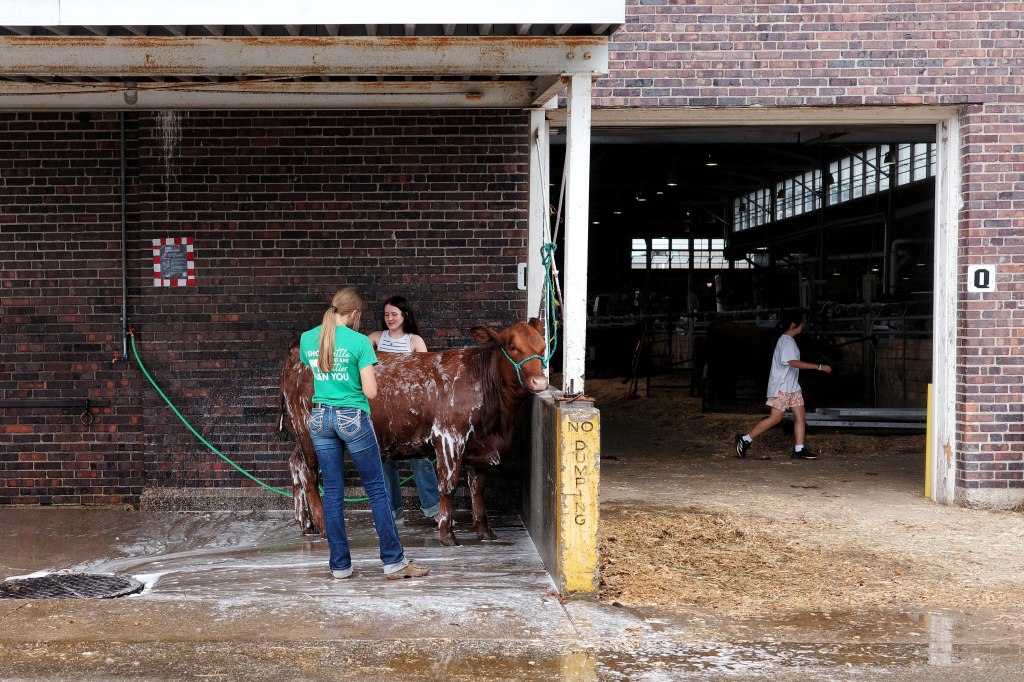
Cooperative cow-washing.

And when I say ‘cleaning their animals,’ I don’t mean they were just washing them (although there’s an astonishing amount of animal-washing going on all the time). I mean they’re shampooing them, blow-drying them, combing them, trimming them, vacuuming them.
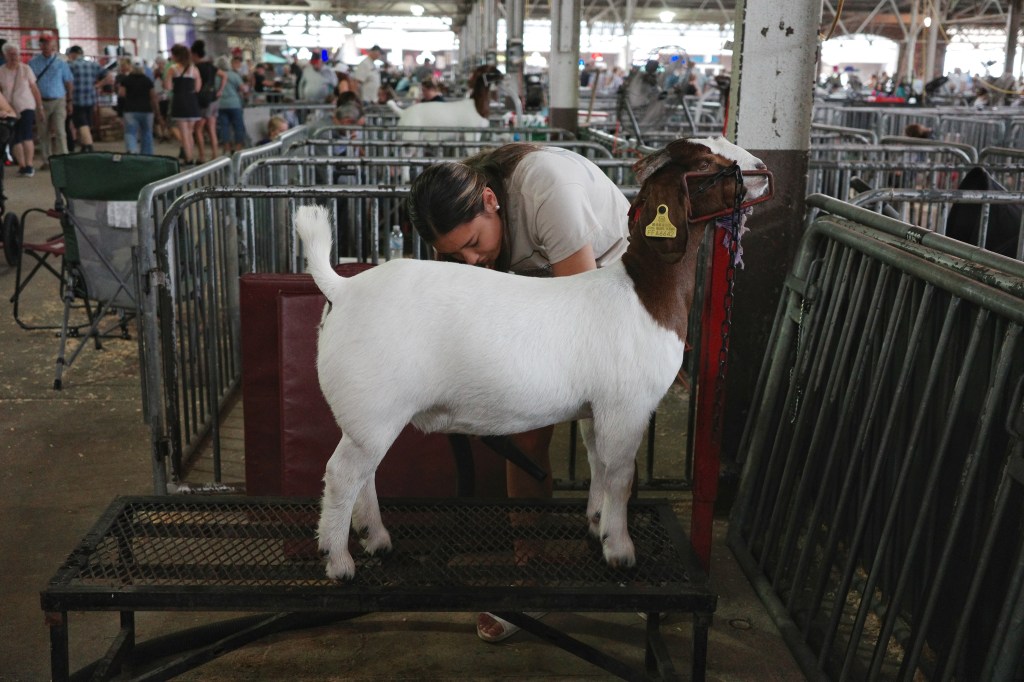
A little light goat-vacuuming.

Seriously, people were vacuuming off…something, I don’t know what. Loose hair? Dandruff? Barn grit? No idea, but everywhere you go in the animal barns at the fair, there are men and women and kids vacuuming their livestock.
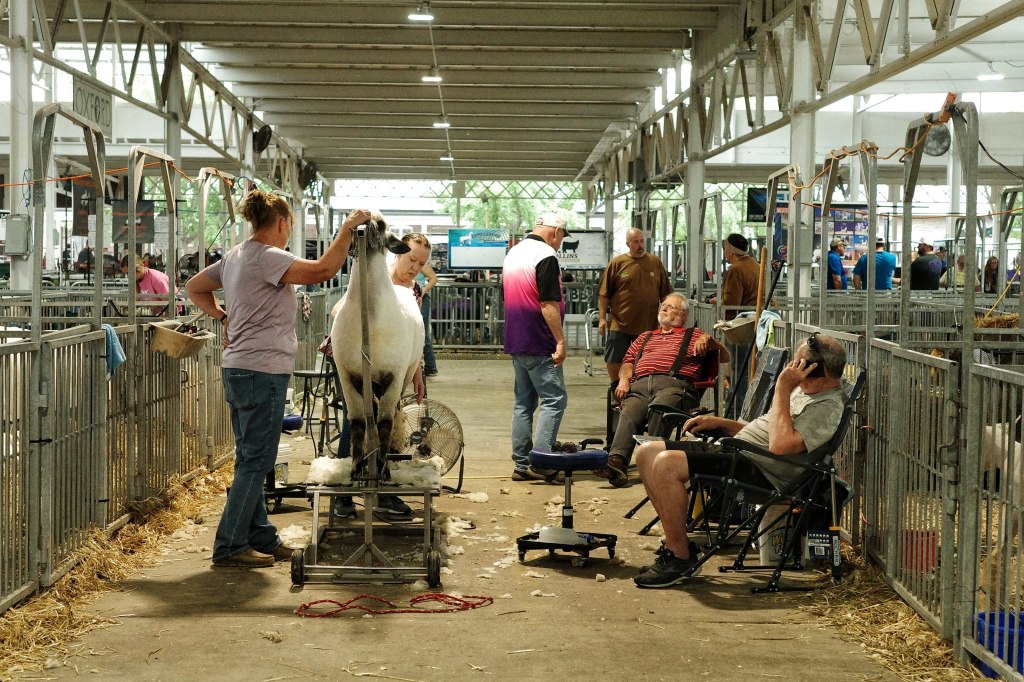
Women grooming sheep while men sit and chat.

These animals weren’t just being cleaned; they were being groomed. Meticulously groomed. (Okay, sorry, a slight tangent here. The term groom has a slightly hazy etymology. It’s probably(?) related to the Old English growan, meaning ‘to grow.’ At any rate, by the 14th century groom referred to a male servant who attended to officers (and their gear and horses) in a noble household. By the 19th century, the noun had been verbed, and groom referred to the process of tidying up or preparing for a purpose. So groom referred to both a person and what the person did. I don’t know why I thought you needed to know that, but there it is.)
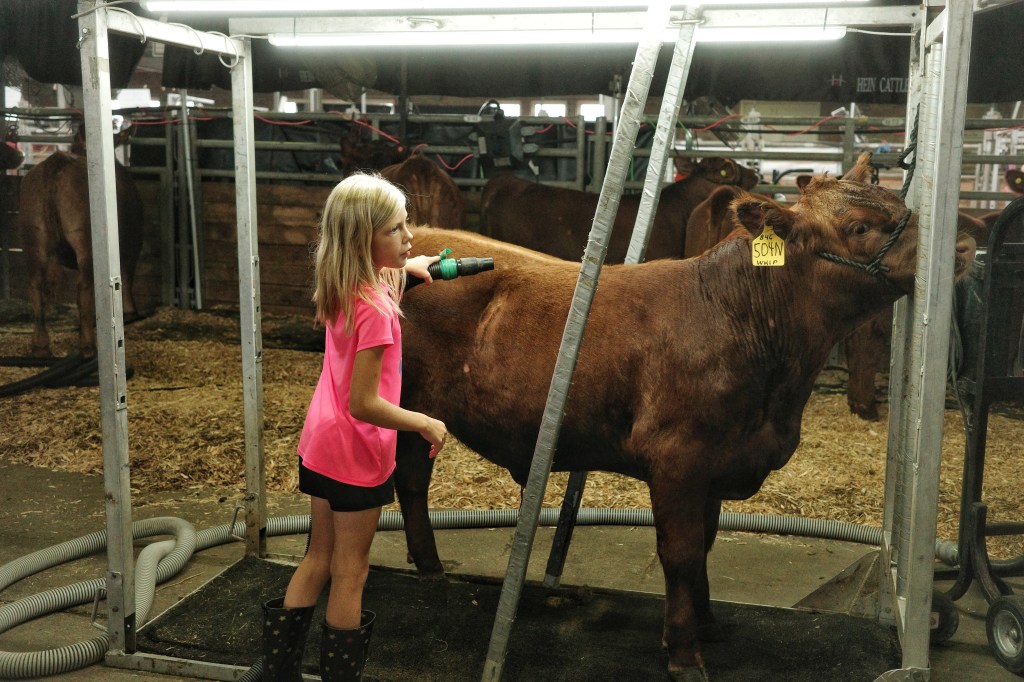
A young girl vacuuming (or blow-drying) a cow.

As I was saying, these livestock animals (and I’m talking about cows, horses, pigs, goats, sheep, llamas, alpacas (is that the plural of ‘alpaca’?), rabbits, and chickens (do rabbits and chickens count as livestock? No idea.) are meticulously groomed. It’s clear that some of the grooming is done in the hope of winning a prize, but it was also clear that much of it was done out of pride and affection. That was especially true of the younger people.
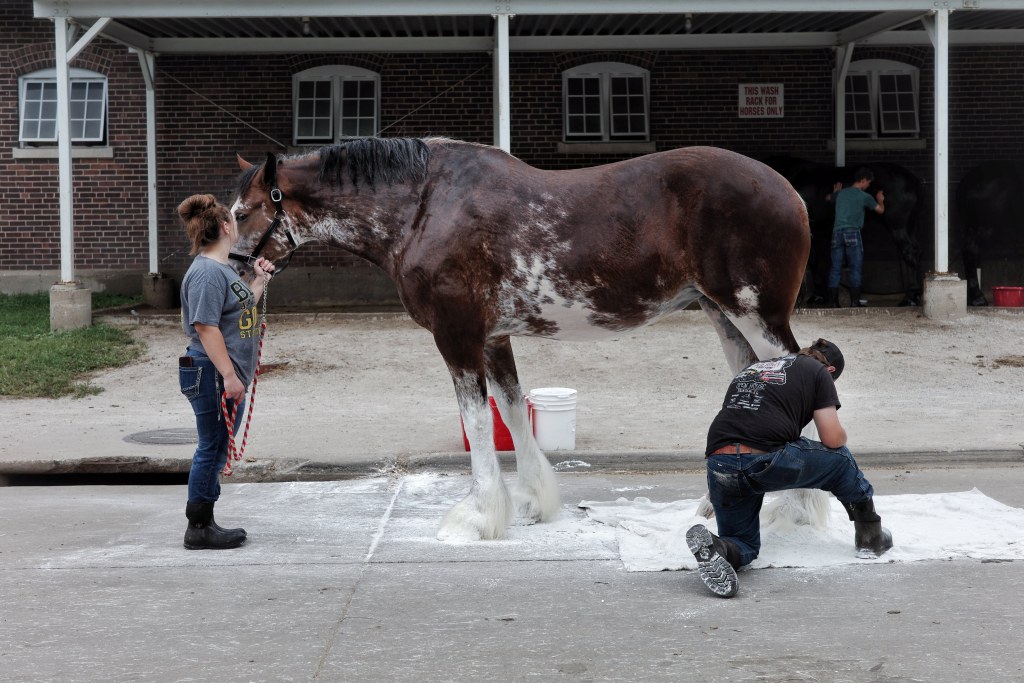
Equine pedicure.

Here’s a thing you probably need to understand. All this cleaning and grooming? It’s taking place in and around massive cooperative barns housing hundreds of animals. Animals are noisy, so these barns are a constant barrage of animal noises. Also? Animals shit and piss a lot. I mean, a LOT. And they’re not particular about where or when they do it. So even though there’s a constant stream (so to speak) of people shoveling, sweeping up, and carting of waste products (the logistics of livestock waste management must be staggering), the fact remains that these massive barns…well, they smell like you’d think they’d smell, but not as bad as you’d expect.
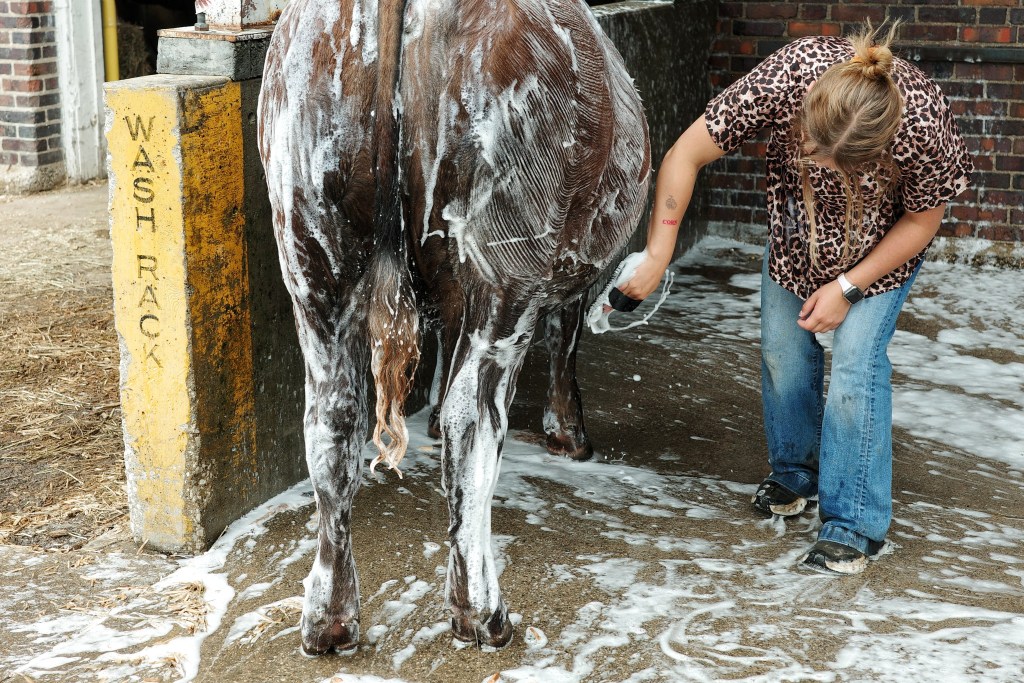
Bovine shampoo.

What I’m trying to say here is that there’s an astonishing amount of hard work done by the farm families who bring their livestock to the fair, and all that work makes the environment as pleasant as possible. One of my reasons for visiting the animal barns during the State Fair is to look at animals, of course, but it’s also to see this remarkable group of people cobble together a shared sense of community. There’s something very tribal about it. And as a sociologist by training, it’s fascinating.
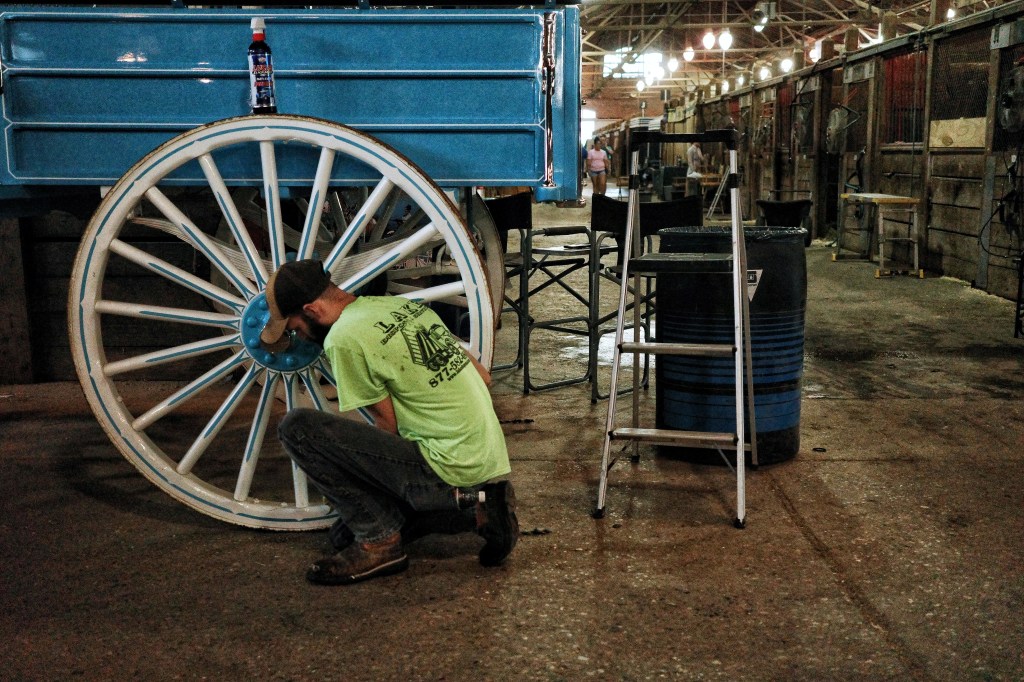
Detailing a wagon wheel.

But here’s the problem with being a sociologist: I know that the farming community I see at the State Fair is, largely, a myth. Around 40% of farms in Iowa are owned by corporations. Modern farming, even among non-corporate farms, is a business more than a self-sufficient way of life. The farming life we witness at the State Fair is something of a sentimental homage to an idea of rural living from the past. An homage grounded in nostalgia and an agrarian myth.

But so what? I’d argue there’s value in that. The fact is, it’s not corporations who are grooming their livestock at the State Fair. It’s not corporations who are hauling manure and polishing wagon wheels. It’s families doing that.

My visits to the State Fair animal barns always leave me impressed (and yes, a wee bit stunned by the smell and noise). I leave those barns profoundly grateful there are people–families–still willing to do the hard work of making sure the world gets fed. As myths go, this is a pretty damned good one, and I’m glad folks are keeping it alive.

the one thing everybody agreed on

Like a few million other folks, I showed up at the local No Kings protest. We were all there for the same fundamental reason: because Comrade Donald Trump and his cadre of Nazgûl have been merrily shitting on…well, everything that’s good and promising and hopeful and decent about the US.

Fuck Trump.

People are pissed off about SO MANY things Trump has done (and intends to do). The attacks on immigration, science, trans rights, healthcare, civil liberties, the environment, due process, Gaza (and Israel and Iran and and and), veteran’s benefits, free speech, the national debt, the January 6th pardons, everything about January 6th, the assault on education, the assault on libraries, the assault on the very concept of Truth.

No, really, fuck Trump.

But one thread tied all the anger and frustration and resentment together. A deep, abiding rage against Donald Trump as a person. Not only for the horrors he’s inflicted on the United States, but a profound loathing for him as an individual. As I wandered through the No Kings crowd, I kept seeing this same sentiment. Fuck Trump.

Also? Fuck Trump.

People really hate this motherfucker and they hate him personally. They hate him for what he’s done, they hate him for what he wants to do, and they hate for him who he is. Which, I suppose, is only fair, considering how many people he hates for who they are. Trump has a singular talent for both hating others and being hated.

Seriously, fuck that guy.

Why do people hate him so? Because he’s a liar, because he buried one of his many wives on a goddamn golf course, because he’s betrayed the United States, because he’s got truly godawful taste in everything, because he’s cheated on every wife he’s had, because he’s massively ignorant and unaware of it, because he’s a liar, because he’s fucked over every person and contractor he’s ever worked with, because he’s an unrepentant racist, because he hates women, because he loves autocrats, because he’s a liar, because he’s a coward, because he’s never owned a pet, because he’s a narcissist, because he pretends to support the military but believes they’re losers, because he’s a liar, because of his stupid fucking red hats, because he’s a phony, because he’s put incompetent people in positions of power, because he insults everybody who disagrees with him, because he’s a vindictive prick, because he’s a liar, because he’s rude, because of his stupid fucking hair, because he encourages his followers to be violent, because he hates immigrants but hires them to work for his resorts, because he’s shit all over the Arts, because he’s a liar, because he’s cruel and enjoys inflicting harm on others, because he pretends to be a Christian without having an inkling of Christian charity, because he’s a sex pest, because he’s committed many many crimes but has never been held accountable for any of them, because the people who like him are all massive assholes, because he’s a fucking liar.

And the horse he rode in on.

I’m sure I’ve skipped a few dozen other reasons why people hate him. But I think you get the point. People sincerely hate Trump.

But there was another guy at the No Kings event. Bearded guy, dressed all in black, sitting on a granite railing. He was wearing a T-shirt that said “Hate Will Never Win.” I hope he’s right. I genuinely hope hate won’t win. But I also hope the hatred against Donald Trump will get people to stand up for themselves and for others. I hope it will get people to push back against his authoritarianism. I hope it will get people to vote. I hope it will get people to hold Trump accountable for all (or at least some) of the horrible things he’s done to this country.

And then I hope we can let go of that hate.

small love story

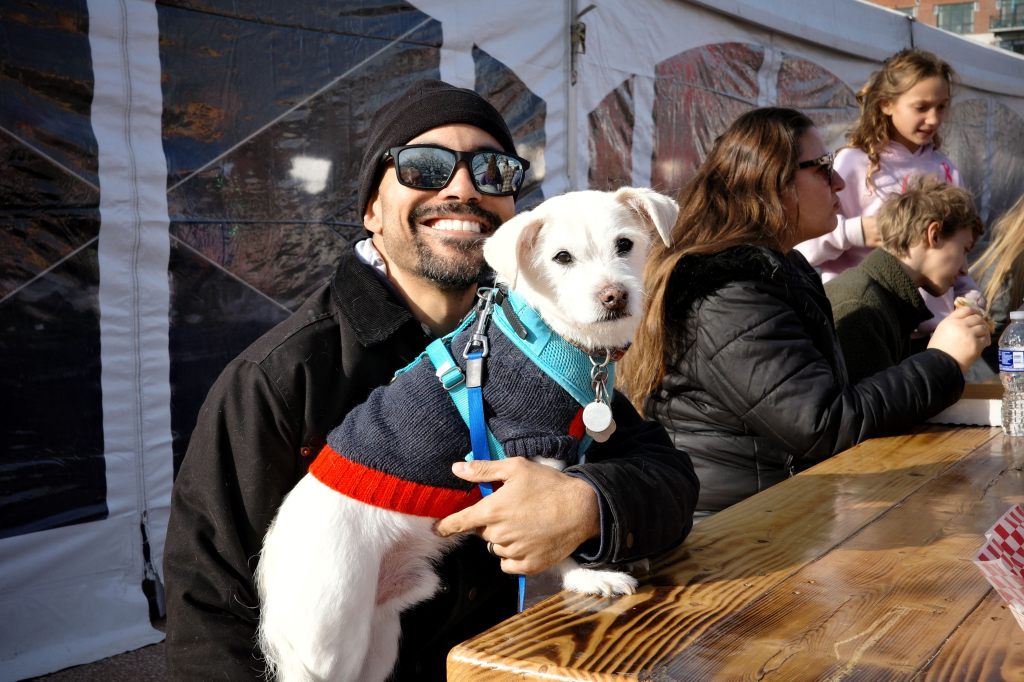
I’m at the Christkindlmarket and I see this guy and his dog sitting at a table. He’s holding the dog and the dog is leaning against him. I know it sounds ridiculous, but the moment I saw them I thought, “Madonna and child.” I blame all the Christmas stuff for that. I’m not a Christian, but I’m a fan of any holiday that’s (supposed to be) about love and sharing.

Anyway, I’ve got my little Ricoh GR3X in hand as I approach them, and the guy knows why I’m coming. I could see it on his face, the recognition that I wanted to photograph his dog. And it obviously pleased him. I barely got the words out…”Would you mind if I…?” before he said, “Sure.”

The dog, though, seemed a tad uncertain, so I slowed down. Instead of the close-up I’d intended, I stayed back a bit. Instead of shifting my position to isolate the guy and his dog from other people from the frame, I stayed still. Instead of shooting 3-4 frames, I took only one. I moved slowly to take the photo.

I said something like, “He’s a wee bit shy, isn’t he.” The guy said the dog was timid around other people, which is why he’d brought him to the Christkindlmarket and why he was holding him. He wanted the dog to feel safe and protected, but he also wanted him to get used to being around other people.

I didn’t even try to pet the dog, though I wanted to. I didn’t try to shoot more photos of them, though I very much wanted to. I figured the little guy was dealing with enough already.

In the end I said something like, “You’ve got yourself a little buddy.” He said, “I sure do.” And I walked away. But seeing them together lifted my spirits–which, given the world as it is today, was quite a feat. The obvious bond between them, the care the guy was taking with the dog, the trust the dog had in the guy — it was lovely, and I was weirdly proud of them both.

I could have taken a better photograph of them. They deserve a better photo. But it might have made the dog nervous, and no photo would be worth that.

colors, textures, and retirement-age train otaku

I’m not a train guy. Not a railroad guy. I mean, sure, I like trains and railroads. I appreciate their historical significance. I like to hear their whistles and see them rumbling along the tracks. I absolutely love the photographs of O. Winston Link. But if somebody asked me if I’d like to go spend a day looking at trains, I’d say…well, I’d say yes. Not because I’m a train guy, but because I’ll go look at just about anything.

And that’s exactly what I did recently. I agreed to go on a family/friend train excursion that included historic trains, a small train museum, and a dining experience in an old train that traversed some fields and woods and a ridiculously narrow bridge over a rather high river valley. It wasn’t something I’d have chosen on my own, but I’m really glad I agreed. (Pro-tip: always agree to do almost everything, because you never know.) It was fun and, of course, I took a few photos.

I’d expected to enjoy the train ride, and I did. There was a period of time when I lived on the East coast and I frequently traveled by train–Boston, New York City, Washington, DC, Norfolk. I always enjoyed it. But there’s a radical difference between (what in the US passes for) ‘modern’ train travel and an historical train. The engine that pulled our dining cars wasn’t a steam engine or anything, but it was old and slow and pleasantly lazy. Which was just as well, since the tracks were also old and the train swayed a LOT more than any train I’d ever been on. Hell, at times it swayed more than a lot of boats I’ve been on. You don’t want a lot of swaying when you’re on a high trestle bridge over a river valley. Still, it was fun and the food was surprisingly good.

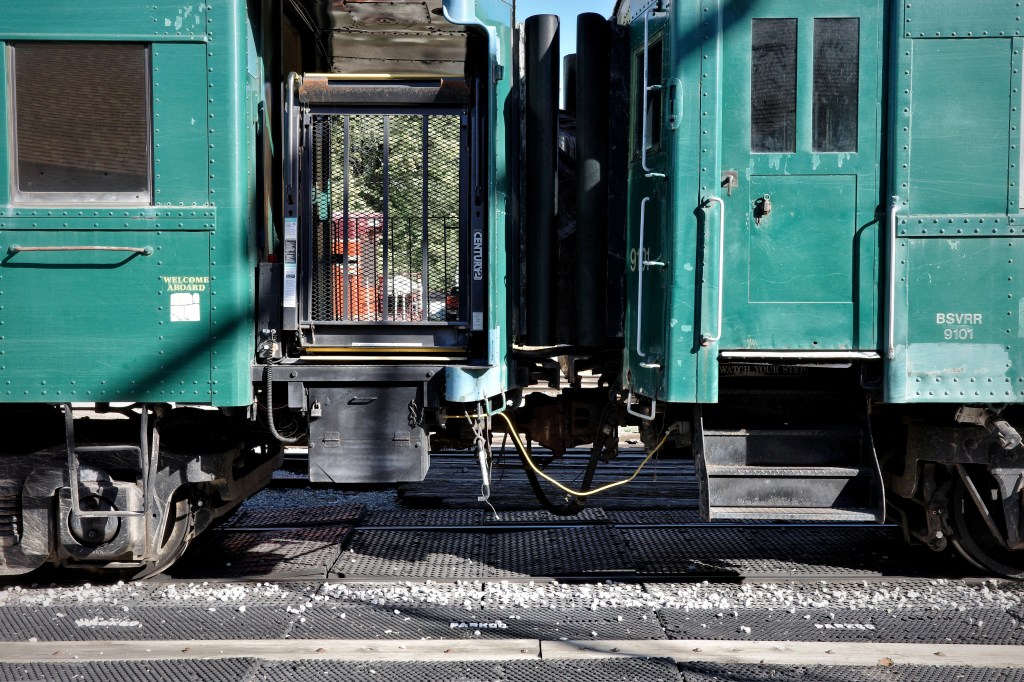
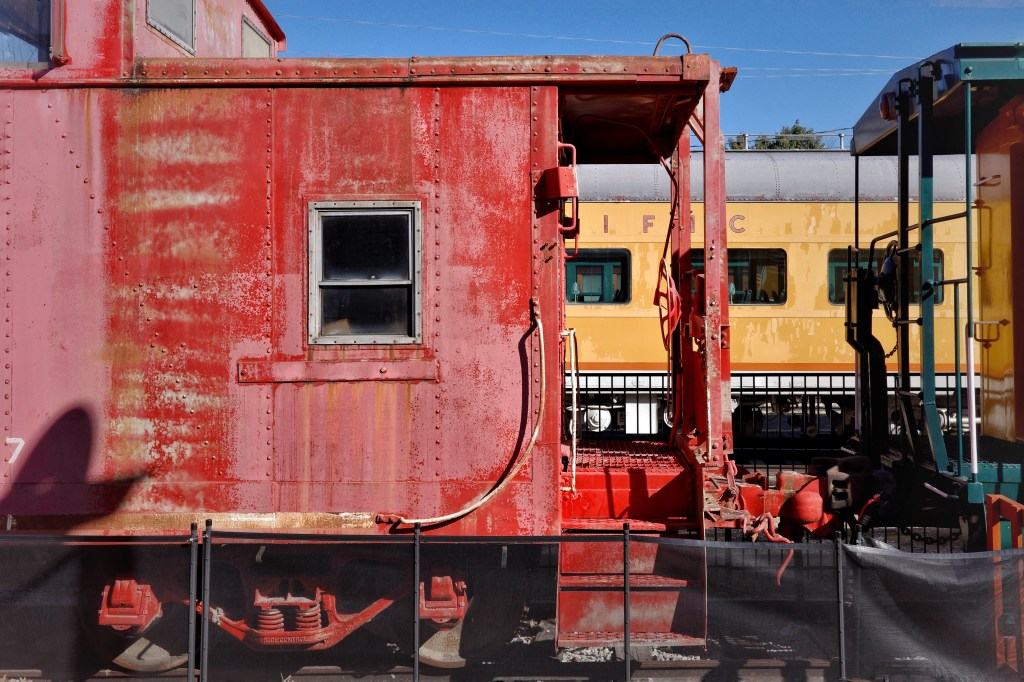
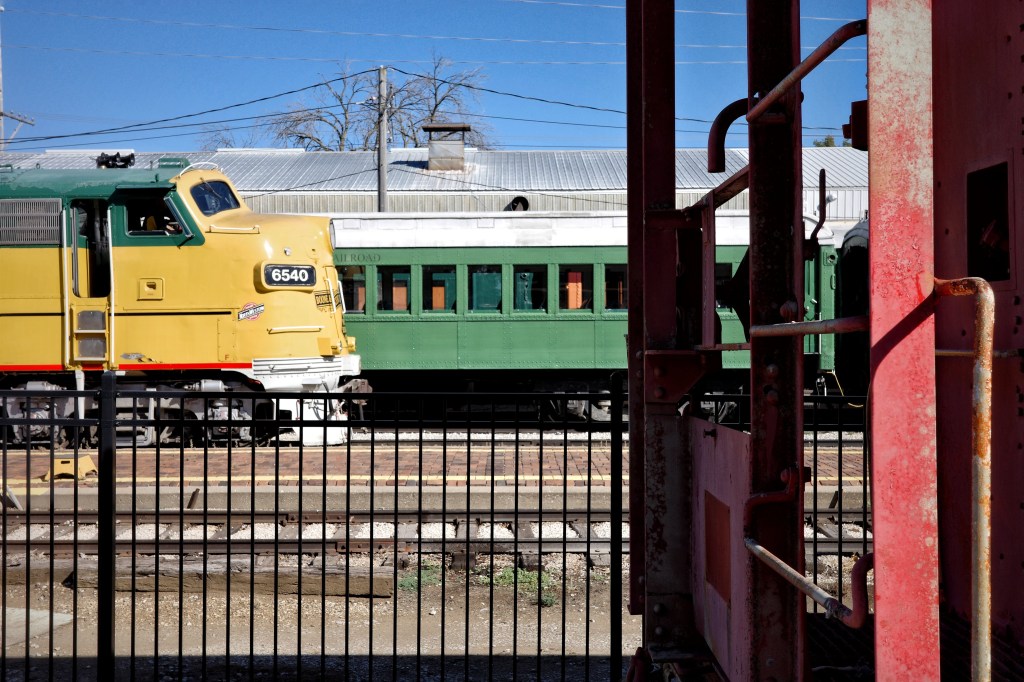
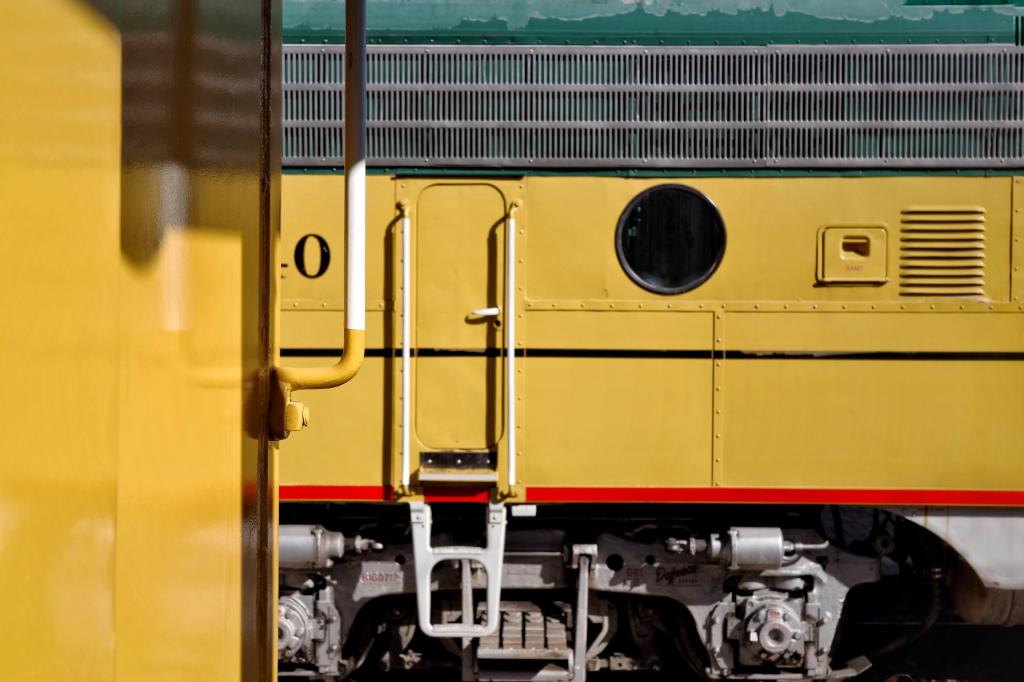
But the train ride and the meal were, for me, secondary. Hell, they were tertiary. I could have spent the entire day noodling around the train yard, looking at stuff I didn’t understand and appreciating it. BIG blocks of color. Gobs of dark, sexy shadow. Weirdly-shaped mechanical bits and bobs. And who knew trains had so many ladders? Everywhere you look, there’s a ladder. And different shapes of ladders, at that.

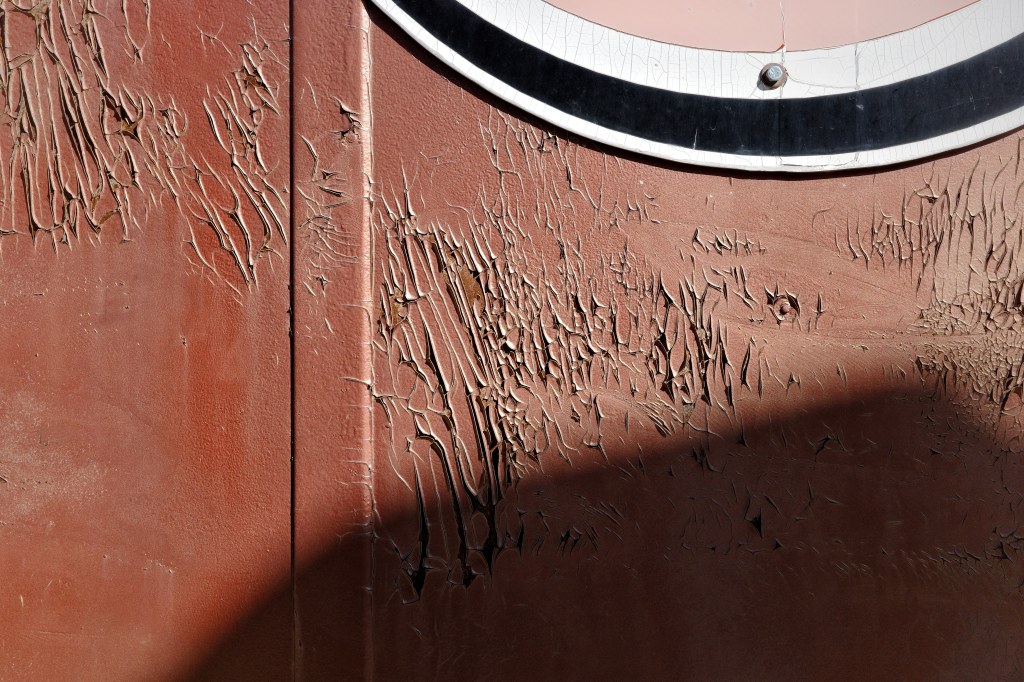
I hadn’t anticipated being fascinated by the shapes and forms, particularly of the works of the undercarriage (if that’s what it’s called). Everything was so massively sturdy. And I was completely captivated by the colors–the sun-faded greens, the bright yellows and oranges, the weathered reds and russet browns of the cars. I could have spent an hour just looking at the variety of textures and photographing the industrial weirdness of the undercarriage.

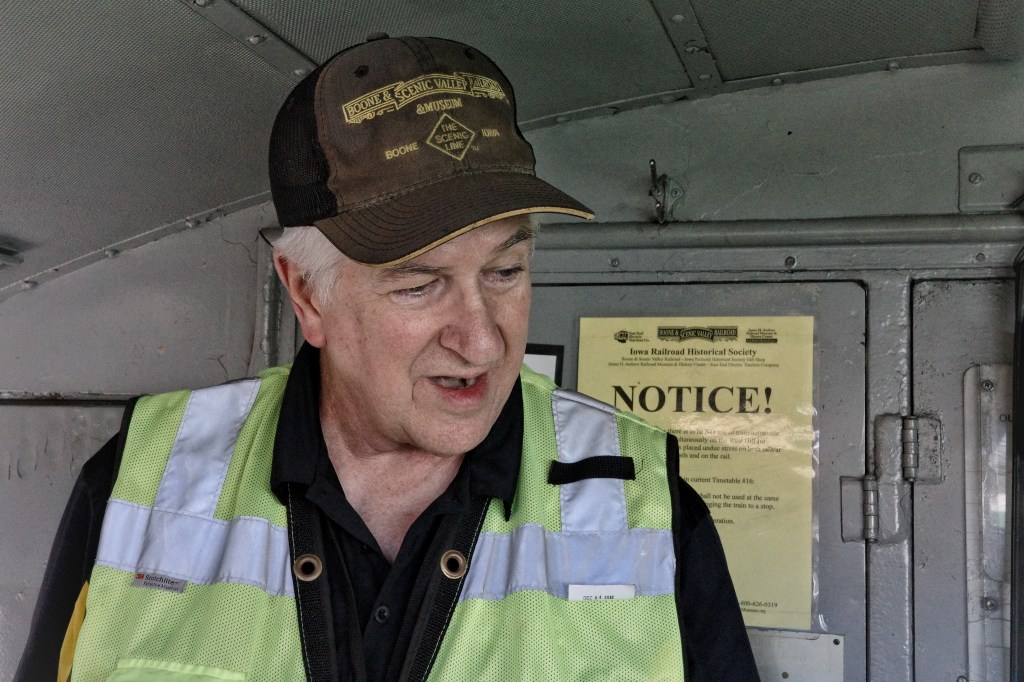
For once, I was more interested in the stuff than in the people, and I rather regret that because when I took a moment to actually talk with the people they were…well, I guess you could call them retirement-age train otaku. They were obsessive, but reserved until encouraged. One guy, with minimal encouragement, agreed to let my brother and I climb up an exterior ladder into the engineer’s cockpit (if that’s what it’s called). I don’t think it was actually prohibited, but it was certainly not part of the routine. Once we got up there, he explained how the engine, which had been built in 1958, had been retired from some Canadian railroad. He rattled off the specifications of the engine, and where it fit in the evolution of train engines. I suspect he’d have told us the entire life history of that particular engine, but folks were waiting for us and we had to leave.

I actually regretted leaving the train yard. But not everybody shares my interest in weathered paint and arcane mechanical whatsits, so I left without complaint. Now I find myself with a metric ton of train-related photographs, and while I’m hesitant to impose them on the unsuspecting Intertubes, I’m afraid you’re going to see more train stuff on my social media. Of course, I won’t be able to identify what’s IN the photos. You’ll have to find a retirement-age train otaku for that.

i still talk to strangers

I wrote a piece back in April of 2023 about my habit of talking to strangers. Here’s a somewhat concise summary of the point of that post.

I like talking to strangers. I like meeting new people and learning something about them. Granted, most of my conversations with strangers are casually superficial, so it’s not like I’m learning anything important or meaningful about them or their lives. But the simple fact of meeting and having an idle conversation with random strangers tells me something about humanity in general.

And this is what I’ve learned: most people are pretty much okay.

That’s still true. Most people really are pretty much okay. A few days ago I found myself in Perry, Iowa, a small town of about 8,000 people. As my companion and I walked down the street, we saw a guy get out of a pickup truck, carrying a couple of small jars. One of which looked like homemade pickles.

I kind of leaned forward and grinned at the jar of pickles…and he stopped. He was delivering the pickles and some homemade cherry jelly to a couple of friends in a nearby shop. I asked if he sold his homemade goods, and he said, “No, I just give them to friends.” He asked, in a very kindly but curious say, what we were doing in Perry. I told him we were just walking around, looking at the town and its architecture, shooting photos.

He started talking about the town—how it had changed over the years, how it had fallen on hard times, and he started to get a bit emotional. I said something vague about how it was clear that he loved his town, and that sort of love was a wonderful thing. Then he left to deliver his goods.

We walked on. I stopped to take a few photos. And then the guy came trotting up to us. The friend who was to get the cherry jelly wasn’t in the shop, so he thought we might like it. This stranger, just because we’d chatted with him for a bit, wanted to share his jelly with us.

Randy Kennedy and a jar of cherry jelly.

Randy Kennedy. He’d lived in Perry most of his life, and he walked with us down the street, giving us a history of almost every building and the people/families who lived/worked in them. The old shoe store owned by Greek immigrants, whose son was a hero in the Second World War. The French woman who ran a small diner/sandwich shop, and the various sandwiches she made, and how he and his friends would tap on a window and she’d sell them sandwiches through the window. The florist whose shop always smelled so nice. The building where the local newspaper had been printed and how he and his brother had been paperboys and they’d gather at “that door right there” and collect their papers, and how he was sometimes late in getting his deliveries made because he’d stop and get a slice of pie at another shop. He told us about two taverns with doors on opposite sides of an alley, one for hippies and one for farm folks, and how they’d drink together and argue politics in the 1970s.

As we walked and talked, other locals would drive by or ride by on bikes, and many of them would call out to Randy, and he’d wave back. He walked with us for maybe thirty minutes, telling us stories about how wonderful the town was, and how it was failing now, and how MAGA had created deep rifts in the community. He talked about the way the town felt increasingly divided, and had become less tolerant. He talked about the local pork producing plant that closed six months earlier, putting 800 people out of work. Eight hundred, out of a population of eight thousand.

He didn’t mention the school shooting that happened in January, leaving an 11-year-old boy and the school’s principal dead, and seven others wounded. Some things were apparently still too raw to talk about. But most of the shops—even the ones that were closed and empty—kept ‘Perry Strong’ posters in their windows, maybe claiming more resilience than the town actually has. Maybe hoping resilience would hold the town up long enough for some good news.

This guy loved his small town and was proud of what it had been and mourning what it had become. He was pessimistic about the future, but desperately hoped he was wrong. His love for the town was heartbreaking. He was sad, but said he was okay. That’s when I asked if I could take his photograph, holding the jelly he’d give us.

Like I said in my earlier post, most people are pretty much okay. In a lot of ways, being okay can be seen as a victory. Randy Kennedy may look a wee bit sad in this photo; he has good reason to be. And yet he’s basically okay. The proof of that is that he chased a couple of strangers down the street just to give us some cherry jelly that he’d made himself.

I talk to strangers. I will always talk to strangers. And this morning, I had cherry jelly on my toast.

a pagan half hour

We’re living through the early stages of a climate change nightmare right now. Persistent heat domes with dangerously high temperatures, torrential rainstorms, exceptionally powerful hurricanes forming earlier than usual, drought-based wildfires whipped into firestorms by freakishly high winds, stronger than usual tornadoes that stay on the ground longer, thousand-year floods every couple of years leading to dams collapsing.

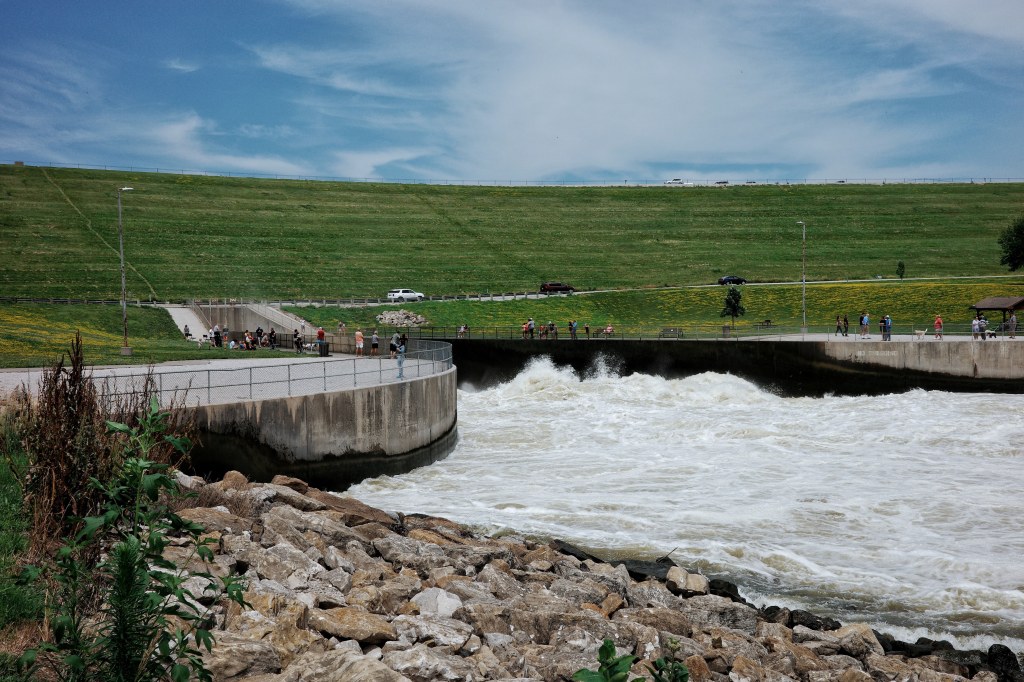
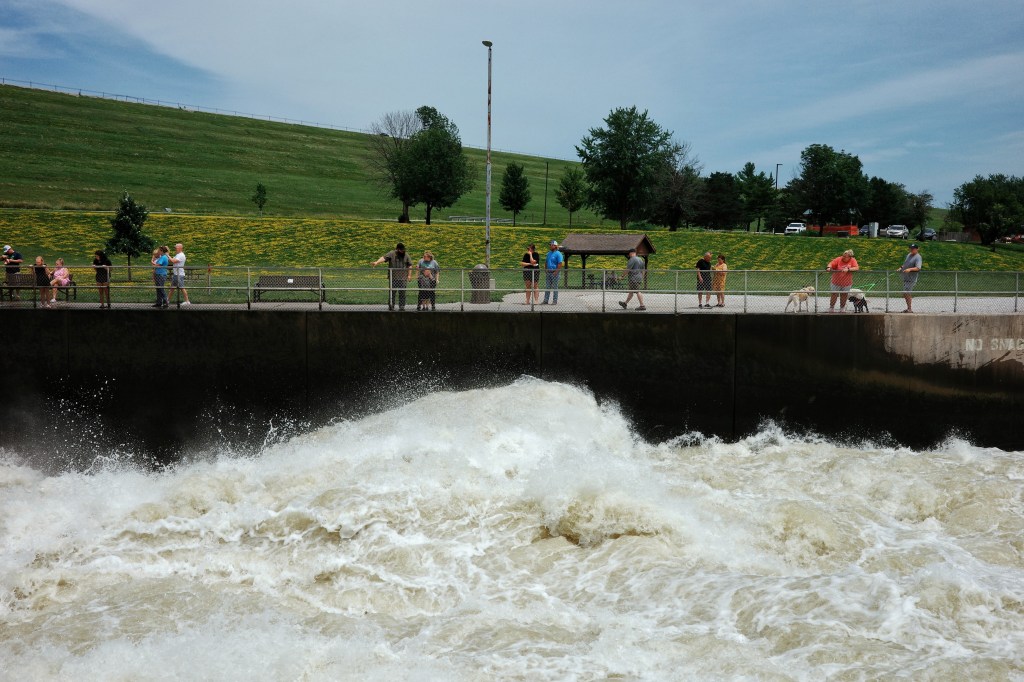
Because of the exceptional rainstorms, the Des Moines River is currently 20-22 feet higher than normal–not quite at actual flood levels (which, I believe, is 24 feet). A visit to the dam which creates Saylorville Lake yesterday was compelling. The 6000 acre lake has risen almost two feet in the last 24 hours; the spillway was releasing over 16,000 cubic feet of water every second — that’s 190% of its normal release. It was loud and furious and utterly fascinating to see.

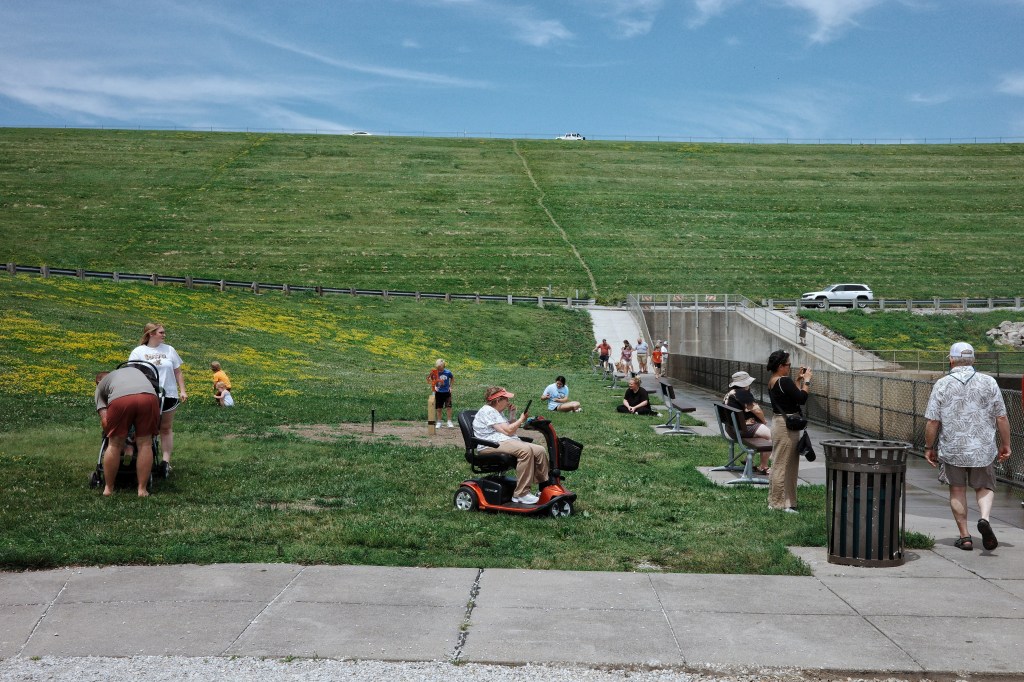
View of the spillway from the parking area

People showed up to see it. Young people, old people, families with kids and dogs, couples, people on their own — a constant low-volume parade of people just to take a look at the chaos of the spillway. Just a few dozen at a time. Most of them would slowly approach the fence guarding the spillway, gawk a bit, gradually move closer to the release point at the bottom of the dam. The turbulent water was mostly unpredictable, and would splash people unexpectedly. Most laughed and ran away from the fence. A few got irrationally angry, as though the water had played some sort of trick on them.

The dam and the spillway

That large solid hill behind the spillway? That’s actually the dam holding back the Saylorville Lake. On other side, the water level is probably 30-35 feet higher. There’s a second, emergency spillway (not pictured in any of these photos) in the dam. The water level in the lake is expected to peak in a couple of days, and (it’s hoped) will remain a couple of feet below the emergency spillway.

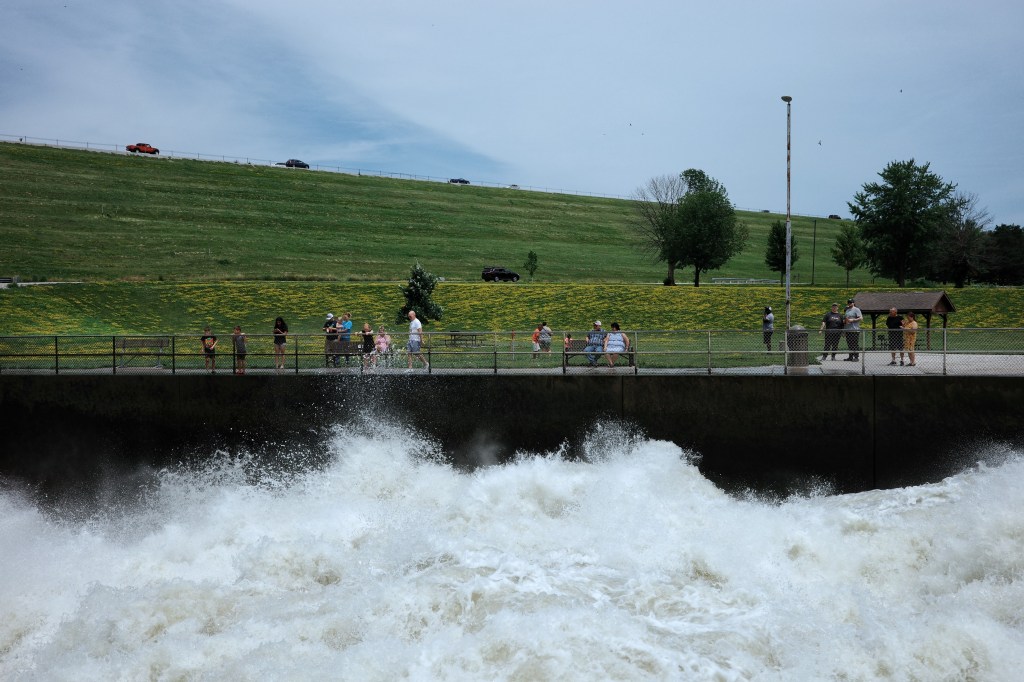
Visitors on the other side of the spillway

“If you fell in there, you’d die.” I can’t tell you how many people I heard say that. They’d stand at the fence, look at the raging water cascading out of the spillway, shake their heads, and say it in an awestruck voice. They often repeated themselves. “Wouldn’t have a prayer, if you fell in there. Nothing you could do. Nothing anybody could do. Find your body somewhere downstream.”

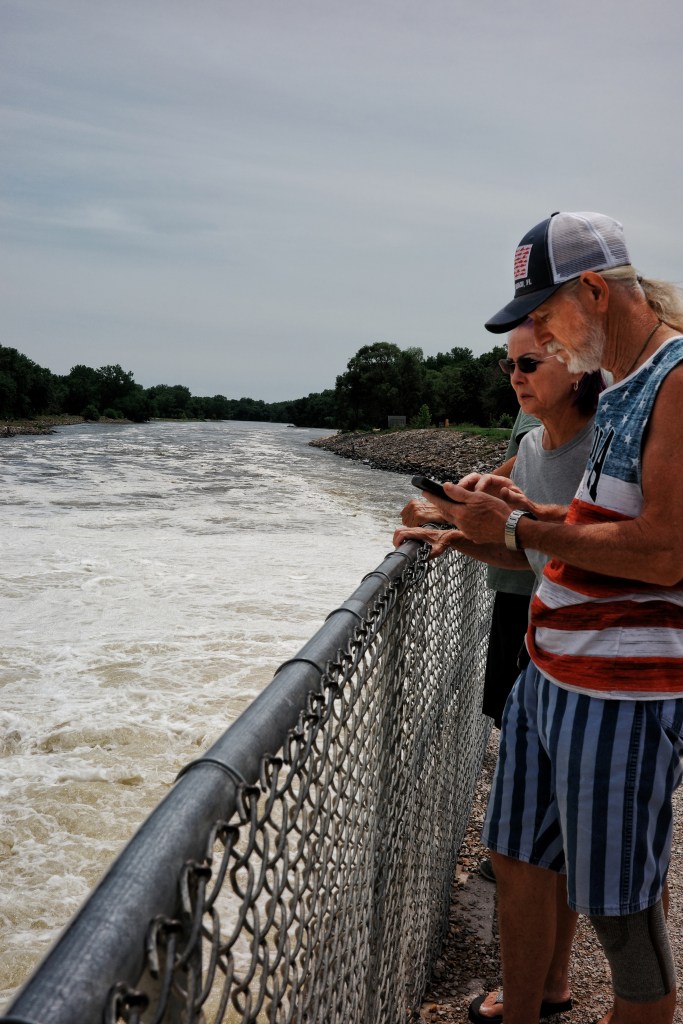
Everybody was a photographer at the spillway

Normally, the only people you’d see at the spillway were fishing. It’s a popular fishing spot; apparently it’s one of the few places you can catch eight to ten different fish species along a single short stretch of the river. Under normal conditions, that also makes it a popular spot for birds — pelicans, cormorants, gulls and terns, eagles. I didn’t see any birds even approach the spillway yesterday. Birds have too much sense for that.

A road runs along the top of the dam.

There was something almost pagan about the experience. Not pagan in a religious sense (since ‘paganism’ is just a term early Christians applied to any pre-Christian belief system), but in the sense of common people making a sort of pilgrimage to witness, awestruck, the beauty and savagery of nature, to experience their own smallness in the world. I doubt many of the people at the spillway thought of it in those terms, but it was there. The awareness of a natural power beyond our control and our understanding.

We were only there for a half hour or so. It seemed like longer, but time gets weird in the presence of the old gods.

Editorial Note: I was informed about this fishing video that shows the spillway under ordinary conditions. You don’t have to watch the entire thing; the opening seconds will give you a sense of what it’s normally like at the spillway.

new camera…and lawdy

A few months ago–October/November of last year–I got sucked back into the Cameraverse. I’d pretty much abandoned cameras (cameras, not photography) in favor of my phone. My phone was convenient, did a fine job, and had the massive advantage of always being with me. But my hands began to miss the feel of a camera in them.

That’s only partly a metaphor. Shooting with a phone and shooting with a camera are two very different tactile experiences. I felt a strong desire to pick up an actual, no-shit, physical camera and go shoot photos. I resurrected my 12-year-old Fujifilm X10 because it was 1) a real camera and 2) it was small. I flirted a bit with another larger Fujifilm camera, but it soon became clear to me that, for a variety of reasons, I don’t enjoy larger cameras.

With a new camera, you photograph whatever is at hand.

So I began to noodle around the InterTubes to see what was out there in the Small Camera World. That introduced me to the Cult of Ricoh. I DO NOT do cults. I resist cults. Cults are bullshit. But after enough exposure to the Ricoh GR3 series, I was ready to shave my head, shake a tambourine, and buy one of the wee bastards. Except I couldn’t find one. Seriously. The problem is/was the Ricoh GR3 series is so popular, they’re on continuous back-order everywhere.

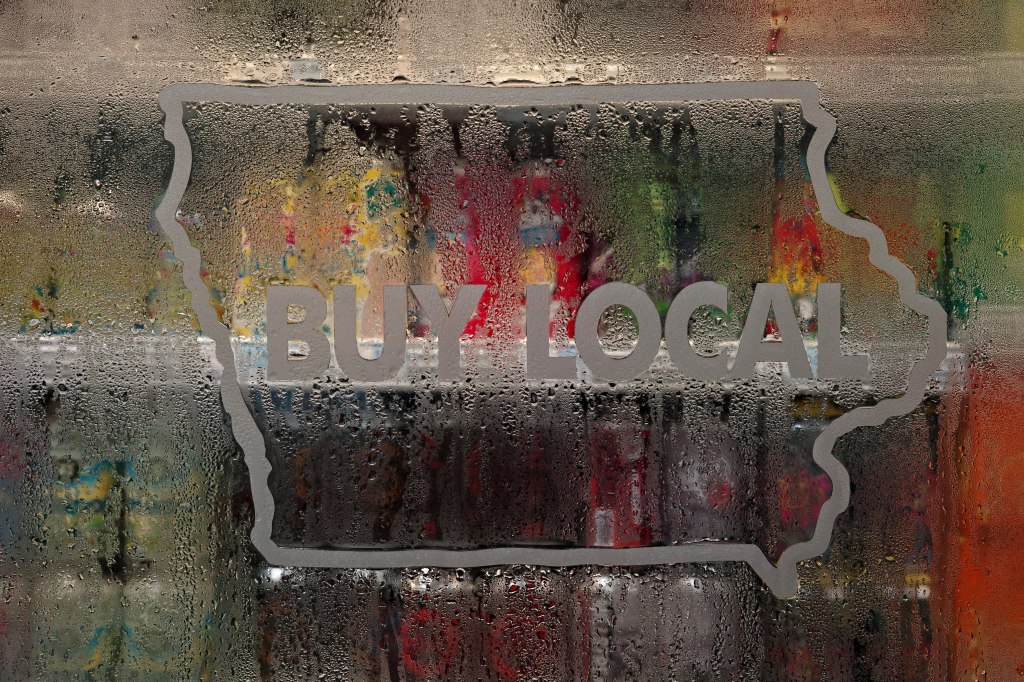
Buy Local

Persistence paid off, and four days ago I was able to unbox a brand new Ricoh GR3x. Here are three inescapable things about the Ricoh GR3 series: 1) They’re small. Really small. I kept hearing them described as ‘pocketable,’ which I assumed was bullshit. It’s not. You can actually tote the thing around in your pants pocket. Regular pants, not baggy cargo pants. I’ve no idea where women carry them, since fashion Nazis have deprived women of real pockets, but lawdy, the camera is small. 2) They’re quick. That photo above? Six seconds. Saw the condensation on the refrigerated beer door, pulled the camera out of my pants pocket, composed and shot the photo with one hand, put the camera back in my pocket. Six fucking seconds. It’s not a great photo, but lawdy. I felt like a gunslinger. 3) They’re easily customizable, if that’s a word. Almost every button on the camera (most of which are accessible when shooting with one hand) can be assigned almost any function. Which won’t mean much to anybody who isn’t a photographer, but trust me, that’s a HUGE deal.

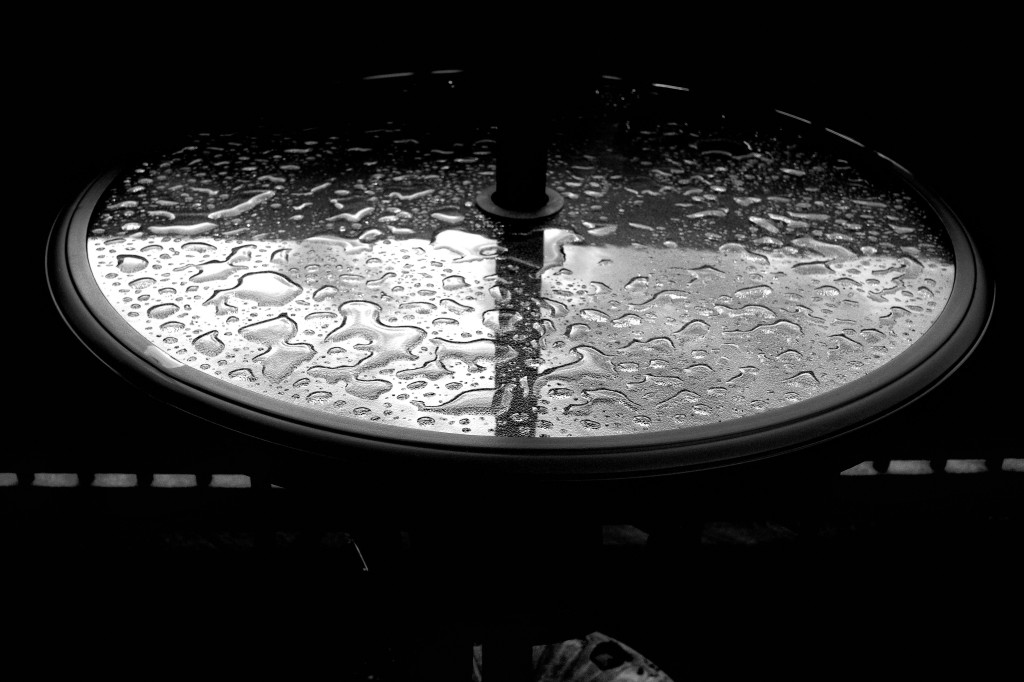
High contrast monochrome — water on a table.

It allows you to experiment. Hell, it almost demands you experiment. During a break in the rain on my first day I shot the photo above. It’s just rainwater organizing itself on a glass-topped patio table, but it has me thinking of a possible new Knuckles Dobrovic project–something about water in its various forms (as a liquid, as a solid, as a vapor, etc) done in high contrast black-and-white. I’ve no idea if it’s a viable project, or if I’ll follow through on it, but the thing is this camera has me thinking about projects again.

The problem? The learning curve. Oh, you can take decent photos almost immediately (as you can see here). But there are SO MANY ways to set up the camera to be responsive to your individual needs/wants, that I expect it’ll take me a couple of months of experimentation. Messing about with different set-ups, trying new ways of arranging things, establishing different photographic profiles for different subjects.

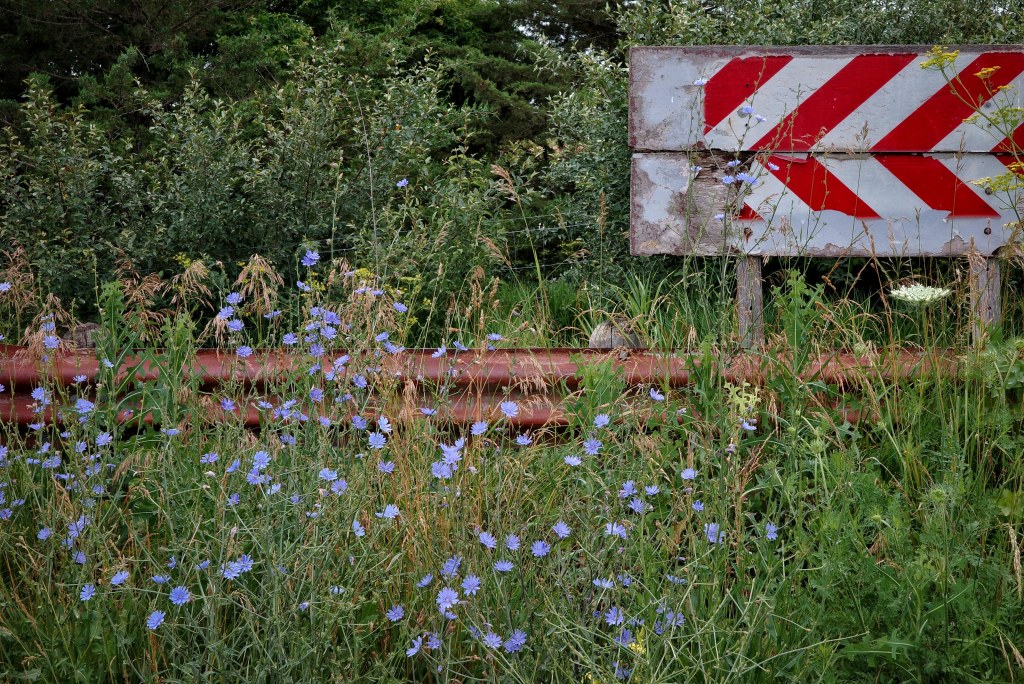
Chicory

Of the four days I’ve had the camera, two were rainy and stormy, one was savagely hot under a Gibsonesque dead channel sky. A bit of sunshine…even the teensiest bit, nicking through the gloomy clouds…would have done wonders for the photo above. The blue of the chicory was so lovely. But you get what you get.

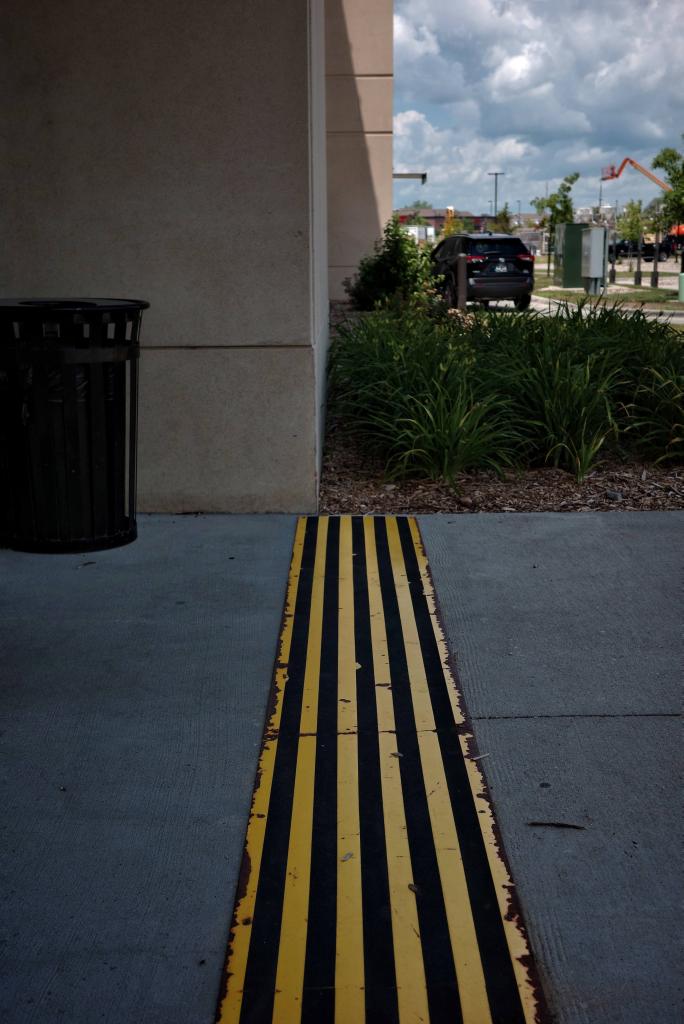
This camera will, I think, allow me to take advantage of what I get. Yesterday what I got was yellow stripes outside the library exit. I hesitated for just a few seconds, one hand full with a heavy book, the other allowed me to dig the Ricoh out of my pocket, shoot this quickly, and be on my way. (And here’s another thing: I almost never shoot in portrait format, but there’s something about the ergonomics of the GR3 that makes you want to shoot that way. I don’t understand it, but there it is.)

Stopped by the library, shot a photo.

I’ve shot a total of 48 photos in these four days. Forty-eight photos, and I think I’m in love. Because this is the first camera that feels like it was designed to shoot the way I see. It’s unobtrusive, it’s fast, it’s easy to shoot with one hand AND at the same time it gives you a LOT of almost immediate control over how the photo will look. All of the elements of exposure–ISO, shutter speed, aperture–all right there for your thumb and index finger. It’s perfect for shooting fast and loose and from the hip. That’s why this camera is a favorite of street shooters.

But that’s not me. I’m not a spray & pray shooter; I tend to compose a photo quickly, but deliberately. I think this wee bugger will give me some of the speed of a street shooter while still letting me make important exposure decisions. It’ll take me a while to get proficient with it, but lawdy.

And I’ll just say it again. Lawdy.

photolosophy

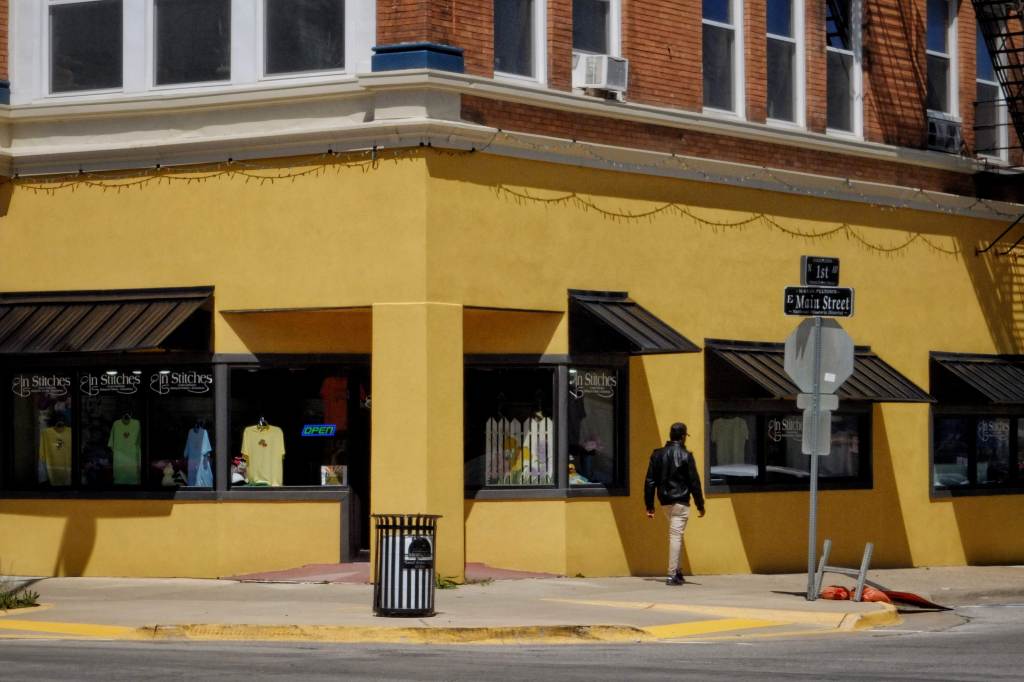
Life is unfair and full of disappointment. Here’s me, with my wee Fujifilm X10 in hand, walking down the street, spotting a mustard-colored corner building. And oh lawdy, there are two women walking down the sidewalk toward that building, one of whom was wearing a shiny blue jacket that would look amazing against that mustard wall. All I had to do was stop, wait for them to be in front of the building, and squeeze off a couple of shots.

But no. They stop before they get there, climb into a parked car, and drive off. So I have to settle for some random guy in a black leather jacket and khaki pants. And if that’s not bad enough, when he reaches the right point for the photo, he’s badly out of step. I shot the photo, but c’mon…it’s like these people have no aesthetic sensibilities at all.

Seriously, would it have killed him to step off with his other foot?

But then I notice there’s a fire escape on one side of the building, casting an absolutely delicious shadow on the mustard-colored wall. But some asshole has (and I assume this was done deliberately) parked a dull white block of an SUV right beneath the shadow, completely ruining the visual. Imagine somebody sticking a big wad of gum or an old bandaid over the woman in Hopper’s ‘New York Office, 1962‘ and you’ll get the idea. I couldn’t bring myself to shoot the photo.

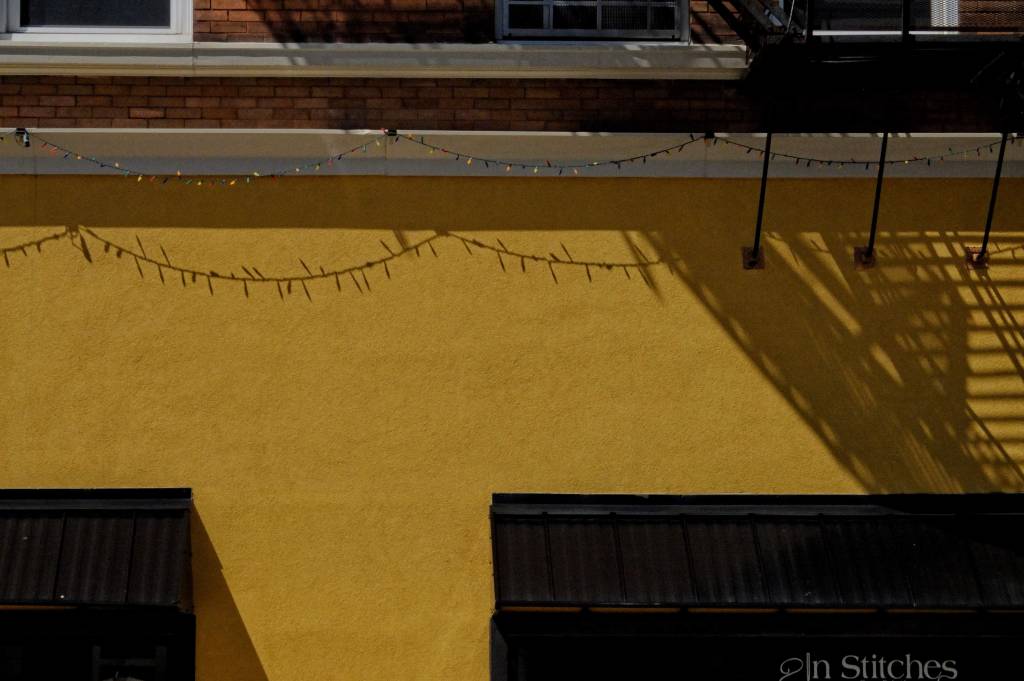
Happily, there was a nice detail worth photographing. The shadow of a string of holiday lights made a nice filigree in an abstract block of color and darkness. It’s not entirely satisfying; it’s like eating croutons that have no garlic. Better than nothing.

It’s got the crunch, but lacks flavor.

But I’ve been told patience is my only redeeming quality (seriously, a million years ago when I was in middle school, in trouble again, having waited in an uncomfortable chair for a long chunk of time for the Boys Advisor to lecture and chastise me for some offense, I was told that patience was my only redeeming quality…and I’ve clung to that one quality ever since), so I decided to wander off and return later when the offending SUV would be gone.

And that’s what I did. I kept walking and shot a few more photos, including this bizarre doorway of a shop that had gone out of business and was blocked by a Port-a-Potty. There’s a sort of warped genius at work there.

Somebody thought, “We’ve got a doorway, we’ve got a port-a-potty, let’s put them together.”

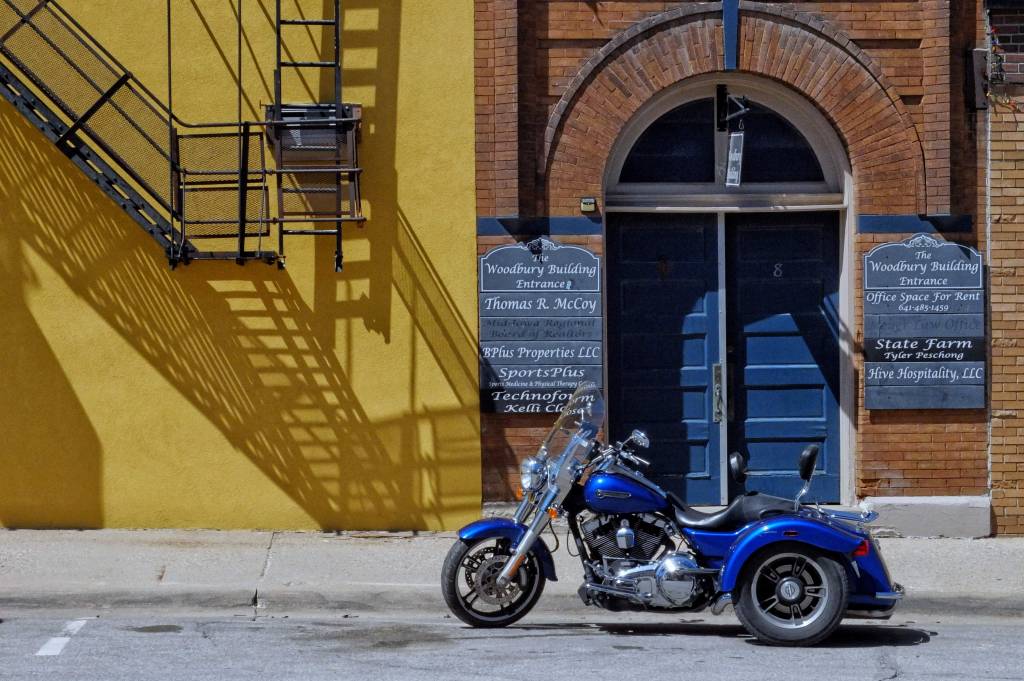
And when I eventually returned to the mustard-colored building? The goddamned white SUV was still there. Not only that, somebody had parked a blue trike motorcycle in the adjoining parking space. I tried not to take it personally, but it hurt. I don’t know what’s wrong with these people. I still couldn’t stomach the idea of photographing that appalling SUV, but I could swallow the blue trike. It allowed me to get a bit of that glorious fire escape shadow. And there was a blue doorway behind the trike, and a rather nice arch overhead, both of which mitigated the offence. Well, somewhat mitigated it.

Okay, but at least I spared you the goddamn SUV.

Life is unfair and full of disappointment. But in a world of white SUVs, there’s also mustard-colored corner shops and doorways blocked by Port-a-Potties. There’s always going to be something around the corner…and you never know what it’s going to be. That’s why we walk around with a camera, right? It’s the philosophy of photogr…ooh. Photolosophy.

Okay. I like that. I’m almost certainly not the first person to come up with that term, but I’m not going to Google it. Not Googling is part of my photolosophy.

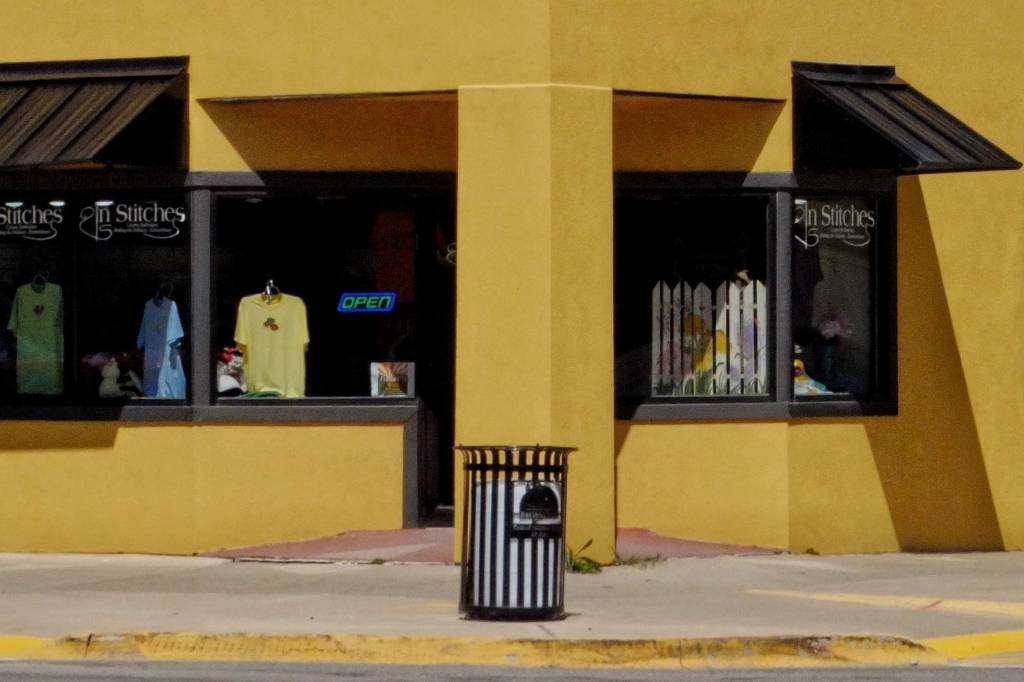
Addendum: MDavis commented on the “crisp striping on the trash can in the first photo.” I also found that appealing. Unfortunately, as I noted in my reply, the hurried photo I shot didn’t quite come together. The elements are all there, but it just doesn’t have any harmony. Still, here it is: