one fact we know for certain

A couple weeks ago I wrote a brief piece reminding folks about the presumption of innocence, and how it has to be applied to everybody–including George Zimmerman, the man who shot and killed Trayvon Martin. I also noted that the way the Florida law is written, it probably doesn’t matter legally that Zimmerman almost certainly provoked the incident that allowed him to shoot and kill Martin. The sad fact is that the law in Florida is almost designed to create situations in which lethal force can be legally used.

(photograph by PressTV)

A few hundred people read that. Not a lot by internet standards, but enough to spark a bit of a fuss–including a comment by somebody named Jonathan Ledlester (his complete comment can be seen in the original post). Ledlester begins his comment with this:

Crayon Martin caused his own death.

You almost don’t have to read any farther to know what direction the comment will take. It’s all right there–the sneering, the dismissiveness, the need to justify, the need to find a way to interpret or invent facts to fit a worldview. The simple refusal to use the dead boy’s name–to give him even the least bit of respect–is telling.

Ledlester goes on to make this observation:

Crayon Martin COULD’VE CALLED THE COPS to report Zimmerman was following him. But Crayon Martin CHOOSE TO NOT CALL THE COPS.

At first glance, this seems to be a rational point. And it is–if you’re white. Ledlester doesn’t seem to be aware that black kids in general may not have the same faith in the impartiality and reliability of the police as do white kids. You can debate whether or not that lack of faith is justified, but it doesn’t change the reality that a lot of black folks don’t believe they can trust the police.

Ledlester then asserts a number of facts not in evidence, describing a scenario in which Martin assaults Zimmerman. That may be true; we don’t know. And that’s just it. We don’t know. But Ledlester omits one fact that we DO know. In his comment, Ledlester states: “Zimmerman told the police dispatcher that he’d lost sight of Martin.” What the recording actually notes is Zimmerman says “He’s running,” and a moment or two later, “He ran.” The reason Zimmerman lost sight of Martin is because Martin was running away. The police dispatcher told Zimmerman “We don’t need you to [follow Martin].”

That should have been the end of the situation. It wasn’t. Zimmerman claims he was returning to his vehicle when he was confronted and assaulted by Martin. Is that likely? Considering Martin was running away moments earlier, probably not. Considering the fact that the shooting occurred only 70 yards away from the townhouse where Martin was staying, it seems improbable that he’d stop, turn around, confront and assault the man he was running away from moments earlier. Is it possible? Sure, anything is possible.

Ledlester ends his comment with this:

Crayon Martin killed himself.

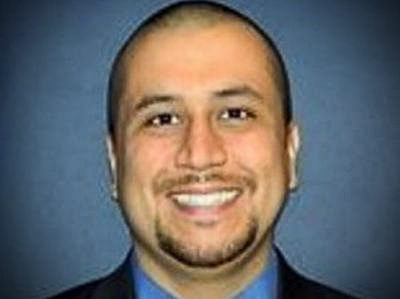
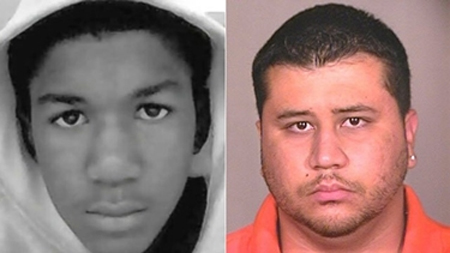
George Zimmerman killed Trayvon Martin. The law might be written in such a way that it allowed him to do so with impunity, but if there’s only one fact we know for certain, it’s this: George Zimmerman shot and killed Trayvon Martin, who was unarmed, who’d done nothing wrong, and was simply walking back from a convenience store.

an innocent man

This is going to be an unpopular thing to say, but it has to be said at some point. George Zimmerman–the man who unquestionably shot and killed Trayvon Martin–is innocent.

This is a fundamental aspect of the U.S. Constitution. Every citizen who stands accused of a crime must be presumed innocent until proven guilty beyond a reasonable doubt in a court of law. This isn’t some legal nicety we can overlook simply because it’s unpopular. If the presumption of innocence has any value at all, it has to apply to everybody–even George Zimmerman. It’s true that standard only applies to juries, but when you hear somebody say Zimmerman ought to be tried and punished, they’re basically saying the Constitution shouldn’t apply to people they don’t like. And that’s fucked up.

So there it is, George Zimmerman shot and killed Trayvon Martin and wherever he is right now, he’s an innocent man. I hate to say it, but he’s probably innocent in two ways. He’s presumptively innocent and may, in fact, be not guilty under the law. According to Florida’s statute 776.013 (3) – Justifiable Use of Force, Zimmerman may never have his innocence challenged. It’s very possible he’ll never be charged with a crime. The law clearly states “A person who is not engaged in an unlawful activity and who is attacked in any other place where he or she has a right to be has no duty to retreat and has the right to stand his or her ground and meet force with force, including deadly force if he or she reasonably believes it is necessary to do so to prevent death or great bodily harm to himself.” The way the law is written, it’s very nearly a license to kill–and indeed, ‘justifiable’ homicides in Florida have increased threefold since the law was enacted.

We can’t know with any certainty what took place in the final few moments before George Zimmerman shot and killed Trayvon Martin. But we can make some educated guesses based on what we do know. We know what Zimmerman told the police during his 911 call. We know, for example, he was unreasonably suspicious of Martin. We know he was following the young man, and continued to do so even after the police told him he shouldn’t. We also know Trayvon Martin knew he was being followed and was nervous about it. We know Zimmerman prejudged Martin (“These assholes, they always get off”), and we know he felt antagonistic toward Martin (he called Martin either a “fucking coon” or a “fucking goon”).

That’s what we know. We can surmise Martin felt threatened by the man following him and decided to confront Zimmerman. We can surmise Zimmerman felt threatened by the confrontation and so pulled his weapon. We can surmise Martin felt threatened by the weapon and may have struck Zimmerman in self-defense. And we can surmise Zimmerman felt threatened by the assault and shot Martin in self-defense.

The way the Florida law is written, the last person to survive feeling threatened is innocent.

Trayvon Martin was innocent in reality. George Zimmerman is innocent under the law. The people who aren’t innocent are the members of the Florida legislature who enacted this stupid fucking law.

There won’t be any real justice for Trayvon Martin. There won’t be any justice for George Zimmerman. The only possible justice that could come out of this tragedy is if the good people of Florida rise up and force their legislature to repeal the law, and maybe vote out the idiots who thought the law was a good idea to begin with.

But this is Florida, where guns don’t kill people–people kill people. And in Florida, you can get away with it.

a pathetic, fearful little man

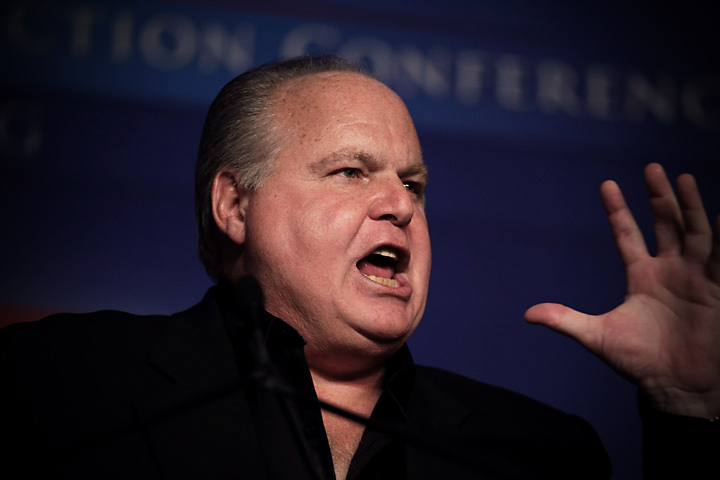
Rush Limbaugh is a coward. He hides behind the title ‘entertainer,’ which he believes gives him cover for making the most reprehensible and offensive remarks. That title also gives timid Republican politicians cover; they can dismiss the things Limbaugh says as outrageous while claiming it’s just entertainment.

It’s a convenient lie that nobody believes—including the people who speak it.

Rush Limbaugh is a coward, and like so many cowards he’s a bully when given the opportunity. He sits in a small sound studio, protected from the outside world, insulated from reality, and from that safe vantage point he mocks and jeers at people who disagree with him. He surrounds himself with sycophants and toadies, people who adore him because he’s found a safe way to say the ugly things they think.

Rush Limbaugh is a coward and a bully, a contemptible and despicable person. But behind all the bluster and bloviating, Limbaugh is also a pathetic and fearful little man, deeply inadequate—and he must be painfully aware of that. He must be terrified that others may recognize his fear and inadequacy. It would be horrible, I think, to be so afraid of so many things.

This isn’t to suggest Limbaugh is deserving of our empathy or compassion. He’s not. But one difference between us and Rush Limbaugh (one of the many differences) is we don’t reserve our compassion and consideration just for those we think are deserving. That would be a cheap sort of compassion.

Rush Limbaugh is a coward and a bully, and as much as I despise the man and the many horrible things he says, I can’t help feeling a grudging sort of sadness for him. In the words of the poet Mr. T., I pity the fool*. But I can’t pity him very much.


* To be more accurate, the phrase “I pity the fool” originally came from James Merle, an Autobiograph, which is a novel written in 1864 by William Black. He wrote: I pity the fool who marries and yet imagines he may be a great man. That seems to apply to Rush Limbaugh, who has married four times and so must want to believe he’s four times a great man. In fact, he’s merely four times a fool.

pissing on the dead

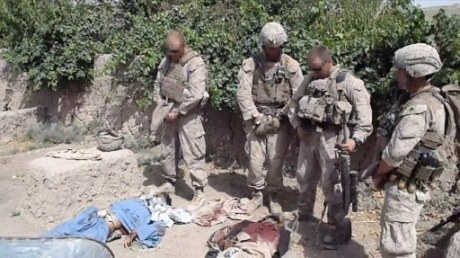
There’s a great deal of surprise and outrage over the video showing the members of a Marine sniper unit pissing on the bodies of dead Afghans. The outrage is merited; the surprise is not.

This is what happens in war. We train people to kill other people, which is the ultimate desecration of the body. Why, then, should anybody be surprised to hear troops desecrate those bodies in other ways?

Desecrating the bodies of the enemy has happened in every war that ever took place. It was an old practice when Achilles dragged Hector’s body around the walled city of Troy some 3300 years ago. It’s been practiced by every army that’s ever existed, and though it may violate moral and legal codes of military conduct, it’ll continue to happen. The U.S. military isn’t—and never has been—exempt. The ways in which wars are fought have changed over time, but desecrating the bodies of the enemy is a constant.

Of course our troops have pissed on the bodies of dead Afghans. This isn’t the first time it’s happened in Afghanistan and it almost certainly won’t be the last. Afghans have undoubtedly pissed on the bodies of dead Marines and soldiers, and they’ll continue to do so. Pissing on the body is a quick and easy way to express contempt and mark territory. It’s an expression of war; it’s part of the nature of war.

This isn’t to say we should condone—or even tolerate—such behavior. Those four Marines deserve to be punished, and punished severely. They deserve punishment for several reasons, not the least of which is that desecrating the bodies of your enemies creates more enemies—and more intransigent enemies.

So yes, we must punish those Marines. Yes, we should be outraged by the behavior. But spare me the shock and surprise. If you don’t want soldiers pissing on the bodies of the enemy, don’t send them to war. If you send young men and women to war, don’t act surprised when they behave the way warriors have always behaved.

i got your sign of weakness right here

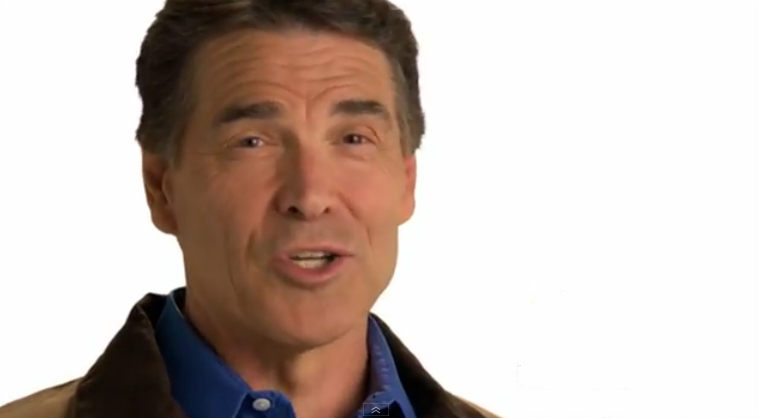
I declare, living in Iowa during primary season is a trial. It seems I can’t go half an hour without hearing Rick Perry’s smug voice proclaiming “Some liberals say faith is a sign of weakness.”

You know what’s a sign of weakness? Making shit up, then suggesting you’re bold for standing up against a claim nobody made—that’s a sign of weakness. It’s also a sign of staggering douche-baggery.

Rick Perry concludes that particular advert by saying “I’m not ashamed to talk about my faith.” Dude, maybe you should be. On account of I think you must have skipped that chunk of the Bible that goes: For I was an hungred, and ye gave me meat: I was thirsty, and ye gave me drink: I was a stranger, and ye took me in. Naked, and ye clothed me: I was sick, and ye visited me: I was in prison, and ye came unto me.

It doesn’t read I was in prison, and ye came unto me and gave me a lethal injection.

I’m not a Christian, and I’m a tad uncomfortable judging another person’s Christianity. But I’m completely comfortable judging somebody’s hypocrisy and douche-baggery. And no amount of smirking proclamations of faith can cover up Rick Perry’s hypocrisy and douche-baggery.

are you fucking kidding me?

I’m stupid enough to spend part of this morning watching highlights (if you can call them that) of the GOP debate last night. They took a video question from a gay soldier serving in Iraq, the question being would the candidates re-institute the Don’t Ask Don’t Tell policy.

Two things struck me. First, the audience booed. The actually booed a person who volunteered to serve his country–a person who is on active duty and serving in Iraq. Are you fucking kidding me? You don’t have to agree with a person’s beliefs or how that person lives his or her life to respect the fact that they’ve chosen to serve the nation in a low-paying job that offers not much more than a chance to get killed in some foreign country. Can you imagine the response if a Democratic audience booed an active duty member of the military?

Second, the question was answered by Rick Santorum. He complained that by allowing gay men and lesbians to serve openly in the military, the government was granting them “a special privilege.” A special privilege? Are you fucking kidding me? How is being allowed to serve in the military a special privilege? Were the people in the audience–the ones who booed–being denied the special privilege of putting on a military uniform and serving in Iraq? If so, we surely ought to make that privilege available to them.

Who the hell are these people? The ones who boo an active duty soldier, the ones who shout out that a person without health insurance should be allowed to die, the ones who cheer for the death penalty? How did they lose all their compassion? What’s made them so selfish and self-centered?

And what’s most desperately sad is they undoubtedly consider themselves to be patriots.

no room for error

Last night the governments of two States executed convicted criminals. Texas executed a man who was clearly guilty of the crime; Georgia executed a man who may not have been guilty. Both executions, though, were perfectly legal.

And that’s the problem. It’s absurdly easy to convict a person of a capital crime because it’s absurdly easy to convict a person of any crime. Even though the U.S. Constitution provides accused criminals with a number of safeguards, the fact is those safeguards have been gradually eroded over time—eroded by the courts, eroded by politicians who want to appear tough on crime, eroded by the 24 hour news cycle which feeds off conflict and fear, and eroded by the popular entertainment media that promotes the illusion that lots of criminals are released because of ‘technicalities.’

Our justice system—which is actually a pretty good system—is grounded in the notion of the presumption of innocence. Jurors are to assume the accused is innocent; it’s up to the State to prove they’re guilty, and to prove it beyond a reasonable doubt. But research shows that most jurors (and, in fact, most citizens) tend to believe a person who has been brought to trial is probably guilty of something. That tendency is exacerbated in capital cases because of death qualified juries.

It’s a little-known fact that the process of jury selection in death penalty cases is slightly different than in regular cases. To sit on a death penalty case, a juror has to believe death is an appropriate punishment for some crimes. There’s a certain logic to that; the argument is that a person who opposes the death penalty would be less likely to vote for a conviction. But that same logic applies in the reverse; research demonstrates that a person who believes in the death penalty is generally more likely to vote for conviction.

So a defendant in a capital case is facing a jury that is more likely to convict. From that point on, the cards are stacked against him.

Yes, there is the lengthy appeals process—but what most people don’t realize is that appeals only address points of law, not points of fact. The original jury are the triers of fact; the appelate courts are triers of law. Innocence or guilt are no longer an issue; the only issue argued in the appeals process is this: were the rules of evidence and the dictates of the law followed during the trial? If the answer is yes, then the trial is considered fair—even if the verdict turns out to have been incorrect. It’s not about the verdict; it’s about the process.

It appears in the case of Troy Davis, the letter of the law was followed. The jury, given the evidence they received, reached a fair verdict. The fact that the evidence was flawed or faulty is irrelevant to the appeal process.

It wasn’t always this easy to conduct a legal execution. Proponents of the death penalty often cite the Bible as support—and it’s true, there are any number of crimes in the Old Testament that are punishable by death (including, by the way, adultery and breaking the Sabbath and persistent disobedience to one’s parents). But in practice, it was incredibly hard to impose the death penalty. In order to sentence a person to death a majority of a Sanhedrin (23 men selected for their wisdom and sagacity) had to vote in favor of it. There had to be two direct witnesses to the crime; those witnesses couldn’t be related to each other or to the accused (or the victim); the witnesses had to be men—and men known to the community for their virtue; both witnesses had to be able to see each other at the time of the crime; and both witnesses had to warn the offender that he was committing a capital crime.

In effect, it was almost impossible to condemn a person to death under the way the laws of the Old Testament were practiced. The reason for that was simple. They believed that to take a life as punishment was the prerogative of their God, and to usurp that prerogative was to dishonor God.

I don’t believe in God. But I believe they had the right idea. I don’t think the government ought to be in the business of killing its own citizens, BUT if the State elects to do that, then there ought to be no room for error.

trees

Maybe it’s silly, but I develop a sort of relationship with certain trees. I grow fond of them; it pleases me to see them when I’m in the vicinity. It’s something about the shape of the tree, or maybe where the tree is located—who knows how these things begin? What matters is there are specific trees that make me happy.

This is one of them:

That one off to the left—the one that looks sort of like a mitten from this angle—that’s the tree. I actually shot this photo of the feral cat that followed me around one foggy day. See that little white speck? That’s the cat; the little bugger paced me for half an hour or so, never getting any closer than this. But even though I shot the photo of the cat, I made sure the tree was in the frame.

I like that tree for several reasons. I like the way the bike path curves gently around it. I like that crows and hawks hang out there (though not at the same time). I like the fact that unlike some of the other trees along this stretch of the bike path, it was never trimmed back to make it ‘pretty’. It’s just a friendly, accessible, pleasant, unpretentious, somewhat disorderly tree.

It’s a nice tree, isn’t it.

They tore it down.

By ‘they’ I mean city workers. They’re refurbishing the bike path, partly because it’s in a flood plain. Two or three times a year the nearby creek (it’s just on the other side of the tree line) floods. It’s always done that. In fact, the worst train wreck in Iowa history took place just up the road, a result of flooding. Last summer, nearly 300 people had to be evacuated from their homes along the flood plain. So the city bought the property, moved the people, and set about ‘correcting’ the problem. Which required tearing down that tree.

I quizzed the workers about it. As much as I hate to admit it, they seem to have had a legitimate reason for removing the tree, though the reason was incomprehensibly technical. But the men I spoke to assured me no other trees would be removed. And, in fact, they’ve encircled the more tame and orderly trees with plastic snow fencing and yellow caution tape. I guess it makes me feel a tad better.But only a tad.

I miss that tree every time I ride or walk that stretch of the path. Eventually I suppose I’ll get used to not seeing the tree. And that will be a little sad too.