speaking in stones

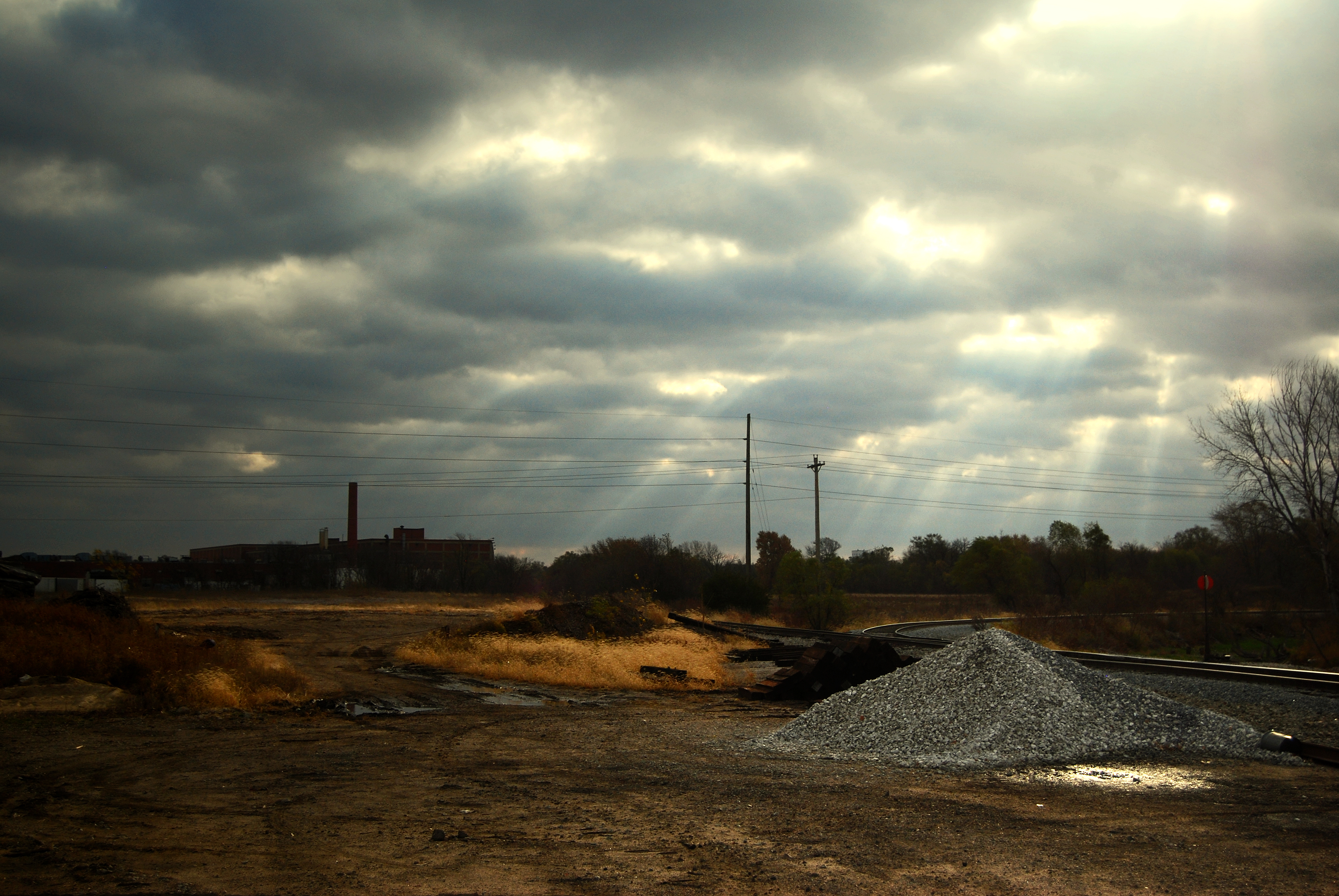
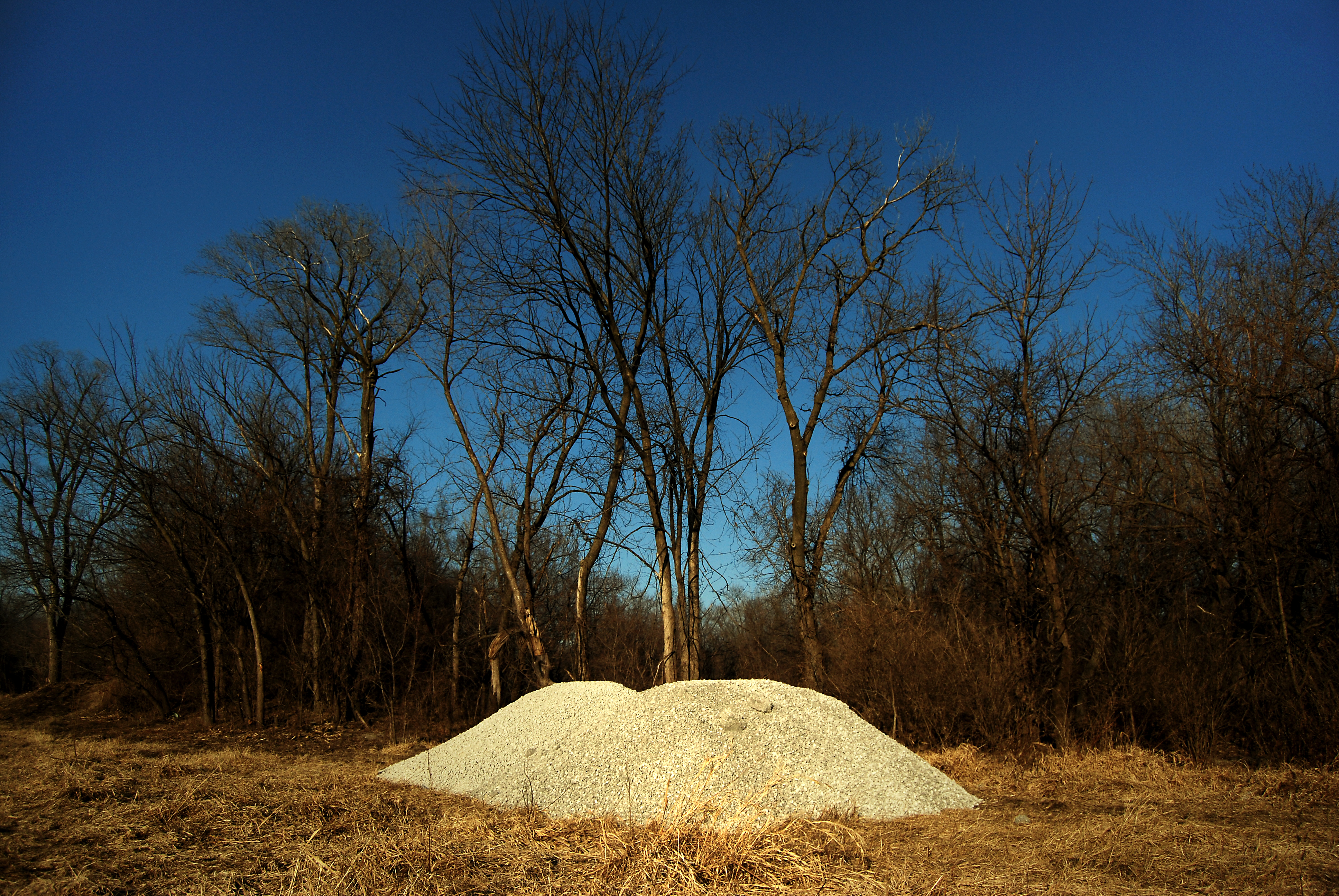
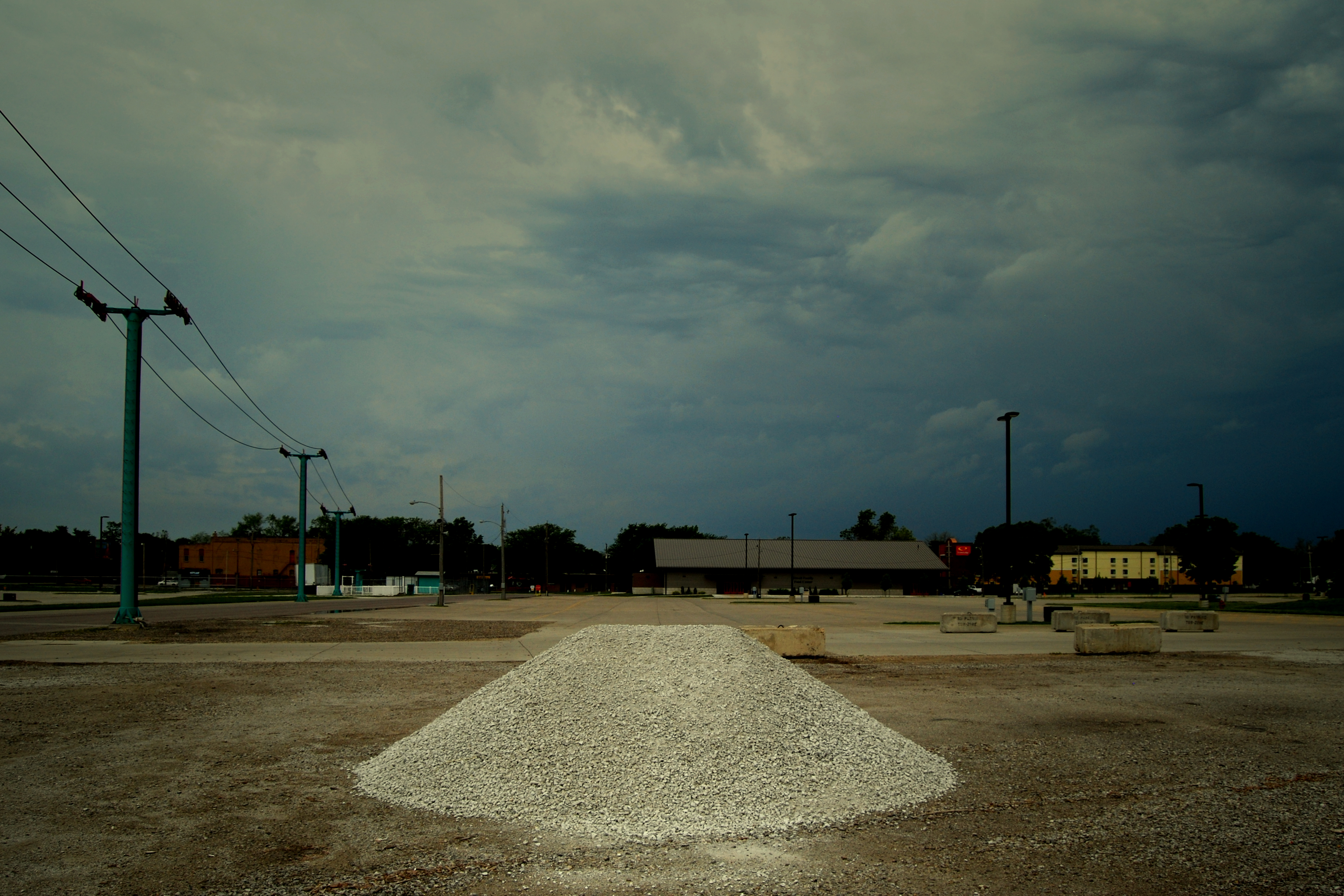
I am drawn to piles of stone.

Much of the appeal is that a pile of stones, no matter how disorganized or haphazard it appears to be, is clearly a product of human intervention. Outside an avalanche, a pile of stones doesn’t happen by accident. Somebody put them there. The exact placement of the stones may have been a matter of chance or convenience, but nonetheless they were put there—and put there deliberately.

People have been piling stone on stone for millenia. Literally. There are cairns and megalithic structures dating back to 9000 BC. Piling stones has always been a means of communication. At first, a pile of stones was a simple way to mark a trail—a device for telling others which way to go. Humans being human, the simple eventually became elaborate. Trail markers became boundary markers—a device for telling others where not to go. As the messages communicated by the piles of stones became more elaborate and sophisticated, so did the piles themselves. People began to pile stone for artistic and spiritual reasons.

And we got Newgrange in County Meath, And we got the pyramids at Giza. And we got the cathedral of Notre Dame in Paris. What is a tomb or a temple, after all, but a sophisticated pile of stones?

Obviously, the piles of stone I photograph haven’t any intentional meaning. They weren’t put there for any religious, artistic or social reason. They were just dumped there. Raw material at a construction site.

But the actual reason the stones are piled in any particulat place is, for me, entirely irrelevant. In my mind, I always choose to attach some sort of social significance to the stones.

Not seriously, of course, but inventing some meaning for the pile changes the way I see the stones. By giving the pile some arbitrary purpose, the stones cease to be mute construction material waiting to be used. Like those earliest piles of stone, they become articulate; they convey a message.

And they become beautiful.

Maybe this is one of the reasons I became so engaged by that chunk of curbing.

passion

Passion makes up for a lot. Passion is beautiful and dangerous; sometimes it’s scary as hell. Passion doesn’t discriminate between good ideas and bad ideas, between the sublime and the profoundly stupid. The same thing that makes Patti Smith an amazing artist who can transcend her own pretensions makes Michele Bachmann frightening and creepy. Yeats, I think, was only half right:

The best lack all conviction, while the worst
Are full of passionate intensity

You can switch those around, and it’s still true.

The best are full of passionate intensity, while the worst
Lack all conviction

As crazy as it sounds, I respect Michele Bachmann’s passion. As far as I can tell (or as far as I care to look into it) I disagree with very nearly every political, economic, and social position she advocates—but I don’t doubt her sincerity and I respect her willingness to voice every crazy bat-shit idea she has.

But here’s the thing: you have to accept the existence of Michele Bachmann in order to truly embrace Patti Smith. Or Billy B. Yeats, for that matter. Because let’s face it, Yeats and Patti Smith share that willingness to voice crazy bat-shit ideas. If you want a world with Yeats in it, if you want a world with Patti Smith, then you have to accept a world with Michele Bachmann. That’s how passion works.

I’m willing to tolerate the Bachmanns so long as I can live in a world where Patti Smith can do this:

Passion is over the top. Always over the top. That’s why it’s dangerous, why it’s beautiful. That’s why people listen to Michele Bachmann talk stupid shit about The Lion King as gay propaganda, and why people listen to Patti Smith sing her fucking heart out about stupid shit like a man on the run, heading down to Mexico to shoot his unfaithful wife. Passion, dude, don’t try to make sense of it.

iron photographer

One of the things I love most about Utata—the peculiar collective of photographers I’m involved with—is a project we call Iron Photographer. We’ve been doing IP projects since April of 2006. Every two weeks Jamelah Earle and I come up with three elements—two compositional elements and an artistic element—which our members try to put together in an artful way.

The IP process begins when Jamelah and I chat about the elements over Instant Messaging. We purposely refuse to come up with a list of possible elements in advance; we want the elements to grow organically out of the conversation. Sometimes one (or both) of us isn’t in the mood to be creative, and the process is messy and awkward and a jangle of nerves, annoying as a paper cut. Other times the process is like the very best jazz, improvisational and intelligent and funny and entirely unpredictable. Sometimes it starts off one way and ends another, or goes through two or three iterations of each. But somehow, we always manage to come up with something.

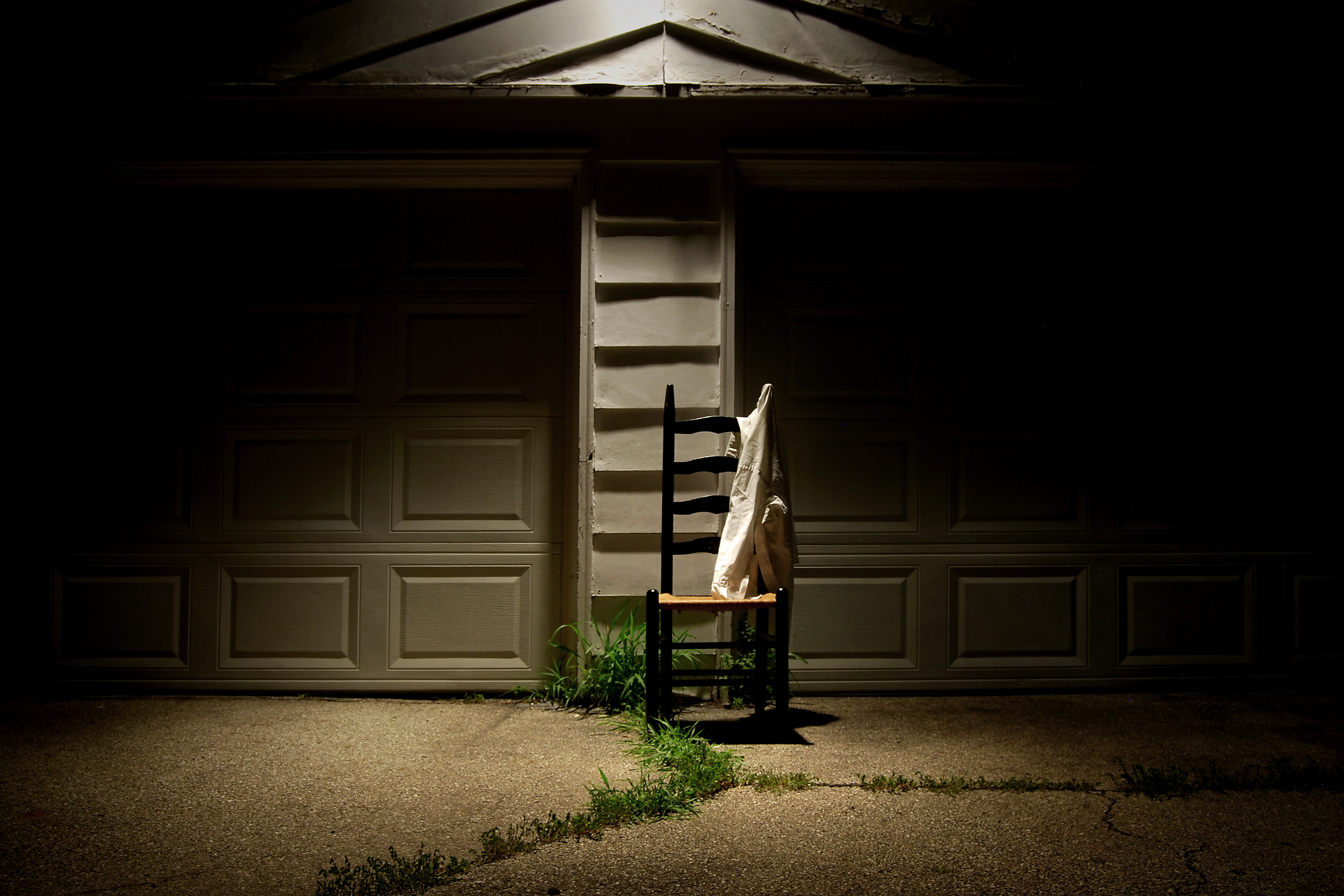
The elements can be…let’s call them idiosyncratic. Something with stripes, a food item, shot slightly out of focus (IP 47). Something white, a chair, shot in a gothic style (IP 102). A plastic bag, something red, shot in square format (IP 118).

What’s amazing to me is how often the members of Utata can take the most impossible and bizarre elements and find incredibly creative and artful ways to put them together. They do it so beautifully and with such consistency that they’ve forced me to become a better photographer in an attempt to keep up with them.

There’s nothing quite like a community of smart, funny, creative people to keep the creative juices percolating (if juices percolate—which under most circumstances, they don’t but in Utata percolating juices wouldn’t raise an eyebrow).

one conversation is nearly over

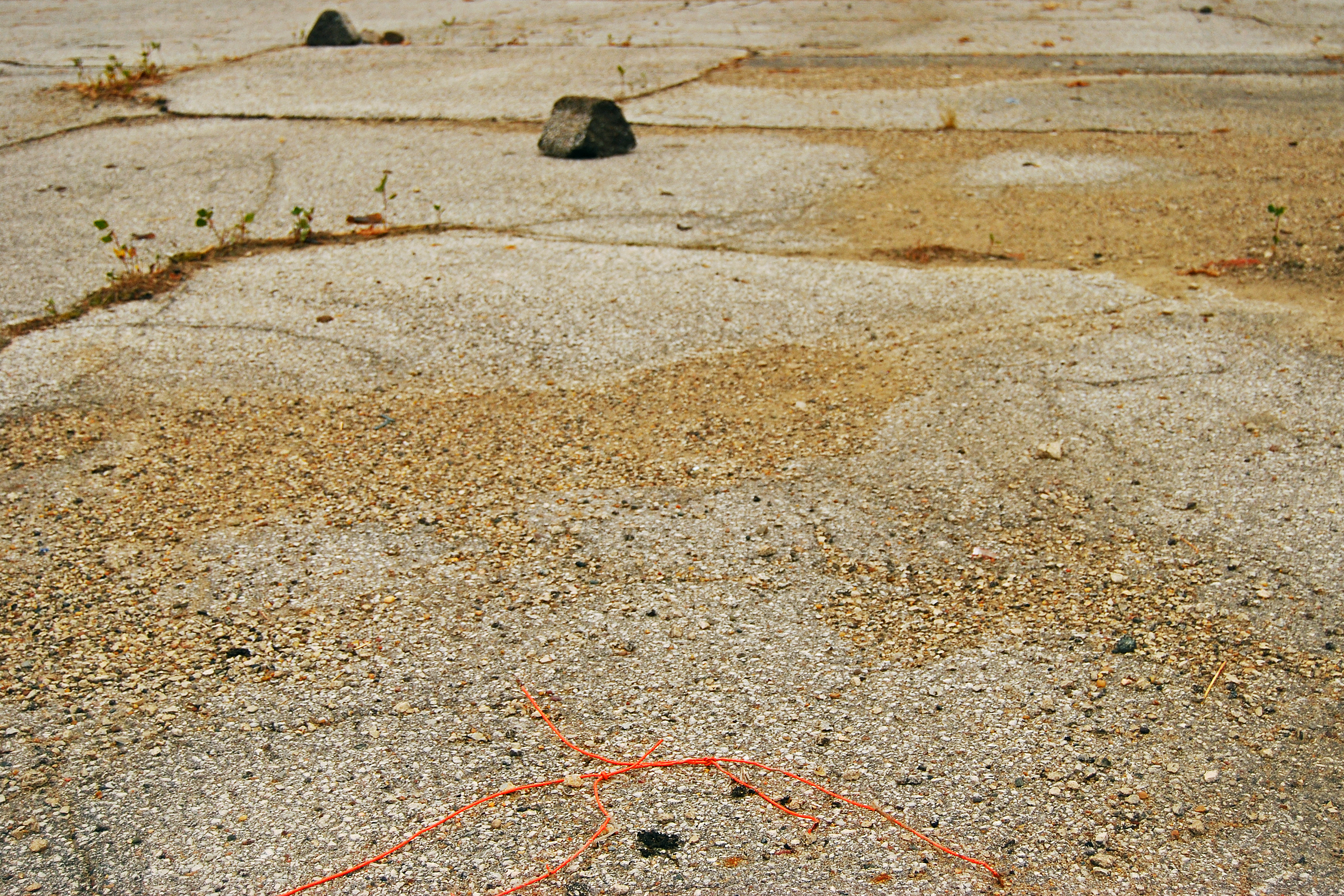
For almost a year I’ve been visiting an odd bit of curbing in a vacant lot where a supermarket was once located. There are two or three places where the curbing of the store’s parking lot had been broken up. It’s not clear if that destruction was accidental, intentional or organic. What was clear, though, was that somebody—for reasons entirely unclear—had tied a length of red PVC wire around a chunk of the broken curbing and carried it some sixty feet away.

And then set it down. I’ve been fascinated by it ever since. Why was it moved from its original position? Why that particular chunk of curbing? Why fashion a carrying handle from red PVC wire when it would be just as easy—easier, in fact—to carry it in your hands? And why leave it where it was left? It made absolutely no sense. I loved it.

Over time, the chunk of curbing was moved again—maybe twenty or thirty feet from its last position, and perhaps it would have been moved farther had the red PVC wire ‘handle’ not snapped. On a later visit I noticed the curbing had been overturned and another chunk of curbing had been carried and set down nearby.

It continued to make no sense, and I continued to be fascinated by it. But now the conversation is almost over. On my last visit, the curbing had been moved once again.

As you can see, the chunk of curbing has been moved and the red PVC wire left behind. In fact, both chunks of curbing have been shifted a few feet from their last positions.

I suspect kids are responsible for most of the recent moving, if only because young boys do things for reasons even they don’t understand—or no reason at all. It doesn’t matter, really who moved them, or even why. There’s something appealing about these migrating chunks of curbing. But the wind will probably blow away the red PVC wire eventually. And then the conversation will be over.

I’ll continue to visit the vacant lot, of course. There’s something about the slow reclamation process that I find weirdly comforting and attractive. There’s a sort of drama to it, though a very patient drama. It’s a different sort of conversation—less peculiar, more fundamental.

This abandoned lot is set on a fairly busy thoroughfare in a moderately poor neighborhood. Nearby is a car-wash, a small local Latino-operated auto repair shop, and an indie copying center that never seems to have any customers. The road noise is vicious—at least until you get near the back of the empty lot. Then it becomes muted, and it’s difficult to distinguish between the road noise and the sussuration of wind through the trees.

It’s not quite tranquil. But you can sense that tranquility used to exist here, and may some day return. That’s a conversation I’d like to join.

i have a crush on stephen fry

If I was gay (or if I were gay and interested in the past subjunctive—which I’m not and which I’m not) I’d be in love with Stephen Fry. I’m about half in love with him anyway. Because he has one of the most delicious voices in this part of the galaxy, and he knows how to use it, and he uses it to say things that ought to be said, and he uses it to say things that ought not to be said but need saying anyway.

And because of this:

I confess, I’m one of those people who sometimes get annoyed at the verbing of nouns. In my defense, I’m only really annoyed when I see it used in corporate jargon. There’s a place for CorporateSpeak. For the most part, that place is Hell (which is where the guy who sent out a memo saying ‘Please gist your reports before sending them to me’ belongs). But the employee who first said she couldn’t go out to lunch because she was ‘dining al desko’ has a special place in heaven.

I can hear that—I shall be dining al desko today—in Stephen Fry’s voice. He makes it sound even better.

(Thanks to Olga van Saane for bringing that video to my attention)

fog, cats, dogs, walnuts

By chance, I heard the weather forecast last night. ‘Fog advisories for the morning; commuters should be alert.’ So I set my alarm for six o’clock ante meridiem—telling myself I’d go to bed early, which of course I failed to do. So there’s me at 6am, looking out the window and not seeing a bit of fog through the dark. Nothing. So I booted up my computer, went to work, and didn’t look out the window again until around eight o’clock.

And we had fog.

I’d completely failed to consider the mechanics of fog production. By 8:15 I was on my bicycle, by 8:30 I was on the bike path that ran along the creek.

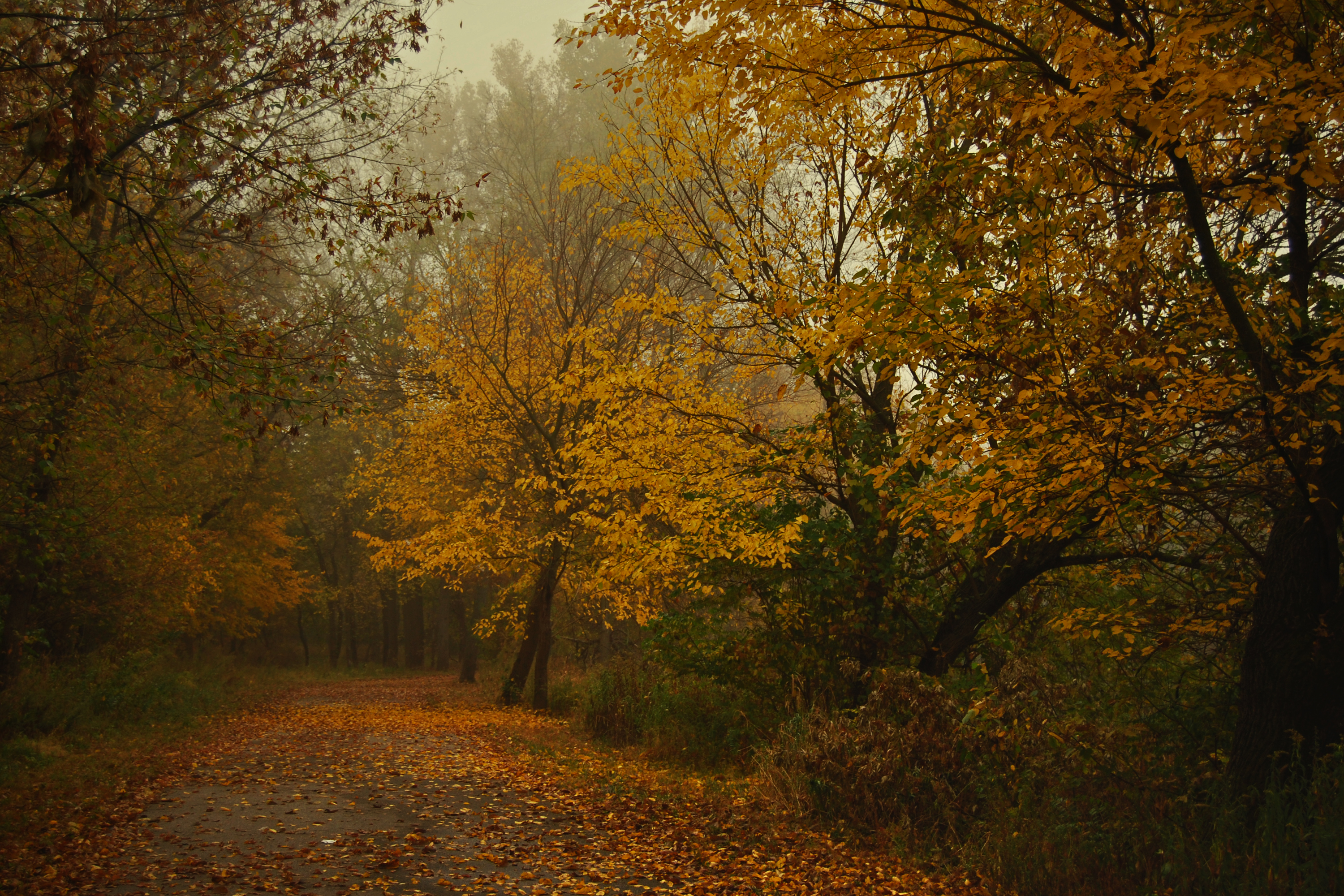
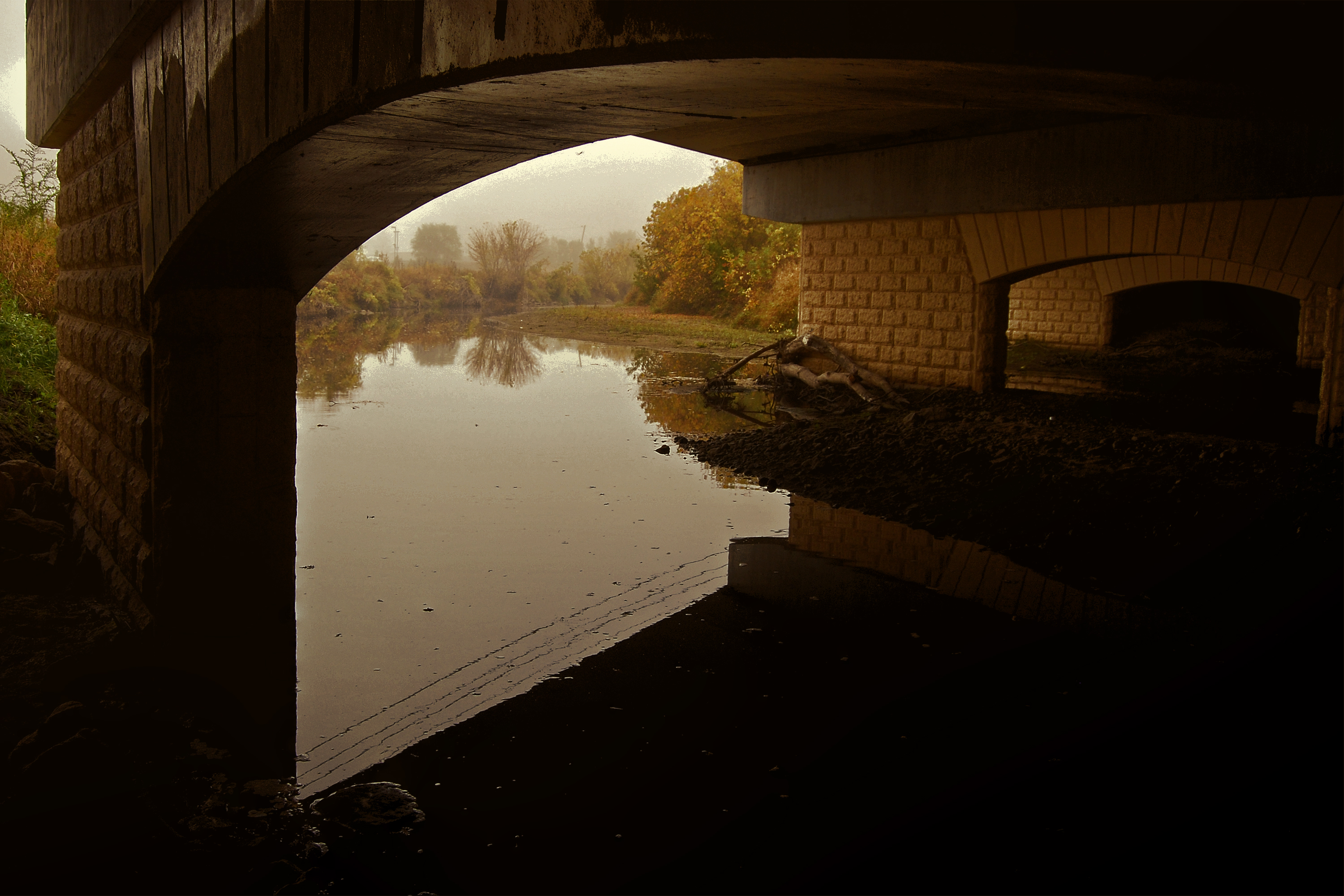
It was a chilly ride, and wet. The fog wasn’t particularly thick, but it made the world all clammy and dark and weird and sometimes a wee bit dangerous. Occasionally it was more like a mist than fog. I stopped under one of the bridges to tie my hair back.
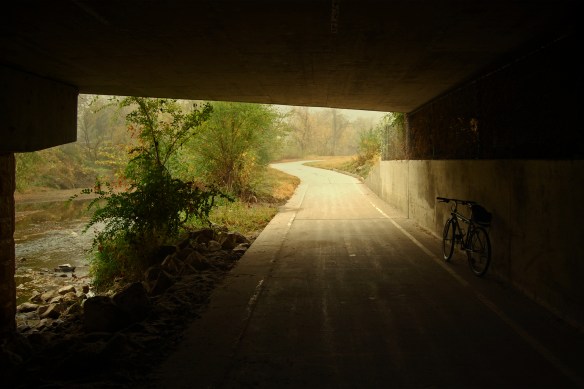
When I stopped, I surprised a feral cat with three kittens. The cat and two of the kittens scampered off up the creek bank; one of the kittens panicked and ran the other way—toward the creek. The creek was running low so the kitten wasn’t in any real danger, but it mewed and cried and was obviously frightened at being separated from the others. So I played border collie for about ten minutes, and eventually succeeded in herding the little bugger back across the bike path and up the bank where the others were.

Did I take a photo of the cat and kittens? Sadly, no. I didn’t take the camera out of the bike bag until after I’d dealt with the kitten. By the time I got the camera out, the thoughtless little bastards had scurried away. Still, it was pleasant under the bridge.

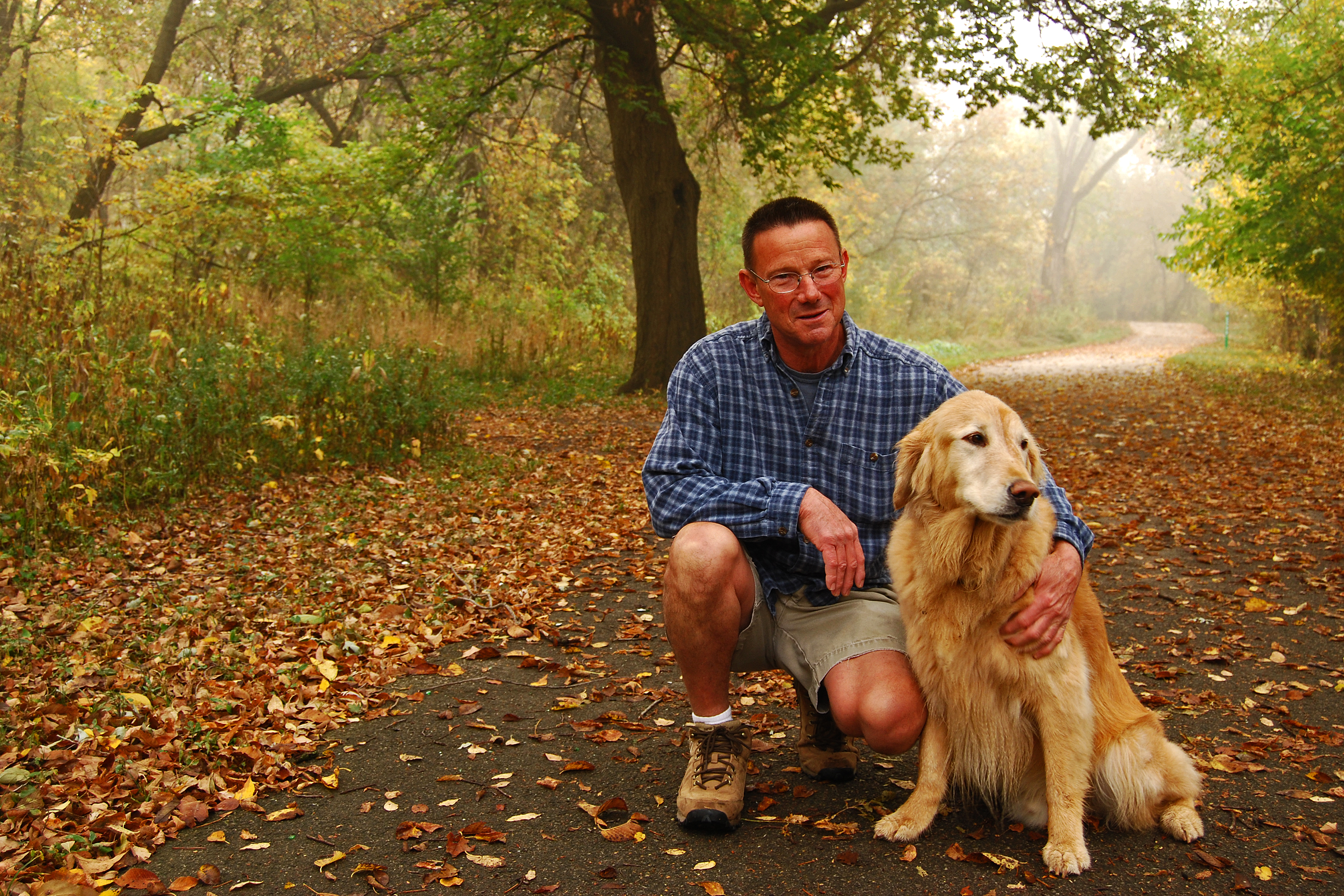
I had much better luck farther down the trail, when I came across Wrigley. I’ve met this dog and his human companion three or four times in the last couple of months. He owns property in the area; Wrigley owns him. He’s a classic golden retriever—smart, friendly, a wee bit loopy, eager to please. And I was reminded why you never want to wear black around a golden; after a few minutes of petting and hugging Wrigley had left about thirty-six pounds of dog hair on my clothes.

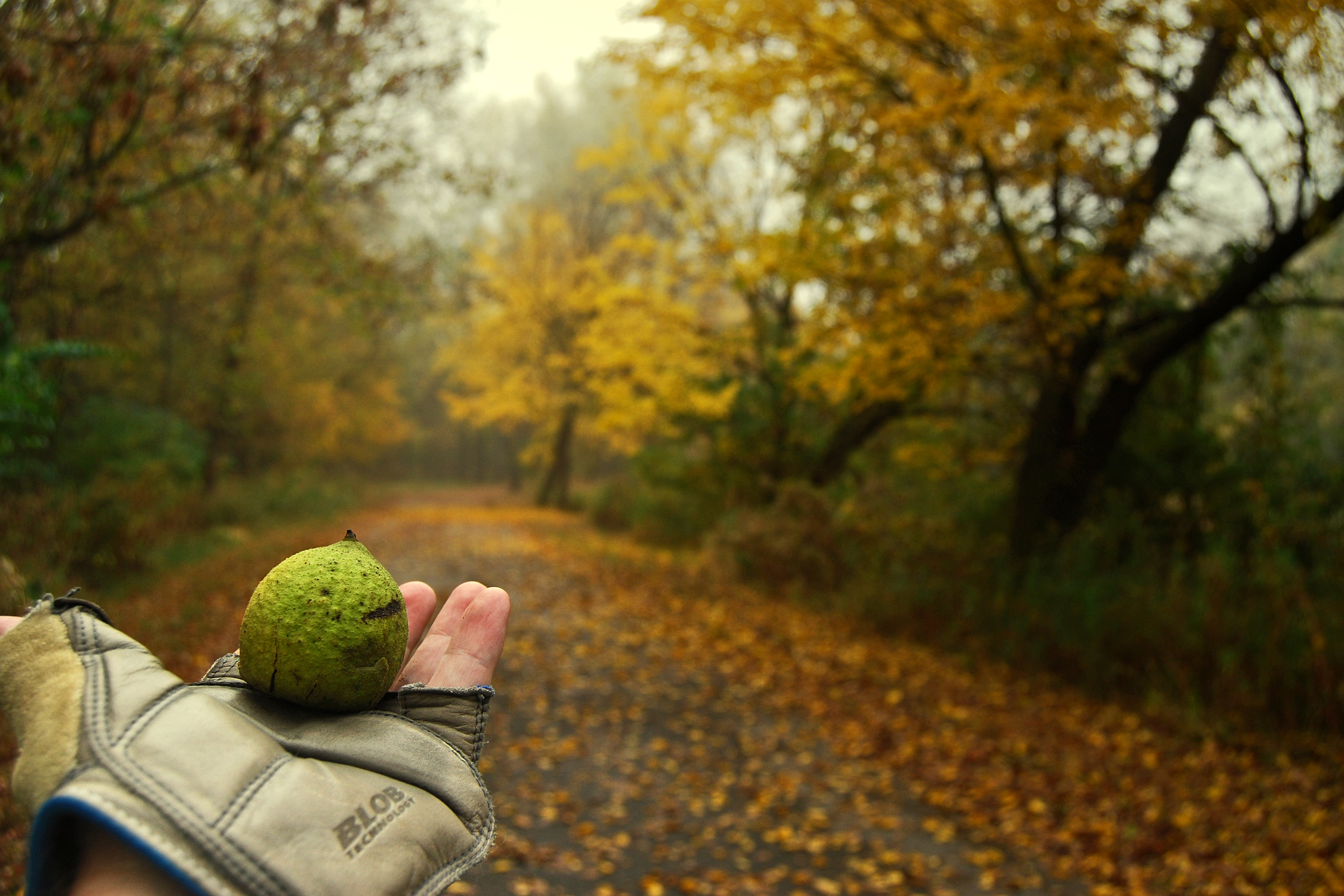
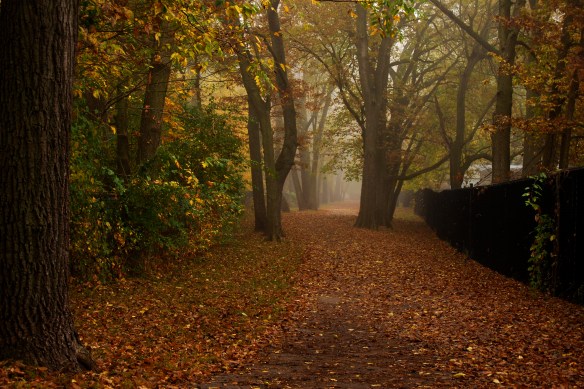
I mentioned earlier that the fog made the world a wee bit dangerous—and so it did, for two reasons. First, all those wet leaves were surprisingly slick; if you took a corner at speed, they’d slide out from under the tires. But the bigger danger came from the fact that the bike path wends its way through groves of walnut trees. Walnut trees drop walnuts. And they drop walnut leaves to hide the walnuts.

So concealed beneath all those lovely leaves are these handball-sized organic land mines waiting for some unsuspecting cyclist to plow into them. And it’s almost impossible not to smack into a few on a long ride. When you use toe cages on your pedals (like I do) finding a walnut with your front tire can get pretty exciting.

Even though wet leaves and walnuts are a massive pain in the cyclist’s ass, I have to admit I like them. First, they’re pretty—and pretty goes a long way. Second, they discourage those folks who ride for exercise from using that particular path. I’ve got nothing against riding for exercise, but so many of the people who do that seem to think those of us who ride for the enjoyment of it are just in the way. We’re taking up valuable bike space that could be more effectively utilized for cardiovascular improvement. Or something like that.

In a couple of weeks the wind will blow most of those leaves away. In a couple of weeks the squirrels will have gathered most of the walnuts. And the exercise crew will be back. And that’s okay too. At least they’re out riding. They’ll just have to get used to me stopping at irregular intervals in the bike path to take photographs and herd kittens.
The fog has burned off now. It’s sunny outside—beautiful blue sky, mid-70s, very light breeze. I’ve got an afternoon of editing in front of me. Editing and noodling around with book cover designs. Even though I wasn’t on the bicycle for exercise this morning, I can feel the ride in my legs. It’s a pretty good feeling.

If I was a golden retriever, I’d turn around three times, lay down, and take a nap.
walking distance

Everywhere is within walking distance if you have the time.

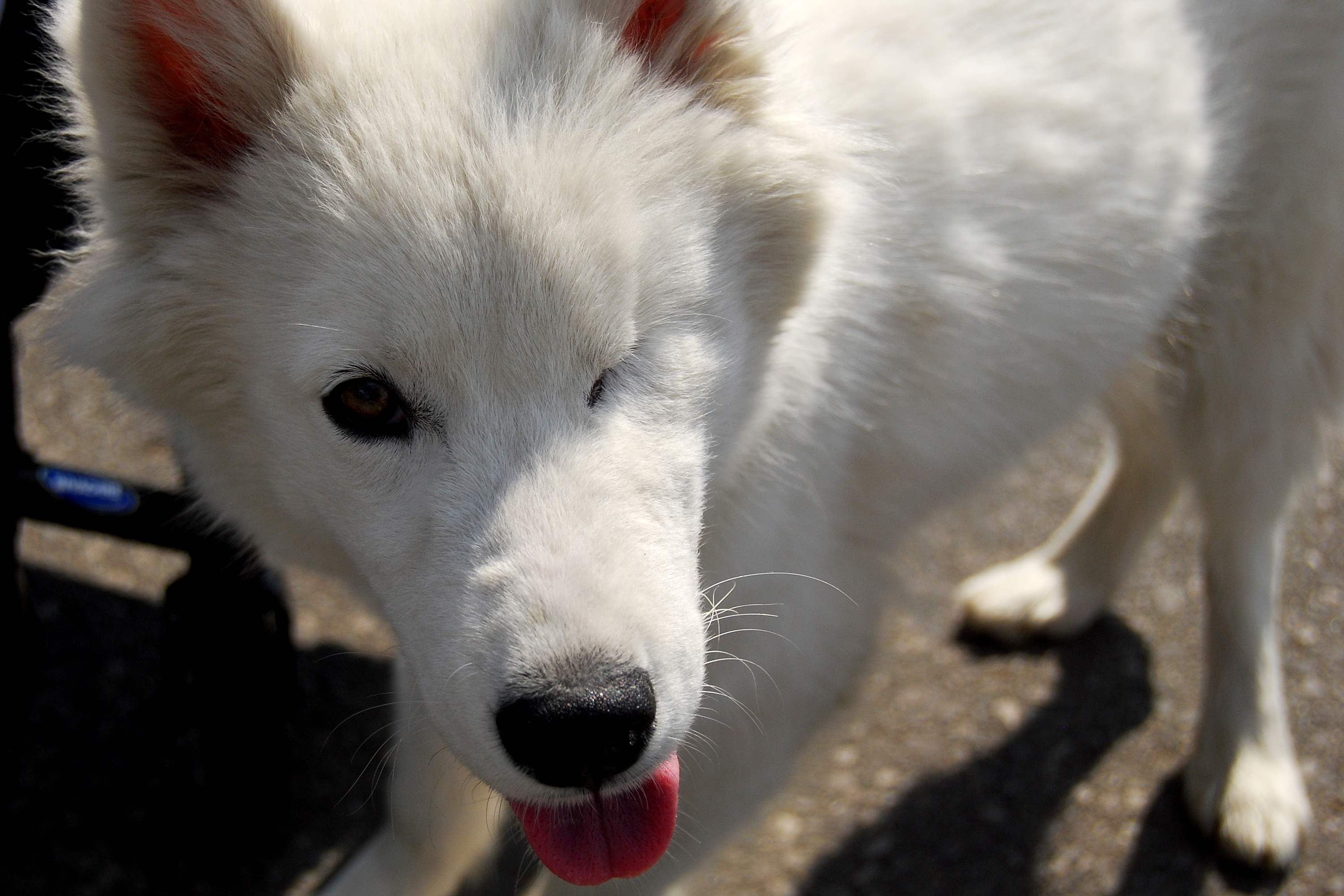
I like slow modes of travel: walking and bicycling. But sometimes cycling is just too fast. On a bicycle you don’t have time to stop and visit with the young woman in a wheelchair who is being pulled along by an enthusiastic one-eyed Samoyed named Astra. Why was the woman in a wheelchair? I don’t know—I didn’t ask. How did Astra lose her eye? I don’t know—I didn’t ask. This is what I do know: Astra is a dog, and all dogs are wonderful no matter how many eyes they have. She’s not a one-eyed dog; she’s a dog—a dog who  happens to have half as many eyes as most dogs. But you don’t judge a dog by the number of its eyes. You judge it by its dogness.

The same is true of people, by the way. The number of operative legs a person has is a pretty inadequate metric for evaluation. If you’re on a bicycle—or worse, in a car—you may not stop long enough to remember that.

On foot you can stop and chat. I’m a big fan of chatting. Oh, I enjoy deep, meaningful conversations about politics and religion and Important Things as well. But there’s something delicious about a brief aimless chat—with friends or with strangers. “Hi, hello, how are you, isn’t it a lovely day, you have a beautiful dog, I like your hat, is there anything better than a sunny day by the river, take care, g’bye.” You can’t do that so easily on a bicycle.

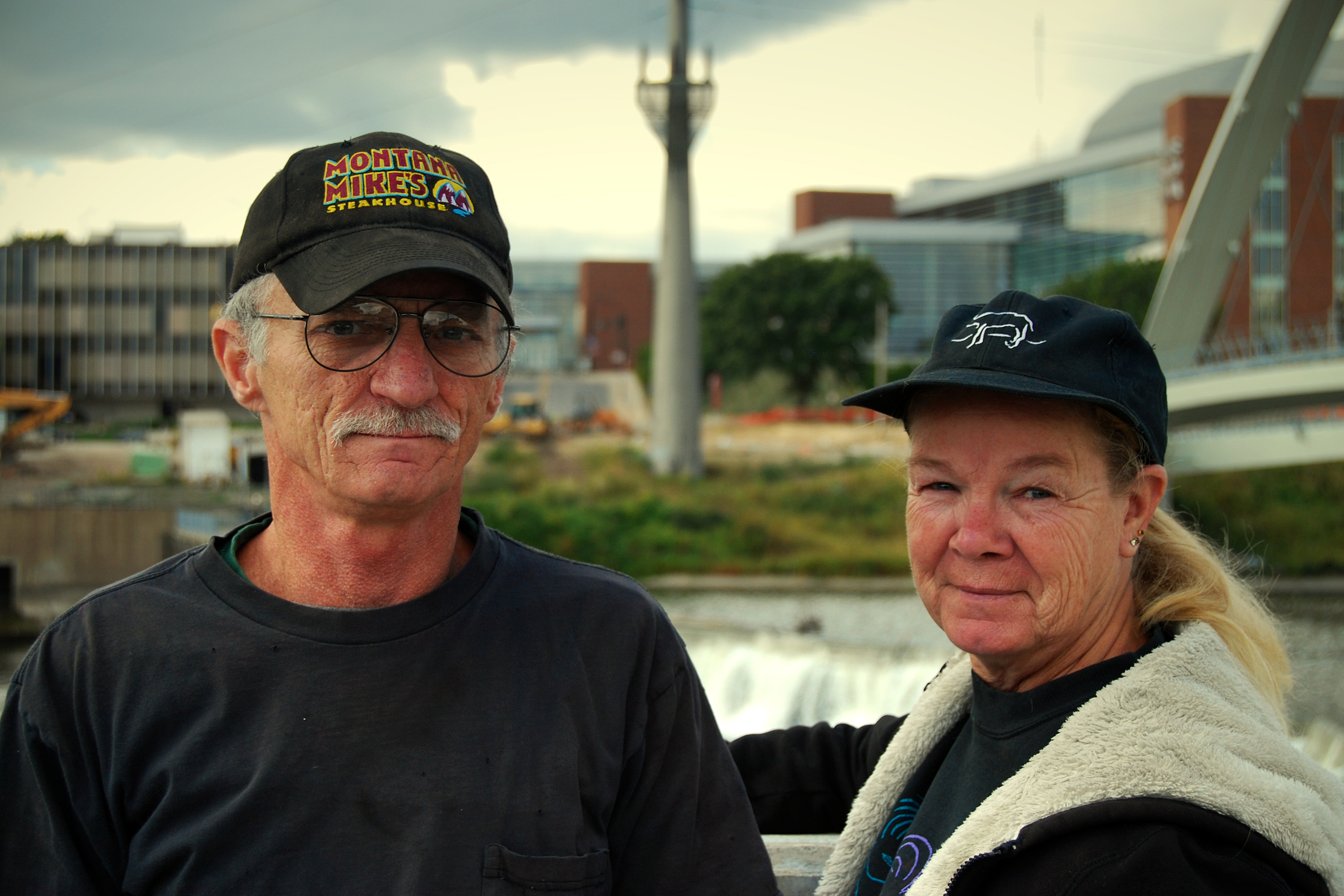
If I’d been on my bike, I probably wouldn’t have stopped to chat with Mike and Jodi, who were just loitering along the river, taking a walk themselves, watching the water go by and the fisherman waste their bait. They seemed a tad embarrassed when I asked if I could take their photograph—but he straightened his cap and she removed her sunglasses, and both seemed pleased by what they saw in the LCD monitor.

Just ordinary people out on an ordinary Sunday afternoon taking an ordinary walk. The only thing out of the ordinary was when some long-haired character with a camera approached them, nattering away, and asking to take their photograph. I figure I gave them something to talk about—fair exchange for a photograph. With any luck, Mike and Jodi will have met Astra on their walk.

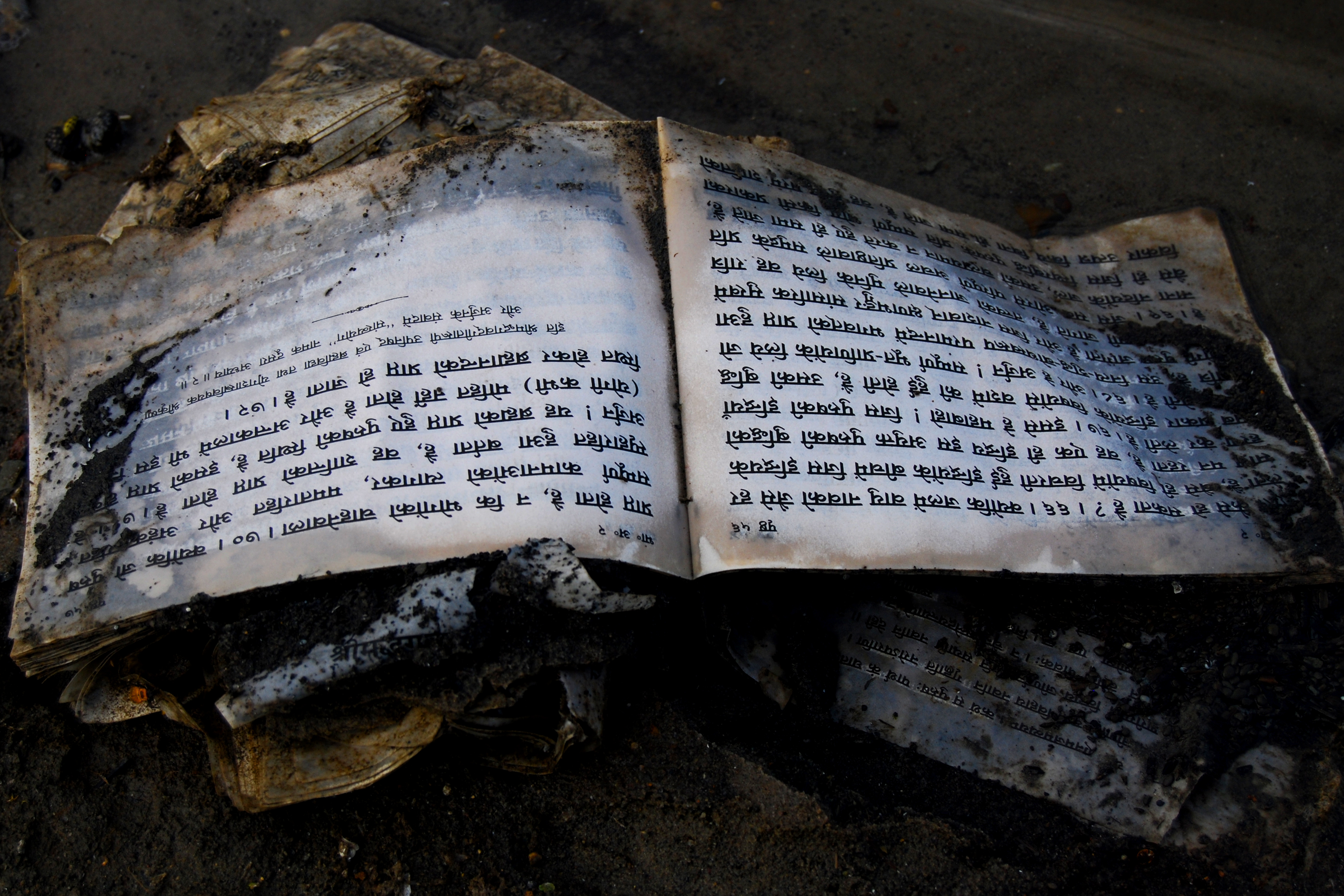
Farther up the river—much, much farther—I came across (actually my friend Stacey came across it first and pointed it out to me) a water-logged text written in what appears to be a form of Sanskrit. I never would have seen this on a bicycle (nor, I daresay, would she). There’s a Hindu temple nearby; I assume somebody was studying along the river and accidentally dropped the book in the water. Or perhaps somebody just wanted to share it with the frogs and fish and pelicans (the annual autumn white pelican migration is taking place now—is it a coincidence that the best English-language books are published by Pelican Press? Well, yes. Of course it’s a coincidence. C’mon).

It’s a beautiful written language, Sanskrit, and although I’ve no idea at all what this says, it’s a lovely addition to the river.

Steven Wright is correct—everywhere is within walking distance if you have the time. This is why you should take the time. Or make the time. Because the people you meet and the things you see will, if you let them, take you farther than your legs will carry you. It can give you an entirely new understanding of walking distance.

(Update: I am reliably told by Arvind Kumar that the text is in Hindi, not Sanskrit; both languages use the Devanagari script.)

this is my bike

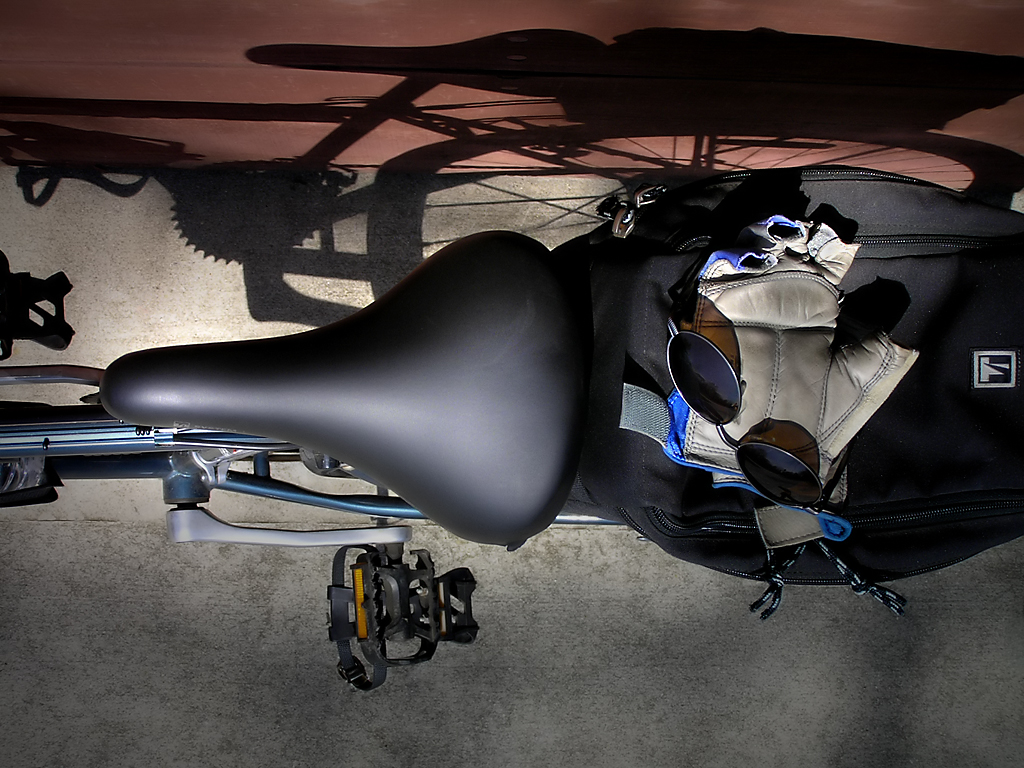
This is my bicycle. I dearly love it. It’s an old bugger; a Trek 850 I bought in 1995 for about US$400. I’ve put thousands of miles on it—miles of riding sandy trails on Cape Hatteras, miles of city streets in Norfolk, VA and all over Manhattan, miles of hilly country roads in rural Pennsylvania, miles of suburban lanes and bike paths in central Ohio, miles of roads and converted railroad lines in Iowa—and the old bike is still as solid as ever. Except for replacing the knobby tires for road tires, nothing on the bike has been changed or upgraded. The sumbitch is nearly indestructible. Sixteen years on a four hundred dollar investment—that’s twenty-five dollars a year. A bargain.

But obviously, it’s not about the money. You know what it is about? I’ll tell you. Here’s a true thing: a bicycle is a self-propelled, two-wheeled Fountain of Youth. You get on a bike and you immediately feel like you’re twelve years old.

Oh sure, bicycles are also very practical and efficient and utilitarian. They’re not only a common means of transportation in much of the world, they’re also used to convey goods and products. They don’t pollute, they’re good for your health, they’re cost-efficient and easy to maintain and blah blah blah. But fuck all that—mostly they’re fun.

There’s an instant joy in getting on a bicycle and pushing off—an instant feeling of liberation. I’m sure if I had to rely exclusively on a bike for year-round transportation I’d feel differently. But I don’t.

Later today I’ll jam an old L.L. Bean knapsack into the bike bag and ride down to the market to buy enough groceries for the next few days. I’ll probably buy something wildly unhealthy (I’m thinking I need a chili cheese dog for supper tonight) that will completely undo any fitness benefit I gain from riding the bike. But that’s okay; I’ll still feel like I’m twelve years old during the ride.