somewhat true detective

“Yo, Greg, you should watch True Detective.” That’s what everybody kept telling me. “Great acting,” they said. “Lyrical cinematography, complex characters, clever plot,” they said, “all wrapped up in a realistic crime drama that takes place in the South. You’ll love it.”

So I watched it. The entire first season — eight hour-long episodes — over the last four weeks. And hey, they were mostly right. I did love it. The acting was terrific, just like folks told me (I swear, Matthew McConaughey never blinked once during the entire season), and the cinematography was artful. I suppose the characters could be seen as complex, but they’re pretty much right off the Stock Character–Complex Model shelf. We’ve all seen the Marty Hart character before, the hard-working detective who drinks too much and thinks too little. And the Rust Cohle character is basically Serpico, the Cerebral Cop, quoting big chunks of Thomas Ligotti, who is the High Lord of Anhedonia. It’s the quality of the acting that makes these characters interesting, not the characters themselves.
true detective tree2

The plot? Well, it was fairly predictable. Let’s face it, there’s nothing original about two detectives solving a nasty crime committed by powerful people who use their influence to hinder the investigation. That said, the plot was elevated by being beautifully structured and through the mostly masterful pacing. I say ‘mostly’ masterful pacing because there were a few scenes that were stretched out because apparently HBO requires a certain number of minutes devoted to young women showing their tits and ass. (Disclaimer: I’m not opposed to tits or ass so long as they’re organic to the story and don’t disrupt the pacing; but c’mon, the only reason they included some of the sex scenes — including the pointless image in the opening sequence where we see a woman’s naked ass above a pair of spiked stiletto heels — is to attract a young male audience.)

But a realistic crime drama? Well, no — but nobody really expects this sort of show to be realistic. Real life investigation can be pretty dull, after all. However, I did appreciate how the writer, Nic Pizzolatto, demonstrated that good detective work often involves a buttload of time sitting alone in a room sifting through old files and public records. That facet of investigation almost never makes it to the screen. It doesn’t quite make up for Pizzolatto’s wholesale lifting of dialog from Ligotti, but you have to give the guy props when he deserves them.

So yeah, True Detective was excellent television and I’m really glad folks recommended it to me. But nobody — not one person — told me that True Detective was a classic Southern Gothic story. And lawdy, that’s the heart of the whole goddamn thing.
true detective house

Some of you are probably saying “Southern Gothic? I have never heard of this Southern Gothic. Qu’est-ce que c’est Southern Gothic?” Allow me to ‘splain.

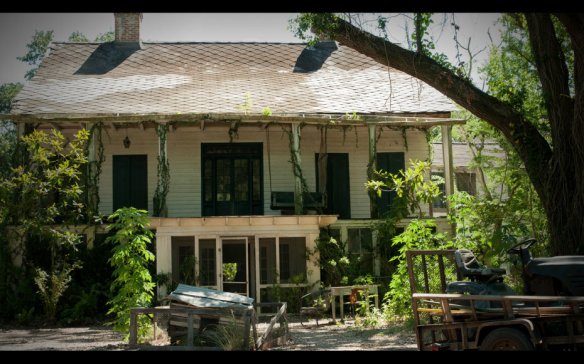
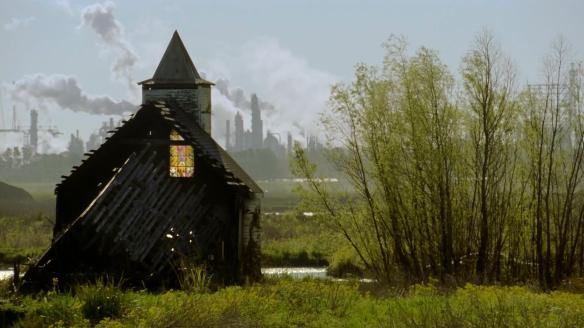
Southern Gothic is a highly atmospheric literary genre grounded in the decay — both physical and moral — of the Old South aristocracy. Southern Gothic (and I’m just going to start calling it SG on account of I’m lazy) stories usually involve the decline of Southern gentility into perversion, grotesquerie, and madness. The descendants of antebellum families that once owned plantations and slaves have been reduced to living in house trailers parked out in the country, and they’re working odd jobs. The slaves are gone, the plantations either sold to Yankees or fallen into dilapidation (or worse, turned into tourist venues). The cotton fields have been plowed under, replaced by strip malls and big box stores.

The characters in SG stories struggle to understand the world around them and find some way to fit their lives into modern society. Drug addition, alcoholism, confused sexuality, sexual paraphilia, mental and physical deformities, religious depravity or fanaticism, poverty, alienation, violence, the supernatural, illegitimacy — tie all that up with a bow of futile and pointless family pride and you’ve got yourself a classic SG story.
true-detective-episode-2

That sort of moral and spiritual degradation isn’t unique to the Southern Gothic genre; literature and film are full of examples of the moral corruption of European aristocrats. We’re talking everything from Count Dracula to the Marquis de Sade to Charles II of England. It’s not just power that corrupts — it’s also unquestioned privilege. Privilege allowed folks to whip and/or rape the young village boys and girls without any fear of consequence. Society can take that privilege away, but the desire to continue whipping and raping doesn’t necessarily go with it. That means the unwholesome behavior has to become more secretive. That’s been universally true. What makes the corruption of SG stories unique, I think, is its relationship to heat and defeat.

Heat is debilitating. It reveals itself through sweat, and sweat lubricates Southern Gothic stories. Sweat, not perspiration. In SG literature, sweat suggests either labor or animal lust. It suggests either being out in the field doing a job — which indicates a lower social status — or you’re driven by a sexual desire so strong that you ignore the fact that it’s just too damned hot to fuck. Either way, sweat suggests you’re not the master of your own behavior. All the decent, privileged people, after all, are sitting on the porch, sipping something cool and fanning themselves. They may perspire, but they do not sweat.

true detective detectives

In True Detective, we see all the main characters sweating — all but the Reverend Billy Lee Tuttle, who is never seen outside an air-conditioned building. He’s metaphorically still sitting on the porch, watching the lower classes laboring away. Except, of course, when he puts on a Mardi Gras masque and works up a sweat doing something really horrific to young girls. (We never actually see what he does; all we know is that it makes hardened law enforcement types scream when they see it.)

But more than the Southern heat, it’s Southern defeat that really counts. Yeah, we’re talking about the American Civil War again. We’re talking about the cultural resentment at the loss of status, property, income, and privilege. Loss — that’s really the wrong term. In SG stories characters don’t feel they lost their former status; they feel it was taken from them — stolen from them — and that sparks a deep, underlying current of bitterness.

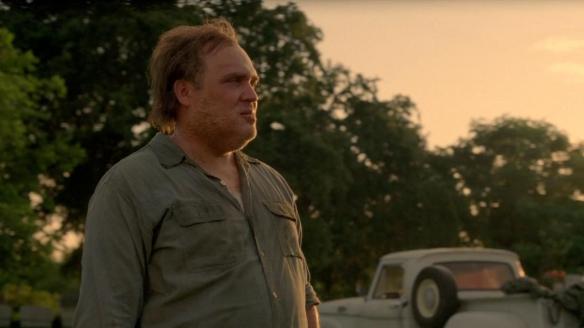
In True Detective we see echoes of that bitterness mostly in the character of Errol Childress — the chubby, scarred, perpetually sweaty pervert who is descended from an illegitimate branch of the Tuttle family tree. He’s not only been deprived of the privilege his ancestors enjoyed, he’s even deprived of their name. At one point, the two detectives who are investigating Cohle happen across Childress and ask directions. They drive off while he’s still speaking — an insult he’s able to shrug off because, as he says, “My family’s been here a long time.”
true detective childress

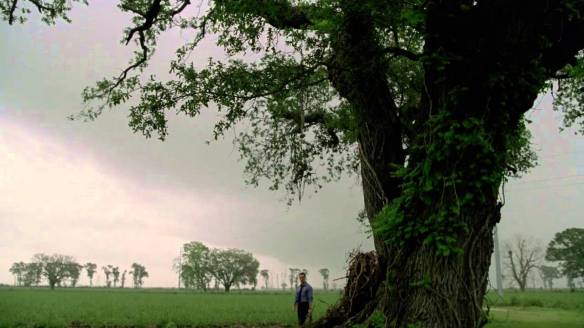
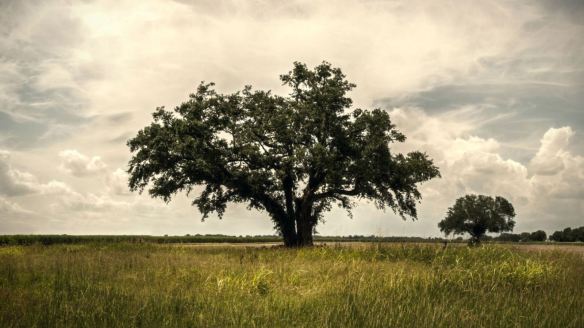
There’s another thing we see a lot in Southern Gothic stories: symbolism. At the beginning of the series and very near the end (and periodically throughout), we see an old, gnarled tree standing alone in a corn field. The tree looks ancient, like it’s been there forever; its roots are deep in the land. The field, on the other hand, is relatively new and the crops are planted around the tree. The depravity of the Tuttle/Childress clan has been around a long time; it’s anchored to the land and it’s still here despite recent changes of society. Society, in fact, has shaped itself around the Tuttles, and left them largely undisturbed (while the Childress family has been left in a sort of socio-cultural backwater). The Tuttle/Childress family tree has many branches, and branches show up all over the show as bizarre clues and as set decorations. The symbolism is obvious, but not overwhelming.

There are lots of flaws and problems with True Detective. For example, it never bothers to explain the references to The King in Yellow or Carcosa (both of which come from classic gothic horror stories) or their significance in the murders committed by Childress. And then there’s this: what’s the story purpose of Cohle having visual hallucinations? They’re almost completely ignored except in the first and last episodes, and I can’t see how they contribute in any material way to either the plot or the character development.
true detective tree

But the flaws and problems are, I think, minor when compared to the overall success of the show (and I’m talking about artistic success, not commercial success). True Detective was an absolute pleasure to watch. But dammit, it’s not really a detective story. It’s Southern Gothic, baby, right down to its depraved heart.
i kinda don’t hate facebook

Yeah, Facebook. You hate it. Everybody hates it. It’s a timesink, an annoying distraction, a bog of pointless announcements and idiotic quizzes, a morass of maudlin appeals for support from people you barely know (or don’t know at all), a fixed point attractor for every cute cat video ever made (and usually made badly), a wasteland of recipes you’ll never make and articles you’ll never read. Facebook is an utter and complete waste of bandwidth. Everybody agrees. I agree as well.

Except I don’t. Not really. Oh, I complain about Facebook, but the fact is I rather enjoy it. Every day — every single goddamned day — there are at least half a dozen different posts on Facebook that I find worthwhile. Or more than worthwhile. I find posts that make me think, that connect me to ideas and places and people and things I find fascinating, that give me information I want or need, that amuse me or delight me. And yes, yes of course, there are lots of posts that annoy the hell out of me. Sentimental pap, or faux inspirational quotations, or stupid hateful stuff about Obama, or stuff about…I don’t know…cars. Or basketball. But every single day, for me the good stuff on Facebook outweighs the annoying stuff.

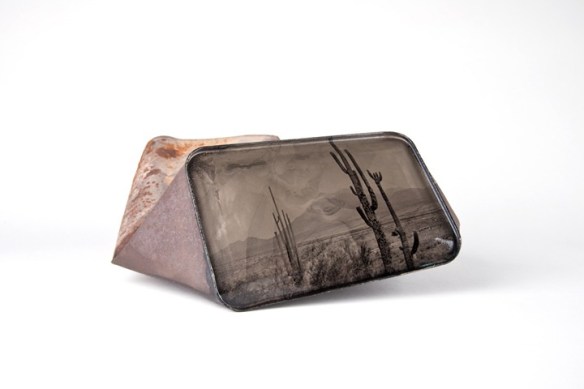
For example, this morning on Facebook an Irish photographer, John Baucher, alerted me to the work of an Arizona-born artist (David Emitt Adams) who uses the wet-plate collodion process to create powerful  and photographs of the desert on old discarded tin cans found in the desert. It’s the perfect melding of subject and medium, as well as a profound statement about the effect of humankind on the environment. Adams says,

“I have never known this landscape without the forgotten debris of urban sprawl. Today, the notion of land untouched by the hand of man is so foreign it might as well be make-believe.”

David Emitt Adams


And this morning on Facebook, Barış Kılıçbay, a Turkish scholar, shared a short video edited by Jacob Swinney, in which the first and final frames of several films are shown side-by-side. It sounds simple and obvious, but it’s actually surprisingly sophisticated and compelling. It offers some real insight into how a narrative is — or should be — deliberately structured.


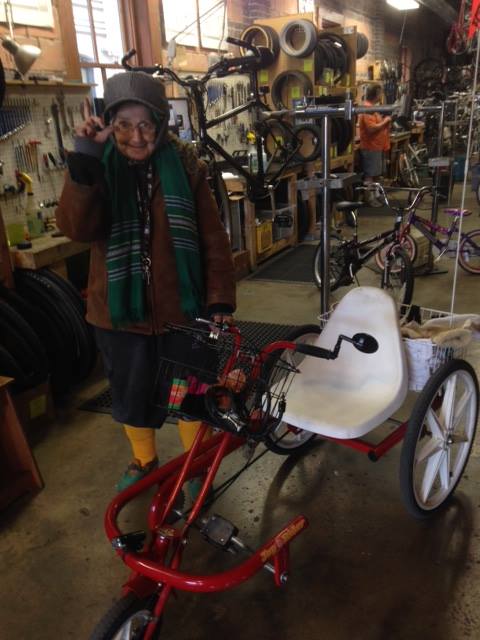
And this morning on Facebook the Des Moines Bike Collective posted a video about the Idaho Stop and showed me a photograph of an 83-year-old woman who’d stopped by the shop for help fixing a chain on her bike. The collective regularly posts information about cycling and how various urban areas are working to make cycling safer and more convenient. They also frequently feature local folks who are doing cool bike-related stuff.

bike collective - janet


And just now on Facebook, British science blogger Elise Andrew (who runs the brilliant I Fucking Love Science page) posted a link to an interactive exercise in speculative zombie epidemiology. By inputting a couple of variables (such as the kill-to-bite ratio and zombie velocity) and picking a location for Zombie Patient Zero to appear, you can follow the pattern and rate of a zombie epidemic in the U.S.

That dark area in the Midwest? That shows how in two weeks, a single zombie in Des Moines capable of walking less than one mile per hour and infecting 85% of the people it bit would have spread the infection far and fast enough to envelope both Minneapolis and Chicago. Who wouldn’t want to know that?

zombie infection rate


I don’t any of these people, really. I’ve never met John Baucher, though we occasionally correspond and we communicate frequently on Facebook. I have no idea how I came to know Barış Kılıçbay — through a friend, or a friend of a friend. And it doesn’t matter. What matters is that our small interactions on Facebook have occasionally made my day more interesting. I’m not a member of the Des Moines Bike Collective, but I know they’re a force of good in the community and two or three times a week they inform me about something bicycle-ish I’d otherwise never learn. And I only know Elise Andrew through IFLS, but she’s expanded my understanding in dozens of science-related fields.

My point, if you can call it that, is that although Facebook really is horrible, it’s also really pretty terrific. If you like zombies. And bikes. And movies. And wet collodion tin can photography.

corn cribs, beer caves, kids on fire, taxi-leaping

I like a Sunday newspaper. Any local Sunday newspaper. I’m talking about an actual newspaper. A physical, hold-it-in-your-hand, lay-it-on-the-table. turn-the-page newspaper. There’s something uniquely pleasurable about the weight and heft of a Sunday paper.  Every other day of the week I’ll read the news online; I’ll weave my way through a couple dozen different news sources, national and international. But on Sundays, I go traditional.

It’s not entirely the physicality of the local newspaper that draws me. It’s the localness of the news. Since the Des Moines Register is Iowa’s only statewide newspaper, they have local stories from all over the state. Events that are important and/or meaningful to people who live in those communities. Here are some examples (these are all actual headlines and ledes from the first section of the newspaper):

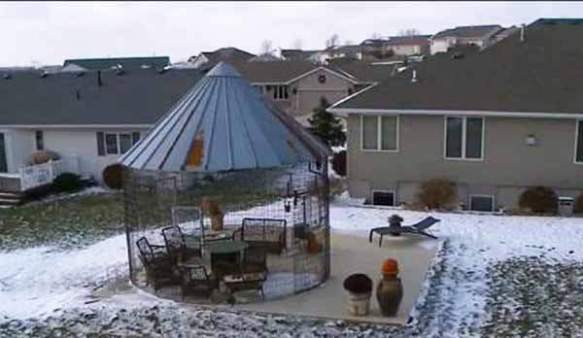
Corncrib-Gazebo gets on neighbors’ nerves
Some residents of Carroll are annoyed when they look into a neighbor’s backyard and see a corncrib that’s been turned into a gazebo.

A neighbor said the gazebo ‘would look nice on an acreage or a farm, but just doesn’t fit the character of the subdivision.’ So he started a petition to have the gazebo removed. The city, however, informed him that the corncrib met municipal building and zoning codes since ‘it’s being used for outdoor entertainment, not to store or dry corn.’ Another neighbor stated the corncrib-gazebo was more attractive “than junk cars or an old boat.”

Better than junk cars or an old boat.

Better than junk cars or an old boat.

Or, as Buckminster Fuller said:

Let architects sing of aesthetics that bring
Rich clients in hordes to their knees.
Just give me a home, in a great circle dome,
Where stresses and strains are at ease.

And then there was this:

More investigation ordered of beer caves
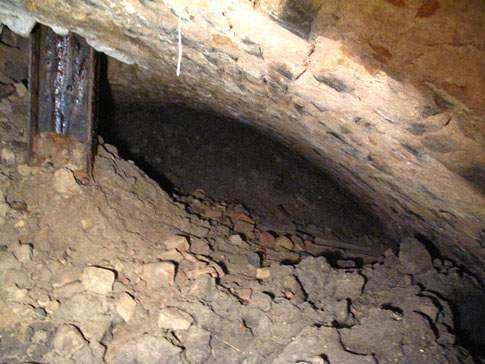
More investigation has been ordered for the 150-year old beer caves recently rediscovered under Interstate Highway 380.

That’s right, beer caves. During the summer, a routine inspection of a highway bridge revealed a small sinkhole nearby. An examination suggested there might be a couple of caves below the highway. Some geologists were called in. Using some sort of imaging device, they found at least 11 caves, and maybe as many as 14. The caves turned out to be storage for the Christian Magnus Eagle Brewery and Bottling Works. Back in the 1850s a pair of German immigrants established the brewery, and at one point were producing around 25,000 bottles of 4.5% beer annually. The brewery was built by Cedar Lake, and during the winter months the brewery workers harvested ice from the lake, which they put in the beer caves where the beer was stored.

Christian Magnus Eagle Brewery and Bottle Works (circa 1870)

Christian Magnus Eagle Brewery and Bottle Works (circa 1870)

The brewery was shut down during Prohibition, and then demolished in 1937. People forgot about the caves, and eventually a highway was built over the area. After the discovery of the caves, the Office of the State Archaeologist was called in to explore them. An archaeologist who went into the caves described them as “impossibly dangerous.” After fifteen minutes in the caves, he returned to the surface with a few photographs. The caves will most likely be filled in to stabilize the highway and bridge.

Beer cave

One of the many beer caves hidden below the highway

In non-beer-related news:

Man catches fire, gets help
Dave Allison heard a boom inside his business’s building. “Then I saw this young kid rolling out on fire.”

Allison said “I just did what anybody would do.” And what, you ask, would anybody do when faced with a kid rolling out on fire? “I took off my coat and went over there and smothered the flames.” Obviously. Who was the kid? What caused the fire? Who knows? But the kid caught on fire and he got help. What more would you want to know? Happily, Allison did not take photos of the flaming kid before helping him. Not every news story has photographs.

Not every story in the first section of the Sunday newspaper was local. The Des Moines Register recognizes that important news takes place outside of Iowa. Which accounts for this (presumably beer-related) story:

Nebraska fan hurt after hurdling Wisconsin taxi
A Nebraska football fan is nursing an injured face after he tried to hurdle a taxi early Saturday.

So the headline is misleading. The Nebraska fan did NOT actually hurdle the taxi. He only made the attempt. I declare, modern journalism is in a sad state. Still, it’s a story worth reporting.

Mr. Bryce Consbruck, 22 years old and apparently a fan of the Nebraska Cornhuskers, was in Madison, Wisconsin to watch his team play against the Wisconsin Badgers. Seriously. Cornhuskers and Badgers are the actual names of two college football teams. At any rate, young Mr. Consbruck decided, at around two o’clock in the morning, to…well, let’s read the newspaper account:

[H]e ran into traffic and tried to leap over the taxi. He missed and hurt his face.

Madison police described Consbruck as “intoxicated.” Quelle surprise! When the police officers spoke to Consbruck, he “responded with a profanity-laced statement expressing his hope that the Cornhuskers would defeat the Badgers.” He also apparently promised not to attempt any taxi-leaping in the future.

Consbruck was cited for (and I swear I am not making this up) Sudden Pedestrian Movement. He was taken to a local hospital for treatment. Also? The Badgers beat the Cornhuskers 59-24, thereby completely ruining young Mr. Consbruck’s weekend.

There you have it. All the news that’s fit to print. I knew you’d want to know.

it ain’t just the zombies

I’ve avoided writing about The Walking Dead because, as improbable it sounds, there are people who don’t share my perfectly normal interest in zombies. But almost everybody I know is interested in art and photography. The cinematography of TWD is always compelling — but sadly most zombie fans don’t recognize the artistry involved in constructing those shots. That artistry was apparent in the most recent episode.

A word of warning: this WILL CONTAIN SPOILERS.

wd1

In order to really appreciate the photography, it’s necessary to give a bit of background information. Here’s what you need to know: 1) a zombie apocalypse has taken place; only a few survivors exist, 2) everybody is infected with the zombie virus, though it’s dormant in the living, 3) a zombie bite is always fatal, 4) everybody who dies — including those who die of natural causes — becomes a zombie,  5) the only way to ‘kill’ a zombie is to destroy its brain.

A group of survivors has taken residence in an old prison, where they can live in relative safety inside its walls. However, some sort of lethal flu-like syndrome has infected many of the survivors — and when they die…you get the picture. The most recent episode is called Isolation. On the most obvious level, it refers to the fact that the survivors are attempting to isolate their members who’ve contracted the ‘flu.’

wd2

On a deeper level, though, the episode is about human isolation. The geographic isolation of the small group of humans in a world of hungry zombies. Their physical isolation inside the walls of the prison (which, after all, is designed to isolate convicts from the citizenry, and from each other). The medical isolation of the sick from the healthy. The psychological isolation of the survivors from each other. And the terrible emotional isolation of the individual survivors from their own feelings.

And all of that is depicted on the screen — through the writing and the acting, of course, but also through the camera work.

wd4

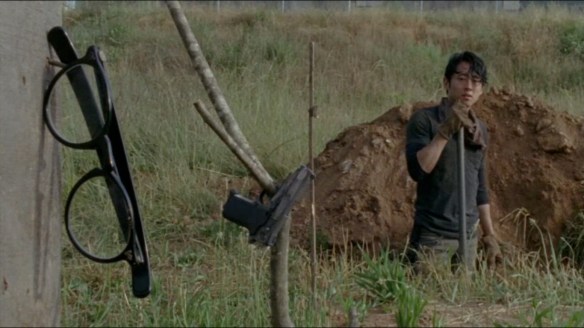
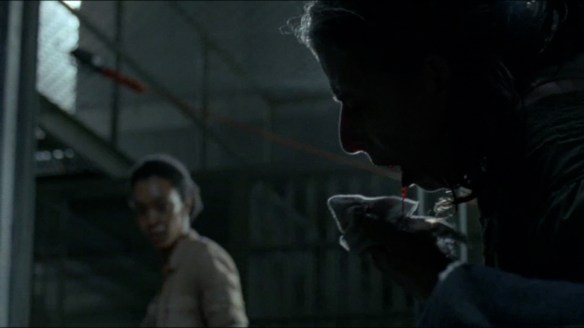
Notice how often the cinematographer uses the entire frame — not just from side to side, but from front to back. He deliberately stacks subjects on various planes within the frame. In the foreground of the first shot above we see a pair of eyeglasses attached to a simple grave-marker. Viewers will recognize the glasses as belonging to a young boy, the first victim of the mysterious flu. In the previous episode the boy died, became zombiefied, and had to be killed. In the middle-ground, a pistol — a killing tool, necessity in TWD world. In the background is Glenn, who is clearly exhausted — he’s exhausted both physically and emotionally, exhausted in almost every possible way (the boy with the eyeglasses was attacking Glenn at the time he was killed).

Everything in that shot — Glenn, the dead boy, the handgun — is linked thematically. Every element is isolated from the others. And yet every element is also inextricably linked to the others. The photography supports and enhances those themes.

wd7

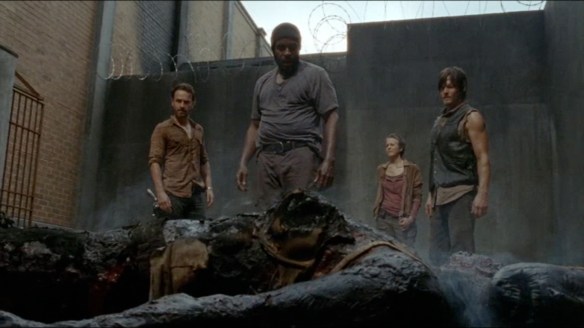
The same is true of the second shot. In the foreground, two bodies belonging to people who’d displayed symptoms of the illness. They’d been isolated; but somebody entered the isolation area, killed them, dragged their bodies outside, and set fire to them (much of the episode revolves around discovering who murdered these two). In the front middle-ground is the lover of one of the victims — a man obviously in shock. In the rear middle-ground are Rick and Daryl, leaders of the group of survivors. And in the background is Carol, the only one not looking directly at the bodies. At the end of the episode, Carol is revealed as the murderer.

Again, everyone and everything in the frame is thematically linked to everything else. And again, they’re all isolated from each other.

wd9

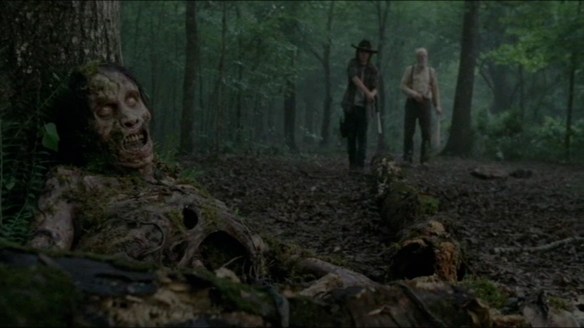
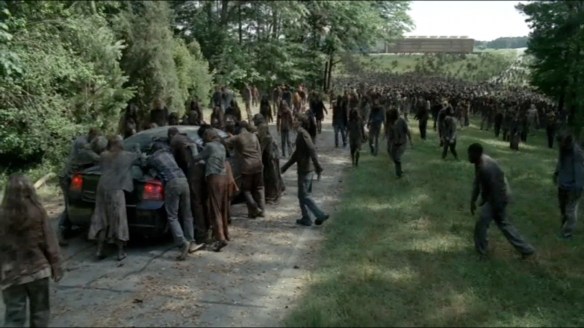
The director and cinematographer also use the frame to instill a sense of confinement. Everything seems to be crowding in on the characters. Even in the scenes that take place outdoors, the characters are somehow confined. In the woods they’re hemmed in by the trees, and by lurking zombies. On the open road — that most American venue — they find themselves quickly enclosed by a herd of zombies, trapped in the vehicle that’s supposed to grant them freedom of movement.

This happens in scene after scene in the episode. The frame is filled in every direction, thematically tight, and psychologically crowded. All those cascading claustrophobic moments create an aura of dread and despair in the viewer. It’s subtle, but very effective.

wd11

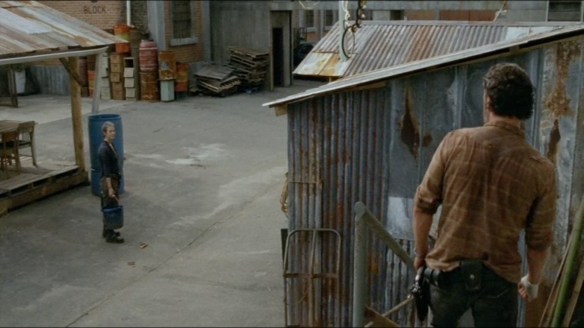
In the final sequence of the episode Rick is reluctantly preparing himself to ask Carol if she’s the person who killed and burned the two flu-sufferers. They’re filmed far apart; he’s high above her, in a rather judgmental position. She’s small and far below, waiting. He gradually comes down to her level — physically, emotionally, ethically — and asks the question he doesn’t want to ask.

The tension is palpable. She answers simply — yes. And walks away, the distance between them growing. And yet they’re both still linked, both still confined, both even more isolated.

I began watching The Walking Dead for the zombies. I still like it for that reason. Zombies are just flat out cool. But I appreciate TWD for the quality of the acting, the occasionally brilliant writing, and for the consistently amazing camera work.

happy birthday molly

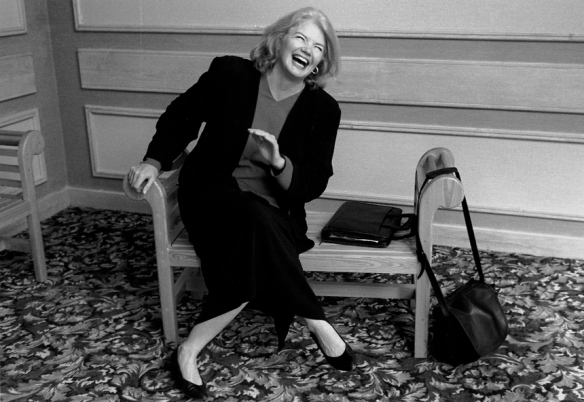
Today is the birthday of the late, great Molly Ivins. ‘Late’ on account of she’s been dead since 2007, which is far too long. ‘Great’ on account of she was the smartest and wittiest and sharpest political writer since the invention of political writering.

molly ivins1

Laughing Molly Ivins

I don’t recall the first time I came across Molly’s writing, but I’d been a fan for quite a long time before I ever saw her speak. I only saw her speak the one time. I was a grad student at the American University back in 1990 or 91, and I heard she was going to be interviewed at some local event. So I put on a sport coat and a tie and took myself to some grand Washingtonian venue and joined the other couple hundred folks who’d come to hear Molly speak.

I don’t know what I was expecting, but it wasn’t the tall (in her cowboy boots she had to be over six feet tall), awkward-looking woman with the unfortunate haircut (it looked like she’d cut her own hair…with pinking sheers) who walked onto the stage. Then she sort of dropped herself into a wing-backed chair and grinned — and there was so much joy and delight and orneriness in that grin that I completely fell in love with her. She grinned like a pirate.

I couldn’t tell you what she talked about. I just don’t recall. What I do recall is that she was charming and clever and thoughtful and uproariously funny. I don’t know if she was exaggerating her drawl or if she was moderating it, but there was no doubt Molly Ivins was from Texas. And laugh…lawdy, that woman could bring a laugh. Nothing demure about it; she laughed all the way down to her boots.

Young Molly Ivins

Young Molly Ivins

It was the breast cancer that killed her. One more reason to hate cancer and donate money to kick its ass.

“Having breast cancer is massive amounts of no fun. First they mutilate you; then they poison you; then they burn you. I have been on blind dates better than that.”

That was Molly Ivins. She’d bring you the Truth in all its ugliness. And she’d make you laugh about it. She didn’t make light of it, she didn’t want you to ignore the ugliness; she wanted you to feel the sting of the ugly. But she didn’t want you to forget to laugh. She didn’t want you to forget that having fun isn’t just how we tolerate the ugly. It’s how we defeat it.

A few of my favorite lines from our Molly:

[W]e’ve bounced back from this same mistake before—the mistake of thinking that we can make ourselves safer if we just make ourselves less free. We get so scared of something—scared of communism or crime or drugs or illegal aliens—that we think we can make ourselves safer by sacrificing freedom.  Never works.  It’s still true: the only thing to fear is fear itself.

I don’t have an agenda, I don’t have a program. I’m not a communist or a socialist. I guess I’m a left-libertarian and a populist, and I believe in the Bill of Rights the way some folks believe in the Bible.

A populist is someone who is for the people and against the powerful, and so a populist is generally the same as a liberal—except we tend to have more fun.

In Texas, we do not hold high expectations for the [Governor’s] office; it’s mostly been occupied by crooks, dorks and the comatose.

I dearly love the state of Texas, but I consider that a harmless perversion on my part, and discuss it only with consenting adults.

I have been attacked by Rush Limbaugh on the air, an experience somewhat akin to being gummed by a newt. It doesn’t actually hurt, but it leaves you with slimy stuff on your ankle.

So keep fightin’ for freedom and justice, beloveds, but don’t you forget to have fun doin’ it. Lord, let your laughter ring forth. Be outrageous, ridicule the fraidy-cats, rejoice in all the oddities that freedom can produce. And when you get through kickin’ ass and celebratin’ the sheer joy of a good fight, be sure to tell those who come after how much fun it was.

Aw lawdy, that was a woman. They say the good die young. I don’t know about that. What I do know is this: the great die too soon.

The late, great Molly Ivins

The late, great, beautiful Molly Ivins

Happy birthday, Molly Ivins. We miss you.

on-a-stick

Here’s one of the reasons I love history. The very first Iowa State Fair opened on 25 October, 1854. On that very same day, on the Crimean Peninsula some 5200 miles away, British light cavalry troops went barreling down a valley in a suicidal assault on entrenched Russian forces — the infamous Charge of the Light Brigade.

The first Iowa State Fair lasted three days and had an attendance of about 7,000 visitors. Nobody died. The Charge of the Light Brigade lasted about half an hour and involved nearly 700 men; 156 of them were killed (along with 335 horses), and another 122 were wounded.

Tennyson, of course, wrote a stirring poem romanticizing the pointless slaughter of the Light Brigade. I think the world would have been a better place if he’d written a poem about the grand prize-winning sheep at the Iowa State Fair, or food-on-a-stick. It’s not as dramatic, to be sure, but I believe we could do with much less “Theirs not to make reply / Theirs not to reason why / Theirs but to do and die” and more food-on-a-stick.

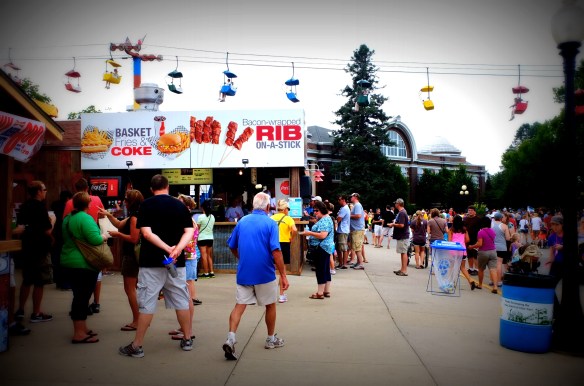
Bacon-wrapped Barbecued Rib on a Stick

Bacon-wrapped Barbecued Rib on a Stick

This year there were more than sixty (60!) foods served on-a-stick, most of them either deep-fried, wrapped in bacon, or covered with chocolate (or at least two of the three). There was the Shrimp Corndog On-a-Stick, the Soft Salted Chocolate Dipped Almond Pretzel On-a-Stick, Peanut Butter and Jelly On-a-Stick, Chocolate-Covered Key Lime Dream Bar On-a-Stick, a Hard-boiled Egg On-a-Stick, Chocolate-Covered Deep Fried Cheesecake On-a-Stick, Lamb Sausage On-a-Stick, Turkey Sausage Wrapped in a Pancake On-a-Stick, a Smoothie On-a-Stick, Chocolate-Covered Turtle Mousse Bar On-a-Stick, a Deep Fried Double Bacon Corn Dog On-a-Stick, Pork Chop On-a-Stick, a Deep Fried Snickers On-a-Stick, Fresh Pineapple dipped in Funnel Cake Batter and Deep Fried On-a-Stick, Sesame Chicken On-a-Stick and I think I’ll stop there.

Sadly, this year there was no Chocolate-Covered Fried Bacon On-a-Stick — the State Fair Food Trifecta.

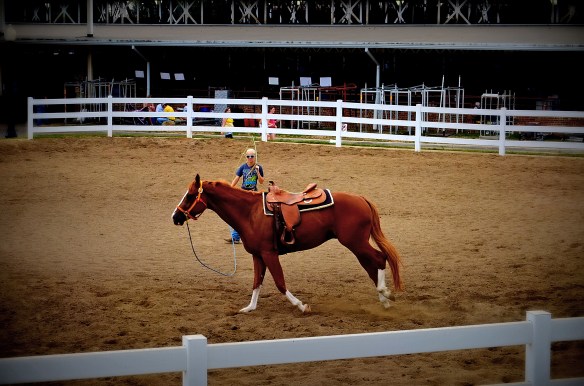
Exercising a horse

Exercising a horse

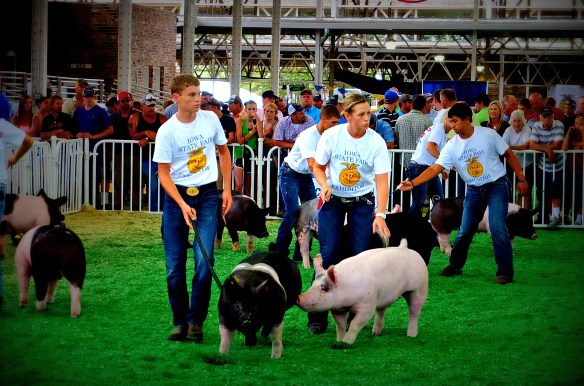
Food and animals (and animals raised to be turned into food) are a significant part of the fair. I’m pretty much a dunderhead when it comes to agriculture, but I enjoy wandering through the various animal barns and looking at the livestock. I can tell a horse from a cow, and a cow from a sheep, and a sheep from a pig — but one horse looks pretty much like another horse to me, and while I’m sure individual swine have distinct personalities, don’t ask me to tell one from the other.

But the kids who raised them can tell them apart. No doubt adults take a great interest in the livestock judging, but it’s almost always young teens who are in the ring with the animals. There’s something very sweet and innocent about watching these earnest young folks show the animals they’ve raised (of course, you have to ignore the fact that those pigs might turn up next year on the Iowa State Fair menu — and, in the case of the bacon-wrapped barbecued rib, some of them could turn up twice).

Pre-show warm-up

Pre-show warm-up

Showing the livestock isn’t just a matter of pride, of course. There are cash prizes for the winners. Not just the winners of the livestock competitions, but also the winners of the best zucchini, the best needlepoint, the best peach preserves, the best hog caller (I’ve no idea how one judges hog-calling), the best of just about anything related to farming or produce. How much money? About half a million dollars, spread out among the winners of some 60,000 exhibitors. It’s a big deal, winning at the Iowa State Fair.

The fair was given its permanent location in 1886. The fairgrounds covers 445 acres (160 of those acres is devoted to campgrounds for fair-goers and exhibitors). Most of the primary buildings were constructed in the early 1900s. They’re lovely old buildings, well-maintained and preserved. Although the Agriculture Building (home of the Butter Cow) was built in 1904, it’s a classic example of late-19th century exposition style architecture. It would have been easy for the State Fair Authority to tear down these old buildings and replace them with more modern structures, but to their credit they’ve resisted that temptation.

Pioneer Hall, built in 1886

Agriculture Building, built in 1904

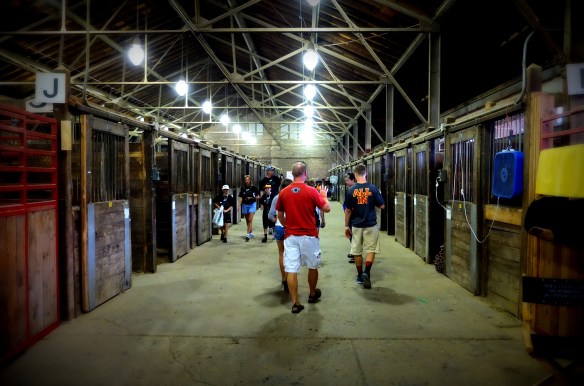
I often visit the fairgrounds during the off-season just to walk through the massive old barns and structures. One of my favorites is the Horse Barn, built in 1907. We’re talking about two acres of brick and stone and metal girders — that’s more than 87,000 square feet. In other words, it’s a really big fucking barn. It has nearly 400 stalls; during the fair they’re almost all filled with really big fucking horses. And to be honest, even during the off-season the place smells faintly of old hay and horseshit. But I find it weirdly lovely, and I don’t mind the smell. Much.

Horse barn

Horse barn

One of the things I love about the Iowa State Fair is the celebration of useless skills. Let’s face it, nobody really needs a blacksmith anymore. But you have to love the fact that there are people still using a forge to work iron and steel, people still weaving basketry by hand, people throwing pottery and canning jam and quilting and brewing ale and growing Fairhope miniature roses.

The fair not only awards prizes to folks who do those things well, they provide space for people to give demonstrations of their skills. In one building you’ll see a guy working iron, in the next building you’ll see somebody painting miniatures on wood, or weaving a rug out of alpaca hair, or using a pocketknife to whittle a birdcage from a single block of wood. It may be silly and archaic, but it’s also pretty wonderful.

Working iron

Working iron

And then, of course, there’s the Midway. That’s the term used in the U.S. and Canada for an area deliberately separated from the exhibition sites and designated for various forms of entertainment. The term ‘midway’ was coined during the great Chicago World’s Columbian Exposition, held in 1893 (Columbian because it was the 400th anniversary of the arrival of Christopher Columbus to the New World — and yes, it was actually the 401st anniversary and yes, there’s absolutely no connection between Columbus and the city of Chicago, but don’t blame me; I’m just explaining the origin of the term).

The Midway is where you’ll find the games of chance (in which chance rarely plays a part), the very worst forms of fair food (which is saying something), amusement rides (designed, I’m convinced, to provoke the regurgitation of fair food), and other sources of pleasure and delight.

The Midway

The Midway

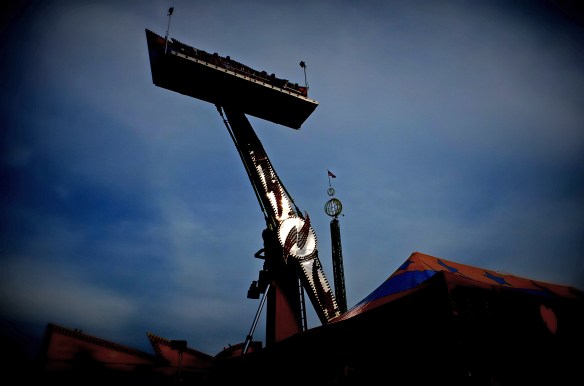
The Midway is the gaudiest, noisiest, smelliest, craziest, drunkest, annoyingest, and most aggressively fascinating part of the fair. This is what the Iowa State Fair has instead of the Charge of the Light Brigade. There’s an aura of self-destructiveness that infuses the air of the Midway. All the things you know you probably shouldn’t do are available here. The Midway is where you’re most likely to step in puke, most likely to see a fistfight, most likely to see tattoos in the most unlikely places, most likely to Death Metal t-shirts, and most likely to win a giant plushie banana.

More of the Midway

More of the Midway

The Midway reaches its peak madness hours after dark — which is why I tend to leave before twilight. I have grown older and wiser and less tolerant of noise and vomit and drunken bikers. But I’d be lying if I said I didn’t like the Midway. No state fair experience is complete without a trip through the Midway.

On the periphery of the Midway you can find the more tame amusements — the ones designed for children. You can’t always see the children’s rides, but you can locate them by the wide fringe of camera-toting parents surrounding them.

Super Slide

Super Slide

I spent about six hours noodly about at the Iowa State Fair, and that was enough. I didn’t get to see everything I’d wanted to see, but still I managed to eat a Bacon-wrapped Barbecued Rib On-a-Stick, a Deep Fried Pork Tenderloin with Bacon on the Inside and Outside, and a Deep Fried Hostess Twinkie On-a-Stick (surprisingly without bacon).

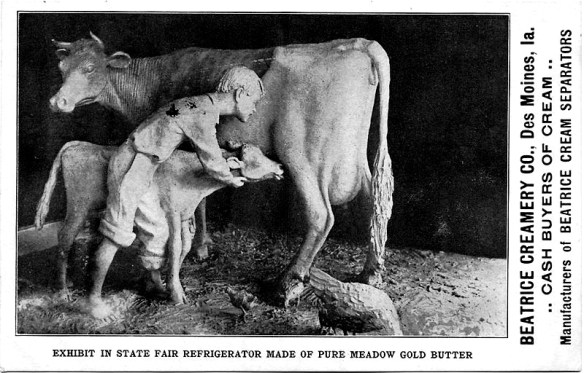
It wasn’t until I was driving home that I realized I’d neglected to see the Butter Cow. That’s been an Iowa State Fair tradition since 1911 — a life-sized cow carved out of around 600 pounds of butter. Each year since 1996 (Iowa’s Sesquicentennial) there’s also been a companion butter sculpture. That first year it was a butter version of Grant Woods American Gothic (I swear, I’m not making this up). There have also been butter versions of Elvis, Da Vinci’s The Last Supper, John Wayne (honest, I’m really not making this up), a Harley Davidson motorcycle, Tiger Woods (don’t look at me, I’m just reporting this), Neil Armstrong’s walk on the moon, and Harry Potter.

1911 Postcard of the original Butter Cow sculpture

1911 Postcard of the original Butter Cow sculpture

This year the companion sculpture was a butter Abraham Lincoln (in honor of the centennial of the completion of the Lincoln Highway, which runs through Iowa). That’s the Iowa State Fair — a bacon-wrapped barbecued rib on-a-stick, a pig that weighs over 1000 pounds (did I forget to mention the largest pig and cow competitions?), and the Great Emancipator carved from a solid chunk of churned cow’s milk.

Ain’t that America.

The Room

I like games. I love games. I love ‘play’ as a concept, and as an activity that’s absolutely fundamental and necessarily integral to a meaningful life. There’s been an element of ‘play’ in everything I’ve ever done for as long as I can remember. I’ve never held a job that didn’t allow me to include ‘play’ in some manner. Even when the job was deadly serious, there was always the potential for ‘play’ in it somewhere.

So I love games — but I’m not really a gamer. Not in the modern sense of the term. I don’t spend much time playing video games, primarily because so many of them are goal-directed. Achieve this, attain that, increase in level, gain points, compete against your friends, maximize your scoring potential, win.

Don’t get me wrong. I can be ridiculously competitive in some things, and I like winning. But for the most part, it’s not what drives me. What drives me is being immersed in the experience of the game, deeply engaged in playing it. The outcome is secondary. Or even tertiary.

I’m talking about all this because I got an email from a friend who knows how I feel about play and games. The subject line of the email: Here, look at this. And the text of the email:

I downloaded this on my phone. I fucking hate it. It’s all about observation and thinking and logic and intuition and solving puzzles and the music totally fucking creeps me out. It’s everything that makes me nuts in a game. It made me think of you. You’ll love it.

And it included a link to this teaser:

So I downloaded the game to my new phone. I think it cost me two bucks. It’s the only game app I’ve put on my phone. And my friend was right. I love it.

There’s a narrative behind it, but I really don’t care (which in itself is odd, because I’m usually all about the narrative). I’ve not finished the game yet, and I’m in no hurry to do that (well, I’m in an absolute hurry to finish only in the sense that I want to keep playing; but I’m in no hurry in that I want it to last). The experience is satisfying in the way solving any puzzle is always satisfying. But the game designers understand that solving the pleasure of solving the puzzles is enhanced by the visually rich environment and the sweet and peculiarly creepy music. It’s so good that I’m parceling the game out, which seems awfully Protestant of me — like it’s a reward for doing the things I’m actually required to do. There’s apparently something to all that ‘delayed gratification’ business.

I have no idea if I’m almost done with the game, or if I’ve just begun, or if I’m somewhere near the middle. If it ends after I’ve solved the next puzzle, I’ll be disappointed. Not by the game itself, but only because it’s over.

Now I have to make myself some lunch, log in a couple hours in reviewing my students’ homework, and then back to The Room.

llamas on parade

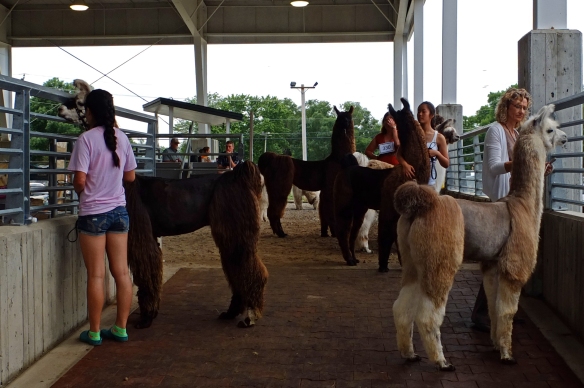
I was surprised to learn the Llama Futurity Association, in conjunction with the International Llama Registry, was having its 2013 World Championship Show & Sale this weekend. In fact, I was surprised to learn there was a Llama Futurity Association and an International Llama Registry. But they actually exist and they were having a llama show.

I’d never in my entire life been to a llama show before. Not once. This one promised to have pack trials (I still have no idea what llama pack trials are), costume classes (sadly, the costume event was held earlier — but c’mon, llamas in costume? It is to swoon), a llama cart pulling competition (which I assume involves llamas pulling a cart), and a live auction (in case you wanted to buy an extra llama while you’re there). Was there any way I was going to miss what might be my only chance to see an international and world llama event? Hell no.

Llamas all around

Llamas all around

When we arrived, there were two events underway. The main event was a sort of llama conformation judging. Like the Westminster Kennel Club, only for llamas. A man in a burgundy coat was examining groups of llamas with a critical eye. He had them stand, he had them walk in a circle, he had them…well, stand and walk in a circle. That was pretty much it. Then he’d frown a bit and point at one, then arrange them in some sort of order and everybody mostly seemed pleased.

I confess, I didn’t give much attention to the llama conformation event, though I’m sure it was fascinating. But somebody mentioned that at the same time, at the other end of the arena, was — and I swear I’m not making this up — a llama agility trial.

Llama standing on a square

Llama standing on a square

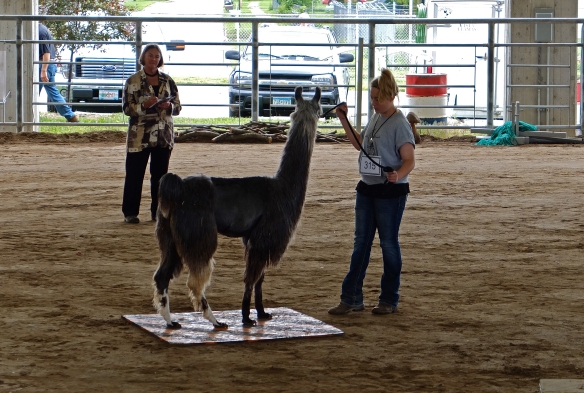
It was described to me as the llama equivalent of a dog agility trial. As it turned out, that was a rather generous description. There was certainly an agility course — a set of standard obstacles laid out — and the entrants were required to attempt the course while an impartial judge evaluated the animal’s success at each obstacle. And it was certainly a trial for many of the contestants, both human and camelid. But the concept of agility was stretched pretty thin.

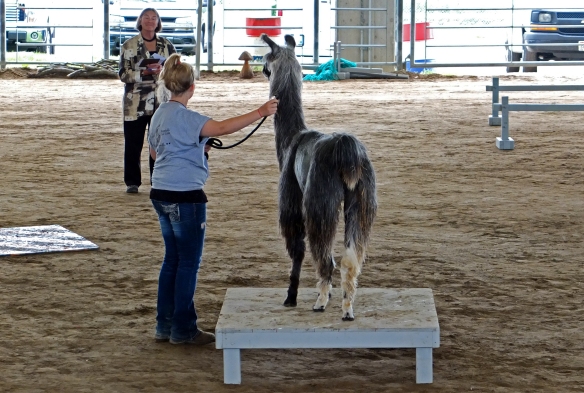
Llama standing on a raised square

Llama standing on a raised square

The llamas were required to 1) walk under an object, requiring them to lower their heads a few inches, 2) stand on a square, requiring them to stand still with all four hooves on the square, 3) stand on a platform, which was basically a square elevated to a height of maybe six inches, 4) hop over a pair of jumps approximately a foot in height, 5) walk up a ramp, turn a corner, and walk down the ramp without falling, 6) walk backwards for about a meter, 7) walk sideways for about a meter, 8) walk through a puddle, and 9) walk through a short tunnel.

Llama walking on a ramp

Llama walking on a ramp

Now, this may sound silly. And in some sense it is — it really is. Unlike dogs, many of whom seem to really enjoy running agility obstacles (or at least enjoy the interaction with their handlers), the llamas clearly didn’t give a rat’s ass about the trial. They were mostly willing to be led through the obstacles, but it didn’t take a llamaologist to see that, given the chance, they’d have preferred to just be standing around looking dignified.

llama walking backwards

Llama walking backwards

I’m told llamas are intelligent animals, and I’ve no reason to doubt that. They have a sort of lofty poise, and carry themselves with solemn stateliness. But I’m not sure anybody could claim they’re particularly agile. Only one of the llamas I watched actually completed the course without incident. With that single exception, the llamas were entirely dismissive of the small jumps; most of them just strolled right through them, not even bothering to acknowledge their existence. It was as if they were too polite to point out that some ill-bred rascal had inadvertently cluttered up the area with some planks.

Llama walking sideways

Llama walking sideways

What kept this event from being completely comical was this: the love and affection felt by the handlers for their llamas. They wanted their animals to do well, to be sure, but mostly they just seemed to enjoy being actively engaged with them. It was rather sweet to watch them together, even when the animals appeared absolutely puzzled about why in the world this human expected them to walk sideways (if llamas had thought balloons, there would have been dozens that said I’m terribly sorry, but I just don’t understand the point of this.)

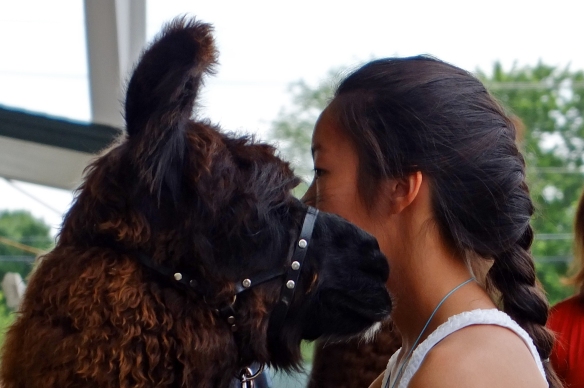
One of the things that surprised me (and there were a lot of things that surprised me) was that most of the llama handlers were women — primarily young women. In fact, women seemed to be in charge of almost every aspect of the entire llama-fest. There were men and boys there, of course, and a few of them participated in the activities (it also appeared that most of the judges were men), but everywhere I looked it was women who were making things happen and keeping things running smoothly.

A girl and her llama

A girl and her llama

There’s something wonderful about events like this. There’s no money in it; the only reward is the pleasure of participating. These people brought their llamas (and a handful of alpaca) from all over the U.S. simply out of passion. And that’s beautiful.

So sure, the notion of a llama agility trial is absurd. Who cares. These folks were having fun, and the llamas didn’t seem to object very much. I’d be hard-pressed to find a better way to spend a couple of hours on a Saturday afternoon.