This morning, for the first time in a year, I actually wanted to read the news. For the first time since the darkness dropped again and Comrade Donald Trump slouched back into the White House, I actually looked forward to reading the news.
Because the news was good. Not just because Democrats won, and not just because they won by larder-than-expected margins, and not just because they won from coast to coast. The news is good because of the way they won. The ways they won, I should say, Because the way they won in New York City was different than the way they won in New Jersey and in Virginia. That confuses the pundit class.
Today there will be a LOT of pundits claiming Zohran Mamdani is the new face of the Democratic Party. Nope. He’s the face of the Democratic Party in New York City. Mikie Sherrill is the face of the Democratic Party in New Jersey, and Abigail Spanberger is the face of the Democratic Party in Virginia. We don’t have–we don’t need or want–a single face to represent the Democratic Party. We want a variety of faces and a medley of different voices all dedicated to civil rights and the needs of working people. This morning, we have more of that.
But we need still more. We want and need Democrats who will not just speak out against MAGA fascism in the US, but who will actively resist it. MAGA should be worried about last night’s electoral results, but the people who should be actually scared are the impotent Old Guard of the Democratic Party. They’ve convinced themselves that they’re helpless and weak against MAGA; they’ve allowed themselves to be cowed by Trump, they’ve been too timid to fight back. These election results are also a warning for them–either stand up and fight for democracy or get the fuck out of the way.
Yes, the news this morning is good. We should celebrate it. We should take as much joy as we possibly can from it. And then tomorrow (or what the hell, next week) we have to get back to work. The results of this one election isn’t going to turn the nation around. The US is still massively fucked up. It will remain massively fucked up for the near future. But this morning we see evidence that, with hard work, we can begin to unfuck the nation. That’s what I call good news.
So, in the words of the philosophers Kool & the Gang, “Let’s all celebrate and have a good time.”
The only thing I know about keeping livestock is…okay, I don’t know anything about keeping livestock. I mean, I know it’s hard work. I don’t know that from experience, since I’ve never kept livestock, but even sharing space with a pet (cats and dogs, certainly, and probably birds and lizards, what do I know?) means cleaning up after them. Even the tidiest of cats uses a litterbox and somebody has to deal with that.
Why am I talking about this? Because looking over the photographs I took at the recent Iowa State Fair, I noticed I have a lot of photos of farm people cleaning stuff. Cleaning their animals, cleaning the gear needed to take care of their animals, cleaning the things their animals pull, cleaning up massive amounts of animal shit. Everywhere I went, men and women and kids were busy cleaning.
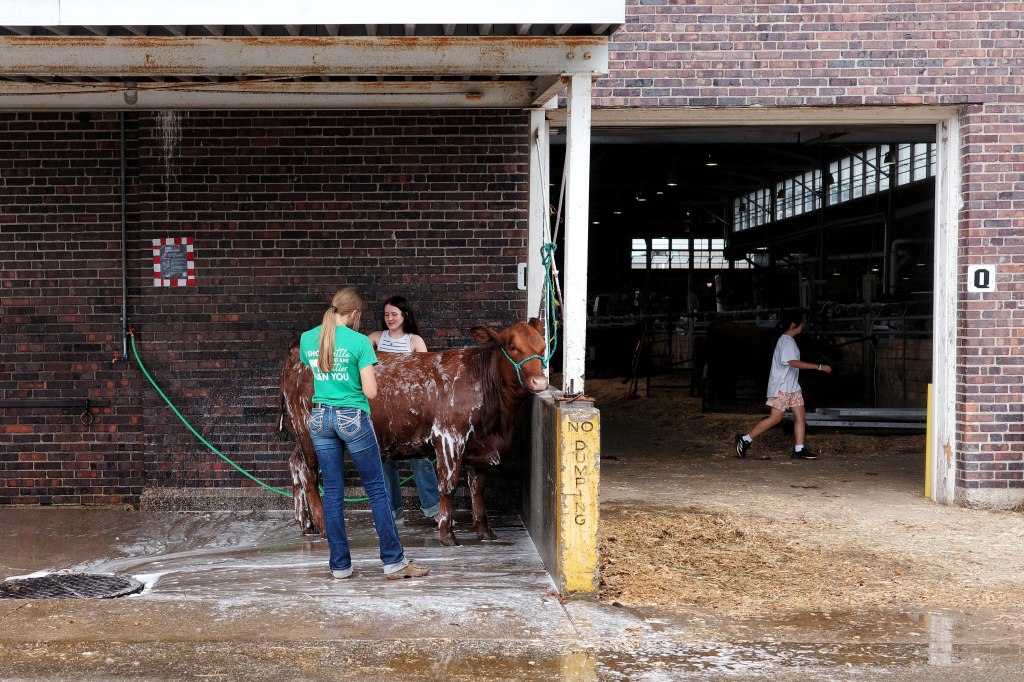
Cooperative cow-washing.
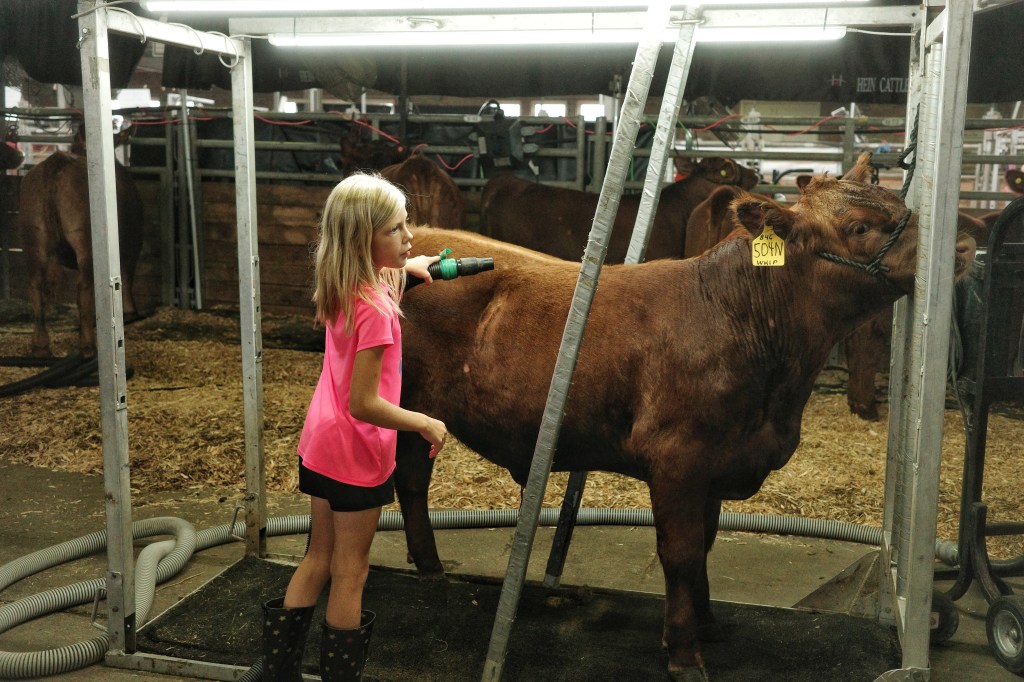
And when I say ‘cleaning their animals,’ I don’t mean they were just washing them (although there’s an astonishing amount of animal-washing going on all the time). I mean they’re shampooing them, blow-drying them, combing them, trimming them, vacuuming them.
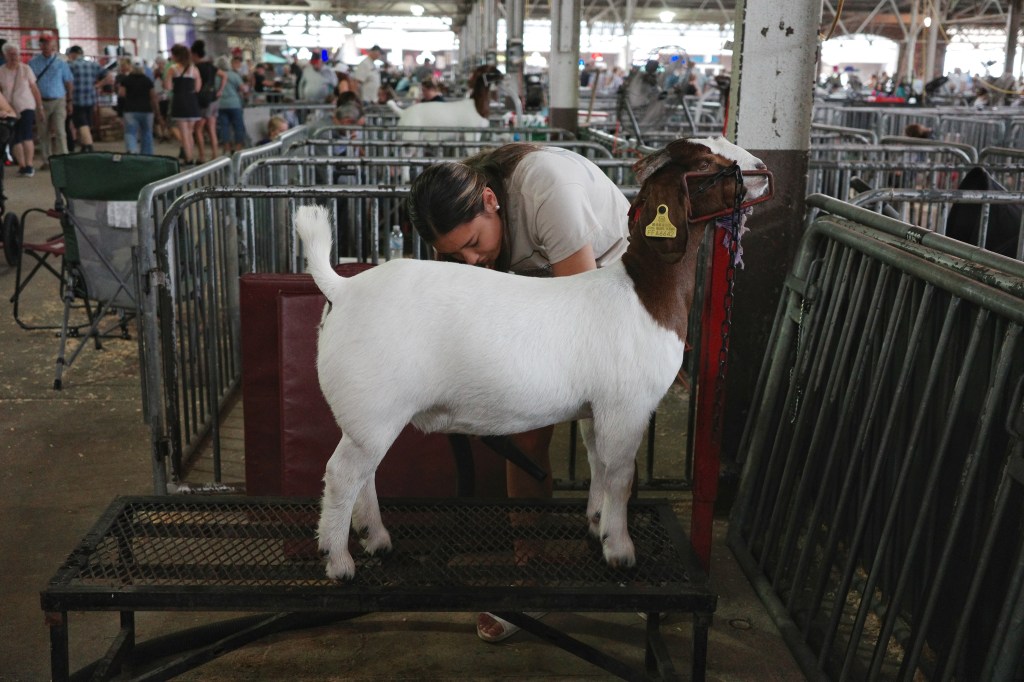
A little light goat-vacuuming.
Seriously, people were vacuuming off…something, I don’t know what. Loose hair? Dandruff? Barn grit? No idea, but everywhere you go in the animal barns at the fair, there are men and women and kids vacuuming their livestock.
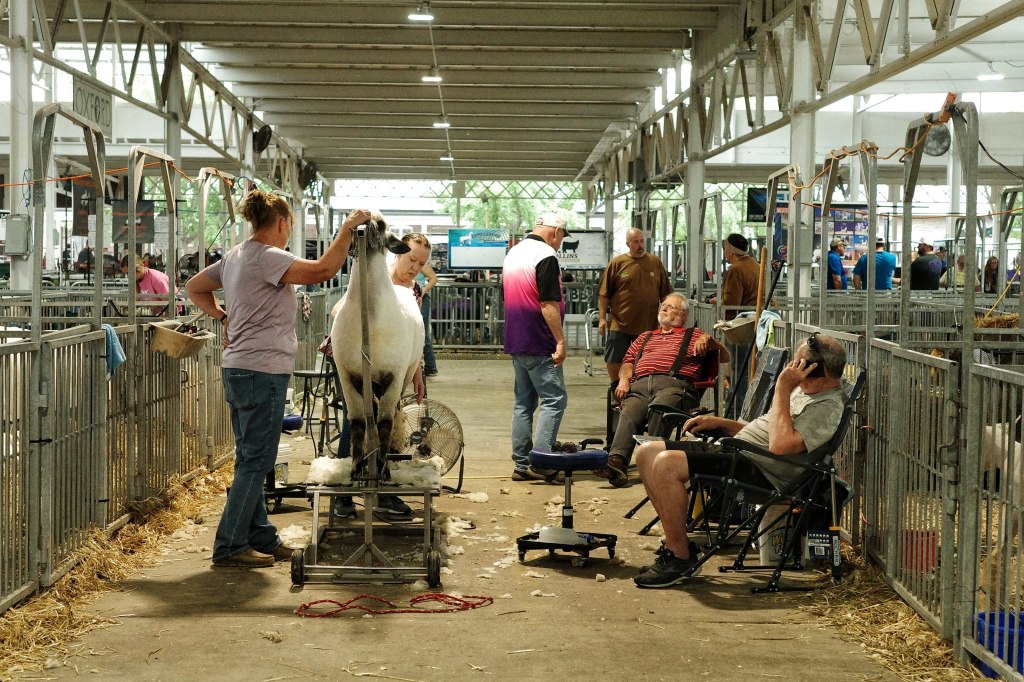
Women grooming sheep while men sit and chat.
These animals weren’t just being cleaned; they were being groomed. Meticulously groomed. (Okay, sorry, a slight tangent here. The term groom has a slightly hazy etymology. It’s probably(?) related to the Old English growan, meaning ‘to grow.’ At any rate, by the 14th century groom referred to a male servant who attended to officers (and their gear and horses) in a noble household. By the 19th century, the noun had been verbed, and groom referred to the process of tidying up or preparing for a purpose. So groom referred to both a person and what the person did. I don’t know why I thought you needed to know that, but there it is.)
A young girl vacuuming (or blow-drying) a cow.
As I was saying, these livestock animals (and I’m talking about cows, horses, pigs, goats, sheep, llamas, alpacas (is that the plural of ‘alpaca’?), rabbits, and chickens (do rabbits and chickens count as livestock? No idea.) are meticulously groomed. It’s clear that some of the grooming is done in the hope of winning a prize, but it was also clear that much of it was done out of pride and affection. That was especially true of the younger people.
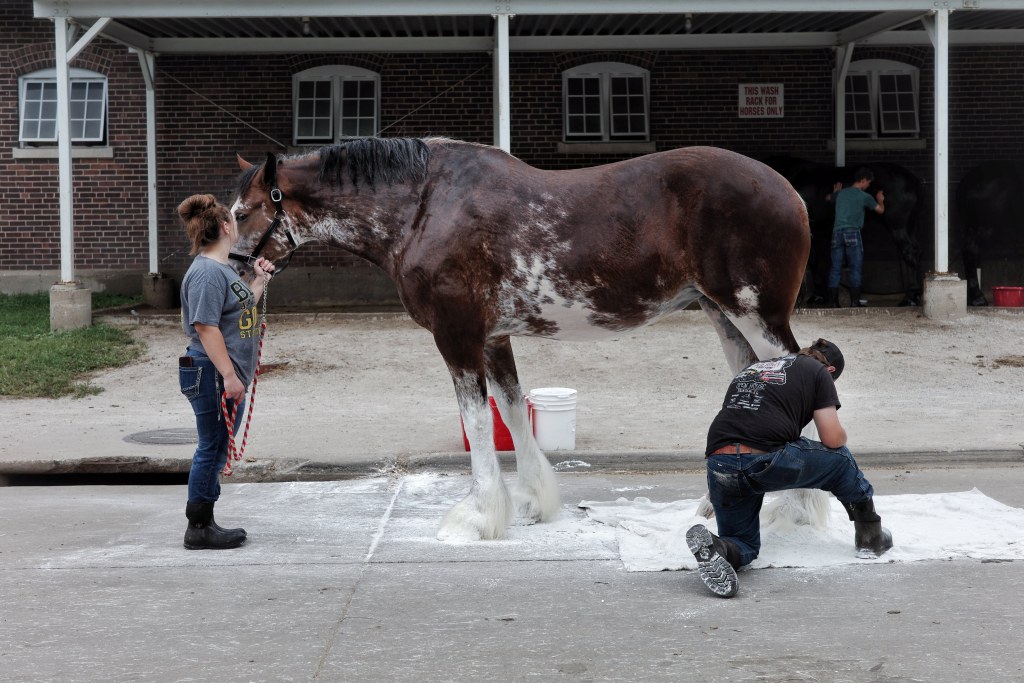
Equine pedicure.
Here’s a thing you probably need to understand. All this cleaning and grooming? It’s taking place in and around massive cooperative barns housing hundreds of animals. Animals are noisy, so these barns are a constant barrage of animal noises. Also? Animals shit and piss a lot. I mean, a LOT. And they’re not particular about where or when they do it. So even though there’s a constant stream (so to speak) of people shoveling, sweeping up, and carting of waste products (the logistics of livestock waste management must be staggering), the fact remains that these massive barns…well, they smell like you’d think they’d smell, but not as bad as you’d expect.
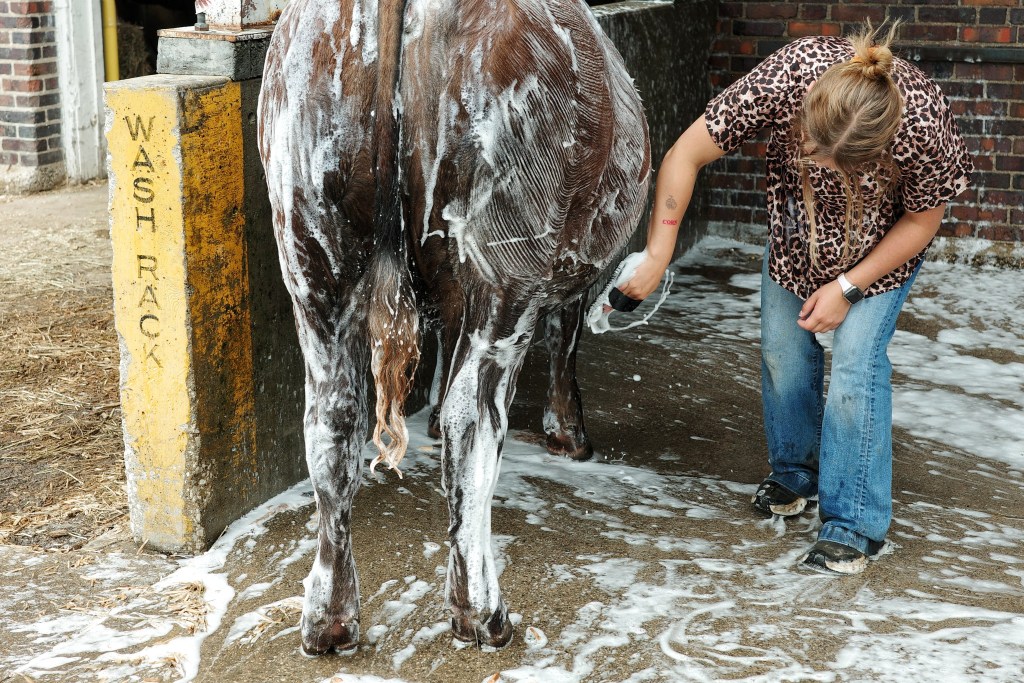
Bovine shampoo.
What I’m trying to say here is that there’s an astonishing amount of hard work done by the farm families who bring their livestock to the fair, and all that work makes the environment as pleasant as possible. One of my reasons for visiting the animal barns during the State Fair is to look at animals, of course, but it’s also to see this remarkable group of people cobble together a shared sense of community. There’s something very tribal about it. And as a sociologist by training, it’s fascinating.
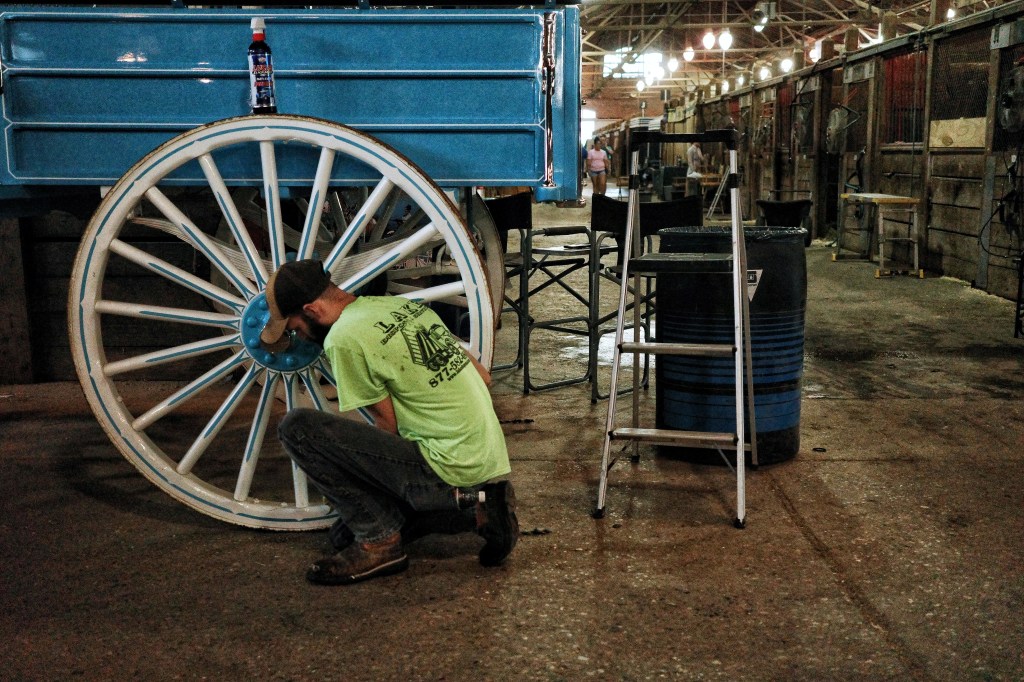
Detailing a wagon wheel.
But here’s the problem with being a sociologist: I know that the farming community I see at the State Fair is, largely, a myth. Around 40% of farms in Iowa are owned by corporations. Modern farming, even among non-corporate farms, is a business more than a self-sufficient way of life. The farming life we witness at the State Fair is something of a sentimental homage to an idea of rural living from the past. An homage grounded in nostalgia and an agrarian myth.
But so what? I’d argue there’s value in that. The fact is, it’s not corporations who are grooming their livestock at the State Fair. It’s not corporations who are hauling manure and polishing wagon wheels. It’s families doing that.
My visits to the State Fair animal barns always leave me impressed (and yes, a wee bit stunned by the smell and noise). I leave those barns profoundly grateful there are people–families–still willing to do the hard work of making sure the world gets fed. As myths go, this is a pretty damned good one, and I’m glad folks are keeping it alive.
A couple of days ago I wrote about a photograph I’d taken of some cracks and oil stains in a random patch of blacktop. It may seem a wee bit weird to photograph a patch of blacktop, but…well, just wait. In that post, I briefly referred to the fact that there’s a difference between blacktop and asphalt. That sparked a reply to the post, and that reply reminded me of an earlier crushed stone and bitumen-related photograph I’d taken fifteen years ago.
Now that was weird.
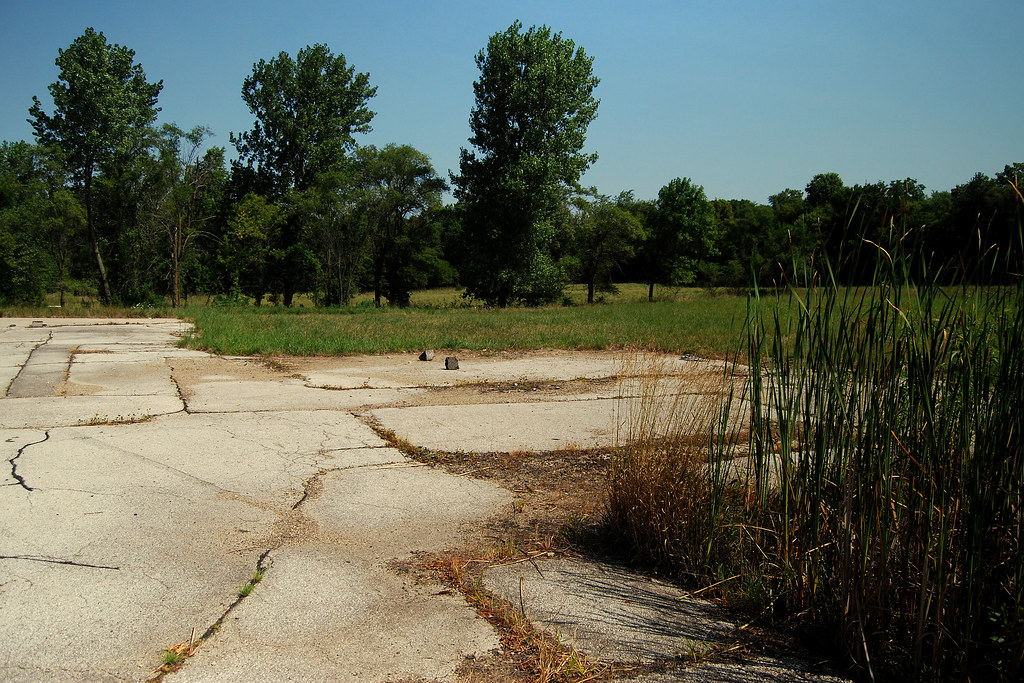
Back in November of 2010 I was noodling around a location where a local supermarket had been demolished. All that remained of the store was its foundational slab and what had once been a parking lot. That’s where I came across something odd.
November 13, 2010
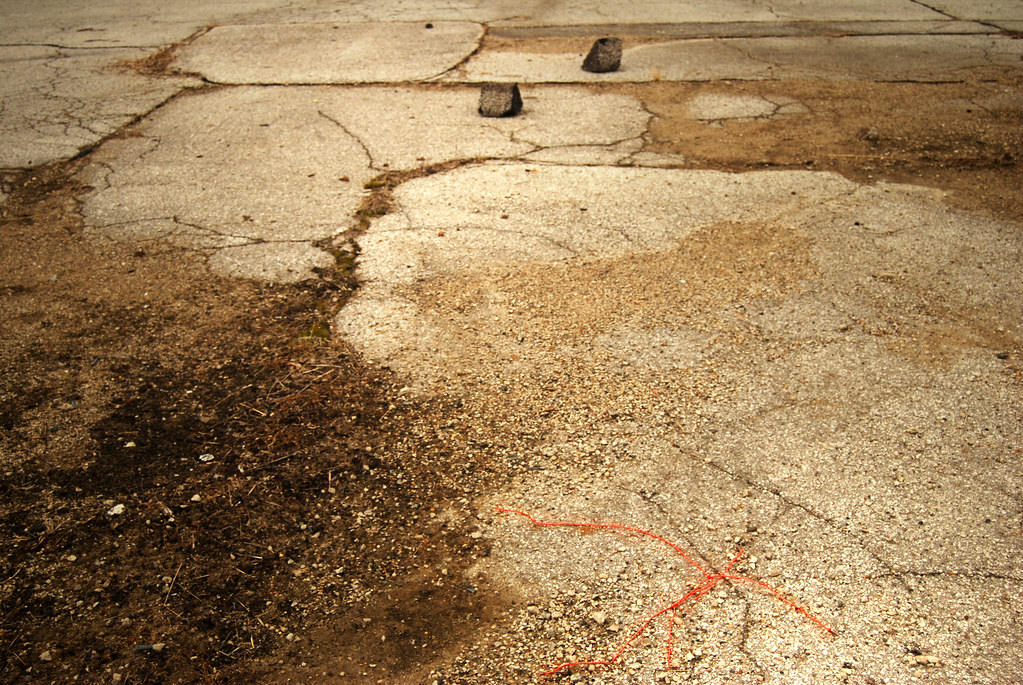
Yep, that’s a chunk of asphalt curbing around which somebody had tied a strand of red PVC-coated wire. Why would somebody do that? I don’t know, but I assumed it was to make it easier to carry. Why would somebody want to carry a chunk of asphalt curbing? No idea. I located the spot from which the curbing had been removed about 20 yards away. There were several similar chunks of broken asphalt curbing. But somebody had selected that particular chunk, tied red PVC wire around it, and moved it.
Why? No fucking clue. But it was odd, and I do love things that are odd.
December 23, 2010
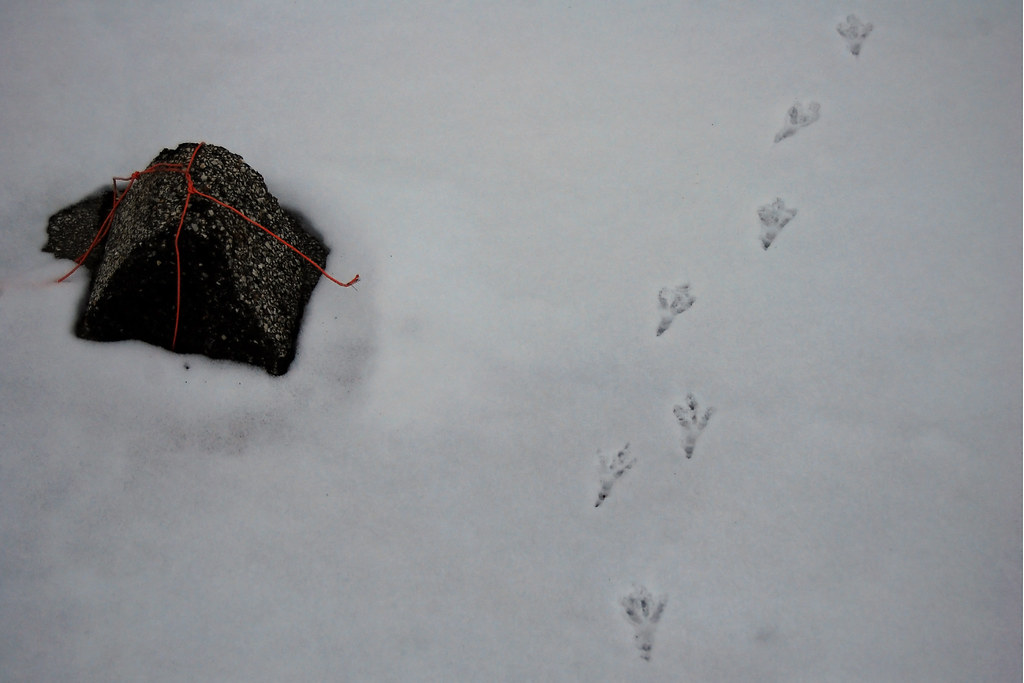
So I returned to that spot about six weeks later. The chunk of curbing was still there. It had snowed, but the snow had melted off the chunk. A heron had apparently been curious enough to check it out. Not sure if that meant the heron was as curious as I was, or if I was as stupid as a heron.
Anyway, I stood there in the snow for a while, trying to cobble together some semi-logical reason for somebody to tie some PVC wire around a chunk of curbing and carry it twenty yards before dropping it. I was sure there was a logical reason; not necessarily logical to me, but logical to the person who did it. But I’m damned if I could figure it out.
February 16, 2011
I found myself occasionally wondering about that chunk of curbing and the red PVC wire. Did the person just happen to have some red PVC wire in their pocket? Had they deliberately brought the wire with them, intending to move the chunk of curbing? And why why why would they want to move it in the first place? It made no sense, but I was intrigued by it.
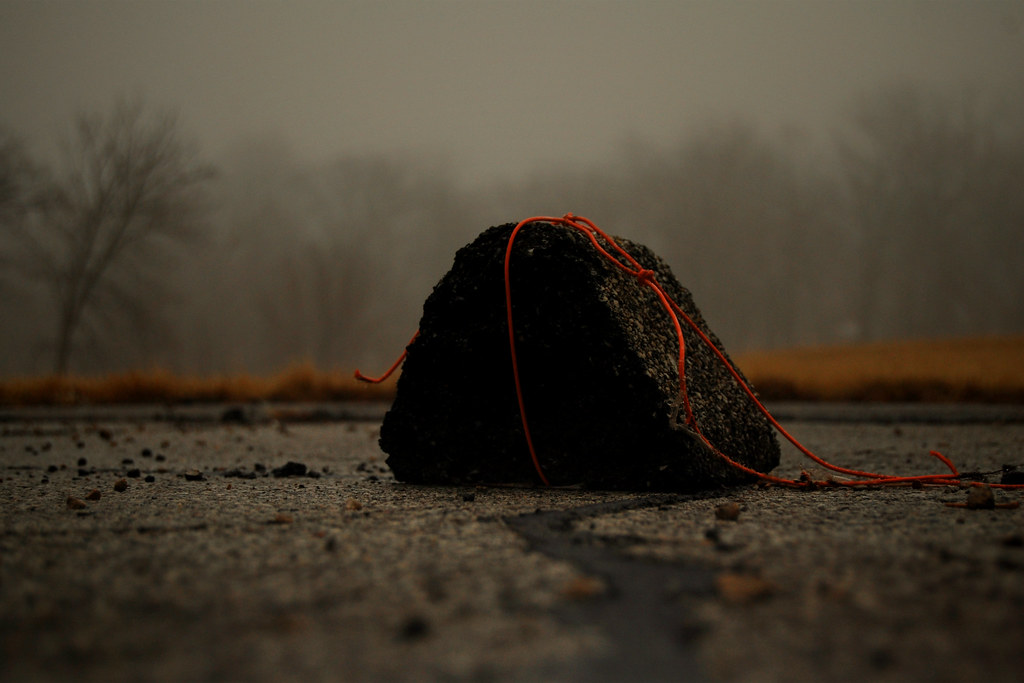
So I went back again on a cold, wet, foggy day in February. And yep, it was still there.
February 16, 2011
It wasn’t just strange; it was also visually interesting. I was taken with that red PVC wire. I considered taking hold of the wire and lifting the chunk, just to see how heavy it was. But I was reluctant to disturb it. It wasn’t just an object of curiosity anymore. That’s when I began to think of the chunk of curbing as a possible photo project. Which meant it didn’t seem right to intentionally change anything about the subject matter.
April 13, 2011
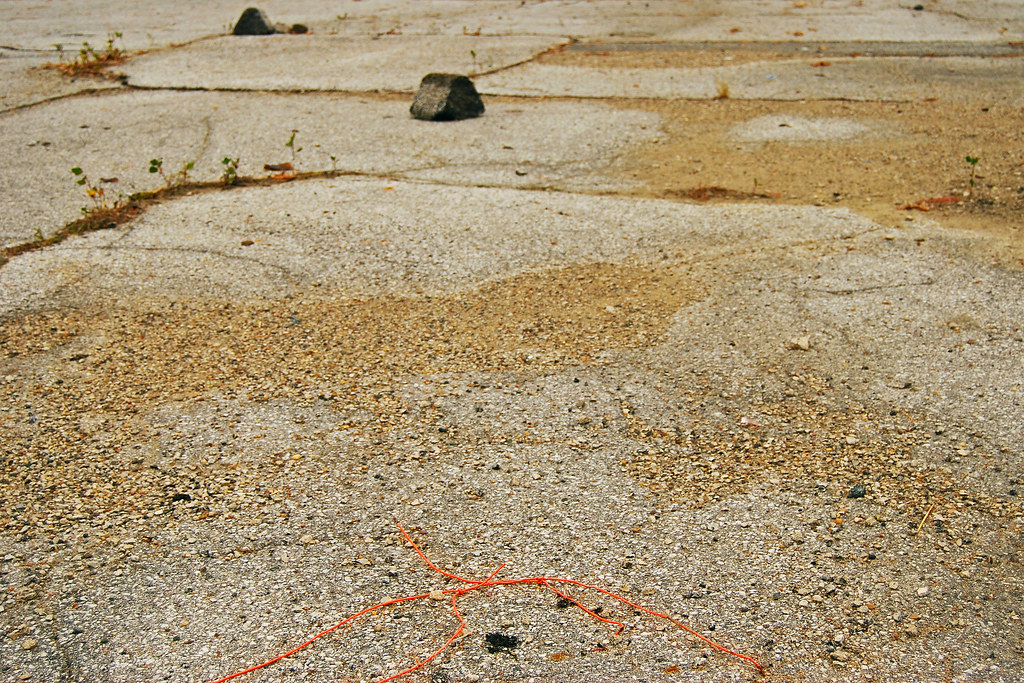
I returned to visit the chunk of curbing about a month later and was shocked to see it had been moved. Somebody had apparently picked it up, carried it about twenty-five feet, at which point the red PVC wire had snapped.
I can’t imagine many people would find a reason to noodle around the detritus of a former supermarket. But IF somebody did, and IF that somebody happened upon the chunk of curbing, then surely they’d be tempted to pick it up. I mean, I’d been tempted to pick it up myself. The way the PVC wire was wrapped around the chunk of curbing–it was clearly intended for it to be picked up. Who could resist it?
Somebody didn’t resist it. Somebody had seen it, had picked it up, and toted the chunk of curbing twenty-five feet. Hell, that was the most understandable thing about the whole situation.
August 24, 2011
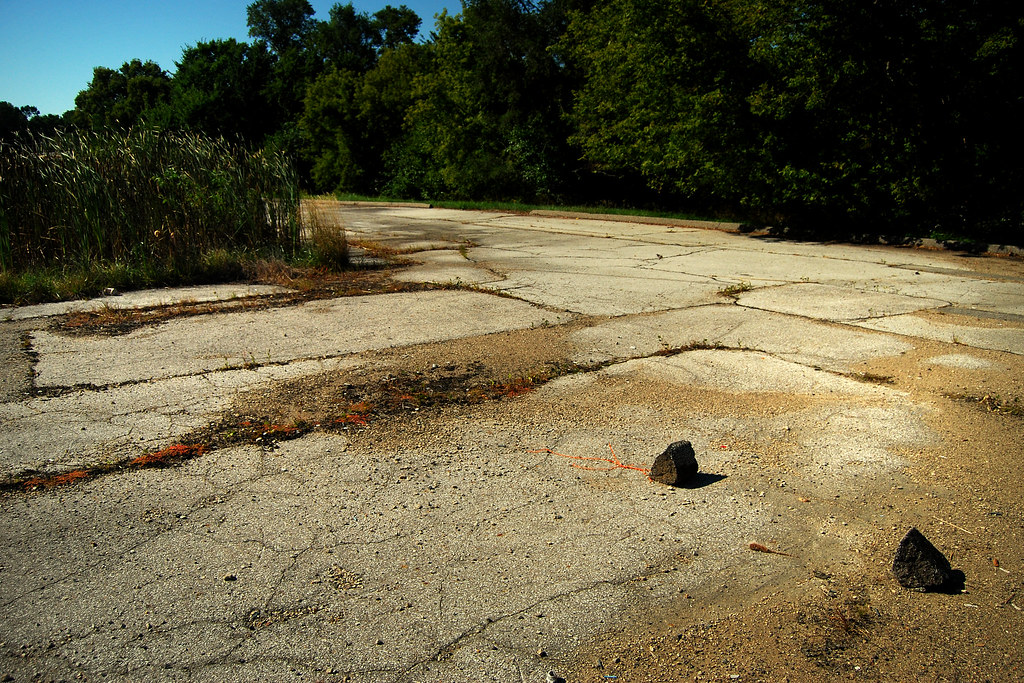
I didn’t get back to visit my pet chunk of asphalt curbing until late in the summer. As I approached, I saw two chunks. I thought maybe whomever had moved the curbing back in the spring must have returned and broken it.
But no. It was a second chunk of asphalt curbing. Somebody–maybe the same person who’d moved it earlier–had apparently gone to the spot where other chunks of curbing were scattered, picked up another chunk, carried it to the vicinity of my pet chunk, and dropped it.
This compounded the WTFedness of the situation. It reinforced the original weirdness. It made no sense at all. It was insane. It was…kind of wonderful. I was oddly pleased by the development.
September 8, 2011
I returned a month later. Not much had changed. Some orangish lichen had grown in a nearby crack and I spent some time trying to find a way to photograph the red PVC wire and the orange lichen, but nothing seemed to work. In the end, I just documented my chunk of asphalt curbing along with its companion.
I figured I’d just about come to the end of the chunk’s story. I was still curious about the whole thing, but the original aura weirdness was beginning to fade.
October 18, 2011
Still, I’d developed something of a perverse relationship with that chunk of curbing. I felt a need to check on it. So of course I went back.
The red PVC wire had moved. It had broken six months earlier, but a length of it had been trapped beneath the chunk of curbing. How did it get loose? Maybe a bird or animal had tugged on the wire and freed it? In any event, I took it as a sign (No, not that sort of sign; just an ordinary sign) that the project was at an end. Surely, the wire would soon get blown away. Without the red PVC wire, the chunk of curbing was just a chunk of curbing. As soon as it was gone, the photo project would be over.
December 20, 2011
I gave it a couple of months. I went back in December. Nothing had changed. As near as I could tell, the red PVC wire hadn’t even moved. That was…weird. You’d think that over the course of two months something would have moved the wire. But that was just minor league weird compared to the overall weirdness.
Still, I’d made the decision that I’d keep coming back until the red wire was gone. So I returned in the spring. The entire area was fenced off and construction equipment was tearing up the old parking lot.
There’s an apartment complex there now.
I no longer live in that area, but maybe once or twice a year there’ll be a reason for me to pass nearby. And when I do, I think about that chunk of asphalt curbing, and the bright red PVC-insulated wire, and the person who’d tied the wire into a parcel-carrier. And I wonder what in the hell they’d been doing, and why. And it pleases me that I’ll never know the answer.
Okay, it’s been one whole year (plus a day or two) since I unboxed my Ricoh GR3X. One year, and I’m still infatuated with it. Here’s what I wrote about the camera a month or so after I bought it:
[T]his camera seems to have been designed almost specifically for the way I shoot photographs. I’m not a street photographer, although I enjoy shooting street. I’m not a landscape photographer, or a fine arts photographer, or a portrait photographer; I don’t really belong to any of the more common photographic traditions. I belong to what I like to call the flâneur school of photography.
Then I wrote some pretentious shit about the term flâneur. Basically my style of photography is to sort of noodle around places, noticing things, chatting with strangers, sticking my nose where it probably doesn’t belong, and shooting photos. That sounds pretty casual. It probably looks pretty casual to other folks—and it kinda is. But I’m not really a casual photographer. I almost never photograph anything without pre-visualizing it. Happily, I’ve been shooting long enough that the pre-visualization process (composition and exposure decisions) usually only takes a moment.
The Ricoh GR3 makes the process between pre-visualization and shooting easy. It’s designed to let you change the exposure settings with one hand. In fact, the video reviews I watched before digging into my pocket to buy the Ricoh often showed people shooting photographs with one hand. My first response to that was ‘What kind of fucking amateur is shooting photos with one hand?’ I mean, one of the first and most valuable lessons I learned in photography was how to hold a camera to eliminate camera-shake, to give yourself a stable platform. I sure as hell was NOT going to be shooting any photos with one hand.
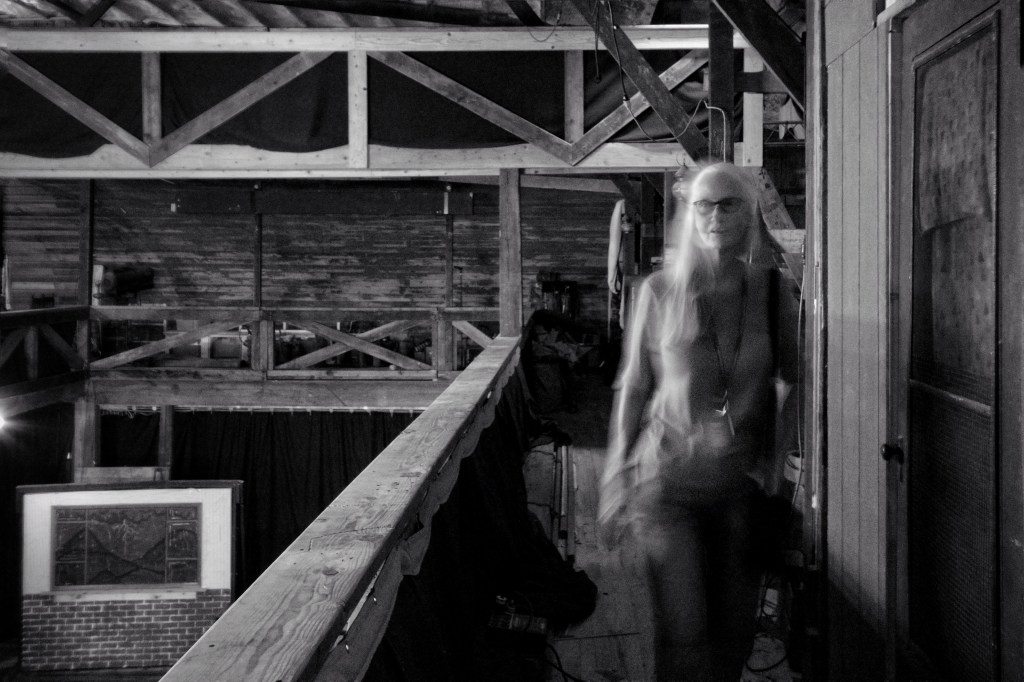
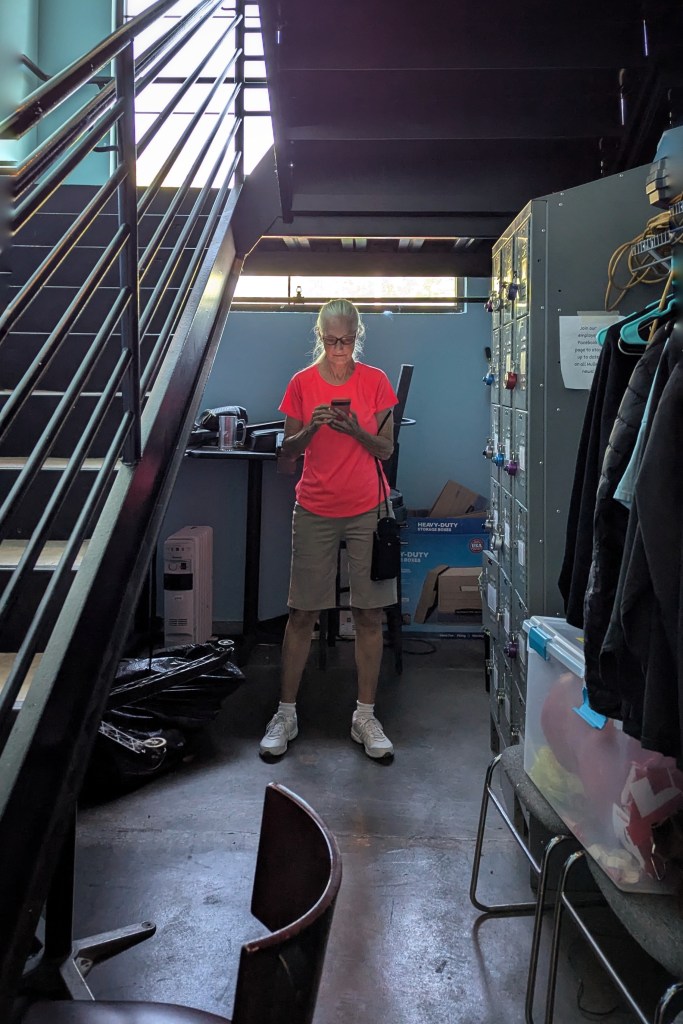
You guys, guess what. I now routinely shoot photographs with one hand. Every photo in this post was shot with one hand. I have to say, at first that felt…irresponsible. But the camera weighs almost nothing (really, it’s about nine ounces) and the image stabilization system is incredibly forgiving. The photo above? I shot that in a low-light situation. We’re talking a half second exposure at F11. With one hand. Ginger is blurry because she’s walking, but everything else is clear and in focus. That ought to be impossible with one hand. But here we are.
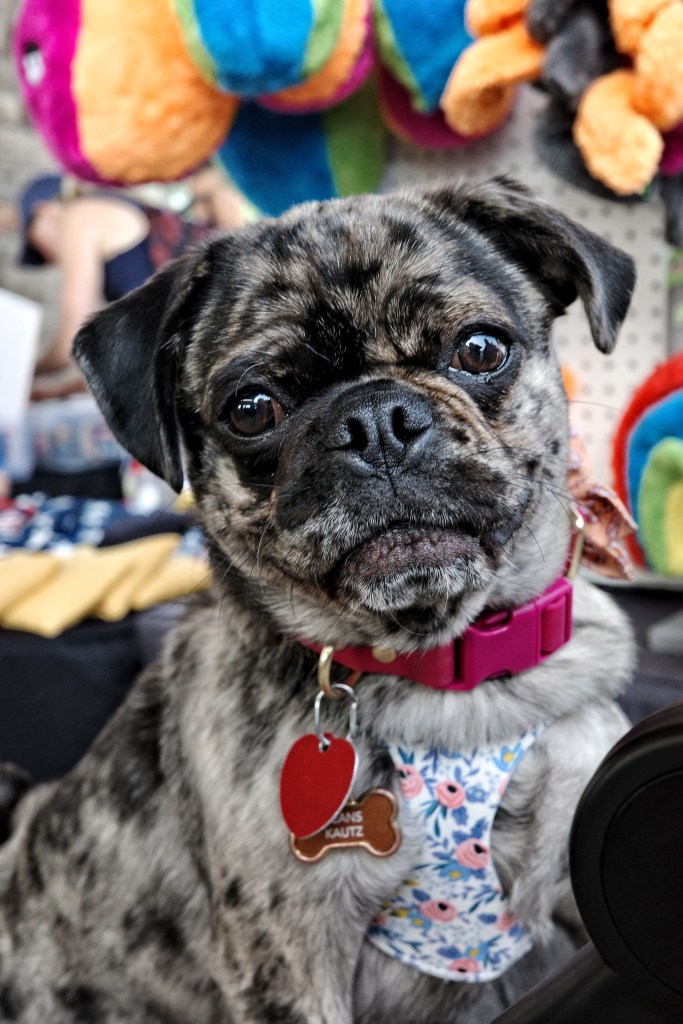
Now, shooting with one hand seems sorta kinda…natural? For example, I’m at the local farmers market, I’m toting a bag with pastries and fresh veggies, and I see a woman with a pug in a baby carriage. I pull the camera out of my pocket (did I mention it fits in my pants pocket? Not like a cargo pants pocket, but a regular blue jeans pocket…astonishing), ask the woman if I can photograph her dog, and a moment after she says ‘sure,’ I’ve got the photo. One hand.
And that’s another thing. For most of my long and randomly wicked life, I’ve been reluctant to shoot photos in portrait aspect. Even with my cell phone, I turn it sideways and shoot in landscape. But with the Ricoh, I seem to be shooting a LOT more vertically. I don’t know if it’s the camera (it’s probably the camera) or a change in the way I see the world, but there it is.
Over this last year I’ve shot 3335 photographs on the Ricoh. For some photographers, that’s probably just a busy couple of weeks, but it’s a lot of photos for me. I’m a rather parsimonious photographer (which I’m sure is a result of having learned to shoot pre-digital, when film and processing cost money I didn’t have).
So am I shooting differently with the Ricoh? Yes and no. I’m still shooting the same sorts of photos, but I’m doing it more quickly, more fluidly, and more vertically. And I’m doing it with one hand in my pocket.
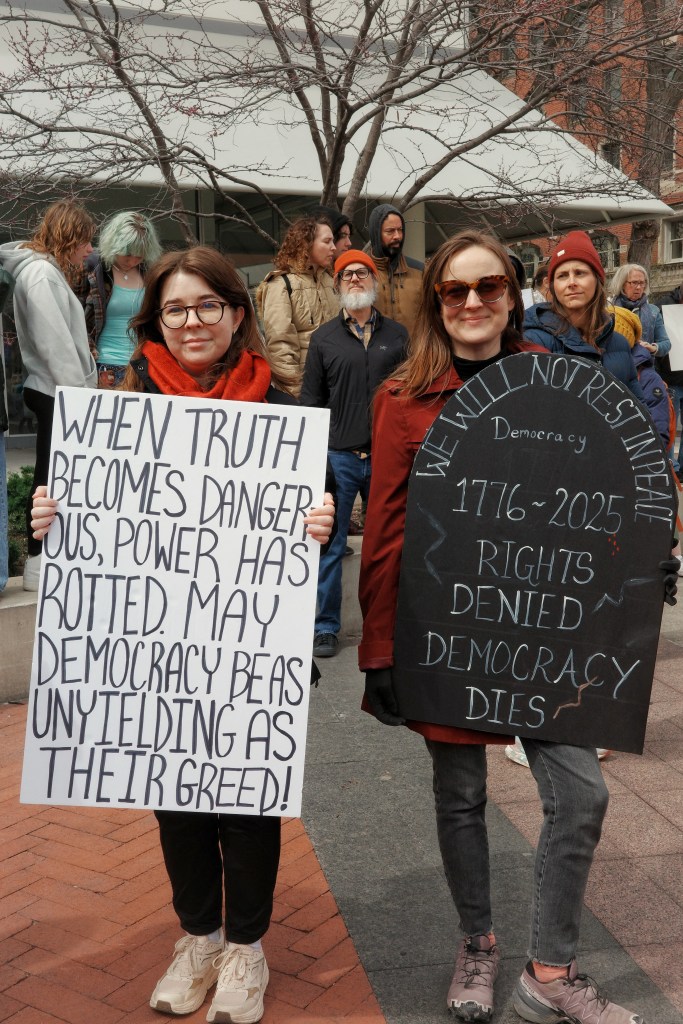
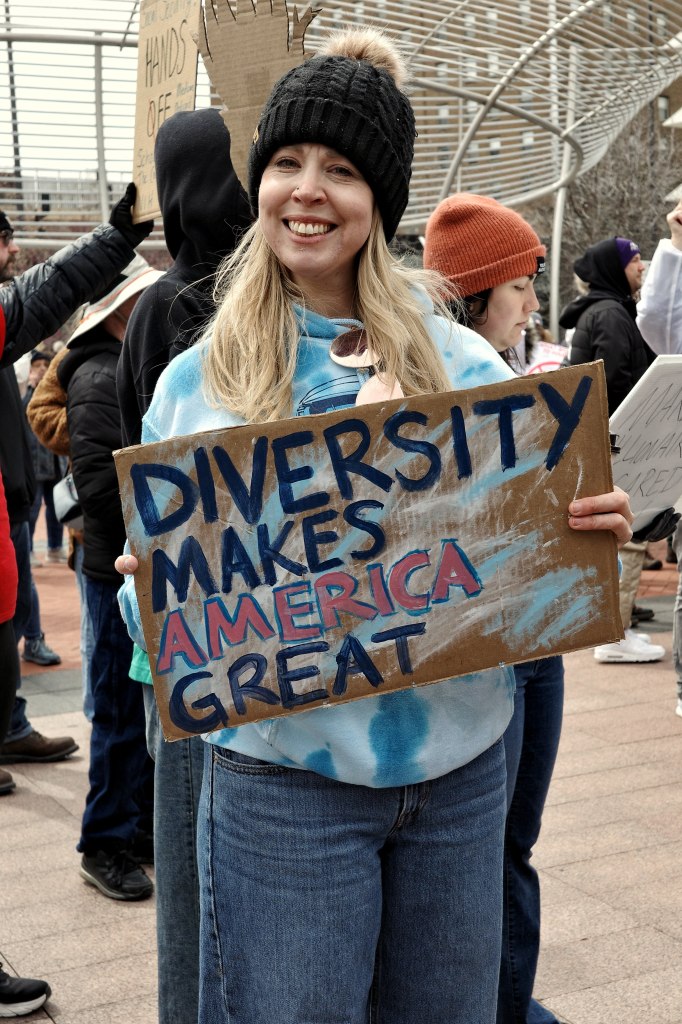
Like a million other concerned people, I attended the local Hands Off! protest yesterday. I wasn’t sure how many people would show up, considering it was a cold, blustery day (about 42F with steady 14mph winds and gusts about twice that). I thought we might still get a thousand people. Maybe.
The local news estimated the attendance to be around 7,500, and they tend to be conservative in their estimates. It was an eclectic crowd with a variety of concerns. Climate change, veteran’s benefits, social security, health care, education, trans rights, social justice, the court system, immigrant’s rights, Ukraine, and more. But there was absolutely universal condemnation of Comrade Trump, Elon Musk, and DOGE.
The protest began, as all protests do, with speeches. I confess, I paid little attention to the actual speeches, though I was pleased to hear the crowd cheering and applauding. During the speeches, I left the main crowd and moved around the fringes. Why? Because there are folks who want to protest and make their voices heard BUT for any of a thousand reasons may be uncomfortable with crowds.
The folks on the fringe of the protest were pretty much the same people who made up the rest of the crowd. They were mostly white (this IS Iowa, after all) but beyond that they seemed to be a fairly representative sample of the protesters. There were young kids (some in strollers), and working class folks, and church-goers, and goths, and office workers, and trans folk, and wine moms, and college students, and old folks (some using walkers), and union members, and passers-by who just wanted to know what the hell was going on.
One of the things I found most interesting about the event was that everybody was 1) happy and 2) pissed off. They were pissed off enough to give up their Saturday to carry signs and listen to speeches and shout for Elon Musk to be deported and for Donald Trump to be impeached and to take over one of the main city streets and march a mile or so in cold, blustery weather to the state capitol building, where they listened to still more speeches. But they were also happy and laughing and clearly delighted to be with others who agreed with them. There was a tremendous sense of relief, and a sense of urgency, and a sense of something approaching hope and optimism. That all seems contradictory, but it didn’t feel like it.
Nobody there thought this march–or any of the hundreds of other marches–was going to change anything. Nobody there was that innocent. But it felt like there was a shared commitment to changing the way we govern ourselves. There was a very clear feeling of joy at the chance to express themselves, to carry signs and chant slogans and shout out their frustration and rage and hope.
It was also clear that this was the first time a lot of these people had attended a protest. At the beginning, there was a tentativeness to the crowd. A lot of looking around to see if anybody was watching, if anybody was upset or offended by what they were doing. This was especially clear when the organizers asked them to take to the street and march up to the capitol, where we’d join up with a second protest. We are a car-brained culture, and these people were unsure about the propriety of taking over a street without permission.
But they did it. And when cars approached the head of the march, they had to stop and make a U-turn. At the back of the march, a lone police officer in a squad car followed to insure no drivers disrupted the march from behind. Within a few hundred yards, this crowd of normal Iowans were chanting, “Whose street? OUR STREET!” There was a palpable sense of released anger and resentment and liberation. It really was OUR street.
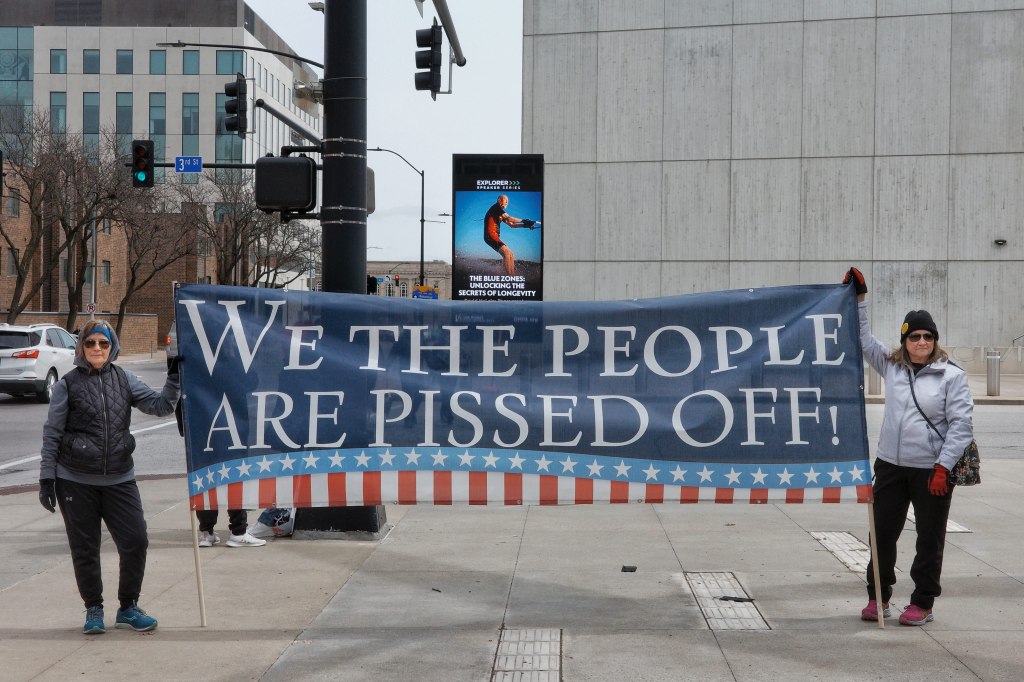
When the crowd took to the street, these two women with their “We the People” sign led the way. It seemed appropriate. Because it’s true. We, the people, are massively pissed off. And yesterday, we let those malignant fuckwits of the Trump administration know it.
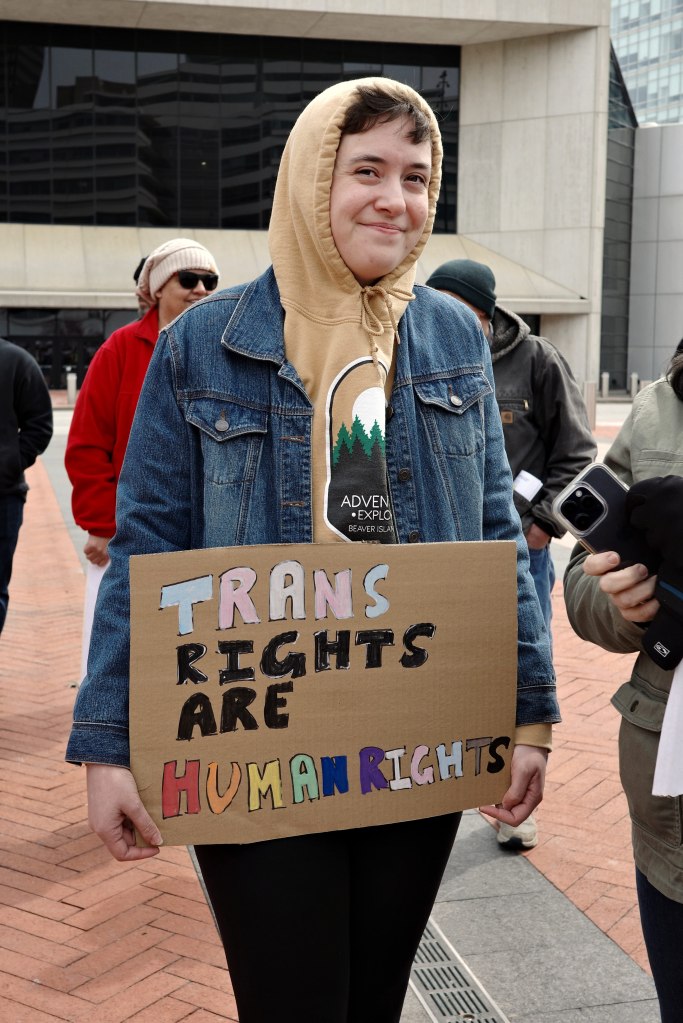
I took a lot more photos of (and in) the crowd itself. But here I wanted to show the people who, at least at the beginning of the day, hovered around the fringe of the protest. The people who usually get overlooked. The people who don’t make the highlight reels or the news reports. As so many protest signs said, you know things are grim when even the introverts show up.
You’ll notice that most of these photographs are of women. You’ll notice they’re not drawing attention to themselves. They’re drawing attention to the signs they’re carrying. Signs they mostly made themselves. There’s a song from the 1950s resistance movement in South Africa that goes, “Wathint’ abafazi, wathint’ imbokodo.” This translates as:
When you strike the women, you strike stone.
We’ve been striking stone for decades. Centuries. Eventually, it’s going to spark a fire that will incinerate the patriarchy. It may still be a long time coming, but it’ll happen. And when it does, women like the ones in these photos–the ones quietly occupying space at the fringe–they’ll have helped light that spark.
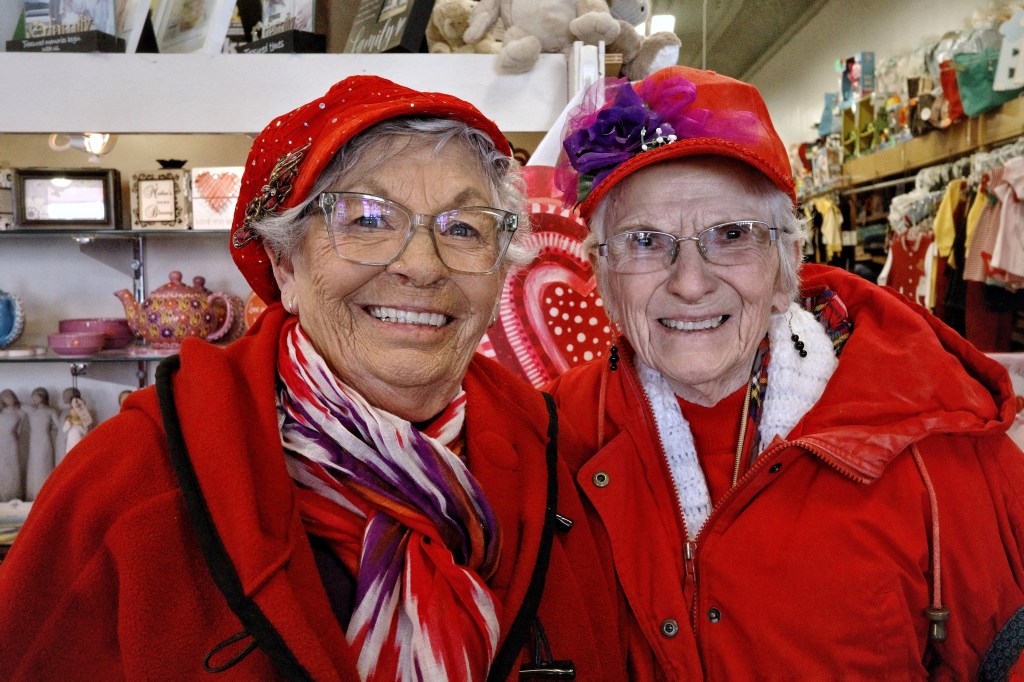
So here’s me in this small town (we’re talking fewer than 500 people) where there’s a little diner that serves the most excellent desserts (they make their bread pudding with cinnamon rolls). While I’m having lunch, there’s an impossible-to-ignore table with about a dozen older women. They’re all wearing red hats. Not MAGA hats, just hats that are red. All sorts of hats. And these women, they’re having a good time, laughing and talking.
It was fun to see them, and I thought about shooting a photo, but decided not to. I could have justified it ethically in photographic terms, but my momma taught me that old women deserve a few extra layers of respect. So I didn’t.
But after lunch, I ran into a couple of them at a gift shop across the street. And I chatted them up, because I was curious and because I like talking to strangers. We must have talked for more than ten minutes. And at one point, I asked if I could take their photo. And they said yes.
They belong to the Red Hat Ladies. It’s an informal group of a couple of dozen women who meet for lunch maybe once a month, maybe every couple of weeks, depends on their mood. They have rules, sort of. You have to be invited to be a member. You have to be over 60. You have to be sorta kinda approved by most of the other members (they indicated that wasn’t actually a rule, but you know, there’s some folks that just don’t click). And you have to wear a red hat to lunch. Most of them also wore red coats. I got the impression that many (maybe most) of them were widowed or divorced.
And they were a hoot. I teased them, they teased me back. They were so very clearly happy with themselves, and it made me happy to see them and spend time with them. There’s something wonderful about the way older women gather together, something liberating and caring, something that leaves them highly opinionated. It’s like they’ve learned to shrug off so much of the bullshit they’ve had to deal with for most of their lives. And if they haven’t actually shrugged it off, they’ve learned to shove the bullshit off to one side long enough to get together and have a good time. You have to respect that.
I suspect (and I hope this is true) that there are similar Red Hat Lady collectives all over the world. I’m pretty sure I’d object to many of the political and religious views of these women, but I’m inclined to think I’d trust them to run the country. Certainly, I’d prefer them to the hateful crew that’s now in charge. The thing about the Red Hat Ladies, they know when to be sensible and when to stick a purple bow on a red hat and if folks don’t like it, they can go eat lunch someplace else.
I’m pretty much content with being a guy, but I’m also sort of envious of these Red Hat Ladies. They’ve got something few men will ever have. One more reason to burn the patriarchy.
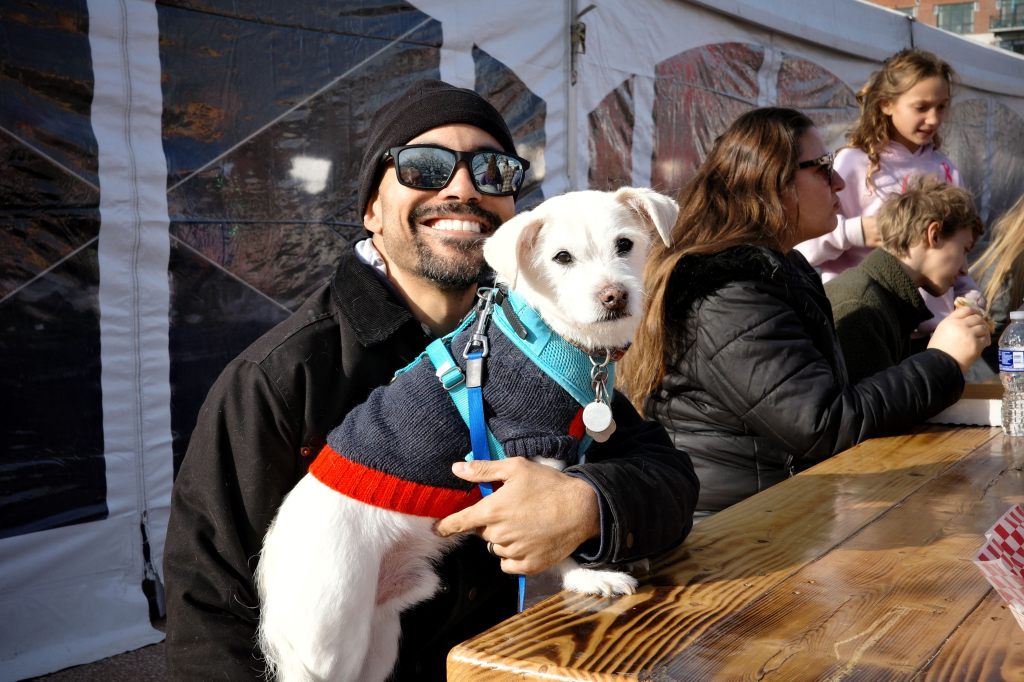
I’m at the Christkindlmarket and I see this guy and his dog sitting at a table. He’s holding the dog and the dog is leaning against him. I know it sounds ridiculous, but the moment I saw them I thought, “Madonna and child.” I blame all the Christmas stuff for that. I’m not a Christian, but I’m a fan of any holiday that’s (supposed to be) about love and sharing.
Anyway, I’ve got my little Ricoh GR3X in hand as I approach them, and the guy knows why I’m coming. I could see it on his face, the recognition that I wanted to photograph his dog. And it obviously pleased him. I barely got the words out…”Would you mind if I…?” before he said, “Sure.”
The dog, though, seemed a tad uncertain, so I slowed down. Instead of the close-up I’d intended, I stayed back a bit. Instead of shifting my position to isolate the guy and his dog from other people from the frame, I stayed still. Instead of shooting 3-4 frames, I took only one. I moved slowly to take the photo.
I said something like, “He’s a wee bit shy, isn’t he.” The guy said the dog was timid around other people, which is why he’d brought him to the Christkindlmarket and why he was holding him. He wanted the dog to feel safe and protected, but he also wanted him to get used to being around other people.
I didn’t even try to pet the dog, though I wanted to. I didn’t try to shoot more photos of them, though I very much wanted to. I figured the little guy was dealing with enough already.
In the end I said something like, “You’ve got yourself a little buddy.” He said, “I sure do.” And I walked away. But seeing them together lifted my spirits–which, given the world as it is today, was quite a feat. The obvious bond between them, the care the guy was taking with the dog, the trust the dog had in the guy — it was lovely, and I was weirdly proud of them both.
I could have taken a better photograph of them. They deserve a better photo. But it might have made the dog nervous, and no photo would be worth that.
I’m not a train guy. Not a railroad guy. I mean, sure, I like trains and railroads. I appreciate their historical significance. I like to hear their whistles and see them rumbling along the tracks. I absolutely love the photographs of O. Winston Link. But if somebody asked me if I’d like to go spend a day looking at trains, I’d say…well, I’d say yes. Not because I’m a train guy, but because I’ll go look at just about anything.
And that’s exactly what I did recently. I agreed to go on a family/friend train excursion that included historic trains, a small train museum, and a dining experience in an old train that traversed some fields and woods and a ridiculously narrow bridge over a rather high river valley. It wasn’t something I’d have chosen on my own, but I’m really glad I agreed. (Pro-tip: always agree to do almost everything, because you never know.) It was fun and, of course, I took a few photos.
I’d expected to enjoy the train ride, and I did. There was a period of time when I lived on the East coast and I frequently traveled by train–Boston, New York City, Washington, DC, Norfolk. I always enjoyed it. But there’s a radical difference between (what in the US passes for) ‘modern’ train travel and an historical train. The engine that pulled our dining cars wasn’t a steam engine or anything, but it was old and slow and pleasantly lazy. Which was just as well, since the tracks were also old and the train swayed a LOT more than any train I’d ever been on. Hell, at times it swayed more than a lot of boats I’ve been on. You don’t want a lot of swaying when you’re on a high trestle bridge over a river valley. Still, it was fun and the food was surprisingly good.
But the train ride and the meal were, for me, secondary. Hell, they were tertiary. I could have spent the entire day noodling around the train yard, looking at stuff I didn’t understand and appreciating it. BIG blocks of color. Gobs of dark, sexy shadow. Weirdly-shaped mechanical bits and bobs. And who knew trains had so many ladders? Everywhere you look, there’s a ladder. And different shapes of ladders, at that.
I hadn’t anticipated being fascinated by the shapes and forms, particularly of the works of the undercarriage (if that’s what it’s called). Everything was so massively sturdy. And I was completely captivated by the colors–the sun-faded greens, the bright yellows and oranges, the weathered reds and russet browns of the cars. I could have spent an hour just looking at the variety of textures and photographing the industrial weirdness of the undercarriage.
For once, I was more interested in the stuff than in the people, and I rather regret that because when I took a moment to actually talk with the people they were…well, I guess you could call them retirement-age train otaku. They were obsessive, but reserved until encouraged. One guy, with minimal encouragement, agreed to let my brother and I climb up an exterior ladder into the engineer’s cockpit (if that’s what it’s called). I don’t think it was actually prohibited, but it was certainly not part of the routine. Once we got up there, he explained how the engine, which had been built in 1958, had been retired from some Canadian railroad. He rattled off the specifications of the engine, and where it fit in the evolution of train engines. I suspect he’d have told us the entire life history of that particular engine, but folks were waiting for us and we had to leave.
I actually regretted leaving the train yard. But not everybody shares my interest in weathered paint and arcane mechanical whatsits, so I left without complaint. Now I find myself with a metric ton of train-related photographs, and while I’m hesitant to impose them on the unsuspecting Intertubes, I’m afraid you’re going to see more train stuff on my social media. Of course, I won’t be able to identify what’s IN the photos. You’ll have to find a retirement-age train otaku for that.