Strangest thing. I’ve been shooting photos since about the Triassic period and in all that time I very rarely shot photos in portrait orientation. Well, I mean, except when I was shooting actual portraits, of course. Landscape orientation has always seemed more natural and organic to me.
But since I’ve been using this Ricoh GR3X, I find myself shooting more shots in portrait style. I really can’t explain it. Is it because the camera is so small and light that I’m more willing to turn it on its side? That doesn’t make much sense to me, because I tend to pre-visualize almost all of my shots. I generally ‘see’ them before I shoot them. So why would the camera matter? Maybe it’s the fixed lens? I don’t know.
Or maybe I’m just ‘seeing’ more portrait-oriented shots? Maybe it’s just a coincidence that I’ve started doing that shortly after picking up a new camera? That seems improbable too. Doesn’t it?
Another thing. I’m not entirely sure this is true, but it seems like when I shoot something in portrait orientation, I pay closer attention to the edges of the frame. I like to think I do that with most shots, but I find myself actively thinking about the edges when I’m shooting in portrait. Maybe that’s just because I’m not used to it? Maybe I do it so automatically in landscape orientation that I just don’t notice it as much? That seems possible.
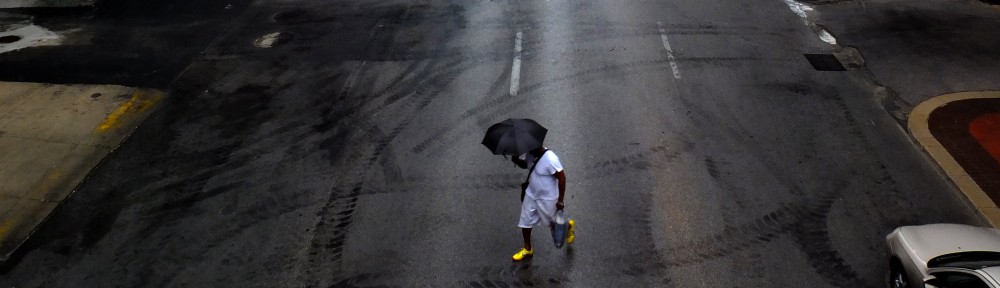
Take this photo, for example. I wanted that tiny bit of chimney in the upper right. And that sliver of the window frame on the left side. And along the bottom, that white line of the parking strip and the blob of shadow from a parked car. I wanted those things, but I didn’t want very much of them. Which, because the GR3 has a fixed lens, meant stepping forward just an inch or two, then stepping back half an inch. It meant doing the goddamn hokey-pokey in the middle of the street until I had it just right.
When I got home and downloaded the photos, I noticed that of the 24 photos I shot during that brief photo-walk, 7 of them were in portrait orientation. Seven. Almost a third of the photos. I’ve never in my life done anything like that.
It doesn’t bother me. It’s just a bit of a shock. Has this happened to anybody else? Have you suddenly found yourself shooting in a different orientation? Or have I maybe had a stroke and just failed to notice it? Maybe it’s a tumor. I don’t know. All I know is that it’s weird.
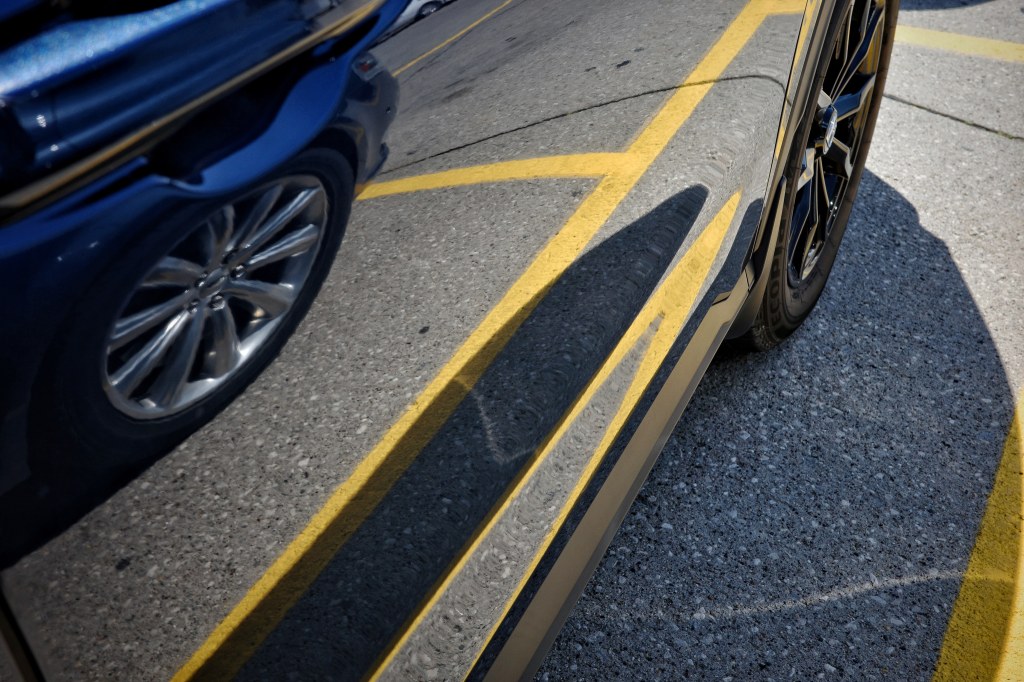
I’m an absolute pain-in-the-ass to run errands with. Why? Because I have a tendency to get distracted by stuff I see. Random stuff. I’m talking abstract lines and shadows and shapes and colors, stuff that usually gets lost in the passing clutter of everyday life. Stuff that, when it’s isolated within a frame, becomes visually interesting (to me, at least). Like, for example, some newly painted yellow parking lines reflected off a car door.
We’d just bought a few groceries and I’d just put the bag in the back seat when I saw the reflection. I stood there for a moment, sort of arranging it in my head. In the past, I’d have just admired it, then got in the car. But now I have an actual camera that fits in my pocket. So now I have this photograph.
It’s just a flash of light, shadow, line, and color that likely won’t appeal to anybody but me. But this is how I go through the world, seeing stuff like this. And since I now own a little Ricoh GR3X, I can photograph the world the way I see it. Sure, I could have taken a similar photo with my cellphone. But it’s not the same. With an actual camera you have more control over the exposure.
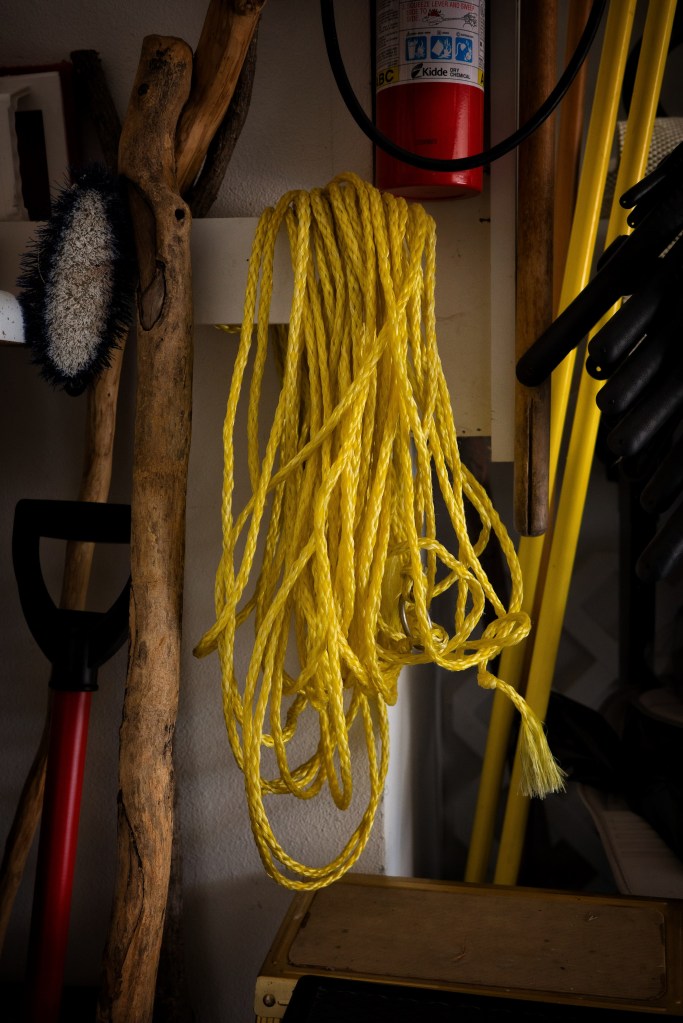
I also use the GR3X to take ‘normal’ photographs, of course. The usual landscapes, urbanscapes, street images, New Topo stuff (which counts as ‘normal’ for me). But almost every day there’s some weird little visual thing that will captivate me enough to stare at for a moment, but not enough to go fetch a camera. Having a camera in my pocket comes in handy at these moments. You know…in case I see a bit of sunlight illuminating a coil of yellow polypropylene rope hanging in the garage.
The yellow rope alone would have been enough. But the red of the fire extinguisher almost exactly matched the red of the walking stick. You can explain that to people, but without the photograph they probably won’t see it. They may not see it even with the photograph. But that’s okay.
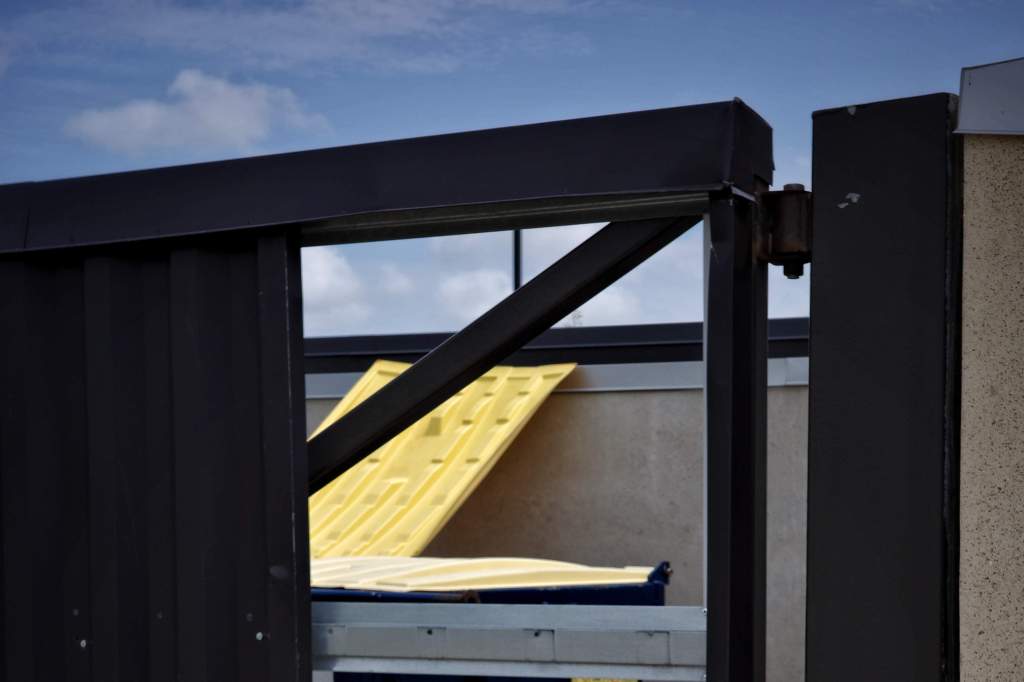
My friends and family are ridiculously patient with me when this sort of thing happens. “What are you doing? Why have you stopped?” “The dumpsters have yellow lids.” “Yellow lids.” “One of them is open and the yellow is brighter. And the clouds.” “I’ll wait in the car.” It’s really a wonder they don’t stab me.
There’s an old photographer’s aphorism: the best camera is the one you have with you. I suppose at some point I’ll get over my infatuation with this camera and I’ll stop carrying it with me all the time. But right now, it’s just part of my leaving-the-house ritual. I grab my keys, my wallet, my phone, and my Ricoh GR3X before I walk out the door.
There are two benefits to this. First, I’m shooting more photographs and shooting them more thoughtfully. Second, carrying this camera everywhere has impressed upon me how very tolerant folks are of my eccentricities. It reminds me that I’m a very lucky guy. It reminds me to appreciate the people around me even more. How many cameras can do that?
EDITORIAL NOTE: Okay, I just now noticed that the predominant color in all three of these photos is yellow. Is that weird? It seems weird. But now I have to change the title to reflect that.
Okay, why am I looking at one of my old photographs? I explained all this back in May, but to recap quickly, I happened across an article on some photo website that suggested looking at and analyzing your old photos as if they were made by a different person. Although that idea strikes me as silly, I thought I’d try it.
And I did. Twice, so far. But I have to admit, I’ve failed. I mean, yeah, I looked at a couple of old photos and yeah, I tried to analyze them. But I didn’t analyze them as if some other jamoke shot them. I did try to look at the photos as objectively as I could (and I like to think I succeeded at that), but I couldn’t separate that analysis from my personal awareness of what was happening in the world around me when I shot the photo or my reasons for shooting it.
But, whatever. Here I am, doing it again. I’m just going to ignore the original idea and continue my pattern of…of whatever it is that I’ve done. I’m even creating a new tag: greg looks at an old photo. I’ll probably do this once every month or two. Probably. Anyway, here:
1:09 PM, Monday, August 15, 2016
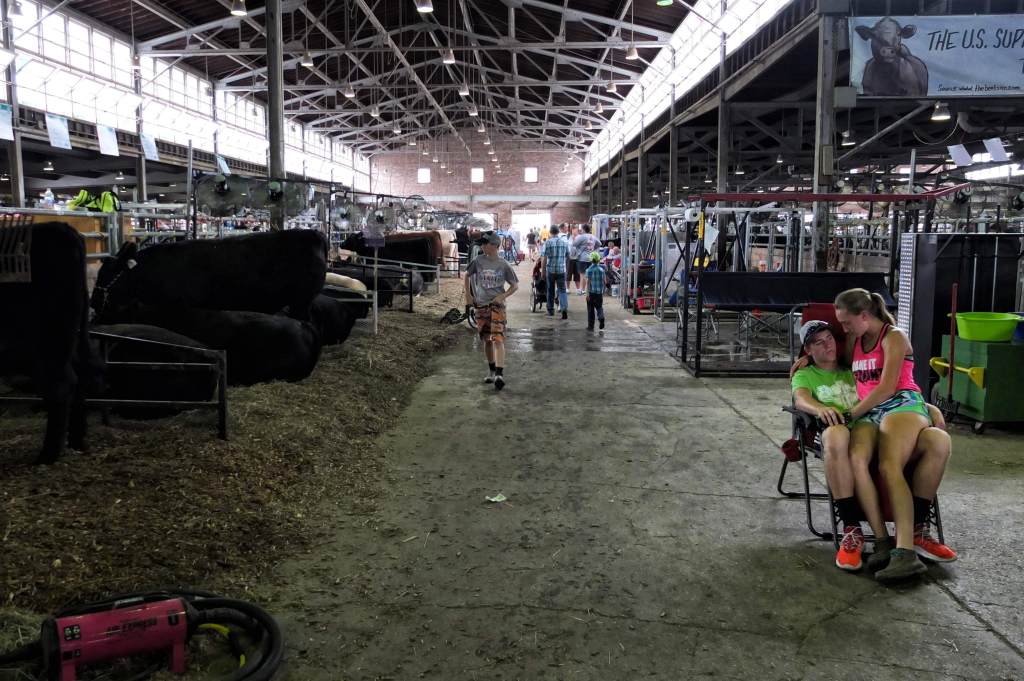
I chose this photograph for two reasons. First, because the Iowa State Fair is underway (I’m planning to attend soon). And second, because it doesn’t quite work as a photo. It almost works. Technically, it’s a tad underexposed. I shot it with my wee Fujifilm X10, which is a fine little camera but it doesn’t allow for quick exposure changes (this was shot at f2.2 at 1/100 and an ISO of 400). If I’d had time, I’d have fiddled with the exposure compensation dial. But that’s the thing about shooting photos that are about people living their lives. They’re not there to be photographed; they’re there because they’re there. You just have to take what’s given. So, underexposed a wee bit.
I’m happy with the basic composition, although the exposure detracts from it. Obviously, the young couple are the primary subject of the photo, but as I approached them I noticed some sort of vacuum/blower device on the floor; it was almost the same color as the top the young woman was wearing. This is where the exposure hurts me; the vacuum thingy gets lost; you can barely see it in the lower left corner of the frame. Still, the quietness of the young couple is, I think, nicely balanced by the other activity in the barn. And I quite like the cow portrait in the upper right of the frame.
So yeah, as a photograph it’s technically flawed, but (I think) well composed. What I really wanted was to depict a moment in the lives of these kids. For almost two weeks, folks from farms all over the state basically live in these massive barns, along with their livestock. They arrive before the fair starts and often don’t leave until after it ends. The Cattle Barn, the Sheep Barn, the Swine Barn, the Horse Barn—they all become small, temporary communities. Over the years, I’ve taken dozens of photos of people in these barns—napping, eating, playing (young barn kids seem to enjoy playing practical jokes on fair-goers), making friends, living a weird approximation of their ordinary lives. There’s something rather sweet about it, something simple (and something rather uncomfortable for those of us not accustomed to barnyard smells). Because they’re only here for a brief time, all these human interactions—the friendships, the squabbles, the romances–become compressed, more immediate.
Another thing about this photo that appeals to me: the transience of these relationships is in marked contrast to the stability of the Fair itself. The Iowa State Fair has been held almost every year since 1854 (they skipped 1898 because of the World’s Fair in Omaha, and missed three years from 1942–1945 because the fairgrounds had been turned into a supply depot for World War II, and the Covid pandemic axed the fair in 2020). It’s been held at this same location since 1886; some of the buildings from the early 1900s are still in use. The barn in which these kids are having their moment was built in 1914.
This particular moment took place in 2016, but you can easily imagine a similar moment in the same barn a hundred years ago. Different fashions, different hair styles, different chair, but the cattle haven’t changed much, and the barn is almost exactly the same. Imagine how many of these moments have happened over the years.
I have a complicated history with Instagram. I downloaded the app and joined 11 years ago today, on 21 July, 2013. I did it under a pseudonym–Knuckles Dobrovic–because, like every good photographer I knew, I assumed Instagram was trash and I didn’t want to be associated with it. As I wrote at the time,
We sneered at Instagram for being a cheap, easy, lazy way to turn crappy photos into images that look artsy. Not ‘artful’ or ‘artistic’ but artsy. We sneered at it because the learning curve for using Instagram is — well, it’s hardly a curve at all. It’s almost a straight line. You shoot a photo with your cell phone, you flip through a couple dozen preset filters until you find one you like, tap to apply it, and hey bingo, you have yourself an artsy photo of your drunken friends at a tacky Chinese restaurant.
I hadn’t actually looked at Instagram; I was just operating on the assumption it was trash. I had to join it in order to confirm my assumption. And hey, I was right. It was, in fact, trash. It still is trash, mostly. But eleven years ago to my surprise, I also found a healthy dose of really fine photography. All sorts of photography, from street work to portraiture to landscape to editorial work to fashion photography. There was (and still is) solid work to be found on Instagram.
I used the Knuckles Dobrovic account mainly to explore IG. But I also felt an obligation to participate, so I used it as a platform for a hastily cobbled together project. After a few months, I decided to more fully embrace IG; I created a second account under my own name. Originally, the account was devoted to square format monochrome photos. Now, of course, it’s my main IG account for all types of photography.
I continued to use the Knuckles account as a platform for random photo projects (for anybody interested, I’ll include a list and a description of those projects in an addendum at the end of this post). The last Knuckles project ended in April of 2023. I haven’t posted anything under the Knuckles account since then.
Until today. My IG anniversary. I’m starting my 8th Knuckles project. Appropriately, it’s going to be pretty similar to how I began my personal IG account. I’ve always had four simple rules for a Knuckles Dobrovic project.
It’s got to be simple (which means I won’t have to do a lot of planning or a lot of post-processing).
It’s got to be organic to my life (which means it’s something I can photograph during the course of an ordinary day — whatever that is).
It’s got to have at least one intellectual component (which is more accurately described as a pretentious bullshit element).
It’s got to be able to keep my interest over time.
So here we go. Simple: high contrast monochrome, which is made easy with my new Ricoh GR3X camera. Organic to my life: my normal flâneur walk-about style plus whatever I happen to see that catches my interest. Pretentious Bullshit Element: my ongoing fascination with the Japanese Provoke-style photography, which is NOT how I normally see the world. Keeping my interest: Well, yeah. I’ve played around with this style of photography before and I see no reason why I’ll ever stop. At some point, I may feel the need to start a 9th Knuckles project, but until then…well.
ADDENDUM: Previous Knuckles Dobrovic projects. Things on a Table — I put a thing on a table and photographed it.
My Feet on the Earth — I took walks, stopping periodically to photograph my feet. I selected two or three of the images during a walk and created multiple exposure images.
One Hundred Appropriated Google Street Views — This was sort of an homage to Hiroshige’s ‘One Hundred Famous View of Edo’. While playing the online game GeoGuessr (which involves finding a random location based on Google Street View), I made screen captures of interesting vistas. I converted those screen grabs into square black & white images.
Slightly Dislocated — During the enforced isolation of the pandemic, I shot square format photos during my solo walks or masked errands. I diddled with the color a wee bit, digitally sliced the image in thirds, then re-arranged the pieces.
Are Bure Bampot — I’d been playing Geoguessr again, and during a break I read something about Daido Moriyama, the godfather of a photographic style called are bure bokeh, which roughly translates as “rough, coarse/crude, out of focus.” That same afternoon, on Twitter, a Scots acquaintance referred to somebody as ‘a total bampot,’ which I was told means “an idiot, a foolish person, a nutcase”. For reasons I can’t explain, the phrase are bure bampot came to me, and I decided to follow through on it. As before, I made Google Street View screen captures of scenes and locations in Scotland. This time I modified them using the are bure bokeh style.
Geoguesser Bus Stops — A bus is the most democratic form of public transport. They’re most commonly used by the poor and working classes, but the bus stops for everybody. A bus network is fundamentally simple: a series of designated routes with consistent designated arrival/departure times and stable designated boarding locations with predetermined fees. It’s a predictable, reliable, efficient dynamical transportation system in which bus stops act as fixed point attractors. Bus stops are ubiquitous; they’re everywhere because a bus network is socially elastic–the design can be stretched to fit almost any community anywhere in the world. Bus stops are both local and global.
There are people–lots of people–who like to name things. I know people who’ve given names to their car, who’ve named their computer, who’ve named their favorite camera. I’m not one of those people. I don’t anthropomorphize gear. A camera is just a tool. You choose the tool best suited for the job you’ve got planned.
I say that, but lawdy, I’m starting to develop a relationship with my new camera. My Ricoh GR3X and me, we’re becoming buddies.
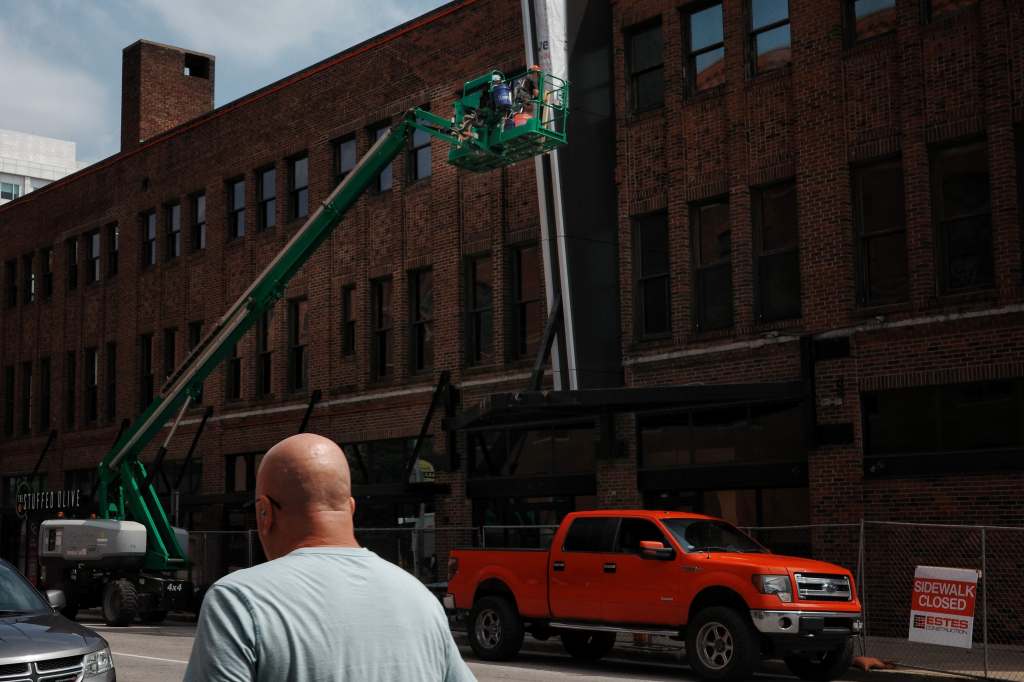
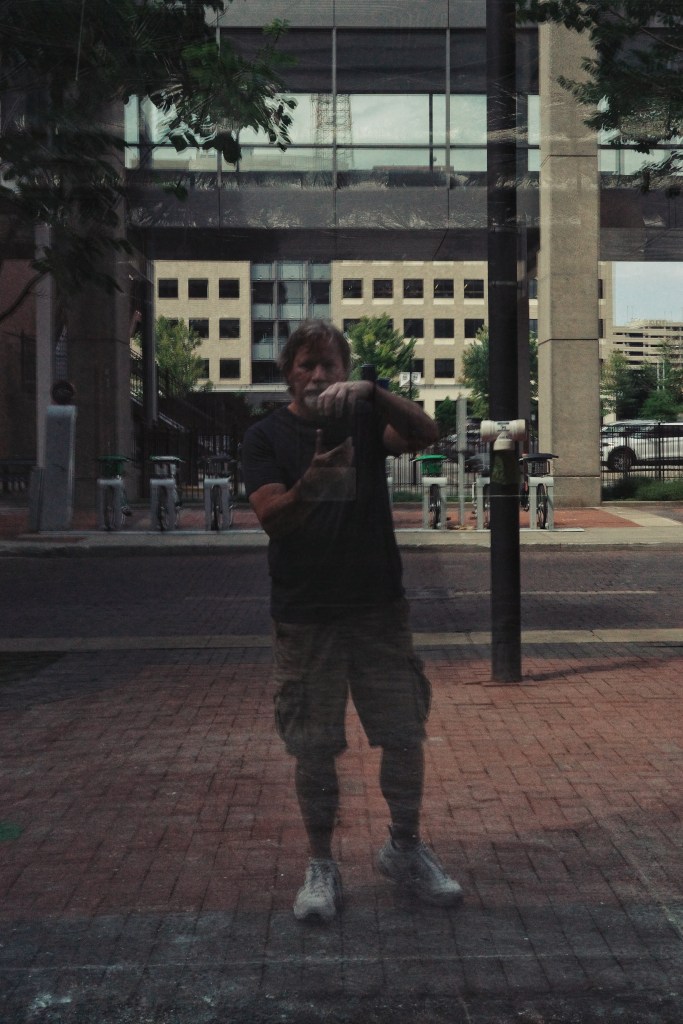
A bald guy walks down the street.
Why? Because this camera seems to have been designed almost specifically for the way I shoot photographs. I’m not a street photographer, although I enjoy shooting street. I’m not a landscape photographer, or a fine arts photographer, or a portrait photographer; I don’t really belong to any of the more common photographic traditions. I belong to what I like to call the flâneur school of photography.
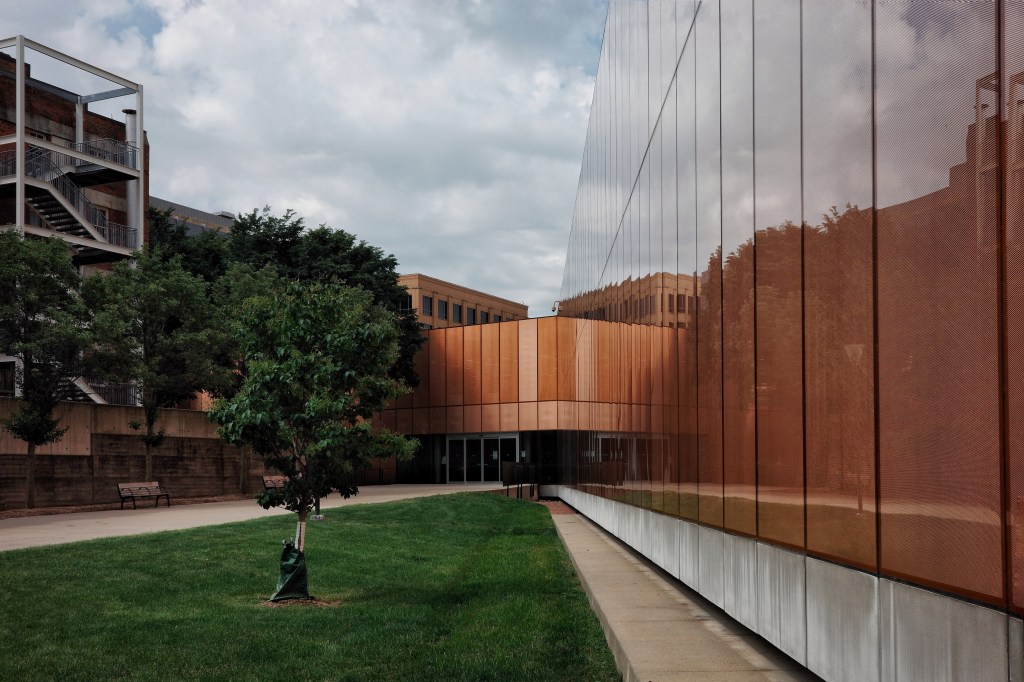
A tree in the library courtyard.
If you’re not familiar with the term, a flâneur is somebody who roams around idly observing the world while being somewhat emotionally detached from it. Somebody who’s not necessarily involved in what’s taking place around them, but is keenly aware of it. One writer described a flâneur as “an amateur detective and investigator of the city.” The term is usually applied to urban life, but it’s a philosophical approach to the world that can take place anywhere. It’s a strange nonjudgmental balance between being analytical and emotional.
(By the way, the term flâneur is French but it’s derived from the Old Norse verb flana, which meant “to wander with no purpose.” And if you’re wondering how a French word is derived from an Old Norse word, you need to read more about Vikings.)
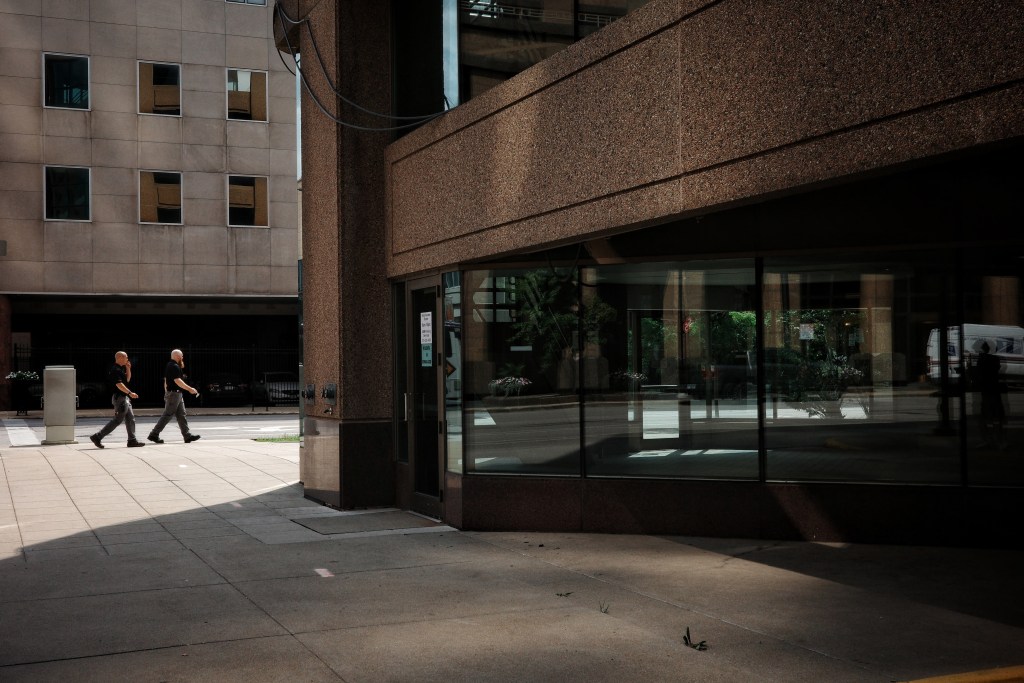
I don’t think those guys were intentionally walking in step, but…
That’s how I shoot photographs. Hell, that’s largely how I’ve lived my life. I’m a flâneur both by nature and by training. Almost every career I’ve had involved the same basic process: observe, analyze, filter the analysis through emotion (or the emotion through analysis), then act. It’s a skill set that helped me as a medic in the military, as a counselor in the Psych/Security unit of a prison for women, certainly as a private investigator specializing in criminal defense, and even (to a lesser extent) as a teacher.
In terms of photography, being a flâneur just means noodling around, paying sharp attention to detail, and seeing stuff in terms of composition. What’s cool is that when it all comes together–the scene, the light, the moment–there’s an immediate emotion, a serotonin hit that’s generated whether you have a camera or not.
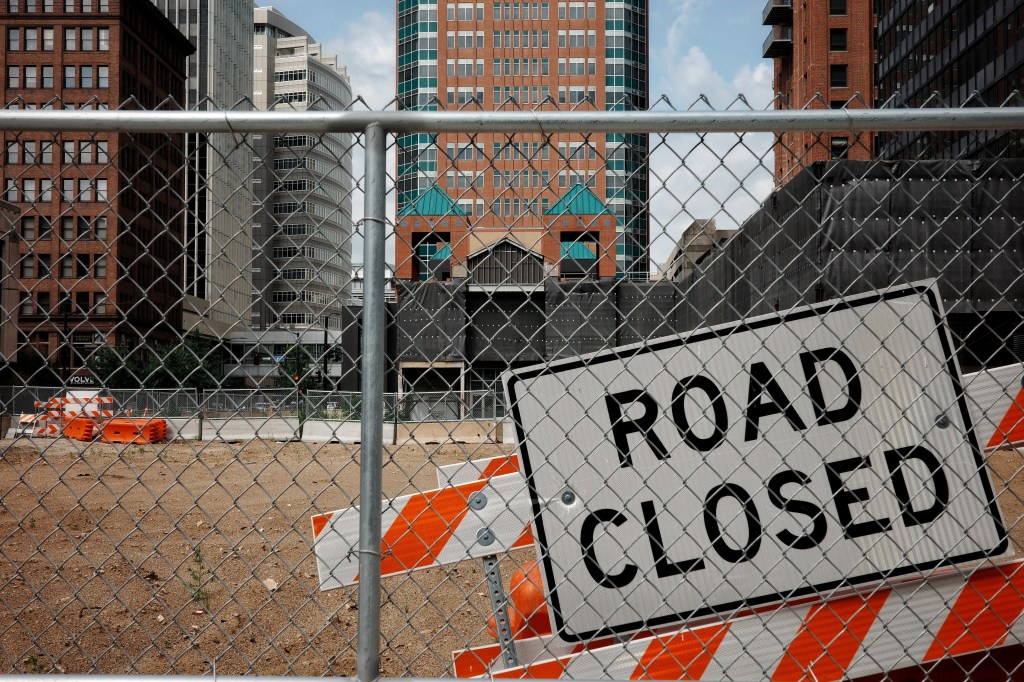
Yeah, road closed.
My Ricoh GR3X is ideally suited to the flâneur school of photography, partly because it’s so compact and easy to carry everywhere. I’d heard you could carry it in a regular pants pocket, but I assumed that was mostly bullshit. It’s not. I’ve done it; I’ve walked around–I’ve ridden my bike–with this unit IN MY GODDAMN POCKET. It also turns on almost immediately, which is incredibly handy. Best of all (I’m not sure this is actually the ‘best of all’ because there are so many ‘best’ things about this camera), you can shoot with one hand. Even in the manual mode, you can control all the settings you need with one hand.
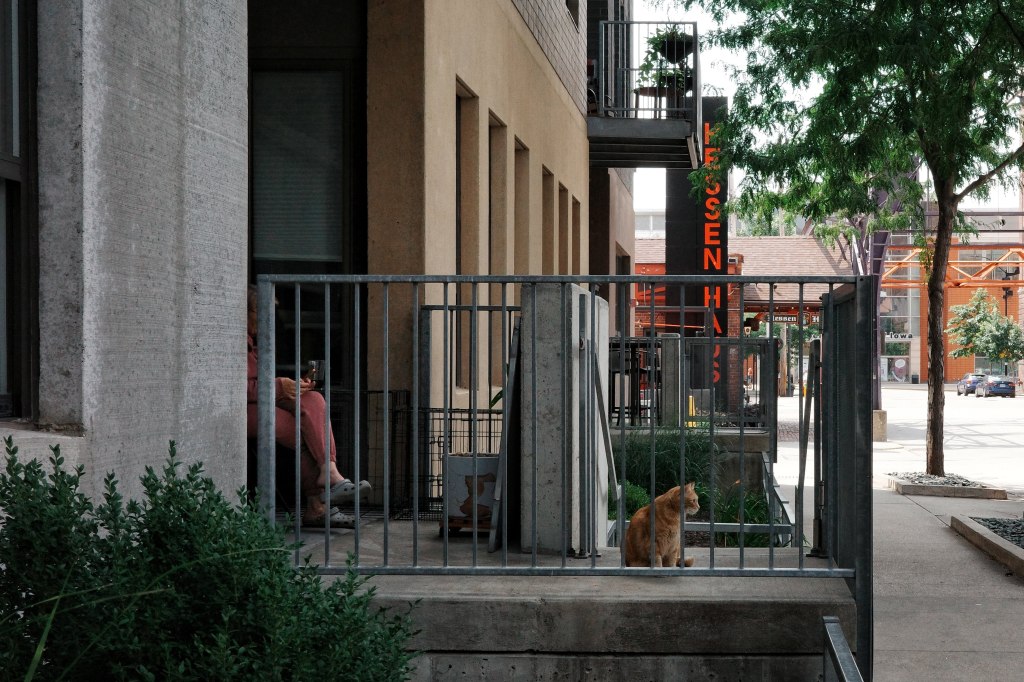
Ginger cat.
Seriously, you can pull the camera out of your pocket, turn it on, compose the shot, adjust all the elements of exposure with one hand, take the shot, turn the camera off, and put it back in your pocket…and you can do all that in just a moment. Which is pretty much what I did with the photo above. As I was walking down the street I noticed the ginger cat. I stepped off to one side so as not to spook the cat, which is when I noticed the woman’s legs. Her legs were in shadow, so I had to quickly adjust the exposure to make sure they’d show up in the photo. Then a step back to include the tree and the window in the frame, and there it was. Maybe ten seconds from seeing the cat to taking the shot. One hand.
Say hello to my little friend
It’s not a perfect camera; I’d love for it to be weather-sealed and dust-proofed, but I’m not sure it’s possible to do that without making it bigger. It’s more important (to me, at any rate) to have a camera I can tote in my pocket than one I can shoot in the rain. There have been a couple of instances where some fill flash would have been handy; the GR3 series doesn’t have a native flash. But, again, that’s small beans.
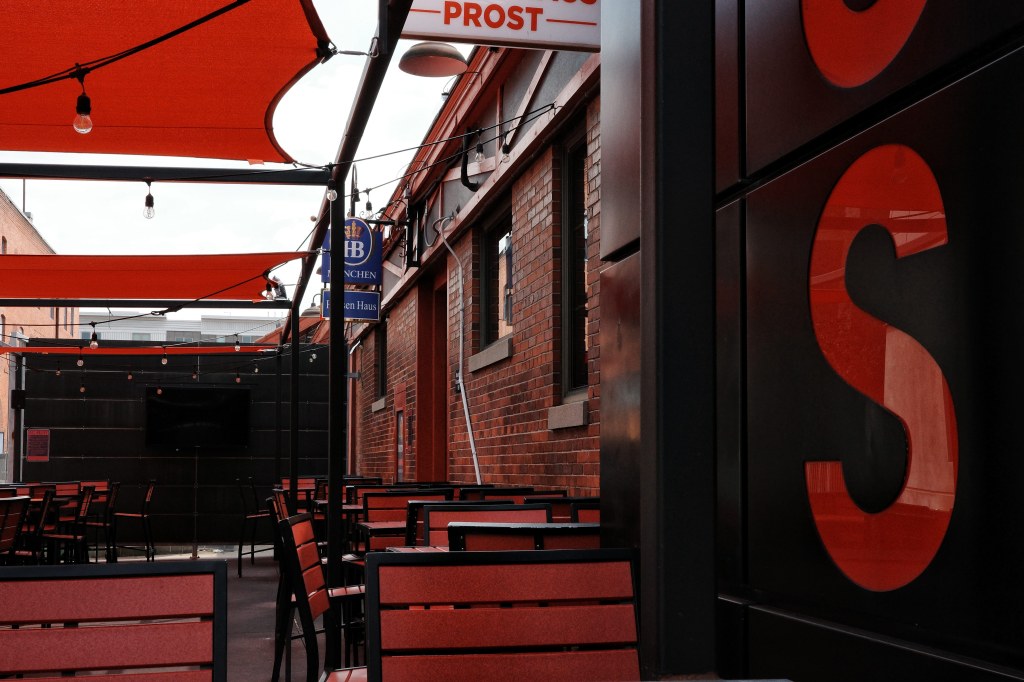
Big S.
The fact is, this camera has already allowed me to get some shots I couldn’t have done with any of my other cameras. And it’s allowed me to get some shots quicker and more easily than with my other cameras. I could have made the shot above with any of my cameras, but it would have taken longer and I’d have had to use both hands. It’s not a great photo (I shot it largely as a reminder to go back when this bar was open), but I was able to get the depth of field I wanted with a minimum of fuss. That absence of fuss is like heroin; it’s fucking addictive.
So yeah, it looks like me and the GR3X are becoming good buddies. I look forward to spending time with it.
I used to pay a lot of attention to photography. Not just the practice of photography (you know, shooting photos and all that), but photography as a craft and art form. Then, for a lot of reasons, I stopped doing that. For a few years, I just wasn’t interested in photography. I shot occasional photos with my cellphone and that was enough. But a few months ago I picked up one of my old cameras and…hey, guess what. My interest in photography was resurrected.
I started thinking about photography again. I started reading articles about photography again, and studying other photographers again. In doing so, I came across an article that suggested looking at your old photos as if they were made by a different person. I’ve never really bothered to look at my old photos. I saw them when I took them and again when I processed them; why look again? But I thought, “Well, what the hell, I might as well try that.” And I did. I picked an old photo and studied it (and wrote about it here). Now I’m doing it again.
Here’s a thing I learned the last time I did this: looking at old photos–and I mean actively looking at them, not just thumbing through them quickly–is weird. It’s sort of dissociative. At least it is for me. It turns out there’s two or three things going on at the same time. You 1) look at the photo as a photo, an object in its own right. But you also 2) consider what was happening in the world around you when you shot that photo. And 3) you remember why you shot the photo.
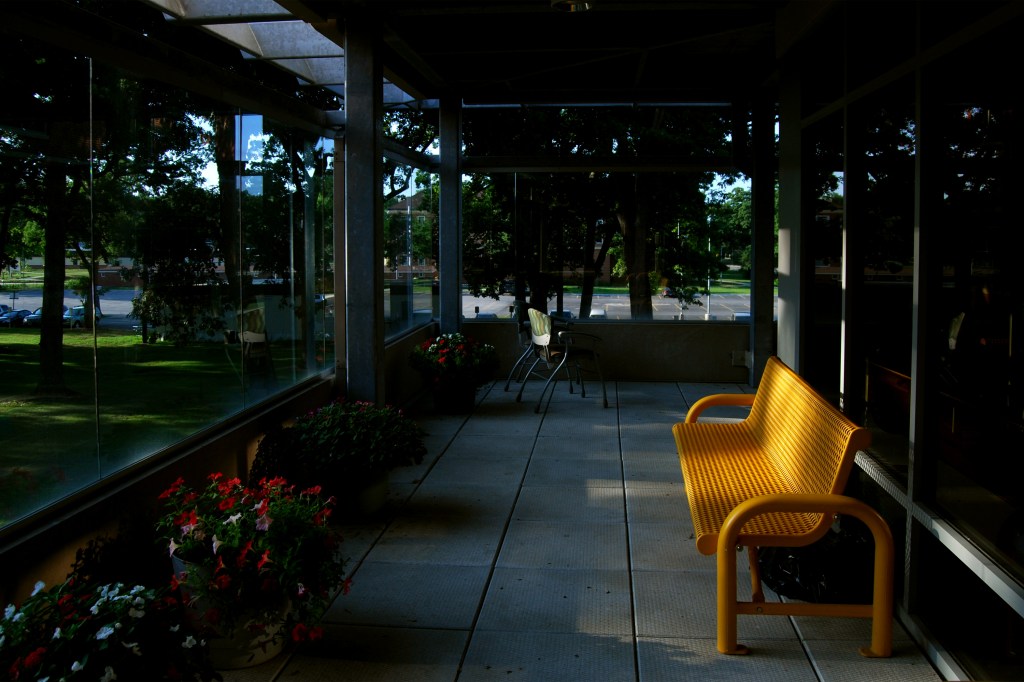
6:59 PM, Sunday, August 7, 2011
This photo was shot on a Sunday evening, at 6:59 PM on the 7th of August, 2011. It was shot at a hospice facility for veterans, where my brother Jesse Eugene was dying from pancreatic cancer. I visited him almost daily during his stay. On that particular day, I’d wheeled his bony ass out to this small enclosed porch so he could look at some trees and feel some sunshine. He stayed in his wheelchair, I sat on the bench. We didn’t talk much. I think the trees and sunshine meant more to me than to him. He may have been humoring me when I suggested visiting the porch. We were only out there a short time before he said he was tired and wanted to return to his room.
I remember wanting to shoot his photo while we were out there; the light was amazing. But he looked awful–the cancer had pretty much ravaged him–and I knew he wouldn’t want his photo taken like that. After I got him back in his bed and comfortable, I scurried back to the porch and took this photo, catching the last little bits of that delicious sunlight.
He died a few days later. This may have been the last time he left his hospice room. I think it was. It’s possible somebody else might have wheeled him out to that porch, but I don’t think so. At the time, it never occurred to me that he might never get to sit in the sunlight again.
Here’s a weird thing. I knew he was dying, but I can’t remember ever thinking something like, “This will be the last time he ever eats black-eyed peas” or “He’ll never get to hear this song again.” I take that back; I vividly recall bringing his dog to visit, knowing it would be the last time he got to hold and hug his little buddy. That was pretty crushing. But that was unusual; mostly I always thought there’ll be at least one more day. But, of course, eventually there wasn’t.
Here’s another weird thing–an uncomfortable weird thing. There’s a selfish part of me that wants this to have been taken on the last day Jesse Eugene sat in sunshine. Why? Because it would give the photo more emotional weight. That complicates my thoughts about this photograph. I have to wonder if my memory is reliable. It’s entirely possible I’m remembering this as the last time my brother sat in sunlight because I want to remember it that way.
Without all that context, I think it’s a pretty good photo. The light is sweet, that yellow bench is an absolute treat, the hint of flowers in the left of the frame is a nice touch. The last rays of sunlight give the photo a sentimental quality that, I hope, isn’t entirely sappy.
I’m still uncomfortable with this idea of examining an old photo of mine, but I’m willing to consider there may be some value in it. I’ll probably do it again in a month or so.
We’re living through the early stages of a climate change nightmare right now. Persistent heat domes with dangerously high temperatures, torrential rainstorms, exceptionally powerful hurricanes forming earlier than usual, drought-based wildfires whipped into firestorms by freakishly high winds, stronger than usual tornadoes that stay on the ground longer, thousand-year floods every couple of years leading to dams collapsing.
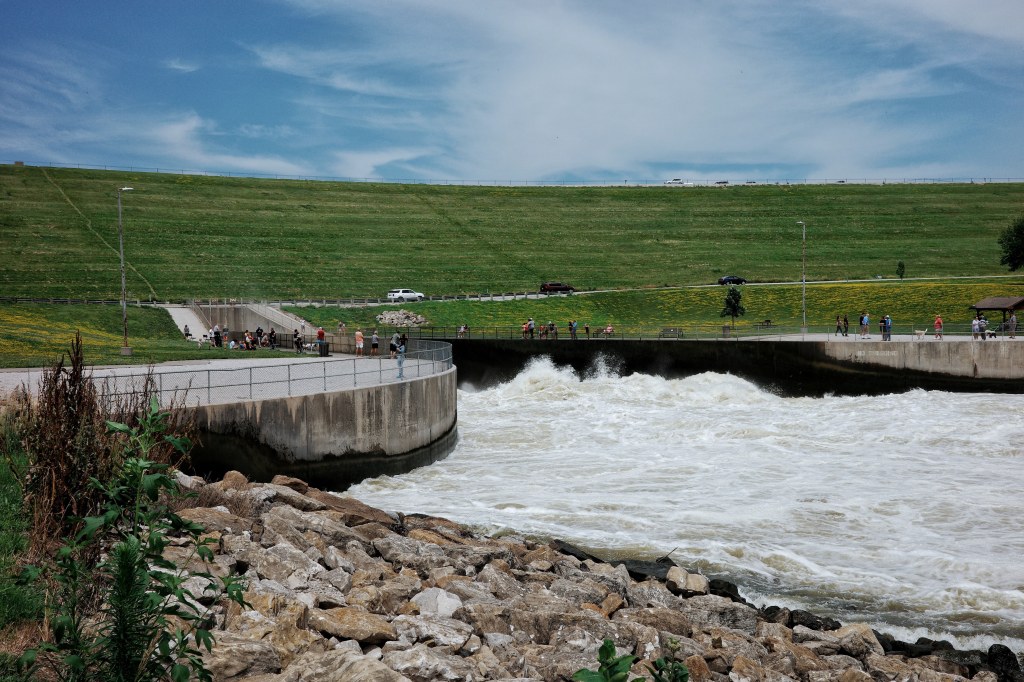
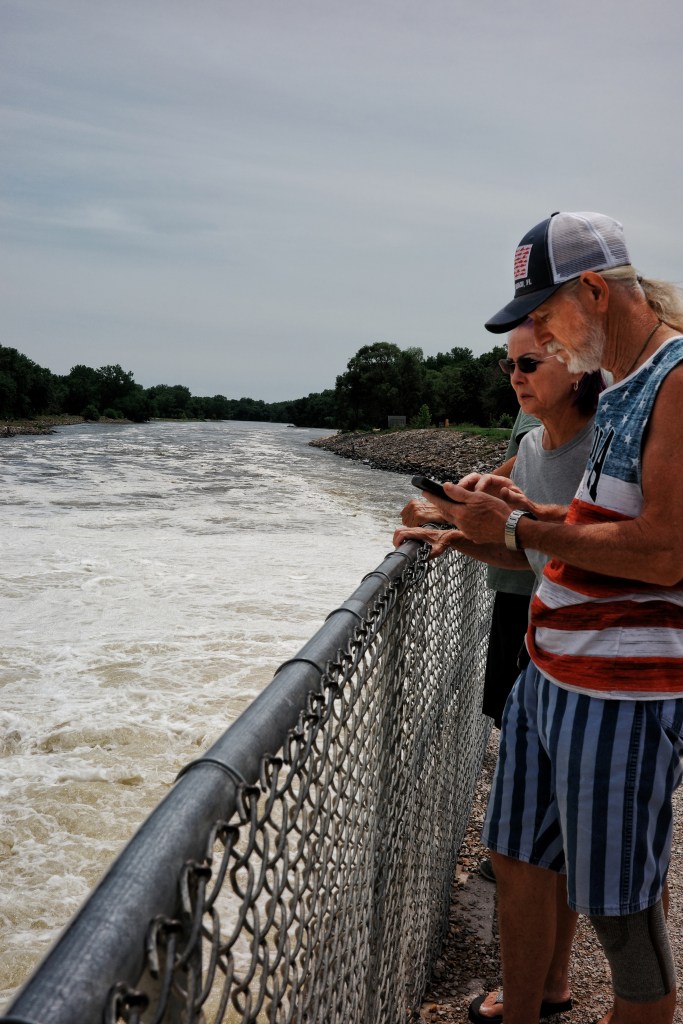
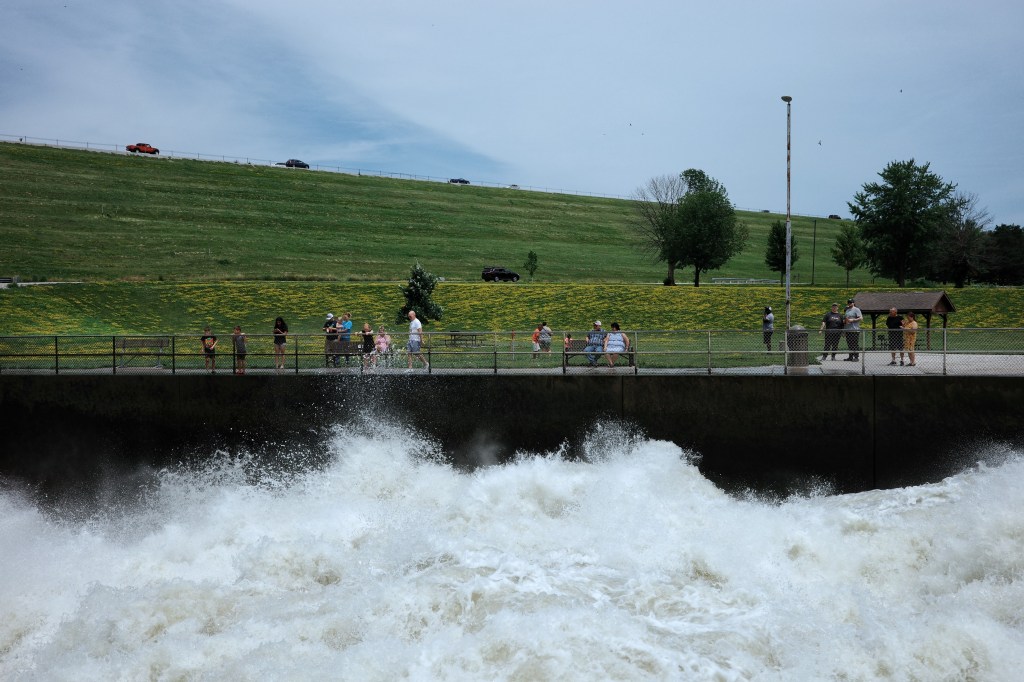
Because of the exceptional rainstorms, the Des Moines River is currently 20-22 feet higher than normal–not quite at actual flood levels (which, I believe, is 24 feet). A visit to the dam which creates Saylorville Lake yesterday was compelling. The 6000 acre lake has risen almost two feet in the last 24 hours; the spillway was releasing over 16,000 cubic feet of water every second — that’s 190% of its normal release. It was loud and furious and utterly fascinating to see.
View of the spillway from the parking area
People showed up to see it. Young people, old people, families with kids and dogs, couples, people on their own — a constant low-volume parade of people just to take a look at the chaos of the spillway. Just a few dozen at a time. Most of them would slowly approach the fence guarding the spillway, gawk a bit, gradually move closer to the release point at the bottom of the dam. The turbulent water was mostly unpredictable, and would splash people unexpectedly. Most laughed and ran away from the fence. A few got irrationally angry, as though the water had played some sort of trick on them.
The dam and the spillway
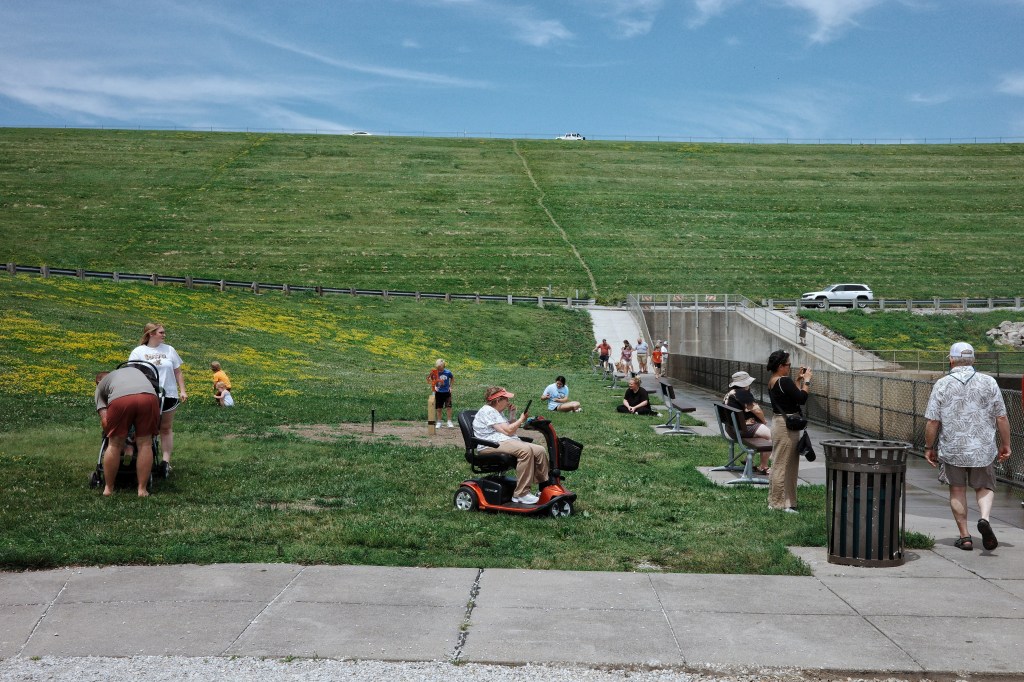
That large solid hill behind the spillway? That’s actually the dam holding back the Saylorville Lake. On other side, the water level is probably 30-35 feet higher. There’s a second, emergency spillway (not pictured in any of these photos) in the dam. The water level in the lake is expected to peak in a couple of days, and (it’s hoped) will remain a couple of feet below the emergency spillway.
Visitors on the other side of the spillway
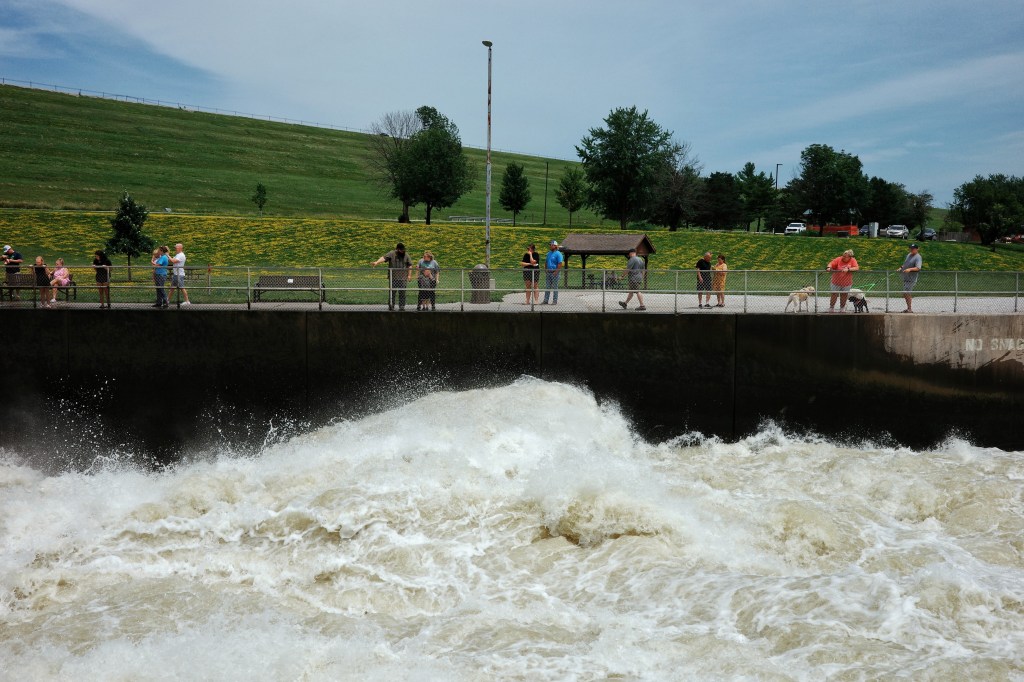
“If you fell in there, you’d die.” I can’t tell you how many people I heard say that. They’d stand at the fence, look at the raging water cascading out of the spillway, shake their heads, and say it in an awestruck voice. They often repeated themselves. “Wouldn’t have a prayer, if you fell in there. Nothing you could do. Nothing anybody could do. Find your body somewhere downstream.”
Everybody was a photographer at the spillway
Normally, the only people you’d see at the spillway were fishing. It’s a popular fishing spot; apparently it’s one of the few places you can catch eight to ten different fish species along a single short stretch of the river. Under normal conditions, that also makes it a popular spot for birds — pelicans, cormorants, gulls and terns, eagles. I didn’t see any birds even approach the spillway yesterday. Birds have too much sense for that.
A road runs along the top of the dam.
There was something almost pagan about the experience. Not pagan in a religious sense (since ‘paganism’ is just a term early Christians applied to any pre-Christian belief system), but in the sense of common people making a sort of pilgrimage to witness, awestruck, the beauty and savagery of nature, to experience their own smallness in the world. I doubt many of the people at the spillway thought of it in those terms, but it was there. The awareness of a natural power beyond our control and our understanding.
We were only there for a half hour or so. It seemed like longer, but time gets weird in the presence of the old gods.
Editorial Note: I was informed about this fishing video that shows the spillway under ordinary conditions. You don’t have to watch the entire thing; the opening seconds will give you a sense of what it’s normally like at the spillway.
Yesterday, to distract myself from the SCOTUS-induced alternating rage/depression cycle, I sorted through some of the photos I shot at Saturday’s Farmer’s Market. And there was one photograph that…well, wait. I need to back up a bit. Two things.
First thing, a reminder: I recently bought a new camera, a Ricoh GR3x. It’s unlike any camera I’ve ever owned. To begin with, there’s no viewfinder; you compose the photo using the rear LCD screen. I was actually hesitant to buy the camera because of the lack of a viewfinder (yes, you can buy an attachment viewfinder, but that’s more coin and fuck that.) Composing with an LCD screen seems wrong; that’s what you do with your fucking phone. To my film-trained mind, it’s NOT how you use a camera. And yet, with the GR3x it turns out to be surprisingly handy and intuitive. Old dog, new tricks.
Second thing: Alex Webb. He’s a street photographer who’s famous for extremely colorful and complex photos. When I say ‘complex’ I mean many/most of his photos are composed in a way that organically divides and separates the elements within the frame into what could be different, distinct photos. I’m not going to include an example image here because when I publish this and post the link on various social media, there’s a good chance it’ll feature Webb’s photo instead of the photo I’m writing about; I don’t want people to think I’m taking credit for Webb’s work. But seriously, if you’re not familiar with this guy, do a quick image search. He’s amazing.
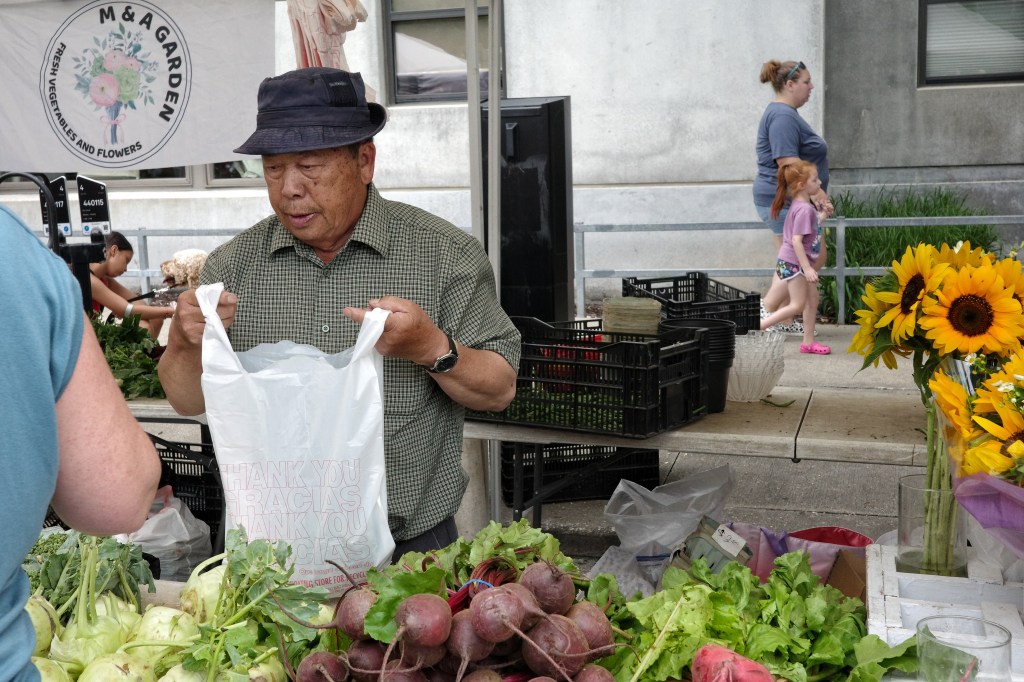
So, back to the opening paragraph, me sorting through Saturday’s photographs. At the Farmer’s Market I noticed a woman comforting her dog (which looked to be some sort of spaniel/poodle mixed breed) behind a vendor’s booth. The dog had apparently been overexcited by the crowd. There was something very sweet about their interaction and I wanted to photograph it. Having recently re-examined Alex Webb’s work, I thought it would be cool to include the vendor in the shot. But there was a guy who kept moving in front of me (I think he thought I was trying to cut in front of him to get the vendor’s attention). I’d shift to one side hoping to get a shot, and the guy kept shifting with me. With each step, I was losing sight of the woman and her dog. Just as I was about to give up, I saw a mother & child walking by behind the vendor.
I took the photo.
Not a great photo, but the potential is there.
Okay, it’s not a great photo. But I like it because it’s as close as I’ve ever come to shooting something almost almost in Webb’s style. Not in terms of color (my photo is rather drab in terms of color), but because the frame can be visually divided into three distinct image areas. The woman and her dog, the vendor, and the mother and child. Granted, the original idea of the woman and her dog largely gets lost, and the image is badly off balance…but still, there it is.
The thing is, if I’d been using a camera with a viewfinder, I wouldn’t have seen the mother and child before they entered the frame (and yes yes, if you’re shooting with a rangefinder camera you can keep your left eye open, which allows you to see outside the camera frame, but that only works if you’re right-eye dominant…and I’m not; I compose with my left eye). If I’d been using one of my usual cameras, I’d have missed the shot.
The GR3x allowed me to compose this photograph thoughtfully and almost instantly. It’s not a great photo by any means, but it demonstrates (to me, at least) this particular camera’s potential to catch unique, unexpected moments. I understand why this camera is beloved among many street photographers.
I don’t do much street photography. I’m not particularly good at it, but I enjoy it. But I also believe in practicing in public, in showing work that doesn’t quite meet my standards for what the work could be. So this is why I’ve inflicted this photo and this blog post on you. Thanks for being patient.

 gregfallis.com