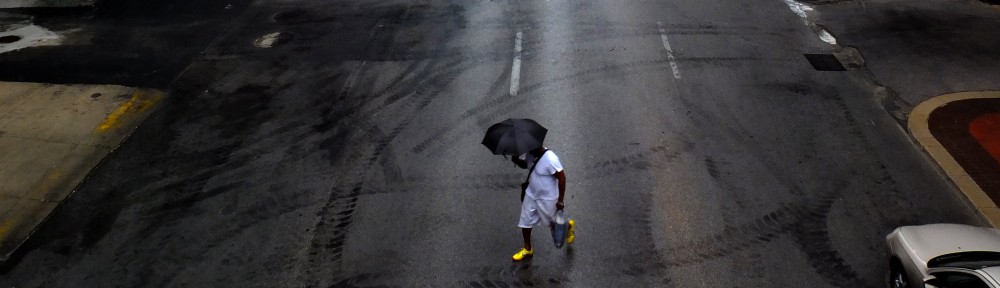
brutal bastard

You get that one moment. That’s it. You either get the shot or you don’t. And let’s face it, most often, you don’t. And in some types of photography, there’s no second chance. I love that. I hate that.

Yesterday was a cold, bright, sunny day. A good day for a guy with a fine little street camera to take a walk through the city. As I was walking along I saw this dark gash of an alleyway running between a building and a parking garage. I have a thing for alleys, so I decided to wander down it. But it was on the other side of the street; I had to wait for traffic to clear before I could jaywalk to the alley.

As I stood there I saw an obscure shape moving in the alley. A guy. A guy with a red hat. And I knew there might be a photograph to be made.

This is what I love: sometimes you can anticipate that moment. You can see the shot developing. You can visualize all the elements potentially moving into place. Potentially, that’s the key. It’s all about the potential, because any number of things can happen to totally fuck up the situation. A cloud might obscure the light. A car might pass in front of you at the critical moment. A passerby could throw off the balance of the composition.

I saw the guy with the red hat. A moment earlier I’d noticed a doorway with a red logo at about head level. I figured there was a good chance the guy was going to walk out of the dark alley and into the light. So I hurried to my right so I could include both the red hat and the red logo — and the moment I began moving I also began to kick myself in the ass. I was thinking “Idiot, you should have closed in on the alley and caught the guy stepping into the sunlight.” But it was too late to change my mind. I’d committed myself to a wide shot.

Sometimes the shot never comes together. You know that going in, of course. Sometimes all those elements you saw moving together simply move away from each other. The guy could turn around and go back down the alley. He could step out of the alley, but remove his red hat. Somebody could could open the door with red logo. So many things could go wrong.

But they didn’t. Things not only didn’t go wrong, they actually got better The guy stepped out of the alley and into the sunlight, just like I’d hoped he would. His red hat was almost perfectly in line with the red logo on the door, just as I’d hope it would. And then a little black and white dog followed him out.

So I took the shot.

a guy and his dogIt was the shot I wanted. It was almost exactly as I’d envisioned it. But it doesn’t really work. Not at this scale.

The guy gets lost, the red hat gets lost, the red logo gets lost, even the little dog gets lost. I think the photo might work if it was printed very, very large — but dammit, it doesn’t work at this scale. It just doesn’t.

Even when all the elements do come together — even when it all coheres perfectly and organically, as if it was predestined — even when you get the shot you want, it might not actually be the shot you want.

It gets worse. I got the shot I wanted. I knew it as soon as I released the shutter. I’d no idea it wouldn’t turn out, of course, but at that moment I knew I’d got the shot. I felt satisfied and full of myself. For maybe half a second. Even as I was lowering the camera, I saw the guy hold something out in his hand. The little dog leaped up to get it. And I missed it.

Photography is a brutal bastard. And I must be masochistic, because I’m okay with that.
 

the questions we ask

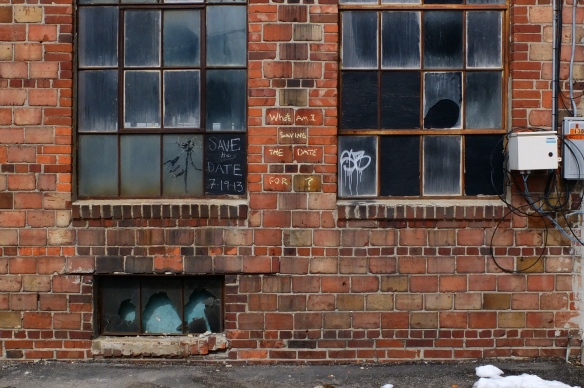
Last week, while strolling down a relatively nice alley, I came across something peculiar written on a board covering a broken window. It said

Save the date
7•19•13

If you’re anything like me (and really, what are the odds of that?) you see something like that and you immediately start asking a whole series of completely unanswerable questions. What’s happening on that date? Why should I save it? Why would anybody put that request (if it is a request) on a board covering a broken window in an alley? Sure, it’s a relatively nice alley, but c’mon. For whom is this invitation (if it is an invitation) intended? Am I supposed to save the entire day? Just the evening? Is the event (assuming there is an event associated with that date) taking place in the alley? And finally, what the fuck, really?

There’s not much point in having questions if you don’t actually ask them, right? So I decided to ask them.

okay but whyI packed some chalk in a pocket of my jacket, stuck my little Fujifilm X10 in the other pocket, took myself right back to the alleyway, and…and I stood there, realizing I couldn’t ask all those questions. For one thing, I didn’t have enough chalk. Nor enough space. So I had to satisfy myself with asking just one question. It’s a wee bit hard to see in the small version, but I left a little note asking:

WHAT AM I SAVING THE DATE FOR?

Leo Babauta says the questions we ask determines the type of people we become. If so, it seems I’ve become the type of person who stands in alleys and asks ‘What the fuck?’

I’ll check back periodically (it’s a relatively nice alley, after all) to see if I get an answer. If an answer arrives, I’ll be sure to let y’all know.

save the date

So I’m walking down this alley, right? Walking down the alley, minding my own business mostly, and in the back of this building–it looks like it might have been a garage space at one time, or maybe some sort of small manufacturing enterprise that went toes up–on one of the boarded-over broken windows, I see this:

Save the date
7•19•13

Sometimes I see things and they don’t quite register in my brain until a few seconds later. I took maybe five or six steps and then my brain belatedly kicks in. Dude, my brain says, did you see that? And I’m all ‘Yeah, I saw it.” And my brain says Well? And I say ‘Okay’ and me and my brain turn around and retrace those five or six steps.

save the date2

And sure enough, my brain was right to insist we turn around. There it is. Save the date. (Okay, there’s also a cast-off blouse or jacket, stained with what appears to be blood; I didn’t examine it too closely because 1) I wasn’t about to pick it up without a pair of latex gloves and 2) I really do not want to be seen standing in an alley holding a bloody jacket in my hands.)

Save the date. I’m just taking it for granted that this isn’t like ‘Save the Whales.’ I don’t think the date is in any danger or is in any way threatened. I’m assuming whoever wrote that is suggesting I don’t make any plans for the 19th day of July because…because why?

Let’s just assume this (this what? Is it an invitation? an announcement? a command?) is a savvy niche marketing strategy, that it’s a direct approach targeting the ‘folks who wander down alleys’ demographic. And while we’re assuming, let’s also assume it’s not targeting a ‘folks who don’t mind standing in alleys holding bloody jackets’ demographic. That leads us inevitably to this question: Uhhh…what the fuck?

I realize this is a small broken window; there isn’t room to include a detailed account of what’s going to take place on that date. But a hint would have been nice.

So I go online to see if I can determine what’s happening on the 19th of July. There’s a Taylor Swift concert in Philadelphia. Wrong city, wrong demographic. Somebody named Tracy is getting married. But probably not in that alley (although that would be a wedding I’d definitely attend). There’s a synchronized swimming competition. Doesn’t sound like a likely candidate. There’s a bull riding event in Florida and a group called Train is appearing in Indianapolis on their Mermaids of Alcatraz tour. Nope, that’s not it. The Red Sox are playing the Dog-Ass Yankees at Fenway. That’s always a good time. And in Des Moines there’s a muscle car auction at the State Fairgrounds and the Civic Center is hosting a student performance of The Princess and the Pea. Probably not events you’d advertise in an alley.

I’m willing to save the date on my calendar (if I owned a calendar, which I don’t, but that’s not the point, is it–the point is this: ‘Why am I saving the date?’ A related point may be ‘Do you really think folks who wander down alleys are also folks who keep engagement calendars?’). I may have to return to the alley with a bit of paint and a brush and use one of the remaining boarded-over broken windows to request more information.

Okay but why am I
saving the date?

It wouldn’t be vandalism. It would just be an appeal for clarification. Right?

we’re still at war

It’s common knowledge that liberals hate America, right? We don’t support the troops, and the only reason we’re not burning the flag right this very minute is because we’re too busy queuing up in disorderly socialist lines for the privilege of spitting on wounded veterans.

At least that’s the litany we hear every fifteen minutes from conservative Republican outlets like FOX News. But thankfully, there exists a courageous news venue that unflaggingly keeps the troops in mind, that regularly reminds us that there are still men and women in uniform serving in a combat zone.

Spc. Andrew Harvey, a 1st Infantry Soldier, patrols along steep cliffs of the Korengal Valley's surrounding mountains during Operation Viper Shake, Afghanistan, April 21, 2009. Photo courtesy army.mil.

Spc. Andrew Harvey, a 1st Infantry Soldier, patrols along steep cliffs of the Korengal Valley’s surrounding mountains during Operation Viper Shake, Afghanistan, April 21, 2009. Photo courtesy army.mil.

Is it FOX News? No, it’s not. Is it the New York Times? Sadly, no. Maybe it’s TIME magazine? Nope.

It’s Mother Jones. That’s right, Mother Jones — the notoriously left-wing muckraking magazine. Since June of 2009, MoJo has been publishing We’re Still at War: Photo of the Day. It’s not published every single day, but several times a week they print a photograph of U.S. military forces either in a combat zone or training for deployment to a combat zone. It’s a small thing, but it serves as a constant reminder.

The sad thing is that the American public actually needs reminding.

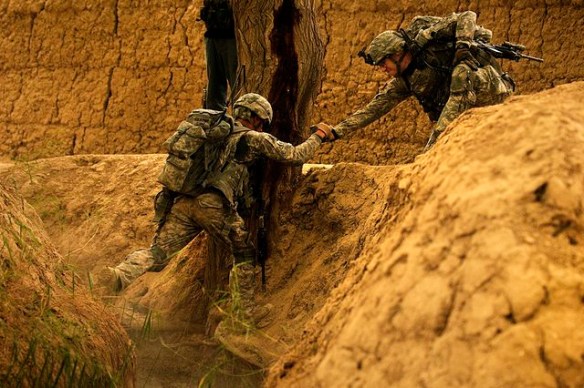
COMBAT OUTPOST MIZAN, Afghanistan—US Army 1st Lt. Troy Peterson, right, platoon commander for 3rd Platoon, Fox Company, 2nd Squadron, 2nd Stryker Cavalry Regiment, assists his radio operator, US Army Pfc. Justin Cobbs, across a ravine during a dismounted patrol near Combat Outpost Mizan, Mizan District, Zabul Province, on Aug. 16, 2010. Photo via the US Army by Senior Airman Nathanael Callon.

COMBAT OUTPOST MIZAN, Afghanistan—US Army 1st Lt. Troy Peterson, right, platoon commander for 3rd Platoon, Fox Company, 2nd Squadron, 2nd Stryker Cavalry Regiment, assists his radio operator, US Army Pfc. Justin Cobbs, across a ravine during a dismounted patrol near Combat Outpost Mizan, Mizan District, Zabul Province, on Aug. 16, 2010. Photo via the US Army by Senior Airman Nathanael Callon.

It’s become shockingly easy to forget that we’re still at war. While we’re immersed in our daily lives–buying groceries, watching Downton Abbey, making fun of Justin Bieber–men and women are still fighting and killing and dying in Afghanistan. It’s easy to forget because most folks don’t have any meaningful connection to the war or the people fighting it.

There are about a million and a half active duty personnel serving in the U.S. military–the Army, Marines, Air Force, Navy, and Coast Guard. That sounds like a lot of people to have in military harness, but it’s less than half of one percent of our population. Of that million and a half troops, around 70,000 are currently serving in Afghanistan. That’s still a lot of people, but the odds are you don’t know any of them.

There’s never been a point in U.S. history in which the American public has been so separate from its military. There’s a fairly good chance you (whoever you are) have a family member who served in the military at some point in the past–probably World War II, maybe Korea, maybe Vietnam. But the odds of you knowing somebody currently on active duty are pretty slim. The odds of you knowing somebody who has served in Afghanistan or Iraq are even more slim. The odds of you knowing somebody who is currently stationed in Afghanistan are remote.

The sun sets behind U.S. Army Sgt. 1st Class Jamie R. Johnson, a platoon sergeant from Bayonet Company, 2nd Battalion, 327th Infantry Regiment, Task Force No Slack, in Afghanistan's Kunar Province March 17. Photo by U.S. Army Sgt. 1st Class Mark Burrell, 210th MPAD

The sun sets behind U.S. Army Sgt. 1st Class Jamie R. Johnson, a platoon sergeant from Bayonet Company, 2nd Battalion, 327th Infantry Regiment, Task Force No Slack, in Afghanistan’s Kunar Province March 17. Photo by U.S. Army Sgt. 1st Class Mark Burrell, 210th MPAD

Last year 301 U.S. troops were killed in Afghanistan. In 2011, 412 troops were killed there, and 496 were killed the year before that. That’s averaging more than one death a day for the last three years.

Unless one of those dead troops was a member of your family, it’s easy to ignore them. Their deaths were almost certainly not reported on the national news. They might have been given a solemn moment in the local news. But let’s face it–they were strangers. They are as distant from us as the murder of a drug dealer in Newark or the accidental shooting of a 13 year old girl in Ovid Township, Michigan. They are, in a very real and very sad way, nobody at all.

Spc. Jon Saladin, a paratrooper with the 82nd Airborne Division's 1st Brigade Combat Team, walks past an Afghan graveyard during a US–Afghan patrol on April 30, 2012, Ghazni province, Afghanistan. Saladin serves with Company A, 2nd Battalion, 504th Parachute Infantry Regiment. US Army photo by Sgt. Michael J. MacLeod.

Spc. Jon Saladin, a paratrooper with the 82nd Airborne Division’s 1st Brigade Combat Team, walks past an Afghan graveyard during a US–Afghan patrol on April 30, 2012, Ghazni province, Afghanistan. Saladin serves with Company A, 2nd Battalion, 504th Parachute Infantry Regiment. US Army photo by Sgt. Michael J. MacLeod.

Except these nobodies volunteered to put on a uniform and take risks in the service of their country. Well, our country. It’s our country too, right? We pay taxes after all (though let’s be honest, we try to pay as little as we can). But the troops sometimes have to pay in a more fundamental way.

So they deserve our support and our attention. They deserve more than we give them. Much more. Mother Jones publishes a photo of the troops a few times a week–it’s not much. It’s not much at all. But MoJo’s We’re Still at War: Photo of the Day is more attention than most news organizations give to the troops. And Mother Jones gives them a name.

Lance Cpl. Cassidy Zacharyasz provides overwatch for International Security Assistance Forces as they conduct a district transition assessment visit with Nawa District officials at the Nawa District Government Headquarters, Helmand province, Afghanistan, Jan. 29, 2013. U.S. Marine Corps photo by Sgt. John R. Rohrer

Lance Cpl. Cassidy Zacharyasz provides overwatch for International Security Assistance Forces as they conduct a district transition assessment visit with Nawa District officials at the Nawa District Government Headquarters, Helmand province, Afghanistan, Jan. 29, 2013. U.S. Marine Corps photo by Sgt. John R. Rohrer

Thanks to Mother Jones we know this:

In April of 2009, Spc. Andrew Harvey served in the Korengal Valley.
In August of 2010, 1st Lt. Troy Peterson and Pfc. Justin Cobbs served in Zabul Province.
In March of 2011, Sgt. 1st Class Jamie R. Johnson served in Kunar Province.
In April of 2012, Spc. Jon Saladin served in Ghazni province.
And just a few weeks ago Lance Cpl. Cassidy Zacharyasz was on duty in Helman Province.

These are real people. They have real families. They’re making real sacrifices. And we need to remember that, like it or not, we’re still at war.

self evident truths

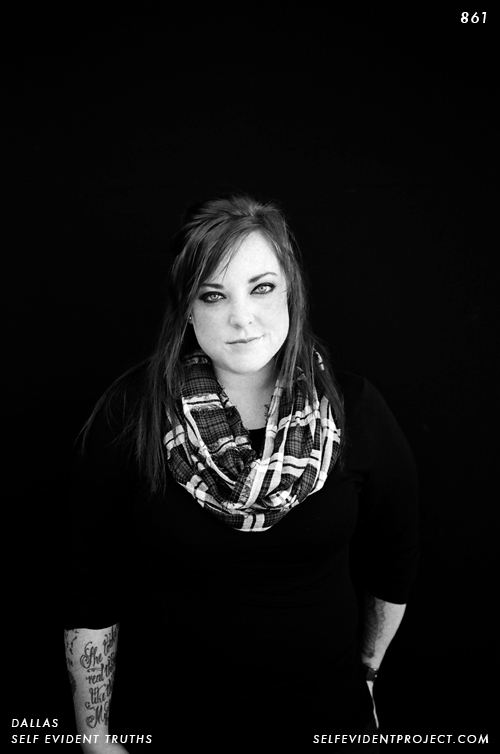
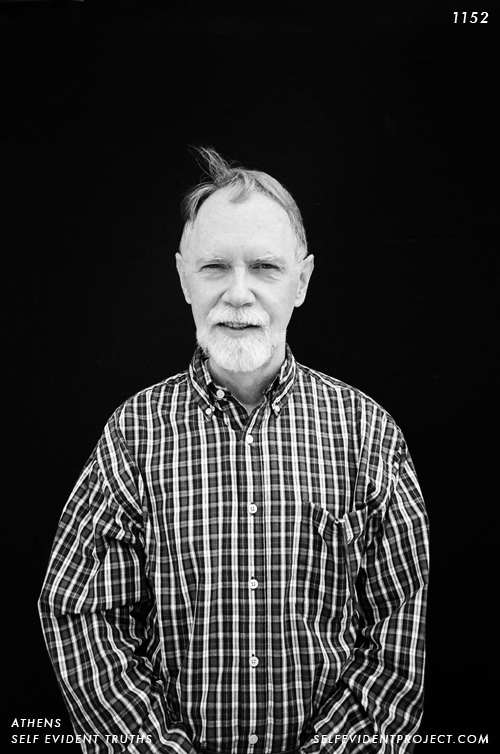
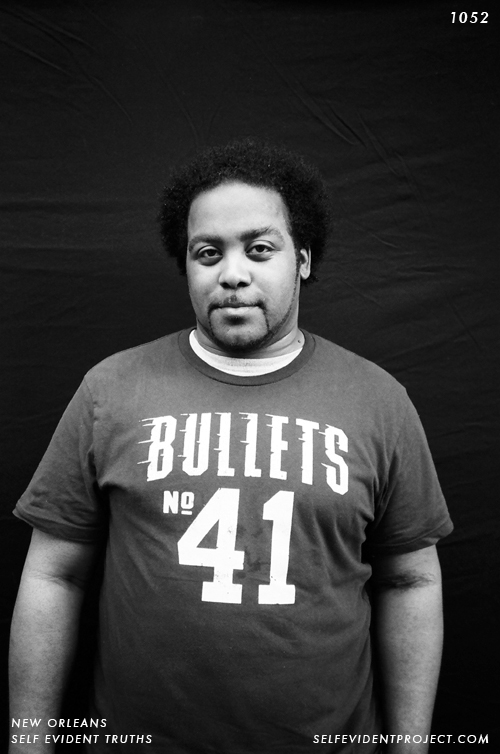
I spent some time looking at the portraits from the Self Evident Truths project before I read the ‘About’ section. I like the photographs. They’re simple, unfussy, comfortable, direct, wonderfully relaxed portraits of ordinary people. I like them a lot.

On the landing page, the portraits scroll by at an unhurried pace — about the pace you’d expect if you were strolling through town and looked casually at the people coming toward you on the sidewalk. It’s pleasant and smile-making to just sit for a while and look at the faces that pass by.

self evident truths 2

Then I read the ‘About’ page. These are the first few lines on that page:

In 2010 iO Tillett Wright began a project called Self Evident Truths, photographing anyone that felt like they qualified to fall on some part of the LGBTQ spectrum, from bisexual, to transgender. Shot in simple black and white, in natural light, with no makeup or styling, the photos were intended to humanize the very varied face of gays in America today.

Intended to humanize. I read that and thought ‘We need to humanize gay folks?’ That notion seems so out of date. It feels like something activists would say in the 1990s.

Don’t get me wrong, I love the portraits. I love the foundational concept — I find something oddly pleasing about portraits of ordinary people categorized in some way. I’d love to see portraits of people who work in grocery stores, or people who are in bowling leagues, or people who frequent swap meets, or people who keep lists of the birds they see. I suspect they’d all look fairly similar to the people we see in the Self Evident Truths project.

But I can’t imagine shooting portraits of birders or bowlers or grocery store employees in order to humanize them. It’s 2013 — do we really need to humanize LGBTQ folks?

self evident truths 1

If the Montana legislature is any indication, then yeah, I guess maybe we do.

Yesterday the Montana legislature voted on a measure to strike an old Montana law that criminalized “sexual contact or sexual intercourse between two persons of the same sex.” The Montana Supreme Court ruled that law was unconstitutional in 1997, but the law remained on the books despite regular attempts to have it removed. Why? Because some Montana Republicans apparently felt that if they voted to remove the law, they’d get some of the gay on them. And you know, that stuff is hard to wash out. Or something like that.

This year was different. This year Montana Democrats garnered enough support to have the unconstitutional law stricken from the criminal code. The vote was 38-10. That’s right, ten Republicans still voted to retain the law even though it’s unconstitutional and even though it can’t be enforced. Lawdy.

Despite the fact that the U.S. Supreme Court has ruled them unconstitutional, there are still at least a dozen other states with anti-sodomy or anti-homosexual laws on the books. There are elected legislators in at least a dozen states who are so afraid of gay folks that they refuse to remove blatantly unconstitutional laws from their criminal codes.

But I still disagree with iO Tillett Wright and the Self Evident Truths project on this issue. I don’t think we need to ‘humanize’ gay folks. I think we need to humanize the people who hate gay folks.

self evident truths 3

Visit the Self Evident Truths site. Visit their shop. Buy prints of the portraits. Buy ‘We Are You’ t-shirts. Donate to the project if you can. But work to humanize bigots and assholes. Gay folks are already okay as they are.

Editorial note: When I say ‘gay folks’ I mean everybody in the LGBTQ mishpocha; I just get weary of the acronym. Also? It’s already totally fucking obvious, but for the record let me just point out that all the photos are from the Self Evident Truth project.

faire l’idiot dans les ruelles

I’m completely comfortable writing about photography in most circumstances. I’m less comfortable when I’m writing about — I started to say my photography, but that sounds so pretentious. I’m less comfortable writing about the photographs I shoot. But about a month ago I received an email asking me the following questions:

I guess what I’m asking is how do you develop a personal photography project? Do you just pick a thing and start taking picture of it? Do you make up rules or guidelines before you start? How do you start a photography project?

I nattered on about my approach to the Faux Life series and the Traffic Signal series. But it occurs to me that I haven’t really addressed the actual questions. Since I promised I’d write about each of the three photo series I’ve included on this site, I thought maybe I could use this third piece to at least attempt some answers.

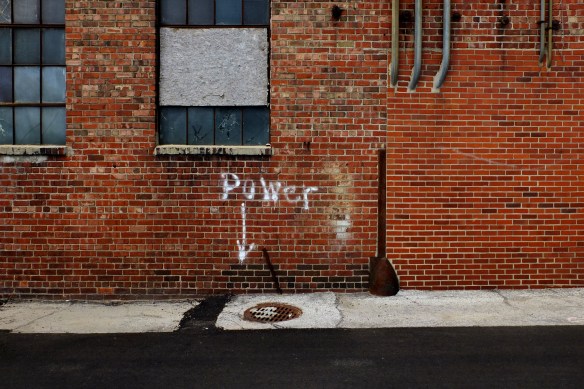
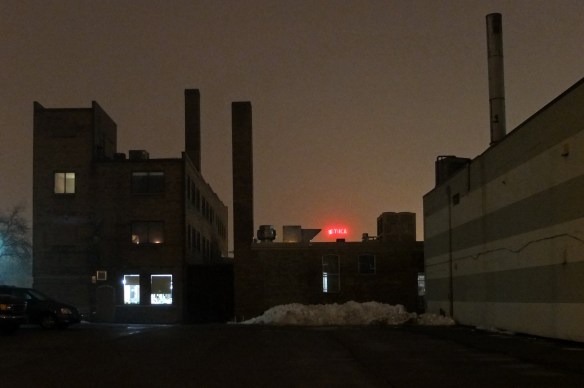
in case you were wondering where the power was

in case you were wondering where the power was

Do you just pick a thing and start taking picture of it? Yes. Well, no. Sometimes.

With the Faux Life series I knew what I wanted before I shot the first photograph — but that’s a conceptual series. I had to develop the concept before I could shoot the series. So in that case, yes I picked a thing and started taking photos of it. The Traffic Signal series grew out of a different project — one that focused more on writing than on photography. It wasn’t until I’d shot some photos of traffic signals that I actually became interested in them as a distinct theme. So no, I didn’t just pick a thing and start taking photographs of it. I hadn’t even considered it as a thing until after I’d taken several photos in which traffic signals were featured.

With the Larking about in Alleys series I was doing just that. Larking about in alleys and shooting photos of stuff I saw there. I’d no idea of making it into a coherent series until a friend of mine (the delightful Beckett Gladney) suggested it.

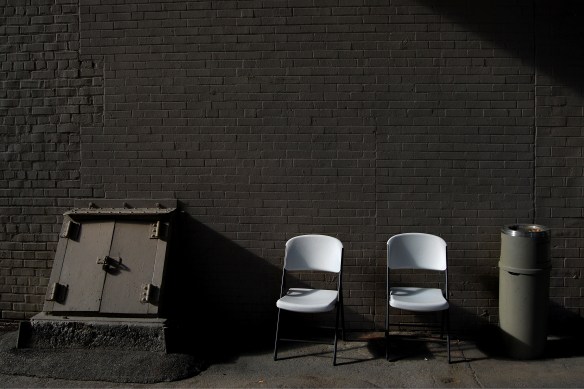
tobacco row

tobacco row

Do you make up rules or guidelines before you start? Yes. Well, no. Sometimes.

Since the Faux Life series was conceptual, I obviously had to come up with some basic rules before I began shooting. 1) Rephotograph moments from the Buffy the Vampire Slayer (or Angel) television series, 2) shoot them in black-and-white, 3) post-process the images to shift the focus or make them more dramatic, 4) find an appropriate (or an inappropriate) line from a Jane Austen novel, 5) insure that both the image and the text combine to create something not found in either original.

Those were the ‘rules.’ But I discovered I had to be flexible within the confines of those rules. For example, I’d originally intended to rephotograph action sequences — chase scenes or fights. But they turned out to be surprisingly uninteresting. I learned that the more quiet and nuanced scene carried more emotional impact.

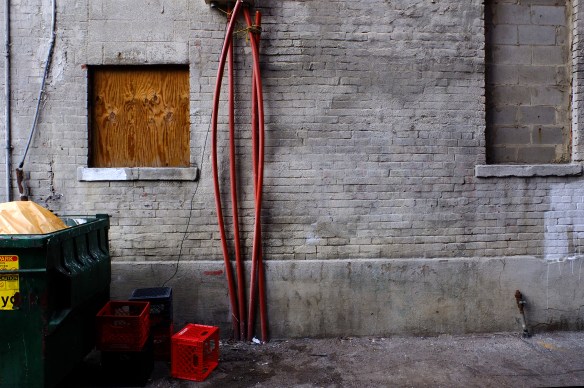
in an alley nothing is ever quite straight

in an alley nothing is ever quite straight

The Traffic Signals series was significantly easier because it had significantly fewer rules. Just the one, really: photograph a traffic signal in such a way that it provides an unexpected perspective of such a commonplace device. Simple.

On the other hand, Larking about in Alleys turned out to be surprisingly more difficult. Initially, I was truly just larking about — wandering idly through alleyways to see what I could see, and doing it for the simple reason that I enjoy seeing stuff not really intended to be seen. But once I began the series, I needed it to be cohesive and coherent. It had to require more than simply being IN an alley and shooting a photograph. The photo had to have (and yes, I realize how loopy this sounds) a certain alley quality. It had to have alleyness.

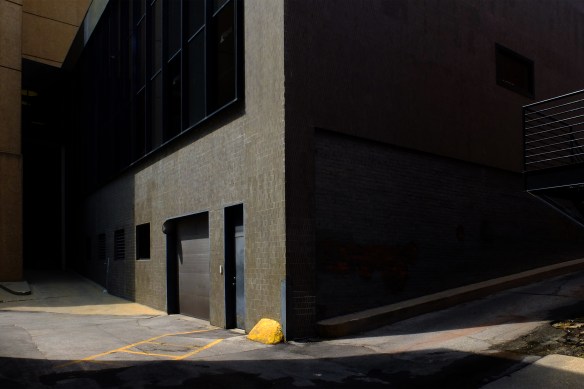
probably trespassing

probably trespassing

And that meant I had to think about alleys. Alleys in American cities are basically utilitarian. They’re working spaces rather than commercial spaces. They tend to be cosmetically ignored; nobody really cares how an alley looks. They tend to be narrow and confined, though they often open up unexpectedly into a wider space (as seen below). Alleys aren’t usually built for traffic — not in the sense of the efficient transport, by foot or vehicle, of goods or people from one place to another. For the most part, alleys aren’t intended to be thru-ways; they’re a temporary destination — a place to load and unload. Although they’re usually open to the public, the public isn’t expected to use them. The public most certainly isn’t expected to lark about in them.

alley opens into parking lot

alley opens into parking lot

Once I’d developed a sense of alleyness, I began trying to shoot photos that would suggest those alley qualities. It’s not as easy as you’d think.

But that’s it. That’s how I develop a photography project. Which is to say, that none of the three series on this website developed in the same way. I realize that’s not a particularly helpful answer to the questions. But hey, I’m a writer, not a photographer.

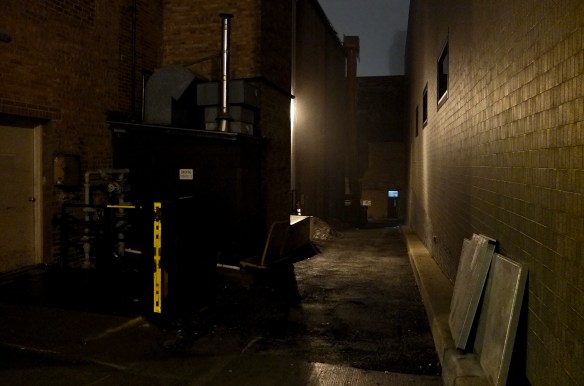
alley in the mist

alley in the mist

I don’t think it’s terribly difficult to start a photography project. I suspect it can be difficult to do something original, or to do it in an original way. And I have absolutely no help to offer about that.

Oh, and about the title of this piece? It’s my understanding (and many thanks to Sonya Butler) that Faire l’idiot dans les Ruelles is French for Larking about in Alleys. It sounds so much more amusing in French.

a five dango city

It was a cold, cloudy, wet, grey, miserable sort of afternoon and I was downtown with a couple of hours to piss away on nothing in particular. In other words, a perfect time to go larking about in alleys. Alleys are best photographed in rotten weather because there are fewer people working in them. I actually like the people who work in alleys, but they tend to be camera-shy. And suspicious. It’s just easier to do alley work in foul weather.

So I slipped the little X10 in my pocket and headed out to find a nice juicy alley. First, though, I thought I’d make a little detour to visit to the river.

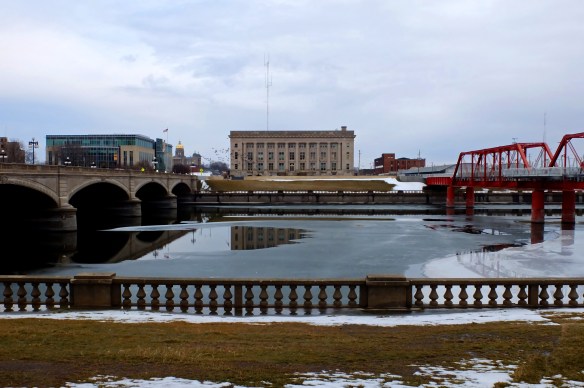
courthouse across the river

courthouse across the river

I’m of the opinion that you can never go very wrong making a detour to visit the river. Any river. That said, I have to admit there are certain aspects of a river that make you better appreciate a good alley. Like the absence of walls and buildings to block the wind. Let’s face it, rivers suck at wind-blocking.

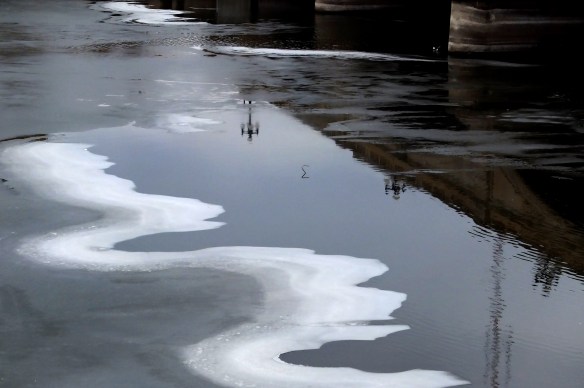
On the other hand, the absence of all those walls and buildings gives rivers the great advantage of meteorological drama. With rivers you get all that accompanying sky. And you get it twice — once overhead and once in reflection.

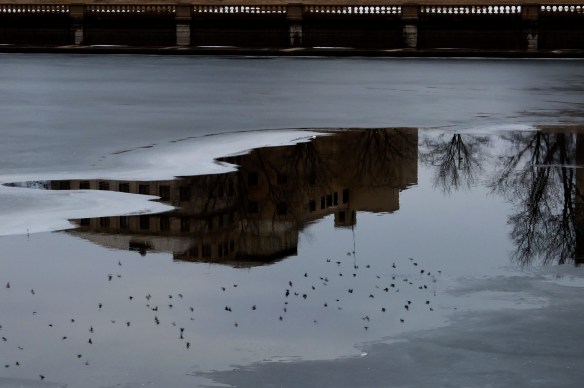
there are always pigeons along the river

there are always pigeons along the river

There really wasn’t anything particularly interesting going on at the river. There was the usual flock of pigeons morris-dancing around in the sky. Despite the cold and wet, there were a few intrepid bicyclists and runners tooling up and down the riverwalk and bike path. There were a couple of really bitchy Canada Geese fussing at each other.

It took me a while to figure out why it was so quiet. The construction that’s been taking place along the riverwalk for the last couple of years is largely finished. There were no generators coughing away, no backhoes, no bucket trucks or forklifts, no men with jackhammers. The riverwalk was…quiet.

riverwalk intersection

riverwalk intersection

For years the Des Moines city planners have been making a considerable effort to draw people back into the downtown area. It’s not just that developers have been building loft apartments and faux brownstones — the city has been adding a lot of public art and other quality of life amenities. There’s a new dog park, there’s a skating rink, there are bike trails and pedestrian bridges, there’s a botanical center and a science center and a historical building — all near the river.

Construction has just been completed on a small, two-level riverwalk pavilion. When it opens, it’ll include public restrooms (and trust me, that’s important in a city) and a small cafe or coffee shop.

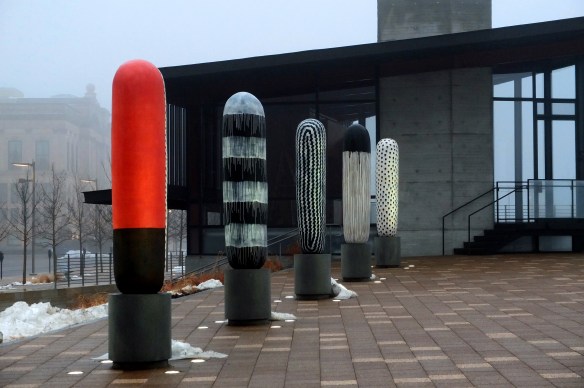
And in front of the pavilion: five dango.

the dangos of jun kaneko

the dango of jun kaneko

The dango are large ceramic sculptures by Japanese artist Jun Kaneko. A dango is a sort of Japanese steamed dumpling. These don’t look anything like dumplings, but I think there is something dumplingish about them. They’re not bland like dumplings, but they’re simple and strangely comforting. These are happy-making works of art.

There’s something very sweet and childlike about the dango. They were only installed a few weeks ago, but they seem to fit right in along the river. Seeing them, touching them, watching other folks look at them with a sort of bemused confusion — it makes me ridiculously happy.

Still, I hadn’t set out to look at the dango; I’d set out to wander idly through alleys. So I didn’t stay.

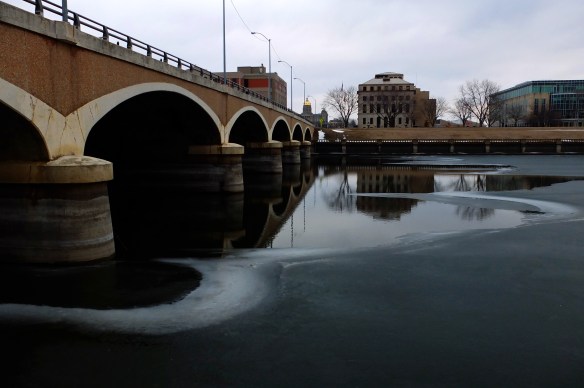
 the court avenue bridge

the court avenue bridge

But before I ventured forth alleyward, I decided to check out the other structure that’s been under construction along the riverwalk.

Rivers flood. All of them, they all flood. If you look at the large version of the photo below (or almost any photo of the riverwalk) you’ll see several lines of flood levels. What you can’t see are the tree-trunk-sized logs jammed up in the infrastructure beneath those bridges. When the Des Moines River has once-in-a-century floods (which we seem to have every five years or so now, thanks to climate change and the short-term planning of the old Army Corps of Engineers), it really floods. It’s not uncommon for those balustrades to be under water.

police department

police department

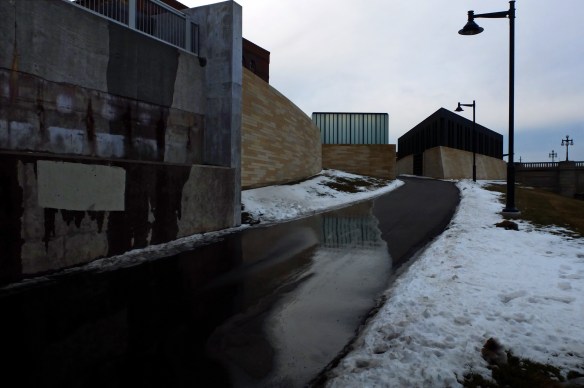
I’m mentioning that because the other structure that’s been under construction is a storm pump station. It’s designed to keep those pesky once-in-a-century flood waters under control. Both the pump station and the new pavilion have exceedingly cool flood doors that can be closed during high water. They look a lot like the doors you see protecting the island lairs of James Bond villains.

I spent an absurd amount of time looking at those doors. I don’t really want to see the river flood, but at the same time I can’t wait until the river floods.

and the snow melts slowly

flood pump station

I was just getting ready to head out and find a friendly alley when my cell phone chirped. I discovered I’d spent about two hours walking a grand total of about three and a half blocks. I had to hurry to meet my friend, so I took a shortcut through an alley.

I did manage to shoot a photo in the alley. But it was blurry.

Siren

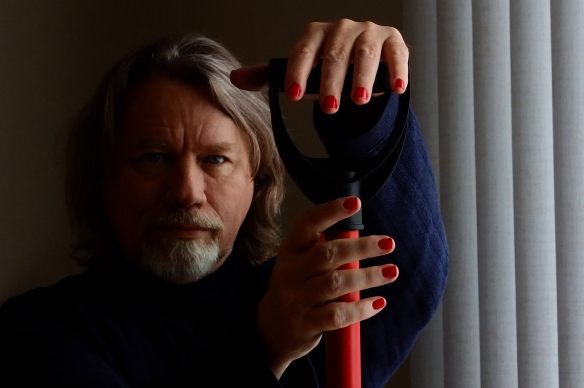
So. My fingernails. They’re red. Bright red. Incredibly fucking red. I have incredibly fucking red fingernails. I’m typing this with fingers that have incredibly fucking red nails. It’s really distracting.

Last night, during the fourth quarter of the Super Bowl, while it looked like San Francisco might actually make a comeback, I had my fingernails painted incredibly fucking red. The actual shade of red, according to the label on the bottle, is Siren. No, I’m not making that up. Siren. Also on the label is a warning:

Avoid Heat and Flame

For all I know, Heat and Flame may be other shades of red. And if they’re redder than Siren, you can bet your ass I’ll avoid them. But I assume the manufacturers of Siren are actually warning me NOT to put the bottle of fingernail polish in a fire. I hadn’t even considered putting the bottle in a fire — not until they told me NOT to. Now it seems like it might be an interesting experiment.

why yes, my fingernails ARE incredibly fucking red

why yes, my fingernails ARE incredibly fucking red

You may be wondering why I had my fingernails Sirenized. I got to confess, there were moments when I wonder that my ownself. I did it for an Iron Photographer photo. I have discussed the IP process before. I can’t even begin to tell you about the phenomenally stupid shit I’ve done for Iron Photographer photographs. I need to point out that Iron Photographer is about creating artful photographs, not about doing stupid shit. But it’s surprising how often the process involves some degree of stupid shit.

This time it involved Siren. And a shovel. Seriously, it always makes sense while you’re putting the photo together. It’s only when you look at it afterwards that you begin to ask yourself “What the HELL was I thinking?”

Now I have to figure out how to remove this incredibly fucking red nail polish before I can leave the house. Or answer the door (I have an order of Thin Mints scheduled to be delivered and I do NOT want to have Siren-red nails when I’m handing over some cash to the poor innocent Girl Scout. Or her mother).