storm season

After yesterday, I think we can say storm season has arrived. Massive severe weather systems pushed their way through the American heartland yesterday, causing destruction all the way from northern Texas to Minnesota. There were twenty-four confirmed reports of tornados on the ground in five different states (one of them was spotted three or four miles northwest of where I live — though we only experienced high winds, torrential rain, and a few minutes of hail).

It was horrible. It was glorious. It made me miss my brother, Jesse Eugene.

and it's still rainingJesse Eugene and I didn’t have a great deal in common. We were always close and we always enjoyed each other, but I’m not sure we’d have been friends if we weren’t brothers. Still, we spent a lot of time together over the last couple years of his life. Hunting morels in the spring (I haven’t found a single mushroom this year, which would have made him laugh his ass off, the vicious bastard), playing games on the X-Box (he’d have been really curious about the new version being released tomorrow), playing golf (which reminds me, I need to set up a tee time with my remaining brother), and sitting on his porch, cooking and drinking beer (I did most of the cooking; he did most of the drinking — an unfair division of labor).

And storms. We had this in common: we both loved storms.
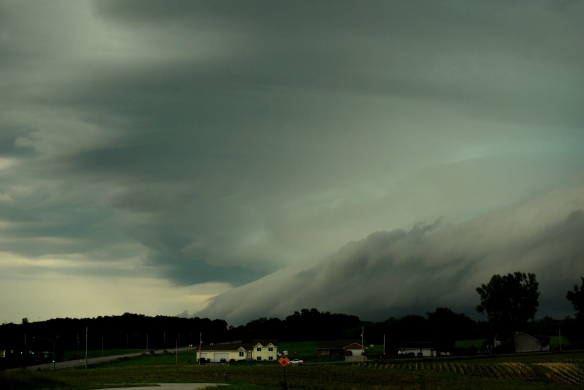
and then it got worseWhen a storm was approaching, we’d both stop what we were doing and pile into his truck, head out into the countryside, and find a spot where we could watch it.

It’s one of the best things about living in the American Midwest: you can actually watch weather systems develop. You can watch a storm grow and turn mean — or grow, then give in to entropy and dissipate. You can watch rain pissing down like mad a couple of miles away, while you’re standing placidly in sunshine. You can see tornados form — or try to form and fail — or form and just hang there in the sky like wasp tails, without ever touching down. And lawdy, the lightning. Beautiful and terrifying and mesmerizing.

There’s something elementally compelling about watching a storm grow in size and strength. It’s both scary and magnificent. Sometimes you realize the storm hasn’t actually gotten bigger — it’s just gotten closer. That can be unnerving.
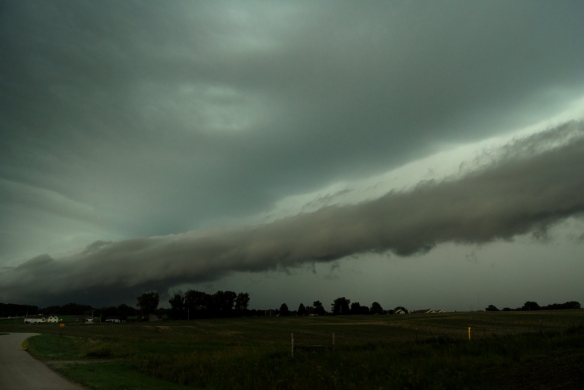
a bit of rotationI think what made Jesse Eugene such a good storm-watching companion was that neither of us was interested in the experience as an adventure. Some people like to get close to storms because they enjoy the thrill, the risk. My brother served as a Marine in Vietnam and was a career firefighter; I’ve been a medic in the military, I was a counselor in the Psychiatric/Security Unit of a prison for women, and a private investigator specializing in criminal defense — we’d both experienced very real risks and dangers, and neither of us felt any need to seek out new ones.

For us, watching storms was all about witnessing something primal, something wild and savage and entirely unrestrained. Something completely beyond anything resembling human control, but something that was still organic. Storms follow rules and laws of nature that we didn’t / couldn’t understand, and we were both drawn by the fact that a storm was always capable of doing something totally unexpected. One moment the sky would be grey and scarred with dark clouds, the next it would turn a weird purplish-green, the color of a three-day old bruise, and then half an hour later it would be blue again. Or maybe it would stay dark and rain like it was the End of Days. You just didn’t know.
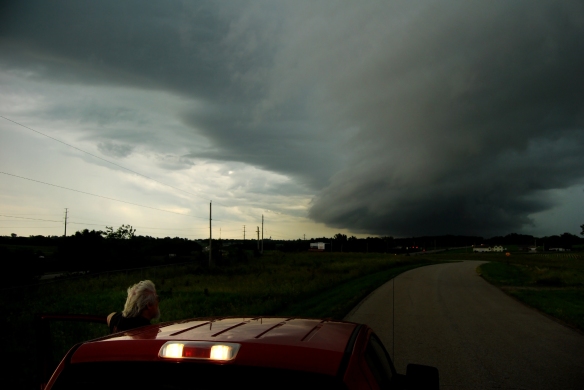
anvil cloudThat’s Jesse Eugene in the photo above. He’s been dead for almost two years now, and I miss him. Not every day, but I miss him. It’s not necessarily painful — it’s usually just a quiet but sudden sense of the absence of the familiar. Like if you get a new office chair. Or you switch from winter boots to sneakers. It just feels a wee bit off. It’s a reminder that things are different now. But you know that feeling will pass. You get used to it.

But during yesterday’s storm, I missed him a lot. I missed the feral grin he’d get when the storm was getting stupid wild, or getting too close. It was a grin that said If we had a lick of sense, we’d get back in the vehicle right now and haul ass — but isn’t this great? Let’s wait just a tad longer.

Here’s today’s weather forecast:

A few t-storms, some severe; storms can bring downpours, large hail, damaging winds, and a tornado.

I don’t believe in any sort of afterlife. I don’t believe Jesse Eugene is somewhere else, on some other plane of existence, looking down and enjoying the storm with me. But I know if he was still alive, he’d be watching the horizon for a shift in the weather. And grinning in anticipation.

Editorial note: All of the photographs above were shot in a span of fifteen minutes on 21 June, 2011.
walking like a camel

No, I don’t do it for the exercise. Yes, I understand that both walking and cycling are terrific forms of exercise, but no, that’s not why I do it. Yes, I’m usually going somewhere when I go for a walk or a ride, but no, that ‘somewhere’ isn’t a destination. I’m not actually going to that place. That place is just a prompt, a nudge, a reminder that it’s time to turn around and go back. Yes, the walk or ride serves a purpose; the walk or the ride is the purpose.

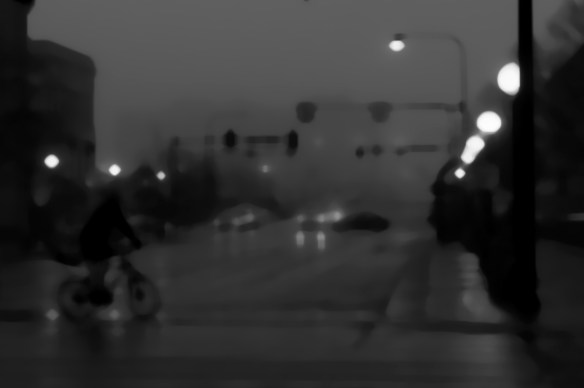
the cyclistI do this almost every day, regardless of weather. Sometimes I’ll walk or ride for hours, sometimes just for ten or fifteen minutes. I might stroll for a couple of hours along the river; I might ride five minutes to the nearby Stop & Rob and buy a Coke Zero. The purpose isn’t to see the river or fetch a Coke, though those are both fine things. The purpose is movement, the purpose is to move the body and disengage the mind from whatever I was doing and allow it to re-engage in…well, something else.

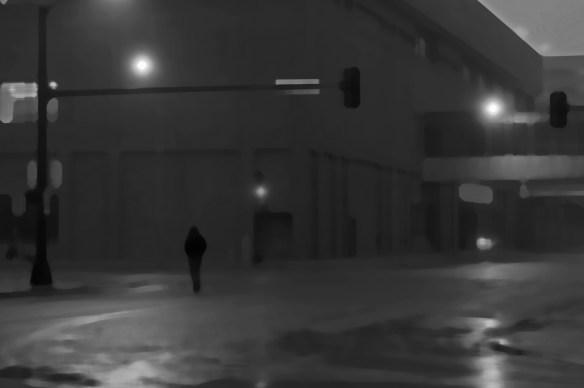
jaywalkHere’s a true thing: I don’t really walk or ride. I saunter. I even saunter when I’m on a bicycle. This is how Chambers defines saunter:

to walk, often aimlessly, at a leisurely pace; to wander or stroll idly

That’s me, wandering idly on foot or bicycle, somewhat aimlessly, at a leisurely pace.

promenadeThere’s some uncertainty about the etymology of saunter. It’s been suggested the term derives from sans terre, ‘being without land or a home,’ which would be a good reason for walking aimlessly. Others believe it comes from s’aventurer, ‘to take risks or leave to chance.’ My favorite explanation of the term, though, comes from the Middle Ages, during the period of the Crusades.

When we think of the Crusades, we generally think of armored knights on destriers, traveling to Jerusalem to ‘rescue’ Christendom. But it wasn’t just knights and noblemen who made their way halfway around the world; poor folks were also seized with the irrational desire to travel to the Holy Land. But they had to walk and beg for food as they made their way à la sainte terre. While of lot of those folks were sincere, the willingness of people to help a common sainte-terrer (it was a sacrifice that would gain them favor with God) created a population of poor folks who wandered through much of Europe claiming to be journeying to the Holy Land, but actually were just medieval hobos.

humming to himselfObviously, I’m not that sort of saunterer. I’m more in the Ludwig Von School of walking. Beethoven took a long stroll almost every afternoon, with a pencil and some paper stuffed in a pocket so he could write down any musical thoughts he might have. I keep myself open to ideas when I walk or ride, but I don’t take any writing paraphernalia with me. I tell myself that if an idea is good enough, I’ll remember it. If I don’t remember it when I get home, I tell myself the idea couldn’t have been that good.

That’s probably nonsense, but it gives me some comfort when I get home and can’t recall the ‘great’ idea I had when out sauntering.

a wee bit tipsyOr maybe I’m more in the Thoreau School of walking. Thoreau said this:

[T]he walking of which I speak has nothing in it akin to taking exercise, as it is called…but is itself the enterprise and adventure of the day.
Moreover, you must walk like a camel which is said to be the only beast which ruminates when walking.

I’m very much taken with the notion of riding a bicycle like a camel.

hard day at the officeI think I could argue that the real reason I take walks or go on rides is to get outside of my mind. Things happen when you’re out and about. Real things, and they happen to real people. The things that happen when you’re at your desk only happen in your mind.

Here’s an example of the way things happen. This thing happened to the composer Benjamin Britten, who was a great walker. It’s my favorite Benjamin Britten story (okay, my only Benjamin Britten story, because c’mon, does anybody have more than one Benjamin Britten story?). He was walking along a railroad track one day and came across a couple of young boys standing by the track, waiting. They had a newt in a jam jar. Britten asked the kids what they were doing. They said, “We’re waiting for the two o’clock train to come out of Aldeburgh, so we can show this newt what a steam train looks like.”

I’m willing to bet you five dollars this will become your favorite Benjamin Britten story too.

louche

Louche. I can’t recall the first time I encountered this word, but I immediately fell in love with it. I’d no idea what the definition of louche was, but I knew exactly what it meant.

Checking a dictionary simply confirmed it.

Louche, adjective:
1) of questionable taste or morality; decadent
2) not reputable or decent; shady, dubious, seedy

What else could it possibly mean? I was attracted to the word partly by the way it comes out of your mouth. Loosh. You have to make a sort of kissy-face to say it.

It’s French, of course. How could it not be? From the Old French term lousche or lois, which apparently meant ‘cross-eyed’ or ‘squint-eyed.’ That came from the Latin lusca, which is the feminine form of luscus which meant ‘one-eyed.’

You can almost see it, can’t you. A man peering squint-eyed through the half-gloom of evening at a woman wearing a red smear of lipstick. A louche scenario.

But louche isn’t just an adjective; it’s also a noun and a verb. As a noun it describes the cloudiness that comes from a suspension of fine particles in a liquid. As a verb it describes the act of suspending those particles. That sounds so very scientific, but it can be an almost erotic act of decadence.

When preparing absinthe to drink, one first pours the liquor into a glass. A slotted spoon is laid across the rim of the glass. A cube of sugar is placed on the spoon. Ice-cold water is then very slowly dripped over the sugar, dissolving it into the absinthe. The absinthe itself is highly alcoholic — forty-five to eighty percent alcohol combined with anise, fennel, and other medicinal herbs. The high alcohol content keeps the herbal oils in suspension. The higher the alcohol content, the more oils the absinthe can hold. The introduction of cold sugar-water causes the herbal oils in the absinthe to become cloudy, creating a sort of milky opalescence and releasing the aromas and scents of the herbs. The cloudiness is called the louche.

Decadent. Of questionable taste or morality. Disreputable. Shady. Louche.

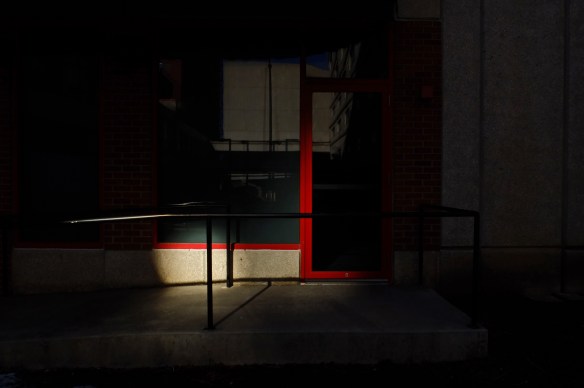
Which explains why, when I was recently walking down 5th Street as evening approached and shadows began to obscure and conceal parts of the world, I passed a bright red doorway glancing at me sideways out of the darkness, the first word that came to my mind was louche.red door

equal justice under law

I’ve met one Justice of the Supreme Court. Well, two if you’re willing to count Thurgood Marshall — but that was in 1993 and Thurgood Marshall was dead at the time. You can’t really say you’ve ‘met’ somebody just because you looked at his coffin lying in state in the Great Hall of the United States Supreme Court building. I did meet Nina Totenberg that day, sorta kinda; she was interviewing some of the people standing in line to meet Thurgood Marshall’s coffin. She didn’t interview me, but she smiled at me when I said “Hi Nina.” She has a nice smile. When you’re standing in a long line on a cold January morning to look at somebody’s coffin, a nice smile means a lot.

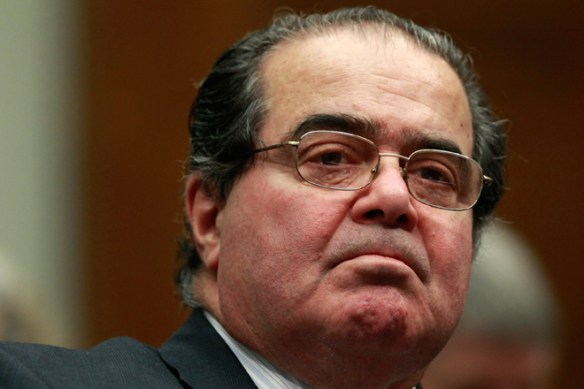
The Supreme Court Justice I did meet was Antonin Scalia. I met him at Heathrow Airport in London. I was arriving to help conduct a summer course in International Justice Systems. I’m not sure why Justice Scalia was in London. Probably wanted to experiment in fucking up a judicial system that’s older than ours.

My colleague spotted Scalia behind us in the airport, and paused a moment in order to meet him. I paused as well, because I’m not a total jerk. My colleague introduced the both of us and told him why we were there. He shook Scalia’s hand. Scalia, to his credit, said something gracious and encouraging, then turned to me.

Associate Justice of the United States Supreme Court, Antonin Scalia

Associate Justice of the United States Supreme Court, Antonin Scalia

I didn’t extend my hand. Neither did he. It was immediately clear to both of us that we were mortal enemies.

Then he moved on. I’m absolutely convinced he could hear what I was thinking, though. What I was thinking was this: “You, sir, are no Thurgood Marshall.

I do not like Justice Scalia. I’ll grudgingly admit he’s brilliant and articulate jurist, but he’s also a judicial hypocrite. He claims to be a Constitutional originalist and textualist, but he never seems reluctant to treat the U.S. Constitution as a living document when it suits his ideology. For example, Scalia has stated the 14th Amendment (which, among other things, guarantees equal protection under the law) doesn’t necessarily apply to women or gay folks since it was crafted after the Civil War for the purpose of preventing racial discrimination. Yet during the 2000 election crisis, in Bush v. Gore, Scalia used that same 14th Amendment and that same equal protection argument to decide to stop the Florida recount. (Do I need to point out that George W. Bush was not a victim of racial discrimination?)

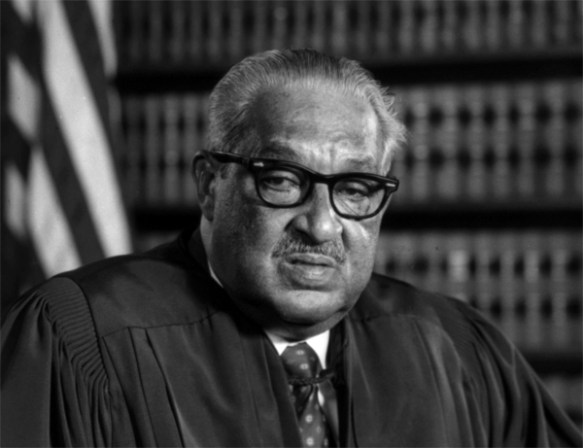
Justice Marshall was — still is — a hero to me. Not just because he was a civil rights lawyer at a time when that was a dangerous occupation, but because he never lost his compassion for common folks or his zeal for protecting the civil rights of all people. Antonin Scalia used the 14th Amendment to insure George Bush would be elected president; Thurgood Marshall used the 14th Amendment to end racial segregation of public schools.

Associate Justice of the Supreme Court of the United States, Thurgood Marshall

Associate Justice of the Supreme Court of the United States, Thurgood Marshall

I was a doctoral student at American University when Marshall died in January of 1993. Three days later, his coffin was lying in state in the Supreme Court building, on the same catafalque that had held Abraham Lincoln’s. Instead of attending class, I joined the long, subdued line of people standing in the cold, waiting to pay their respects. You hear that phrase a lot, paying respect. This was one of those instances when the phrase was entirely accurate.

I don’t know how many people passed by his coffin. Thousands. All kinds of people. People in suits, of course, since this was Washington, D.C. But also people in military uniform, young folks in jeans, old black women who’d dressed in their Sunday outfits that Wednesday. What moved me the most, though, was the number of working folks who showed up. Regular people, standing in long lines, outside in the January air, come to pay their respects to a Justice of the Supreme Court of the United States. I’ve never seen anything quite like it.

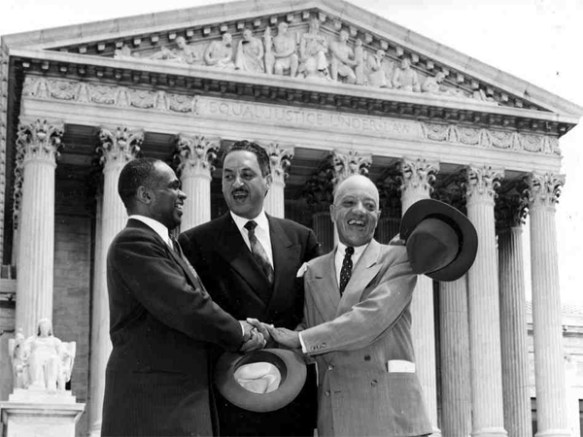
They closed the doors at ten o’clock that night. I’d already gone home by then, but I heard about it. The people still outside waiting got to see Marshall’s coffin carried out of the Great Hall and down the steps. If you’ve never been to the Supreme Court Building, it looks pretty much like any other governmental structure in DC. But above the door, these words are carved: Equal Justice Under Law. Thurgood Marshall believed in those words, and he made a great many other people believe in them as well.

Young Thurgood Marshall on the steps of the U.S. Supreme Court

Young Thurgood Marshall on the steps of the U.S. Supreme Court

Antonin Scalia is probably smarter than Thurgood Marshall was. He’s maybe more articulate than Marshall was. He’s more forceful on the bench than Marshall was. But on that day in the future when Scalia is laid to rest, how many people will associate his name with Equal Justice Under Law? How many people do you think will be willing to take a day off work and stand for hours outside in the cold in order to pay their respects?

walking

I don’t really like to go walking in the morning. I like to wake slowly. Maybe read a bit before I get out of bed. I like to ease into the day. Drink some juice, eat my morning Advil, have a cup of coffee with too much sugar and too much cream. I like my mornings comfortable. I like my mornings unhurried.

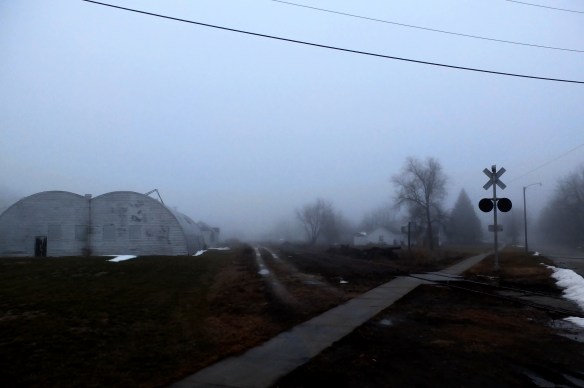
So it makes no sense whatsoever for me to rise early, dress hurriedly, skip my juice and coffee (but not my Advil), and head out for a long walk — especially when it’s damp and chilly. Which is what I did yesterday. But you know…fog and mist, dude. Fog and mist.

why my shoes were muddy

why my shoes were muddy

I don’t like to walk in the morning, but I do like to walk in fog and mist. And since those conditions occur more frequently in the morning — well, there it is.

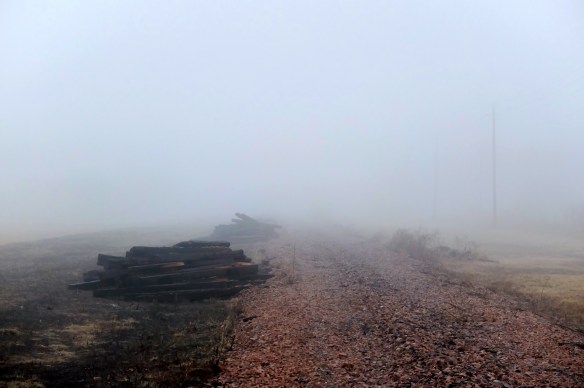
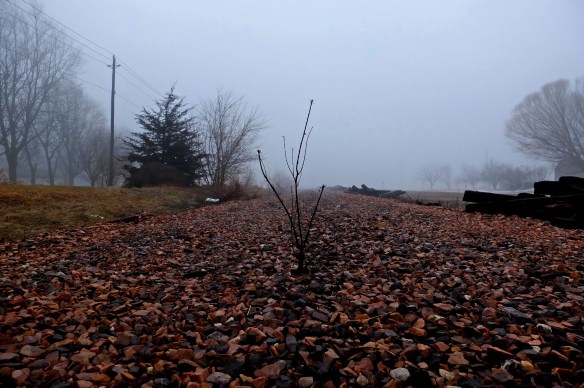
I like to walk in the fog and mist because they smooth things. They soften the corners of things, they plane off the sharp edges. They make the world soft and a wee bit vague. Fog and mist elevate the ambiguity of the world — everything seems less solid, more forgiving. Less harsh, more indulgent. More romantic, and I mean romantic in the medieval sense of the term. Open to adventure and mystery and imagination.

rail bed

rail bed

I enjoy purposeless walking. I don’t walk for exercise, and unless I’m on an errand, I rarely walk with a destination in mind. Well, that’s only half-true. It’s not uncommon for me to walk to or toward a specific location, but that location isn’t really a destination. I’m not going to that spot for any particular reason. In fact, I’m not really going there at all. It’s just a vague geographical marker, a reminder to suggest I should consider turning around and heading homeward.

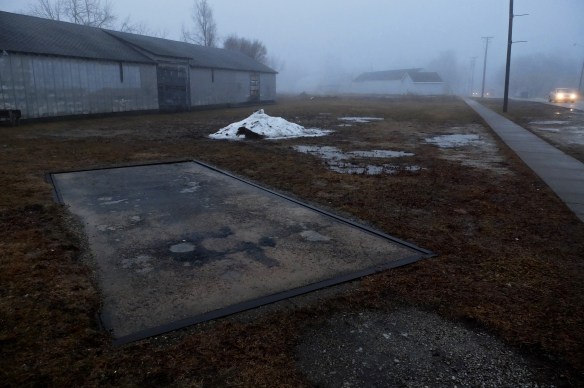
I rarely have anything that resembles a schedule, but I always have work to do. Taking a walk gives me a pleasant interruption during my day; walking idly toward a specific fixed point provides me with a very flexible timetable. If I want to walk for, say, an hour, I have a general sense how far I’ll walk in thirty minutes. I know, for example, that it will take me about forty minutes to reach the heliport (which, okay, isn’t really a heliport at all — it’s just a concrete slab that was probably the foundation of some sort of shed, but I’ve never felt any overpowering compulsion to adhere strictly to reality). So when I get close to the heliport, I can decide to turn around and begin walking vaguely in the direction of home. Or I can keep walking. It’s a system.

heliport

heliport

Even though I often walk with a camera tucked away in a pocket or in a bag slung over my shoulder, I’m usually not walking to shoot photographs. I’m normally not actively looking for things to photograph. I’m just walking. With a camera. On the vast majority of my walks, the camera never leaves my pocket or bag. I do sometimes go on photo-walks, but that’s a whole nother thang.

For me, most of my walks are a form of meditation. I generally walk mindfully, as Buddhists like to say. When I was part of a Zen community in Washington, DC the roshi explained mindfulness to me; he said it was the quality of being in the immediate moment, fully aware and cognizant of what’s going on around you, but not involved in it or with it. I was able to tell him, “Dude, I was a private investigator for seven years; I did a lot of surveillance; I’ve got seven years of practice at being mindful.”

So as I walk I notice a lot of stuff. Birds, the condition of a passer-by’s shoes, signs in windows, bits of paper being shuffled along by the breeze, the breeze itself. I can notice stuff and appreciate it without being distracted by it. I don’t feel any need to try to ‘capture’ it with a photograph.

i saw this stick

i saw this stick

But at the same time, it usually registers when I see something that might make an interesting photo. Sometimes it only really registers after I’ve taken a few steps. It’s like my brain sends up a flare and it takes a moment for the flare to rise high enough for me to see it. Dude, you just walked by some interesting graffiti — you might want to turn around and take a look. Like that.

It sounds almost robotic in a way, though it doesn’t feel that way. I mean, it’s as if there’s some sort of algorithmic process taking place below the conscious level. A quiet decision-making process I can mostly ignore. Dude, you just stepped in some mud. “Is that important? If ‘no’ then keep walking; if ‘yes’ then stop and clean shoes.” Naw, not important. “Keep walking. Will it be important later? If ‘no’ keep walking; if ‘yes’ walk on the grass” Yeah, it might important later when I get home. “Walk on grass.”

Everybody has those internal discussions. Don’t they?

eight ball

eight ball

This is why most of my walks are solitary. If I’m with another person, there’s a social obligation to interact. I like walking with other people, don’t misunderstand me. It’s just a different experience. And not always a pleasant one — for them, that is. I usually have a good time. But as I said, I walk fairly slowly. More an amble than a walk. A stroll. A meandering stroll. And I stop now and then. And I comment on stuff. “Do you smell cinnamon?” “That woman had the most extraordinary eyebrows.” “Did you hear that? Black-capped chickadee.” “Sign painters should be required by law to learn the rules of apostrophization.”

I can be annoying on a walk.

powerball

powerball

Yesterday morning on my walk I noticed the lottery jackpot was US$130 million. This afternoon I think I’ll walk toward one of the local convenience stores. Maybe I’ll stop and buy a lotto ticket. There’s one about fifteen minutes away, one about twenty-five minutes away, and another about forty minutes away.

This is what passes for a scheduling decision in my life.

a pretty good day

My day? How was my day? I’m glad you asked. My day didn’t go quite as planned.

My plan was simple. Most of my plans are simple. I’m not even sure you can call a vaguely elastic notion of ‘a nice lunch somewhere’ and ‘a walk someplace interesting’ a plan. But that was the extent of it. A nice lunch. A walk. What could possibly go wrong?

But first I had a minor problem to deal with. My debit card was about to expire. I’d called the bank before the Thanksgiving holiday to find out if a new card had been sent (I recently moved and was concerned the card might have been sent to the old address). I was assured the card had just been mailed to the correct address and I’d have it soon. But it still hadn’t arrived yesterday, so I called the bank again and spoke to a very polite young man named Michael.

Michael told me I needn’t be concerned, the card had probably been lost in the mail. But to be safe he could put a block on the debit card and send me a replacement debit card. He asked if it would be okay if he did that. I said “Why don’t you send a replacement, and I’ll keep using this one and keep an eye out for suspicious charges.” Michael didn’t think that was a wise course of action. It took a few more minutes of conversation before I finally realized Michael was just being polite; he was absolutely going to enforce a policy of blocking the existing card and issuing a replacement to protect me (and the bank) from fraud. And he was going to block the card NOW.

I checked my pockets; I had a total of US$19 in cash. Enough for lunch and a walk, but certainly not enough for the next few days. I asked Michael “What am I going to do for cash?” Simple — go to a branch of the bank, he said, and they’ll issue a temporary replacement card I could use until my permanent replacement card arrived.

So I went to the bank. A very polite young man named Terry said he was terribly sorry the post office had lost my renewed debit card, and he deeply regretted any inconvenience it caused me, but he’d be delighted to give me a temporary replacement card. He just needed to see a state-issued photo ID card. I gave him mine. It had expired. “Sorry,” polite Terry said. “You need to have a current state-issued photo ID card.” I showed him my Social Security card. No. I showed him my Veterans Administration card, issued by the federal government, complete with a brightly-colored photo of my smiling face. No. I showed him my voter registration card. No. I showed him various other forms of photo identification — everything from an ancient faculty ID card from Fordham University, to my library card, to my Utata business card, all with photos of me at various ages. No. I pointed out that it was highly unlikely I’d concoct an elaborate false identity spanning more than a decade just to obtain access to a temporary replacement debit card for an account with just a few hundred dollars in it, especially since I’d had an activated and working permanent debit card just an hour earlier.

Terry was very polite…but no. I needed to go to the Department of Motor Vehicles and get a new state-issued photo ID. On my return, he’d be over the moon to give me a temporary replacement debit card.

So I went to the DMV. Yesterday was the 29th day of November. Going to the DMV at the end of the month, when everybody who dawdled and/or forgot to renew their various licenses, is like a combination of attending a Palestinian funeral in Gaza (a mad, chaotic crush of people, all rending their clothes and wailing, wishing they too were dead) and an old-style Soviet bread line (an infinite number of somber, sad-faced, spiritless drones dressed in rags, waiting in line with bovine fatalism, without any real hope of getting anything remotely like what they’re standing in line to receive). To make matters worse, I arrived right at lunch time, when all the employed people who were delusional enough to think they could get their end-of-the-month DMV chores done during their lunch hour arrived. And when most of the DMV personnel went out to McDonalds for a Big Mac.

I got in line. I waited. I made it to the clerk — a polite middle-aged man named Raul. “I need to renew my state-issued photo ID,” I said. Raul would be absolutely delighted to renew my state-issued photo ID. Did I have a certified copy of my birth certificate? I told him the bank didn’t require a certified copy of my birth certificate to get a temporary replacement debit card…so no. “How about your passport?” No, I hadn’t brought my passport either (which wouldn’t have done any good anyway because it’s also expired). Raul said if I returned with a valid passport or a certified copy of my birth certificate, he would happily give me a new state-issued photo ID so I could get my temporary replacement debit card until my permanent replacement debit card arrived since my existing debit card had been blocked because the post office had apparently lost the renewal debit card.

Here’s something you may not know. In order to get a certified copy of your birth certificate, you need to go to the county courthouse and present a state-issued photo ID card or a valid passport. In order to get a valid passport, you have to present either a state-issued photo ID card or a certified copy of your birth certificate.

Happily, I actually had a certified copy of my birth certificate. So I returned to the house, found the birth certificate, returned to the DMV and Raul gave me a new state-issued photo ID, returned to the bank and Terry gave me a temporary replacement debit card. It took six hours. Then I had a very pleasant but very late lunch, and took a very short walk as the sun was beginning to give up.

During the walk I saw the best Men’s Toilet Ever:

menAnd I saw this quickly-walking woman who had no interest in having a cold beer:

cold beerBack at the house, the mail had been delivered. You can imagine how I felt as I approached the mailbox. But of course, the debit card hadn’t arrived while I was out getting the temporary replacement debit card. This is real life, not fiction, and real life rarely gives you a neat and tidy resolution.

In real life, mostly what you get is another day pretty much like the day before. Every so often real life drops in a day that’s twisted as a pretzel. But I kind of like pretzels, and even though my day didn’t go as planned, I thoroughly enjoyed most of it. It was still a pretty good day.

all gothic and syrupy

I’ve occasionally mentioned Utata in this blog. I’ve talked about how the group has helped to shape the sort of photographs I shoot, and I’ve mentioned some of the projects that grow out of Utata (like the Thursday Walks, and Iron Photographer, and our bi-annual big projects).

But I haven’t said very much about the people I get to work with, and that’s a shame because those people are completely fucking brilliant and altogether charming. I was in a state of Off-the-Intertubes recently, and when I returned I discovered these two comments in the Super-Secret Utata Staff Lounge:

“I’m in the middle of making some bramble whisky. I may strain it through an old sock instead of the more conventional muslin cloth.”

“I’m making bramble whisky too, but I must be doing something wrong as my recipe doesn’t include old socks.”

First, I should probably note that I am occasionally referred to in Utata as ‘Old Sock’ (don’t ask; it’s not a long story, but it’s a story that makes almost no sense at all). Much more important is the bramble whisky. Now, I’m familiar with brambles and blackberries, and I’ve been rather intimate with various forms of whisky — but bramble whisky? Never heard of it. And I admitted as much, which sparked this conversation:

“I highly recommend bramble booze (or sloe, elderberry, rosehip, random non-deadly-nightshade hedgerow fruit). You can take the absolute dog-roughest bathtub poitín and turn it into a magical elixir for the price of a pound of sugar and a walk in the countryside.”

“Oh how I miss sloe gin. I hate regular gin, but sloe gin tastes like something from Tolkien.”

“Following last year’s damson glut, I have a ridiculously large amount of damson gin in the cupboard if anyone is desperate…”

“You can flavour gin with quinces – the little decorative ones as well as the bigger eating ones. I have no idea if they’re any more easy to find in the US. It goes a lovely pink colour and tastes of … well … to me it tastes a bit like the perfume that my grandmother used to wear but I’m not sure that helps anybody else.”

“I made some quince brandy last year. Best described as ‘interesting’.”

“I think you need to beat those quinces up a bit. I chopped and slightly cooked mine before boozing them. Nearly killed an electric chopper with them too … they were just fractionally harder than diamonds.”

From bramble whisky to sloe gin to damson gin to quince brandy. I wouldn’t be the least bit surprised to discover I have some moonshiners in the South Carolina branch of the family, but to my knowledge none of my kin has created anything that sounds quite so romantic or Jane Austen-ish as quince brandy.

David Wilkinson’s quince brandy (photo by David his ownself)

Of course, I developed a strange, immediate desire to make my own bramble whisky, or something like it. So I asked for a recipe.

“Use a recipe depending on your fruit and liquor, specific ratios of fruit, booze sugar are needed, as Sam indicated this works best with hard fruits even if they’re supposedly soft fruits like cherries. If you want to go with folklore and hazy memories then here’s my description. Sit in a comfortable chair and listen to the radio. I always used a needle to prick them not a fork, and it’s been years, but the way I remember doing it with my Mamgu is to fill your empty bottle one third with the washed and pricked fruit, then pour fine granulated sugar on top till it comes about an inch above the fruit. Then we’d pour over the booze until the bottle was about four fifths full. The screw in the cork or the lid, and shake it violently.Put it in a cold dark pantry filled with jars of home-made chutney and marmalade. Shake it daily for a week or two, then once a week until shortly before Christmas. By then it should be all gothic and syrupy. Decant it and drink it from the tiny little glasses that you can’t buy new anywhere but little old ladies have millions so you’ll probably find some in Goodwill.”

There was some debate about the best way to prepare the fruit. One school of thought advocated a certain level of thuggery (“You do need to bash them up a bit”). Another seemed more appropriate to scaring off vampires (“Pin-pricking is too tedious – I take a sharp knife and cut a small cross into each damson”). But this response has settled me firmly in the pin-pricking school:

“Pricking them all over with a pin, while sitting in a comfy chair and listening to the radio (use BBC iplayer for this, they have a wacky dramatisation of Dracula this week) is the most important part. Your fingertips get stained an olive-ish purple and end up smelling like mossy hedgerows.”

And there you have it. Everything you’d ever want to know about preparing your own bramble whisky — from fruit-pricking instructions to the general ambience in which it should be prepared to the proper stemware in which it should be served.

And there you also have a brief introduction to the sort of people who staff Utata. Smart, funny, and infinitely helpful. That I get to work with these people makes me feel all gothic and syrupy.

nine-eleven / thirty-three

I had two friends die in the attacks of 9/11. Not close friends, but friends. One was a member of the book club I was in. We met once a month for a couple of years. He was a nice guy, smart and funny, owned a pair of Cavalier King Charles Spaniels that he pampered ridiculously. I only saw him once outside of the book club — in a bar on the Upper West Side. He was with friends and I was with friends, so we just chatted briefly and that was it. He worked in the South Tower. Later I learned he’d called his sister from the Sky Lobby on the 78th floor to tell her they were evacuating his office as a precaution after the North Tower was hit. That’s about where the second plane hit. We figure he died immediately. Nearly a year later he was officially identified as a victim. Basically that means they found some bit of flesh which they matched to his DNA.

My other friend was somebody I knew from graduate school in Washington, DC. We’d worked together briefly in the Social Science Research Lab. He’d taken a job as some sort of analyst for a research firm in New York City. He worked a few blocks away from the World Trade Center. We assume he left his office and went down to the scene to see what was happening, but that’s just a guess. All we know is he went to work that morning and sometime later his body was identified. He was probably killed by falling debris.

I’d moved from Manhattan a few months before that September. I’ve always felt like I should have been there, which is totally irrational and completely stupid. But there it is. Every September 11th since then I’ve felt a sense of loss — but I’ve also had this uncomfortable feeling that I should feel that loss more. That I should feel the loss deeper. I’ve felt that every September 11th until this year. This year is different.

Every morning, after coffee and a glance out the window, I turn on the computer to check the news. Every morning. I never used to do that. That changed on 9/11/2001. I didn’t know about the World Trade Center until a friend called to tell me about it. I turned on the television about five minutes before the second aircraft struck. So now, every single morning, I check the news.

Yesterday morning, tucked away in my email I saw this subject line: jamelah.net [New Post] thirty-three.

My friend Jamelah had her birthday yesterday. She turned 33. Every year on her birthday she writes a sort of summary of the preceding year — things that happened, things she’s learned, things that went well and things that didn’t, things she did or maybe didn’t do. And she posts a self-portrait.

So yesterday morning after I checked the news. I read Jamelah’s birthday post. And it reminded me that even when horrible things are happening over here, there are wonderful things happening over there. And that sense of loss I usually feel on 9/11 — I didn’t feel it yesterday. Wherever I went yesterday, I saw flags flying at half-mast, and of course that reminded me of the tragedy. But it also reminded me that it was Jamelah’s birthday, and that’s a sweet thought.

I usually chat online with Jamelah for an hour or so (with the emphasis on ‘or so’) every couple of weeks. I’m sure sharing a birthday with a national tragedy must be a massive pain in the ass for her, but yesterday I was glad for it. I’ve got two friends who died eleven years ago yesterday — but I’ve also got a friend who is alive today and given a choice between mourning and celebrating, I’ve got to go with celebrating.

So happy birthday Jamelah. I’ll chat with you in a week or so.