So I’m in a parking lot. No, wait, not a parking lot…a parking area. It’s not like a parking lot outside a big box store, with lines designating parking spaces. This is just an extra wide bit of blacktop on a winding blacktop road through some woods near the spillway of a dam. It’s a place where people who fish the area above the spillway can park their cars.
On a weekday, it’s usually empty except for the occasional Asian or Latino immigrant looking to put some fish on the table. It’s a quiet spot. Shaded by trees. My partner and I sometimes make the half hour drive to this spot with a couple of camp chairs, something cool to drink, and our books. We sit, we read, we look at the birds, we listen to the wind in the trees, we chat with the folks who come to fish. On the way home we usually stop for ice cream. It’s nice.
She can sit still longer than I can. My knees are wonky and I have to get up periodically and stretch them. There’s always something to look at, and I’ve always got a camera with me, so occasionally I’ll take a photo. Yesterday I took a photo of the blacktop.
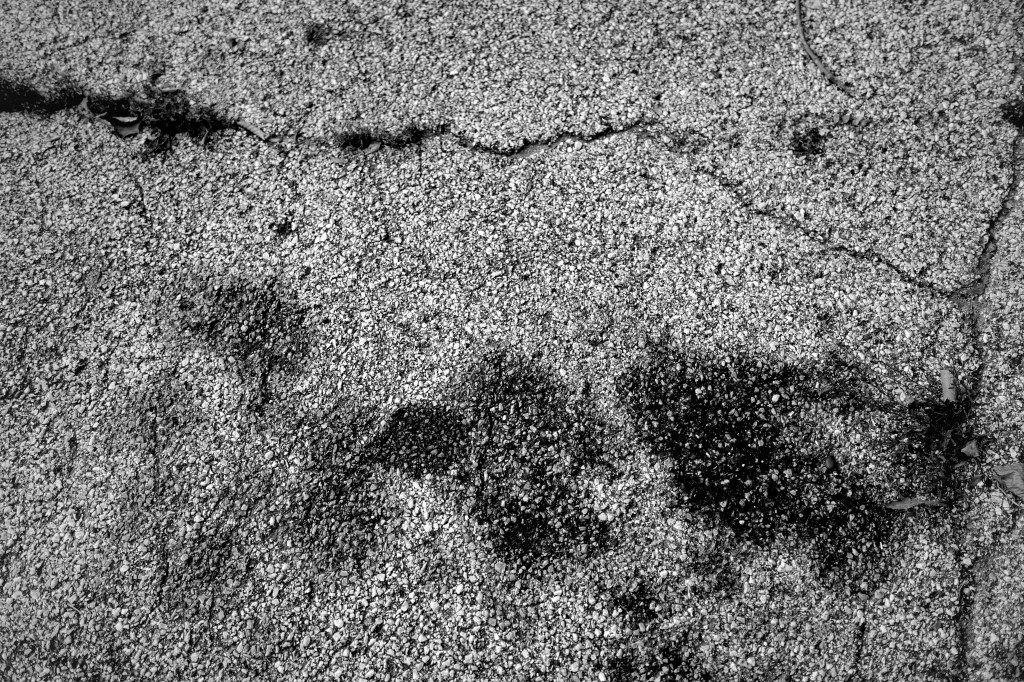
I don’t know why this particular patch of blacktop caught my attention, but it did. There are some cracks with little weedy bits growing in them, and some oil stains–some new, some faded. But it’s just blacktop (which isn’t asphalt, by the way; both blacktop and asphalt are made of crushed stone and bitumen, but the ratio of stone to bitumen is higher in blacktop, which can give it a more sparkly appearance–and lawdy, this is way more information than you need or want).
I pulled my Ricoh GR3X out of my pocket and looked at that patch of blacktop from several different angles and directions. I raised the camera higher, I lowered it closer to the surface, looking for a different framing of the patch. I probably spent three or four minutes trying to get the framing just right. Then I took this single photo.
I looked up to see my partner was watching me. She said,
“Bug?” “What?” “Where you taking a picture of a bug or something?” “Oh. No. Just the blacktop.”
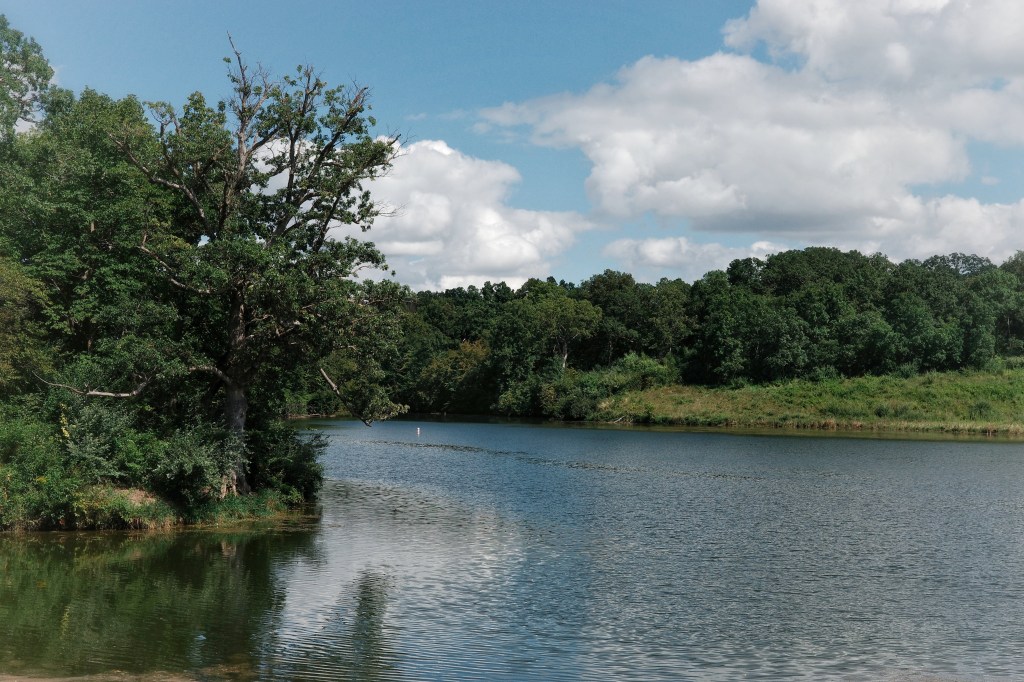
She looked at me for a moment, then nodded and went back to her book. The sky is blue, the clouds are white and fluffy, the water ripples a wee bit with the wind. There are swallows hawking for insects just above the surface of the lake. A kettle of vultures is making lazy circles in the distance. And there’s Greg taking a photo of a patch of blacktop.
Late last night I was noodling about on YouTube, looking for something about Japanese photographer Miyako Ishiuchi (who, by the way, is vastly underappreciated) and I came across a video by–I guess he’d be considered an ‘influencer’? I’m not going to mention names; he’s a good photographer, makes a LOT of videos about photography and photo gear, he’s got a large following. This particular video was focused on his feelings about being burnt out. He said:
“Lately I’ve been feeling like my photography hasn’t been saying what I want to say. I’ve been questioning if it’s even the right medium for me to communicate my thoughts and feelings.”
Okay, valid. And hey, he’s right. Still photography isn’t a very effective medium for expressing thoughts and feelings. Writing is a good medium for communicating thoughts and feelings. Cinematography–moving images–another good medium for communicating thoughts and feelings. A cohesive series of purposely related still images can be an effective medium for communicating thoughts and feelings.
But a single photograph? Nope.
A single photograph is useless for expressing thoughts and it’s unreliable as a tool for expressing something as complex as feelings. A single photo can certainly invoke a mood, and that mood might suggest something of what the photographer was feeling. But it might not. A happy photographer can shoot a grim, moody photo; a photographer in deep despair can still shoot a cheerful photograph. A single photo, regardless of how powerful it is, is just a moment isolated in time and limited by an artificial frame.
As to thoughts, you often hear people say stuff like, “This photo tells a story.” No. No, it doesn’t. A single photo doesn’t tell a story. It can’t tell a story. A story has a beginning, a middle, and an ending; you need at least three photographs to tell a story.
BUT a single photograph can hint at a story. It can imply a story. The viewer, looking at a single photo, can create a story based on that moment. But it’s the viewer’s story; it comes from the viewer. It’s only inspired by the photo. A single photo can be the beginning, the middle, or the ending of a story. But an entire story? Nope.
This is not a story. It could be part of a story, but it’s not, in itself, a story.
That said, still photography can be a powerful story-telling tool IF you string together a series of related photographs. Photo-stories can even be more powerful than video, because you can take your time looking at a still photo. You can examine every corner of the frame. You have time to blink and think and ponder what you’re seeing in each image, instead of simply responding to the images streaming in front of you.
The photographer in the video also said this:
“I feel like a good photograph is something that expresses what the creator wanted to say.”
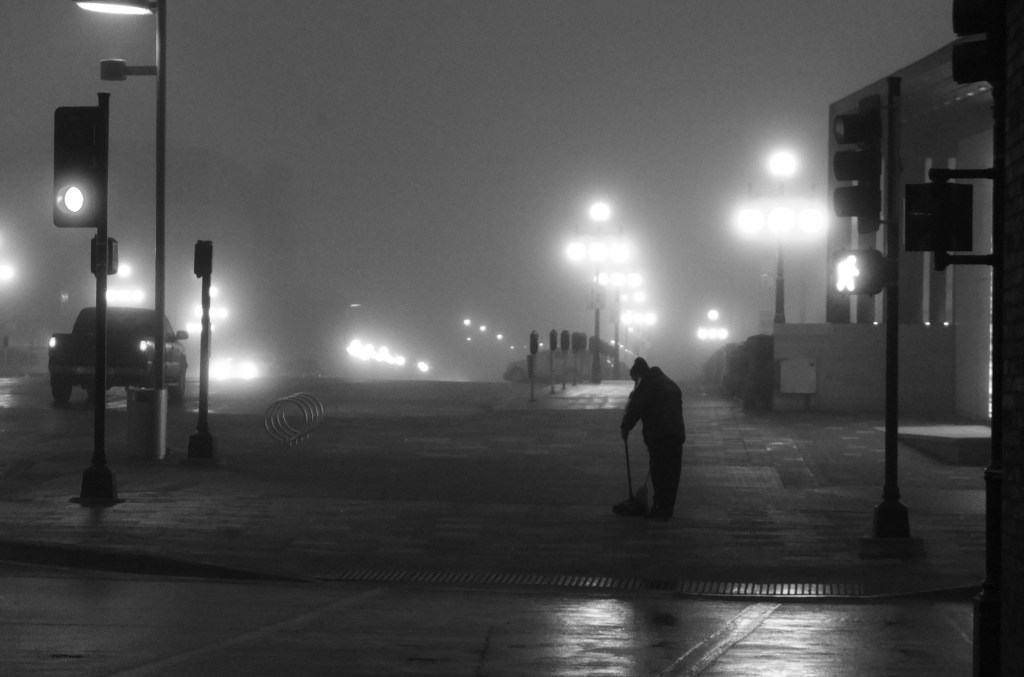
I dunno, maybe? If you want to say something like “Ducks are cool” or “Tall buildings are impressive” or “Look at this guy cleaning up street trash on a cold, wet, foggy morning,” then yeah, a good photo can express what you want to say. But if you want to express anything more complex than a simple declarative sentence, then your hope that a photograph will express what you want to say is…well, misplaced.
The only thing I was trying to say was, ‘Seeing this guy at work makes me feel something.’
Another thing—at no point in his video did the guy ever articulate WHAT he wanted to say. Or why he wanted to say it. Or how his photography was falling short. In fact, he said,
“I sometimes feel like I don’t have anything to say…and that I’m just making photos.”
Dude, that’s fine. Ain’t nothing wrong with just making photos. But when you deliberately take a photograph, regardless of the subject, you ARE saying something. You’re saying, “This is what I see. This is how I see it. What’s happening in front of my camera is interesting to me. It makes me feel a certain way. Maybe it’ll have a similar effect on you.” The impulse to press the shutter release is, by itself, a valid reason to take a photo.
I found this guy’s video annoying. Annoying and ironic. The irony is that the guy who was complaining that still photography failed to communicate his thoughts and feelings was actually communicating his thoughts and feelings using a medium designed to communicate thoughts and feelings.
My point is this: any expressive medium–still photography, cinema, writing, dance, painting, acting, sculpture–is limited. Don’t ask more from any expressive medium than it can give you. And don’t whine about the limitations.
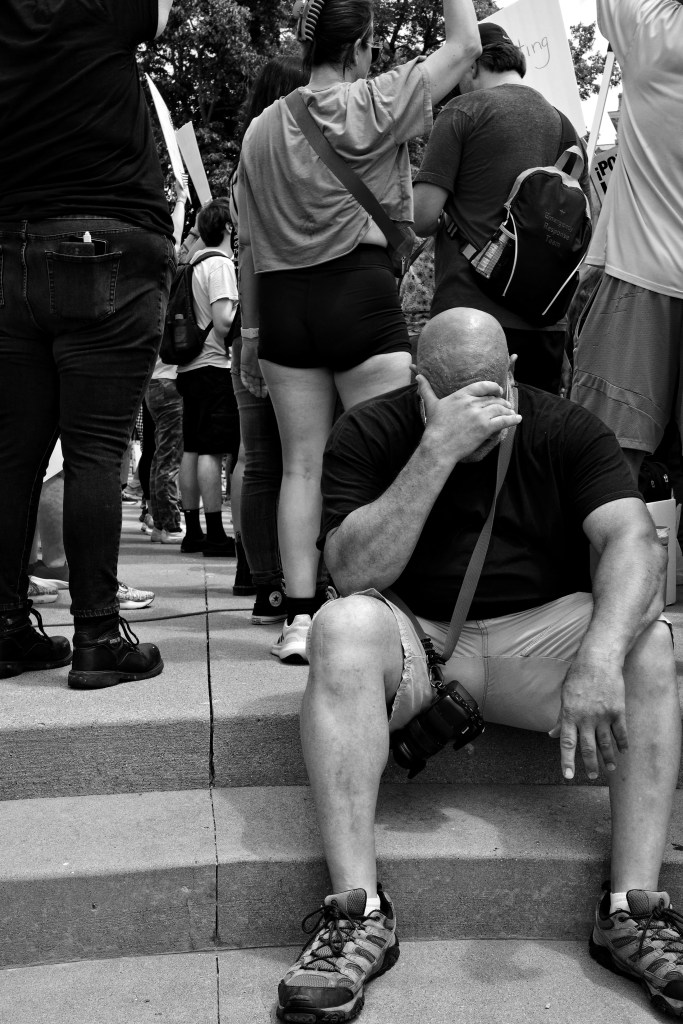
I posted this photograph on Bluesky a couple of days ago. I almost didn’t take it.
I was noodling around the edges of a demonstration and saw this guy, overcome with emotion (and maybe the heat), turn away and sit down. He was a big guy, bald, looked strong; not gym-strong, but work-strong. The anguish on his face was hard to look at but strangely beautiful. It was probably a moment he’d rather not have in public…but he did.
Overcome.
Okay, let me just get this out of the way: in the US you have no right to privacy when you’re in a public space. That’s the law. If you’re in public, other people have the right to take your photograph. The question is never whether it’s legal to take another person’s photo; the question is always whether it’s ethical or appropriate. Those are individual decisions and only the photographer gets to make them.
I wanted to take that guy’s photo. But I didn’t. It seemed too private, too personal. Then he put his hand up and covered his face. The depth of his emotion was still clear from his body language, but by covering his face the image became less about him as a person and more about the emotion itself. So I took one shot and moved on.
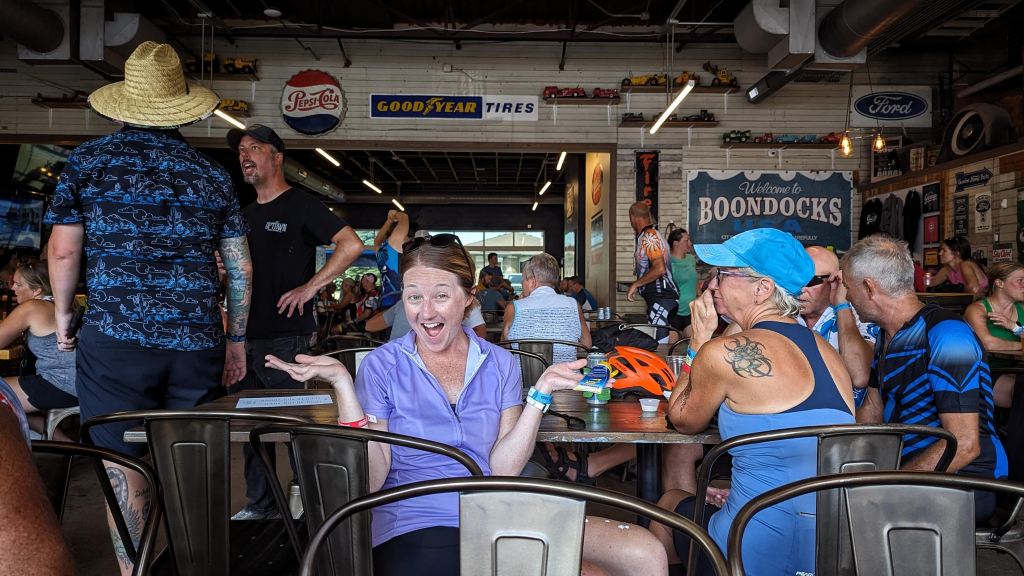
I don’t shoot a lot of photographs of people. When I do, it’s most often during a public event. A farmer’s market, a street fair, a protest march, a sporting event, that sort of thing. Sometimes I’ll shoot people in more generic public venues–at a fruit stand, in a pub, on a bicycle ride. I may or may not ask permission to take their photo; it depends on the situation and the moment. I’m very open about carrying my camera in circumstances like this; I’m not trying to conceal what I’m doing, but at the same time I don’t try to draw attention to myself.
“Oh? You want a photo?”
Occasionally I’ll see somebody who, for one reason or another, interests me and I’ll stop them and ask if I can take their photo. Occasionally, they’ll say no; sometimes because they’re in a hurry, sometimes because they’re shy, sometimes for reasons they don’t articulate. If they say no, I just thank them and go on my way.
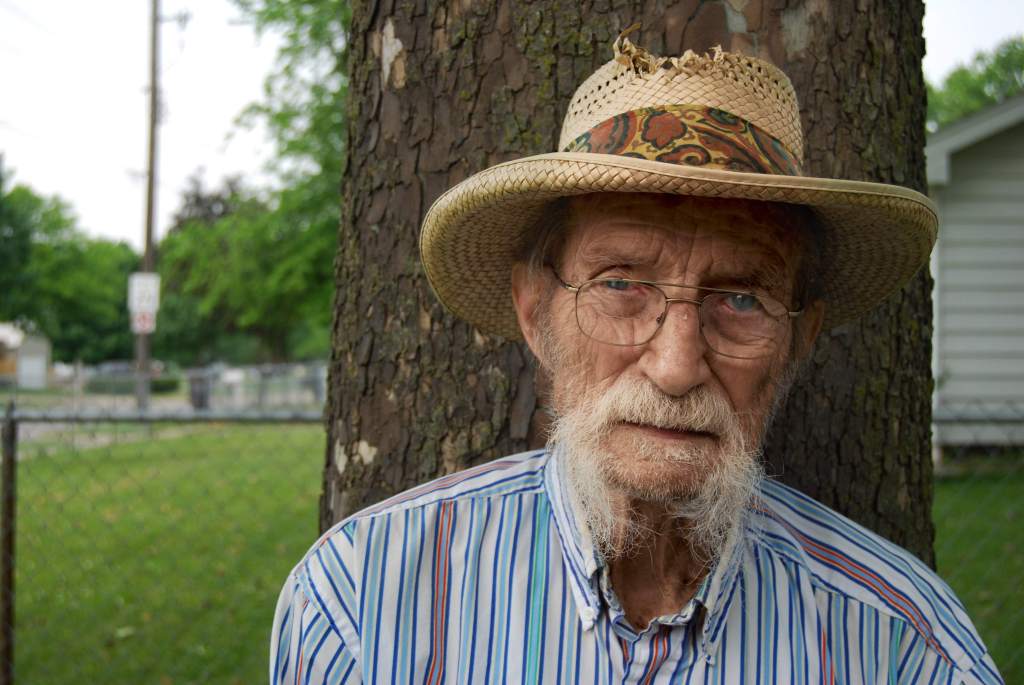
But most people say yes. Like this guy, John, who was waiting for a bus. Most people are friendly. They may ask, “Why do you want to take my picture?” and if they do, I tell them. I told John I liked his mustache and his hat. I don’t always ask their name, but I always thank them and show them the photo. Nobody has ever asked me to delete their photo.
John, waiting for the bus.
I DO NOT take photos of marginalized people in states of distress. I confess, I’m occasionally tempted to shoot those sorts of photos. Suffering is part of the human condition, after all, and I think if it’s done with compassion, such photos can have merit. But they can also just be cheap exploitation. And frankly, the viewer can’t know the photographer’s purpose by looking at the photo. The photo is what it is.
Having just said that I don’t take photos of folks experiencing hardship, I’m now going to admit I actually DID take one a couple of weeks ago. I was walking down a city street and came across a man who was stumbling along, leaning against a containment wall of a landscaped office building. As I got closer it became clear he was extremely intoxicated. I asked him if he was okay. He kind of wobbled his head; I couldn’t tell if he was shaking his head ‘no’ or if he was nodding. He said, “I just need to lay down for a bit, I just need to rest, to sleep.” He said that two or three times.
And he did just that. He climbed up on the containment wall, laid his head on his arm, and closed his eyes. I don’t know if he went to sleep or if he just passed out. I stood there for a very long moment, uncomfortable about leaving him and equally uncomfortable about staying with him. The look of misery and exhaustion never left his face. But there was something almost delicate about his relaxed hands.
I very much wanted to photograph him. And I was ashamed of wanting that. In the end, after a minute or so, I took the photo and left. Was it an ethical violation of his privacy in moment of vulnerability? Yes, without a doubt. But I did it anyway.
It’s a good photograph. Not a great one, but good. t’s an honest one. I like it and I hate it. I haven’t shown it to anybody. I discussed the entire incident with my partner and told her about the photo; she was rightly troubled by my behavior. So am I.
I held off on watching Murderbot on AppleTV until last night. Why? For reasons.
I don’t recall what prompted me to buy All Systems Red, the first of the Murderbot diaries. It might have been a recommendation from a friend, maybe I read a review, I really don’t remember. I recall being skeptical, though. The name Murderbot seemed silly, offputting.
But I bought it and damn. Then I had to wait a few months to buy the next one. The first four installments came pretty quickly, as I recall, and each one solidified my feeling for the character. Now, of course, I’ve read (and loved) every Murderbot story that’s been published. And I’ve read them more than once.
And that’s exactly why I avoided the television series. I figured there was at least a 90% chance the series would screw it up. How could it not? I mean, I know what SecUnit looks like. I know the sound of its voice. Any actor chosen to portray SecUnit would almost certainly be wrong. Alexander Skarsgård is an excellent actor, but he’s NOT SecUnit (at least not in my head). Kate Box (from Deadloch) could probably do it. Maybe Gwendoline Christie (Brienne of Tarth from Game of Thrones). But Alexander Skarsgård?
So my expectations of the show were low. I fully expected to dislike it.
Reader, I was wrong.
As I said, last night I decided to watch the first episode. Well, I decided to watch the first ten minutes. And I’ll say this: the first five minutes of Murderbot was somewhat painful. SecUnit’s voice was wrong. Its attitude was SO wrong. In the stories, when SecUnit refers to humans as ‘assholes’ it’s simply making an observation; in Skarsgård’s voice, it sounded judgmental. Early in the series, SecUnit doesn’t care enough about humans to judge them.
But then…damn it, the show began to seduce me. It’s not MY Murderbot, but…I don’t know, that first episode was…good? Good enough that I watched the second episode. Which was better. And yes, now I’m hooked.
Skarsgård is very, very good at evoking SecUnit’s discomfort at being forced to associate with humans. I still think his voice is wrong, but goddamnit he’s SO good at looking at a wall like it’s a comfort blanket. He may not be MY SecUnit, but he’s really effective as A SecUnit.
None of the other characters were quite right (in my head). Except Mensah (played by Noma Dumezweni), who was perfect. Her ability to depict patient compassion without being annoying is wonderful to watch. And, again, the more I watched, the more I enjoyed the crew. They’re not MY PreservationAux survey team, but they’re a damned good and engaging PreservationAux survey team. Allowances must be made when translating the written word to the screen.
By the end of the first episode, I realized I needed to divorce MY SecUnit from AppleTV’s SecUnit and MY PreservationAux survey team from the show’s team to more fully enjoy the series. My SecUnit is still (and always will be) the best, but their version is really watchable and very entertaining.
I’m still a wee bit skeptical. I’m prepared to be disappointed, because so much of SecUnit’s development takes place INSIDE its head–what it’s thinking, what it’s feeling (it is seriously uncomfortable with emotion), and how its behavior is shaped by its thinking and feeling (and yes, it’s an ‘it’ rather than a gendered being).
But it looks like Skarsgård might have the acting chops to pull off SecUnit’s internal struggle to adamantly deny its humanity while still insisting on its personhood. To me, that’s the heart of the Murderbot Diaries. So far, Skarsgård’s ability to mute his facial expressions while still depicting unwelcome emotions has been spot on. It’s just a fraction of an emotion away from deadpan (and yes, I think Kate Box would have done it better).
So tonight I’ll watch another episode. Maybe two (I suck at binge-watching). I can say without any hesitation that it’s the second-best Murderbot ever.
Okay, it’s been one whole year (plus a day or two) since I unboxed my Ricoh GR3X. One year, and I’m still infatuated with it. Here’s what I wrote about the camera a month or so after I bought it:
[T]his camera seems to have been designed almost specifically for the way I shoot photographs. I’m not a street photographer, although I enjoy shooting street. I’m not a landscape photographer, or a fine arts photographer, or a portrait photographer; I don’t really belong to any of the more common photographic traditions. I belong to what I like to call the flâneur school of photography.
Then I wrote some pretentious shit about the term flâneur. Basically my style of photography is to sort of noodle around places, noticing things, chatting with strangers, sticking my nose where it probably doesn’t belong, and shooting photos. That sounds pretty casual. It probably looks pretty casual to other folks—and it kinda is. But I’m not really a casual photographer. I almost never photograph anything without pre-visualizing it. Happily, I’ve been shooting long enough that the pre-visualization process (composition and exposure decisions) usually only takes a moment.
The Ricoh GR3 makes the process between pre-visualization and shooting easy. It’s designed to let you change the exposure settings with one hand. In fact, the video reviews I watched before digging into my pocket to buy the Ricoh often showed people shooting photographs with one hand. My first response to that was ‘What kind of fucking amateur is shooting photos with one hand?’ I mean, one of the first and most valuable lessons I learned in photography was how to hold a camera to eliminate camera-shake, to give yourself a stable platform. I sure as hell was NOT going to be shooting any photos with one hand.
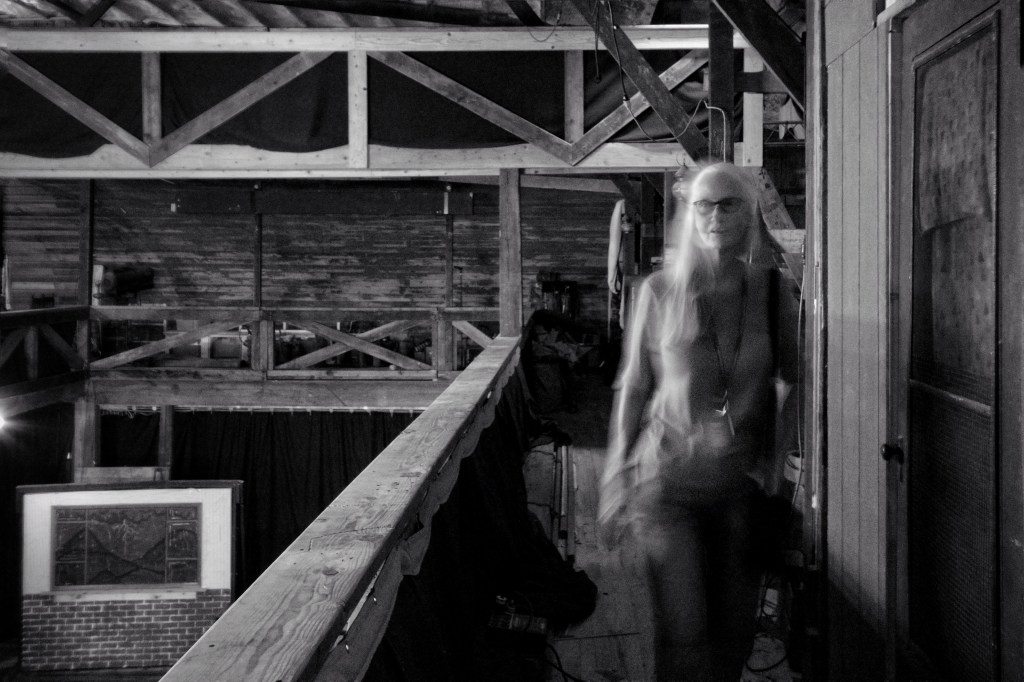
You guys, guess what. I now routinely shoot photographs with one hand. Every photo in this post was shot with one hand. I have to say, at first that felt…irresponsible. But the camera weighs almost nothing (really, it’s about nine ounces) and the image stabilization system is incredibly forgiving. The photo above? I shot that in a low-light situation. We’re talking a half second exposure at F11. With one hand. Ginger is blurry because she’s walking, but everything else is clear and in focus. That ought to be impossible with one hand. But here we are.
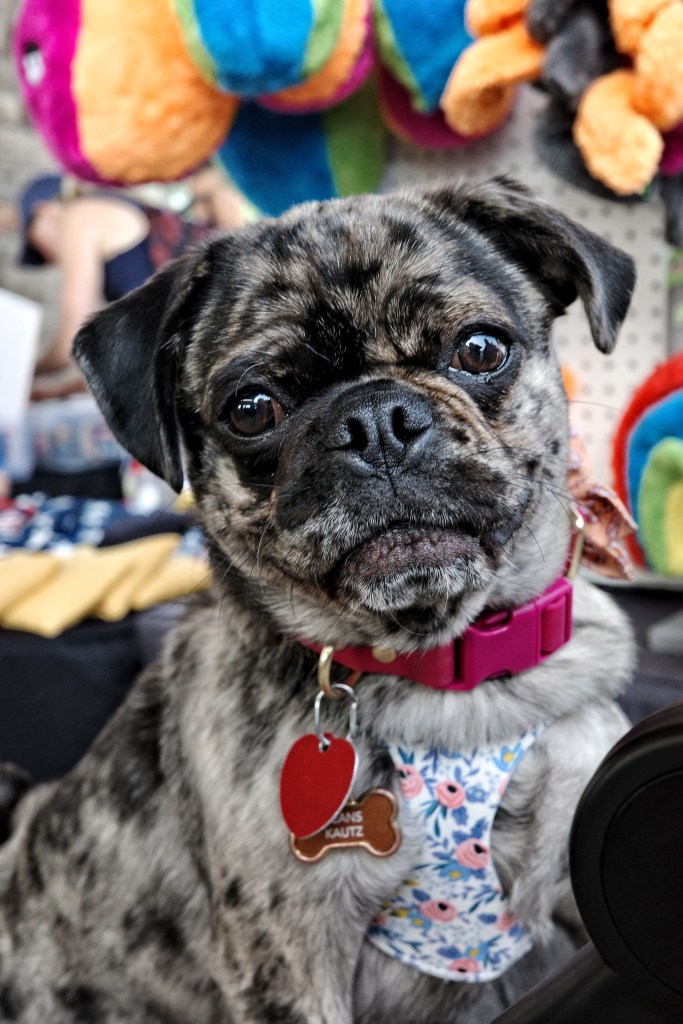
Now, shooting with one hand seems sorta kinda…natural? For example, I’m at the local farmers market, I’m toting a bag with pastries and fresh veggies, and I see a woman with a pug in a baby carriage. I pull the camera out of my pocket (did I mention it fits in my pants pocket? Not like a cargo pants pocket, but a regular blue jeans pocket…astonishing), ask the woman if I can photograph her dog, and a moment after she says ‘sure,’ I’ve got the photo. One hand.
And that’s another thing. For most of my long and randomly wicked life, I’ve been reluctant to shoot photos in portrait aspect. Even with my cell phone, I turn it sideways and shoot in landscape. But with the Ricoh, I seem to be shooting a LOT more vertically. I don’t know if it’s the camera (it’s probably the camera) or a change in the way I see the world, but there it is.
Over this last year I’ve shot 3335 photographs on the Ricoh. For some photographers, that’s probably just a busy couple of weeks, but it’s a lot of photos for me. I’m a rather parsimonious photographer (which I’m sure is a result of having learned to shoot pre-digital, when film and processing cost money I didn’t have).
So am I shooting differently with the Ricoh? Yes and no. I’m still shooting the same sorts of photos, but I’m doing it more quickly, more fluidly, and more vertically. And I’m doing it with one hand in my pocket.
As I’ve explained elsewhere, about a year ago I came across an article on some photo website that suggested looking at and analyzing your old photos as if they were made by a different person. The idea seemed a wee bit silly to me, but I was just coming out of a photographic slump…so what the hell, I thought I’d try it.
That slump is long dead now, though I suspect it had more to do with buying a camera that fits my approach to photography than with this practice of looking at old photos. That said, I’ve found some unexpected value in looking at my old photographs. I’m not learning anything new about photography (as I recall, the article was about evaluating or improving your compositional skills or something), but I’ve been surprised to find a weird sense of formality in my photos.
I don’t think of myself as being a formal photographer. I tend to shoot sparingly (I learned photography in the film era, which meant every shot cost money and I was rather poor), but quickly. I’ve been doing this photo stuff long enough that I don’t really think much when it comes to composition. I just put myself or my subject in a position that feels right, then take the photo. While I don’t believe there are any rules that MUST BE OBEYED, I do think there are some very strong photographic suggestions that ought to be considered. For example, if you’re making an informal portrait, you should be reluctant to have your subject strike a pose and you should avoid putting your subject in the center of the frame.
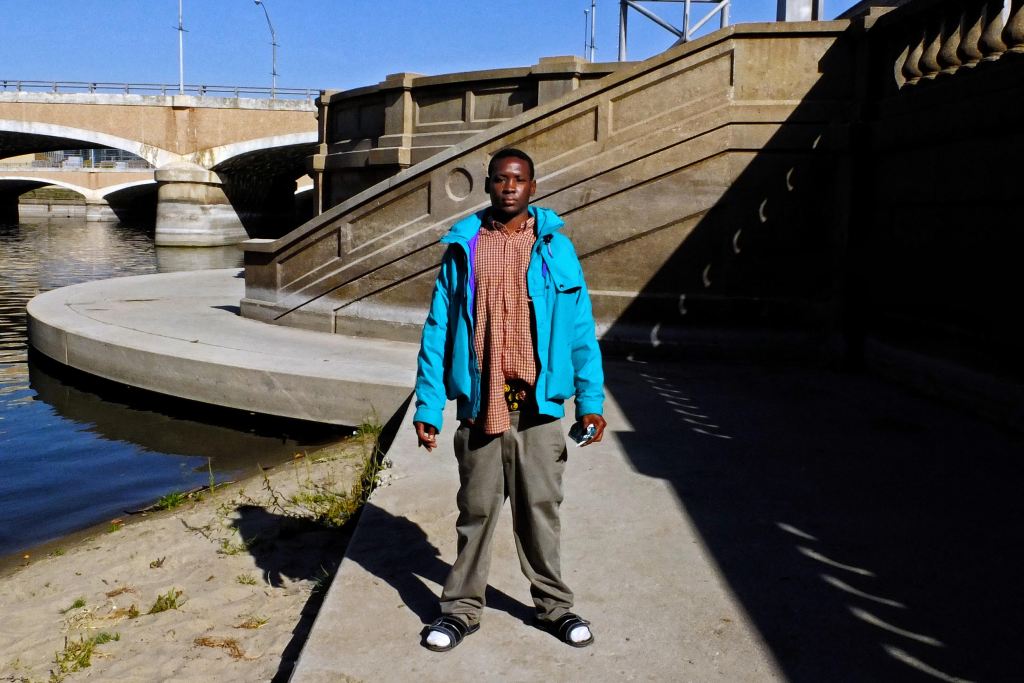
10;29 AM, Wednesday, October 3, 2012
Like this. This is Sakim. I’ll tell you about Sakim in a moment. First, the photo. It’s everything you don’t want in an informal portrait–stiff pose, center of the frame. But (to me, at any rate) it works as a photograph. Why? Partly because of the composition; all the lines direct your eye to him and the angle of his arms matches the angle of the light on the sidewalk. It also works partly because this genuinely represents this particular person at this particular moment.
I was noodling along the riverwalk when I saw Sakim approaching. He was wearing a black baseball cap with smiley faces on it, drinking juice from a soft packet, and walking in a sort of marching gait that I associate with psychiatric patients. I’ve worked with a lot of psychiatric patients, mostly in a prison setting. I’m comfortable encountering them in unscripted public settings. I’ve found folks with emotional issues are often eager to visit with people IF those people are relaxed around them. Of course, the opposite is also true; some folks just want to be left alone. You can’t always tell until you start visiting with them.
I don’t recall how we struck up a conversation, but based on past experience I suspect I initiated it. I do recall he had a soft, gentle, deeply accented voice. We spoke about the weather (it was warm for October, but Sakim said it was chillier than where he was from) and his juice (he didn’t mind that his juice was warm). He wasn’t entirely comfortable having a conversation, but I had the feeling he didn’t really want the conversation to end. My sense was that he didn’t quite know how to have a casual conversation and was always concerned that he wasn’t doing it right.
After a few moments I asked if I could take his photo and he agreed. He took his cap off and stuck it down the front of his pants (which was disappointing–I really wanted him to leave it on, but I didn’t want him to feel like he’d made a mistake by taking it off). Then he struck this awkward pose. He had the sun to his back, which left his face in shadow, so I asked if we could trade places. He struck the same pose again. I told him he could relax. He said he was relaxed. Without lifting the camera to my eye, I recall asking him to take a couple steps this way and that way until it felt like he was in the right position, then I raised the camera and took a single shot. I showed him the photo and thanked him; he said “Okay” or something, then he turned around and went marching off.
Sakim never smiled the entire time we talked. Never showed any emotional affect at all. The entire encounter couldn’t have taken more than 3-5 minutes. I left feeling like I’d sort of failed him somehow.
When I got home and looked at the day’s photos, I almost deleted this one. I was only looking at Sakim and thinking about his awkward attempt to engage with a stranger. It’s NOT a good photo of him. He looks a little sad and distant. But even though it violated my sense of informal portraiture, and even though it’s not a good photo of Sakim, I felt it still worked as a photograph. Despite that, I’m not sure I ever posted it on social media.
If nothing else, this practice of looking at old photographs has reminded me of my 3-5 minutes with Sakim. It’s been almost 13 years. I hope he’s okay.
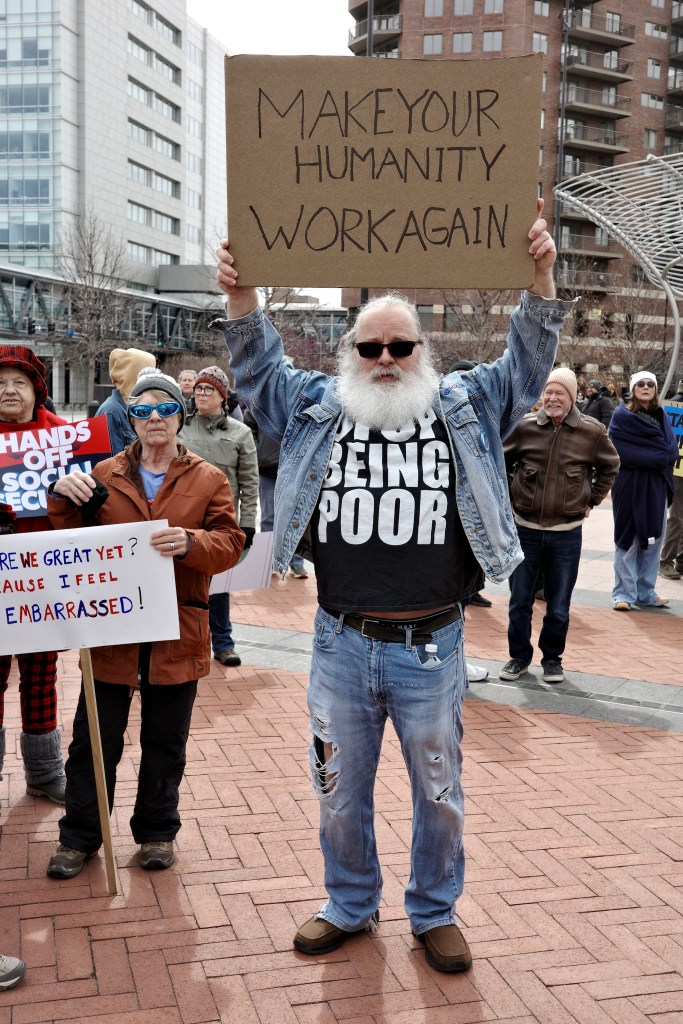
Like a million other concerned people, I attended the local Hands Off! protest yesterday. I wasn’t sure how many people would show up, considering it was a cold, blustery day (about 42F with steady 14mph winds and gusts about twice that). I thought we might still get a thousand people. Maybe.
The local news estimated the attendance to be around 7,500, and they tend to be conservative in their estimates. It was an eclectic crowd with a variety of concerns. Climate change, veteran’s benefits, social security, health care, education, trans rights, social justice, the court system, immigrant’s rights, Ukraine, and more. But there was absolutely universal condemnation of Comrade Trump, Elon Musk, and DOGE.
The protest began, as all protests do, with speeches. I confess, I paid little attention to the actual speeches, though I was pleased to hear the crowd cheering and applauding. During the speeches, I left the main crowd and moved around the fringes. Why? Because there are folks who want to protest and make their voices heard BUT for any of a thousand reasons may be uncomfortable with crowds.
The folks on the fringe of the protest were pretty much the same people who made up the rest of the crowd. They were mostly white (this IS Iowa, after all) but beyond that they seemed to be a fairly representative sample of the protesters. There were young kids (some in strollers), and working class folks, and church-goers, and goths, and office workers, and trans folk, and wine moms, and college students, and old folks (some using walkers), and union members, and passers-by who just wanted to know what the hell was going on.
One of the things I found most interesting about the event was that everybody was 1) happy and 2) pissed off. They were pissed off enough to give up their Saturday to carry signs and listen to speeches and shout for Elon Musk to be deported and for Donald Trump to be impeached and to take over one of the main city streets and march a mile or so in cold, blustery weather to the state capitol building, where they listened to still more speeches. But they were also happy and laughing and clearly delighted to be with others who agreed with them. There was a tremendous sense of relief, and a sense of urgency, and a sense of something approaching hope and optimism. That all seems contradictory, but it didn’t feel like it.
Nobody there thought this march–or any of the hundreds of other marches–was going to change anything. Nobody there was that innocent. But it felt like there was a shared commitment to changing the way we govern ourselves. There was a very clear feeling of joy at the chance to express themselves, to carry signs and chant slogans and shout out their frustration and rage and hope.
It was also clear that this was the first time a lot of these people had attended a protest. At the beginning, there was a tentativeness to the crowd. A lot of looking around to see if anybody was watching, if anybody was upset or offended by what they were doing. This was especially clear when the organizers asked them to take to the street and march up to the capitol, where we’d join up with a second protest. We are a car-brained culture, and these people were unsure about the propriety of taking over a street without permission.
But they did it. And when cars approached the head of the march, they had to stop and make a U-turn. At the back of the march, a lone police officer in a squad car followed to insure no drivers disrupted the march from behind. Within a few hundred yards, this crowd of normal Iowans were chanting, “Whose street? OUR STREET!” There was a palpable sense of released anger and resentment and liberation. It really was OUR street.
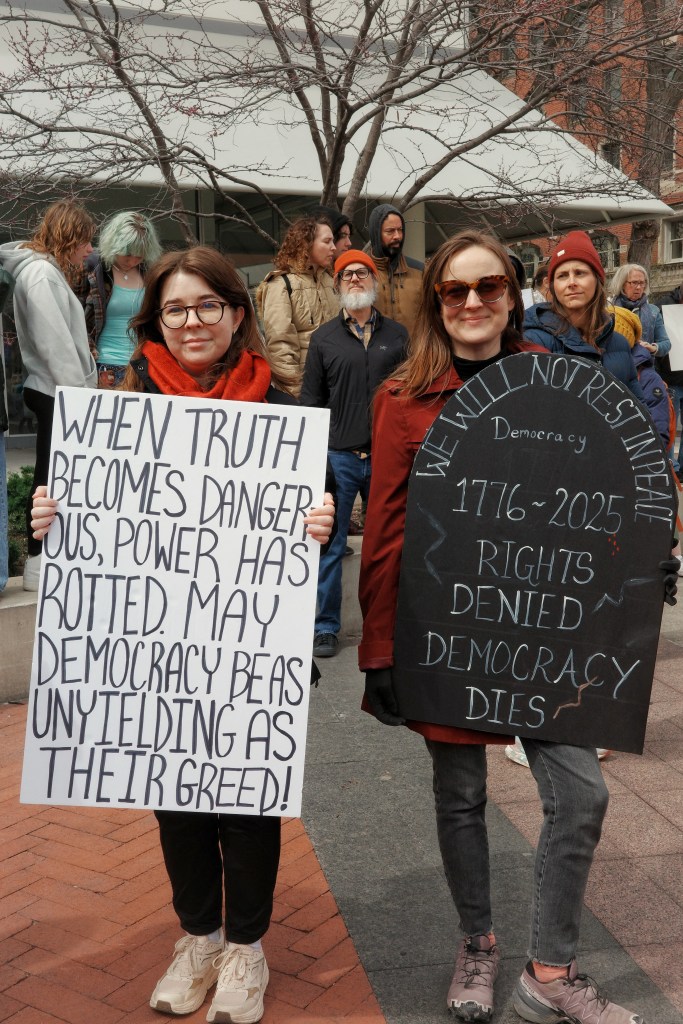
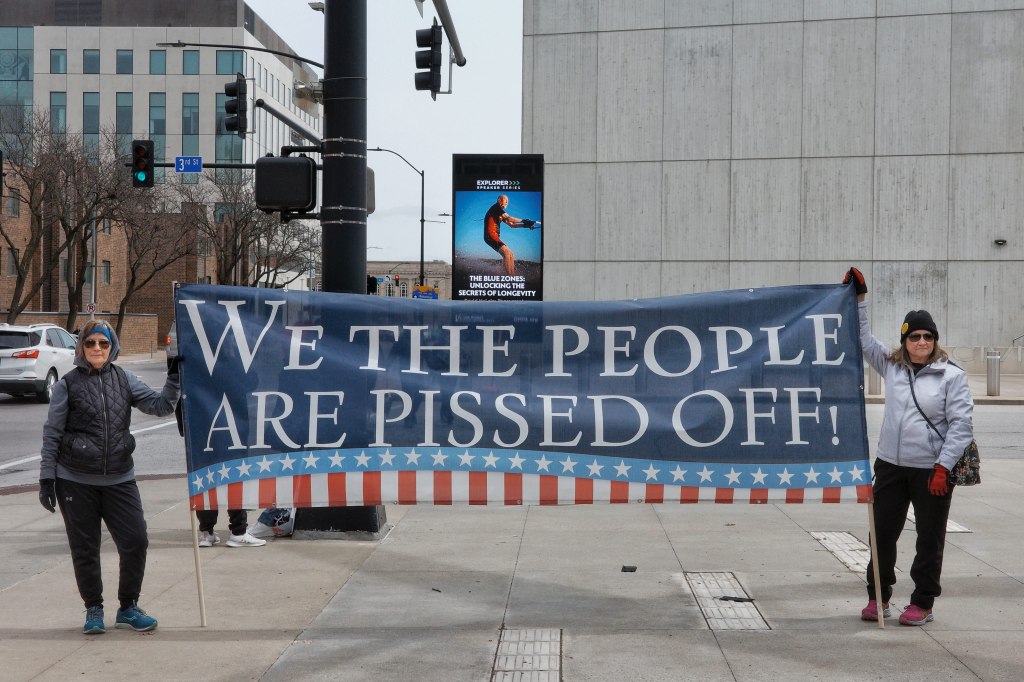
When the crowd took to the street, these two women with their “We the People” sign led the way. It seemed appropriate. Because it’s true. We, the people, are massively pissed off. And yesterday, we let those malignant fuckwits of the Trump administration know it.
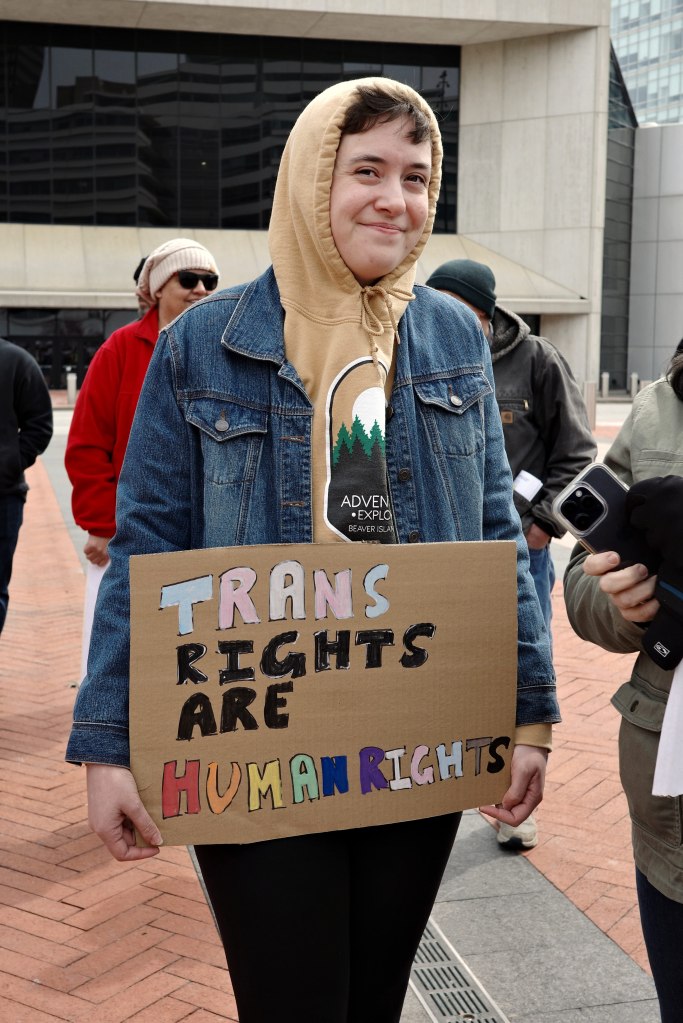
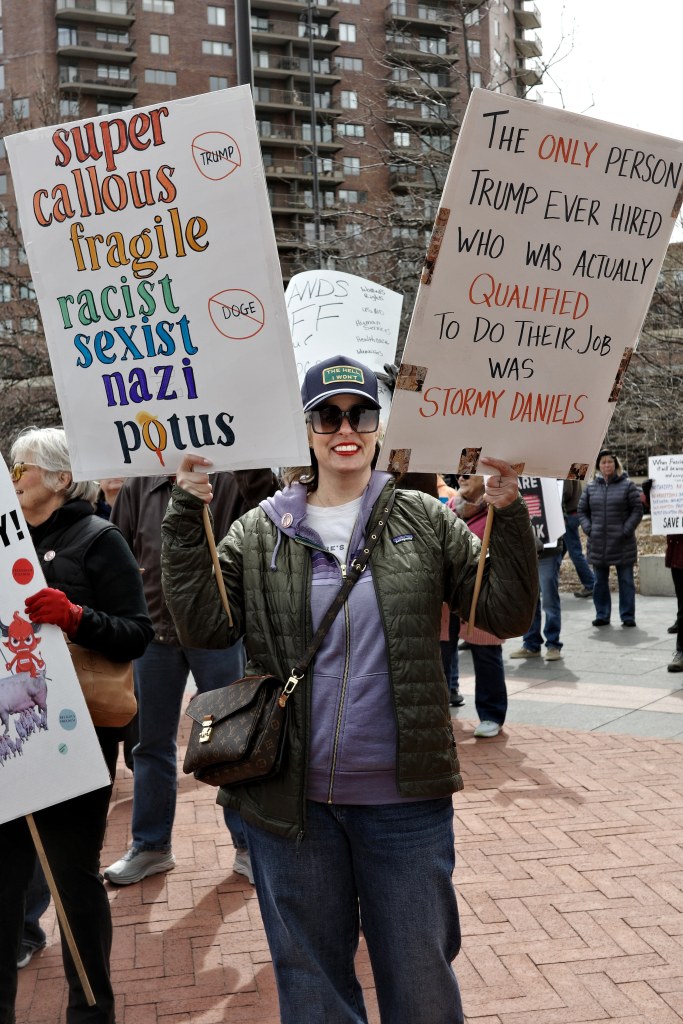
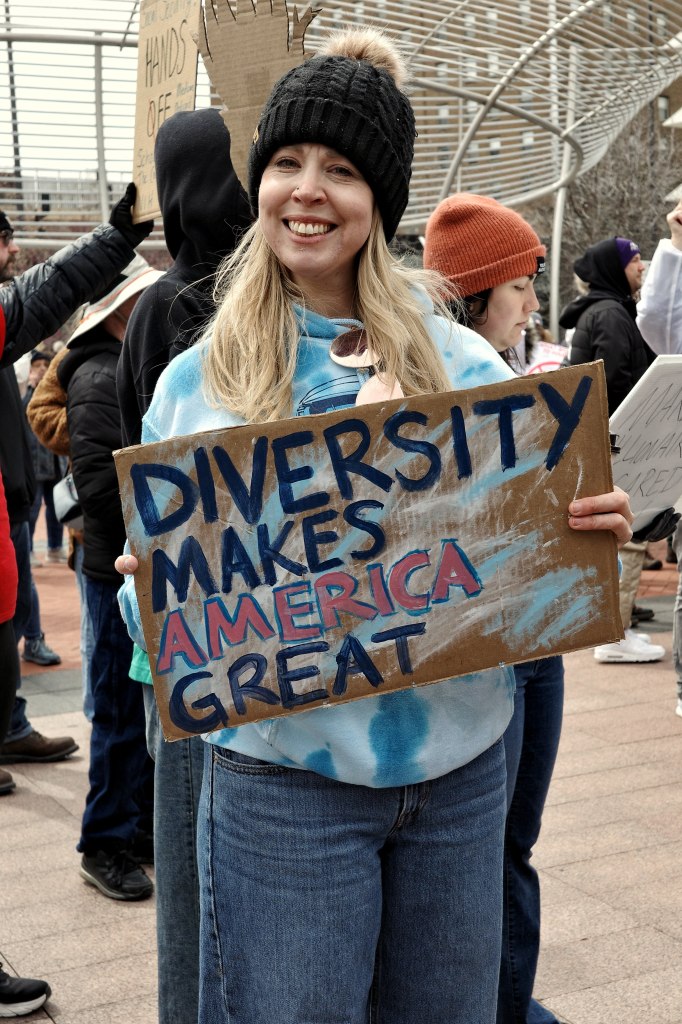
I took a lot more photos of (and in) the crowd itself. But here I wanted to show the people who, at least at the beginning of the day, hovered around the fringe of the protest. The people who usually get overlooked. The people who don’t make the highlight reels or the news reports. As so many protest signs said, you know things are grim when even the introverts show up.
You’ll notice that most of these photographs are of women. You’ll notice they’re not drawing attention to themselves. They’re drawing attention to the signs they’re carrying. Signs they mostly made themselves. There’s a song from the 1950s resistance movement in South Africa that goes, “Wathint’ abafazi, wathint’ imbokodo.” This translates as:
When you strike the women, you strike stone.
We’ve been striking stone for decades. Centuries. Eventually, it’s going to spark a fire that will incinerate the patriarchy. It may still be a long time coming, but it’ll happen. And when it does, women like the ones in these photos–the ones quietly occupying space at the fringe–they’ll have helped light that spark.
I’m trying to find a balance here between honesty and modesty. Here’s the thing: I mostly write short detective fiction. I write with the intent of selling my stories to one or two magazines–Alfred Hitchcock’s Mystery Magazine or Ellery Queen’s Mystery Magazine.
Why those two? Because when I wrote my first short detective story, I checked to see who published the most prestigious mystery magazines, and the answer was AHMM and EQMM. I figure if you’re going to get rejected, you may as well get rejected by the best.
This is where the honesty and modesty business comes in. I’m a good writer. Not a prolific writer, but a careful, deliberate writer. I’ve sold every story I’ve submitted to those magazines, with one exception (which, of course, I think was an error on their part). When you consider the acceptance rate for those magazines is about 3-4%, that’s a pretty good record. I’ve had stories included in Best Of anthologies, I have a story in Alfred Hitchcock’s 50th Anniversary anthology, I’ve won an Edgar for Best Short Story.
So yeah, I think I’m a good writer, but I don’t have much attachment to the finished product. I’ve written about this before.
Once I finish writing a piece of fiction, I seem to lose all emotional attachment to it. I’ve done what I wanted to do with it, I’ve written the story, and now it’s done. I submit the story to a magazine; they either accept it (and send me a check) or reject it (and send me a rejection letter), but that’s their job. My job is over. Time to do something else. The finished story is old news; it just doesn’t seem very important anymore.
So it’s been a weird experience for me to get frustrated over a story that’s actually been accepted. Here’s what happened. I wrote a story, submitted it, didn’t think about it for a few months. I finished writing another story and was getting ready to submit it, which reminded me I hadn’t heard back about the other story (I submitted that story to the other magazine). This was last October. I wrote the editor, asking for an update.
The update? “We like your story and want to buy it.” BUT there was some corporate issues which prevented them from issuing contracts; I was asked if I could be patient for a few weeks while they got the issue settled? I said yes, of course. In mid-December I got an email saying I should get a contract “in the next 2-3 weeks.” I was fine with that. Then on 1/2/25, I was told “your story is at the top of the list for when we can request contracts again.” On 1/24/25, I got an email saying, “you can expect a contract in mid February.”
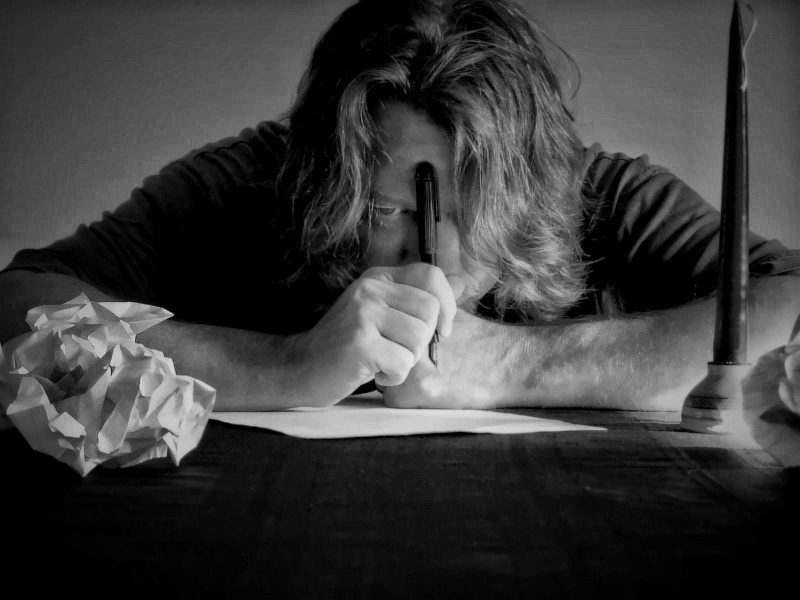
No, this old photo isn’t how I write; just how I feel at the moment.
Mid-February came; no contract. It was annoying, not just because the contract was taking so long, but because for the first time, I felt emotionally involved in the product. It pissed me off that I cared about the story as a product. I told myself, “It’s just a story. It’s just words in a row. It’s just something I made up. I should be happy that somebody somewhere wants to give me actual money for sitting in a room and making shit up.”
A couple of weeks ago, I learned that the company that publishes those two magazines (and also publishes two of the best known science fiction magazines) had been purchased by another company. That explained the long delay in the contract. But I was still frustrated and annoyed.
So this morning, five fucking months after I was told the magazine wanted to buy my story, I wrote a polite email to the editor saying how much I’ve appreciated working with the staff of the magazine, but that this long delay was a shabby way to treat writers. I said I wanted to withdraw the submission.
I didn’t send the email. Why? Because, as I said earlier, I’m a careful, deliberate writer; I wanted to re-read it and make sure it was correct before I sent it. And I went to the gym.
While I was at the gym, I got an email with the contract.
That should settle the issue, right? But I’m sitting here, still annoyed as fuck. Partly because the email came from a different editor (what happened to the woman I’m used to dealing with?), partly because of the long delay, partly because this contract pays half on acceptance and half on publication (all the previous contracts paid on acceptance), and partly because goddamnit goddamnit goddamnit, I don’t know I’m just pissed.
The rational part of me says, “Just sign the damned thing and take the coin.” It says, “Don’t fuck up a relationship with a magazine that’s been good to me.” It says, “Give the new people a chance to get their shit together.” The irrational part of me wants to reject the contract because goddamnit goddamnit goddamnit, I don’t know I’m just pissed.
I’m also aware that a LOT of my anger is displaced fury at what’s going on in the US right now. I’m not used to being angry. I hate it. But here we are.
And the thing is, I KNOW what I’m going to do. I’m not in this for the money (nobody who writes short fiction is in it for the money, but being offered an extra US$700+ for sitting in a room and making shit up…well, that’s nice and it’ll buy a few eggs.

 gregfallis.com