sure enough gettin’ worse

It’s been a week now. Seven days since I woke up and discovered it wasn’t just another PTSD nightmare. Donald Trump really no shit actually won the election. A full week, and folks I’ve been struggling.

Here’s the thing: I’m a Buddhist. I’m not a particularly good Buddhist, but for the most part I try to abide by the basic tenets of Buddhism. I don’t often talk about this Buddhist stuff because 1) who cares? and 2) it’s nobody’s business. But I’ve been struggling, because one concept lies at the heart of all the various Buddhist groups: compassion. So I’ve been trying to practice compassion for Trump voters.

It ain’t easy. For example, I read a New York Times column by Rabbi Michael Lerner entitled Stop Shaming Trump Supporters. I’m going to quote a chunk of his column:

The right has been very successful at persuading working people that they are vulnerable not because they themselves have failed, but because of the selfishness of some other villain (African-Americans, feminists, immigrants, Muslims, Jews, liberals, progressives; the list keeps growing).

Instead of challenging this ideology of shame, the left has buttressed it by blaming white people as a whole for slavery, genocide of the Native Americans and a host of other sins, as though whiteness itself was something about which people ought to be ashamed. The rage many white working-class people feel in response is rooted in the sense that once again, as has happened to them throughout their lives, they are being misunderstood.

No. As Donald J. Grabbembythepussy would say, wrong. The left has NOT been blaming white people as a whole. The right has been telling white people that the left has been blaming them — and a LOT of white folks have fallen for that lie. The political right-wing has also promoted the lie that the ‘failure’ of some groups of white folks been the fault of “some other villain”. Rabbi Lerner has got the wrong end of the stick.

Here’s where I begin to struggle. When I was formally studying Buddhism I was taught the greatest impediment to compassion is our attachment to a personal belief about how the world should be. I was also taught that compassion and forgiveness went together like peanut butter and milk chocolate. I have no problem feeling a good Buddhist level of compassion for folks who’ve been lied to and whose suffering is exacerbated by their acceptance of those lies. It’s the forgiveness component that’s kicking my ass.

Which leads me to this: if you voted for a candidate who is racist, sexist, homophobic, and xenophobic, then even if you’re not personally racist, sexist, homophobic, or xenophobic, you’re at the very least willing to support racism, sexism, homophobia, and xenophobia. I can feel compassion for folks who are scared of other races, who are fearful of women, who are anxious about folks who are different. But right now I’m just not capable of being forgiving of such bullshit.

And if you voted for a candidate who explicitly advocates torture and the revenge killing of the families of terrorists, then even if you’re not personally in favor of torture and revenge killing, you’re at the very least willing to support torture and revenge killing. I can feel compassion for folks who are so afraid of the world around them that they think hurting other people is the only way to protect themselves. But right now I’m just not capable of being forgiving of such bullshit.

So right now, this week, I’m struggling. Right now, this week, I’m in Mose Allison’s camp. Everybody cryin’ mercy, when they don’t know the meaning of the word. Right now, this week, I have no time for racists who suddenly feel safe to be racists, and who whine when they get called on their racism.

Right now, this week — and maybe the next, and maybe the week after that — I’ll do my damnedest to be compassionate, but I’m putting a hold on the forgiveness. I figure the Buddha would understand. That dude had compassion down.

Postscript: I just found out Mose Allison died yesterday, Fuck me with a chainsaw.

proust – pivot – lipton

There’s a semi-interesting article in The New Yorker titled How the Proust Questionnaire Went From Literary Curio to Prestige Personality Quiz. I say ‘semi-interesting’ because it takes what I think is an interesting idea — the evolution of a questionnaire a lot of folks are familiar with — and turns it into a fairly pretentious exercise (which is a thing most of us love and hate about The New Yorker). The New Yorker is one of the few places where you’ll find a line like this:

It’s safe to say that, today, the Sainte-Beuvian paradigm has triumphed—if not among literary critics, then certainly in the culture at large.

I guess that IS safe to say, if only because hardly anybody would know what the fuck you were talking about, unless they’d read the article in The New Yorker. And maybe not even then. But despite that, it’s actually interesting to have some glimpse into the origins of the questionnaire.

I became familiar with the questionnaire because of James Lipton’s odd talk show, Inside the Actors Studio. Lipton interviews actors (or directors, and an occasional screenwriter) about their craft. It began in 1994 as a sort of filmed seminar for students in the Actors Studio Drama School — a one-one-one informal but intensely personal interview with somebody who actually works in the business. Over time it’s become a popular show in its own right. The show often reaches a pretension level that can rival The New Yorker, but I’ve never seen an episode that wasn’t worth watching. That said, I wouldn’t entirely disagree with the Sunday Times critic who described the show as:

“[J]ust a chat show on satellite, but the veil of education and posterity is held decorously high, so everybody turns up and talks with a smile.”

Each episode ends with Lipton asking a series of ten questions that he attributes to French television personality Bernard Pivot, who did a similar show devoted to writers. Pivot said his list of questions was inspired by Marcel Proust. Proust got the idea from a popular 18th century parlor game he learned from Antoinette Faure. And the green grass grows all around, all around. If you’re really curious about all this, then you’re probably the sort of person the article in The New Yorker was written for, and you should probably go read it.

Most folks, though, are primarily interested in the questionnaire — the actual ten questions themselves. Some of the questions are pedestrian, some are silly, some are insightful, but it was always interesting to see how various actors/directors/writers would answer them.

Obviously, I’m going to give the questions and my own answers — but I’m genuinely curious to see how other folks would answer them as well. So, here we go:

What is your favorite word? Ownself. It’s a Southernism, I think. At least I’ve never heard anybody outside of the Deep South use it in the same way as Southern folk do. It means ‘yourself’ or ‘myself;, of course, but in a more deeply personal and possessive sort of way. Saying “my ownself” or “your ownself” emphasizes the ownership of whatever the hell you’re talking about. For example, saying “I’ll do it myself” doesn’t carry the same level of investment or commitment as “I’ll do it my ownself”, which is less invested than “I’ll do it my own damn self.”

What is your least favorite word? Any hateful slur — kike, nigger, faggot, pick one.

What turns you on? Smart people.

What turns you off? Willfully stupid people. You know, folks who are capable of learning and understanding, but either can’t be bothered to learn or refuse to learn because it would make them doubt something they believed. Willfully stupid people can fuck right off.

What sound or noise do you love? Water rippling around stones.

What sound or noise do you hate? Leaf blowers. I fucking hate leaf blowers.

What is your favorite curse word? I don’t really have a favorite. I’m sort of partial to ‘cocksucker’, though it’s not an expression I use. I like it because it was used beautifully and creatively in the HBO series Deadwood. HBO’s The Wire did something similar with ‘motherfucker’, but The Wire‘s motherfucker lacked the deep, profound sense of commitment to obscenity that we saw in Deadwood‘s cocksucker.

What profession other than your own would you like to attempt? Architect, maybe. Or investigative epidemiologist.

What profession would you not like to do? Anything to do with accounting.

If heaven exists, what would you like to hear God say when you arrive at the pearly gates? I always have trouble with this premise. It’s like saying “If you had your own personal dragon, what would you do with it?” But you have to play the game by the rules, so IF heaven existed and IF there was a god waiting to greet me, I guess I’d like to hear her say “Hi, come on in, we have an extensive library. And there are no leaf blowers.”

So that’s me. What about you?

nobody cares

“Sometimes I feel like I should just give up.”

One of my writing students recently said that. In fact, I hear that with distressing regularity from my students. (As an aside, it still occasionally strikes me as improbable that I’ve become a Person Who Has Students.) That statement is almost never posed as a question, but the question is always there as a not-very-subtle subtext. Should I just give up? And that question always masks another question, which is generally phrased as another statement: I’m never going to be good enough to get published, am I.

The question at the heart of all this is an awkward question. It requires a graceful answer. It also requires an honest answer. As a Person Who Has Students, it’s my experience that honesty and grace don’t always dovetail together.

The graceful response is easy. “No, of course you shouldn’t give up. If you approach your writing with diligence and sincerity, you can become good enough to get published.” There’s some measure of truth in that. If you work hard at any craft — writing, cabinetry, weaving, brick-laying, pottery — you can improve. Most of my students have the capacity to be good enough to get published.

But most won’t. That’s the honest answer. Hard work doesn’t guarantee mastery, and mastery doesn’t guarantee success. The unwelcome Truth is that while most of my students have the capacity to improve, relatively few will actually fulfill that capacity; they either lack the necessary persistence or are prevented by circumstance from achieving it. And even whose who ARE good enough, may still not be good enough. Even if they produce excellent work, the first publisher to read it may reject it. And so might the second and third. And the fourth and and and.

Nobody cares about your zombie novel

Nobody cares about your zombie novel

Instead of responding directly to my student, I asked a question: “What matters most to you — writing a good story or getting published?” Everybody wants both, of course — and logically one should follow the other. If you write a good story, it’s got a better chance of getting published. But knowing which of those matters most changes your approach. If getting published matters most, then you let the marketplace direct the work. If the marketplace is hot for zombies, then you write zombies. Some folks will sneer at that, but there’s nothing wrong with it. It’s a professional approach  Getting paid for your work is a wonderful thing, and the best way to get paid is to give the market what it wants. And down at the bone, a good zombie story is first and foremost a good story — just with zombies.

If it’s the writing itself that matters most, then your approach is different and the reward is different. In that case, story takes precedence over the marketplace. You might still write a story about zombies, but it’s the story that’s driving the process, not the zombies. And I’m going to repeat myself: down at the bone, a good zombie story is first and foremost a good story. It’s an issue of whether you’re writing a good zombie story or a good story that has zombies in it. In either case, it’s got to be a good story.

A few days after my chat with the student, I came across this video by Ted Forbes. You should watch it. Not right now, necessarily (because c’mon, I want you to keep reading this, don’t I) but at some point take a few minutes and watch it. It’s called Nobody Cares About Your Photography.

I don’t know Ted Forbes; we’re ‘friends’ on Facebook, which just about the most tenuous sort of human connection possible. I don’t think I’ve ever exchanged a word with him, but I watch his Art of Photography videos. I don’t always care about the subject matter, but it’s always worthwhile to listen to anybody who’s passionate about something talk intelligently about it. I’m pretty confident that if you listened to somebody talk passionately and with intelligence about lawn bowling, you’d learn something you could use in writing. Or in photography.

Forbes says nobody cares about your photography — and he’s basically right. In the same way, nobody cares about your writing. There are SO many writers out there (and so many photographers or lawn bowlers) that it’s easy for you, as an individual, to be ignored. And if you’re proficient enough to care about your work and intelligent enough to wonder about your place, you’ll almost certainly at some point wonder if you should just give up.

Forbes, I think, makes two important, related points. He says No more easy shots and The world needs work that matters. What the hell does that even mean? And how does it translate into writing?

I don’t think he’s saying you need to be trying to create work that will be of historical importance (if he IS saying that, then the poor guy is delusional — but still worth watching). I think when he says No more easy shots he’s basically saying not to do the same old shit you’ve always done just because you’ve always done it. Do different shit, or do that old shit differently. Don’t relax, don’t sit down, don’t do it in your sleep.

And when he says The world needs work that matters I don’t think he’s saying the work must be Very Important Work. I think he’s saying to think about what the work actually means and how it fits into our culture. That sounds impressive as hell, doesn’t it. But consider the works of P.G. Wodehouse. It’s fluff. But it’s incredibly well-written fluff. It’s not easy to write comedic fiction that light-hearted.

Does the writing of P.G. Wodehouse matter? I’d say it does. People need a bright, witty escape from the world. They need it and deserve it. The question isn’t whether the world needs another novel about zombies — or about elves, or former special ops soldiers, or a sharp-witted nanny who is kidnapped by Barbary pirates. The question isn’t whether anybody really cares about your elven special ops zombie romance novel. They don’t.

But they do care about stories. They care about what stories do. About what stories make them feel. About the things stories inspire them to think about.

The world needs good stories. Stories matter. Grace matters, honesty matters, passion matters, intelligence matters. Stories will always matter. You may not write one that finds its way to an enthusiastic reader. But you can try. If you can approach your work with grace, honesty, passion, and intelligence, then it might matter. It might.

Lawn bowling

Lawn bowling

If it doesn’t — well, there’s always lawn bowling.


michael herr — there it is

Michael Herr died a couple of days ago. There’s a pretty good chance you won’t be familiar with the name, but if you’ve ever seen a movie about the war in Vietnam — hell, if you’ve even heard there was a war in Vietnam — then Michael Herr has shaped your understanding of the world.

He was a correspondent for Esquire magazine who covered Vietnam from 1967 to 1969. Well, covered isn’t the right term. He didn’t report the news from the war; he reported the experience of Vietnam — and in 1977 he turned all those experiences into an astonishing book called Dispatches. It’s not a history of the war; it’s not a morality tale, it’s not one of those ‘war is hell’ stories; it’s a semi-hallucinatory account of what one war was like for one correspondent. Herr sort of dolphined through Vietnam — sometimes dancing lightly across the surface, and sometimes diving so deep that light barely penetrates.

Going out at night the medics gave you pills, Dexedrine breath like dead snakes kept too long in a jar.

That’s the first line of the first chapter of Dispatches. The entire book is filled with lines like that — lines so beautiful you read them two or three times, lines so full of dread and horror you wish you hadn’t read them at all because you know they’ll stick like cockleburs in your brain — and if you’ve already got a head half-packed with memories you wish you didn’t have, you don’t really need any more. And yet you’re grateful for the beauty and horror of those lines because they ring true, all the way down to the bone.

Herr wrote the voice-over narration for Francis Ford Coppola’s Apocalypse Now, and helped write the screenplay for Full Metal Jacket, the film by Stanley Kubrick. But nothing compares to Dispatches. Michael Herr was one of the writers who revealed to me the actual power of good writing. Dispatches had a profound effect on my life — on how I saw the world, on how I related to my family, even on how I’ve done the various jobs I’ve had.

Vietnam is what we had instead of happy childhoods.

I never served in Vietnam. I did my four years in military harness toward the end of the war, and I did every fucking thing I could do to keep my ass in the States. Both of my older brothers went through Vietnam, though. Marines, both of them. One completed a full thirteen month tour and came back physically whole, but emotionally fucked up. The other brother was only there for about five months, then spent about twice that long in the Great Lakes Naval Hospital getting rehab for the leg he nearly lost. He was in Recon; his team was essentially inserted into an ambush; they were hit even before they could set up a perimeter. Now he has a chunk of steel instead of a thigh bone, receives a disability check every month from Uncle Sugar, and the State of Iowa gives him a license plate that gives him a preferred parking space.

Herr wrote a great deal about the Marines. He spent a lot of time with them. Marines re-taking the city of Hue, Marines under siege in Khe Sanh. If those names aren’t familiar to you, and there’s probably no reason they should be, just imagine the worst combat scenes you’ve seen in movies, then add some 60s rock. Reading about Marines in Dispatches helped me understand my brothers; it helped me love them.

Herr also wrote about LURPs — the guys who did the Army’s long-range recon patrols. That was helpful because I eventually ended up working with a former-4th Division LURP. We were both private investigators specializing in criminal defense work, and sometimes that meant going to scary places and asking nosy questions of scary people. This guy was a little crazy and a little scary himself, so he fit right in. We worked as a team — he’d be armed; I wouldn’t (I didn’t like carrying a firearm — not because I object to them, but because I felt a gun would make me over-confident and less situationally aware; being frightened kept me alert).

Being a LURP had taught him two things in detail. First, how to keep watch. When we’d go someplace dangerous, he’d sidle off quietly to one side and just keep watch while I’d approach the subject and do the talking. He’d take up a position, silent and relaxed and vigilant, and he’d sort of blend into the woodwork. It also taught him about violence — to avoid it when possible, and to commit to it when it was necessary. Overwhelming, sudden, sharp violence.

Knowing he was there never stopped me from being scared, but there was tremendous comfort in knowing I wasn’t alone. I learned to trust him totally. Trust is a word folks toss around a tad too freely, I think. When I say I trusted this guy, what I mean was I was confident that if things went Oh Shit, he’d step up. No hesitation. He might not be able to save me from getting hurt, but I knew he wouldn’t leave me — and that means a lot.

I don’t think we’d have become friends if Dispatches hadn’t allowed me to peek into the experiences guys like him had gone through. In fact, I’m not sure we were really friends at all; we had very little in common. Just that bond of trust. I think it meant a lot to him that I trusted him so much.

I guess Dispatches served me as a sort of guidebook, offering insights into people I loved and relied on. The book is almost 40 years old, and it still helps me keep the horizon line fairly straight. When I have my own terrifying PTSD moments and nightmares, it actually helps to know mine are a mild version — that I’ve had pretty good luck to limit my own personal horror show to the occasional moment of panic and sweaty, gasping nightmare.

Hell, it even helps me just to remember this brief passage from Dispatches. Herr wrote about the practice of saying “good luck” to somebody:

…and though I meant it every time I said it, it was meaningless. It was like telling someone going out in a storm not to get any on him, it was the same as saying “Gee, I hope you don’t get killed or wounded or see anything that drives you insane.”

Obviously I haven’t been killed. The only physical wound I’ve received came from a rather aggressive Rottweiler. And I’ve only seen things that wake me at night, occasionally leaving me too afraid to go back to sleep. That’s unpleasant, but it truly counts as good luck, and because of Dispatches I’m able to be thankful for it.

Michael Herr

Michael Herr

I wanted to include a photo of Michael Herr from his Vietnam days — but I couldn’t find any that are worth a damn. He describes one, though:

Dana [Stone] used to do a far-out thing, he’d take pictures of us under fire and give them to us as presents. there’s one of me on the ramp of a Chinook at Cam Lo, only the blur of my right foot to show that I’m not totally paralyzed, twenty-seven pushing fifty, reaching back for my helmet and the delusion of cover. Behind me inside the chopper there’s a door gunner in a huge dark helmet, a corpse is laid out on the seat, and in front of me there’s a black Marine, leaning in and staring with raw raving fear toward the incoming rounds, all four of us caught there together while Dana crouched down behind the camera, laughing. “You fuck,” I said to him when he gave me the print, and he said, “I thought you ought to know what you look like.”

That’s the photograph I wanted to show. Not this trench-coated guy in a suit and tie. It’s not that the Michael Herr on the ramp of that Chinook is the real Michael Herr, but it’s the Michael Herr who exists in my imagination.

interruptions

This is why it’s so hard for me to get things done.

I took a short walk this morning. I try to take a walk every day, even if it’s just a short stroll to the local Stop & Rob for a cookie. Round trip, a walk to the S&R is about 1.75 miles. If I’m not interrupted, it takes me maybe forty minutes to get there, buy my cookie, return home, and re-park my ass in front of the computer.

But I’m always interrupted. Always. Almost. This morning I walked by an old couple (I call them old but they’re probably not all that much older than I am, really) sitting in lawn chairs inside their garage. “Hot,” the old guy called out. And he was right, it was already closing in on 90F. Anyway I stopped and chatted with them for a bit. He was a retired something-or-other in some insurance-related business; she never said what she did. We chatted about the weather for a bit. They seemed nice, and they clearly liked each other, and that was that. On I went.

After I’d gone thirty yards or so I thought “I should have taken their photograph.” Opportunity lost, right there.

At the S&R I bought a frosted sugar cookie, put it in a bag to tote home, and headed out. I was only a few steps out the door when this guy says “Excuse me,” so of course I stopped. He wanted to know how to get to Oskaloosa — which, believe it or not, is an actual name of an actual town. I knew the name of the town, but didn’t have a clue where it was. But I had my phone, so it only took a moment to call up a map and get directions.

He wondered why his phone wouldn’t do that. He had a Samsung something or other with Google Maps, so I had him tap on the little microphone skeuomorph (which is a real word, though WordPress doesn’t seem to think so) and say “Give me directions to Oskaloosa.” And hey, his phone gave him directions, and he was happy.

He thanked me, said he thought he detected a little Dixie in my voice, and I told him I’d spent a chunk of my life in the Deep South. He said he was from Baton Rouge, and was in Iowa working on constructing a pipeline (one whose construction I opposed, but he didn’t need to know that). We chatted a bit more, then he asked if I’d ever had any gratons.

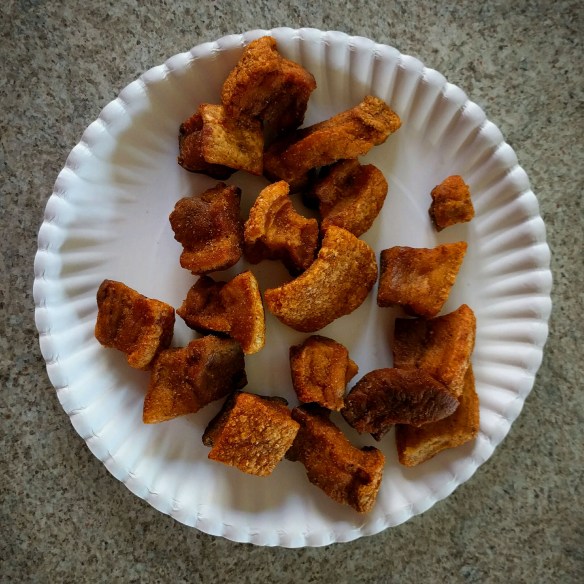
If you’ve never spent much time in Cajun country, you may not know that gratons are what other Southern folk call ‘cracklings’, and if you’ve never spent much time in the American South you may not know what ‘cracklings’ are. As far as that goes, you may not want to know what ‘cracklings’ are. But I’m gonna tell you: they’re fried chunks of pig skin and fat. Here, look:

gratons

Now, I don’t eat much meat anymore. And I realize that even dedicated carnivores are likely to turn their faces away from gratons. But I grew up eating stuff like this. He asked if I’d ever had any, and I said yes, and he opened up his car door and pulled out a container about the size of a coffee can full of spicy home-made gratons. Not those commercial pork rinds you might see in truck stops, but the real thing. I took one, popped it in my mouth, and it was hot. Even though my head said I should be disgusted, my mouth was telling me I was home. It’s hard to escape your culture.

It must have shown on my face, on account of he laughed and said “Here, have some more.” So I held out the bag I had my cookie in, and he dumped in a bunch of gratons. We shook hands and that was that. On I went. After I’d gone thirty yards or so I thought “I should have taken his photograph.” Another opportunity lost, right there.

I managed to get home without further incident. Less than two miles, 75 minutes, two conversations with strangers, and a bag of spicy gratons (which reminds me — Public Service Announcement: Cajun spices do NOT improve a frosted sugar cookie). Just another morning.

And this is why it’s so hard for me to get things done.

fuck you sexual harasser

I can remember being in high school, riding around in a car with my buddies, passing a couple of girls on the street, and the guys leaning out the windows, laughing and shouting. I don’t recall what they shouted. Probably something like “Hey baby, looking good.” I remember thinking it was a stupid thing to do — not because I thought it was harassing or threatening, but simply because it didn’t seem to me like an effective way to pick up girls.

I never gave much thought to cat-calling as a young man. It was just something some guys did. I did four years in the military and heard male troops catcall women, and didn’t think much about it. I did four years in college and heard undergrads catcall women, and didn’t think much about it. Then I became a counselor in the psychiatric/security unit of a prison for women. The inmates taught me a LOT about what life was like for women — or at least what life was like for women who ended up in prison. Every few weeks I’d be assigned weekend duty. That sometimes included taking low-risk inmates on local excursions — a movie, maybe. Maybe a trip to a nearby park. Maybe a visit to a local diner so they could get to eat something other than prison food. It wasn’t unusual for me to drive a prison van with six to eight women convicts into town, herd them into the local theater, buy them all popcorn, and watch a movie with them.

And it wasn’t unusual for local young men, seeing us all walk down the street, to shout out the windows of their pickups at the women. When that happened, I noticed a lot of the women would tense up. And I paid attention, though not entirely for the right reasons. I paid attention in part because I’d been trained to notice body language. But I was also very aware that when any group of inmates start to tense up, you’d best pay attention.

A big chunk of my job was to try to understand and help these women, so on various occasions I’d talk to some of them about their reaction to the cat-calling. I remember one of them saying something like “When I hear that, I get ready to run. They gonna have to catch me, if they want to rape me.” That’s when I first started to get it. I still tended to put that anxiety down to druggie paranoia and living in bad neighborhoods — but I got the first real inkling of what it was like for those women to move through the world.

Years later I was living with a woman — a feminist criminologist. She opened my eyes in a lot of ways. One of the many things I learned was that an intellectual understanding of feminism doesn’t give you any meaningful insight into how women have to live. There was a night when she asked me to go with her to fetch something from a local market. I was busy doing something and didn’t really want to interrupt it. I figured she just wanted me along for company. But she explained there wasn’t any safe place for her to park at the market — which made no sense to me, since there was plenty of parking spaces nearby. What she meant, though, was 1) a lot of navy men often went to that market for beer and 2) there wasn’t a street light she could park beneath. She needed to park under a street light, she said, to be sure nobody was hiding in or near the car.

And I began to understand a bit more. I could run to the market to buy a clove of garlic without a second thought. For her, a run to the market required strategies to stay safe. And it wasn’t just a run to the market at night — it was going to the gym in the morning, it was getting off work in the evening, it was going to the mall, it was taking the dog for a walk. Taking the damned dog for a damned walk, and just by doing that she knew there was a decent chance she’d get harassed. Just walking down a street with a dog.

To me, this was a revelation. To her, it was so glaringly obvious that it hardly needed to be mentioned. And this was a woman who taught feminist thinking.

And you know what? I still don’t get it. Not really. I mean, I get it when I think about it. But as a guy, I rarely have to think about it. Which is why I’m both ashamed and grateful when a woman reminds me. And that’s what happened this morning. A friend of mine, Lori Andrews, posted this on Facebook:

I just got cat called with “mommy”. Of course I was far enough away that I couldn’t identify which construction worker did it. But here is what I wanted to say to him.

I have hated you my entire life. You drove beside me when I was a child and terrified me. You followed me and tried to touch me when I was a young woman. You have yelled at me from cars, broken my reverie in quiet walks, assaulted me verbally on my bike. You still talk about me and call out to me just out of view but always in earshot. Always when just I alone can hear it and no passers by are aware. Every day of my life I have endured your endless taunts and frightening threats. I’m 48 years old.

Fuck you sexual harasser. Fuck you.

It’s difficult for me to imagine the ridiculous lengths women have to go through every day just to avoid being harassed or harmed. Most of my life I’ve been in careers that required me to try to understand what life is like for other people. I like to think I’m pretty good at it. But every time I come across an experience like Lori’s, I’m reminded that I still don’t really get it. Despite having the lesson repeated to me countless times by so many women, it still doesn’t entirely register in my brain that women deal with this shit every day.

Here’s proof of that: earlier today I mentioned to a woman friend that I was thinking about writing a blog post about cat-calling because another friend had posted about an incident on Facebook. I said something like “More women should talk about this crap, so men will be reminded of just how hateful and pernicious it is.” My friend said “Why should it be a woman’s responsibility to remind men not to be assholes?”

There’s no good way for me to end this post. There’s nothing I can say that won’t come across as self-serving, or patronizing, or stupid in some way. But this has been on my mind all morning and it’s important that this stuff gets discussed.

I want to thank Lori for allowing me to quote her Facebook post and use her name. And I want to thank all the women who responded to her Facebook post, and as long as I’m at it, I should thank all the women who’ve been patient with me over the years. It’s not your responsibility to remind men not to be assholes — but thank you for doing it anyway.

nothing much

Yesterday afternoon a friend called. Well, she didn’t actually call call; she sent me an email. Which is what she does instead of calling. But her emails have the quality of a phone call, so I think of them as ‘calls’. Anyway, she said “What exciting thing did you do today?” As if all my days are filled with exciting things.

“I moved a couple of stones around on the table on the deck,” I said. “Then looked at the places where the stones used to be.” Not what you’d call traditionally exciting.

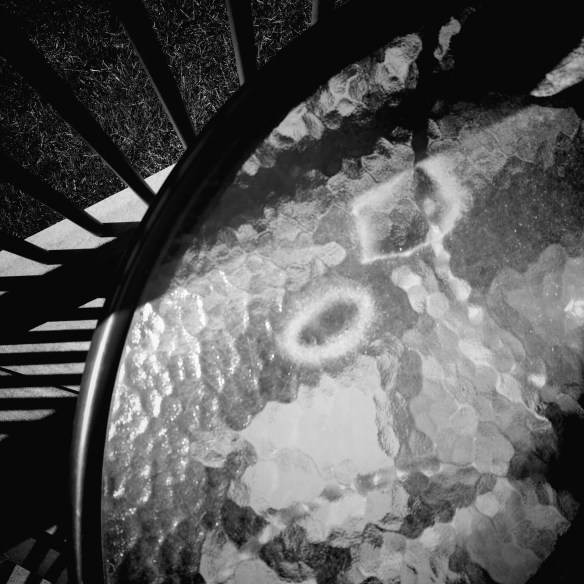
There’s this table on the deck — a little round glass-topped table — and I put stuff on it. You know how it is; you move around through the world and you pick stuff up. An odd-shaped stone or an interesting piece of wood or dried dog-chewed chunk of tennis ball. I don’t know what most folks do with that stuff, but me, I put it on the table. I used to put stuff on the table then photograph the stuff. An art project, I guess you could say. Then after a year or so I stopped doing that as a project. I still put stuff on the table and occasionally photograph it — just not as a project.

moved the rocks1

Here’s something obvious: if you leave a thing on the table for a while, it gathers dust. When it rains, the dust washes off. That dust dries around the base of the thing. So if you leave a thing on the table for a long while, then move it, sometimes it leaves an interesting pattern. Sometimes it just leaves a mess, but sometimes there’s a pattern and sometimes that pattern is interesting.

I like to look at those patterns. They please me. The whole process of creating that pattern pleases me. Sometimes I’ll leave the pattern and wait for the next rain to destroy it. More often I’ll just Windex the hell out of it and wipe it away. Then I’ll put something else on the table. Or maybe just re-arrange whatever crap is already at rest on the table.

Then I’ll wait. It’s a calm, still, quiet, personal sort of excitement.

moved the rock2

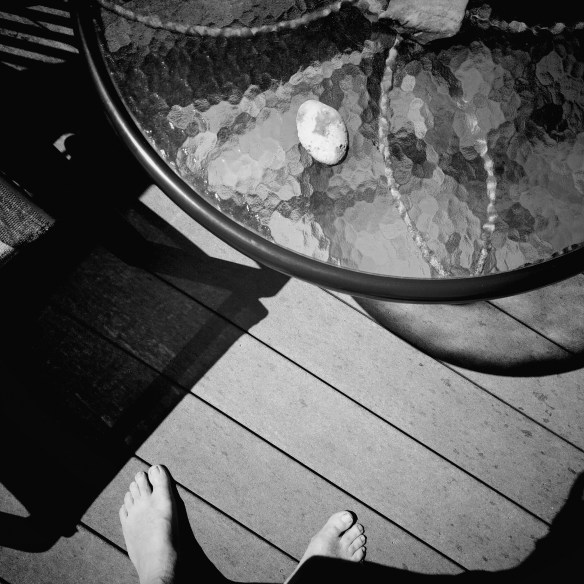
Anyway, that’s the exciting thing I did. I picked up the stones and looked at the patterns left behind. Then I put one of the stones down again.

It’s a pleasant little stone. Looks a bit like an egg. I saw it as I was walking down Delaware Avenue, sitting with a few thousand other decorative stones surrounding some greenery in front of Guadalajara, a Mexican restaurant. Only took a moment to stop, stoop down, and pick it up. I don’t think the folks at Guadalajara would mind that I took their stone.

move the rocks with cat

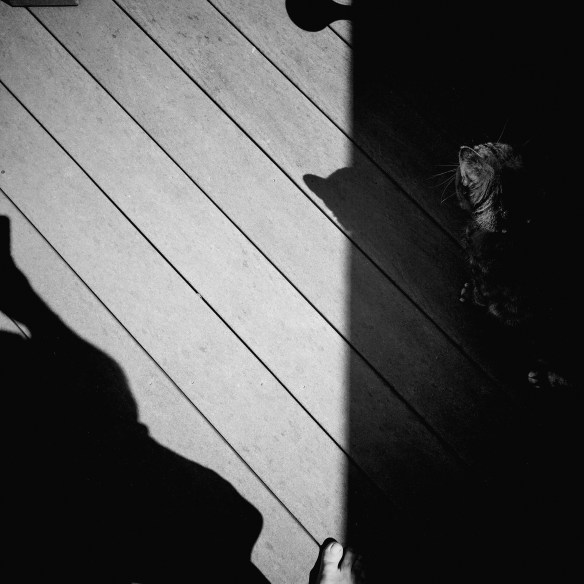
Later, the cat came wandering out. The cat takes a limited interest in these things. The cat doesn’t particularly care about patterns of dust left by rain-washed stones; the cat just wants to be around when something’s happening — even if that something is nothing much.

The cat has her own metrics for excitement.

bus stops


You’re either on the bus or off the bus. If you’re on the bus, and you get left behind, then you’ll find it again. If you’re off the bus in the first place — then it won’t make a damn.
(Ken Kesey – The Electric Kool-Aid Acid Test)

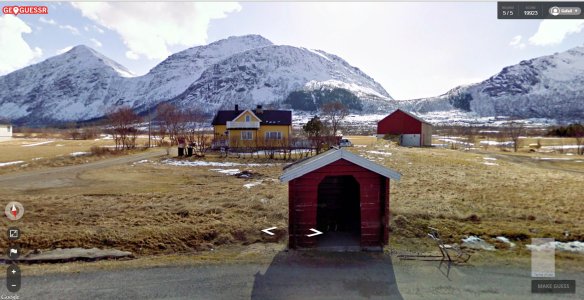
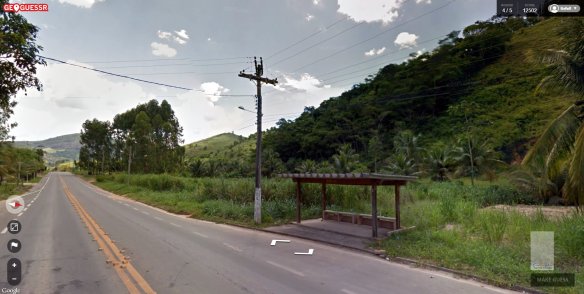
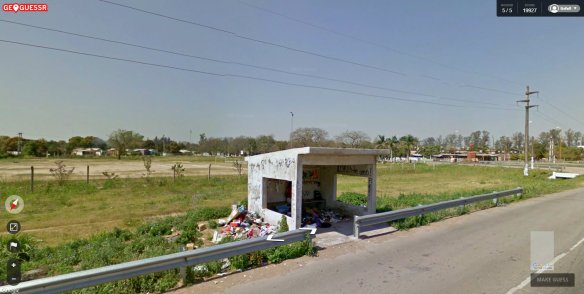
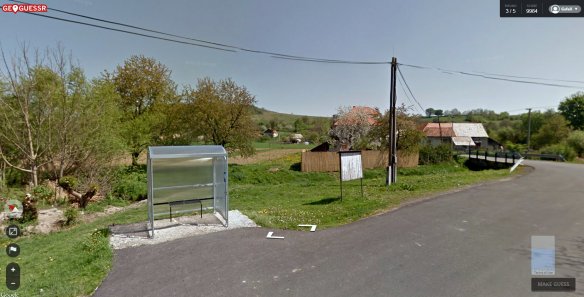
I’ve written about the GeoGuessr game before. It continues to be fun and challenging, and I still play once or twice a week. I find I’m approaching the game differently, though. I’m still always lost, of course, and trying to figure out where the hell I am — but now I’m also looking for recurring, universal scenes. Clothes hanging on outdoor clothes lines. Solitary cyclists riding down isolated roads. Couples walking, holding hands. Bus stops. A village in Latvia, a small town in west Texas, a city in Scandinavia — doesn’t matter. Folks still need to dry their laundry, they still hold hands, they still wait on the bus.

A bus stop in Norway

A bus stop in Norway

I’ve become particularly interested in bus stops — partly because they’re ubiquitous, partly because they’re the most democratic form of public transport. It’s true that, outside of major metropolitan areas, buses are most commonly used by the poor and working classes, but the bus stops for everybody — and you don’t need a reservation.

Near Stega Mala, Poland

Near Stega Mala, Poland

We can thank John Greenwood for that. In the early 19th century, Greenwood was a toll gate keeper on the Manchester-to-Liverpool turnpike. Yes, they actually had turnpikes back then — the monarchy built a few decent roads and charged travelers a fee to use them. The fees were collected at various points along the road, which were marked by a shelter and a pike stretched across the road. Once the fee was paid, the pike was turned and the travelers were able to continue. These turnpikes were mostly used by merchants who needed to transport their goods quickly, or by the merchant classes who could afford to book a seat on a coach. Ordinary people took ordinary roads, which were messier and more dangerous.

Near Boa Vista, Brazil

Near Boa Vista, Brazil

Greenwood changed all that in 1824; he bought a horse and a wagon and began the first mass transport service for ordinary folks. All they had to do was show up at the appointed spot at the appointed time (no reservation necessary) and pay a small fee to ride in the wagon. A similar service was developed two years later in the French city of Nantes. A retired military officer who’d built a heated bath house on the outskirts of the city devised a transport system for getting clients to and from the baths. His clients would gather at the Place du Commerce, outside a shop owned by a Monsieur Omnès, whose motto was  Omnès Omnibus — all for all. You can figure out the rest.

Outside of Arvik, Norway

Outside of Arvik, Norway

The concept of a bus network is fundamentally simple: a series of designated routes with consistent designated arrival/departure times and stable designated boarding locations with predetermined fees. It’s a predictable, reliable, efficient dynamical transportation system, and bus stops act as fixed point attractors. Riders know where to go and when to be there.

And yet it’s an incredibly elastic concept. The same basic approach can be molded to work anywhere under almost any condition. It works in the mountains, it works in the desert; it works in totalitarian nations, it works in democracies; it works in urban centers, it works in rural areas. Buses just make sense — so it’s not at all surprising to find bus stops scattered throughout the Google Street View universe.

Portstewart, Ireland

Portstewart, Ireland

What IS surprising, though, is the diversity of design. Some bus stops are elaborately designed structures, some are purely utilitarian; some have shelters to protect riders from the elements, some are merely wide spots in the road; some are meticulously cared for, some are trash magnets; some are designed to make the wait as comfortable as possible for the riders, some…well, aren’t.

Near Calilegua, Argentina

Near Calilegua, Argentina

Over the years I’ve become a fan of the bus. I often prefer to take the bus than drive. Of course, I have some advantages over most bus riders. I’m rarely in a hurry and I rarely have to be anywhere at any specific time, so I don’t mind if the bus ride is slow and stops often. The pace of a municipal bus suits me.

I enjoy looking out through the large bus windows. These days I find myself living in a rather dull, middle class, suburban neighborhood; the bus takes back through the sorts of poor, working class neighborhoods I grew up in. As a kid, I never felt there was anything interesting or beautiful about those neighborhoods. Now I see variety and diversity that’s entirely absent from where I live — variety in the people who live there, in the houses they live in, in the clothes they wear, in the level of life on the street. It makes me appreciate experiences I used to take for granted.

Sudovice, Slovakia

Sudovice, Slovakia

Among the Hopi and Pueblo peoples of the American Southwest there’s a creation legend involving Grandmother Spider. She existed in the world before it became the world. Before there were places. She spun a web that spanned the entirety of the incipient universe. It connected everything that was to exist, thereby creating — and linking — all places.

She’d have been a great bus driver.

Rural South Africa

Rural South Africa