thoughts on wonder woman

There’s been a fun and interesting ‘challenge’ on Bluesky this month, revolving around movies. Each day there’s a prompt; something like ‘movie with the greatest opening scene’ or ‘best book-to-movie adaptation’ or ‘movie you love that everybody hates.’ Some folks just respond with a title of the movie and a still photo, but others offer thoughts and explanations about why they chose that particular movie. The whole thing has been entertaining.

Yesterday’s challenge was ‘a good movie in a genre you dislike.’ I generally dislike and avoid superhero movies and movies based on comic franchises. The protagonists almost always have a ‘origin story’ explaining how/why they became superheroes. This usually involves either a traumatic incident that shaped their future (parents are murdered, planet explodes, etc.) or they get caught up in some scientific or mystic mishap that somehow imbues them with superpowers. I’m actually okay with that. The problem is these superheroes tend to be rather incestuous because they share a common comic franchise, which provides the characters with arcane, massively inter-related, overly-complicated backstories and histories that only fans appreciate. The resolutions of these movies depend way too much on epic battle scenes between super-characters. I don’t mind that the outcome of those battles is predictable. I DO mind that as battle scenes go, they’re generally dull—explosions take precedence over acting. And one last thing; in superhero movies ordinary people (and the cities they live in) are usually just props and backdrops; their destruction is only used as a metric to demonstrate how important the superhero is.

None of that applied to the movie I chose: the 2017 film Wonder Woman, starring Gal Gadot as Diana. She didn’t have some sort of complex, traumatic past that caused her to take up superheroing as a career or hobby. She didn’t experience some scientific or mystical event that gave her superpowers. Her parents weren’t murdered in front of her, her planet wasn’t destroyed, she wasn’t bitten by a radioactive spider, she’s not avenging anything in particular. In most ways, she’s not really a superhero. She was born an Amazon and trained to be a warrior. The training included a philosophy that the point of being a warrior was to fight for folks who can’t fight for themselves, to fight against injustice. That’s basically it, it’s just that simple. There’s a purity and innocence to her motives. She’s doing what she was born and raised to do. She’s not there to fight super-villains; she’s there to punch Nazis.

In the movie, that eventually means fighting in World War Two. There have been other movies and television shows in which a woman leads men into battle. In every other case I can think of, that’s depicted as a woman doing something transgressive, doing something women aren’t supposed to do. In other movies, it’s usually explained as an extension of some maternal instinct. They’re momma lions fighting to protect their families and the families of their people. That’s all very commendable, but it’s also very traditional.

Again, that’s not Diana. She’s a warrior. Her motive for leading others into battle isn’t just to protect others; it’s to fight injustice. It’s a subtle but important distinction. And it works because there’s an amazing training sequence at the beginning of the film. The training involved warriors being gracefully lethal, but the gracefulness was an integral aspect of the lethality. They were being graceful because it was pretty; they were being lethal with an economy of motion.
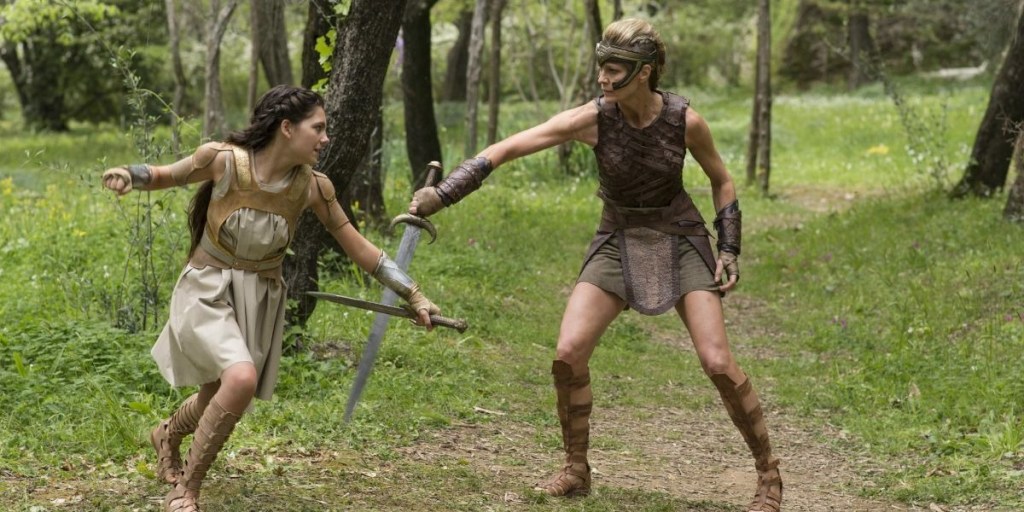
Diana, training to be an Amazon warrior

When a squad of Nazis landed on the island, the Amazons attacked. It wasn’t women against men; it was warriors against soldiers. There was a savage beauty in that attack, not because the Amazons were beautiful but because they were well-trained and graceful. Later in the movie, Diana leads an assault against an entrenched Nazi army. The physicality of the training scene made the assault on the trenches work. All that jumping and twisting and swinging in the beautiful setting of the island was translated onto the bleak horror of No Man’s Land. Again, the fact that Diana was a woman wasn’t even an issue; there was a palpable sense that THIS was what she’d been training for.

One other thing. I very much liked the way the writers/director dealt with Gal Gadot’s appearance. They acknowledged a few times that she’s physically beautiful—then just moved on, because that was the least interesting aspect of the character. This was smart, in my opinion, because the director and writers knew they HAD to address beauty in order to get it out of the way. They did the same thing with her outfit (and c’mon, it’s a ridiculous outfit for anybody to wear in modern combat). They provided both practical and symbolic reasons for Diana to dress the way she did.
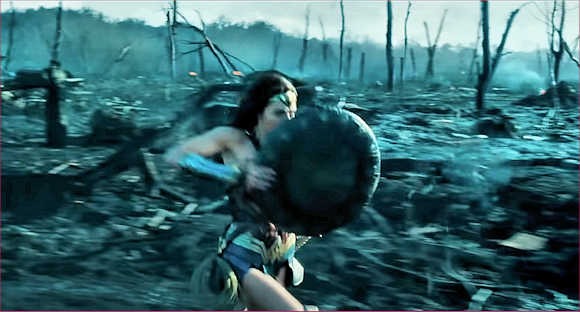
Diana becoming Wonder Woman

Earlier in the film, the characters spent some time in London. We saw how Diana the warrior being confined by custom to wearing restrictive clothing, being confined to silence by patriarchal convention. There was a momentary respite from that in a scene in which Diana kicks ass in the alley fight. But it’s not until she’s facing Nazis in trenches that we get to see her become Wonder Woman. She shrugs off the cloak she’s been wearing over her outfit, and it’s like she’s also shrugging off all those tiresome patriarchal conventions. When she climbs over the top of the trench, it’s a liberating moment, for the audience as well as the character.

But after that battle, the movie became disappointing. One of the Nazis is revealed to be Ares, the god of war…and what had been a smart, funny film became silly and stupid. It became another dull superhero versus super-villain flick. Gal Gadot was largely replaced with CGI, and they CGI’d the life and heart out of the character. We had the usual super-villain speech-making, the usual massively catastrophic damage to structures and regular people, the usual explosions and fireballs, and all the personality of the actors disappeared. It became a cartoon; it became everything I dislike about comic and superhero movies.

But damn…the first two-thirds of the movie was just fucking brilliant.
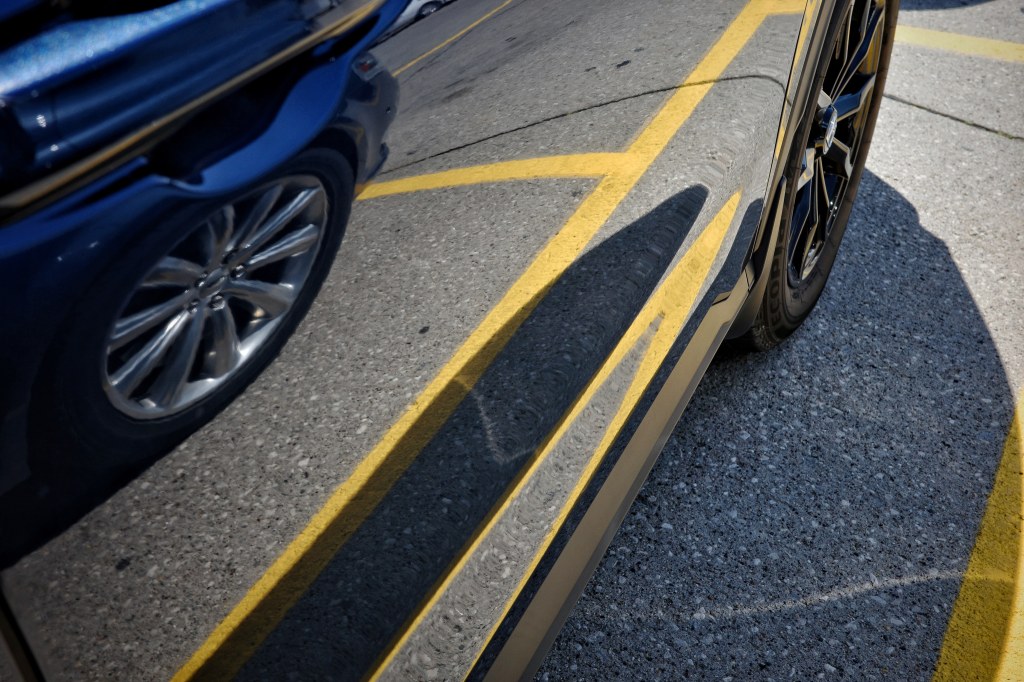
yellow lines, yellow rope, yellow dumpster lid

I’m an absolute pain-in-the-ass to run errands with. Why? Because I have a tendency to get distracted by stuff I see. Random stuff. I’m talking abstract lines and shadows and shapes and colors, stuff that usually gets lost in the passing clutter of everyday life. Stuff that, when it’s isolated within a frame, becomes visually interesting (to me, at least). Like, for example, some newly painted yellow parking lines reflected off a car door.

We’d just bought a few groceries and I’d just put the bag in the back seat when I saw the reflection. I stood there for a moment, sort of arranging it in my head. In the past, I’d have just admired it, then got in the car. But now I have an actual camera that fits in my pocket. So now I have this photograph.

It’s just a flash of light, shadow, line, and color that likely won’t appeal to anybody but me. But this is how I go through the world, seeing stuff like this. And since I now own a little Ricoh GR3X, I can photograph the world the way I see it. Sure, I could have taken a similar photo with my cellphone. But it’s not the same. With an actual camera you have more control over the exposure.

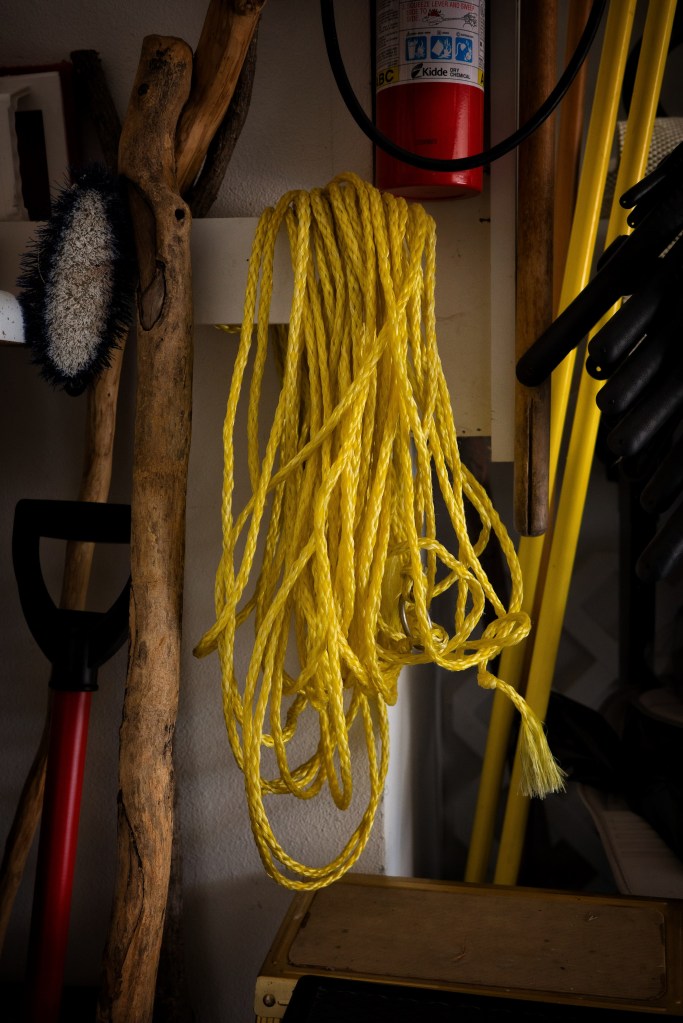
I also use the GR3X to take ‘normal’ photographs, of course. The usual landscapes, urbanscapes, street images, New Topo stuff (which counts as ‘normal’ for me). But almost every day there’s some weird little visual thing that will captivate me enough to stare at for a moment, but not enough to go fetch a camera. Having a camera in my pocket comes in handy at these moments. You know…in case I see a bit of sunlight illuminating a coil of yellow polypropylene rope hanging in the garage.

The yellow rope alone would have been enough. But the red of the fire extinguisher almost exactly matched the red of the walking stick. You can explain that to people, but without the photograph they probably won’t see it. They may not see it even with the photograph. But that’s okay.

My friends and family are ridiculously patient with me when this sort of thing happens. “What are you doing? Why have you stopped?” “The dumpsters have yellow lids.” “Yellow lids.” “One of them is open and the yellow is brighter. And the clouds.” “I’ll wait in the car.” It’s really a wonder they don’t stab me.

There’s an old photographer’s aphorism: the best camera is the one you have with you. I suppose at some point I’ll get over my infatuation with this camera and I’ll stop carrying it with me all the time. But right now, it’s just part of my leaving-the-house ritual. I grab my keys, my wallet, my phone, and my Ricoh GR3X before I walk out the door.

There are two benefits to this. First, I’m shooting more photographs and shooting them more thoughtfully. Second, carrying this camera everywhere has impressed upon me how very tolerant folks are of my eccentricities. It reminds me that I’m a very lucky guy. It reminds me to appreciate the people around me even more. How many cameras can do that?

EDITORIAL NOTE: Okay, I just now noticed that the predominant color in all three of these photos is yellow. Is that weird? It seems weird. But now I have to change the title to reflect that.

ptsd morning

I’m getting over my very first case of Covid, which has been unpleasant but tolerable. I mention that because…I don’t know, maybe that helps to explain my PTSD episode this morning. Maybe?

It’s been a while since I’ve had one of those. I still have occasional lightning quick PTSD moments, but they’re mild and not disruptive. It’s like a jolt of static electricity–a sharp moment that passes almost instantly. In fact, the spark of this morning’s episode is my most common trigger: a light shining from under a closed door. I wrote about this…okay, this is weird. I just checked, and I wrote about this almost exactly ten years ago. August 21, 2014. I’m NOT going to read anything into that.

Okay, quick recap. DON’T READ THIS & DON’T CLICK ON THE LINK ABOVE IF SUICIDE IS A TRIGGER FOR YOU.

A million years ago when I was a medic in the military I responded to an off-base call involving a patient in ‘respiratory distress’ in the basement of a hotel. The basement was dim, but you could see to walk through the corridors. There was bright light coming from beneath the doorway of the room we were led to. We opened the door to an Asian guy who’d hung himself a couple of days earlier. It was ugly. There’s more detail in the post from a decade ago, if you want that information.

Anyway, light beneath a closed door is such a common trigger for me that when I see it, I’ll usually say, “Dead Asians” and everybody understands 1) why I’ve gone quiet for a moment and 2) why they should probably turn off lights when they leave a room and close the door.

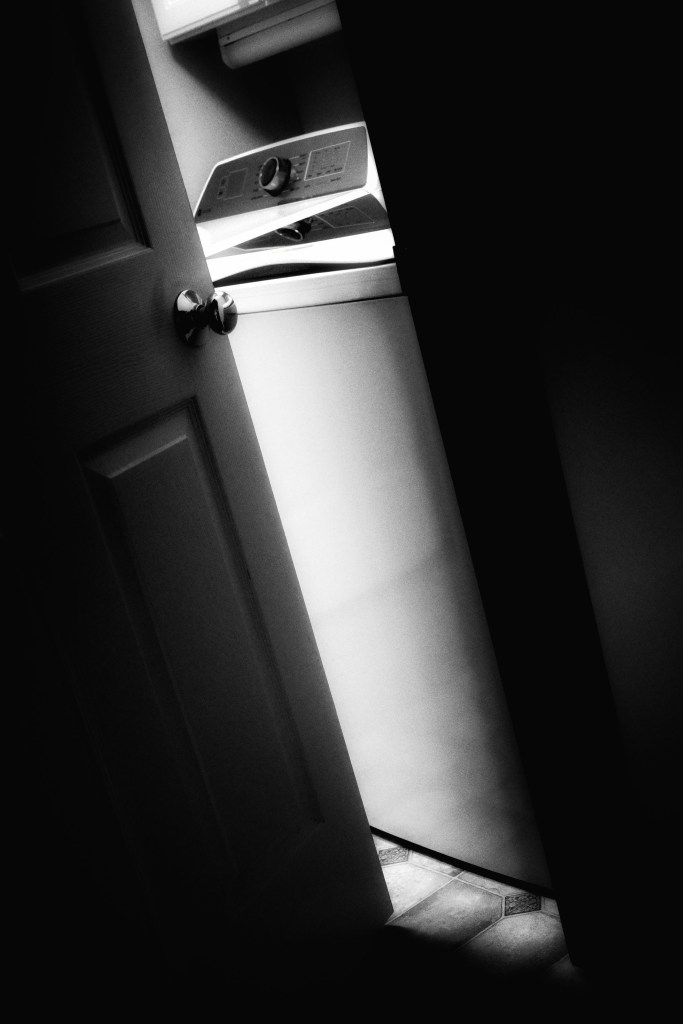
Normally, that’s it. I see the light, there’s a moment of shock, then I’m fine. No big deal. But for some reason, this morning when it happened, I found myself…well, fucked up. It was my own fault; I’d left the light on in the laundry room while I did something and when I started to return to the laundry, it hit me. I didn’t want to open the door. Which was silly, and I did open it, and of course there was nothing in there but the washer and dryer.

But for the next hour or so, I couldn’t shake the…I don’t even know what I couldn’t shake. A feeling, I guess. Not so much the image of the dead guy, which is still pretty clear in my mind, but the feeling of getting ready to open the door and seeing something so awful that it would still be with me decades later. I don’t know about anybody else, but on these rare occasions when the PTSD spanks me, I find myself replaying several of the other awful things I’ve seen and done. It’s like I’m getting all the horrific shit out of the way at one time, so I can get on with my life.

It’s just a laundry room.

I took a photo of the laundry room because that’s what I do. And then I thought maybe I should write about the photograph, which would require writing about why I took the photo, and what the hell, I might just as well write about the whole thing, right?

Does it help to write about it? Nope, not really. Didn’t help to take the photograph either. I didn’t expect it to. But it seems…not important, but worthwhile to write about it, because that puts it back into perspective. I’ve lived the sort of life in which I encountered a big chunk of horrible shit. Horrible shit is supposed to stay with you; you don’t want to be the sort of person who isn’t affected by horrible shit.

But it’s worthwhile to remind yourself that it doesn’t have to live with you all the time. This evening I’ll grill out some chicken and asparagus; I’ll have a nice meal and a good craft beer and spend the evening with people I love. THAT is what lives with me all the time. The horrible shit…it’ll dissipate. And with any luck, I won’t have another episode for months or years. I’m okay with that.

in which I look at an old photo (part 3)

Okay, why am I looking at one of my old photographs? I explained all this back in May, but to recap quickly, I happened across an article on some photo website that suggested looking at and analyzing your old photos as if they were made by a different person. Although that idea strikes me as silly, I thought I’d try it.

And I did. Twice, so far. But I have to admit, I’ve failed. I mean, yeah, I looked at a couple of old photos and yeah, I tried to analyze them. But I didn’t analyze them as if some other jamoke shot them. I did try to look at the photos as objectively as I could (and I like to think I succeeded at that), but I couldn’t separate that analysis from my personal awareness of what was happening in the world around me when I shot the photo or my reasons for shooting it.

But, whatever. Here I am, doing it again. I’m just going to ignore the original idea and continue my pattern of…of whatever it is that I’ve done. I’m even creating a new tag: greg looks at an old photo. I’ll probably do this once every month or two. Probably. Anyway, here:

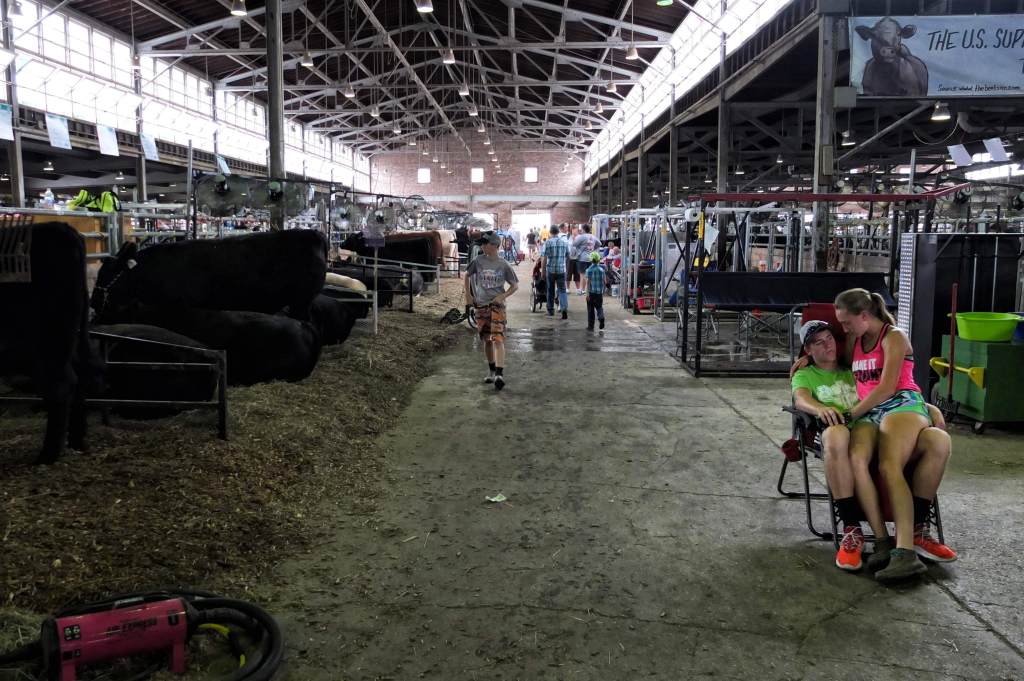
1:09 PM, Monday, August 15, 2016

I chose this photograph for two reasons. First, because the Iowa State Fair is underway (I’m planning to attend soon). And second, because it doesn’t quite work as a photo. It almost works. Technically, it’s a tad underexposed. I shot it with my wee Fujifilm X10, which is a fine little camera but it doesn’t allow for quick exposure changes (this was shot at f2.2 at 1/100 and an ISO of 400). If I’d had time, I’d have fiddled with the exposure compensation dial. But that’s the thing about shooting photos that are about people living their lives. They’re not there to be photographed; they’re there because they’re there. You just have to take what’s given. So, underexposed a wee bit.

I’m happy with the basic composition, although the exposure detracts from it. Obviously, the young couple are the primary subject of the photo, but as I approached them I noticed some sort of vacuum/blower device on the floor; it was almost the same color as the top the young woman was wearing. This is where the exposure hurts me; the vacuum thingy gets lost; you can barely see it in the lower left corner of the frame. Still, the quietness of the young couple is, I think, nicely balanced by the other activity in the barn. And I quite like the cow portrait in the upper right of the frame.

So yeah, as a photograph it’s technically flawed, but (I think) well composed. What I really wanted was to depict a moment in the lives of these kids. For almost two weeks, folks from farms all over the state basically live in these massive barns, along with their livestock. They arrive before the fair starts and often don’t leave until after it ends. The Cattle Barn, the Sheep Barn, the Swine Barn, the Horse Barn—they all become small, temporary communities. Over the years, I’ve taken dozens of photos of people in these barns—napping, eating, playing (young barn kids seem to enjoy playing practical jokes on fair-goers), making friends, living a weird approximation of their ordinary lives. There’s something rather sweet about it, something simple (and something rather uncomfortable for those of us not accustomed to barnyard smells). Because they’re only here for a brief time, all these human interactions—the friendships, the squabbles, the romances–become compressed, more immediate.

Another thing about this photo that appeals to me: the transience of these relationships is in marked contrast to the stability of the Fair itself. The Iowa State Fair has been held almost every year since 1854 (they skipped 1898 because of the World’s Fair in Omaha, and missed three years from 1942–1945 because the fairgrounds had been turned into a supply depot for World War II, and the Covid pandemic axed the fair in 2020). It’s been held at this same location since 1886; some of the buildings from the early 1900s are still in use. The barn in which these kids are having their moment was built in 1914.

This particular moment took place in 2016, but you can easily imagine a similar moment in the same barn a hundred years ago. Different fashions, different hair styles, different chair, but the cattle haven’t changed much, and the barn is almost exactly the same. Imagine how many of these moments have happened over the years.

we got us a presidential buddy movie

Alright, buddy, I’ll see you soon.” That’s how Democratic POTUS nominee Kamala Harris ended her phone call asking Gov. Tim Walz to be her running mate. She calls him ‘buddy.’

Buddy is one of those familiar terms with a murky etymology. It’s thought to have evolved from butty, an 18th century term for ‘work-mates’ associated with Welsh coal miners. It’s a wonderfully informal word describing close but informal friendships. Buddy has been mostly associated with men, but these days gender is a lot more fluid than it used to be. Oddly enough, that cultural shift has been supported by popular culture in the form of buddy movies.

Buddy movies are basically male rom-coms. Romantic comedies between hetero men. They’re not sexual (usually), but they’re about two people who are intimately close to each other, engaged in some sort of adventure. And people, that’s what we’ve got with Harris/Walz. We got us a buddy movie. Kamala and Tim’s Excellent Adventure.

Sure, in some ways it’s a non-trad buddy movie. I mean, we’re talking about a whip smart mixed race woman former DA from California and a classic Midwestern Dad who’s a balding former social studies teacher and high school football coach. But in all the ways that matter, it’s an absolutely classic pairing. Most buddy movies revolve around two people from different backgrounds with different personalities who go through episodic shit and in the end gain mutual respect and a stronger relationship.

And Coach Walz is perfect casting. He’s the polar opposite of the GOP notion of masculinity. He’s not loud, he’s not a bully, he’s not aggressive, he’s not domineering, he’s not suffering from testosterone poisoning, he’s not brutally competitive. He’s compassionate, caring, practical, thoughtful, considerate, helpful. Walz is the kind of guy who’s not only loan his neighbor a hedge trimmer, he’d also offer to help trim the hedge. And he’d know HOW to trim a hedge.

The Adventure Begins

Tim Walz appears to be a sort of counter-Kamala, but he’s not…and that’s much of what makes this buddy team work. He’s what Kamala Harris would be if she’d grown up a white boy in Nebraska. And she’s what Coach Walz would be if he’d grown up a mixed race girl who moved frequently as a child. They bring together a weird melding of experiences and cultures that work perfectly together. (Editorial Note: yeah, I don’t know if that whole ‘who they’d be’ business is accurate in any way, but it like it so I’m keeping it.)

I’m telling you, we need a campaign poster in which Harris and Walz are dressed in Men in Black suits and shades, with the tagline “Protecting the earth from the scum of the universe.” We need a poster of them in ordinary clothes and the tagline “The Not-So-Odd Couple.” We need a poster of them in Wyld Stallyns t-shirts, standing outside a phone booth, with the tagline “Be excellent to each other. And party on, dudes!”

This presidential campaign is going to be different. Yes, it’ll get ugly at times, and yes we’ll probably be disappointed by something Harris or Walz does, and yes yes yes we’ll still have to see Trump and JD being creepy and hostile and mean-spirited. But buddy movies are all about two people overcoming that shit by being supportive of each other. And the very best buddy movies, like the very best rom-coms, have happy endings.

And let also say this: we fucking deserve a happy ending.

goddamnit

Let’s talk about Neil Gaiman. No, wait. Let me first offer up my creds.

I was, for several years, a private investigator specializing in criminal defense. I helped criminal defense attorneys defend criminals. That sounds awful, I know. But two things. First, the US Constitution says every person accused of a crime deserves a fair trial, and a fair trial means the accused has the right to challenge the evidence of the State. The other thing is this: my job was to investigate a criminal case and report facts and evidence to the defense attorney. Not facts and evidence that HELPED the defendant. Just facts, just evidence. It didn’t matter to me if the facts/evidence helped or hurt the accused. A good defense lawyer needs an unbiased account of the case.

I’m telling you this so you can judge for yourself whether or not I’m full of shit when I talk about Neil Gaiman. He hasn’t, to my knowledge, been charged with a crime. He has, though, been accused by multiple women of sexual abuse.

I believe them.

I wish it wasn’t true, but it almost certainly is.

A lot of feminists (and I like to count myself as a feminist) say we should always believe women. I don’t always believe anybody. If there’s anything I learned as a PI, it’s this: everybody lies. But as a criminal defense PI, I never had a case in which a woman lied about sexual assault. Some women may have confused some of the details of the assault (no surprise; sexual assault is pretty fucking traumatic), but I never had a single sexual assault/rape case in which the accusation was unfounded. I’m not saying women don’t lie about it; I’m just saying I never had a criminal case in which a woman lied about it. (I should amend that; I never had a case in which an adult woman lied about it. I did, sadly, have two cases in which adolescent girls lied about sexual assault—one apparently out of spite, one for no apparent reason. Kids don’t always act logically.)

But back to Neil Gaiman, a writer I’ve long respected and admired. He always struck me as being thoughtful, caring, sensitive, and honest. He may actually be some of those things most of the time. But based on the reports I’ve heard and read, I believe he also used his position and influence to coerce or pressure women to engage in unwanted sexual acts.

When the first woman reported, I hoped it would turn out to be an isolated incident (which, of course, is one incident too many). That was my hope, but I fully anticipated there’d be more. It’s always safe to assume influential men will be assholes. Hell, it’s always safe to assume all men, influential or not, will be assholes. I mean, patriarchy is built on a foundation of men being assholes, and believing in their absolute right to be assholes.

At this point, I think three more women have now come forward with accusations against Gaiman. Why is that important? Because any form of abuse can be a single act. A person might get roaring drunk and piss their pants once and never do it again. A person might get angry and hit somebody once, and never do it again. A person might pressure somebody to have sex once, and feel bad about it, and never do it again. Everybody is capable of acting badly. But a pattern of behavior is what defines an abuser. It’s necessary to distinguish between a person who commits a bad act and a person who’s a bad actor.

Neil Gaiman, it appears, is a bad actor.

Is it possible he’s being unfairly accused? Sure. But it’s highly unlikely. Is it possible that he believes all these acts were consensual? Sure. But he’s forfeited any claim to actual innocence, and my experience suggests these women are telling the truth.

EDITORIAL NOTE: This is further evidence (as if we need any more evidence) that we must burn the patriarchy. Burn it to the ground, gather the ashes, piss on them, douse them in oil and set them on fire again. Burn the patriarchy, then drive a stake directly through the ashes where its heart should be, and then set fire to the stake. Burn the fucker one more time. And keep burning it, over and over. Burn it for generations.