somewhat true detective

“Yo, Greg, you should watch True Detective.” That’s what everybody kept telling me. “Great acting,” they said. “Lyrical cinematography, complex characters, clever plot,” they said, “all wrapped up in a realistic crime drama that takes place in the South. You’ll love it.”

So I watched it. The entire first season — eight hour-long episodes — over the last four weeks. And hey, they were mostly right. I did love it. The acting was terrific, just like folks told me (I swear, Matthew McConaughey never blinked once during the entire season), and the cinematography was artful. I suppose the characters could be seen as complex, but they’re pretty much right off the Stock Character–Complex Model shelf. We’ve all seen the Marty Hart character before, the hard-working detective who drinks too much and thinks too little. And the Rust Cohle character is basically Serpico, the Cerebral Cop, quoting big chunks of Thomas Ligotti, who is the High Lord of Anhedonia. It’s the quality of the acting that makes these characters interesting, not the characters themselves.
true detective tree2

The plot? Well, it was fairly predictable. Let’s face it, there’s nothing original about two detectives solving a nasty crime committed by powerful people who use their influence to hinder the investigation. That said, the plot was elevated by being beautifully structured and through the mostly masterful pacing. I say ‘mostly’ masterful pacing because there were a few scenes that were stretched out because apparently HBO requires a certain number of minutes devoted to young women showing their tits and ass. (Disclaimer: I’m not opposed to tits or ass so long as they’re organic to the story and don’t disrupt the pacing; but c’mon, the only reason they included some of the sex scenes — including the pointless image in the opening sequence where we see a woman’s naked ass above a pair of spiked stiletto heels — is to attract a young male audience.)

But a realistic crime drama? Well, no — but nobody really expects this sort of show to be realistic. Real life investigation can be pretty dull, after all. However, I did appreciate how the writer, Nic Pizzolatto, demonstrated that good detective work often involves a buttload of time sitting alone in a room sifting through old files and public records. That facet of investigation almost never makes it to the screen. It doesn’t quite make up for Pizzolatto’s wholesale lifting of dialog from Ligotti, but you have to give the guy props when he deserves them.

So yeah, True Detective was excellent television and I’m really glad folks recommended it to me. But nobody — not one person — told me that True Detective was a classic Southern Gothic story. And lawdy, that’s the heart of the whole goddamn thing.
true detective house

Some of you are probably saying “Southern Gothic? I have never heard of this Southern Gothic. Qu’est-ce que c’est Southern Gothic?” Allow me to ‘splain.

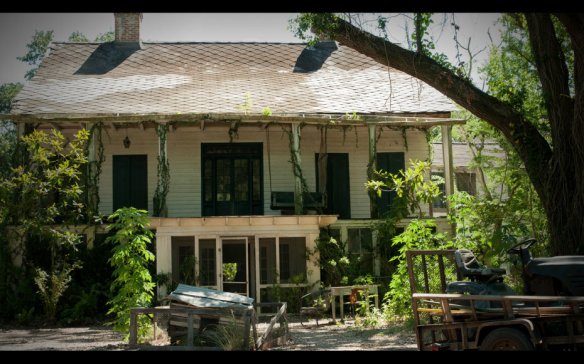
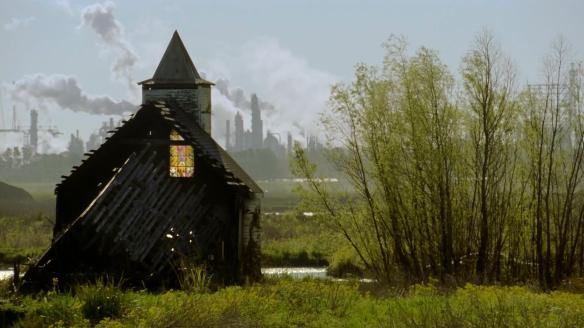
Southern Gothic is a highly atmospheric literary genre grounded in the decay — both physical and moral — of the Old South aristocracy. Southern Gothic (and I’m just going to start calling it SG on account of I’m lazy) stories usually involve the decline of Southern gentility into perversion, grotesquerie, and madness. The descendants of antebellum families that once owned plantations and slaves have been reduced to living in house trailers parked out in the country, and they’re working odd jobs. The slaves are gone, the plantations either sold to Yankees or fallen into dilapidation (or worse, turned into tourist venues). The cotton fields have been plowed under, replaced by strip malls and big box stores.

The characters in SG stories struggle to understand the world around them and find some way to fit their lives into modern society. Drug addition, alcoholism, confused sexuality, sexual paraphilia, mental and physical deformities, religious depravity or fanaticism, poverty, alienation, violence, the supernatural, illegitimacy — tie all that up with a bow of futile and pointless family pride and you’ve got yourself a classic SG story.
true-detective-episode-2

That sort of moral and spiritual degradation isn’t unique to the Southern Gothic genre; literature and film are full of examples of the moral corruption of European aristocrats. We’re talking everything from Count Dracula to the Marquis de Sade to Charles II of England. It’s not just power that corrupts — it’s also unquestioned privilege. Privilege allowed folks to whip and/or rape the young village boys and girls without any fear of consequence. Society can take that privilege away, but the desire to continue whipping and raping doesn’t necessarily go with it. That means the unwholesome behavior has to become more secretive. That’s been universally true. What makes the corruption of SG stories unique, I think, is its relationship to heat and defeat.

Heat is debilitating. It reveals itself through sweat, and sweat lubricates Southern Gothic stories. Sweat, not perspiration. In SG literature, sweat suggests either labor or animal lust. It suggests either being out in the field doing a job — which indicates a lower social status — or you’re driven by a sexual desire so strong that you ignore the fact that it’s just too damned hot to fuck. Either way, sweat suggests you’re not the master of your own behavior. All the decent, privileged people, after all, are sitting on the porch, sipping something cool and fanning themselves. They may perspire, but they do not sweat.

true detective detectives

In True Detective, we see all the main characters sweating — all but the Reverend Billy Lee Tuttle, who is never seen outside an air-conditioned building. He’s metaphorically still sitting on the porch, watching the lower classes laboring away. Except, of course, when he puts on a Mardi Gras masque and works up a sweat doing something really horrific to young girls. (We never actually see what he does; all we know is that it makes hardened law enforcement types scream when they see it.)

But more than the Southern heat, it’s Southern defeat that really counts. Yeah, we’re talking about the American Civil War again. We’re talking about the cultural resentment at the loss of status, property, income, and privilege. Loss — that’s really the wrong term. In SG stories characters don’t feel they lost their former status; they feel it was taken from them — stolen from them — and that sparks a deep, underlying current of bitterness.

In True Detective we see echoes of that bitterness mostly in the character of Errol Childress — the chubby, scarred, perpetually sweaty pervert who is descended from an illegitimate branch of the Tuttle family tree. He’s not only been deprived of the privilege his ancestors enjoyed, he’s even deprived of their name. At one point, the two detectives who are investigating Cohle happen across Childress and ask directions. They drive off while he’s still speaking — an insult he’s able to shrug off because, as he says, “My family’s been here a long time.”
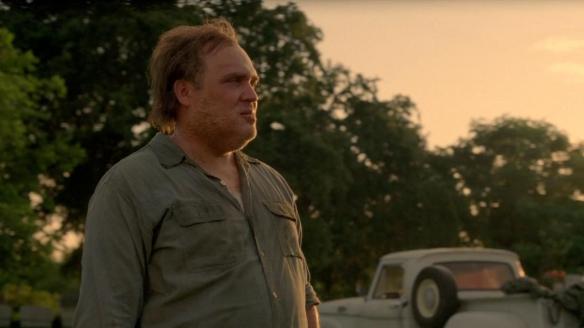
true detective childress

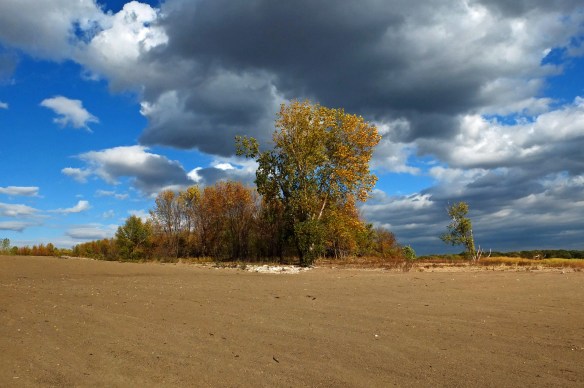
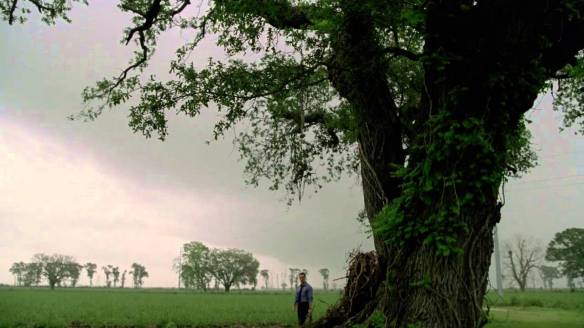
There’s another thing we see a lot in Southern Gothic stories: symbolism. At the beginning of the series and very near the end (and periodically throughout), we see an old, gnarled tree standing alone in a corn field. The tree looks ancient, like it’s been there forever; its roots are deep in the land. The field, on the other hand, is relatively new and the crops are planted around the tree. The depravity of the Tuttle/Childress clan has been around a long time; it’s anchored to the land and it’s still here despite recent changes of society. Society, in fact, has shaped itself around the Tuttles, and left them largely undisturbed (while the Childress family has been left in a sort of socio-cultural backwater). The Tuttle/Childress family tree has many branches, and branches show up all over the show as bizarre clues and as set decorations. The symbolism is obvious, but not overwhelming.

There are lots of flaws and problems with True Detective. For example, it never bothers to explain the references to The King in Yellow or Carcosa (both of which come from classic gothic horror stories) or their significance in the murders committed by Childress. And then there’s this: what’s the story purpose of Cohle having visual hallucinations? They’re almost completely ignored except in the first and last episodes, and I can’t see how they contribute in any material way to either the plot or the character development.
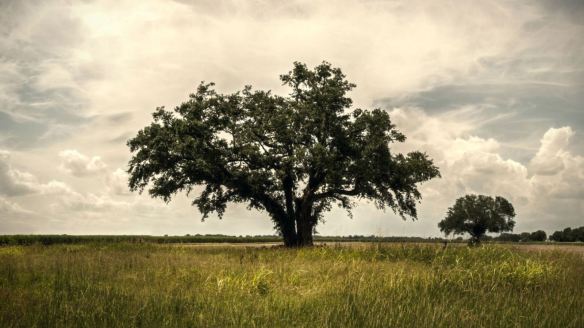
true detective tree

But the flaws and problems are, I think, minor when compared to the overall success of the show (and I’m talking about artistic success, not commercial success). True Detective was an absolute pleasure to watch. But dammit, it’s not really a detective story. It’s Southern Gothic, baby, right down to its depraved heart.
i kinda don’t hate facebook

Yeah, Facebook. You hate it. Everybody hates it. It’s a timesink, an annoying distraction, a bog of pointless announcements and idiotic quizzes, a morass of maudlin appeals for support from people you barely know (or don’t know at all), a fixed point attractor for every cute cat video ever made (and usually made badly), a wasteland of recipes you’ll never make and articles you’ll never read. Facebook is an utter and complete waste of bandwidth. Everybody agrees. I agree as well.

Except I don’t. Not really. Oh, I complain about Facebook, but the fact is I rather enjoy it. Every day — every single goddamned day — there are at least half a dozen different posts on Facebook that I find worthwhile. Or more than worthwhile. I find posts that make me think, that connect me to ideas and places and people and things I find fascinating, that give me information I want or need, that amuse me or delight me. And yes, yes of course, there are lots of posts that annoy the hell out of me. Sentimental pap, or faux inspirational quotations, or stupid hateful stuff about Obama, or stuff about…I don’t know…cars. Or basketball. But every single day, for me the good stuff on Facebook outweighs the annoying stuff.

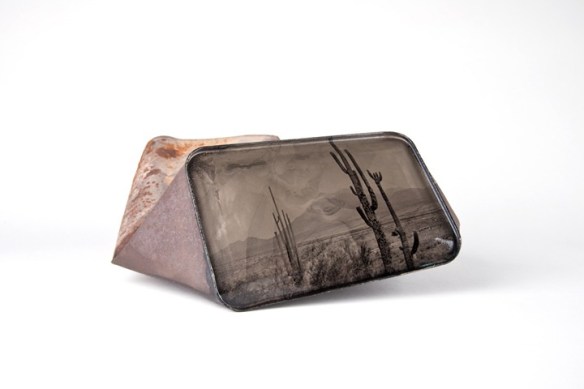
For example, this morning on Facebook an Irish photographer, John Baucher, alerted me to the work of an Arizona-born artist (David Emitt Adams) who uses the wet-plate collodion process to create powerful  and photographs of the desert on old discarded tin cans found in the desert. It’s the perfect melding of subject and medium, as well as a profound statement about the effect of humankind on the environment. Adams says,

“I have never known this landscape without the forgotten debris of urban sprawl. Today, the notion of land untouched by the hand of man is so foreign it might as well be make-believe.”

David Emitt Adams


And this morning on Facebook, Barış Kılıçbay, a Turkish scholar, shared a short video edited by Jacob Swinney, in which the first and final frames of several films are shown side-by-side. It sounds simple and obvious, but it’s actually surprisingly sophisticated and compelling. It offers some real insight into how a narrative is — or should be — deliberately structured.


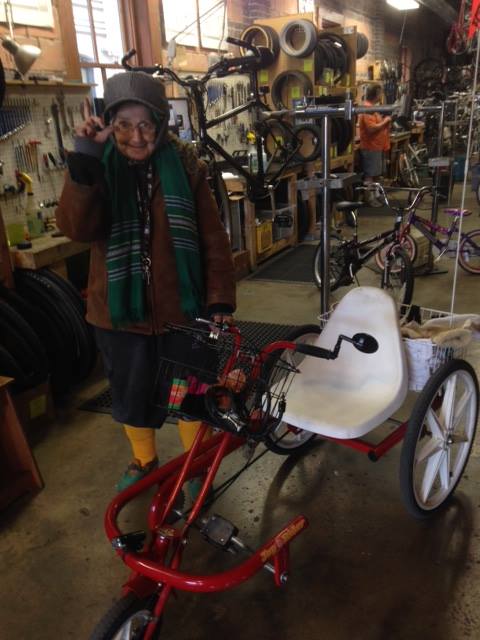
And this morning on Facebook the Des Moines Bike Collective posted a video about the Idaho Stop and showed me a photograph of an 83-year-old woman who’d stopped by the shop for help fixing a chain on her bike. The collective regularly posts information about cycling and how various urban areas are working to make cycling safer and more convenient. They also frequently feature local folks who are doing cool bike-related stuff.

bike collective - janet


And just now on Facebook, British science blogger Elise Andrew (who runs the brilliant I Fucking Love Science page) posted a link to an interactive exercise in speculative zombie epidemiology. By inputting a couple of variables (such as the kill-to-bite ratio and zombie velocity) and picking a location for Zombie Patient Zero to appear, you can follow the pattern and rate of a zombie epidemic in the U.S.

That dark area in the Midwest? That shows how in two weeks, a single zombie in Des Moines capable of walking less than one mile per hour and infecting 85% of the people it bit would have spread the infection far and fast enough to envelope both Minneapolis and Chicago. Who wouldn’t want to know that?

zombie infection rate


I don’t any of these people, really. I’ve never met John Baucher, though we occasionally correspond and we communicate frequently on Facebook. I have no idea how I came to know Barış Kılıçbay — through a friend, or a friend of a friend. And it doesn’t matter. What matters is that our small interactions on Facebook have occasionally made my day more interesting. I’m not a member of the Des Moines Bike Collective, but I know they’re a force of good in the community and two or three times a week they inform me about something bicycle-ish I’d otherwise never learn. And I only know Elise Andrew through IFLS, but she’s expanded my understanding in dozens of science-related fields.

My point, if you can call it that, is that although Facebook really is horrible, it’s also really pretty terrific. If you like zombies. And bikes. And movies. And wet collodion tin can photography.

to dedicate a portion of that field

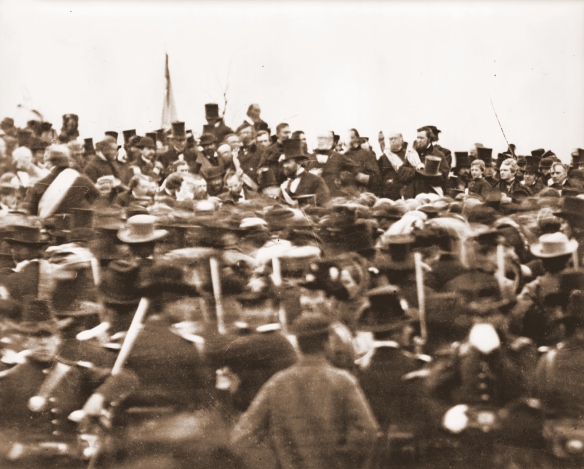
There was a great deal of fuss yesterday about the 150th anniversary of Abraham Lincoln’s Gettysburg Address. And rightly so; it’s beautifully written — simple, eloquent, thoughtful. In fact, it’s hard these days to appreciate just how thoughtful it was.

That’s partly because we tend to think of it as a ‘speech’ — as an act of public oratory. A stirring and moving speech, to be sure, but basically we tend to see it just a speech given to an audience to dedicate a cemetery.

Abraham Lincoln at Gettysburg

Abraham Lincoln at Gettysburg

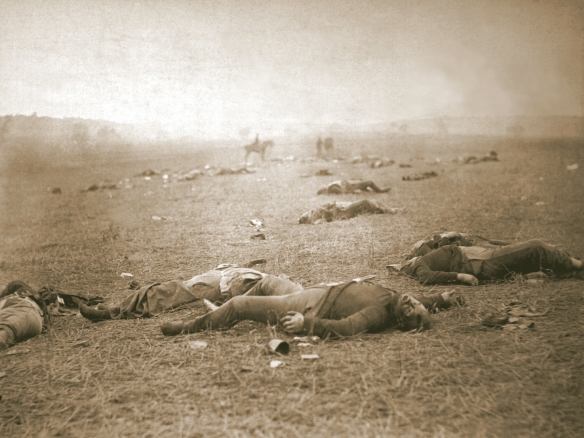
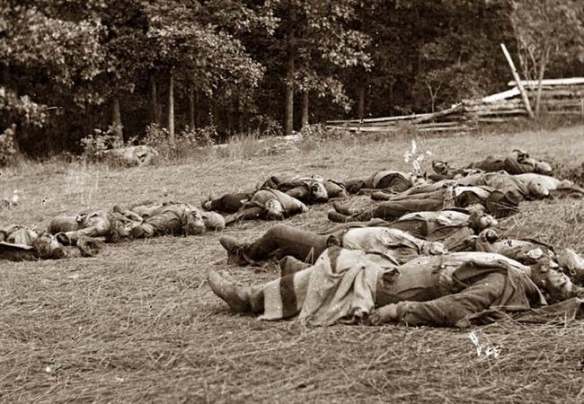
A cemetery. A burial ground. A graveyard. Yes, we all know the Gettysburg Address was to dedicate the ground on which the Battle of Gettysburg was fought. For us, that’s history. For Lincoln, it was a recent event. The dedication took place only four months after the horrific three-day battle. Nearly eight thousand men were killed. Nearly thirty thousand were wounded or went missing (‘missing’ might mean the men ran away; it might mean they were simply obliterated). Many of the wounded were still convalescing in Gettysburg when Lincoln gave his short remarks. Coffins were still stacked at the railway station where he arrived.

The battle had been so savage and so many people had died that almost immediately afterwards it was clear that something astonishing and awful (and I mean awful in the oldest sense of the term) had taken place at Gettysburg. Something so appalling that it was necessary for the entire nation to pause a moment and recognize it.

Dead troops at Gettysburg

Dead troops at Gettysburg

Why did Lincoln wait four months to dedicate the battleground? Because it took that long to gather the dead, try to identify them, and rebury them. That’s right, rebury them. We forget that the battle took place in the first week of July. Try to imagine eight thousand human bodies (many of which were dismembered) scattered over several hundred acres. Imagine five thousand dead mules and horses. Imagine the July heat, and the stench of decomposition. The noise of bluebottle flies was said to be deafening.

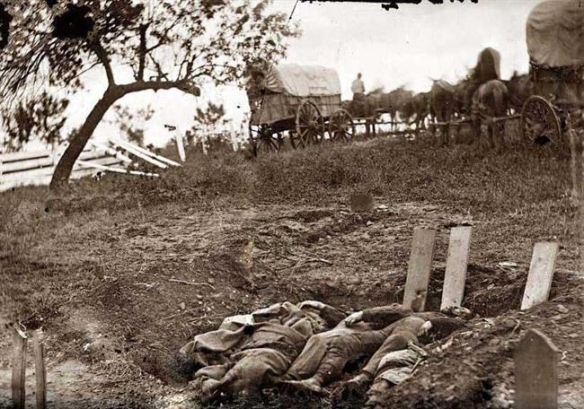
Now try to imagine the task of cleaning all that up using Civil War-era technology. Picks, shovels, muscle. The horses were burned; the men mostly buried in quickly-dug shallow graves, many of which were later washed open by heavy rains that fell in the second week of July.

Confederate dead in shallow graves at Gettysburg

Confederate dead in shallow graves at Gettysburg

The grisly work was done by Union troops, by captured Confederate soldiers, and by unfortunate townsfolk who’d been dragooned by the authorities. The town of Gettysburg, at the time of the battle, only had a population of about 2500. Fewer than half the number of the dead.

In the four months between the battle and the dedication, the organizers bought the land on which the battle was fought, they laid out a design for where the graves would be dug, they re-interred most of those bodies, they telegraphed invitations and coordinated a public dedication (Lincoln, by the way, wasn’t the main speaker; his job was to present some brief closing remarks after the main speaker was finished).

To do all that in 120 days was a remarkable feat.

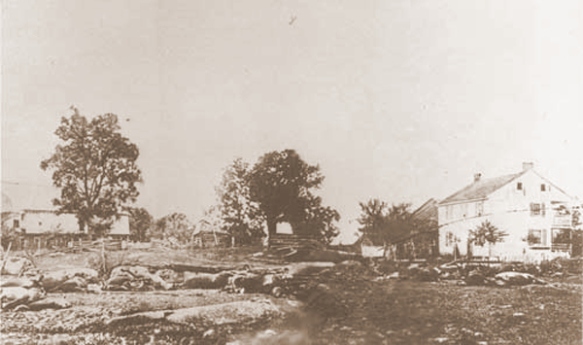
Dead horses at Gettysburg

Dead horses at Gettysburg

And don’t forget this: the war wasn’t over. The outcome was still very much in doubt. There’d never been anything on the North American continent remotely like the ongoing slaughter of that war. They were more than two years into the war, there were already nearly a quarter of a million casualties, and nobody could guess how much longer it would last. That’s what Lincoln faced when he went to Gettysburg. Read his speech with that in mind, and you’ll see he wasn’t just dedicating a national cemetery; he was telling the nation there was more to come, and asking them to maintain their resolve.

Lincoln spoke about the “unfinished work” and “the great task remaining before us.” He acknowledged the uncertainty of whether the nation “or any nation so conceived and so dedicated, can long endure.” Despite all that, he talked about the necessity of an “increased devotion to that cause for which they gave the last full measure of devotion.”

Confederate dead laid out for burial at Gettysburg

Confederate dead laid out for burial at Gettysburg

To stand on the site where so much death and destruction had taken place, to tell the public there would be more of the same, and to ask the public to accept the necessity of sacrifice on that scale in order to maintain an ideal — that’s just astonishing. What’s even more astonishing is this: the people agreed to accept that burden. The war would stagger on for another year and a half after Gettysburg. Tens of thousands more would die. Lincoln himself would give the last full measure of devotion before the end.

Think about that. Then think about this: there are people in this nation today who talk of seceding from the Union because they dislike a health care policy. There are people in this nation today who talk about secession because they believe the president isn’t a Christian, or because they feel their taxes are too high, or that someday they might not be able to purchase high capacity ammunition magazines.

And those people consider themselves to be patriots.

aimless, but not pointless

It’s probably got something to do with the transitional seasons — spring and autumn. Summer and winter are seasons of certainties and absolutes; you know what you can expect: heat and cold. Spring and autumn, though, are seasons of flux and movement; they’re about the passage from one absolute to another.

Maybe that’s why I feel a greater need to explore the countryside in spring and autumn. That’s where you witness the change.

DSCF4161b

Saturday began as a dark, cloudy, stormy day with no real promise of improvement. I had good reasons to stay inside — a book doctoring gig that was overdue, household chores I’d put off for too long, photographs I’d taken the week before but hadn’t yet uploaded. Valid reasons to stay home. But I felt restless…and here’s a true thing: I almost never feel restless. When I do, I usually give in to it.

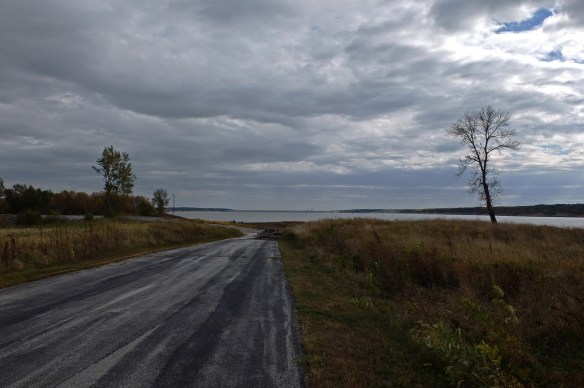
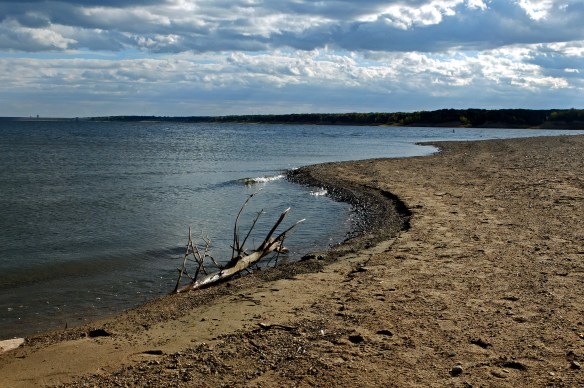
So I went to a nearby lake, with no purpose in mind other than to noodle around and see what there was to see. It was raw outside, miserably damp, and the light looked infirm. But there’s always something to see at the water’s edge. Lake, brook, ocean, river, doesn’t matter — there’s always something to see.

DSCF4196b

Then the clouds began to fail. The sun took a shufti, and started to wriggle and squirm through the cloud cover. And soon the day had become lovely. It didn’t get warm or anything, but it became comfortable. And the light…lawdy.

I’m sort of stingy when it comes to photography — maybe because I learned to shoot using film. I’ll lift the camera to my eye fairly often, but I don’t always press the shutter release. I’m not particularly conscious of my reasons for shooting or not shooting. All I know is sometimes it feels right and sometimes it doesn’t.

I was out at the lake for about an hour and a half — ninety minutes — and I took about ninety photographs. For me, that’s a LOT of photos.

DSCF4183c

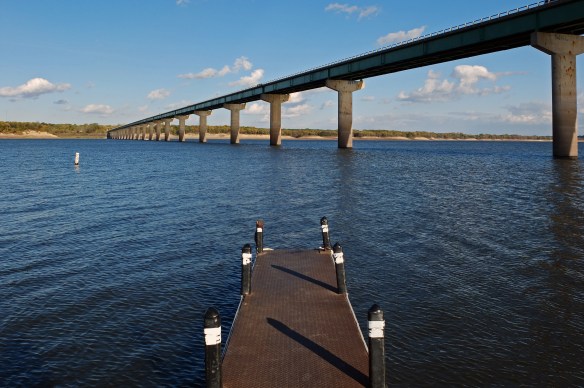
They call it a lake, but in fact it’s a reservoir built in the late 1960s and 70s as part of a flood control program. It’s hard to believe these days, but it wasn’t that long ago when the U.S. government spent big money on big projects that benefited regular people in a big way. Not only did the massive construction project itself provide a lot of jobs, but the finished lake supports a large community of small businesses.

The lake is a major local recreational area. It’s popular with recreational boaters, with hunters, with anglers, with hikers, with bicyclists (there are bike trails all through the area), with picnickers, with photographers (I saw one guy with a 4×5 view camera), with campers. All of those people spend money on their hobbies. They buy boats and jet-skis (and have them repaired and moored at marinas in the summer and stored in the winter), they buy fishing and hunting gear, they buy bikes and cameras, they eat at local diners and buy gas at local filling stations, they buy camping gear and rent camping sites at the many campgrounds, they buy sunscreen and mosquito repellent, they buy beer and soda, they spend a metric buttload of money every year. All because the government built a 26,000 acre flood protection reservoir. (All of which is to say ‘Fuck you, Tea Party Asshats!’)

DSCF4220bIn the summer, this lake is busy. It slows down quite a bit in the autumn, and on a day that began so cold and unwelcoming it wasn’t surprising that there were so few people to be seen. There were a few people bundled up but still zooming around in boats, there were a few folks fishing, there was a guy with a dog, and another guy wrestling with a large format camera. Lots of gulls, a few deer, some dead fish, a different hawk every few yards, no obvious raccoons or weasels (though a lot of tracks), finches so tiny you could fit two in a teacup.

It seems so quiet when you first arrive — but soon you realize how much sound there is. The waves, of course, and the wind through the grasses. Distant drone of boat motors. That ridiculous but somehow still moving plaintive cry of the gulls. Soft rattling of dead leaves. It seems absurd that the world could be so quiet and still so full of noise.

DSCF4207c

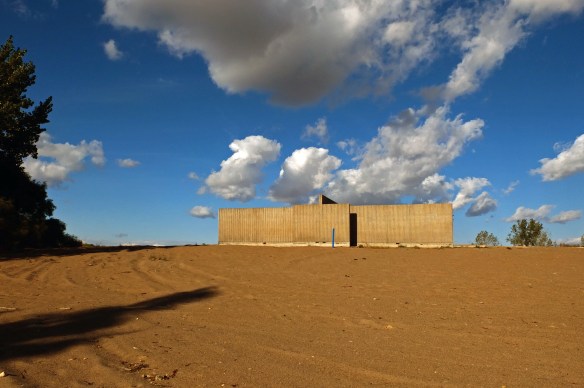
At one of the many official recreation spots there’s a bath house for swimmers — an open air place to shower and change in and out of swim suits. It’s a purely functional building made of formed concrete. It looks rather like a failed student project from the Soviet School of Architecture and Design. It ain’t pretty.

But, again, the light. Light has the capacity to turn even a butt-ugly bath-house into something interesting. For a moment, anyway.

DSCF4214b

Here’s an odd thing. When I first arrived at the lake, I spent most of my time looking out at everything. Looking out at the horizon, out at the trees and out over the water, out at the buildings and the shifting clouds. But the longer I was there, the more I began to look down.

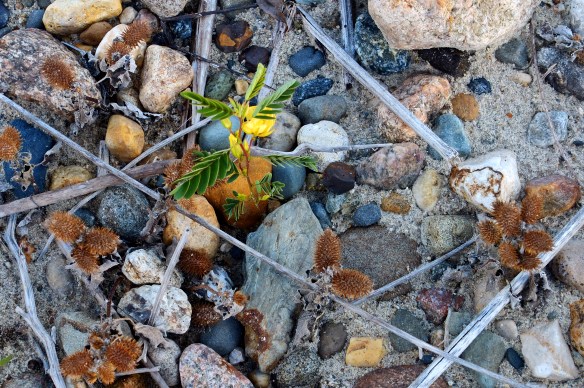
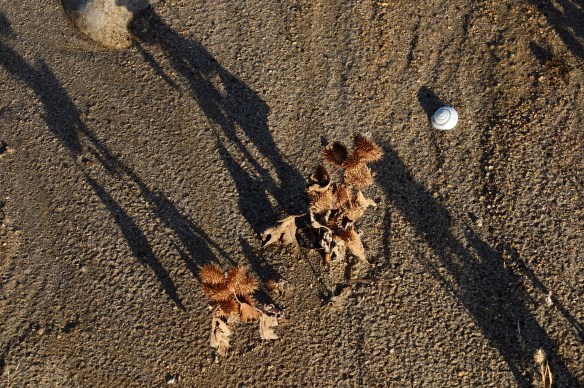
Looking out, you tend to see the larger world and the things you notice are large things. Looking down, you notice the smaller world. A world of small stones and tiny plants and odd-looking insects and sand and dry broken bits of wood and dead grasses and clusters of cockleburs. Along the lakeside, it’s a universe of cockleburs.

DSCF4230b

Cockleburs are really rather fascinating. The seeds, of course, are hard ovals covered in spines. The spines are actually wonderfully-formed hooks, though the tiny hooks are difficult to see without close study. But c’mon, who really looks at a cocklebur? Nobody. You just want to get the wee bastards off. Off your shirt, and off your pants, and off your socks, and your shoes, and Jeebus on toast I’ll bet the damned things could stick to tank treads.

That’s the point, of course. The spiny hooks are an incredibly efficient and effective mode of seed dispersal. But what’s really cool about these remarkably annoying plants is that they’re classic examples of photoperiodism. They’re what’s called short-day plants, plants that only bloom when the days begin to get shorter. Short-day plants have a protein that actually serves as a photo-receptor, which is incredibly cool. What’s even more cool (if you like this sort of thing) is that the photo-receptor isn’t triggered by the amount of light during the day, but by the amount of dark during the night. Short-day plants should actually be called long-night plants.

DSCF4235b

But wait — there’s still more cool but weird cocklebur stuff. That infuriating egg-shaped seed pod generally holds two seeds — one seed grows the next year, the other seed waits and grows during the second year. It’s a marvelously effective way to insure the perpetuation of the species. If you were to pick a few of those irritating burrs off your socks and boil them, you could make a tea that’s moderately effective at relieving nasal and sinus congestion. Or, you could use the plant itself to make a yellow dye. Seriously. The cocklebur belongs to the genus Xanthium, which means ‘yellow’ in Greek. It got that scientific name from a 17th century French botanist, Joseph Pitton de Tournefort, who was aware that the plant had been used for centuries by the Greeks to create a yellow hair dye.

So the next time you have to pick cockleburs off your shoestring, remember to give a moment of thought to what a truly remarkable plant it is. Then throw the irksome little bastard away (which, of course, is exactly what the irksome little bastard wants).

DSCF4241b

An hour and a half, that’s all the longer I was out there. An hour and a half, and the clouds began to move back in, the wind picked up, and the air took on a dampness that made it seem colder than it was. An hour and a half, and if I believed in the soul I’d say mine was replenished in that time. Ninety minutes of mostly aimless walking and looking and shooting photos.

And another ten minutes picking the damned cockleburs off my clothes.

just another afternoon by the river

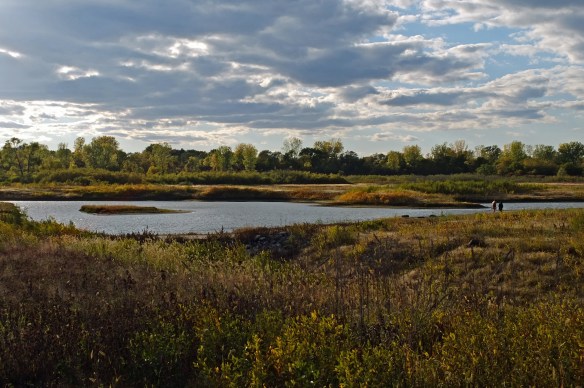
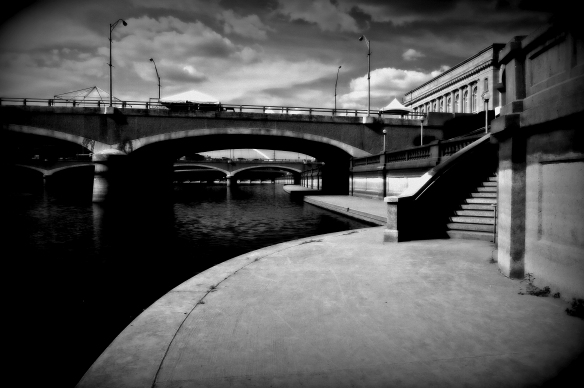
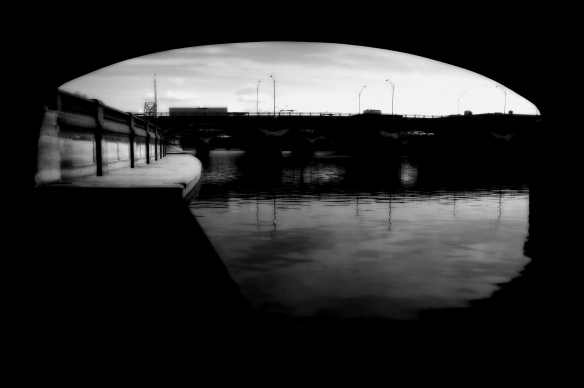
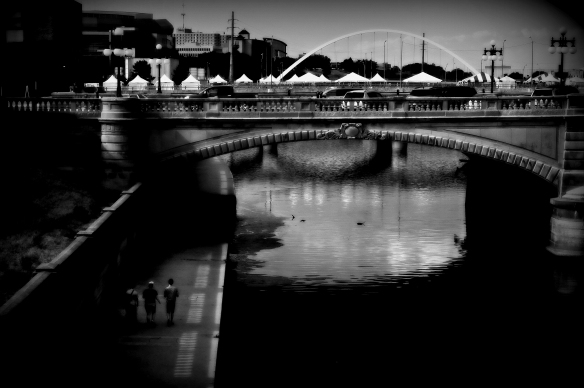
The Des Moines River is a little over 500 miles long. The section I spend most of my time on is maybe a mile. Probably a little less than that. It’s an urban section of river; there’s nothing ‘natural’ about it. There aren’t any real river banks, there are no trees lining the water, there are no organic eddies or sandbanks or mudflats. There are concrete walkways and arched bridges and dams and promenades and buildings. You can buy a coffee (or a beer or a glass of wine) in a small kiosk and sit and watch the water roll on.

I do that fairly often. When I do, I usually  find myself looking at the river and wondering what it must have been like before. City Hall Before, this was French territory. Most folks think of North America as a former British colony, which is a limited version of the truth. In fact, the British were largely confined to a relatively narrow strip of land along the Atlantic coast. Most of the interior was held by the French. Well, actually it was held by the native tribes who lived there before any Europeans made their way across the ocean. But history was written by Europeans, so it’s mostly concerned with what Europeans did.

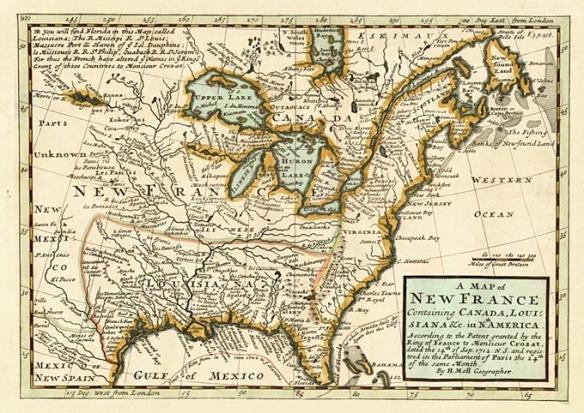
My point, if you can call it that, is this: Iowa used to be part of Nouvelle-France. New France was fucking HUGE. It stretched west from Newfoundland all the way to the Great Plains (and, eventually, clear to the Rocky Mountains). It included all the land south of Hudson Bay down to the Gulf of Mexico. The entire drainage basin of the Mississippi River comprised a district called Louisiana, which was divided into Haute Louisiane and Basse-Louisiane. Upper and Lower Louisiana. Sort of like North and South Dakota, only with the benefit of not being either of the Dakotas. new france Of course, the native peoples didn’t give a moose’s ass what the French called the land. I suspect they just stood around grinning and snickering to themselves while these odd white guys kept ‘discovering’ places and renaming them. The first white guys set foot in what eventually became Iowa in 1659. Pierre-Esprit Radisson and his brother-in-law Médard des Groseilliers. Despite their poncy names, these guys were tough. They were coureurs de bois — runners of the woods. Unlike voyageurs, who were licensed to do business by trading companies (in other words, capitalist lackeys), coureurs de bois were independent, entrepreneurial fur-trappers, traders, and explorers.

Radisson and des Groseilliers explored and mapped a big chunk of the North American interior. Radisson eventually had three or four towns named after him, and a hotel chain, and even a Canadian Coast Guard vessel. Nobody named anything after Médard des Groseilliers. This is what happens when you partner up with a guy whose name is more cool than yours. But even though these men made their way to Iowa, they almost certainly didn’t travel up the Des Moines River. steps up holga Nobody really knows which European made the first trip up La Rivière des Moines. It could have been Michel Accault, Antoine Angel, and Father Hennepin in 1680; they were in the area. Or maybe it was the cartographer Jean-Baptiste-Louis Franquelin a few years later, though it’s more likely he copied some other guy’s map of the river. The Baron Louis-Armand de Lom d’Arce de Lahontan said he traveled up the Des Moines, but most historians think he was lying about it. We know that Pierre Charles Le Sueur made his way up the river in 1700, but he probably wasn’t the first. A few years after Le Sueur, Father Peter Francis Xavier de Charlevoix wrote this:

[T]he river Moingona issues from the midst of an immense meadow, which swarms with Buffaloes and other wild beasts

Swarms of buffalo where there are now coffee shops. How cool is that? The buffalo are gone now, other than a few small herds kept in parks so sticky-fingered children can look at them. The buffalo are gone, and so are the French. underbridge holga We know why the buffalo are gone. Because we were well-armed murderous bastards and we slaughtered them for our amusement. But why did the French leave? They had a massive presence in the New World — not just all that territory in North America, but throughout the Caribbean. That’s why pirates in the movies (the ‘bad’ pirates, not the good Errol Flynn pirates) always speak with a French accent — because they fucking owned Hispaniola. So why did the French leave? Give some of the credit to François-Dominique Toussaint Louverture, a slave born on Hispaniola.

In 1791 Louverture took the island away from the French by leading a successful slave rebellion. That pissed off the French and a decade later Napoleon Bonaparte sent a sizable military force to New Orleans to support an effort to re-take Hispaniola. The United States was only about 15 years old at the time, and having the French military camped out in New Orleans made the government nervous. Almost half of the goods imported into the U.S. passed through the port of New Orleans. So even though the French failed to retake Hispaniola (which is now Haiti and the Dominican Republic), President Thomas Jefferson thought it might be a good idea to find a way to get the French off our stoop.

along the river holga

In 1803 Jefferson decided to try to buy the city of New Orleans from the French. He figured he’d offer France a cool US$10 million for the city — and what the hell, maybe some of the surrounding land. Why not? France would get a little cash in the bank, the U.S. would get a nice port and party town, everybody would be happy.

But Bonaparte was dans le pétrin — in a pickle. He’d lost the income from the sugar grown on Hispaniola, he was facing another war with Britain, and his nation was close to bankruptcy. So before the U.S. made its ten million dollar offer, Bonaparte proposed to sell ALL of Louisiana for 50 million francs (plus canceling a debt of about 18 million francs). That amounted to about 15 million dollars. Jefferson had planned to offer ten million just for the city; now he could get the entire French enchilada (yeah, I know, let’s not get bogged down in national cuisine here) for another five million. A bargain, right?

dam holga

Congress opposed the purchase. Seriously. Jefferson was about to double the size of the nation — to pick up around 828,000 square miles of territory at a cost of about three cents an acre — and Congress opposed it. They said the president didn’t have the authority to make or accept the offer. They disliked the idea of granting citizenship to the French, Spanish, and free black people who lived in the territory (nobody even considered citizenship for the native peoples). They worried about the political effects of bringing in all those farmers when so much of the power of Congress depended on the wealth of the merchants and bankers along the coast.

In other words, Congress — primarily the House of Representatives — were dicks about the whole thing (sound familiar?). But the sale squeaked through in the House and was passed by the Senate, and hey bingo, the United States was suddenly bigger and in a position to start seriously fucking over the native peoples west of the Mississippi.

river so quiet holga

So I walk beside the Des Moines River. I sip my coffee and watch the water pass by. And I think about those courageous coureurs de bois (and they were courageous; it took some massive balls to go wandering in unexplored and often hostile territory), and I think about the European politics that eventually led the United States to the genocide of the natives who lived in the Americas (and the French were just as guilty in this; in 1729 Louis XV authorized the extermination of the Fox Indians because they were interfering with the fur trade). Half a mile south of where the photograph above was taken you can still find the remains of an old fort constructed to protect the French monks who’d come to the New World to force Baby Jesus down the throats of the natives.

So many wonderful and horrible things happened along this river. And the only thing that’s been consistent throughout is the river itself. The river doesn’t care. The buffalo were here, the Indians were here, the French were here, now I’m here.

Given that history, I don’t think this ends particularly well for me.

gazania in a monkey’s head

So, back in May, right? I’m noodling around in the Sally (yes, I know the Salvation Army opposes marriage equality, but they still provide services to poor folks and since I live nearby, I like to stop in now and then and slip them a few bucks; I’m vocal about my support for marriage quality, but I’m not going to ace out poor folks just to get back at the Sally, and anyway same-sex marriage has been legal in Iowa for a few years now, so let’s not get sidetracked from oh lawdy it’s too late). And what do I see? A ceramic boxlike thing with a monkey’s head on it.

And I snatch it off the shelf. I know immediately, right then, I’m buying it.

no evil

“You’re buying a tissue holder with a chimpanzee’s head on it?” my friend asked. And I realize I’m not holding a boxlike thing with a monkey’s head; I’m holding a tissue holder with a chimpanzee’s head. Easy mistake to make.

“It’s not a tissue holder,” I tell her. “It’s a planter. Or it’s going to be.” She gives me that patient no-point-in-discussing-it look, which I get so often. At the checkout counter, a short woman wearing a sweater with a teddy bear holding some balloons on the front says, “Oh, I’ve always liked that tissue holder. That’ll be four dollars.”

Four bucks for a planter with a chimpanzee’s head. That’s a bargain. In fact, there are four chimpanzee faces on it. See no Evil, Hear no Evil, Speak no Evil, and a fourth face which I believe is Contemplating a Little Evil.

So since I now own a planter, I need a plant. We head off to the nearest garden center, where I wander around aimlessly, looking at a staggering array of plants, all of which are labeled with detailed information about the amount of water required, the amount of light necessary, the proper pH level, appropriate moon cycle for planting, the expected growth size of the plant, the size and color and dimension of its blooms, the Latin name of the plant, whether or not its edible and how best to prepare it, the etymology of its common name, which chapter the plant appears in Professor Snape’s Potions textbook.

I see a plant called a Gazania. It has odd, primitive-looking leaves and  a name that sounds like a fictional nation in a Marx Brothers movie. I snatch it off the shelf. I know immediately, right then, I’m buying it.

gazania in a bag

It turns out you can’t actually plant a Gazania (or anything else, for that matter, in a tissue holder on account of a tissue holder doesn’t have a bottom. You need a bottom in a planter, else the plant just falls out. I figured that out my ownself. So you have to plant the Gazania in a small planter, then somehow weasel the leaves through the tissue opening. If you take your time and are careful, it can be done. It can also be done if you don’t know what the fuck you’re doing and just try shit until it works.

My friend’s friend said, “It’ll die. It needs a bigger pot. It’s got to have muttermutter sunlight. It’s supposed to be planted muttermutter.” “It’s a Gazania,” I said. “In a monkey’s head. If it lasts a week, I’ll be happy. Anything beyond that is gravy. And besides, I piss on the nation of your birth.”

I cannot abide a naysayer.

gazania inna monkey head

Anyway, I was happy. Stupidly and completely happy. I had a Gazania in a monkey’s head. How many folks can say that? If it died, so what? Four bucks for the monkey’s head, four bucks for the Gazania — hell, you pay more than that for a movie (I saw The Heat with Melissa McCarthy and Sandra Bullock last week — it’s hilarious, y’all should go see it; it won’t bring you as much joy as a Gazania in a monkey’s head, but very few things will, you know?).

And hey, it didn’t die. In fact, in a couple of weeks, it blossomed. Which was pretty much a shock on account of I didn’t even know it was a flower. I had a flowering Gazania in a monkey’s head. Crazy-ass, wild yellow flowers. Gaudy bastards, with a red blaze down the center of each petal.

I was over the moon.

gazania

Look at those flowers. They look like something a child would draw. A child who’s seen too much Speed Racer.

And it hasn’t stopped. It just keeps on continuing to blossom. One flower withers and dies, and another takes its place. Sometimes two takes its place. I trim off the dying flowers and this thing just keeps pushing out new flowers, like Octomom.

I swear, no power in the ‘verse can stop it.

more gazania

Well, okay. I know that’s not true. I know it’ll die in the fall. Maybe. Actually, I don’t have a clue what it’ll do in the fall. But probably it’ll die, right? And that’s okay. On account of it’s been the best eight bucks I’ve ever…well, no. That’s almost certainly not true either. I’m sure I’ve spent eight bucks in lots of better ways, though I can’t think of any at the moment. Still, it was a really great eight bucks, no mistake.

Also? I may start a website MonkeyHeadGazaniasforMarriageEquality.com. And I’ll be sure to thank the Sally for giving me the idea.

my share of lightheartedness

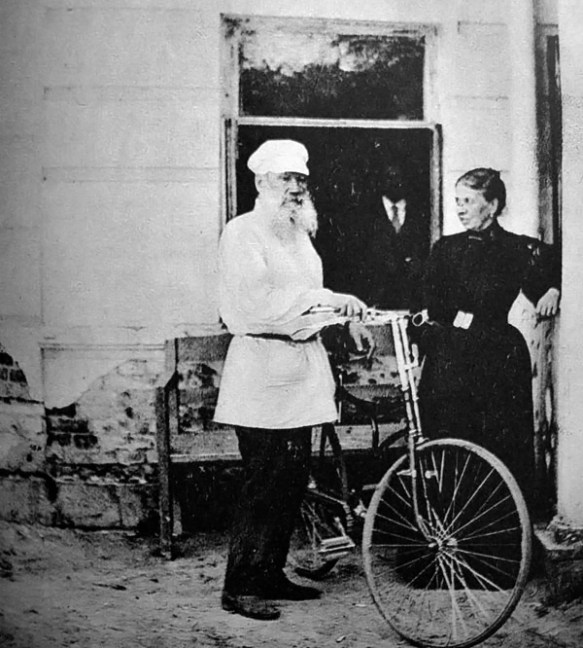
The year was 1896, and Russian novelist Leo Tolstoy experienced two life-changing events. One was tragic; one wasn’t. First, his son, Ivan Lvovich, died. Vanichka, as he was called, was only seven years old, and Tolstoy’s last child.

Second, two months later, Tolstoy learned to ride a bicycle. He was 67 years old.

Lighthearted Leo Tolstoy

Lighthearted Leo Tolstoy

Moskovskoye Obshchestvo Lyubiteley Velosipede (the Moscow Society of Velocipede-Lovers — and no, I’m not making this up) gave Tolstoy a bicycle and offered him instruction on how to operate the machine. To everybody’s surprise, he quickly became a devoted cyclist, riding along his garden paths most mornings after writing. Tolstoy on a bike; in 1896 that was considered a major news story. Scientific American reported on it: Count Leo Tolstoy…now rides the wheel, much to the astonishment of the peasants on his estate.

One of Tolstoy’s friends was considerably less enthused. He wrote: “Tolstoy has learned to ride a bicycle. Is this not inconsistent with Christian ideals?” Tolstoy’s reply:

I feel that I am entitled to my share of lightheartedness and there is nothing wrong with enjoying one’s self simply, like a boy.

Dude was right. No doubt about it. We’re all entitled to a share of lightheartedness. And there’s nothing wrong with enjoying oneself like a boy. I do it all the time. I did it last Friday, in fact. And though I forgot to take my camera, I did take my phone — which like all modern phones, takes photographs.

What was once a lumber yard

What was once a lumber yard

As a camera, the Nexus 4 is a great cell phone. It’s not bad as a camera, you understand. It’s just not…well, a camera. Still, it’s good enough that when I rode by this old lumber yard on the way out of town, I had to stop and shoot the photo. It’s not that old, the lumber yard. I mean, it’s not like Tolstoy-old. But it’s semi-beat up and sort of weathered, and it’s a pretty sort of almost-yellow, so worth a photo. If I’d had my actual camera with me, I’d have ridden around the place and given it more attention. Maybe.

Here’s the thing about being an informal member of the American Midwest Society of Velocipede-Lovers: you almost always have to deal with wind. And heat, in the summer. Wind and heat can play merry hell with bicycle-riding photographer’s attitude. And that day was both hot and windy. We’re talking steady 18 mph winds with gusts up to 27mph. Riding into the wind is great exercise.

I fucking hate exercise.

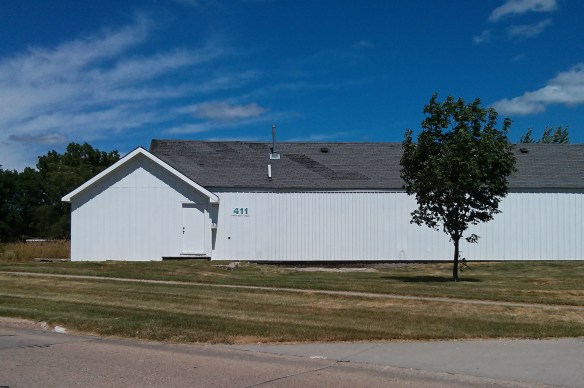
Some sort of storage shed, plus a tree

Some sort of storage shed, plus a tree

I stopped occasionally to drink some water. Some serious cyclists I know always refer to this as ‘hydration.’ They hydrate themselves. I’ve actually heard them say it, right out loud. “I gotta hydrate.” Then later they re-hydrate themselves. They engage in periodic hydration management. That’s some serious business, hydration. Nothing lighthearted about it. Which is why I just pause now and then and drink some water.

I should note that Tolstoy never, not once, in all the tens of thousands of pages he wrote, ever referred to hydration. It would have astonished the peasants on his estate.

Bike trail intersection

Bike trail intersection

One of the disconcerting things about riding a bicycle in the American Midwest is how abruptly town transitions into farmland. One moment you’re noodling your bike down house-lined streets, then you’re riding through old, out-dated semi-industrial areas, and suddenly without any real warning you discover you’re actually out in the country. You know…where they grow things. Like crops. Soybeans and corn and…and maybe that’s it. I don’t know. But there are massive fields full of green growing things.

And none of it blocks the wind.

There's a lot of not much out here

There’s a lot of not much out here

On the other hand, after you’ve spent forty-five minutes riding northwest into an 18mph headwind, you can turn your bike homeward and enjoy the rare pleasures of an 18mph tailwind. You hardly have to put foot to pedal. You sit upright and the wind will blow you most of the way home.

Riding with the wind is a lot more fun than riding into it — but the fact is, just getting on a bike is enough to make you lighthearted. Tolstoy learned that. At 67 years of age, he learned it. Even after the horrorshow of his youngest child’s death, Tolstoy learned that simply by putting his bony ass on a bicycle seat, he could become lighthearted. It doesn’t change anything, of course. Riding a bike won’t actually make anything better. But it will temporarily lighten the heart. And that’s good for you.
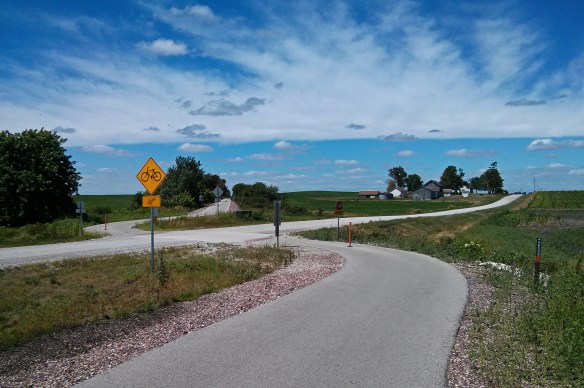
And hey, maybe you can astonish some peasants. It’s good for them.

noodling away a sunday morning

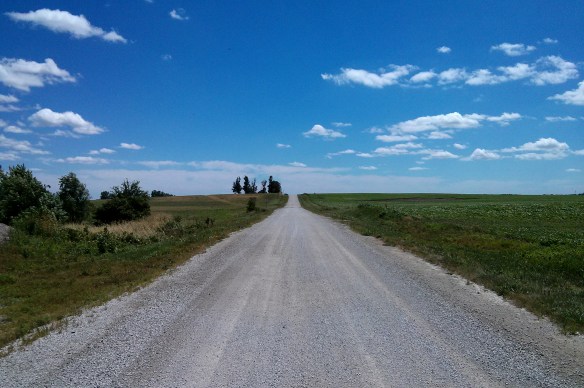
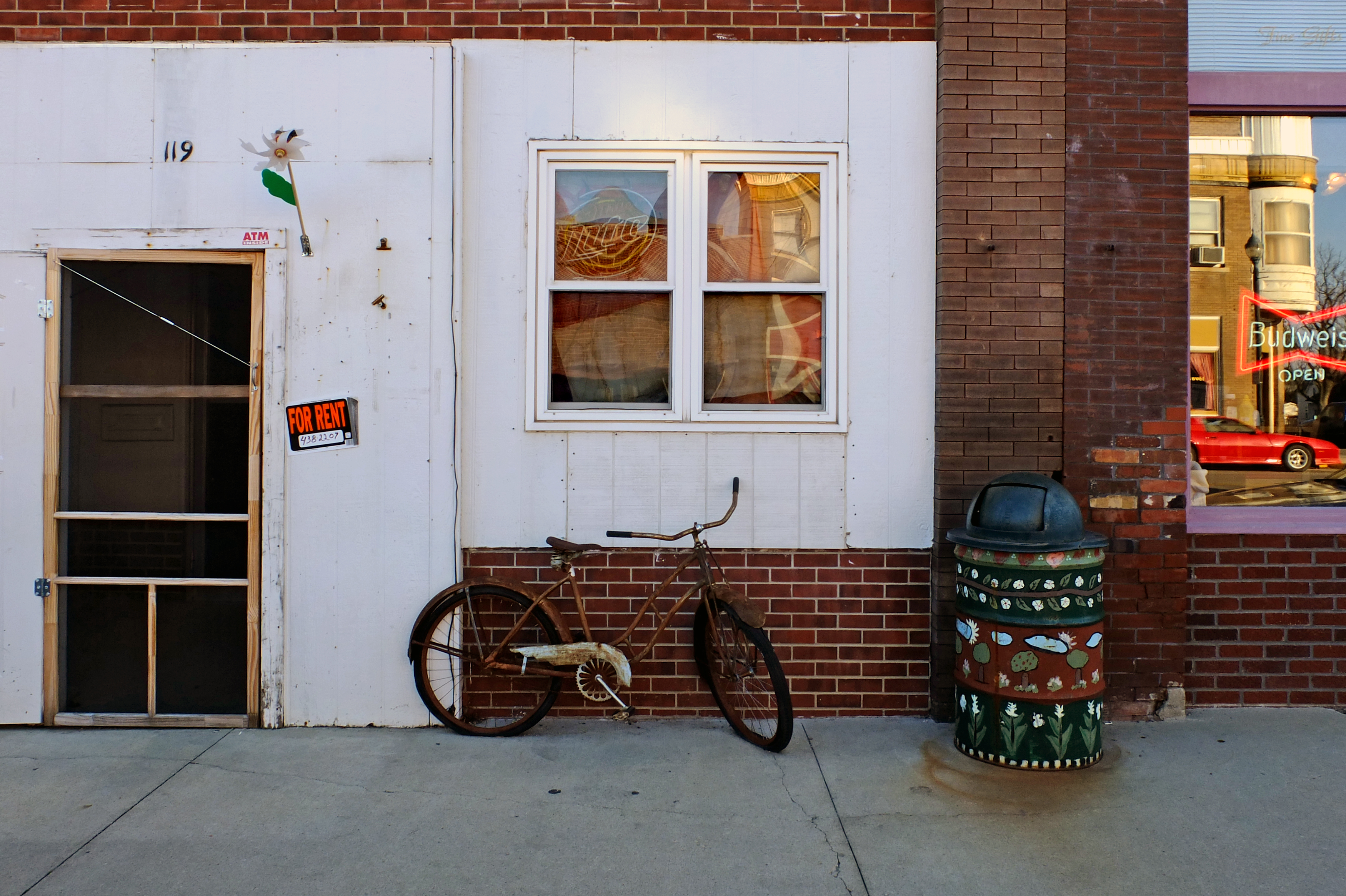
Last Sunday my brother Roger Lee and I went out for breakfast. For no real reason, we chose to leave the city and go find a diner or local cafe in a small town. Iowa is teeming with small towns. We found ourselves at CayAnne’s in Woodward (population 1024), and breakfasted on biscuits and a tasty but rather odd-looking spicy sausage gravy.
just outside of CayAnne’s restaurant

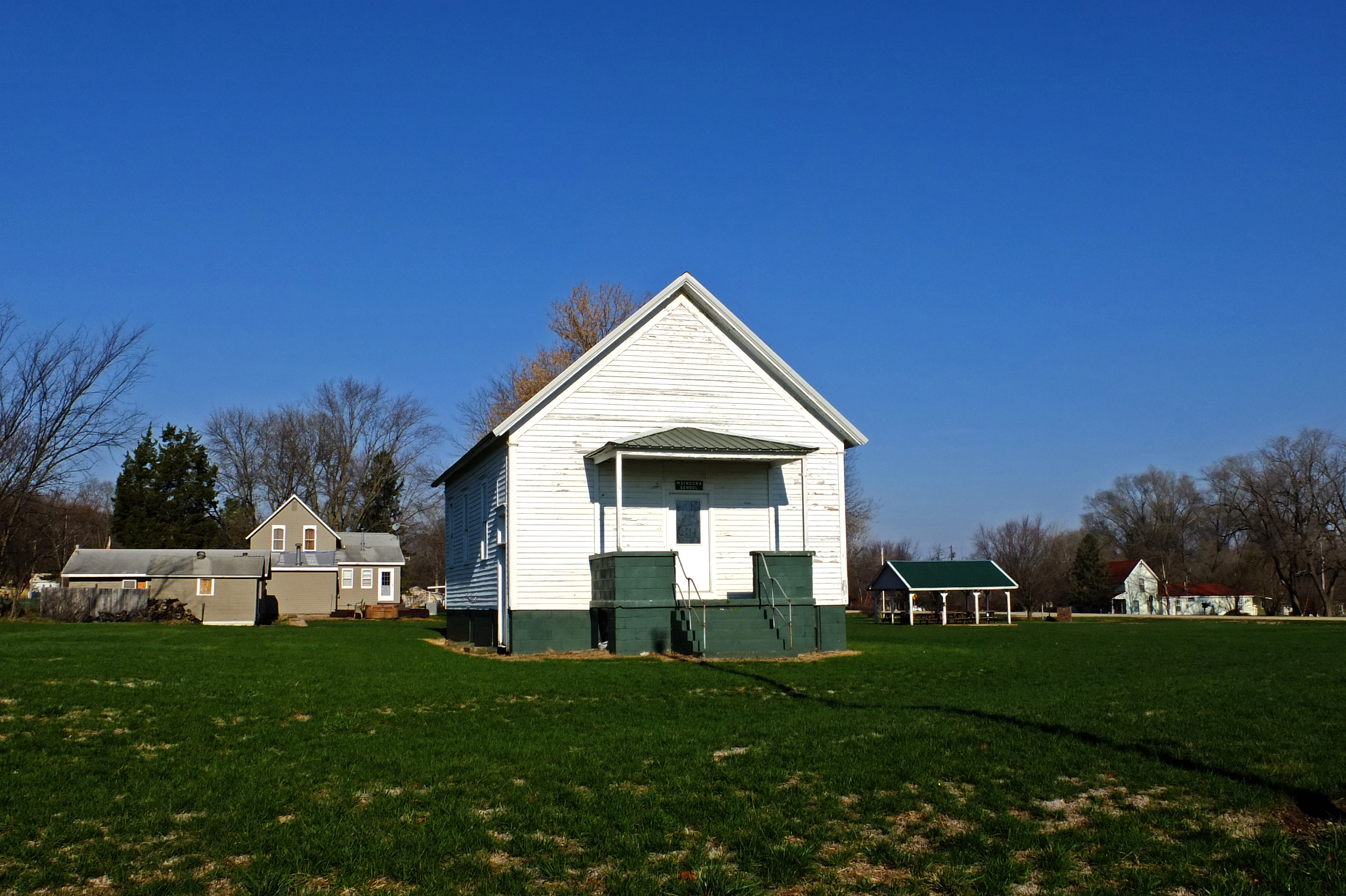
After breakfast we sort of noodled around the county, sliding in and out of various small towns. Like the town of Moingona (population unknown, but it’s really small), where we saw the original town school. It’s not in use (at least I don’t think it’s in use), but it was nice that the town cared enough about the old building to preserve it. The school probably constitutes about 5% of all the town’s structures (excluding sheds). Like I said, the town is really small.

moingona schoolhouse

Moingona is named for the native American tribe that inhabited the area before white folks arrived and casually took their land and kept their name. The town was home to Kate Shelley — the first woman in the U.S. to have a bridge named after her. On a stormy night (okay, it was a dark and stormy night) in July of 1881 a railroad bridge was partially washed out by a flash flood. A pusher locomotive that had been sent out to inspect the track conditions failed to notice the mostly-missing bridge. Our Kate, hearing the crash, rescued two of the engine’s crew (the other two died). Knowing that a passenger train was scheduled to pass over the bridge soon, Kate (relying on the illumination of the storm’s lightning) crawled across the remaining span of the damaged bridge, then ran a mile or so to alert the nearest depot manager of the problem. The passenger train, with 200 aboard, was stopped in time. A grateful Chicago & NorthWestern Railroad rewarded her with US$100, a half barrel of flour, half a load of coal and a life-time pass. Later they named a nearby bridge after her.

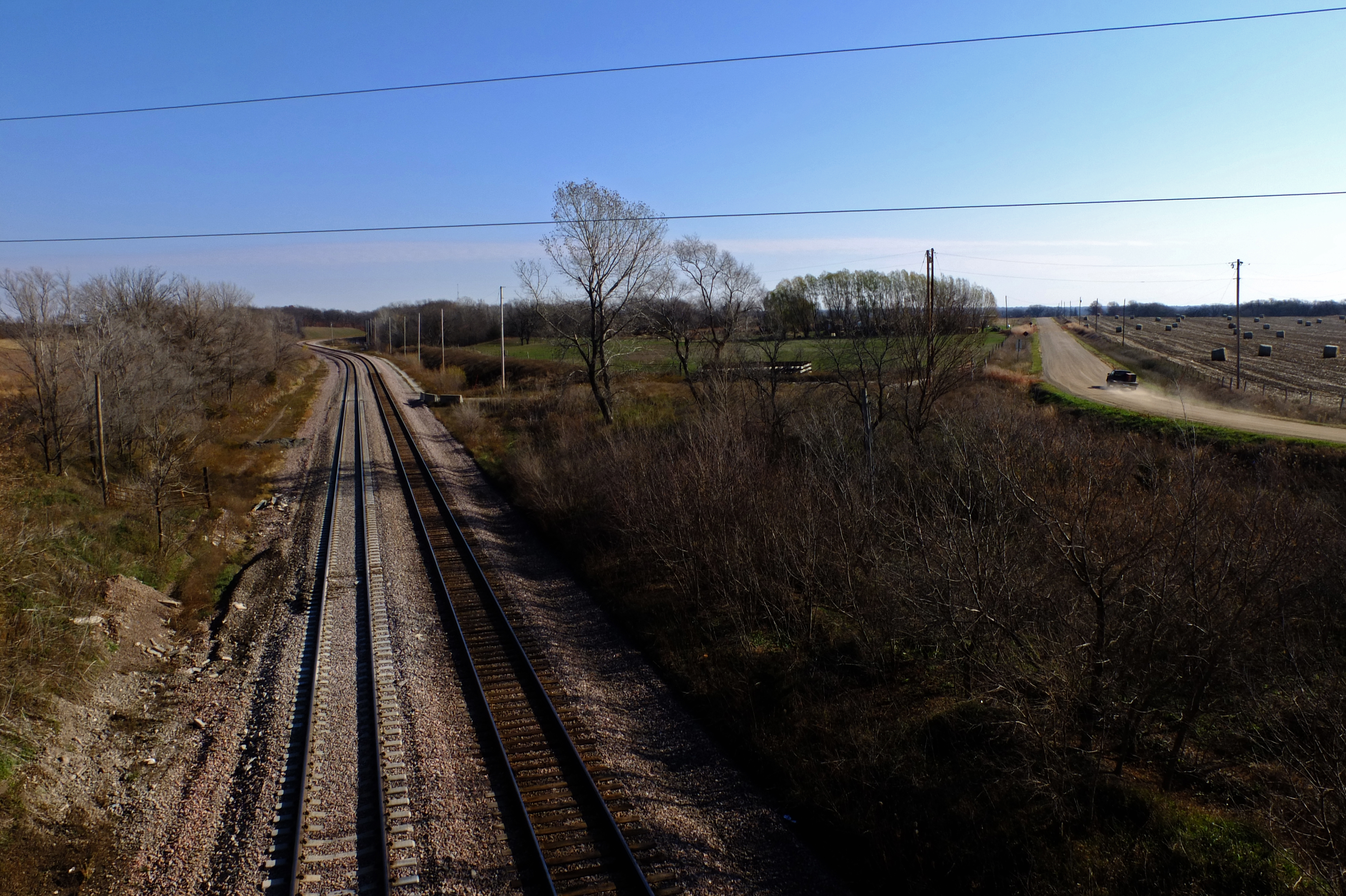
railroad track and dusty road

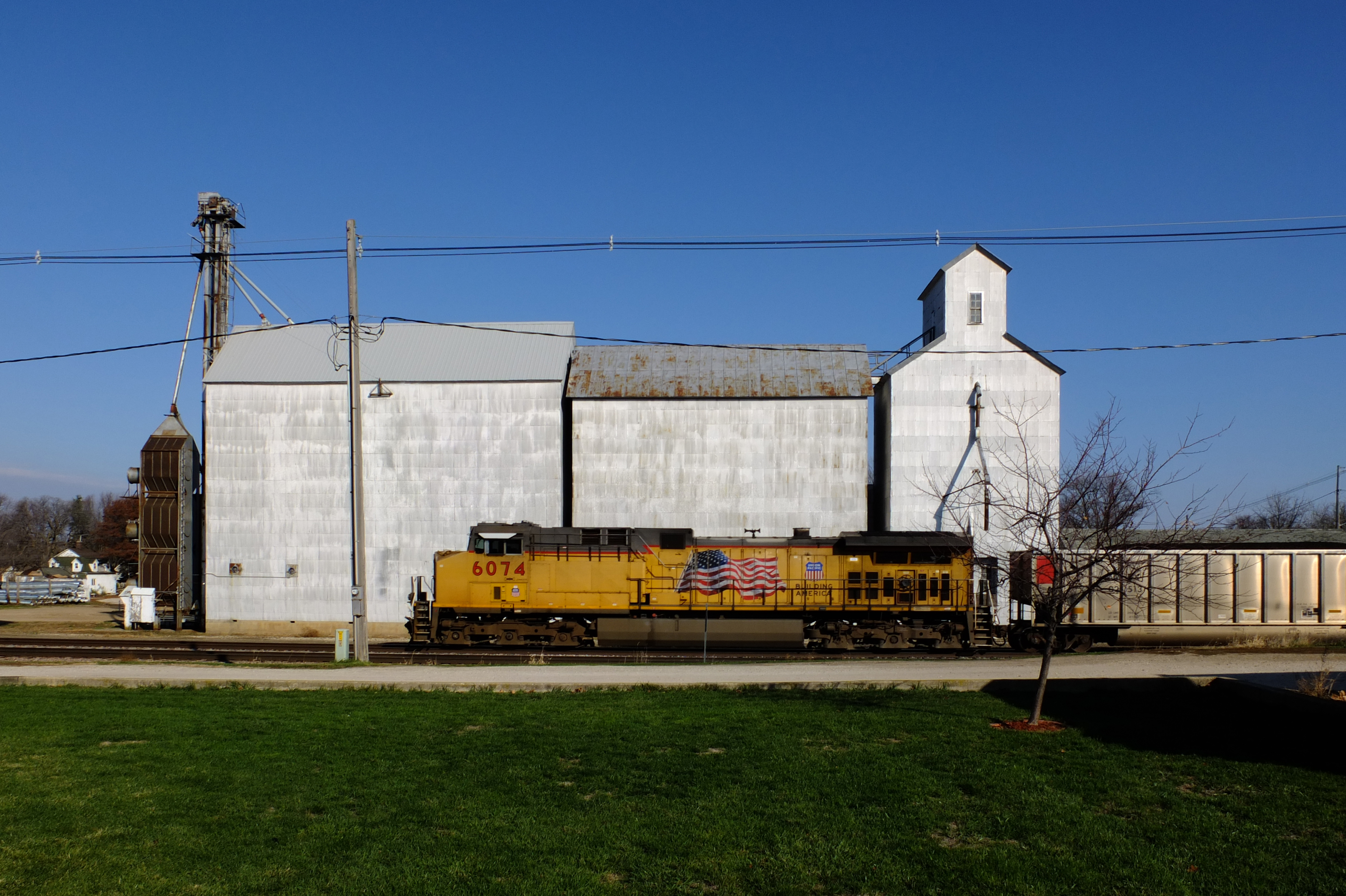
After we left Moingona, we discovered the railroad tracks were still in use. We began to sort of leisurely follow them. I can’t say it was an intentional decision at first, but the tracks seemed to parallel the general direction we were heading. After a while, we began to feel some sort of connection with them.

union pacific – building america

I believe it was outside of Ogden (population 2041) we came across some sort of slag heap, or possibly the tailings of a mining operation (both coal and iron were mined locally in the late 19th century). The truth is, I don’t know what the hell it is. It’s a massive pile of something. It looks vaguely like a smallish, Midwestern version of Ayers Rock in Australia. You can get a sense of the scale of the pile by noting the house and large garage on the right side of the frame. Aside from the dwarf alpaca, this pile of something may have been the oddest thing we saw all day.

a very large pile of something

We eventually found ourselves in the town of Boone (population 12,661). Boone was originally a coal-mining town. A pair of thick coal veins were discovered near the banks of Honey Creek, which attracted local blacksmiths (who needed the coal for their forges). It became incorporated as a town in 1866, the year the C&NW Railroad laid track through the area. The Lincoln Highway passes through Boone. That’s the first transcontinental road built for the automobile. The Lincoln Highway begins at the intersection of 42nd and Broadway in Manhattan and ends at 100 34th Avenue in San Francisco; that’s the address of Lincoln Park and the California Palace of the Legion of Honor. When I win the Lotto, I think I’ll spend a few months idling along the length of the Lincoln Highway.

boone scenic valley railroad

Boone, to my surprise, also turns out to be the home of the Pufferbilly Days Festival. I’d never heard of Pufferbilly Days. In fact, I’d never heard of a Pufferbilly, It turns out that Pufferbilly is another term for a railroad steam engine, and the festival appears to be a celebration of All Things Railroadish. The Boone Scenic Valley Railroad operates a number of old railroad engines, and periodically takes passengers on short jaunts around the area (including, apparently, the Kate Shelley Memorial High Bridge, which I’m assured is the longest, highest, double-track railroad bridge in the country — who knew, right?).

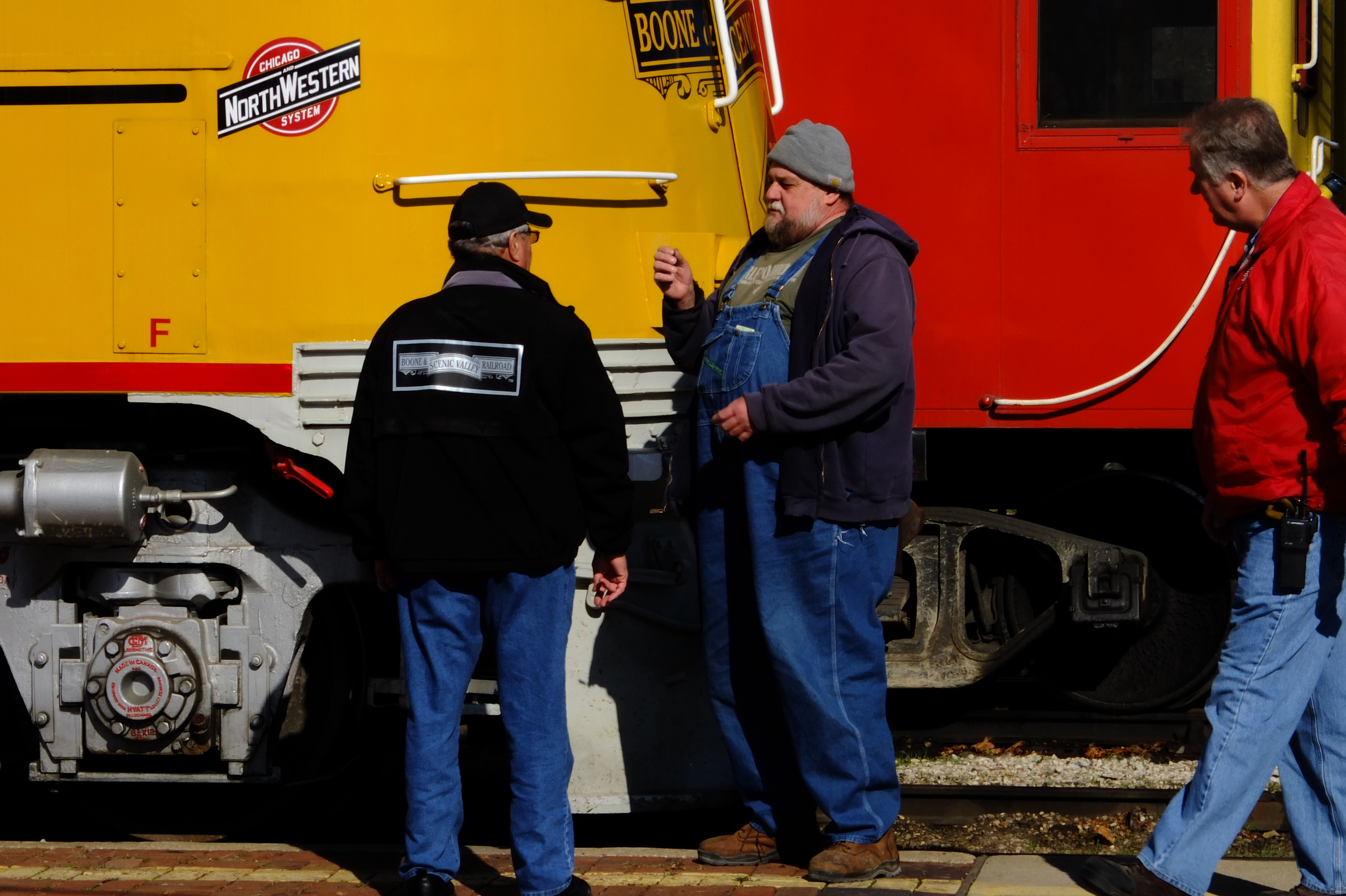
engineers

While we were nosing around the depot area, a couple engineers and assorted other folk were warming up Engine 6540. Unfortunately, by that time Roger Lee and I had already pissed away the entire morning and were running late, so we couldn’t stay to see if they were planning to take the train anywhere.

All in all, it was a strangely entertaining morning. Unfortunately, I failed to photograph the herd of dwarf alpaca (which, upon closer examination, turned out to be a single adult alpaca standing in a herd of goats) or the peculiar reddish-orange sausage gravy we had for breakfast (the gravy was similar in color to parts of the large Pile of Something which, now that I consider it, is a wee bit alarming). Still, I still managed to shoot just under fifty frames during the morning. For me, that’s a lot of photos.

Roger Lee and I plan (well, as much as we plan anything) to do this periodically over the next few months. We’ll take off on a Sunday morning, find a small town for breakfast, and then wander around pointlessly until we’re late, after which we’ll hurry back to the city. It may not be a very tight plan, but it’ll do.