not a bad job

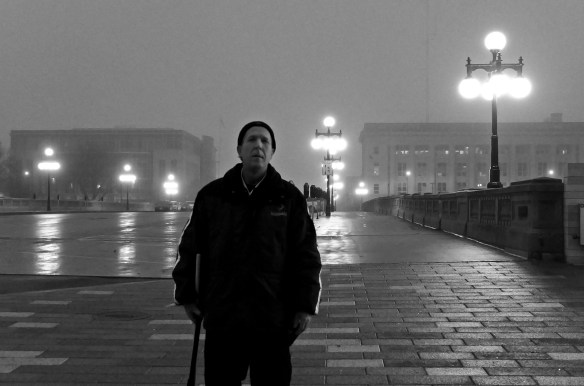
It’s eight-thirty in the morning. Dense fog and a deep, soaking mist. Cold, and getting colder. I’m walking around with my little Fujifilm X10, shooting manually because the fog and mist completely bitch-slapped the autofocus and light metering. Not many people on the street; not many people are stupid enough to be outside in that weather.

And I see this guy. He’s got a short broom — looks sort of like a modern version of an old-fashioned besom — and a long-handled dustpan. And he’s sweeping up trash off the street. At 0830 hours, in the cold, foggy mist. I shoot a couple of quick frames, thinking to myself “This poor bastard must be miserable.”

kent at work

I keep walking, he keeps looking for trash and sweeping it up. I nod to him and smile and say “You’ve got a cold morning for it.” He smiles and shrugs and says “I don’t mind so much, long as it’s doing this…” and he waves his hand up and down, like a karate chop “…and not doing this.” He waves his hand back and forth like he’s polishing a table. “Yeah, least there’s no wind,” I say.

His name is Kent. He’s been keeping the city streets clean for nearly three years. He says it’s not a bad job. “I like being outside. I get to meet people, walk around, don’t have to stay in one place.” He’s learned which business owners are nice, which ones ignore him like he’s not there, which ones are rude. He won’t identify any of the rude ones.

Kent says there’s about a dozen folks cleaning up the downtown area. He thinks most of his co-workers are pretty good or okay; a couple are lazy and some complain about the weather, but mostly they’re good people. He knows that most of the people he meets on the street don’t appreciate what he does, but he says clean streets sidewalks make the city a better place. He won’t say his job is important, but it’s clear he feels like he’s doing something worthwhile.

kent2

We talk for about ten minutes. We could have talked longer, but it’s obvious Kent feels he should get back to work. Sidewalks aren’t going to clean themselves, are they. I ask if I can take his photo. Kent sort of shuffles his feet, but nods. I take the shot, show it to him, and he grins. He tells me to stay safe; I tell him to stay warm. I go back to walking around, shooting photos; he goes back to picking up trash.

When people complain about their taxes — when they talk about cutting taxes and reducing the size of government — they’re talking about folks like Kent. Every single working day, regardless of the weather, this guy is out there making his city a more livable place. He’s making a meaningful contribution to the common good, which is a lot more than most of the folks complaining about their taxes do. Kent might not be comfortable saying his job is important, but it surely is.

And you know what’s really cool? You probably have somebody like Kent working in your city too. These folks don’t just exist in John Prine songs, you know. So take note of the people out there, and be sure to say hello to them.

aimless, but not pointless

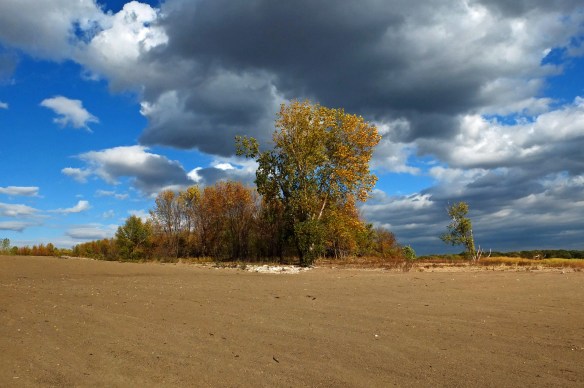
It’s probably got something to do with the transitional seasons — spring and autumn. Summer and winter are seasons of certainties and absolutes; you know what you can expect: heat and cold. Spring and autumn, though, are seasons of flux and movement; they’re about the passage from one absolute to another.

Maybe that’s why I feel a greater need to explore the countryside in spring and autumn. That’s where you witness the change.

DSCF4161b

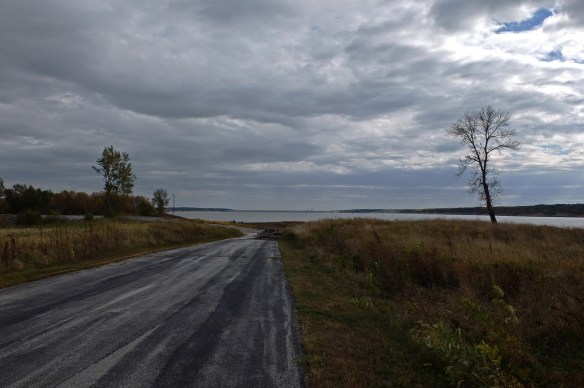
Saturday began as a dark, cloudy, stormy day with no real promise of improvement. I had good reasons to stay inside — a book doctoring gig that was overdue, household chores I’d put off for too long, photographs I’d taken the week before but hadn’t yet uploaded. Valid reasons to stay home. But I felt restless…and here’s a true thing: I almost never feel restless. When I do, I usually give in to it.

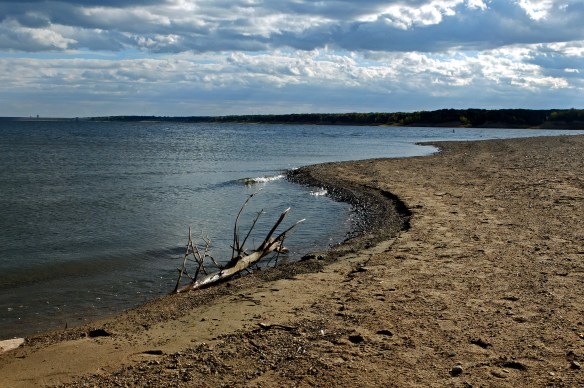
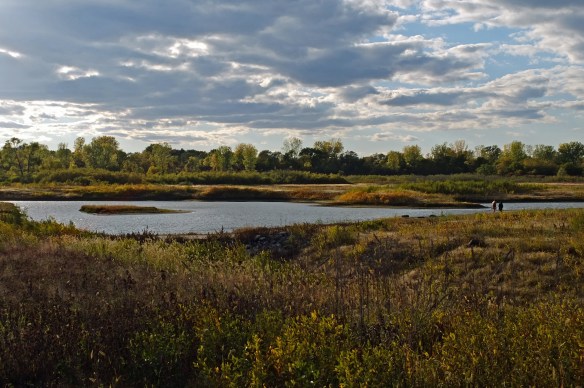
So I went to a nearby lake, with no purpose in mind other than to noodle around and see what there was to see. It was raw outside, miserably damp, and the light looked infirm. But there’s always something to see at the water’s edge. Lake, brook, ocean, river, doesn’t matter — there’s always something to see.

DSCF4196b

Then the clouds began to fail. The sun took a shufti, and started to wriggle and squirm through the cloud cover. And soon the day had become lovely. It didn’t get warm or anything, but it became comfortable. And the light…lawdy.

I’m sort of stingy when it comes to photography — maybe because I learned to shoot using film. I’ll lift the camera to my eye fairly often, but I don’t always press the shutter release. I’m not particularly conscious of my reasons for shooting or not shooting. All I know is sometimes it feels right and sometimes it doesn’t.

I was out at the lake for about an hour and a half — ninety minutes — and I took about ninety photographs. For me, that’s a LOT of photos.

DSCF4183c

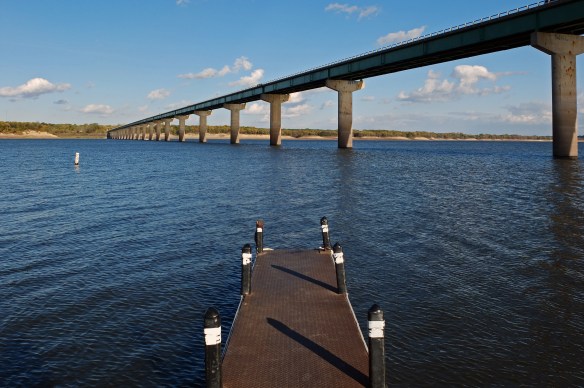
They call it a lake, but in fact it’s a reservoir built in the late 1960s and 70s as part of a flood control program. It’s hard to believe these days, but it wasn’t that long ago when the U.S. government spent big money on big projects that benefited regular people in a big way. Not only did the massive construction project itself provide a lot of jobs, but the finished lake supports a large community of small businesses.

The lake is a major local recreational area. It’s popular with recreational boaters, with hunters, with anglers, with hikers, with bicyclists (there are bike trails all through the area), with picnickers, with photographers (I saw one guy with a 4×5 view camera), with campers. All of those people spend money on their hobbies. They buy boats and jet-skis (and have them repaired and moored at marinas in the summer and stored in the winter), they buy fishing and hunting gear, they buy bikes and cameras, they eat at local diners and buy gas at local filling stations, they buy camping gear and rent camping sites at the many campgrounds, they buy sunscreen and mosquito repellent, they buy beer and soda, they spend a metric buttload of money every year. All because the government built a 26,000 acre flood protection reservoir. (All of which is to say ‘Fuck you, Tea Party Asshats!’)

DSCF4220bIn the summer, this lake is busy. It slows down quite a bit in the autumn, and on a day that began so cold and unwelcoming it wasn’t surprising that there were so few people to be seen. There were a few people bundled up but still zooming around in boats, there were a few folks fishing, there was a guy with a dog, and another guy wrestling with a large format camera. Lots of gulls, a few deer, some dead fish, a different hawk every few yards, no obvious raccoons or weasels (though a lot of tracks), finches so tiny you could fit two in a teacup.

It seems so quiet when you first arrive — but soon you realize how much sound there is. The waves, of course, and the wind through the grasses. Distant drone of boat motors. That ridiculous but somehow still moving plaintive cry of the gulls. Soft rattling of dead leaves. It seems absurd that the world could be so quiet and still so full of noise.

DSCF4207c

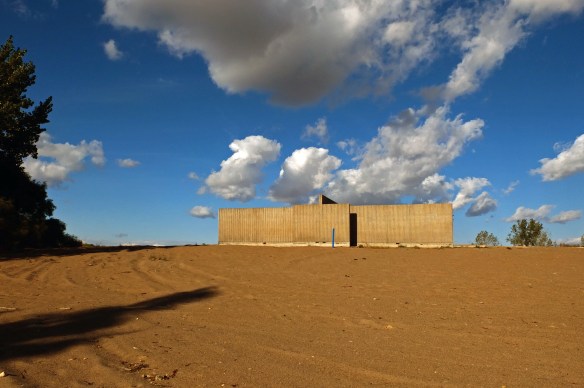
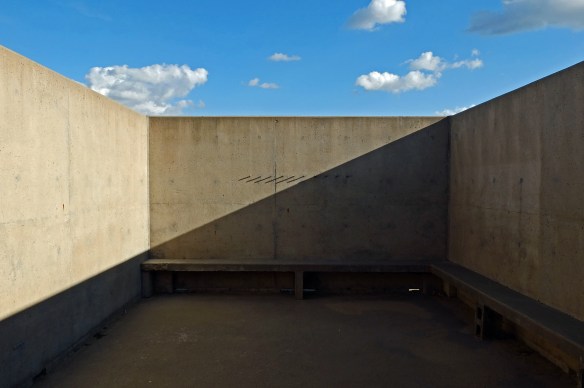
At one of the many official recreation spots there’s a bath house for swimmers — an open air place to shower and change in and out of swim suits. It’s a purely functional building made of formed concrete. It looks rather like a failed student project from the Soviet School of Architecture and Design. It ain’t pretty.

But, again, the light. Light has the capacity to turn even a butt-ugly bath-house into something interesting. For a moment, anyway.

DSCF4214b

Here’s an odd thing. When I first arrived at the lake, I spent most of my time looking out at everything. Looking out at the horizon, out at the trees and out over the water, out at the buildings and the shifting clouds. But the longer I was there, the more I began to look down.

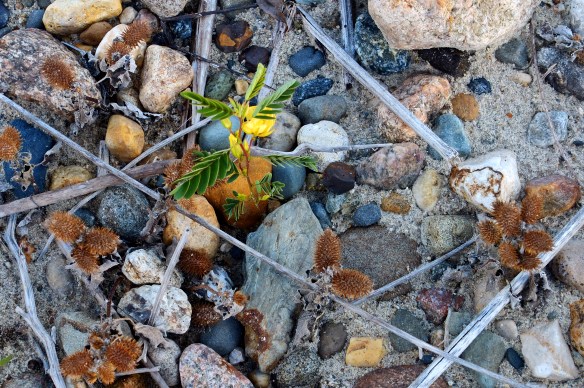
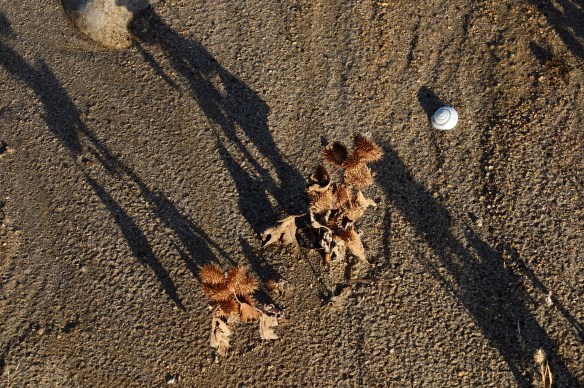
Looking out, you tend to see the larger world and the things you notice are large things. Looking down, you notice the smaller world. A world of small stones and tiny plants and odd-looking insects and sand and dry broken bits of wood and dead grasses and clusters of cockleburs. Along the lakeside, it’s a universe of cockleburs.

DSCF4230b

Cockleburs are really rather fascinating. The seeds, of course, are hard ovals covered in spines. The spines are actually wonderfully-formed hooks, though the tiny hooks are difficult to see without close study. But c’mon, who really looks at a cocklebur? Nobody. You just want to get the wee bastards off. Off your shirt, and off your pants, and off your socks, and your shoes, and Jeebus on toast I’ll bet the damned things could stick to tank treads.

That’s the point, of course. The spiny hooks are an incredibly efficient and effective mode of seed dispersal. But what’s really cool about these remarkably annoying plants is that they’re classic examples of photoperiodism. They’re what’s called short-day plants, plants that only bloom when the days begin to get shorter. Short-day plants have a protein that actually serves as a photo-receptor, which is incredibly cool. What’s even more cool (if you like this sort of thing) is that the photo-receptor isn’t triggered by the amount of light during the day, but by the amount of dark during the night. Short-day plants should actually be called long-night plants.

DSCF4235b

But wait — there’s still more cool but weird cocklebur stuff. That infuriating egg-shaped seed pod generally holds two seeds — one seed grows the next year, the other seed waits and grows during the second year. It’s a marvelously effective way to insure the perpetuation of the species. If you were to pick a few of those irritating burrs off your socks and boil them, you could make a tea that’s moderately effective at relieving nasal and sinus congestion. Or, you could use the plant itself to make a yellow dye. Seriously. The cocklebur belongs to the genus Xanthium, which means ‘yellow’ in Greek. It got that scientific name from a 17th century French botanist, Joseph Pitton de Tournefort, who was aware that the plant had been used for centuries by the Greeks to create a yellow hair dye.

So the next time you have to pick cockleburs off your shoestring, remember to give a moment of thought to what a truly remarkable plant it is. Then throw the irksome little bastard away (which, of course, is exactly what the irksome little bastard wants).

DSCF4241b

An hour and a half, that’s all the longer I was out there. An hour and a half, and the clouds began to move back in, the wind picked up, and the air took on a dampness that made it seem colder than it was. An hour and a half, and if I believed in the soul I’d say mine was replenished in that time. Ninety minutes of mostly aimless walking and looking and shooting photos.

And another ten minutes picking the damned cockleburs off my clothes.

just another afternoon by the river

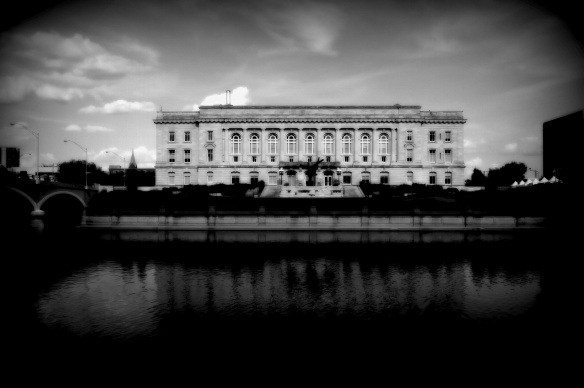
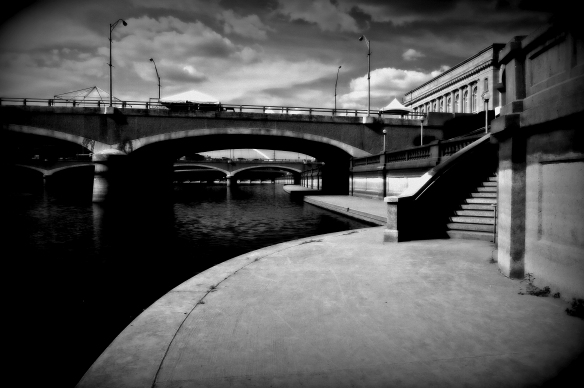
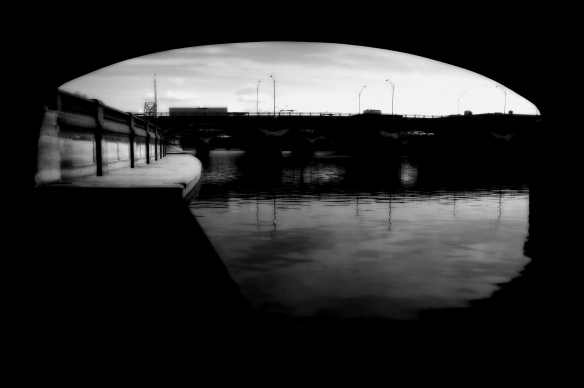
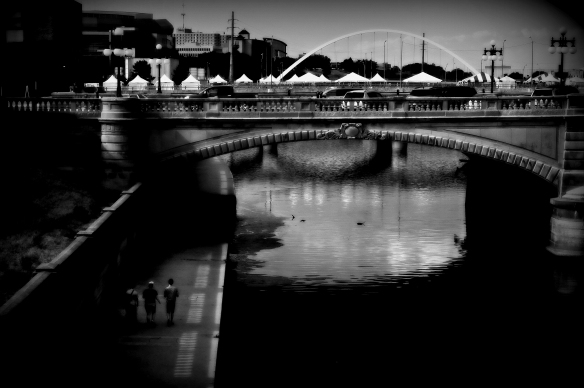
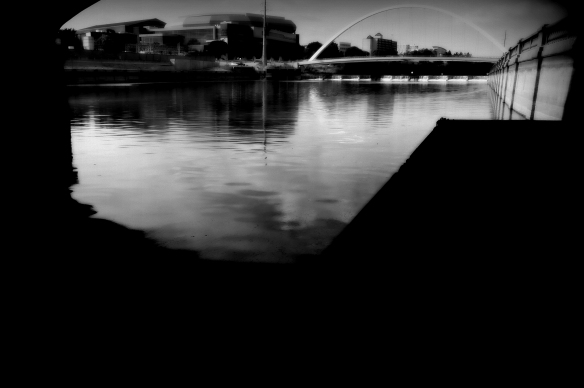
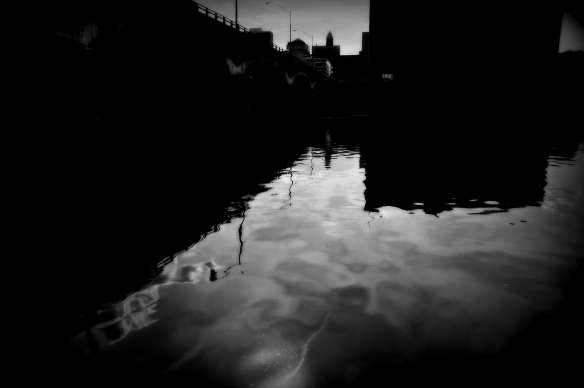
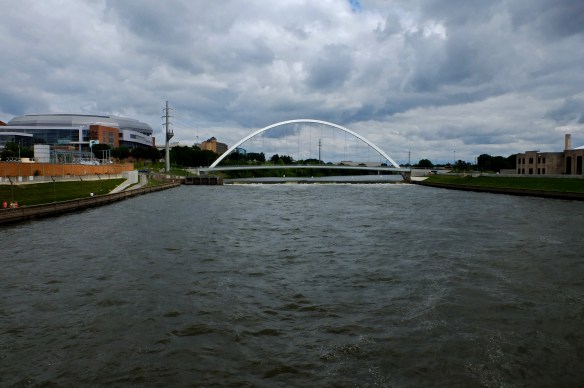
The Des Moines River is a little over 500 miles long. The section I spend most of my time on is maybe a mile. Probably a little less than that. It’s an urban section of river; there’s nothing ‘natural’ about it. There aren’t any real river banks, there are no trees lining the water, there are no organic eddies or sandbanks or mudflats. There are concrete walkways and arched bridges and dams and promenades and buildings. You can buy a coffee (or a beer or a glass of wine) in a small kiosk and sit and watch the water roll on.

I do that fairly often. When I do, I usually  find myself looking at the river and wondering what it must have been like before. City Hall Before, this was French territory. Most folks think of North America as a former British colony, which is a limited version of the truth. In fact, the British were largely confined to a relatively narrow strip of land along the Atlantic coast. Most of the interior was held by the French. Well, actually it was held by the native tribes who lived there before any Europeans made their way across the ocean. But history was written by Europeans, so it’s mostly concerned with what Europeans did.

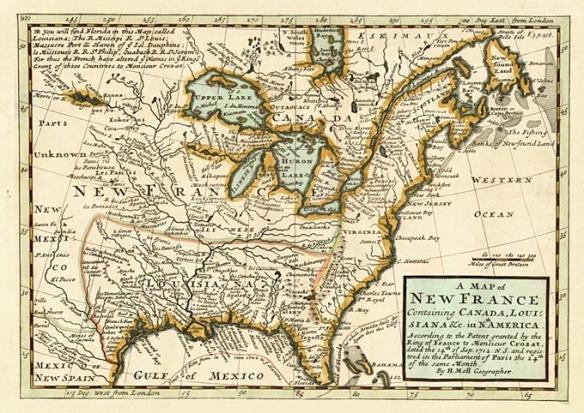
My point, if you can call it that, is this: Iowa used to be part of Nouvelle-France. New France was fucking HUGE. It stretched west from Newfoundland all the way to the Great Plains (and, eventually, clear to the Rocky Mountains). It included all the land south of Hudson Bay down to the Gulf of Mexico. The entire drainage basin of the Mississippi River comprised a district called Louisiana, which was divided into Haute Louisiane and Basse-Louisiane. Upper and Lower Louisiana. Sort of like North and South Dakota, only with the benefit of not being either of the Dakotas. new france Of course, the native peoples didn’t give a moose’s ass what the French called the land. I suspect they just stood around grinning and snickering to themselves while these odd white guys kept ‘discovering’ places and renaming them. The first white guys set foot in what eventually became Iowa in 1659. Pierre-Esprit Radisson and his brother-in-law Médard des Groseilliers. Despite their poncy names, these guys were tough. They were coureurs de bois — runners of the woods. Unlike voyageurs, who were licensed to do business by trading companies (in other words, capitalist lackeys), coureurs de bois were independent, entrepreneurial fur-trappers, traders, and explorers.

Radisson and des Groseilliers explored and mapped a big chunk of the North American interior. Radisson eventually had three or four towns named after him, and a hotel chain, and even a Canadian Coast Guard vessel. Nobody named anything after Médard des Groseilliers. This is what happens when you partner up with a guy whose name is more cool than yours. But even though these men made their way to Iowa, they almost certainly didn’t travel up the Des Moines River. steps up holga Nobody really knows which European made the first trip up La Rivière des Moines. It could have been Michel Accault, Antoine Angel, and Father Hennepin in 1680; they were in the area. Or maybe it was the cartographer Jean-Baptiste-Louis Franquelin a few years later, though it’s more likely he copied some other guy’s map of the river. The Baron Louis-Armand de Lom d’Arce de Lahontan said he traveled up the Des Moines, but most historians think he was lying about it. We know that Pierre Charles Le Sueur made his way up the river in 1700, but he probably wasn’t the first. A few years after Le Sueur, Father Peter Francis Xavier de Charlevoix wrote this:

[T]he river Moingona issues from the midst of an immense meadow, which swarms with Buffaloes and other wild beasts

Swarms of buffalo where there are now coffee shops. How cool is that? The buffalo are gone now, other than a few small herds kept in parks so sticky-fingered children can look at them. The buffalo are gone, and so are the French. underbridge holga We know why the buffalo are gone. Because we were well-armed murderous bastards and we slaughtered them for our amusement. But why did the French leave? They had a massive presence in the New World — not just all that territory in North America, but throughout the Caribbean. That’s why pirates in the movies (the ‘bad’ pirates, not the good Errol Flynn pirates) always speak with a French accent — because they fucking owned Hispaniola. So why did the French leave? Give some of the credit to François-Dominique Toussaint Louverture, a slave born on Hispaniola.

In 1791 Louverture took the island away from the French by leading a successful slave rebellion. That pissed off the French and a decade later Napoleon Bonaparte sent a sizable military force to New Orleans to support an effort to re-take Hispaniola. The United States was only about 15 years old at the time, and having the French military camped out in New Orleans made the government nervous. Almost half of the goods imported into the U.S. passed through the port of New Orleans. So even though the French failed to retake Hispaniola (which is now Haiti and the Dominican Republic), President Thomas Jefferson thought it might be a good idea to find a way to get the French off our stoop.

along the river holga

In 1803 Jefferson decided to try to buy the city of New Orleans from the French. He figured he’d offer France a cool US$10 million for the city — and what the hell, maybe some of the surrounding land. Why not? France would get a little cash in the bank, the U.S. would get a nice port and party town, everybody would be happy.

But Bonaparte was dans le pétrin — in a pickle. He’d lost the income from the sugar grown on Hispaniola, he was facing another war with Britain, and his nation was close to bankruptcy. So before the U.S. made its ten million dollar offer, Bonaparte proposed to sell ALL of Louisiana for 50 million francs (plus canceling a debt of about 18 million francs). That amounted to about 15 million dollars. Jefferson had planned to offer ten million just for the city; now he could get the entire French enchilada (yeah, I know, let’s not get bogged down in national cuisine here) for another five million. A bargain, right?

dam holga

Congress opposed the purchase. Seriously. Jefferson was about to double the size of the nation — to pick up around 828,000 square miles of territory at a cost of about three cents an acre — and Congress opposed it. They said the president didn’t have the authority to make or accept the offer. They disliked the idea of granting citizenship to the French, Spanish, and free black people who lived in the territory (nobody even considered citizenship for the native peoples). They worried about the political effects of bringing in all those farmers when so much of the power of Congress depended on the wealth of the merchants and bankers along the coast.

In other words, Congress — primarily the House of Representatives — were dicks about the whole thing (sound familiar?). But the sale squeaked through in the House and was passed by the Senate, and hey bingo, the United States was suddenly bigger and in a position to start seriously fucking over the native peoples west of the Mississippi.

river so quiet holga

So I walk beside the Des Moines River. I sip my coffee and watch the water pass by. And I think about those courageous coureurs de bois (and they were courageous; it took some massive balls to go wandering in unexplored and often hostile territory), and I think about the European politics that eventually led the United States to the genocide of the natives who lived in the Americas (and the French were just as guilty in this; in 1729 Louis XV authorized the extermination of the Fox Indians because they were interfering with the fur trade). Half a mile south of where the photograph above was taken you can still find the remains of an old fort constructed to protect the French monks who’d come to the New World to force Baby Jesus down the throats of the natives.

So many wonderful and horrible things happened along this river. And the only thing that’s been consistent throughout is the river itself. The river doesn’t care. The buffalo were here, the Indians were here, the French were here, now I’m here.

Given that history, I don’t think this ends particularly well for me.

straight to the heart

A little over a year ago, while taking a walk along the river, I noticed a sketch of a woman’s face on a bridge abutment. To my surprise, it turned out to be a sketch of Louise Brooks.

Sketch of Louise Brooks, August 15, 2012

Sketch of Louise Brooks — August 15, 2012

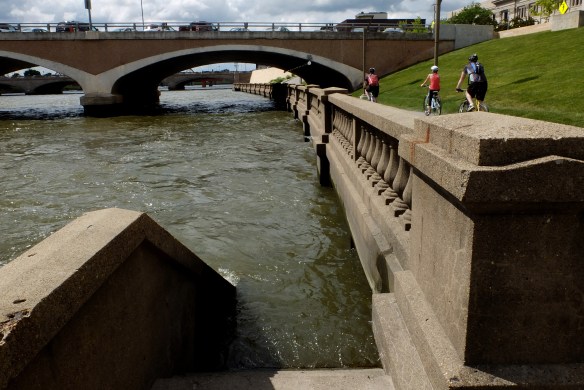
Last Thursday I found myself walking along that same stretch of river again. I’d walked by that bridge abutment several times over the last year, but it was almost always inaccessible. In the winter, ice made that part of the riverwalk unsafe, and it was blocked off. Then for several weeks in the spring, the area was flooded and much of the riverwalk was under water. At one point the river covered half the balustrade. The area was also closed much of the summer to complete the final phase of the multi-year riverwalk redevelopment project.

Ice, flooding, weather, construction work — it seemed unlikely the sketch would have survived the events of last year. But it did. Barely.

Louise Brooks -- September 5, 2013

Sketch of Louise Brooks — September 5, 2013

All that remained was a faint trace of the original sketch. Just the suggestion of eyes and lips, just a hint of the shape of her hair — that distinctive flapper bob. It would be easy to overlook the sketch, if you didn’t know it was there.

I was ridiculously pleased to see it again. It’s not just that I’m fond of the sketch, though I am. It’s that I feel some sort of strange connection with whoever made the sketch. I’ve no idea what prompted that person to make a portrait of a once-famous figure on the abutment of that bridge, but I can’t help feeling as if I was the intended audience. Not me specifically, of course, but surely the artist must have hoped somebody would see the sketch and recognize that face and appreciate it.

louise brooks2

It’s all so improbable. Improbable that somebody would sketch a portrait of Louise Brooks on the side of a bridge in Des Moines, Iowa. Improbable that I’d recognize her face. Improbable that Louise Brooks lived the life she did. Improbable that the sketch would still be there after a year.

It’s all so improbable — and it’s so perfectly poetic. In 1989, four years after her death, biographer Barry Paris wrote this about Louise Brooks:

Nobody burned more bridges than Louise Brooks, or left prettier blazes on two continents. People around her scrambled for cover, but she watched the flames with a child’s pyromaniacal glee…. With the advent of talkies, her name would largely disappear, but her face would not: a girl in a Prince Valiant bob, with electrifying eyes that drilled straight to the heart from the silent screen and left you weak when you met their gaze. Eyes that beckoned not so much ‘come hither’ as ‘I’ll come to you.’

Her name would largely disappear, but her face would not. Barry Paris was right. It’s still there, fading gradually.

Louise Brooks

Louise Brooks

on-a-stick

Here’s one of the reasons I love history. The very first Iowa State Fair opened on 25 October, 1854. On that very same day, on the Crimean Peninsula some 5200 miles away, British light cavalry troops went barreling down a valley in a suicidal assault on entrenched Russian forces — the infamous Charge of the Light Brigade.

The first Iowa State Fair lasted three days and had an attendance of about 7,000 visitors. Nobody died. The Charge of the Light Brigade lasted about half an hour and involved nearly 700 men; 156 of them were killed (along with 335 horses), and another 122 were wounded.

Tennyson, of course, wrote a stirring poem romanticizing the pointless slaughter of the Light Brigade. I think the world would have been a better place if he’d written a poem about the grand prize-winning sheep at the Iowa State Fair, or food-on-a-stick. It’s not as dramatic, to be sure, but I believe we could do with much less “Theirs not to make reply / Theirs not to reason why / Theirs but to do and die” and more food-on-a-stick.
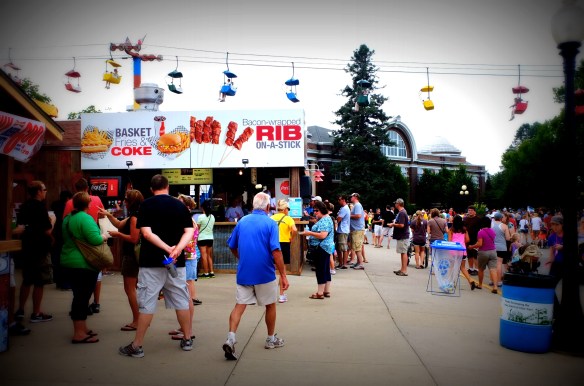
Bacon-wrapped Barbecued Rib on a Stick

Bacon-wrapped Barbecued Rib on a Stick

This year there were more than sixty (60!) foods served on-a-stick, most of them either deep-fried, wrapped in bacon, or covered with chocolate (or at least two of the three). There was the Shrimp Corndog On-a-Stick, the Soft Salted Chocolate Dipped Almond Pretzel On-a-Stick, Peanut Butter and Jelly On-a-Stick, Chocolate-Covered Key Lime Dream Bar On-a-Stick, a Hard-boiled Egg On-a-Stick, Chocolate-Covered Deep Fried Cheesecake On-a-Stick, Lamb Sausage On-a-Stick, Turkey Sausage Wrapped in a Pancake On-a-Stick, a Smoothie On-a-Stick, Chocolate-Covered Turtle Mousse Bar On-a-Stick, a Deep Fried Double Bacon Corn Dog On-a-Stick, Pork Chop On-a-Stick, a Deep Fried Snickers On-a-Stick, Fresh Pineapple dipped in Funnel Cake Batter and Deep Fried On-a-Stick, Sesame Chicken On-a-Stick and I think I’ll stop there.

Sadly, this year there was no Chocolate-Covered Fried Bacon On-a-Stick — the State Fair Food Trifecta.
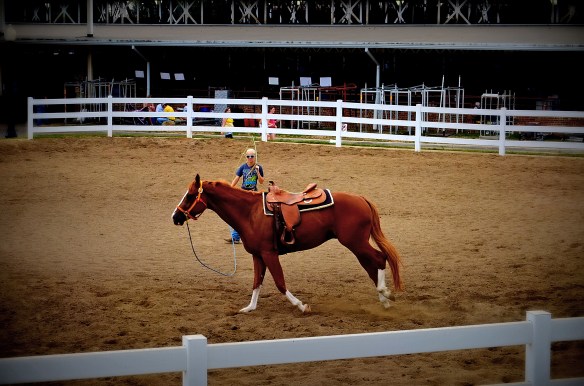
Exercising a horse

Exercising a horse

Food and animals (and animals raised to be turned into food) are a significant part of the fair. I’m pretty much a dunderhead when it comes to agriculture, but I enjoy wandering through the various animal barns and looking at the livestock. I can tell a horse from a cow, and a cow from a sheep, and a sheep from a pig — but one horse looks pretty much like another horse to me, and while I’m sure individual swine have distinct personalities, don’t ask me to tell one from the other.

But the kids who raised them can tell them apart. No doubt adults take a great interest in the livestock judging, but it’s almost always young teens who are in the ring with the animals. There’s something very sweet and innocent about watching these earnest young folks show the animals they’ve raised (of course, you have to ignore the fact that those pigs might turn up next year on the Iowa State Fair menu — and, in the case of the bacon-wrapped barbecued rib, some of them could turn up twice).
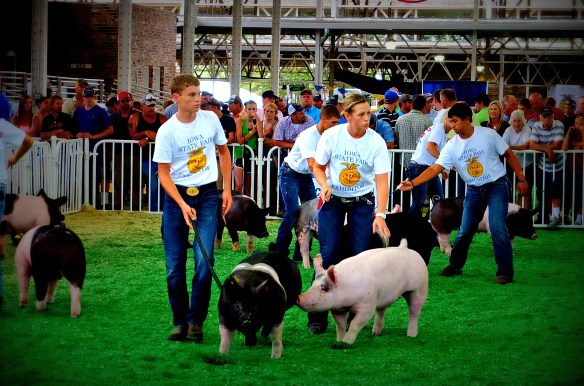
Pre-show warm-up

Pre-show warm-up

Showing the livestock isn’t just a matter of pride, of course. There are cash prizes for the winners. Not just the winners of the livestock competitions, but also the winners of the best zucchini, the best needlepoint, the best peach preserves, the best hog caller (I’ve no idea how one judges hog-calling), the best of just about anything related to farming or produce. How much money? About half a million dollars, spread out among the winners of some 60,000 exhibitors. It’s a big deal, winning at the Iowa State Fair.

The fair was given its permanent location in 1886. The fairgrounds covers 445 acres (160 of those acres is devoted to campgrounds for fair-goers and exhibitors). Most of the primary buildings were constructed in the early 1900s. They’re lovely old buildings, well-maintained and preserved. Although the Agriculture Building (home of the Butter Cow) was built in 1904, it’s a classic example of late-19th century exposition style architecture. It would have been easy for the State Fair Authority to tear down these old buildings and replace them with more modern structures, but to their credit they’ve resisted that temptation.
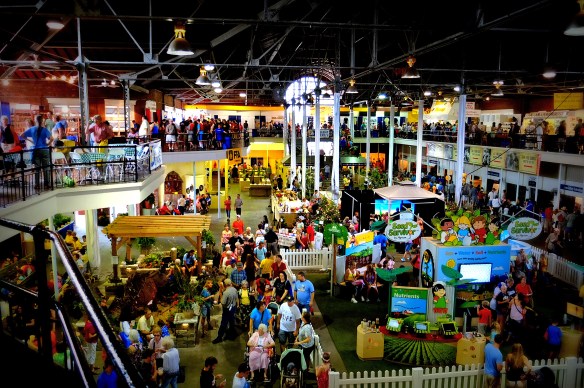
Pioneer Hall, built in 1886

Agriculture Building, built in 1904

I often visit the fairgrounds during the off-season just to walk through the massive old barns and structures. One of my favorites is the Horse Barn, built in 1907. We’re talking about two acres of brick and stone and metal girders — that’s more than 87,000 square feet. In other words, it’s a really big fucking barn. It has nearly 400 stalls; during the fair they’re almost all filled with really big fucking horses. And to be honest, even during the off-season the place smells faintly of old hay and horseshit. But I find it weirdly lovely, and I don’t mind the smell. Much.
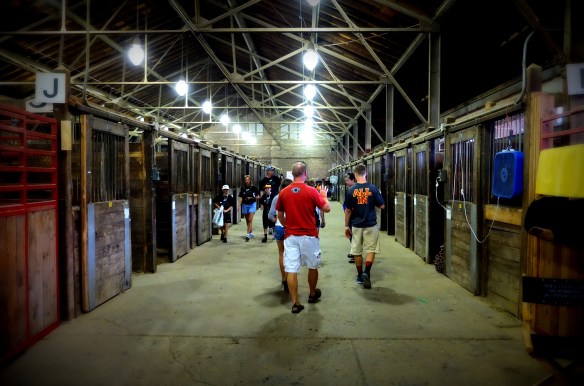
Horse barn

Horse barn

One of the things I love about the Iowa State Fair is the celebration of useless skills. Let’s face it, nobody really needs a blacksmith anymore. But you have to love the fact that there are people still using a forge to work iron and steel, people still weaving basketry by hand, people throwing pottery and canning jam and quilting and brewing ale and growing Fairhope miniature roses.

The fair not only awards prizes to folks who do those things well, they provide space for people to give demonstrations of their skills. In one building you’ll see a guy working iron, in the next building you’ll see somebody painting miniatures on wood, or weaving a rug out of alpaca hair, or using a pocketknife to whittle a birdcage from a single block of wood. It may be silly and archaic, but it’s also pretty wonderful.

Working iron

Working iron

And then, of course, there’s the Midway. That’s the term used in the U.S. and Canada for an area deliberately separated from the exhibition sites and designated for various forms of entertainment. The term ‘midway’ was coined during the great Chicago World’s Columbian Exposition, held in 1893 (Columbian because it was the 400th anniversary of the arrival of Christopher Columbus to the New World — and yes, it was actually the 401st anniversary and yes, there’s absolutely no connection between Columbus and the city of Chicago, but don’t blame me; I’m just explaining the origin of the term).

The Midway is where you’ll find the games of chance (in which chance rarely plays a part), the very worst forms of fair food (which is saying something), amusement rides (designed, I’m convinced, to provoke the regurgitation of fair food), and other sources of pleasure and delight.
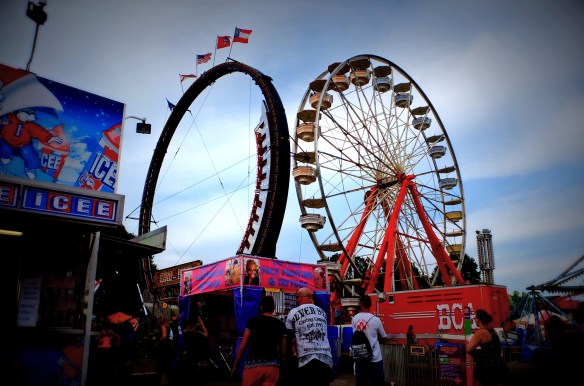
The Midway

The Midway

The Midway is the gaudiest, noisiest, smelliest, craziest, drunkest, annoyingest, and most aggressively fascinating part of the fair. This is what the Iowa State Fair has instead of the Charge of the Light Brigade. There’s an aura of self-destructiveness that infuses the air of the Midway. All the things you know you probably shouldn’t do are available here. The Midway is where you’re most likely to step in puke, most likely to see a fistfight, most likely to see tattoos in the most unlikely places, most likely to Death Metal t-shirts, and most likely to win a giant plushie banana.
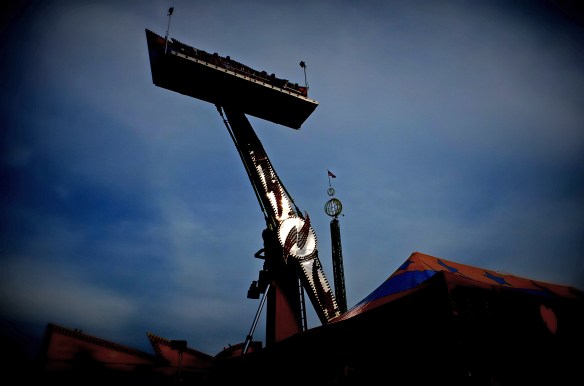
More of the Midway

More of the Midway

The Midway reaches its peak madness hours after dark — which is why I tend to leave before twilight. I have grown older and wiser and less tolerant of noise and vomit and drunken bikers. But I’d be lying if I said I didn’t like the Midway. No state fair experience is complete without a trip through the Midway.

On the periphery of the Midway you can find the more tame amusements — the ones designed for children. You can’t always see the children’s rides, but you can locate them by the wide fringe of camera-toting parents surrounding them.

Super Slide

Super Slide

I spent about six hours noodly about at the Iowa State Fair, and that was enough. I didn’t get to see everything I’d wanted to see, but still I managed to eat a Bacon-wrapped Barbecued Rib On-a-Stick, a Deep Fried Pork Tenderloin with Bacon on the Inside and Outside, and a Deep Fried Hostess Twinkie On-a-Stick (surprisingly without bacon).

It wasn’t until I was driving home that I realized I’d neglected to see the Butter Cow. That’s been an Iowa State Fair tradition since 1911 — a life-sized cow carved out of around 600 pounds of butter. Each year since 1996 (Iowa’s Sesquicentennial) there’s also been a companion butter sculpture. That first year it was a butter version of Grant Woods American Gothic (I swear, I’m not making this up). There have also been butter versions of Elvis, Da Vinci’s The Last Supper, John Wayne (honest, I’m really not making this up), a Harley Davidson motorcycle, Tiger Woods (don’t look at me, I’m just reporting this), Neil Armstrong’s walk on the moon, and Harry Potter.
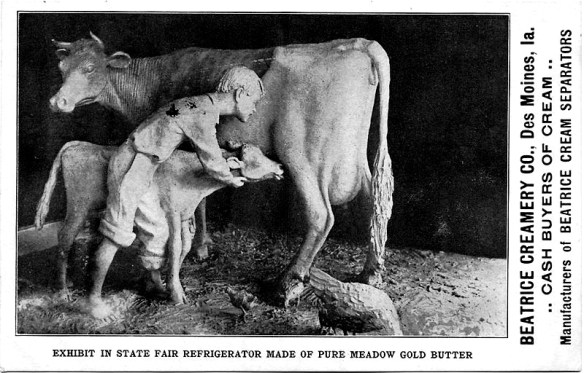
1911 Postcard of the original Butter Cow sculpture

1911 Postcard of the original Butter Cow sculpture

This year the companion sculpture was a butter Abraham Lincoln (in honor of the centennial of the completion of the Lincoln Highway, which runs through Iowa). That’s the Iowa State Fair — a bacon-wrapped barbecued rib on-a-stick, a pig that weighs over 1000 pounds (did I forget to mention the largest pig and cow competitions?), and the Great Emancipator carved from a solid chunk of churned cow’s milk.

Ain’t that America.
salvage & coffee

Okay, first — free wi-fi. Who doesn’t love free wi-fi? It’s free, it’s wireless, and it’s…I don’t know. Something that begins with fi. Fizzy, maybe. Doesn’t matter. It’s free and you can connect to the Intertubes, and that’s what counts.

Second, there’s a coffee shop that also serves an Italian soda, which is a lot like an egg cream. It’s not an egg cream; I’m confident they don’t use U-bet Chocolate Flavor Syrup, which is absolutely essential in the making of an egg cream. But considering this is the Midwest, it’s close enough. The basics are there: seltzer, milk or cream, flavored syrup in a chilled glass. It’s light and cool and refreshing, which is what you want in the summer. They serve coffee as well, of course.

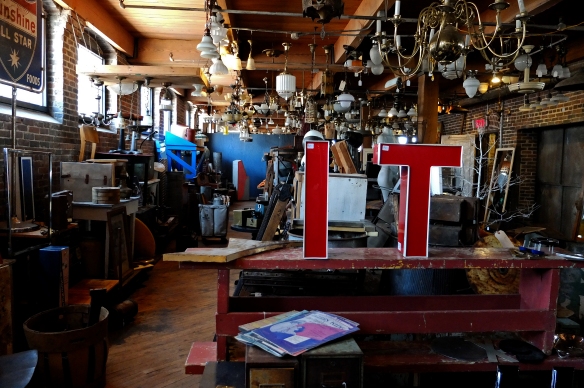
IT

I declare, every square inch of ceiling space is covered with light fixtures

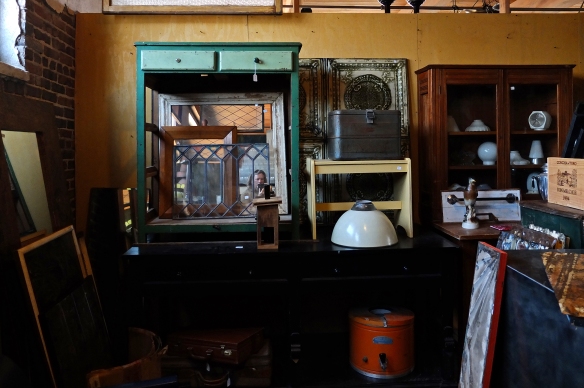
Finally, there are three floors filled with stuff salvaged from hither and yon. Not just hither, mind you, and not just yon — hither AND yon. Chicago, St. Louis, New York, London — you get the idea. Hither. Yon.
So, to recap: free wi-fi, Italian soda (almost an egg cream) and coffee, architectural salvage. All in the same old warehouse building. It’s called West End Salvage and Coffee Shop. It’s located directly beside the 9th Street viaduct and three blocks from the County Jail. I love this place.

west end salvage and coffee

West End Salvage & Coffee — that’s it on the left

They don’t mind if folks just wander around and look at stuff. Hell, they encourage folks to just wander around and look at stuff. “Hey folks,” they say, “go wander around. Look at stuff.” And that’s exactly what folks do. The place is sort of a combination of a maze and a warren, so you often hear the voices of folks you can’t see, saying things like “Ooh, look at that” or “What the hell is that thing?” or “I want that — I don’t know what it is or what it does, but I want it.”

I’ve said each of those things myself.

I could totally justify buying any of these things

I could totally justify buying any of these things

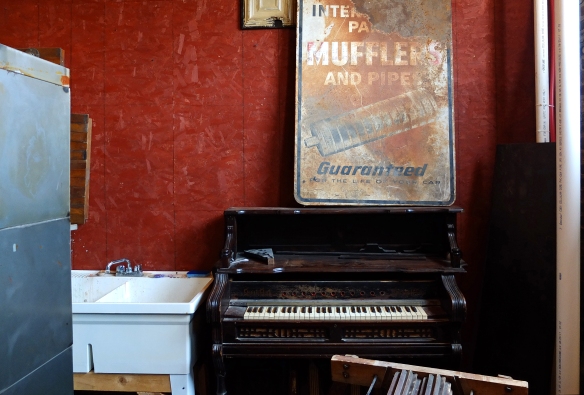
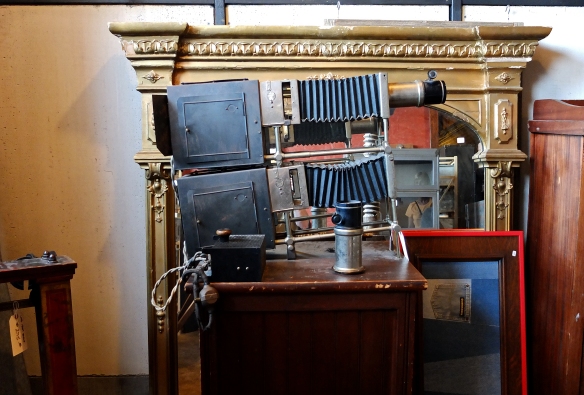
It’s the sort of building where you step around a massive wooden cupboard and find a stereopticon sitting on a beat-up old printer’s cabinet. Or an un-restored organ standing beside a plastic double-sink, near a crate containing a collection of large metal gears. If you’re ever in need of a tin box, this place has several dozens in sizes ranging from tiny enough to fit a pair of earrings to enormous enough to bury a rhinoceros. And chairs, lawdy these people have chairs. And mirrors. All over the fucking place, chairs and mirrors. And tables. And and and.

Yeah, that's me under the table in the mirror that's behind the leaded glass window

Yeah, that’s me under the table in the mirror that’s behind the leaded glass window

All those mirrors can be startling. You’re always catching reflections out of the corner of your eye. Your own reflection, the reflections of other people. And since the mirrors are often semi-hidden behind other stuff, those reflections can be a tad startling. You’re not always expecting to see a face peep out from under a table, or from behind a sign written in the Tibetan alphabet explaining something about goat husbandry.

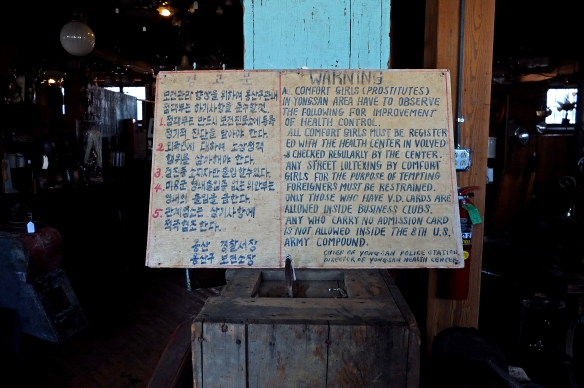
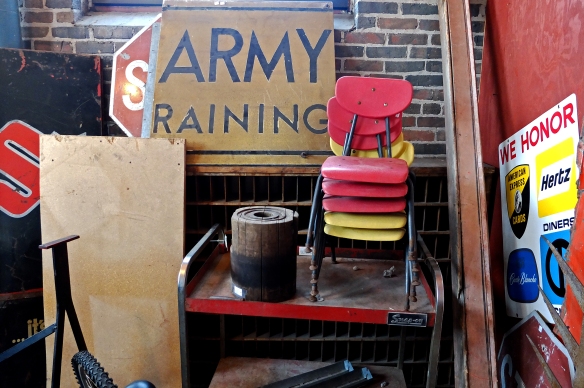
There are lots of signs here. Hanging on the wall, leaning against an old sofa, standing on tables. Signs for products, instructional signs, place-name signs. Even an old sign written in bad English explaining the rules for prostitutes wanting to do business with the U.S. 8th Army stationed in Korea.

I have no idea what street loltexing might be, but apparently it must be restrained

I have no idea what street loltexing involves, but apparently it must be restrained

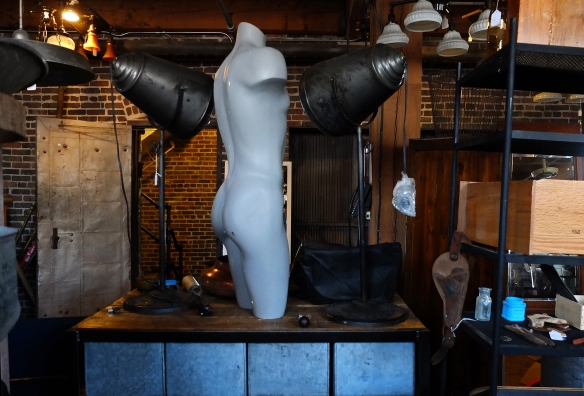
Some of the stuff you see has been refurbished or repurposed. Some of it’s in the process of being refurbished or repurposed (it’s not uncommon to hear the sound of power tools whining). But most of the stuff is just casually strewn about by folks with an intuitive sense of color and aesthetics. You really get the sense that somebody made a deliberate decision to arrange that blue male torso between that pair of old floodlights.

You see that same sense of unhurried thoughtfulness in design almost everywhere in the building. Almost everywhere.

Just behind the torso's butt you can see the stairs leading up to more stuff and down to the coffee shop

Just behind the torso’s butt you can see the stairs leading up to more stuff and down to the coffee shop

Oh, there are areas where stuff is just gathered higgledy-piggledy, but there are enough instances where the arrangement is so aesthetically pleasing that it can’t be accidental.

At some point you stop saying to yourself “That would be a great photo prop.” At some point you stop asking yourself “If I owned that, where would I put it?” At some point you realize you just want to move into the building.

Okay, so it's not all arranged with an eye toward aesthetics

Okay, so it’s not all arranged with an eye toward aesthetics

I’m told that the West End Salvage & Coffee folks have a make-over show on the Home and Garden Television cable channel. You know the type of show I’m talking about. Some folks are bored with their normal old living room and want to turn it into something that’s more representative of who they are as individuals — so they hire somebody to design and furnish a room for them. One of those shows.

I haven’t seen it (though I’m a big fan of HGTV). I haven’t bothered to watch it on account of who cares? I mean, there are dozens of those shows, and West End Salvage is much too cool to be wasted on that stuff. They ought to be doing shows on the stuff they salvage — where it came from, who made it, why the salvage job has become necessary, what the salvaged thing does, and what eventually happens to it.

You guys, it's a stereopticon, just sitting right there

You guys, it’s a stereopticon, just sitting right there

I don’t know about you, but I’d definitely watch a show that told me the general history of stereopticons, and where this one was made, and by whom, and who originally bought it, and who’d buy it now, and what they intended to do with it. That would be SO much more interesting to watch than seeing some folks have their dining room re-done.

And hey, maybe have a go at some street loltexing

And hey, maybe have a go at some street loltexing

On the other hand, if they did a really cool show then maybe West End Salvage and Coffee would be overrun by tourists. So maybe it’s for the best. Because, c’mon — free wi-fi, something sorta kinda close to an egg cream from the coffee shop, and floors of architectural salvage? Who wants to fuck that up by having hordes of fat-walleted HGTV fanboys and girls cluttering up the place? Not me.

creature of habit

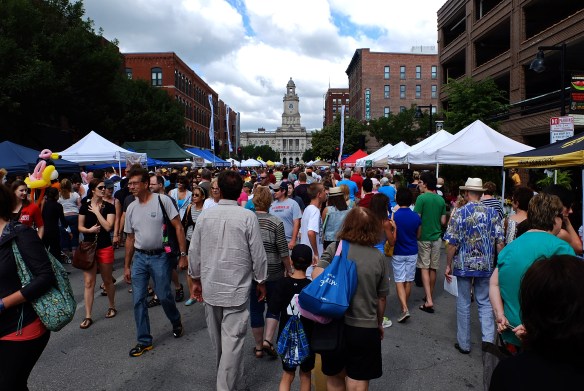
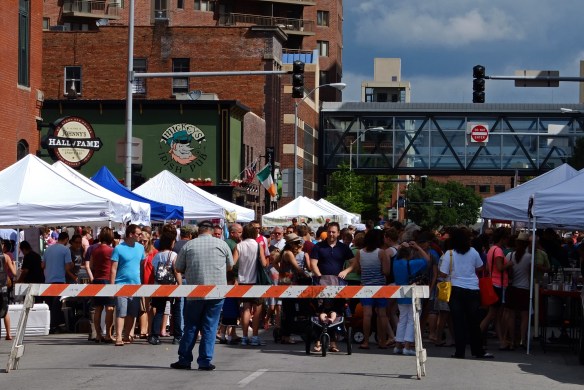
It’s summer and I’ve once again become a creature of habit. Saturday morning means the Downtown Farmer’s Market. Even if I don’t actually need to buy anything, I go to the DFM. I may pick up a fresh-baked loaf of jalapeno-cheese bread, or fresh asparagus, or a cinnamon roll the size of a toaster, or a free-range organic artisan t-shirt printed by Thai immigrants. Sometimes you don’t know what you need until you see it.

But mostly I go to the DFM just to wander around.

farmer's market1

I almost always stop at Breakfast Delights (one week I arrived late and the line was simply too long). They’re a little outfit from Corning, Iowa (population: 1635, located on Highway 34, about halfway between Creston and Red Oak; I’m told it’s the birthplace of Johnny Carson). Each Saturday the folks who own and operate Breakfast Delights drive about 95 miles to downtown Des Moines, set up their awning and grills, and serve up delicious breakfasts (including a sausage and egg croissant that ruins you for any other sausage and egg croissant). They also follow RAGBRAI every year.You have to love a small-town caterer that will trail along with a week-long bicycle ride that runs all the way across Iowa, from the Missouri River to the Mississippi.

farmer's market4

You smell the food cooking and hear the music at the Downtown Farmer’s Market before you actually get to it. The food ranges from classic Kansas City barbecue to authentic samosas (and lassi on ice), to spanakopita, to falafel, to handmade tamales, to almond chocolate ghoriba and stuffed Mejdool dates, to fresh spring rolls, to lamb or pork cevapi sold by recent Bosnian immigrants. There’s also, of course, fresh fruits and vendors serving wheatgrass shots, and a few gluten-free specialty booths.

There are half a dozen music venues scattered throughout the DFM. As you wander up and down the streets, you might hear old-school country-western, or a jazz-fusion trio, or a multi-pierced woman playing Emotional Rescue on an electric violin, or some sort of Brazilian afro-funk quartet, or a middle-aged white couple singing the ballads of John Denver, or some serious kick-ass and nasty Chicago blues, or maybe a very sincere young woman paying an autoharp and singing cheerful songs to groups of face-painted children. And somehow it all blends in together without becoming noise.

farmer's market2

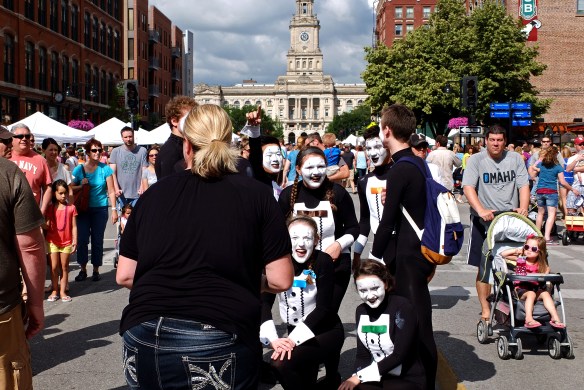
And for the last two or three weeks — mimes. Seriously. A troupe of actual, no-shit, genuine, non-ironic mimes wandering through the crowd, posing with every damned child under the age of ten. I’d no idea mimes still existed. I thought they’d all been hunted down. But I have to say, there’s something oddly inspiring about their ability to sustain that level of enthusiasm.

after the market

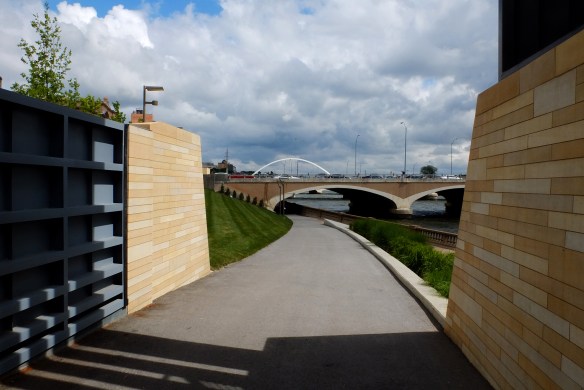
After the Downtown Farmer’s Market, I usually walk along the river (the DFM is within an easy frisbie-toss of the Des Moines River). Down through the flood gates, along the refurbished riverwalk — the relative quiet of the river makes for a nice transition from the busy-ness of the market itself. There are usually other walkers, a steady stream of cyclists, some folks fishing, and I can report I’ve never seen a mime by the river.

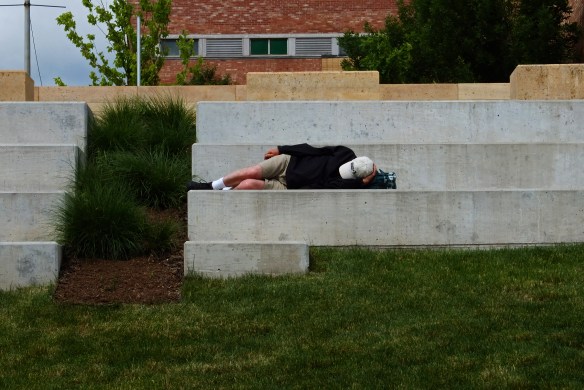
You do, though, see folks napping. Sometimes the nappers are homeless folks; sometimes they’re just over-fed, exhausted market shoppers. On occasion I may have closed my eyes down there my ownself.

after the market nap

Yesterday the river was still probably six or seven feet above its normal level, but the flooding has receded quite a bit. A couple weeks ago only the tops of the balustrade were visible, and the upper level of the riverwalk was underwater in several places. The lower level of the riverwalk — the one that’s normally just a few inches above the river itself — hasn’t been visible for weeks.

after the market2

After walking along the river for a while, it’s back home and the continuation of Saturday. I’m usually back by noon or one o’clock — a bit foot-weary, a bit heavier (although a bit lighter in the pocket), and content. 

after the market3

Every Saturday, the river is both different and entirely the same as it was the preceding Saturday. Every Saturday, the Downtown Farmer’s market is different and entirely the same as the week before. Every Saturday, with few exceptions, I visit them both.

Considering that every other day of the week is largely unplanned and schedule-free, I guess I don’t mind being a creature of habit for three or four hours one day a week.

llamas on parade

I was surprised to learn the Llama Futurity Association, in conjunction with the International Llama Registry, was having its 2013 World Championship Show & Sale this weekend. In fact, I was surprised to learn there was a Llama Futurity Association and an International Llama Registry. But they actually exist and they were having a llama show.

I’d never in my entire life been to a llama show before. Not once. This one promised to have pack trials (I still have no idea what llama pack trials are), costume classes (sadly, the costume event was held earlier — but c’mon, llamas in costume? It is to swoon), a llama cart pulling competition (which I assume involves llamas pulling a cart), and a live auction (in case you wanted to buy an extra llama while you’re there). Was there any way I was going to miss what might be my only chance to see an international and world llama event? Hell no.

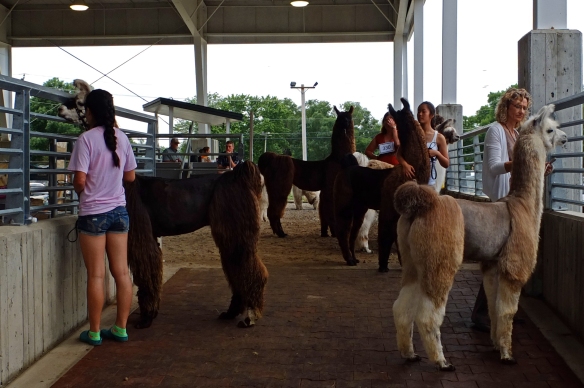
Llamas all around

Llamas all around

When we arrived, there were two events underway. The main event was a sort of llama conformation judging. Like the Westminster Kennel Club, only for llamas. A man in a burgundy coat was examining groups of llamas with a critical eye. He had them stand, he had them walk in a circle, he had them…well, stand and walk in a circle. That was pretty much it. Then he’d frown a bit and point at one, then arrange them in some sort of order and everybody mostly seemed pleased.

I confess, I didn’t give much attention to the llama conformation event, though I’m sure it was fascinating. But somebody mentioned that at the same time, at the other end of the arena, was — and I swear I’m not making this up — a llama agility trial.

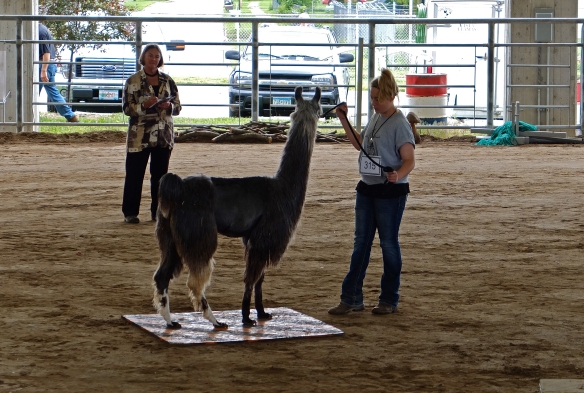
Llama standing on a square

Llama standing on a square

It was described to me as the llama equivalent of a dog agility trial. As it turned out, that was a rather generous description. There was certainly an agility course — a set of standard obstacles laid out — and the entrants were required to attempt the course while an impartial judge evaluated the animal’s success at each obstacle. And it was certainly a trial for many of the contestants, both human and camelid. But the concept of agility was stretched pretty thin.

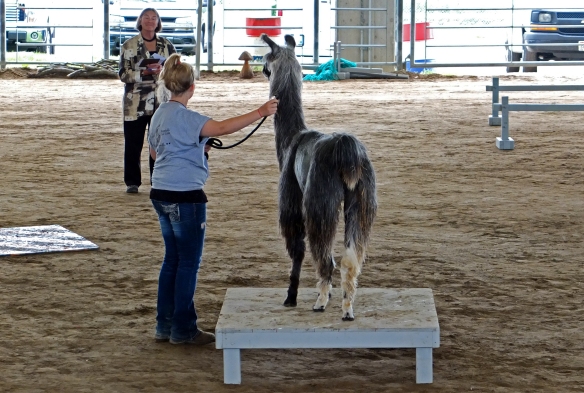
Llama standing on a raised square

Llama standing on a raised square

The llamas were required to 1) walk under an object, requiring them to lower their heads a few inches, 2) stand on a square, requiring them to stand still with all four hooves on the square, 3) stand on a platform, which was basically a square elevated to a height of maybe six inches, 4) hop over a pair of jumps approximately a foot in height, 5) walk up a ramp, turn a corner, and walk down the ramp without falling, 6) walk backwards for about a meter, 7) walk sideways for about a meter, 8) walk through a puddle, and 9) walk through a short tunnel.

Llama walking on a ramp

Llama walking on a ramp

Now, this may sound silly. And in some sense it is — it really is. Unlike dogs, many of whom seem to really enjoy running agility obstacles (or at least enjoy the interaction with their handlers), the llamas clearly didn’t give a rat’s ass about the trial. They were mostly willing to be led through the obstacles, but it didn’t take a llamaologist to see that, given the chance, they’d have preferred to just be standing around looking dignified.

llama walking backwards

Llama walking backwards

I’m told llamas are intelligent animals, and I’ve no reason to doubt that. They have a sort of lofty poise, and carry themselves with solemn stateliness. But I’m not sure anybody could claim they’re particularly agile. Only one of the llamas I watched actually completed the course without incident. With that single exception, the llamas were entirely dismissive of the small jumps; most of them just strolled right through them, not even bothering to acknowledge their existence. It was as if they were too polite to point out that some ill-bred rascal had inadvertently cluttered up the area with some planks.

Llama walking sideways

Llama walking sideways

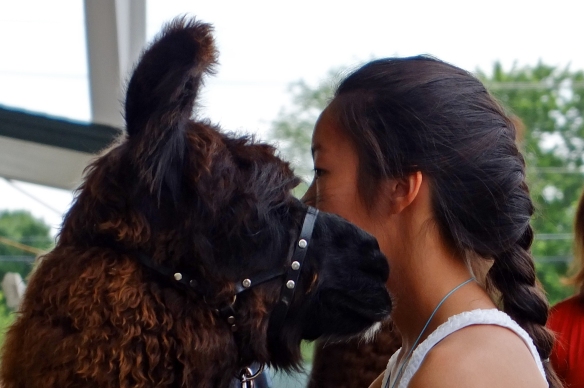
What kept this event from being completely comical was this: the love and affection felt by the handlers for their llamas. They wanted their animals to do well, to be sure, but mostly they just seemed to enjoy being actively engaged with them. It was rather sweet to watch them together, even when the animals appeared absolutely puzzled about why in the world this human expected them to walk sideways (if llamas had thought balloons, there would have been dozens that said I’m terribly sorry, but I just don’t understand the point of this.)

One of the things that surprised me (and there were a lot of things that surprised me) was that most of the llama handlers were women — primarily young women. In fact, women seemed to be in charge of almost every aspect of the entire llama-fest. There were men and boys there, of course, and a few of them participated in the activities (it also appeared that most of the judges were men), but everywhere I looked it was women who were making things happen and keeping things running smoothly.

A girl and her llama

A girl and her llama

There’s something wonderful about events like this. There’s no money in it; the only reward is the pleasure of participating. These people brought their llamas (and a handful of alpaca) from all over the U.S. simply out of passion. And that’s beautiful.

So sure, the notion of a llama agility trial is absurd. Who cares. These folks were having fun, and the llamas didn’t seem to object very much. I’d be hard-pressed to find a better way to spend a couple of hours on a Saturday afternoon.