iowa state fair: part one — machine love

I went to the Iowa State Fair on Monday. I love that fair beyond all measure because it’s organically weird and completely ridiculous. It’s also completely ordinary, and folks, I’m here to tell you that ‘ordinary’ is its own kind of weird and ridiculous. Seriously. You don’t think of ‘ordinary’ as weird and ridiculous until you’re in the middle of tens of thousands of examples of it.

The fairgrounds has maybe half a dozen different gateways. I entered through a gate where agricultural equipment was on display. Let me be clear about this: I don’t know dick about agriculture. I’ve visited a few farms in my life, but I don’t have a clue what actually goes on there. I know there’s plowing and planting and harvesting, and probably a lot of stuff in between. I know farming is hard work (well, I hear it’s hard work, and I’m willing to accept the claim). I also know farming involves a lot of odd-looking, complicated, wildly expensive equipment. But what that equipment does is a mystery to me.

Look at this thing, for example:

For farming on Mars, probably.

For farming on Mars, probably.

What the hell IS that? The wheels were nearly as tall as I am. You need a ladder to climb up to the — I don’t even know what you call the place the driver (operator?) sits. The control center? The cockpit? The bridge? I have no idea. But I’m thinking this thing would be great fun to drive. On Mars.

Then there’s this machine below — the thing with the rubber tank treads. I not only don’t know what the hell it is, I not only don’t know what it does, I couldn’t even figure out which end was the front. Not until I noticed the rear-view side mirrors. You guys, this thing has rear view side mirrors. Why? What are they expecting to pull up behind it? I mean, it’s a farm machine, right? Presumably it’s meant to be driven on farms. I can only assume it’s meant to be driven on the farms of Arrakis, the desert planet of Dune. But just look at it.
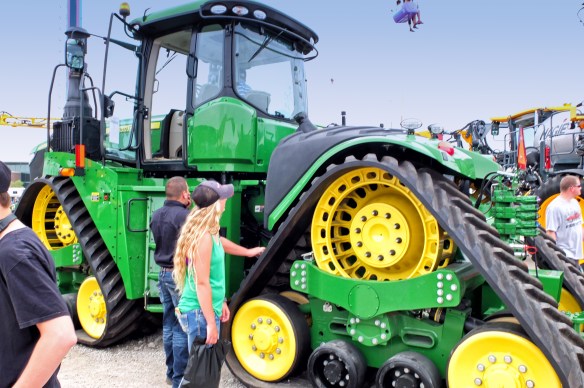
Sandworms in mirror may be closer than they appear.

Sandworms in mirror may be closer than they appear.

These machines fascinate me. I confess, I don’t really care what they’re supposed to do; I’m just intrigued by their massive size and their design. There were also a lot of smaller, but equally obscure, machines. Seriously creepy-looking devices and attachments that looked like they were designed by Torquemada — if Torquemada had been a Romulan.

Did I take any photos of those things? No, I did not. Why? Because it never occurred to me that today (or any other day) I’d be writing about farm equipment. But trust me, there’s a good reason you occasionally see a news report about some farmer who was killed or mutilated by a piece of farm equipment. It’s because a lot of that shit is flat-out terrifying to look at. A lot of it gives the impression that human mutilation was built into the design.

But down at the bone, the Iowa State Fair is just a fair. Here’s a true thing: ALL fairs are grounded in nostalgia. You cannot attend a fair without thinking about how things were when you were a kid. So it’s understandable that scattered throughout the Iowa State Fair grounds are collections of old farm equipment. Including this — which I presume is some sort of Hall of Tractors Used by The Ancients.
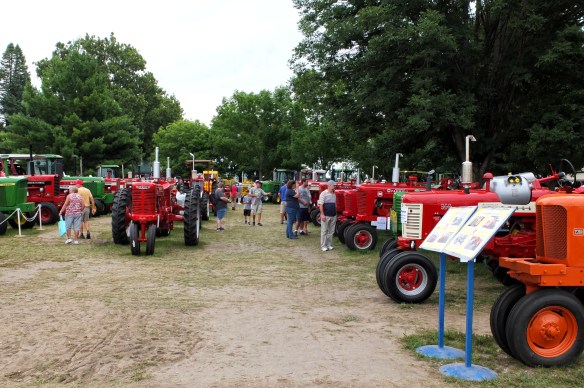
Tractors of Our Forefathers.

Tractors of Our Forefathers.

I heard a guy about my age tell a young boy “Yeah, my dad had one of these units. Old Farmall Super MD, three-plow, broke a lot of acres with that tractor.” I don’t have a clue what any of that means, but the guy was sure fond of that tractor. The kid was skeptical (as kids should be). He looked at the tractor like maybe it had arrived in Iowa on the ark (and yes, by the way, there actually was an Evolution: Fact or Myth booth at the fair).

I saw a LOT of old tractors littered around the fairgrounds. Mostly red or green, a few that were yellow. It was pretty common to see a couple of old guys loitering about the tractors, talking about things like couplers (whatever those are) and…I don’t know. Gear ratios, maybe. Tractor stuff.
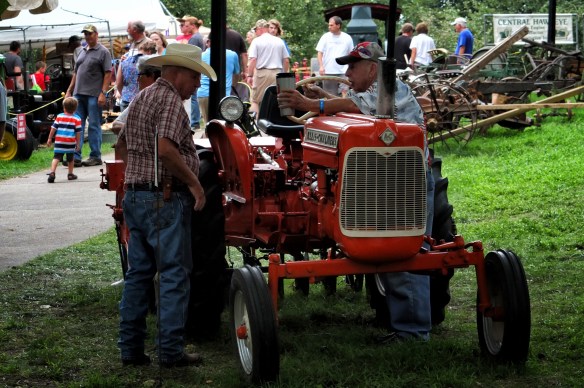
Bromance -- bonding over an Allis-Chalmers tractor.

Bromance — bonding over an Allis-Chalmers tractor.

Iowa is a farm state. You can’t travel around Iowa without passing by farms. And that’s been the extent of my experience — driving (or cycling) by farms and farmland. It’s only when I attend the State Fair that I get some remote sense of what farmers do. What they do is pretty fundamental: they feed us. They grow the stuff we eat. It’s really that simple, and really that complex.

I see them sometimes at the Farmer’s Market, in their hats and overalls and checkered shirts. I occasionally see them in a diner in some small town where I’ve gone to have breakfast and see some ‘local color’. But when I’m at the fair, that’s the only time I find myself actually appreciating them — which is probably pretty shitty of me.

Later today I’ll run some errands, and while I’m out I may stop by some roadside stand where a young farm girl (it’s almost always a young farm girl) is selling melons and sweetcorn from the back of a pick-up — crops picked early this morning. Today, when I say “Thank you” after buying the produce, this time I’ll really mean it.
story of my life

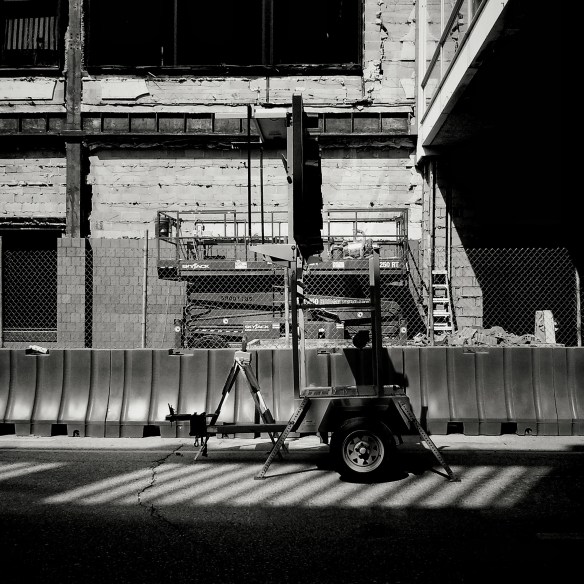
“What are you doing?”
       “Taking a photo.”
“Of what…that thing? With the wheels?”
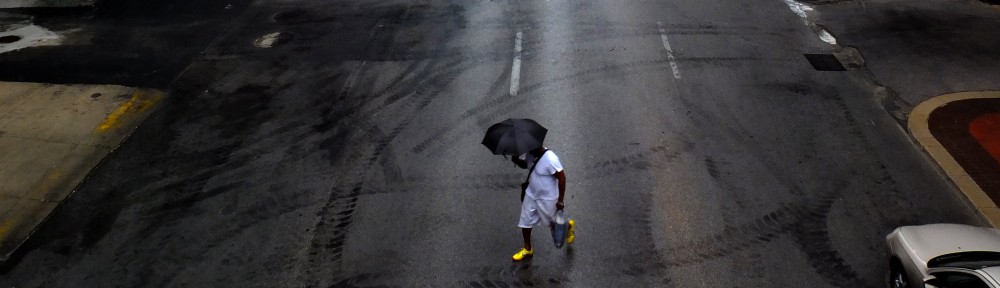
       “Nope, the lines.”
“Lines?”
       “Lines.”
“Like…lines?”
       “Yes.”
“I don’t get it.”
       “I know. It’s okay.”
“Lines.”
       “Yes.”
“Okay then.”

lines

so sad so cool

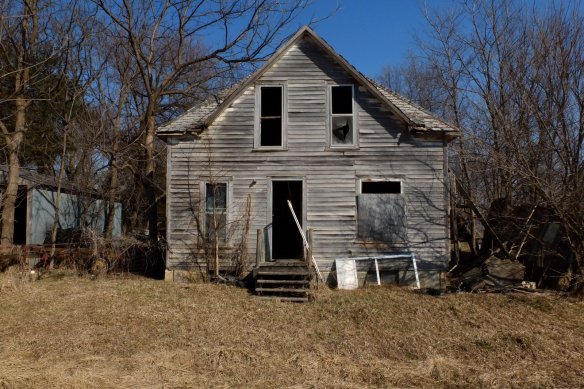
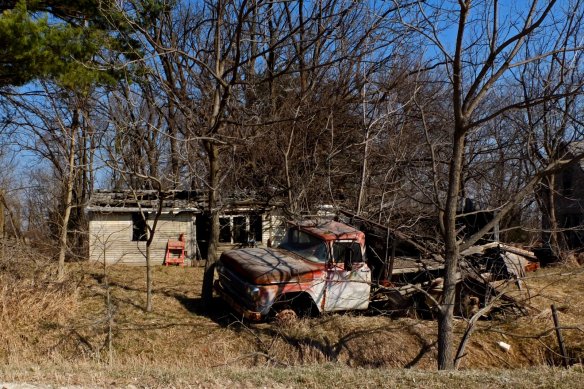
The truck, that was the first thing I noticed — just off the road, on the other side of a deep, grassy ditch. At some point in time it had been a serious truck. Not a gentleman farmer’s pick-up that could also be used to run errands, but a full-sized working truck built to haul serious payloads. Now it was basically a ruin; sitting lop-sided in the dead grass. It had been sitting there so long it had actually settled into the soil.

truck2

Beyond the truck was a house. A small farmstead, really — the house, a collapsed barn, a few small outbuildings, some sheds, a scattering of grain bins, rusted farm equipment. There was surprisingly little vandalism, aside from a few shattered windows and maybe the front door, which had been torn from its hinges. Most of the damage appeared to be the result of weather and long neglect. The property was clearly abandoned, and had been for some time.

It’s a curious term, abandon. It connotes a complete giving up, an absolute and total acknowledgment that there will be no return, a total surrender. Perhaps whoever lived there had originally intended to return — but at some point there had to be a moment of recognition that it would never happen. There’s something profoundly sad about that.

abandoned farmhouse2

Here’s an odd thing: I couldn’t bring myself to enter the house. I mounted the stairs and stood in the doorway, but I was reluctant to go inside. Not because it wasn’t safe (the house itself seemed pretty stable), and not because it would be trespassing (legally, I was already trespassing). I was unwilling to go inside because it felt wrong. It felt like a violation, somehow. What makes it odd is that at one point in my life I had a job that involved routinely trespassing and violating the privacy of other folks. But back then I was getting paid; to trespass in the house for no reason other than my own amusement seemed like some sort of transgression.

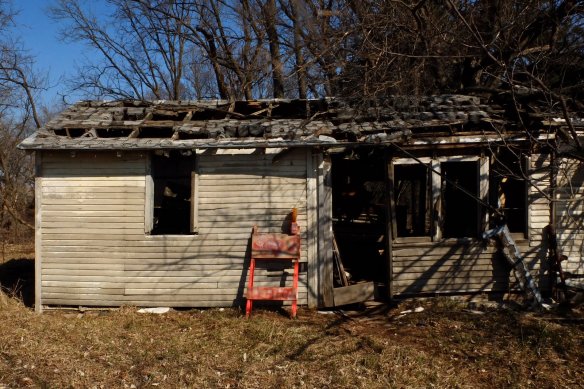
However, I didn’t feel that way about the other buildings on the property. I noodled around in them without any compunction at all. This one, for example.

music room2

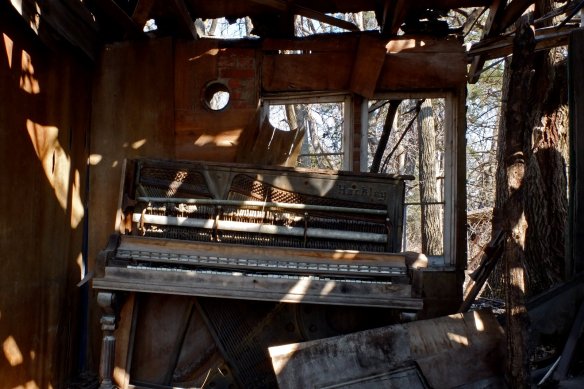
It was just a few yards away from the main house. The roof had caved in a long time ago, and the debris made it almost impossible to walk around. It didn’t help that there were obvious nails and shards of broken glass lying about (combined with the fact that I was wearing sneakers). Still, it was easy to tell the building had most recently been used as a sort of office or studio.

The bones of an old Hackley upright piano occupied the main room.

piano also2

In 1863, at the height of the American Civil War, Milo J. Chase began building pianos in Grand Rapids, Michigan. A few years later, his company was reorganized as Chase-Hackley Pianos. The company had a good reputation as builders of durable, medium quality instruments. The pianos could be bought directly from the manufacturers, which allowed buyers to avoid sales and additional shipping charges. This made Chase and Hackley pianos popular with rural and farm families — at least until they went out of business in 1930, victims of the Great Depression.

It’s easy to imagine farm kids sitting in front of this old Hackley, struggling away at some painful version of Clair de Lune.

tractor again2

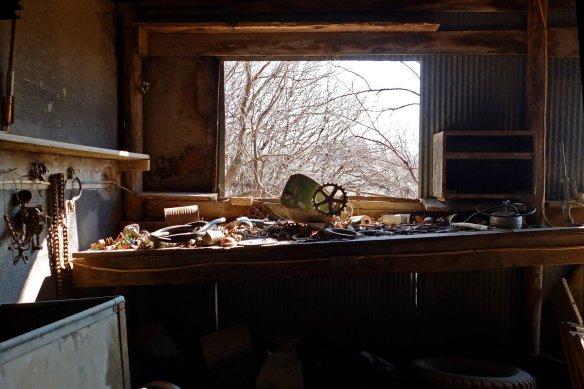
Behind the house were a variety of small, slowly collapsing sheds and workshops, as well as well as some farm equipment — all of which suggest that at one time this was a rather successful farming operation. There was a woodworking shed, a machine and tool shed, and a couple of storage buildings — all of which were in some stage of dilapidation. Only a few had working doors; none had functioning windows.

As with the house, most of the damage was a result of time and weather — and in some cases, animals. One bench was littered with raccoon shit, there were what appeared to be small mammal nests under some of the workbenches, and paw prints in the dust.

shed again2

The barn was the most severely damaged structure on the farmstead. The roof and one wall had completely collapsed, two of the other walls were pretty unstable, and the fourth wall seemed to be supported primarily by stacked bales of old hay. I wouldn’t have gone inside at all, except that I could see some bones — and bones make me stupid.

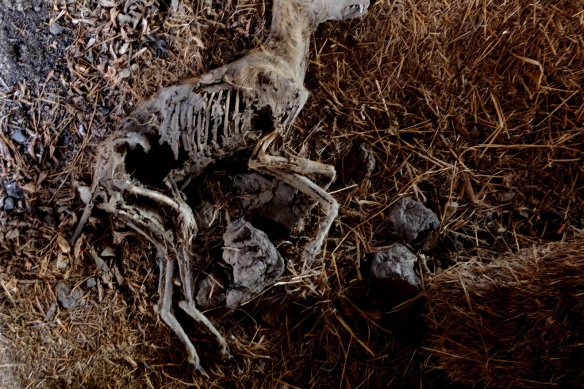
So I crouched down and groucho-walked inside to look at them. It was dark, of course, and what I first thought was an old sack turned out to be the semi-mummified remains of a dog. It appeared to have died of exposure or natural causes rather than violence, and was eviscerated by other creatures after death. The roof was too low at that point to allow me to examine the dog closely. I couldn’t even photograph it properly; I had to hold the camera out at arm’s length and shoot blindly. This is the only shot that was in focus — which is probably just as well.

family dog2

I didn’t stay at the farmstead very long. Places to go, people to meet, and all that. But the entire time I was there, I was very aware of my own internal dissonance. I’m not a terribly self-reflective person under most circumstances. I don’t spend much (or any) time thinking about what I feel, or wondering why I do stuff. Yet I was conscious of being torn between feeling This is so sad and thinking This is so cool.

Because it was so sad and it was so cool, and it still is. I’ll almost certainly go back at some point when I have more time to explore. Maybe I’ll even overcome my conscience and actually go inside the house.

oxbows and bottoms

One of the advantages (and let’s face it, there aren’t many) to being a freelance writer is that on any given day you can look out the window, see that it’s a lovely afternoon, and say “Fuck it, I’m going to go wander.” You can’t do that very often, of course, if you want to keep beans and tortillas on the table. But just knowing you can say it — and do it — is pretty liberating.

Yesterday I looked out that window, saw that it was a perfectly lovely autumn afternoon, said “Fuck it” (and yeah, I said it right out loud), turned off the computer, grabbed my aging little Fujifilm X10 camera, and walked out the door. I knew exactly where I wanted to go. Sort of.

chichaqua1

The Chichaqua Bottoms Greenbelt. I knew it existed. I’d seen it on Google maps. I knew generally where it was located (it’s only about 20 minutes by car from where I live). I had a basic understanding of what was meant by ‘bottoms’ and ‘greenbelt’. But I’d never taken the time to actually go there. Proof, if you needed proof, that I can be a massive fucking idjit.

This might seem silly, but one reason I wanted to visit the place is because of Chichaqua. I’ve mentioned this before, but it’s worth repeating. Some 350 years ago when this area was being explored and mapped by French coureurs de bois and voyageurs, they asked the local Sauk and Meskwaki Indians what the river was called. The river, they were told, was Chicaqua. The French had also heard that same term to describe a skunk,so they assumed that was the name of the river. The French began calling it Rivière Mouffette. Skunk River. And that’s what it’s still called. In fact, chichaqua was a term meaning ‘having a powerful smell.’ The natives had been talking about the wild onions and cabbage that grew along the river banks.

I don’t know why that amuses me so much. But it does.

chichaqua2

What’s weird, though, is the Chichaqua Bottoms Greenbelt is no longer a part of the Skunk River. A century ago (give or take a few decades) folks decided to ‘straighten’ the river. Which is a pretty arrogant thing to do. The idea was that a slow-moving, winding, meandering river was inefficient and prone to flooding. So they dug a massive gash in the ground and re-channeled the river. This sort of thing happened all over the world, by the way — not just in the American Midwest. Nobody realized at the time that a slow-moving, meandering river was a good thing for flooding. It localized the flood, which reduced the overall severity. Nobody realized that ‘straightening’ a river would reduce an area’s biodiversity. Hell, nobody knew what biodiversity was, or why it might be a good thing.

So…big gash, straight river. And about 25 miles of the old Skunk was isolated.

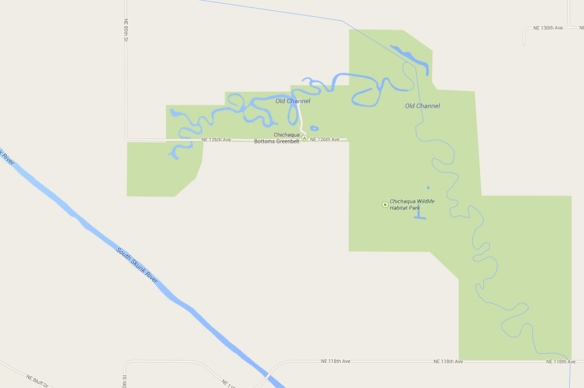
chichaquamap

See that straight blue line on the map? That’s the current channel of the South Skunk River. It’s basically a long ditch. A very pretty ditch, to be sure, and I love wandering along it. Nature has made interesting and lovely, but it’s still a ditch. That wiggly blue line? That’s the old channel. Nothing even remotely ditch-like about it.

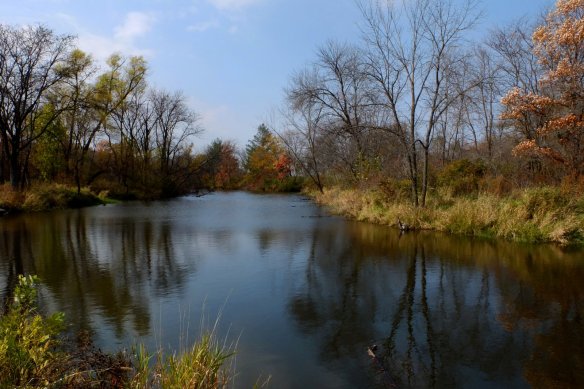
Back in 1960, the county bought up about 9000 acres of the old Skunk River channel. The water had never drained from the old channel; the area had basically become a series of oxbow lakes and bottoms. What the hell are oxbows and bottoms? Glad you asked. That’s an oxbow in the photograph below.

chichaqua7

An oxbow is a U-shaped body of water; it occurs naturally in meandering rivers. An oxbow lake is one that’s formed when the U-shaped loop is cut off from the main channel, either because some engineering fuckwit decides to ‘straighten’ the river, or because a big flood (or sometimes an earthquake) will shift the river channel itself. Bottoms, on the other hand, are alluvial lowlands, which probably doesn’t tell you much. It’s what we call that land by a river that floods all the time. Marshy land, mosquito-breeding swamps, rich in sediment. If a river runs through a city, the Bottoms are where the poor folks usually live.

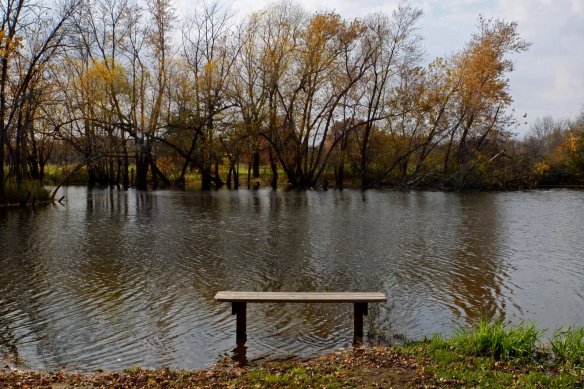
That bench in the photograph below? That’s sitting on bottomland. Oxbow lakes and bottoms. Great for wildlife and flood reduction. Sucks for housing.

chichaqua4

After the county bought up the old Skunk River channel, they sort of encouraged it to be more of what it already was — a wildlife habitat. They re-introduced otters, and bobolinks, and wild turkeys, and a few species of endangered turtles. Other species returned on their own, like Pileated Woodpeckers and various raptors. They preserved old trees and planted tree species that used to grow in the area before it became farmland.

And I have to say, they’ve done a fantastic job. The place is completely fucking beautiful. Within the first half hour I was there I saw two Great Blue Herons walking along the dead-end road that leads to the area. Herons on the road. They were apparently gigging for frogs in the marshy ponds just off the blacktop. I saw the first bobolink I’ve ever seen in the wild. I nearly stepped on a Northern Water Snake that was three and a half feet long.

chichaqua3

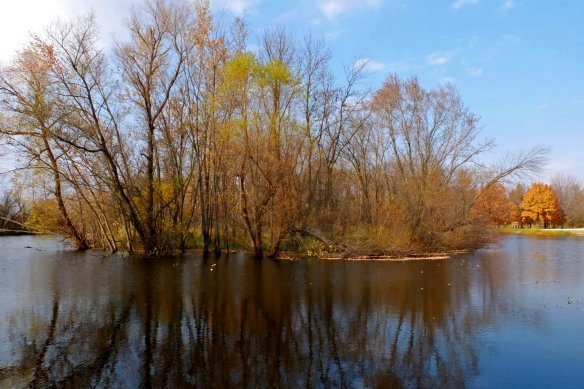
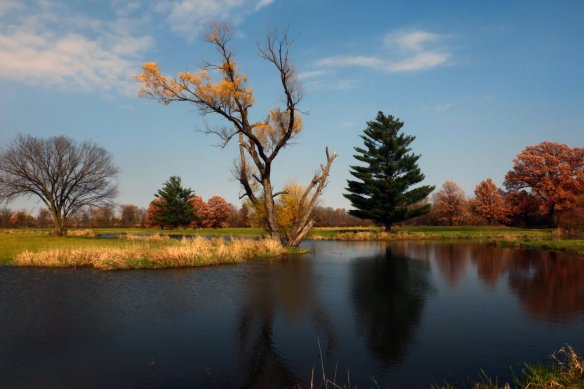
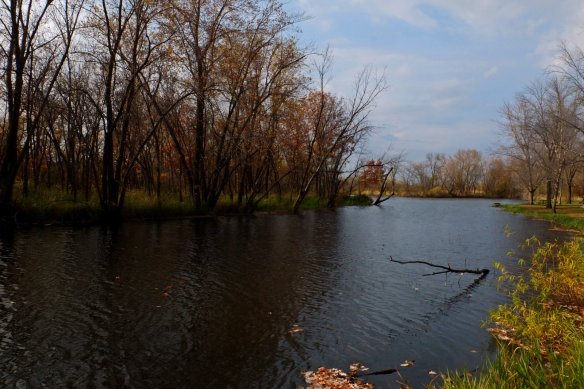
Did I get photos of those critters? No, I didn’t. Why? Because I was too busy looking at them to bring my camera to my eye. I’m rubbish when it comes to wildlife photography. What I did instead was photograph the stuff that didn’t move. You know — trees and all that. The water — which I guess does move, even in oxbow lakes. But the lakes and marshes themselves are pretty stationary. I’m not much better at landscape photography than I am at shooting wildlife. I think that’s partly because the landscape is SO BIG and the camera can only jam a small chunk of it through the lens. Still, these photos will, I hope, give you some small idea of the Chichaqua Bottoms.

chichaqua8

I’d only planned to be there a short time. I figured maybe an hour. You know, just a break from work to refresh my mind — then back to the computer. But do you remember that bit I mentioned at the beginning of this post? That bit about one of the few advantages of being a freelance writer is the ability to say “Fuck it, I’m going to go wander”? Well, that’s exactly what I did.

It’s days like this that make the lack of a steady income bearable. Pension plan? Pffft. You can’t put days like this in the bank. You have to spend them when you have them.

a small town in iowa

I can be a terribly annoying traveling companion. Unless I’m in a hurry — and I’m almost never in a hurry — I prefer to travel along secondary highways and county roads. That means driving more slowly on roads that are often poorly maintained; it means getting caught behind tractors for miles; it usually means no fast food for lunch; it means driving through small towns with absurdly conservative speed limits.

But I like the small towns. Small towns can surprise you. There’s always a chance you’ll come across something odd and/or fascinating and/or emotionally moving. On my way toward the Mississippi River last week, I came across a water tower in the shape of a teapot. And a billboard commemorating a local boy who’d been killed in Iraq. And a diner owned and operated by a guy with a hook for a hand. And a town named after a 19th century Muslim religious and military leader.

Elkader, Iowa

Elkader, Iowa

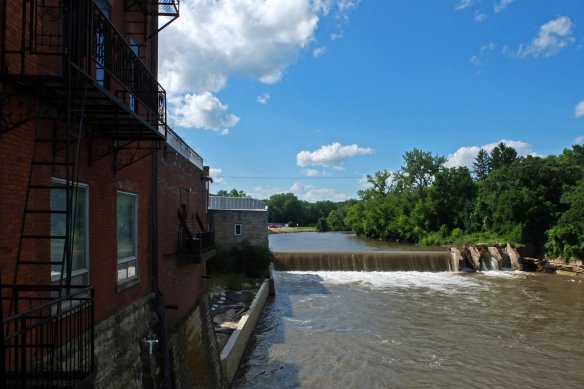
Seriously. I am NOT making this up. I’m talking about Elkader, Iowa, located on the banks of the Turkey River in Pony Hollow. Yes, that’s right — there’s actually a real place called Pony Hollow, through which the Turkey River runs. Elkader’s current population is about 1275, which is only about 800 people more than when the town was founded in 1846. Back then, it was nothing but a gristmill, a sawmill, and a blacksmith shop.

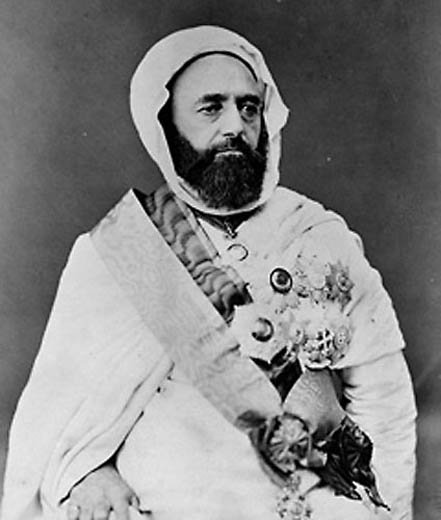
When the local leaders decided to name their new town, they chose to name it after one of the most respected men of the era: Emir Abd-al-Qādir ibn Muhieddine al-Hasani el Djezairi. He was a Sufi scholar, the Commander of the Faithful, a jihadist, an Algerian resistance leader, a poet, and a military leader.

Abdelkader

Abd-al-Qādir ibn Muhieddine al-Hasani el Djezairi

But you can’t name your town Abd-al-Qādir ibn Muhieddine al-Hasani el Djezairiville, no matter how much you respect the guy. Fortunately, he was usually just referred to as Abdelkader. So…Elkader. Which, let’s face it, is still a pretty odd name. So who was this guy? And why would Iowans name their town after him? I’m so glad you asked.

Abdelkader was born in Mascara, Algeria in 1808 (or somewhere around there — 19th century Algerian record-keeping left something to be desired). His father ran a religious school for Sufis, so it’s not surprising Abdelkader was a good student; he could read and write by age 5, and by 14 could recite the entire Qur’an by memory. When he was 17 he set out on the Hajj — the religious pilgrimage all Muslims are expected to make if possible. Afterwards he noodled around the Muslim religious and philosophical world for about five years. He was, it seems, something of a religious nerd.

elkader the dam

Elkader, dam on the Turkey River

In 1830, a few months after Abdelkader got home, France invaded Algeria. At that time, Algeria was ruled by the Ottoman Empire. France wanted to boot the Ottoman tyrants out of Algeria and replace them with…well, French tyrants. The people of Algeria weren’t particularly happy with Ottoman rule, but neither did they want to be ruled by the French. So Abdelkader found himself forced to shed his religious nerd role and start waging a guerrilla war against the infidel French. He became an Algerian nationalist.

And hey, he won. Sort of. For a while. He spanked the French, and at one point Abdelkader controlled a hefty chunk of Algeria. He established a benevolent theocracy; Jews and Christians were not only made welcome, they were given high government positions. He even earned the respect of the French soldiers who fought against him — not just as a warrior, but also as a kind and generous opponent. His treatment of French prisoners of war earned Abdelkader international praise. Although the French soldiers respected him, French leaders didn’t. They initiated a scorched-earth policy against the territories controlled by Abdelkader. The French destroyed the houses and farms of civilians, they burned the crops and slaughtered the livestock.

So after 17 years of fighting, Abdelkader surrendered. He was imprisoned in France for half a decade, then released on the condition that he never return to Algeria.

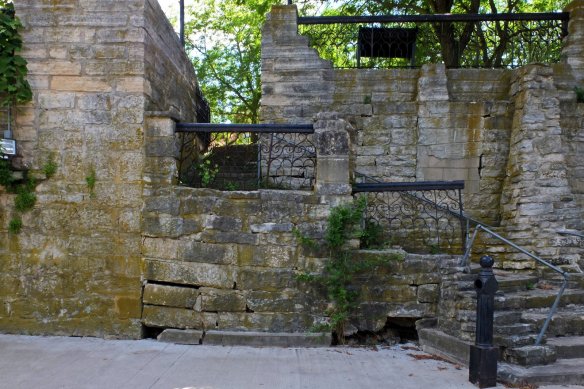
elkader stairs

Elkader, stairs to the river walkway

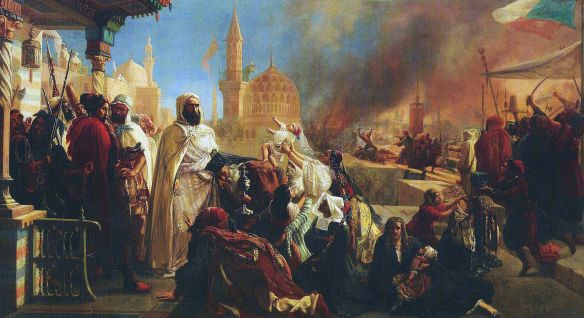
He settled in Damascus, Syria and lived there in relative peace. Then in 1860 a conflict between Muslims and Christians broke out in other parts of Syria. The fighting spread rapidly; almost 400 Christian communities were destroyed, and maybe 20,000 Christians were killed.

When the conflict reached Damascus, Abdelkader intervened. He and his children and his followers went into the streets and rescued local Christians at great personal risk. He brought as many as possible into his home and his gardens and his courtyard — nuns, merchants, laborers, artisans, any Christian who was in danger. And he kept them safe.

Abd-al-Qādir saving the Christians of Damascus

Abd-al-Qādir saving the Christians of Damascus

News of this spread, and Christians all over the world rushed to embrace Abdelkader. Greece bestowed on him the Grand Cross of the Redeemer (a poor grasp of irony, the Greeks). The Ottoman Empire issued him the Order of the Medjidie, First Class. The Vatican gave him the Order of Pius IX. The parliament of Great Britain sent Abdelkader a gold-inlaid shotgun. Not to be outdone, President Abraham Lincoln sent him a pair of inlaid pistols. Even France, which had imprisoned him and condemned him to exile, gave him the Grand Cross of the Légion d’honneur and offered him a pension (they didn’t let him return to Algeria, though — they’re French, not stupid).

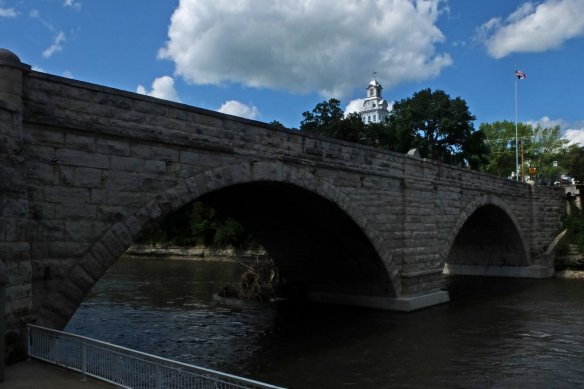
And in Iowa, they named a town after him. It’s not what you’d call a great town. It’s a tad beat-up. A little worn with age. Not very well-maintained. But the river is nice, and the bluffs that surround the town are picturesque. And they have a very fine stone bridge. Elkader is very proud of its bridge, and they want visitors to know it’s the largest stone double-arch bridge west of the Mississippi. Being west of the Mississippi is pretty important to the good people of Elkader; they also want folks to know they have the oldest continuously operated grocery store west of the Mississippi (Wilke’s Grocery, if you’re really curious).

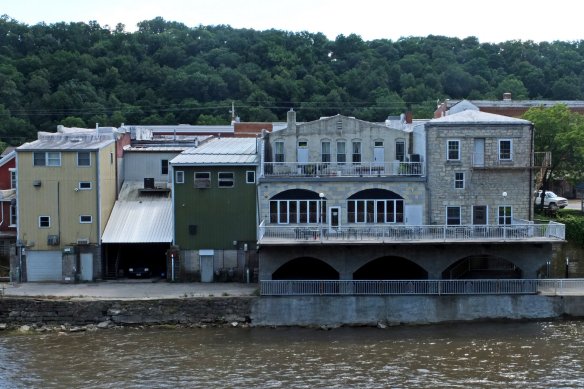
Elkader, houses along the Turkey River

Elkader, houses along the Turkey River

For the most part, Elkader is just another small Midwestern country town. But the guys who named it did a better job than they could have imagines. The town’s name draws a small but steady stream of Algerian visitors. Algerian immigrants, Algerians touring the U.S., second and third generation Algerian-Americans. They all come to see the Iowa town named for one of their national heroes. One Algerian-American came to visit, and decided to stay. He and his partner opened an Algerian restaurant — Schera’s. Did I mention this guy is not only Algerian by birth, but also a Sufi Muslim? And he’s gay.

Yes, there’s a gay-owned Algerian restaurant in a small Iowa town named after an Islamic insurgent. And the remarkable thing about that fact? It doesn’t seem to be that big a deal. Oh, sure, there are some local folks who dislike the name of the town, and tried to change it after the 9/11 attacks (Elkader, they complained, sounds too much like al-Qaeda). And yeah, there are some folks who dislike gay people. And yes, there are even some people who object to the ‘foreignness’ of the food served at Schera’s. But basically nobody pays much attention to the people who make a fuss. The town has always been called Elkader, gay folks have been legally getting married in Iowa for half a decade, and you either like Algerian food or you don’t. No big deal.

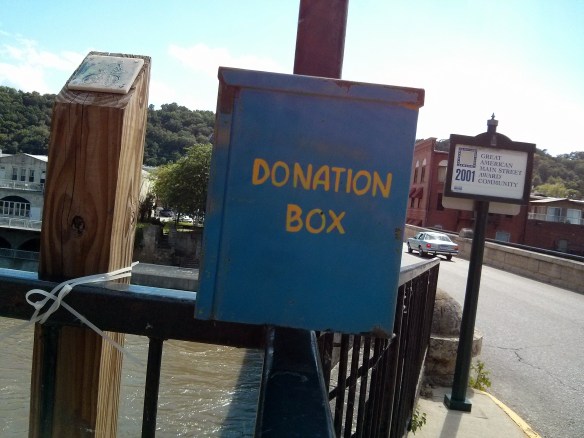
Elkader, bridge donation box

Elkader, bridge donation box

That’s just the way things are. They really are proud of their bridge, though, and with good reason. It really is a very fine bridge, east or west of the Mississippi. If you ever happen to find yourself in Elkader, they accept donations to maintain the bridge. Drop a buck or two in the box. It’s what Emir Abd-al-Qādir ibn Muhieddine al-Hasani el Djezairi would do.

impermanence

So there’s me, on the first day of Spring, noodling around the Riverwalk just as if I didn’t have anything else to do. And man, it felt like Spring. Bright and sunny, almost warm, fresh breeze. Bicyclists were out, and young mothers with strollers, and over the lunch hour all the employed people abandoned their offices and escaped the skywalk and hit the sidewalks with all the energy of spawning salmon.

So yeah, even though I had work that needed to be done, I was out walking. And here’s a true thing: you cannot walk along the Riverwalk without stopping occasionally and peeking over the balustrade to watch the river flow by. While I was doing that, I saw a milky white film of some sort, splashed out on the river. Who knows what it was — soap scum maybe, or chemical waste, or something organic roiled up by the snow melt rushing over the dam upstream. Whatever it was, my immediate reaction was disappointment and a mild distaste at the sight of it.

But then it sort of drew me in. It was almost hypnotic, the way the motion of the river shaped and reshaped the stuff, the way the color shifted with each tiny wave.

I must have watched this happen for a quarter of an hour. I can’t say it was pretty, but there was something compelling about it — something unexpectedly absorbing. The river, I knew, would shrug this stuff off, whatever it was. Even in the short time I was there, I could see the stuff gradually being disrupted by the current — broken up, disorganized, reorganized, and all while being forced inevitably downstream. There wasn’t a single moment when the stuff held a coherent shape.

I realized the only constant in this event was me. I was standing still. I wasn’t moving. I was the only fixed point in an otherwise unfixed occurrence.

So I left.

ridiculous and marvelous

There was a freezing mist in the air on Friday. Great weather for sitting inside — for the reading of books and the making of soup. It was wretched weather for driving or for walking, or for being outside at all. But because the freezing mist coated the entire area in a thin, barely perceptible but incredibly lovely casing of ice, outside is where I went.

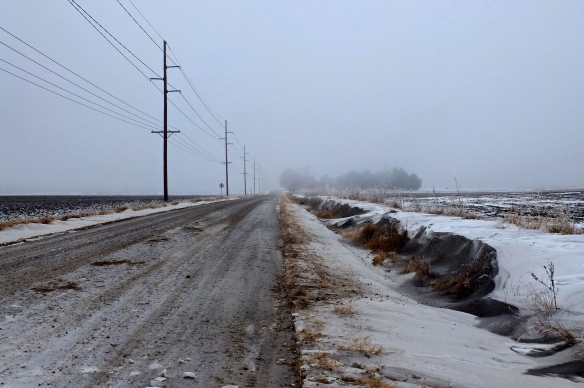
Driving on primary roads was treacherous, but it was relatively easy to drive on the secondary gravel roads that abound in the American Midwest. Gravel means traction, even in icy conditions. So that’s where I went. And this is what I saw.

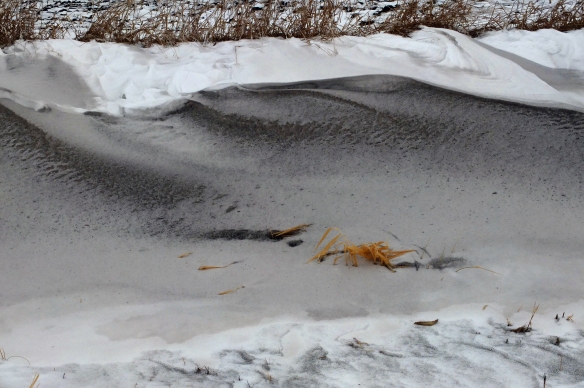
dirty snow

A great deal of nothing much. Eighty-five thousand years ago a glacier pushed its way through here. It hung around for about seventy thousand years, then gradually withdrew. It left behind a landscape that alternates between rolling hills and large swathes of flat terrain. Farmland. Good for growing things; not much to hold the eye.

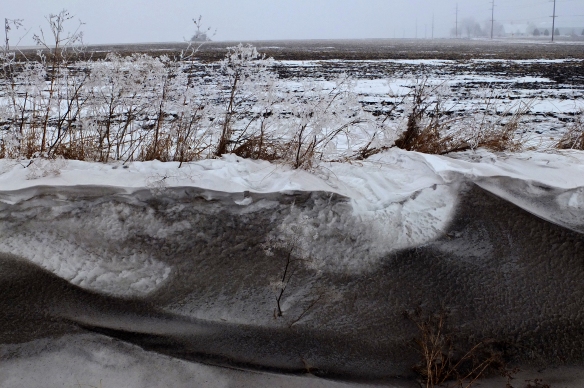
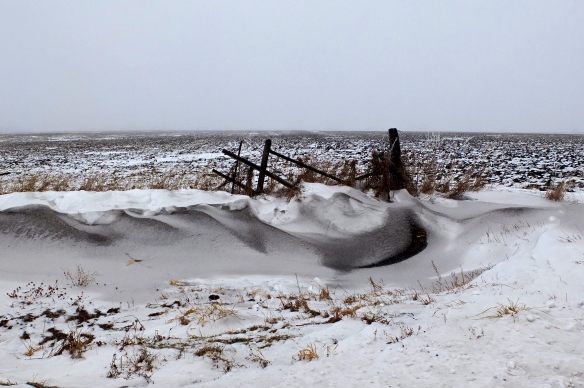
Or so it seemed at first. As I drove down this gravel road I found my eyes drawn to the ditch. At first I gave my attention to the ice-coated weeds, but I quickly found myself more interested by the wind-sculpted snow, and the abstract patterns created by the windblown topsoil.

topsoil

There’s an East Asian form of ink-and-wash painting that’s generally referred to by the Japanese name sumi-e. Other East Asian cultures practice the art, and they each have different names for the style. The Chinese (who likely invented it) call it shui-mo hua; in Vietnam it’s called tranh thuỷ mặc, and it’s sumukhwa in the Koreas. There are minor differences between the styles, but in general the techniques and the approach are the same.

In essence, sumi-e paintings are created using subtle gradations of black ink diluted by water. The approach attempts to interpret the spirit of the subject rather than to create an accurate representation of it. If, for example, the painting was of a duck, the artist would be more concerned with instilling it with duckness — with a sense of the way a duck moves, with that absurdly duckish dignified waddle — rather than with a detailed illustration of the bird. There are variations of the style in which color is used, but in its purest form it’s just black and white and spirit.

more dirty snow

As I drove along, stopping periodically to get out of the car and walk the ditch, I realized I was seeing a sort of organic sumi-e. Not in the sense that some Cosmic Artist was at work interpreting the spirit of the wind along a quarter-mile stretch of earthen canvas, but in the sense that the wind itself had revealed something of how it moved, and did it largely in black and white.

The thing I found most intriguing, I think, was that the beauty of the dirty snow wasn’t limited by scale. I found the same delicate shading, the same unexpected lines and shapes, the same beautifully uneven distribution of soil whether I was looked at an area of a few inches or several yards.

gate

I suppose I was out exploring the freezing mist for about ninety minutes. I spent maybe fifteen minutes getting out of town and finding that road, and another fifteen getting back to the warm, dry house. The other hour was spent rambling down a quarter-mile stretch of gravel road, looking at dirty snow in a ditch.

I’ll be meeting my brother for breakfast this morning, and at some point he’ll ask me what I’ve been up to. And when I tell him I’d spent an hour out walking in the freezing mist, getting cold and wet, looking at a ditch, thinking about glaciers and East Asian art and unevenly distributed bits of soil, I know he’ll grin and shake his head — because it sounds ridiculous.

And maybe it is. But we live in a wonderfully ridiculous world, and even in a great deal of nothing there’s a lot to see.

straight to the heart

A little over a year ago, while taking a walk along the river, I noticed a sketch of a woman’s face on a bridge abutment. To my surprise, it turned out to be a sketch of Louise Brooks.

Sketch of Louise Brooks, August 15, 2012

Sketch of Louise Brooks — August 15, 2012

Last Thursday I found myself walking along that same stretch of river again. I’d walked by that bridge abutment several times over the last year, but it was almost always inaccessible. In the winter, ice made that part of the riverwalk unsafe, and it was blocked off. Then for several weeks in the spring, the area was flooded and much of the riverwalk was under water. At one point the river covered half the balustrade. The area was also closed much of the summer to complete the final phase of the multi-year riverwalk redevelopment project.

Ice, flooding, weather, construction work — it seemed unlikely the sketch would have survived the events of last year. But it did. Barely.

Louise Brooks -- September 5, 2013

Sketch of Louise Brooks — September 5, 2013

All that remained was a faint trace of the original sketch. Just the suggestion of eyes and lips, just a hint of the shape of her hair — that distinctive flapper bob. It would be easy to overlook the sketch, if you didn’t know it was there.

I was ridiculously pleased to see it again. It’s not just that I’m fond of the sketch, though I am. It’s that I feel some sort of strange connection with whoever made the sketch. I’ve no idea what prompted that person to make a portrait of a once-famous figure on the abutment of that bridge, but I can’t help feeling as if I was the intended audience. Not me specifically, of course, but surely the artist must have hoped somebody would see the sketch and recognize that face and appreciate it.

louise brooks2

It’s all so improbable. Improbable that somebody would sketch a portrait of Louise Brooks on the side of a bridge in Des Moines, Iowa. Improbable that I’d recognize her face. Improbable that Louise Brooks lived the life she did. Improbable that the sketch would still be there after a year.

It’s all so improbable — and it’s so perfectly poetic. In 1989, four years after her death, biographer Barry Paris wrote this about Louise Brooks:

Nobody burned more bridges than Louise Brooks, or left prettier blazes on two continents. People around her scrambled for cover, but she watched the flames with a child’s pyromaniacal glee…. With the advent of talkies, her name would largely disappear, but her face would not: a girl in a Prince Valiant bob, with electrifying eyes that drilled straight to the heart from the silent screen and left you weak when you met their gaze. Eyes that beckoned not so much ‘come hither’ as ‘I’ll come to you.’

Her name would largely disappear, but her face would not. Barry Paris was right. It’s still there, fading gradually.

Louise Brooks

Louise Brooks