the women’s march — seven years ago

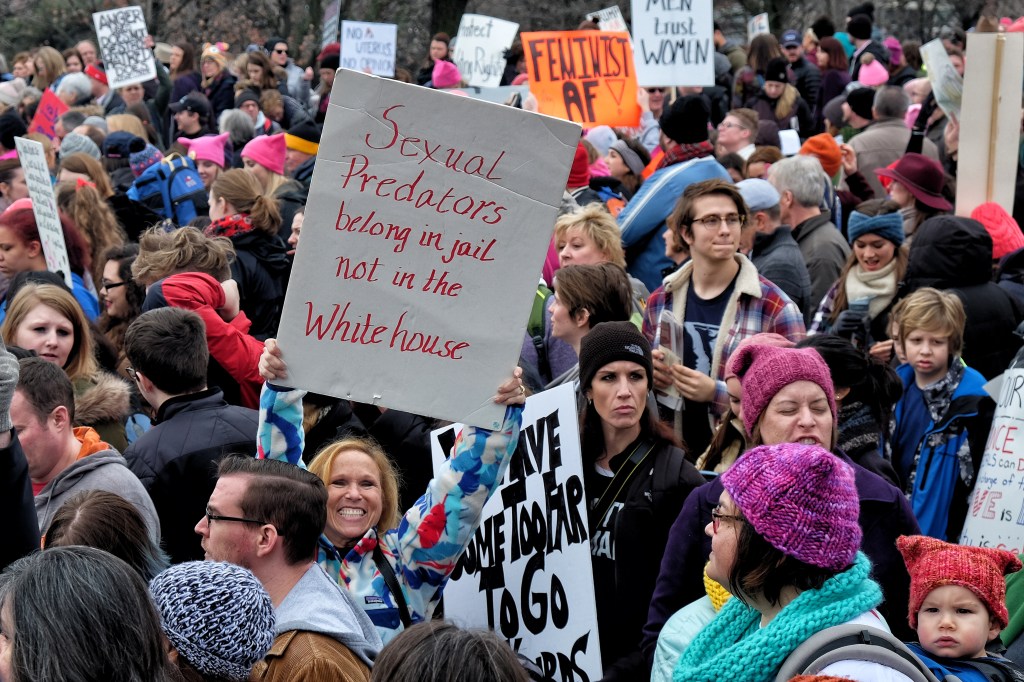
Seven years…seems like a lifetime. Donald Trump, with the aid of Vlad Putin, had been installed in the White House. Women decided to protest.

It was really that simple—which is to say it wasn’t simple at all. It was a spontaneous desire to protest, but it took incredible coordination by a group of volunteers. The original plan to march in Washington DC expanded to other major cities, then to more modest cities, then to small towns. In fact, there were satellite protest marches across the globe. There are no truly accurate numbers, but it’s estimated that in the US more than five million people marched that cold January day. That was a little over 1% of the US population. It was, in the end, the largest single-day protest in US history.

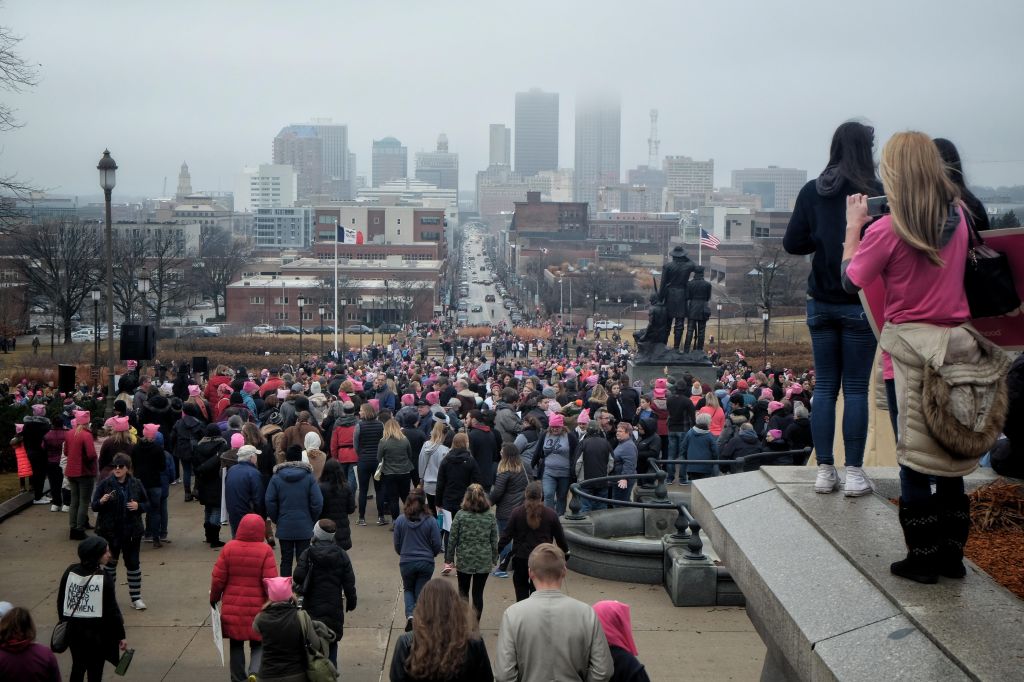
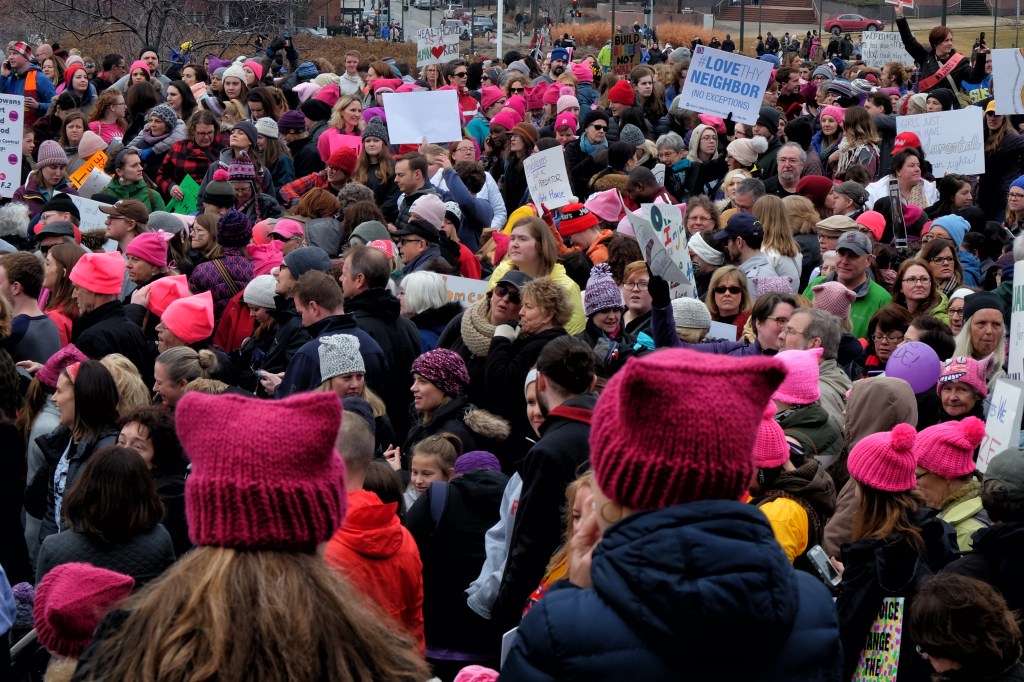
The crowd began to gather. We hoped to get 6000. We got 26,000.

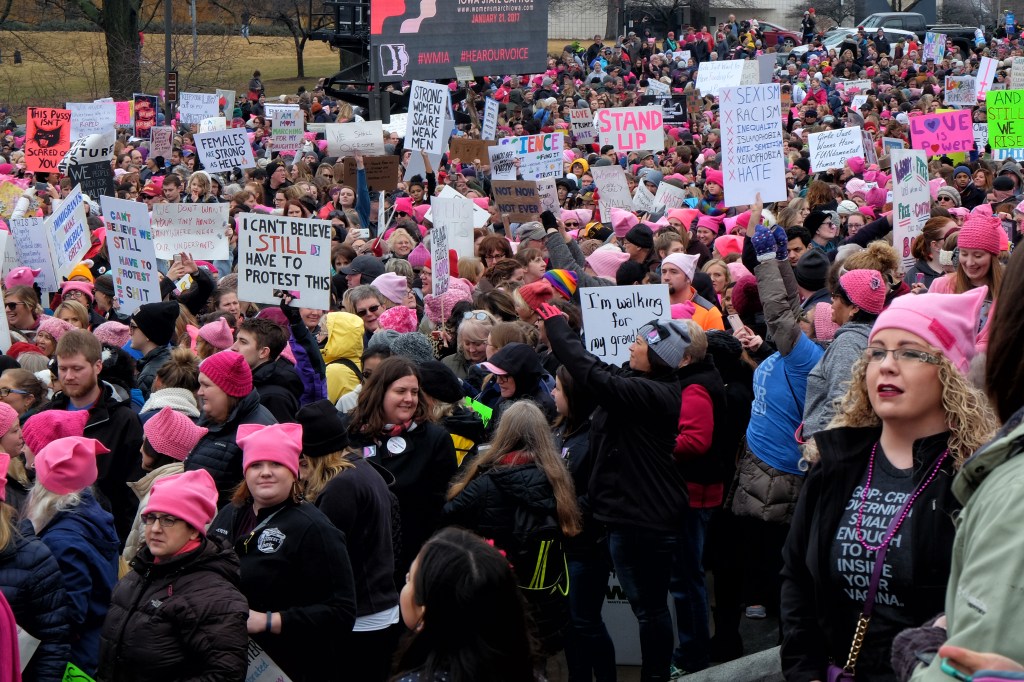
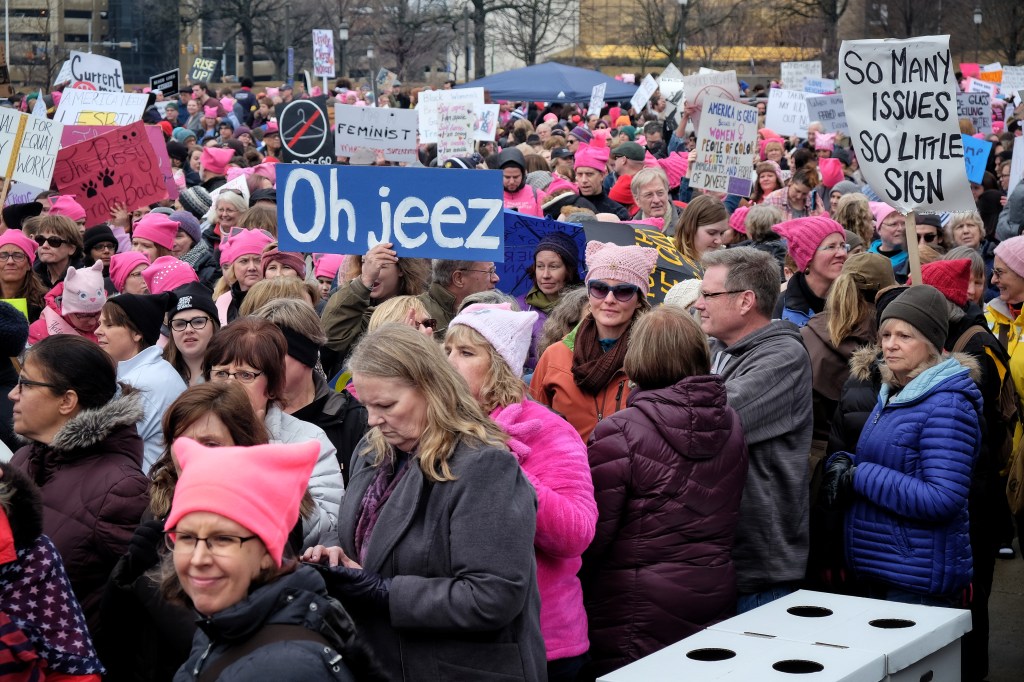
A couple of women in Los Angeles had an idea to create a hat that would not only help marchers stay warm, but would also be a visual statement of protest against a man who bragged women would allow him to “grab them by the pussy.” The pink pussy hat idea was flawed (it didn’t represent women of color or trans women) and was later abandoned as a form of protest, but on that day it provided a singularly powerful visual and emotional impact. It was, in a way, a sort of counter MAGA red baseball cap. The hats were also an example of the fundamental opposition to Trump; the vast majority of the pink pussy hats were made by hand by volunteers—often by personal friends of the marchers themselves.

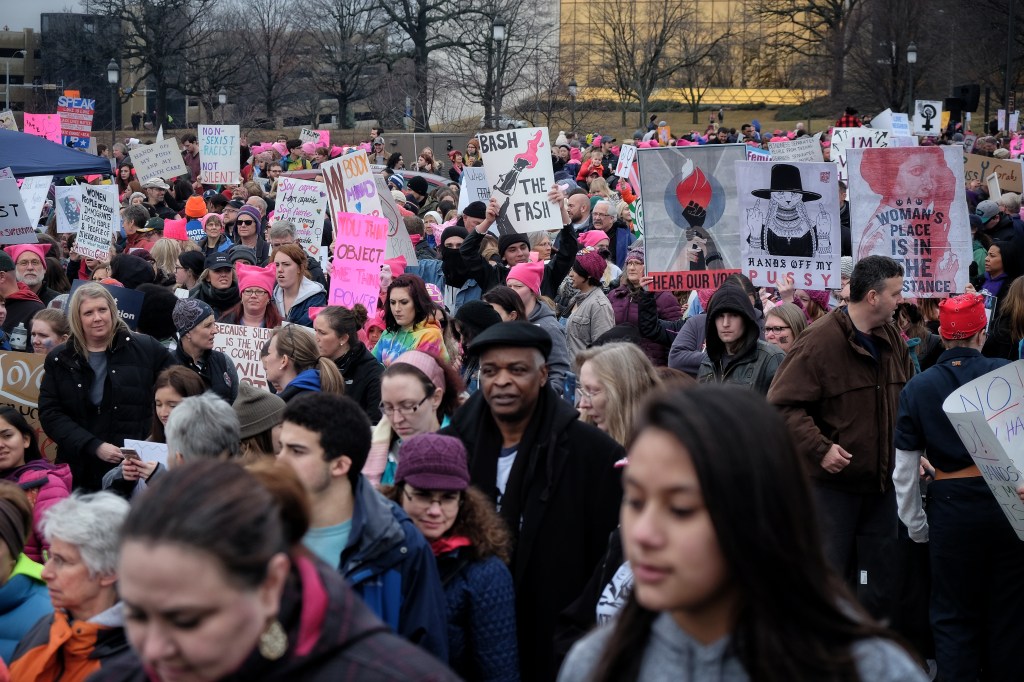
Listening to music; waiting for the speeches to start.

I marched in Des Moines, Iowa. Originally, the organizers thought we’d have a couple of thousand marchers. Later, they hoped to have maybe 6,000. Then they thought it was possible for 10,000 to show up. According to the local newspaper the final estimate was approximately 26,000. (I wrote about the march and the pussy hats a couple days later.)

Oh Jeez

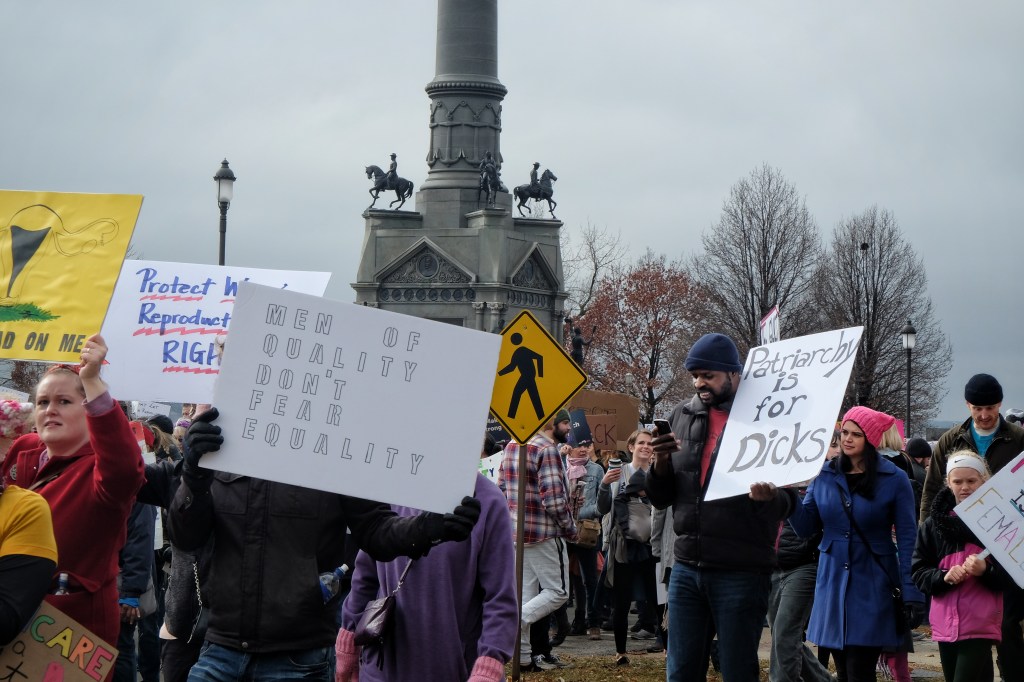
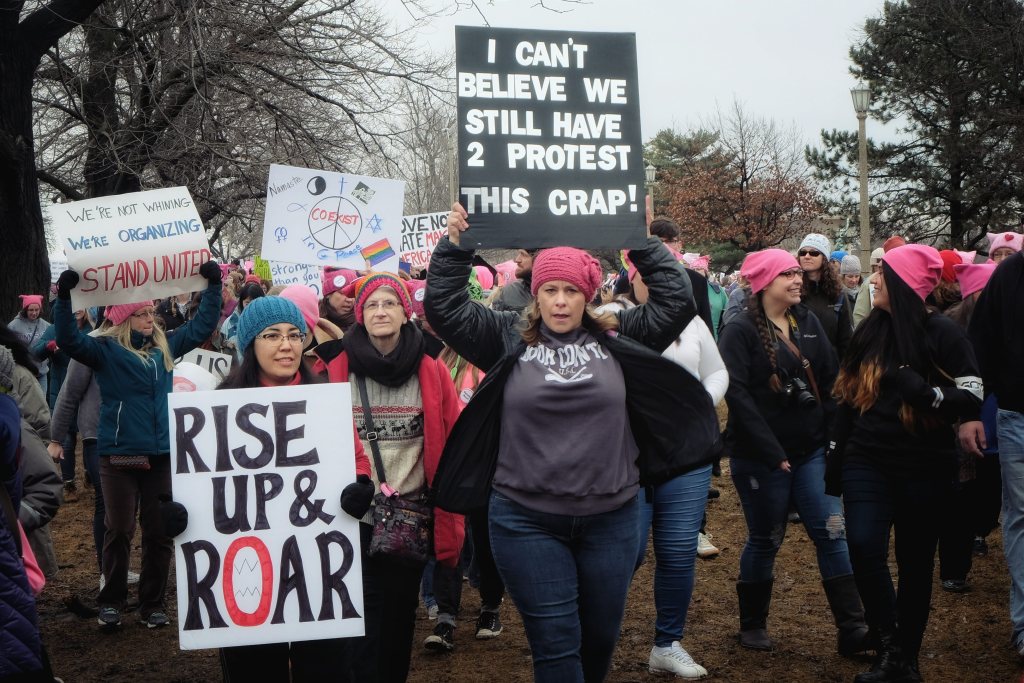
It was mostly women and girls, but a lot of men showed up as well. All ages. It was as racially diverse as Iowa gets (which, let’s admit it, isn’t terribly diverse). Abled and disabled. We gathered at the Iowa state capitol building. There was music, there was food and hot coffee, there were speeches, there were spontaneous chants, there was singing, and then we…well, marched. I use the term ‘march’ rather loosely. We basically hiked around the capitol grounds. Because this is Iowa, the march itself was far more polite than the signage and the chants; we didn’t block the streets, we didn’t get into any punch-ups with the very few counter-demonstrators, and we didn’t leave a mess for other folks to clean up.

Patriarchy is for dicks.

I suppose the march officially ended when we’d returned to our original location, but few people left at that point. It may have been anger and concern that sparked the march and brought us all together, but once we’d gathered there was a pervasive sense of togetherness that everybody seemed reluctant to dismiss. There was a sense of hope, a feeling that if we all acted together—if we all worked for each other—we could mitigate the harm we fully expected to come from a Trump administration.

Not in the White House

We were so innocent. Trump was—and still is—worse than we could imagine. He’s done more damage than we thought possible. He had—and still has—more support for his authoritarian, anti-democratic, racist, misogynistic, vindictive agenda than we could conceive. I don’t think any of us had any idea of just how ugly, how hateful, how mean-spirited Trump’s supporters would be. We certainly didn’t anticipate how persistently and aggressively they’d attack long-held civil rights and liberties. We were so terribly innocent.

We’ve put away those hats, but we’ve kept the righteous anger.

It’s been seven years since the March. And we’re tired. Physically tired, emotionally tired, spiritually tired. We’ve put away our pussy hats (I still have mine—made for me by a friend, Kim Denise—stashed in a drawer), and rightly so because they weren’t inclusive. Our confidence in the benefits of protest has eroded; our confidence in our system of governance has been abraded by constant aggressive assaults by right-wing hate.

Bash the Fash

It’s fucking hard to be optimistic. The March itself, which was a buoyant expression of righteous anger and determination, has become a prolonged grind. It feels like the coming election will determine whether it’s possible for the US to recover from Trumpism.

Believe it.

So it doesn’t matter that we’re tired. We know what we need to do. We don’t need to gather together in person and march again, we don’t need pussy hats, we don’t need clever signs or chants. What we need is pretty simple. We need to gather together in spirit and tell Trump and all his enablers and supporters to go fuck themselves.

Just like the March itself, it’s that simple. Which is to say it’s not simple at all. But it’s necessary.

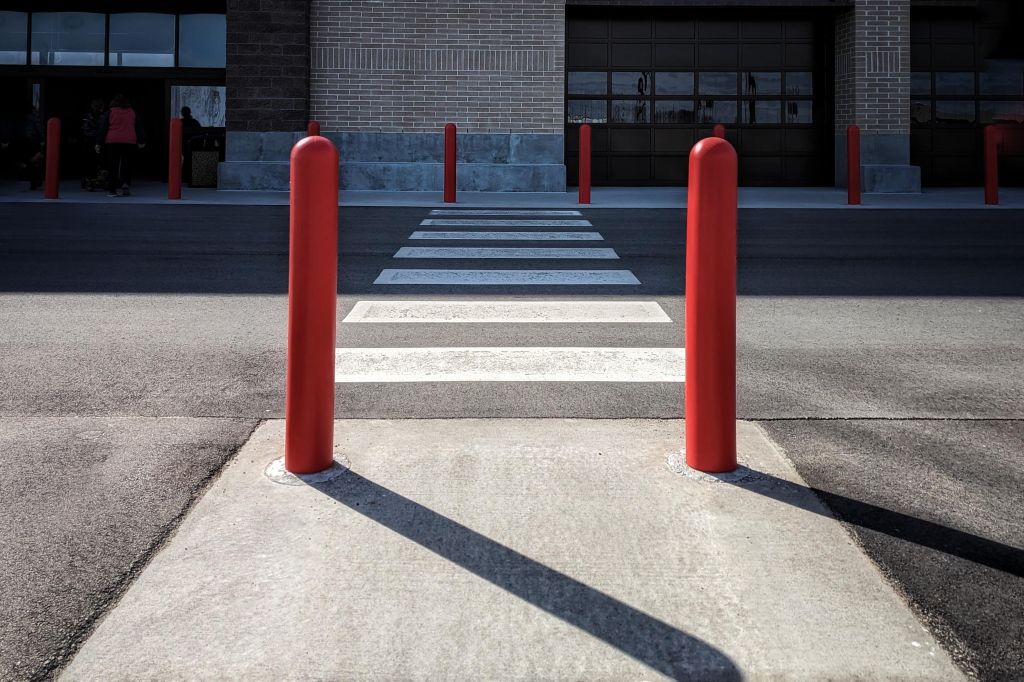
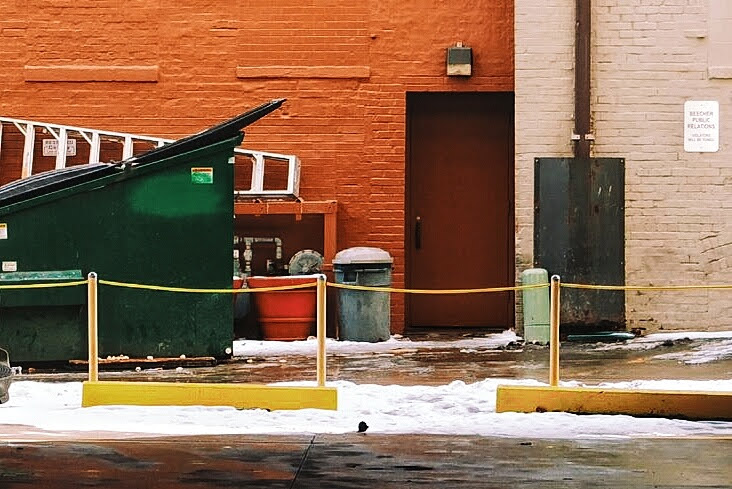
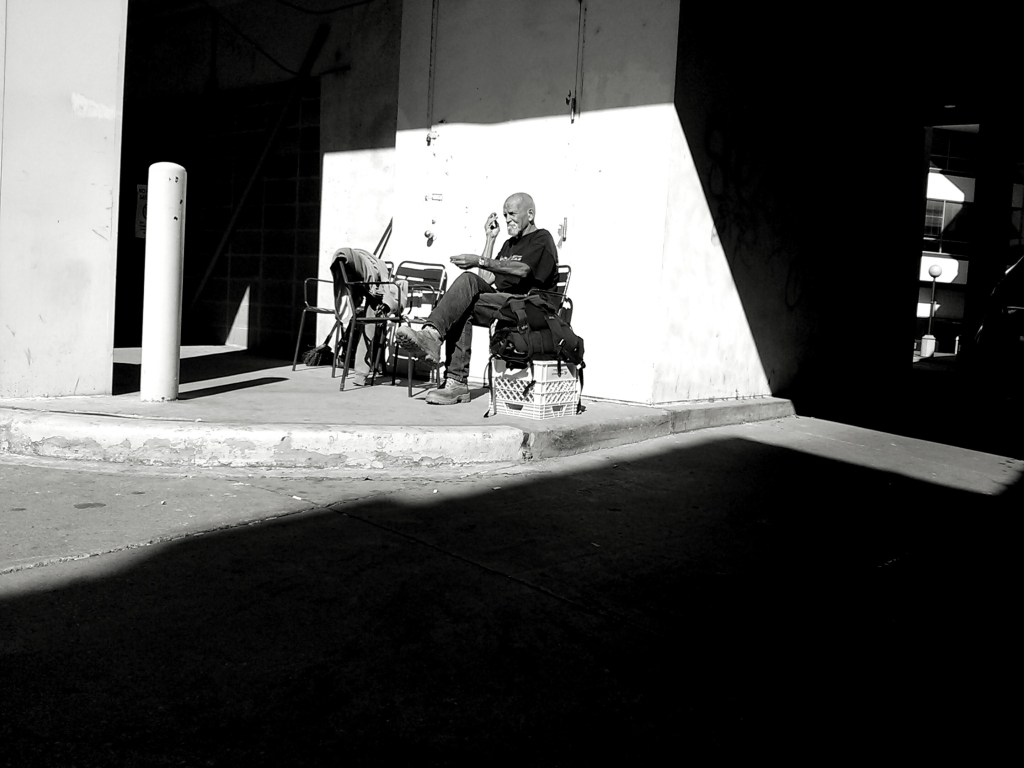
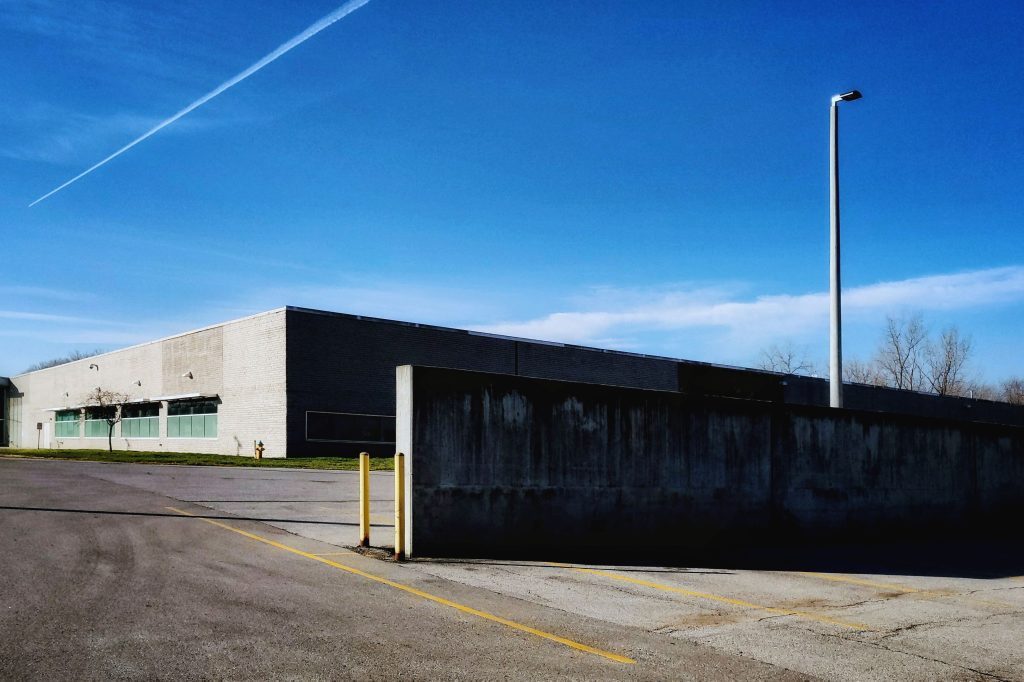
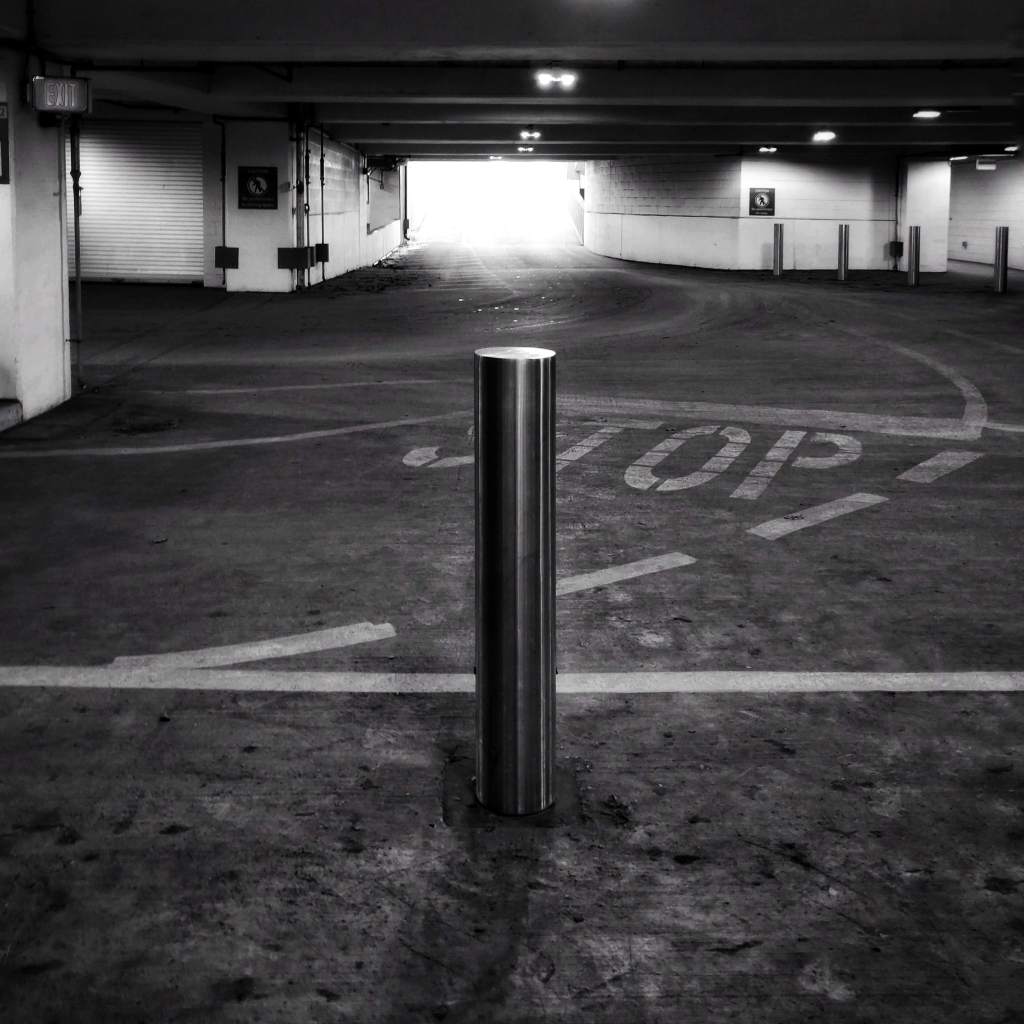
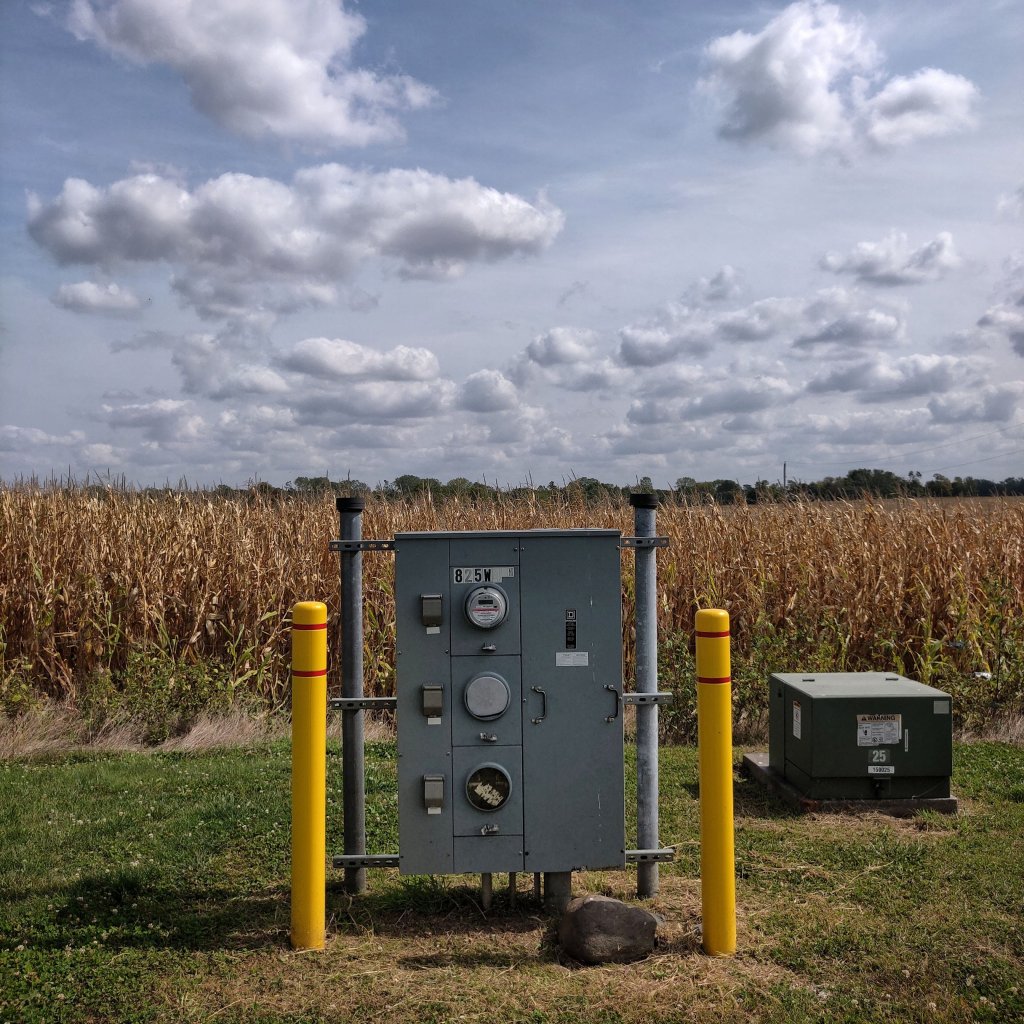
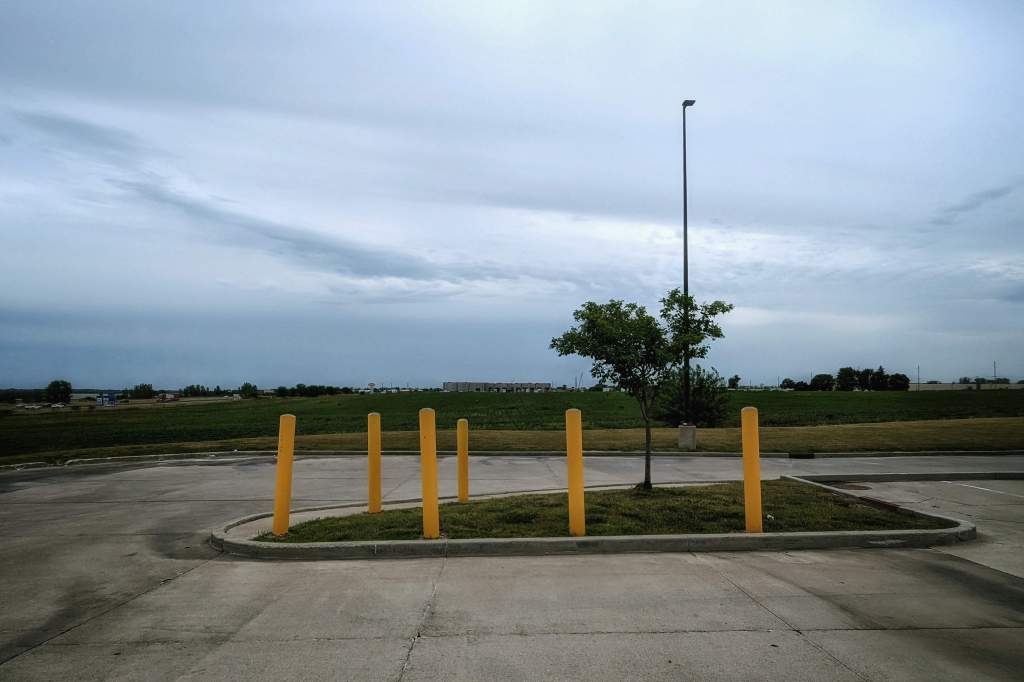
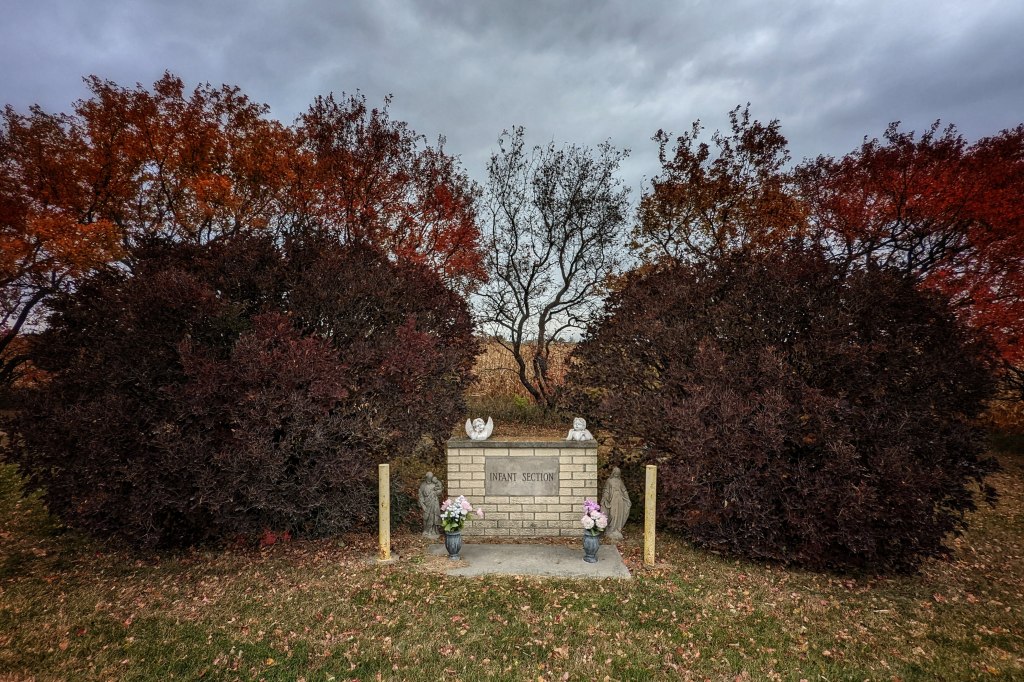
yes, i have a thing for bollards

I don’t know when it started, this thing for bollards. Out of curiosity, I did a quick search through my digital photographs and found a photograph of a bollard from 2007. I know I’ve shot photos of bollards with film cameras, including instant film cameras. I’ve photographed them in color and in black-and-white, in several formats (square, 3:2, 4:3), in all sorts of environments, in all manner of weather, using whatever camera I happened to have at hand. So yeah, my bollard fascination has been active for at least a couple of decades.

Why bollards? No idea. I mean, sure, I can come up with lots of justifications for why I photograph them. They’re an interesting compositional form. They’re often present in uniform groups, so there can be a nice repetitive element to them. They’re frequently painted in bright colors—and when they’re not, when they’re old and battered with weathered paint, they can add a sort of wabi-sabi aura to an image.

But like I said, those are justifications for including them in a photo. The fact is, I’ve no idea when or why bollards as a concept attached themselves to my brain like some sort of remora. What’s weird—well, one of the many weird things—is that so many other folks are aware of my interest in and affection for bollards. I’ve had friends from all over the globe shoot and photographs of the local bollards they encounter just for my interest. Do I talk about bollards that much? I guess I must.

Maybe my interest in bollards attracted the attention of other folks partly because so many people had no idea that all those banged up ‘posts’ they see everywhere every day actually have a name. Bollard, it comes from the Old Norse term bolr, meaning “the trunk of a tree”, and the suffix -ard, which generally acts as an attributive pejorative intensifier (as in ‘coward’ being one who cowers, or ‘drunkard’ being one who is often drunk, or even ‘bastard’ which originally referred to “someone conceived on a pack-saddle” (French bast), since they were used as makeshift beds).

Originally, bollards were tree trunks used by Vikings to moor their ships and boats. Over time, the term was used to describe the posts on docks used for that same purpose. By the early 1700s, urban bollards began to be used to constrain horse and wagon traffic. Now the term bollard is applied mostly to posts used to protect objects (or people) from being struck by carelessly driven vehicles.

Bollards are everywhere. The fact that they’re ubiquitous makes them almost invisible. Unless, of course, you look for them. Some bollards are decorative—brightly colored or metallic and shiny. Some are sort of disguised; there’s a small, family-owned ice cream joint not too far from where I live that has bollards shaped like ice cream cones. But most bollards are plain, unadorned, simple, practical, utilitarian. They’re not there to please the eye, but to serve a purpose.

In my mind, bollards are sort of heroic. Yes, that’s right…I’ve romanticized bollards. I find a weird, sad, lonely, powerful beauty in them. They may be weather-beaten, banged up, isolated and ignored, damaged, with chipped paint, but they’re still standing there, doing their job. Protecting stuff.

No matter how abused or battered they are, bollards provide the illusion of permanence. They’re fucking solid. But at the same time, the very fact that they’re so often damaged exposes the lie of permanence. Bollards will stand a very long time, but eventually they’ll be removed and replaced. And very likely, nobody will notice when that happens.

I’m also attracted to bollards because they’re excellent examples of the humanness of things. They’re thoughtful, deliberate infrastructure. Somebody deliberately put them where they are. Somebody decided there was something that needed to be protected, and chose a specific type of bollard to be placed in specific patterns to keep that ‘something’ safe. The humanness of things is always there, if you look for it.

So, yeah, bollards. They’re not pretty. They’re common, unrefined, even crude. They don’t need your respect. But they deserve it.

…and be there

F/8 and be there. That’s the classic photographer’s maxim. It’s usually attributed to Arthur Fellig (better known as Weegee), though it’s highly unlikely he actually said it. Weegee was famous for what was called ‘spot’ or ‘moment’ photography in the 1930s and 40s. He made it his business for being at the right spot for newsworthy moments and being prepared to photograph them. A camera aperture of F/8 is generally considered an all-purpose aperture; it allows in enough light for a decent exposure while providing a relatively broad depth of field. So how do you get a good ‘spot’ photo? F/8 and be there.

In fact, Weegee routinely shot most of his famous photos with his massive 4×5 Speed Graphic camera set at F/16 or F/22. Not that the actual aperture he used matters. What matters is the concept is solid. Be in the right spot with usable camera settings, and you’ll probably get a good shot.

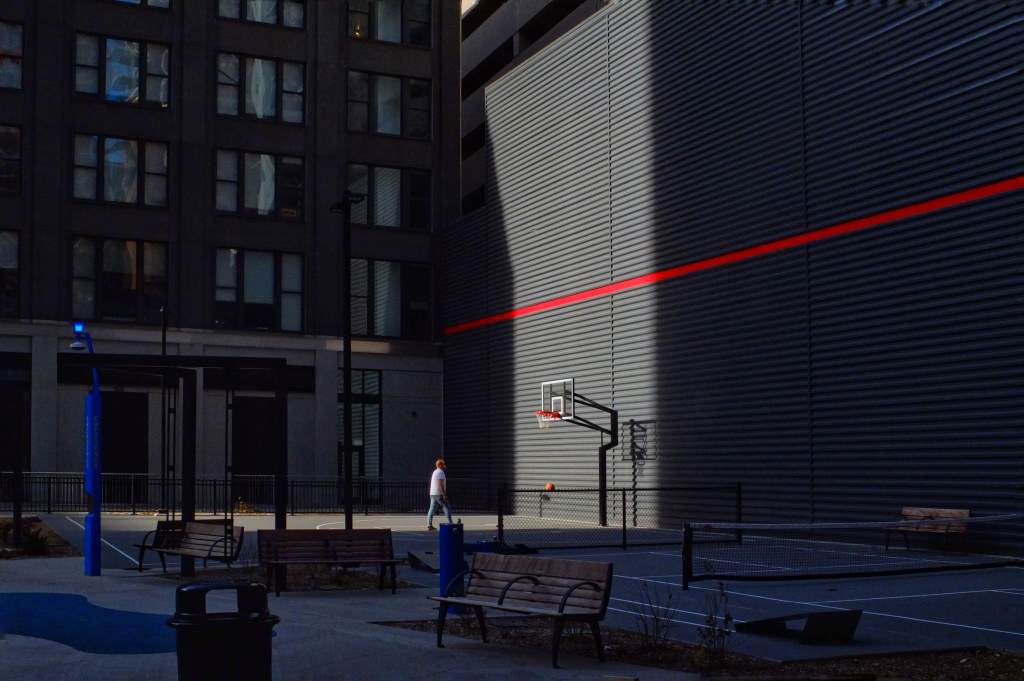
Me, I had my 12-year-old Fujifilm X10 set to F/5.6 in case I came across some random right spot. I was just idly wandering around the city when I heard the distinctive sound of a basketball being dribbled. I followed the sound. There’s a small urban recreation area in Des Moines with a single pickleball court, a ping pong table, a few tables set up for chess and backgammon, and a basketball half-court. This is what I saw when I came around a corner.

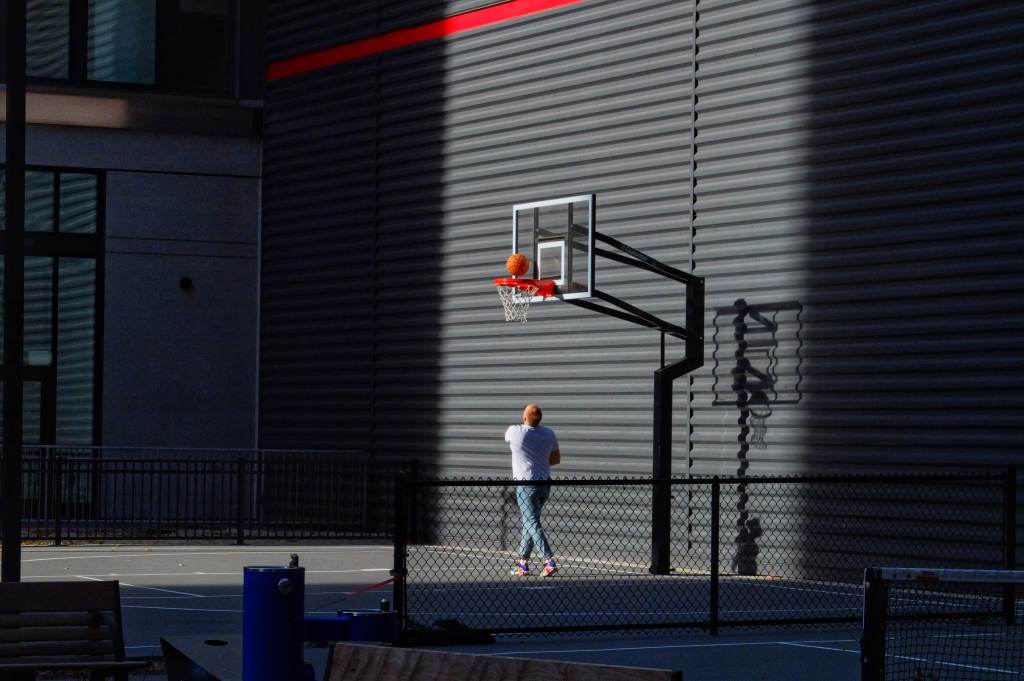
There was a guy, all by himself, dribbling a basketball, juking around imaginary defenders, shooting baskets. He was in the shade and almost invisible, but the setting itself was so stark and had such a startling red stripe that I turned on my camera and kept approaching, hoping he’d move into the sunlight. And he did.

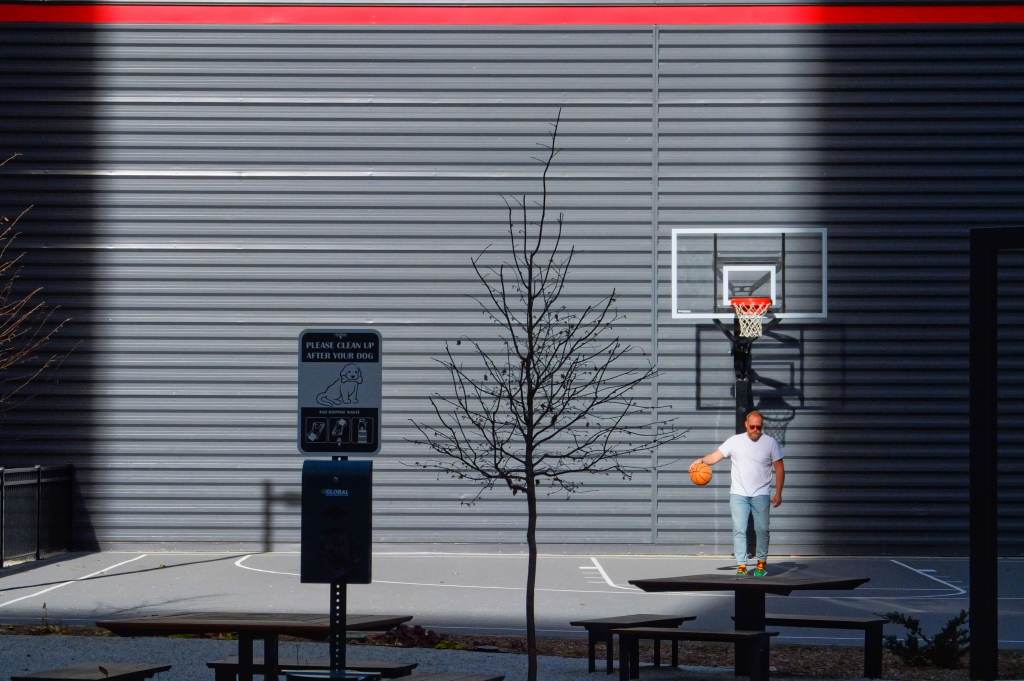
I kept edging closer. I refused to look down to double-check the camera settings for fear he’d move into the sunlight and I’d miss the shot. He kept dribbling and juking and shooting, and every time he moved into the sunlight, I snapped a photo.

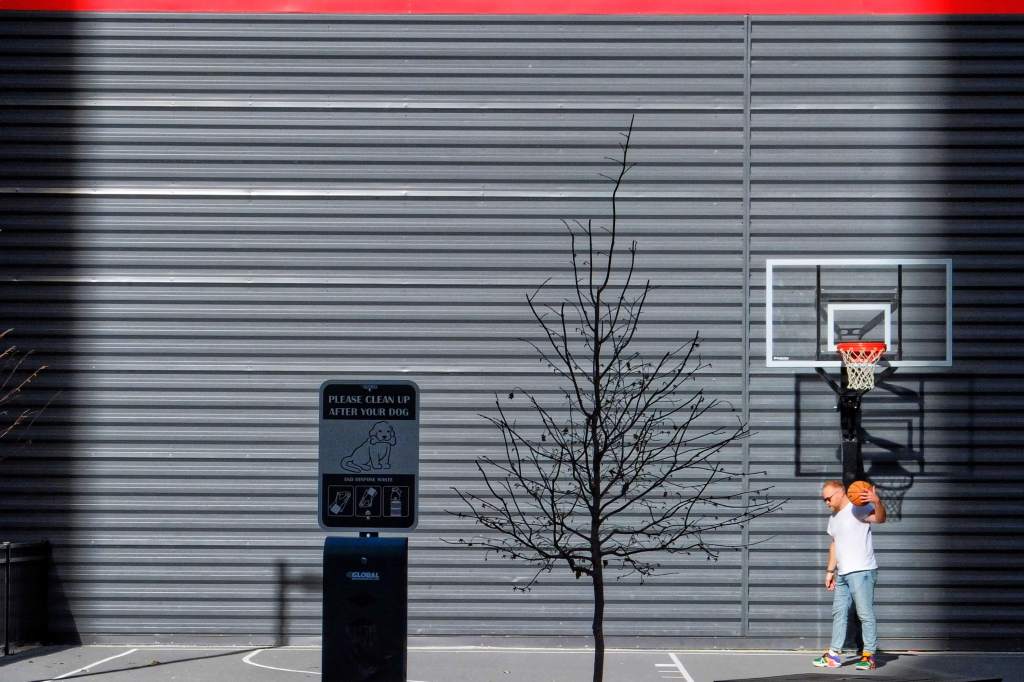
I only got five shots before he stepped into the shadow to check his watch. Then he put on a jacket, collected his basketball, and walked off. My first shot was as 12:44, the last at 12:45. Two minutes at most. Probably closer to seventy or eighty seconds, most of which was spent walking forward, camera ready, trying to maneuver the guy into the sunshine by wishing really really hard.

Once it was clear the moment was gone, I started desperately chimping* my camera’s playback, hoping I’d managed to get at least one shot that was worthwhile. In one of the shots, the guy was too obscured by the shadow. The other four? They all turned out.

Are they great photographs? No. But when you’re shooting a photo, you generally have an idealized version of the resulting image in your mind. These four photographs are pretty much what I was hoping they’d be. Pretty much. I have some niggling complaints about the final photo, but overall I was ridiculously pleased.

Photographing some random guy shooting baskets on his lunch hour is a small thing. But it’s the sort of thing that keeps photographers walking around with a camera. There’s a definite dopamine jolt when you get the shot right. It doesn’t even matter what the shot is about; you just want to recreate that feeling again. That’s exactly why I was idly wandering around the city and exactly why my camera set to my default daytime aperture of F/5.6.

I’m no Weegee, but I want to be ready when I’m there, wherever there happens to be.

EDITORIAL NOTE: Chimping, for non-photographers, is the act of looking down at the screen of your digital camera while reviewing the shots you’ve just made, and making chimp-like “Ooh ooh” noises as you do it.

a tale of two railroad crossings

Okay, the title is a lie. There’s only one railroad crossing in this story. But the title was too good to pass up. Sue me.

Lately we’ve been seeing a lot of Nazi shit again. Some of it’s related to the appalling situation in Israel, of course, because Nazis will always find some way to contribute to whatever hate is taking place. Some of it comes from the Republican Party.

Seriously, the leadership of the Texas Republican Party voted 32-29 to reject a resolution saying members of the Texas GOP should “have no association whatsoever with any individual or organization that is known to espouse anti-Semitism [sic], pro-Nazi sympathies, or Holocaust denial.” They didn’t say it was fine to hang out with Nazis; they just decided hanging out with Nazis wasn’t important enough to make a fuss over.

You may be wondering, Greg, old sock, what’s that got to do with railroad crossings? I’m about to tell you.

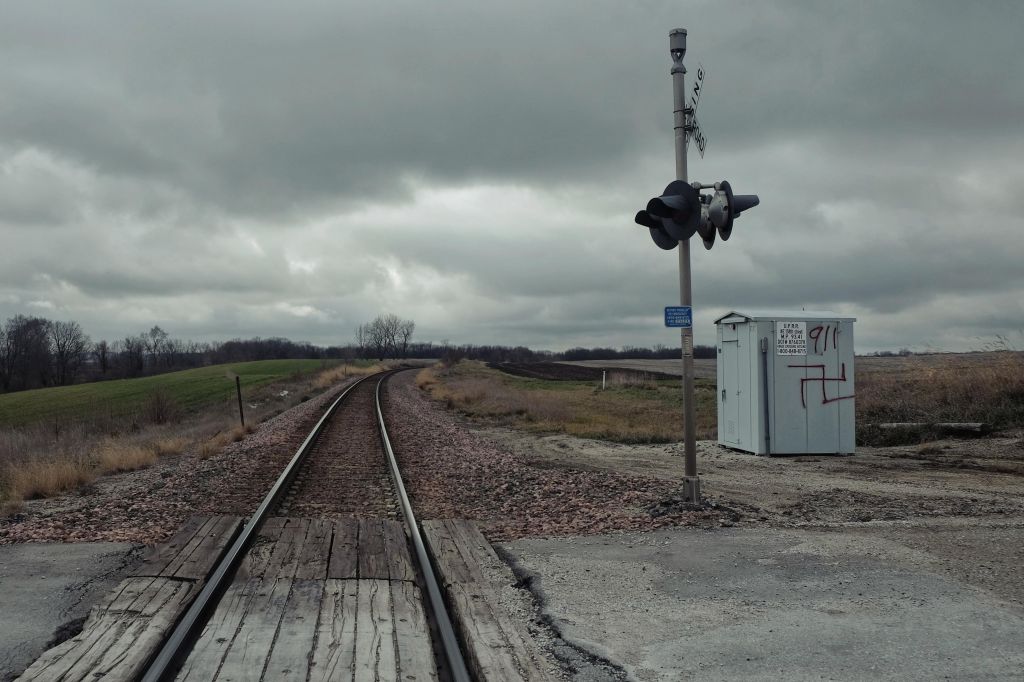
A few years ago I was out noodling around in the countryside and happened across a swastika painted on a shed beside a railroad crossing. So I did what anybody would do. I stopped and took a few photographs of it.

It was one of those cold, drizzly, dreary December days, which made for a nicely dramatic photograph. I only took three or four shots (because it was cold, drizzly, and dreary). Just as I was about to get back in the car, a sheriff’s deputy arrived. I waited and waved. He got out and politely asked me what I was doing. I told him I was shooting photographs. In the past, I’ve had a few encounters with the police who wanted to see my photos, so I prepared myself to refuse that request (you know…just on principle). Instead, he said something like, “I hope you got your shots, because I’m here to paint over that swastika.”

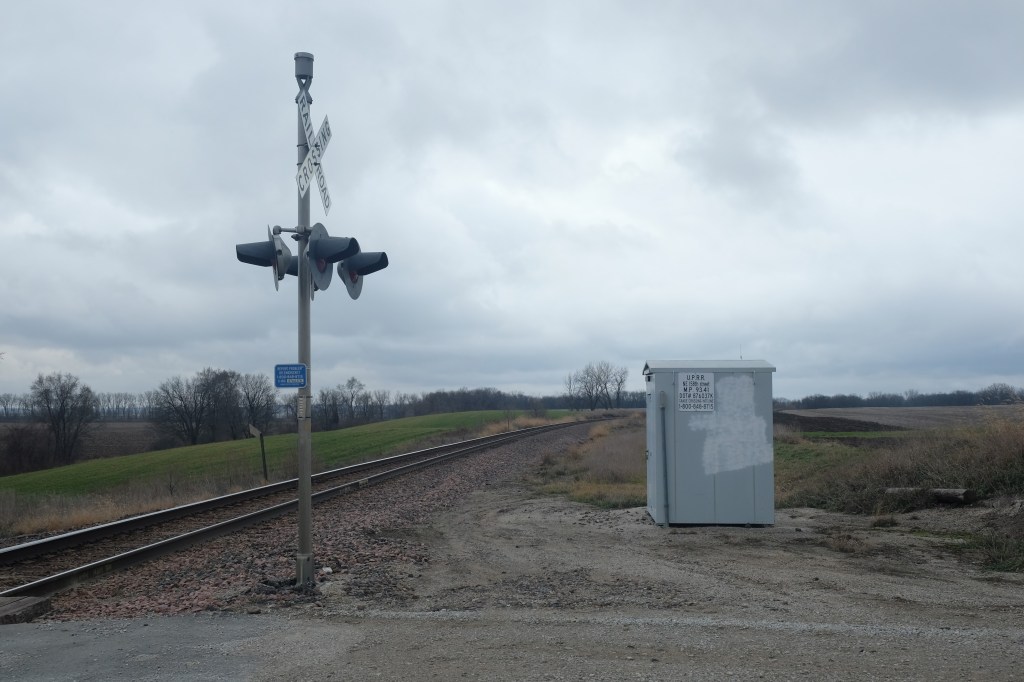
I asked if I could photograph him doing that. He said he’d rather I didn’t. And because he was polite, I didn’t. I got back in my car and left. But I returned about twenty minutes later.

The deputy was gone. So was the swastika. It’s certainly not as interesting as a photograph, but socially and culturally, it’s a huge improvement.

I don’t know if somebody reported the swastika or if one of the local deputies spotted it while on patrol. But I was pleased that the sheriff’s office acted.

EDITORIAL NOTE: I was a criminal defense investigator for several years, which meant I was in an openly adversarial relationship with policing agencies. I don’t fully ascribe to the ACAB (all cops are bastards) view, but I’m painfully aware that all police officers have the capacity to be cast-iron bastards and often are. Because of that, I’m quietly thankful when I see any law enforcement person actually contributing to public safety without being a bastard about it.

return of the fujifilm x10

This is what happened. At some point over the last few months I began to miss the feeling of using a camera. I missed holding a camera in my hands. I wasn’t dissatisfied with my phone; it takes excellent photos. But it’s not the same; it’s a multi-use device that also happens to take photographs. I missed using a tool designed solely for the purpose of making photographs.

So a couple of weeks ago I opened up a cupboard and looked at all my abandoned cameras. I don’t have a camera collection; I just have some cameras I’ve stopped using. Some are film cameras, some are digital. I picked up a few and handled them. It was one of those Goldilocks moments; this camera was too big, this one was too heavy, this one would require a substantial investment in film and processing.

I pulled out the last camera I’d bought–a Fujifilm mirrorless camera. I was surprised to find the battery still had a charge. So I shot a few frames around the house. It felt awkward in my hands. Worse, I’d forgotten all the familiar menu pathways. I couldn’t remember how to make the cameras do what I wanted it to do. When I put the camera back in the cupboard, I noticed the very first Fujifilm camera I bought. A small X10, the first model of the compact cameras with the letter X and two digits in the product name. I bought it back in 2012 and wrote a blog post about it.

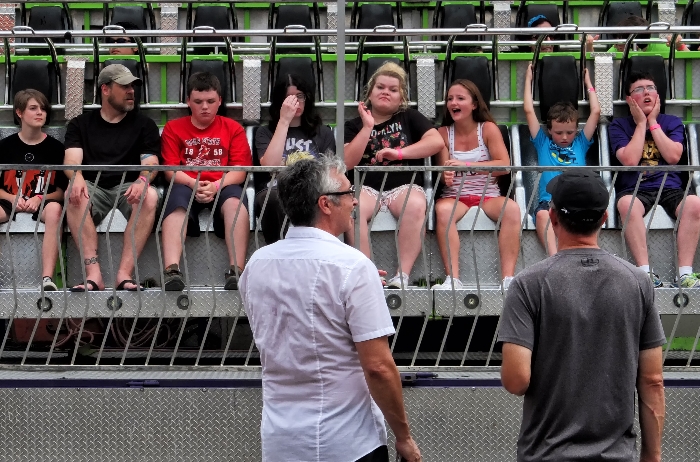
Out of curiosity, I did a quick file search and found the last photo I shot with x10. It was from August 15, 2016 at the Iowa State Fair, at one of those rides designed to toss people around and give them the illusion of danger. I liked the photo; you can see anxiety and bravado, you can see the clinched-butt need to appear calm and unfazed.

Iowa State Fair 8/15/2016

That photo was the spark I needed. So I dug around in the cupboard until I found the battery charger and charged the batteries. It had been so long since I’d used the camera that I had to re-set everything from scratch, including the date and time. I even tracked down the manual for the X10 online. I’m sure I must have at least glanced at the manual when I bought the camera, but I was unaware of some of the things the camera could do. For example, I created a custom setting for black-and-white shots, which is something I’ve never done before (and I’ll come back to that in a bit).

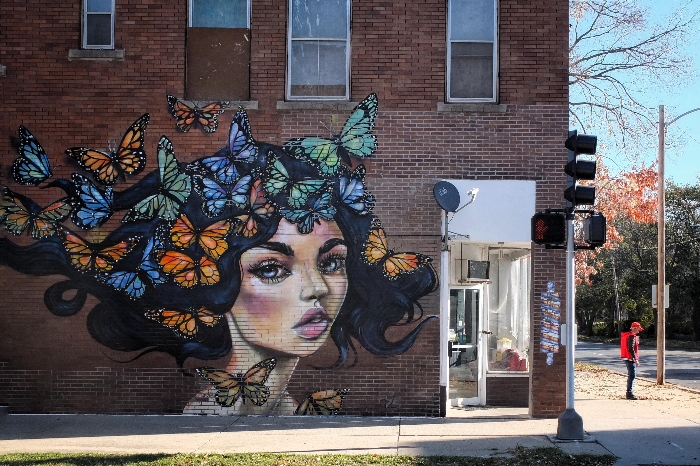
A man in a bright red vest and hoodie standing outside a barber shop.

Yesterday I set out to see if I could remember how to use a camera. Well, that’s not entirely true; I set out to go geocaching with my brother, but I used the excursion as an opportunity to re-acquaint myself with the X10. The little camera was a tad too big to slip into the pocket of my jeans, but it slid easily into the pocket of my hoodie. It weighed next to nothing. While my brother did the grunt work of geocaching, I watched a guy in a red vest fidget outside a barbershop in a Latino neighborhood. And the camera felt right.

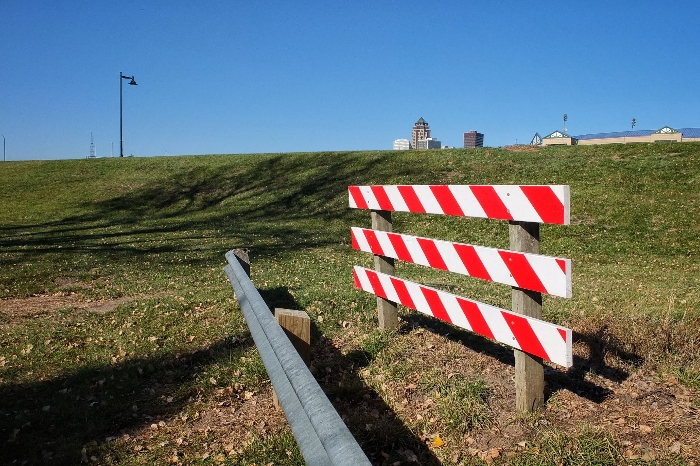
Dead end road across the river from the minor league baseball stadium.

The camera felt right but the final results were…mixed. The first thing I had to re-adapt to was the parallax effect since the X10 is a sort of retro-designed rangefinder camera. I suspect a lot of folks have never used a rangefinder camera and are wondering, “Greg, old sock, what the hell is this parallax effect?” Unlike your basic single-lens-reflex camera, which allows you to see the scene through your lens, a rangefinder viewfinder is only near the lens. So you’re not seeing exactly what the lens sees: that’s the parallax effect. You have to learn to adjust to the small shift between what you see and what the lens sees. The closer you are to the subject, the more drastic the effect.

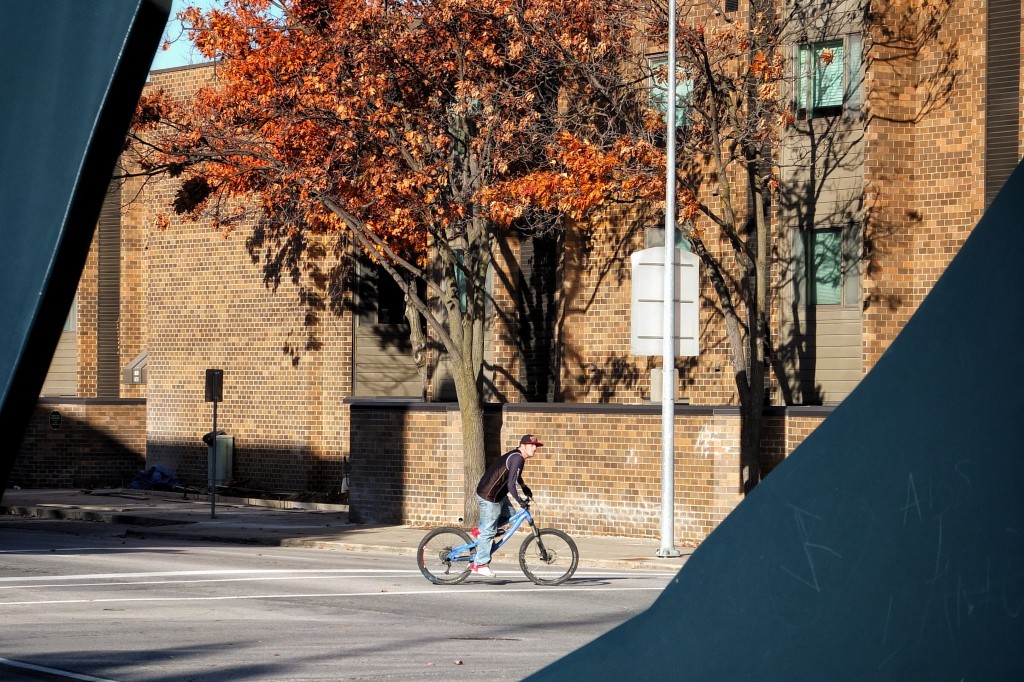
Kid riding a bike, seen through a public art sculpture.

In the photo above, I wanted to catch the rider in that patch of sunlight between the shadow and the tree. I was a fraction of a second late with the shutter as I panned to follow the kid, but I want to claim the tiny amount of parallax exacerbated the problem (DISCLAIMER: it almost certainly did not exacerbate the problem, but it’s a convenient thing to blame). If I was a fraction of a second too late releasing the shutter in the photo above, I was a fraction too soon in the photo below.

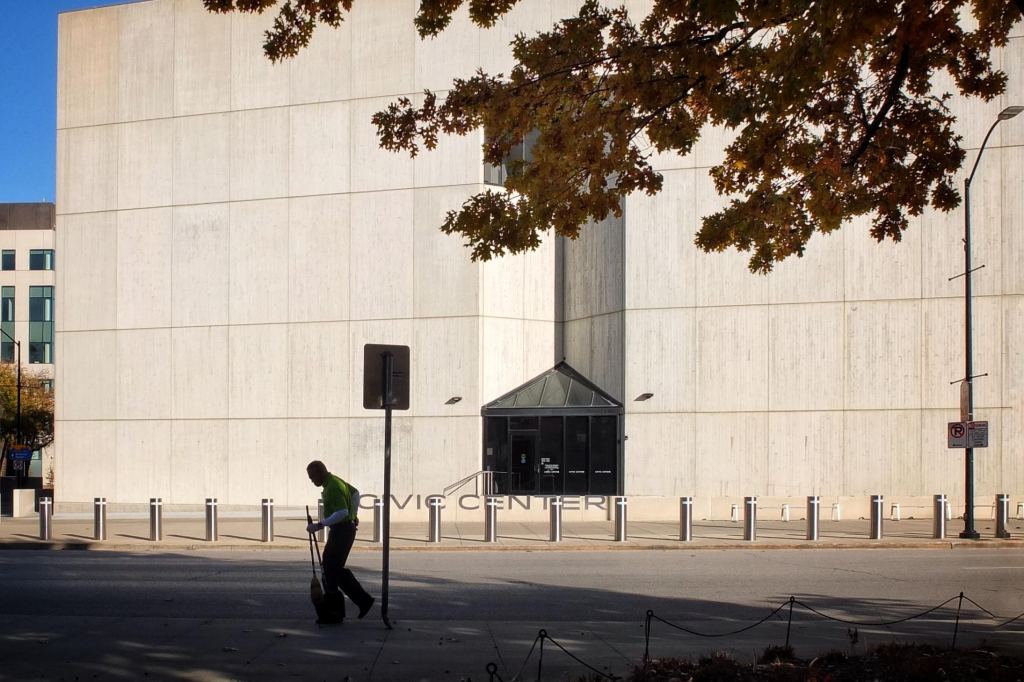
A city employee cleaning up litter and leaves.

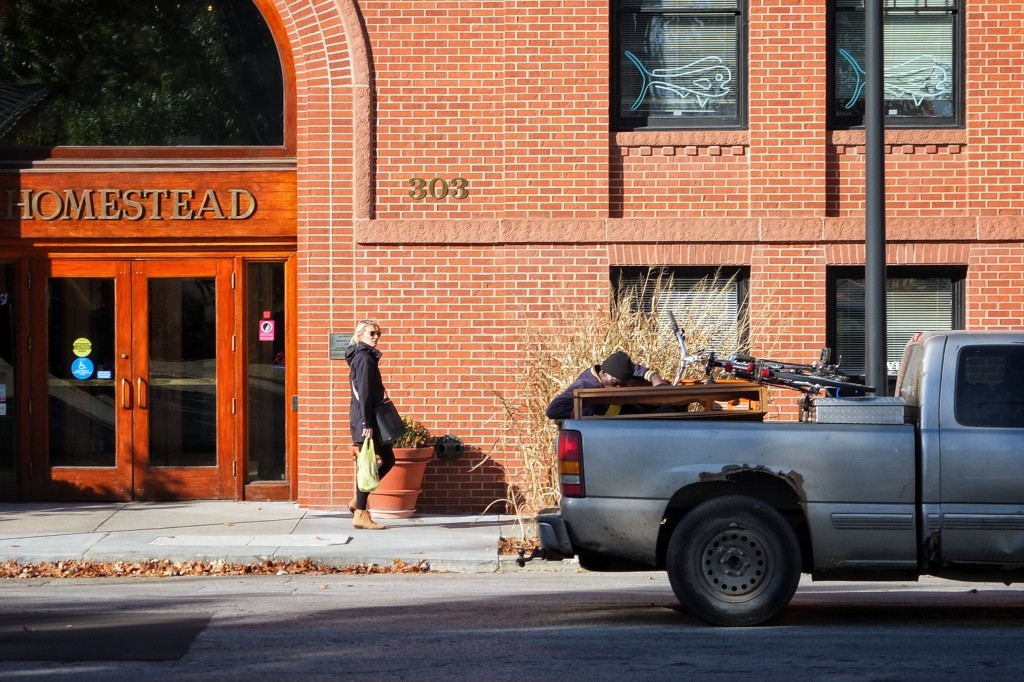
I’d hoped to catch the street cleaner at a point just beyond the sign identifying the location as the Civic Center. I was a tad too quick on the trigger. Much of the day was spent confronting the reality of the Ferris Bueller School of Photography. Life moves pretty fast. If you don’t stop and look around once in a while, you could miss it. I was lucky not to miss the look of disdain by this privileged white woman as she watched a black man securing some home furnishings in the back of a rusty pick-up.

A man secures some home furnishings in his pick-up while a woman walks by and watches.

I mentioned earlier that I created a custom setting for black-and-white shots. This is one of the advantages of digital photography. With a film camera, you either have to change from color film to black-and-white film or carry two cameras. With a digital camera, you just turn a dial or change a menu option. I decided to try to create a setting that would sorta kinda almost mimic Daido Moriyama’s Provoke period. High contrast, high ISO, high grain. (Of course, digital imagery doesn’t have grain; it has noise, which isn’t remotely the same…but what the hell, I set the noise allowance as high as possible).

And hey, guess what. It didn’t work.

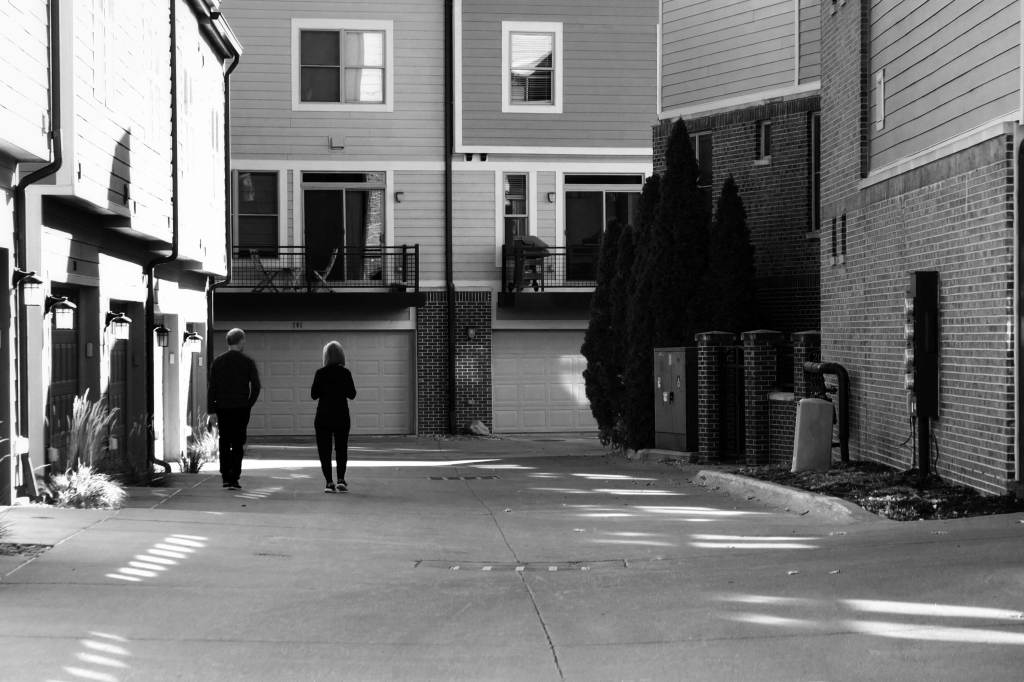
Two people walking behind some townhomes.

It wasn’t really a surprise that it didn’t quite work. Partly because Moriyama wouldn’t photograph a couple walking behind some upscale trendy townhomes. Partly because I didn’t see many high contrast scenes. And partly-mostly because I’m no Daido Moriyama. I shot maybe a dozen frames (okay, digital imagery doesn’t actually have frames either) using the custom setting. Most of them, like the photo above, are painfully dull.

I was only pleased with one black-and-white shot. Frankly I’ve shot MUCH better black-and-white photos with my cell phone (which, if you’re interested, you can see in a post about practicing photography in public). These photos were less black-and-white and more black-and-shite. But I intend to experiment more. Maybe I’ll figure out how to get the camera to give me the b&w photos I want.

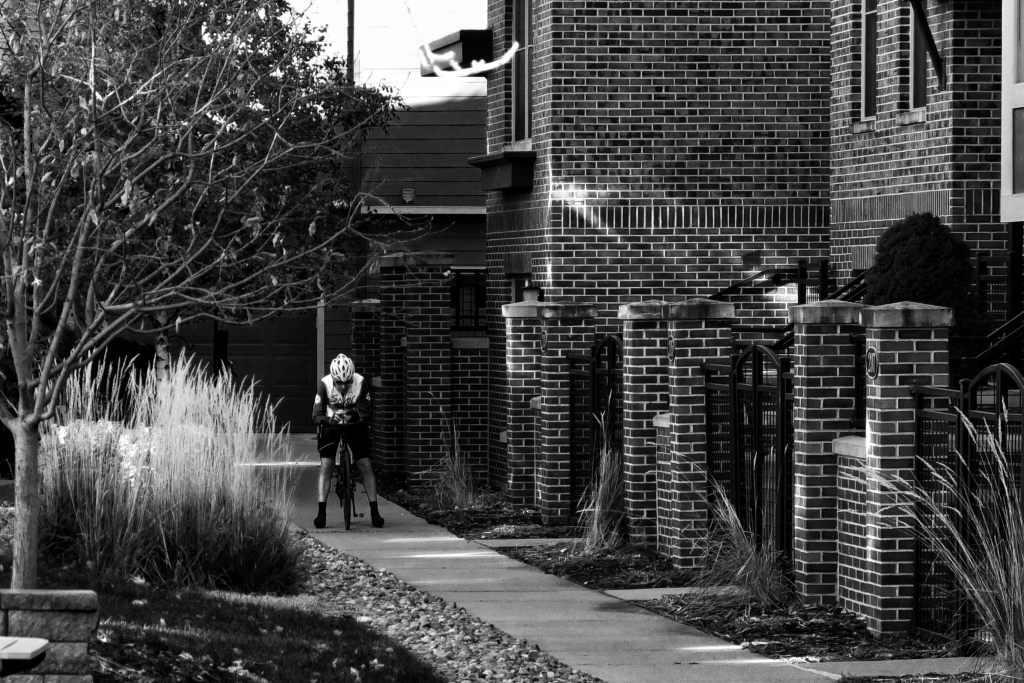
Cyclist checking his stats.

At the heel of the hunt, though, I’m happy with the old X10. I’m reminded that my approach to almost everything I do is grounded in the same attitude. I want to do things well, but so long as I’m enjoying myself, I’m not that concerned with the results. And folks, I had fun with that little X10. I plan to start toting it around with me more often. In fact, I just ordered two extra batteries.
circular dance of ants

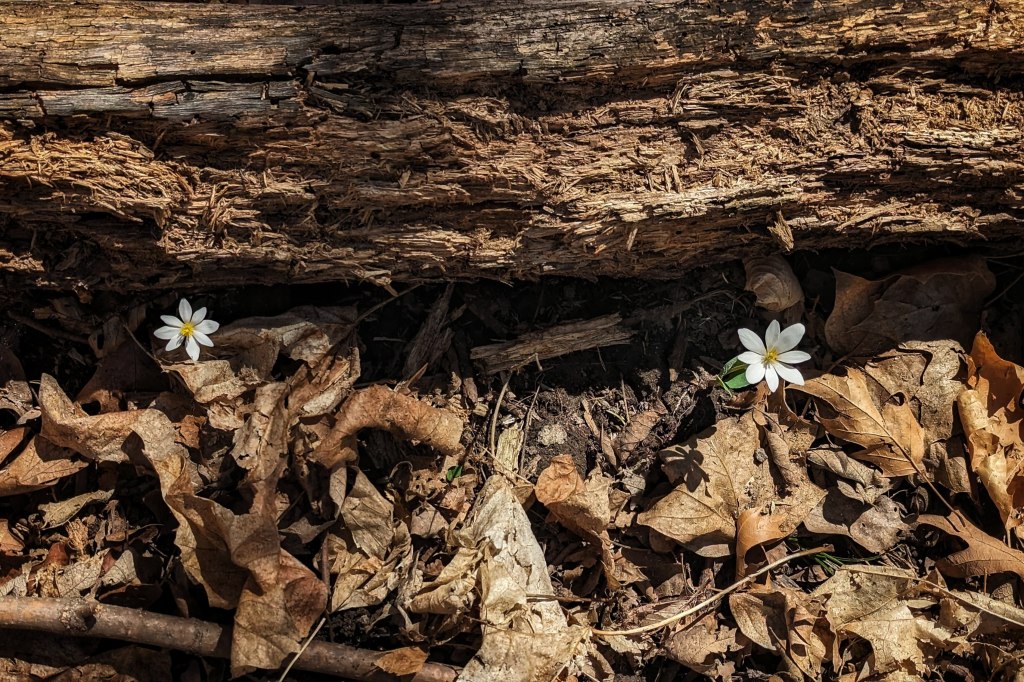
The photograph below shows a pair of bloodroot blossoms, one of the first flowering plants we see at the beginning of morel season. It doesn’t look at all bloody, does it. The sap, however, is generally orange to bright red. It’s sometimes used by native artists as a dye. The sap is also somewhat poisonous; eating bloodroot probably wouldn’t kill you, but it would certainly make you vomit like a high school drunk.

What’s cool about bloodroot, though, is the way it’s disseminated. The flowers produce pollen, but no nectar–which means all those bees and flies that land on the blossoms foraging for nectar are getting scammed. They’re helping pollinate the plant, but they aren’t getting jack in return.

But what’s really cool is that the seeds of bloodroot are spread by ants. That’s right, ants. The seeds have a fleshy organ–an elaiosome–that ants fucking love. They take the bloodroot seeds to their nest, eat the elaiosomes off them, then chuck out the seeds with the other ant trash and nest debris. Ant trash turns out to be a terrific medium for germinating seeds.

The process of ants foraging seeds for their tasty elaiosomes, then getting rid of the useless seeds in ant trash middens is called myrmechory. It’s from the Greek term for ants (mýrmēks) and a circular form of Greek dancing called khoreíā. The ants don’t actually dance in circles, of course, though they probably could if they wanted to. Who’s going to stop them? The important thing, though, is myrmechory works. It’s great for the ants, who get a scrumptious treat, and for the bloodroot, which gets dispersed across a wider range.

Of course, bees and flies and other pollen-seeking winged foragers get completely fucked over, which probably adds to the enjoyment of the elaiosome-eating ants. I’m okay with that. I mean, bees get to fly, after all; they get a temporary pardon from gravity. Hard to blame ants for being a wee bit envious and taking some small pleasure out of seeing the winged bastards get stiffed.

drive-by

I went for a drive on Thursday.

No, wait. It would be more accurate to say I went for a ride; I didn’t do any driving, I was just a passenger. It would be even more accurate to say four of us decided to visit a small town and have lunch in some local cafe (or diner or bakery or brewery or whatever passes for a lunch spot in that particular small town), and while we were out, I shot some photos. This is something we do periodically. After we eat we tend to tool around fairly randomly and see what there is to see. We may tour the town (if it’s big enough to actually tour), we may wander along the surrounding back roads.

I generally sit in the front passenger seat and shoot photos. Sometimes we stop and I shoot photos, sometimes I shoot photos out the window, sometimes I convince the driver (my very patient and obliging brother) to stop, turn around, drive back to something I thought might make an interesting photo.

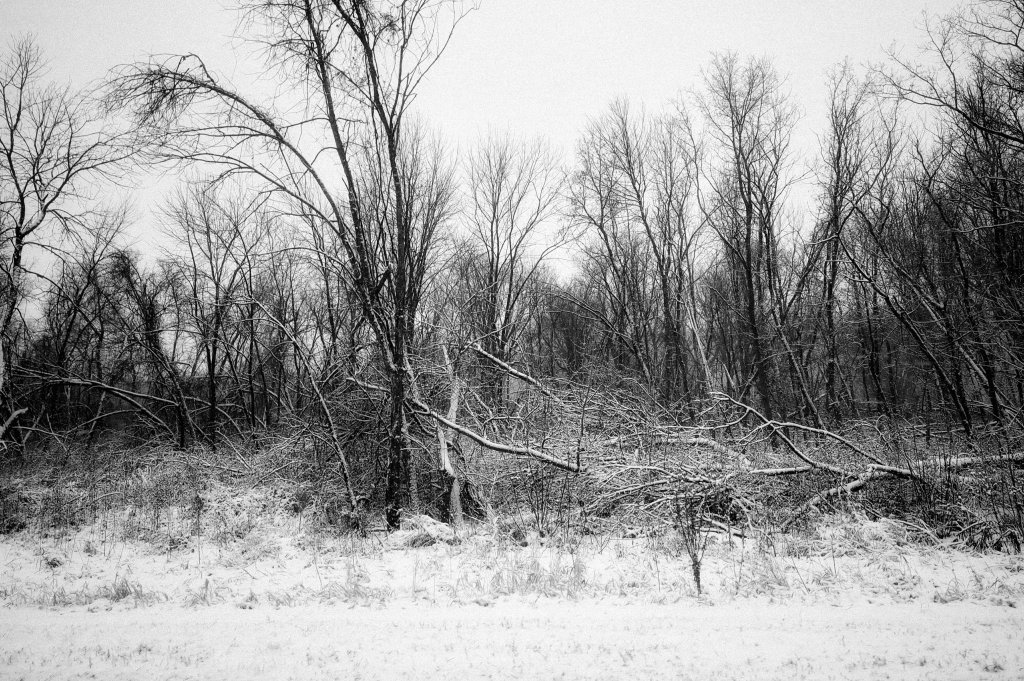
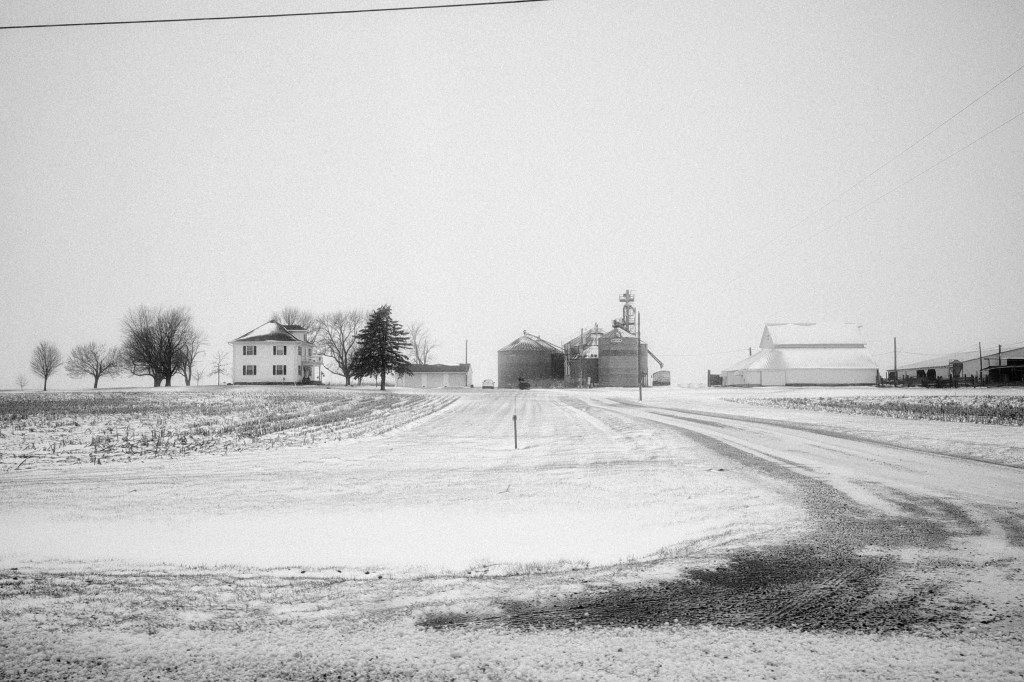
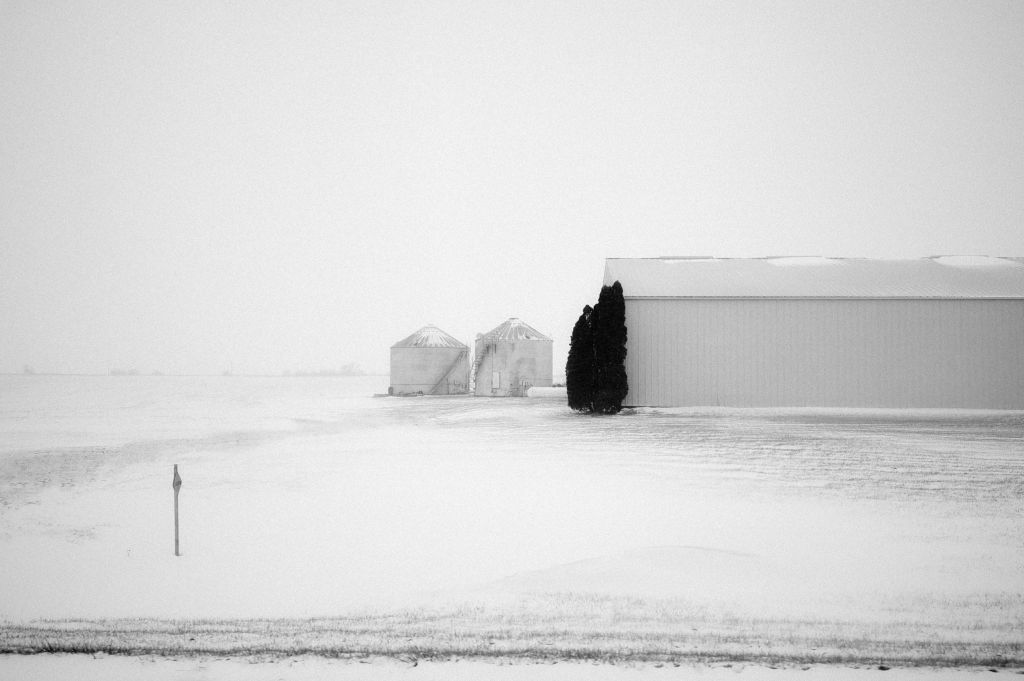
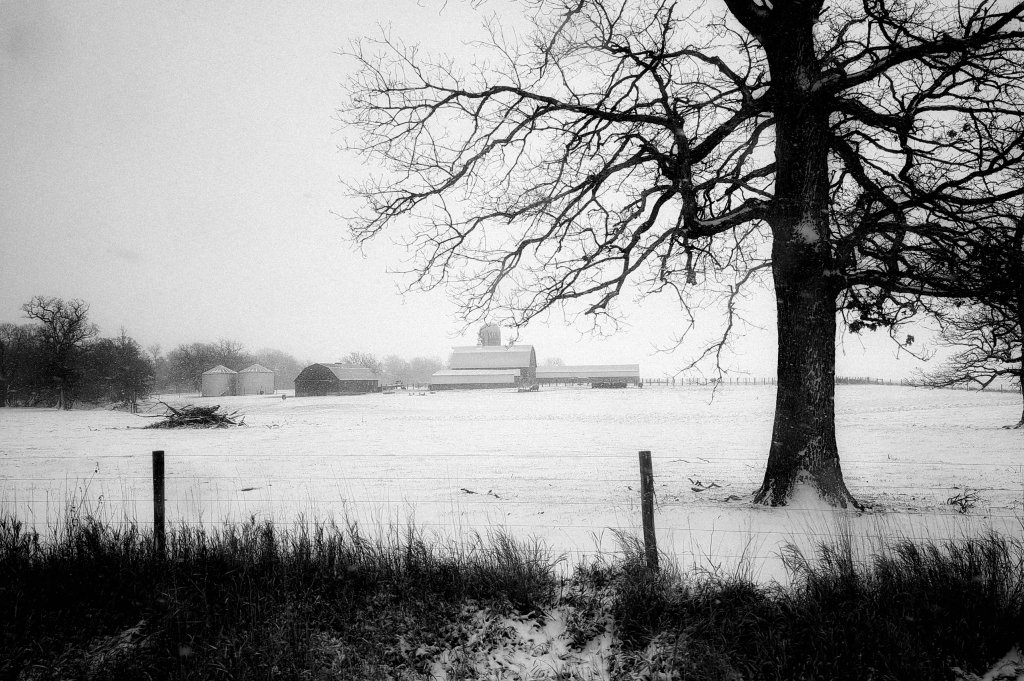
My point, if you can call it that, is that on Thursday we…well, we did that. It was a chilly, occasionally breezy day with a steady fall of exceedingly fine snow. I don’t mean fine in terms of high quality or excellence (although as snow goes, it was pretty fine); I mean fine in terms of texture and delicacy. It was mostly a light, powdery sort of snow; it made the world look like it had been dusted with a sprinkling of powdered sugar.

Two things. One, I used to bring one of my cameras on these ventures, but for the last few years I’ve mostly used my phone for this sort of photography. Two, in winter I tend to shoot in black-and-white. I know it makes more sense to shoot in color and convert it to b&w; you have greater control over the final image. But there’s some weird trigger in my brain that says, “Hey, old sock, if you’re going to make black-and-white photos, commit to it.” It doesn’t make any sense, but there it is.

Over the years I’ve used half a dozen different dedicated b&w phone apps. So far, I keep gravitating back to an app called Vignette, which is a very flexible app that allows you to create a number of different camera profiles. I bang it around until I get a b&w setting that meets my general needs and aesthetic, then save it. Every time I buy a new phone, I sort of recreate that setting (although the recreated version is never quite the same as the previous, I’m okay with that).

All of the photos here are drive-by photos. They were shot through the passenger side window (which, of course, was closed because it’s fucking winter here). There’s always a part of me that wishes the window was perfectly transparent, and a conflicting part of me that likes the fact that the window conditions change and the photos change accordingly. The window might be a tad foggy with condensation, or it might be streaked with water or melting snow, or even spattered with mud or road grime. It all finds its way into the photo.

Drive-by photography is ridiculous. It’s all about predicting an image–seeing what’s up ahead and visualizing what it might look like when you get there. If that’s loopy enough, you then have to anticipate what’s coming and try to time the shutter release (okay, there’s no actual shutter in a cellphone, I know that, but you know what I mean) to correspond with what you hope will be a proper composition. That’s another issue with the Vignette app: the shutter lags. Just a moment, but it’s a fairly predictable moment. Which means if you’re using Vignette to shoot a drive-by photo, you have to factor that lag into the equation.

Half the fun of drive-by shooting, of course, is not quite knowing what you’re going to get. You make a number of guesses and predictions based on your experience and intuition and your understanding of the technical concerns, and hope for a good result. Most times, you guess wrong. But sometimes you guess just right and the photo is what you hope it will be. I guessed right (or close enough to right) on the photos you see here. None of them has been cropped, but most of them have been rotated slightly to straighten the horizon line.

The snow helped. Not just because it was pretty, but because we were driving more slowly. That gave me more time to evaluate the shot and a larger margin of error.

There are few finer ways to spend a weekday, when all the normal employed people are at work and out of the way. Good company, good food (usually), good drink (usually), and the serendipitous exploration of some place we have no real reason to visit other than whim. I count myself very fortunate that I get to do this.

saturday, noodling around

I don’t know what you did last weekend, but I drove 75 miles to the small former coal town of Humeston, Iowa. Why? Because there’s a tiny cafe. Almost every small town has some sort of tiny cafe or diner. But this one–the Grassroots Cafe–serves a grape salad that’s so good you want to lie on the floor and kick your feet in the air. And the bread pudding would make angels weep that it exists for mortals on the earthly plane.

The Grassroots Cafe

Humeston is a really small town. Population: 465 in 2020. It was the home of the Humeston and Shenandoah Railroad, which in 1881 ran 113 miles from Humeston to (guess where) Shenandoah, Iowa. In its glory days, the H&S RR ran 14 classic 4-4-0 steam locomotives, hauling mostly coal, grain, livestock and occasionally passengers to the slightly larger town of Shenandoah, where the railroad joined up with the Missouri, Iowa, and Nebraska Railway system. (You may be wondering, “Greg, old sock, what is a 4-4-0 locomotive?” I wondered the same thing and I googled it. You can do the same thing. Don’t be lazy. And stop calling me ‘old sock’.)

This is Humeston.

By the late 1920s, the H&S RR was beginning to fade. The advent of the automobile (and, more importantly, the truck), combined with improved roads, the gradual decline of local coal, and the beginnings of the Great Depression, strangled the small railroad business. The railroad died slowly and in sections, but by the mid-1940s, during the Second World War, it was essentially gone. As the railroad died, so did the town’s population.
Humeston, near the cinder bike path.

Although the railroad is gone, the track left behind became Iowa’s first rails-to-trails bike path. Thirteen and a half miles, from Humeston to Chariton. Unfortunately, it’s also Iowa’s worst-maintained bike path. About half of it is gravel and cinder; the other half is…well, just grass. Sometimes overgrown grass. It’s doubly sad because it’s one of the few bike trails with covered bridges.

Humeston

On arrival in Humeston, I gave in to an impulse. Sometimes you just have to give in to your impulses. You know how it is. You’re on the road, you see a train, you pretty much have to say, “Train” out loud, even though anybody with you can see the damned train. Same with horses and cows (and, I don’t know, maybe sheep? Yeah, probably sheep). Even if you resist saying it aloud, there’s a part of you that’s thinking and wanting to say “Cow” when you see a cow. It just happens.

The photographic equivalent of saying “train” or “cow” is shooting your reflection in a window.

First photo in Humeston

Obviously, I gave in to that impulse. My first thought was that Humeston should be photographed in black-and-white (why yes, I DO have an app I use just for b&w photography–doesn’t everybody?). But the day became so sunny and bright (though still brutally cold) that I quickly abandoned that idea and shifted to my standard photo app.

Selfie with Humeston bench.

And my first photo was, yes, a reflection selfie. There’s no point to it; you just have to do it sometimes. Usually, you do it once and that’s enough; you won’t have to do it again for weeks or months. The impulse has been fulfilled and you can get on with your life. But there are occasions when the itch just doesn’t feel properly scratched until you’ve done it a few times.

Yes, three (3!) reflection selfies in Humeston.

So I wandered around on the streets of Humeston briefly (briefly because 1) it was savagely cold and 2) there isn’t enough of Humeston to wander around at length). It feels like a small town, to be sure, but it doesn’t feel like a small town in decline. Sure, some of the shops are empty, and some are a wee bit worse for wear, but everybody I met was cheerful and there was a sort of bright enthusiasm to the limited commerce. The aisles of the general store (yes, there’s a general store) were so exuberant that they were almost hallucinatory.

Tripping in Humeston.

As much as I love to visit small towns, I always find myself wondering what it would be like to grow up in one–and deciding it would be awful on so many levels that you’d need an abacus to count them. I have absolutely nothing to base that on, and the people I know who grew up in small towns generally have nice things to say about the experience. But damn.

On the way home from Humeston, we passed through the town of Lucas, Iowa, where we saw this charming little brick building. Of course, we decided to stop and look.

Lucas is so small it makes Humeston feel like a metropolis. Before it was a town, it was just a station on the Burlington and Missouri River Railroad line. The station was established in 1866. A decade later, the Whitebreast Coal and Mining Company sank a mine near the station. There was a rich deposit of coal, and by 1880, they’d opened a second coal mine and created a company town. If you’re not familiar with the concept of a company town, it’s basically a town in which practically everything–all the stores, the housing, the local services–are owned by a single company that’s also the sole (or at least the primary) employer. If you wanted to buy a shirt or a loaf of bread, if you wanted to have a boil lanced or a tooth extracted, you paid the money you earned from the company back to the company, before returning to the house you’ve rented from the company.

Lucas selfie with optional shop cats.

By 1890, there were 1300 people living and working for the Whitebreast Coal and Mining Company in Lucas. But here’s the thing about coal. Once you dig it up, it’s gone. A coal mine without coal is just a big fucking hole in the ground. The last productive coal mine in the Lucas area closed in 1923. By 1930, the population had dropped to about 500. In the 2020 census, the population was only 172.

Dr. Bell’s office.

There were three antique/craft stores in Lucas. None of them were open during our brief stop, nor was the John L. Lewis Mining Labor Museum (union organizer John Lewis apparently got his first job as a coal miner in Lucas). I doubt that Doc Bell is still in business, but his office is still standing. If you look, you can recognize the bones of the old company town that existed here a century ago.

That was my Saturday. A day spent not doing much of anything–just noodling around in small towns, thinking about stuff, shooting shop-window selfies. In other words, a day well spent.