the point

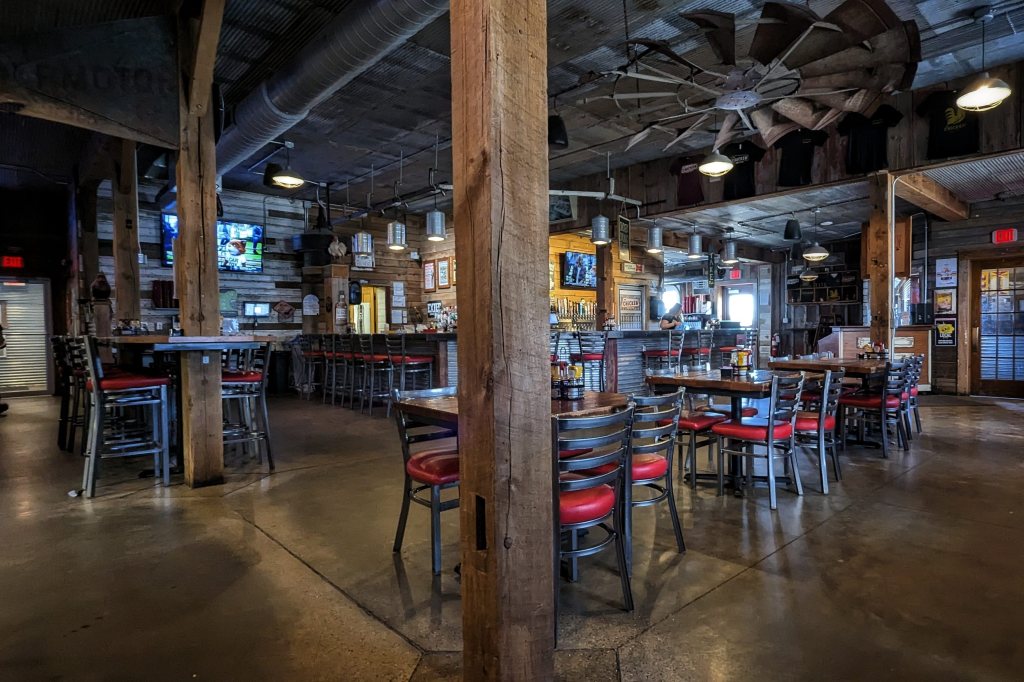
Okay, this happened. On social media, I posted a photograph of…well, wait. Let me just show you the photo, that’ll make this easier.

That’s it. It’s not anything remotely artsy; it’s just an interior shot made from a corner booth. The primary reason I shot the photo was because it amused me; it’s a classic private investigator perspective–back to the wall and a view covering all three entrances and exits. (Yes, I worked for about seven years as a PI specializing in criminal defense, and yes, I actually did pay attention to those things back then, but no, it’s not really a concern to me anymore, but yes, it’s still sort of a habit.)

A friend commented, casually referring to this as a ‘dive bar’ and adding “…or what we call here, ‘the pub’.” (‘Here’ in that context meant Ireland.) And for reasons that probably don’t bear examination, I felt compelled to point out that this place is NOT a dive bar. Or a pub. It’s a sort of combination roadhouse and bicycle bar.

Because this is how my mind works, I’ve spent a few idle moments (well, maybe half an hour) thinking about the taxonomy of drinking establishments. Obviously, there’s no universally agreed classification; there’s no International Organization for Standardization overseeing drinking establishments. BUT there IS a history.

On the outskirts of town, along a road and bike trail — bicycle roadhouse.

The Roman tradition of conquering places and fucking around with local cultures and norms relied heavily on their ability to build and maintain a network of roads. Along those roads, they created tabernae–rude sheds and shelters where travelers could refresh themselves with food and drink, and maybe a safe place to sleep. Eventually, taverns began more like houses open to the public, and local folks would gather there to get news from travelers over a friendly ale. Public houses–pubs–became central to neighborhoods. Public houses located outside of town (or on the outskirts of town) generally provided rowdier entertainment–roadhouses.

Now there’s an entire constellation of drinking establishments. We still have pubs, some towns still have taverns that also act as inns (though those are largely supplanted by hotels and the hotel bar), we still have roadhouses. But we’ve also got dive bars, which are sort of low-rent pubs devoted to serving local folks inexpensive drinks without a lot of fuss. We’ve got bicycle bars for thirsty cyclists, and brew pubs for beer connoisseurs (from the Latin cognoscere, meaning ‘to know, to understand, be familiar with’), and concept bars that are devoted to a specific theme (like zombies or hobbits or steampunk or bondage), and sports bars with eighteen large-screen televisions showing a disconcerting number of sports events, and cocktail bars where beer and ale is spurned in favor of spirits, and wine bars which you can figure out yourself, and pool bars (both swimming and billiards), and population bars directed at specific groups (like LGBTQ or veterans of foreign wars) and I’m probably forgetting several other types of drinking establishments.

My point is…well, I’ve forgotten what my point was. I definitely had a point when I started writing this. I wonder what happened to it. Somehow I seem to have gone from looking at things from a PI perspective to tavern taxonomy to the fucking Romans to a semi-random rambling list of bar types. A point could get lost anywhere in there.

Turns out, that photo at the beginning did NOT make this easier.

Uh…how ’bout those Red Sox, huh?

do i gotta use words?

On some social media platforms I describe myself as a writer and a photographer. That recently led to an interesting question. I was asked:

“Do you shoot photographs the same way you write? Do you write like you shoot photos?”

My response was pretty simple: Never thought about it. And then, of course, I started thinking about it. I probably spent most of an afternoon thinking about it. Well, that’s not really accurate. I thought about it off and on for an afternoon. Because that’s a thing I do; I think about stuff.

Morning light, drinking coffee

My first thought was: Well, maybe I do. I mean, it was worth considering. Both writing and photography are vehicles for self-expression. They’re both grounded in craft rather than art, although they’re amenable to art. Do I need to go into the difference between art and craft? I suppose I do…but briefly. Basically, craft is about structured skills that can be learned whereas art is about unstructured imagination. I think that’s brief enough.

Anybody of average intelligence can learn the skills involved in writing and photography, stuff like the mechanics of grammar or the mechanics of exposure, or how to use punctuation in a sentence or determine an image’s depth of field. So in that sense, sure, I write and shoot photos in the same way. Learn the skills, apply them to the work.

But there’s a lot more to fiction than being able to write a complete sentence; there’s a lot more to creative photography than being able to correctly expose a photo. It all comes down to composition: 1) choosing what gets included, 2) what gets excluded, and 3) how it’s presented.

Because while writing and photography are both vehicles for self-expression, they’re completely different vehicles. Asking if me if I write the same way I shoot photos is like asking me if I drive a truck the same way I paddle a kayak. It’s like asking me if I sing the same way I play the banjo. (Okay, I don’t actually play the banjo, but you get the idea.)

I can articulate my reasons for crafting sentences and paragraphs. I’m aware as I’m writing why I arrange scenes the way I do. I know I’m trying to amuse the reader, or distract the reader from something in the story, or foreshadow an event that will take place later, or reveal something about a character.

I can’t always articulate why I shoot a photograph. Sometimes there’s just something about the arrangement of the world that pleases me. Looking through a camera’s viewfinder allows me to put a border–a frame–around a chunk of the world. At that point it becomes about arranging the world within that frame. A step to the right, two steps forward, dropping down on a knee–all of that changes the arrangement of the world inside the frame. But I’m not always aware of why a specific arrangement pleases me. Afterwards, looking at the photo, I can sometimes perform a sort of autopsy on the image to figure out what I was seeing at the moment I shot the photo.

Seven posts

(Sorry…here’s a tangent. Autopsy is from the Greek auto, meaning ‘self’, and opsis, meaning ‘see’ or view’. It basically means ‘to see for yourself’. Since the late 17th century autopsy has been used to describe a forensic dissection of the body to see for yourself what caused the body to die.)

Anyway, having thought about the question ‘Do you shoot photographs the same way you write?’ I decided to do a brief autopsy on a few photos I shot recently. The first was shot while I was sitting drinking coffee and reading the news–the morning light coming through a window. The other two were just things I saw during a semi-short road trip to find a small town diner for lunch.

The first photo autopsy was easy. I was just pleased by the momentary arrangement of light and shadow, of lines and shapes. And it was momentary; five minutes later the earth had rotated enough that the light through the window had shifted and was no longer interesting. But THINK about that for a moment. That photo depends entirely on the alignment of the solar system. How cool is that?

I suppose the second and third photographs also depended on the cooperation of the solar system since all photography depends on light, but not in such an immediately obvious way. They’re photos of ordinary crap you’d see in the Midwest countryside. Some posts marking the boundaries of a parking area in a public hunting zone. A blue corrugated metal shed. Why were they worth photographing?

Okay, I’m going to get even more pretentious here. There was a French poet-essayist-philosopher with the cumbersome name of Ambroise Paul Toussaint Jules Valéry (though he’s normally just called Paul Valéry). He wrote:

To see is to forget the name of the thing one sees.

That reads like a Zen koan, except that Valéry’s comment actually makes some sort of sense–or at least it does to me. The photo of the blue corrugated metal shed doesn’t depend on it being a blue corrugated metal shed. It’s ‘shedness’ is irrelevant. What matters is that it offers three different shades of blue, which pair well with the softer blue of the sky. What matters is the sharp angular lines of its shape, which contrasts nicely with the sinuous way the gravel road curves around it. It doesn’t matter that those three utility poles exist to distribute low voltage power to customers while keeping the cables insulated from the ground and out of the way of people and vehicles. It only matters that they provide a sense of balance to the overall image.

To see is to forget the name of the thing one sees. To forget the thing’s purpose, its use, its reason for existing. Those things can contribute to the complete effect of an image on the viewer, of course. I mean, the photo of the blue corrugated metal shed could be seen as a commentary on how humans have transformed the prairie by organizing its resources for commercial purposes. The photo of the posts in the parking area of a public hunting zone could serve as a reminder that early residents of the area hunted game in order to survive (and some still do).

But that’s all gravy. The photographs either work (or fail to work) on their own compositional merits. The words don’t always matter, and they shouldn’t. The visuals displace and supplant the words.

So there’s my answer. Nope, I don’t shoot photos the way I write. And more apologies, but here comes another pretentious moment. This is from TS Eliot’s Fragment of an Agon:

I gotta use words when I talk to you
But if you understand or if you dont
That’s nothing to me and nothing to you
We all gotta do what we gotta do

I’ve got to use words when I talk to you, but not when I show you something. But if you understand the words or images or if you don’t, that’s nothing to me. And really, it’s nothing to you either. We’ve all got to do what we’ve got to do.

knuckles, back on the map

As some of you may know, Knuckles Dobrovic is the name under which I occasionally create photo projects on Instagram. This began back in 2013. I created the Knuckles alias to explore Instagram, to learn what it was and how it worked, and to do that without having my name associated with it. I thought it made sense to dissociate myself from the account back then; now it just seems silly. In any event, I created the account and began to compile a very simple project. I put a thing on a glass-topped table on my deck and photographed it.

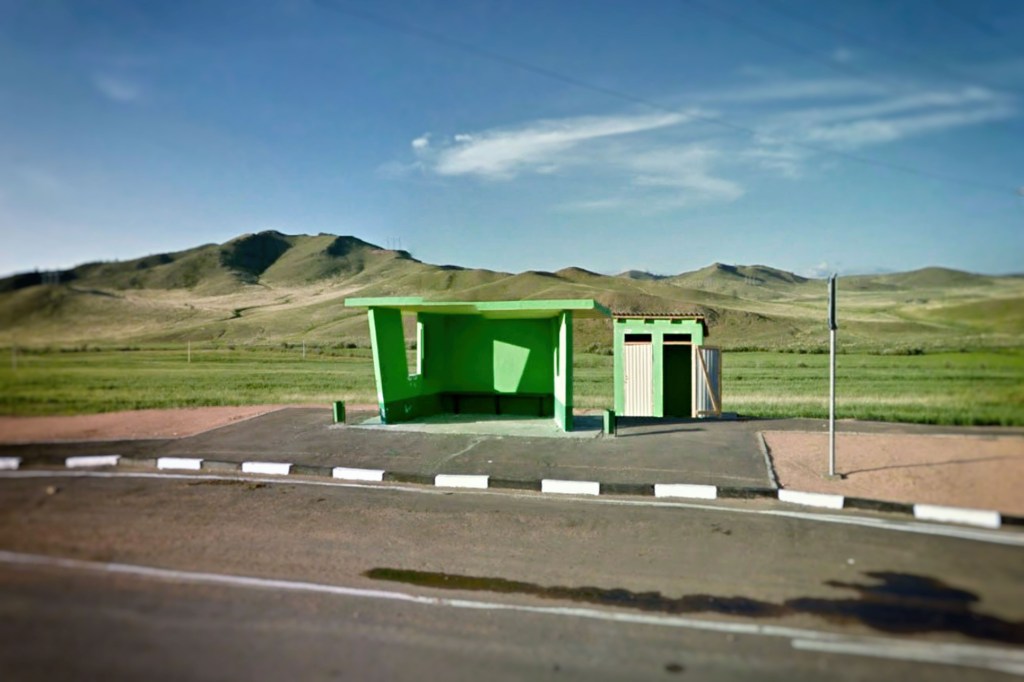
South of Ulan-Ude, Russia

I did that for about a year, during which I realized how ridiculous it was to have an alias account. So I created an IG account in my own name. When Things on a Table was finished, I put the Knuckles account on a shelf and forgot about it. Except–and I realize this is also silly–I’d become attached to the name. So eventually I revived the Knuckles account for another project. And then another. This will be the seventh Knuckles photo project.

Arvik, Norway

Early on, I cobbled together some simple, flexible parameters for Knuckles projects:

  • It’s got to be simple (which means I won’t have to do a lot of planning or a lot of post-processing).
  • It’s got to be organic to my life (which means it’s something I can photograph during the course of an ordinary day — whatever that is).
  • It’s got to have at least one intellectual component (which is more accurately described as a pretentious bullshit element).
  • It’s got to be able to keep my interest over time.
Near Yotvata, Israel

Here’s a quick recap of the various Knuckles projects themselves with a link to a representative image from that project:

  1. Things on a Table — I put a thing on a table and photographed it.
  2. My Feet on the Earth — I took walks, stopping periodically to photograph my feet. I selected two or three of the images during a walk and created multiple exposure images.
  3. One Hundred Appropriated Google Street Views — This was sort of an homage to Hiroshige’s ‘One Hundred Famous View of Edo’. While playing the online game GeoGuessr (which involves finding a random location based on Google Street View), I made screen captures of interesting vistas. I converted those screen grabs into square black & white images.
  4. Slightly Dislocated — During the enforced isolation of the pandemic, I shot square format photos during my solo walks or masked errands. I diddled with the color a wee bit, digitally sliced the image in thirds, then re-arranged the pieces.
  5. Are Bure Bampot — I’d been playing Geoguessr again, and during a break I read something about Daido Moriyama, the godfather of a photographic style called are bure bokeh, which roughly translates as “rough, coarse/crude, out of focus.” That same afternoon, on Twitter, a Scots acquaintance referred to somebody as ‘a total bampot,’ which I was told means “an idiot, a foolish person, a nutcase”. For reasons I can’t explain, the phrase are bure bampot came to me, and I decided to follow through on it. As before, I made Google Street View screen captures of scenes and locations in Scotland. This time I modified them using the are bure bokeh style.
Unknown location in South Africa

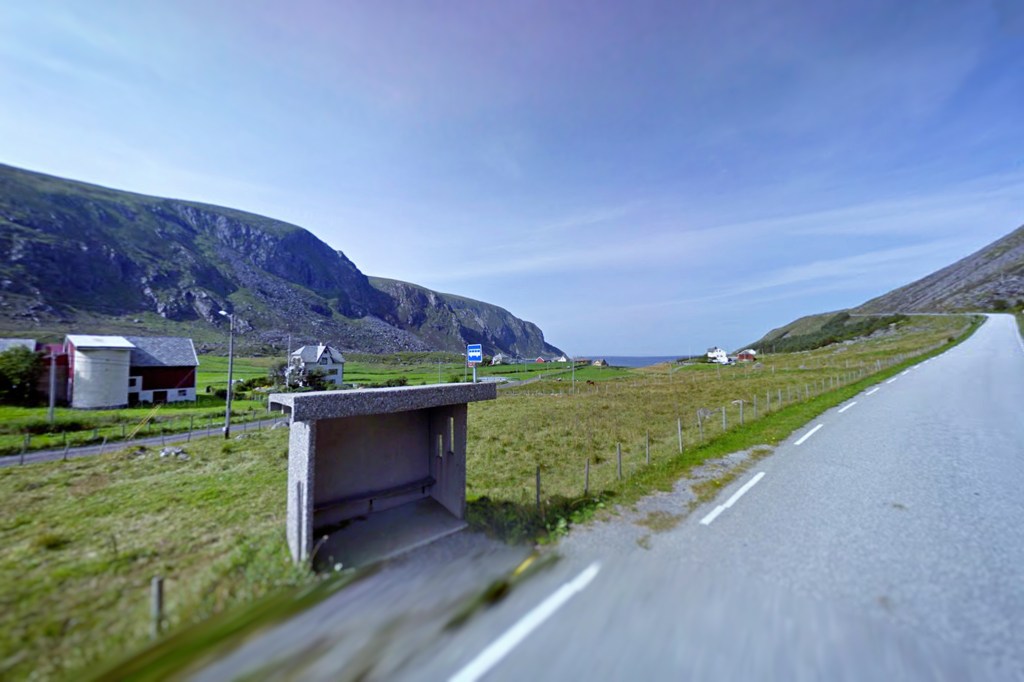
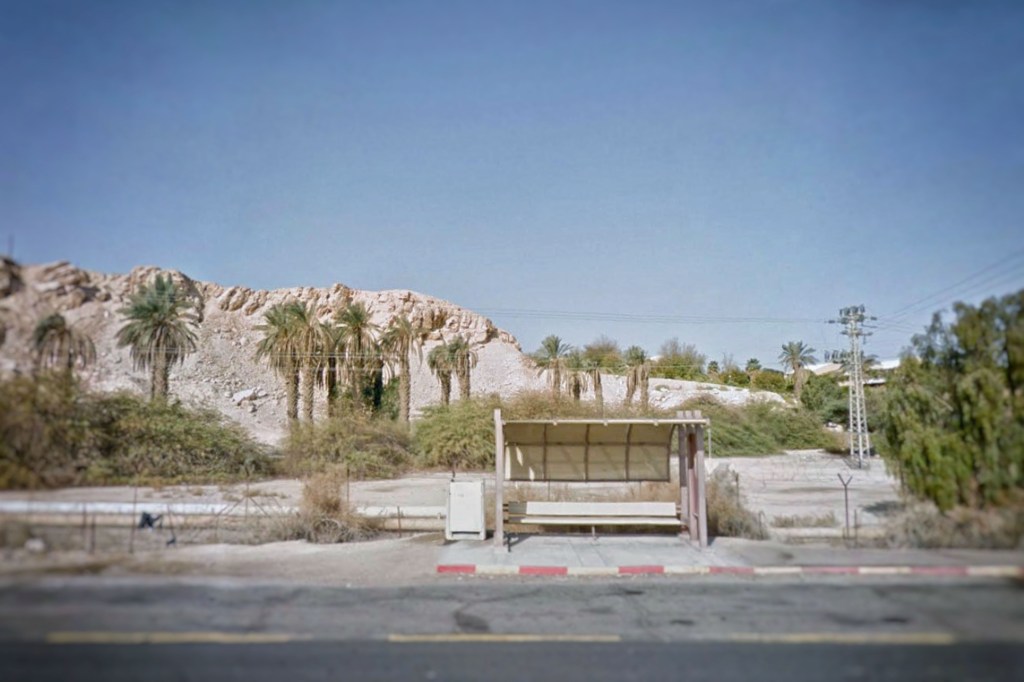
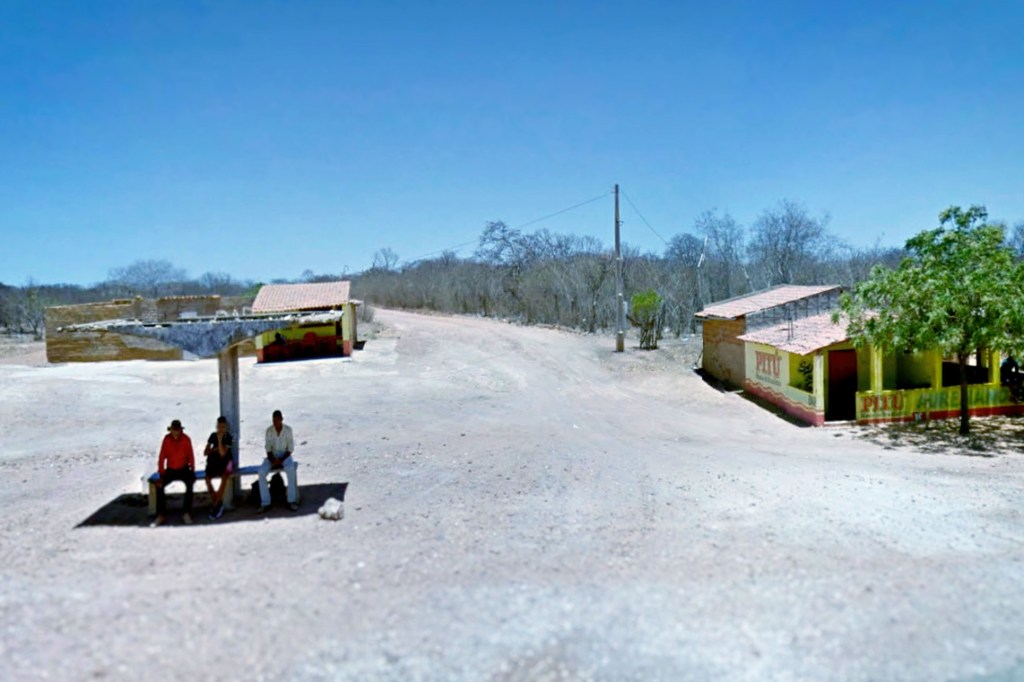
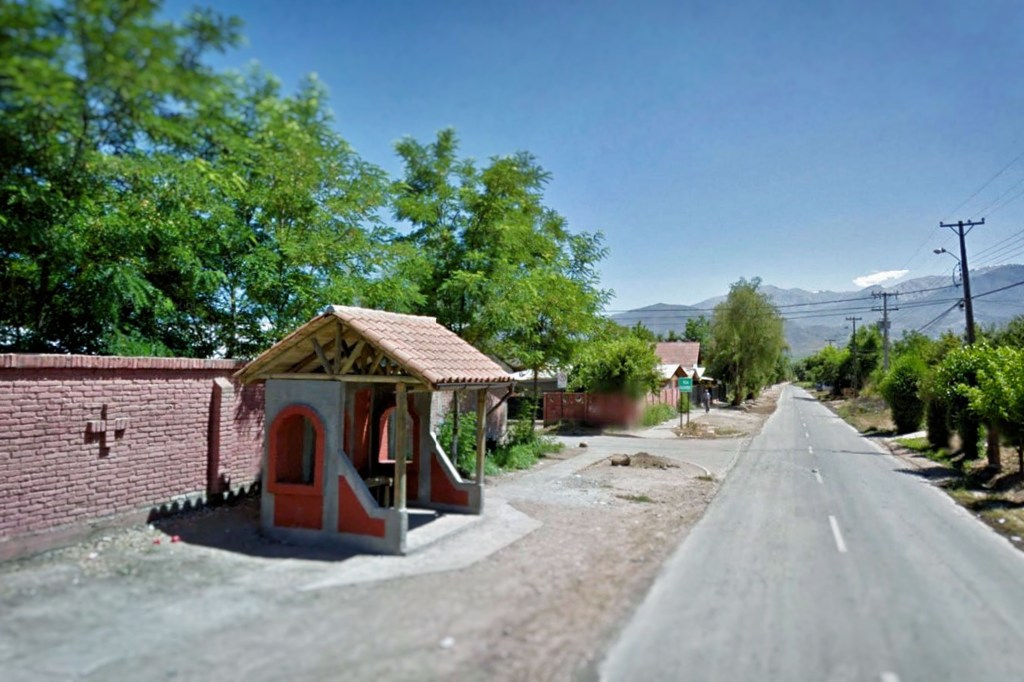
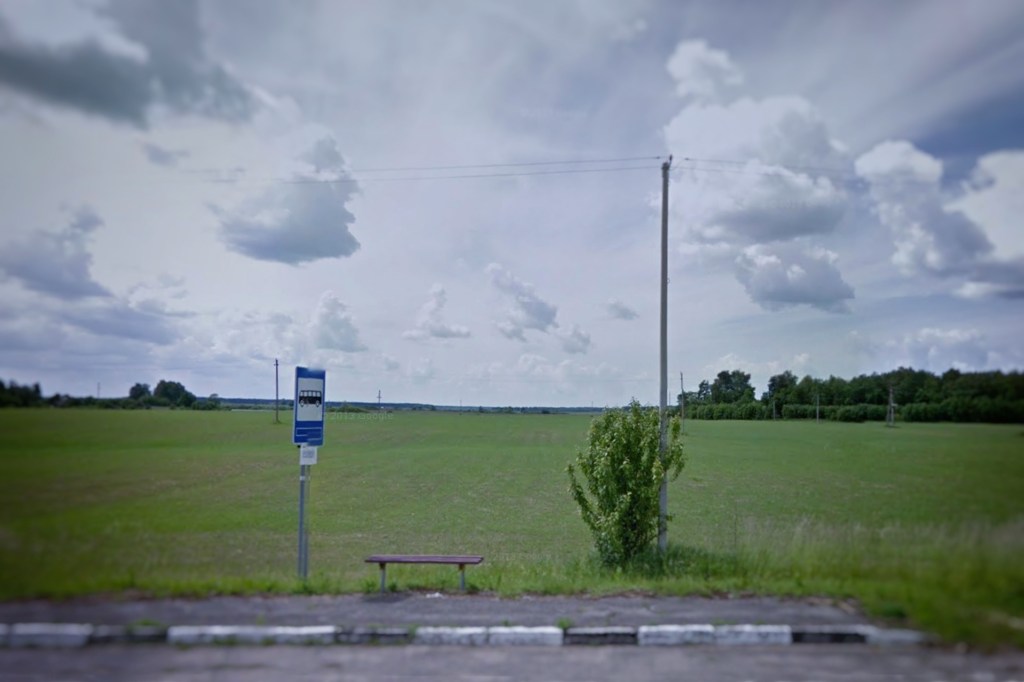
Now I’ve returned yet again to Google Street View with a new project: Bus Stops. I’ve always been intrigued by the bus stops I’ve encountered playing GeoGuessr, and I often pause long enough to get a screen capture of them. I’ve written about my fascination with bus stops before; lots of folks know about my interest. Recently an acquaintance sent me a link to a photo of a primitive bus stop in Turkey. It occurred to me that over the years I’d amassed a small collection of Google Street View screen captures of bus stops.

So I decided to do a quick search my old files and organize them. I found just over a dozen images of bus stops–enough to kickstart a new Knuckles project. It falls well within the Knuckles Criteria: simple, organic to my life, an intellectual component, and since I’ve been doing it haphazardly and thoughtlessly for years I’m not likely to get bored with it.

San Esteban, Chile

The intellectual component? A bus is the most democratic form of public transport. They’re most commonly used by the poor and working classes, but the bus stops for everybody. In cities it’s not uncommon to see people in business attire riding the bus to work. A bus network is fundamentally simple: a series of designated routes with consistent designated arrival/departure times and stable designated boarding locations with predetermined fees. It’s a predictable, reliable, efficient dynamical transportation system in which bus stops act as fixed point attractors. And if that’s not enough, bus stops are ubiquitous. They’re everywhere because a bus network is socially elastic–the design can be stretched to fit almost any community anywhere in the world. But stops are both local and global.

Outside of Petronys, Lithuania

You need more? Bus stops can tell you a lot about a community. Are the bus stops clean? Cared for? Are they in poor repair? Are they stylish or simple? Some bus stops have trash receptacles. Some are trash receptacles themselves. Some are shelters, designed to please the eye as well as keep riders dry and protect them from the wind. Some are purely utilitarian. Some are nothing more than a wide space in the road. You look at a bus stop, you learn something about the people who use them and the communities in which they live.

Bus stops are fascinating. But you have to look at them. So here…take a look.

another ordinary day

Wake up, get myself dressed, wander into the kitchen, remember the cat isn’t going to be there, make coffee, read the news, get distracted by…something. That last bit? Getting distracted by…something? Story of my life, right there.

I’m not driven by ambition or security or responsibility or success (whatever that means), but I am ridiculously weak to curiosity. I have a compelling need to know stuff. Unfortunately, it’s rarely useful stuff. If you’re looking for somebody who knows how to repair something mechanical or build a cabinet or replace an electrical outlet, I’m completely fucking useless. But if you ever want to know the name of the brother of the last Saxon king of England or the history and etymology of ‘spatula’ or why jamon iberica is the best ham in the world, I’m your huckleberry.

I only know these things because I allow myself to be distracted by something. And following that distraction led to something else, which led me to something else, which ended up with me accumulating still more useless information. And that’s exactly what happened to me this morning.

In an online forum devoted to readers of the historical fiction of Dorothy Dunnett I came across a passing reference to St. Mary’s Loch–the site of a band of mercenaries in Dunnett’s work. Being familiar with the novel, I had a general notion of where the loch was located in Scotland, but (and this where it always starts…with that but) I decided to look at a map to get a more exact location. And I was curious why the loch was named for St. Mary.

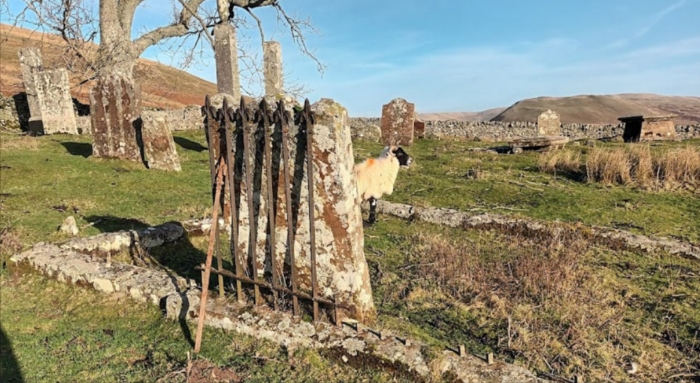
The answer to that last question was both obvious and easy to discover. It was named for a church dedicated to St. Mary. That church is gone now, but the graveyard is still there (and since this is about useless information, the difference between a graveyard and a cemetery is that a graveyard is associated with a churchyard, which requires a church; so this grave site is still a graveyard even though the church is gone).

St. Mary’s graveyard.

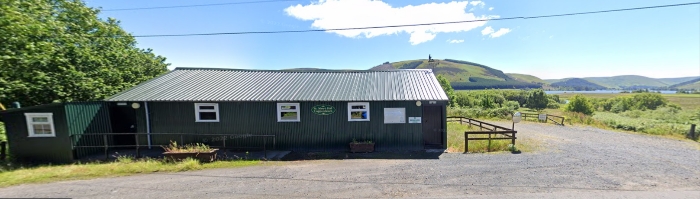
Information about the burial site led me to somebody’s blog post about St. Mary’s Loch, which included a reference to “the Hamlet of Cappercleuch with its couthy old, corrugated iron village hall.” Multiple sources of distraction here. What the fuck does couthy mean? (Spoiler: it’s a Scots term meaning ‘sociable, friendly, congenial, comfortable, snug.) And who wouldn’t want to see a couthy old, corrugated iron village hall?

That led me to Google Maps and Google Street View of Cappercleuch. It turns out that a corrugated iron village hall is…well, just that. It’s basically a rather ordinary, disappointing metal shed. Not particularly old, and certainly not very couthy.

St. Mary’s Hall at Cappercleuch — neither old nor couthy.

Still, as long as I was noodling about with Google Street View, I figured I may as well spend a few minutes looking at St. Mary’s Loch and seeing what else Cappercleuch had to offer. And within ninety seconds I came across another distraction. This:

What the hell is this?

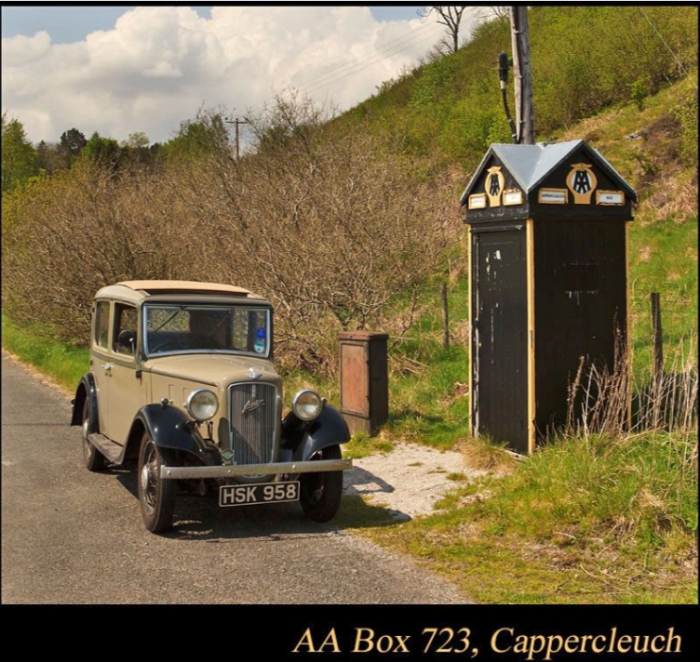
Reader, now THIS is a serious distraction. Just what the hell IS this? I mean, I can see what it is: a small, cross-gabled, distinctively decorated, phone-box sized structure. But what is its purpose? Why is it located just off the A708 motorway in Cappercleuch? (And if you’re curious enough to look for this on Google Maps, here’s a shortcut for you.)

The first thing I learned was that the A708 was one of the five most dangerous roads in proportion to traffic in all of Scotland. Or at least it was between 2007 and 2009. Not particularly helpful information, unless many of those accidents were because drivers were distracted by this weird boxy structure.

We can assume it’s not a Scots Tardis, but it has that ‘police box’ aura about it. It’s something official, certainly. The carefully crafted logo seems to confirm that. If we look closely, we can sort of see that it has the number 723 on the side. So, of course, the only thing for us to do is Google Box 723 Cappercleuch. And that gives us this:

I’m just going to assume you’ve made the same leap I did. AA stands for Automobile Association. It’s the UK version of AAA. AA boxes were an early form of roadside assistance in the UK. The first AA boxes were introduced in 1911. They were lit by oil lamps at night, and were sometimes referred to as “the lighthouses of the road.” The AA boxes contained maps to help folks who were lost, as well as a fire extinguisher, a lantern, and a telephone available to contact the AA for assistance. Members of the Automobile Association were issued with keys that fit all AA boxes in the UK.

By 1919 the AA had established a well-connected communication and assistance network of over a thousand roadside boxes, many of which were manned by yellow-uniformed ‘sentries’ who were there to offer free assistance.

Improvements in technology eventually made the AA boxes obsolete. By the late 1960s, the AA began to phase them out. In 2002 only 21 call boxes were still standing; AA shut down the entire network and made plans to dispose of the structures. The following year the boxes were listed as historic landmarks, and efforts were made to physically restore them. Apparently nineteen boxes still exist.

There’s a part of me, of course, that wants to use Google Maps to find them all. It shouldn’t be hard to do. There is absolutely NO REASON for me to do that, but at some point I probably will. Because that sort of pointless activity is my wheelhouse.

But it won’t be done today. I’ve learned some minimal self discipline over the years.

I’ve no idea how much of my day is spent giving in to my curiosity. I’m going to guess at least a couple of hours every day. There are folks who’ll consider this an inefficient use of my time.

Ain’t it great?

rabbit hole

I am weak to distraction. Doesn’t much matter what I’m doing, if I stumble across an interesting bit of information, an intriguing casual comment, a footnote in a book, almost anything that catches my eye and my imagination, I’m lost. I’ll stop what I’m doing and leap down that rabbit hole.

This morning on Twitter I came across a quote by novelist Henry Green, explaining the inspiration for his 1945 novel Loving. This is what he said:

I got the idea of Loving from a manservant in the Fire Service during the war. He was serving with me in the ranks, and he told me he had once asked the elderly butler who was over him what the old boy most liked in the world. The reply was: ‘Lying in bed on a summer morning, with the window open, listening to the church bells, eating buttered toast with cunty fingers.’ I saw the book in a flash.

It’s a great anecdote and an absolutely terrific line by the butler. So…there’s my rabbit hole. I tracked down the quotation. It was an interview conducted by novelist Terry Southern for The Paris Review (TPR) in 1958. Southern was also smitten with the butler’s line and used it to tweak the nose of the TPR’s editor. He wrote, “[Y]ou realize of course that the word ‘cunty’ makes the reply, gives it bite, insight, etc. I mean to say it simply would not do to rephrase it.”

Why was Southern pointing this out? Because five years earlier, TPR’s debut issue had included one of Southern’s short stories in which the term shit had been edited out. Instead of one character telling another “Don’t get your shit hot” TPR printed “Don’t get hot.” That’s a much weaker line.

Southern felt so strongly about the editing that he demanded TPR issue a correction in the following issue. And hey, they did. Sort of. Here’s their disappointing correction:

Terry Southern is most anxious that The Paris Review point out the absence of two words from his story The Accident (issue one): the sentence “don’t get hot” should have read “don’t get your crap hot,” an omission for which we apologize to all concerned.

The non-correction correction infuriated Southern, of course. So he was delighted (and absolutely correct) to force TPR to include cunty in the interview.

This made me happy for a couple of reasons. First, of course, is the butler’s line itself, which is simple but poetic. Second, because every writer likes to see an editor put in their place (even though editors are almost always right, damn it). Third, because I had a similar experience years ago.

I’d written a short story called Maybe the Horse Will Learn to Sing, which was published in Alfred Hitchcock’s Mystery Magazine. The story included this line:

So in trying to tweak Sweeney’s nose all I’d managed to do was to step on my own dick. There’s a lesson there, I suspect.

AHMM wanted to change that line to read, step on my own foot or something equally awful. Since I wanted to get paid, I agreed to change the line to some other weak analogy (I can’t recall what the final version was). The following year, however, that story was included in the 1999 anthology The Best American Mystery Stories, edited by Ed McBain and Otto Penzler. When I was asked permission to reprint the story, I agreed on the condition that they change the line back to the original. Penzler laughed and agreed it was a better line. That laugh was worth as much to me as the check.

So, that was today’s totally pointless but (for me) entertaining rabbit hole. That was probably 90 minutes out of my morning, including writing this pointless but (again, for me) entertaining blog post.

meat shield

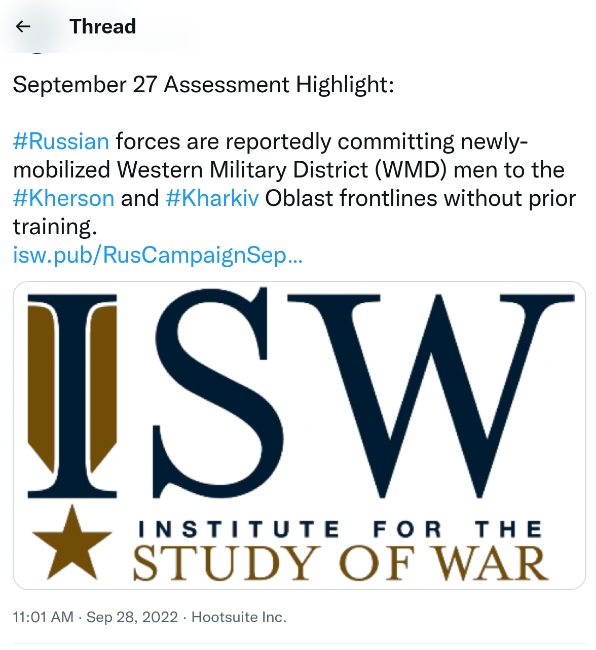
Yeah, so Vlad Putin is ‘mobilizing’ 300,000 Russian men to serve in his ‘special military operation’ in Ukraine. In fact, he’s probably ordered a much larger conscription; some estimate as many as a million Russian men, mostly from the more rural ethnic regions of Russia.

The vast majority of these conscripts will receive little (or no) training before being deployed. This is a feature of the Russian Army, not a design flaw. The lack of training is a deliberate aspect of Russian military strategy in Ukraine.

You may be thinking, “Greg, old sock, that doesn’t make a lick of sense.” And you’d be right (aside from calling me ‘old sock’ and I don’t know WHY you insist on calling me that) IF we were thinking about any conventional Western military strategy. But the current Russian military approach is built around what they call a Battalion Tactical Group (BTG).

The BTG approach involves a cadre of highly skilled soldiers around which poor quality infantry units can be attached. Different types of unskilled units will be attached to a BTG depending upon the nature of the mission or the condition under which they’re fighting. The unskilled or untrained units serve as a literal meat shield to protect the core of the BTG.

This is how it works. Say you’re a Russian officer and you want to know if there’s an ambush ahead, or if there are tanks in that village. You send the meat shield forward to draw their fire. That exposes the location of the enemy units, allowing the BTG’s artillery to target those positions. It works the same way on defense; station the meat shield in between the advancing Ukrainians and the core BTG; when the conscripts get attacked, the BTG artillery can target Ukrainian attackers more effectively.

It’s hard on the meat shield, to be sure, but it keeps the core of skilled professional troops more or less intact. Since the conscripts require little or no training and, for the most part, aren’t given decent weaponry, the meat shield is easily replaced. Just conscript a few thousand more ethnic peasants, and hey bingo, you’re back in business.

It’s a mistake to think of the effectiveness of the Russian Army in terms of casualties. It’s designed to have high casualty rates. Lots of dead and wounded conscripts are acceptable, so long as they achieve the strategic and tactical goals, and keep the core BTG units relatively secure.

The mobilization of a 300,000 body meat shield will help the Russian Army defend the territory they’ve stolen — for a period of time. Maybe it’ll be enough to get them through the winter, which will give them time to train and reinforce the BTGs. And that will prolong the war.

This, of course, is assuming Putin doesn’t contract ‘high building syndrome’ because of his unpopular war policies. It’s looking more and more like he’s losing control of the nation.

on the buying of books

I used to read everything. For years, I always had two books going–a novel and some work of nonfiction. The novels were almost always literary fiction (with the occasional dip into genre fiction); the nonfiction could be anything at all. Plate tectonics, a biography of Isadora Duncan, a history of clocks, the Boer war, a book on beekeeping. Seriously, I’d read anything and I read all the time–two or three books a week. I was basically a book slut.

Over the years, my reading habits have changed. That’s due partly to technology. In 2011, I was given a Nook–the ebook reader developed by Barnes & Noble. I didn’t ask for it and didn’t really want it. I was of the opinion that reading on an electronic device couldn’t be truly satisfying. I believed there was a feel and a scent that belongs to a physical book and it contributes to the reading experience.

Maybe it does. But it doesn’t contribute that much–at least for me. I’ll never go back to reading physical books.

The best thing about e-books is also the worst thing: the ease with which you can buy a book. I absolutely love hearing somebody talk about a book, and being able to buy it and have it in my collection 90 seconds later. I love having all my books with me and easily accessible at any time, wherever I go. I still have a Nook (which, by the way, is terrible tech, but it’s good enough to keep by the bed for late night/early morning reading), but most of my reading is done on a tablet.

Most of my nonfiction reading is now comprised of the weird, interesting, esoteric stuff I can access in online magazines or blogs or websites. The biggest change in my reading habits has been a shift from literary fiction to genre fiction.

This is partly because buying e-books has freed me from the tyranny of cover art. I used to have very strict cover art rules (mostly applied to genre fiction). For example, I would not buy a book with a cover featuring a woman warrior in ‘sexy’ armor. Or a detective in a trench coat. Or a skeleton. Or a goddamn dragon. In fact, I refused to buy a book if it had the word ‘dragon’ in the title.

That changed when a friend whose literary taste I respected, suggested a novel called His Majesty’s Dragon, by Naomi Novik. The title was bad enough, but it also had a dragon on the cover. It was described to me as ‘Jane Austen, but with witty dragons.’ Witty dragons, for fuck’s sake. But buying it online meant I didn’t have to hand the book and my credit card to an actual person, who’d look at me like I was the sort of person who’d buy a book with a dragon on the cover.

The novel turned out to be smart, funny, well-written, full of adventure, completely charming, and the dragon…well, she was witty. Even before I finished reading the novel, I bought the second book in the series (which also had a dragon on the cover).

That novel sort of broke the genre dam. I’ve discovered that the large ideas that drive what I used to think of as ‘serious’ literary fiction also exist in genre fiction–and often in a more accessible form. For example, Novik’s dragon series intelligently examines gender norms, as well as civil rights and liberties–both for women and for dragons. This may sound stupid, but it works.

For the last five years or so, I’ve been reading mostly genre fiction. Now the vast majority of my reading is divided between a metric buttload of genres. Cozy mysteries, hard scifi, detective fiction, mannerpunk, historical fiction, a smattering of fantasy, police procedurals, some urban fantasy, speculative fiction, military scifi, slipstream, almost anything.

But there are exceptions. I’m still reluctant to buy a novel that features elves or dwarves. I’m still skeptical of any novel that deals with magic or the supernatural, unless the writer provides some sort of internally consistent ‘rules’ for how the supernatural stuff works. I’ve written about this before, and I’ll repeat something I said then:

If a writer is only using the supernatural as a convenient way to move the story forward, that writer is not respecting the reader. As far as that goes, the writer isn’t respecting the craft of writing. As goofy as it sounds, ghosts (and the readers of supernatural stories) are better served when the ghosts have rules. It’s really that simple. And by the way, that’s also true for witches, and necromancers, and kitchen boys who inherit magic rings, and vampire librarians, and half-demon private detectives, and travel journalists who find a djinn in an antique bottle, and and and.

I’ve strayed a bit from my point (if you can call it a point–and really, who would be surprised by me straying from it?), which is that e-books have changed what I read. It essentially liberated genre fiction for me; it allowed me to see the great beauty of its flexibility, of its capacity blending ideas and concepts and approaches from different genre forms.

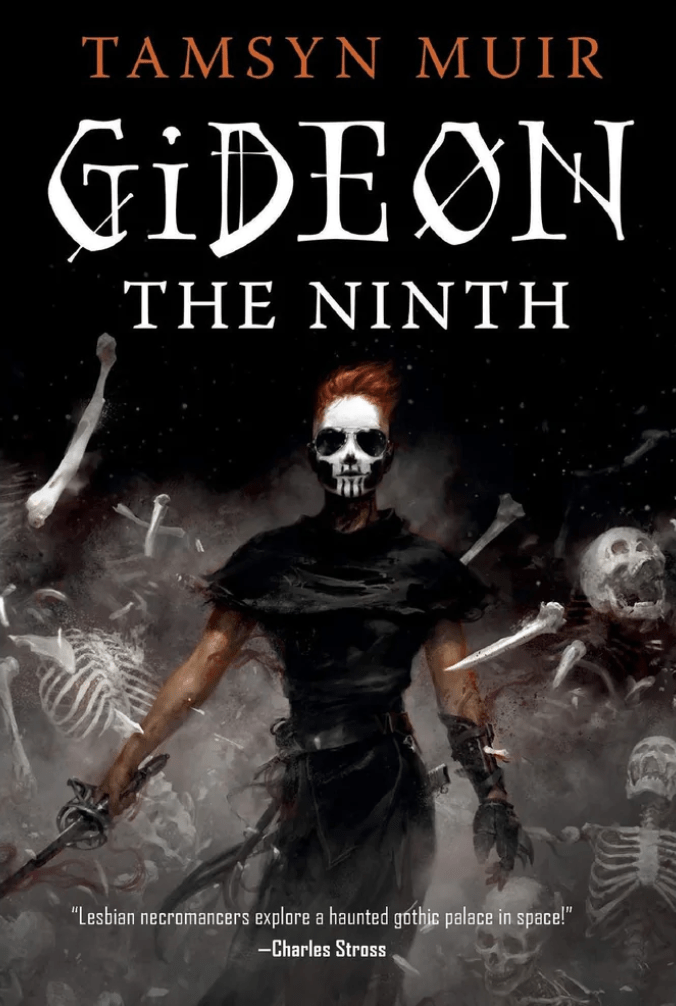
The only problem with e-books is the problem of impulse control. I buy a LOT more books on impulse, which is sometimes a bad idea. I have bought some truly awful novels on impulse. On the other hand, I once bought a novel based entirely on a nine-word blurb (Lesbian necromancers explore a haunted gothic palace in space) and it became one of my favorite books. The cover art was dramatic, but doesn’t do justice to the brilliant and charming complexity of the novel. When I was halfway through Tamsyn Muir’s Gideon the Ninth, I wanted to recommend it to a friend. So I did a google search for reviews to help me describe it. The review on NPR said the novel “…is too funny to be horror, too gooey to be science fiction, has too many spaceships and autodoors to be fantasy, and has far more bloody dismemberings than your average parlor romance.” That review leaves out the humor, the fencing, and the love story.

I have friends who continue to limit their reading to serious mainstream literary fiction. I actually feel sort of sorry for them. They’ll never get to meet clever dragons during the Napoleonic wars or lesbian necromancers in space, and their world will be the poorer for it.

random thoughts

Okay, first, what the fuck is this about?

This happened last night at Comrade Trump’s rally in Ohio. I’m hearing it’s either some sort of QAnon salute (you know, that whole ‘where we go one, we go all’ bullshit) or some sort of obscure but not recent Nazi thing. Whatever it is, it’s fucking weird and more than a little unnerving. In any event, it seems pretty obvious that Trump is priming the pump so that when he’s indicted (and yeah, I said when, not if) this crowd will respond with unfocused stochastic violence. A cult that believes Trump is the central figure in a secret war against an international Satanic cabal of pedophiles is capable of just about anything so long as it doesn’t require focus or logic.

Second, I generally have a low cuteness tolerance. But for some reason I’m ridiculously fond of public gardens that have — and this is difficult for me to admit — little pixies scattered around in the shrubbery. Not a LOT of pixies, on account of that would be cuteness overload, but just a few quietly concealed among the plants and pathways. I mean, a person should be able to walk through the garden and not see any of the wee creatures at all, but knowing that there may be a few of them there, lurking cutely, waiting to be spotted — well, that’s probably a good thing.

This ornament is about the size of my thumb (which, I assume, is an average sized thumb). I don’t know if these are actually pixies or fairies or some other mini-supernatural being. I’m sure there’s a taxonomy for these things, and there’s bound to be some internet database detailing the differences between pixies and fairies, but I can’t research it because, as I said, I have a low tolerance for cuteness.

Third, I keep getting credited by friends for the phrase Jesus suffering fuck. I wish I could take credit for it, but I first heard it used by Billy Connolly, the Scottish actor/comedian. He said he’d first heard the phrase in Glasgow. So my guess is it’s likely something somebody uttered in a pub when confronted with something impossibly, ruinously stupid.

Billy Connolly

As an expression, it’s close to perfect. It just rolls well off the tongue. Jesus suffering fuck. There’s a purity to it, a unity; a complete protein comprised of equal parts of the poetic and the profane. I try to use it deliberately but sparingly. I mean, you don’t want to bring your Amati to a hoedown, but you still need to use it regularly to maintain the harmonics.

Fourth, I was thinking about the hateful and profoundly idiotic stunt in which the governor of Florida thought it would be clever to spend state funds to hire a plane to fly Venezuelan immigrants from Texas to Martha’s Vineyard in Massachusetts, but then I let myself get distracted by a less obvious question: who in the hell was Martha?

She was either the mother-in-law or (more likely) the deceased daughter of Bartholomew Gosnold. This guy, I declare. He was born in Suffolk, England in born in 1571, graduated from the University of Cambridge, studied law, but decided he’d rather go sailing. In 1602, he took a 39-foot bark crewed by 32 men and sailed to the coast of Maine where, and I am NOT making this up, he was met on the beach by a native wearing imported European shoes and pants. That’s 1602, and Europeans had already begun fucking up the local culture.

Bartholomew Gosnold

In any event, Gosnold and his crew worked their way south, spent some time fishing (they were the folks who decided on the name Cape Cod because of…well, the cod they caught) and stayed for a couple of days on an island where they ate strawberries. Gosnold named the island after his mother-in-law/deceased daughter (pick one, they were both named Martha), then moved on. After about six weeks in the area, during which they loaded up their ship’s hold with furs, cedar wood, and sassafras (which was exceedingly profitable because it was thought to be a cure for syphilis), they sailed home. Eighteen years later, the Mayflower followed Gosnold’s route to Massachusetts, thereby establishing the conditions for four centuries of Europeans fucking over the natives.

I doubt any of the Venezuelan immigrants know that story. If they heard it, I’d like to think they’d look at each other and say, “Jesus suffering fuck.” Only, you know, in Spanish.