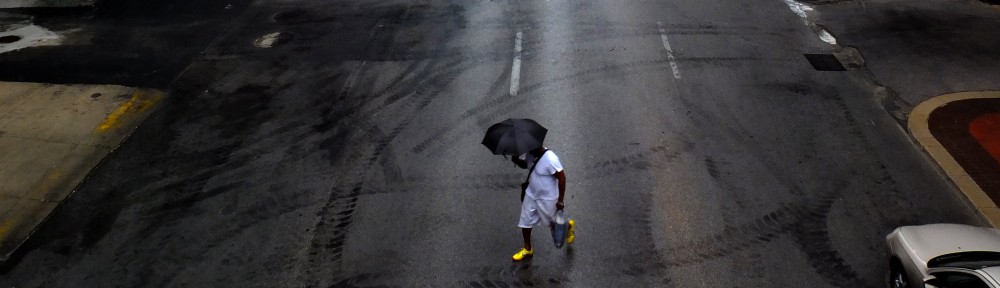
in a small town

I wouldn’t know Jason Aldean from Adam’s off ox, but he’s stirred up a fuss with his song Try That in a Small Town. I say ‘his song’ as if Aldean wrote it. He didn’t. The song was actually written by four guys: Kelley Lovelace, Kurt Allison, Neil Thrasher, and Tully Kennedy. Aldean just recorded the song.

Anyway, I listened to it. I sort of assumed it would be a traditional country-western song. You know…simple form, folksy lyrics, standard country music instruments (like fiddles or banjos or a steel guitar). But it’s not. Musically, it’s rock. Fairly hard rock at that. But the lyrics are sung in a sort of semi-traditional nasal country voice. Like a lot of country music, though, it’s short. Three minutes. Which is plenty long enough.

It’s the lyrics, of course, that make this song controversial. The lyrics were clearly intended to be controversial. The lyrics were meant to make everybody angry–to get folks to argue about it. It’s not so much a song as it is a musical grift. Get folks pissed off, keep the song in the public eye, put some coin in pockets.

It’s basically a cartoonish MAGA anthem made up of racist right-wing nightmares, faux tough guy attitude, hollow patriotism, all backed up with threats of violence. It’s a classic MAGA conglomeration of self-pity, masculine insecurity, misogyny, and free-floating resentment and rage. It’s a song written by assholes, recorded by an asshole, meant to be consumed by assholes.

Seriously, it would be comical if it weren’t so stupidly hateful and transparently phony. Try This in a Small Town is the musical version of a dentist buying a Harley and wearing leathers. It’s a mall security guard who joins a ‘militia’ and wears camo with his ‘warrior’ buddies on weekends. It’s the appliance store assistant manager who believes he was passed over for promotion because he’s white and male.

Try that in a small town
See how far ya make it down the road
Around here, we take care of our own

That’s the ugly heart of the song, right there. We take care of our own. If you’re not one of our own, you don’t belong and you’d best get the fuck out of town.

And hey, people have done just that. Folks who don’t fit in their small hometowns have always packed up and left. That’s one of the main reasons small towns are failing. The kids who are bored have left. The creative people have left. The curious people have left. The people who ask too many questions, they’ve left to find answers. And most of them don’t come back.

I recommend you don’t
Try that in a small town
Full of good ol’ boys, raised up right
If you’re looking for a fight
Try that in a small town

The ONLY people looking for a fight in a small town are the ones who are so absolutely certain they’re right; the ones who get to define ‘our own’. If you’re in the minority, you’re looking to avoid a fight. You know you’re not welcome, you know you’re outnumbered, and you know there are folks in your community who hate you and are actually eager to kick the everloving shit out of you. So you leave the first fucking chance you get.

And hey, that’s what happens. The people who don’t fit in, they leave. The young leave. The creative people leave. The curious people leave. The people who get bored leave. The people who want more from life, they leave. The people who want to try new things, they have to leave. The people who write songs, they leave.

There are actually a LOT of good songs about small towns. Songs that aren’t specifically designed for rage-grifting. Songs in almost every musical genre. Songs that look realistically and honestly at life in small towns. Some of them are celebratory, some are nostalgic, most of them are sad.

And over a double Bourbon
He said “I’ll tell you man to man,
This town died forty years ago.
Son, get out while you can.”

You want to know about life in small towns? Don’t look to assholes like Jason Aldean.

gender bullshit

There’s a long…and I mean seriously long, as in Please babby Jeebus, is this thing ever going to end long…opinion piece on the meaning of masculinity in this morning’s Washington Post. It’s entitled Men are lost. Here’s a map out of the wilderness, and frankly, that title alone would normally be enough for me to ignore it. Except it was written by Christine Emba, whose opinion I value. So what the hell, I read it.

And hey, she does a good job of examining the ways people are trying to define masculinity these days. The piece is well-researched, thoughtful, well-written, and determinedly even-handed (which is probably why it’s so fucking long). But as I continued to read it, I kept asking myself the same question: who the fuck cares?

There are some really really really broad categories of being that are ultimately undefinable. They resist definition because they’re so broad and vague and elastic. Who is a man? Who is Black? Who is an artist? Who is a parent? Who is a Red Sox fan? Who is a healer? Who is an athlete? Who is an influencer? Who is a cook?

I mean, it’s possible–even necessary–to organize a specific set of requirements necessary to meet professional standards to define some roles. There are prerequisite training and skills to become, say, a licensed hair stylist. But that’s an administrative thing; if you style your own hair, then hey bingo, as far as I’m concerned you’re a hair stylist.

But trying to define these broad generic categories is basically bullshit. Don’t nobody get to set any goddamn rules on who is (or is not) a man or a woman. And why the fuck would anybody want to? Why would anybody waste a single fucking moment fretting about it?

Toward the end of her opinion piece, Emba writes this:

For all their problems, the strict gender roles of the past did give boys a script for how to be a man. But if trying to smash the patriarchy has left a vacuum in our ideal of masculinity, it also gives us a chance at a fresh start: an opportunity to take what is useful from models of the past and repurpose it for boys and men today.

Well, she’s right that the past DID give boys a script for how to be men (and for girls to know how to be women), but isn’t that the source of the problem? A script is just the written text for a performance. We don’t need no script to be who we are. We are already who we are. People need to stop acting and just fucking relax.

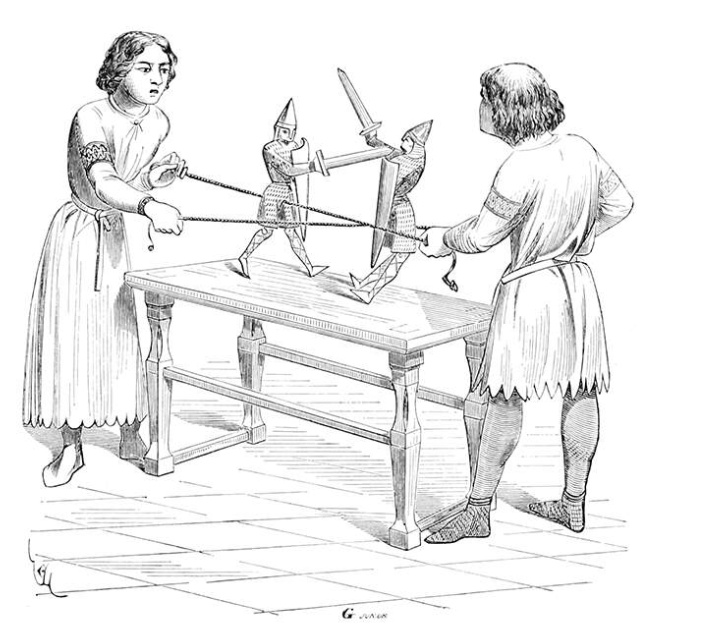
(Engraving by Eugène Emmanuel Viollet-le-Duc)

Emba also mentions that ‘trying to smash the patriarchy has left a vacuum in our ideal of masculinity.’ Well, yeah. That’s the whole fucking point, isn’t it. Scrap that shit. Scrap the ideal of femininity too. Scrap the concept of ideals, because they’re imaginary. There IS NO IDEAL man or woman. No ideal cook or artist or Red Sox fan or parent or Black person (and stop thinking of Idris Elba, okay, just stop it). There’s only somebody’s bullshit notion of what they think is ideal.

Here’s another part of the problem. If we smash the patriarchy and replace it with the matriarchy, would that be better? Well, yeah, probably. But that has its own set of problems, and eventually we’d need to smash that as well.

Emba ends her opinion piece with this:

The old script for masculinity might be on its way out. It’s time we replaced it with something better.

This is just my opinion: if you define yourself as a man, then you’re a man. If you refuse to define yourself along any gender line, ain’t nothing wrong with that. Because the problem isn’t gender, really. The problem is the script. Emba got that point right.

People are comfortable with a script. A script tells them what to do, how to behave, where to stand, what to say and when to say it. People like a script. So yeah, maybe Emba is right that we need to replace it. Not just the ‘masculinity’ script, but the gender script. Maybe all we really need is a script that says this: Don’t be an asshole.

That’s a good script because asshole is also one of those categories that resist definition because they’re so broad and vague and elastic. If the script is don’t be an asshole, the actor would have to consider their entire galaxy of self-defined asshole behaviors. And then NOT do those things. That would solve a whole lot of problems.

bluesky smilin’ at me

I’ve been asked to give my initial impression of Bluesky, the social network. I was invited to join about a month ago (courtesy of Bryce Fields, an old Flickr friend), and I have to say, it’s not quite what I expected it to be. But it is pretty much what I hoped it would be.

I was reluctant to leave Twitter because it fed a lot of my niche interests. Yeah, it was messy and ugly and getting more hateful by the hour, but it also allowed me to get a regular info-fix of crows, politics, archaeology, William Gibson fashion views, lizards, peculiar chunks of history, the US Women’s National Team (soccer), mortuary symbolism, and lots of other stuff. Twitter was like a Big Box store unfortunately staffed by Nazis but well-stocked with a lot of weird shit I wanted to know. I didn’t think there could be a venue where I could find all of that in a hate-free environment.

Twitter, as awful as it was (and still is), was also incredibly useful for real-time news. If something newsworthy was happening somewhere in the world, it was happening on Twitter. I’m talking about anything newsworthy–whether it was a riot or a natural disaster or some guy who found a human toe in a can of soup. Sure, you had to be alert for massive amounts of misinformation and even deliberate hateful disinformation, but Twitter served a purpose.

So here’s the question: does Bluesky work well enough to replace Twitter? Yes, it does. Bluesky isn’t quite there in terms of newsworthiness…yet. But it shows real potential in regard to my niche interests. And best of all, it’s virtually Nazi-free. Hell, it’s actually (and I hesitate to say this for fear of jinxing it) very pleasant. It’s comfortable without being ‘safe’ if that makes sense.

It’s important to remember that Bluesky is still in Beta, which means that a number of things we take for granted on other social media are missing. Stuff like hashtags or the ability to construct long discussion threads or DMs. Maybe those things will come later, I don’t know. At this point, their absence only marginally detracts from the experience.

The Bluesky experience is relaxed and welcoming. Some of this may be because it’s still fairly small. But, at the risk of sounding sappy, the users make a genuine effort to get along with each other. I’ve seen very little drama or rancor. There’s almost no indication of the sort of asshole culture that thrives on Twitter. I’m not saying there aren’t any assholes on Bluesky; I’m saying that assholes are handled better on Bluesky. There’s a relaxed Don’t Feed the Asshole vibe. Instead of trading insults or entering into pointless arguments with transphobic Nazis, users on Bluesky tend to just mute or block them. You can’t own the libs if the libs just ignore your existence.

It’s also nice to see Big Hat users (you know what I mean…folks who are well-known or famous in certain circles, and have hundreds of thousands of followers on Twitter, folks who wear a Big Hat) interacting with new users, especially when those users don’t know they’re Big Hats. On Twitter, you probably wouldn’t see Neil Gaiman helping a new user learn how to change his Bluesky handle to include his personal domain name. On Twitter you probably wouldn’t see somebody tell John Scalzi, “I followed you because you were kind and funny; I didn’t know you were famous.” That’s one of the things I’ve enjoyed the most about Bluesky–how accessible everybody is. It doesn’t mean people will pay attention to what you post (very little of what I post gets any attention), but it means you can easily find yourself asking questions about blue crayfish of somebody who turns out to be the Research Curator of Non-molluscan Invertebrates at the NC Museum of Natural Sciences.

My only real complaint with Bluesky is that I occasionally encounter users whose sincere preachiness I find mildly annoying…even when they’re right. There are folks who seem to seek out images posted without an Alt description in order to remind them (gently and with respect) that they really really should include Alt descriptions of images out of courtesy for visually impaired or autistic users. But even though I find it annoying, that’s probably the best way to change online culture. The sad fact is, some folks need to be reminded to be decent people. And (confession time!), I have to admit I never gave much thought to Alt descriptions before. Now I’ve set a filter on Bluesky that won’t allow me to post an image UNLESS I include an Alt description. That’s how Bluesky works; it encourages you to be decent.

I’ve been asked if Bluesky is supportive of LGBTQ+ communities. And the answer is no. It’s not merely supportive; it’s fucking celebratory. I’m not saying it’s an ongoing party, but there are corners of Bluesky culture that would make homophobes and transphobes really uncomfortable. Which, in my opinion, is another mark in its favor. It’s also nice that you can set filters that allow you to choose whether or not you want to see images of somebody wearing ass-less chaps and a sailor hat.

Also, there are lots of photos of dogs and cats (and sometimes the people associated with them). And for some reason, I see a lot of potato recipes. I’m okay with that.

Bluesky isn’t perfect. For example, there’s a noticeable absence of crow discussion. But the people here are tremendously enthusiastic, and that sort of makes up for the lack of crows. It’s that universal level of enthusiasm that makes Bluesky so attractive to me. Everybody here seems to be enthusiastic about something (like, say, star nosed moles). They’re also enthusiastic about creating a social network that is tolerant and accepting of almost everything except assholes.

As the site grows, it’ll change. It’s to be hoped that it will get even better, but that’s a gamble, isn’t it. For now, I’ve found it to be the most comfortable, welcoming, easy-to-use social network. It won’t suit everybody, of course, but I feel at home here.

EDITORIAL NOTE: Don’t forget, we need to burn the patriarchy. Burn it to the ground, gather the ashes, piss on them, douse them in oil, and set them on fire again. Burn the patriarchy, then drive a stake directly through the ashes where its heart used to be, and then set fire to the stake. Burn that fucker one more time. And keep burning it, over and over. Burn it for generations. Then nuke it from orbit. Then have tea.

a writer, not an author

I don’t spend much time thinking about myself. I mean, I’ve lived with me my whole life; there’s not much unknown territory there for me to explore. But I had this exchange on BlueSky (one of the more promising ‘next Twitter’ social media). There was a call to create an ‘authors feed’. My response:

This is probably silly, but I tend to be uncomfortable with the term ‘author’. I’ve published some stuff–short fiction, nonfiction books, a novel–so ‘author’ technically fits. But maybe it sounds too pretentious for me? I think of myself as a writer. I write stuff.

The reply:

Yeah, that’s the old imposter syndrome kicking in. The only requirement to being an author is to have authored something.

And I thought, “Yeah, that’s probably it.” I suspect anybody who has had some success in anything has, at one point, thought, “Lawdy, who do I think I’m fooling?” Normally, that would be it. Question asked, question answered, end of story.

But this morning, after I sat down at the keyboard, drinking my morning cold brew, looking out the window, reading the news, going through my usual morning routine before starting to write, I thought, “Naw…I’m not an imposter. I mean, I won a damn Edgar this year. That’s a pretty big deal.” And I looked at the mantle…

…and then I thought, “Hey…where’s my Edgar?” Because it wasn’t on the mantle.

Okay, some history. I learned I’d been nominated for an Edgar from Lori Rader-Day (who, by the way, is the real deal; you should go out RIGHT NOW and buy all her books). I thought that was pretty cool, but aside from doing some of the scut work associated with the nomination, I didn’t give it much thought. I didn’t expect to win. I even forgot about the big Edgar event when they announced the winners. Again, it was Lori who alerted me that I’d won. Again, I thought it was pretty cool and I understood I’d be getting a statuette at some point. And again, I pretty much forgot about it until it arrived.

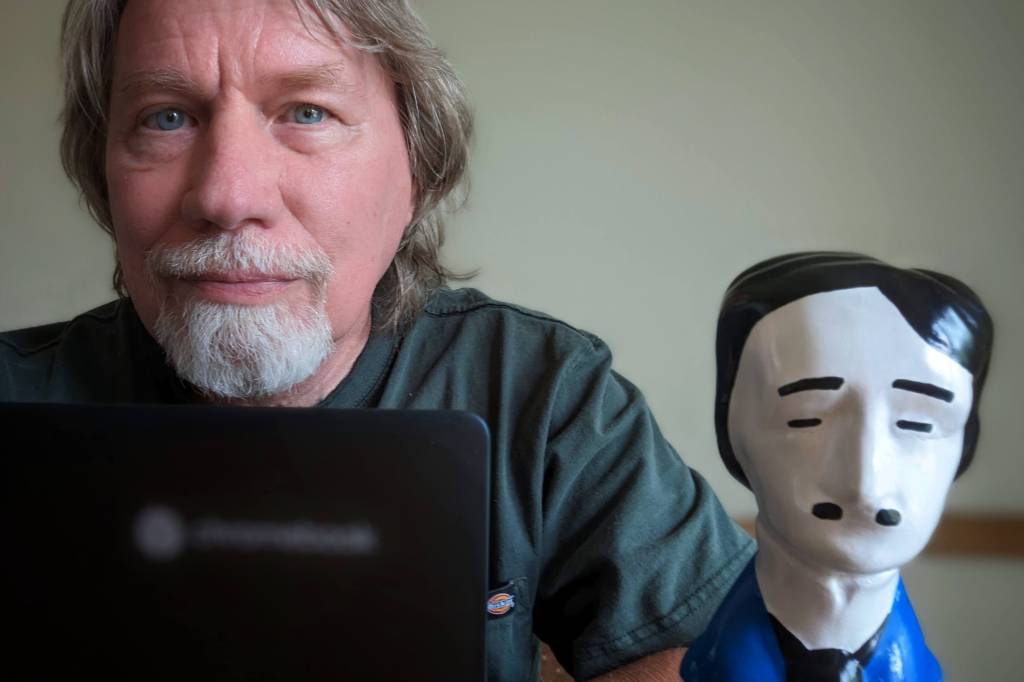
Now THAT was cool. I took it out of the box, put it on the kitchen table (where I usually keep my Chromebook and do most of my writing in the mornings), looked at it a few times, then pretty much ignored it. Until I was reminded I hadn’t taken a photo of it. So I did that.

See? I won that thing right there.

Some time later, I happened to notice it sitting on the mantle over the fireplace. And I said something clever, like, “Hey, look…my Edgar.” To which Ginger replied, “I put it there a couple of weeks ago, you idiot.” So this morning, when I looked at the mantle to remind myself that getting an Edgar is a big deal and I’m not an imposter, I realized she must have moved it somewhere else. I’ll have to ask her later.

My point–if you can call it that–is I don’t feel like an imposter. I have actual, physical, tactile proof that I’m not an imposter. So what is my problem with the term ‘author’? And I’ve decided it’s this: ‘Author’ is a fixed, static state. You become an author when the work is done. ‘Writer’ is dynamic; it’s a thing you DO. I don’t think of myself as an author because I’m not particularly interested in what I’ve already done because…well, I’ve already done it. I am interested in what I’m doing, which is writing.

Like I said, I don’t spend much time thinking about myself, mainly because I’m not that interesting to me. But I realize some of this crap–like why I prefer to be a writer instead of an author–might be interesting to other folks. So, there you have it.

iowa kids are okay

Right, background information first. The Iowa High School Athletic Association and the Iowa Farm Bureau coordinate with the office of the Governor of Iowa to create the Iowa Governor’s Scholar program. It’s designed to honor the highest-achieving students from each of Iowa’s high schools. It seems to be largely a ceremonial thing–the students get some sort of certificate of recognition and get a chance to be photographed standing next to the governor. The governor has to sacrifice a chunk of time standing still while kids rotate in and out for their photos, but she gets some free good publicity. Everybody wins, right?

That’s what normally happens. This year, not so much. This year Gov. Kim Reynolds and the GOP-controlled legislation have enacted a number of awful MAGA-inspired laws. This year, some of the kids being honored felt compelled to speak out in protest to the Iowa GOP’s repeated attempts to turn this state in the Florida of the Midwest.

For example, this year the Iowa GOP passed a wide-ranging education bill that includes a ban of public school books that include descriptions of sex acts, It also makes it easier to remove challenged books from school libraries. The law could include everything from Catcher in the Rye to Twilight to What’s Eating Gilbert Grape to And Tango Makes Three (which is a children’s book about two bonded male penguins in the Central Park Zoo who raised a penguin chick). It’s a truly reprehensible law.

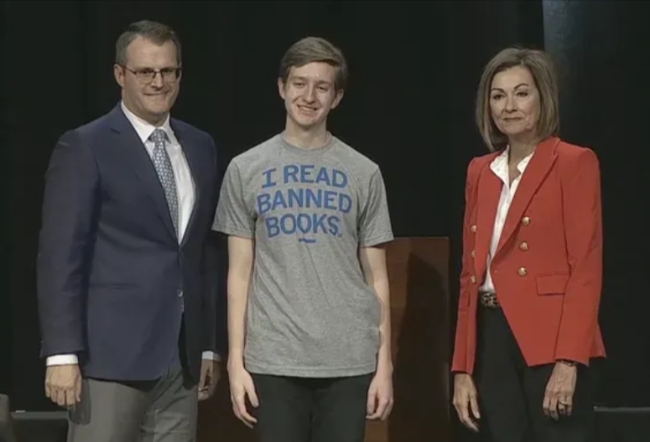
Newton HS senior Leo Friedman believes books have value.

This year, the GOP-controlled legislature also passed legislation creating what they call “education savings accounts.” This new law allows the state to use funds marked for public education to be spent instead on private education. It provides families with US$7,600 per student in public education funds which can now be used to cover private school tuition and fees. Most of those private schools, of course, are religious schools and religious schools are almost universally conservative Christian schools. This law not only undermines the purpose of secular public education, it also creates the conditions for religious/political indoctrination.

Newton HS senior Merin Pettigrew feels public funds should be used in public schools.

Also this year, Gov. Reynolds and the Iowa GOP have passed a number of anti-trans legislation. This includes barring transgender girls and women from participating in girls and women’s sports, a ban on students (and adults) using public school bathrooms and locker rooms that don’t align with their gender assigned at birth, and prohibiting minors from receiving gender-affirming care even with a parent’s or guardian’s permission. These laws not only discriminate against trans kids, it publicly marks them as dangerous, thereby putting trans kids at emotional and physical risk.

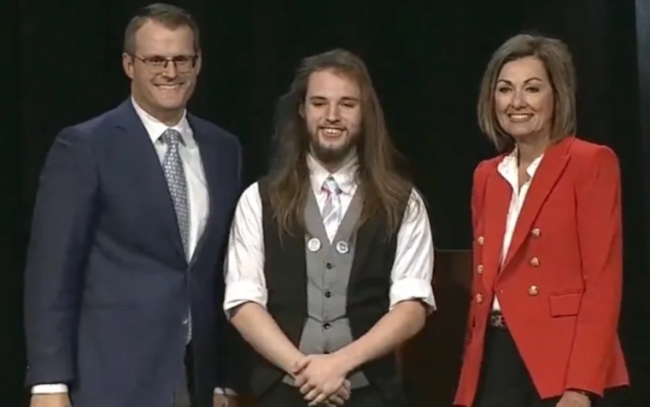
Davenport West HS senior Clementine Springsteen believes trans rights are human rights.

Springsteen wore pins stating “Trans Rights Are Human Rights” and “She Her” and as she left the stages loudly proclaimed, “Trans rights are human rights.” 

These were deliberate, thoughtful acts of civil protest against the sort of hyper-partisan political legislative movements we’re seeing in several ‘red’ states. They were acts of individual courage and integrity, done with as much respect as possible under the circumstances. Friedman said,

“I intend no disrespect to any other of the students (or attendees) there for sure. But if the governor feels disrespected, that is the purpose of the protest. Because we don’t respect what she has done recently with the laws that have been passed and the ideologies that she instilled into the government in our state.”

Springsteen, who is trans, explained why it’s critically important for trans kids to be able to affirm themselves while still in school. She came out as trans to her classmates during a speech class.

“I was terrified, obviously. But my teacher has always been really supportive. She’s always been really supportive, and there for me. As far as the class goes, there were a few there who I was really terrified of how they’d react. But I think within my speech, I’m hopeful that I managed to change their minds about the issue. I didn’t have any issues with them after that point. “

And that’s it, isn’t it. This is one of the unspoken benefits of public education. School is where kids learn how to get along with other kids, even those who are different in some way. School is where kids get exposed to new ideas, it’s where kids learn other kids can hold different views, believe different things, have different backgrounds, have different types of parents, exist in different ways, and yet can still get along with each other. School is where we begin to learn how to behave as adults.

Gov. Reynolds and the Iowa GOP need to go back to school. These kids could teach them a lot about modern life.

i talk to strangers

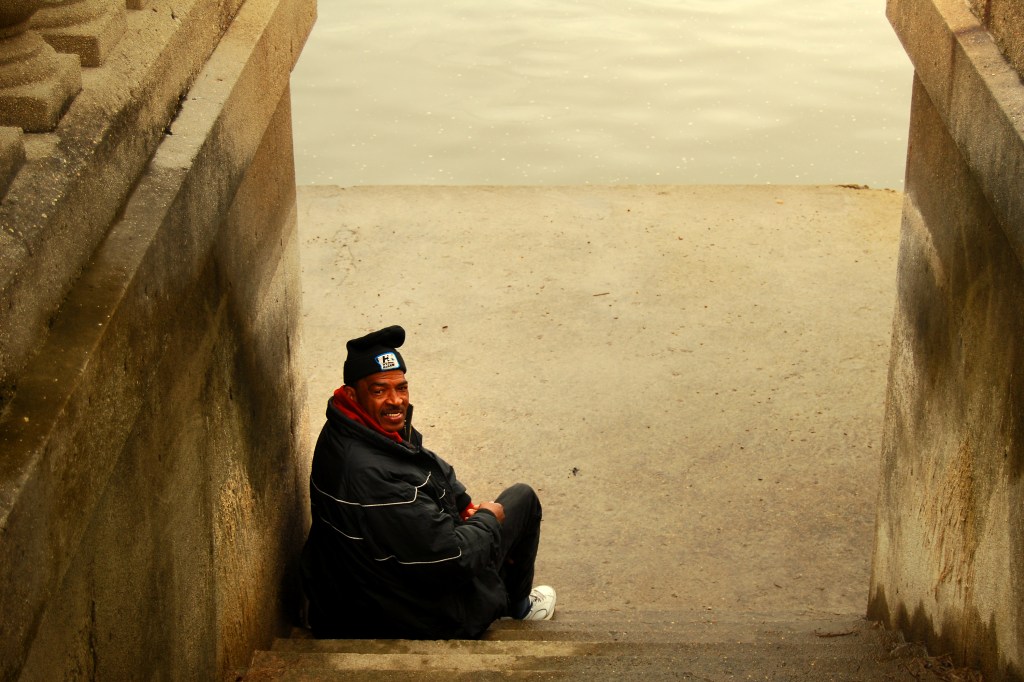
A few years ago, on a cloudy, rainy day, I was taking an idle stroll along the riverwalk in Des Moines and I came across a guy sitting on the steps. We chatted for a bit about nothing in particular. As I was leaving, I stopped and asked if I could take his photograph. He said “You gonna make me look sad or stupid?” I said, “Are you sad or stupid?” and he snorted and said “I sure am.” That’s when I took his photo. When I asked his name, he said “I’m just a guy sitting by the river.”

Just a guy sitting by the river.

I talk to strangers. I like talking to strangers. I like meeting new people and learning something about them. Granted, most of my conversations with strangers are casually superficial, so it’s not like I’m learning anything important or meaningful about them or their lives. But the simple fact of meeting and having an idle conversation with random strangers tells me something about humanity in general.

And this is what I’ve learned: most people are pretty much okay.

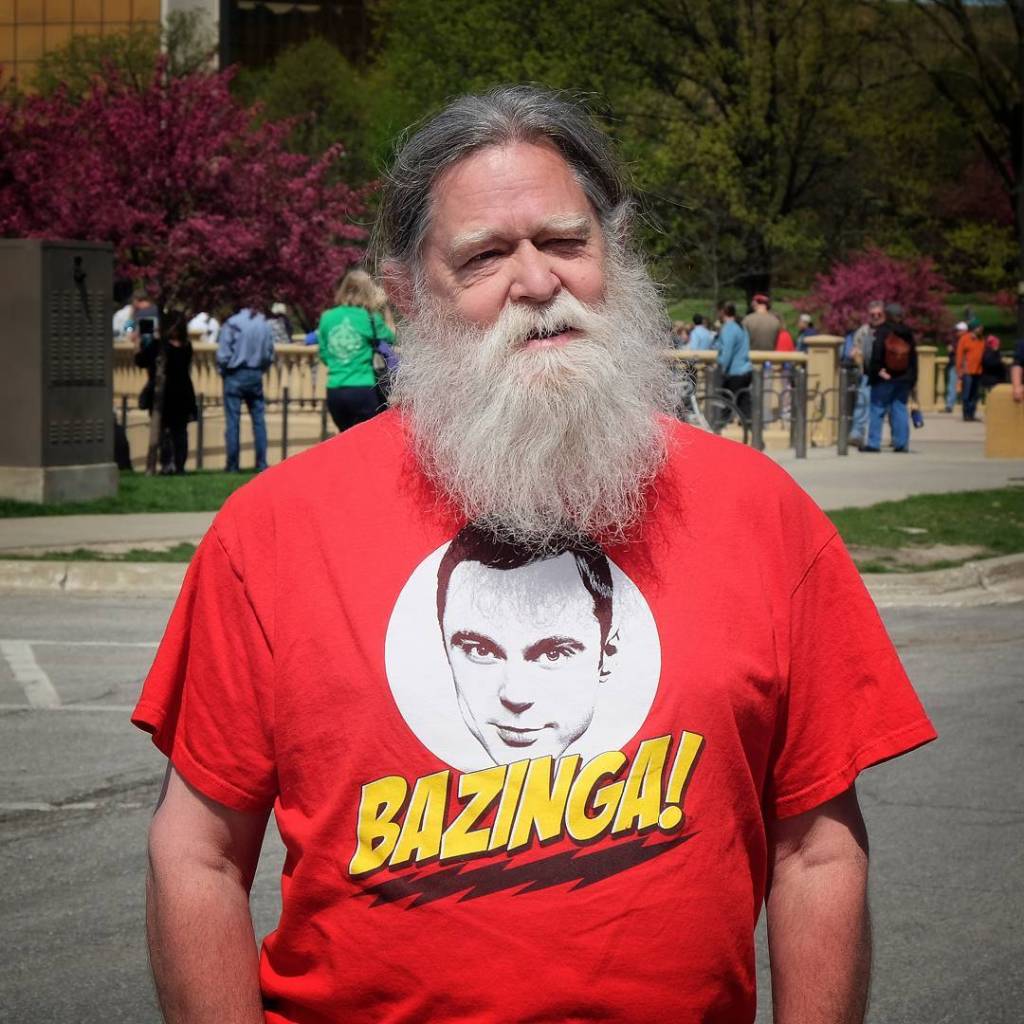
Just bought a bunch of children’s science booklets from the 1960s.

This guy (points up), for example. He’d just bought a bunch of outdated science booklets for kids, and he was happy and excited about them. To me, they looked like badly illustrated pamphlets depicting decades-old information about science. But his enthusiasm was infectious, and I found myself actually interested in the best 1960s approach to dealing with prairie dog overpopulation.

Is that information useful? Nope, not even remotely. But I love knowing that somewhere out in the world is a guy who can give a logical, sincere, and passionate defense of relying on natural predation instead of poison to deal with what ranchers consider vermin.

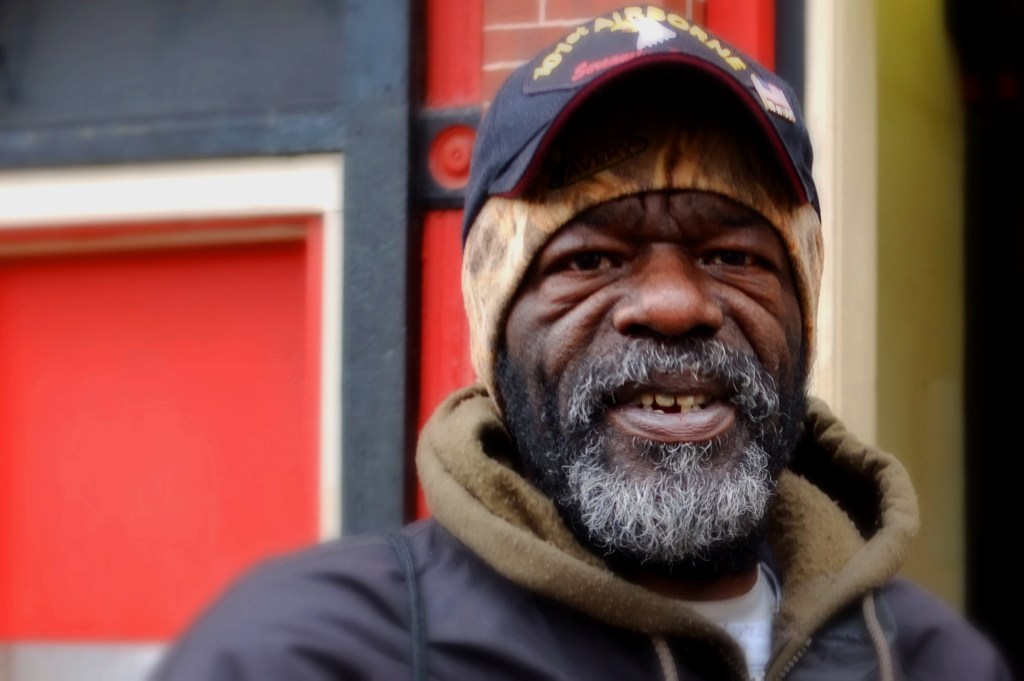
Mickey, whose story had…flaws

Every stranger I’ve met has a story. They’re not all true, of course. I don’t think that matters. Mickey (above) told me he was a disabled veteran. And who knows, maybe he was. He had a Marine Corps emblem on his jacket but his cap said 101st Airborne, which is a division of the Army. He was using a hand-carved walking stick, which I admired–and that’s how we struck up a short conversation. It was too chilly outside to chat for very long, and as we parted I gave him a quick salute–which he returned.

Here’s a True Thing: in basic military training, they literally teach you how to salute. How to hold your hand and wrist, the proper position of your upper arm, the correct incline of your elbow. They make you practice this over and over until it becomes automatic. Mickey didn’t know how to perform a proper salute. Does that mean he was lying about himself? Maybe. Maybe not. Again, I don’t think it matters. His story didn’t have to be true; it still told me something about what he believed and who he’d like to be and what he finds important.

James, sitting under a bridge

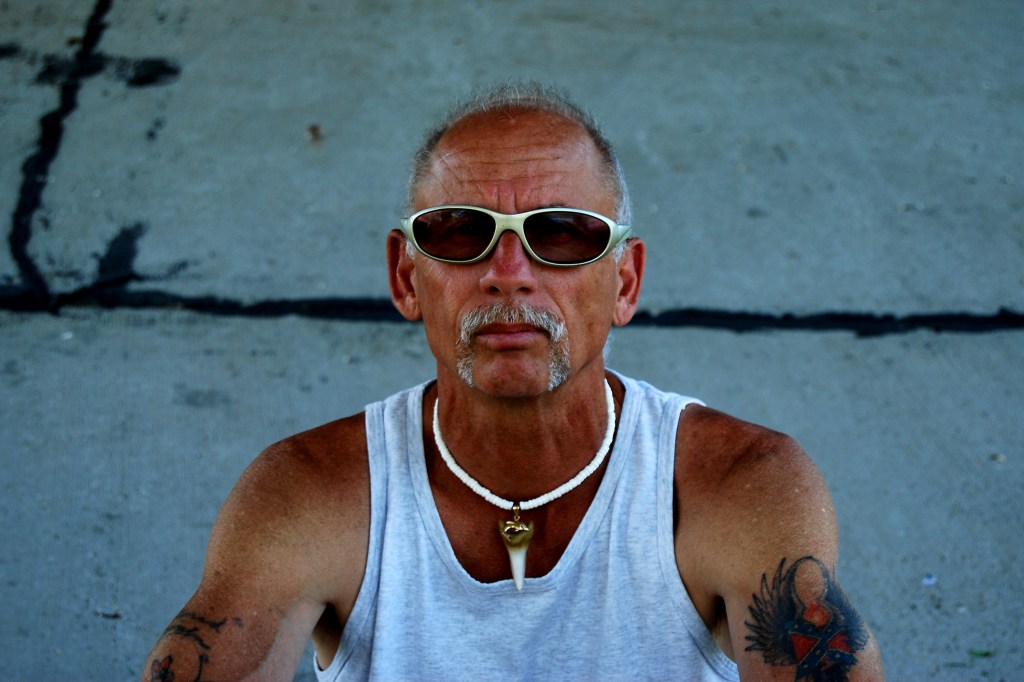
I met James on a hot summer day, sitting under a bridge. I was riding my bike, he was sitting in the cool shade drinking something in a brown paper bag. I stopped to get a drink from my water bottle. We discussed the heat, of course, but James also told me he worked at a nearby theme park; he liked to get away from the noise and the people, and the bridge was within walking distance. It was relatively quiet, cool, and it gave him a bit of what he called “down time.” You could tell James had been around a long, hard block–probably more than once–but he had a weird sort of muted raffish elegance about him. The careful way he trimmed his facial hair, his necklace, his sunglasses, his ornate tattoos–it’s as much about who he wants to be as who he is. And who knows–maybe he actually is who he wants to be.

Guy pushing his bike

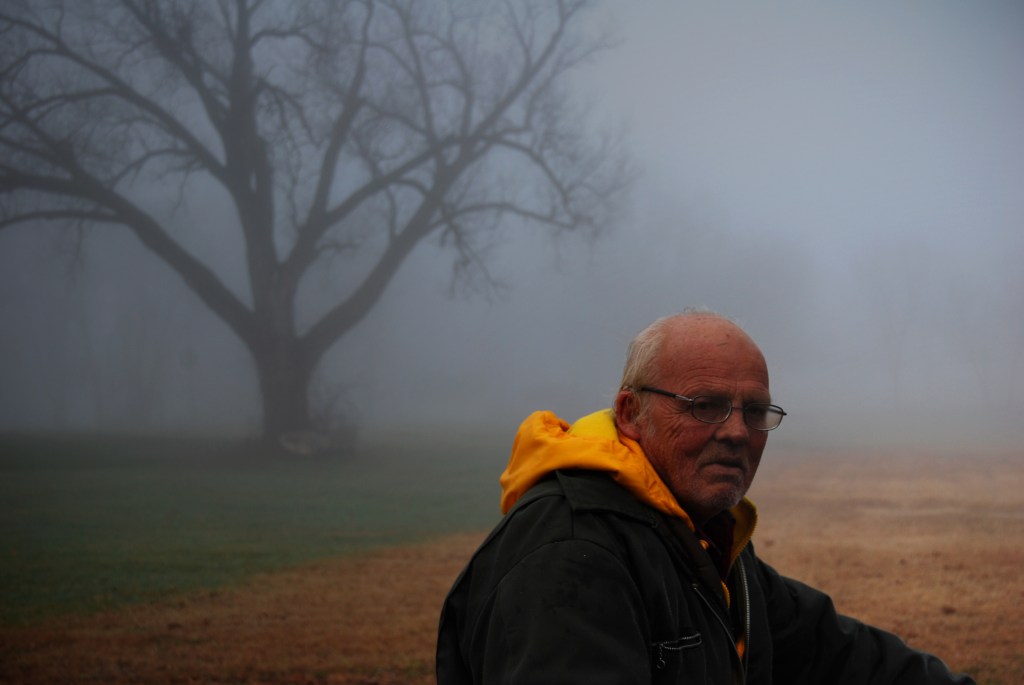
Meeting strangers is easy; they’re everywhere. But it’s getting a wee bit more difficult to get them to talk. People are increasingly suspicious of strangers. I guess I can’t blame the guy in the photo above for being suspicious. It was a cold, foggy morning. I was riding my bike; he was walking a bike. So I stopped to ask him if he was okay, if he needed help with his bike. He hesitated, then said, “I’m okay; I live nearby.” I told him I had a small tool kit in my bike bag and I’d be happy to help if I could. He shook his head. He was clearly uneasy, so I let it go. Instead, I asked if I could take his photo. He asked, “Why?” I said something about his yellow hoodie and the fog, which probably didn’t make any sense to him. But he said, “Okay.” I took his photo, wished him good luck, and went on my way.

I wondered later if maybe the guy didn’t want me reaching into my bike bag. Maybe he thought I carried a gun there. Some people do. On one cycling forum I follow, there are lots of discussions about self-protection on bikes. People are afraid they’ll be attacked as they ride or when they stop, afraid they’ll maybe get bike-jacked. A lot of those fearful people have opted to bike armed.

Scared people are the last people who should be carrying firearms. But we now live in a world in which wrong-place shootings take place on an alarmingly regular basis. It’s inevitable, I suppose, that somebody will get shot for being on a bike in the wrong place at the wrong time (assuming it hasn’t already happened somewhere). The fact that a term like ‘wrong-place shooting‘ even exists is an indictment against our society. I’d argue one of the reasons we have wrong-place shootings is because fewer people are willing to talk to strangers. All day every day there’s a ‘news’ station that injects fear porn directly into the veins of its viewers. They tell folks that ‘others’ are out to get them, to take their stuff, to molest their children, to break into their homes, to take away their rights, to destroy their religion, to confiscate their guns. Of course, they’re frightened.

Kent, keeping the streets clean.

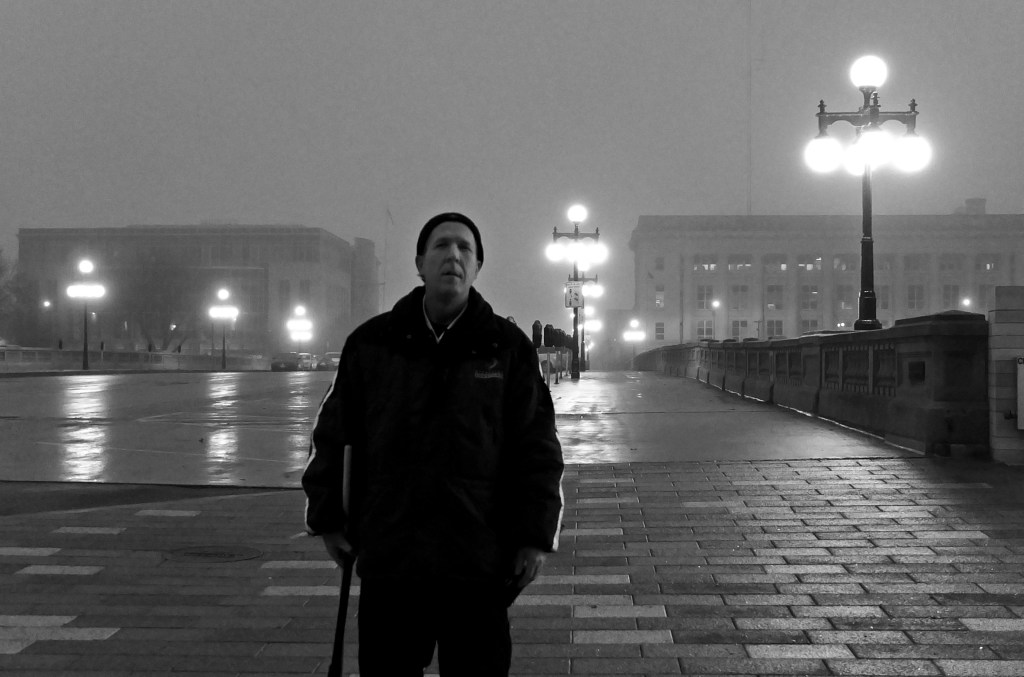
This is Kent. I met him on a cold, foggy morning too. He was walking the streets, sweeping up the trash other people (and their dogs) left behind. He’d been keeping the city streets clean for nearly three years. I asked him about his work. He said, “It’s not a bad job. I like being outside. I get to meet people, walk around, don’t have to stay in one place.” He’d learned which business owners were nice, which ones ignored him like he wasn’t there, which ones were rude. He wouldn’t identify any of the rude ones. Kent said there were about a dozen people who worked cleaning up the downtown area. He thought most of his co-workers were okay; a couple were lazy and some complained about the weather, but basically they were good, decent people. He knew most of the people he met on the street didn’t appreciate his work, but he said clean streets sidewalks make the city a better place. He wouldn’t say his job was important, but it was clear he felt he was doing something worthwhile.

These are just a half dozen of the many strangers I’ve talked to in recent years. All of them have been interesting in some way. All of them are connected in some way, if only by a shared community or a shared humanity. And I like to feel I’m connected to them as well. A guy feeling sad and stupid sitting by the river, a guy excited about science for kids, a guy who maybe lied about his past, a guy sitting quietly under a bridge, a nervous guy afraid to ask for or accept help, and a guy who gets up every morning and tries to make city life a little bit better. These people–these strangers–have enriched my life.

We don’t have to live in fear and isolation. We don’t have to be afraid of strangers. At the risk of sounding hopelessly like a Pollyanna, I truly believe the world would be a lot better place–and we’d all be a lot more relaxed–if we’d just take a few moments and talk to a stranger.

circular dance of ants

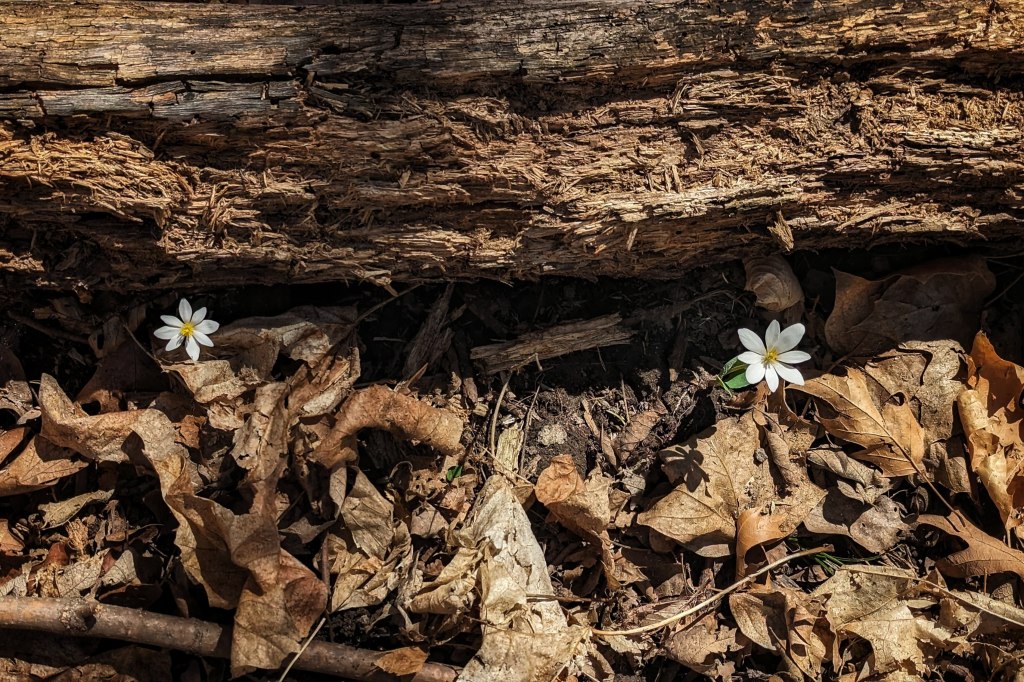
The photograph below shows a pair of bloodroot blossoms, one of the first flowering plants we see at the beginning of morel season. It doesn’t look at all bloody, does it. The sap, however, is generally orange to bright red. It’s sometimes used by native artists as a dye. The sap is also somewhat poisonous; eating bloodroot probably wouldn’t kill you, but it would certainly make you vomit like a high school drunk.

What’s cool about bloodroot, though, is the way it’s disseminated. The flowers produce pollen, but no nectar–which means all those bees and flies that land on the blossoms foraging for nectar are getting scammed. They’re helping pollinate the plant, but they aren’t getting jack in return.

But what’s really cool is that the seeds of bloodroot are spread by ants. That’s right, ants. The seeds have a fleshy organ–an elaiosome–that ants fucking love. They take the bloodroot seeds to their nest, eat the elaiosomes off them, then chuck out the seeds with the other ant trash and nest debris. Ant trash turns out to be a terrific medium for germinating seeds.

The process of ants foraging seeds for their tasty elaiosomes, then getting rid of the useless seeds in ant trash middens is called myrmechory. It’s from the Greek term for ants (mýrmēks) and a circular form of Greek dancing called khoreíā. The ants don’t actually dance in circles, of course, though they probably could if they wanted to. Who’s going to stop them? The important thing, though, is myrmechory works. It’s great for the ants, who get a scrumptious treat, and for the bloodroot, which gets dispersed across a wider range.

Of course, bees and flies and other pollen-seeking winged foragers get completely fucked over, which probably adds to the enjoyment of the elaiosome-eating ants. I’m okay with that. I mean, bees get to fly, after all; they get a temporary pardon from gravity. Hard to blame ants for being a wee bit envious and taking some small pleasure out of seeing the winged bastards get stiffed.

the improbable wilmer mclean

You have to feel sorry for Wilmer McLean. Some folks just can’t catch a break.

In 1861 our boy Wilmer was a successful merchant and farm owner. He was happily married to the former Virginia Mason (a wealthy widow). They had a young child and lived in a nice house on a good piece of farmland near Manassas, Virginia. Life was good. At least it should have been. It would have been, except for the brewing civil war.

In April of that year, Pierre Gustave Toutant-Beauregard had been appointed a general in the newly formed Confederate Army and assigned to defend the port of Charleston, South Carolina. Beauregard’s artillery assault on the Union Fort Sumter in Charleston harbor were the first shots fired in the American Civil War. By July, Beauregard was placed in command of Confederate forces in Northern Virginia and he needed a place to establish his headquarters.

So one fine summer day, there was a knock on Wilmer’s door. An aide to Gen. Beauregard politely let him know his farm–his home and his barn–were being commandeered. Wilmer wasn’t happy about it, but as a young man he’d served in the Virginia Militia; he understood that sacrifices had to be made. So he and his family abandoned their farm while the first major land battle of the Civil War–the Battle of Bull Run–was fought on his farm.

Not surprisingly, the McLean home and barn were both damaged during the battle. Beauregard liked to tell the story of how his dinner in the house was interrupted by a Union cannonball coming through McLean’s fireplace. Still, Wilmer and his family returned to the farm after the battle and remained on the farm for another year–until the Second Battle of Bull Run. At that point, Wilmer said, “Fuck this.” He packed up his family (his poor wife was pregnant again) and they moved a hundred miles south to a small quiet town in Southern Virginia, where the war wouldn’t interfere too much with his life.

And hey, it worked. Mostly. By 1865, our boy Wilmer had been living as quiet a life as one possibly could in a nation torn apart by a long, brutal civil war. He was 51 years old; he and his family had a nice house and he was making a fairly decent living as a merchant and a sugar broker for the Confederate Army.

But then, on this very day, April 9th, there was another knock on Wilmer’s door. Charles Marshall was an aide to another Confederate general–Robert E. Lee, the commander of the Army of Northern Virginia. Marshall wanted our boy Wilmer to show him a house suitable for a meeting between Lee and another general. Given his previous unfortunate experience with Confederate generals, Wilmer showed Marshall a couple of ramshackle houses. Marshall rejected them. After a bit of pressure, Wilmer reluctantly agreed to let Gen. Lee use his own house for the meeting.

The McLean residence in Appomattox Court House

The meeting, of course, turned out to be between Lee and Gen. Ulysses Grant, the commander of the Army of the Potomac. During that meeting, held in Wilmer’s parlor, Lee agreed to surrender his army, essentially ending all major combat operations in the Civil War. It was all very quiet, very formal, very somber.

But once the surrender was signed and Lee had ridden away, the Union officers wanted souvenirs of the historic event. They began helping themselves to various household items–tables, chairs, lamps, whatever was at hand. It wasn’t exactly looting; many of them actually paid Wilmer for the items they took. But as before, Wilmer had no choice in the matter. In 1861, the Union Army damaged his property with artillery; in 1865, they did it by hand. War doesn’t spare civilians.

The end of the war also brought the end of Wilmer’s career as a merchant and sugar broker. He was eventually forced to sell his house and move his family back to his boyhood home of Alexandria, where he found a job with the Internal Revenue Service.

Wilmer McLean liked to say the Civil War began in his front yard and ended in his front parlor. It’s a good line. That good line was the only good thing our boy Wilmer got from the war.

You have to feel sorry for Wilmer McLean. Some folks just can’t catch a break.