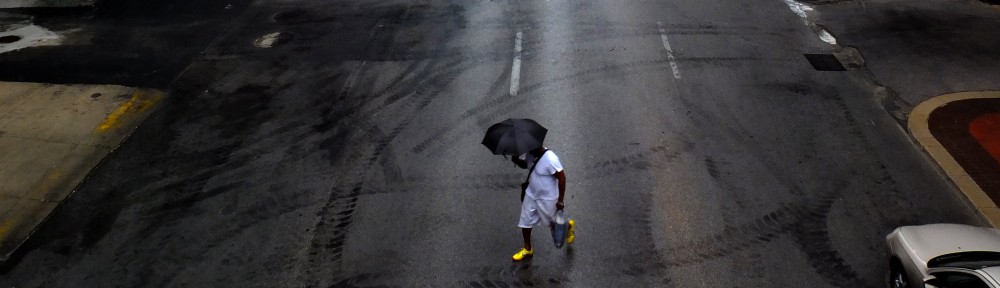
a cold, wet, miserable day is trumped by seriously badass fudge

It was thirty-seven degrees Fahrenheit yesterday morning. Over the previous two days, we’d had seven inches of snow. The morning vacillated between mist and drizzle, interrupted by brief periods of actual rain. The only good thing you could say about the weather was that it was washing away the snow. It was a cold, wet, miserable day. The fourth day of May, and it was cold and wet and miserable, and the only sensible thing to do was stay in bed. Maybe read a grim Russian novel about peasants. Starving peasants.

But yesterday was also the opening day of this year’s downtown Farmer’s Market. And that meant Spring was officially here. And that made everything pretty much okay. Bugger Russian novels. I was going shopping.

Opening day of the farmers' market

Farmers’ market – from the skywalk, looking south down 4th Street

I love the Farmer’s Market. Every Saturday morning from the first weekend in May to the last weekend in October, the city closes off a few streets and vendors set up booths and stalls from which they sell their goods and wares. These are small, local producers of victuals and crafts. They sell a lot of fresh fruits and vegetables, of course, and all the expected pies and jams and pastries and herbs and breads and honeys. But there are also folks selling locally produced eggs, beef, poultry, lamb, rabbit, and goat. Hell, you can buy elk, ostrich, or buffalo, if that suits your tastes. There are folks selling locally made cheeses — cheddar, gouda, blue cheese. There are folks selling local wines (which can be an adventure) and usually somebody selling Templeton Rye — a marvelous locally distilled whiskey. There are skilled craftsmen selling ironmongery and hand-crafted furniture and all manner of jewelry. And there’s music, even in the rain. And puppetry sometimes. And of course you can buy food and drink to eat while you’re shopping — the usual burgers and barbecue, to be sure, but you can also pick up some regional delicacies made and sold by immigrants from Bosnia, Thailand, El Salvador, Morocco, Viet Nam, India.

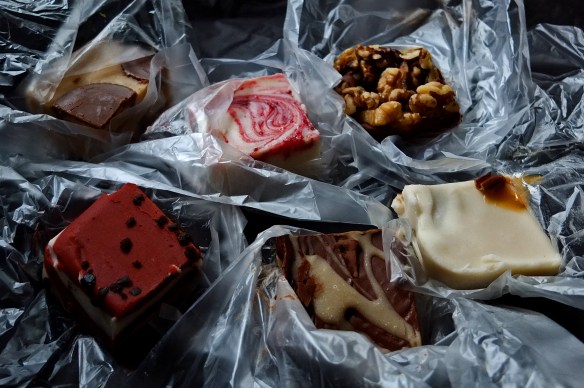
I didn’t buy a lot. An asiago focaccia. Some asparagus. Some cherry and apple pastries. A half dozen pieces of frightfully expensive artisanal fudge.

farmers market mapThis is not your momma’s fudge. This is a confection meticulously prepared by Master Fudgesmiths. This fudge is handmade by craftswomen following arcane fudge-making techniques that have been handed down from generation to generation of Flemish bekwaam handwerkswomen. Red velvet fudge, praline fudge, traditional old school chocolate-walnut fudge, raspberry fudge, peanut butter fudge, and a milk chocolate fudge with teensy Reese’s Peanut Butter Cups cleverly grafted into the mix.

Dude, we’re talking some seriously badass fudge.
Seriously badass fudge

Seriously badass fudge

But it’s not just the stuff you can buy that makes me love the market. It’s the gentle carnival atmosphere. Everybody is friendly, everybody is happy, everybody wants to be there and they all make an effort to get along. I know that sounds terribly sappy, but there it is. Even as cold and wet and miserable as it was yesterday morning, the people were having fun.

Happily, three of the downtown parking garages offer free parking on market day. On cold, wet, miserable days like yesterday, it’s possible to park inside, take the skywalk to an exit near the market, and remain dry and warm going to and from the market (and on those hot days in summer, you can use the skywalk to keep cool and in the shade).

Warm and dry in the skywalk

Warm and dry in the skywalk

Farmer’s markets are pretty common these days. Every city and most large towns have one. I’m sure this one isn’t radically different from a weekend farmer’s market near you. That’s part of what makes them so wonderful. Farmer’s markets benefit everybody — the farmers and the artisans who produce the goods, the consumers who buy and eat them, and the community itself. Everybody. Think about that for a moment. How many activities can you think of in which everybody benefits?

You should go to your local market next weekend. Seriously. Get up, go to the market, buy yourself some fresh vegetables, if you’re a carnivore you should buy some chemical-free chicken (yes, it’s a tad more expensive, but you’re getting better food with better flavor), buy yourself a treat of some sort, meet and mingle with a lot of strangers, pet a dog, be a part of your community. Then go home and take a nap. If you don’t wake up feeling refreshed and satisfied with life after that, then you probably belong in a coldwater garret somewhere, eating stale crusts of bread, and reading Russian novels.
walking like a camel

No, I don’t do it for the exercise. Yes, I understand that both walking and cycling are terrific forms of exercise, but no, that’s not why I do it. Yes, I’m usually going somewhere when I go for a walk or a ride, but no, that ‘somewhere’ isn’t a destination. I’m not actually going to that place. That place is just a prompt, a nudge, a reminder that it’s time to turn around and go back. Yes, the walk or ride serves a purpose; the walk or the ride is the purpose.

the cyclistI do this almost every day, regardless of weather. Sometimes I’ll walk or ride for hours, sometimes just for ten or fifteen minutes. I might stroll for a couple of hours along the river; I might ride five minutes to the nearby Stop & Rob and buy a Coke Zero. The purpose isn’t to see the river or fetch a Coke, though those are both fine things. The purpose is movement, the purpose is to move the body and disengage the mind from whatever I was doing and allow it to re-engage in…well, something else.

jaywalkHere’s a true thing: I don’t really walk or ride. I saunter. I even saunter when I’m on a bicycle. This is how Chambers defines saunter:

to walk, often aimlessly, at a leisurely pace; to wander or stroll idly

That’s me, wandering idly on foot or bicycle, somewhat aimlessly, at a leisurely pace.

promenadeThere’s some uncertainty about the etymology of saunter. It’s been suggested the term derives from sans terre, ‘being without land or a home,’ which would be a good reason for walking aimlessly. Others believe it comes from s’aventurer, ‘to take risks or leave to chance.’ My favorite explanation of the term, though, comes from the Middle Ages, during the period of the Crusades.

When we think of the Crusades, we generally think of armored knights on destriers, traveling to Jerusalem to ‘rescue’ Christendom. But it wasn’t just knights and noblemen who made their way halfway around the world; poor folks were also seized with the irrational desire to travel to the Holy Land. But they had to walk and beg for food as they made their way à la sainte terre. While of lot of those folks were sincere, the willingness of people to help a common sainte-terrer (it was a sacrifice that would gain them favor with God) created a population of poor folks who wandered through much of Europe claiming to be journeying to the Holy Land, but actually were just medieval hobos.

humming to himselfObviously, I’m not that sort of saunterer. I’m more in the Ludwig Von School of walking. Beethoven took a long stroll almost every afternoon, with a pencil and some paper stuffed in a pocket so he could write down any musical thoughts he might have. I keep myself open to ideas when I walk or ride, but I don’t take any writing paraphernalia with me. I tell myself that if an idea is good enough, I’ll remember it. If I don’t remember it when I get home, I tell myself the idea couldn’t have been that good.

That’s probably nonsense, but it gives me some comfort when I get home and can’t recall the ‘great’ idea I had when out sauntering.

a wee bit tipsyOr maybe I’m more in the Thoreau School of walking. Thoreau said this:

[T]he walking of which I speak has nothing in it akin to taking exercise, as it is called…but is itself the enterprise and adventure of the day.
Moreover, you must walk like a camel which is said to be the only beast which ruminates when walking.

I’m very much taken with the notion of riding a bicycle like a camel.

hard day at the officeI think I could argue that the real reason I take walks or go on rides is to get outside of my mind. Things happen when you’re out and about. Real things, and they happen to real people. The things that happen when you’re at your desk only happen in your mind.

Here’s an example of the way things happen. This thing happened to the composer Benjamin Britten, who was a great walker. It’s my favorite Benjamin Britten story (okay, my only Benjamin Britten story, because c’mon, does anybody have more than one Benjamin Britten story?). He was walking along a railroad track one day and came across a couple of young boys standing by the track, waiting. They had a newt in a jam jar. Britten asked the kids what they were doing. They said, “We’re waiting for the two o’clock train to come out of Aldeburgh, so we can show this newt what a steam train looks like.”

I’m willing to bet you five dollars this will become your favorite Benjamin Britten story too.

brutal bastard

You get that one moment. That’s it. You either get the shot or you don’t. And let’s face it, most often, you don’t. And in some types of photography, there’s no second chance. I love that. I hate that.

Yesterday was a cold, bright, sunny day. A good day for a guy with a fine little street camera to take a walk through the city. As I was walking along I saw this dark gash of an alleyway running between a building and a parking garage. I have a thing for alleys, so I decided to wander down it. But it was on the other side of the street; I had to wait for traffic to clear before I could jaywalk to the alley.

As I stood there I saw an obscure shape moving in the alley. A guy. A guy with a red hat. And I knew there might be a photograph to be made.

This is what I love: sometimes you can anticipate that moment. You can see the shot developing. You can visualize all the elements potentially moving into place. Potentially, that’s the key. It’s all about the potential, because any number of things can happen to totally fuck up the situation. A cloud might obscure the light. A car might pass in front of you at the critical moment. A passerby could throw off the balance of the composition.

I saw the guy with the red hat. A moment earlier I’d noticed a doorway with a red logo at about head level. I figured there was a good chance the guy was going to walk out of the dark alley and into the light. So I hurried to my right so I could include both the red hat and the red logo — and the moment I began moving I also began to kick myself in the ass. I was thinking “Idiot, you should have closed in on the alley and caught the guy stepping into the sunlight.” But it was too late to change my mind. I’d committed myself to a wide shot.

Sometimes the shot never comes together. You know that going in, of course. Sometimes all those elements you saw moving together simply move away from each other. The guy could turn around and go back down the alley. He could step out of the alley, but remove his red hat. Somebody could could open the door with red logo. So many things could go wrong.

But they didn’t. Things not only didn’t go wrong, they actually got better The guy stepped out of the alley and into the sunlight, just like I’d hoped he would. His red hat was almost perfectly in line with the red logo on the door, just as I’d hope it would. And then a little black and white dog followed him out.

So I took the shot.

a guy and his dogIt was the shot I wanted. It was almost exactly as I’d envisioned it. But it doesn’t really work. Not at this scale.

The guy gets lost, the red hat gets lost, the red logo gets lost, even the little dog gets lost. I think the photo might work if it was printed very, very large — but dammit, it doesn’t work at this scale. It just doesn’t.

Even when all the elements do come together — even when it all coheres perfectly and organically, as if it was predestined — even when you get the shot you want, it might not actually be the shot you want.

It gets worse. I got the shot I wanted. I knew it as soon as I released the shutter. I’d no idea it wouldn’t turn out, of course, but at that moment I knew I’d got the shot. I felt satisfied and full of myself. For maybe half a second. Even as I was lowering the camera, I saw the guy hold something out in his hand. The little dog leaped up to get it. And I missed it.

Photography is a brutal bastard. And I must be masochistic, because I’m okay with that.


self evident truths

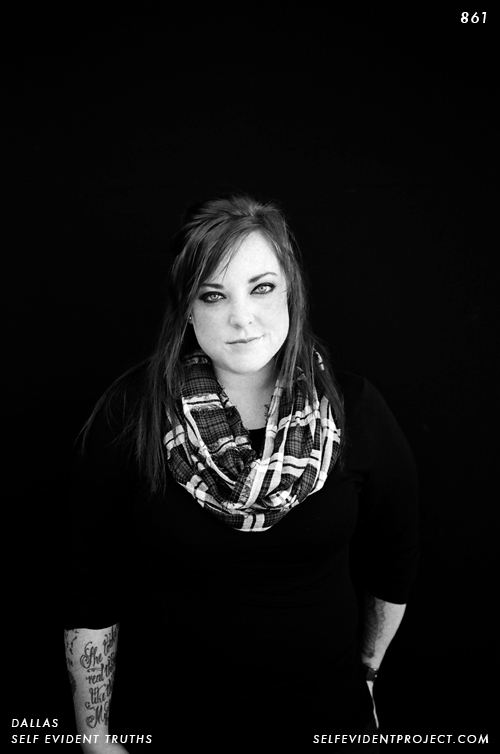
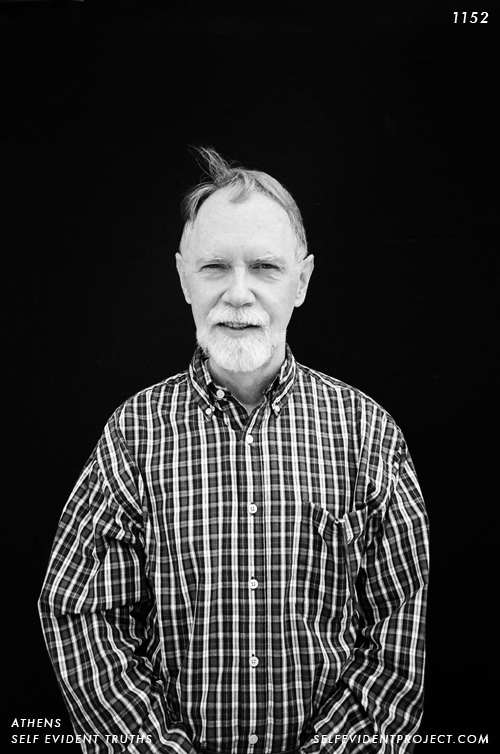
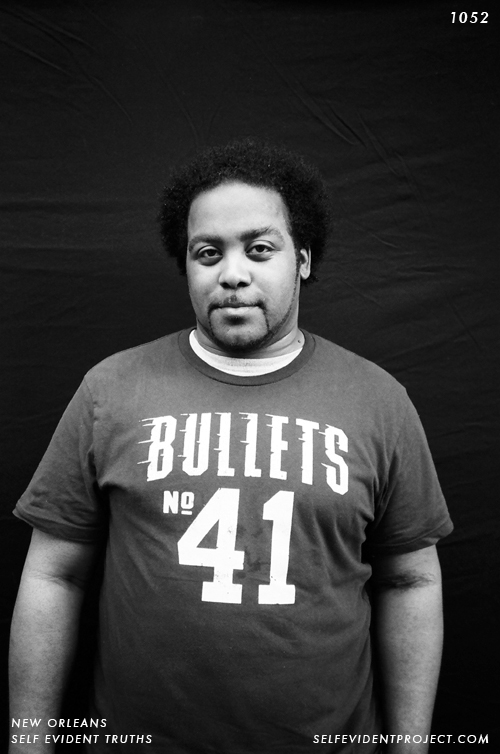
I spent some time looking at the portraits from the Self Evident Truths project before I read the ‘About’ section. I like the photographs. They’re simple, unfussy, comfortable, direct, wonderfully relaxed portraits of ordinary people. I like them a lot.

On the landing page, the portraits scroll by at an unhurried pace — about the pace you’d expect if you were strolling through town and looked casually at the people coming toward you on the sidewalk. It’s pleasant and smile-making to just sit for a while and look at the faces that pass by.

self evident truths 2

Then I read the ‘About’ page. These are the first few lines on that page:

In 2010 iO Tillett Wright began a project called Self Evident Truths, photographing anyone that felt like they qualified to fall on some part of the LGBTQ spectrum, from bisexual, to transgender. Shot in simple black and white, in natural light, with no makeup or styling, the photos were intended to humanize the very varied face of gays in America today.

Intended to humanize. I read that and thought ‘We need to humanize gay folks?’ That notion seems so out of date. It feels like something activists would say in the 1990s.

Don’t get me wrong, I love the portraits. I love the foundational concept — I find something oddly pleasing about portraits of ordinary people categorized in some way. I’d love to see portraits of people who work in grocery stores, or people who are in bowling leagues, or people who frequent swap meets, or people who keep lists of the birds they see. I suspect they’d all look fairly similar to the people we see in the Self Evident Truths project.

But I can’t imagine shooting portraits of birders or bowlers or grocery store employees in order to humanize them. It’s 2013 — do we really need to humanize LGBTQ folks?

self evident truths 1

If the Montana legislature is any indication, then yeah, I guess maybe we do.

Yesterday the Montana legislature voted on a measure to strike an old Montana law that criminalized “sexual contact or sexual intercourse between two persons of the same sex.” The Montana Supreme Court ruled that law was unconstitutional in 1997, but the law remained on the books despite regular attempts to have it removed. Why? Because some Montana Republicans apparently felt that if they voted to remove the law, they’d get some of the gay on them. And you know, that stuff is hard to wash out. Or something like that.

This year was different. This year Montana Democrats garnered enough support to have the unconstitutional law stricken from the criminal code. The vote was 38-10. That’s right, ten Republicans still voted to retain the law even though it’s unconstitutional and even though it can’t be enforced. Lawdy.

Despite the fact that the U.S. Supreme Court has ruled them unconstitutional, there are still at least a dozen other states with anti-sodomy or anti-homosexual laws on the books. There are elected legislators in at least a dozen states who are so afraid of gay folks that they refuse to remove blatantly unconstitutional laws from their criminal codes.

But I still disagree with iO Tillett Wright and the Self Evident Truths project on this issue. I don’t think we need to ‘humanize’ gay folks. I think we need to humanize the people who hate gay folks.

self evident truths 3

Visit the Self Evident Truths site. Visit their shop. Buy prints of the portraits. Buy ‘We Are You’ t-shirts. Donate to the project if you can. But work to humanize bigots and assholes. Gay folks are already okay as they are.

Editorial note: When I say ‘gay folks’ I mean everybody in the LGBTQ mishpocha; I just get weary of the acronym. Also? It’s already totally fucking obvious, but for the record let me just point out that all the photos are from the Self Evident Truth project.

a five dango city

It was a cold, cloudy, wet, grey, miserable sort of afternoon and I was downtown with a couple of hours to piss away on nothing in particular. In other words, a perfect time to go larking about in alleys. Alleys are best photographed in rotten weather because there are fewer people working in them. I actually like the people who work in alleys, but they tend to be camera-shy. And suspicious. It’s just easier to do alley work in foul weather.

So I slipped the little X10 in my pocket and headed out to find a nice juicy alley. First, though, I thought I’d make a little detour to visit to the river.

courthouse across the river

courthouse across the river

I’m of the opinion that you can never go very wrong making a detour to visit the river. Any river. That said, I have to admit there are certain aspects of a river that make you better appreciate a good alley. Like the absence of walls and buildings to block the wind. Let’s face it, rivers suck at wind-blocking.

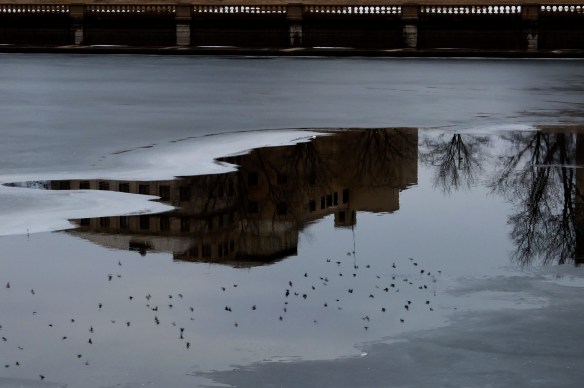
On the other hand, the absence of all those walls and buildings gives rivers the great advantage of meteorological drama. With rivers you get all that accompanying sky. And you get it twice — once overhead and once in reflection.

there are always pigeons along the river

there are always pigeons along the river

There really wasn’t anything particularly interesting going on at the river. There was the usual flock of pigeons morris-dancing around in the sky. Despite the cold and wet, there were a few intrepid bicyclists and runners tooling up and down the riverwalk and bike path. There were a couple of really bitchy Canada Geese fussing at each other.

It took me a while to figure out why it was so quiet. The construction that’s been taking place along the riverwalk for the last couple of years is largely finished. There were no generators coughing away, no backhoes, no bucket trucks or forklifts, no men with jackhammers. The riverwalk was…quiet.

riverwalk intersection

riverwalk intersection

For years the Des Moines city planners have been making a considerable effort to draw people back into the downtown area. It’s not just that developers have been building loft apartments and faux brownstones — the city has been adding a lot of public art and other quality of life amenities. There’s a new dog park, there’s a skating rink, there are bike trails and pedestrian bridges, there’s a botanical center and a science center and a historical building — all near the river.

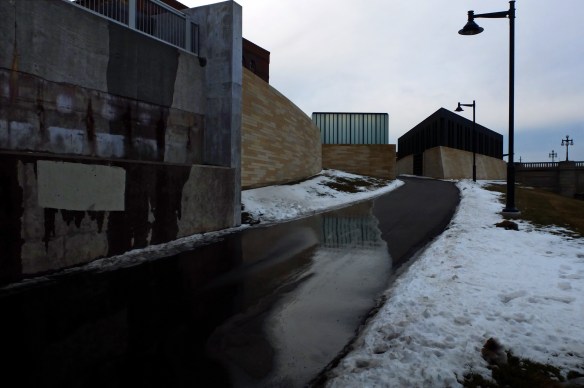
Construction has just been completed on a small, two-level riverwalk pavilion. When it opens, it’ll include public restrooms (and trust me, that’s important in a city) and a small cafe or coffee shop.

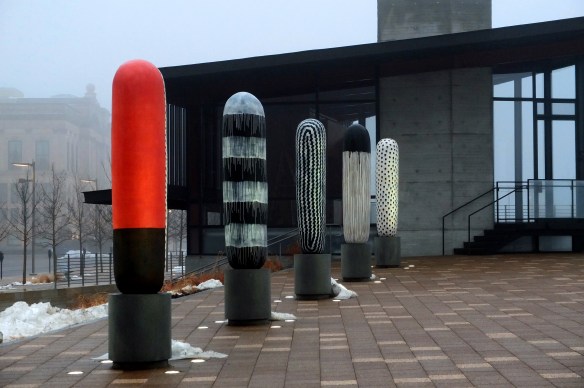
And in front of the pavilion: five dango.

the dangos of jun kaneko

the dango of jun kaneko

The dango are large ceramic sculptures by Japanese artist Jun Kaneko. A dango is a sort of Japanese steamed dumpling. These don’t look anything like dumplings, but I think there is something dumplingish about them. They’re not bland like dumplings, but they’re simple and strangely comforting. These are happy-making works of art.

There’s something very sweet and childlike about the dango. They were only installed a few weeks ago, but they seem to fit right in along the river. Seeing them, touching them, watching other folks look at them with a sort of bemused confusion — it makes me ridiculously happy.

Still, I hadn’t set out to look at the dango; I’d set out to wander idly through alleys. So I didn’t stay.

 the court avenue bridge

the court avenue bridge

But before I ventured forth alleyward, I decided to check out the other structure that’s been under construction along the riverwalk.

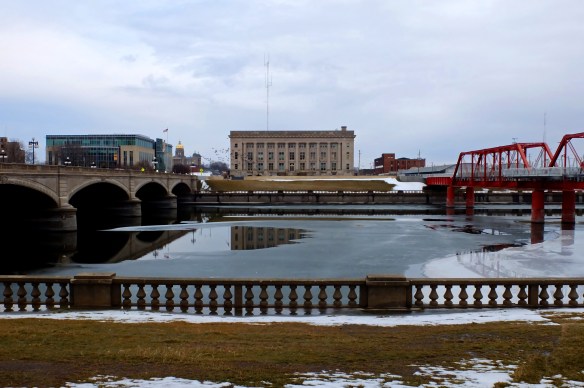
Rivers flood. All of them, they all flood. If you look at the large version of the photo below (or almost any photo of the riverwalk) you’ll see several lines of flood levels. What you can’t see are the tree-trunk-sized logs jammed up in the infrastructure beneath those bridges. When the Des Moines River has once-in-a-century floods (which we seem to have every five years or so now, thanks to climate change and the short-term planning of the old Army Corps of Engineers), it really floods. It’s not uncommon for those balustrades to be under water.

police department

police department

I’m mentioning that because the other structure that’s been under construction is a storm pump station. It’s designed to keep those pesky once-in-a-century flood waters under control. Both the pump station and the new pavilion have exceedingly cool flood doors that can be closed during high water. They look a lot like the doors you see protecting the island lairs of James Bond villains.

I spent an absurd amount of time looking at those doors. I don’t really want to see the river flood, but at the same time I can’t wait until the river floods.

and the snow melts slowly

flood pump station

I was just getting ready to head out and find a friendly alley when my cell phone chirped. I discovered I’d spent about two hours walking a grand total of about three and a half blocks. I had to hurry to meet my friend, so I took a shortcut through an alley.

I did manage to shoot a photo in the alley. But it was blurry.

walking

I don’t really like to go walking in the morning. I like to wake slowly. Maybe read a bit before I get out of bed. I like to ease into the day. Drink some juice, eat my morning Advil, have a cup of coffee with too much sugar and too much cream. I like my mornings comfortable. I like my mornings unhurried.

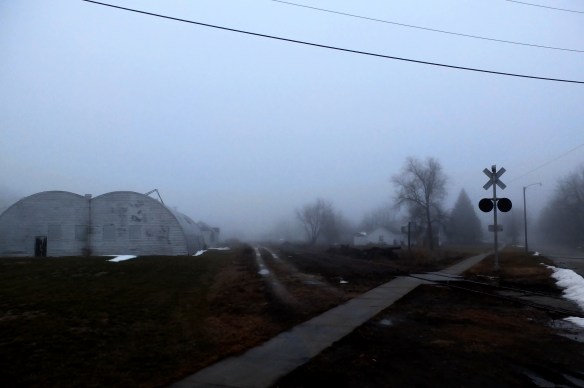
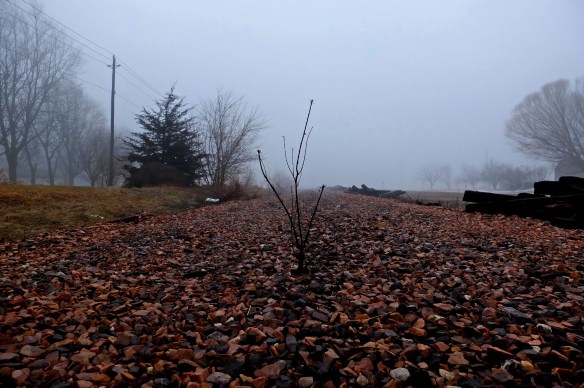
So it makes no sense whatsoever for me to rise early, dress hurriedly, skip my juice and coffee (but not my Advil), and head out for a long walk — especially when it’s damp and chilly. Which is what I did yesterday. But you know…fog and mist, dude. Fog and mist.

why my shoes were muddy

why my shoes were muddy

I don’t like to walk in the morning, but I do like to walk in fog and mist. And since those conditions occur more frequently in the morning — well, there it is.

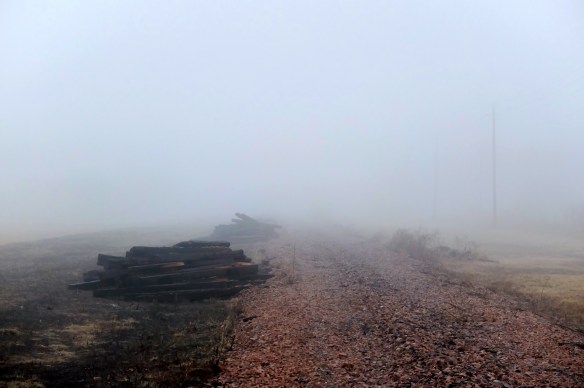
I like to walk in the fog and mist because they smooth things. They soften the corners of things, they plane off the sharp edges. They make the world soft and a wee bit vague. Fog and mist elevate the ambiguity of the world — everything seems less solid, more forgiving. Less harsh, more indulgent. More romantic, and I mean romantic in the medieval sense of the term. Open to adventure and mystery and imagination.

rail bed

rail bed

I enjoy purposeless walking. I don’t walk for exercise, and unless I’m on an errand, I rarely walk with a destination in mind. Well, that’s only half-true. It’s not uncommon for me to walk to or toward a specific location, but that location isn’t really a destination. I’m not going to that spot for any particular reason. In fact, I’m not really going there at all. It’s just a vague geographical marker, a reminder to suggest I should consider turning around and heading homeward.

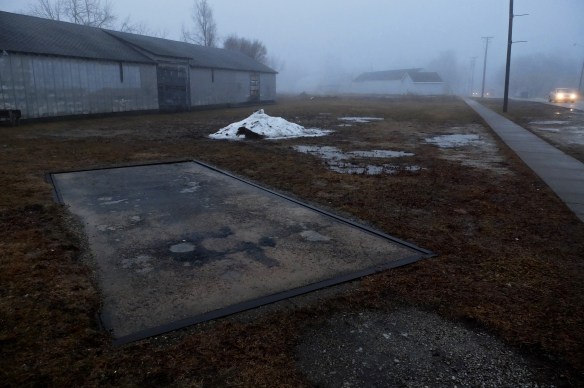
I rarely have anything that resembles a schedule, but I always have work to do. Taking a walk gives me a pleasant interruption during my day; walking idly toward a specific fixed point provides me with a very flexible timetable. If I want to walk for, say, an hour, I have a general sense how far I’ll walk in thirty minutes. I know, for example, that it will take me about forty minutes to reach the heliport (which, okay, isn’t really a heliport at all — it’s just a concrete slab that was probably the foundation of some sort of shed, but I’ve never felt any overpowering compulsion to adhere strictly to reality). So when I get close to the heliport, I can decide to turn around and begin walking vaguely in the direction of home. Or I can keep walking. It’s a system.

heliport

heliport

Even though I often walk with a camera tucked away in a pocket or in a bag slung over my shoulder, I’m usually not walking to shoot photographs. I’m normally not actively looking for things to photograph. I’m just walking. With a camera. On the vast majority of my walks, the camera never leaves my pocket or bag. I do sometimes go on photo-walks, but that’s a whole nother thang.

For me, most of my walks are a form of meditation. I generally walk mindfully, as Buddhists like to say. When I was part of a Zen community in Washington, DC the roshi explained mindfulness to me; he said it was the quality of being in the immediate moment, fully aware and cognizant of what’s going on around you, but not involved in it or with it. I was able to tell him, “Dude, I was a private investigator for seven years; I did a lot of surveillance; I’ve got seven years of practice at being mindful.”

So as I walk I notice a lot of stuff. Birds, the condition of a passer-by’s shoes, signs in windows, bits of paper being shuffled along by the breeze, the breeze itself. I can notice stuff and appreciate it without being distracted by it. I don’t feel any need to try to ‘capture’ it with a photograph.

i saw this stick

i saw this stick

But at the same time, it usually registers when I see something that might make an interesting photo. Sometimes it only really registers after I’ve taken a few steps. It’s like my brain sends up a flare and it takes a moment for the flare to rise high enough for me to see it. Dude, you just walked by some interesting graffiti — you might want to turn around and take a look. Like that.

It sounds almost robotic in a way, though it doesn’t feel that way. I mean, it’s as if there’s some sort of algorithmic process taking place below the conscious level. A quiet decision-making process I can mostly ignore. Dude, you just stepped in some mud. “Is that important? If ‘no’ then keep walking; if ‘yes’ then stop and clean shoes.” Naw, not important. “Keep walking. Will it be important later? If ‘no’ keep walking; if ‘yes’ walk on the grass” Yeah, it might important later when I get home. “Walk on grass.”

Everybody has those internal discussions. Don’t they?

eight ball

eight ball

This is why most of my walks are solitary. If I’m with another person, there’s a social obligation to interact. I like walking with other people, don’t misunderstand me. It’s just a different experience. And not always a pleasant one — for them, that is. I usually have a good time. But as I said, I walk fairly slowly. More an amble than a walk. A stroll. A meandering stroll. And I stop now and then. And I comment on stuff. “Do you smell cinnamon?” “That woman had the most extraordinary eyebrows.” “Did you hear that? Black-capped chickadee.” “Sign painters should be required by law to learn the rules of apostrophization.”

I can be annoying on a walk.

powerball

powerball

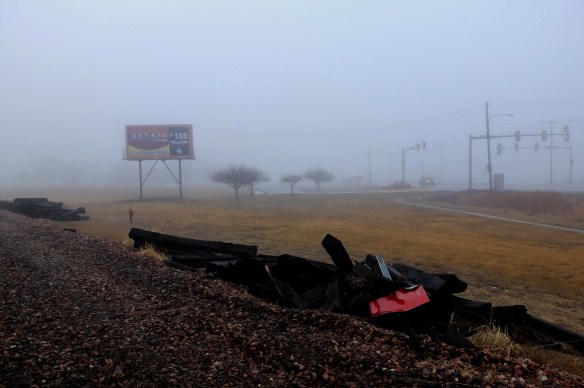
Yesterday morning on my walk I noticed the lottery jackpot was US$130 million. This afternoon I think I’ll walk toward one of the local convenience stores. Maybe I’ll stop and buy a lotto ticket. There’s one about fifteen minutes away, one about twenty-five minutes away, and another about forty minutes away.

This is what passes for a scheduling decision in my life.

in which i answer a question about photo projects

Because I’m the Managing Editor of Utata.org, I get a hefty chunk of photography-related email. Most of it has to do with photography exhibitions, or photography books, or questions about Utata photo projects. Relatively little of my email deals with my own views on photography. But a few days ago I got an email that included the following questions:

I guess what I’m asking is how do you develop a personal photography project? Do you just pick a thing and start taking picture of it? Do you make up rules or guidelines before you start? How do you start a photography project?

I started to write back and basically say ‘Dude, I don’t have a clue how to start a project.’ But that sounded pretty stupid. The more I thought about it, the more I realized I must have some vague notion of how to go about it. I mean, I’ve done a number of photo projects. They couldn’t have all happened by accident. Could they?

So over the last few days I’ve found myself sporadically thinking about projects. This is what I discovered: each of the three projects I’ve included on this site (I have other photo projects; I just haven’t published them here) began in a different way. And since I do not want to write another post about guns, I’ve decided to write something about each of those three projects.

later i saw a red-haired woman in a blue sundress

later i saw a red-haired woman in a blue sundress

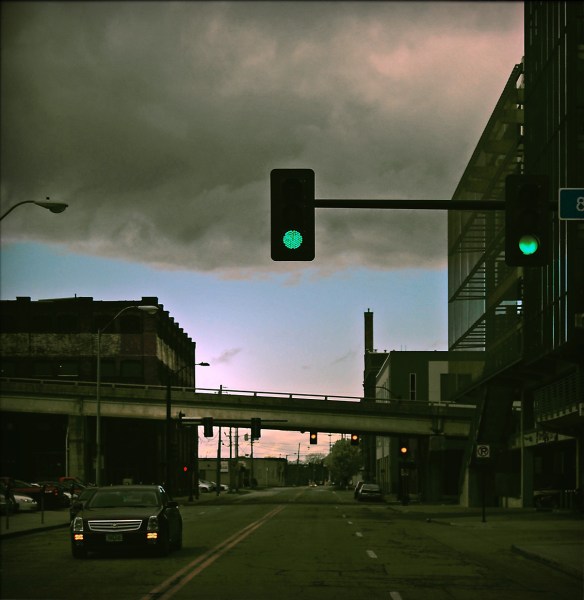
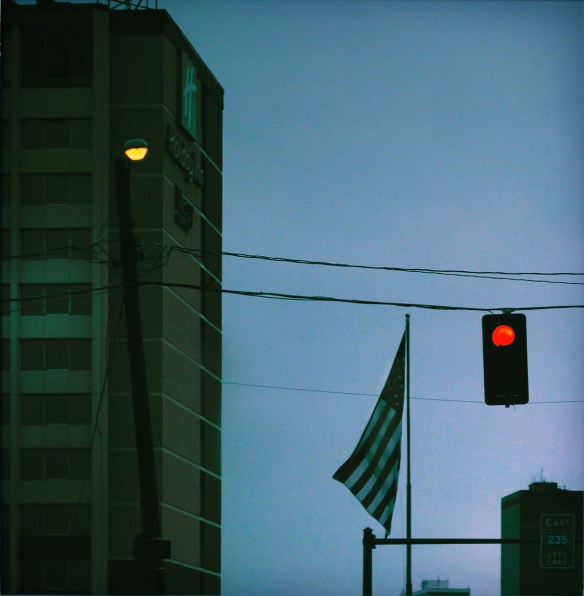
I’m going to begin with the Traffic Signals series, because it’s the simplest. Well, that’s not true — the Larking About in Alleys series is actually the simplest. But Traffic Signals is the oldest of the three projects. And, of course, I just checked and found that Faux Life is older by a year. But fuck it, I’m going to talk about Traffic Signals anyway.

The project as it exists now actually began with a different project. The Utata Storytellers Project of 2009 required us to make up to six photographs in which we would relate a story. We were only allowed a maximum of 35 words per photo. I kicked around a number of ideas for the gig, but came across my final project idea rather by accident.

the unquiet sky, shy as an alligator

the unquiet sky, shy as an alligator

I was standing at a crosswalk with some other pedestrians. There was a buzzing sound coming from the traffic signal. That buzzing ceased (or at least reduced in volume) when the light changed and we were allowed to cross the street. It struck me as odd and more than a little funny. It was as if the traffic signal was also sending out audible cues.

So I concocted a little talein which a person believed he was being given messages through the traffic lights and pedestrian signals. It’s called After the Bombs Dropped. For the photographs, I used an app called Poladroid, which mimics Polaroid photography. I thought it added a more authentic feel to the story.

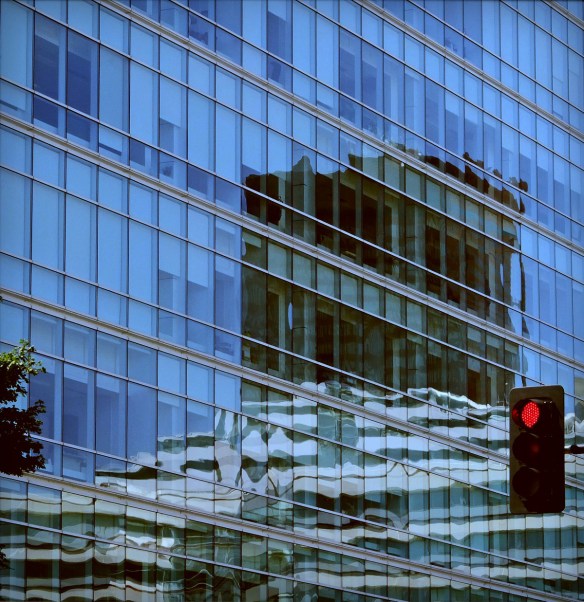
angry birdsWhen the project was finished, I found I was still intrigued by traffic signals. I was fascinated by the fact that so many people — both drivers and pedestrians — obeyed them, even when there wasn’t any traffic on the streets. And yet even though they obeyed the signals, people never really looked at them. And they were everywhere. Everywhere.

So I kept photographing them. On the set in my flickr photostream, I continue to use the Poladroid app for the images. That aesthetic still appeals to me. But for my personal files (and here on this site) I use the app but dispense with the faux Polaroid border — primarily because the border looks goofy here. (It may look goofy on flickr as well, but hey — that’s flickr.)

restless

restless

I like to think the series is deceptively simple. As I said, traffic signals are everywhere. But while they’re ubiquitous, they’re not necessarily visually interesting. Most aren’t.

I’ve come to appreciate how difficult it is to photograph traffic signals in a way that creates a sense of drama. It’s not about documenting traffic signals; it’s about imparting a sense of tension within the frame.

it was a mistake to call her

it was a mistake to call her

I’m not always successful. But the challenge keeps me interested in the project. It also, I have to confess, annoys anybody I’m in a car with when I insist they either stop the vehicle or let me out and drive around the block until I get the photo.

It’s not quite an obsession, but it has an obsessive component to it. And happily the world is full of traffic signals, so it’s unlikely I’ll run out of material.

ice ice baby

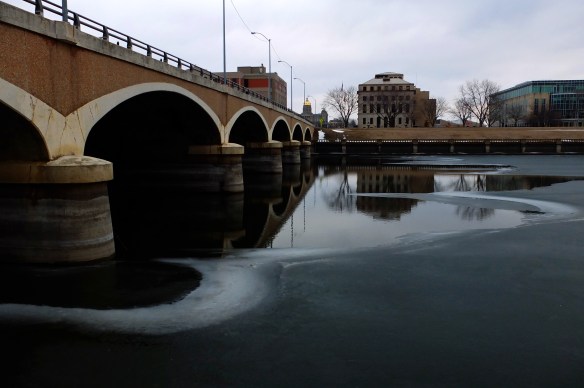
I like people. I really do. But sometimes I despair of their lack of interest in the world around them. A few days ago I was downtown, crossing a bridge over the river, and I was overtaken by a couple of guys walking in the same direction. I heard one of them say “River’s iced over.” The other guy glanced over the side of the bridge and said “Yep.” And that was it.

One of the most intriguing winter phenomena was taking place below them, and they didn’t see it. Rivers and streams freeze every year, yes. It’s nothing new. But it’s a fascinating process. It’s a radically different process than what takes place on a lake or pond because…well, river water moves, and that makes the freezing process significantly more complex.

On a moving body of fresh water, ice almost always begins to form along the banks. There are a couple reasons for that. First, the temperature in the shallow water along the shore drops faster on a cold night. Second, there are quiescent areas along the banks where the water is more still. Ice that forms along the bank is appropriately known as border ice. If the river or stream or brook is narrow enough — or if the weather stays cold enough — border ice will gradually expand toward the center of the stream until the entire surface freezes over.

Border ice

Border ice

But that’s not so very different from what happens on lakes and ponds — or in your birdbath, for that matter. The really interesting stuff takes place away from the banks, where the water is more turbulent. That’s when the freezing process gets weird and wonderful.

As the temperature drops, the surface of the water begins to lose heat rapidly. The turbulence of the river flow sort of roils that super-cooled surface water with a less cold layer of water just below the surface. This causes tiny crystals of ice to form. Those crystals gather in loose, randomly-oriented discoid or needle-shapes. This is called frazil ice.

Frazil often looks like slush in the water. There are a couple of things that make frazil interesting. First, like most ice, frazil floats — so it travels downstream. Second it has an extreme capacity to adhere to any object it comes in contact with. In other words, frazil clumps easily.

frazil ice

Frazil ice

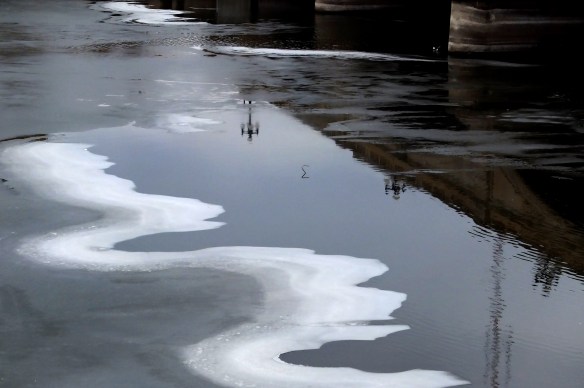
As it floats downstream, frazil bumps into stuff and sticks. In the photograph above, you can see frazil in its slushy form at the top of the frame. You can also see the line where frazil is clumping to more frazil, which will form the border of an ice pan. That raised line of ice is actually caused by the repeated collision of frazil against frazil.

A later stage of freezing occurs when frazil crystals coagulate to form a sort of soupy layer on the surface of the water. This is called grease ice because it looks slick. It doesn’t reflect light very well, which gives the water surface a matte appearance.

Grease ice

Grease ice

As the ice crystals become more compacted and solid they release more heat, creating surface slabs of ice known as ice pans. This is more like the ice we’re most familiar with. Ice pans often break free and float away downstream, banging and colliding with other ice pans, given them a softly rounded edges.

When these surface slabs of ice form in the bend of a river, they sometimes get caught in the rotational shear of the current and the ice pan spins around and around. As it rotates, the outer edge is gradually ground away until if forms an almost perfect circle. I’ve only seen this phenomenon once; sadly, I don’t have a photograph of it.

The photograph below, however, shows several different facets of the river freezing process. You can see the border ice; you can see where frazil has formed and clumped together causing a slushy barrier; you can see where that barrier has coalesced into grease ice; and you can see where ice pans have broken away and been refrozen in mid-stream.

Ice pans

Ice pans

This astonishing collection of various freezing processes is precisely what those guys were looking at when they said “River’s iced over.”

Now, I understand that other folks might not find these details as intriguing as I do. I understand that for a lot of folks — most folks, probably — the only ice that matters is the ice in their drinks. I understand that, I really do. But I can’t help feeling that those two guys who hurried by me on the bridge have missed out on something. I can’t help thinking that if they stopped for just a moment and really looked at the river, if they’d  asked themselves what was happening — even if they never bothered to seek out the answers — that their lives would be somewhat richer.