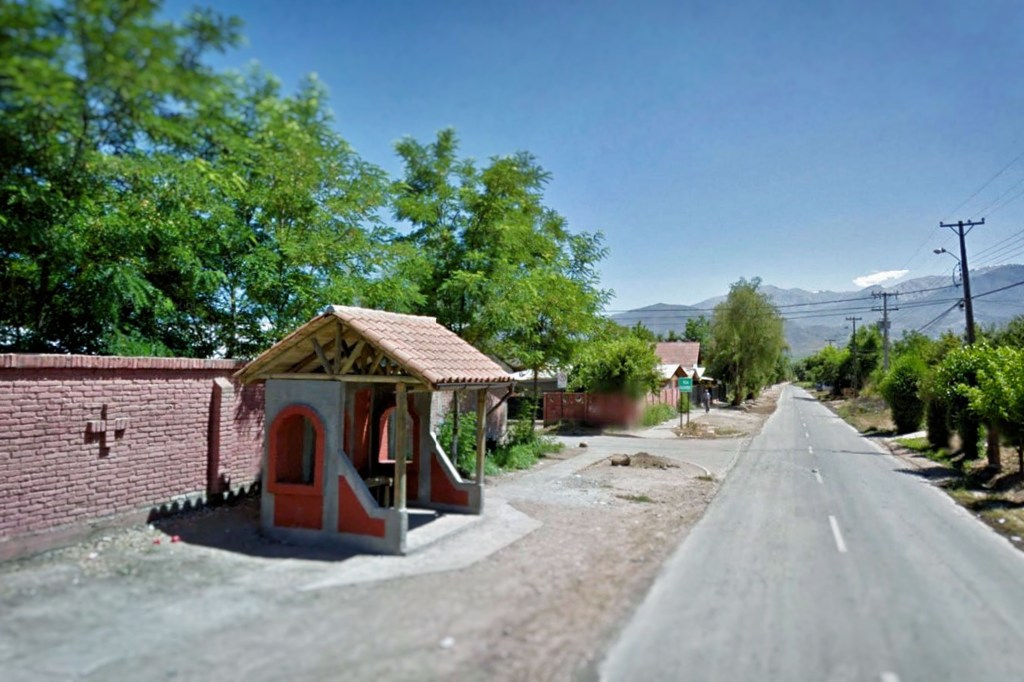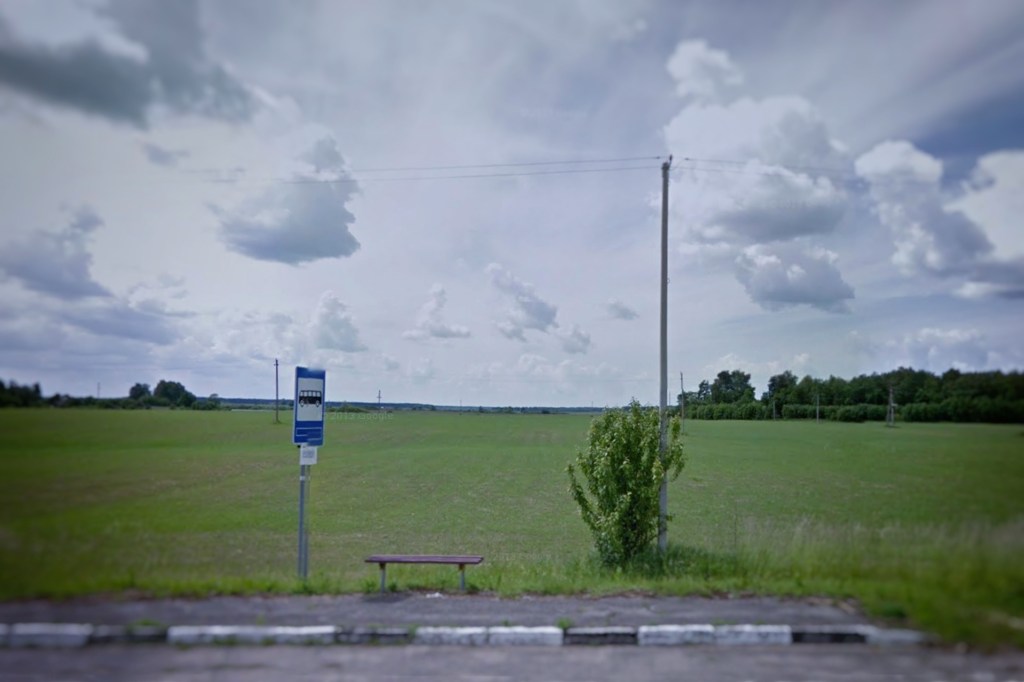
another ordinary day

Wake up, get myself dressed, wander into the kitchen, remember the cat isn’t going to be there, make coffee, read the news, get distracted by…something. That last bit? Getting distracted by…something? Story of my life, right there.

I’m not driven by ambition or security or responsibility or success (whatever that means), but I am ridiculously weak to curiosity. I have a compelling need to know stuff. Unfortunately, it’s rarely useful stuff. If you’re looking for somebody who knows how to repair something mechanical or build a cabinet or replace an electrical outlet, I’m completely fucking useless. But if you ever want to know the name of the brother of the last Saxon king of England or the history and etymology of ‘spatula’ or why jamon iberica is the best ham in the world, I’m your huckleberry.

I only know these things because I allow myself to be distracted by something. And following that distraction led to something else, which led me to something else, which ended up with me accumulating still more useless information. And that’s exactly what happened to me this morning.

In an online forum devoted to readers of the historical fiction of Dorothy Dunnett I came across a passing reference to St. Mary’s Loch–the site of a band of mercenaries in Dunnett’s work. Being familiar with the novel, I had a general notion of where the loch was located in Scotland, but (and this where it always starts…with that but) I decided to look at a map to get a more exact location. And I was curious why the loch was named for St. Mary.

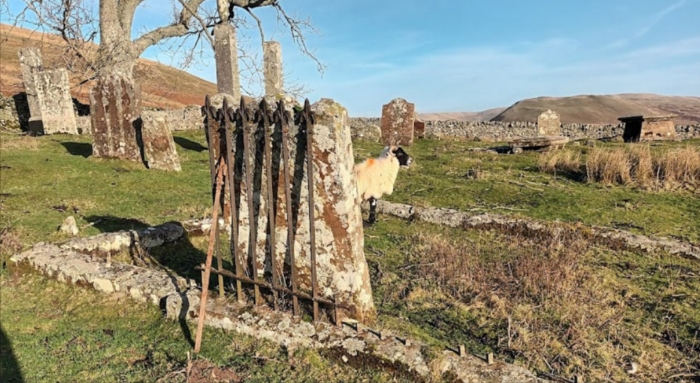
The answer to that last question was both obvious and easy to discover. It was named for a church dedicated to St. Mary. That church is gone now, but the graveyard is still there (and since this is about useless information, the difference between a graveyard and a cemetery is that a graveyard is associated with a churchyard, which requires a church; so this grave site is still a graveyard even though the church is gone).

St. Mary’s graveyard.

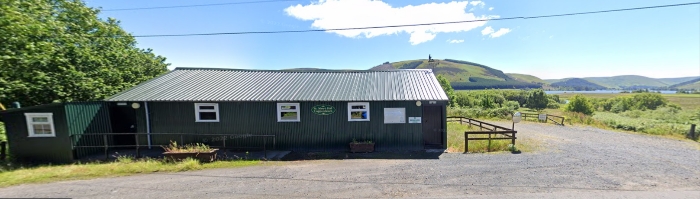
Information about the burial site led me to somebody’s blog post about St. Mary’s Loch, which included a reference to “the Hamlet of Cappercleuch with its couthy old, corrugated iron village hall.” Multiple sources of distraction here. What the fuck does couthy mean? (Spoiler: it’s a Scots term meaning ‘sociable, friendly, congenial, comfortable, snug.) And who wouldn’t want to see a couthy old, corrugated iron village hall?

That led me to Google Maps and Google Street View of Cappercleuch. It turns out that a corrugated iron village hall is…well, just that. It’s basically a rather ordinary, disappointing metal shed. Not particularly old, and certainly not very couthy.

St. Mary’s Hall at Cappercleuch — neither old nor couthy.

Still, as long as I was noodling about with Google Street View, I figured I may as well spend a few minutes looking at St. Mary’s Loch and seeing what else Cappercleuch had to offer. And within ninety seconds I came across another distraction. This:

What the hell is this?

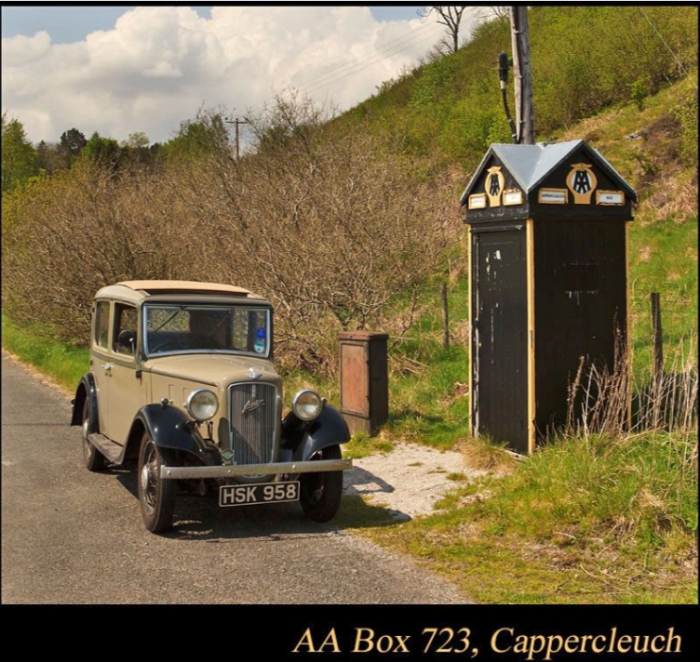
Reader, now THIS is a serious distraction. Just what the hell IS this? I mean, I can see what it is: a small, cross-gabled, distinctively decorated, phone-box sized structure. But what is its purpose? Why is it located just off the A708 motorway in Cappercleuch? (And if you’re curious enough to look for this on Google Maps, here’s a shortcut for you.)

The first thing I learned was that the A708 was one of the five most dangerous roads in proportion to traffic in all of Scotland. Or at least it was between 2007 and 2009. Not particularly helpful information, unless many of those accidents were because drivers were distracted by this weird boxy structure.

We can assume it’s not a Scots Tardis, but it has that ‘police box’ aura about it. It’s something official, certainly. The carefully crafted logo seems to confirm that. If we look closely, we can sort of see that it has the number 723 on the side. So, of course, the only thing for us to do is Google Box 723 Cappercleuch. And that gives us this:

I’m just going to assume you’ve made the same leap I did. AA stands for Automobile Association. It’s the UK version of AAA. AA boxes were an early form of roadside assistance in the UK. The first AA boxes were introduced in 1911. They were lit by oil lamps at night, and were sometimes referred to as “the lighthouses of the road.” The AA boxes contained maps to help folks who were lost, as well as a fire extinguisher, a lantern, and a telephone available to contact the AA for assistance. Members of the Automobile Association were issued with keys that fit all AA boxes in the UK.

By 1919 the AA had established a well-connected communication and assistance network of over a thousand roadside boxes, many of which were manned by yellow-uniformed ‘sentries’ who were there to offer free assistance.

Improvements in technology eventually made the AA boxes obsolete. By the late 1960s, the AA began to phase them out. In 2002 only 21 call boxes were still standing; AA shut down the entire network and made plans to dispose of the structures. The following year the boxes were listed as historic landmarks, and efforts were made to physically restore them. Apparently nineteen boxes still exist.

There’s a part of me, of course, that wants to use Google Maps to find them all. It shouldn’t be hard to do. There is absolutely NO REASON for me to do that, but at some point I probably will. Because that sort of pointless activity is my wheelhouse.

But it won’t be done today. I’ve learned some minimal self discipline over the years.

I’ve no idea how much of my day is spent giving in to my curiosity. I’m going to guess at least a couple of hours every day. There are folks who’ll consider this an inefficient use of my time.

Ain’t it great?

drive-by

I went for a drive on Thursday.

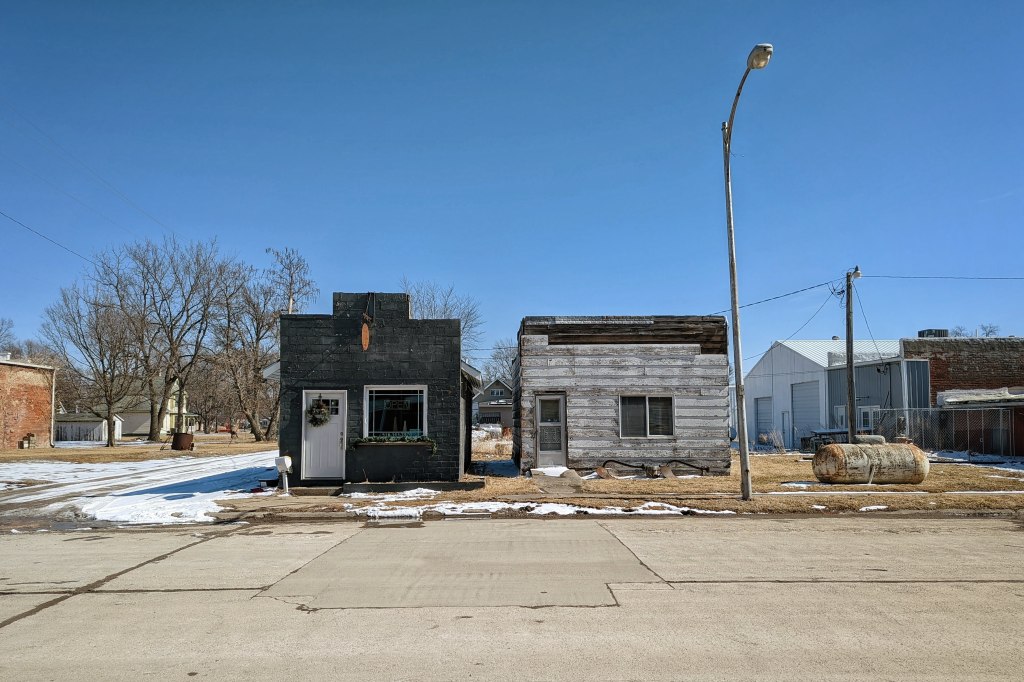
No, wait. It would be more accurate to say I went for a ride; I didn’t do any driving, I was just a passenger. It would be even more accurate to say four of us decided to visit a small town and have lunch in some local cafe (or diner or bakery or brewery or whatever passes for a lunch spot in that particular small town), and while we were out, I shot some photos. This is something we do periodically. After we eat we tend to tool around fairly randomly and see what there is to see. We may tour the town (if it’s big enough to actually tour), we may wander along the surrounding back roads.

I generally sit in the front passenger seat and shoot photos. Sometimes we stop and I shoot photos, sometimes I shoot photos out the window, sometimes I convince the driver (my very patient and obliging brother) to stop, turn around, drive back to something I thought might make an interesting photo.

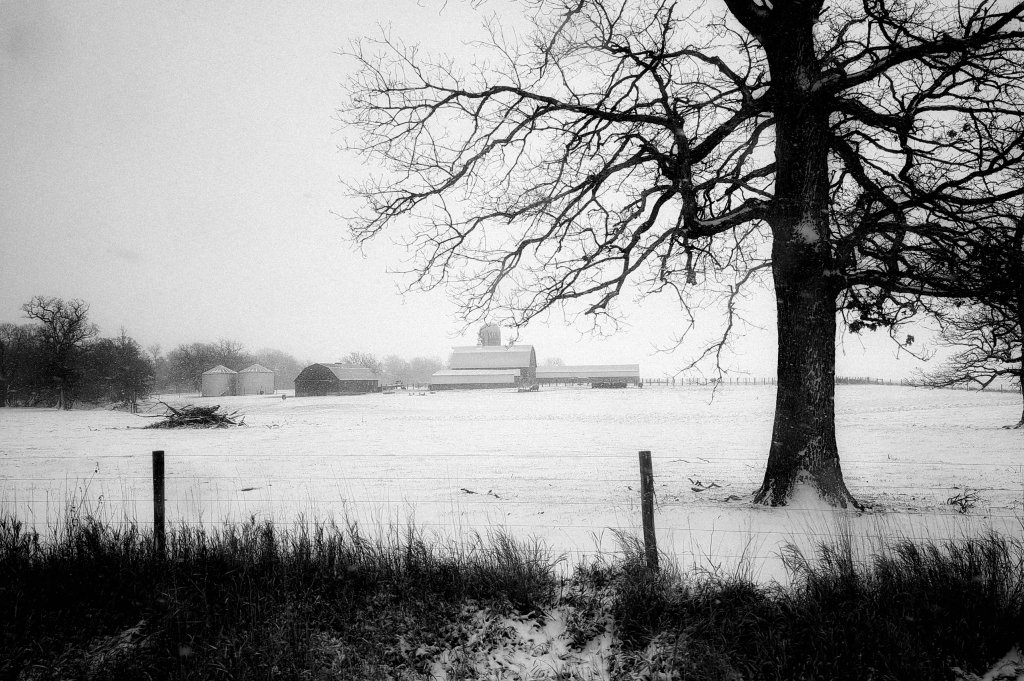
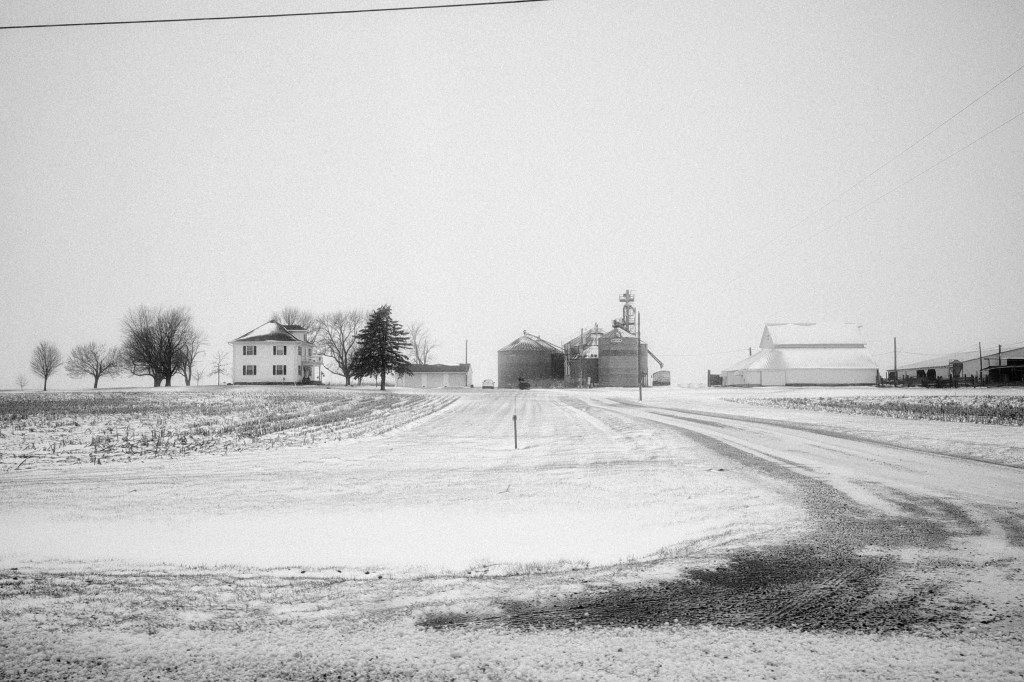
My point, if you can call it that, is that on Thursday we…well, we did that. It was a chilly, occasionally breezy day with a steady fall of exceedingly fine snow. I don’t mean fine in terms of high quality or excellence (although as snow goes, it was pretty fine); I mean fine in terms of texture and delicacy. It was mostly a light, powdery sort of snow; it made the world look like it had been dusted with a sprinkling of powdered sugar.

Two things. One, I used to bring one of my cameras on these ventures, but for the last few years I’ve mostly used my phone for this sort of photography. Two, in winter I tend to shoot in black-and-white. I know it makes more sense to shoot in color and convert it to b&w; you have greater control over the final image. But there’s some weird trigger in my brain that says, “Hey, old sock, if you’re going to make black-and-white photos, commit to it.” It doesn’t make any sense, but there it is.

Over the years I’ve used half a dozen different dedicated b&w phone apps. So far, I keep gravitating back to an app called Vignette, which is a very flexible app that allows you to create a number of different camera profiles. I bang it around until I get a b&w setting that meets my general needs and aesthetic, then save it. Every time I buy a new phone, I sort of recreate that setting (although the recreated version is never quite the same as the previous, I’m okay with that).

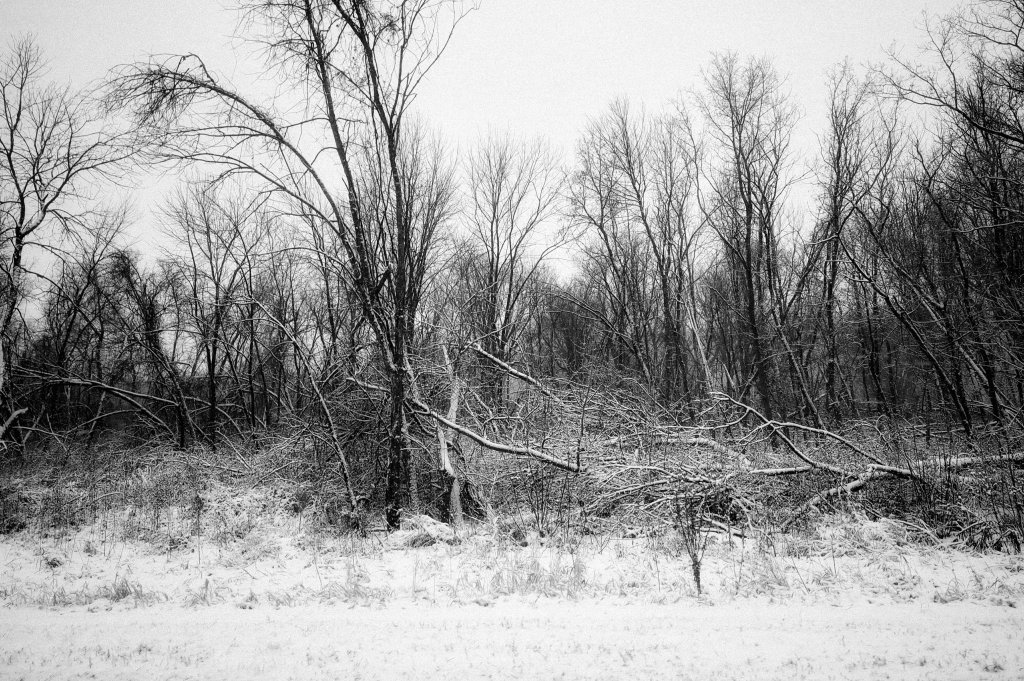
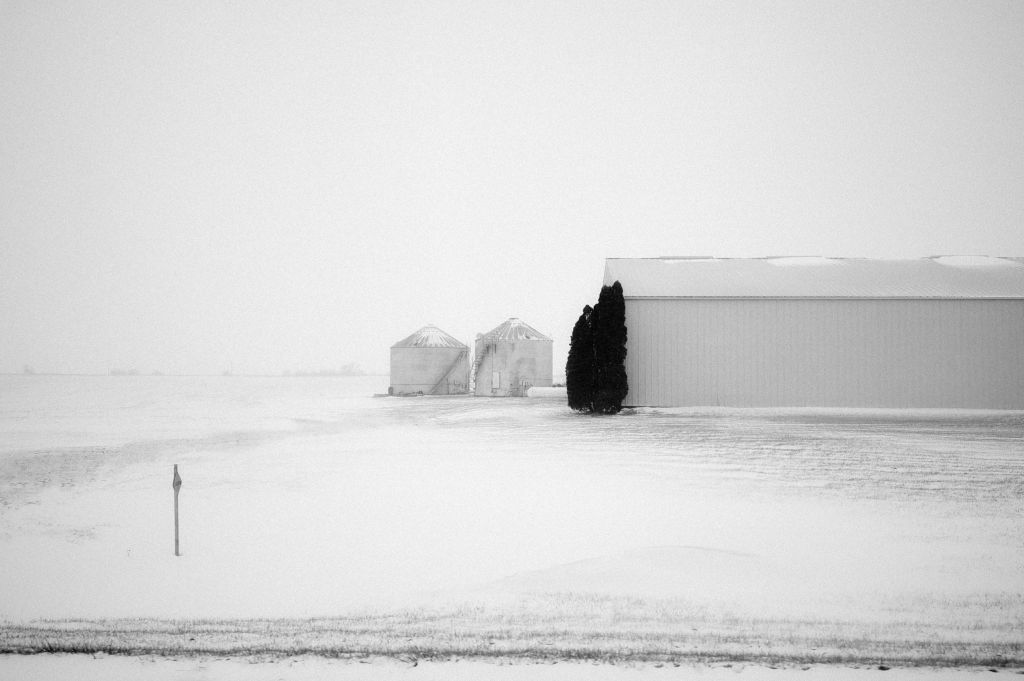
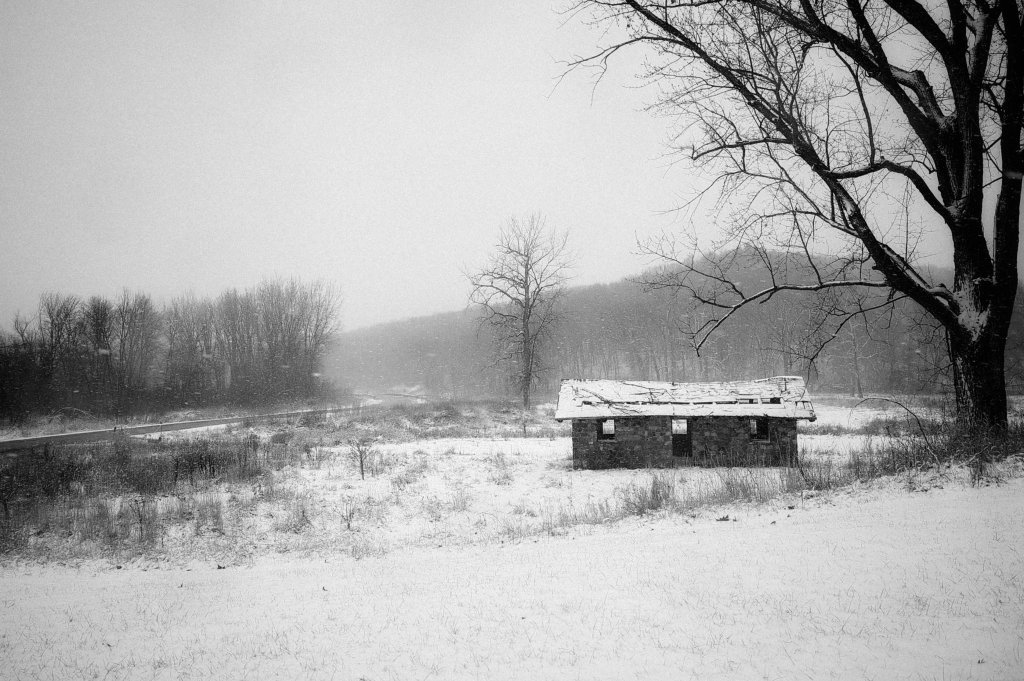
All of the photos here are drive-by photos. They were shot through the passenger side window (which, of course, was closed because it’s fucking winter here). There’s always a part of me that wishes the window was perfectly transparent, and a conflicting part of me that likes the fact that the window conditions change and the photos change accordingly. The window might be a tad foggy with condensation, or it might be streaked with water or melting snow, or even spattered with mud or road grime. It all finds its way into the photo.

Drive-by photography is ridiculous. It’s all about predicting an image–seeing what’s up ahead and visualizing what it might look like when you get there. If that’s loopy enough, you then have to anticipate what’s coming and try to time the shutter release (okay, there’s no actual shutter in a cellphone, I know that, but you know what I mean) to correspond with what you hope will be a proper composition. That’s another issue with the Vignette app: the shutter lags. Just a moment, but it’s a fairly predictable moment. Which means if you’re using Vignette to shoot a drive-by photo, you have to factor that lag into the equation.

Half the fun of drive-by shooting, of course, is not quite knowing what you’re going to get. You make a number of guesses and predictions based on your experience and intuition and your understanding of the technical concerns, and hope for a good result. Most times, you guess wrong. But sometimes you guess just right and the photo is what you hope it will be. I guessed right (or close enough to right) on the photos you see here. None of them has been cropped, but most of them have been rotated slightly to straighten the horizon line.

The snow helped. Not just because it was pretty, but because we were driving more slowly. That gave me more time to evaluate the shot and a larger margin of error.

There are few finer ways to spend a weekday, when all the normal employed people are at work and out of the way. Good company, good food (usually), good drink (usually), and the serendipitous exploration of some place we have no real reason to visit other than whim. I count myself very fortunate that I get to do this.

saturday, noodling around

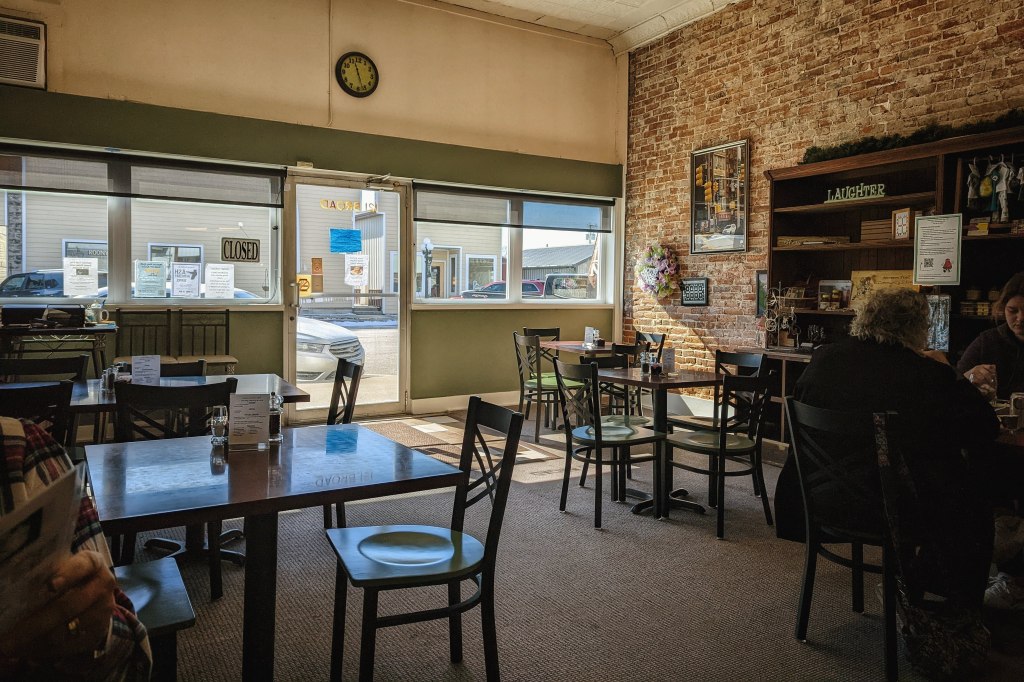
I don’t know what you did last weekend, but I drove 75 miles to the small former coal town of Humeston, Iowa. Why? Because there’s a tiny cafe. Almost every small town has some sort of tiny cafe or diner. But this one–the Grassroots Cafe–serves a grape salad that’s so good you want to lie on the floor and kick your feet in the air. And the bread pudding would make angels weep that it exists for mortals on the earthly plane.

The Grassroots Cafe

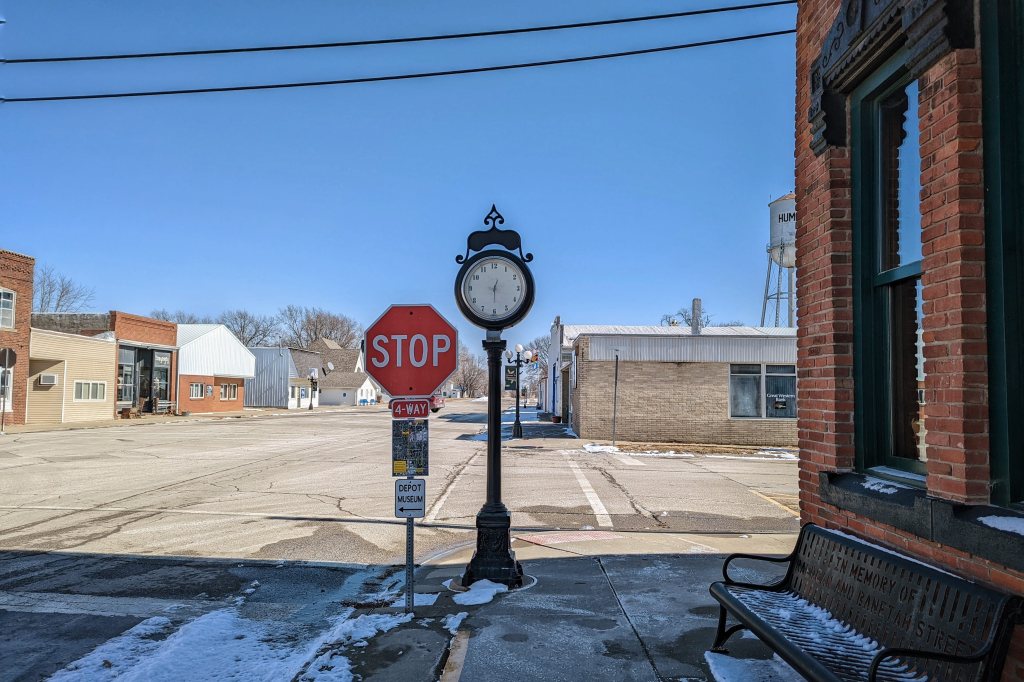
Humeston is a really small town. Population: 465 in 2020. It was the home of the Humeston and Shenandoah Railroad, which in 1881 ran 113 miles from Humeston to (guess where) Shenandoah, Iowa. In its glory days, the H&S RR ran 14 classic 4-4-0 steam locomotives, hauling mostly coal, grain, livestock and occasionally passengers to the slightly larger town of Shenandoah, where the railroad joined up with the Missouri, Iowa, and Nebraska Railway system. (You may be wondering, “Greg, old sock, what is a 4-4-0 locomotive?” I wondered the same thing and I googled it. You can do the same thing. Don’t be lazy. And stop calling me ‘old sock’.)

This is Humeston.

By the late 1920s, the H&S RR was beginning to fade. The advent of the automobile (and, more importantly, the truck), combined with improved roads, the gradual decline of local coal, and the beginnings of the Great Depression, strangled the small railroad business. The railroad died slowly and in sections, but by the mid-1940s, during the Second World War, it was essentially gone. As the railroad died, so did the town’s population.

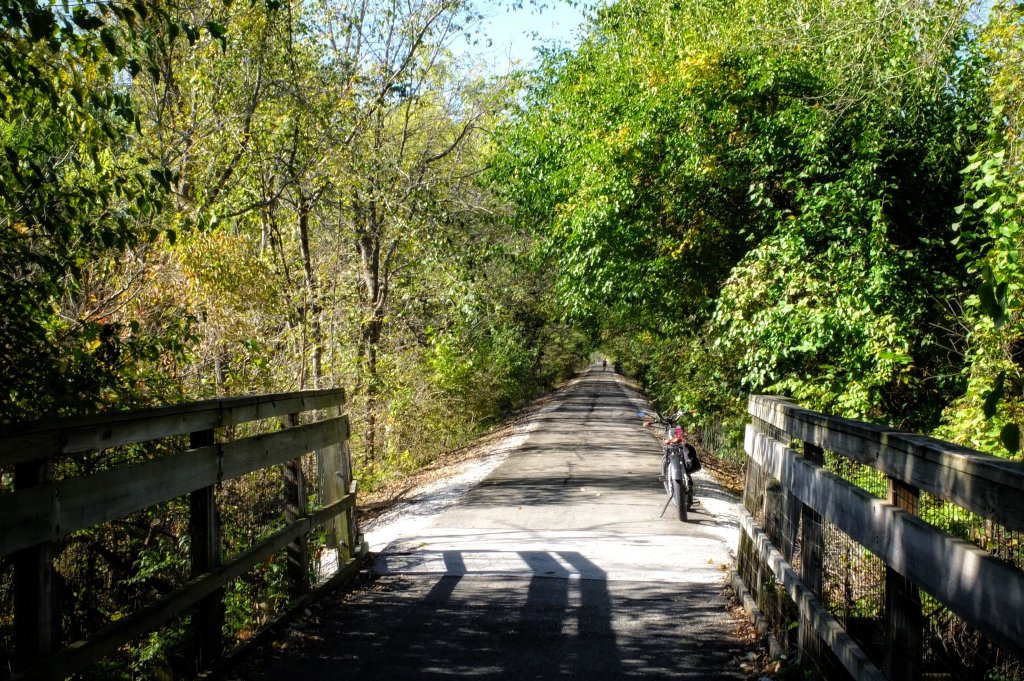
Humeston, near the cinder bike path.

Although the railroad is gone, the track left behind became Iowa’s first rails-to-trails bike path. Thirteen and a half miles, from Humeston to Chariton. Unfortunately, it’s also Iowa’s worst-maintained bike path. About half of it is gravel and cinder; the other half is…well, just grass. Sometimes overgrown grass. It’s doubly sad because it’s one of the few bike trails with covered bridges.

Humeston

On arrival in Humeston, I gave in to an impulse. Sometimes you just have to give in to your impulses. You know how it is. You’re on the road, you see a train, you pretty much have to say, “Train” out loud, even though anybody with you can see the damned train. Same with horses and cows (and, I don’t know, maybe sheep? Yeah, probably sheep). Even if you resist saying it aloud, there’s a part of you that’s thinking and wanting to say “Cow” when you see a cow. It just happens.

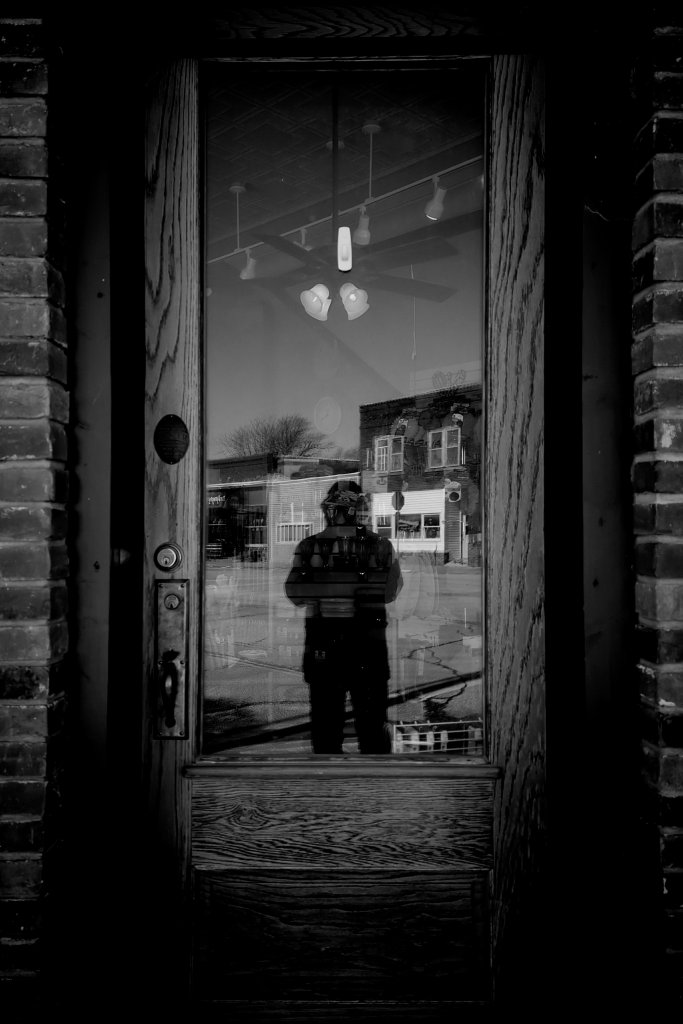
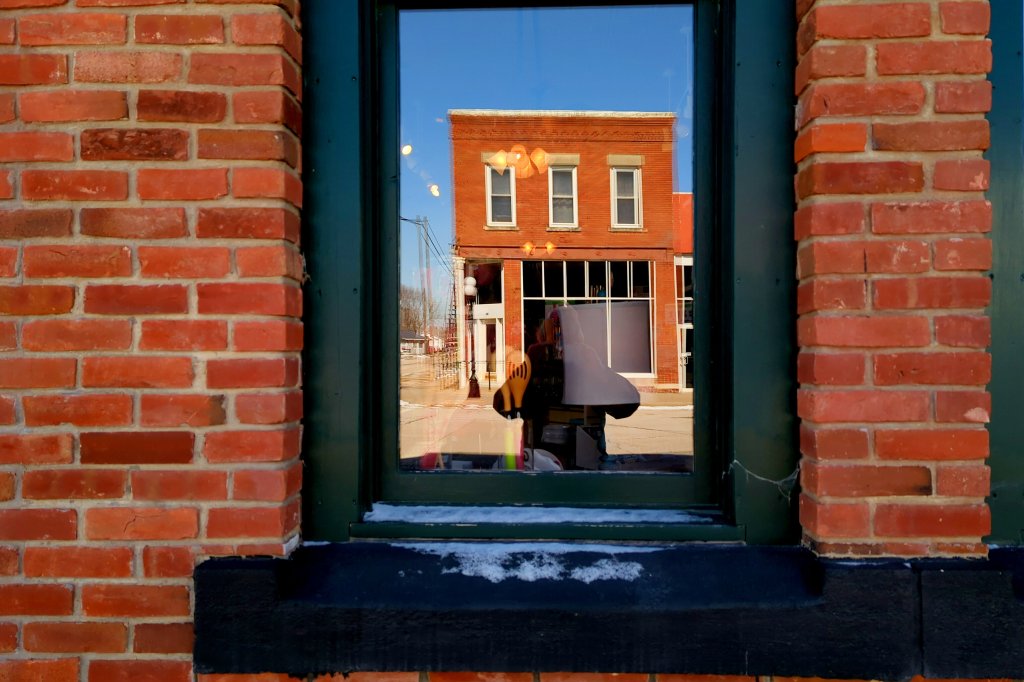
The photographic equivalent of saying “train” or “cow” is shooting your reflection in a window.

First photo in Humeston

Obviously, I gave in to that impulse. My first thought was that Humeston should be photographed in black-and-white (why yes, I DO have an app I use just for b&w photography–doesn’t everybody?). But the day became so sunny and bright (though still brutally cold) that I quickly abandoned that idea and shifted to my standard photo app.

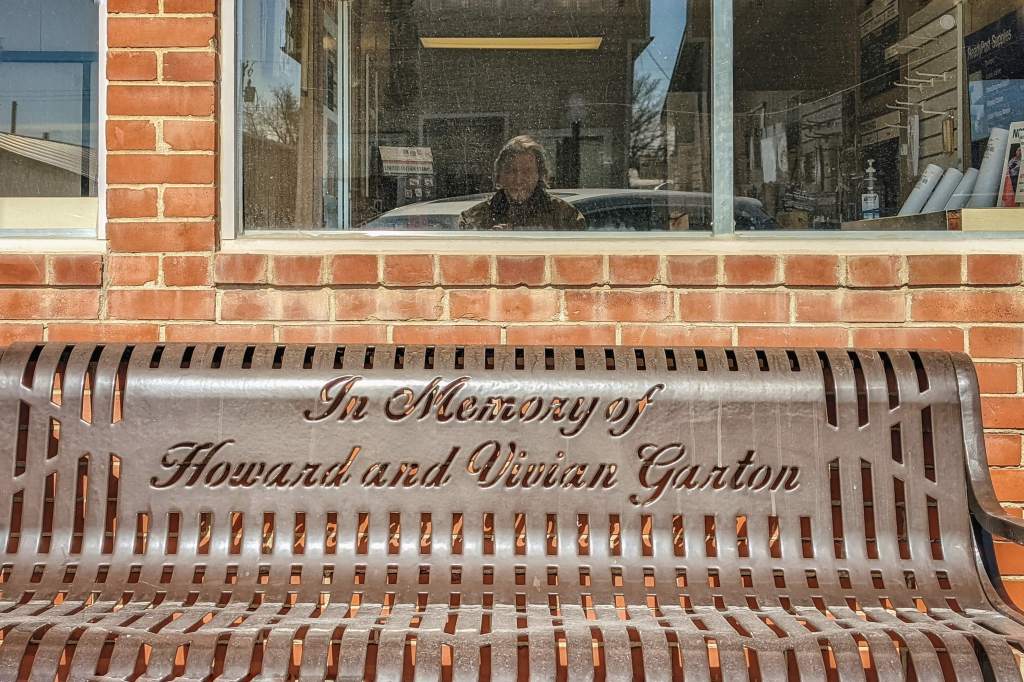
Selfie with Humeston bench.

And my first photo was, yes, a reflection selfie. There’s no point to it; you just have to do it sometimes. Usually, you do it once and that’s enough; you won’t have to do it again for weeks or months. The impulse has been fulfilled and you can get on with your life. But there are occasions when the itch just doesn’t feel properly scratched until you’ve done it a few times.

Yes, three (3!) reflection selfies in Humeston.

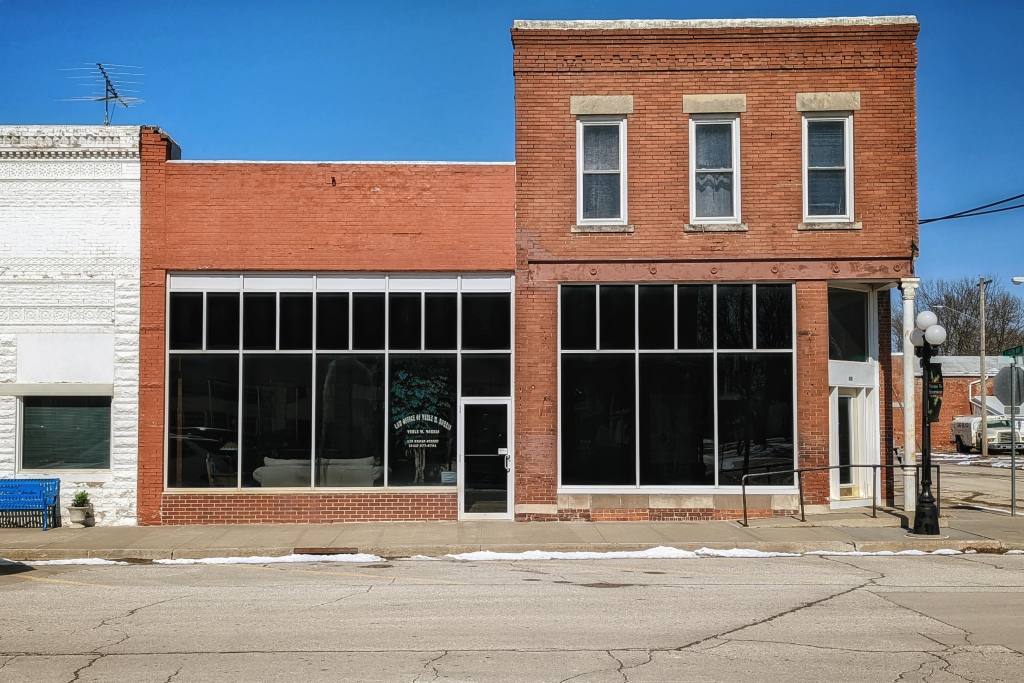
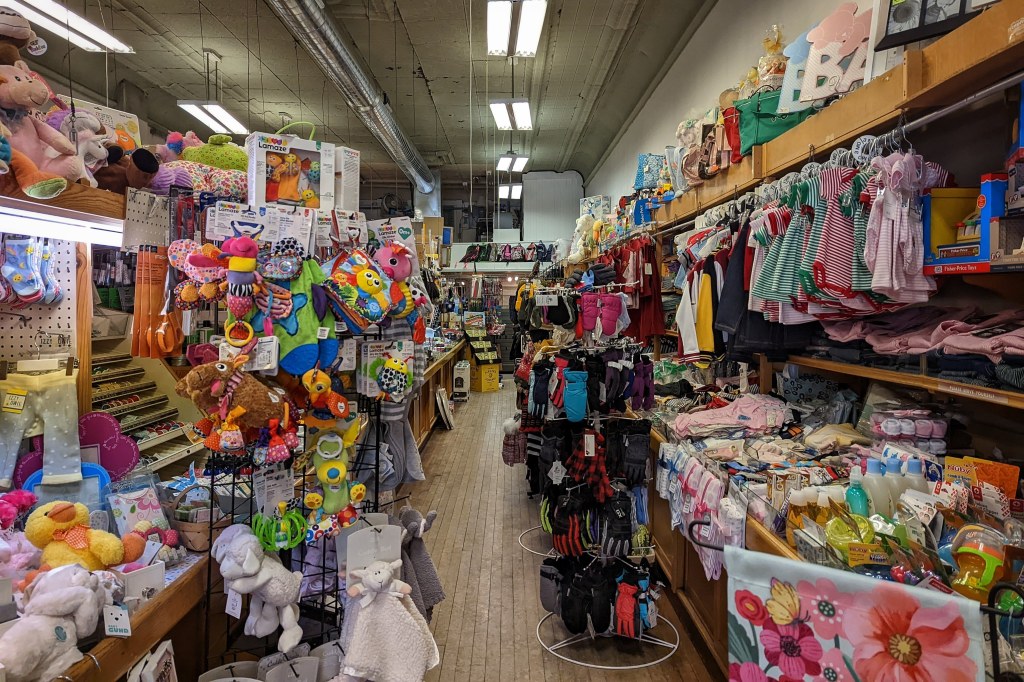
So I wandered around on the streets of Humeston briefly (briefly because 1) it was savagely cold and 2) there isn’t enough of Humeston to wander around at length). It feels like a small town, to be sure, but it doesn’t feel like a small town in decline. Sure, some of the shops are empty, and some are a wee bit worse for wear, but everybody I met was cheerful and there was a sort of bright enthusiasm to the limited commerce. The aisles of the general store (yes, there’s a general store) were so exuberant that they were almost hallucinatory.

Tripping in Humeston.

As much as I love to visit small towns, I always find myself wondering what it would be like to grow up in one–and deciding it would be awful on so many levels that you’d need an abacus to count them. I have absolutely nothing to base that on, and the people I know who grew up in small towns generally have nice things to say about the experience. But damn.

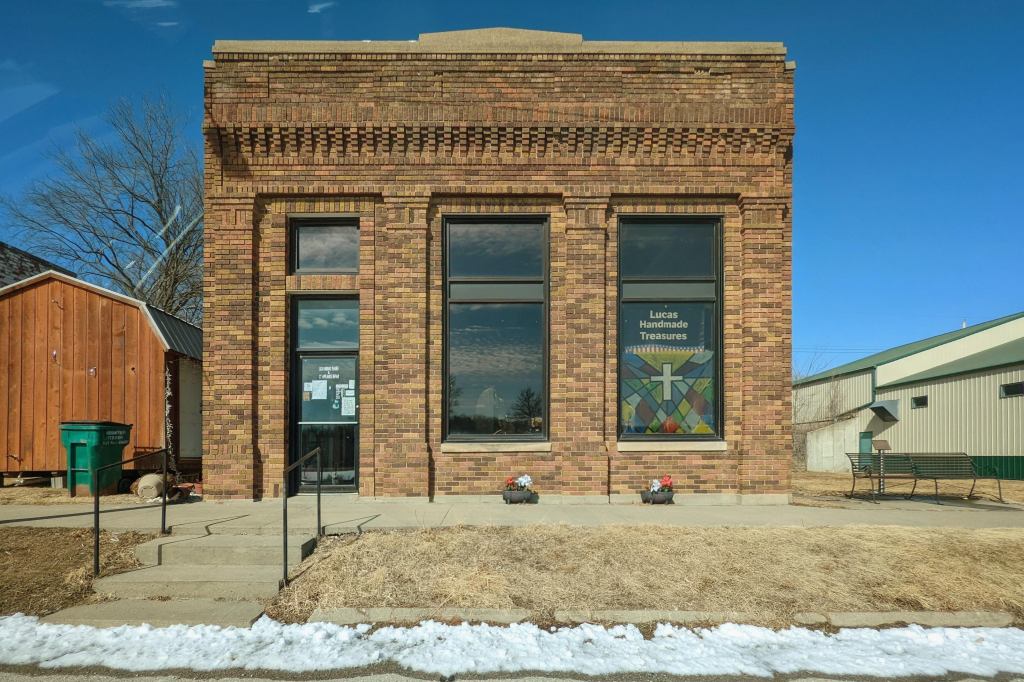
On the way home from Humeston, we passed through the town of Lucas, Iowa, where we saw this charming little brick building. Of course, we decided to stop and look.
Lucas is so small it makes Humeston feel like a metropolis. Before it was a town, it was just a station on the Burlington and Missouri River Railroad line. The station was established in 1866. A decade later, the Whitebreast Coal and Mining Company sank a mine near the station. There was a rich deposit of coal, and by 1880, they’d opened a second coal mine and created a company town. If you’re not familiar with the concept of a company town, it’s basically a town in which practically everything–all the stores, the housing, the local services–are owned by a single company that’s also the sole (or at least the primary) employer. If you wanted to buy a shirt or a loaf of bread, if you wanted to have a boil lanced or a tooth extracted, you paid the money you earned from the company back to the company, before returning to the house you’ve rented from the company.

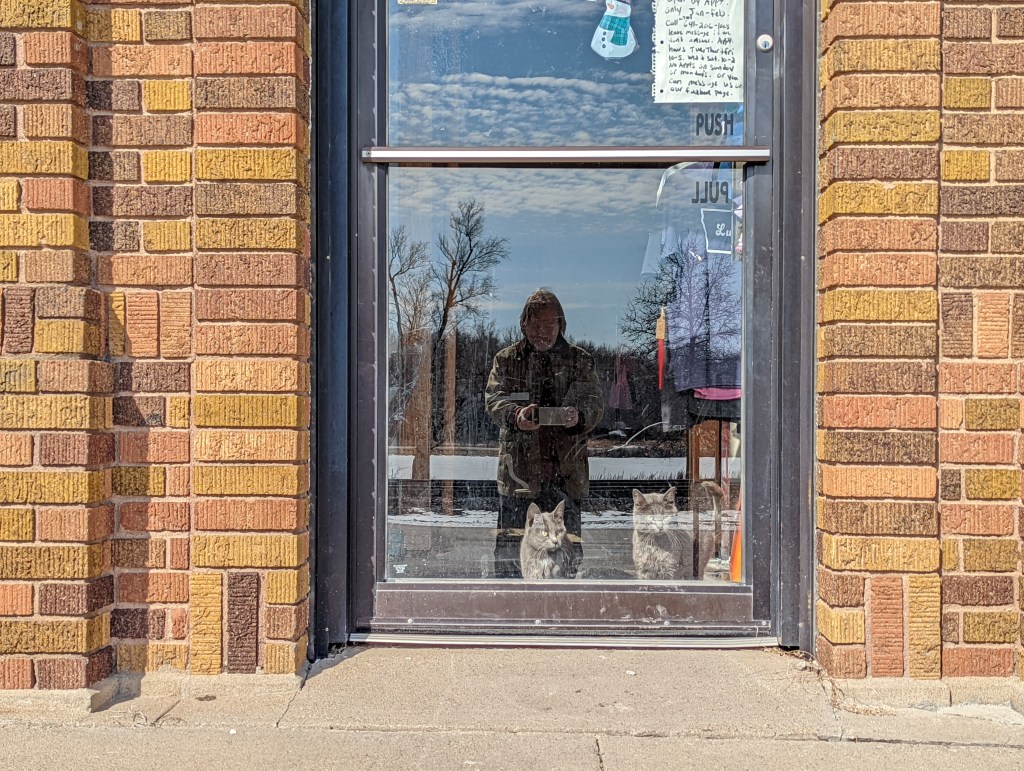
Lucas selfie with optional shop cats.

By 1890, there were 1300 people living and working for the Whitebreast Coal and Mining Company in Lucas. But here’s the thing about coal. Once you dig it up, it’s gone. A coal mine without coal is just a big fucking hole in the ground. The last productive coal mine in the Lucas area closed in 1923. By 1930, the population had dropped to about 500. In the 2020 census, the population was only 172.

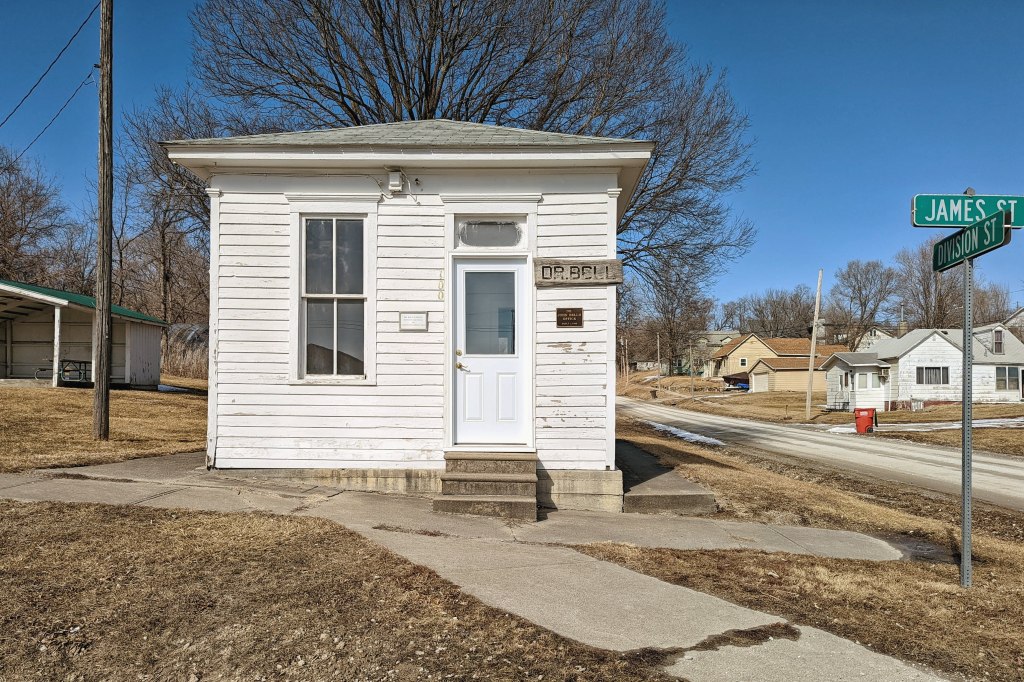
Dr. Bell’s office.

There were three antique/craft stores in Lucas. None of them were open during our brief stop, nor was the John L. Lewis Mining Labor Museum (union organizer John Lewis apparently got his first job as a coal miner in Lucas). I doubt that Doc Bell is still in business, but his office is still standing. If you look, you can recognize the bones of the old company town that existed here a century ago.

That was my Saturday. A day spent not doing much of anything–just noodling around in small towns, thinking about stuff, shooting shop-window selfies. In other words, a day well spent.

let the journey unfold

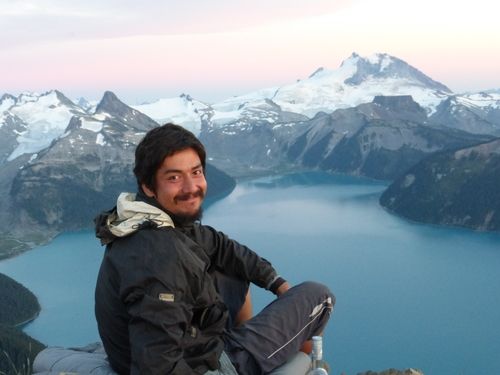
I recently learned that Iohan Gueorguiev is dead. He died months ago–August of 2021. I had no idea.

You know how it is. There are things you wish you’d done. There are things you wish you could do. But there are also things you wish you’d wanted to do, even though you know you wouldn’t actually do them even if you had the opportunity.

I wish I would have wanted to do what Iohan did. I know, if given the chance to do what he did, I’d have turned it down. What he did was just too hard. I mean, it was absolutely wonderful and amazing and quixotic. I admire him for what he did and how he did it. But even though I’d have enjoyed doing some small parts of what Iohan did, I don’t have it in me to really want to do it.

What did Iohan Gueorguiev do?

He rode a bicycle. He rode it a lot. He rode it very far. Incredibly far, in fact. Insanely far.

Iohan was born in Bulgaria in 1988. When he was 15 years old, his parents sent him to live with an uncle in Mississauga, Ontario. At some point he bought a bicycle–a touring bike–and went for a ride. To Vancouver. About 2700 miles.

That started his weird fascination and love for long-distance bike-camping. In 2014, he decided to ride his bike from the Arctic Sea in Alaska to the town of Ushuaia in Tierra del Fuego, the southernmost town in Argentina, generally called the ‘end of the world’. He thought it might take him a year. He was wrong. Wildly wrong.

It was, to be frank, an absurd and ridiculous idea. The distance from Prudhoe Bay, Alaska to Ushuaia is about 9500 miles as the crow flies. On a bicycle, it’s…well, who knows how far it would be? Farther than any rational person would consider riding.

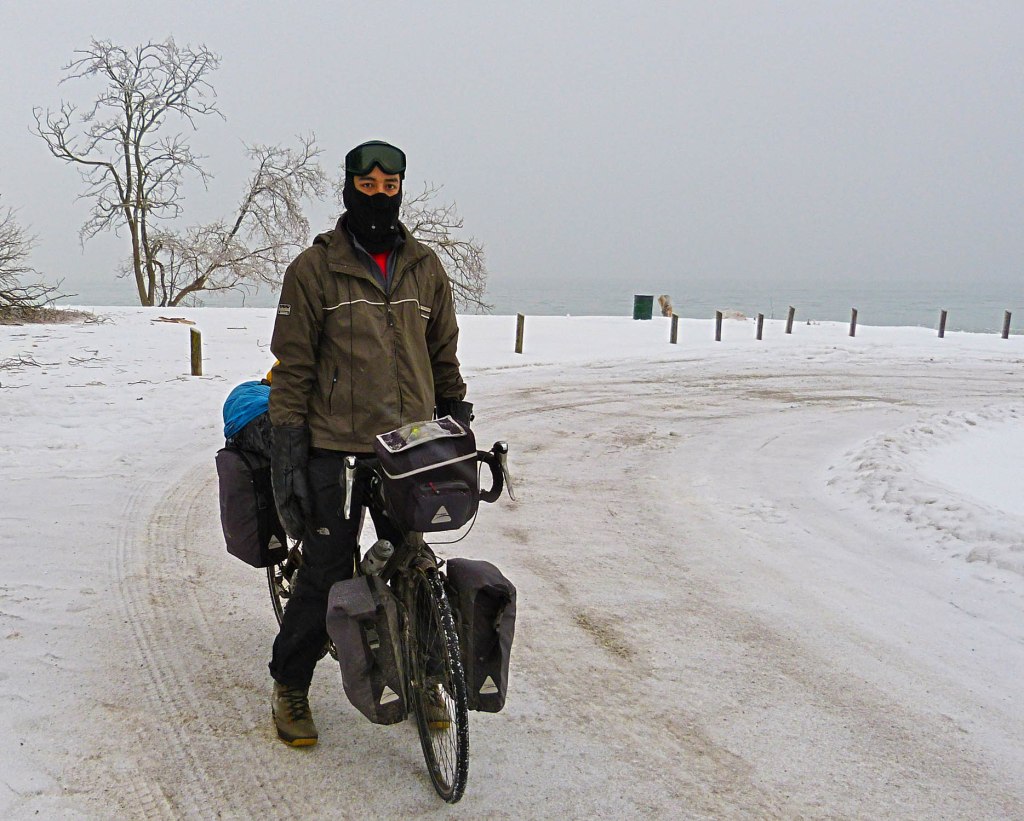
Iohan’s touring bike–with its narrow road tires–was entirely inadequate for the project. Eventually he was able to acquire a fat tire bike that was significantly more suited for the trip, and over time he obtained a better camera (and a GoPro and some sort of drone), but his gear was always a secondary–or tertiary–consideration. The adventure was what mattered–the things he saw, the people he met. He maintained a blog describing the trek (which is how I learned about him) and he produced a number of YouTube videos.

“I want to see the world. Follow a map to its edges and keep going. Forgo the plans. Trust my instincts. Let curiosity be my guide. I want to change hemispheres. Sleep with unfamiliar stars. And let the journey unfold before me.”

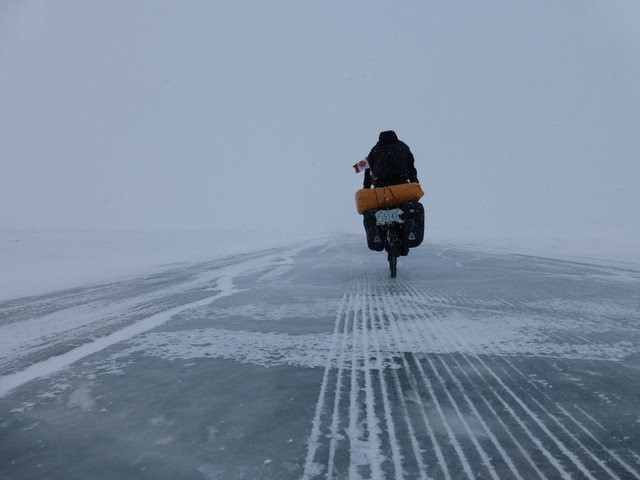
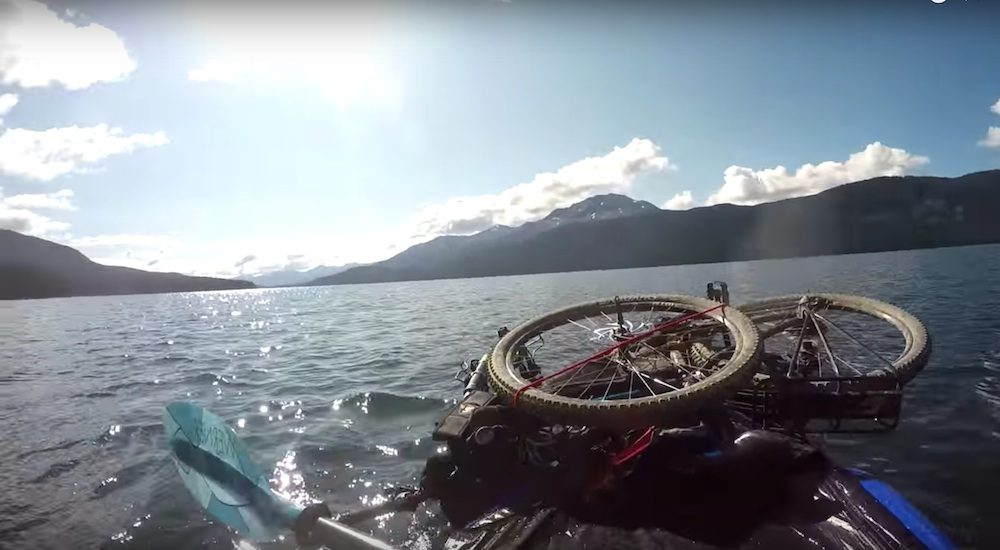
That’s mostly what he did–let the journey unfold. Iohan rarely took the easy route. He rode anywhere he could, anywhere he wanted: ice highways, lumber roads, hiking paths, wilderness trails. Hell, sometimes he didn’t take a route at all–he just set off in the general direction. On at least one occasion he broke down his bike to cross a lake using a collapsible kayak. He refused to let common sense dictate the trip.
He encountered every obstacle you could predict: bad weather, wildlife, gear failures, terrible terrain, mechanical issues. And yet he always seemed to find something positive about his situation. Cycling in a blizzard? He didn’t have to worry about his food supply spoiling. Traveling up a hazardous mountain trail so steep he has to carry his bike and all his supplies? The air is cool, he says, and fresh and invigorating.

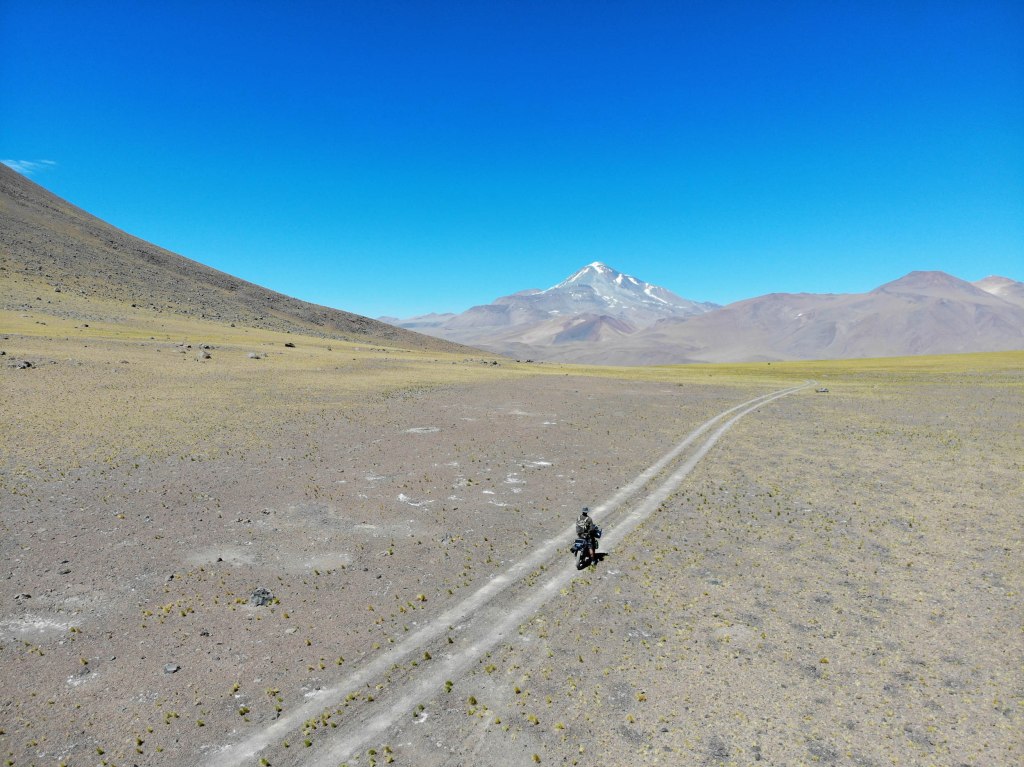
“Ruta de Los Seis Miles is a 1,310km, month-long, high altitude desert traverse across the Central Andean Dry Puna in Chile and Argentina. This route promises the most physically and mentally demanding high altitude touring in the Andes. Thankfully, it’s balanced with dream-like mountain scenery with salt fields, lava flows, flamingo-filled lakes, and some of the highest volcanos in the world, far away from the civilization.”

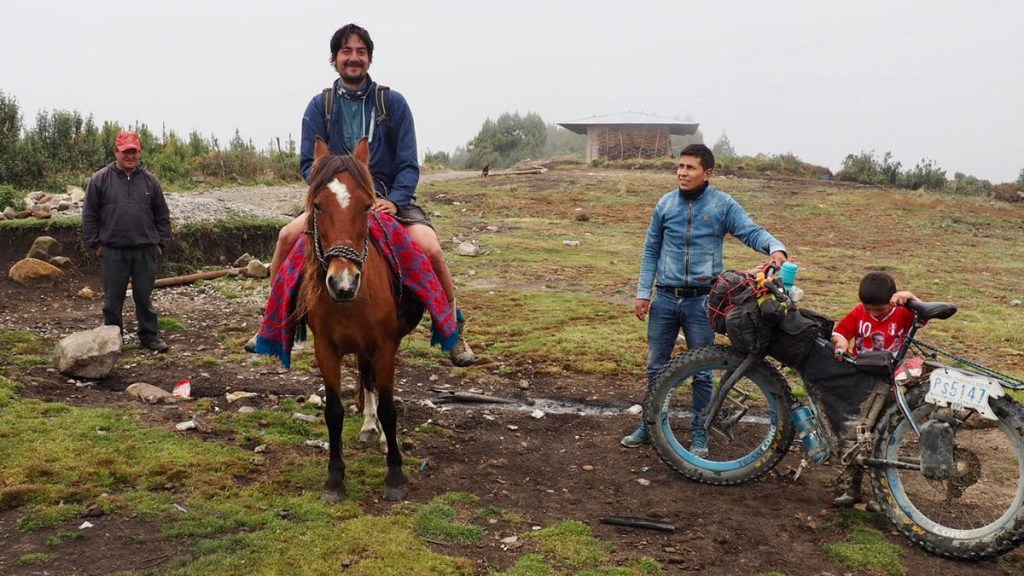
Everywhere he went, Iohan met good people. They’d offer him a safe place to sleep, a warm meal, maybe a bit of money, stories. He seemed to take as much joy from the people he met as he did from the sights he saw. He was certainly comfortable being alone–and there were times on the trip when he was terribly alone–but he clearly delighted in meeting new people in unusual circumstances.

“My motivation: the kindness of strangers and the beauty of the wild.”

Without a private fortune (which Iohan didn’t have) or some sort of corporate sponsorship (which he occasionally received), he was forced to interrupt his journey periodically and return to Canada and earn enough money to continue. Then he’d resume the adventure where he’d left off.

The trip he originally thought might take a year stretched out to more than six. Then Covid arrived; the pandemic disrupted everything. Iohan returned to Canada. He still took what he’d describe as ‘short trips’ in Canada. But the trips weren’t very rewarding; the pandemic made it impossible for him to meet new people. Depression set in; he developed insomnia, made worse by sleep apnea.

Last August, Iohan killed himself.

He still had about 1500 miles to go to reach Ushuaia.

Earlier I said I wish I would have wanted to do what Iohan did. I try to do what he did on a much much much more modest scale. I ride my bike. I talk to strangers. But if it’s too cold or too hot or too windy or too wet, I stay home. Still, there’s a part of me that wishes I had the sort of irrational will that could inspire me to actually undertake an adventure like his.

Iohan Gueorguiev went as far as he could. So much farther than common sense would carry you. He experienced so much more than the rest of us. It would be wrong to think he fell 1500 miles short of his destination. The distance Iohan Gueorguiev traveled can’t be measure in miles. He kept going until he couldn’t. Then he stopped.

EDITORIAL NOTE: You can still access Iohan Gueorguiev’s blog and his videos at BikeWanderer. It’s nice to watch the videos and think maybe he’s still on his way.

that’s right, it’s a movie review

I sporadically read movie and/or television reviews. I don’t necessarily trust entertainment reviewers, but I tend to assume they get it approximately right. Maybe they don’t point to true north, but they wave in a general northish direction. The reviews of Don’t Look Up were harsh; I saw it described as glib, as disastrous, as unamusing, as obvious and without subtlety, as over-the-top, as trivializing an actual social problem, as cynical and mocking. Reviewers said Don’t Look Up failed both as satire and as comedy.

But sometimes all I want is mindless, distracting entertainment–something glib and trivial and obvious. Besides, there were a lot of really fine actors in it, so how bad could it be?

I won’t say Don’t Look Up is a great movie; it’s not. But it’s not at all what the reviewers claimed it was. It’s not mindless entertainment; it’s not glib or trivializing or without subtlety. It’s a damned fine movie. It IS over-the-top, but considering the last few years, it’s only over the top by inches.

With only the tiniest possible SPOILER, I’m going to tell you what the movie is about. I’m not going to relate the entire plot; I’m only going to reveal one plot element (which you probably already know). But I’m going to describe what I think is the pivotal scene. It takes place fairly early in the film, and it establishes the theme on which the movie depends.

Three people–a grad student who discovers a comet heading directly toward earth, the professor who oversees her research, and a government official who heads some obscure agency devoted to protecting Earth from comets and/or other space stuff–are at the White House with a high-ranking military escort. They’re there to warn the president of the impending extinction level event. POTUS is busy doing political bullshit, so they’re left idling in a hallway. The escort leaves briefly and returns with bottled water and some snacks. He complains about how expensive the snacks were. The others reimburse him–US$20. He keeps the change. Later, the grad student (played by Jennifer Lawrence with unfortunate hair) discovers the snacks and water were free. Periodically through the rest of the film, she talks about how astonished she was that this guy screwed them for a few bucks when they were at the White House trying to warn humanity that all life on the planet is likely going to be extinguished. She just can’t understand people who act that way.

And that’s the movie. Good, decent people trying to do what’s right, trying to do what’s best for everybody, trying to deal with a system designed for–and occupied by–people primarily concerned with themselves and their own gain, people who are willing to lie, mislead, and manipulate others to achieve their short term goals. It’s not just that they have incompatible value systems; it’s that they don’t even share the same definition of values.

It’s a comedy. Sort of. It’s satire. Sort of. Actually, I’m damned if I know what genre it falls into. It’s a critique of the politico-corporate culture we live in, where maximizing profits and shareholder value have priority over human concerns. It’s a critique of the social media driven culture in which celebrity is valued over knowledge and manipulated opinion trumps science. All of that sounds very dull, doesn’t it; but this is not a dull movie.

In the end, I found Don’t Look Up to be weirdly hopeful. It suggests that trying to do good, trying to do the right thing, is in itself a worthy goal, even if you don’t believe you can succeed. It suggests a person’s sincere attempt to do what’s right confers a sort of grace on the person. I like to think that’s true.

Don’t Look Up is worth watching.

EDITORIAL NOTE: By the way, this is one of the few films in which scientists are depicted as normal people who are simply devoted to science. Nerdy, perhaps, but ordinary.

Melanie Lynskey

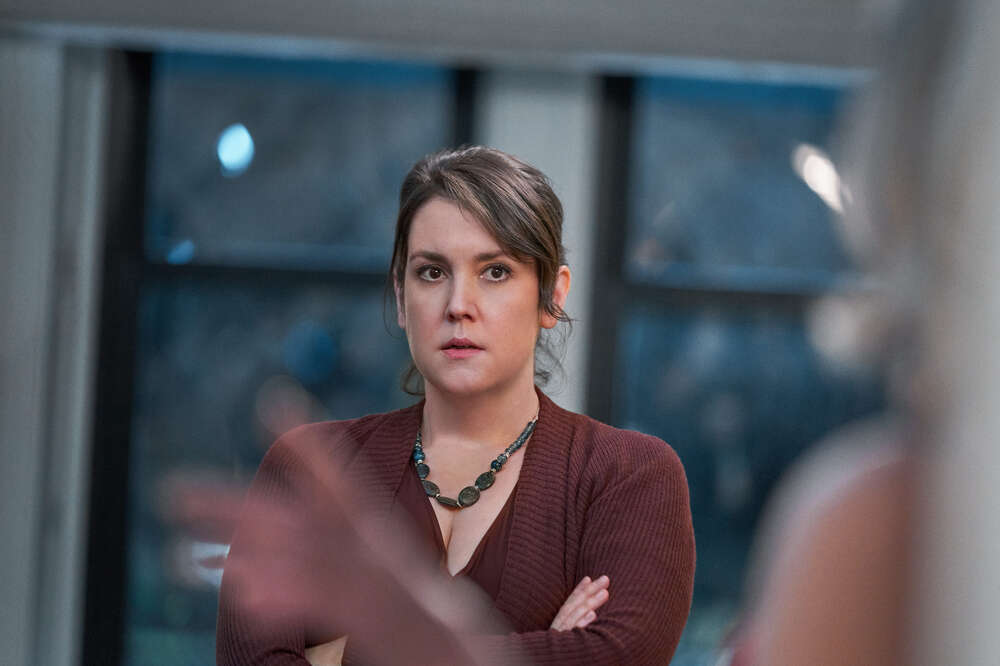
Also? The cast includes Melanie Lynskey, who has a brilliantly quiet career playing strong, soft-spoken women; she deserves a lot more attention than she gets. It’s a small role, but she’s perfect in it. She knows how to throw a pill bottle and make it sting.

sunday — this beautiful world

Sunday morning, early October, chilly but sunny, not a cloud in the sky, very little wind. Who wouldn’t want to go for a bike ride? Now, I know what you’re thinking; you’re thinking, “Greg, old sock, you always want to go for a bike ride.” First, stop calling me ‘old sock’. Second, well, yeah.

My brother-in-law, who’ll I’ll call “Jeff” (on account of that’s his name) and I started our ride in a little Iowa town called Mingo. I am NOT making that up. It’s an old coal-mining town, named after the Mingo tribe of the Iroquois nation. The Mingos, by the way, didn’t call themselves Mingos; that’s what the neighboring Algonquin tribes called them. It’s a corruption of the Algonquin term mingwe, which apparently means ‘sneaky’. But they weren’t sneaky enough to escape the notice of ‘progress’. As part of the Indian Removal Act of 1830, any remaining Mingos in Iowa were required to shift themselves to Kansas. Why? As President Andrew Jackson said at the time,

“What good man would prefer a country covered with forests and ranged by a few thousand savages to our extensive Republic, studded with cities, towns, and prosperous farms?”

Andrew Jackson was more fucking savage than the Mingos, and a LOT of us would prefer a country covered with forests. Anyway, Mingo now is a sneaky little town of about 300 white people and a small biker tavern (as opposed to a cyclist pub). We did NOT have a beer at the Greencastle Tavern because 10:30 in the morning is too early to drink. And besides, the tavern wasn’t open yet.

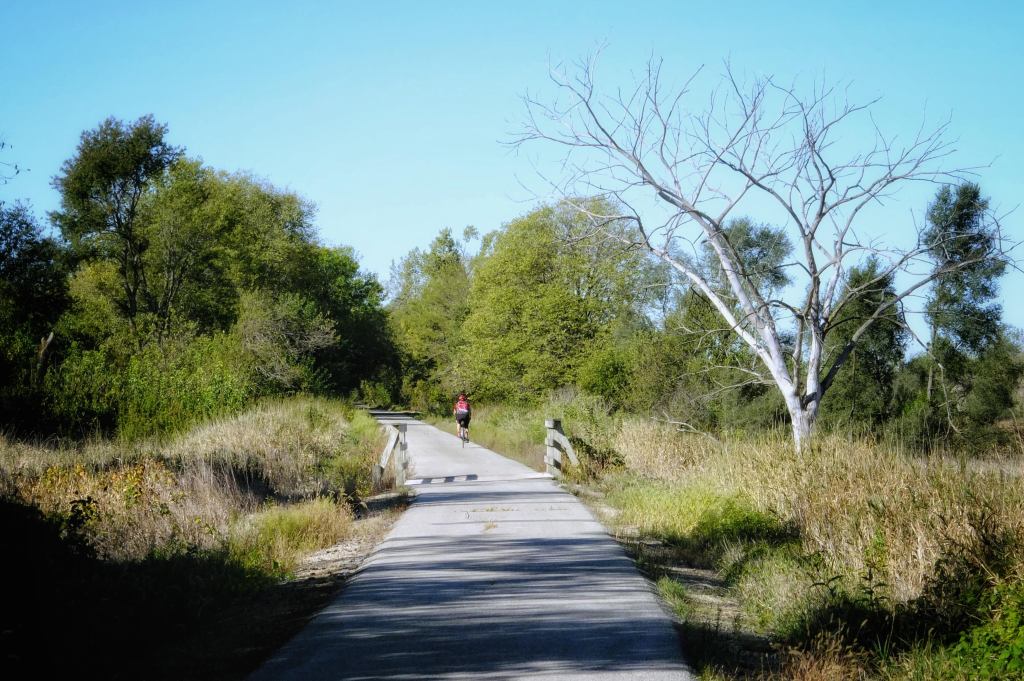
Just outside of Mingo.

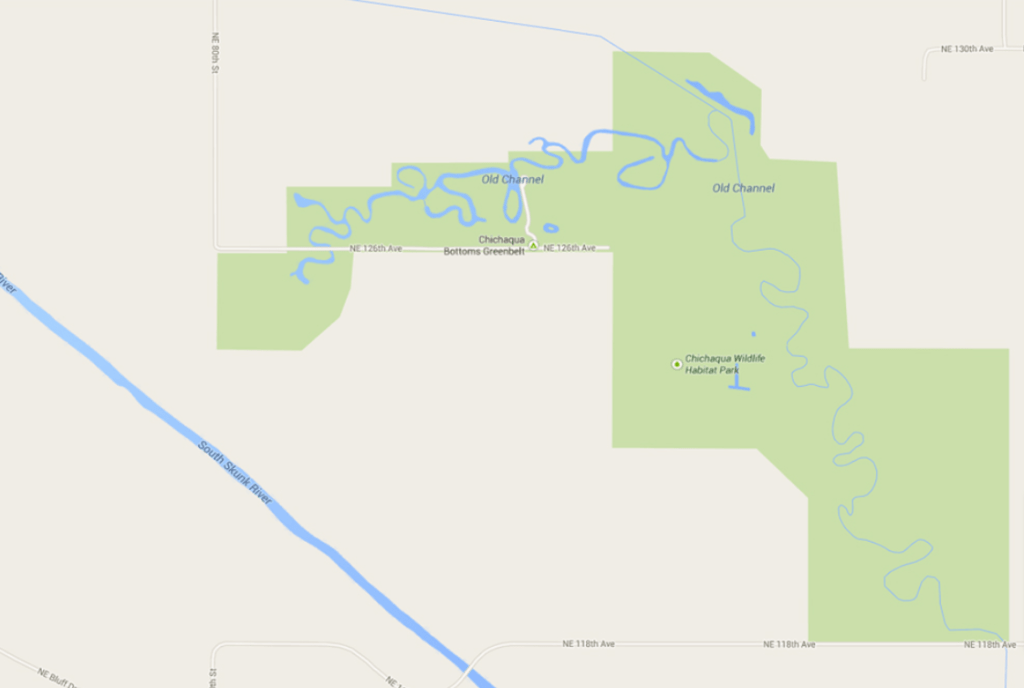
This bike trail is called the Chichaqua Valley Trail. You might assume that’s because it runs through the Chichaqua Valley. Silly rabbit. There is no Chichaqua Valley. There is, however, a 25-mile-long series of oxbows and bottomlands called the Chichaqua Bottoms Greenbelt. The oxbows are the isolated remains of the South Skunk River, which coal companies ‘straightened’ in order to facilitate barges transporting coal from mining towns like Mingo. More ‘progress’.

That straight line is the current channel of the South Skunk River

The Skunk River got its name a couple hundred years before the Mingo arrived in this part of the country. The French voyageurs, exploring and trapping beaver, asked the local Meskwaki tribe what the river was called. They were told the river was Chichaqua. The natives were referring the smell of the wild onions and cabbage that grew along the riverbanks. They’d also used that term to describe skunks. So we can thank the confused French for the Skunk River.

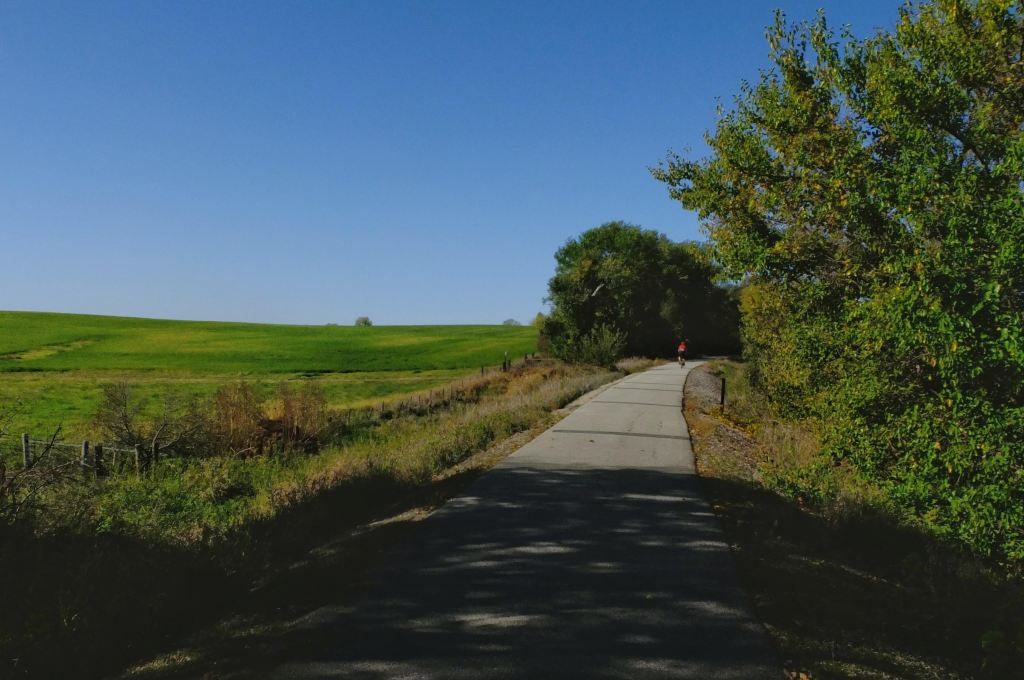
Like so many Iowa bicycle trails, the Chichaqua Trail follows an old railroad line. This was the Wisconsin, Iowa & Nebraska Railroad, originally built in 1885 to haul coal and livestock throughout the Midwest. You can actually gauge your progress along the trail by watching for old railroad mile markers that show the distance to Kansas City. Unlike most rails-to-trails bike paths, which tend to be incredibly straight and incredibly dull, this trail is full of curves and turns. One bicycle trail guide describes it as ‘serpentine,’ which may be a tad too elegant, but isn’t entirely wrong.

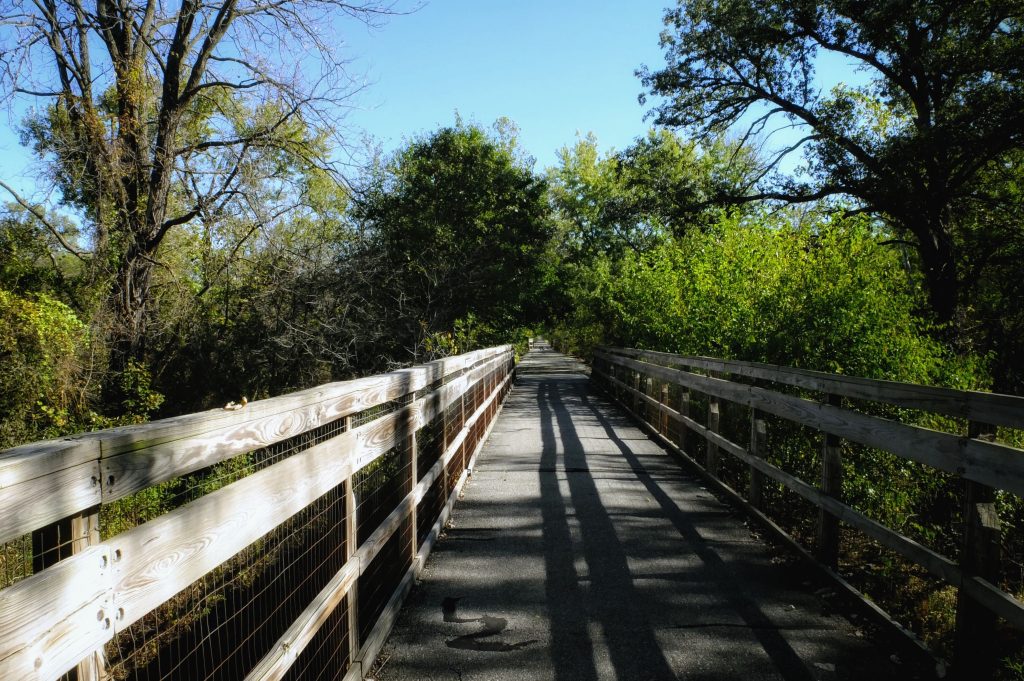
One of the many bridges.

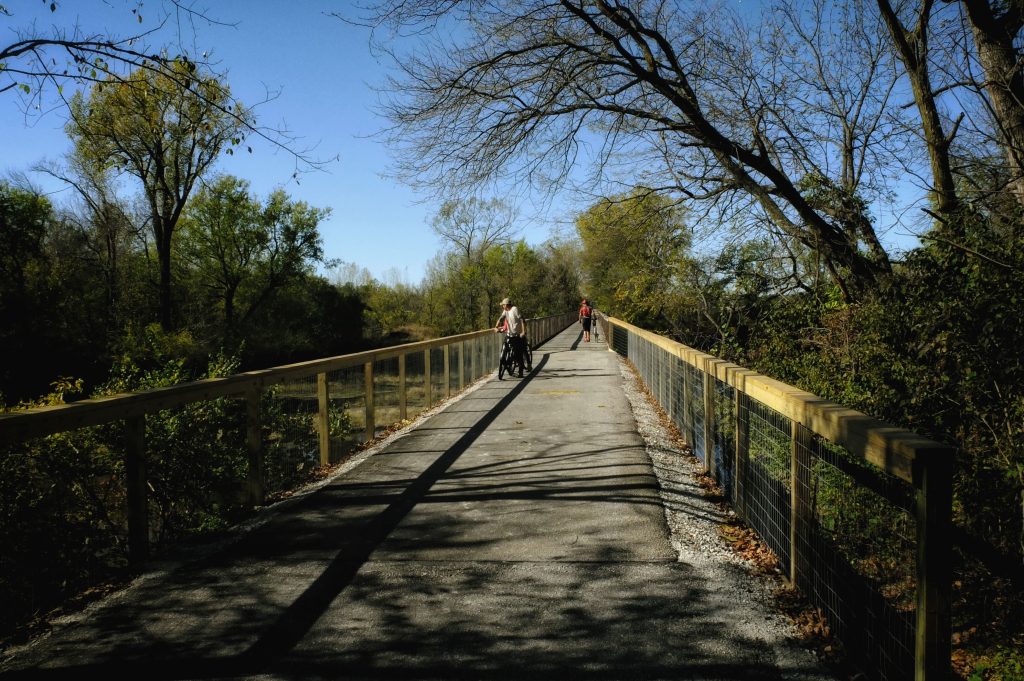
It runs mostly through farmland and woods. It’s a quiet trail. Even on a perfect autumn Sunday afternoon, we saw very few other cyclists. For the most part, all you hear is the wind and the sound of your tires on pavement or rattling over the many wooden bridges. There are a LOT of bridges–some small, some extensive. The trail crosses over creeks, drainage ditches, oxbows, and the South Skunk River. I don’t know how many bridges there are; I forgot to keep count after the first nine.

Another bridge.

We tend to think of bike trails on old railroad lines as being flat–and they generally are. When there are hills, early railroad builders tended to rely on long slow inclines. Really long inclines. There’s a section of the trail that winds uphill for just about four miles. And I mean it winds. You can only see a few hundred feet in front of you, so you have no grasp of just how close–or how far away–you are from the top. It’s not steep, but it’s fucking endless. You start to believe…to hope…that you’ll be able to see the top around the next bend in the trail, And each bend in the trail crushes that hope. You won’t see any photos of that hill, because there was no way I was going to stop.

Bridge over the South Skunk River

After about 15 miles, we reached the town of Bondurant, named for the first white person who settled there (Alexander C. Bondurant–I don’t know if he did anything worthy or important other than being white and deciding he’d gone far enough west and decided to just stop traveling). Eventually the Chicago Great Western Railway Company built a depot there–which has been reproduced as a rest area for cyclists. It’s very nice. Bathrooms, picnic tables, repair station, drinking water. All very pleasant, but Jeff and I made straight for Reclaimed Rails–a bike brew pub just off the trail.

One of the best things about cycling in Iowa is the advent of the bike brew pub. Beer and bikes are a natural pairing. The sugars and salts in beer help you absorb fluids more efficiently than water alone; you’d have to drink a lot more water to get the same hydration effects of beer. No, I’m serious. THIS IS SCIENCE, people. Beer also has almost as many antioxidants as red wine, and that helps your leg muscles recover. And hey, it’s cold and it tastes good.

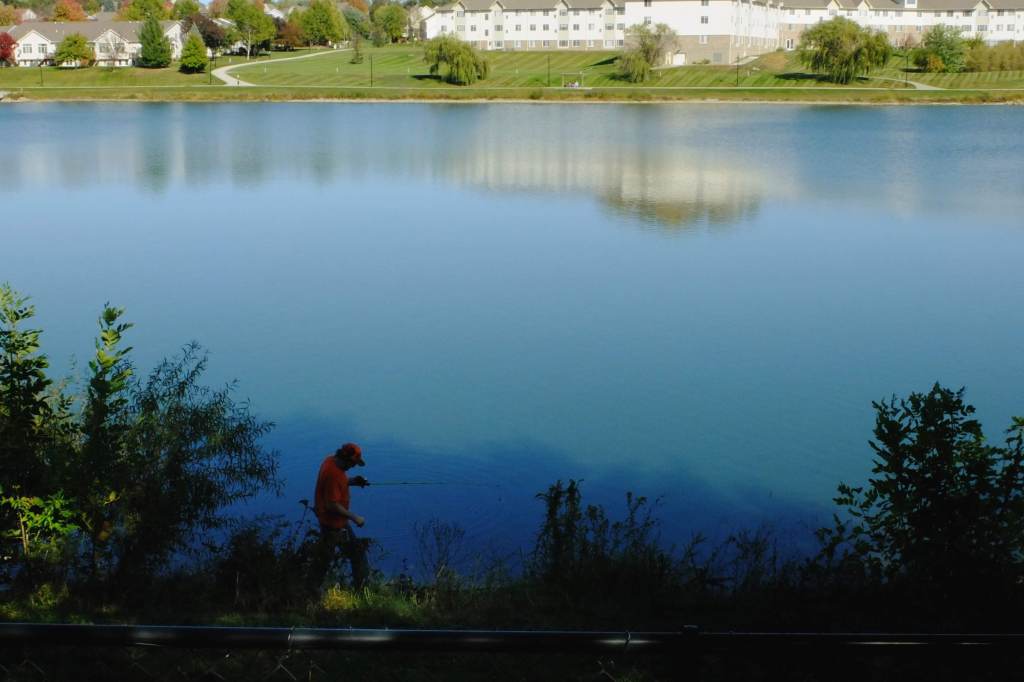
Along the Gay Lea Wilson Trail, a man fishing.

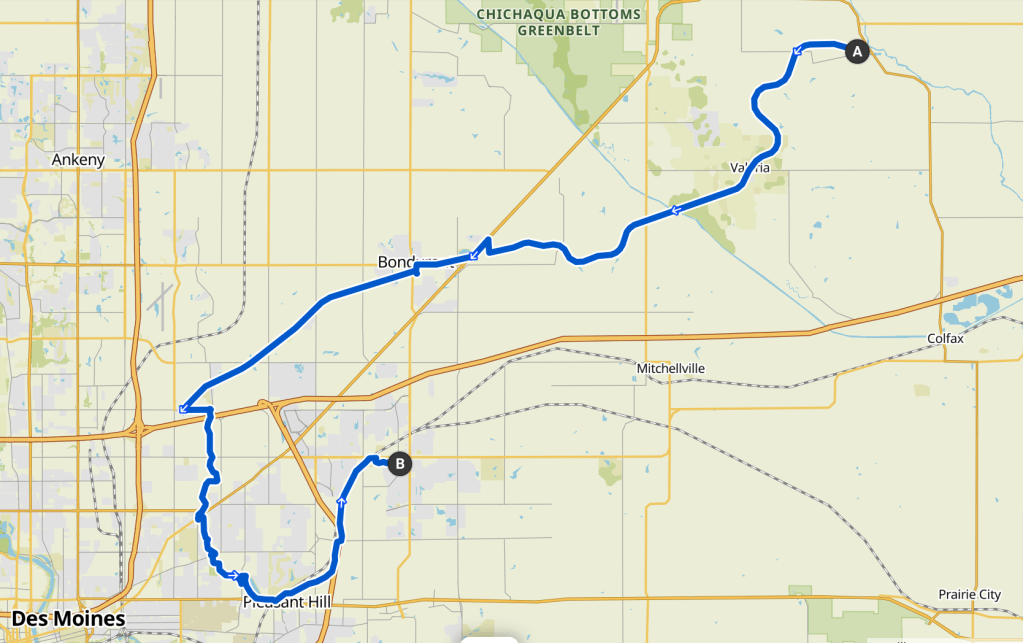
After hydrating and dosing ourselves with antioxidants (mine was a nice malty Märzen), we set off again. After a few miles, we turned off onto the Gay Lea Wilson Trail, named for the advocate who came up with the idea of a series of bike paths and trails through central Iowa. Unlike the rails-to-trails bike paths, which were based on direct routes for transporting goods, the Gay Lea Wilson trail weaves in and out of semi-rural areas and suburbs. It’s designed to transport people, making it easy for folks (and families) to access the trail and travel by bike to places they want to visit. Places like libraries and parks and picnic areas and playgrounds and…well, brew pubs.

Another 15 miles or so took us to our final stop: Brightside Aleworks, a fairly new craft brew pub that has a relaxed vibe closer to a coffee shop than a beer joint. We’d ridden about 33 miles altogether. Aside from the brutal four mile uphill stretch, it was a nice way to spend a day. It was fun. And the beer was cold and welcome (I had a biscuity, slightly sweet Irish red).

That’s the thing about cycling. It’s fun. Sure, it’s good for you. Fresh air, healthy exercise, all that. But mostly it’s fun. That’s why I ride. Bugger exercise; I ride because it makes me happy. Because it’s one of the best ways to see the world you live in. You get to meander along at whatever pace you want (well, fucking hills excepted) and be a part of the landscape, rather than just passing through it in a car.

Dr. K.K. Doty (who doesn’t seem to exist on the internet other than as the author of this quote) wrote: Cyclists see considerably more of this beautiful world than any other class of citizens. A good bicycle, well applied, will cure most ills this flesh is heir to. Most ills. Not all ills. But most. It’s a bicycle, not a miracle machine.

Well, maybe a miracle machine. Small miracles in a big world. It’s enough.

a slightly faster way of walking

I swear, every couple of weeks I come across another article about electric bikes and ‘cheating’. This one was on the Electrek website. Are electric bikes cheating? If you google ‘ebike cheating‘ you’ll get a cascade of results, and every single one debunks the idea that riding an ebike is cheating.

I’ve never quite understood the question. How can riding a bike–any sort of bike–be considered cheating? Cheating at what? Cheating against whom? That question led me to understand my personal approach to cycling is something of an aberration. The fact that the question persists–the fact that the question even exists and that it gets asked so often–is, in my opinion, evidence of a deep problem in the cycling culture of the United States.

I believe the problem evolved from the way cycling has been marketed. In the US, it’s almost always promoted as a ‘fun’ form of exercise. Exercise is basically a form of self-competition. Exercise isn’t supposed to be easy. Push yourself, work hard, work a little harder, sweat a bit more, feel the burn, ignore the pain, keep going, do better than you did the last time, meet or exceed your personal best. Exercise is a constant measuring of yourself now against yourself before. Are you getting better? Are you maintaining? Are you fading?

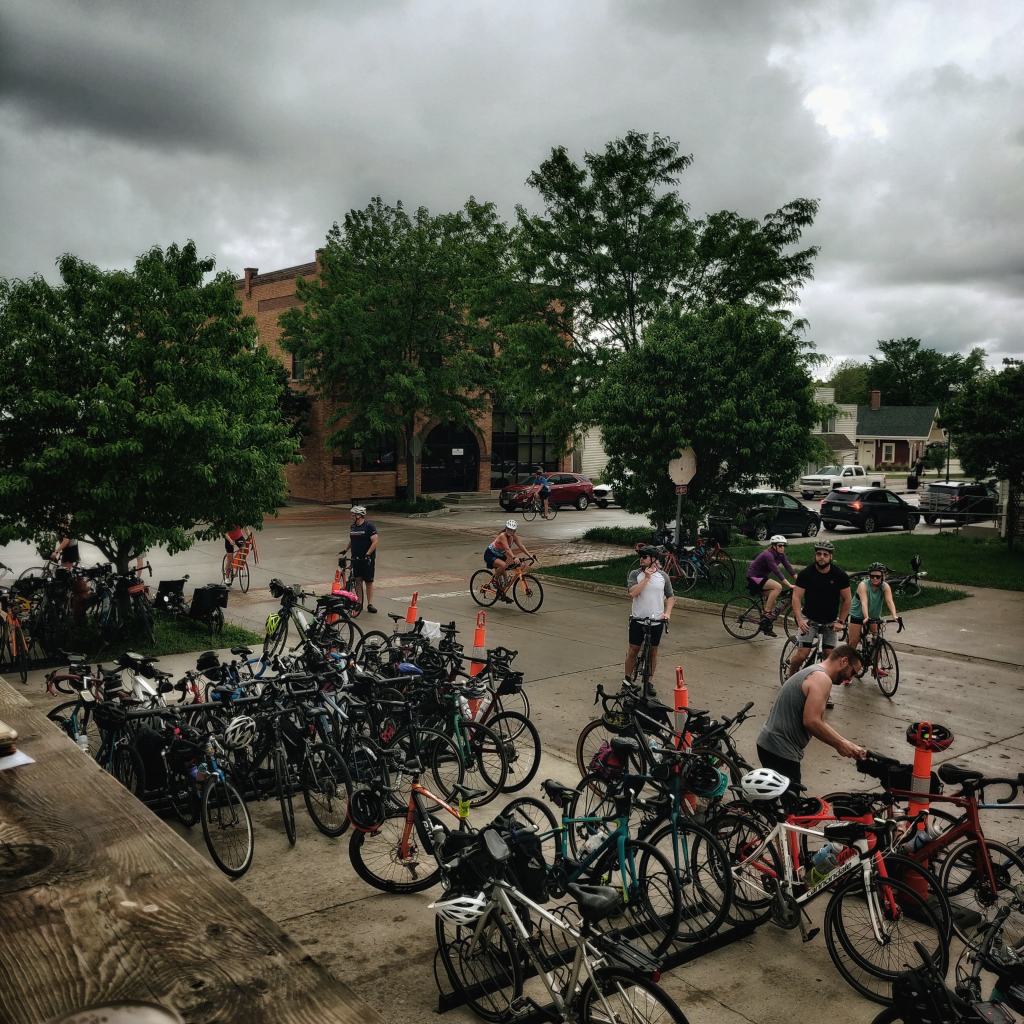
Row upon row of road bikes.

There’s nothing wrong with exercise, of course. It IS actually good for you. But there’s a lot more to cycling than a good workout, and that’s generally ignored when cycling is being marketed or advertised. In the US cycling is occasionally presented as an alternate form of transportation–as a way to commute to work or a way to run short errands. But it’s never marketed as a source of joy or delight or pleasure.

I’ve been cycling most of my life–never for physical fitness, sometimes as a mode of transportation, but always because it makes me happy, because it brings me joy and delight. I didn’t realize that approach to cycling was an aberration until recently. Part of that realization came about because of the ebike-cheating question. But it was driven home this year after joining a few organized bike rides.

Rows of road bikes outside a pub.

I’m basically a solitary cyclist. I like to ride at my own pace, take my own path, stop when I want, go faster or slower as my mood takes me. There’s just SO MUCH to see when you’re on a bike. You lose that independence when you ride in a group. But this year my charming sister (and her equally charming husband) have invited me along on a few organized bike rides–and because she’s my sister and because she’s charming, I’ve gone along.

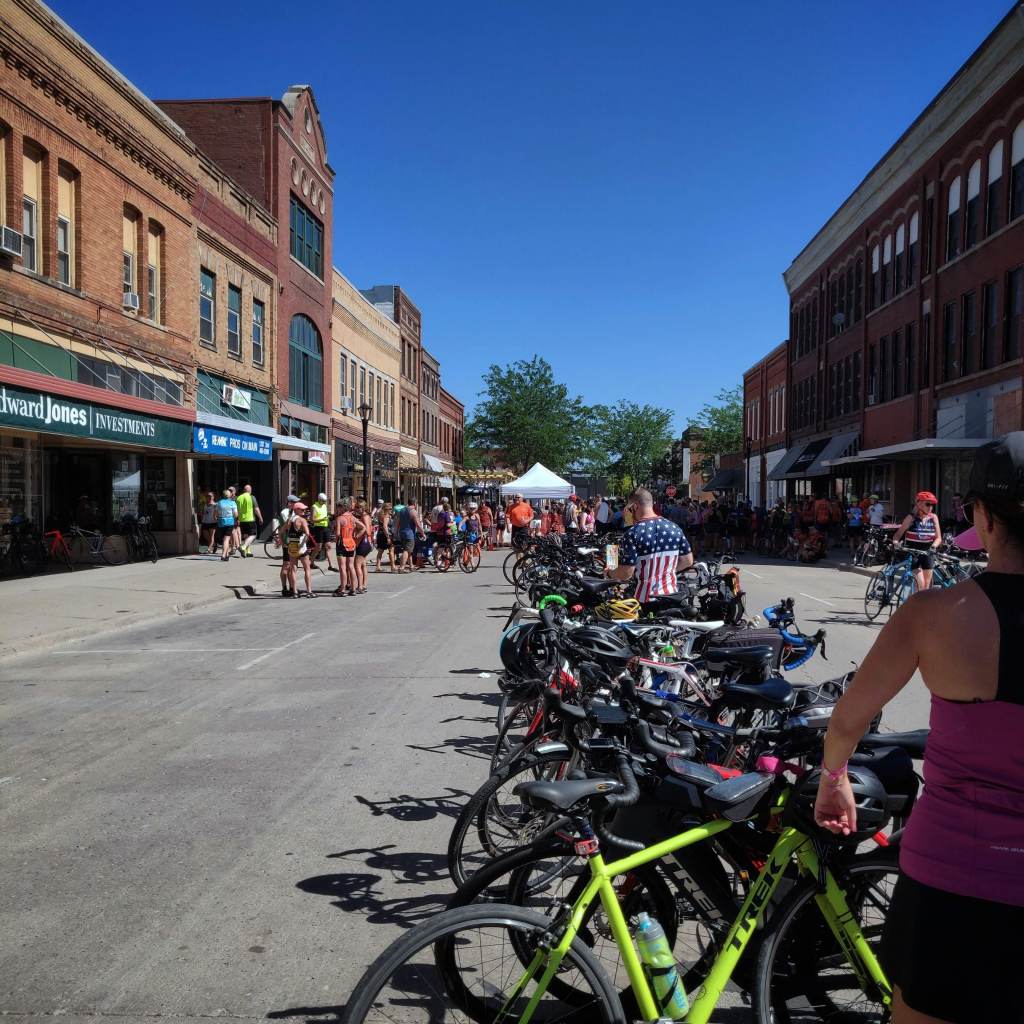
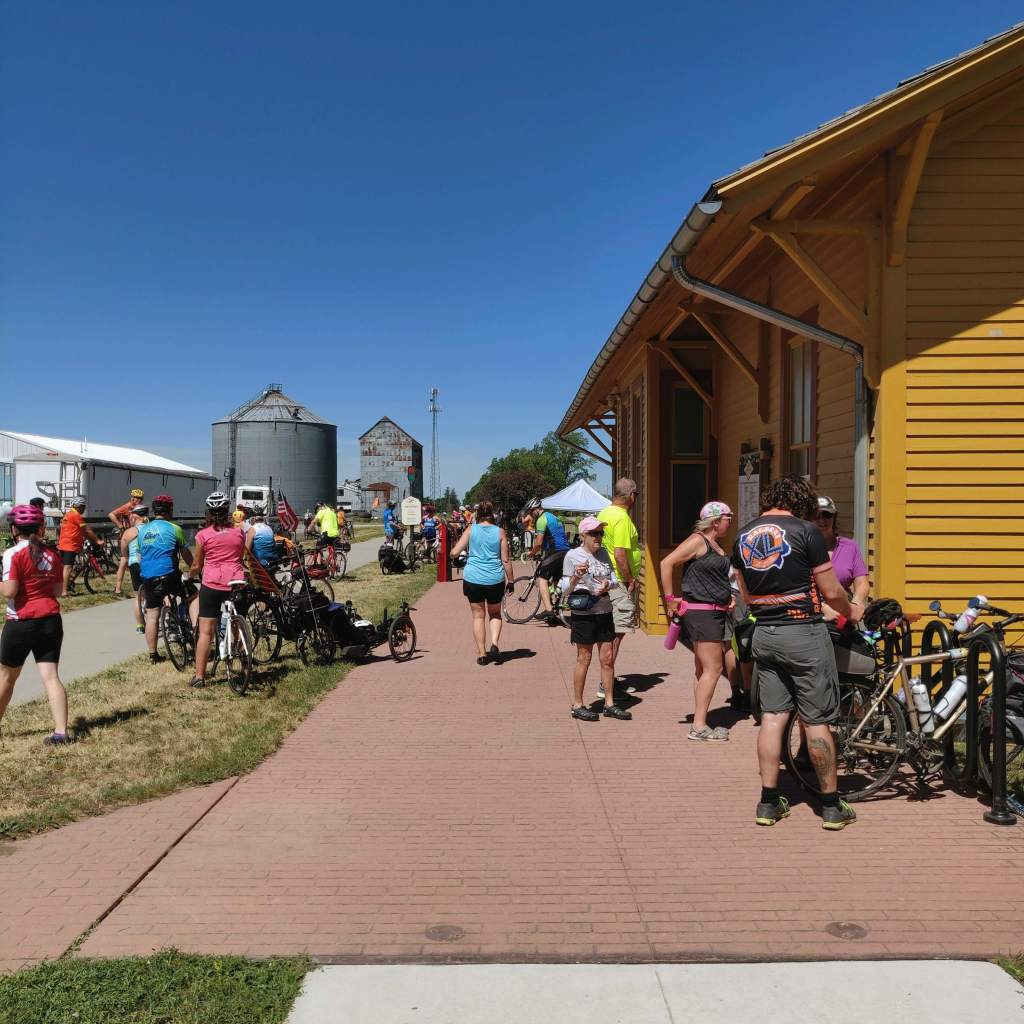
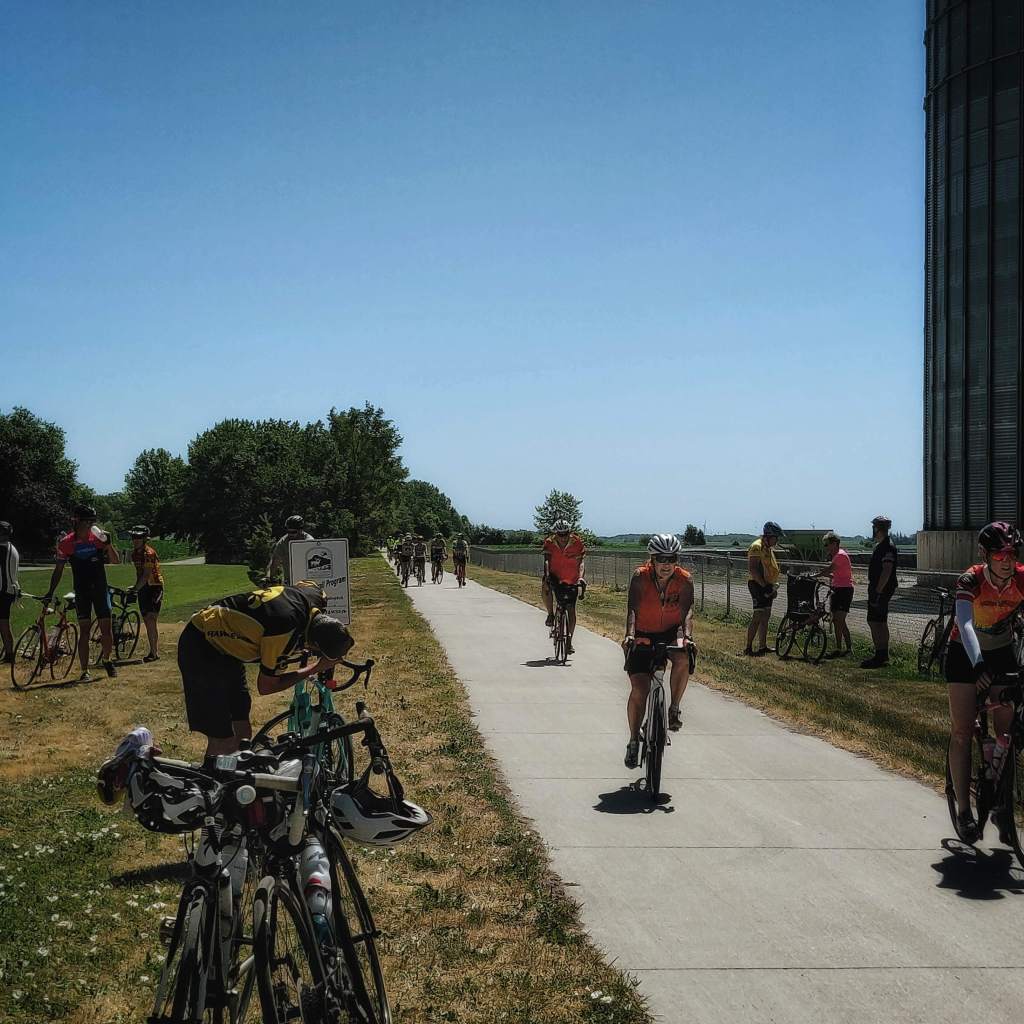
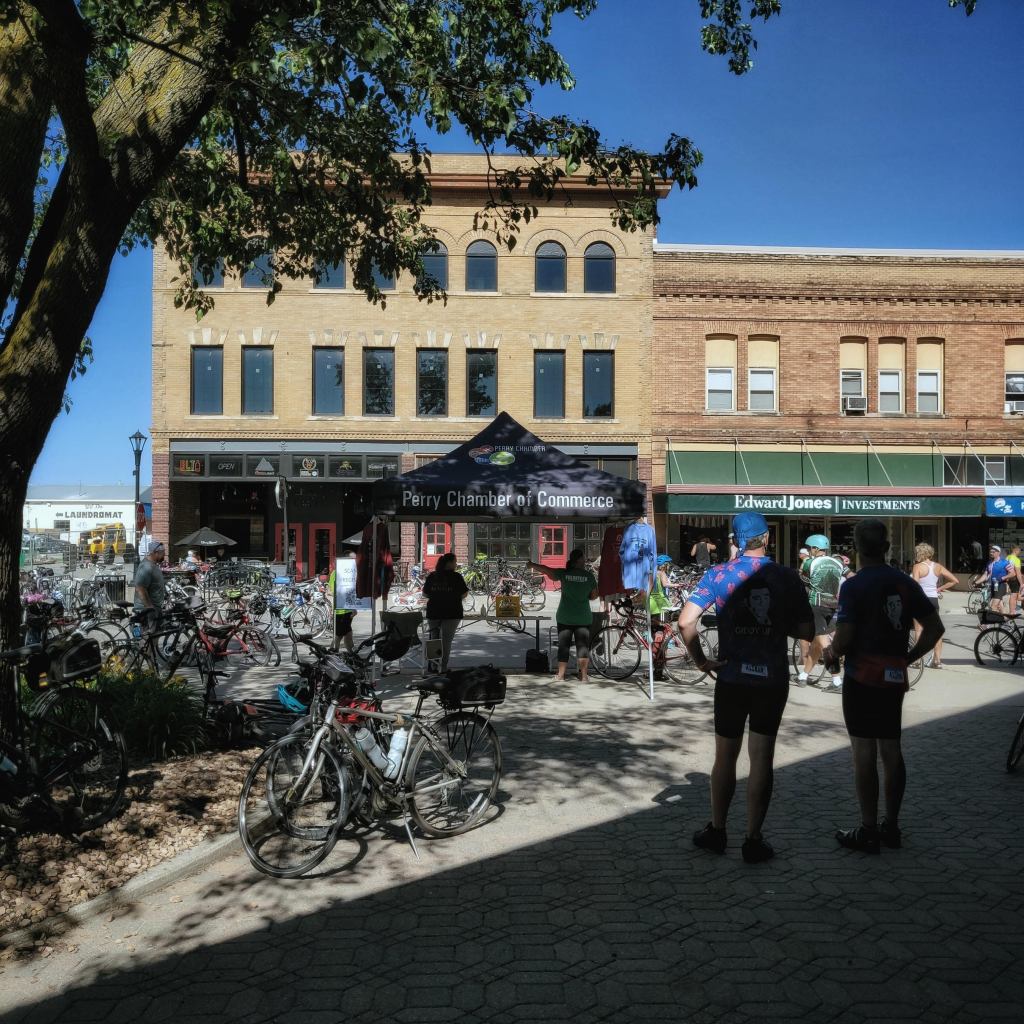
I’ve thoroughly enjoyed the rides, in part because they always start at some bike pub and end at some bike pub, often with a couple of stops at bike pubs along the way. Bikes and beer have a long, happy history together. But because almost all of my professional training has taught me to pay attention to social behavior, I noticed this very obvious fact: aside from me on my ebike, almost everybody rode a road bike. There’d be an occasional mountain bike, a couple of fat tire bikes, maybe a recumbent bike, and one or two other ebikes–but the the vast majority of cyclists were on road bikes.

Why?

Dozens of road bikes.

A road bike is designed to be fast. Essentially, they’re designed for racing, even if racing isn’t the cyclist’s intent. Because of that, road bikes are the least versatile type of bike, the most finicky, the least forgiving, the most expensive, the least comfortable. But they’re fast. They’re built to be ridden almost exclusively on hard surfaces. They have thin, high pressure tires to minimize surface friction on the road, and that makes them faster. They lack any sort of suspension because the flex of suspension reduces the efficiency of the pedaling, and that makes them faster. The riding position is aerodynamic (which makes them faster), but it’s also unnatural and puts a lot of stress on joints and nerves.

Because road bikes are fast, and because their design makes them more vulnerable to road conditions, and because of the unnatural riding position, cyclists on road bikes need to focus their attention on the road in front of them. A lapse in attention can result in a crash. The result is folks on road bikes aren’t devoting much attention to the general environment they’re riding through. These cyclists are mostly focused on the road just a few yards in front of them.

Road bikes outside a former train depot.

Why, I asked myself, were all these people riding road bikes? Because in the US, a road bike is the mark of a ‘serious’ cyclist. Because if you want a good workout–if your primary goal for cycling is exercise–you want a machine designed for competition, even if you’re only competing with yourself.

An electric bike can make cycling easier. This is where the ‘cheating’ notion comes in. Electric bikes can be fast–but with less physical effort. They can be fast with seatpost and tire suspension, which makes them more comfortable to ride. They can be fast with the rider in a more natural and comfortable riding position, with less neck and joint strain. They can be fast while allowing the rider to look around and enjoy the scenery.

And that’s ‘cheating’. Cyclists on electric bikes are cheating because they can go fast without having to suffer as much as regular bike riders. They’re cheating because they haven’t ‘earned’ the speed. They’re cheating ONLY IF you accept the notion that the primary purpose of a bike is sport or exercise or physical fitness. They’re cheating ONLY IF you buy into the way cycling is marketed.

Road bikes.

At the halfway point of a recent organized ride, while having a beer, I discovered that my sister and her husband simply didn’t see most of the cool stuff we rode by. A group of turkeys along the bike path, the dappled horses watching us ride by, a ring-necked pheasant that flew across the bike path about ten feet high directly in front of them, the turtle on a log in a pond, the fat groundhog. They didn’t see any of that, and it made me sort of sad.

Earlier I mentioned googling ‘ebike cheating’ and getting a flood of articles debunking the notion of cheating. Each of those articles base their ‘not cheating’ conclusion on the fact that ebike riders are still getting a good workout. They’ll tell you how ebikes still require physical effort–though the rider has more control over how much effort is expended. They’ll tell you ebike riders tend to ride more often than riders on regular bikes, and they tend to ride further–all of which increases the ebike rider’s fitness.

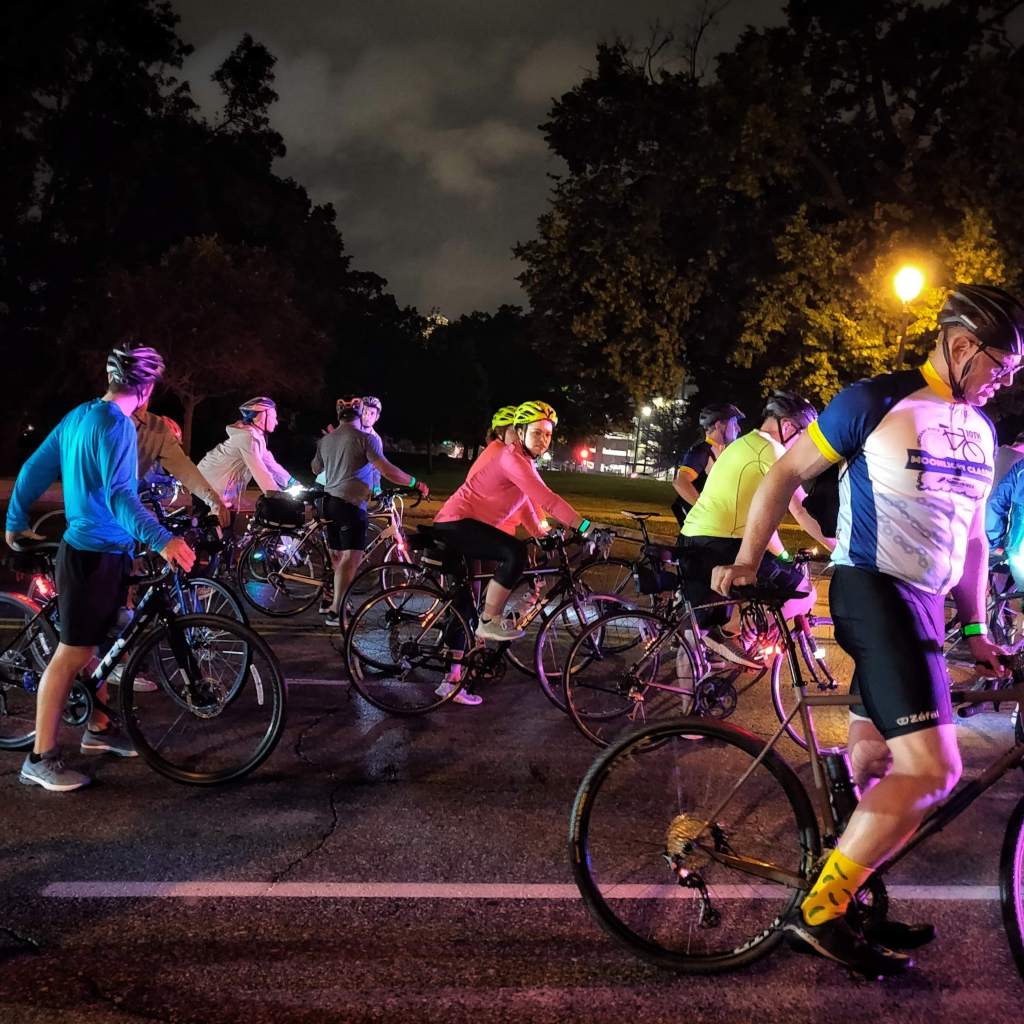
Road bikes on the Moonlight Classic.

Do you see the problem there? All of those articles accept the marketing premise–that the primary reason for cycling is fitness and exercise–as a given. None of them consider that there are other reasons for cycling. None of them consider that riding an ebike makes cycling more pleasurable, more joyous.

The problem is NOT road bikes. Road bikes are incredibly efficient machines. I’ve owned road bikes (though mine were all geared for touring rather than racing) and I’ve ridden them hundreds of miles. The problem (and I admit, this may only be a problem from my personal perspective) is that the marketing emphasis on physical fitness in cycling has turned it into a narrow form of self-competition that detaches riders from a richer experience. There’s nothing wrong with riding for exercise, but neither is there anything wrong with riding because it’s just fucking fun. I have never had as much simple joy and delight in riding a bike as I have this past year. Never.

For a lot of the riders in these organized cycling events, a beer at the end (or the halfway point) is seen as a reward–a sort of liquid recompense for the labor of cycling. I’m of the opinion that a beer is–or should be–just another pleasant facet of an already pleasant experience. It’s as integral to the experience as seeing a turtle on a log. You don’t have to have a beer or see a turtle on a log to enjoy a bike ride, but both enhance the ride in the same way.

I once read an article about the Dutch approach to cycling. It described cycling as a slightly faster way of walking. That fits perfectly with the way I ride. It’s just a pleasant way of getting around, quickly and easily, arriving at your destination (if you have one) without too much fuss, without being weary or sweaty (unless you want to be), and allowing you to enjoy and appreciate the world around you as you go.

beer & bikes, bikes & beer

A couple of days ago I posted the following photograph on social media. The photo was taken at the halfway point of my bike ride. In the description I casually mentioned there was a bicycle brew pub just out of the frame.

Bondurant, IA — cyclist stop.

That comment sparked a question:

“A bicycle brew pub? Do tell. Is this a punctuation thing? Or are there really bicycle brew pubs? ‘Cause I’d be down with that!”

I was sort of surprised by the question, because of course bicycle brew pubs exist. I mean, bikes exist, and pubs exist, and a number of those pubs exist along bicycle trails, and many of those pubs either brew their own beers or at least serve locally brewed beers. Bicycle brew pubs are a natural pairing. I guess I assumed there are bicycle brew pubs scattered along bike trails all over the US. I assumed–and still assume–they’re scattered along bike paths all across the entire globe.

Down the former railroad track…

In fact, back in 2013 I wrote about the creation of the shandy–a mixture of beer and lemon-flavored soda tossed together in 1922 by a desperate former railway worker who ran a bicycle pub/inn in Deisenhofen, Germany. In some places, this style of beer is called a Kugler after Franz Xaver Kugler, the innkeeper who ran short of beer and decided to stretch his inventory by adding lemonade to it. Another name for this type of beer concoction is Radler, the German term for ‘cyclist’. Beer and bikes go together like spaghetti and meatballs, like Scooby Doo and Shaggy, like Netflix and chill. Sort of.

…past the marsh…

Herr Kugler may have had a railroad career before serving beer to bicyclists, but he had nothing (to my knowledge) to do with the Rails to Trails movement in the US. Still, I think the logic of converting unused railroad lines into cycling trails is undeniable. Railroad lines tend to be fairly straight and largely flat, which makes for easy cycling and easy conversion. Yes, they’re also prone to long gradual inclines that aren’t particularly noticeable to the eye, but make their presence known to a cyclist’s knees and thighs, but that seems a small sacrifice to make. If there’s a problem with rails to trails bike paths, it’s that they often put railroad lines on raised banks to protect them from flooding. That means IF you happen to have a mishap and go off the trail, you may find yourself (and your bike) tumbling down a steep 15-30 feet incline.

…along groundhog central…

One of the great things about former railroad lines is that they pass through the countryside and through less developed areas–areas where train noise wouldn’t disrupt the lives (and traffic) of city/townsfolk. That means you get to ride through farmland and semi-industrial areas, and that means you get to see a lot of animals. Not just livestock like cattle and sheep, but wildlife that’s adapted their habitats to modern human life. I’ve seen everything from foxes to turkeys to snakes on my rides. One of my favorite parts of the path I took a couple of days ago is a stretch of about a mile that’s heavily populated with groundhogs. Big, fat, lazy bastards who are accustomed to bicycles and in no particular hurry to get out of your way–unless you stop to take a photo. Then the shifty buggers retreat.

…through the Valley of Warehouses…

Groundhog Central is in the middle of what I call the Valley of Warehouses–an area between the satellite community where I live and Des Moines. There are dozens of massive brutalist structures that act as distribution centers for the mass transit of goods. The newest of these mega-warehouses are being built in what used to be farmland. I think the structure in the photo above is a new distribution center being built for Amazon, the devil-king of interstate commerce. The best thing about these facilities–possibly the only good thing–is that bike paths are incorporated into their infrastructure design.

…over the bridge…

Another advantage of rails-to-trails paths is that railroads built LOTS of small–and sometimes not-so-small–bridges over the multitude of rivers, creeks, and brooks that would otherwise make cycling through the Midwest awkward. They needed these bridges in out of the way areas because many small railroad lines were created to carry coal from coal mines to the cities and towns. Coal was so often discovered in generally inconvenient locations–troublesome for railroads and coal producers, but in the end it’s worked out well for bicyclists.

…and eventually into a small town with a bicycle brew pub.

That brings me back to bicycle brew pubs. We have a lot of them. Hell, we have three in my small community. The Iowa Beer organization released a map in 2019 showing the location of 85 bike trail beer pubs. It’s a tad out of date, of course. Although the pandemic was hard on most taverns and restaurants, it had the effect of making bicycles increasingly popular. If you have a bicycle, you often want to ride to a destination; small town bicycle brew pubs seem to have weathered the pandemic fairly well. I suspect there may be a few more bike brew pubs now than before the pandemic.

Iowa Beer Trail breweries in 2019

The path I took yesterday follows most of the route for the upcoming Beer 30 ride–a 30-mile round-trip cycling event that starts at the Uptown Garage Brewing Company then follows the trail to the small town of Bondurant, Iowa and the Reclaimed Rails Brewing Company, which is located just out of the frame of the photograph at the top of this post. The Beer 30 ride then returns to the Uptown Garage. Dozens of organized beer trail events like this take place in Iowa. Some are annual events, some are weekly.

I’ve no idea how many riders will be attending the Beer 30. At least a hundred. Maybe two or three times that number. I’ll be one of them.