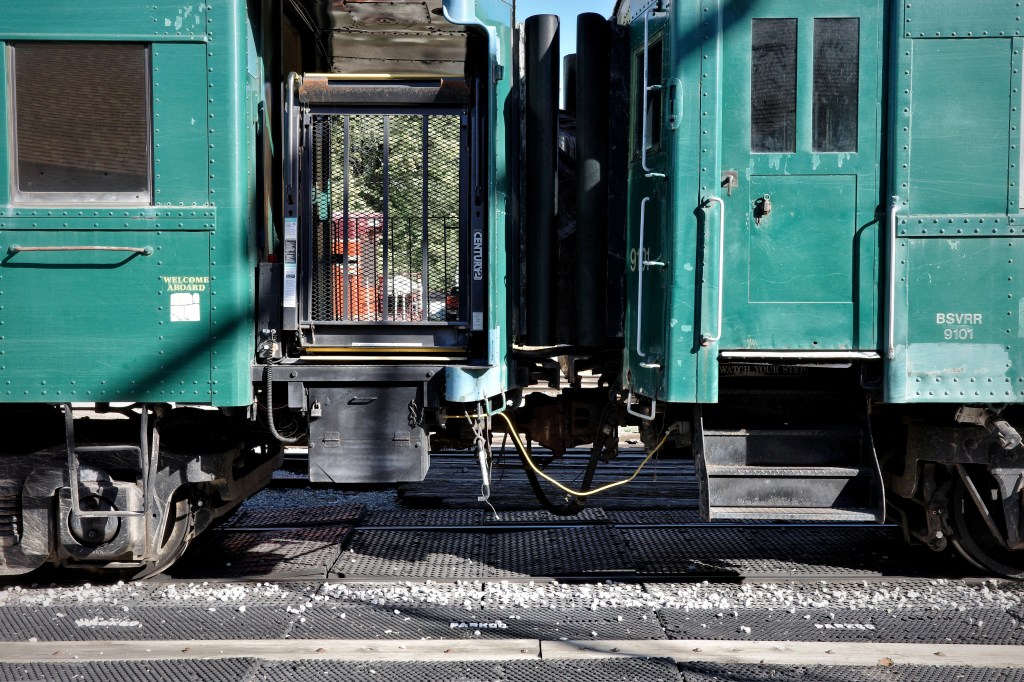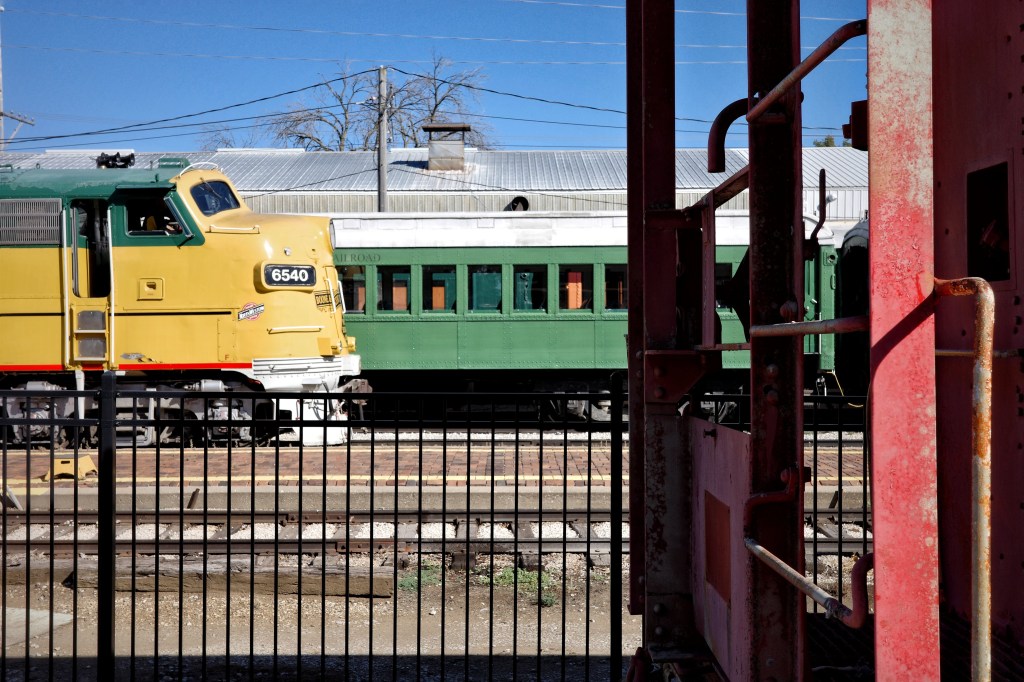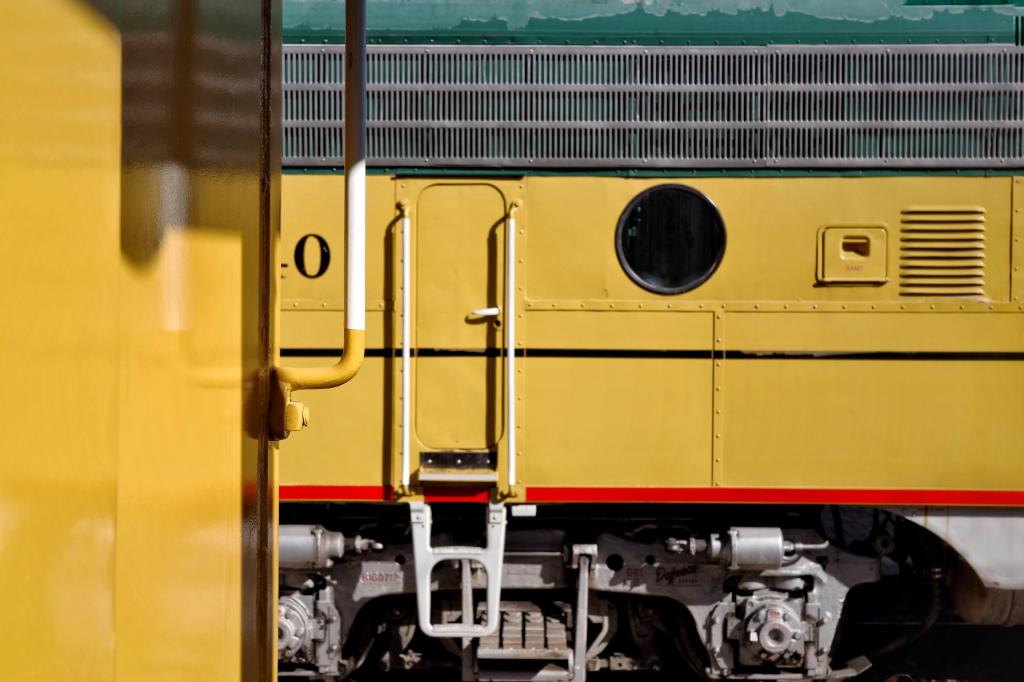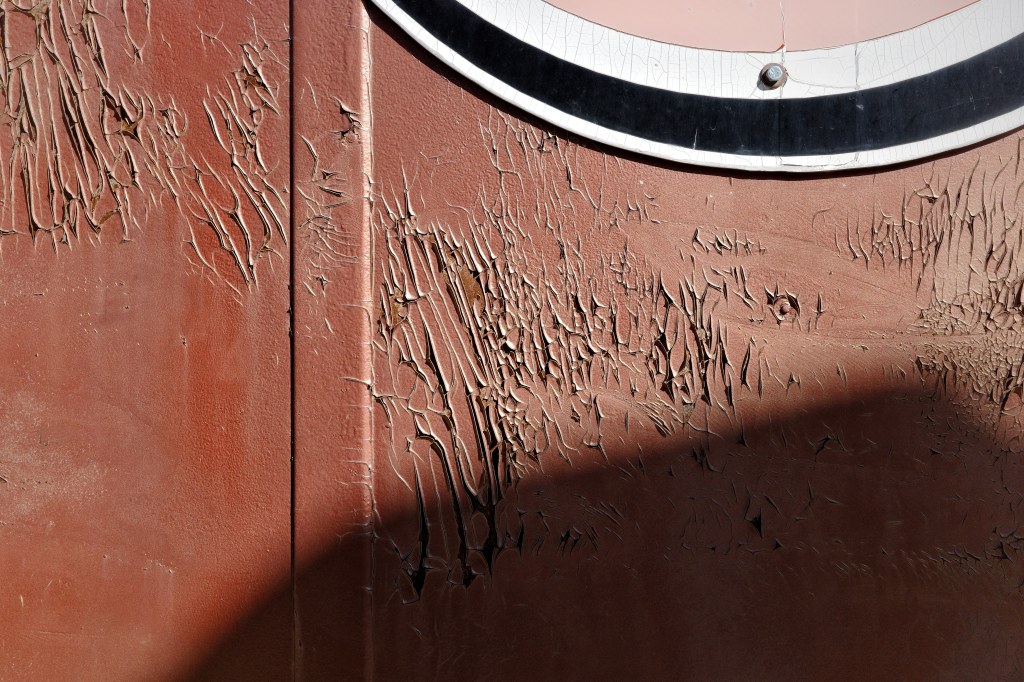
weird is good

Strangest thing. I’ve been shooting photos since about the Triassic period and in all that time I very rarely shot photos in portrait orientation. Well, I mean, except when I was shooting actual portraits, of course. Landscape orientation has always seemed more natural and organic to me.

But since I’ve been using this Ricoh GR3X, I find myself shooting more shots in portrait style. I really can’t explain it. Is it because the camera is so small and light that I’m more willing to turn it on its side? That doesn’t make much sense to me, because I tend to pre-visualize almost all of my shots. I generally ‘see’ them before I shoot them. So why would the camera matter? Maybe it’s the fixed lens? I don’t know.

Or maybe I’m just ‘seeing’ more portrait-oriented shots? Maybe it’s just a coincidence that I’ve started doing that shortly after picking up a new camera? That seems improbable too. Doesn’t it?

Another thing. I’m not entirely sure this is true, but it seems like when I shoot something in portrait orientation, I pay closer attention to the edges of the frame. I like to think I do that with most shots, but I find myself actively thinking about the edges when I’m shooting in portrait. Maybe that’s just because I’m not used to it? Maybe I do it so automatically in landscape orientation that I just don’t notice it as much? That seems possible.

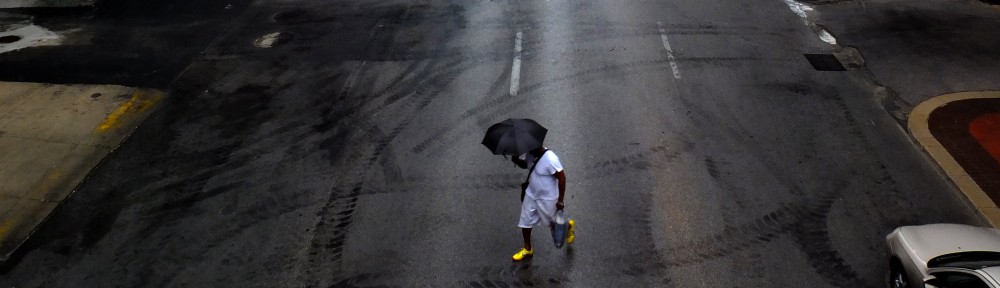
Take this photo, for example. I wanted that tiny bit of chimney in the upper right. And that sliver of the window frame on the left side. And along the bottom, that white line of the parking strip and the blob of shadow from a parked car. I wanted those things, but I didn’t want very much of them. Which, because the GR3 has a fixed lens, meant stepping forward just an inch or two, then stepping back half an inch. It meant doing the goddamn hokey-pokey in the middle of the street until I had it just right.

When I got home and downloaded the photos, I noticed that of the 24 photos I shot during that brief photo-walk, 7 of them were in portrait orientation. Seven. Almost a third of the photos. I’ve never in my life done anything like that.

It doesn’t bother me. It’s just a bit of a shock. Has this happened to anybody else? Have you suddenly found yourself shooting in a different orientation? Or have I maybe had a stroke and just failed to notice it? Maybe it’s a tumor. I don’t know. All I know is that it’s weird.

Happily, I believe weird is good.

i still talk to strangers

I wrote a piece back in April of 2023 about my habit of talking to strangers. Here’s a somewhat concise summary of the point of that post.

I like talking to strangers. I like meeting new people and learning something about them. Granted, most of my conversations with strangers are casually superficial, so it’s not like I’m learning anything important or meaningful about them or their lives. But the simple fact of meeting and having an idle conversation with random strangers tells me something about humanity in general.

And this is what I’ve learned: most people are pretty much okay.

That’s still true. Most people really are pretty much okay. A few days ago I found myself in Perry, Iowa, a small town of about 8,000 people. As my companion and I walked down the street, we saw a guy get out of a pickup truck, carrying a couple of small jars. One of which looked like homemade pickles.

I kind of leaned forward and grinned at the jar of pickles…and he stopped. He was delivering the pickles and some homemade cherry jelly to a couple of friends in a nearby shop. I asked if he sold his homemade goods, and he said, “No, I just give them to friends.” He asked, in a very kindly but curious say, what we were doing in Perry. I told him we were just walking around, looking at the town and its architecture, shooting photos.

He started talking about the town—how it had changed over the years, how it had fallen on hard times, and he started to get a bit emotional. I said something vague about how it was clear that he loved his town, and that sort of love was a wonderful thing. Then he left to deliver his goods.

We walked on. I stopped to take a few photos. And then the guy came trotting up to us. The friend who was to get the cherry jelly wasn’t in the shop, so he thought we might like it. This stranger, just because we’d chatted with him for a bit, wanted to share his jelly with us.

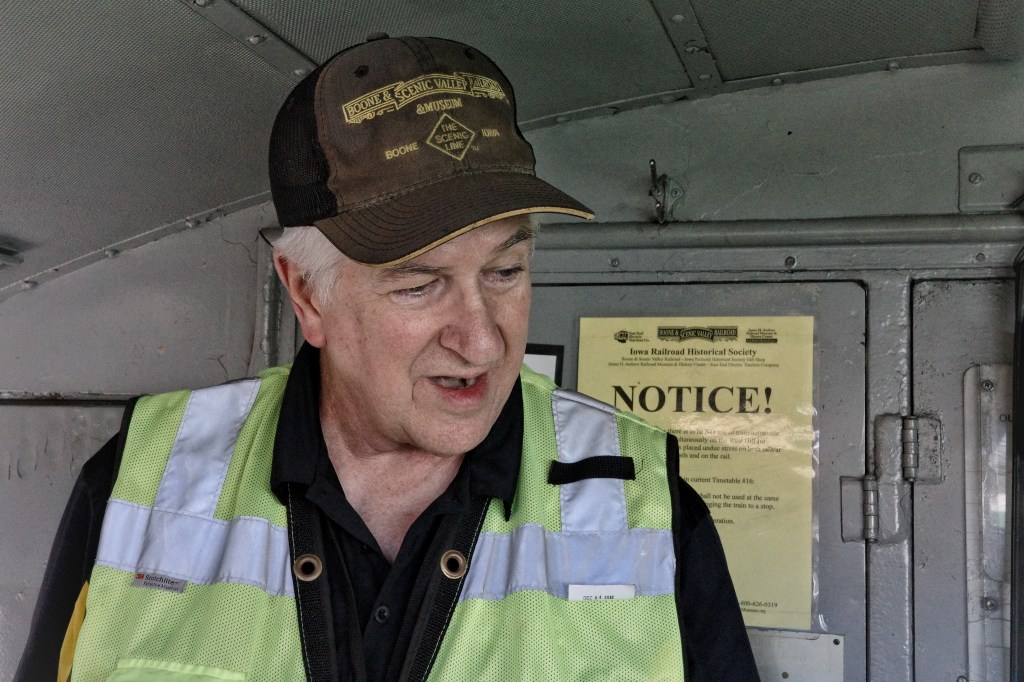
Randy Kennedy and a jar of cherry jelly.

Randy Kennedy. He’d lived in Perry most of his life, and he walked with us down the street, giving us a history of almost every building and the people/families who lived/worked in them. The old shoe store owned by Greek immigrants, whose son was a hero in the Second World War. The French woman who ran a small diner/sandwich shop, and the various sandwiches she made, and how he and his friends would tap on a window and she’d sell them sandwiches through the window. The florist whose shop always smelled so nice. The building where the local newspaper had been printed and how he and his brother had been paperboys and they’d gather at “that door right there” and collect their papers, and how he was sometimes late in getting his deliveries made because he’d stop and get a slice of pie at another shop. He told us about two taverns with doors on opposite sides of an alley, one for hippies and one for farm folks, and how they’d drink together and argue politics in the 1970s.

As we walked and talked, other locals would drive by or ride by on bikes, and many of them would call out to Randy, and he’d wave back. He walked with us for maybe thirty minutes, telling us stories about how wonderful the town was, and how it was failing now, and how MAGA had created deep rifts in the community. He talked about the way the town felt increasingly divided, and had become less tolerant. He talked about the local pork producing plant that closed six months earlier, putting 800 people out of work. Eight hundred, out of a population of eight thousand.

He didn’t mention the school shooting that happened in January, leaving an 11-year-old boy and the school’s principal dead, and seven others wounded. Some things were apparently still too raw to talk about. But most of the shops—even the ones that were closed and empty—kept ‘Perry Strong’ posters in their windows, maybe claiming more resilience than the town actually has. Maybe hoping resilience would hold the town up long enough for some good news.

This guy loved his small town and was proud of what it had been and mourning what it had become. He was pessimistic about the future, but desperately hoped he was wrong. His love for the town was heartbreaking. He was sad, but said he was okay. That’s when I asked if I could take his photograph, holding the jelly he’d give us.

Like I said in my earlier post, most people are pretty much okay. In a lot of ways, being okay can be seen as a victory. Randy Kennedy may look a wee bit sad in this photo; he has good reason to be. And yet he’s basically okay. The proof of that is that he chased a couple of strangers down the street just to give us some cherry jelly that he’d made himself.

I talk to strangers. I will always talk to strangers. And this morning, I had cherry jelly on my toast.

thoughts on wonder woman

There’s been a fun and interesting ‘challenge’ on Bluesky this month, revolving around movies. Each day there’s a prompt; something like ‘movie with the greatest opening scene’ or ‘best book-to-movie adaptation’ or ‘movie you love that everybody hates.’ Some folks just respond with a title of the movie and a still photo, but others offer thoughts and explanations about why they chose that particular movie. The whole thing has been entertaining.

Yesterday’s challenge was ‘a good movie in a genre you dislike.’ I generally dislike and avoid superhero movies and movies based on comic franchises. The protagonists almost always have a ‘origin story’ explaining how/why they became superheroes. This usually involves either a traumatic incident that shaped their future (parents are murdered, planet explodes, etc.) or they get caught up in some scientific or mystic mishap that somehow imbues them with superpowers. I’m actually okay with that. The problem is these superheroes tend to be rather incestuous because they share a common comic franchise, which provides the characters with arcane, massively inter-related, overly-complicated backstories and histories that only fans appreciate. The resolutions of these movies depend way too much on epic battle scenes between super-characters. I don’t mind that the outcome of those battles is predictable. I DO mind that as battle scenes go, they’re generally dull—explosions take precedence over acting. And one last thing; in superhero movies ordinary people (and the cities they live in) are usually just props and backdrops; their destruction is only used as a metric to demonstrate how important the superhero is.

None of that applied to the movie I chose: the 2017 film Wonder Woman, starring Gal Gadot as Diana. She didn’t have some sort of complex, traumatic past that caused her to take up superheroing as a career or hobby. She didn’t experience some scientific or mystical event that gave her superpowers. Her parents weren’t murdered in front of her, her planet wasn’t destroyed, she wasn’t bitten by a radioactive spider, she’s not avenging anything in particular. In most ways, she’s not really a superhero. She was born an Amazon and trained to be a warrior. The training included a philosophy that the point of being a warrior was to fight for folks who can’t fight for themselves, to fight against injustice. That’s basically it, it’s just that simple. There’s a purity and innocence to her motives. She’s doing what she was born and raised to do. She’s not there to fight super-villains; she’s there to punch Nazis.

In the movie, that eventually means fighting in World War Two. There have been other movies and television shows in which a woman leads men into battle. In every other case I can think of, that’s depicted as a woman doing something transgressive, doing something women aren’t supposed to do. In other movies, it’s usually explained as an extension of some maternal instinct. They’re momma lions fighting to protect their families and the families of their people. That’s all very commendable, but it’s also very traditional.

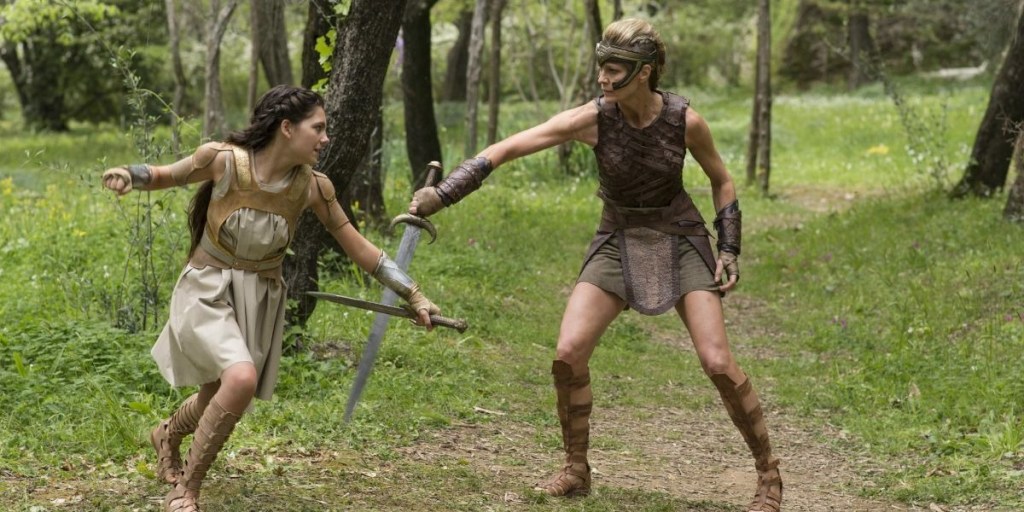
Again, that’s not Diana. She’s a warrior. Her motive for leading others into battle isn’t just to protect others; it’s to fight injustice. It’s a subtle but important distinction. And it works because there’s an amazing training sequence at the beginning of the film. The training involved warriors being gracefully lethal, but the gracefulness was an integral aspect of the lethality. They were being graceful because it was pretty; they were being lethal with an economy of motion.

Diana, training to be an Amazon warrior

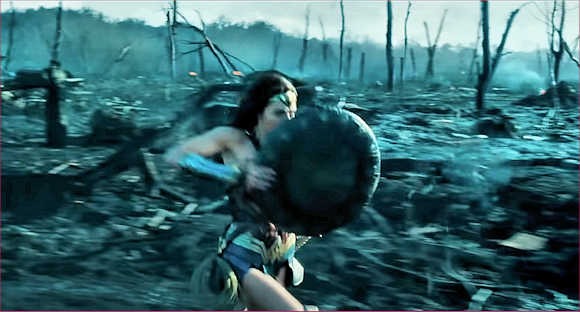
When a squad of Nazis landed on the island, the Amazons attacked. It wasn’t women against men; it was warriors against soldiers. There was a savage beauty in that attack, not because the Amazons were beautiful but because they were well-trained and graceful. Later in the movie, Diana leads an assault against an entrenched Nazi army. The physicality of the training scene made the assault on the trenches work. All that jumping and twisting and swinging in the beautiful setting of the island was translated onto the bleak horror of No Man’s Land. Again, the fact that Diana was a woman wasn’t even an issue; there was a palpable sense that THIS was what she’d been training for.

One other thing. I very much liked the way the writers/director dealt with Gal Gadot’s appearance. They acknowledged a few times that she’s physically beautiful—then just moved on, because that was the least interesting aspect of the character. This was smart, in my opinion, because the director and writers knew they HAD to address beauty in order to get it out of the way. They did the same thing with her outfit (and c’mon, it’s a ridiculous outfit for anybody to wear in modern combat). They provided both practical and symbolic reasons for Diana to dress the way she did.

Diana becoming Wonder Woman

Earlier in the film, the characters spent some time in London. We saw how Diana the warrior being confined by custom to wearing restrictive clothing, being confined to silence by patriarchal convention. There was a momentary respite from that in a scene in which Diana kicks ass in the alley fight. But it’s not until she’s facing Nazis in trenches that we get to see her become Wonder Woman. She shrugs off the cloak she’s been wearing over her outfit, and it’s like she’s also shrugging off all those tiresome patriarchal conventions. When she climbs over the top of the trench, it’s a liberating moment, for the audience as well as the character.

But after that battle, the movie became disappointing. One of the Nazis is revealed to be Ares, the god of war…and what had been a smart, funny film became silly and stupid. It became another dull superhero versus super-villain flick. Gal Gadot was largely replaced with CGI, and they CGI’d the life and heart out of the character. We had the usual super-villain speech-making, the usual massively catastrophic damage to structures and regular people, the usual explosions and fireballs, and all the personality of the actors disappeared. It became a cartoon; it became everything I dislike about comic and superhero movies.

But damn…the first two-thirds of the movie was just fucking brilliant.

a pagan half hour

We’re living through the early stages of a climate change nightmare right now. Persistent heat domes with dangerously high temperatures, torrential rainstorms, exceptionally powerful hurricanes forming earlier than usual, drought-based wildfires whipped into firestorms by freakishly high winds, stronger than usual tornadoes that stay on the ground longer, thousand-year floods every couple of years leading to dams collapsing.

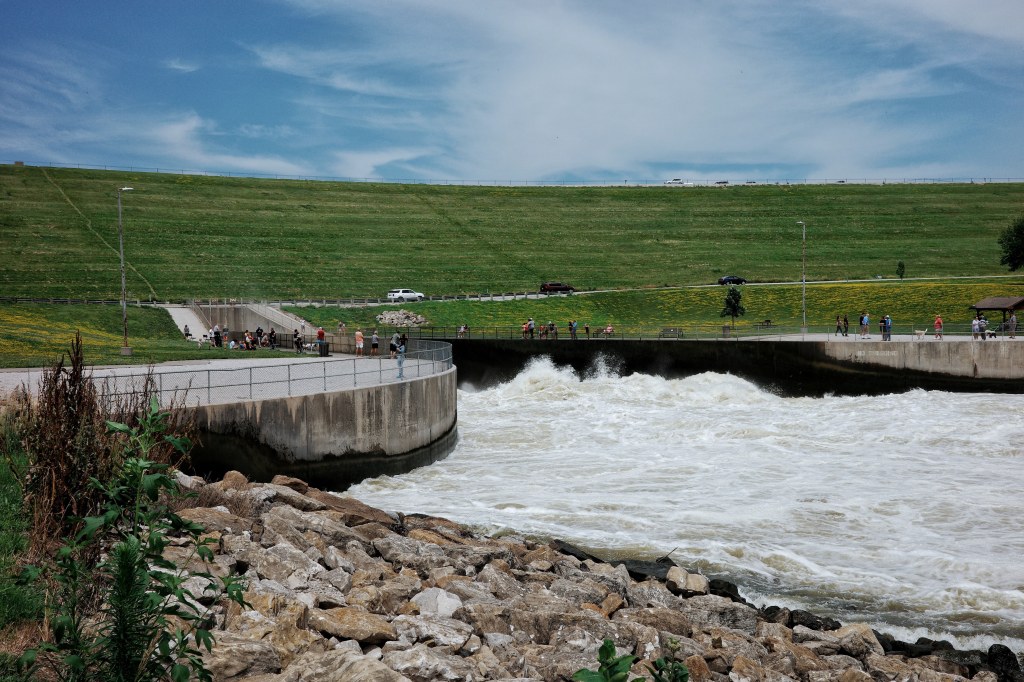
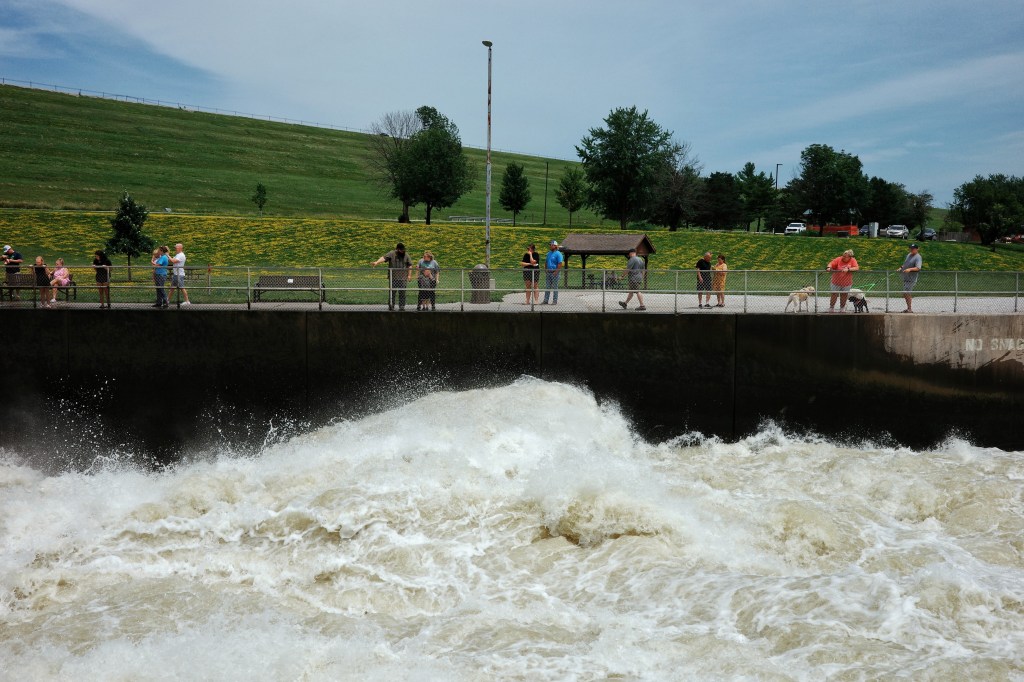
Because of the exceptional rainstorms, the Des Moines River is currently 20-22 feet higher than normal–not quite at actual flood levels (which, I believe, is 24 feet). A visit to the dam which creates Saylorville Lake yesterday was compelling. The 6000 acre lake has risen almost two feet in the last 24 hours; the spillway was releasing over 16,000 cubic feet of water every second — that’s 190% of its normal release. It was loud and furious and utterly fascinating to see.

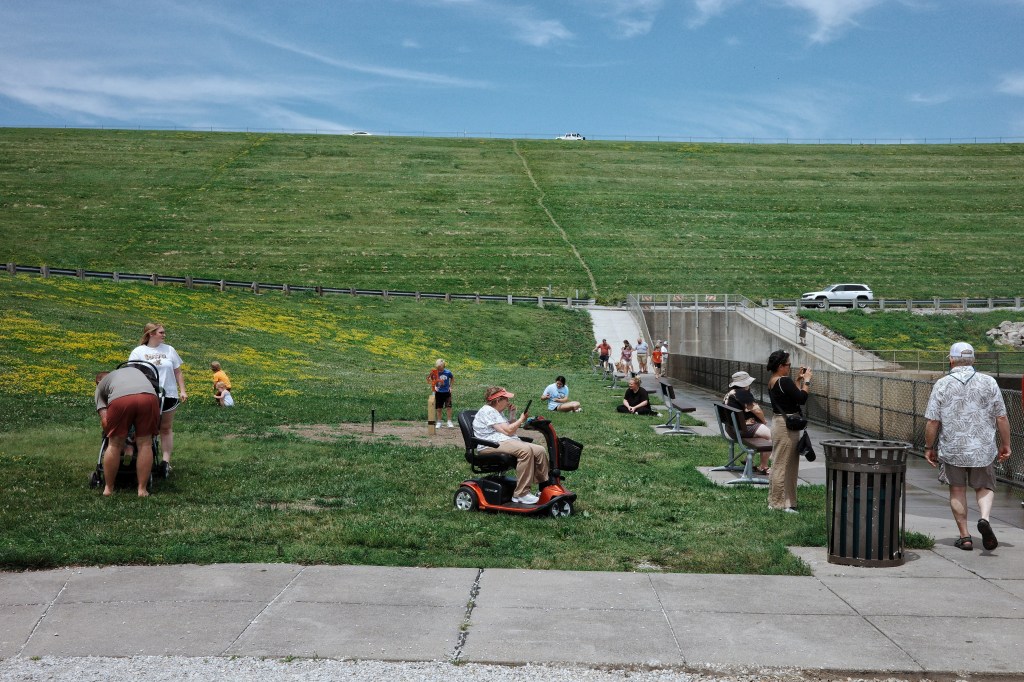
View of the spillway from the parking area

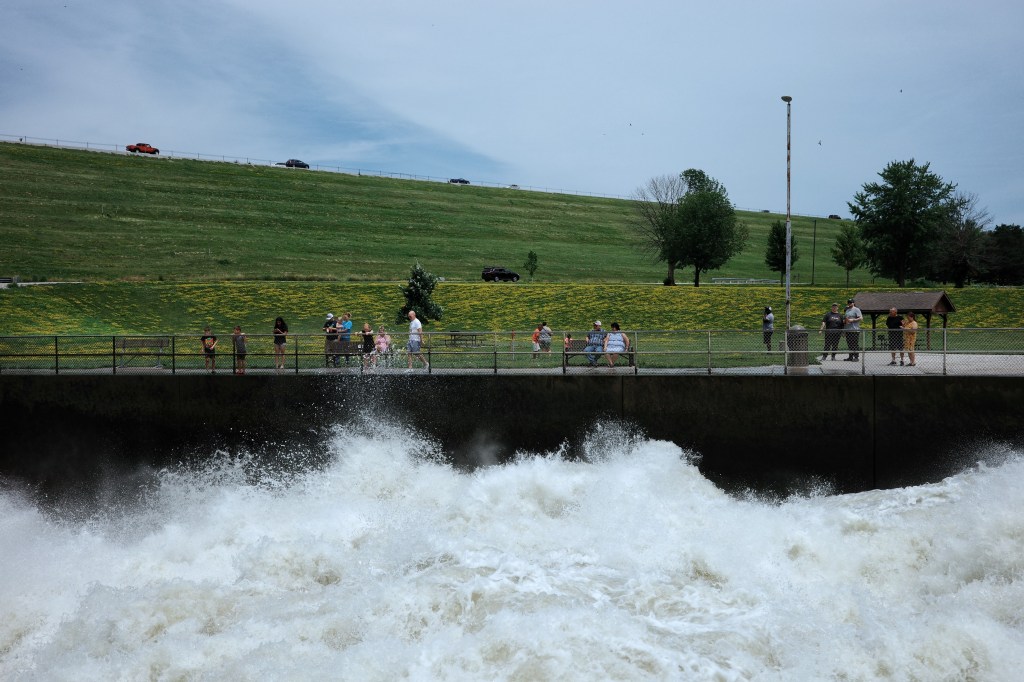
People showed up to see it. Young people, old people, families with kids and dogs, couples, people on their own — a constant low-volume parade of people just to take a look at the chaos of the spillway. Just a few dozen at a time. Most of them would slowly approach the fence guarding the spillway, gawk a bit, gradually move closer to the release point at the bottom of the dam. The turbulent water was mostly unpredictable, and would splash people unexpectedly. Most laughed and ran away from the fence. A few got irrationally angry, as though the water had played some sort of trick on them.

The dam and the spillway

That large solid hill behind the spillway? That’s actually the dam holding back the Saylorville Lake. On other side, the water level is probably 30-35 feet higher. There’s a second, emergency spillway (not pictured in any of these photos) in the dam. The water level in the lake is expected to peak in a couple of days, and (it’s hoped) will remain a couple of feet below the emergency spillway.

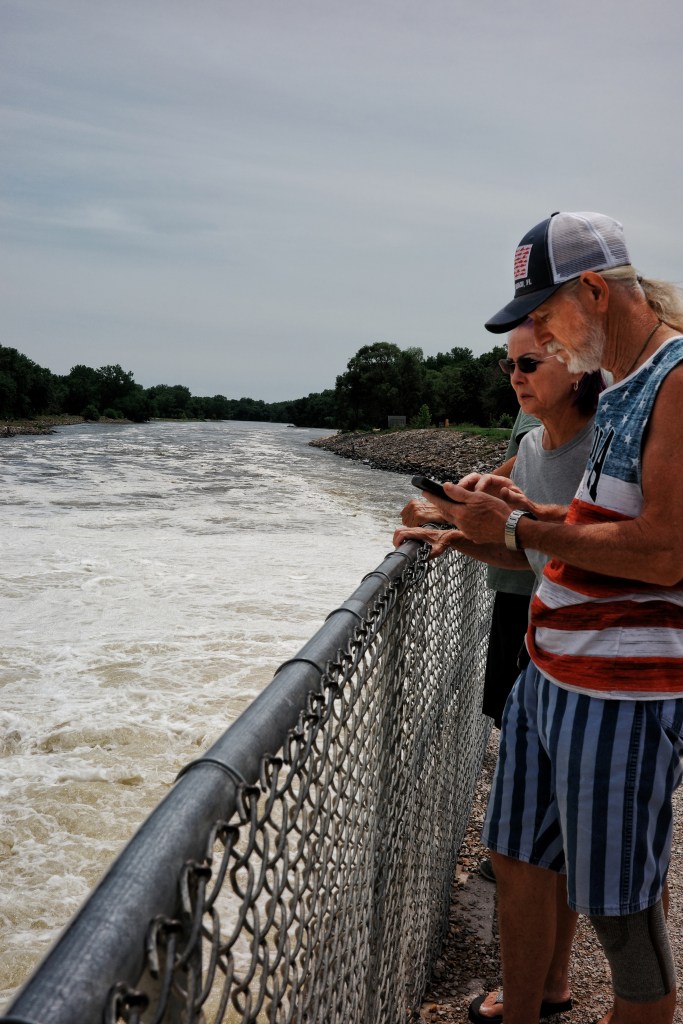
Visitors on the other side of the spillway

“If you fell in there, you’d die.” I can’t tell you how many people I heard say that. They’d stand at the fence, look at the raging water cascading out of the spillway, shake their heads, and say it in an awestruck voice. They often repeated themselves. “Wouldn’t have a prayer, if you fell in there. Nothing you could do. Nothing anybody could do. Find your body somewhere downstream.”

Everybody was a photographer at the spillway

Normally, the only people you’d see at the spillway were fishing. It’s a popular fishing spot; apparently it’s one of the few places you can catch eight to ten different fish species along a single short stretch of the river. Under normal conditions, that also makes it a popular spot for birds — pelicans, cormorants, gulls and terns, eagles. I didn’t see any birds even approach the spillway yesterday. Birds have too much sense for that.

A road runs along the top of the dam.

There was something almost pagan about the experience. Not pagan in a religious sense (since ‘paganism’ is just a term early Christians applied to any pre-Christian belief system), but in the sense of common people making a sort of pilgrimage to witness, awestruck, the beauty and savagery of nature, to experience their own smallness in the world. I doubt many of the people at the spillway thought of it in those terms, but it was there. The awareness of a natural power beyond our control and our understanding.

We were only there for a half hour or so. It seemed like longer, but time gets weird in the presence of the old gods.

Editorial Note: I was informed about this fishing video that shows the spillway under ordinary conditions. You don’t have to watch the entire thing; the opening seconds will give you a sense of what it’s normally like at the spillway.

almost, almost…

Yesterday, to distract myself from the SCOTUS-induced alternating rage/depression cycle, I sorted through some of the photos I shot at Saturday’s Farmer’s Market. And there was one photograph that…well, wait. I need to back up a bit. Two things.

First thing, a reminder: I recently bought a new camera, a Ricoh GR3x. It’s unlike any camera I’ve ever owned. To begin with, there’s no viewfinder; you compose the photo using the rear LCD screen. I was actually hesitant to buy the camera because of the lack of a viewfinder (yes, you can buy an attachment viewfinder, but that’s more coin and fuck that.) Composing with an LCD screen seems wrong; that’s what you do with your fucking phone. To my film-trained mind, it’s NOT how you use a camera. And yet, with the GR3x it turns out to be surprisingly handy and intuitive. Old dog, new tricks.

Second thing: Alex Webb. He’s a street photographer who’s famous for extremely colorful and complex photos. When I say ‘complex’ I mean many/most of his photos are composed in a way that organically divides and separates the elements within the frame into what could be different, distinct photos. I’m not going to include an example image here because when I publish this and post the link on various social media, there’s a good chance it’ll feature Webb’s photo instead of the photo I’m writing about; I don’t want people to think I’m taking credit for Webb’s work. But seriously, if you’re not familiar with this guy, do a quick image search. He’s amazing.

So, back to the opening paragraph, me sorting through Saturday’s photographs. At the Farmer’s Market I noticed a woman comforting her dog (which looked to be some sort of spaniel/poodle mixed breed) behind a vendor’s booth. The dog had apparently been overexcited by the crowd. There was something very sweet about their interaction and I wanted to photograph it. Having recently re-examined Alex Webb’s work, I thought it would be cool to include the vendor in the shot. But there was a guy who kept moving in front of me (I think he thought I was trying to cut in front of him to get the vendor’s attention). I’d shift to one side hoping to get a shot, and the guy kept shifting with me. With each step, I was losing sight of the woman and her dog. Just as I was about to give up, I saw a mother & child walking by behind the vendor.

I took the photo.

Not a great photo, but the potential is there.

Okay, it’s not a great photo. But I like it because it’s as close as I’ve ever come to shooting something almost almost in Webb’s style. Not in terms of color (my photo is rather drab in terms of color), but because the frame can be visually divided into three distinct image areas. The woman and her dog, the vendor, and the mother and child. Granted, the original idea of the woman and her dog largely gets lost, and the image is badly off balance…but still, there it is.

The thing is, if I’d been using a camera with a viewfinder, I wouldn’t have seen the mother and child before they entered the frame (and yes yes, if you’re shooting with a rangefinder camera you can keep your left eye open, which allows you to see outside the camera frame, but that only works if you’re right-eye dominant…and I’m not; I compose with my left eye). If I’d been using one of my usual cameras, I’d have missed the shot.

The GR3x allowed me to compose this photograph thoughtfully and almost instantly. It’s not a great photo by any means, but it demonstrates (to me, at least) this particular camera’s potential to catch unique, unexpected moments. I understand why this camera is beloved among many street photographers.

I don’t do much street photography. I’m not particularly good at it, but I enjoy it. But I also believe in practicing in public, in showing work that doesn’t quite meet my standards for what the work could be. So this is why I’ve inflicted this photo and this blog post on you. Thanks for being patient.

new camera…and lawdy

A few months ago–October/November of last year–I got sucked back into the Cameraverse. I’d pretty much abandoned cameras (cameras, not photography) in favor of my phone. My phone was convenient, did a fine job, and had the massive advantage of always being with me. But my hands began to miss the feel of a camera in them.

That’s only partly a metaphor. Shooting with a phone and shooting with a camera are two very different tactile experiences. I felt a strong desire to pick up an actual, no-shit, physical camera and go shoot photos. I resurrected my 12-year-old Fujifilm X10 because it was 1) a real camera and 2) it was small. I flirted a bit with another larger Fujifilm camera, but it soon became clear to me that, for a variety of reasons, I don’t enjoy larger cameras.

With a new camera, you photograph whatever is at hand.

So I began to noodle around the InterTubes to see what was out there in the Small Camera World. That introduced me to the Cult of Ricoh. I DO NOT do cults. I resist cults. Cults are bullshit. But after enough exposure to the Ricoh GR3 series, I was ready to shave my head, shake a tambourine, and buy one of the wee bastards. Except I couldn’t find one. Seriously. The problem is/was the Ricoh GR3 series is so popular, they’re on continuous back-order everywhere.

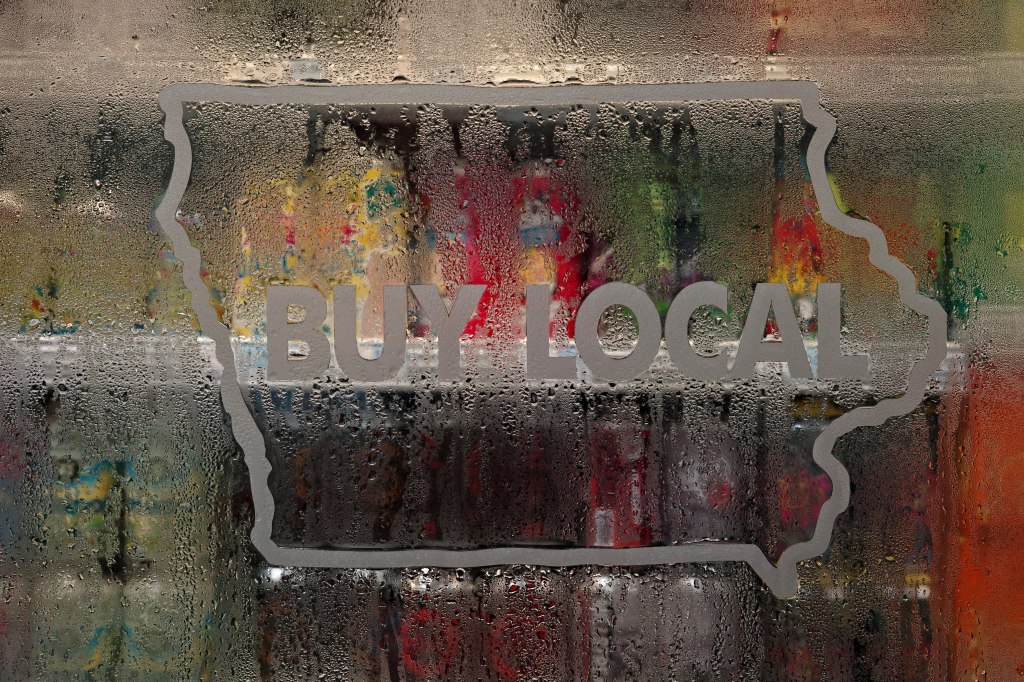
Buy Local

Persistence paid off, and four days ago I was able to unbox a brand new Ricoh GR3x. Here are three inescapable things about the Ricoh GR3 series: 1) They’re small. Really small. I kept hearing them described as ‘pocketable,’ which I assumed was bullshit. It’s not. You can actually tote the thing around in your pants pocket. Regular pants, not baggy cargo pants. I’ve no idea where women carry them, since fashion Nazis have deprived women of real pockets, but lawdy, the camera is small. 2) They’re quick. That photo above? Six seconds. Saw the condensation on the refrigerated beer door, pulled the camera out of my pants pocket, composed and shot the photo with one hand, put the camera back in my pocket. Six fucking seconds. It’s not a great photo, but lawdy. I felt like a gunslinger. 3) They’re easily customizable, if that’s a word. Almost every button on the camera (most of which are accessible when shooting with one hand) can be assigned almost any function. Which won’t mean much to anybody who isn’t a photographer, but trust me, that’s a HUGE deal.

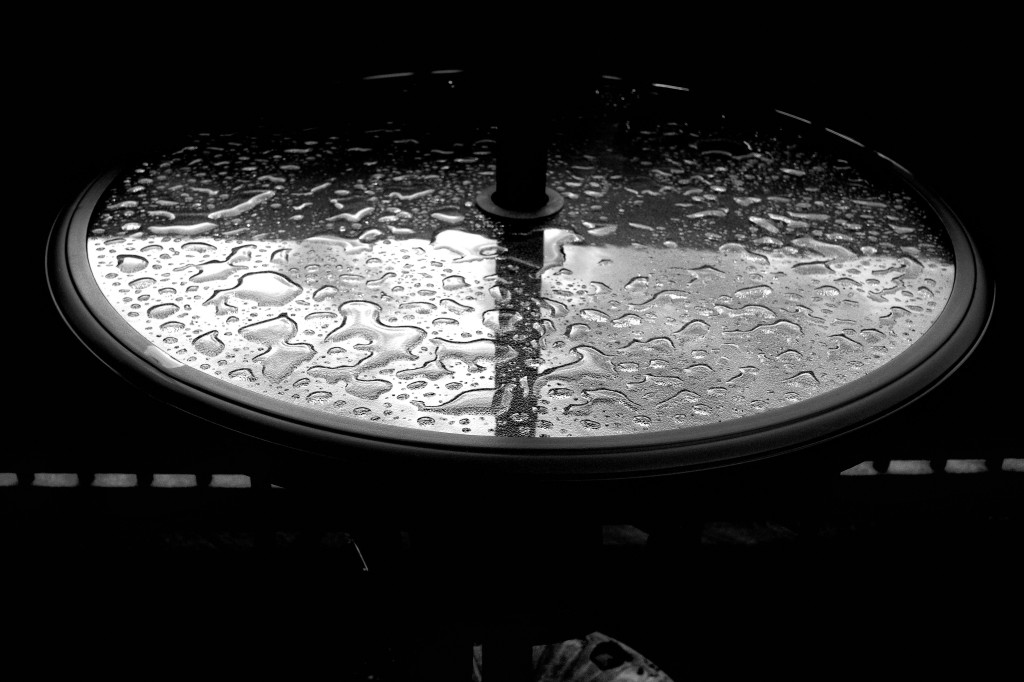
High contrast monochrome — water on a table.

It allows you to experiment. Hell, it almost demands you experiment. During a break in the rain on my first day I shot the photo above. It’s just rainwater organizing itself on a glass-topped patio table, but it has me thinking of a possible new Knuckles Dobrovic project–something about water in its various forms (as a liquid, as a solid, as a vapor, etc) done in high contrast black-and-white. I’ve no idea if it’s a viable project, or if I’ll follow through on it, but the thing is this camera has me thinking about projects again.

The problem? The learning curve. Oh, you can take decent photos almost immediately (as you can see here). But there are SO MANY ways to set up the camera to be responsive to your individual needs/wants, that I expect it’ll take me a couple of months of experimentation. Messing about with different set-ups, trying new ways of arranging things, establishing different photographic profiles for different subjects.

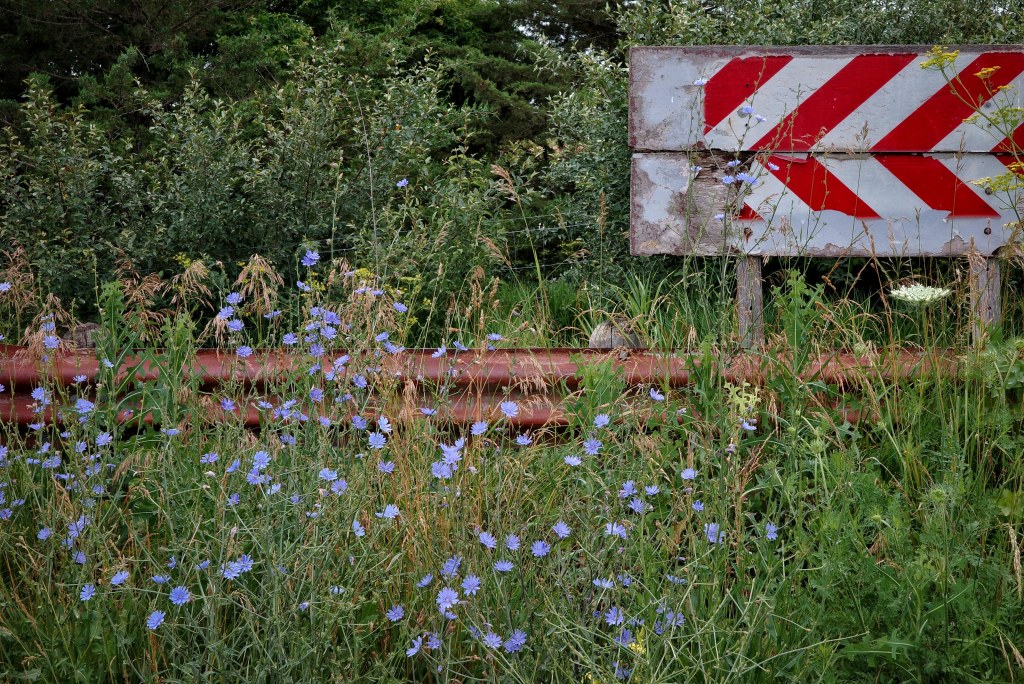
Chicory

Of the four days I’ve had the camera, two were rainy and stormy, one was savagely hot under a Gibsonesque dead channel sky. A bit of sunshine…even the teensiest bit, nicking through the gloomy clouds…would have done wonders for the photo above. The blue of the chicory was so lovely. But you get what you get.

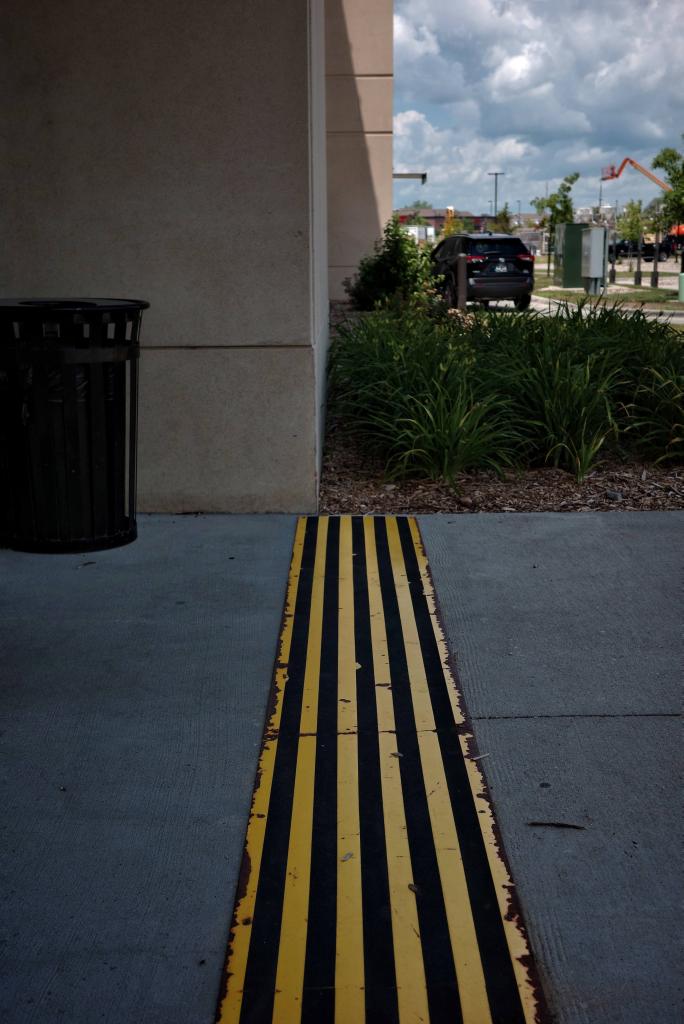
This camera will, I think, allow me to take advantage of what I get. Yesterday what I got was yellow stripes outside the library exit. I hesitated for just a few seconds, one hand full with a heavy book, the other allowed me to dig the Ricoh out of my pocket, shoot this quickly, and be on my way. (And here’s another thing: I almost never shoot in portrait format, but there’s something about the ergonomics of the GR3 that makes you want to shoot that way. I don’t understand it, but there it is.)

Stopped by the library, shot a photo.

I’ve shot a total of 48 photos in these four days. Forty-eight photos, and I think I’m in love. Because this is the first camera that feels like it was designed to shoot the way I see. It’s unobtrusive, it’s fast, it’s easy to shoot with one hand AND at the same time it gives you a LOT of almost immediate control over how the photo will look. All of the elements of exposure–ISO, shutter speed, aperture–all right there for your thumb and index finger. It’s perfect for shooting fast and loose and from the hip. That’s why this camera is a favorite of street shooters.

But that’s not me. I’m not a spray & pray shooter; I tend to compose a photo quickly, but deliberately. I think this wee bugger will give me some of the speed of a street shooter while still letting me make important exposure decisions. It’ll take me a while to get proficient with it, but lawdy.

And I’ll just say it again. Lawdy.

slow cycling movement

Every week or so I’ll take a glance at some online cycling magazines and forums. It’s usually just a glance, because there’s rarely anything there to interest me. I don’t really care about most cycling tech, like derailleurs or suspension; I’m not interested in performance enhancing drinks or supplements; I have no interest at all in the various forms of cycling competition; and I’ve never paid any real attention to cycling efficiency or fitness. I’d rather pound a nail through my foot than read something about the coefficients of drag or wind resistance. I’ll occasionally read something about bicycle infrastructure or a recent development in ebikes. But in general, I’m not the target audience for cycling magazines.

That said, today I stumbled across an article that caught my attention. It was titled How to ride your bicycle slower and love it. It surprised me for a couple of reasons. First, because it never occurred to me that anybody would ever need to learn how to ride more slowly. I mean, you ride slower by…well, riding more slowly. Right? It’s pretty fucking obvious. But second, and more interesting (from my perspective, at any rate) I was surprised to discover there’s a growing (slowly growing, I presume) slow cycling movement.

Taking a break with my mountain bike, September, 2011

I was completely unaware of this. Apparently, there are communities of cyclists who’ve banded together to boldly declare, “Hey, I’m in no particular rush.” The article took pains to actually explain what slow cycling is, how it’s done, and why a person would do it. Slow cycling is:

[R]iding your bicycle in a relaxed manner, with time to look around and see the landscape…. It’s for leisurely enjoyment, not achievement, speed, or distance-bragging…. It’s all about meeting up with friends for a leisurely ride to the café for a streetside chat or going for a slow roll around town.

I shouldn’t mock (I’m going to, but I shouldn’t) because slow cycling is–and always has been–my default cycling mode. By nature, I’m a noodler. Whether I’m walking, driving, or riding a bike, I tend to just sort of noodle along. I’ve got nothing against riding for exercise. If that’s your interest, fine. Bikes are great for exercise. But so many of the people who ride for fitness seem to think those of us who ride for enjoyment are just in the way. We’re taking up valuable bike trail space that could be more effectively utilized for cardiovascular improvement.

A converted railway station on a bike trail, where I took a break.

The article about slow cycling (and yeah, I feel sort of silly even using that name) even went so far as to suggest how slow cyclists should dress. It’s not surprising that I actually dress in classic slow cyclist fashion. Cycling jerseys? Why? Wear a comfortable tee-shirt, or even something with buttons and a collar. What matters is that it should wick moisture away from the body to help keep you cool. Cycling shorts? Who needs them? (Well, I do, for one; I always have padded cycling underwear under my multi-pocketed sports shorts, and yeah, I like having lots of pockets for phones and keys and wallet and a camera.) When I’m riding with a group, the way I dress has always marked me as somebody not ‘serious’ about cycling.

When I’m riding with a group, I ride at the group’s pace, because that’s the polite thing to do. That’s usually anywhere from 15 to 20 miles per hour. But the vast majority of my cycling has been done solo. And yeah, then I ride slow. I’m talking a carefree 10-12 mph. That’s fast enough to cover distance, but slow enough to allow me to look at stuff while I ride. I’m constantly swiveling my head to look at birds and deer and groundhogs and whatever cool stuff I happen to see along the road or bike trail.

I took a break to chat with some guy and his dog I met on a bike path.

Not only do I ride slowly when I ride solo, but I stop fairly often. I stop and talk to strangers, I stop to pet dogs, I stop to look at stuff, I stop to take photos, I stop to have a drink and kick back for a bit and enjoy the quiet. I used to carry a small hammock; there have been many times I’ve stopped, tied the hammock between a couple of convenient trees, climbed in and taken a short nap. Or read a book.

None of that is efficient. It doesn’t burn many calories. It just makes me happy.

Which brings me back to that article. It claimed that slow cycling “releases serotonin and other happy hormones, not adrenalin.” That’s right. Happy hormones. Those are my favorite hormones. Fuck those grumpy hormones. Fuck them in the neck.

I was glad to learn a slow cycling movement exists, though I admit I haven’t seen any sign of it around here. Most cyclists I see are still on road bikes, still wearing colorful spandex cycling gear, still cycling with their heads down to be more aerodynamic, still failing to notice the chipmunks they’d just ridden past. Maybe that’ll change over time.

Or maybe I haven’t been paying enough attention. It’s possible I was looking at other stuff and the slow cyclists just sort of noodled on by me while I was distracted. I’d like that.

ebike evolution

Today is World Bicycle Day. And, okay, that sounds silly–like with all the awful shit taking place in the world, we need to set aside a day to celebrate bikes. But it actually makes sense. Bikes are–and always have been–revolutionary.

That includes electric pedal-assist bikes. The perception of ebikes is evolving rapidly. I bought my first ebike back in June of 2020. There weren’t many of them around at the time. In fact, I didn’t see another ebike in the wild until late that autumn. They were so uncommon that people–pedestrians, other cyclists, even people in cars at stop signs and traffic lights–would stop me to ask about the bike. They had lots of questions: how did it work, how far could it go, how fast, how much did it cost. And very often, these two questions: “But isn’t it…cheating?” and “Aren’t they for…old/disabled people?”

Those questions are what I like to call ‘stupid-ass questions.’ No, they’re not cheating. No, they’re not just for old or disabled people. They’re just bicycles. Bicycles plus.

When I bought my first ebike, they were as rare as unicorns.

I’ve talked about the ‘cheating’ issue before. The entire concept of cheating in recreational cycling is ridiculous. It’s stupid on multiple levels. Cheating implies some sort of competition. Who the fuck are we competing with when we go out for a ride? If you’re riding purely (or even primarily) for exercise, you could, I suppose, argue that you’re competing against yourself–that you’re trying to cycle better each time you go for a ride. Go faster, go farther, go longer, burn more calories. If that’s the case, then riding a bike would be cheating against runners. Riding a bike with multiple gears is cheating against cyclists who ride fixies. If you buy into the ‘cycling is competition’ argument, then anything that makes cycling easier can be considered cheating. All that spandex shit you wear? That’s cheating.

The other question–ebikes are for old or disabled folks–is equally wrong-headed. Ebikes ARE great for older folks and for folks who have some sort of disability. It allows people who otherwise couldn’t or wouldn’t ride a bike to…well, ride a bike. The same is true for step-through bikes, which are easier to get on and off (and yeah, there were assholes who thought they were clever by referring to my bike as a girl’s bike–like that’s an insult). Anything that helps people get on bikes and ride is a good thing. That’s pretty fucking obvious.

My second ebike is a lot more nimble.

Here’s the thing: a lot of us don’t see cycling as competition or a fitness tool. We’re riding bikes because they’re fun. We’re riding bikes as a form of transportation. That’s the main thing about ebikes: they’re generally adaptable. If you want an inexpensive way to commute to work without getting all sweaty, an ebike is your friend. If you want to take long rides without worrying that you’ll exhaust yourself (turning a fun ride into an ordeal), an ebike allows you to do that. Even if you want to cycle for exercise, you can reduce the level of pedal assist and sweat your ass off.

There are still a LOT of bicyclists who mock ebikes. But it’s changing. I rode my bike to the local farmers market on Saturday. The market is deliberately located on the town’s central bicycle trail. I’d say at least a third–maybe even half–of the bikes parked around the market were ebikes. There are two bike brew pubs within a few hundred yards of the farmers market; around a quarter of the bikes parked outside those pubs were ebikes.

I can ride farther and longer and have more fun with my ebike.

Don’t get me wrong; ebikes are far from perfect. They’re generally more expensive than regular bikes. They’re heavier. Batteries have a limited capacity, which affects the bike’s range (although that’s becoming less of an issue). Any device that depends on electricity to function necessarily has more ways to fail than their human-powered counterparts. And yet, despite this, ebikes are becoming more popular.

Why? Because they’re fun. I’ve been riding bike for most of my life, but I can honestly say I’ve never had as much fun on a bike as I’ve had the last four years. For me, the ebike has been liberating. I called my first ebike the best purchase I ever made. That’s still true. My second ebike is a much better bike, but that first bike was a revelation. The second bike was confirmation of how much better my life is with an ebike.

It’s World Bicycle Day and I’m certain most people–including most cyclists–won’t notice. They don’t need to. They’ll be out riding their bikes regardless.