jackassery

I’m a big believer in academic freedom. I’ve managed to acquire a handful of degrees from various colleges and universities, and for a brief time I was actually an academic my ownself. When I heard the State of Oklahoma was considering legislation promoting academic freedom, I was understandably pleased.

I said to myself, “Yay Oklahoma!” I started to read HR1674, the Scientific Education and Academic Freedom Act, with a song in my heart. The legislation begins like this:

[A]n important purpose of science education is to inform students about scientific evidence and to help students develop critical thinking skills they need in order to become intelligent, productive, and scientifically informed citizens.

Who could argue against that? We totally want our students to develop mad critical thinking skillz. Yay Oklahoma! Yay critical thinking skills! The proposed legislation acknowledges that encouraging the development of those critical thinking skills can lead to controversy.

[T]he teaching of some scientific concepts including but not limited to premises in the areas of biology, chemistry, meteorology, bioethics and physics can cause controversy, and that some teachers may be unsure of the expectations concerning how they should present information on some subjects such as, but not limited to, biological evolution, the chemical origins of life, global warming, and human cloning.

So far, so good, right? Yay Oklahoma! Yay critical thinking skills! Yay controversy! Controversy is good. Controversy makes you think. Controversy requires you to…wait. Wait a minute. Wait just one fucking minute here, buddy. Biological evolution? The chemical origins of life? Global warming?

Are you crazy? There’s no scientific controversy about evolution. There’s no scientific controversy about the origin of life or anthropogenic climate change. Those are established scientific facts. What jackass wrote this proposed legislation?

This jackass.
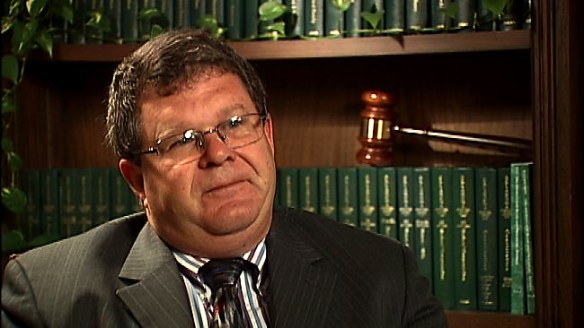
gus blackwell and a mallet

Gus Blackwell (Jackass – Oklahoma)

This is Oklahoma state legislator Gus Blackwell. Would you be surprised to discover Blackwell is a Republican? Or that he’s a Baptist minister? Or that he’s spent the last two decades employed by the Oklahoma Baptist General Convention?

I’m not suggesting Blackwell is a jackass because he’s a Republican or a Baptist. There are lots of Republicans and Baptists who go through life without engaging in jackassery. No, Blackwell is a jackass because he’s introduced legislation that would give his Baptist theology the same credibility as science. Blackwell is a jackass because his proposed legislation goes on to say this:

[N]o student in any public school or institution shall be penalized in any way because the student may subscribe to a particular position on scientific theories.

What does that mean? In effect, it means if students were to write a report claiming climate change is a hoax or arguing that the Earth is only 6000 years old and women were created from the rib of Adam, they couldn’t be ‘penalized’ with a bad grade. In an interview, Blackwell said,

“I proposed this bill because there are teachers and students who may be afraid of going against what they see in their textbooks. A student has the freedom to write a paper that points out that highly complex life may not be explained by chance mutations.”

Blackburn is a jackass, but he’s right about that. A certainly student does have the freedom to write a paper arguing against evolution. But if that paper was written for a science class, then the student should expect a failing grade. Not because the teacher may disagree with the student’s belief system, but because that student would be what we academics call ‘wrong.’

Blackwell and his ilk (yes, there is an entire ilk of jackasses like Gus Blackwell) propose this sort of legislation under the guise of promoting ‘academic freedom.’ I’m sorry to say they know as much about academic freedom as they know about science.

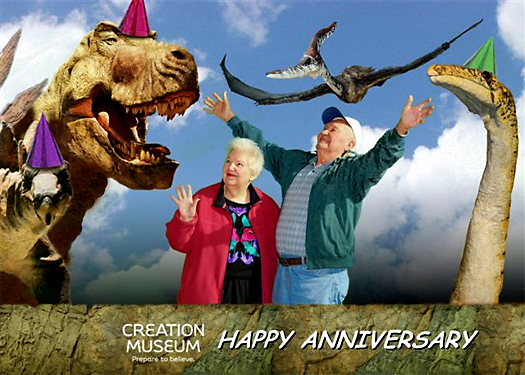
Academic freedom, like evolution or gravity or anthropomorphic climate change, is an actual thing. It has an actual meaning. It’s not a matter of opinion. And it’s got nothing to do with students having the freedom to write papers about humans cavorting with dinosaurs in the Garden of Eden.
creation museum

Academic freedom doesn’t apply to students representing a personal point of view. Legally, it doesn’t even apply to teachers or college professors. In the United States, the courts have ruled that academic freedom resides in the university. Academic freedom gives the university the power to appoint faculty and set standards for their behavior.

All major universities in the U.S. abide by the 1940 Statement of Principles on Academic Freedom and Tenure, which insures that:

  • Teachers are entitled to full freedom in research and in the publication of the results, subject to the adequate performance of their other academic duties.
  • Teachers are entitled to freedom in the classroom in discussing their subject, but they should be careful not to introduce into their teaching controversial matter which has no relation to their subject. Limitations of academic freedom because of religious or other aims of the institution should be clearly stated in writing at the time of the appointment.
  • College and university teachers are citizens, members of a learned profession, and officers of an educational institution. When they speak or write as citizens, they should be free from institutional censorship or discipline, but their special position in the community imposes special obligations. As scholars and educational officers, they should remember that the public may judge their profession and their institution by their utterances. Hence they should at all times be accurate, should exercise appropriate restraint, should show respect for the opinions of others, and should make every effort to indicate that they are not speaking for the institution.

It was academic freedom that enabled Blackwell to attend Oklahoma Baptist University and Southwestern Baptist Theology Seminary and study Baptist theology. Yay academic freedom! But academic freedom doesn’t mean he can legislate that his theology be given equal credibility as science. Boo jackassery!

Happily for Gus Blackwell, though, nobody has proposed legislation limiting his freedom to be a jackass.

a trick of fog and mist

Fog. The weather forecast said — promised — there would be fog in the morning. So I arranged my schedule (okay, I don’t actually have anything even remotely resembling a schedule — but if I did, I’d have arranged it) so I could be downtown early in the morning. Because fog, right?

Here’s a meteorologically true thing: the only difference between fog and mist is their density as measured by the degree of visibility. They’re both just localized collections of water droplets suspended in the air. They’re essentially stratus clouds — flat, lazy, featureless clouds — hanging on at or just above ground level. Here’s the difference between fog and mist: if you can see for more than a kilometer, you’re in mist; if you can see less than a kilometer, you’re in fog.

waiting for the bus

waiting for the bus

I had both. Fog and mist. Most of the time there was a layer of fog about 10 to 20 meters above the ground, beneath which was mist. Sometimes the cloud would dip down and I was in fog; sometimes it lifted a wee bit and I was in mist.

It was very odd and strange, and even if it made photography confusing as hell, it made for an interesting walk. One moment visibility would be only a few hundred feet, the next you could see for a couple of block; one moment it was chilly and damp, and the next moment if was…well, it stayed chilly and damp, but the degree of chilliness and dampness shifted radically.

chill breeze by the river

chill breeze by the river

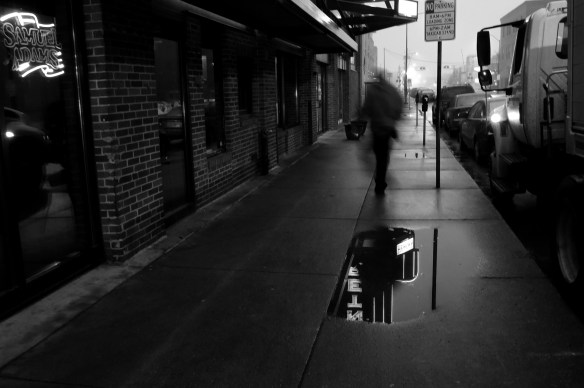
I was on the street by around 6:30 in the morning. At that hour, there weren’t a lot of people about. It’s been a long, long time since I’ve held a straight job, and I’d forgotten the simple fact that most folks go to work by themselves. Aside from car-poolers and folks who take public transportation, people don’t generally go to work in groups. Almost everybody I saw that morning was alone. One solitary person, moving purposefully through the fog/mist. It made them all seem isolated.

heading for the diner

heading for the diner

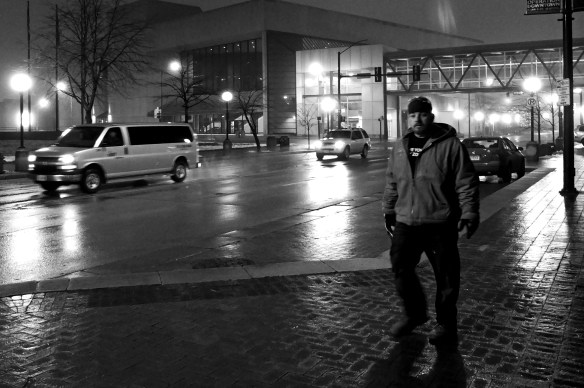
Isolated, but not unfriendly. I photographed several people as they walked toward me, and as they reached me I usually smiled and showed them their photo. Most of them paused long enough to admire themselves, make a joke, ask a question. The guy in the photograph below looked at his picture and said “That’s pretty good. But why did you take my picture?” I guess it was a good question because a very attractive young woman had been walking in front of him, and I didn’t shoot her photo. I said “Because you’re so purty.” He laughed, punched me gently in the arm, said “Fuck you,” and wandered off still laughing.

because you're so purty

because you’re so purty

I know that right now you’re almost certainly wondering about the etymology of fog and mist, because that’s just the sort of person you are. And aren’t you in luck, because I can tell you there’s some uncertainty about the etymology of ‘fog’ but not about ‘mist.’ Most linguists suggest fog is related to the Dutch vocht and German feucht (which, if there is any justice in the world, has to be pronounced fucked). The origins of ‘mist,’ on the other hand, are pretty clear. It comes from the Old English term mist (what a shock), which apparently referred to a ‘dimness of eyesight.’ That Old English term is believed to derive from the Proto-Indo-European meigh which meant ‘to urinate’ (and no, I’m not making this up).

In photographic terms, this means if you’re shooting in fog or mist your autofocus is fucked, which could leave you pissed.

on court street

on court street

Here’s a photographically true thing: as atmospheric conditions, both fog and mist can be dense enough to bitch-slap most autofocus systems. One of the things I’ve come to rely on with my little Fujifilm X10 is its quick and accurate autofocus, and even though it tried valiantly, the X10 wasn’t always successful.

At first it was a tad frustrating when I chimped a photo and saw it wasn’t in focus. Then I reminded myself that sharpness is a bourgeois concept. It’s also a relative notion. If the photo shows what you want it to show, that’s all that counts. Besides, black-and-white photography is more about form and line and shape and geometry than about clarity. Fog and mist are made for b&w work.

old woman

old woman

At one point I saw this stooped figure approach, moving in a slow rolling sort of gait that was oddly gorilla-like. I shot the photo above and another, and waited for the person to walk into the patch of light at the corner. It turned out to be an old Slavic-looking woman, which left me in sort of a moral quandary. Not in regard to shooting her photo; that seemed immediately inappropriate. The quandary was whether or not I should offer to carry her bag. It didn’t look particularly heavy, but that wasn’t the issue. However, it seemed a rather impertinent offer; I know how my own mother would have reacted to that offer. “What…do I look too old to carry my own bags?”

So I lowered my camera and stood there, waiting and trying to decide what to do. She shuffled on by without even looking up. And I continued on my way.

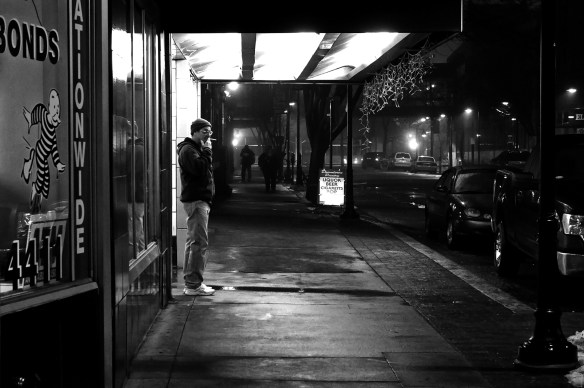
outside the bail bond office

outside the bail bond office

The fog started to lift pretty quickly after that. The X10’s autofocus breathed a sigh of relief and went back to work. There were more people on the street — some still making their way to work, some already working, some making deliveries, some just hanging out, some taking their dogs for their morning ‘walkies.’

The people with dogs were always willing to stop a moment and allow their dogs to be praised and admired. Here’s an odd thing: all of the dog-walkers I met that morning were happy to have their dogs photographed, but every single one of the people were reluctant to be photographed themselves.

in a hurry

in a hurry

Near the end of my walk I saw this woman in the photograph below standing along the promenade overlooking the riverwalk. I shot a couple frames of her standing there. She looked so sad and forlorn I felt I should speak to her. So I said “Excuse me?” and when she turned I told her I’d just taken her photograph and asked if she’d like to see it.

She smiled and said yes. When she saw it she laughed and said, “Oh good, you got the old lights on the bridge. I was just standing here admiring them.”

on the promenade

on the promenade

We chatted for maybe five minutes. She was just out taking a walk in the fog, and was as happy and cheerful as anybody I saw all morning. There was nothing the least bit sad or forlorn about her.

It was just another trick of the fog and mist.

ice ice baby

I like people. I really do. But sometimes I despair of their lack of interest in the world around them. A few days ago I was downtown, crossing a bridge over the river, and I was overtaken by a couple of guys walking in the same direction. I heard one of them say “River’s iced over.” The other guy glanced over the side of the bridge and said “Yep.” And that was it.

One of the most intriguing winter phenomena was taking place below them, and they didn’t see it. Rivers and streams freeze every year, yes. It’s nothing new. But it’s a fascinating process. It’s a radically different process than what takes place on a lake or pond because…well, river water moves, and that makes the freezing process significantly more complex.

On a moving body of fresh water, ice almost always begins to form along the banks. There are a couple reasons for that. First, the temperature in the shallow water along the shore drops faster on a cold night. Second, there are quiescent areas along the banks where the water is more still. Ice that forms along the bank is appropriately known as border ice. If the river or stream or brook is narrow enough — or if the weather stays cold enough — border ice will gradually expand toward the center of the stream until the entire surface freezes over.

Border ice

Border ice

But that’s not so very different from what happens on lakes and ponds — or in your birdbath, for that matter. The really interesting stuff takes place away from the banks, where the water is more turbulent. That’s when the freezing process gets weird and wonderful.

As the temperature drops, the surface of the water begins to lose heat rapidly. The turbulence of the river flow sort of roils that super-cooled surface water with a less cold layer of water just below the surface. This causes tiny crystals of ice to form. Those crystals gather in loose, randomly-oriented discoid or needle-shapes. This is called frazil ice.

Frazil often looks like slush in the water. There are a couple of things that make frazil interesting. First, like most ice, frazil floats — so it travels downstream. Second it has an extreme capacity to adhere to any object it comes in contact with. In other words, frazil clumps easily.

frazil ice

Frazil ice

As it floats downstream, frazil bumps into stuff and sticks. In the photograph above, you can see frazil in its slushy form at the top of the frame. You can also see the line where frazil is clumping to more frazil, which will form the border of an ice pan. That raised line of ice is actually caused by the repeated collision of frazil against frazil.

A later stage of freezing occurs when frazil crystals coagulate to form a sort of soupy layer on the surface of the water. This is called grease ice because it looks slick. It doesn’t reflect light very well, which gives the water surface a matte appearance.

Grease ice

Grease ice

As the ice crystals become more compacted and solid they release more heat, creating surface slabs of ice known as ice pans. This is more like the ice we’re most familiar with. Ice pans often break free and float away downstream, banging and colliding with other ice pans, given them a softly rounded edges.

When these surface slabs of ice form in the bend of a river, they sometimes get caught in the rotational shear of the current and the ice pan spins around and around. As it rotates, the outer edge is gradually ground away until if forms an almost perfect circle. I’ve only seen this phenomenon once; sadly, I don’t have a photograph of it.

The photograph below, however, shows several different facets of the river freezing process. You can see the border ice; you can see where frazil has formed and clumped together causing a slushy barrier; you can see where that barrier has coalesced into grease ice; and you can see where ice pans have broken away and been refrozen in mid-stream.

Ice pans

Ice pans

This astonishing collection of various freezing processes is precisely what those guys were looking at when they said “River’s iced over.”

Now, I understand that other folks might not find these details as intriguing as I do. I understand that for a lot of folks — most folks, probably — the only ice that matters is the ice in their drinks. I understand that, I really do. But I can’t help feeling that those two guys who hurried by me on the bridge have missed out on something. I can’t help thinking that if they stopped for just a moment and really looked at the river, if they’d  asked themselves what was happening — even if they never bothered to seek out the answers — that their lives would be somewhat richer.