in which I look at an old photo

Here’s a thing I’m going to do. Well, it’s a thing I’m thinking I might do. I’m not going to commit to actually doing it because it might be awful–for me and for any poor bastard reading this blog. Anyway, here’s the thing:

I’m thinking I might periodically look at one of my old photos and review or analyze it as if it were shot by a stranger.

I almost never look at my old photos. The very idea of looking at my old photos sounds boring as fuck. The idea of talking about one of my own photos sounds pretentious and annoying (and also boring as fuck). So why am I going to do this? I’ll explain the reasons later. Anyway, here’s the first photo I’ve chosen for this maybe-project.
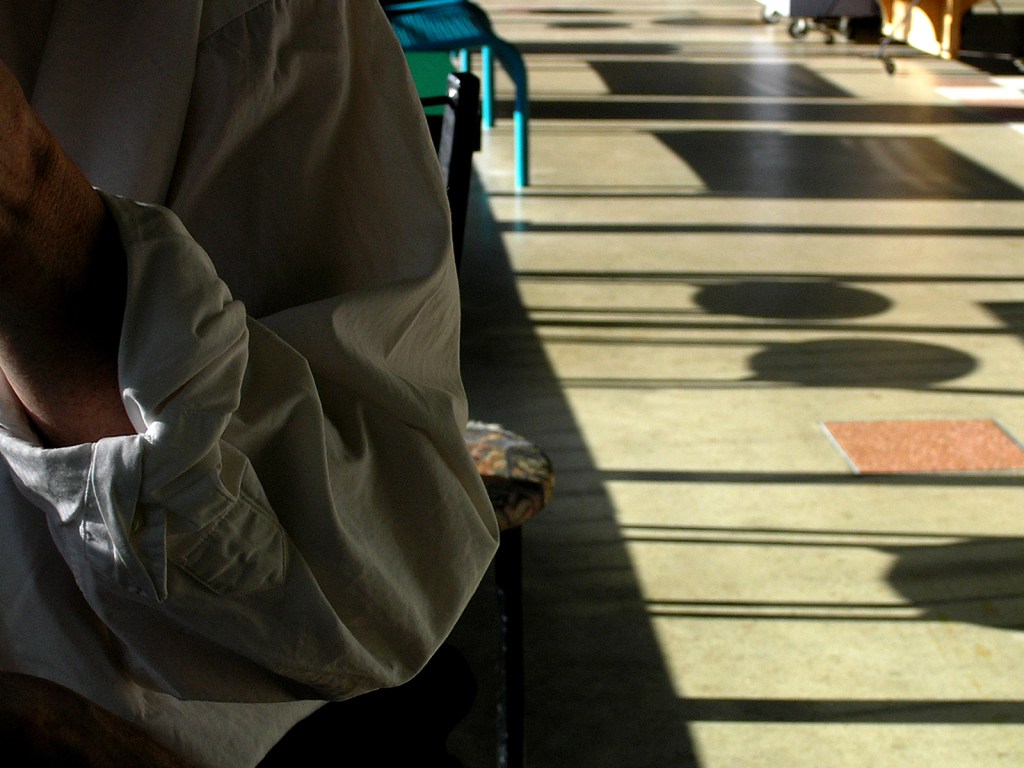
5:51 PM, Wednesday, September 27, 2006

I shot this one late afternoon in September of 2006 (EXIF data is handy) with my very first digital camera, an Olympus C-770 UZ. A four megapixel powerhouse. It’s shot in a 4:3 aspect ratio, which I’ve never been comfortable with. As I recall, there was an option to shoot in 3:2, but it required some loss in resolution, which was noticeable in a 4mp camera.

I was having coffee with a friend and was somewhat distracted by the pattern of the late afternoon shadows. I recall shooting a couple frames of the shadows, but the images weren’t very interesting. At some point, my friend raised her arm to sip her coffee; the sun had shifted enough to illuminate the edge of the rolled up sleeve of her white shirt. I asked her to do it again and took the shot.

It’s not a great photograph, but that arm and sleeve humanizes the image. It’s not just a photo of some shadows; it’s a photo of a human moment. There’s a palpable mood here–quiet, reflective, casual, conversational. There’s something comfortably relaxed, intimate even, about that rolled up sleeve. I also like the fact that the image is intimate while being sort of impersonal; there’s almost nothing to identify the other person–age, gender, height, weight. It could be anybody. Fill in the blank.

Finally, the perspective puts the viewer IN the scene. Sitting relaxed across at a table with a friend in an almost empty coffee shop on a sunny afternoon.

Okay. Now, why am I talking about this 18-year-old photo? Here’s why.

I used to spend a lot of time thinking about photography. Thinking about different photographers, about styles and trends in photography, about the decision-making processes involved in making photos. For years I wrote a fairly regular series of essays about photographers (which can be found here). I started those essays primarily as a way to educate myself, but they became a tool for discussion in a Flickr group called Utata.

And then I stopped. I could probably cobble together some logical explanation for why I stopped, but really, who cares? The thing is, I just didn’t spend much time thinking about photography and photographers. I continued to shoot photographs, but lackadaisically and rarely with an actual camera. I was satisfied with my Pixel phone. Until a few months ago.

Again, I could probably cobble together some logical explanation for why I picked up a 12-year-old camera, but, again, who cares? I picked it up and started shooting with a camera again. Which led me to start shooting with another of my cameras. Which led me to decide to buy a new camera (which should arrive in a month or so). I’ll write about the new camera when it arrives. But the thing is, I’m thinking about photography again. I’m reading about photography again. And one of the articles I read included some bullshit about reviewing your old photographs.

Here’s a True Thing: I have no real interest in looking at my old photos. The very idea of looking at my old photos sounds boring as fuck. I mean, I shot those photos; I’ve already seen them. I’d rather look at new photos, photos shot by somebody else.

But this article suggested looking at your old photos as if they were made by a different person. The rationale is that we change over time, so our approach to photography probably changes. Which sorta kinda makes sense to me, since in a very real way I’m NOT the same person I was in, say, 2006.

So I said, “What the hell, why not?” and I opened up Google Photos and scrolled all the way down to the oldest photos. The photo above was one of them. It seemed like a good place to start.

I don’t know if this is a good idea or not. I’m not sure I’ll follow through on it. But back in the days when I was actively thinking about photography, I stumbled across some thoughts by Alfred Stieglitz and William Gedney about practicing in public. Although they didn’t put it quite like this, those guys were suggesting that if you’re serious about photography, you’ve got to be willing show your whole ass. Maybe this is related to that whole notion.
photolosophy

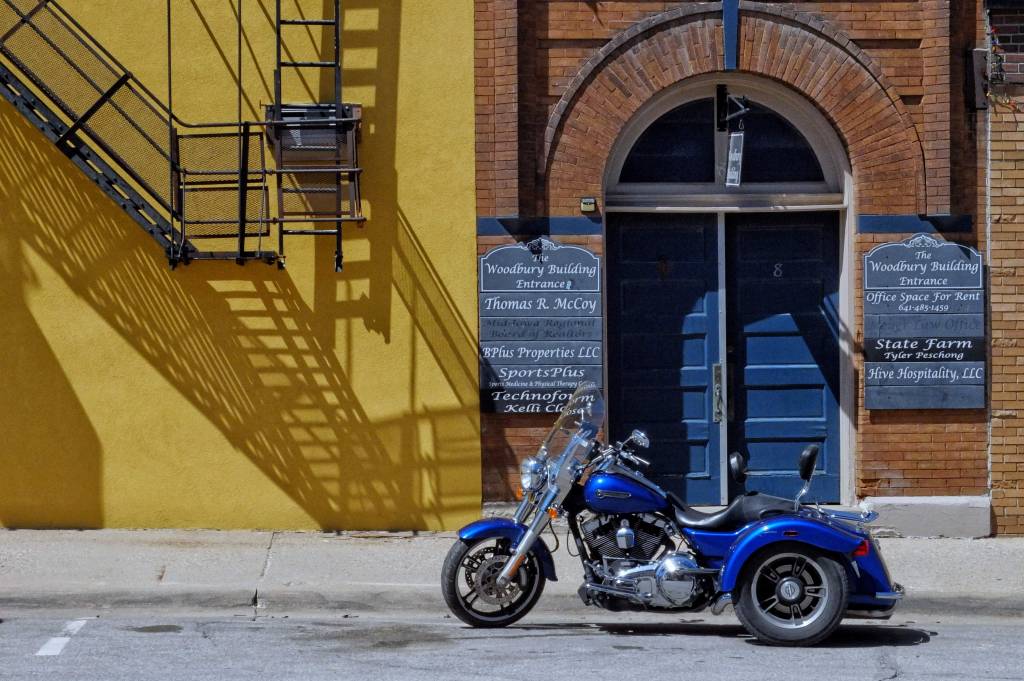
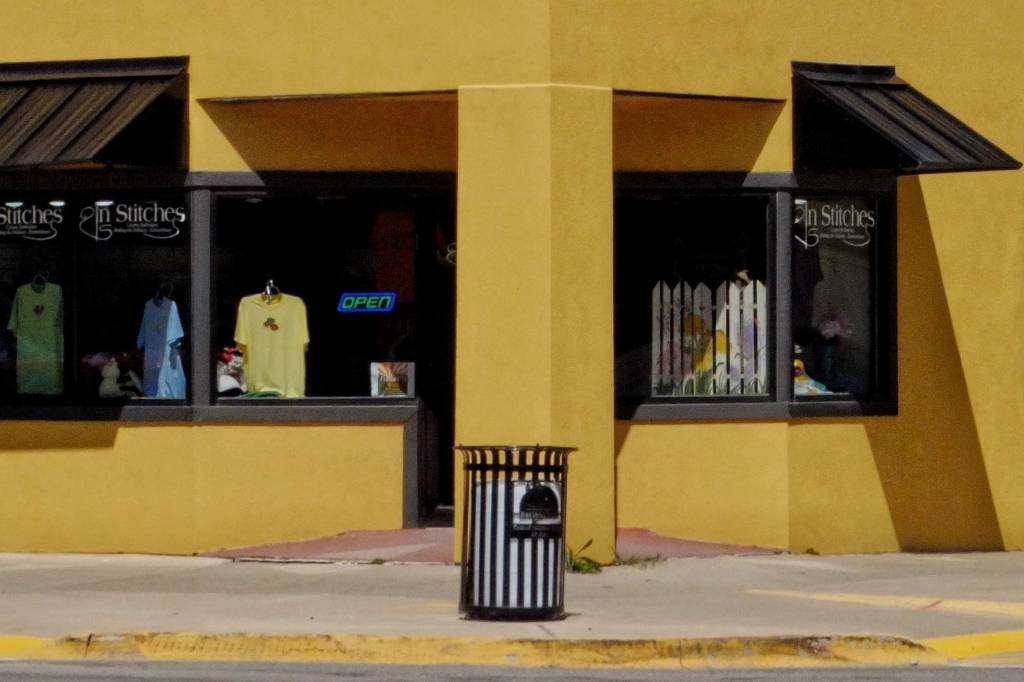
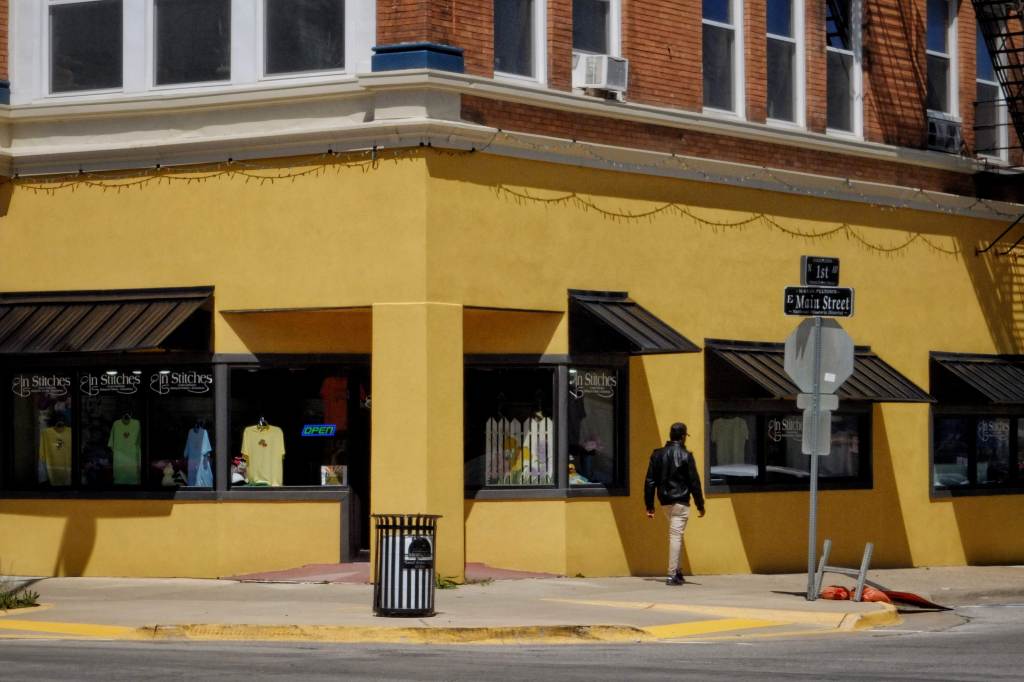
Life is unfair and full of disappointment. Here’s me, with my wee Fujifilm X10 in hand, walking down the street, spotting a mustard-colored corner building. And oh lawdy, there are two women walking down the sidewalk toward that building, one of whom was wearing a shiny blue jacket that would look amazing against that mustard wall. All I had to do was stop, wait for them to be in front of the building, and squeeze off a couple of shots.

But no. They stop before they get there, climb into a parked car, and drive off. So I have to settle for some random guy in a black leather jacket and khaki pants. And if that’s not bad enough, when he reaches the right point for the photo, he’s badly out of step. I shot the photo, but c’mon…it’s like these people have no aesthetic sensibilities at all.

Seriously, would it have killed him to step off with his other foot?

But then I notice there’s a fire escape on one side of the building, casting an absolutely delicious shadow on the mustard-colored wall. But some asshole has (and I assume this was done deliberately) parked a dull white block of an SUV right beneath the shadow, completely ruining the visual. Imagine somebody sticking a big wad of gum or an old bandaid over the woman in Hopper’s ‘New York Office, 1962‘ and you’ll get the idea. I couldn’t bring myself to shoot the photo.

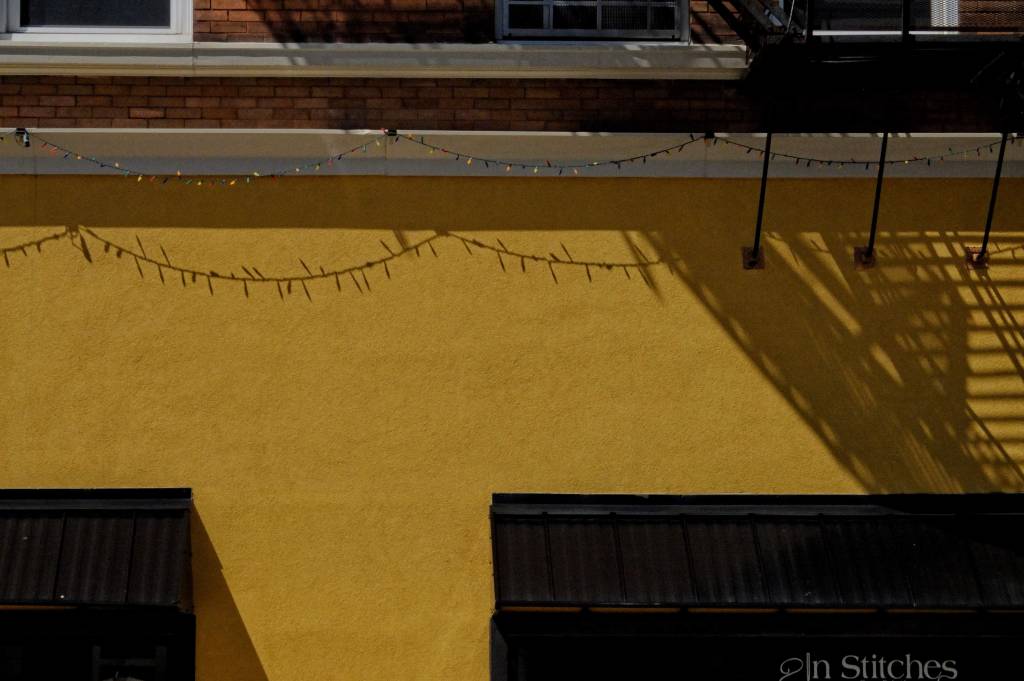
Happily, there was a nice detail worth photographing. The shadow of a string of holiday lights made a nice filigree in an abstract block of color and darkness. It’s not entirely satisfying; it’s like eating croutons that have no garlic. Better than nothing.

It’s got the crunch, but lacks flavor.

But I’ve been told patience is my only redeeming quality (seriously, a million years ago when I was in middle school, in trouble again, having waited in an uncomfortable chair for a long chunk of time for the Boys Advisor to lecture and chastise me for some offense, I was told that patience was my only redeeming quality…and I’ve clung to that one quality ever since), so I decided to wander off and return later when the offending SUV would be gone.

And that’s what I did. I kept walking and shot a few more photos, including this bizarre doorway of a shop that had gone out of business and was blocked by a Port-a-Potty. There’s a sort of warped genius at work there.

Somebody thought, “We’ve got a doorway, we’ve got a port-a-potty, let’s put them together.”

And when I eventually returned to the mustard-colored building? The goddamned white SUV was still there. Not only that, somebody had parked a blue trike motorcycle in the adjoining parking space. I tried not to take it personally, but it hurt. I don’t know what’s wrong with these people. I still couldn’t stomach the idea of photographing that appalling SUV, but I could swallow the blue trike. It allowed me to get a bit of that glorious fire escape shadow. And there was a blue doorway behind the trike, and a rather nice arch overhead, both of which mitigated the offence. Well, somewhat mitigated it.

Okay, but at least I spared you the goddamn SUV.

Life is unfair and full of disappointment. But in a world of white SUVs, there’s also mustard-colored corner shops and doorways blocked by Port-a-Potties. There’s always going to be something around the corner…and you never know what it’s going to be. That’s why we walk around with a camera, right? It’s the philosophy of photogr…ooh. Photolosophy.

Okay. I like that. I’m almost certainly not the first person to come up with that term, but I’m not going to Google it. Not Googling is part of my photolosophy.

Addendum: MDavis commented on the “crisp striping on the trash can in the first photo.” I also found that appealing. Unfortunately, as I noted in my reply, the hurried photo I shot didn’t quite come together. The elements are all there, but it just doesn’t have any harmony. Still, here it is:

yes, I watched civil war and have thoughts

Okay, first? There be SPOILERS here. If you want to see the Alex Garland film Civil War with innocent eyes, then DON’T READ THIS.

Second, Civil War is NOT a movie about how the United States split up into various factions. In fact, you can basically ignore the underlying premise of the story. It’s just not very important. Well, it’s not important to the story. Sure, it’s weird as fuck that California and Texas have somehow joined together to overthrow the fascist government of the United States (and even weirder that–and I swear I’m NOT making this up–they are supported by the armed forces of Florida), but none of that really matters. It could have been Wakanda and Ruritania teaming up to fight against Fredonia and the story would be the same.

Because this is a movie about two journalists and two news photographers covering a story. That’s basically it. They don’t take any moral or political stance; they’re simply documenting and reporting what they see. And what they see is pretty fucking awful.

It’s also a sort of road movie. Instead of a traditional plot, this movie is a series of related vignettes. As the four make their way from New York City to Washington, DC, they encounter a series of deeply localized situations. Here’s a gas station controlled by a few guys who maybe belong to some sort of community militia, there’s a town where life goes on without any apparent awareness that a civil war is taking place (until you notice the snipers on a rooftop), and over there are some uniformed sociopaths quietly filling a mass grave.

Obviously, the four characters are affected by these scenarios. The two journalists–one a sort of adrenaline junkie, the other an older obese man at the end of his career–are an important part of the story, but they’re essentially supporting roles. The ‘stars’ of the movie are the photographers. The journalists just have to observe and report; the photographers have to get the photos, which requires them to expose themselves to the action.

This was the aspect of the film I was most interested in. Unlike a lot of movies in which an actor pretends to be a photographer, Kirsten Dunst and Cailee Spaeny clearly knew how to hold a camera. While I’m skeptical that a photographer–even a rookie–would rely on a 1980s-era Nikon FE2 film camera (without a motor drive, no less) in a modern combat situation, I wasn’t particularly troubled by it. After all, the FE2 was Don McCullin’s camera of choice in Vietnam, so I assume that choice was no accident. Kirsten Dunst’s more modern Sony A7 camera bodies made a lot more sense, although I’m not convinced an experienced conflict photographer would be running around during close quarters combat toting a camera with a massive and highly visible 70-200mm zoom lens.

But overall, both actors looked natural using their cameras. There was no sense that the cameras were just being treated as props. And I have to say, I got a kick out of the fact that Kirsten Dunst (like me) has a dominant left eye–which is sort of inconvenient for a photographer.

I was especially pleased when the film referenced Lee Miller, one of the pioneering women photojournalists during World War 2. And doubly pleased by a brief early scene that was (intentionally, I hope) a callback to Miller. The scene shows Kirsten Dunst in a bathtub, which I found was reminiscent of the famous photograph of Lee Miller sitting in Hitler’s bathtub on the day he committed suicide.

My only real complaint about the film is that the climactic scene was predictable–and frankly, that’s a pretty small complaint. Fairly early in the story, Jessie (the rookie) asks Lee (the veteran) if she’d photograph Jessie’s body if she was killed in action. Lee responds, “What do you think?” (or words to that effect). At that point, it was clear that one of them would be killed and the other would shoot the photograph. It could have played out either way, but it seemed more likely there’d be a sort of ‘passing the torch’ moment in which the rookie becomes the veteran. It’s a seriously stupid scene. Jessie exposes herself to gunfire and Lee, instead of tackling her and removing both of them as a target, stands in front of Jessie, facing her (her back to the gunfire). It makes for a nice photo of Lee’s face as she’s being killed, but is still stupid.

However, the final shot of the film–the shot on the screen as the credits roll–is perfect. In the final scene, Jessie photographs some troops summarily executing the president. It’s a very matter-of-fact scene, not particularly dramatic. As the credits roll, though, we see the shot taken after the execution. It’s depicted as if the image is very slowly being developed in a darkroom–the gradual revealing of the scene. It’s a classic military trophy photo, similar to every awful trophy photo shot in every war. Soldiers standing over a body, smiling proudly.

That final image is disgusting. It’s brilliant. It’s horrible. It’s perfect in that it says everything that needs to be said about war and violence. THAT is the shot that people need to think about and discuss. It reminds us that violence is the worst form of seduction.

one lens, monochrome

I was maybe 16 years old when I first borrowed my momma’s rangefinder camera and began shooting photographs. It was a completely manual film camera, which meant I had to learn the actual mechanics of photography–the relationships between shutter speed, aperture, and film speed; how the elements interact to determine the depth of field; how to use a light meter.

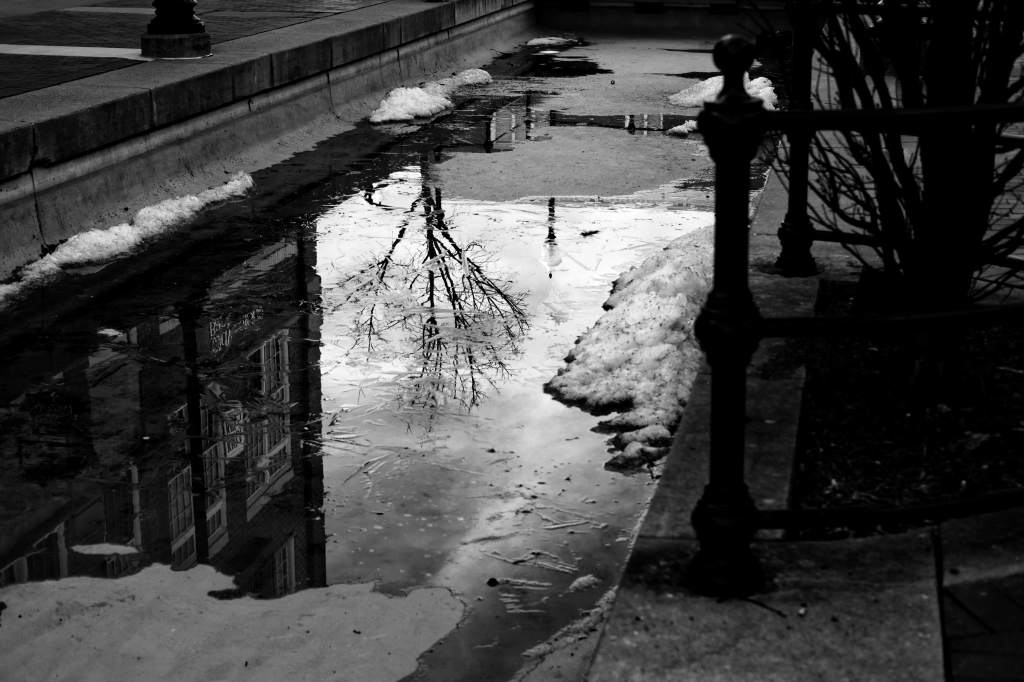
An obligatory puddle reflection photo

Basically, I spent a decade or so just goofing around with cameras. Then, for reasons I can’t recall, I decided to take it all a bit more seriously. I bought my first serious camera (a Canon A1) and I began to teach myself, in a semi-methodical way, the practice of photography.

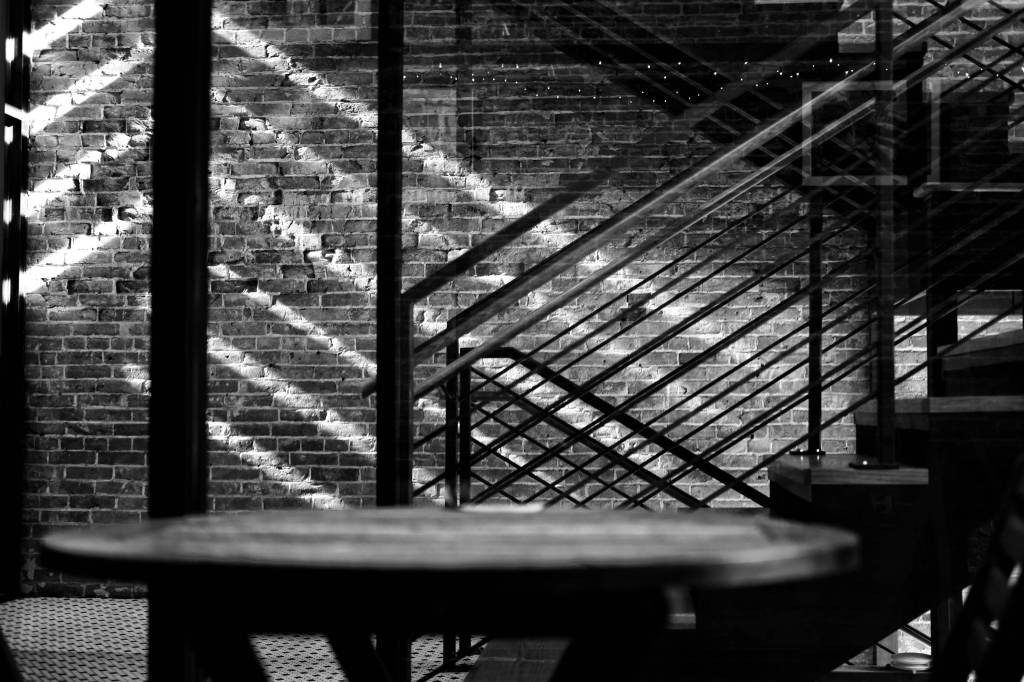
Light getting frisky in an entryway

I say ‘semi-methodical’ because I set a sort of loose curriculum for myself. I’d periodically focus on some specific aspect of photography. Portraiture, for example, or capturing motion. When I decided to become more deliberate in terms of composition, I put a 50mm lens on the camera, put the camera on a tripod, and kept it there for a couple of months.
Sometimes you just have to shoot in portrait format.

It was a massive pain in the ass. But it radically changed my approach to shooting. I learned to pay more attention to detail, to be aware of the corners of the compositional frame, to notice distractions within the frame, to be patient, to pre-visualize the composition. Having a prime lens on a tripod slows you down. Instead of simply changing the composition by taking a step forward, or to the left, or squatting down, I’d have to pick up the tripod and move it. Then possibly adjust the height of the camera, or make sure it’s level, or tilting it up or down. It meant thinking about the composition before shooting, and trying to put myself in the right place to avoid any hassle.
Light, reflections, shadows can get weird

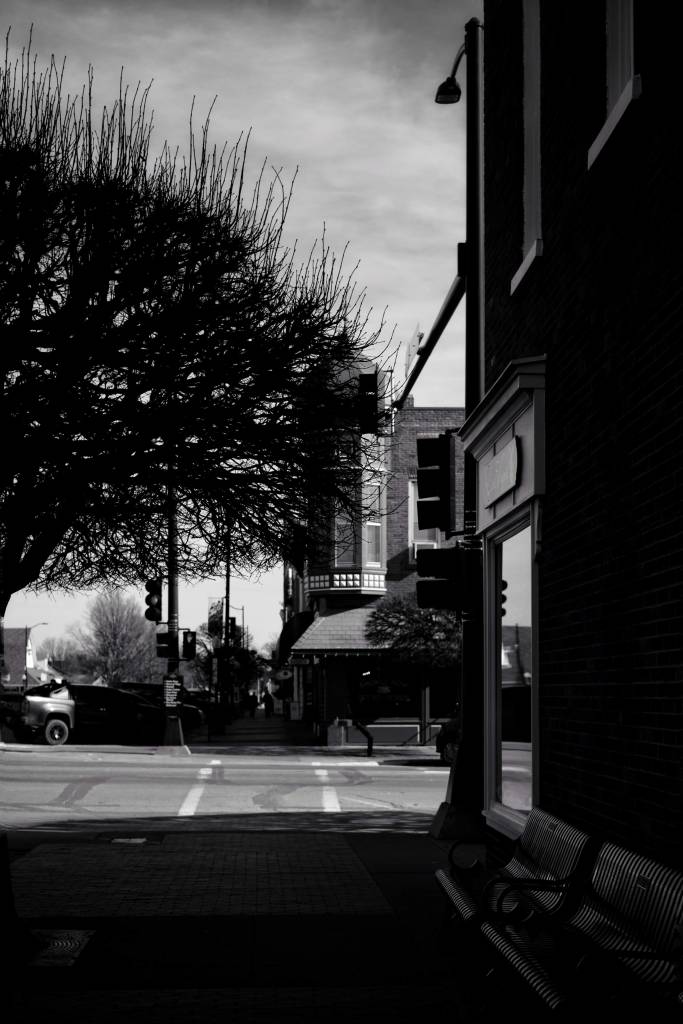
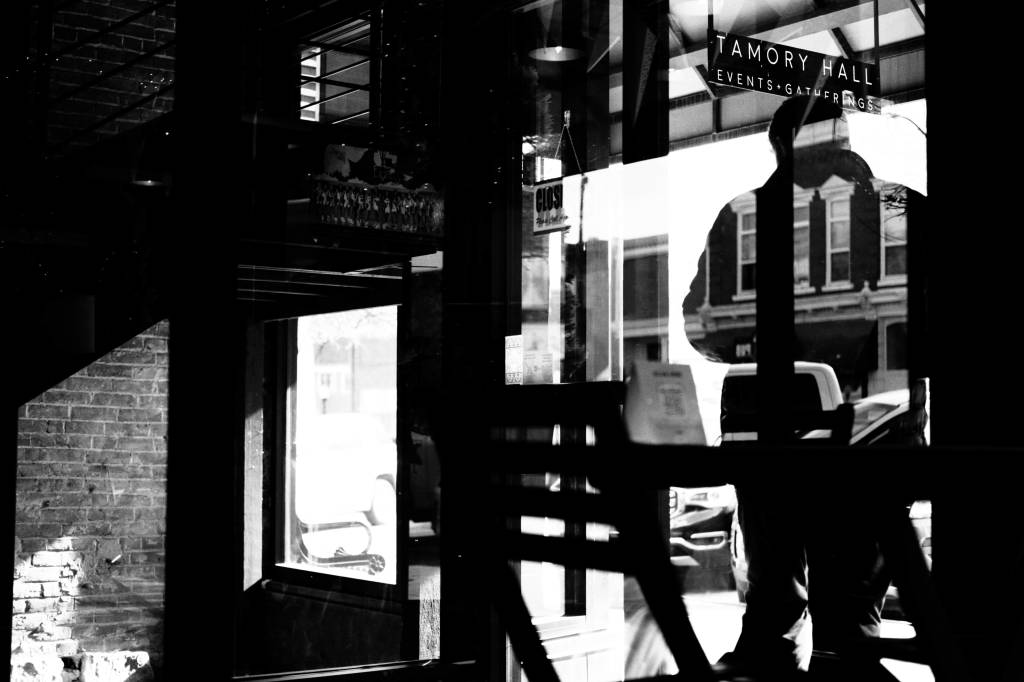
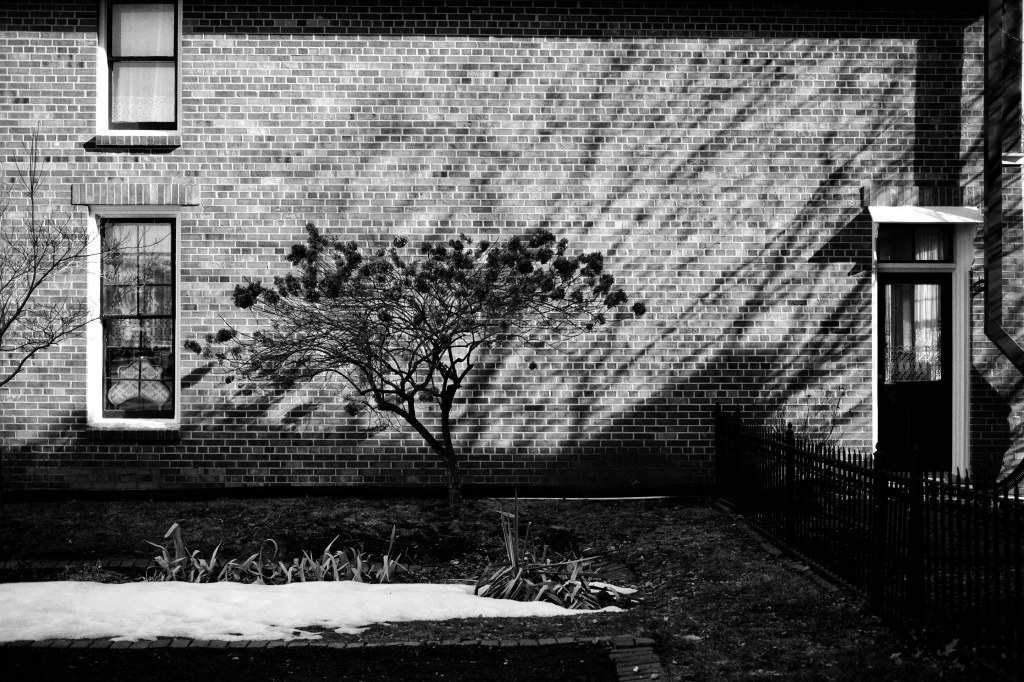
Now I’m thinking about doing something similar. I bought an inexpensive 35mm prime lens with the notion of putting it on another old Fujifilm camera (an X-T10) and leaving it there. Again, the idea is to force me to be more deliberate when it comes to composition. I’m also considering using that camera to shoot exclusively in black-and-white, to force myself to pay more attention to line, form, shape, and shadow.
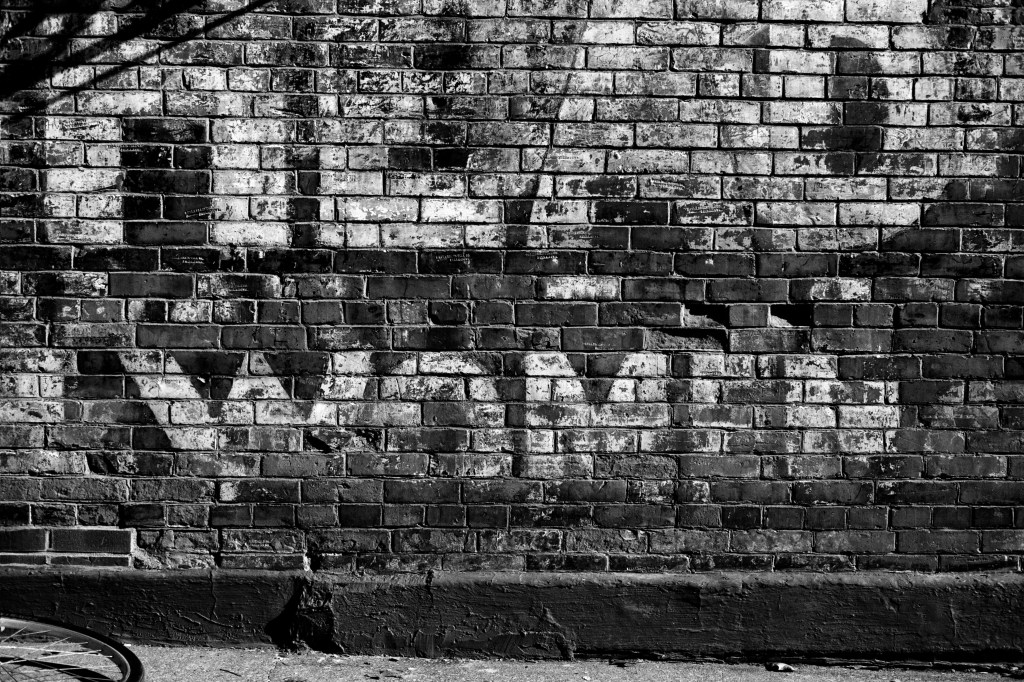
Parked car prevented me from getting the entire ghost sign.

So far, I’ve only taken the X-T10 out once with those restrictions, and I have to say the results were mixed. I’d forgotten some very obvious problems with that approach. For example, physical obstructions can’t be negotiated. If, for example, a parked car makes it impossible to step as far back as you need to get everything you want in the frame, you’re just fucked. And working in monochrome denies you the joy of shooting a photo simply because the colors make something interesting. There was a coffee shop window with yellow, blue, and red vinyl seats, and I was terribly tempted to switch to a color profile. I told myself I can always go back with another camera. Which might be a lie.

Monochrome prevents you from seeing how impossibly green the plants in the snow were.

Shooting with a single prime lens turned out to be annoying as fuck. But it was also weirdly fun. I don’t know how long I’ll continue to abide by my self-imposed ‘prime lens in monochrome’ restrictions (and, of course, I’ll continue to shoot with my older and tinier Fujifilm X10), but my first foray was fun. And fun is what it’s about, right?

At least it is for me.

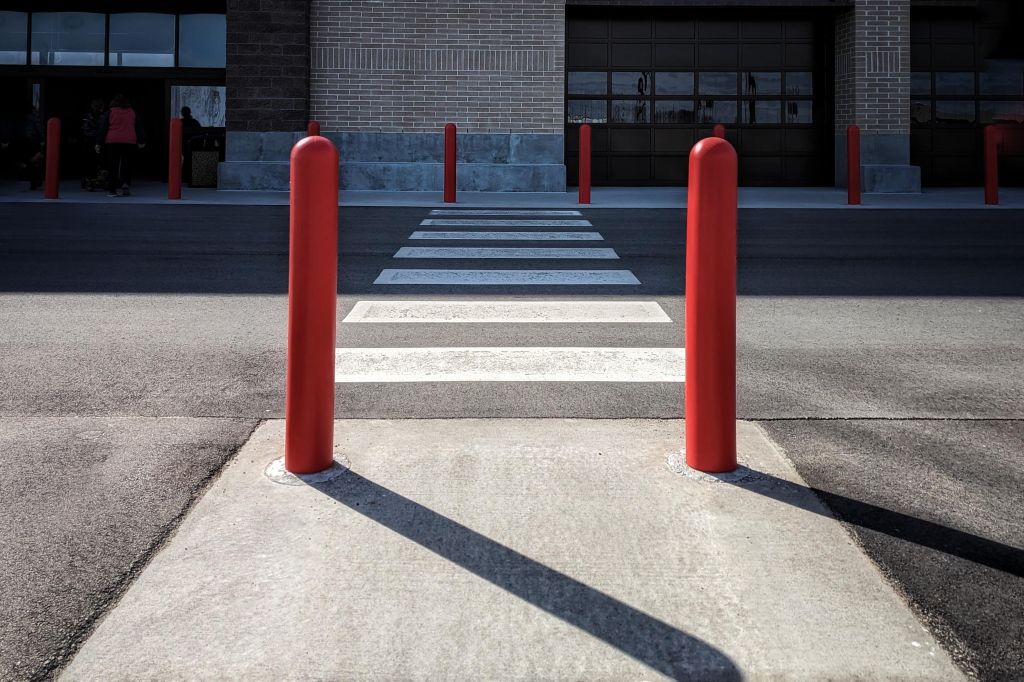
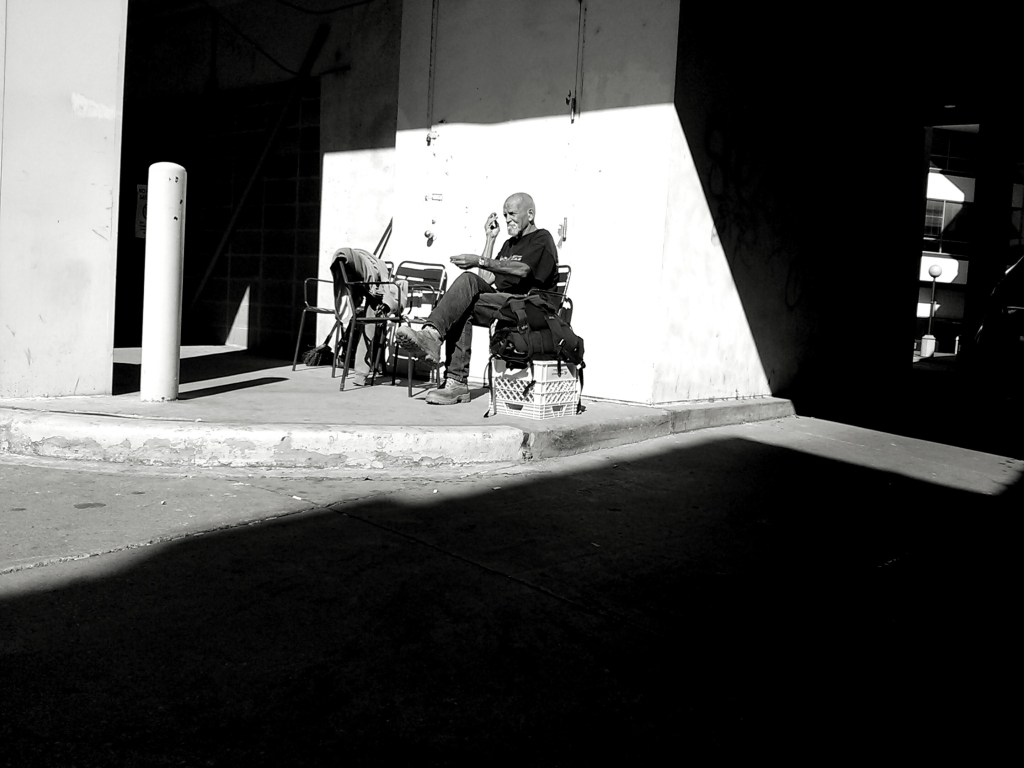
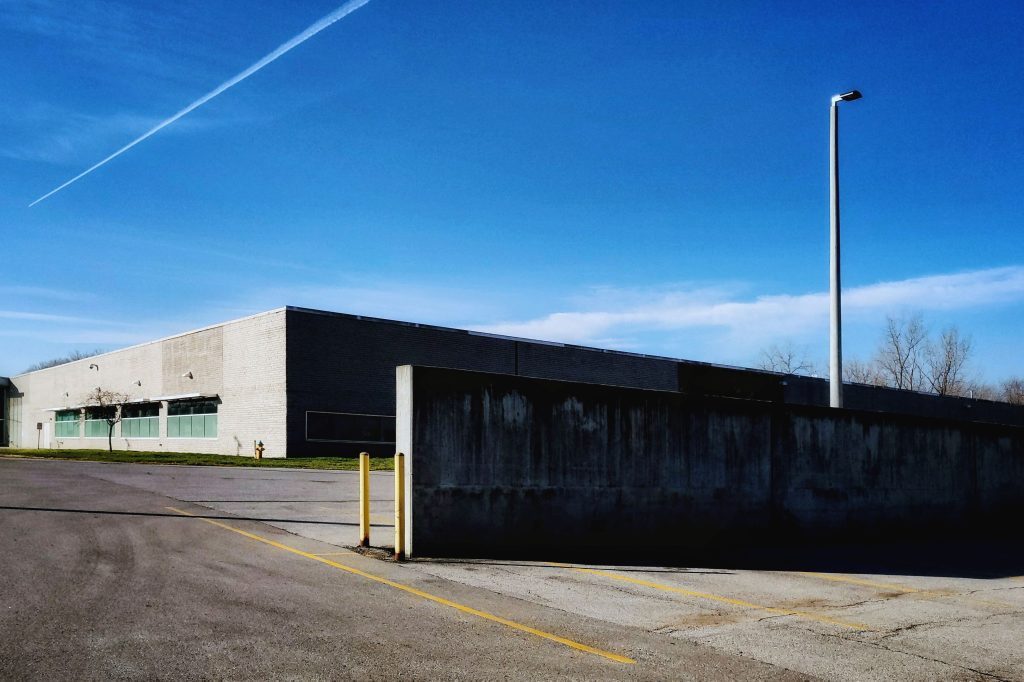
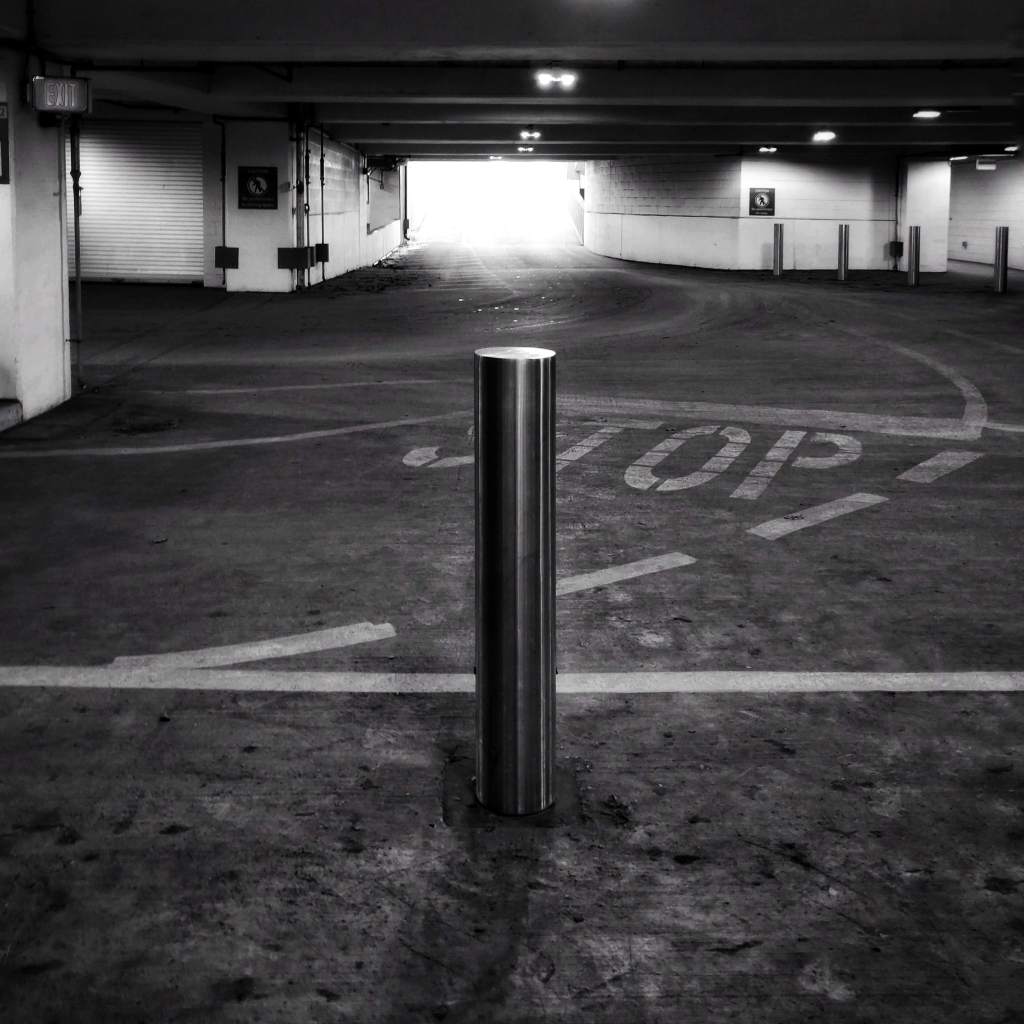
yes, i have a thing for bollards

I don’t know when it started, this thing for bollards. Out of curiosity, I did a quick search through my digital photographs and found a photograph of a bollard from 2007. I know I’ve shot photos of bollards with film cameras, including instant film cameras. I’ve photographed them in color and in black-and-white, in several formats (square, 3:2, 4:3), in all sorts of environments, in all manner of weather, using whatever camera I happened to have at hand. So yeah, my bollard fascination has been active for at least a couple of decades.

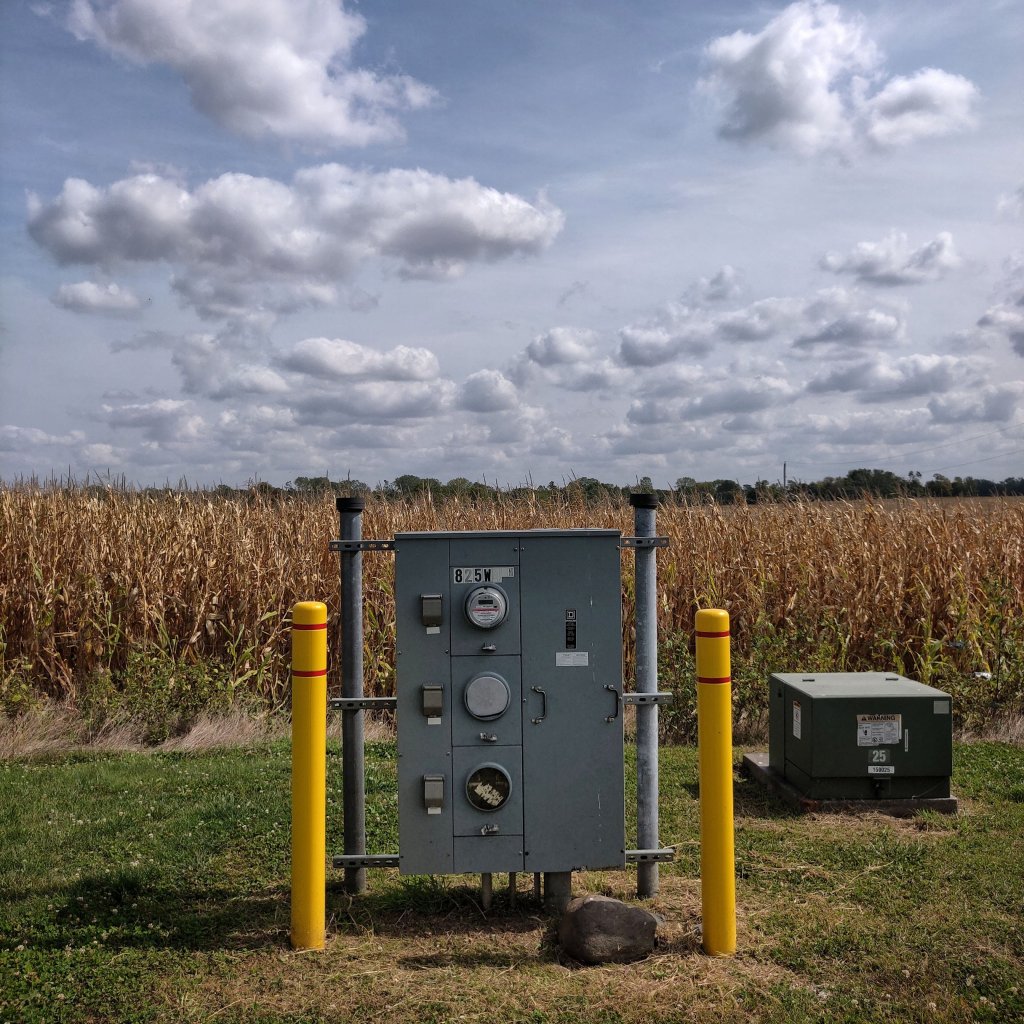
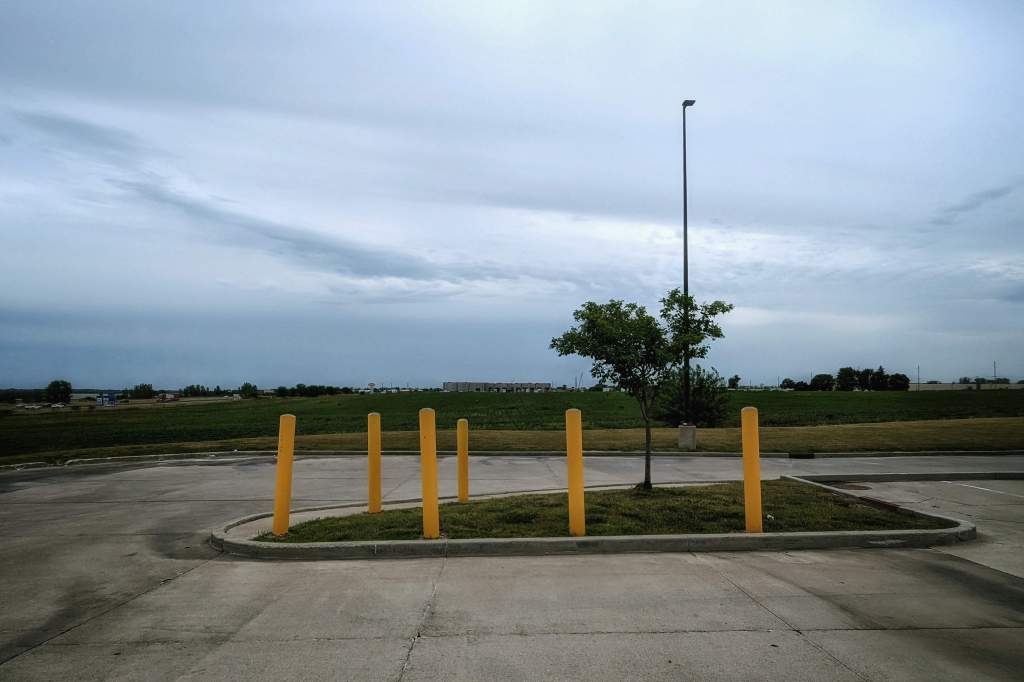
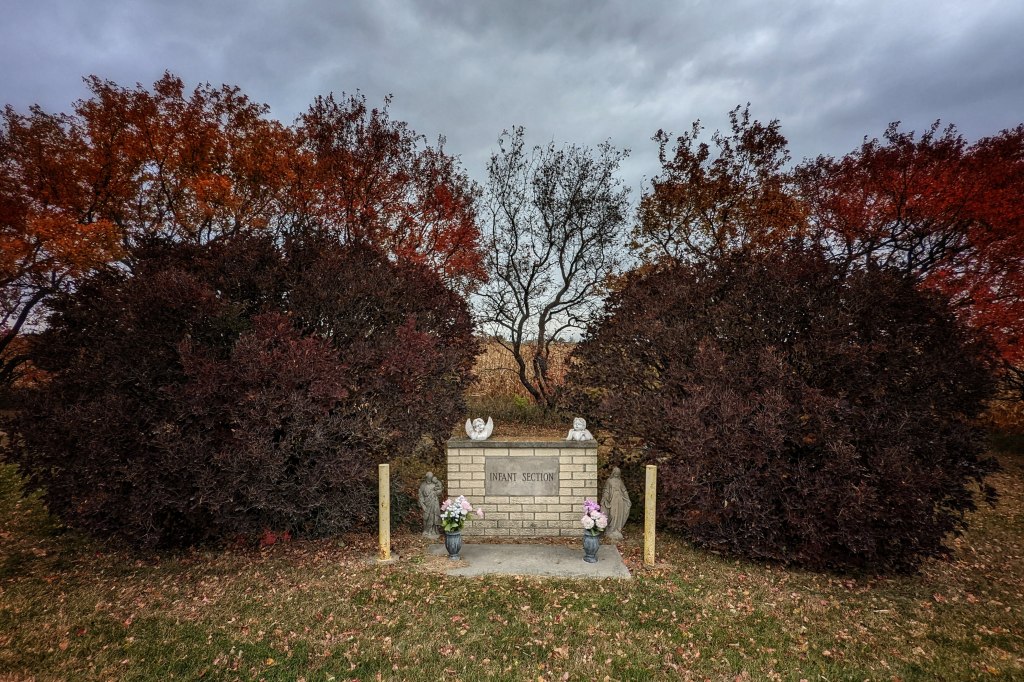
Why bollards? No idea. I mean, sure, I can come up with lots of justifications for why I photograph them. They’re an interesting compositional form. They’re often present in uniform groups, so there can be a nice repetitive element to them. They’re frequently painted in bright colors—and when they’re not, when they’re old and battered with weathered paint, they can add a sort of wabi-sabi aura to an image.

But like I said, those are justifications for including them in a photo. The fact is, I’ve no idea when or why bollards as a concept attached themselves to my brain like some sort of remora. What’s weird—well, one of the many weird things—is that so many other folks are aware of my interest in and affection for bollards. I’ve had friends from all over the globe shoot and photographs of the local bollards they encounter just for my interest. Do I talk about bollards that much? I guess I must.

Maybe my interest in bollards attracted the attention of other folks partly because so many people had no idea that all those banged up ‘posts’ they see everywhere every day actually have a name. Bollard, it comes from the Old Norse term bolr, meaning “the trunk of a tree”, and the suffix -ard, which generally acts as an attributive pejorative intensifier (as in ‘coward’ being one who cowers, or ‘drunkard’ being one who is often drunk, or even ‘bastard’ which originally referred to “someone conceived on a pack-saddle” (French bast), since they were used as makeshift beds).

Originally, bollards were tree trunks used by Vikings to moor their ships and boats. Over time, the term was used to describe the posts on docks used for that same purpose. By the early 1700s, urban bollards began to be used to constrain horse and wagon traffic. Now the term bollard is applied mostly to posts used to protect objects (or people) from being struck by carelessly driven vehicles.

Bollards are everywhere. The fact that they’re ubiquitous makes them almost invisible. Unless, of course, you look for them. Some bollards are decorative—brightly colored or metallic and shiny. Some are sort of disguised; there’s a small, family-owned ice cream joint not too far from where I live that has bollards shaped like ice cream cones. But most bollards are plain, unadorned, simple, practical, utilitarian. They’re not there to please the eye, but to serve a purpose.

In my mind, bollards are sort of heroic. Yes, that’s right…I’ve romanticized bollards. I find a weird, sad, lonely, powerful beauty in them. They may be weather-beaten, banged up, isolated and ignored, damaged, with chipped paint, but they’re still standing there, doing their job. Protecting stuff.

No matter how abused or battered they are, bollards provide the illusion of permanence. They’re fucking solid. But at the same time, the very fact that they’re so often damaged exposes the lie of permanence. Bollards will stand a very long time, but eventually they’ll be removed and replaced. And very likely, nobody will notice when that happens.

I’m also attracted to bollards because they’re excellent examples of the humanness of things. They’re thoughtful, deliberate infrastructure. Somebody deliberately put them where they are. Somebody decided there was something that needed to be protected, and chose a specific type of bollard to be placed in specific patterns to keep that ‘something’ safe. The humanness of things is always there, if you look for it.

So, yeah, bollards. They’re not pretty. They’re common, unrefined, even crude. They don’t need your respect. But they deserve it.

…and be there

F/8 and be there. That’s the classic photographer’s maxim. It’s usually attributed to Arthur Fellig (better known as Weegee), though it’s highly unlikely he actually said it. Weegee was famous for what was called ‘spot’ or ‘moment’ photography in the 1930s and 40s. He made it his business for being at the right spot for newsworthy moments and being prepared to photograph them. A camera aperture of F/8 is generally considered an all-purpose aperture; it allows in enough light for a decent exposure while providing a relatively broad depth of field. So how do you get a good ‘spot’ photo? F/8 and be there.

In fact, Weegee routinely shot most of his famous photos with his massive 4×5 Speed Graphic camera set at F/16 or F/22. Not that the actual aperture he used matters. What matters is the concept is solid. Be in the right spot with usable camera settings, and you’ll probably get a good shot.

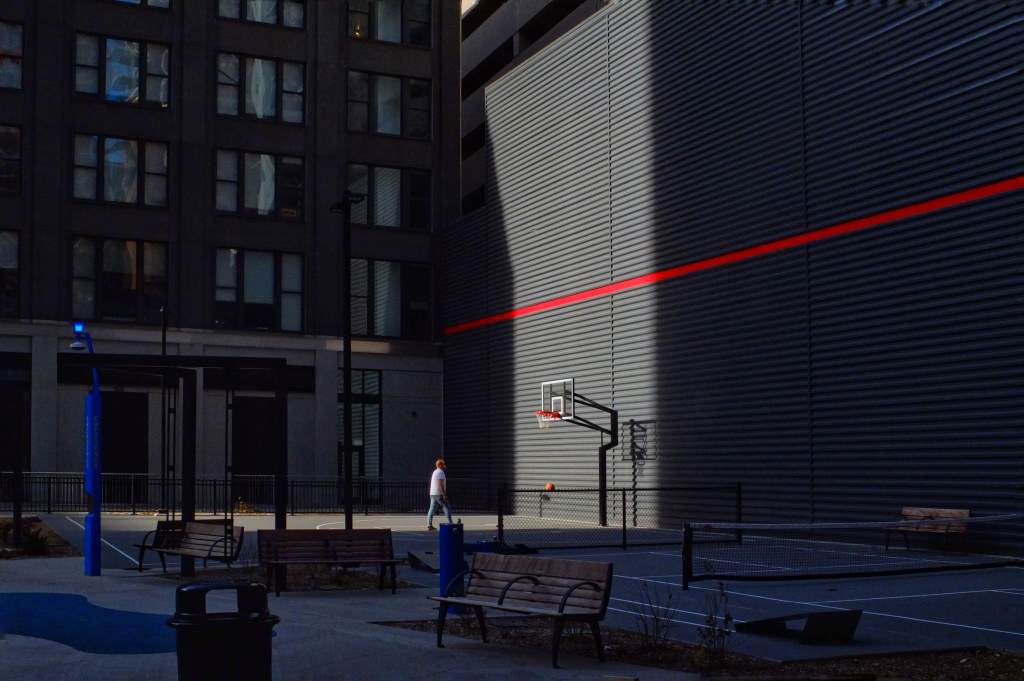
Me, I had my 12-year-old Fujifilm X10 set to F/5.6 in case I came across some random right spot. I was just idly wandering around the city when I heard the distinctive sound of a basketball being dribbled. I followed the sound. There’s a small urban recreation area in Des Moines with a single pickleball court, a ping pong table, a few tables set up for chess and backgammon, and a basketball half-court. This is what I saw when I came around a corner.

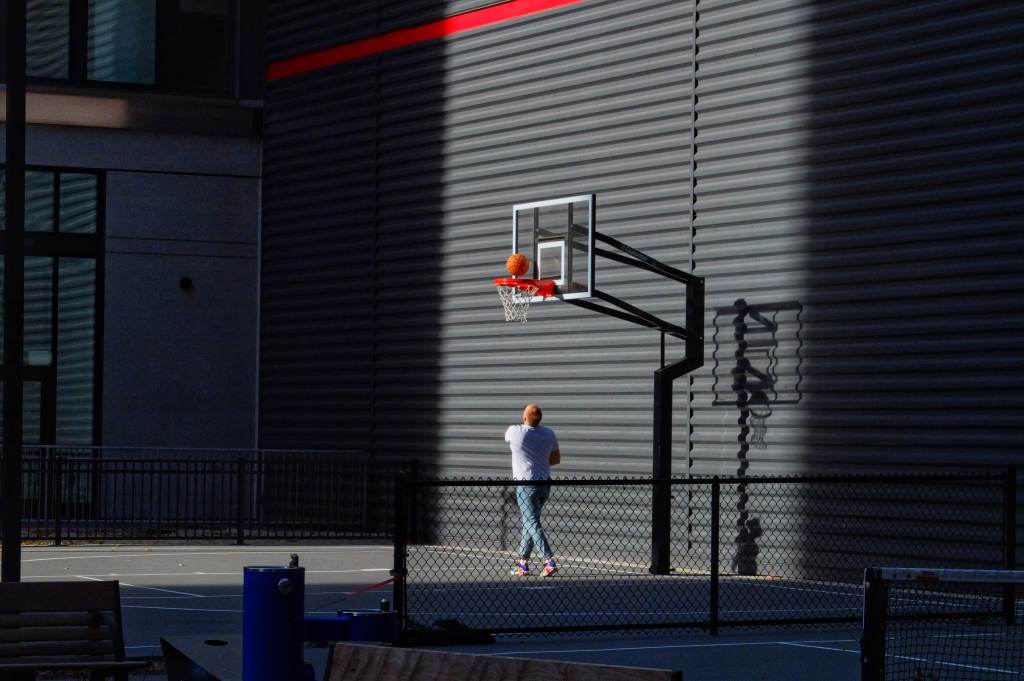
There was a guy, all by himself, dribbling a basketball, juking around imaginary defenders, shooting baskets. He was in the shade and almost invisible, but the setting itself was so stark and had such a startling red stripe that I turned on my camera and kept approaching, hoping he’d move into the sunlight. And he did.

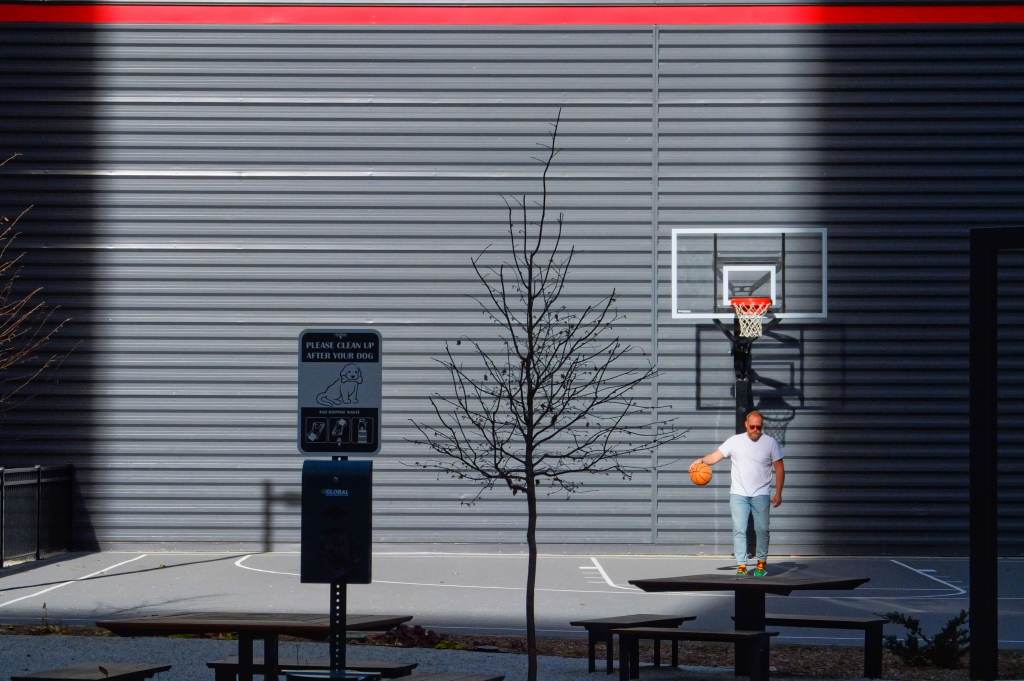
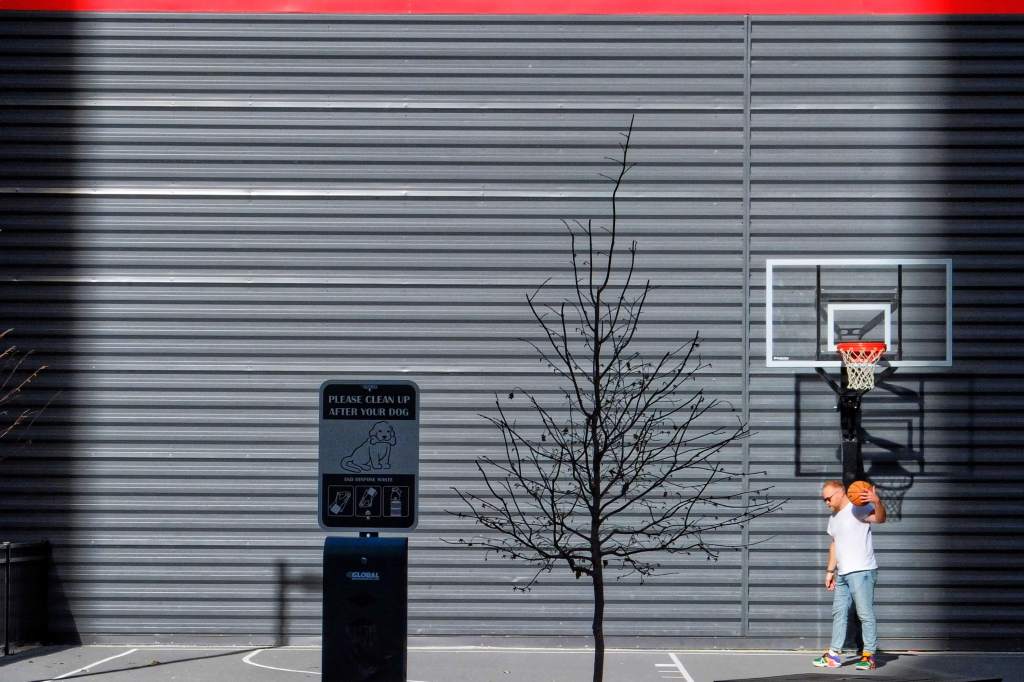
I kept edging closer. I refused to look down to double-check the camera settings for fear he’d move into the sunlight and I’d miss the shot. He kept dribbling and juking and shooting, and every time he moved into the sunlight, I snapped a photo.

I only got five shots before he stepped into the shadow to check his watch. Then he put on a jacket, collected his basketball, and walked off. My first shot was as 12:44, the last at 12:45. Two minutes at most. Probably closer to seventy or eighty seconds, most of which was spent walking forward, camera ready, trying to maneuver the guy into the sunshine by wishing really really hard.

Once it was clear the moment was gone, I started desperately chimping* my camera’s playback, hoping I’d managed to get at least one shot that was worthwhile. In one of the shots, the guy was too obscured by the shadow. The other four? They all turned out.

Are they great photographs? No. But when you’re shooting a photo, you generally have an idealized version of the resulting image in your mind. These four photographs are pretty much what I was hoping they’d be. Pretty much. I have some niggling complaints about the final photo, but overall I was ridiculously pleased.

Photographing some random guy shooting baskets on his lunch hour is a small thing. But it’s the sort of thing that keeps photographers walking around with a camera. There’s a definite dopamine jolt when you get the shot right. It doesn’t even matter what the shot is about; you just want to recreate that feeling again. That’s exactly why I was idly wandering around the city and exactly why my camera set to my default daytime aperture of F/5.6.

I’m no Weegee, but I want to be ready when I’m there, wherever there happens to be.

EDITORIAL NOTE: Chimping, for non-photographers, is the act of looking down at the screen of your digital camera while reviewing the shots you’ve just made, and making chimp-like “Ooh ooh” noises as you do it.

a tale of two railroad crossings

Okay, the title is a lie. There’s only one railroad crossing in this story. But the title was too good to pass up. Sue me.

Lately we’ve been seeing a lot of Nazi shit again. Some of it’s related to the appalling situation in Israel, of course, because Nazis will always find some way to contribute to whatever hate is taking place. Some of it comes from the Republican Party.

Seriously, the leadership of the Texas Republican Party voted 32-29 to reject a resolution saying members of the Texas GOP should “have no association whatsoever with any individual or organization that is known to espouse anti-Semitism [sic], pro-Nazi sympathies, or Holocaust denial.” They didn’t say it was fine to hang out with Nazis; they just decided hanging out with Nazis wasn’t important enough to make a fuss over.

You may be wondering, Greg, old sock, what’s that got to do with railroad crossings? I’m about to tell you.

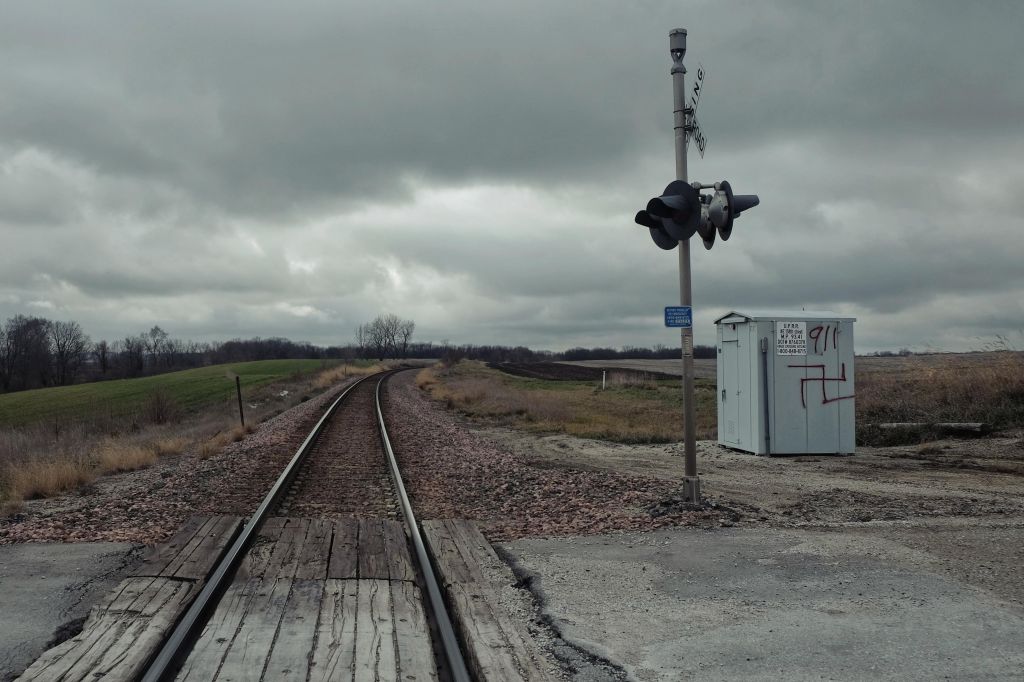
A few years ago I was out noodling around in the countryside and happened across a swastika painted on a shed beside a railroad crossing. So I did what anybody would do. I stopped and took a few photographs of it.

It was one of those cold, drizzly, dreary December days, which made for a nicely dramatic photograph. I only took three or four shots (because it was cold, drizzly, and dreary). Just as I was about to get back in the car, a sheriff’s deputy arrived. I waited and waved. He got out and politely asked me what I was doing. I told him I was shooting photographs. In the past, I’ve had a few encounters with the police who wanted to see my photos, so I prepared myself to refuse that request (you know…just on principle). Instead, he said something like, “I hope you got your shots, because I’m here to paint over that swastika.”

I asked if I could photograph him doing that. He said he’d rather I didn’t. And because he was polite, I didn’t. I got back in my car and left. But I returned about twenty minutes later.

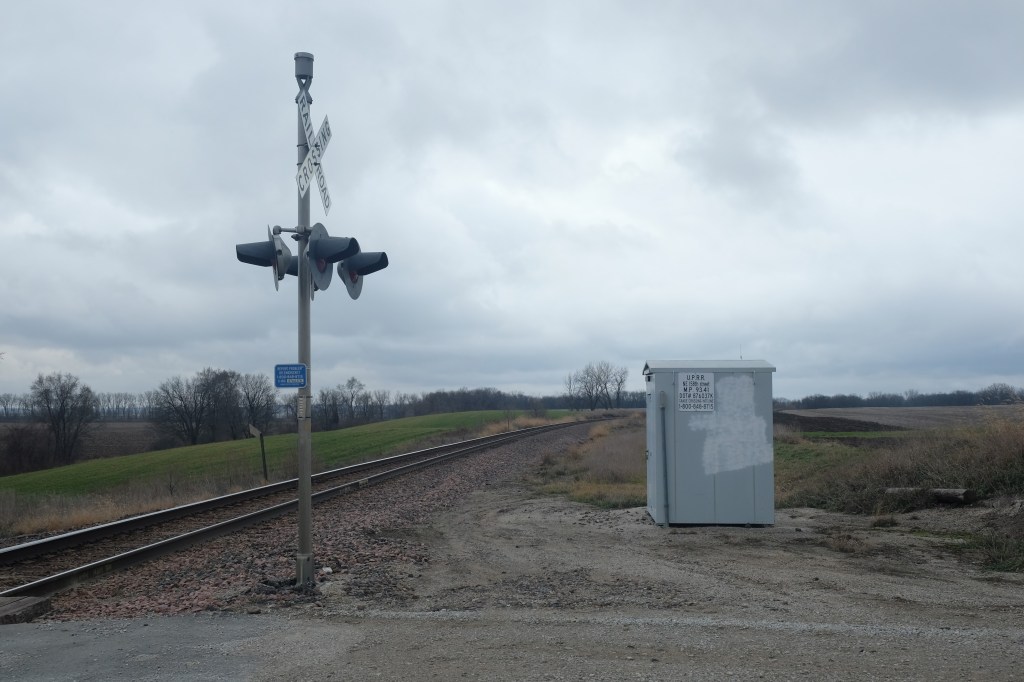
The deputy was gone. So was the swastika. It’s certainly not as interesting as a photograph, but socially and culturally, it’s a huge improvement.

I don’t know if somebody reported the swastika or if one of the local deputies spotted it while on patrol. But I was pleased that the sheriff’s office acted.

EDITORIAL NOTE: I was a criminal defense investigator for several years, which meant I was in an openly adversarial relationship with policing agencies. I don’t fully ascribe to the ACAB (all cops are bastards) view, but I’m painfully aware that all police officers have the capacity to be cast-iron bastards and often are. Because of that, I’m quietly thankful when I see any law enforcement person actually contributing to public safety without being a bastard about it.

box of glasses

I don’t know about you (seriously, I can in all honesty say that I absolutely do not know about you), but whenever I come across a box full of old eyeglasses, I fall victim to a sort of mild compulsion. I feel the need to put them on. It’s not an irresistible compulsion; I could probably hold out against it, if I really wanted to. But why would I?

Perhaps you also feel that same impulse when you come across a box full of old eyeglasses. It’s possible. But like I said, I don’t know about you.

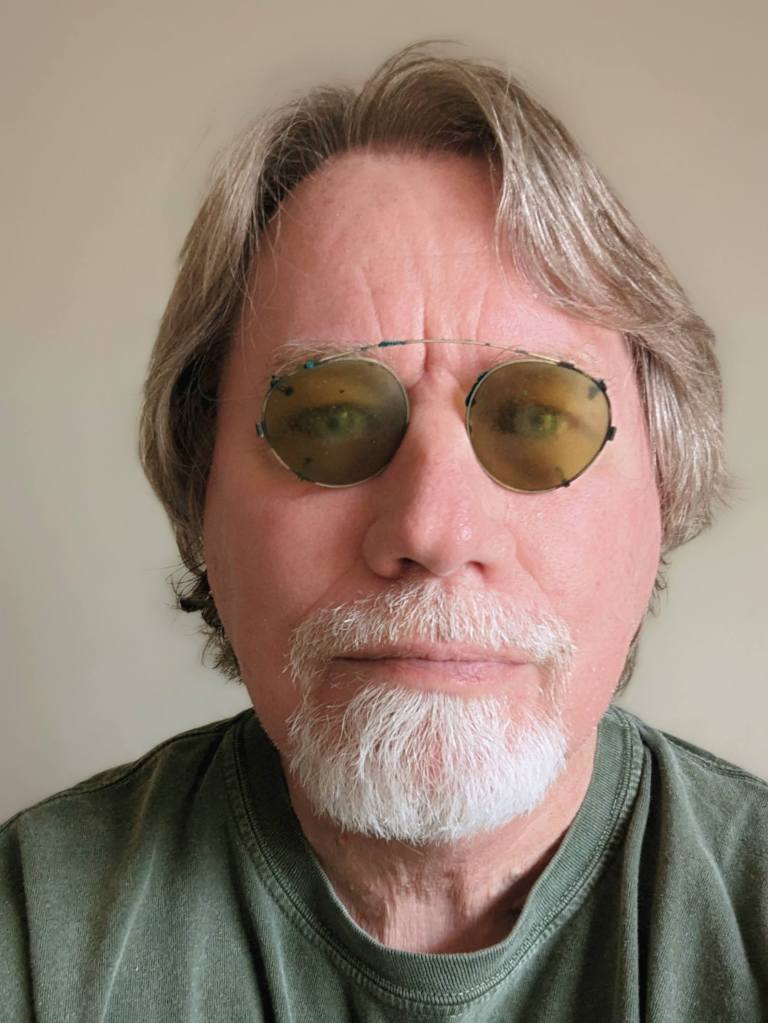
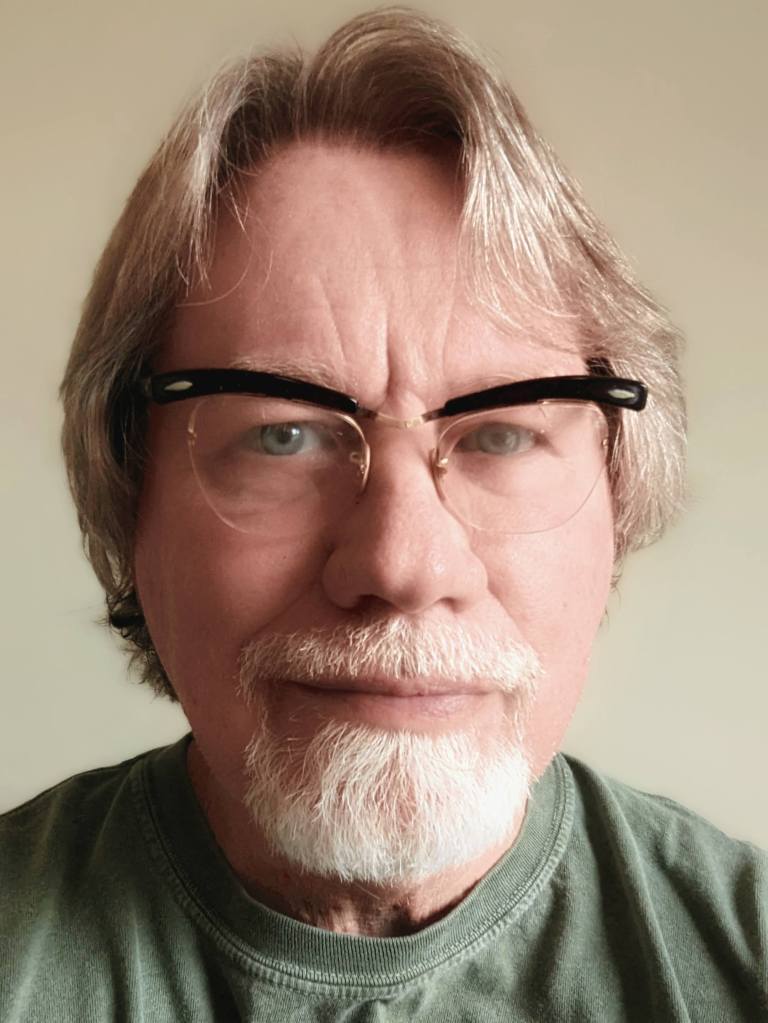
In any event, I did, in fact, recently come across a box full of old eyeglasses while clearing out some shelves in the garage. I don’t know how many pairs of glasses. Dozens, both men’s and women’s, both regular glasses and prescription sunglasses. And hey, I gave in to that compulsion. I gave in without any hesitation at all. I wanted to see what the world looked like through a series of lenses generated for other people.

[SPOILER: it looks blurry.]

And almost immediately I felt another mild compulsion: I wanted to see what they looked like on somebody’s face. But you can’t just ask somebody to sit and try on old eyeglasses that belonged to other people, all of whom are dead. You can’t ask somebody to do that just for your own amusement. I mean, you can ask them to do that, but it would be awfully presumptuous.

So instead, I turned to the Model of Primary Convenience. Me.

I don’t take many selfies. I know what I look like; I’ve had this same face all my life, so there’s nothing there for me to discover. And, in all honesty, I’m sort of uncomfortable taking photographs of myself (unless it’s a reflection in a window or something).

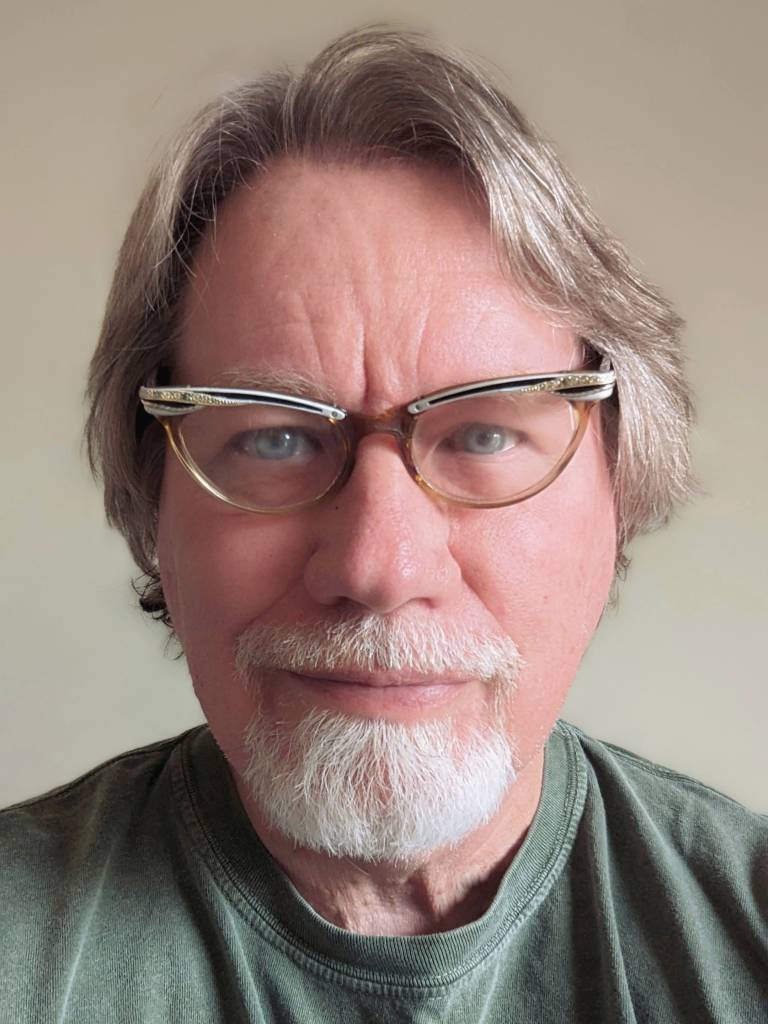
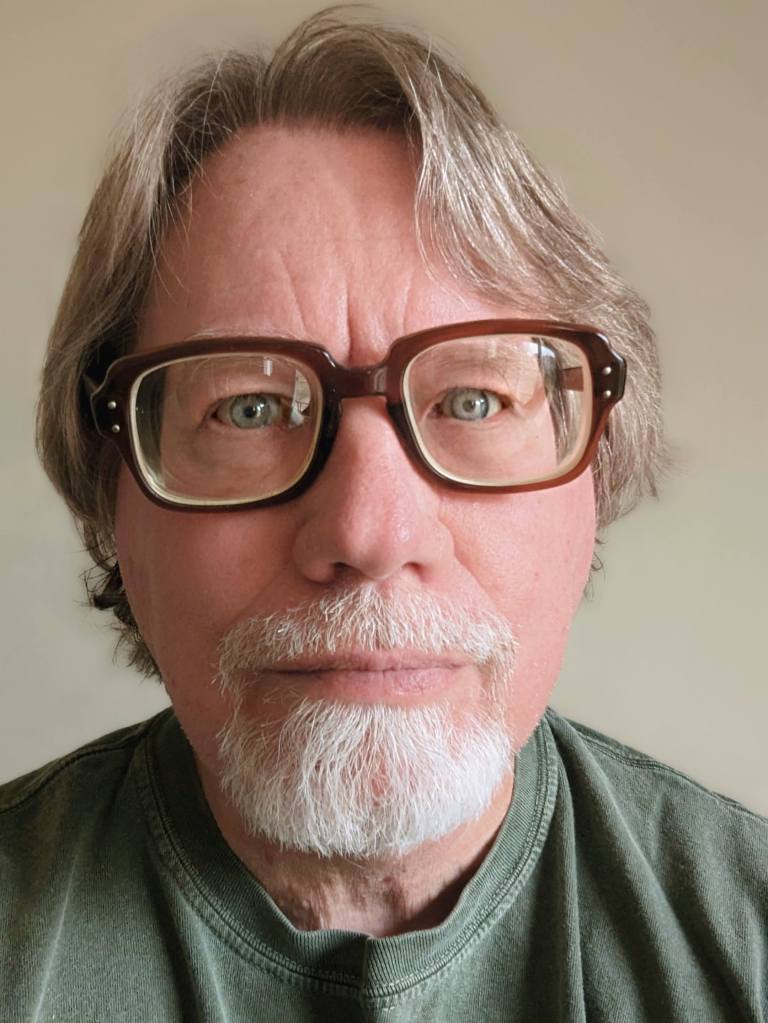
But there I was, under a mild compulsion, sitting at a table with a box full of eyeglasses and my Pixel phone in front of me. So, I put on the first pair of eyeglasses I pulled out of the box (women’s cat-eye glasses) and I took a selfie. And I looked at it. And it was sort of hilarious.

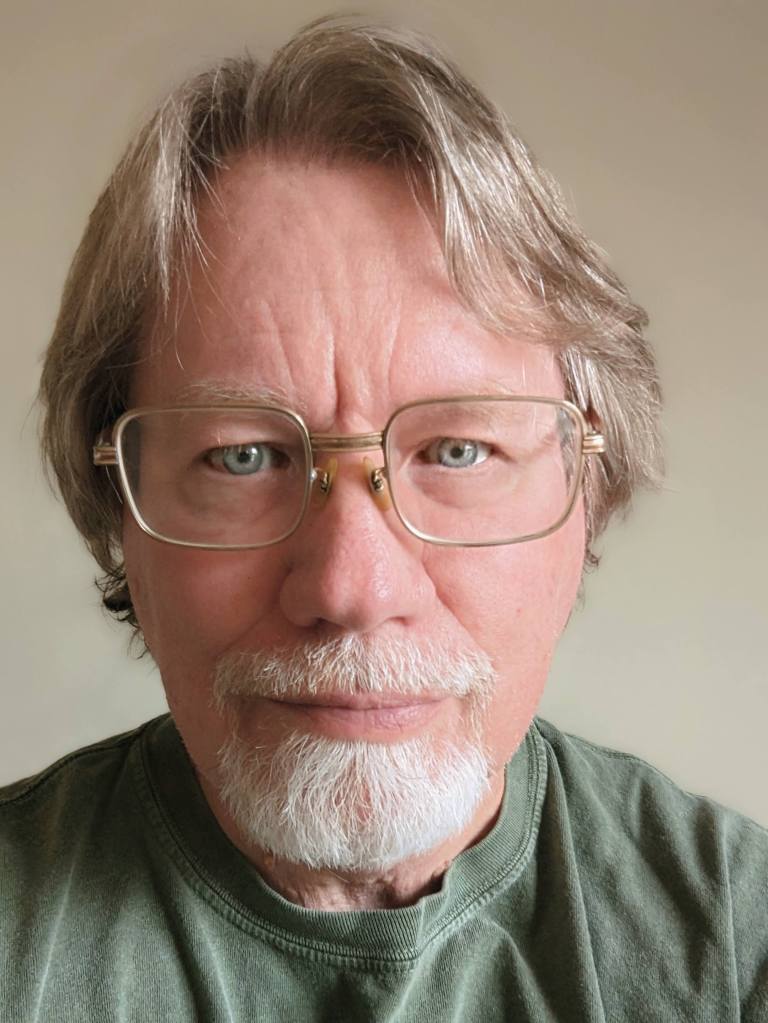
So I did it again, with a different pair of eyeglasses.

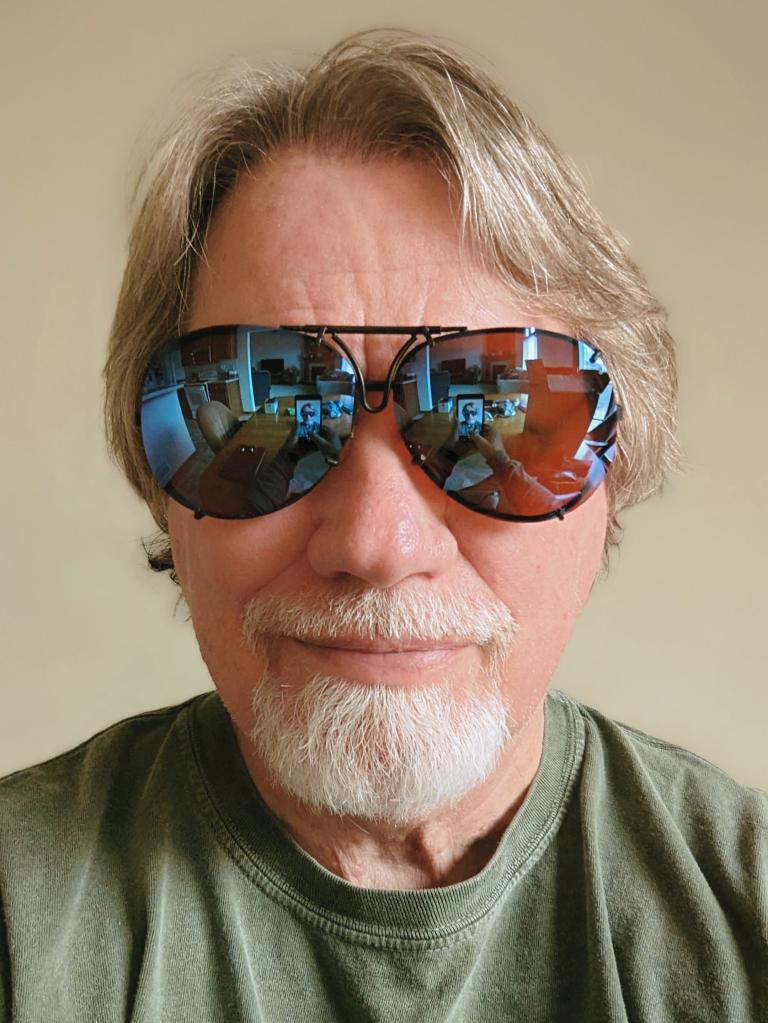
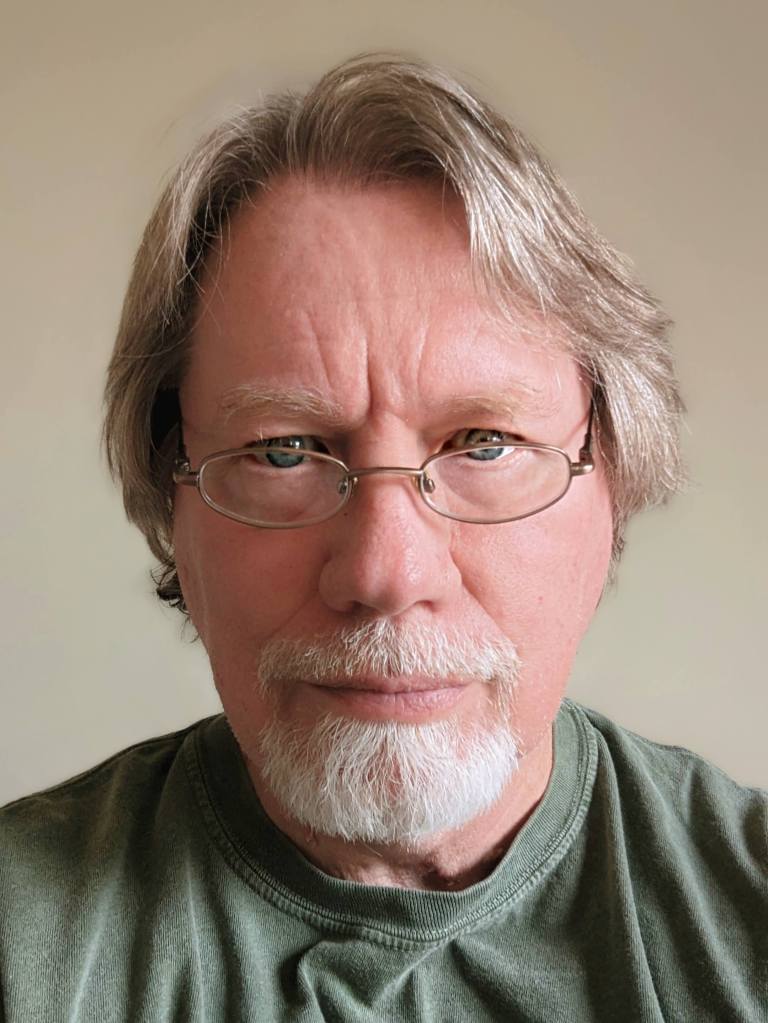
Here’s a True Thing about people who spend years shooting photographs: you sometimes stumble upon an idea that feels like it’s worth repeating. It becomes a project. Eventually, I tried on 25 different pairs of eyeglasses and took a selfie in each of them.

This wasn’t as simple as it sounds (and it sounds really simple). Lots of the glasses I put on were so strong they were disorienting. Others were so dark they were difficult to see through. I often had to guess when I was properly framed so I could press the shutter release (which, yes, I know, isn’t actually a shutter release; it was either call it a shutter release or the button, and the button makes it sound like I was launching a thermonuclear weapon).

I tried to maintain the same facial expression in all the photos because…well, I don’t really know. Some perverted notion of uniformity, maybe? Something to do with the notion of an internally consistent photo project. In any event, it was really difficult to maintain the same expression, partly because I kept wanting to laugh and partly because the glasses distorted my sense of reality to the degree that I often couldn’t see my expression clearly enough to maintain it.

Earlier, I wrote that I tried on twenty-five different pairs of eyeglasses and took a selfie in each of them. I probably tried on twice that many; I just didn’t take a selfie in all of them. A lot of the old eyeglasses were similar in design, so there was no point in photographing them. I mean, one pair of aviator-style glasses looks a lot like every other pair of aviator-style glasses.

A lot of those similar looking eyeglasses had radically different prescription strengths. It probably won’t surprise anybody to learn that trying on a few dozen different eyeglasses of various prescription levels will can you a whanging headache. So if I failed to keep my expression the same in all the photos–if, in some of the photos, I look confused or dazed or disoriented or dangerously unbalanced–now you know why.

I did all this entirely to entertain myself, of course. I’m sort of embarrassed to admit that’s my reason for doing a lot of the stuff I do. But having turned my personal amusement into something of a photo project–having shot a couple dozen selfies in various eyeglasses–I find myself thinking some of you might find it amusing as well.

Besides, I firmly believe in Stieglitz’s concept of practicing in public, of showing work that doesn’t quite meet your standards for what the work could be. He wrote:

[I]f one does not practice in public in reality, then in nine cases out of ten the world will never see the finished product of one’s work. Some people go on the assumption that if a thing is not a hundred percent perfect it should not be given to the world

Stieglitz talked a lot of bullshit, but he was spot on in this regard. I don’t feel any need for ‘the world’ to see the stuff I do, but I’m a firm believer in sharing anything I think somebody somewhere might find interesting. Even when it makes me look ridiculous.