the curious incident of the diner at midday

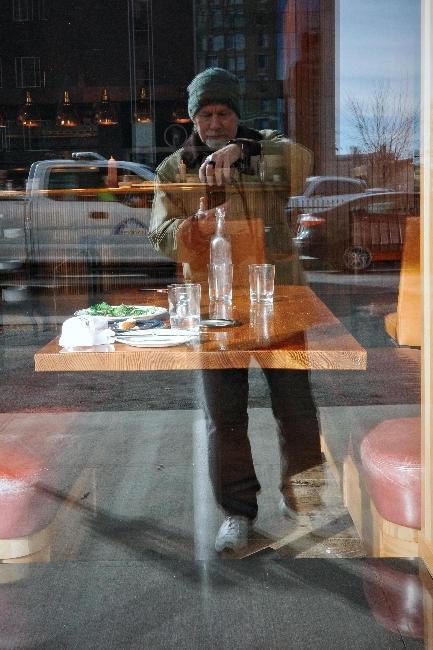
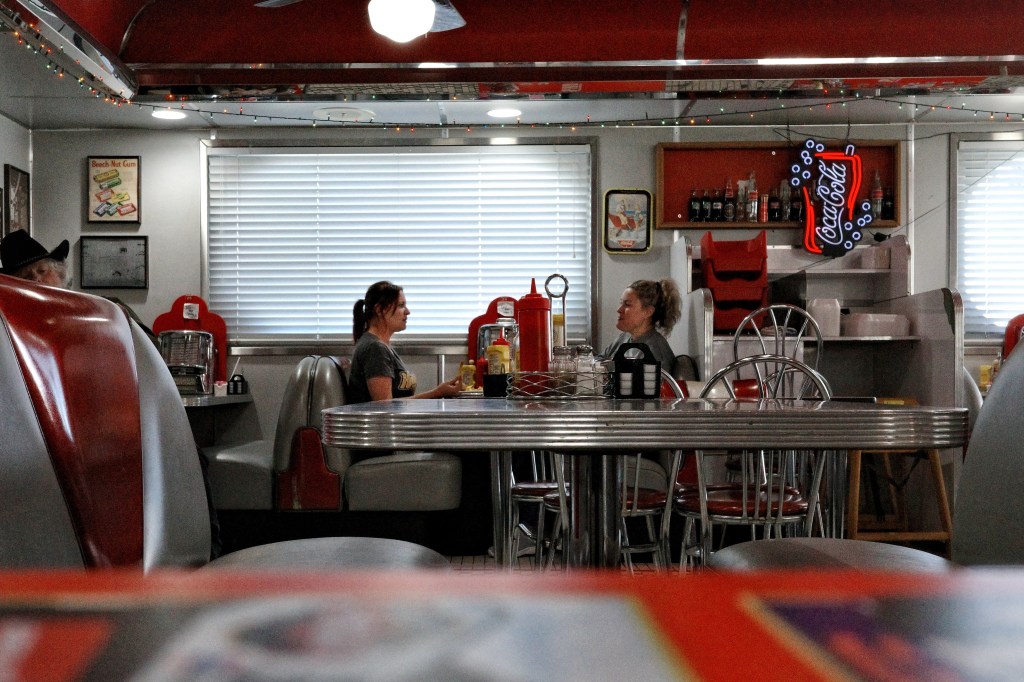
Here’s one of those photography ethics things. I was sitting in a booth in a quintessential American lunch-car diner with my camera on the table. While looking at the menu, I heard the sound of stressed voices coming from across the diner. I glanced over, saw two women who I thought had a family resemblance staring at each other. The light was nice and the scene had some drama. What to do?

  1. Mind your own business?
  2. Turn your camera on the table and shoot a quick photo without looking?
  3. Pick up your camera and photograph the situation?

Obviously, the most ethical thing to do is 1) Mind your own business. I had no idea what the situation was, it had nothing to do with me, and the two women involved would almost certainly prefer to be ignored.

But if you’ve ever practiced street photography–or if you’ve ever wanted to practice street photography–you know that people are often most interesting and most honest during emotionally charged moments. And those moments are almost always worth photographing. So some/many photographers would at least consider options 2 and 3.

You have to be a complete asshole to choose option 3; to pick up your camera and openly, deliberately invade their privacy. Option 3, however, has the dubious advantage of being honest and direct, whereas option 2 is, let’s face it, sort of underhanded. The thing about option 2–shooting without looking, without composing–is you’re allowing the fickle Gods of Photography determine if you get a decent shot or not. If the shot sucks, then it will get binned and nobody has to think about it.

If the result works as a photograph, then both options 2 and 3 set up a secondary ethics challenge: do you further violate the privacy of these two women by posting it? If you choose to post it, do you post it on a very public social media platform (like, say, BlueSky or Instagram) or on a significantly less popular platform (like, say, your blog)?

Obviously, I chose option 2. Well, sort of. I mean, it’s not like I sat there and considered all the ethical questions. I took the photograph without considering anything at all, completely unhindered by any thought process. I turned the camera on, turned it toward their table, touched the shutter release, turned the camera off, and didn’t think about it again until I got home and looked at my photos.

And hey, I got lucky. It’s a pretty good shot (in my opinion).

This is the shot in question.

Obviously, I decided to post the photos here, on my personal blog. I’ll also post links to the blog on Facebook and BlueSky. How do I justify this? I’m relying on the Men in Black defense. If you’re in a public place: don’t start nothing, won’t be nothing. If you raise voices in a public setting, the public will look at you. Sure, few of them will take your photo, but a photograph is essentially nothing more than an extended look. You don’t have a reasonable expectation of privacy in a public setting.

Another thing: I’ve no idea what these women were talking about. I don’t know if they were arguing, if they were upset with each other or with something else, if their distress was sincere or in jest, if one was distressed and the other wasn’t. I don’t know because I didn’t pay any attention to them (other than to note their voices were momentarily raised). They could have been outraged by the portions or the size of their bill, for all I know.

That said, it’s important (to me, at any rate) not to fully absolve myself. The women may not have had a reasonable expectation of privacy while talking to each other in a very public diner, but I didn’t have to pay attention to them. While I didn’t make any effort to take a good photograph, the fact remains that by taking any photograph I invaded what they probably thought of as a private moment.

Was it worth it? I don’t know. I think it’s an interesting photograph. The chance that either of them will ever see this…or that anybody they know will ever see this…are incredibly slim. I could probably legitimately make the ‘No harm, no foul’ argument. But maybe this type of photography is a social harm in and of itself. I don’t know.

Here’s the thing: I spent several years as a private investigator. Much of my work (which was primarily criminal defense investigation) involved making ethical decisions in the immediate moment–and there was rarely any obviously correct decision in those moments. So I’m used to questioning my ethics. It’s easier with photography. With photography, you can always take the shot and delete it later IF you decide it was inappropriate or unethical. In photography, you have that leeway.

Looking at the photo, I don’t think the level of tension between the two women is terribly obvious–unless you’re looking for it. I don’t think there’s any ethical reason NOT to publish it. Others may disagree, but I’m comfortable with my decision.

small love story

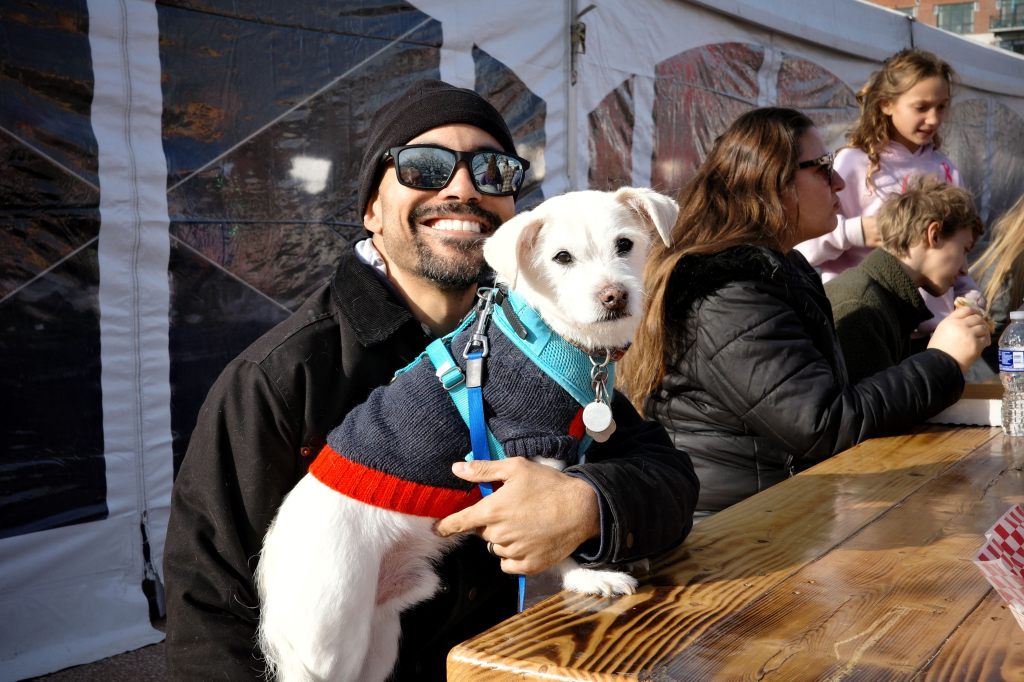
I’m at the Christkindlmarket and I see this guy and his dog sitting at a table. He’s holding the dog and the dog is leaning against him. I know it sounds ridiculous, but the moment I saw them I thought, “Madonna and child.” I blame all the Christmas stuff for that. I’m not a Christian, but I’m a fan of any holiday that’s (supposed to be) about love and sharing.

Anyway, I’ve got my little Ricoh GR3X in hand as I approach them, and the guy knows why I’m coming. I could see it on his face, the recognition that I wanted to photograph his dog. And it obviously pleased him. I barely got the words out…”Would you mind if I…?” before he said, “Sure.”

The dog, though, seemed a tad uncertain, so I slowed down. Instead of the close-up I’d intended, I stayed back a bit. Instead of shifting my position to isolate the guy and his dog from other people from the frame, I stayed still. Instead of shooting 3-4 frames, I took only one. I moved slowly to take the photo.

I said something like, “He’s a wee bit shy, isn’t he.” The guy said the dog was timid around other people, which is why he’d brought him to the Christkindlmarket and why he was holding him. He wanted the dog to feel safe and protected, but he also wanted him to get used to being around other people.

I didn’t even try to pet the dog, though I wanted to. I didn’t try to shoot more photos of them, though I very much wanted to. I figured the little guy was dealing with enough already.

In the end I said something like, “You’ve got yourself a little buddy.” He said, “I sure do.” And I walked away. But seeing them together lifted my spirits–which, given the world as it is today, was quite a feat. The obvious bond between them, the care the guy was taking with the dog, the trust the dog had in the guy — it was lovely, and I was weirdly proud of them both.

I could have taken a better photograph of them. They deserve a better photo. But it might have made the dog nervous, and no photo would be worth that.

lesson learned

I’ve had my Ricoh GR3x for a wee bit more than five months now. Long enough to be pretty familiar with it. Long enough, in fact, to get cocky with it. It’s SO fucking GOOD for shooting quickly and intuitively. So good that I’m starting to get sloppy with composition.

I’m usually pretty deliberate when I shoot photos. I know what I want in the frame, and I know what I don’t want. I’m usually conscious of where I should be standing in order to get the image I want. I’m usually patient. Usually. But I’m so comfortable with this new camera that I’m becoming less disciplined. Sometimes that’s good. Sometimes…not so much.

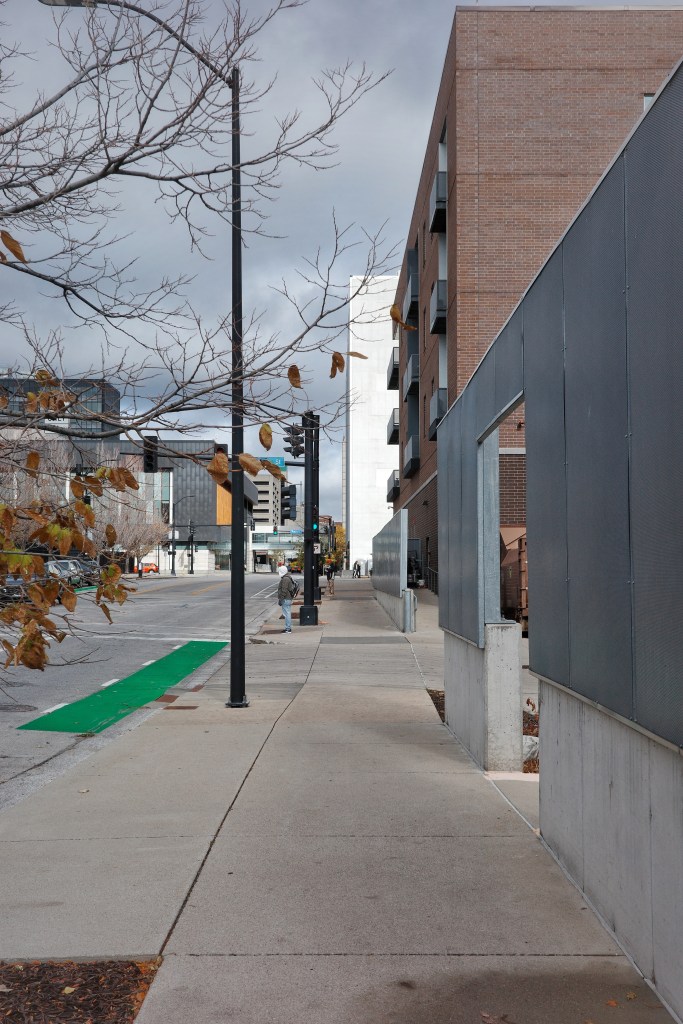
Here’s an example. I was walking down the street on a grey, sullen day when a burst of sunshine broke through the cloud cover, briefly illuminating a white building. I was immediately taken by the light and all of those lovely vertical lines. There was a sweet green patch of bike lane, some dead brown leaves still clinging to a tree, a guy in a hoodie waiting at the crosswalk. There was a wet patch on the sidewalk where a recycling bin had probably been sitting, and it mirrored the patch of turf in which the tree had been planted.

There were a LOT of elements and shapes all working together. So the Ricoh came out of my pocket, and I glanced at the screen, and took a snap as I walked. I mean, I didn’t even pause.

I chimped a quick look at the image without missing a step, and lawdy, I was so smug. Not so much with the image itself (it’s not a great photo) as with the way I shot it–on the move. It wasn’t until I got home and downloaded it that I realized I’d fucked up.

Cut off the top of the light pole.

It’s not a huge deal, partly because, as I said, it’s not a great photo to begin with. But it’s a reminder that speed and convenience aren’t always benefits. If I’d paused for a moment…if I’d taken a half step backward…if I’d followed one of the very basic rules of composition (check the edges of the goddamned frame), it…well, it still wouldn’t be a great photograph, but it would have been a properly composed one. I tell myself, “Self, if I’d paused I might have lost the light!” Which is true. But it’s also true that I wasn’t concerned with the light any more than I was concerned about the composition. I was only thinking about how cool it was to be able shoot that quickly and with such confidence. The confidence was misplaced.

Lesson learned.

(Maybe. Some lessons need to be learned repeatedly.)

in which I look at an old photo (part 4)

Okay, why am I looking at one of my old photographs? I explained all this back in May, but to recap quickly, I happened across an article on some photo website that suggested looking at and analyzing your old photos as if they were made by a different person. Although that idea strikes me as silly, I thought I’d try it.

This is me, still trying it–although, to be honest and transparent, this is also me trying like hell NOT to think about a future under Trump Unbound. So, the photo.

9:22 AM, Saturday, May 14, 2016

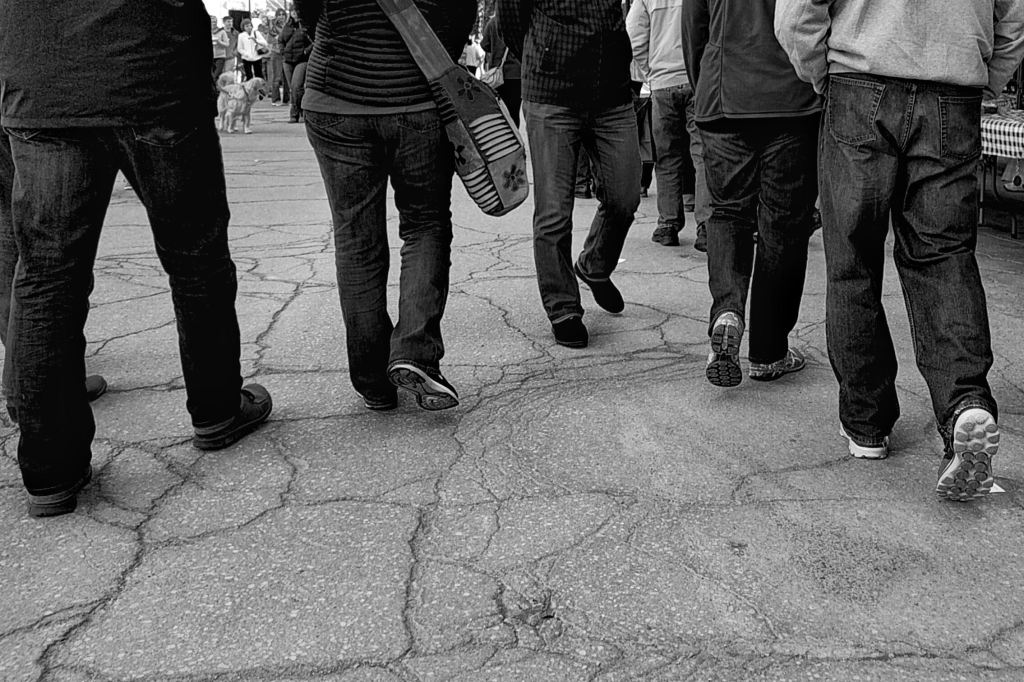
Okay, see that dog, barely visible in the upper left hand side of the frame? That dog was my main interest. It was Saturday morning, we were at the local farmers market (which actually has a policy discouraging dogs, but that policy is almost universally ignored, for which I’m grateful). I keep my eye out for dogs at the farmers market because dogs do unpredictable things. Unpredictable things can make good photographs. Unpredictable things in a crowd, even better.

I shot this with my cellphone, using a dedicated monochrome app (well, that’s not entirely true; it was a general photography app that I’d set up as my dedicated b&w app). So I opened the app as I approached the dog. That’s when I noticed the two couples in front of me separate so a man could pass between them. I instinctively snapped a quick frame, then went back to concentrating on the dog.

The dog apparently didn’t do anything unpredictable or interesting, because I have no other photo of that dog. Later, when I downloaded the photos, I was drawn to the photograph above, but I didn’t give it much thought. There was nothing farmers-markety about it, so it didn’t hold my attention. But I kept going back to it. There’s something about the arrangement–ten feet forming a sort of arc; eight feet walking away, two feet walking toward the viewer. Maybe it’s the balance. Or maybe it’s the implied movement, the sense of coming and going, of people fluidly making way for others. I’m sure I posted this photo online in some venue, but I’m not curious enough to track it down.

Why did I choose this photo to re-examine today? I don’t know. Maybe I picked this particular photo to look at on this particular day because it offers a hopeful metaphor. It feels like everything in the world right now is somehow going away, and I’d like to believe that at some point in the future all that ‘going away’ feeling will part and allow something good to get through.

That sounds a lot like bullshit, doesn’t it. It probably is. Like I said at the beginning, the idea of looking your old photos as if they were made by a different person seems silly. Maybe I just need a bit of silliness today.

the truck is a macguffin

So here’s me, larking about in alleys again. I’ve always had a thing for alleyways. I used to do this frequently, wandering through alleys, looking for stuff that might make an interesting photo. It eventually became a small photo project. I’ve written about how that project came into existence. But like all projects, eventually it came to an end. That was about a decade or so ago.

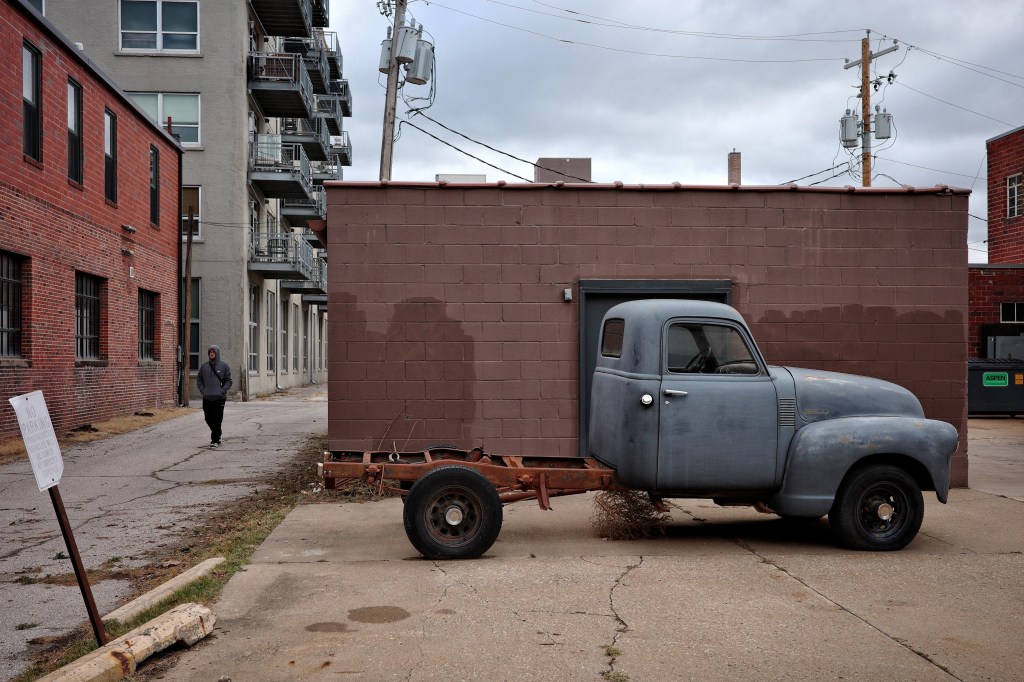
But yesterday I took a little walk. It was cold and cloudy, damp and dismal, and the light seemed fairly listless. I passed by an alley and thought, “What the hell, why not?” There’s almost always something worth photographing in an alley. And there’s always a lot of stuff that’s almost, but not quite, worth photographing. For example, an old, partially dismembered pickup.

When I spotted this unit, I was certain it had potential. It was a sort of blue-grey; I couldn’t tell if the color was a primer coat or the actual color of the truck. It didn’t matter. What mattered was that it was similar to the color of the sky. Again, that seemed like it ought to have potential. The truck also had a tumbleweed caught below its frame, which I thought might contribute something.

But, no. Nothing seemed to work. I looked at the truck from a distance, I looked at it close up, and while I kept seeing potential, I couldn’t see anything worth photographing. It didn’t help that it was parked next to a cinderblock structure that was painted an unfortunate tawny port color. Had the building been a different color, them maybe something might have worked. But it wasn’t. It was just blah.

I gave it a few minutes, trying to find an angle or an approach that appealed to me. I considered shooting it in monochrome, but even then it felt inert, bland, static. So I gave up and started to walk away. Sometimes the photo just isn’t there.

As I started back down the alley, I saw a guy approaching. He was also rather drab, dressed in grey and black. But he was moving—and, lawdy, his hoodie was almost the same color as the truck. I thought maybe…maybe…adding an active figure in the frame might make a photo of the truck work. So I turned around and headed back.

This is where years of shooting photos paid off. I had only a moment to compose the photo. I knew what I wanted. The truck, of course, but I also wanted that crooked sign on the left half of the frame; I wanted those buildings on the right side of the frame to give the image more depth; I wanted the transformers on the telephone poles along the top. Since I was shooting with a fixed focal length lens, I had to position myself in the right spot (rather than zoom in or out). A step forward, a step back, a step to the left or right—every step made a difference. A step back would have brought in the top of a telephone pole, but it would diminish the figure of the guy. He’d be too small in the frame. Easy decision.

I got the composition I wanted just a second or two before the guy arrived. I also knew I wanted to isolate him and his dark clothing against the light grey building backdrop. I knew I’d only get one chance. I was maybe a tenth of a second late. Not enough to matter, but still enough to make me wince. But still, I had my photo of the truck.

This morning, when I started reviewing yesterday’s photos, I realized this wasn’t actually a photo of the truck at all. It’s a photograph of the guy. The truck is, in effect, a MacGuffin. If you’re not familiar with the term, a MacGuffin is a movie device; it refers to an object or event that sets the plot and characters in motion but is essentially insignificant, unimportant, or irrelevant in itself. The truck that drew me in turned out to be largely unimportant.

I thought I was taking a photo of a truck. It turned out I was taking a photo of that guy. The guy—because he’s in the right clothing, in the right spot at the right moment—holds the photograph together. Without that guy, this would be a dull, static, uninteresting photo. With the guy, it becomes a photograph of a single moment in the long course of his life. The truck is just there; the photo is about some guy wandering by himself down an alley for purposes known only to himself.

Now I think of it, that guy could be me.

Okay, I didn’t expect this post to get so weird.

colors, textures, and retirement-age train otaku

I’m not a train guy. Not a railroad guy. I mean, sure, I like trains and railroads. I appreciate their historical significance. I like to hear their whistles and see them rumbling along the tracks. I absolutely love the photographs of O. Winston Link. But if somebody asked me if I’d like to go spend a day looking at trains, I’d say…well, I’d say yes. Not because I’m a train guy, but because I’ll go look at just about anything.

And that’s exactly what I did recently. I agreed to go on a family/friend train excursion that included historic trains, a small train museum, and a dining experience in an old train that traversed some fields and woods and a ridiculously narrow bridge over a rather high river valley. It wasn’t something I’d have chosen on my own, but I’m really glad I agreed. (Pro-tip: always agree to do almost everything, because you never know.) It was fun and, of course, I took a few photos.

I’d expected to enjoy the train ride, and I did. There was a period of time when I lived on the East coast and I frequently traveled by train–Boston, New York City, Washington, DC, Norfolk. I always enjoyed it. But there’s a radical difference between (what in the US passes for) ‘modern’ train travel and an historical train. The engine that pulled our dining cars wasn’t a steam engine or anything, but it was old and slow and pleasantly lazy. Which was just as well, since the tracks were also old and the train swayed a LOT more than any train I’d ever been on. Hell, at times it swayed more than a lot of boats I’ve been on. You don’t want a lot of swaying when you’re on a high trestle bridge over a river valley. Still, it was fun and the food was surprisingly good.

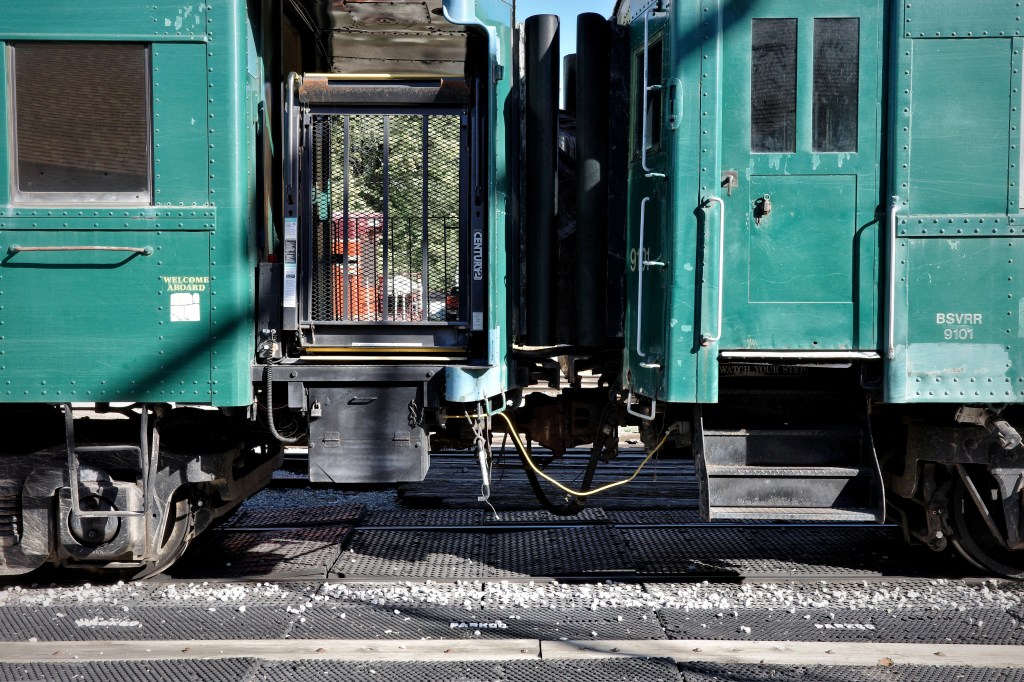
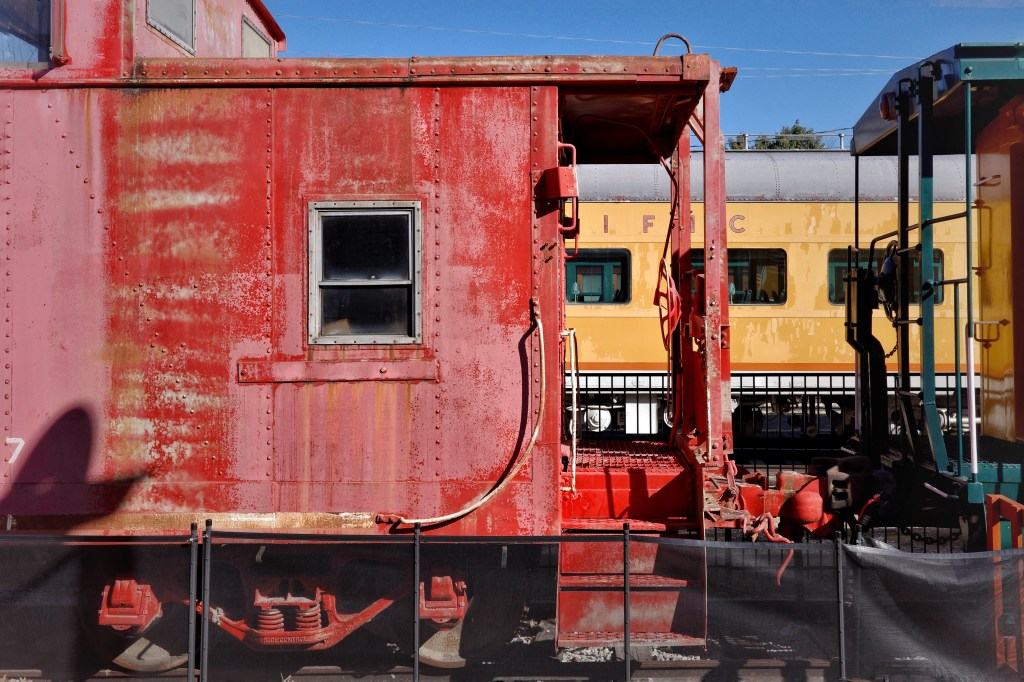
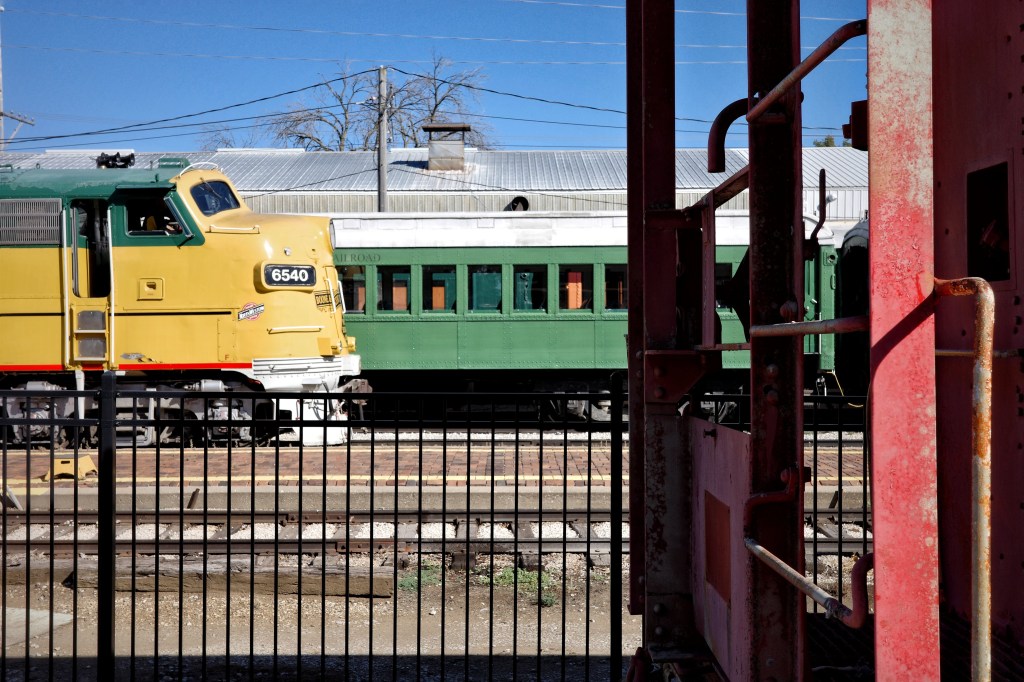
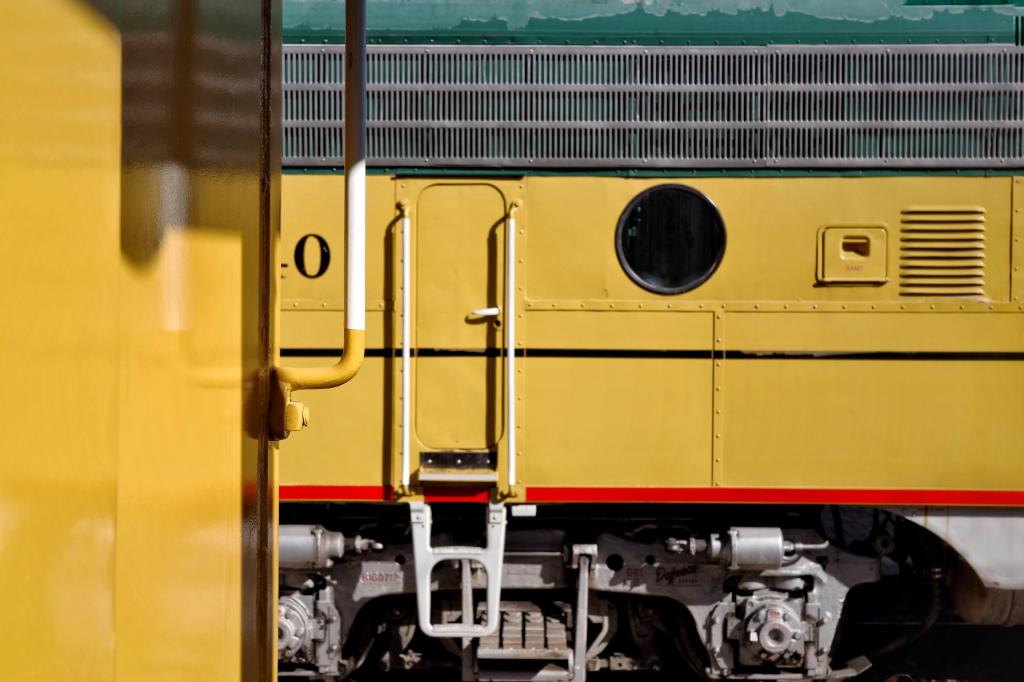
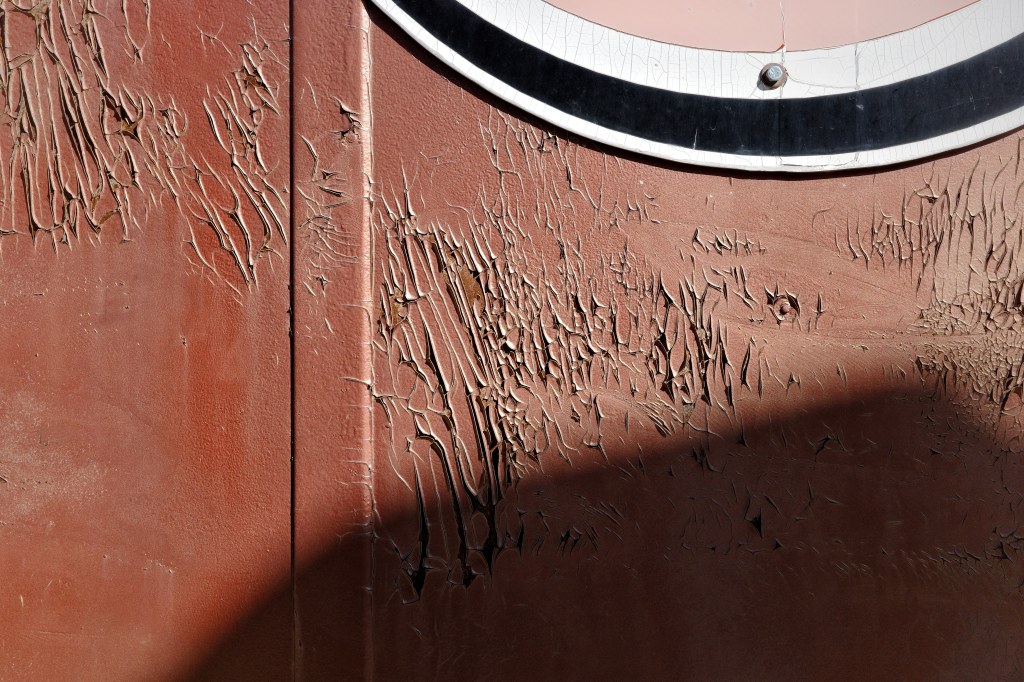
But the train ride and the meal were, for me, secondary. Hell, they were tertiary. I could have spent the entire day noodling around the train yard, looking at stuff I didn’t understand and appreciating it. BIG blocks of color. Gobs of dark, sexy shadow. Weirdly-shaped mechanical bits and bobs. And who knew trains had so many ladders? Everywhere you look, there’s a ladder. And different shapes of ladders, at that.

I hadn’t anticipated being fascinated by the shapes and forms, particularly of the works of the undercarriage (if that’s what it’s called). Everything was so massively sturdy. And I was completely captivated by the colors–the sun-faded greens, the bright yellows and oranges, the weathered reds and russet browns of the cars. I could have spent an hour just looking at the variety of textures and photographing the industrial weirdness of the undercarriage.

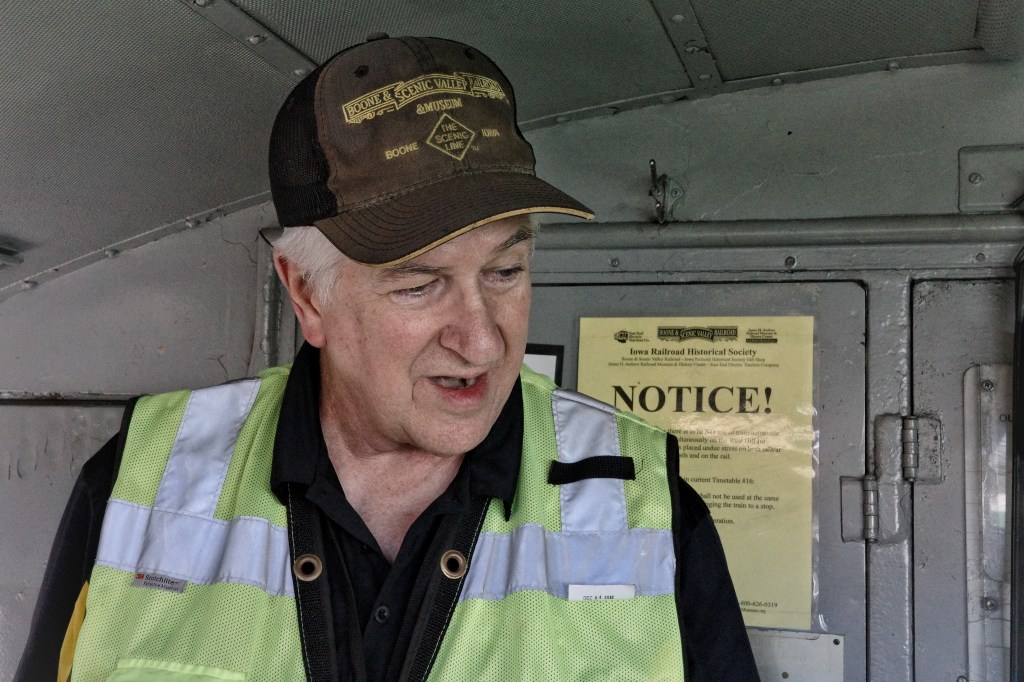
For once, I was more interested in the stuff than in the people, and I rather regret that because when I took a moment to actually talk with the people they were…well, I guess you could call them retirement-age train otaku. They were obsessive, but reserved until encouraged. One guy, with minimal encouragement, agreed to let my brother and I climb up an exterior ladder into the engineer’s cockpit (if that’s what it’s called). I don’t think it was actually prohibited, but it was certainly not part of the routine. Once we got up there, he explained how the engine, which had been built in 1958, had been retired from some Canadian railroad. He rattled off the specifications of the engine, and where it fit in the evolution of train engines. I suspect he’d have told us the entire life history of that particular engine, but folks were waiting for us and we had to leave.

I actually regretted leaving the train yard. But not everybody shares my interest in weathered paint and arcane mechanical whatsits, so I left without complaint. Now I find myself with a metric ton of train-related photographs, and while I’m hesitant to impose them on the unsuspecting Intertubes, I’m afraid you’re going to see more train stuff on my social media. Of course, I won’t be able to identify what’s IN the photos. You’ll have to find a retirement-age train otaku for that.

weird is good

Strangest thing. I’ve been shooting photos since about the Triassic period and in all that time I very rarely shot photos in portrait orientation. Well, I mean, except when I was shooting actual portraits, of course. Landscape orientation has always seemed more natural and organic to me.

But since I’ve been using this Ricoh GR3X, I find myself shooting more shots in portrait style. I really can’t explain it. Is it because the camera is so small and light that I’m more willing to turn it on its side? That doesn’t make much sense to me, because I tend to pre-visualize almost all of my shots. I generally ‘see’ them before I shoot them. So why would the camera matter? Maybe it’s the fixed lens? I don’t know.

Or maybe I’m just ‘seeing’ more portrait-oriented shots? Maybe it’s just a coincidence that I’ve started doing that shortly after picking up a new camera? That seems improbable too. Doesn’t it?

Another thing. I’m not entirely sure this is true, but it seems like when I shoot something in portrait orientation, I pay closer attention to the edges of the frame. I like to think I do that with most shots, but I find myself actively thinking about the edges when I’m shooting in portrait. Maybe that’s just because I’m not used to it? Maybe I do it so automatically in landscape orientation that I just don’t notice it as much? That seems possible.

Take this photo, for example. I wanted that tiny bit of chimney in the upper right. And that sliver of the window frame on the left side. And along the bottom, that white line of the parking strip and the blob of shadow from a parked car. I wanted those things, but I didn’t want very much of them. Which, because the GR3 has a fixed lens, meant stepping forward just an inch or two, then stepping back half an inch. It meant doing the goddamn hokey-pokey in the middle of the street until I had it just right.

When I got home and downloaded the photos, I noticed that of the 24 photos I shot during that brief photo-walk, 7 of them were in portrait orientation. Seven. Almost a third of the photos. I’ve never in my life done anything like that.

It doesn’t bother me. It’s just a bit of a shock. Has this happened to anybody else? Have you suddenly found yourself shooting in a different orientation? Or have I maybe had a stroke and just failed to notice it? Maybe it’s a tumor. I don’t know. All I know is that it’s weird.

Happily, I believe weird is good.

yellow lines, yellow rope, yellow dumpster lid

I’m an absolute pain-in-the-ass to run errands with. Why? Because I have a tendency to get distracted by stuff I see. Random stuff. I’m talking abstract lines and shadows and shapes and colors, stuff that usually gets lost in the passing clutter of everyday life. Stuff that, when it’s isolated within a frame, becomes visually interesting (to me, at least). Like, for example, some newly painted yellow parking lines reflected off a car door.

We’d just bought a few groceries and I’d just put the bag in the back seat when I saw the reflection. I stood there for a moment, sort of arranging it in my head. In the past, I’d have just admired it, then got in the car. But now I have an actual camera that fits in my pocket. So now I have this photograph.

It’s just a flash of light, shadow, line, and color that likely won’t appeal to anybody but me. But this is how I go through the world, seeing stuff like this. And since I now own a little Ricoh GR3X, I can photograph the world the way I see it. Sure, I could have taken a similar photo with my cellphone. But it’s not the same. With an actual camera you have more control over the exposure.

I also use the GR3X to take ‘normal’ photographs, of course. The usual landscapes, urbanscapes, street images, New Topo stuff (which counts as ‘normal’ for me). But almost every day there’s some weird little visual thing that will captivate me enough to stare at for a moment, but not enough to go fetch a camera. Having a camera in my pocket comes in handy at these moments. You know…in case I see a bit of sunlight illuminating a coil of yellow polypropylene rope hanging in the garage.

The yellow rope alone would have been enough. But the red of the fire extinguisher almost exactly matched the red of the walking stick. You can explain that to people, but without the photograph they probably won’t see it. They may not see it even with the photograph. But that’s okay.

My friends and family are ridiculously patient with me when this sort of thing happens. “What are you doing? Why have you stopped?” “The dumpsters have yellow lids.” “Yellow lids.” “One of them is open and the yellow is brighter. And the clouds.” “I’ll wait in the car.” It’s really a wonder they don’t stab me.

There’s an old photographer’s aphorism: the best camera is the one you have with you. I suppose at some point I’ll get over my infatuation with this camera and I’ll stop carrying it with me all the time. But right now, it’s just part of my leaving-the-house ritual. I grab my keys, my wallet, my phone, and my Ricoh GR3X before I walk out the door.

There are two benefits to this. First, I’m shooting more photographs and shooting them more thoughtfully. Second, carrying this camera everywhere has impressed upon me how very tolerant folks are of my eccentricities. It reminds me that I’m a very lucky guy. It reminds me to appreciate the people around me even more. How many cameras can do that?

EDITORIAL NOTE: Okay, I just now noticed that the predominant color in all three of these photos is yellow. Is that weird? It seems weird. But now I have to change the title to reflect that.