in which i look at an old photo (part 8)

Well, here we are again. This is the eighth time I’ve looked at an old photo. This is apparently a thing I do now. Why? Because in May of 2024 I read an article that suggested photographers could benefit from looking at their old photos as if they were made by a different person. I was skeptical about the idea, but what the hell…I did it. The notion still seems a wee bit precious to me. But here I am, doing it again.

Two things: first, I don’t recall the exact point of looking at your old photos as if they were made by a stranger. I know it had something to do with how our approach to photography changes over time, but surely that’s a given, isn’t it? In any event, when I look at these old photos, I find I’m mostly thinking about why I shot that particular photo, or why I shot it in that particular way, or what that photo means to me now. None of which, I suspect, is what the author of the article intended.

Second thing: when I decided to do this, I was stymied by the fact that I’d have to actually pick an old photo to look at. How do you do that? I chose a random approach. I pick a random month in a random year and see what catches my eye. I was completely unprepared to have emotions about this stuff. But I do.

Anyway, here we go.

10:28 AM, Monday, June 21, 2010

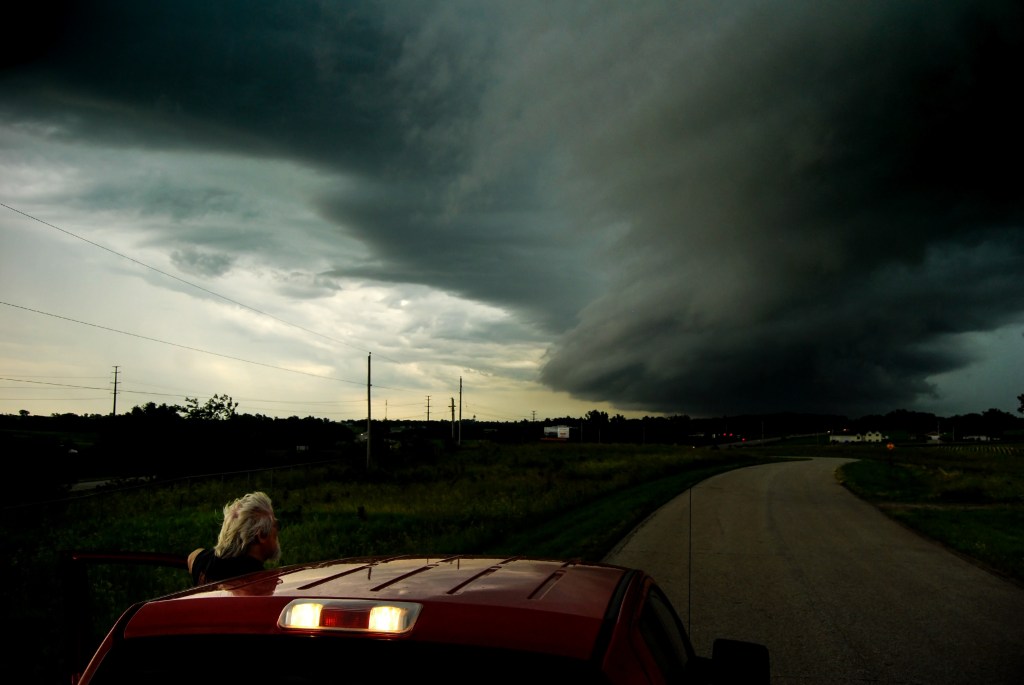
I shot this photo standing up in the back of my brother’s pickup. What you’re seeing here is an anvil cloud. These form when a thunderstorm’s updraft reaches a level of the atmosphere where moisture effectively stops, which causes the storm to spread out horizontally. These sorts of clouds are associated with really severe weather, including hail and tornadoes. As I understand it, when the moist air can’t go any higher, water vapor coalesces and returns to Earth in the form of heavy rain and/or hail. There’s also a lot of wind. A lot of wind.

Light gets really weird during a thunderstorm. The clouds make a huge difference, of course; they shape the angle of sunlight. The air is full of moisture and particulate matter swept up by the wind, so the light gets diffused and often turns into a beautifully ominous bruised color. It’s compelling and lovely and wild and sometimes scary. It’s that savage, unpredictable, astonishing, untamed wildness that makes big storms both lovely and terrifying.

That’s exactly why my brother, Jesse Eugene, and I were there. He’d been a Marine in Vietnam, and a firefighter afterward. There was a stormy wildness in him. A wildness that showed up in most aspects of his life, to be honest. A wildness I’m afraid I encouraged during tornado season. The wildness–and his willingness to give into it–largely ruined his life. There was a part of him that loved the destructive power of fires, and loved facing and beating down that power. I’m sure that’s one of the reasons he loved thunderstorms. I think he probably saw them as a challenge he could face down.

On this particular day, we knew a bad storm was coming and we drove out to meet it. This was just a few miles outside the city. I’d had him stop his pickup at this particular spot because I liked the curve of the road. I got excited when I got out of the vehicle and saw the curve reflected the curve of the anvil cloud. It amused Jesse Eugene when I asked him to turn the truck around so I could include the red roof in a photo. He enjoyed the absurdity of it–of me insisting on posing a pickup truck while a massive thunderstorm was approaching. It soon became too dark and windy to shoot photographs, but we stayed there until the storm hit hard and it began pissing down rain like the End of Days. It was a good storm.

I picked this photo to look at because, even though you can see his face, it’s probably the most honest photograph I’ve taken of my brother. I’m happy with this just as a photograph, even though it’s flawed. I like the way the sunlight behind us illuminated my brother’s white hair. I like the artificial red shininess of the pickup’s roof. I like the way the curve of the road echoes the curve of the clouds. I like the emotion of the image; I like that the emotion is just there and doesn’t depend on the viewer knowing anything at all about the circumstance the people involved. It’s not a great photo, but I think it works.

I’m also happy with it as a memory. I’d much rather remember Jesse Eugene like this, laughing and facing a thunderstorm, rather than the thin, frail, cancer-ravaged person he became at the end. But that’s the thing, I guess. Even the wildest storms eventually lose strength and peter out.

weird and normal

The great and horrible thing about people is that they’re unpredictable; they do weird shit in ways that seem normal and normal shit that in ways that seem weird. If you’re on the street and you have a camera, you can sometimes photograph moments that are both weird and normal at the same time.

Yesterday I spent a short time at an autumn festival in a small Iowa town. It was about what you’d expect: locals and visitors milling about, some music, kids playing, adults trying to be patient with kids playing, old folks enjoying the mild chaos without having to be responsible for anybody, booths selling baked goods (I brought home a delicious apple cinnamon cream cheese coffee cake, which I’m eating as I write this), fresh local veggies, craft goods, displays by local artists, hot and cold beverages (I bought a cup of hard apple-pineapple cider that must have had an ABV of around 10%), tee shirts, decorative gourds, etc, There are usually some decent opportunities for candid photos at festivals like this.

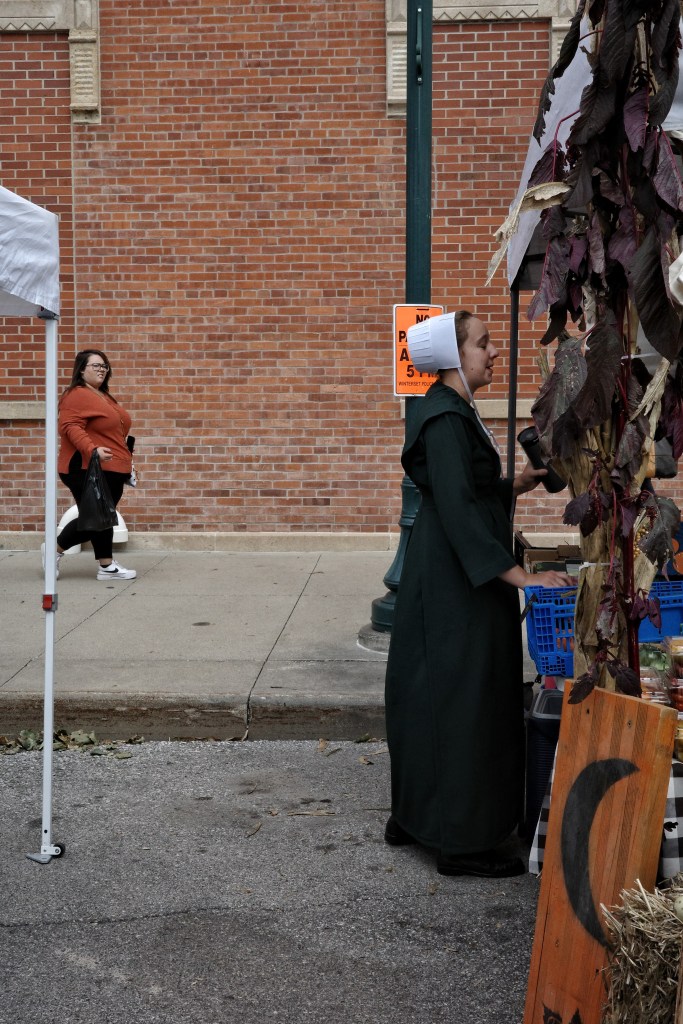
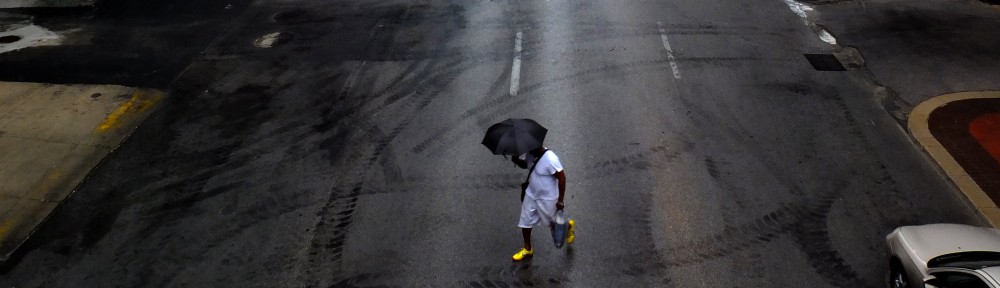
There was a young woman I assumed to be Mennonite since she wore a classic white kapp and black clothing. There are a lot of Amish and Mennonite communities in small Iowa towns, and I think it’s important as a photographer to be sensitive about both when and why you photograph them. In my opinion, it’s okay to photograph them as people, but not as specimens–if that makes sense. I think it’s also okay to photograph them as compositional elements, in much the same way you might photograph a person in a bright red bonnet or wearing yellow shoes (as in the photo at the top of this blog). But it’s NOT okay to photograph them for being different or in a way that treats their clothing as a costume. It’s NOT okay to photograph them as ‘weird’.

This young woman was standing beside a booth decorated in large, deep reddish-brown leaves, which made her white kapp pop out beautifully. But there was a lamp post with a ‘No Parking’ sign directly behind her, which detracted from the scene. So I started to shift position in the hope of getting a better composition. As I moved, I saw another women start to pass behind her. That lizard part of your brain that tells you to do something before your brain actually processes it took over and I snapped a quick shot as I moved. Here’s that shot.

Unfortunately, I never did get the shot I wanted; other people got in the way. But that’s what happens on the street. You either get the shot or you don’t. I moved on and didn’t give the moment another thought. Until I got home and looked at the photos.

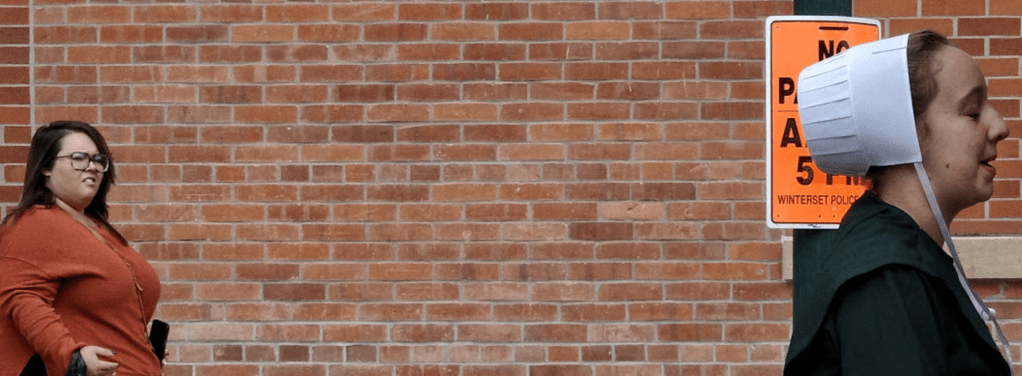
At first glance, the quick shot of the young Mennonite woman wasn’t particularly interesting to me. If anything, it was the sort of photograph I don’t want to take…a ‘normal’ person and a ‘weird’ person. But then I noticed the expression on the face of the woman passing behind her.

I can’t quite figure out what to make of that expression. It’s disapproving, to be sure. But beyond that, I just don’t know. Is she merely displeased by the woman’s clothing/beliefs? Is she outraged, or repelled? Is she offended by the presence of the Mennonite woman or her clothing? Is she being intolerant of religious differences?

It’s entirely possible she wasn’t looking at the the young Mennonite woman at all, that she was looking at something beyond her. But I don’t think so. What is that woman thinking, what is she feeling? And why am I letting it bother me?

In any event, it occurred to me that the ‘normal’ woman in this photograph was being weird and the ‘weird’ woman was being normal. Which made the photo more interesting to me. But because I tend to overthink things, I have to wonder if a photographer feels it’s necessary to explain why a photograph is interesting…is it really interesting? I don’t know.

But I know I’m glad I took the shot. And I’m glad I wrote about it. Because now I can let it go.

EDITORIAL NOTE: Let me once again sing the praises of the Ricoh GR3X. I took this shot while moving and carrying a plastic cup 2/3 full of apple-pineapple hard cider. I was able to turn on the camera, make a quick aperture change to enlarge the depth of field, and press the shutter release, all within a quick moment and with only one hand. Never spilled a drop.

in which i return to instagram

I stopped posting photographs on Instagram (and posting anything on Facebook) back in January of this year (2025), after Mark Zuckerberg (you know…the desperately uncool dweeb who owns Meta, the parent company of IG and FB) announced Meta was ending its fact-checking program and ‘easing’ content moderation.

FB had already become a hostile, advert-bloated social medium; as much as I loved keeping in touch with friends, the FB experience itself was annoying and aggravating. The new policies only promised to make it worse. The problems with IG were different. A lot of people were getting caught up in the illusion of ‘perfect IG lives’ and that created all sorts of emotional health issues. I was only there for the photography, not for ‘lifestyle’ stuff. While it didn’t affect me, the fact that Zuckerberg didn’t care that if it DID affect a lot of people…especially young people…was reason enough to leave.

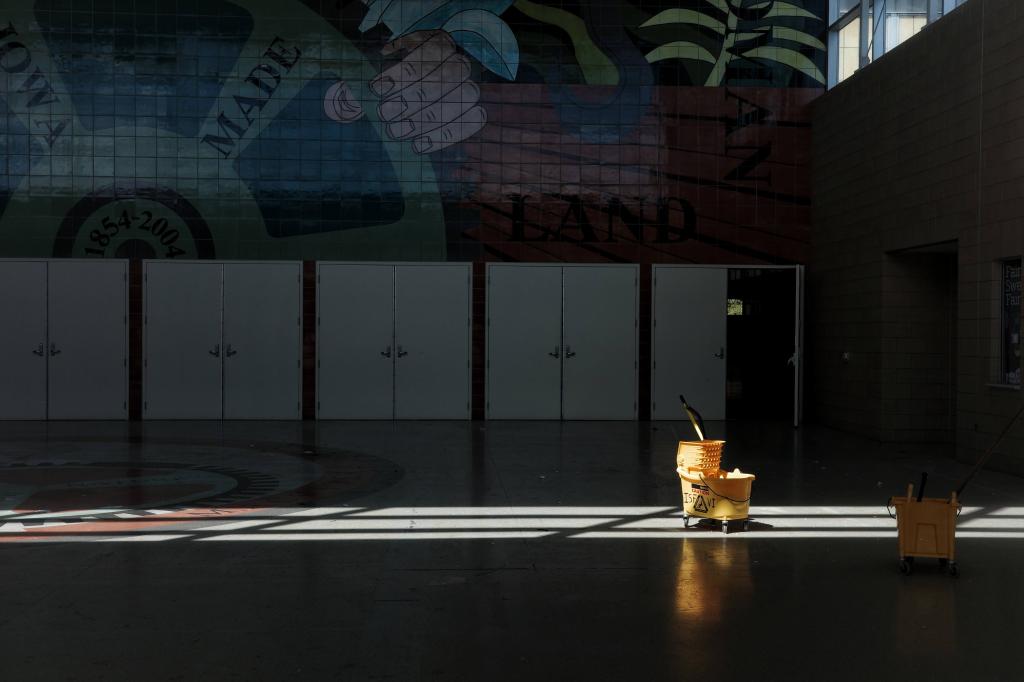
O Holy Mop Bucket (Tuesday, Aug. 26, 2025)

Why am I returning to Instagram? For the same reason I joined in the first place. Photography. I miss seeing good photography. Don’t get me wrong, there’s a lot of good photography on Bluesky, my preferred social medium, but it’s not well organized. In fact, it’s barely organized at all. Bsky is great, but it’s not photocentric. Instagram is. IG allows me to have a curated experience. I can follow a select group of photographers, who sometimes lead me to other interesting photographers.

I’m not doing this to become a ‘better’ photographer (although I think looking at–and trying to understand–good photos CAN lead a person to try new things, which can make you a better photographer). I’m doing this simply because looking at good photography makes me happy. Being happy is a good reason for doing anything, and it’s especially important these days.

I could, of course, just look at the good photos shot by other people; I don’t have any obligation to post anything. By posting (either photos or comments on the photos of other folks), I’m basically supporting the platform, which benefits Zuckerberg. But looking without participating is cowardly and furtive. If I’m going to use the platform, I have to take responsibility for it. So, this morning I posted a photograph on Instagram for the first time since January.

Here’s a stupid thing: when I decided I was going to actually return to IG, I felt some weird pressure to post the ‘right’ photo. A “Return to IG” photo. Something somehow meaningful, something symbolic (I told you it was stupid). So I opened up my photo app with that in mind. But I immediately saw the photo above and thought, “Oooh, mop bucket” like a little kid. So in the end, I just posted the first photo that caught my eye.

And maybe that’s the right way to do Instagram.

in which i look at an old photo (part7)

Back in May of 2024 I reluctantly began to occasionally look at my old photographs, because apparently that’s a thing. I’d never stopped shooting photos, but I’d stopped thinking about the praxis of photography–the many ways in which photography can be put into practice. Then I came across an article somewhere that suggested looking at your old photos as if they were made by a different person and seeing what you could learn from them.

I gave some thought to that idea and decided it was silly. But I did it anyway. And hey, whaddya know? It had some value. Maybe not the intended value (which was something to do with improving your photography maybe?), but value all the same. If nothing else, looking at a few old photographs has reminded me that I tend to be pretty deliberate when it comes to composition.

This is the seventh time I’ve looked at an old photo. And you’ll notice the composition is unusual. I’ll explain why in a moment. First, the photograph.

11:02AM, Thursday, August 15, 2013

Yeah, you’re probably wondering what the hell, right? Allow me to ‘splain. A photography group I used to belong to (well, okay, a group I used to run) would engage in a variety of photo projects. This particular project involved shooting photographs as an homage to photographers we admired or respected. The idea was that by emulating these photographers, we could learn something about them and their approach to photography.

I chose to emulate the work of Uta Barth, a photographer I’d written about several years earlier. Barth is a conceptual fine arts photographer; her most important work is about the act of seeing rather than what is seen. She essentially decided to remove the subject of the photograph from the photograph. By focusing on where the subject would be and by overtly calling the viewer’s attention to the absence of the subject, she attempted to turn the viewer into the subject. When the viewer is the subject, the photograph is no longer about what is in the photograph; it’s about the act of looking at the photograph. Many critics of her early photographs complained that her images were blurry and out of focus. Barth explained the photos were “perfectly in focus, the camera just happens to be focused on an unoccupied point in space.”

I confess, at first this approach didn’t make a lot of sense to me. It was until I realized Barth was basically saying the world and everything in it exists independent of us and independent of anything to do with us. She was saying the world is NOT just our background. That concept hit me hard, partly because it should be so obvious.

The particular photo was my first attempt to emulate Barth, and it’s a failure as an homage. Why? Because, unconsciously, I included a subject. Barth very deliberately cleared away any sign of herself in her work. The inclusion of any personal item makes the photograph about the photographer. “Shoes on the floor, clothes, letters and objects on my desk immediately construct a narrative and identity of the person, and there you have it: I’m the subject.

And hey, there’s me…the two single-use plastic bottles of water (it was 2013; I didn’t know any better back then) and an item of clothing slung over a screen divider. It doesn’t say much about me, but it suggests something—and that’s enough to create a subject of the photograph.

I guess there’s a lesson there. If you’re going to attempt conceptual photography, make sure you have a solid grasp on the concept. And I suppose this demonstrates the value of looking at your old photographs. If nothing else, they remind you of lessons learned.

agri-culture

The only thing I know about keeping livestock is…okay, I don’t know anything about keeping livestock. I mean, I know it’s hard work. I don’t know that from experience, since I’ve never kept livestock, but even sharing space with a pet (cats and dogs, certainly, and probably birds and lizards, what do I know?) means cleaning up after them. Even the tidiest of cats uses a litterbox and somebody has to deal with that.

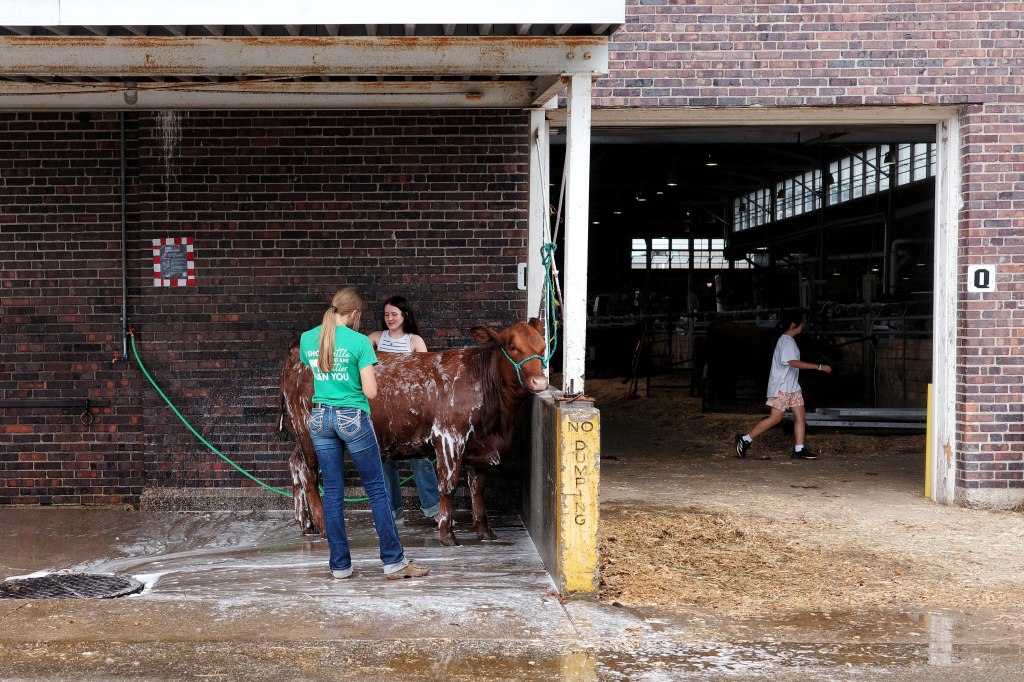
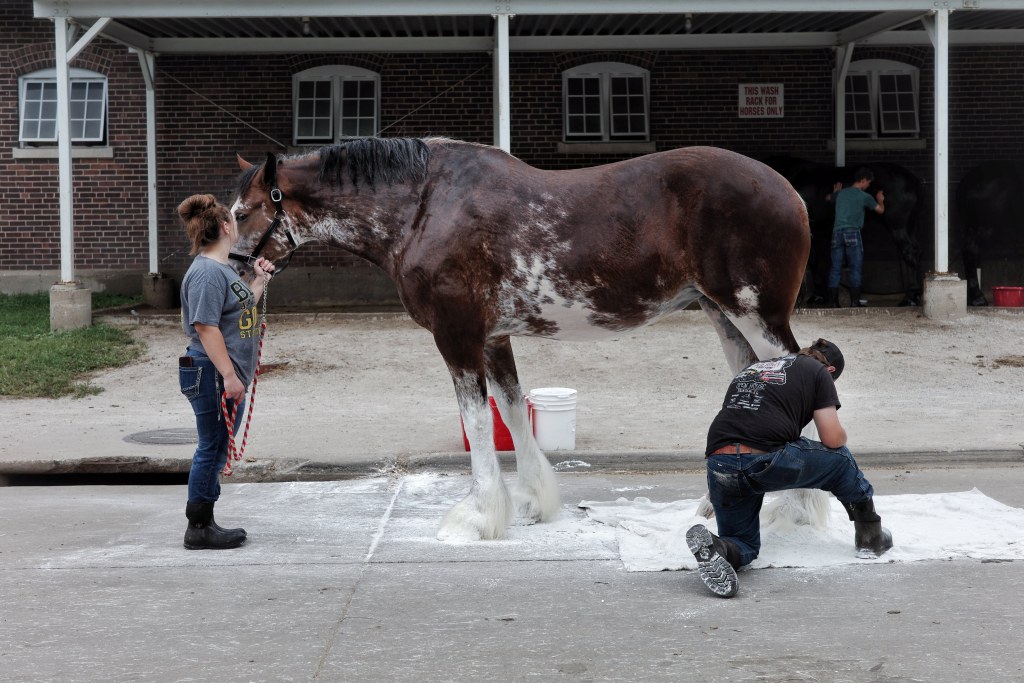
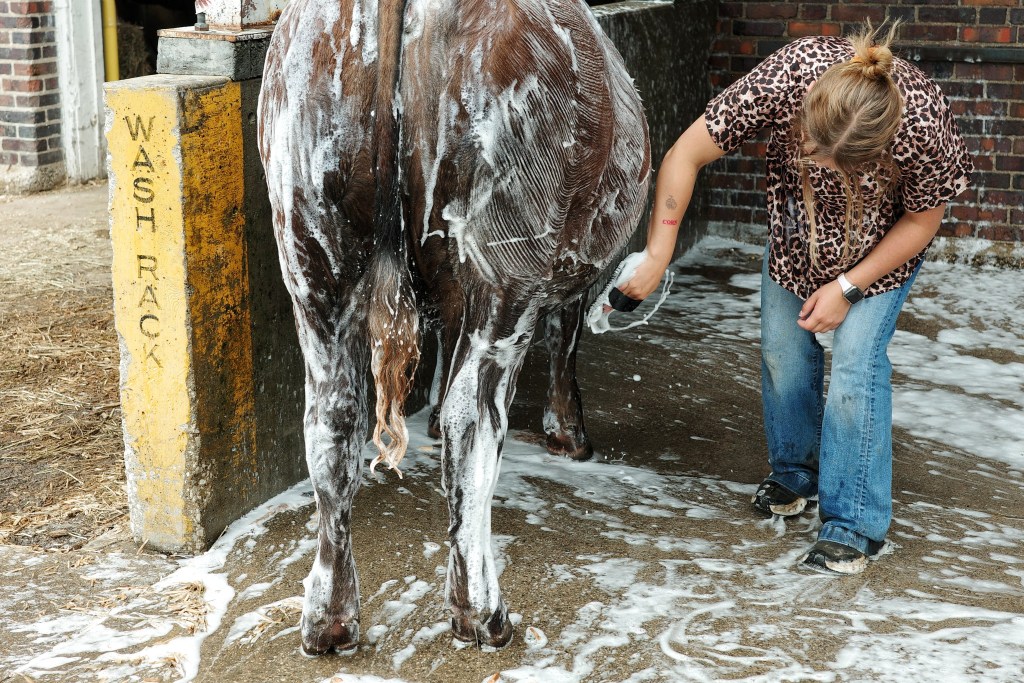
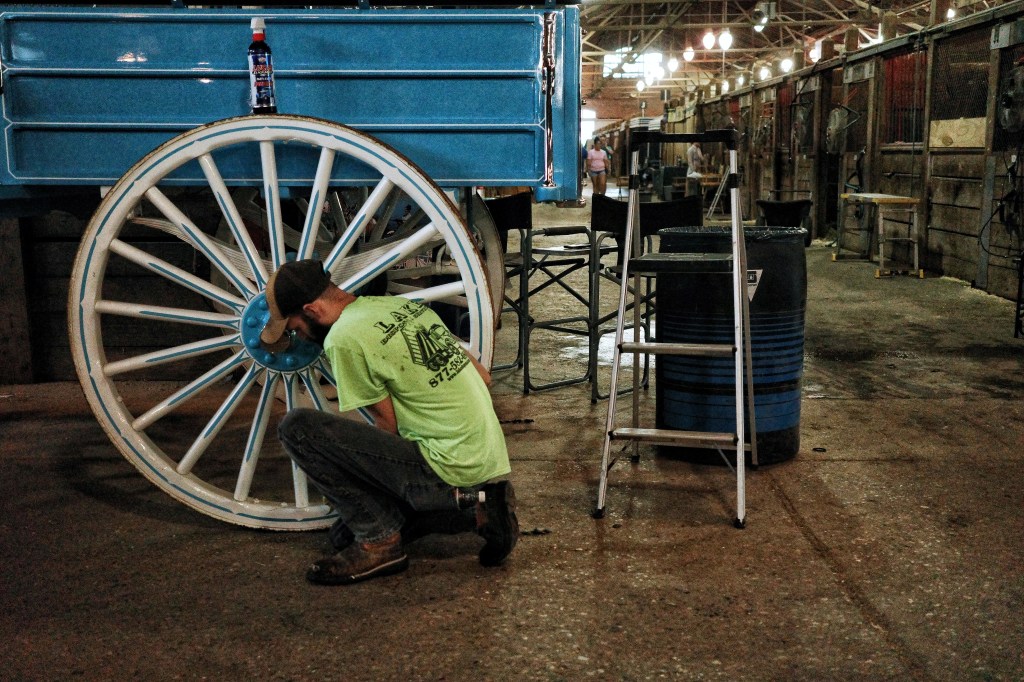
Why am I talking about this? Because looking over the photographs I took at the recent Iowa State Fair, I noticed I have a lot of photos of farm people cleaning stuff. Cleaning their animals, cleaning the gear needed to take care of their animals, cleaning the things their animals pull, cleaning up massive amounts of animal shit. Everywhere I went, men and women and kids were busy cleaning.

Cooperative cow-washing.

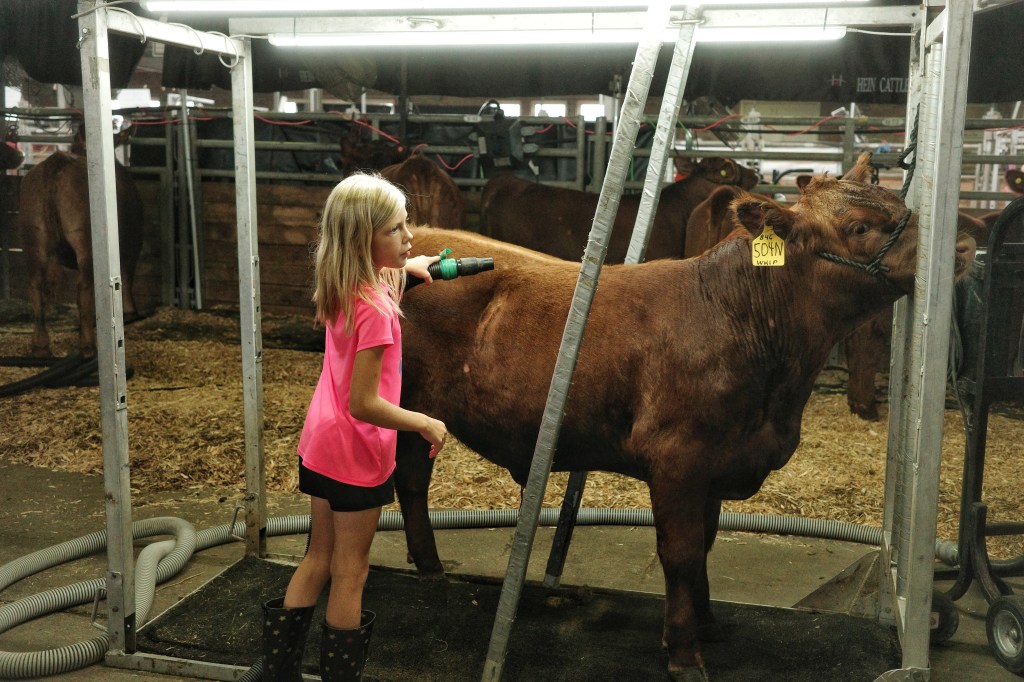
And when I say ‘cleaning their animals,’ I don’t mean they were just washing them (although there’s an astonishing amount of animal-washing going on all the time). I mean they’re shampooing them, blow-drying them, combing them, trimming them, vacuuming them.

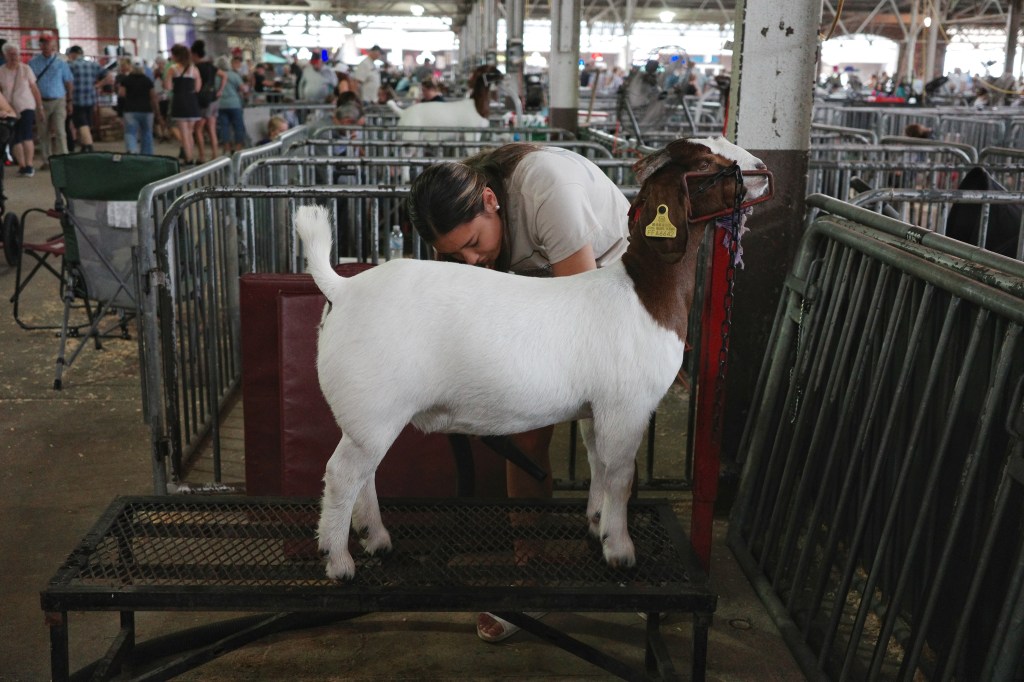
A little light goat-vacuuming.

Seriously, people were vacuuming off…something, I don’t know what. Loose hair? Dandruff? Barn grit? No idea, but everywhere you go in the animal barns at the fair, there are men and women and kids vacuuming their livestock.

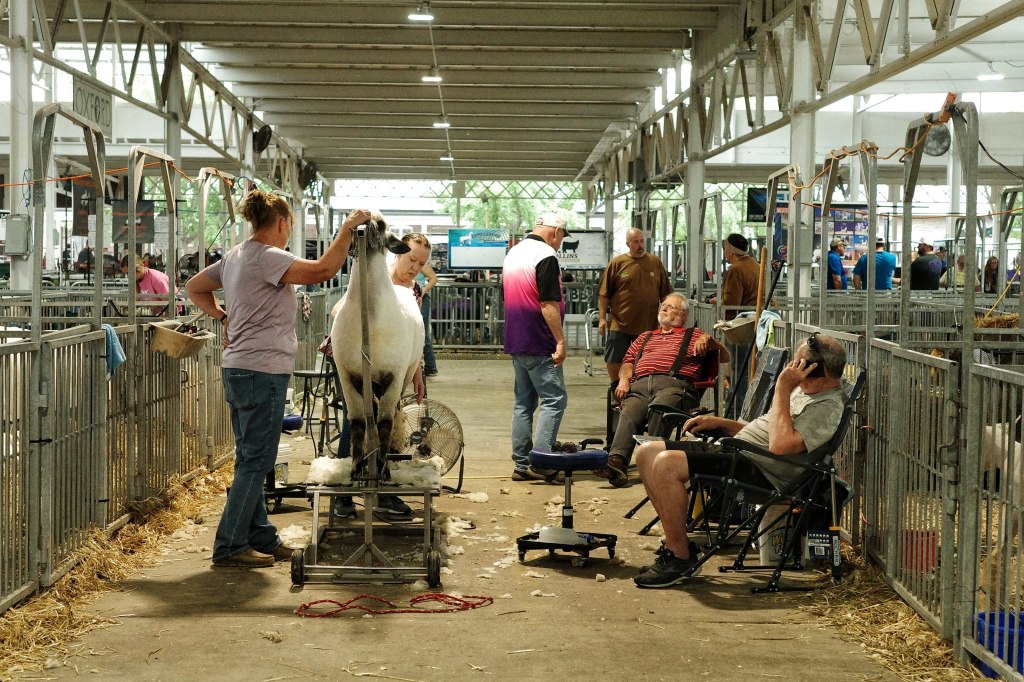
Women grooming sheep while men sit and chat.

These animals weren’t just being cleaned; they were being groomed. Meticulously groomed. (Okay, sorry, a slight tangent here. The term groom has a slightly hazy etymology. It’s probably(?) related to the Old English growan, meaning ‘to grow.’ At any rate, by the 14th century groom referred to a male servant who attended to officers (and their gear and horses) in a noble household. By the 19th century, the noun had been verbed, and groom referred to the process of tidying up or preparing for a purpose. So groom referred to both a person and what the person did. I don’t know why I thought you needed to know that, but there it is.)

A young girl vacuuming (or blow-drying) a cow.

As I was saying, these livestock animals (and I’m talking about cows, horses, pigs, goats, sheep, llamas, alpacas (is that the plural of ‘alpaca’?), rabbits, and chickens (do rabbits and chickens count as livestock? No idea.) are meticulously groomed. It’s clear that some of the grooming is done in the hope of winning a prize, but it was also clear that much of it was done out of pride and affection. That was especially true of the younger people.

Equine pedicure.

Here’s a thing you probably need to understand. All this cleaning and grooming? It’s taking place in and around massive cooperative barns housing hundreds of animals. Animals are noisy, so these barns are a constant barrage of animal noises. Also? Animals shit and piss a lot. I mean, a LOT. And they’re not particular about where or when they do it. So even though there’s a constant stream (so to speak) of people shoveling, sweeping up, and carting of waste products (the logistics of livestock waste management must be staggering), the fact remains that these massive barns…well, they smell like you’d think they’d smell, but not as bad as you’d expect.

Bovine shampoo.

What I’m trying to say here is that there’s an astonishing amount of hard work done by the farm families who bring their livestock to the fair, and all that work makes the environment as pleasant as possible. One of my reasons for visiting the animal barns during the State Fair is to look at animals, of course, but it’s also to see this remarkable group of people cobble together a shared sense of community. There’s something very tribal about it. And as a sociologist by training, it’s fascinating.

Detailing a wagon wheel.

But here’s the problem with being a sociologist: I know that the farming community I see at the State Fair is, largely, a myth. Around 40% of farms in Iowa are owned by corporations. Modern farming, even among non-corporate farms, is a business more than a self-sufficient way of life. The farming life we witness at the State Fair is something of a sentimental homage to an idea of rural living from the past. An homage grounded in nostalgia and an agrarian myth.

But so what? I’d argue there’s value in that. The fact is, it’s not corporations who are grooming their livestock at the State Fair. It’s not corporations who are hauling manure and polishing wagon wheels. It’s families doing that.

My visits to the State Fair animal barns always leave me impressed (and yes, a wee bit stunned by the smell and noise). I leave those barns profoundly grateful there are people–families–still willing to do the hard work of making sure the world gets fed. As myths go, this is a pretty damned good one, and I’m glad folks are keeping it alive.

not the weirdest thing i’ve done

A couple of days ago I wrote about a photograph I’d taken of some cracks and oil stains in a random patch of blacktop. It may seem a wee bit weird to photograph a patch of blacktop, but…well, just wait. In that post, I briefly referred to the fact that there’s a difference between blacktop and asphalt. That sparked a reply to the post, and that reply reminded me of an earlier crushed stone and bitumen-related photograph I’d taken fifteen years ago.

Now that was weird.

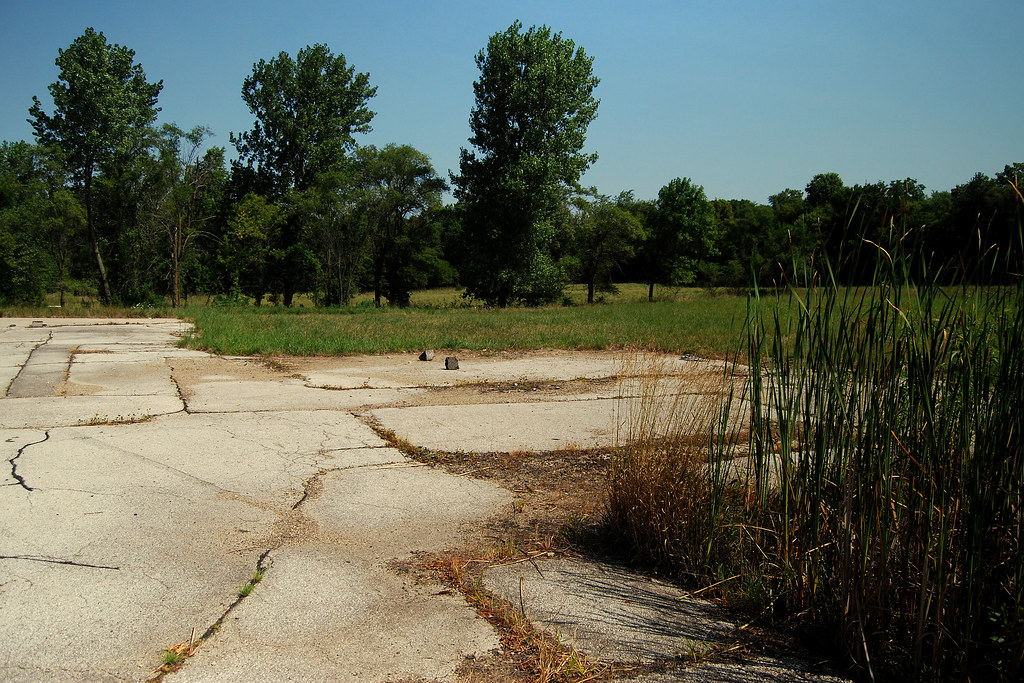
Back in November of 2010 I was noodling around a location where a local supermarket had been demolished. All that remained of the store was its foundational slab and what had once been a parking lot. That’s where I came across something odd.

November 13, 2010

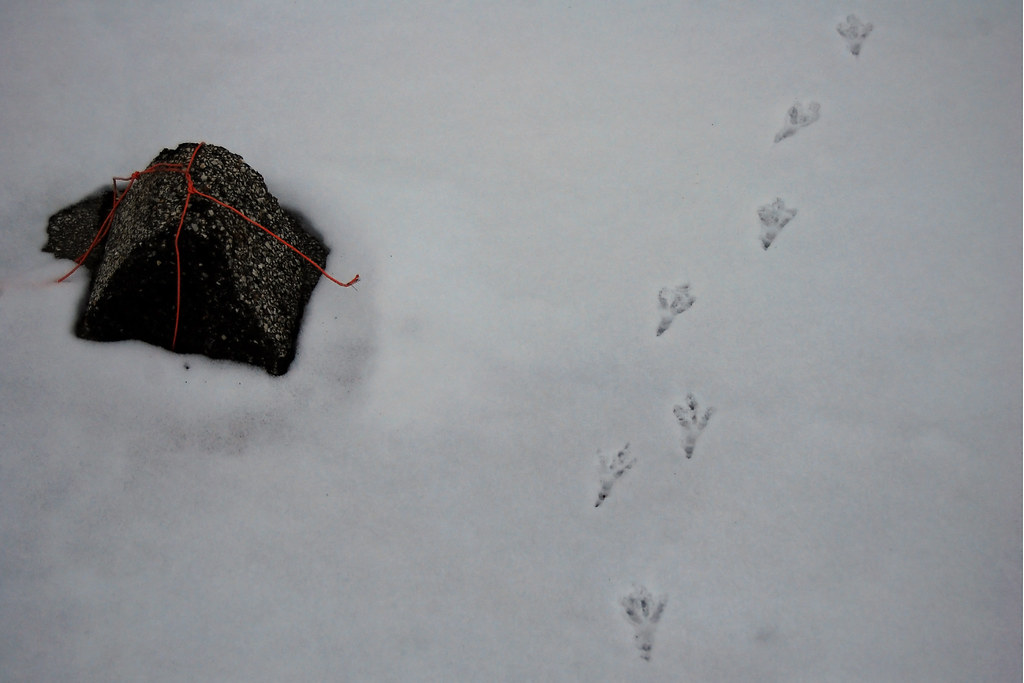
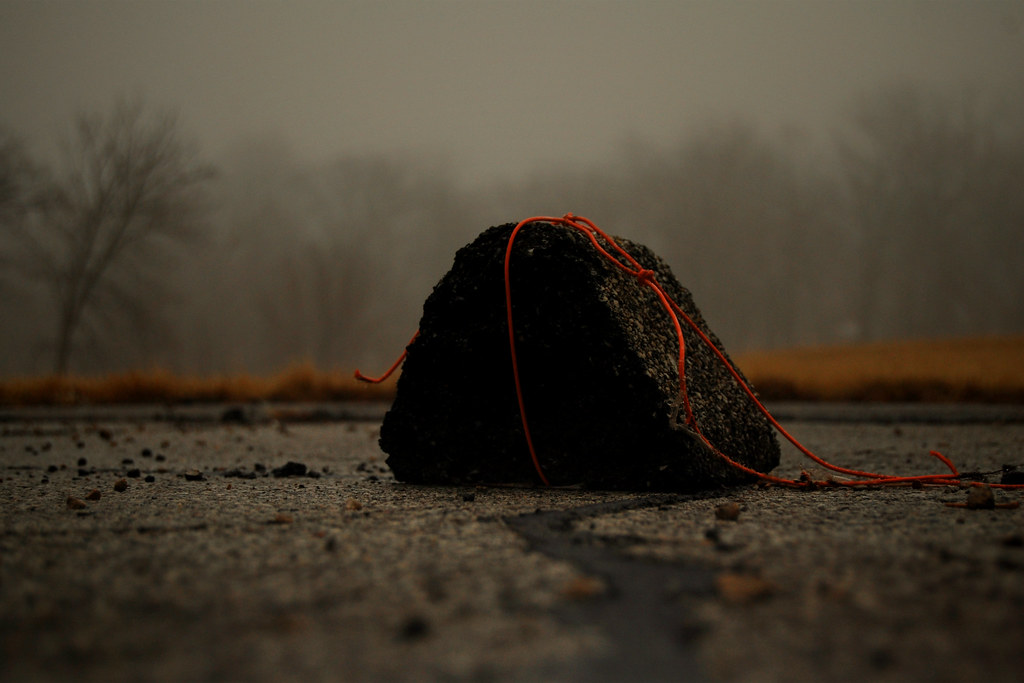
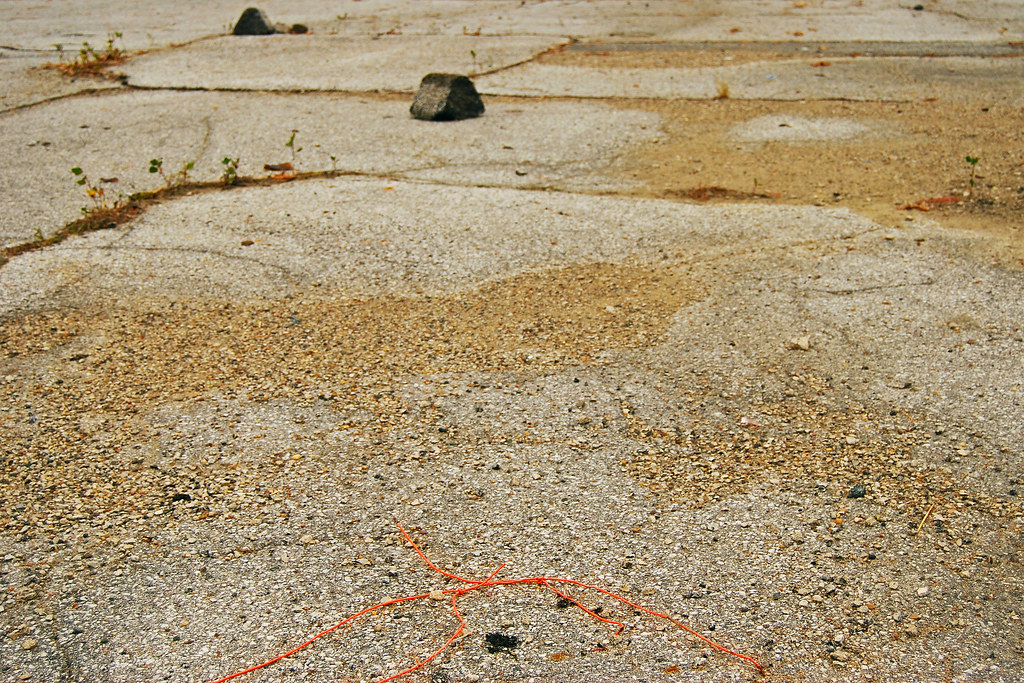
Yep, that’s a chunk of asphalt curbing around which somebody had tied a strand of red PVC-coated wire. Why would somebody do that? I don’t know, but I assumed it was to make it easier to carry. Why would somebody want to carry a chunk of asphalt curbing? No idea. I located the spot from which the curbing had been removed about 20 yards away. There were several similar chunks of broken asphalt curbing. But somebody had selected that particular chunk, tied red PVC wire around it, and moved it.

Why? No fucking clue. But it was odd, and I do love things that are odd.

December 23, 2010

So I returned to that spot about six weeks later. The chunk of curbing was still there. It had snowed, but the snow had melted off the chunk. A heron had apparently been curious enough to check it out. Not sure if that meant the heron was as curious as I was, or if I was as stupid as a heron.

Anyway, I stood there in the snow for a while, trying to cobble together some semi-logical reason for somebody to tie some PVC wire around a chunk of curbing and carry it twenty yards before dropping it. I was sure there was a logical reason; not necessarily logical to me, but logical to the person who did it. But I’m damned if I could figure it out.

February 16, 2011

I found myself occasionally wondering about that chunk of curbing and the red PVC wire. Did the person just happen to have some red PVC wire in their pocket? Had they deliberately brought the wire with them, intending to move the chunk of curbing? And why why why would they want to move it in the first place? It made no sense, but I was intrigued by it.

So I went back again on a cold, wet, foggy day in February. And yep, it was still there.

February 16, 2011

It wasn’t just strange; it was also visually interesting. I was taken with that red PVC wire. I considered taking hold of the wire and lifting the chunk, just to see how heavy it was. But I was reluctant to disturb it. It wasn’t just an object of curiosity anymore. That’s when I began to think of the chunk of curbing as a possible photo project. Which meant it didn’t seem right to intentionally change anything about the subject matter.

April 13, 2011

I returned to visit the chunk of curbing about a month later and was shocked to see it had been moved. Somebody had apparently picked it up, carried it about twenty-five feet, at which point the red PVC wire had snapped.

I can’t imagine many people would find a reason to noodle around the detritus of a former supermarket. But IF somebody did, and IF that somebody happened upon the chunk of curbing, then surely they’d be tempted to pick it up. I mean, I’d been tempted to pick it up myself. The way the PVC wire was wrapped around the chunk of curbing–it was clearly intended for it to be picked up. Who could resist it?

Somebody didn’t resist it. Somebody had seen it, had picked it up, and toted the chunk of curbing twenty-five feet. Hell, that was the most understandable thing about the whole situation.

August 24, 2011

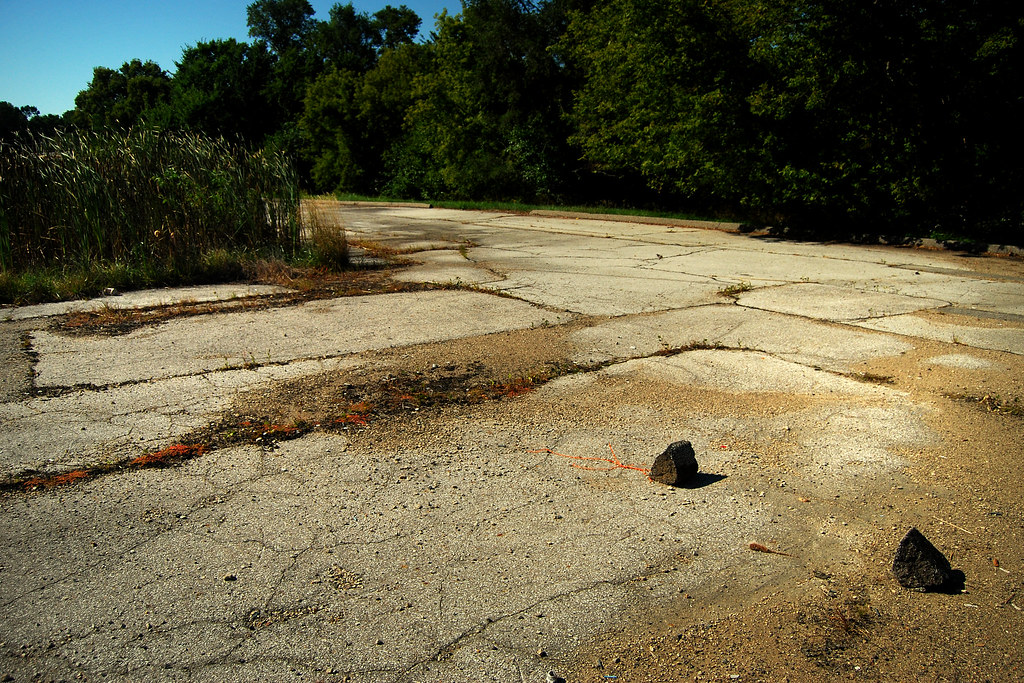
I didn’t get back to visit my pet chunk of asphalt curbing until late in the summer. As I approached, I saw two chunks. I thought maybe whomever had moved the curbing back in the spring must have returned and broken it.

But no. It was a second chunk of asphalt curbing. Somebody–maybe the same person who’d moved it earlier–had apparently gone to the spot where other chunks of curbing were scattered, picked up another chunk, carried it to the vicinity of my pet chunk, and dropped it.

This compounded the WTFedness of the situation. It reinforced the original weirdness. It made no sense at all. It was insane. It was…kind of wonderful. I was oddly pleased by the development.

September 8, 2011

I returned a month later. Not much had changed. Some orangish lichen had grown in a nearby crack and I spent some time trying to find a way to photograph the red PVC wire and the orange lichen, but nothing seemed to work. In the end, I just documented my chunk of asphalt curbing along with its companion.

I figured I’d just about come to the end of the chunk’s story. I was still curious about the whole thing, but the original aura weirdness was beginning to fade.

October 18, 2011

Still, I’d developed something of a perverse relationship with that chunk of curbing. I felt a need to check on it. So of course I went back.

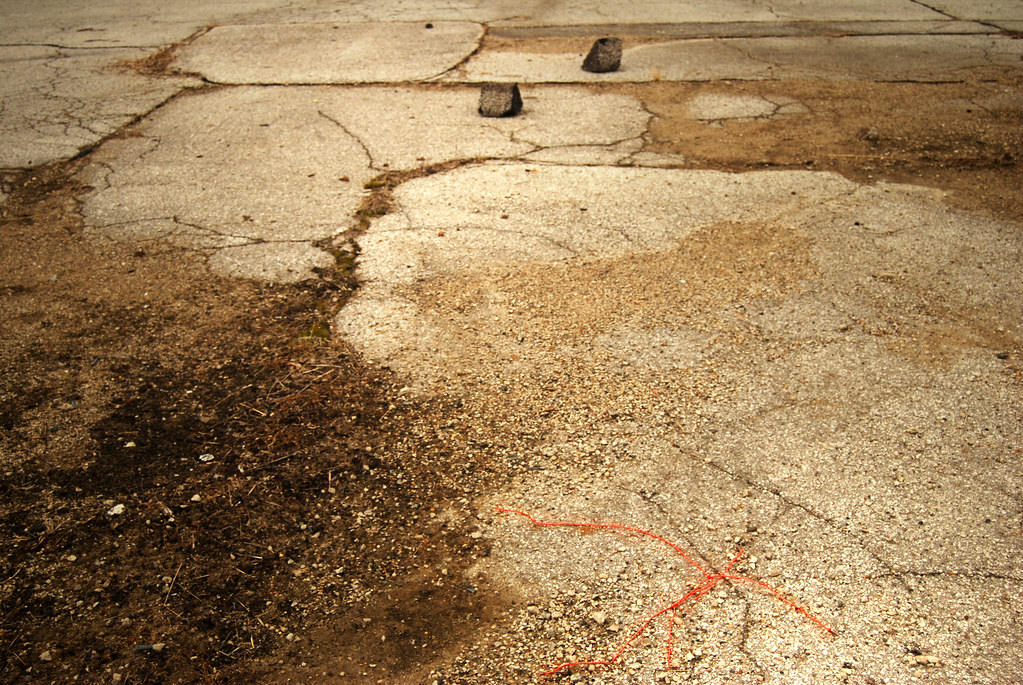
The red PVC wire had moved. It had broken six months earlier, but a length of it had been trapped beneath the chunk of curbing. How did it get loose? Maybe a bird or animal had tugged on the wire and freed it? In any event, I took it as a sign (No, not that sort of sign; just an ordinary sign) that the project was at an end. Surely, the wire would soon get blown away. Without the red PVC wire, the chunk of curbing was just a chunk of curbing. As soon as it was gone, the photo project would be over.

December 20, 2011

I gave it a couple of months. I went back in December. Nothing had changed. As near as I could tell, the red PVC wire hadn’t even moved. That was…weird. You’d think that over the course of two months something would have moved the wire. But that was just minor league weird compared to the overall weirdness.

Still, I’d made the decision that I’d keep coming back until the red wire was gone. So I returned in the spring. The entire area was fenced off and construction equipment was tearing up the old parking lot.

There’s an apartment complex there now.

I no longer live in that area, but maybe once or twice a year there’ll be a reason for me to pass nearby. And when I do, I think about that chunk of asphalt curbing, and the bright red PVC-insulated wire, and the person who’d tied the wire into a parcel-carrier. And I wonder what in the hell they’d been doing, and why. And it pleases me that I’ll never know the answer.

blacktop

So I’m in a parking lot. No, wait, not a parking lot…a parking area. It’s not like a parking lot outside a big box store, with lines designating parking spaces. This is just an extra wide bit of blacktop on a winding blacktop road through some woods near the spillway of a dam. It’s a place where people who fish the area above the spillway can park their cars.

On a weekday, it’s usually empty except for the occasional Asian or Latino immigrant looking to put some fish on the table. It’s a quiet spot. Shaded by trees. My partner and I sometimes make the half hour drive to this spot with a couple of camp chairs, something cool to drink, and our books. We sit, we read, we look at the birds, we listen to the wind in the trees, we chat with the folks who come to fish. On the way home we usually stop for ice cream. It’s nice.

She can sit still longer than I can. My knees are wonky and I have to get up periodically and stretch them. There’s always something to look at, and I’ve always got a camera with me, so occasionally I’ll take a photo. Yesterday I took a photo of the blacktop.

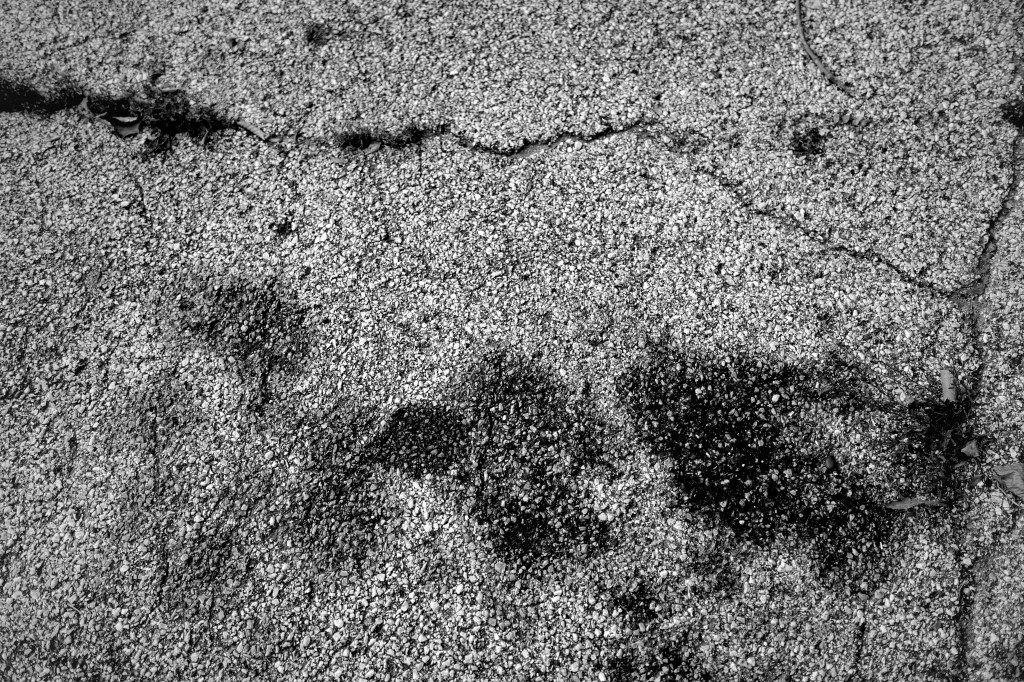
I don’t know why this particular patch of blacktop caught my attention, but it did. There are some cracks with little weedy bits growing in them, and some oil stains–some new, some faded. But it’s just blacktop (which isn’t asphalt, by the way; both blacktop and asphalt are made of crushed stone and bitumen, but the ratio of stone to bitumen is higher in blacktop, which can give it a more sparkly appearance–and lawdy, this is way more information than you need or want).

I pulled my Ricoh GR3X out of my pocket and looked at that patch of blacktop from several different angles and directions. I raised the camera higher, I lowered it closer to the surface, looking for a different framing of the patch. I probably spent three or four minutes trying to get the framing just right. Then I took this single photo.

I looked up to see my partner was watching me. She said,

“Bug?”
“What?”
“Where you taking a picture of a bug or something?”
“Oh. No. Just the blacktop.”

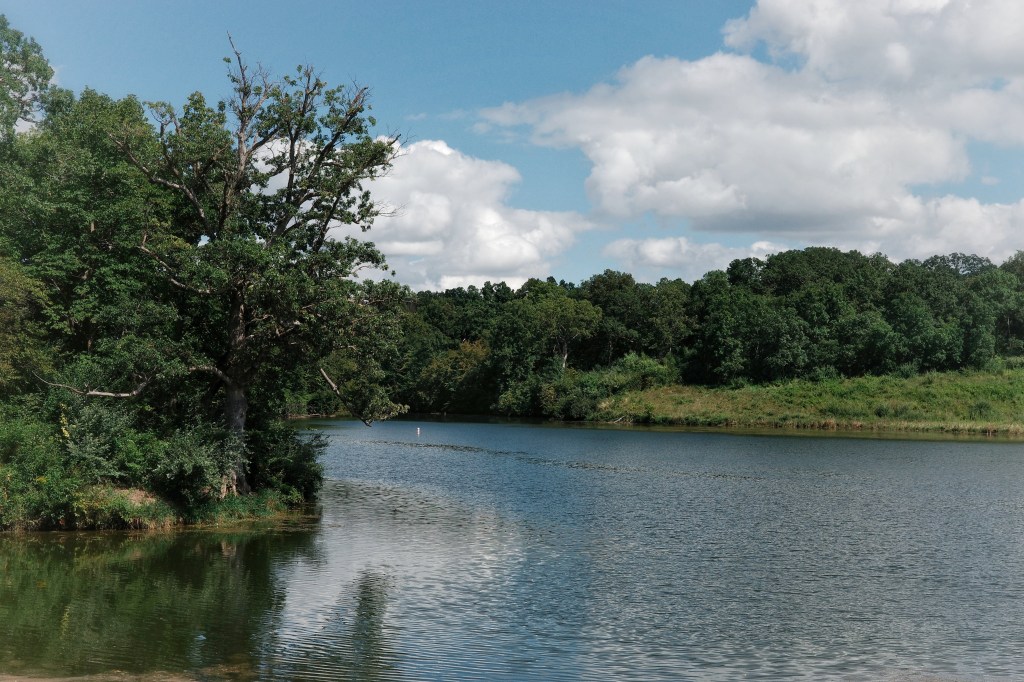
She looked at me for a moment, then nodded and went back to her book. The sky is blue, the clouds are white and fluffy, the water ripples a wee bit with the wind. There are swallows hawking for insects just above the surface of the lake. A kettle of vultures is making lazy circles in the distance. And there’s Greg taking a photo of a patch of blacktop.

The view.

Just another day at the upper spillway.

state fair in…monochrome?

The Iowa State Fair…well, every fair, really…is a colorful event. Bright, garish colors. Not normally a venue I’d consider photographing in black-and-white. And, in fact, of the maybe 150 photos I shot during my five hours of noodling around the fairgrounds yesterday, only a few were shot in monochrome.

Guy in an almost empty barn.

Why would I do that? Because there are some scenes that feel like they ought to be shot in monochrome. Color photography is my default approach, and sure, you can shoot scenes in color and convert them into black-and-white images (which is actually the best approach, since digital imagery is grounded in information rather than color). But if there’s something I want to shoot in black-and-white…well, I shoot it in black-and-white. I want to see it in black-and-white.

Bearded guy.

Obviously, we live in a world of color (well, most of us do) and yay for that. I love color. But sometimes it’s a distraction. The photograph above is all about the beard. But this guy’s clothing was a drab sort of khaki which made his beard almost disappear. Worse, the woman next to him was dressed in bright colors. In fact, most of the passers-by were dressed fairly colorfully. The only way this photo would work was if I removed the distractions of color.

That’s one of the many advantages of digital photography. Almost every modern digital camera allows you to quickly shift back and forth between color and monochrome. I have my Ricoh GR3X set up with two different color profiles and a high contrast monochrome profile. When I saw this guy demonstrating wood-turning on a small lathe, I knew his brown-green smock would interfere with the color of the wood. A turn of a dial, and problem solved.

But what do you do when there are scenes that work in monochrome AND color? For example, a blacksmith at work. You can’t ignore the bright color of flame, or the way fire casts a glow on the surroundings. Obviously, you have to shoot both. Each carries a different emotional weight.

Blacksmith at work.

The photograph above is, I think, a very human photo. It’s as much…or more…about the people in the photo as it is about blacksmithing. The light cast by the flame and the high windows softens everything. It gives the image an almost cozy feeling.

When you remove the distractions of color, the mood changes. It’s not just that the composition becomes more focused on tone and texture, on shadow and light, or line and form. Removing color also means abandoning the strictures of reality. Black-and-white photos are a wee bit divorced from reality, a step or two away from the real world, recognizable but still different. This can give an image an almost mythic quality.

Blacksmith at work.

This photo is less personal, more emotionally distant, more analytic. It’s not about the guy doing the work; it’s more about the mythos of blacksmithing–the narrative of the smithy, the cultural representation of blacksmithing. It has a more primitive vibe. Where the color photo is about warmth, this is about heat and fire.

Also? Black-and-white photography encourages a LOT more artsy-fartsy bullshit.