Yesterday the United States military attacked and destroyed a civilian vessel in international waters, killing eleven people. Comrade Trump claims the boat was carrying narcotics bound for the US, and that the victims were members of Tren de Aragua, the Venezuelan drug cartel.
The alleged ‘drug boat’ moments before being obliterated.
That may be true. We don’t know. We can’t know because we blew them up. What we DO know is this:
It was a civilian vessel.
The vessel wasn’t an immediate threat to anybody or anything.
There was apparently no attempt to intercept the vessel.
There was no attempt to disable the vessel.
There’s no declaration of hostilities against Venezuela.
In other words, the Trump administration hasn’t presented any evidence to justify the use of military force against this boat. It appears to be an extrajudicial killing of 11 people. Which is illegal as fuck.
If we can locate and track the vessel accurately enough to fire a missile up its ass (and we obviously did), then we can track it long enough to intercept it in US waters. At that point, we could determine if there were, in fact, narcotics onboard. If so, we could then detain the crew, interrogate them about the source of the drugs, and hold them for trial in a criminal court. We could have followed the law.
But nope.
There appears to be no reason to blow them up except to gratify the blood lust of Trump and his Cabinet of Nazgûl. This is literally murder. It’s criminal on the part of the people who ordered the missile fired and the person who actually fired it. However, there’s no chance any of them will be held accountable.
It’s important to remember that back in February, just a few weeks after Trump resumed the presidency, Pete Hegseth summarily fired the senior Judge Advocates General of the Army, Navy, and Air Force. These are the officers responsible for enforcing the Uniform Code of Military Justice. Hegseth actually said the JAGs were fired because he didn’t want them to be “roadblocks to orders given by a commander in chief.” That was, in effect, an announcement that Trump intended to use US military forces in ways forbidden by the UCMJ.
And now he has. And what’s perhaps scarier is this: military personnel have shown themselves willing to execute orders they know are illegal, in direct violation of the oath they swore when they entered military service.
Killing these eleven people in this particular way–and doing it openly–is a test and a declaration. It’s a test to see the domestic and international response. And it’s a declaration that Trump intends to use the US military in ways that are expressly forbidden to further his own political and personal agenda.
This is straight up dictatorial bullshit. And with a MAGA-controlled Congress, Trump will get away with it.
I’m sure you’ve all asked yourselves this very same question: “What do I do when I’ve declared a national emergency and activated the National Guard to fight crime, but then there’s almost no crime to fight?” It’s annoying, right?
I mean, they elect you to be POTUS and they give you the entire District of Columbia National Guard to play with, so obviously you’d want to use them to guard the nation against something. Otherwise they’re just wasted, sitting there on the shelf. So, crime. Nobody likes crime. Crime is a good thing to fight. Everybody likes crime-fighting. It’s popular on television. It’s not YOUR fault there’s not much crime to fight.
Courageous National Guard troops, dressed in camouflage AND hi-visibility vests engage trash.
So there you are, you’ve got your troops all dressed up and no crime to fight. What to do, what to do? EASY! Make them fight trash! DC is host to tens of thousands of foreign tourists who toss trash all over the fucking place because that’s how they behave in foreign countries. Except, not so many people are coming to DC now, because they’re not really welcome. Besides, you’ve told them DC is a dangerous shit-hole. So the trash assault is a pretty short term event.
Courageous National Guard troops mulching like nobody has mulched before.
But hey, DC is also beautiful. Trees and bushes and all sorts of pretty flowers, and that shit has to be mulched. The National Guard may not be trained to mulch, but they know how to improvise, adapt, and overcome. Issue them rakes and hoes and other geoponic implements, and turn them loose. They’ll mulch the absolute shit out of whatever needs mulching.
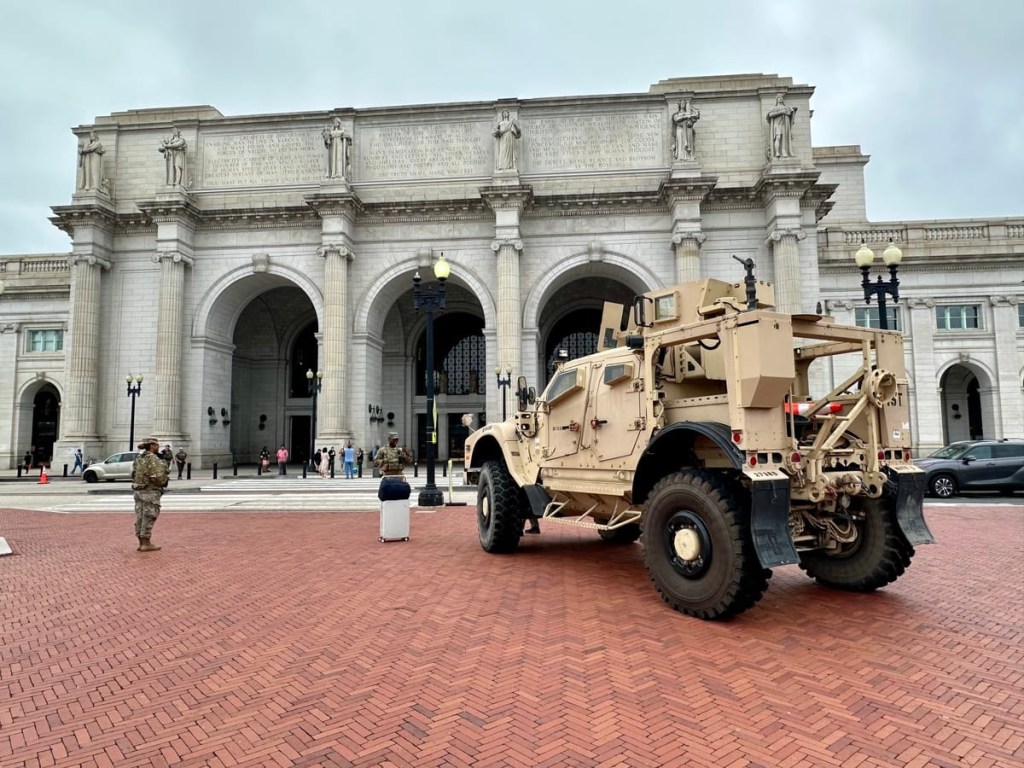
Tactical yardwork is fine, but you really really wanted them to fight crime. That means you have to send the troops where crime exists. Fortunately, there are some pretty tough, crime-ridden neighborhoods in DC, neighborhoods where people don’t always feel safe at night, neighborhoods where news photographers are reluctant to visit. There’s no point in sending your troops there. However, you’ve heard from your pretty-eyed Vice President that vagrants–actual people without proper employment and/or lacking a fixed abode, like in those movies from the 1930s–have been loitering around Union Station. Vagrants are smelly (probably) and unsightly, like windmills off the coast of Scotland. We can’t have that. Also, somebody on your staff might have said something about maybe somebody they knew almost had their luggage stolen while at Union Station.
Courageous National Guard troops supported by an MRAP guarding carry-on luggage.
Now that’s crime worth fighting! Deploy the MRAP! Nothing discourages loitering like a mine-resistant ambush protected vehicle. Ain’t nobody gonna sleep on benches–if there were any benches–at Union Fucking Station when your National Guard is on duty. Ain’t nobody gonna roll away some poor tourist’s Samsonite hardside, not when you’re in charge and you have a MRAP handy.
So there you are. You’ve ended crime in DC. Trash is gone. Plants are mulched. You’ve established peace through superior firepower. Now all you have to do is wait for your Nobel Peace Prize. It’s good to be POTUS.
As you may recall, recently Comrade Donald Trump, as Commander in Chief of the United States Armed Forces, made this claim on national television:
“Iran’s key nuclear enrichment facilities have been completely and totally obliterated.”
Yeah, no. Didn’t happen. Just another in the endless series of Trump’s self-aggrandizing lies. The Defense Intelligence Agency conducted a preliminary Bomb Damage Assessment of the US attack (that’s right, the DIA did a BDA) and assessed that the damage at the primary Fordo site was “not extensive.” Certainly, the site was not obliterated like Trump claimed. But that’s not the real problem.
This morning the Unlikeliest Secretary of Defense Ever, Pete Hegseth, complained about the news coverage of Comrade Trump’s pointless attack on Iran’s nuclear facilities. Hegseth claimed that reports detailing the limited damage done by the bombing was, in effect, an attack on the integrity and honor of the pilots and air crew who flew the mission. Which, obv. is total bullshit. Which, again, is in keeping with almost everything Hegseth says. But that’s not the real problem.
GBU-57 Massive Ordnance Penetrator
It’s been reliably reported that at the primary uraniam enrichment site at Fordo, two of the so-called ‘bunker buster’ bombs (okay, technically they’re called ‘Massive Ordnance Penetrators’ or MOPs) were dropped on the entry point to the facility and on a ventilation shaft, one after the other, to increase the level of destruction. The destruction that, you’ll recall, the DIA described as “not extensive.” Which means the MOPs didn’t do what they were intended to do. But that’s not the real problem.
Here’s the real problem: for a couple of decades, the threat of the ‘bunker buster’ gave the US leverage. Hostile nations, fearful of the power of that specific bomb, were reluctant to test the US resolve. If a nation started to build a highly secure underground facility against the wishes of the US, the US would dangle the ‘bunker buster’ and that was generally enough to dissuade them. The threat of the ‘bunker busters’ was enough to cow most of our adversaries.
They were incredibly effective as a deterrent…as long as we didn’t actually USE them.
Not anymore. Now everybody knows the most fearsome conventional high explosive bomb in the US arsenal can’t do what it was designed to do. You know North Korea is digging deep today.
Trump has once again made the US weaker. Nothing he can say or do—nothing Hegseth or any of Trump’s other sock puppets can say or do—can change the reality. Oh, the ‘bunker buster’ is still a formidable conventional weapon. But now the world knows it’s just another really big bomb, and if you dig deep enough it won’t hurt you.
In the late 19th century, there was a rush to memorialize the American Civil War. There were still a lot of living Civil War veterans around, but enough time had passed that the emotional trauma of that awful war was being scarred over by sentiment. There was a national desire–maybe even a national need–to attempt to ennoble the killing and the dying, to transform the horrific mass slaughter into something virtuous.
Communities did this by erecting monuments and memorials to the fallen soldiers. It’s important to distinguish between these commonplace memorials and the statues of the leaders of the armies. The statues of Civil War generals–Robert E. Lee, Ulysses S. Grant, Stonewall Jackson, William T. Sherman–were created to celebrate both the individuals and the cause they fought for. Every statue of a Confederate general is also a statue defending a war to protect slavery; every statue of Union general is a statue defending the notion of a united nation.
Civil War memorial, Hanson, Massachusetts
But the vast majority of Civil War memorials and monuments–the ones you’ll find in parks and standing in front of courthouses in small towns–are dedicated to the people who did most of the fighting and dying. They’re actually memorials to the grunts, the men who went where they were told to go, who shot at the people they were told to shoot at, and who died because that’s what grunts do. Grunts don’t die for vaguely defined moral or political concepts; they die because somebody in a suit decided those concepts were worth somebody–somebody else–dying for.
For small towns that wanted to memorialize the common soldiers who died in the Civil War, the cost of marble or granite statues was prohibitive. However, there were a small number of New England monument companies that specialized in casting bronze or zinc cemetery statues. The Monumental Bronze Co. of Bridgeport, Connecticut produced a model known as the Silent Sentinel. It was a life-size statue of a generic soldier standing at parade rest and sold for an affordable US$450 (an 8-foot-6-inch version could be had for $750). For Northern markets, the belt buckle of the Silent Sentinel was stamped with US; for Southern markets, it was stamped with CS. Other than that, the statues were exactly the same. The same longcoat, the same rifle, the same knapsack, the same forage cap.
Civil War memorial, New Market, Virginia
Eventually, Southern markets caught on to the fact that they were paying Yankee industrialists for statues of Yankee soldiers passing as Confederate soldiers. They began to insist on changes to their statues–a shorter jacket, a bedroll instead of a knapsack, a different style forage cap. But the fact remains, that many of the Civil War memorials you’ll find in town squares from New England to the Midwest to the Deep South depict the same generic soldier.
That’s appropriate, especially on Memorial Day, when we’re meant to honor the troops who died in military service to their nation. The leaders–the generals, the politicians, the industrialists who profit from the weapons of war–fuck those guys. But all those poor indistinguishable bastards who put on a uniform and went to war because they were told there was a good reason for them to risk death and kill strangers, those people deserve our compassion. They earned those memorials.
An online acquaintance recently sneered at the UK for pledging to send 14 Challenger 2 tanks to Ukraine, asking, “What possible difference can 14 tanks make?” It’s a good question, but a questionable sneer.
It’s important to remember that there are a LOT of different armored combat vehicles being used in the war in Ukraine. Most of them aren’t tanks; some are personnel carriers with heavy weapons, some are fighting vehicles designed to be fast and maneuverable, some are self-propelled artillery or rocket launchers. They sorta kinda look like tanks, but aren’t; they don’t have the same level of armor or armaments. Of the actual tanks, most are light or medium tanks. Very few are main battle tanks.
Light tanks are, obviously, lighter and smaller and faster. They’re mostly used for reconnaissance and skirmishing, probing enemy lines, getting in and out quickly. Medium tanks have better armor and guns, but aren’t quite as mobile; they pack a better punch and are designed to be used in groups, which means they use different tactics. Then there are the heavy tanks, the main battle tanks (MBTs). These are big, heavy bastards, not as mobile, but massively armed and armored. MBTs are designed to act as the hub of a combined force–infantry on foot, infantry in armored fighting vehicles, and medium tanks. They’re the centerpiece of group operations, the tip of the spear.
Challenger 2
How good is this Challenger 2 MBT? They’ve been in service since 1998 and, as near as I can tell, only four have been rendered inoperable in combat. Four. One was destroyed in 2003 in Iraq, killing two of its four-person crew. However, that tank had been hit while its crew hatch was open–and it was a friendly fire incident; it was mistakenly fired on by another Challenger 2 tank. Even then, it took two rounds to destroy the tank. Two other Challenger 2s were made inoperable when their front underbelly armor was penetrated–one by an RPG and the other by an IED. Since then the underbelly armor has been upgraded. And one Challenger 2 had been hit by an anti-tank missile PLUS 14 RPGS, and was still able to retreat; unfortunately, it backed into a deep ditch and lost a track. The crew was quickly rescued unharmed, the track was replaced, and the tank was back in action within six hours. That’s four times in 25 years. I’d call that a success.
This is a seriously badass tank. So when the UK is sending 14 Challenger 2 MBTs, they’re essentially providing Ukraine with the core unit around which a larger ground fighting force can be arrayed. The same is true for all the MBTs being sent by other nations. The US has sent/will be sending 31 M1 Abrams tanks, and a half dozen European nations have sent/will be sending 49 German Leopard 2 tanks.
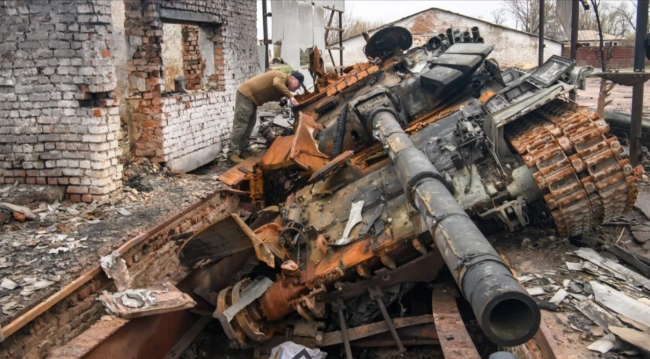
Even without all these MBTs, Ukraine has proven adept at destroying and capturing Russian tanks. Oryx, the Dutch defense analysis website, can account for 1761 Russian tanks destroyed, damaged, abandoned, or captured in the last year. These are confirmed numbers, verified by photographic evidence; the true number of destroyed tanks is significantly higher.
Russian T-72
My online acquaintance says, “But Russia has something like ten thousand tanks in reserve, right?” Probably not. Russia may claim thousands of tanks in reserve, but who can rely on that? They also claimed they could take Ukraine in three days. But even if they DO actually have 10,000 tanks in reserve, they’d be mostly older models–not Russia’s primary MBT, the T-90. We’re already seeing the Russian Army deploying old T-62 tanks in Ukraine, and they haven’t been manufactured since 1975; that’s almost half a century ago.
Given what we know of the corruption in the Russian Army procurement system, we can be pretty confident many of those ten thousand tanks won’t be battle-ready. Not only are manufacturers producing military equipment and parts that don’t meet military specifications (and pocketing the cash), there are also multiple sources reporting Russian commanders selling parts and equipment necessary for vehicle maintenance (and pocketing the cash). We’re hearing about radical equipment failures; for example, cannon barrels (on both tanks and field artillery) need to be regularly replaced because of the tremendous pressure of repeated fire. If they’re not replaced, they…well, explode. That’s hard on the crew.
And if that’s not enough, remember that Russia has a LONG border and needs to keep a large chunk of its military defending that border. It’s not as though Russia can send ALL of its tanks to Ukraine.
So, what possible difference can 14 British Challenger 2 main battle tanks make in the defense of Ukraine? In conjunction with the MBTs and other armored combat vehicles NATO allies are sending, they can make a big difference. This is partly because of the tanks themselves, but also because the Ukrainian Army has proven to be incredibly creative and adaptable in their approach to combat. They’ve learned combined arms operation tactics, at which Russia has failed miserably.
The fact is, Russia’s invasion of Ukraine has been stalled for months. They not only lack the ability to advance, they lack the ability to sustain major combat operations at this same stalled level. The arrival of new, powerful MBTs will very likely allow Ukraine to advance into Russian-controlled parts of Ukraine by the end of the coming summer.
There’s no way Russia can win this war. The only questions are how they’ll lose and how much suffering they’ll cause as they lose. The most likely outcome (and, of course, this is just my opinion) will be Russia withdrawing from much/most of Eastern Ukraine, followed by the same sort of long, consistent, localized border war Russian and Ukraine have fought since 2014.
Yeah, so Vlad Putin is ‘mobilizing’ 300,000 Russian men to serve in his ‘special military operation’ in Ukraine. In fact, he’s probably ordered a much larger conscription; some estimate as many as a million Russian men, mostly from the more rural ethnic regions of Russia.
The vast majority of these conscripts will receive little (or no) training before being deployed. This is a feature of the Russian Army, not a design flaw. The lack of training is a deliberate aspect of Russian military strategy in Ukraine.
You may be thinking, “Greg, old sock, that doesn’t make a lick of sense.” And you’d be right (aside from calling me ‘old sock’ and I don’t know WHY you insist on calling me that) IF we were thinking about any conventional Western military strategy. But the current Russian military approach is built around what they call a Battalion Tactical Group (BTG).
The BTG approach involves a cadre of highly skilled soldiers around which poor quality infantry units can be attached. Different types of unskilled units will be attached to a BTG depending upon the nature of the mission or the condition under which they’re fighting. The unskilled or untrained units serve as a literal meat shield to protect the core of the BTG.
This is how it works. Say you’re a Russian officer and you want to know if there’s an ambush ahead, or if there are tanks in that village. You send the meat shield forward to draw their fire. That exposes the location of the enemy units, allowing the BTG’s artillery to target those positions. It works the same way on defense; station the meat shield in between the advancing Ukrainians and the core BTG; when the conscripts get attacked, the BTG artillery can target Ukrainian attackers more effectively.
It’s hard on the meat shield, to be sure, but it keeps the core of skilled professional troops more or less intact. Since the conscripts require little or no training and, for the most part, aren’t given decent weaponry, the meat shield is easily replaced. Just conscript a few thousand more ethnic peasants, and hey bingo, you’re back in business.
It’s a mistake to think of the effectiveness of the Russian Army in terms of casualties. It’s designed to have high casualty rates. Lots of dead and wounded conscripts are acceptable, so long as they achieve the strategic and tactical goals, and keep the core BTG units relatively secure.
The mobilization of a 300,000 body meat shield will help the Russian Army defend the territory they’ve stolen — for a period of time. Maybe it’ll be enough to get them through the winter, which will give them time to train and reinforce the BTGs. And that will prolong the war.
This, of course, is assuming Putin doesn’t contract ‘high building syndrome’ because of his unpopular war policies. It’s looking more and more like he’s losing control of the nation.
I confess, I’m fascinated by military tech. Always have been. It’s awful, of course. So much military tech is about killing people, and, well, you know—killing people, by and large, is pretty much wrong, right? Yeah.
And yet, there it is; I’m still intrigued by military technology. I mention this because over the weekend the US, at the order of President Uncle Joe, killed Ayman al-Zawahiri, the leader of al-Qaeda. They killed him with a modified Hellfire missile fired by a Predator drone (and yeah, there’s a whole deeply weird, perverse taxonomy at work here—a Hellfire missile from a Predator drone). They killed him “as he stepped onto the balcony of a safe house in Kabul.”
Him. Just him. Just al-Zawahiri. Nobody else. No so-called ‘collateral damage’.
They were able to do that because the Department of Defense, in conjunction with the CIA and engineers from Lockheed Martin, modified an AGM-114 Hellfire missile and turned it into an AGM-114 RX9—basically a hundred-pound laser-guided Ginsu Knife Bomb. Instead of explosives, this missile has—and I’m NOT making this up—six sword-like blades that pop out of the sides of the missile moments before it strikes the target (and by ‘target’ I mean ‘the person the CIA really seriously no-shit wants to kill’).
Smaller than a six-foot-tall human (not sure why that’s important).
The idea, of course, is to limit the number of casualties. Most versions of Hellfire missiles involve explosives, which are notoriously indiscriminate. When shit blows up, anybody in the blast radius is going to get fucked up. That’s a problem. I mean, if the person the CIA really want to kills is, says, standing on a balcony in Kabul and you fire an explosive weapon at him, you’re going to see a lot of kinetic damage to the building and anybody in it (and anybody near it). Kinetic damage is a nice way of saying blown the fuck up.
When a hundred pounds of inert steel with half a dozen blades hits a target on a balcony, the damage is significantly more limited.
Okay, maybe not a Toyota—I dunno. But still.
This missile is so precise that it can target a specific side of a moving vehicle. When the CIA decided to kill Abu Khayr al-Masri, who was riding in the passenger seat of a Toyota (okay, I’m not certain it was a Toyota) the missile hit the passenger side of the Toyota. And yeah, it also killed the driver, because we’re still talking about a hundred pounds of metal WITH a half dozen sword blades flying at mach 1.3, so it’s not like the driver could duck and escape. And sure, anybody in the back seat probably got dinged up and will very likely require years of serious therapy. But still, that’s better than a fucking explosion, right?
Let’s face it. The Hellfire AGM-114 RX9 is a monstrous weapon. We should look on it with horror. And yet, I’m fascinated by it. I have deep, contradictory feelings about the US (or any nation, for that matter) conducting extra-judicial assassinations. But I also think terrorists like Ayman al-Zawahiri (and yeah, he was a terrorist) can’t be allowed to roam around free to plot acts of terror. Given the option, I’d prefer they get a fair trial and, if convicted of a crime, incarcerated. But that wasn’t really an option, was it. So I’m perversely glad that some heinous engineers put this Ninja Ginsu missile together.
What was it Walt Whitman said about containing multitudes?
Even flatworms have demonstrated the ability to learn from experience. Flatworms, like mammals, have a centralized brain; they can be trained to remember a behavior and perform it on cue. They can also be trained to avoid behaviors.
The same apparently isn’t true of Russian Army field commanders.
Your basic flatworm–not clever, but capable of learning from experience.
Perhaps the most astonishing thing about the Russian invasion of Ukraine is the staggering incompetence of their field commanders, who repeatedly fail to take even the most basic precautions to protect their troops. I mean, anybody who has spent any amount of time in military harness just assumes their commanders are fucking idiots who are casually trying to get them killed. The difference is that in the Russian Army, that appears to be true.
Behavioral psychologists back in the 1950s trained flatworms to avoid electric shocks. The Russian Army has failed to learn that lesson. In the weeks since they invaded Ukraine, the Russians have repeatedly left troops and vehicles in vulnerable, stationary positions. And the Ukrainian military has repeatedly shelled the shit out of them.
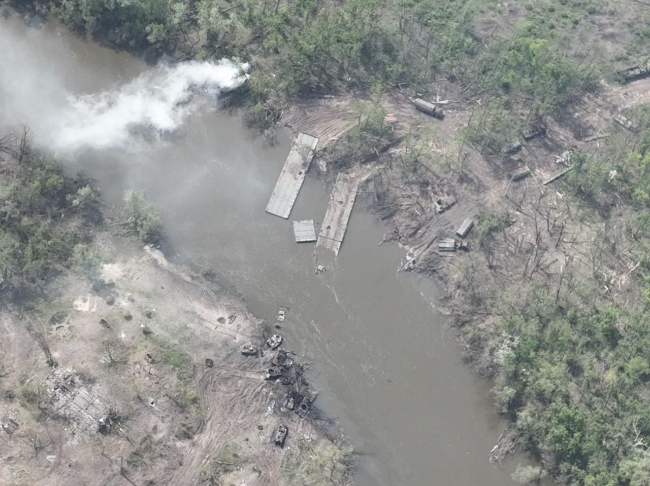
Last week, the Russians decided to take the town of Lysychansk, which meant they had to cross the Siverskyi Donets River. Crossing a river in a combat zone is a big deal. It’s a complex tactical situation for a couple of reasons. First and most obvious, the troops and vehicles crossing the river are terribly exposed. There’s no cover or concealment on a bridge. Second, you have a LOT of vehicles and troops concentrated in the same place, waiting to take their turn crossing the bridge. So they’re exposed, vulnerable and stationary. An army has to prepare to cross a river.
The Ukrainians knew the Russian Army needed to cross the Siverskyi Donets River. They sent a guy named Max–an engineer and an EOD (explosive ordinance disposal) officer–to scope out the situation. He took a recon unit along the river, found the best place to ford it, and left some recon troops in place to keep watch. They prepared to defend the river.
And hey, the Russians showed up as expected. The Ukrainians let them build a pontoon bridge. They let a few troops and combat vehicles to cross over. Then they shelled the shit out of the bridge and the troops and vehicles waiting to cross over. When the artillery subsided, the Ukrainian Air Force showed up and did some close quarters bombing. The Ukrainian recon units hunted down and killed the troops that had already crossed the river and had no way back.
A flatworm wouldn’t have made this mistake.
We don’t have any solid numbers, but it appears the Russians lost over 50 armored combat vehicles and anywhere from 1500 to 2000 troops–and that includes specialized combat engineering troops, which are really hard to replace. That’s effectively a couple of battalion tactical groups eliminated. It’s a staggering loss for the Russian Army at a time when they’re already getting their ass kicked.
This was clever work by the Ukrainians, but it was made possible by the incompetence of the Russians. They failed to do any reliable reconnaissance before the operation. They failed to have reliable real-time drone recon information. They failed to establish and provide any artillery protection for their troops. They failed to provide close air support. They failed in every possible way.
A flatworm can learn from experience.
As a supporter of Ukrainian independence, I’m glad to see Russia get bloodied. But as a military veteran, I hate seeing any troops get killed because of the rigid stupidity of their leaders. The Russian Army has demonstrated it can’t win a traditional, linear ground war, not even against a smaller nation.
The Russian Army is dumber than a flatworm.
UPDATE: It appears the Russian Army attempted to cross the Siverskyi Donets River three times. They failed in their first attempt as reported, so they made a second attempt AT THE SAME LOCATION. I’m not making that up. And hey bingo, they got the same result. Lots of destroyed vehicles, lots of dead troops. So, being the Russian Army, they decided to try cross the river a third time AT THE SAME LOCATION AGAIN. With the same result.
EDITORIAL FLATWORM NOTE: Okay, this has nothing to do with Russia or Ukraine, but there’s an exceedingly cool thing about flatworms and memory. Like a lot of other types of worms, flatworms can regenerate themselves. If you whack off a flatworm’s tail (and really, you shouldn’t, because what’s a flatworm ever done to you?), in a couple of weeks it’ll grow into an entirely new flatworm, complete with a shiny new centralized brain.
But that’s not the cool thing. The cool thing is that if the original flatworm had been taught to run (well, not run–it’s a flatworm, after all) a maze, the newly regenerated flatworm would remember how to run the maze too. Which suggests memory isn’t limited to the centralized brain. Memory MAY be somehow stored in other cells. How cool is that?












 gregfallis.com