first through the door

I give no weight to the claim by the Uvalde, TX police that they couldn’t breach that classroom door because it hadn’t been authorized. No weight at all.

Don’t get me wrong. I’m fully willing to believe that whoever was in charge of the situation (and it was such an astonishing jurisdictional fuck-up that it’s hard to say who was actually giving orders to whom) refused to authorize the breach. But I don’t believe that’s what actually prevented the police from entering the classroom. And in fact, it appears the final decision to breach was made despite orders not to do it.

I strongly suspect the reason for the delay was that nobody wanted to be the first person through the door. They knew there was somebody on the other side of the door with a semi-auto rifle. They knew that person had already shot and killed a bunch of kids; they knew he wouldn’t shy away from shooting at police officers. They knew the first officer through that classroom door would be targeted. They knew there was a very good chance that first officer through the door would be wounded or killed.

I’ve never been in that situation, though I’ve been in something similar. Years ago, when I was working as the counselor for the Psychiatric/Security Unit of a prison for women, I occasionally found myself standing outside a cell in which an inmate had either obtained or fashioned a knife. Obviously, you can’t allow prison inmates to have knives, which means somebody has to take it from them.

Because we had a duty of care for the inmates–and we actually believed in it–that meant finding a way to take the knife from the inmate with the least amount of damage to the inmate. Not the least amount of damage to the unfortunate volunteer who had to enter the cell, but to the inmate. That’s what a duty of care means; you have an obligation to try NOT to hurt the people under your care or allow them to be hurt.

The very best resolution, of course, is for that unfortunate volunteer to try to talk the inmate into surrendering the knife. As the unit’s counselor, my job was to be the unfortunate volunteer. Open the door, go in the cell by myself, try to convince an inmate to drop her weapon. You go in by yourself because that’s less threatening.

I’m not an idiot, though. I always had a team waiting outside, out of view, ready to rush in and help me if/when things went sideways. It made going into that cell a little bit less terrifying.

Talking worked maybe half the time. Half the time the inmate either refused to drop the knife (in which case I had to act to take her knife away) or she attacked me. I trained for this, of course, and practiced techniques for defending myself against a knife attack. But it was still pretty awful waiting outside that door, knowing I’d have to go in and maybe have to defend myself. The longer I had to wait (for example, if the backup team hadn’t arrived), the harder it was to open that door and step inside.

It has to be a LOT scarier to stand outside a door knowing the person inside has a semi-auto weapon and has already killed people.

But here’s the thing: that’s the job. You train for it. You practice it. It doesn’t necessarily make it easier, but it’s your job to put aside your personal safety. If you can’t do that–or if you’re unwilling to do that–then you should leave the job.

Over the last several years, the attitude of police officers has shifted away from that. It began with that mantra “It’s better to be tried by twelve than carried by six.” More and more we’re seeing police officers put their own safety ahead of the public’s. We see police officers shooting suicidal, knife-wielding, psychiatric patients–because it’s safer for them. We see police officers shooting people suspected of possibly having a weapon–because it’s safer for them. We see police officers shooting people out of fear for their own safety.

That’s perfectly understandable. Nobody wants to get hurt, nobody wants to get stabbed or shot, nobody wants to take unreasonable risks. But that’s part of the fucking job. You train and practice ways to reduce the risks, to minimize the risks, to limit the damage you will very likely have to take. But those risks are hard-wired into the job.

As I understand it (and lawdy, there is SO MUCH confusion and misinformation about what actually happened in Uvalde that we still can’t be sure what took place), the first person through the door was grazed by a bullet. He could have been killed. But had he (or some other law enforcement person) had been willing to take that risk 45 minutes earlier, there’d be fewer funerals of children held this week.

The police culture needs to change. They need to be reminded about the entire point of being police officers. Protect and serve. Protect the public, serve the public. Do that even at the risk of your own safety. If you can’t or won’t put the public ahead of yourself, go work security at some shopping mall.

failed russian flatworm strategy

Even flatworms have demonstrated the ability to learn from experience. Flatworms, like mammals, have a centralized brain; they can be trained to remember a behavior and perform it on cue. They can also be trained to avoid behaviors.

The same apparently isn’t true of Russian Army field commanders.

Your basic flatworm–not clever, but capable of learning from experience.

Perhaps the most astonishing thing about the Russian invasion of Ukraine is the staggering incompetence of their field commanders, who repeatedly fail to take even the most basic precautions to protect their troops. I mean, anybody who has spent any amount of time in military harness just assumes their commanders are fucking idiots who are casually trying to get them killed. The difference is that in the Russian Army, that appears to be true.

Behavioral psychologists back in the 1950s trained flatworms to avoid electric shocks. The Russian Army has failed to learn that lesson. In the weeks since they invaded Ukraine, the Russians have repeatedly left troops and vehicles in vulnerable, stationary positions. And the Ukrainian military has repeatedly shelled the shit out of them.

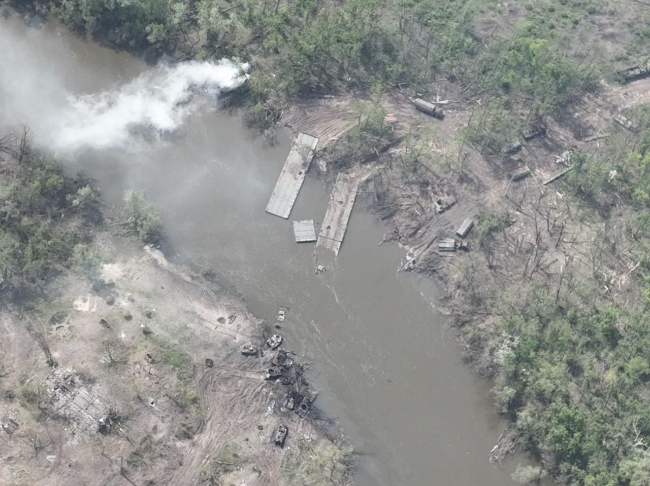
Last week, the Russians decided to take the town of Lysychansk, which meant they had to cross the Siverskyi Donets River. Crossing a river in a combat zone is a big deal. It’s a complex tactical situation for a couple of reasons. First and most obvious, the troops and vehicles crossing the river are terribly exposed. There’s no cover or concealment on a bridge. Second, you have a LOT of vehicles and troops concentrated in the same place, waiting to take their turn crossing the bridge. So they’re exposed, vulnerable and stationary. An army has to prepare to cross a river.

The Ukrainians knew the Russian Army needed to cross the Siverskyi Donets River. They sent a guy named Max–an engineer and an EOD (explosive ordinance disposal) officer–to scope out the situation. He took a recon unit along the river, found the best place to ford it, and left some recon troops in place to keep watch. They prepared to defend the river.

And hey, the Russians showed up as expected. The Ukrainians let them build a pontoon bridge. They let a few troops and combat vehicles to cross over. Then they shelled the shit out of the bridge and the troops and vehicles waiting to cross over. When the artillery subsided, the Ukrainian Air Force showed up and did some close quarters bombing. The Ukrainian recon units hunted down and killed the troops that had already crossed the river and had no way back.

A flatworm wouldn’t have made this mistake.

We don’t have any solid numbers, but it appears the Russians lost over 50 armored combat vehicles and anywhere from 1500 to 2000 troops–and that includes specialized combat engineering troops, which are really hard to replace. That’s effectively a couple of battalion tactical groups eliminated. It’s a staggering loss for the Russian Army at a time when they’re already getting their ass kicked.

This was clever work by the Ukrainians, but it was made possible by the incompetence of the Russians. They failed to do any reliable reconnaissance before the operation. They failed to have reliable real-time drone recon information. They failed to establish and provide any artillery protection for their troops. They failed to provide close air support. They failed in every possible way.

A flatworm can learn from experience.

As a supporter of Ukrainian independence, I’m glad to see Russia get bloodied. But as a military veteran, I hate seeing any troops get killed because of the rigid stupidity of their leaders. The Russian Army has demonstrated it can’t win a traditional, linear ground war, not even against a smaller nation.

The Russian Army is dumber than a flatworm.

UPDATE: It appears the Russian Army attempted to cross the Siverskyi Donets River three times. They failed in their first attempt as reported, so they made a second attempt AT THE SAME LOCATION. I’m not making that up. And hey bingo, they got the same result. Lots of destroyed vehicles, lots of dead troops. So, being the Russian Army, they decided to try cross the river a third time AT THE SAME LOCATION AGAIN. With the same result.

EDITORIAL FLATWORM NOTE: Okay, this has nothing to do with Russia or Ukraine, but there’s an exceedingly cool thing about flatworms and memory. Like a lot of other types of worms, flatworms can regenerate themselves. If you whack off a flatworm’s tail (and really, you shouldn’t, because what’s a flatworm ever done to you?), in a couple of weeks it’ll grow into an entirely new flatworm, complete with a shiny new centralized brain.

But that’s not the cool thing. The cool thing is that if the original flatworm had been taught to run (well, not run–it’s a flatworm, after all) a maze, the newly regenerated flatworm would remember how to run the maze too. Which suggests memory isn’t limited to the centralized brain. Memory MAY be somehow stored in other cells. How cool is that?

mtg omg

I watched the Marjorie Taylor Greene Amnesia-Fest yesterday. Technically, it was an evidentiary hearing to determine if MTG should be barred from seeking re-election to Congress based on a violation of Section 3 of the 14th Amendment to the United States Constitution. In practice, it was MTG playing dodge-ball with the Truth, ducking any personal responsibility by claiming she couldn’t remember much of anything about anything.

You may be wondering just what in the name of the Great Bearded God of Goats is in the 14th Amendment. There’s a whole bunch of stuff in it, but the only part that MTG was fretting about was Section 3, which says this:

No person shall be a Senator or Representative in Congress, or elector of President and Vice President, or hold any office, civil or military, under the United States, or under any State, who, having previously taken an oath, as a member of Congress, or as an officer of the United States, or as a member of any State legislature, or as an executive or judicial officer of any State, to support the Constitution of the United States, shall have engaged in insurrection or rebellion against the same, or given aid or comfort to the enemies thereof. 

The hearing was to determine whether there is any evidence that MTG ‘engaged in insurrection’ against the United States (SPOILER: yeah, lots of evidence) and whether the evidence was enough to begin a legal proceeding to remove her from the mid-term election ballot (SPOILER: probably not, but who knows?). The entire proceeding could be boiled down to this:

Lawyer: Ms. Greene, did you do some insurrection against the US?
MTG: I don’t recall.

I’ve seen a lot of trials and hearings, and I think I can say without any hesitation that MTG was a shitty witness. It wasn’t just that she was occasionally dramatic or uncooperative or snarky AF (though she often was), or that her memory was remarkably and conveniently inconsistent, it was the astonishing scope of her lack of memory that was staggering. She couldn’t remember nothing about nothing unless it meant nothing.

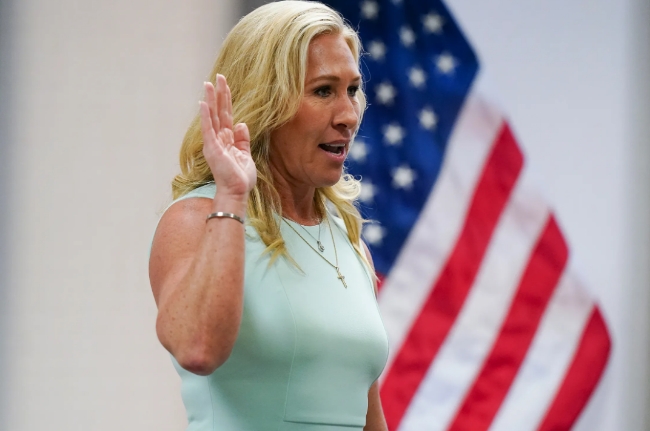
Marjorie Taylor Greene swearing to tell the truth, the whole truth, and nothing but the truth except when she can dodge it.

I wouldn’t expect her to remember every pro-insurrection tweet she made, because lawdy, she made a LOT of them. But I’m pretty sure that most folks would remember whether or not they discussed, with the President of These United States, imposing martial law on the US. That’s not the sort of thing that would slip your mind. But that was the level of her denial.

Sadly, I doubt the judge will find the evidence is sufficient to remove her from the ballot for the mid-term elections. It’s pretty clear she was lying some/many/most of the times she claimed she couldn’t recall stuff she’d done, but it’s damned difficult to prove she was lying.

At the heel of the hunt, this will probably be yet another example of a Republican lying, violating the law, and getting away with it. I suspect MTG will get to stay on the ballot and will likely be re-elected. I suspect other Republicans will learn the lesson that they can lie and get away with it.

I keep hoping that someday somebody somewhere will be held accountable for something.

human decency 101

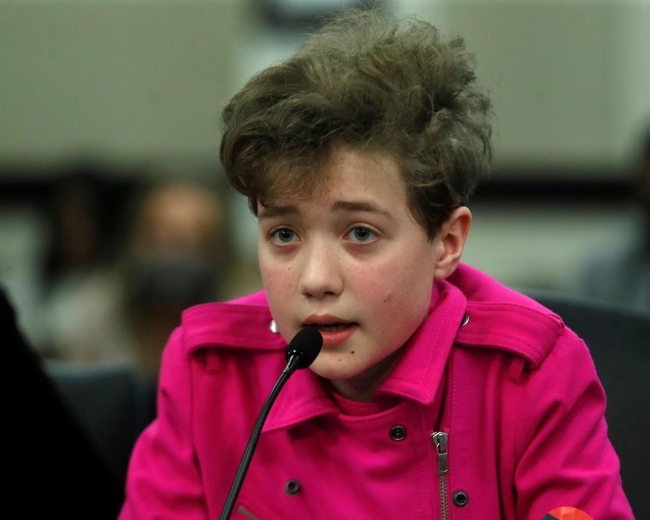
Fischer Wells just wants to play field hockey. The State of Kentucky says she can’t. I’m not making this up. Kentucky passed a law to make sure this twelve-year-old girl won’t be able to play field hockey at her middle school. Think about how fucked up that is.

You know what? It’s more fucked up that you think. Consider the process of passing a law in Kentucky (or any other state, for that matter). It’s a time-intensive process. You have to cobble together the language of the bill you want to become law, including defining all the elements. Then you have to present the bill to…wait. Here, look at this:

This is the amount of effort the State of Kentucky went to in order to keep 12-year-old Fischer Wells from playing field hockey at school. Note Step 11: “If bill is vetoed, it goes back to each chamber. If approved by a constitutional majority in each chamber, the veto is overridden and the bill becomes law.” That actually happened with this particular bill.

Andy Beshear, a Democrat and the Governor of Kentucky, vetoed the bill because it “most likely violates the equal protection rights afforded by the United States Constitution.” The Republicans, who control both legislative chambers, voted to override the veto.

Why would Republicans go to so much fuss and bother to pass this law? Because Fischer Wells is a trans girl. She’s the ONLY known trans girl playing in middle or high school sports in Kentucky. She’s in the 8th grade. She’s not much of a threat.

12-year-old Fischer Wells

A number of states have passed similar laws designed to prevent trans students from participating in middle school, high school, or college sports. They claim they’re doing it in the interest of ‘fairness’. Their reason can be summed up in this comment by Robby Mills, the Kentucky law’s GOP sponsor:

“Boys have athletic advantages even before puberty in cardiovascular endurance, muscular strength, muscular endurance, speed, agility and power tests. A lot of time and effort is put into achieving a certain level of mastery in a sport and it would be crushing for a lady to train her whole career to have it end up competing against a biological male in the state tournament or state finals.”

Sure, that would be tough on a ‘lady’. But Mills and his fellow (should I call them bigots? I mean, the law is bigoted, to be sure. And it’s supported by anti-trans bigots. But it’s possible, I suppose, for a legislator to support the bill NOT because they’re a bigot, but because they want the votes cast by a bigoted public. But fuck that, if you vote for a bigoted law, you’re a bigot) bigots seem to be under the insane impression that there are guys out there in the sports world who consider themselves male BUT are so insecure in their ‘mastery in a sport’ that they’re willing to temporarily identify as female simply in order to win a high school sports championship.

And that’s fucking ridiculous. You have to be astonishingly stupid to believe that.

At the college level, where sports participation starts to really pay off, they’ve already taken steps to insure fairness. The National Collegiate Athletic Association (NCAA) has a complete policy outlining transgender student-athlete participation. In theory, it applies to both trans men and trans women; in practice it’s directed primarily at trans women. It says trans women have to be taking hormonal treatment for gender transition for a certain period of time in order to participate in women’s sports. Trans men, on the other hand, don’t have to be taking testosterone in order to participate in men’s sports.

I’m not entirely convinced the NCAA actually needs to do this, but at least it’s an honest and sensible approach to ‘fairness’ regarding trans folks in college sports.

But the ‘fairness’ issue is really just a mask for all trans-related fear and hatred. Banning trans athletes isn’t just unfair to openly trans athletes, it actively discourages trans kids from even considering participating in sports. It actively discourages trans kids from letting their family and friends know they’re trans. It actively encourages trans kids to hate themselves. It actively increases the likelihood of trans kids self-harming or killing themselves. It actively encourages transphobic people to bully trans kids or find other ways to harass trans people. It normalizes trans fear and hatred.

On the surface, this seems to be a partisan political issue. Republicans pass anti-trans laws, Democrats try to protect trans rights. But some (how much, I don’t know–maybe a lot, maybe a little) of GOP anti-trans legislation is an aspect of their performative politics. It gets their base motivated, so they don’t give any thought to the repercussions. And yet at least one GOP governor demonstrated some basic human decency.

Gov. Spencer Cox of Utah vetoed an anti-trans sports bill passed by his own party–a bill that, like the Kentucky bill, only affected a few kids. Cox wrote this in his response:

“Four kids and only one of them playing girls sports. That’s what all of this is about. Four kids who aren’t dominating or winning trophies or taking scholarships. Four kids who are just trying to find some friends and feel like they are a part of something. Four kids trying to get through each day. Rarely has so much fear and anger been directed at so few. I don’t understand what they are going through or why they feel the way they do. But I want them to live.”

I want them to live. There it is. I don’t understand what they’re going through or why they feel the way they do. BUT I WANT THEM TO LIVE. You don’t have to understand (though it would be nice if you tried). You don’t have to agree with their choices. Just refrain from cruelty. Just let other folks live and be comfortable in their bodies.

There have been thousands–tens of thousands–of Fischer Wells, who’ve grown up afraid. There are lots of adult Fischer Wells out there, trans women who worry about going out in public, who wonder if they look fem enough to avoid harassment, to avoid assault, to avoid being targeted and killed.

If you vilify a 12-year-old trans girl who only wants to play field hockey, you create the social conditions that can keep her scared and uncertain and anxiety-ridden and alienated her entire life.

Just let Fischer Wells play. Let every Fischer Wells play. Just stop being assholes. Just make some attempt at some basic human decency. That’s really what this is about. Letting other people get on with their own lives. Letting people be themselves. It’s really not that hard.

ukraine, let my memory of you be like a blade in my soul

Sometimes fiction and reality collide in unexpected and horrifying ways. A couple of days ago, the war in Ukraine crashed into a fantasy novel written in 1990.

Years ago I had a friend who kept encouraging me to read fantasy fiction. I’d read Tolkien, of course, but I was generally uninterested in the genre. She gave me a novel by a writer with the unlikely name of Guy Gavriel Kay. If a friend gives you something to read, the laws of friendship require you to at least try to read it. So I dutifully read the prologue (I’m also generally suspicious of prologues), then put the novel on a shelf with other novels I’d probably never finish.

The prologue was beautifully written, although the prose was more elegant than the fiction I was accustomed to reading. The characters were engaging and the situation they were facing was powerful. It was largely a nighttime conversation between two men–a prince leading an army facing certain destruction in the morning and a sculptor/friend who was a volunteer in that army. They both acknowledged they were probably going to die in a few hours and wondered if the war was a cause worth dying. This is part of their conversation.

“Oh, our pride. Our terrible pride. Will they remember that most about us, do you think, after we are gone?”
“Perhaps. But they will remember. The one thing we know with certainty is that they will remember us…. We will leave a name.”

Very powerful, emotional, dramatic stuff, right there. My problem was the heroic speech. I’ve done my time in military harness. So did both of my brothers. So did my father and most of my uncles. I’ve been around military men all my life. That’s not how they talk, especially when it comes to really important stuff, like killing and dying. Combined with my basic dislike of the genre, it was enough for me to stop reading.

Now, you may be saying, “But Greg, old sock, it’s fiction…and fantasy fiction at that. Give the writer some slack.” And you’d be right (also, stop calling me ‘old sock’). I’d made a mistake by putting that novel on the shelf. A few years later, another friend–also a fan of fantasy fiction–handed me another novel, also by Guy Gavriel Kay (it’s not a name you’re likely to forget). Again, the laws of friendship required me to try it. The Lions of Al-Rassan. It was amazing and has become one of my favorite novels. I was so taken by it that I went back to the shelves and pulled out the novel I’d abandoned before.

Tigana. That’s the title. It’s also the name of the independent province in which the two men in the prologue lived. The story takes place after the battle referred to in the prologue. Here’s a thing Kay does extraordinarily well–he doesn’t just inform the reader, “Yeah, these guys? They live in Tigana.” Instead he quietly, slowly, subtly adds layers of history, art, tradition, music, cuisine–layers of a unique, believable culture–so that Tigana isn’t just a place on a map. It becomes an indelible aspect of a character’s identity.

This is critically important to the story, because the battle referred to in the prologue destroys all that. The invading sorcerer/king was so enraged by the Tiganan resistance against his army and so grief-stricken by the death of his son (killed in the war) that he wasn’t content with merely conquering and ruling Tigana. He had his army kill women and children, he burned their fields and razed their villages, he flattened their cities. Not content with the physical destruction of Tigana, he eradicated their culture–tore down their statues, destroyed their art. He re-named the capitol city after his dead son. He renamed the province Lower Corte (Corte being the province’s traditional enemy; he wanted to insure the survivors understood they were lesser than their enemies). He killed almost an entire generation of people, and then (because this is the sort of thing sorcerer/kings do) he cast a magic spell that stripped the true name Tigana from the memory of every person NOT born in the province. Nobody else could even hear the name if it was spoken. This meant the few remaining Tiganans couldn’t even discuss with others what had happened to their land and culture. It was as if the kingdom of Tigana had never existed.

This is essentially what Putin and Russia planned for Ukraine.

A few days ago the Russian state-owned news agency RIA Novosti published an article called What Should Russia Do With Ukraine? (You can read a translation of the article here.) It’s grounded on the premise that most of the population of Ukraine are Banderite Nazis or Nazi sympathizers. Banderite refers to Stephan Bandera, a Ukrainian nationalist, Nazi collaborator, and anti-Communist leader who was assassinated by Soviet agents in 1959. The article suggests that Ukrainians have so internalized Nazism that they’re not even aware they’re Nazis. It’s part of their culture, their identity.

That’s complete bullshit, of course, but for Russia/Putin it’s necessary bullshit to justify the plan for Ukraine. When the author of this article says ‘Nazi’ he means ‘Ukrainian’. The article says Nazis must be killed.

Those Nazis who took up arms must be destroyed on the battlefield, as many of them as possible. No significant distinction should be made between the Armed Forces of Ukraine and the so-called “nationalist battalions,”

This also applies to ordinary citizens who support the government of Ukraine. Whatever happens to them during the ‘military special operation by the Russian Federation’ is a just punishment for that support.

They supported the Nazi authorities and pandered to them. A just punishment for this part of the population can only be possible through bearing the inevitable hardships of a just war against the Nazi system…. The Banderite elites must be eliminated; their re-education is impossible.

The survivors of the ‘war against the Nazi system’ will be re-educated and forced to engage in the manual labor of rebuilding the territory.

The further denazification of this bulk of the population will take the form of re-education through ideological repressions (suppression) of Nazi paradigms and a harsh censorship not only in the political sphere but also in the spheres of culture and education…. making the names of accomplices of the Nazi regime public, involving them in forced labor to restore the destroyed infrastructure as punishment for Nazi activities

The article acknowledges that wiping out Ukrainian culture would be a generation-long process.

The period of denazification can take no less than one generation that has to be born, brought up and mature under the conditions of denazification.

Obviously, this includes eliminating the very name of Ukraine.

[T]he name “Ukraine” cannot be kept as a title of any fully denazified state entity on the territory liberated from the Nazi regime…. Denazification will inevitably include de-ukrainization…. history has proved it impossible for Ukraine to exist as a nation-state, and any attempts to “build” such a nation-state naturally lead to Nazism. Ukrainism is an artificial anti-Russian construct that has no civilizational substance of its own.

In the novel, a group of rebel Tiganan conspirators disguise themselves as traveling musicians and merchants and plot to assassinate the sorcerer/king and restore the ability of the people to remember the province of Tigana. One of the characters repeats a sort of prayer: Tigana, let my memory of you be like a blade in my soul. The memory of lost beauty is painful, but pain keeps the memory of that beauty alive.

In the novel, the erasure of Tigana is done through brute force reinforced by magic. Putin doesn’t have any real magic; all he has is brutality and the weak magic of propaganda, like this article. It’s difficult to say how effective the propaganda is with the Russian populace. There are reports that around 70% of Russian people support Putin’s war. Those reports may also be propaganda. Or they may accurately reflect the opinions of people whose only source of information is purposely biased. (Yes, I’m looking at FOX News.)

In the novel, only those born in what was once Tigana can hear the name spoken. Only they can keep the idea of Tigana alive. In real life, all of us can speak about Ukraine, can retain the memory of Ukraine’s once-beautiful cities, can honor the ordinary people of Ukraine who’ve resisted Russia, can weep for those who’ve been tortured and killed, can celebrate the Ukrainian identity and keep it alive.

Ukraine, let my memory of you be like a blade in my soul.

attrition

Every morning this week I’ve sat here at the keyboard and started to write a post about the situation in Ukraine. Every single morning I’ve put a couple hundred words in a row, and every morning I’ve deleted them all.

I mean, what is there to say? Well, obviously there’s a LOT to say–the military situation, the refugee situation, the NATO situation, the war crimes situation, and on and on and on. But the internet is awash in experts opining and analyzing all that. What is there for ME to say? Is there anything I can contribute that’s meaningful?

Not much. I can express opinions, but my opinions about Ukraine aren’t very much different from most folks. And as for those folks whose opinions support Russia and Putin–what is there to say to or about them? Not much, other than ‘Russian warship, go fuck yourself’.

The problem (for me) is that it’s hard to write about anything else at the moment. Everything else seems trivial. Art? Clarence Thomas in the hospital? Republican hypocrisy? Pickleball? The January 6th prosecutions? The arrival of Spring and getting back on the bike? Voter suppression? The latest research on crows? Today’s hearing on the nomination of Ketanji Brown Jackson to the Supreme Court? There are lots of things that occupy my mind and my time besides Ukraine. It’s just that none of them seem as important. None of them ARE as important.

What makes this all the more awful is that the war in Ukraine has become something of a stalemate. It’s turning into a war of attrition–the ugliest, cruelest, and most brutal form of war. A war of attrition isn’t about territorial control; it’s about imposing as much suffering as possible in every way possible in order to force the enemy to give up. It’s about wearing away at the very foundations of a sustainable life–food and shelter. It’s about reducing towns and cities to uninhabitable rubble.

But here’s the truly awful thing: I suspect–I fear–the American public will begin to treat the war of attrition in the same way they’ve treated the global pandemic. They’ll get bored with it. It’ll be normalized, in the same way they’ve come to accept a thousand deaths a week from Covid as normal. In the same way they’ve come to accept extreme weather disasters as normal. Instead of being tortured from a death by a thousand cuts, those cuts will be seen as routine. (By the way, if you google ‘death by a thousand cuts’ most of the results will refer to a song by Taylor Swift rather than lingchi, the ancient Chinese method of torture and execution–how’s that for normalization?)

NOTHING ABOUT THE WAR IN UKRAINE IS NORMAL.

So, what are we to do? What am I to do? Carry on as usual with this blog? I guess the only answer is to try to find some sort of balance. Write about the stuff that interests me, even if some of that stuff is trivial. But also keep talking about the suffering of the people of Ukraine, and about the deliberate cruelty of Putin, and about the policies of nations that support–or fail to support–Ukraine.

That’s what I’ve decided to do. But it feels a little like attrition.

a conversational history of vlad and the boys

PUTIN: Lawdy, I surely do miss the days when the Soviet Union was kicking ass and taking names. I remember when Grozny was part of Mother Russia, not just some town in the Chechen Republic of Ichkeria.
CHECHNYA: Yeah, sorry, not sorry. Here’s your hat, there’s the door.
PUTIN: I think I’ll take Chechnya.
BILL CLINTON: Don’t do it. Don’t you do it.
PUTIN: I think I’ll do it.
CHECHNYA: Over my dead body.
PUTIN: Okay. Haha smiley face. [Takes Chechnya]
BILL CLINTON: Damn it, Vlad.
PUTIN: Well, it was unfortunate that a whole bunch of people died, but Chechnya looks really good on my trophy wall. Can’t make an omelet, and all that.
PUTIN: You know, I’m thinking there are parts of Georgia that would look real sweet on my mantle.
GEORGE W. BUSH: Georgia? What?
PUTIN: Not that Georgia. We got us a Georgia of our own.
NOT THAT GEORGIA: Hey! We’re standing right here.
PUTIN: Not for long. Haha smiley face.
GEORGE W. BUSH: Don’t you do it, Vlad. Just don’t.
PUTIN: Hell, son, I won’t take it all. Just bits of it. Won’t nobody even notice.
PUTIN: [Takes Abkhazia and South Ossetia]
GEORGE W. BUSH: Damn it, Vlad.
PUTIN: I mean, I really like Abkhazia and South Ossetia, but there’s something missing. You know what would be cool? Crimea. I’ve always wanted a warm water port. Sevastopol is cute as a button.
UKRAINE: Dude, Crimea is part of Ukraine.
PUTIN: Oh. Well, bless your little heart.
OBAMA: Don’t do it, Vlad. Don’t you dare do it.
PUTIN: My Uke homey Viktor Yanukovych is okay with it.
UKRAINE: We already kicked Viktor Yanukovych’s whole ass out of the country!
PUTIN: I think I’ll take Crimea.
OBAMA: Vlad…I’m serious here. Vlad…
PUTIN: [Takes Crimea]
OBAMA: Damn it, Vlad.
PUTIN: It was just Crimea. I left the rest of Ukraine, didn’t I? And Sevastopol is, like, the best warm water port ever. I think I’m going to keep it.
TRUMP: It’s okay with me, buddy.
UKRAINE: Hey, whose side are you on, Trump?
PUTIN: Trump is SO TOUGH on me. Haha smiley face.
TRUMP: They speak Russian in Crabeum, don’t they? I mean, they must be Russian, then. What do I care? What’s in it for me?
UKRAINE: Crabeum? What the fuck? And where are those weapons you promised us?
TRUMP: You’ll get the weapons. But first, I need a favor.
UKRAINE: Motherfucker.
CONGRESS: Uhhh, you know, we authorized those weapons. You can’t use them as blackmail.
TRUMP: Jeeze, okay, okay. I was just joking.
PUTIN: I really really like my new Crimea, but if I had me a Donetsk and Luhansk, then I’d almost have a complete set.
UKRAINE: No you don’t. Donetsk and Luhansk are totally part of Ukraine, you prick.
BIDEN: Vlad, I wouldn’t. It would be a mistake.
PUTIN: Would it? Would it really? Haha smiley face.
BIDEN: Don’t be stupid, Vlad.
PUTIN: [Takes Donetsk and…wait, what?]
UKRAINE: We’ll hit you so hard your kids will be bruised. If we had a stick, we’d jam it so far up your ass it would tickle your tonsils.
BIDEN: We’ll give you a stick, Ukraine.
PUTIN: What the fuck?
UKRAINE: Putin, go fuck yourself. With this stick. And, oh yeah, this Javelin missile.
PUTIN: What’s going on here?
BIDEN: Told you. Should’ve listened.
PUTIN: Okay, okay, listen, here are my conditions for a cease fire.
UKRAINE: Putin, you feculent fuck, if you have anything worth saying, we’ll read it in your entrails.

some semi-related thoughts on Ukraine

First off, this is just fucking nuts. I think we can all agree on that. I mean Russia (and when I say ‘Russia’ I mean that motherfucker Vlad Putin) is conducting what is essentially a war of conquest–the type of war that pretty much disappeared by the beginning of the 20th century. Russia is basically saying “Ukraine has shit we want, they’re not going to give it to us, so we’re going to take it.” It’s a large scale gangster war.

Nations (and gangsters and racist police officers) could get by with that shit back in the day before ubiquitous online real-time videography. Not anymore. Now there’s always somebody with a camera and an internet connection to record and distribute the violence. And not just the violence, but the ugly result of the violence. And not just the violence and the ugly result, but also the failures–those times when the violence rebounds against the violent.

A dead Russian soldier smells as bad as a dead Ukrainian civilian

Ukrainians are using tech to undermine Russia’s superiority of numbers. They’re using Google Maps traffic reports to identify streets where Russian military convoys are disrupting traffic–and a convoy that’s moving slowly is a target. Ordinary people are using cell phones to send and receive military intelligence in real time, to coordinate not just attack plans but also places for non-combatants to shelter. They’re using social media to support and encourage each other, to gain international support, and to undermine the morale of Russian troops and the Russian population.

They’re making videos of ordinary Ukrainians confronting and threatening Russian troops. The woman who offered Russians sunflower seeds to carry in their pockets so flowers will grow from their dead bodies. The guy who said they’d play football with the heads of Russian soldiers. They’re making videos of Russian troops surrendering, of Russians being ambushed and killed–videos of dead Russians. It’s brutal and ugly, to be sure. But Russian soldiers will see it on social media. The parents of Russian soldiers will see it back home. They’ll see the bodies of their sons, mangled and burnt. And some of those parents will take to the streets to protest the war. Anything that discourages the aggressor is probably worth it.

Another weird and awful benefit of modern tech. All those combat video games have taught young Ukrainian how to fight an urban war. They know how to create and use choke points, they know the benefits of sniping (an ounce of sniper is worth a pound of suppressing fire), they know the difference between cover and concealment and how to use them, they know not to stay in one place, they know the vulnerable points of tanks and armored vehicles. They’ve used those skills in games, and while there’s a massive difference between knowing stuff in a game and implementing it in real life, the knowledge is there and it’s useful. It’s horrible that young Ukrainians need that knowledge, but it’s good that they have it. This is an urban war in which Playstation and Xbox have been training tools.

Nobody really wins when civilians have to take up arms

The thing is, in video games death is just a delay. In video games, you’ve always got a fair chance of winning. Russian troops may not be very well trained, they may be poorly equipped, they may have serious logistical issues regarding supplies (like food, fuel, ammunition), they may have morale issues, they may not be a very effective fighting force, but there’s a lot of them. Numbers matter. And no matter how dedicated and clever and determined the people of Ukraine are, the odds are against them.

There’s a great deal of bold talk about how Putin has already lost–and there’s a lot of truth there. Putin has fucked Russia’s economy for years, he’s fucked the reputation of Russia. But Russia still has the power to seize Ukraine. They have the power to install a puppet regime. What they don’t have is the power to peacefully occupy Ukraine. So yeah, in that sense, Putin and Russia have already lost. But that doesn’t mean Ukraine will win. Or even survive as anything other than an underground resistance movement.

I do think, though, that this could be one of those inflection points people keep talking about. I think this invasion could teach the democratic world that we can no longer sing the praises of democracy and claim to value human rights AND continue to conduct business as usual with dictators and tyrants. Tolerating authoritarian regimes because there’s something in it for us–that’s just encouraging those regimes to flourish. We can’t continue to treat economics and human rights as separate, unrelated issues.

Democracy may be an unwieldy and awkward and inefficient system of governance, but it’s infinitely preferable to an efficient dictatorship. The people of Ukraine understand that.