speaking of photography…

I have a complicated history with Instagram. I downloaded the app and joined 11 years ago today, on 21 July, 2013. I did it under a pseudonym–Knuckles Dobrovic–because, like every good photographer I knew, I assumed Instagram was trash and I didn’t want to be associated with it. As I wrote at the time,

We sneered at Instagram for being a cheap, easy, lazy way to turn crappy photos into images that look artsy. Not ‘artful’ or ‘artistic’ but artsy. We sneered at it because the learning curve for using Instagram is — well, it’s hardly a curve at all. It’s almost a straight line. You shoot a photo with your cell phone, you flip through a couple dozen preset filters until you find one you like, tap to apply it, and hey bingo, you have yourself an artsy photo of your drunken friends at a tacky Chinese restaurant.

I hadn’t actually looked at Instagram; I was just operating on the assumption it was trash. I had to join it in order to confirm my assumption. And hey, I was right. It was, in fact, trash. It still is trash, mostly. But eleven years ago to my surprise, I also found a healthy dose of really fine photography. All sorts of photography, from street work to portraiture to landscape to editorial work to fashion photography. There was (and still is) solid work to be found on Instagram.
I used the Knuckles Dobrovic account mainly to explore IG. But I also felt an obligation to participate, so I used it as a platform for a hastily cobbled together project. After a few months, I decided to more fully embrace IG; I created a second account under my own name. Originally, the account was devoted to square format monochrome photos. Now, of course, it’s my main IG account for all types of photography.
I continued to use the Knuckles account as a platform for random photo projects (for anybody interested, I’ll include a list and a description of those projects in an addendum at the end of this post). The last Knuckles project ended in April of 2023. I haven’t posted anything under the Knuckles account since then.

Until today. My IG anniversary. I’m starting my 8th Knuckles project. Appropriately, it’s going to be pretty similar to how I began my personal IG account. I’ve always had four simple rules for a Knuckles Dobrovic project.
  1. It’s got to be simple (which means I won’t have to do a lot of planning or a lot of post-processing).
  2. It’s got to be organic to my life (which means it’s something I can photograph during the course of an ordinary day — whatever that is).
  3. It’s got to have at least one intellectual component (which is more accurately described as a pretentious bullshit element).
  4. It’s got to be able to keep my interest over time.

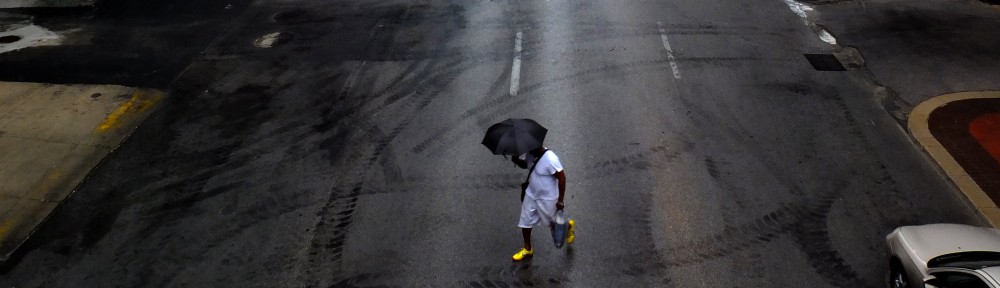
So here we go. Simple: high contrast monochrome, which is made easy with my new Ricoh GR3X camera. Organic to my life: my normal flâneur walk-about style plus whatever I happen to see that catches my interest. Pretentious Bullshit Element: my ongoing fascination with the Japanese Provoke-style photography, which is NOT how I normally see the world. Keeping my interest: Well, yeah. I’ve played around with this style of photography before and I see no reason why I’ll ever stop. At some point, I may feel the need to start a 9th Knuckles project, but until then…well.
ADDENDUM: Previous Knuckles Dobrovic projects.

Things on a Table
 — I put a thing on a table and photographed it.

My Feet on the Earth — I took walks, stopping periodically to photograph my feet. I selected two or three of the images during a walk and created multiple exposure images.

One Hundred Appropriated Google Street Views — This was sort of an homage to Hiroshige’s ‘One Hundred Famous View of Edo’. While playing the online game GeoGuessr (which involves finding a random location based on Google Street View), I made screen captures of interesting vistas. I converted those screen grabs into square black & white images.

Slightly Dislocated — During the enforced isolation of the pandemic, I shot square format photos during my solo walks or masked errands. I diddled with the color a wee bit, digitally sliced the image in thirds, then re-arranged the pieces.

Are Bure Bampot — I’d been playing Geoguessr again, and during a break I read something about Daido Moriyama, the godfather of a photographic style called are bure bokeh, which roughly translates as “rough, coarse/crude, out of focus.” That same afternoon, on Twitter, a Scots acquaintance referred to somebody as ‘a total bampot,’ which I was told means “an idiot, a foolish person, a nutcase”. For reasons I can’t explain, the phrase are bure bampot came to me, and I decided to follow through on it. As before, I made Google Street View screen captures of scenes and locations in Scotland. This time I modified them using the are bure bokeh style.

Geoguesser Bus Stops — A bus is the most democratic form of public transport. They’re most commonly used by the poor and working classes, but the bus stops for everybody. A bus network is fundamentally simple: a series of designated routes with consistent designated arrival/departure times and stable designated boarding locations with predetermined fees. It’s a predictable, reliable, efficient dynamical transportation system in which bus stops act as fixed point attractors. Bus stops are ubiquitous; they’re everywhere because a bus network is socially elastic–the design can be stretched to fit almost any community anywhere in the world. Bus stops are both local and global.
the flâneur school of photography

There are people–lots of people–who like to name things. I know people who’ve given names to their car, who’ve named their computer, who’ve named their favorite camera. I’m not one of those people. I don’t anthropomorphize gear. A camera is just a tool. You choose the tool best suited for the job you’ve got planned.

I say that, but lawdy, I’m starting to develop a relationship with my new camera. My Ricoh GR3X and me, we’re becoming buddies.

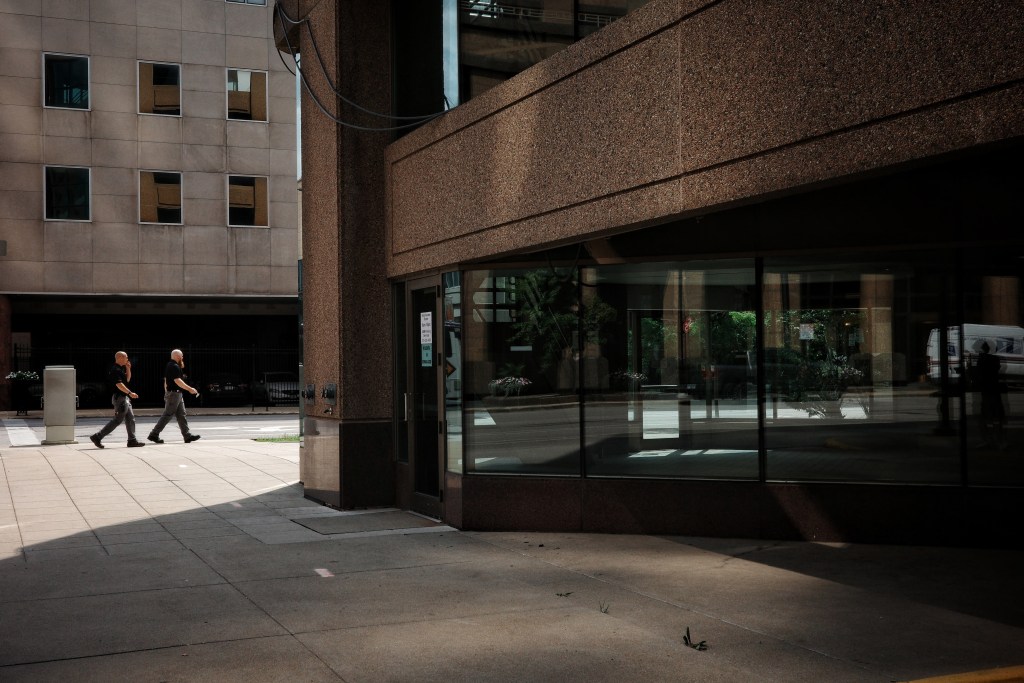
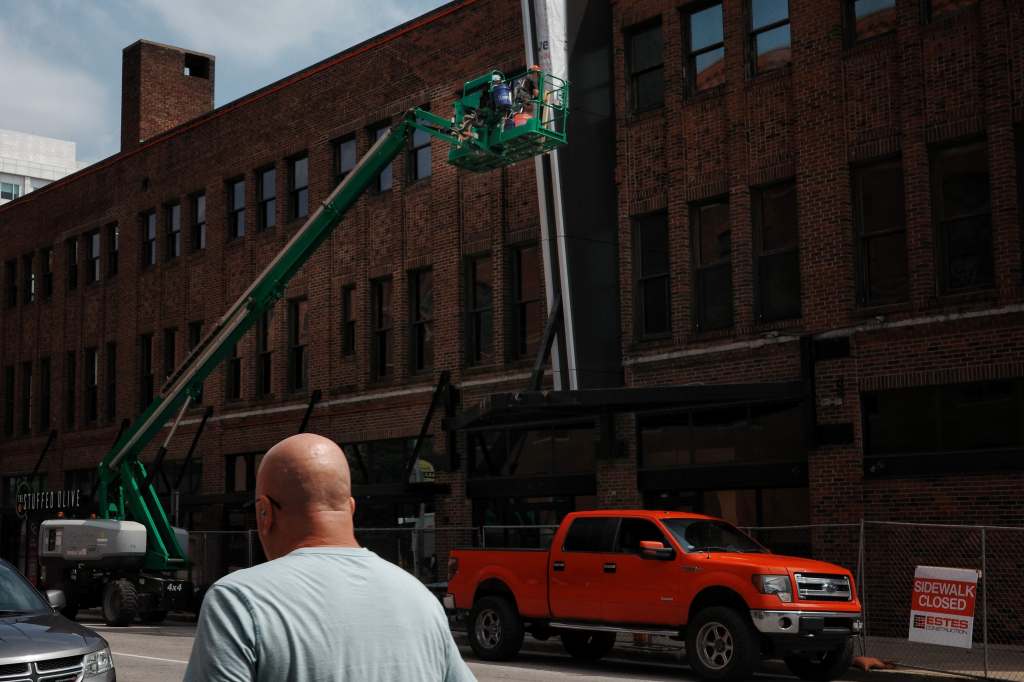
A bald guy walks down the street.

Why? Because this camera seems to have been designed almost specifically for the way I shoot photographs. I’m not a street photographer, although I enjoy shooting street. I’m not a landscape photographer, or a fine arts photographer, or a portrait photographer; I don’t really belong to any of the more common photographic traditions. I belong to what I like to call the flâneur school of photography.

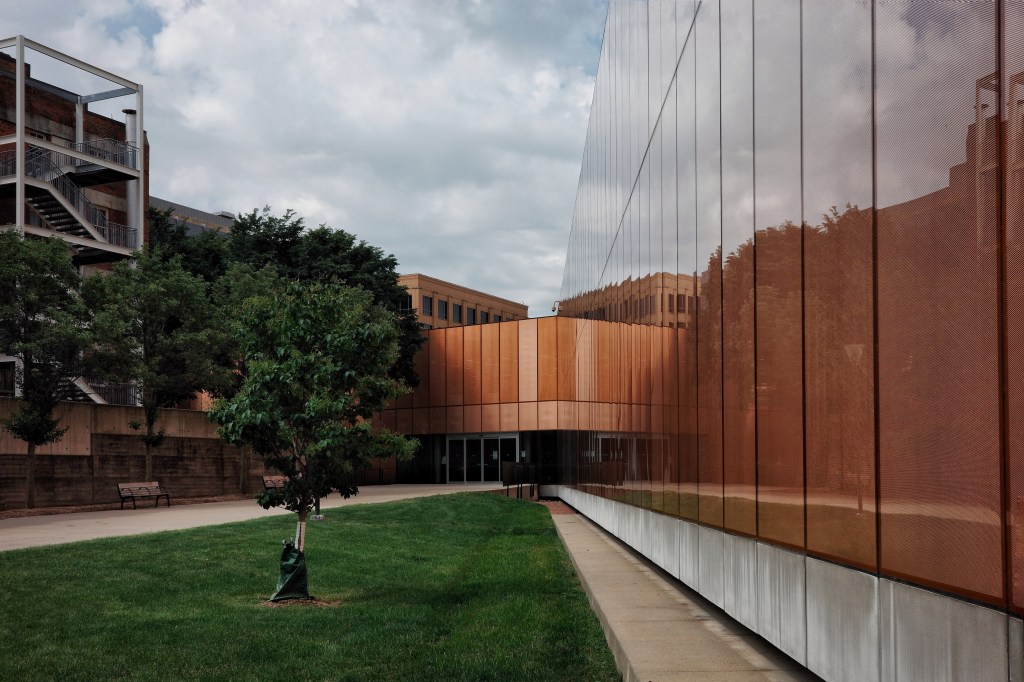
A tree in the library courtyard.

If you’re not familiar with the term, a flâneur is somebody who roams around idly observing the world while being somewhat emotionally detached from it. Somebody who’s not necessarily involved in what’s taking place around them, but is keenly aware of it. One writer described a flâneur as “an amateur detective and investigator of the city.” The term is usually applied to urban life, but it’s a philosophical approach to the world that can take place anywhere. It’s a strange nonjudgmental balance between being analytical and emotional.

(By the way, the term flâneur is French but it’s derived from the Old Norse verb flana, which meant “to wander with no purpose.” And if you’re wondering how a French word is derived from an Old Norse word, you need to read more about Vikings.)

I don’t think those guys were intentionally walking in step, but…

That’s how I shoot photographs. Hell, that’s largely how I’ve lived my life. I’m a flâneur both by nature and by training. Almost every career I’ve had involved the same basic process: observe, analyze, filter the analysis through emotion (or the emotion through analysis), then act. It’s a skill set that helped me as a medic in the military, as a counselor in the Psych/Security unit of a prison for women, certainly as a private investigator specializing in criminal defense, and even (to a lesser extent) as a teacher.

In terms of photography, being a flâneur just means noodling around, paying sharp attention to detail, and seeing stuff in terms of composition. What’s cool is that when it all comes together–the scene, the light, the moment–there’s an immediate emotion, a serotonin hit that’s generated whether you have a camera or not.

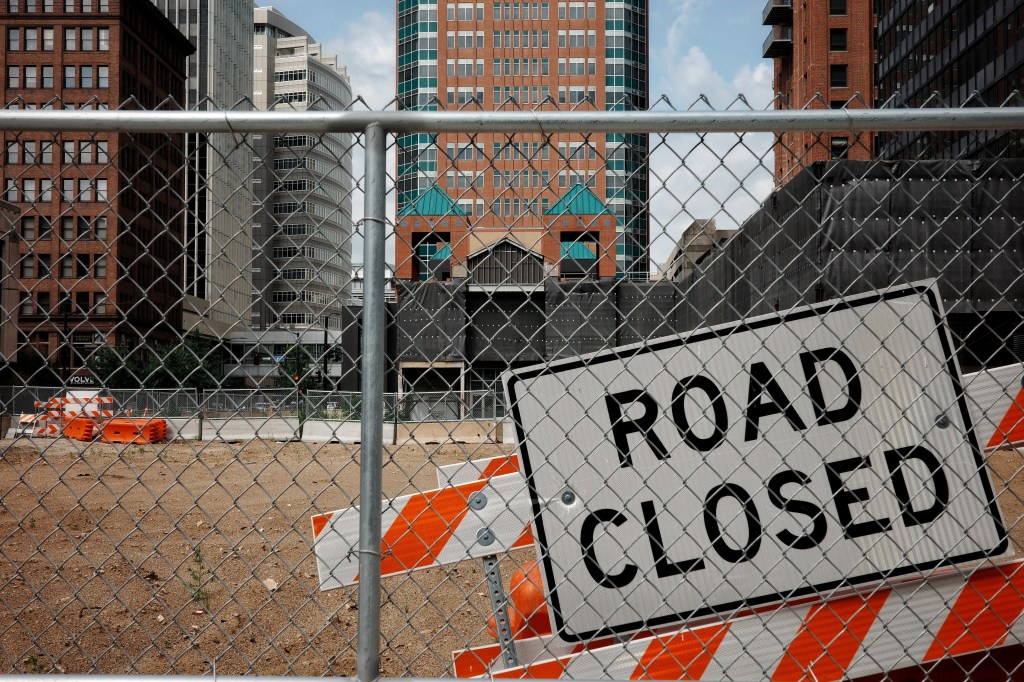
Yeah, road closed.

My Ricoh GR3X is ideally suited to the flâneur school of photography, partly because it’s so compact and easy to carry everywhere. I’d heard you could carry it in a regular pants pocket, but I assumed that was mostly bullshit. It’s not. I’ve done it; I’ve walked around–I’ve ridden my bike–with this unit IN MY GODDAMN POCKET. It also turns on almost immediately, which is incredibly handy. Best of all (I’m not sure this is actually the ‘best of all’ because there are so many ‘best’ things about this camera), you can shoot with one hand. Even in the manual mode, you can control all the settings you need with one hand.

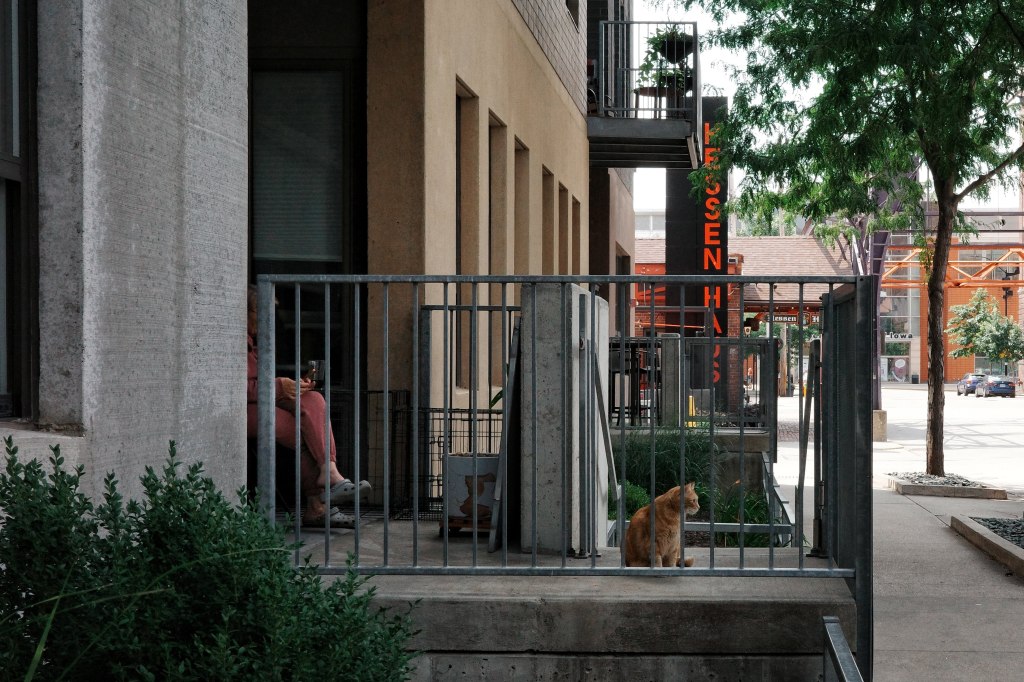
Ginger cat.

Seriously, you can pull the camera out of your pocket, turn it on, compose the shot, adjust all the elements of exposure with one hand, take the shot, turn the camera off, and put it back in your pocket…and you can do all that in just a moment. Which is pretty much what I did with the photo above. As I was walking down the street I noticed the ginger cat. I stepped off to one side so as not to spook the cat, which is when I noticed the woman’s legs. Her legs were in shadow, so I had to quickly adjust the exposure to make sure they’d show up in the photo. Then a step back to include the tree and the window in the frame, and there it was. Maybe ten seconds from seeing the cat to taking the shot. One hand.

Say hello to my little friend

It’s not a perfect camera; I’d love for it to be weather-sealed and dust-proofed, but I’m not sure it’s possible to do that without making it bigger. It’s more important (to me, at any rate) to have a camera I can tote in my pocket than one I can shoot in the rain. There have been a couple of instances where some fill flash would have been handy; the GR3 series doesn’t have a native flash. But, again, that’s small beans.

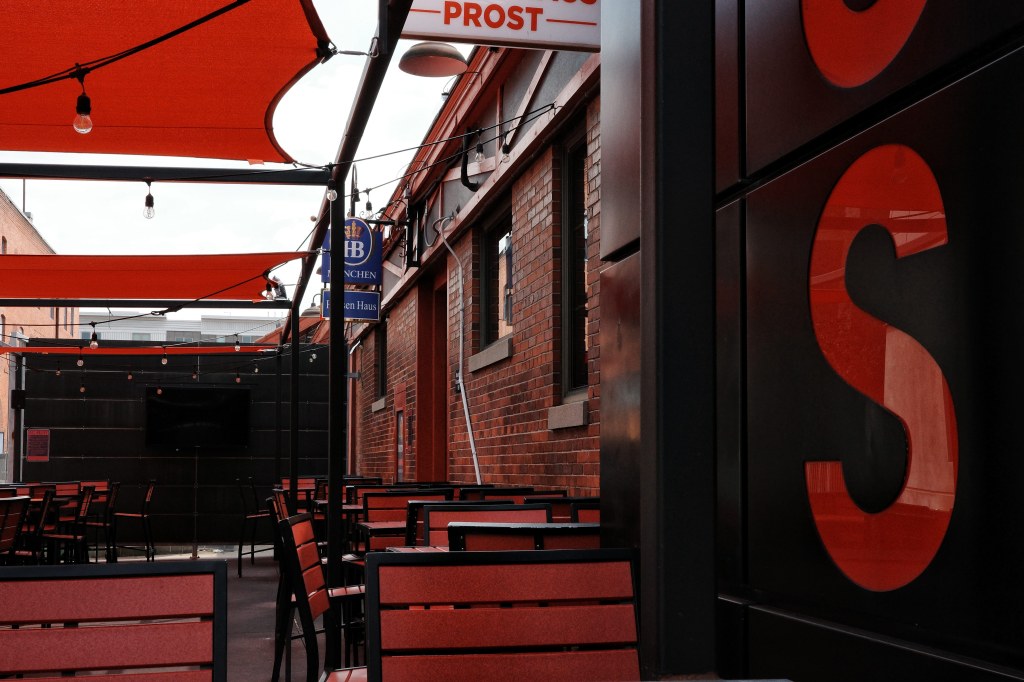
Big S.

The fact is, this camera has already allowed me to get some shots I couldn’t have done with any of my other cameras. And it’s allowed me to get some shots quicker and more easily than with my other cameras. I could have made the shot above with any of my cameras, but it would have taken longer and I’d have had to use both hands. It’s not a great photo (I shot it largely as a reminder to go back when this bar was open), but I was able to get the depth of field I wanted with a minimum of fuss. That absence of fuss is like heroin; it’s fucking addictive.

So yeah, it looks like me and the GR3X are becoming good buddies. I look forward to spending time with it.

in which I look at an old photo (part 2)

I used to pay a lot of attention to photography. Not just the practice of photography (you know, shooting photos and all that), but photography as a craft and art form. Then, for a lot of reasons, I stopped doing that. For a few years, I just wasn’t interested in photography. I shot occasional photos with my cellphone and that was enough. But a few months ago I picked up one of my old cameras and…hey, guess what. My interest in photography was resurrected.

I started thinking about photography again. I started reading articles about photography again, and studying other photographers again. In doing so, I came across an article that suggested looking at your old photos as if they were made by a different person. I’ve never really bothered to look at my old photos. I saw them when I took them and again when I processed them; why look again? But I thought, “Well, what the hell, I might as well try that.” And I did. I picked an old photo and studied it (and wrote about it here). Now I’m doing it again.

Here’s a thing I learned the last time I did this: looking at old photos–and I mean actively looking at them, not just thumbing through them quickly–is weird. It’s sort of dissociative. At least it is for me. It turns out there’s two or three things going on at the same time. You 1) look at the photo as a photo, an object in its own right. But you also 2) consider what was happening in the world around you when you shot that photo. And 3) you remember why you shot the photo.

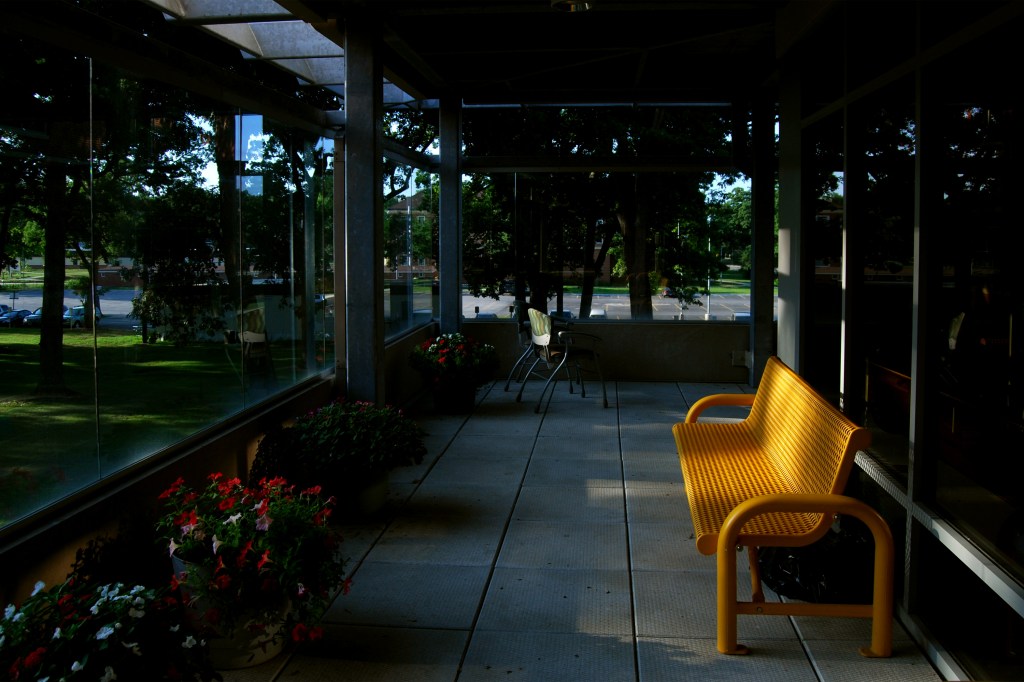
6:59 PM, Sunday, August 7, 2011

This photo was shot on a Sunday evening, at 6:59 PM on the 7th of August, 2011. It was shot at a hospice facility for veterans, where my brother Jesse Eugene was dying from pancreatic cancer. I visited him almost daily during his stay. On that particular day, I’d wheeled his bony ass out to this small enclosed porch so he could look at some trees and feel some sunshine. He stayed in his wheelchair, I sat on the bench. We didn’t talk much. I think the trees and sunshine meant more to me than to him. He may have been humoring me when I suggested visiting the porch. We were only out there a short time before he said he was tired and wanted to return to his room.

I remember wanting to shoot his photo while we were out there; the light was amazing. But he looked awful–the cancer had pretty much ravaged him–and I knew he wouldn’t want his photo taken like that. After I got him back in his bed and comfortable, I scurried back to the porch and took this photo, catching the last little bits of that delicious sunlight.

He died a few days later. This may have been the last time he left his hospice room. I think it was. It’s possible somebody else might have wheeled him out to that porch, but I don’t think so. At the time, it never occurred to me that he might never get to sit in the sunlight again.

Here’s a weird thing. I knew he was dying, but I can’t remember ever thinking something like, “This will be the last time he ever eats black-eyed peas” or “He’ll never get to hear this song again.” I take that back; I vividly recall bringing his dog to visit, knowing it would be the last time he got to hold and hug his little buddy. That was pretty crushing. But that was unusual; mostly I always thought there’ll be at least one more day. But, of course, eventually there wasn’t.

Here’s another weird thing–an uncomfortable weird thing. There’s a selfish part of me that wants this to have been taken on the last day Jesse Eugene sat in sunshine. Why? Because it would give the photo more emotional weight. That complicates my thoughts about this photograph. I have to wonder if my memory is reliable. It’s entirely possible I’m remembering this as the last time my brother sat in sunlight because I want to remember it that way.

Without all that context, I think it’s a pretty good photo. The light is sweet, that yellow bench is an absolute treat, the hint of flowers in the left of the frame is a nice touch. The last rays of sunlight give the photo a sentimental quality that, I hope, isn’t entirely sappy.

I’m still uncomfortable with this idea of examining an old photo of mine, but I’m willing to consider there may be some value in it. I’ll probably do it again in a month or so.

almost, almost…

Yesterday, to distract myself from the SCOTUS-induced alternating rage/depression cycle, I sorted through some of the photos I shot at Saturday’s Farmer’s Market. And there was one photograph that…well, wait. I need to back up a bit. Two things.

First thing, a reminder: I recently bought a new camera, a Ricoh GR3x. It’s unlike any camera I’ve ever owned. To begin with, there’s no viewfinder; you compose the photo using the rear LCD screen. I was actually hesitant to buy the camera because of the lack of a viewfinder (yes, you can buy an attachment viewfinder, but that’s more coin and fuck that.) Composing with an LCD screen seems wrong; that’s what you do with your fucking phone. To my film-trained mind, it’s NOT how you use a camera. And yet, with the GR3x it turns out to be surprisingly handy and intuitive. Old dog, new tricks.

Second thing: Alex Webb. He’s a street photographer who’s famous for extremely colorful and complex photos. When I say ‘complex’ I mean many/most of his photos are composed in a way that organically divides and separates the elements within the frame into what could be different, distinct photos. I’m not going to include an example image here because when I publish this and post the link on various social media, there’s a good chance it’ll feature Webb’s photo instead of the photo I’m writing about; I don’t want people to think I’m taking credit for Webb’s work. But seriously, if you’re not familiar with this guy, do a quick image search. He’s amazing.

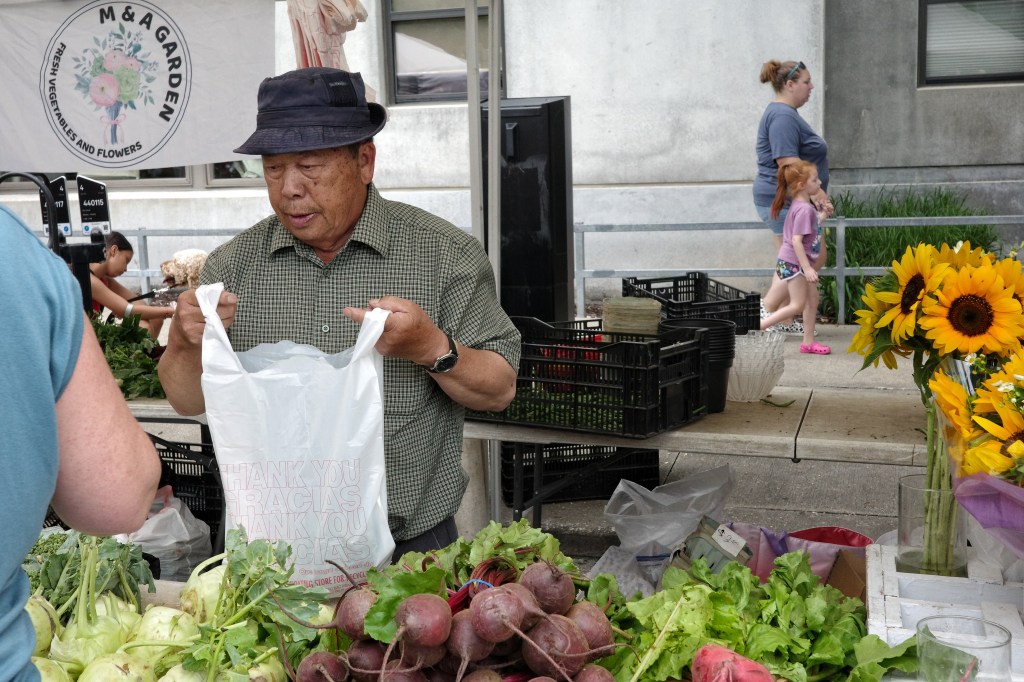
So, back to the opening paragraph, me sorting through Saturday’s photographs. At the Farmer’s Market I noticed a woman comforting her dog (which looked to be some sort of spaniel/poodle mixed breed) behind a vendor’s booth. The dog had apparently been overexcited by the crowd. There was something very sweet about their interaction and I wanted to photograph it. Having recently re-examined Alex Webb’s work, I thought it would be cool to include the vendor in the shot. But there was a guy who kept moving in front of me (I think he thought I was trying to cut in front of him to get the vendor’s attention). I’d shift to one side hoping to get a shot, and the guy kept shifting with me. With each step, I was losing sight of the woman and her dog. Just as I was about to give up, I saw a mother & child walking by behind the vendor.

I took the photo.

Not a great photo, but the potential is there.

Okay, it’s not a great photo. But I like it because it’s as close as I’ve ever come to shooting something almost almost in Webb’s style. Not in terms of color (my photo is rather drab in terms of color), but because the frame can be visually divided into three distinct image areas. The woman and her dog, the vendor, and the mother and child. Granted, the original idea of the woman and her dog largely gets lost, and the image is badly off balance…but still, there it is.

The thing is, if I’d been using a camera with a viewfinder, I wouldn’t have seen the mother and child before they entered the frame (and yes yes, if you’re shooting with a rangefinder camera you can keep your left eye open, which allows you to see outside the camera frame, but that only works if you’re right-eye dominant…and I’m not; I compose with my left eye). If I’d been using one of my usual cameras, I’d have missed the shot.

The GR3x allowed me to compose this photograph thoughtfully and almost instantly. It’s not a great photo by any means, but it demonstrates (to me, at least) this particular camera’s potential to catch unique, unexpected moments. I understand why this camera is beloved among many street photographers.

I don’t do much street photography. I’m not particularly good at it, but I enjoy it. But I also believe in practicing in public, in showing work that doesn’t quite meet my standards for what the work could be. So this is why I’ve inflicted this photo and this blog post on you. Thanks for being patient.

how do you start

This might seem a silly question, but

This question wasn’t asked of me; it was asked generally on Bluesky. But anybody who has ever written anything and been paid for it will eventually get a question that starts the same way. The questions tend to be pretty generic (…but how much dialog do you need?) or vague (…but how do you know when a scene is over?). But this was the most common and fundamental ‘silly’ question:

…but how do you *start* writing? How do you bridge the gap between staring at an empty page, with only a story idea & vague sense of urgency in your head, and convincing yourself to actually Start Writing?

There’s something fundamentally innocent about this situation. I’m just a writer, standing in front of an empty page, asking it how to begin. It’s both silly and serious, because the answer is both self-evident and incomprehensibly complex. How do you start writing a story? You put words in a row. It’s that simple. How do you start writing? Using godlike powers, you create an entire world where none exists and imbue it with rules and natural laws, then populate it with beings who behave as though they have free will but are, in fact, completely and entirely under your control. It seriously IS that complex.

Any story (and by ‘story’ I mean a work of fiction of any length–novel, novella, short fiction) is a cosmological event. When we write a story, we create a world and the world we create shapes how the story will be played out. All fictional worlds, to some degree, resemble the one we live in. The operative term there is resemble. As writers we routinely take liberties with the world we live in, making our fictional worlds different in ways we find useful. We may, for example, create a world in which dog trainers routinely discover dead bodies and solve crimes. Or librarians secretly engage in magical combat with ghosts. Or lesbian necromancers explore haunted gothic palaces in space. Regardless of the liberties we take with reality, the world we create nonetheless still resembles the world we live in.

This is true, but it doesn’t begin to help answer the actual question. How do you confront the empty page?

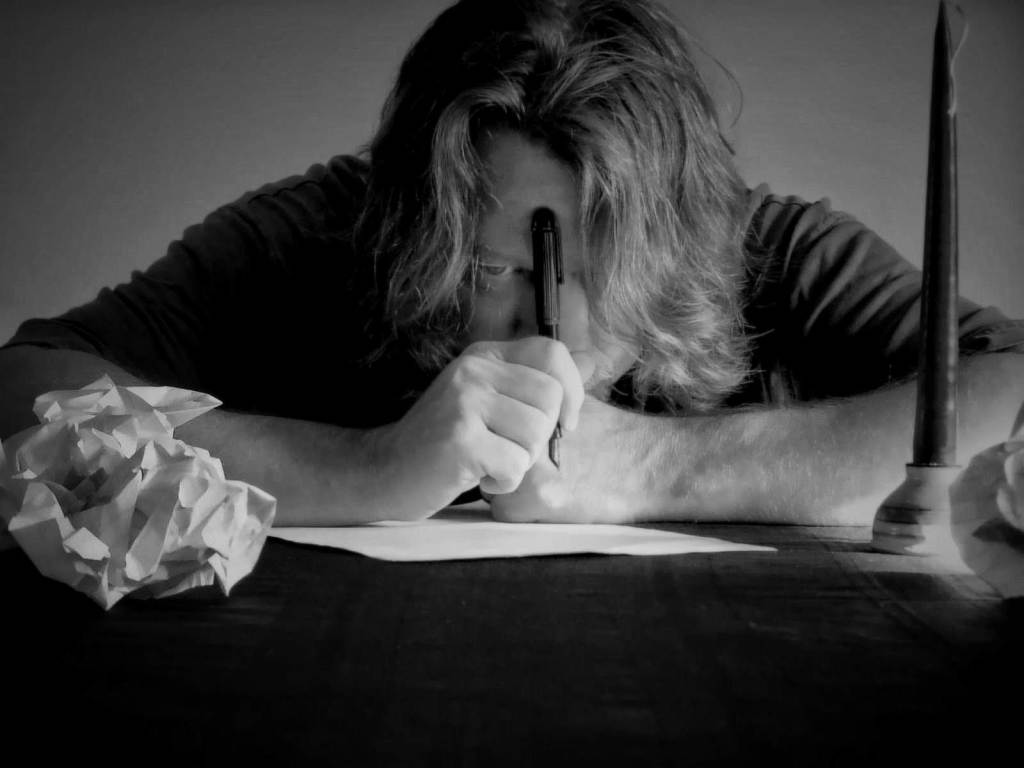
Brain to hand to pen to page.

It’s like when you have a new car (or any other shiny new purchase). You’re very careful where you park, because you don’t want other cars to ding it, or birds to shit on it, or tree sap to fall on it. You dread that first ding, but once it happens you relax a bit. You don’t fret about it as much.

So that’s how you start writing. Ding the car. If you find a clean white page to be intimidating, get it dirty. Put words in a row. Any words.

Another thing. There are LOTS of books on how to write. I haven’t read any of them, but I’m told many have rules on what NOT to do when starting a story. Rules’ like Don’t start with dialog or Don’t start with descriptions of weather or other bullshit. If you’re at a loss with how to start, maybe start by deliberately breaking one of those ‘rules.’

Start with dialog between lesbian necromancers describing the gloomy weather at the gothic space castle if you want. You can always change it later. I mean, it’s ALL just stuff you’re making up, so do whatever the fuck you want. Ain’t nobody looking over your shoulder. Later, if you want/intend/hope to sell what you’ve written, then you may want to take an audience into consideration. But when you’re starting a story, you are completely free. There are no rules, no moral code, no ethical constraints, no social standards you have to comply with.

Once you realize you’re free to write anything you want in any way you want, starting to write becomes pretty easy. Here’s what I know to be true: writing the beginning is fun. It’s all enthusiasm and you’re unburdened by the weight of the story. Writing the ending is harder, but it’s always satisfying. The dangerous part of writing–the part that strangles most writing projects–is the grim fucking middle. That’s where you have to do the grunt work of creativity. That’s where you have to do the heavy lifting of the imagination. The middle requires discipline. I don’t know about you, but I resent discipline. But it’s part of the gig, so there it is.

The beginning though? That’s all bluebirds and sunshine and chocolate eclairs.

juries

Okay, long story.

Years ago, when I was a criminal defense investigator, I worked a bank robbery case. Our client had been charged with robbing a bank in a small New Hampshire town near the border of Massachusetts. It was a local bank, had been in that town for decades, the clients were all local folks. The bank was so small there were only two teller windows. So small, they’d never installed security cameras or security dividers at the teller windows. So small, they’d only just installed a drive through window.

Here’s what happened: guy comes into the bank shortly after it opens, says he has a gun, orders the tellers to empty their cash drawers into a bag. While they’re doing that, the guy is so nervous he pisses himself. They give him the cash, he leaves. Nobody sees him drive away.

The two tellers give the police a very basic description: the robber is maybe six feet tall, short curly dark hair, pale complexion, maybe some acne scars. No arrest is made.

A few weeks later, one of those tellers is working the new drive-through window. Guy drives up, makes a deposit, drives off. The teller says it’s the robber. The local police respond, chase him down, stop his car on the side of the road, order him out at gun point. He gets out, pisses himself. He’s maybe 5’10”, long straight dark hair, fair complexion, no acne scars. The tellers identify him as the robber. He’s arrested, charged with robbery, and taken to jail.

Another couple of weeks pass. Guy walks into the bank shortly after it opens, robs it, manages NOT to piss himself, takes the money, leaves, nobody sees him drive away. The two tellers report to the police saying it’s the same robber as before. The problem is, the guy they’d already arrested is sitting in a jail cell. The police eventually release him. No arrest is made in the second robbery.

Couple of months pass. Across the border in Massachusetts, police bust a couple of guys in a drug deal. Some of the money seized turns out to be from the first bank robbery. The guy holding the money is maybe five-eight, reddish hair, ruddy complexion, no acne scars. But he’s from NH and he’s got no solid alibi for the date and time of the robbery. The NH police charge him with bank robbery. The tellers identify him as the robber.

That was my client. When his lawyer and I interview him, he tells us he didn’t rob the bank and has an alibi he didn’t tell the police; he claims he was in Cape Cod when the bank robbery took place; he’d been there for a couple of days, selling drugs. He gives me some names of people who might confirm his alibi.

I spend a couple of days in and around Truro, talking to drug users. Some confirm the client was there for a few days, but deny buying drugs and can’t/won’t confirm the date (drug users are pretty shitty when it comes to keeping a calendar). Some deny seeing him or knowing him at all. But two guys admit buying drugs from him. They can confirm the date (they had friends from out of state visiting), and can confirm when and where they bought the drugs from (the friends wanted to visit a cemetery near where the dismembered bodies of the Cape Cod Vampire’s victims were found in the late 1960s; that’s where they arranged to meet the client). But, of course, they were very very reluctant to testify about it.

The defense attorney and client conferred. They decided to rely on the strong ID defense. After all, the tellers had already mistakenly identified a different guy once, and their description of the robber at the time of the crime didn’t match the client. They decided an alibi of “I was selling drugs to serial murder fans at the Cape Cod Vampire murder scene” wouldn’t help their already strong ID defense. Besides, Truro was only about three or four hours away from the small NH town; it would have been possible for the client to be selling drugs in Truro, drive to NH, rob a bank, and return to Truro to sell more drugs. And while a jury might wonder why a drug dealer would interrupt a successful drug dealing holiday on Cape Cod to drive 7-8 hours round trip to rob a bank of a few thousand dollars, the alibi seemed to raise more problems than it solved.

The case went to trial, and the jury voted to convict. The client was sentenced to 20 years for a bank robbery he (probably) didn’t commit.

The Jury — by John Morgan (1861)

Why am I telling you this? Because today, Judge Merchan will be instructing the jury in Comrade Trump’s election interference case. And because folks who know I’ve spent a lot of time in and around criminal courts have been asking me for an opinion about the outcome of this trial. Here’s my opinion: the evidence against Trump is solid and the defense case is weak.

But juries are fucking weird. No matter if the case presented by the prosecution or by the defense is solid, once the jurors close the doors and start deliberating, anything can happen. All it takes is one juror who thinks maybe Michael Cohen can’t be trusted (and let’s face it, Michael Cohen CAN’T be trusted, even if he’s telling the truth now) and the State’s case goes down the porcelain facility.

I generally disagree with folks who describe a jury trial as a crap shoot. The dice are usually loaded in the prosecution’s favor. But once the dice start bouncing around, they can bounce in bizarre, unpredictable directions. All we can do is wait.

I’m hoping they bounce toward guilty.

in which I look at an old photo

Here’s a thing I’m going to do. Well, it’s a thing I’m thinking I might do. I’m not going to commit to actually doing it because it might be awful–for me and for any poor bastard reading this blog. Anyway, here’s the thing:

I’m thinking I might periodically look at one of my old photos and review or analyze it as if it were shot by a stranger.

I almost never look at my old photos. The very idea of looking at my old photos sounds boring as fuck. The idea of talking about one of my own photos sounds pretentious and annoying (and also boring as fuck). So why am I going to do this? I’ll explain the reasons later. Anyway, here’s the first photo I’ve chosen for this maybe-project.

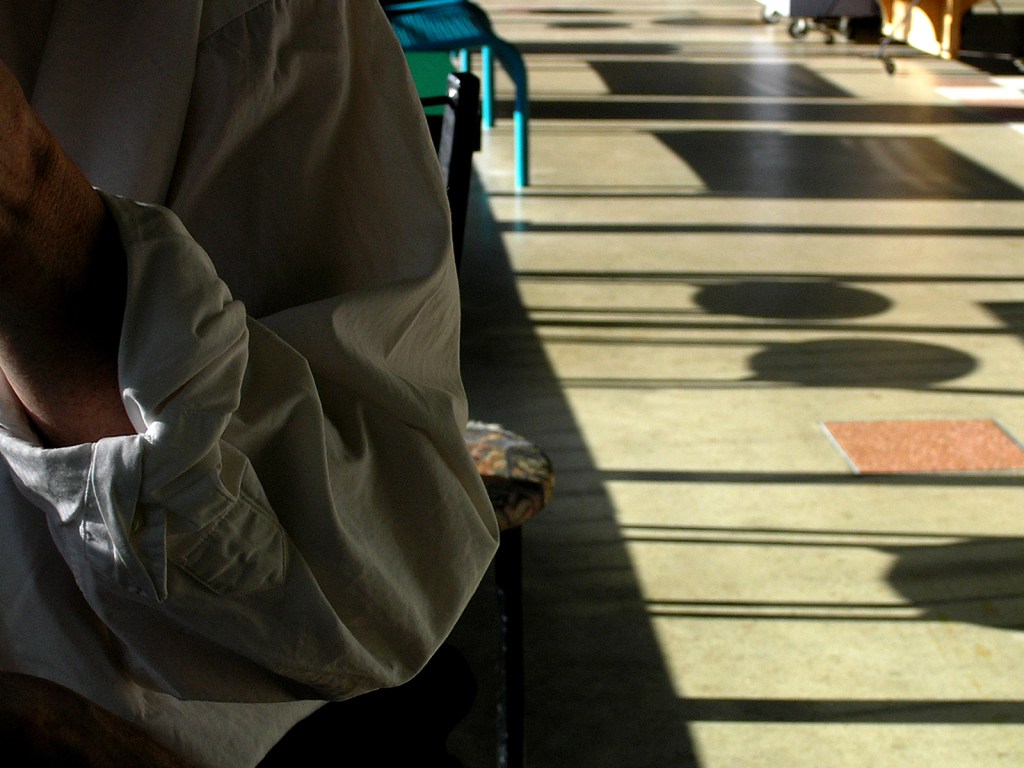
5:51 PM, Wednesday, September 27, 2006

I shot this one late afternoon in September of 2006 (EXIF data is handy) with my very first digital camera, an Olympus C-770 UZ. A four megapixel powerhouse. It’s shot in a 4:3 aspect ratio, which I’ve never been comfortable with. As I recall, there was an option to shoot in 3:2, but it required some loss in resolution, which was noticeable in a 4mp camera.

I was having coffee with a friend and was somewhat distracted by the pattern of the late afternoon shadows. I recall shooting a couple frames of the shadows, but the images weren’t very interesting. At some point, my friend raised her arm to sip her coffee; the sun had shifted enough to illuminate the edge of the rolled up sleeve of her white shirt. I asked her to do it again and took the shot.

It’s not a great photograph, but that arm and sleeve humanizes the image. It’s not just a photo of some shadows; it’s a photo of a human moment. There’s a palpable mood here–quiet, reflective, casual, conversational. There’s something comfortably relaxed, intimate even, about that rolled up sleeve. I also like the fact that the image is intimate while being sort of impersonal; there’s almost nothing to identify the other person–age, gender, height, weight. It could be anybody. Fill in the blank.

Finally, the perspective puts the viewer IN the scene. Sitting relaxed across at a table with a friend in an almost empty coffee shop on a sunny afternoon.

Okay. Now, why am I talking about this 18-year-old photo? Here’s why.

I used to spend a lot of time thinking about photography. Thinking about different photographers, about styles and trends in photography, about the decision-making processes involved in making photos. For years I wrote a fairly regular series of essays about photographers (which can be found here). I started those essays primarily as a way to educate myself, but they became a tool for discussion in a Flickr group called Utata.

And then I stopped. I could probably cobble together some logical explanation for why I stopped, but really, who cares? The thing is, I just didn’t spend much time thinking about photography and photographers. I continued to shoot photographs, but lackadaisically and rarely with an actual camera. I was satisfied with my Pixel phone. Until a few months ago.

Again, I could probably cobble together some logical explanation for why I picked up a 12-year-old camera, but, again, who cares? I picked it up and started shooting with a camera again. Which led me to start shooting with another of my cameras. Which led me to decide to buy a new camera (which should arrive in a month or so). I’ll write about the new camera when it arrives. But the thing is, I’m thinking about photography again. I’m reading about photography again. And one of the articles I read included some bullshit about reviewing your old photographs.

Here’s a True Thing: I have no real interest in looking at my old photos. The very idea of looking at my old photos sounds boring as fuck. I mean, I shot those photos; I’ve already seen them. I’d rather look at new photos, photos shot by somebody else.

But this article suggested looking at your old photos as if they were made by a different person. The rationale is that we change over time, so our approach to photography probably changes. Which sorta kinda makes sense to me, since in a very real way I’m NOT the same person I was in, say, 2006.

So I said, “What the hell, why not?” and I opened up Google Photos and scrolled all the way down to the oldest photos. The photo above was one of them. It seemed like a good place to start.

I don’t know if this is a good idea or not. I’m not sure I’ll follow through on it. But back in the days when I was actively thinking about photography, I stumbled across some thoughts by Alfred Stieglitz and William Gedney about practicing in public. Although they didn’t put it quite like this, those guys were suggesting that if you’re serious about photography, you’ve got to be willing show your whole ass. Maybe this is related to that whole notion.

shogun

I recently finished watching the new Shogun mini-series, and yes, I have thoughts. Before I inflict those thoughts on you, I should report that I’ve read the novel twice. I don’t recall when I first read it, but it was many years ago; I reread it earlier this year when I heard about the remake of the mini-series. I should also say I’ve seen the original Shogun mini-series starring Richard Chamberlain and Toshiro Mifune. So I can compare the new version to the old version and to the novel itself.

Shogun 2024 is both better and worse than Shogun 1980. Visually, it’s significantly better. The cinematography is spectacular. It’s certainly darker (literally), but the biggest difference is the story world of Shogun 2024 looks and feels lived in, if that makes sense. The story world in Shogun 1980 looked and felt like elaborate movie sets. The production values of Shogun 1980 are a product of their time, and it shows. There’s a convincing verisimilitude in the new version that was absent in the original.

The narrative in the new version is, in some ways, easier to follow–which ought to be a good thing, but isn’t always. I’d heard it would emphasize the Japanese perspective over that of the European protagonist. I confess, I was of two minds about this. I mean, the story takes place in early 17th Japan, so yeah, obviously it should be sensitive to the existing culture. But at the same time, it’s a classic ‘stranger in a strange land’ tale. At its heart, it’s a story about a person trying to understand and survive a society that’s exceedingly different from his own.

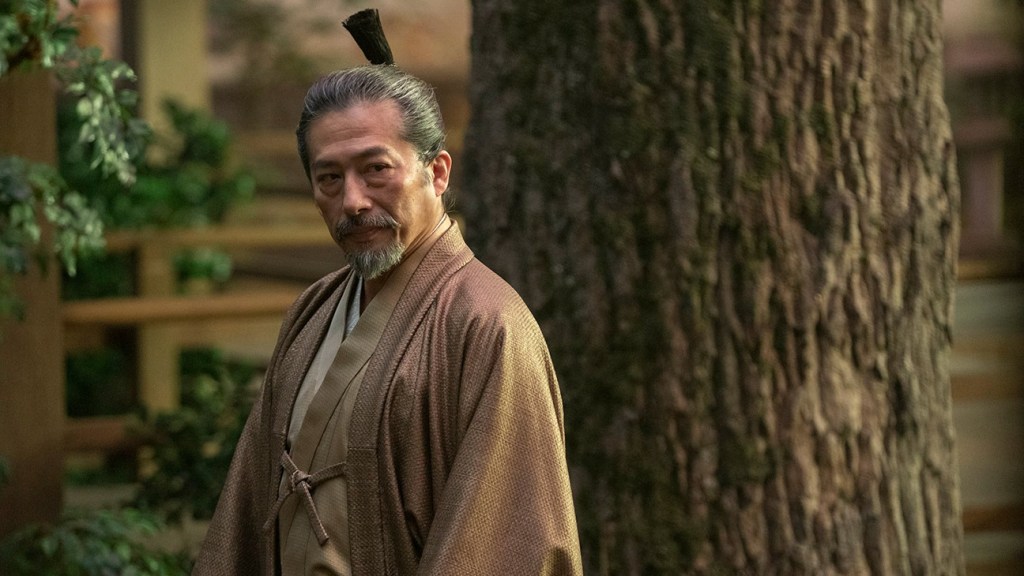
Toranaga — Shogun 2024

In Shogun 2024, the Japanese dialog includes subtitles. This, obviously, allows the viewer to understand what’s being said. Shogun 1980 did NOT provide subtitles, which had a HUGE impact on the story and the viewing experience. The viewer was as confused and uncertain about what was happening as Blackthorne. Unless you spoke Japanese, you were at the mercy of Mariko’s translation–or you were forced to try to deduce what was being said based on the behavior of the characters. This reinforced Blackthorne’s sense of isolation. The absence of subtitles also required the actors to rely more on face and body acting; they had to use body language and facial reactions to physically demonstrate what was taking place and being said.

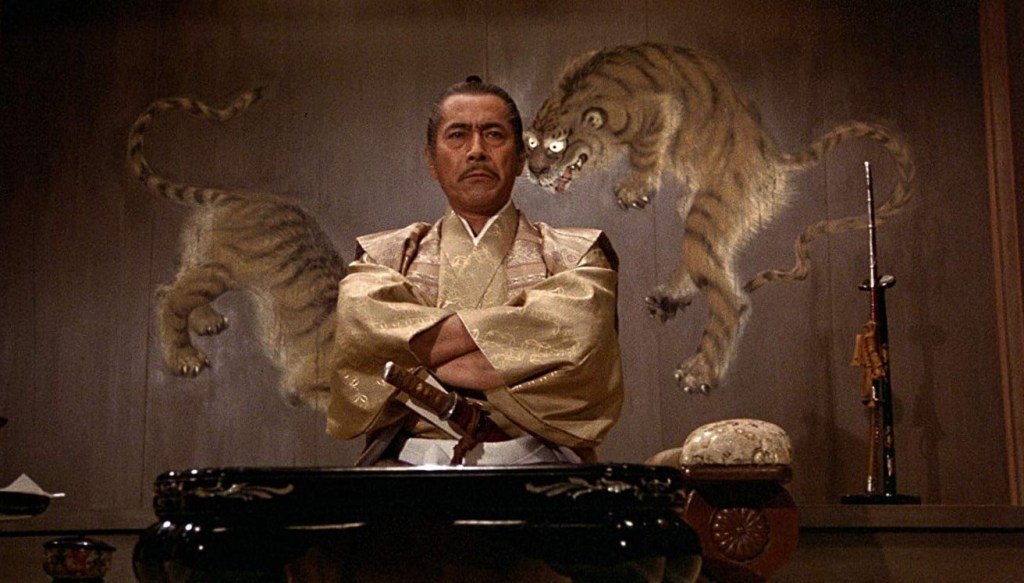
This leads me to my main criticism of Shogun 2024, which is the way Toranaga is depicted. In the novel and in Shogun 1980, Toranaga clearly enjoys being alive. He displays a wide range of emotions; he’s exuberant, he’s stern, he drinks, he’s sentimental, he laughs, he gets angry, he’s wise, he’s deeply curious, he’s willing to be silly, he’s deadly serious, he’s stubborn. For example, in Shogun 1980 Toranaga sees Blackthorne dive off the ship, headfirst into the water. It’s a technique new to Japan and Toranaga immediately wants to learn to dive (this, by the way, is at the heart of the Toranaga-Anjin relationship; Blackthorne has skills that surprise and intrigue Toranaga, skills he wants to learn). Blackthorne demonstrates the dive. Toranaga and his retainers all try it. However, Toranaga is unable to make a proper dive. Initially, it’s a funny scene; his repeated painful belly flops are comical. But Toranaga’s failure at diving puts him at risk of losing face in front of his followers. Blackthorne eventually demonstrates a simpler method and Toranaga finally succeeds. We learn a lot about Toranaga in that scene — his thrill at learning something new, his joy of playing around in the water, his stubbornness and determination, his pride.

In Shogun 2024, however, Toranaga says he wants to learn to dive, but only watches as Blackthorne repeatedly demonstrates his diving technique. Eventually Toranaga leaps into the water and challenges Blackthorne to a race. We learn almost nothing interesting about Toranaga in the 2024 version.

Toranaga –1980

Another example, in Shogun 1980 Blackthorne is being entertained by some women and he becomes a wee bit drunk and high-spirited. He sings a shanty and dances a hornpipe. The noise draws Toranaga to the room. Blackthorne realizes he’s created a scene (which is frowned upon in Japanese society) and starts to apologize, but Toranaga is intrigued and insists on seeing the dance. He then decides to learn Blackthorne’s dance. We’re treated to a scene in which Toranaga is attempting to dance a hornpipe. It’s wonderfully ridiculous and delightful.

The Toranaga of Shogun 2024 doesn’t dance. He doesn’t laugh, he doesn’t get sentimental, he doesn’t get tipsy, he doesn’t get silly, he doesn’t seem to enjoy much of anything. Throughout the series, he’s almost always stern and serious.

In my opinion, this handicaps Toranaga’s development as a character. This is especially clear after Toranaga’s capitulation to his brother and his announced decision to surrender himself in Osaka. In Shogun 1980 and the novel, we see Toranaga lose his joy; we see him defeated and deflated and depressed; there’s a marked contradiction in his behavior. He’s emotionally diminished. The Toranaga of Shogun 2024, on the other hand, has been consistently sober and serious. When he submits to his brother and Osaka, the change in his demeanor is slight. Instead of showing him emotionally changed, the narrative suggests he’s physically ill as well as depressed. It’s simply not as interesting.

This flaw (and yeah, to me it’s a massive flaw) becomes more obvious at the end of the series. Toranaga makes a series of confessions, including the fact that he’s always wanted to become Shogun. In Shogun 1980, he also admits he had Blackthorne’s ship destroyed to keep him in Japan, largely because he needs Blackthorne — not because of his ship or his skills, but because his alien/outsider status allows Toranaga to have an actual friend, somebody who doesn’t have a Japanese agenda. In both versions of the show, Toranaga declares Blackthorne “makes me laugh.” In Shogun 1980, we see that laughter and we know it’s true. Toranaga makes the same statement in Shogun 2024, but we never see that joyful/playful side, so the comment doesn’t ring true.

Shogun 2024 centers the experience of the Japanese characters, but that makes it a story about political maneuvering. Shogun 2024 is about Toranaga’s hidden agenda to become Shogun, in which Blackthorne plays a minor role. In this version, Blackthorne is actively resistant — hostile, even — to change. He remains boorish, rude, and almost willfully ignorant of Japan’s societal norms. It’s not until the final episode, when he realizes he’s unlikely to be able to return to Europe, that he seems to genuinely adapt to Japanese life. It’s a story about political conflict.

Shogun 1980 (and the novel), on the other hand, is about Blackthorne’s struggle to adapt to a very alien culture, which takes place during a potential civil war in Japan. In this version, Blackthorne realizes there are many positive aspects of this new culture and he eagerly embraces aspects of it. This is maybe most clear in Blackthorne’s enthusiastic “Oh lawdy, I fucking LOVE a hot bath” revelation and his pleasure at the simple cleanliness of Japan. It’s a story about cultural conflict.

Both versions end with Blackthorne realizing he’ll never get to leave Japan. But that awareness lands differently in each version. In Shogun 1980, Blackthorne’s willingness to adapt makes his acceptance less painful; having to live the rest of his life in Japan doesn’t seem like much of a sacrifice. In Shogun 2024, however, Blackthorne having to stay in Japan feels like a prison sentence which he’ll try to make it as palatable as possible.

I found Shogun 2024 to be a more compelling and visually interesting story. But I also think it’s a less enjoyable story.