needless death on the high trestle trail

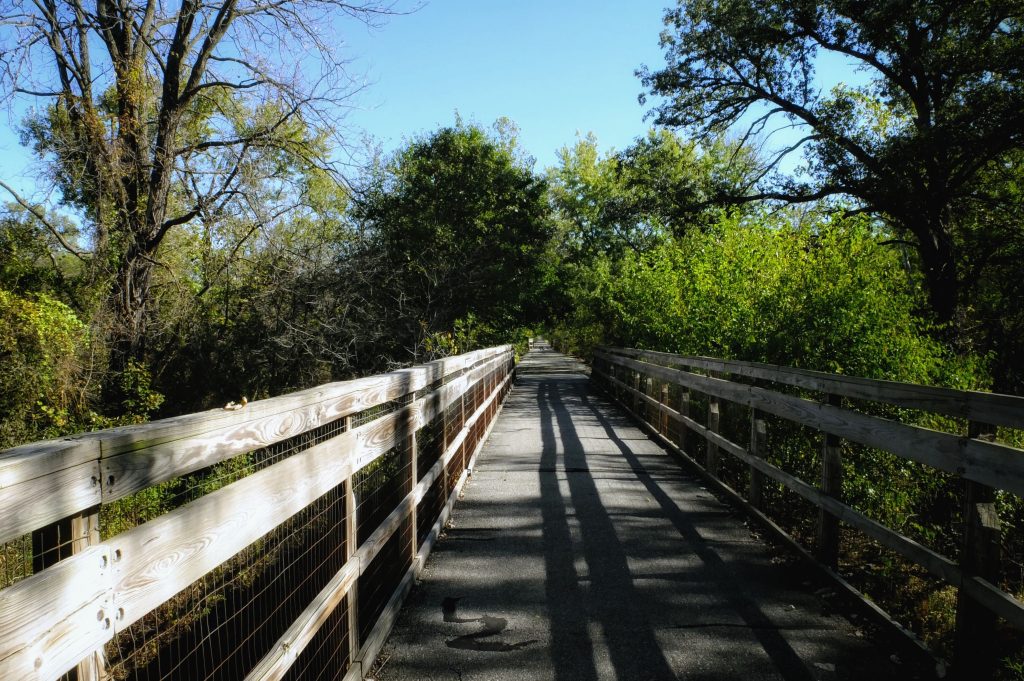
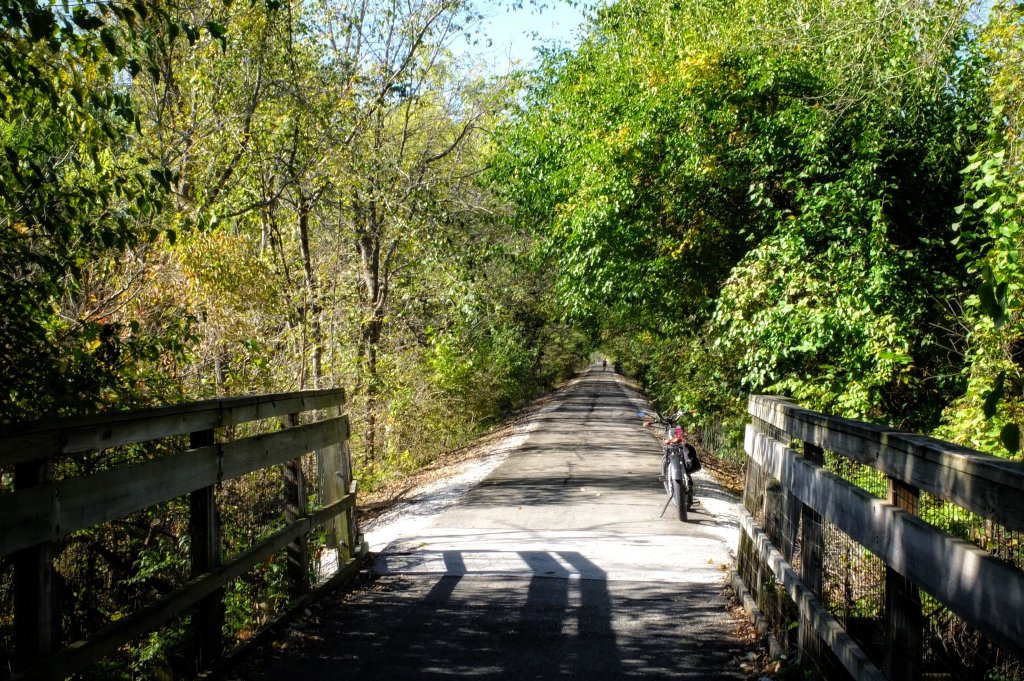
I ride the High Trestle Trail a few times a year. Well, that’s not entirely accurate. The HTT trailhead is about a mile from where I live. The trail itself is 25 miles long, but it’s linked with the approximately 100 miles of dedicated intra-city bike paths, so even if I just ride around town, I’m often on some section of that trail.

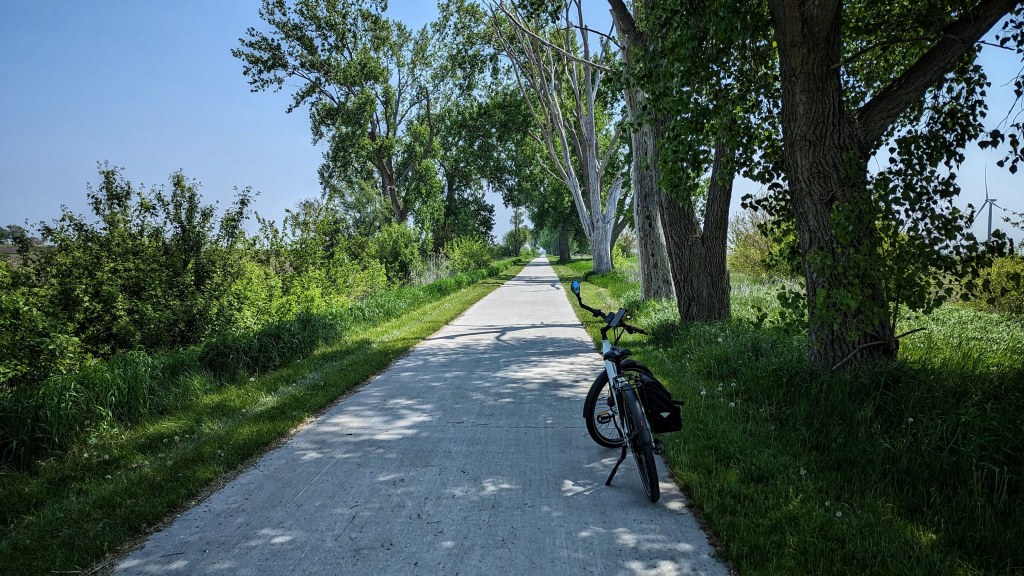
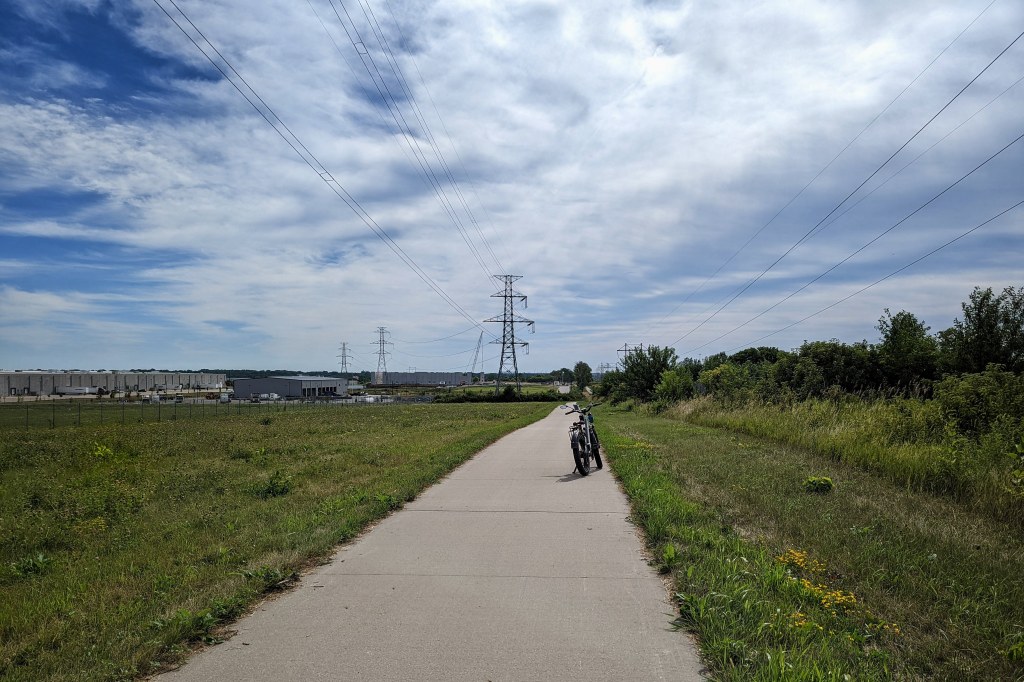
Like a lot of Rails-to-Trails bicycle paths, the HTT tends to be long and straight. Once it leaves the city limits, there’s a long stretch that runs through flat, open farmland. We’re talking corn and soybean fields, which means there’s nothing to protect you from the sun and the wind. And the wind can be brutal. The section of the HTT is great for folks who (unlike me) ride road bikes for fitness or exercise; they can put their heads down and fly.

That’s the section of the HTT where I usually saw Corey Petersen. I didn’t know her; I’ve never spoken to her, but I’ve seen her several times. We’ve shared waves and head-nods the way cyclists do. I didn’t know she was a Marine Corps veteran, but it doesn’t surprise me. Anybody who rides a hand-cycle on a trail known for wind is a bad-ass.
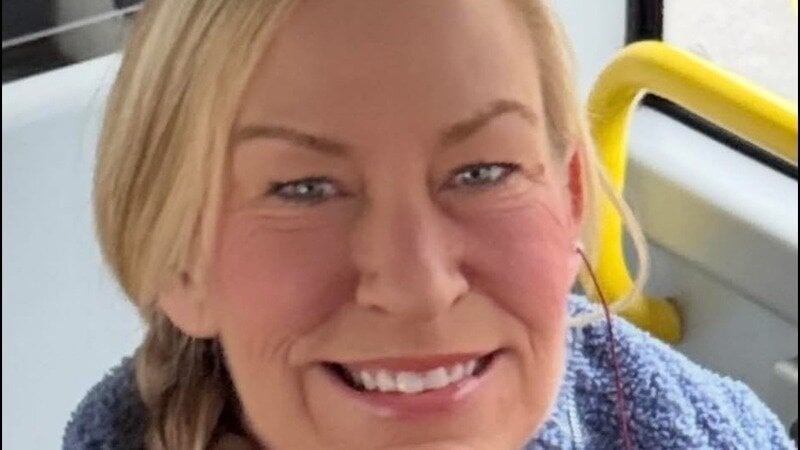
Corey Petersen, cyclist, USMC veteran.

You’ll notice I’m speaking in the past tense. Corey Petersen was killed a week ago while cycling on the HTT (please watch the news video). She was hit by a truck while crossing a busy country road. I’ve always hated that particular intersection. It’s a sharp turn, so you have to slow down. Worse, the trail is designed to make you ride parallel to the busy road, so you have to look back over your shoulder for oncoming traffic behind you. Even worse, there’s a low hill on the road, which limits a driver’s visibility just before the trail crossing. And to make it still worse, the speed limit on that road is 55mph, and many vehicles are traveling above the speed limit.
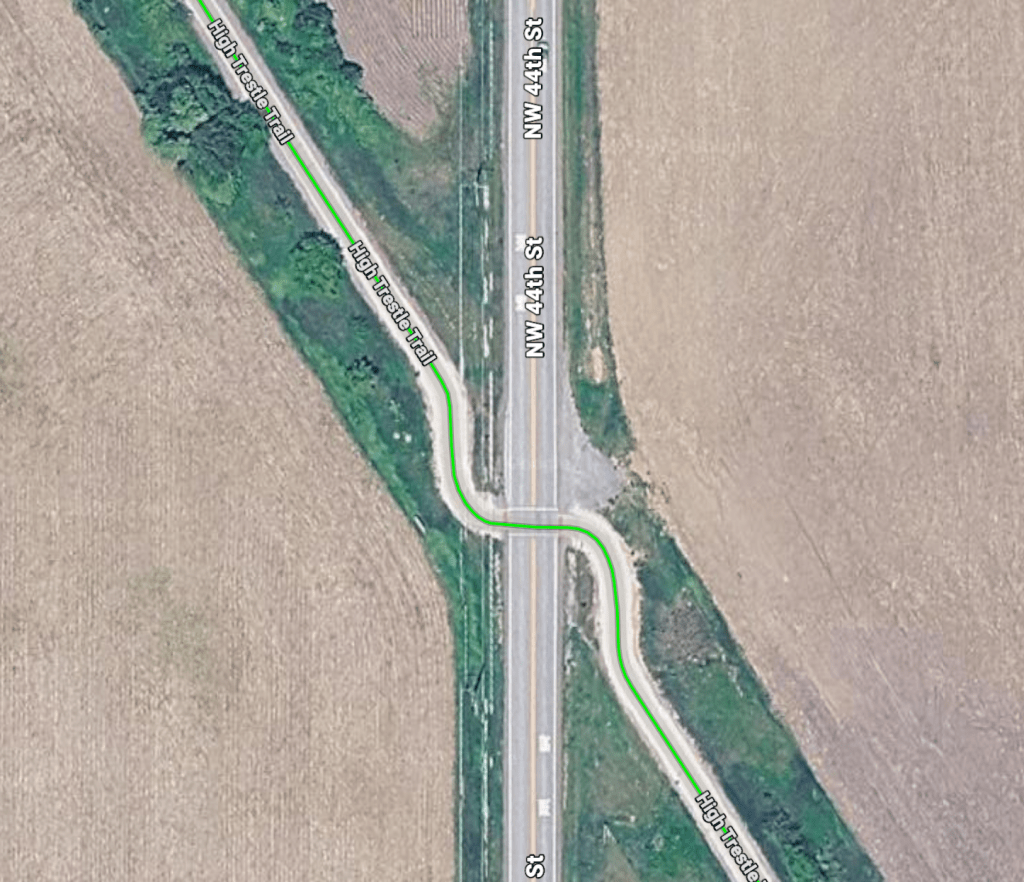
The intersection where Corey Petersen was killed.

It’s a badly-designed, dangerous crossing. It was almost certainly designed by somebody who didn’t understand how bicycles operate. It’s a car-brained design. It’s dangerous enough for folks on regular bikes; for anybody riding a recumbent bike or hand-cycle, which are lower to the ground and much less visible, it’s significantly more dangerous. Although I’ve personally never had a close call there, I’ve been on group rides and witnessed close calls with members of my group.

We don’t know all the facts that led to Corey Petersen’s death. The driver of the truck may have been traveling at the legal speed limit; he may have been paying attention to the road, he may have done everything right…but a vehicle traveling at 55mph covers about 80 feet in a second. At most, a driver cresting the small hill in the road would have 4-5 seconds to respond to a cyclist crossing the road. At most, 4-5 seconds. Make that a recumbent bike, which would be more difficult to see…make that a hand-cycle, which has less immediate torque…and you have a tragedy. Even if the driver is doing everything right. And let’s be honest, how many drivers are doing everything right?
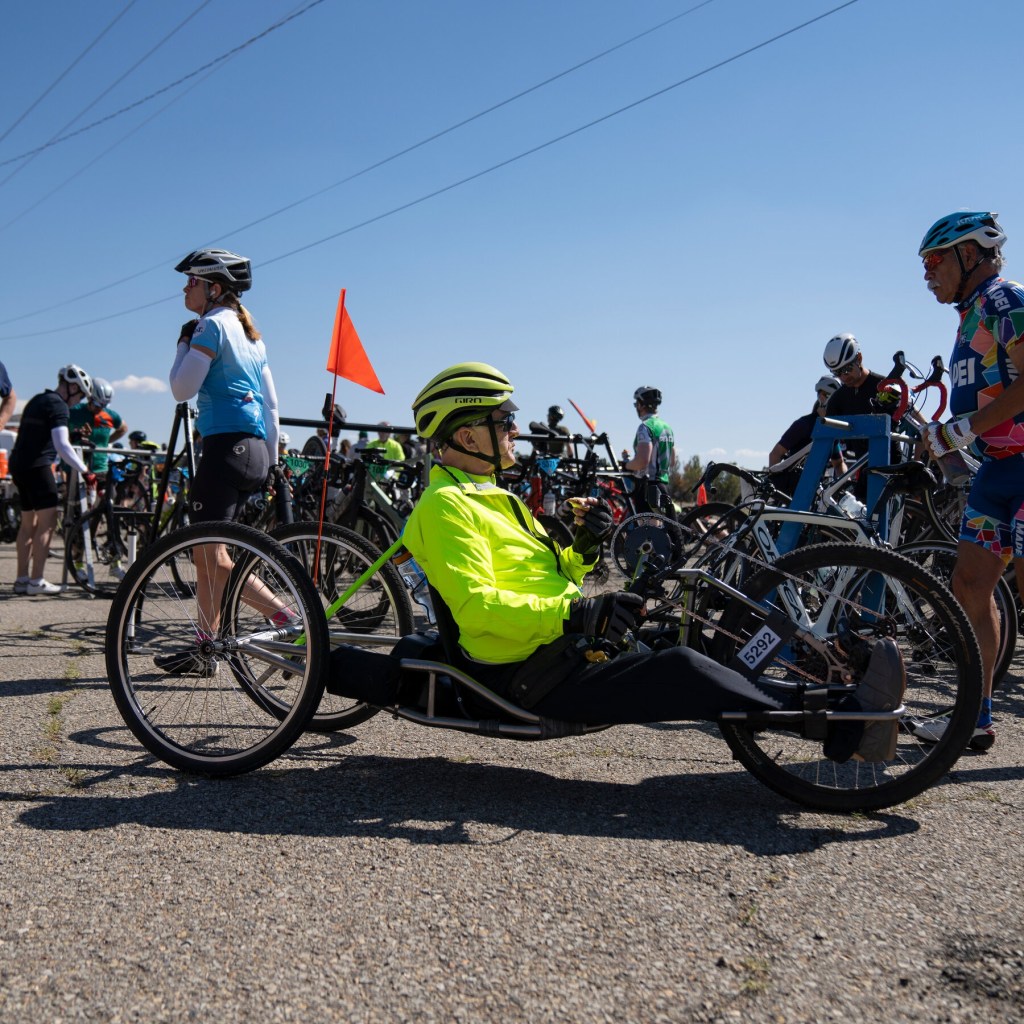
This is a hand-cycle. Cyclist ‘pedal’ with their hands. It’s very low to the ground.

The High Trestle Trail draws a lot of cyclists. The Iowa Natural Heritage Foundation estimates that, on average, around 3000 people ride some section of the trail every week. A popular (and economically important) bicycle trail is an asset to the State and to the towns along the trail. There is absolutely NO reason for such a dangerous crossing to exist on that trail. Granted, the HTT was opened in 2011, but that means they’ve had 14 years to fix a known problem.

There is a petition to make that intersection safer. Please consider signing it.

Back in 1896, the journalist Nellie Bly interviewed Susan B. Anthony. The subject of cycling came up during the interview. This is Anthony’s take on cycling:

Let me tell you what I think of bicycling. I think it has done more to emancipate women than anything else in the world. I stand and rejoice every time I see a woman ride by on a wheel. It gives a woman a feeling of freedom and self-reliance. It makes her feel as if she were independent. The moment she takes her seat she knows she can’t get into harm unless she gets off her bicycle, and away she goes, the picture of free, untrammelled womanhood.

Cycling clearly meant something to Corey Petersen. I can’t speak for her, but I know that being on a bike gives me a sense of freedom and joy. I’m confident Corey felt something similar. I wish ‘she can’t get into harm unless she gets off her bicycle‘ was true.

Sadly, it’s not.
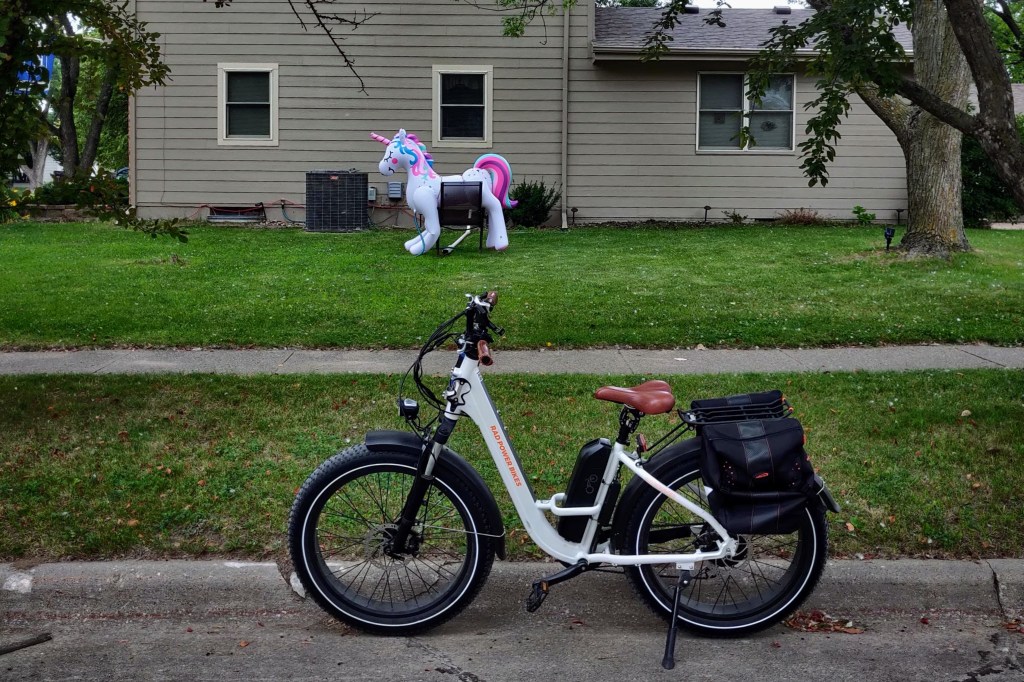
ebike evolution

Today is World Bicycle Day. And, okay, that sounds silly–like with all the awful shit taking place in the world, we need to set aside a day to celebrate bikes. But it actually makes sense. Bikes are–and always have been–revolutionary.

That includes electric pedal-assist bikes. The perception of ebikes is evolving rapidly. I bought my first ebike back in June of 2020. There weren’t many of them around at the time. In fact, I didn’t see another ebike in the wild until late that autumn. They were so uncommon that people–pedestrians, other cyclists, even people in cars at stop signs and traffic lights–would stop me to ask about the bike. They had lots of questions: how did it work, how far could it go, how fast, how much did it cost. And very often, these two questions: “But isn’t it…cheating?” and “Aren’t they for…old/disabled people?”

Those questions are what I like to call ‘stupid-ass questions.’ No, they’re not cheating. No, they’re not just for old or disabled people. They’re just bicycles. Bicycles plus.

When I bought my first ebike, they were as rare as unicorns.

I’ve talked about the ‘cheating’ issue before. The entire concept of cheating in recreational cycling is ridiculous. It’s stupid on multiple levels. Cheating implies some sort of competition. Who the fuck are we competing with when we go out for a ride? If you’re riding purely (or even primarily) for exercise, you could, I suppose, argue that you’re competing against yourself–that you’re trying to cycle better each time you go for a ride. Go faster, go farther, go longer, burn more calories. If that’s the case, then riding a bike would be cheating against runners. Riding a bike with multiple gears is cheating against cyclists who ride fixies. If you buy into the ‘cycling is competition’ argument, then anything that makes cycling easier can be considered cheating. All that spandex shit you wear? That’s cheating.

The other question–ebikes are for old or disabled folks–is equally wrong-headed. Ebikes ARE great for older folks and for folks who have some sort of disability. It allows people who otherwise couldn’t or wouldn’t ride a bike to…well, ride a bike. The same is true for step-through bikes, which are easier to get on and off (and yeah, there were assholes who thought they were clever by referring to my bike as a girl’s bike–like that’s an insult). Anything that helps people get on bikes and ride is a good thing. That’s pretty fucking obvious.

My second ebike is a lot more nimble.

Here’s the thing: a lot of us don’t see cycling as competition or a fitness tool. We’re riding bikes because they’re fun. We’re riding bikes as a form of transportation. That’s the main thing about ebikes: they’re generally adaptable. If you want an inexpensive way to commute to work without getting all sweaty, an ebike is your friend. If you want to take long rides without worrying that you’ll exhaust yourself (turning a fun ride into an ordeal), an ebike allows you to do that. Even if you want to cycle for exercise, you can reduce the level of pedal assist and sweat your ass off.

There are still a LOT of bicyclists who mock ebikes. But it’s changing. I rode my bike to the local farmers market on Saturday. The market is deliberately located on the town’s central bicycle trail. I’d say at least a third–maybe even half–of the bikes parked around the market were ebikes. There are two bike brew pubs within a few hundred yards of the farmers market; around a quarter of the bikes parked outside those pubs were ebikes.

I can ride farther and longer and have more fun with my ebike.

Don’t get me wrong; ebikes are far from perfect. They’re generally more expensive than regular bikes. They’re heavier. Batteries have a limited capacity, which affects the bike’s range (although that’s becoming less of an issue). Any device that depends on electricity to function necessarily has more ways to fail than their human-powered counterparts. And yet, despite this, ebikes are becoming more popular.

Why? Because they’re fun. I’ve been riding bike for most of my life, but I can honestly say I’ve never had as much fun on a bike as I’ve had the last four years. For me, the ebike has been liberating. I called my first ebike the best purchase I ever made. That’s still true. My second ebike is a much better bike, but that first bike was a revelation. The second bike was confirmation of how much better my life is with an ebike.

It’s World Bicycle Day and I’m certain most people–including most cyclists–won’t notice. They don’t need to. They’ll be out riding their bikes regardless.

except for the wind

It was a lovely day for a bike ride…except for the wind. A sunny Monday (which meant all the decently employed people were off at work, leaving most of the bike trail almost empty), just a few days past peak foliage season, unseasonably warm (fuck you, climate change, there’s no reason for it to be 70F in the Midwest in the third week of October). So yeah, a lovely day for a bike ride…except for the wind

But the wind…lawdy. Steady 15-17 mph; gusts over 30. That kind of wind at your back is grand on a bike; it just pushes you along. But riding into that wind is a massive pain in the ass. And cross-wind? Fuck me with a chainsaw. If you need another reason to dislike the wind, it rips away the autumn foliage. Still, a bike ride seemed like a good idea.

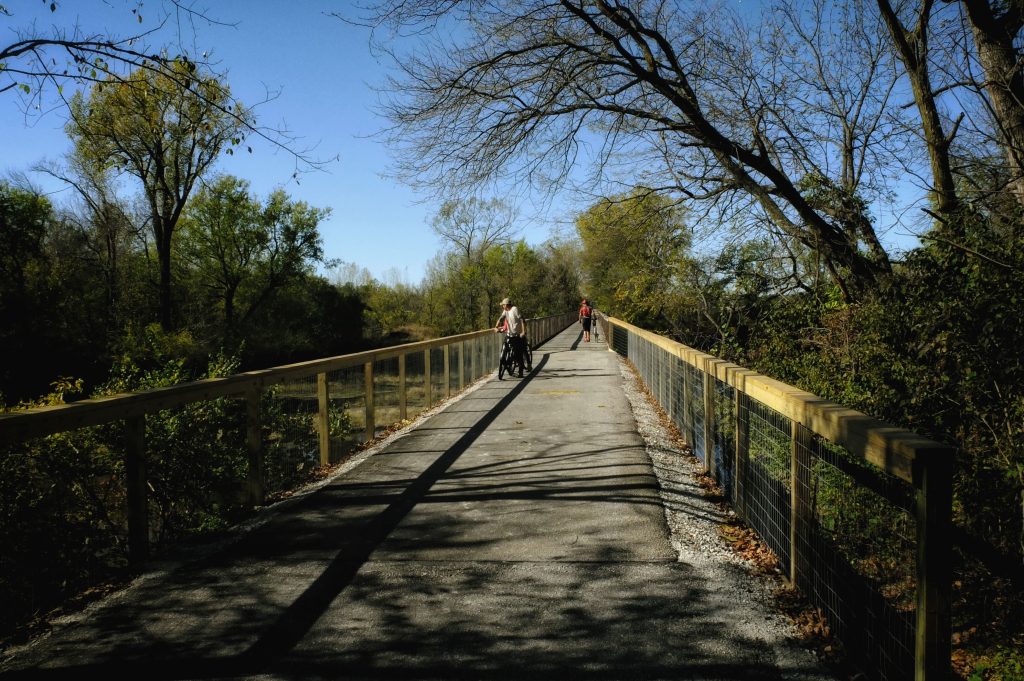
Besides, I’d never ridden across the High Trestle Bridge. I’d ridden most of the High Trestle Trail many times, but the bridge is inconveniently placed near the end of the trail. I like to ride loops; you know, the sort of ride where you circle back to the beginning. The HTT isn’t a loop. It starts in on town, goes through a few other towns, then just ends. When you get to the end, you just turn around and ride the same trail back. That would be fine, except a big section of that trail is what cyclists call boring as fuck. It’s a long, ruler-edge straight, former railroad track that’s almost completely exposed to farmland. Which means there’s absolutely no protection from the sun or the wind. It’s awful.

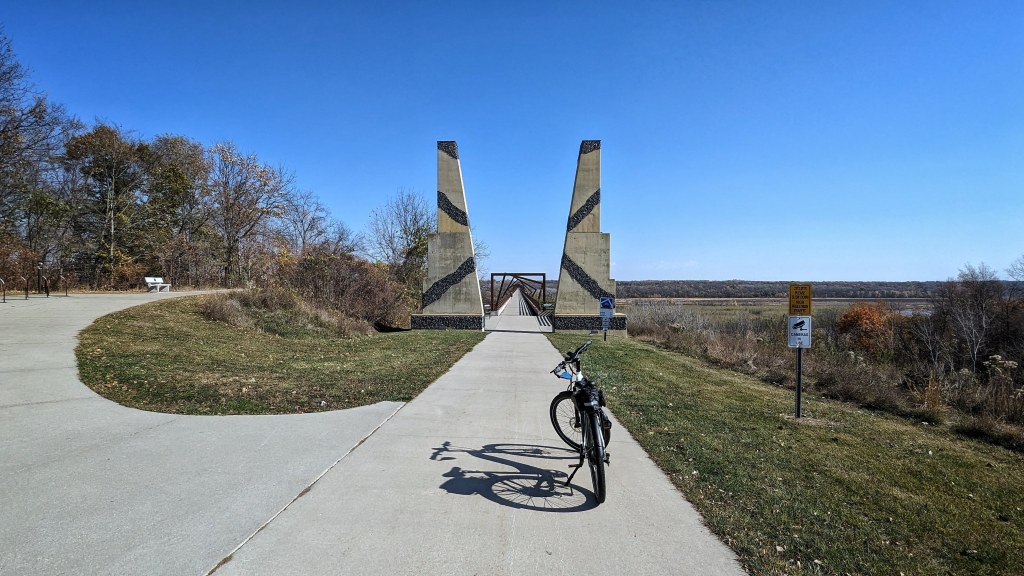
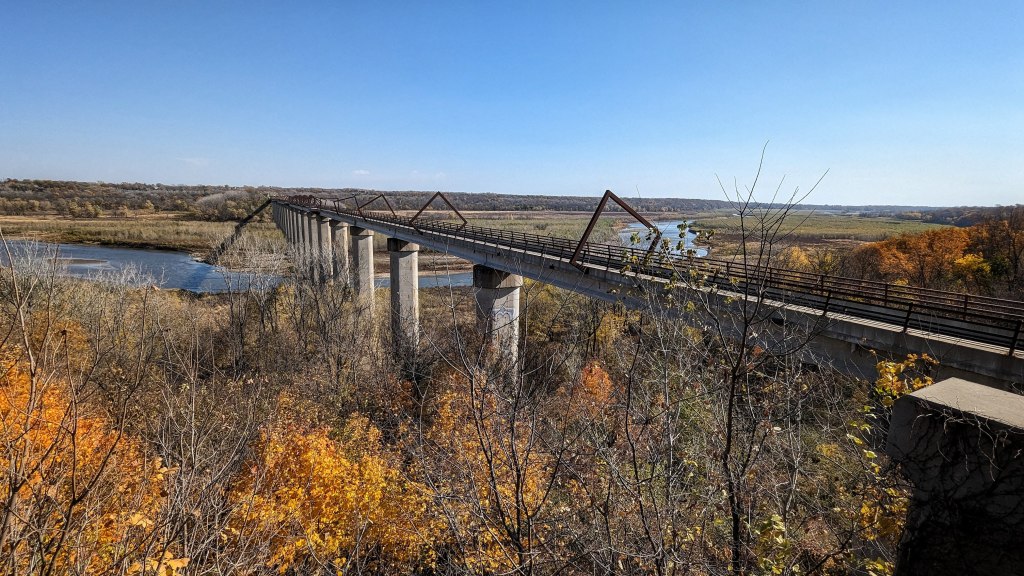
But you can put up with the dull sections so long as there are interesting sections. So we hauled my bike to the far end of the High Trestle Trail and I rode home. The first few miles were lovely; a tree-lined, leaf-strewn trail. Quiet, peaceful, mostly protected from the wind. Then I came to the bridge. It’s a former railroad bridge, spanning the Des Moines River Valley. Half a mile long. One hundred and thirty feet high in the center. Absolutely beautiful. Absolutely exposed to the wind.

Did I mention there were gusts over 30 mph? Did I mention those were cross-winds on the bridge? Even on weekdays, the HHT bridge gets plenty of traffic. The far trailhead is within a few miles of the bridge, and there are bike pubs on both sides. It’s a popular cycling spot. Yesterday was no exception. But those winds.

I saw cyclists start on the bridge, then turn around and come back. I saw a four-bike collision in which it appeared the wind blew one cyclist into another, and two other cyclists piled into them. I saw some cyclists get off their bikes and walk them. And there were a few of us who just put our heads down and rode. I’d originally planned to stop at a couple of the observation areas on the bridge–slightly wider spots where you can dismount and enjoy the scenery. But it was too windy. The bridge is wide enough for maybe three bikes to ride side-by-side, but it felt awfully narrow in those winds.

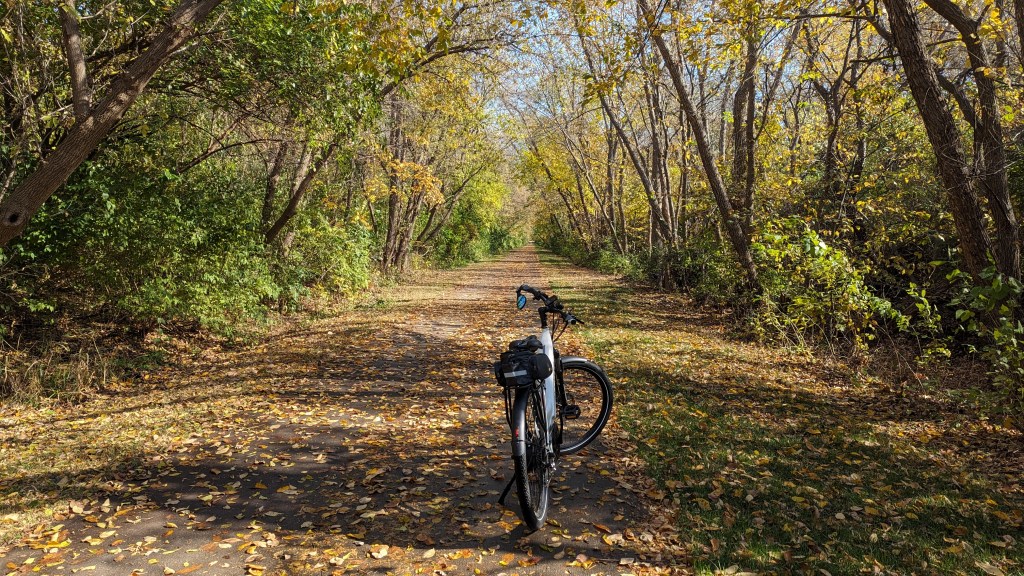
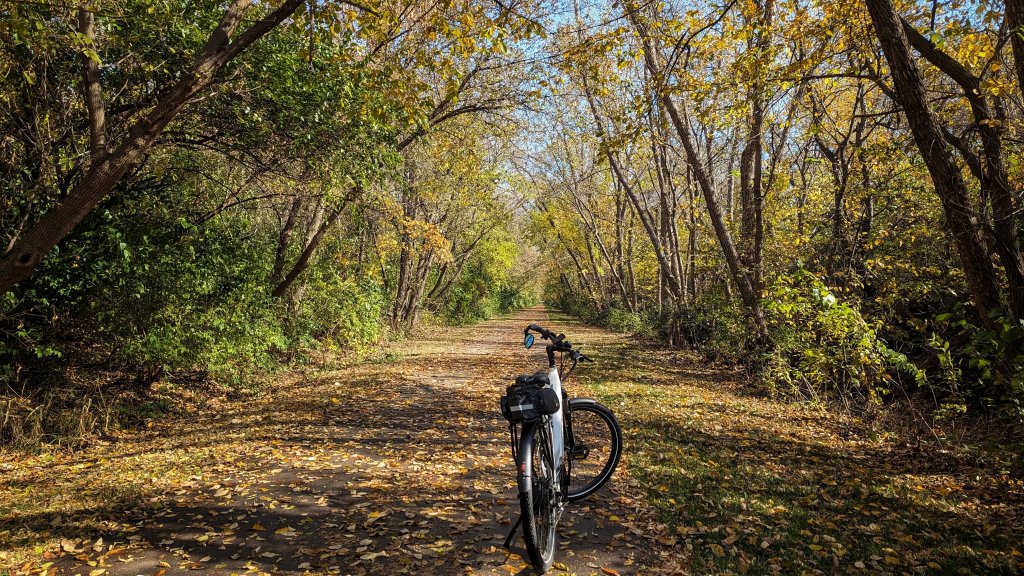
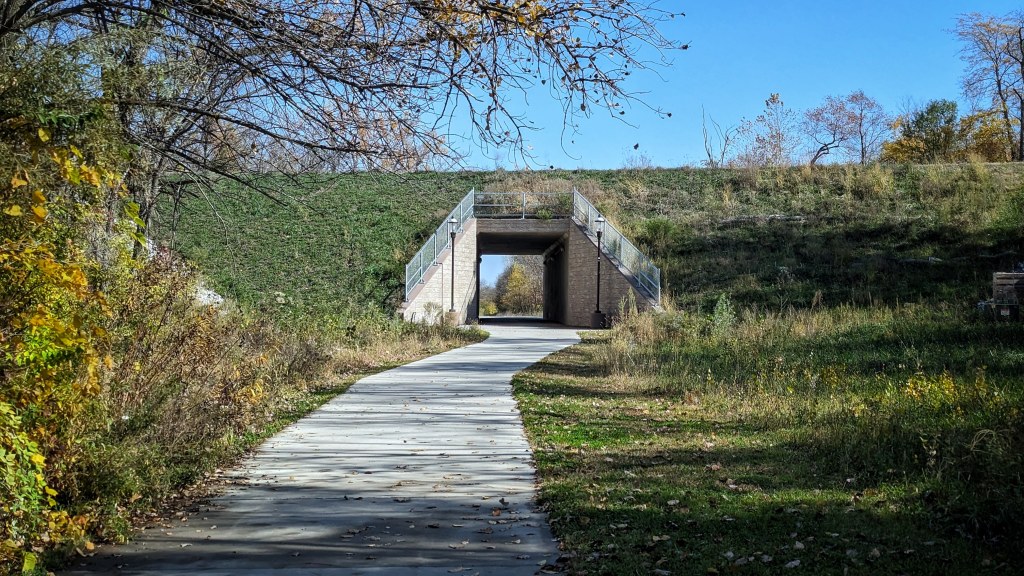
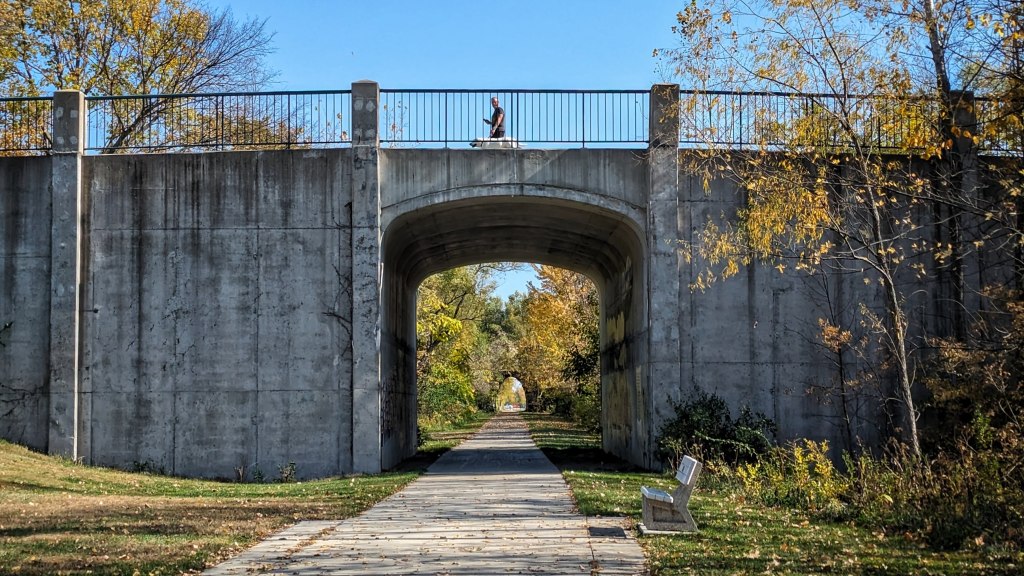
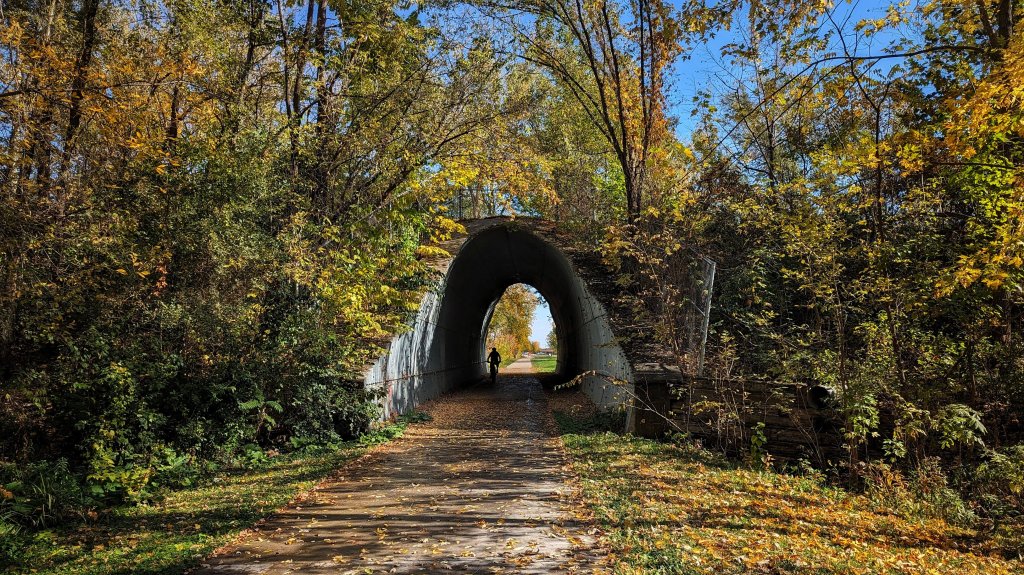
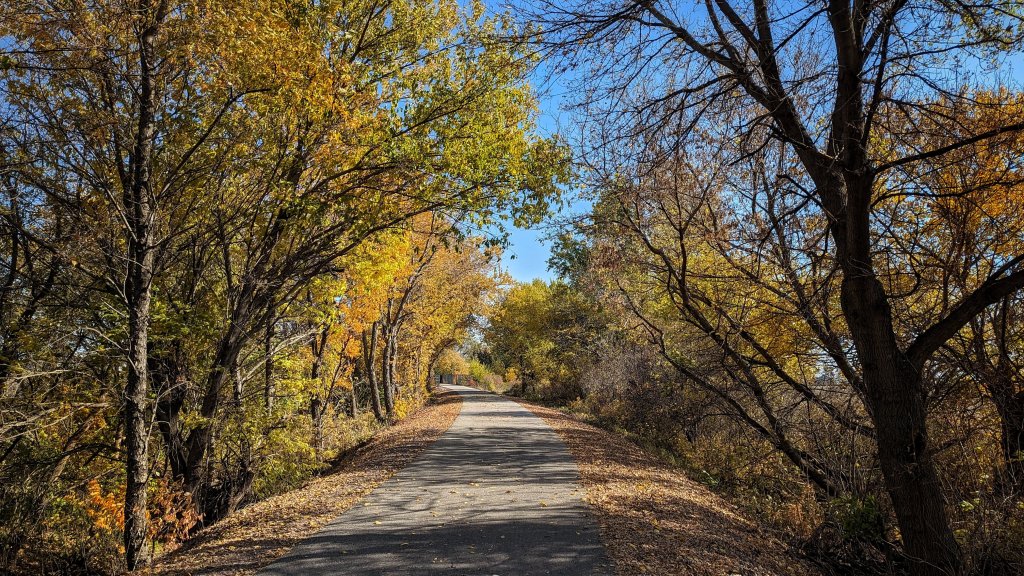
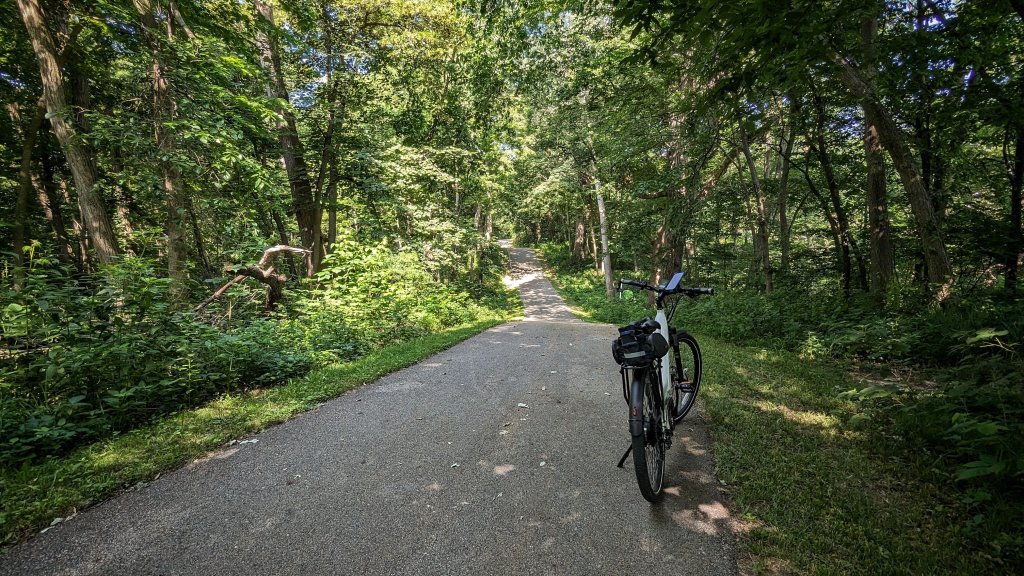
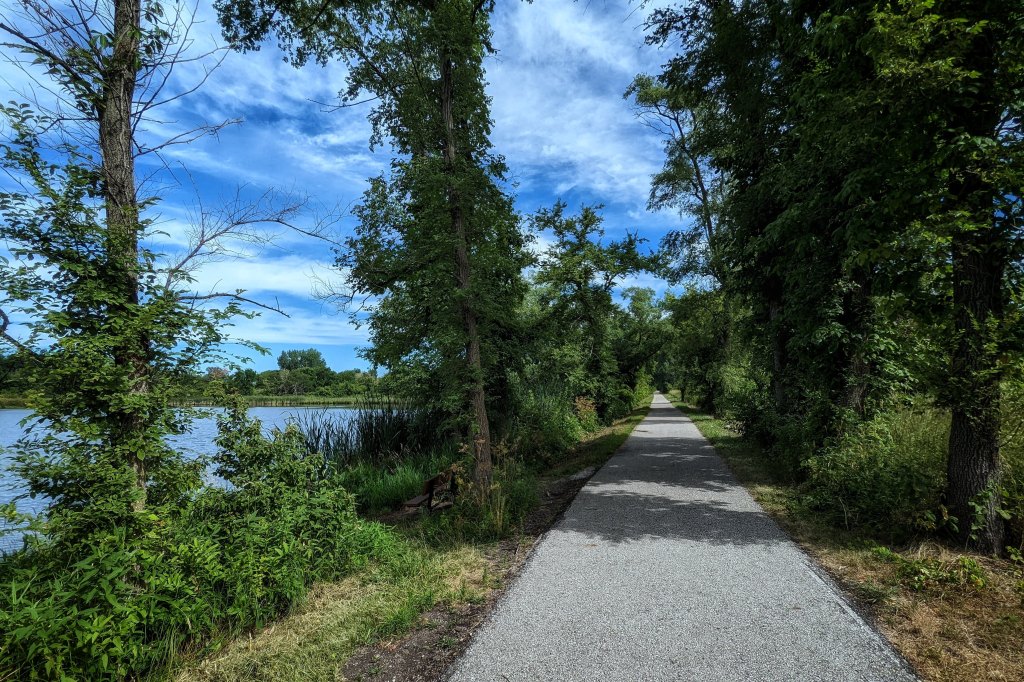
Once across the bridge, the trail became friendlier. It’s a beautifully maintained paved trail, lined with trees, passing by or through a few small farming towns. It was the very best part of the ride; the part in which most of these photos were taken. But then the HHT turns southward and, aside from a few small sections, it’s almost entirely open to the wind. I’ve never been so glad to own an ebike.

My bike has five levels of pedal-assist. It’s so easy to ride, I’ve never felt the need to leave the first level of assist. But into those headwinds, I toggled up to pedal-assist two. Around ten miles straight into steady 15-17 mph headwinds, with gusts of 30 mph. There were very few cyclists riding into the wind; maybe half of the riders I encountered were riding ebikes. The ones who weren’t, looked miserable. I didn’t even think about stopping to take photos.

One of the many nice things about the High Trestle Trail is that there are lots of places to stop and rest. Benches every few miles, small towns with parks, people who live along the trail set out chairs and small tables. I saw at least three bike maintenance locations along the trail, with air pumps and a selection of tools. There are trailheads at both ends of the HHT, with restrooms, picnic tables, and repair stations. The trailhead at the southern end even has porch swings.

It wasn’t a terribly long ride. Less than 30 miles. A hefty chunk of it was unpleasant and more strenuous than I’d like. But any day you get to spend on a bike is a good day. Yesterday was a good day. Except for the wind.

keeping balance

I declare, it’s been a crazy couple of weeks. Between insane weather events, and imploding submersibles, and bizarre Russian semi-coups, and insane imploding bizarre Trump criminal developments, it’s been difficult to focus on a single topic for more than a few minutes at a time.

So I’ve been riding my bike. I mean, when you’re riding a bike, all the rest of that shit fades into vaguely annoying background noise. Like tinnitus. It’s there all the goddamn time, but you just sorta kinda get used to it.

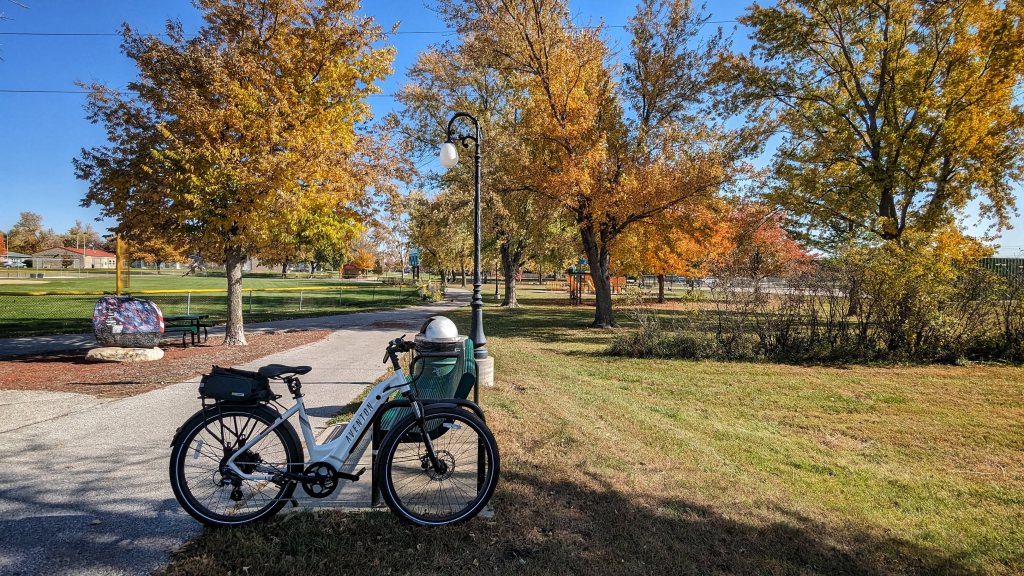
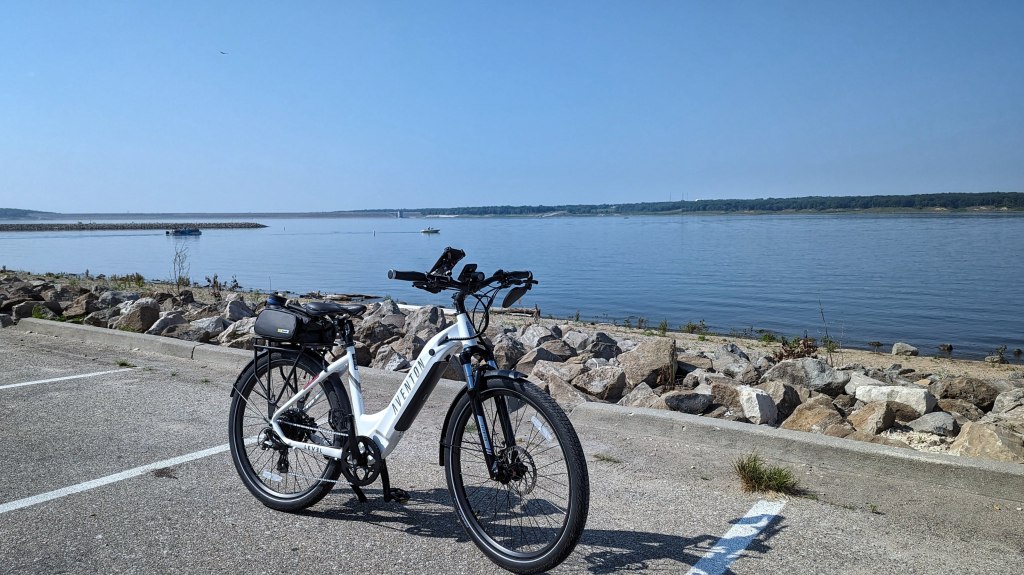
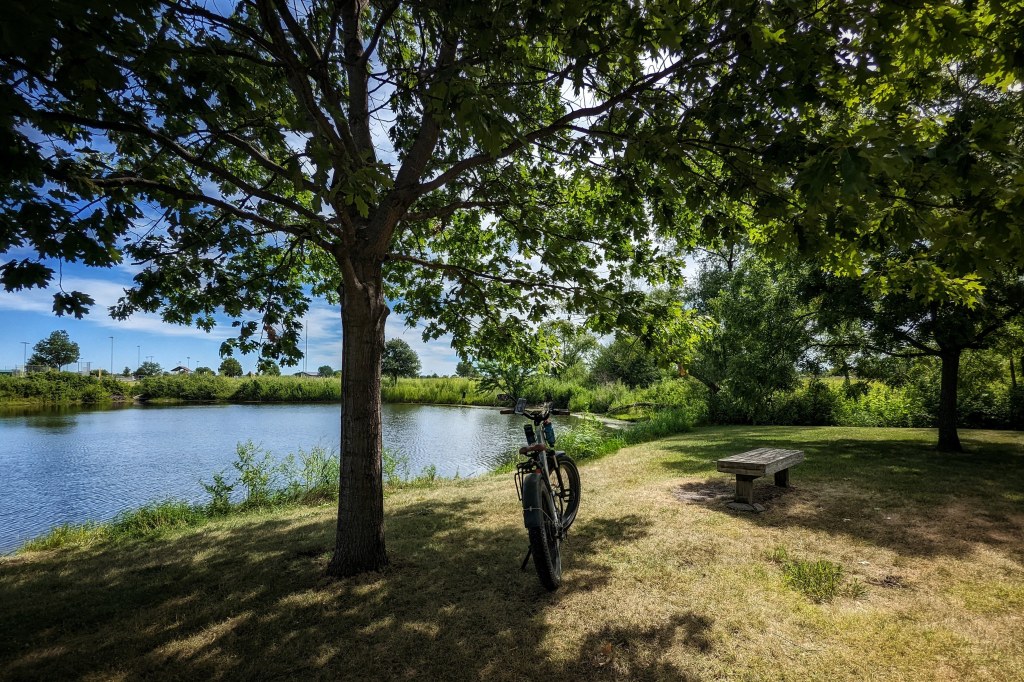
Besides, I have a new bike. Well, it’s not new new. I’ve had it for about a month or so. So it’s still new. Newish. I’ve only put about 170 miles on it. That may sound like a lot, but when you do a few 20-30 mile rides interspersed with sporadically cycling back and forth to the gym, it slowly adds up. And because it’s a new bike and I’m still enamored with it, I’ve been photographing it wherever I’ve gone. Yes, that’s right, I’m taking pictures of a fucking bicycle. Which is just as ridiculous as it sounds.

This is my second electric bike. My first was a fat-tire bike; I described it as the best purchase I’ve ever made. That’s still true, although I sold it when I bought my new bike. It was the best purchase because it allowed me to enjoy cycling again, after years of NOT cycling (because of knee pain). It was a big bastard of a bike; it could go anywhere, but it was cumbersome. The new bike–an Aventon Level 2–is more of a commuter bike. The tires are half as wide, and it’s a lot more nimble. It has a torque sensor instead of the fat bike’s cadence sensor (which will only be of interest to other folks who have ebikes), so riding it feels more like riding a regular bike.

But even on my bike, I can’t fully escape the outside world. For example, President Uncle Joe passed the infrastructure act, which means there’s been a massive increase in transportation construction and repairs, and that includes bicycle paths. Normally, there are a couple hundred miles of easily accessible, dedicated bike trails I can ride, plus all the local bike paths. But with all the new construction, a lot of those paths and trails have been disrupted. It’s a small, temporary inconvenience, and good for Uncle Joe and all…but it’s still annoying to set out on a ride, only to find an excavator has torn up the trail.

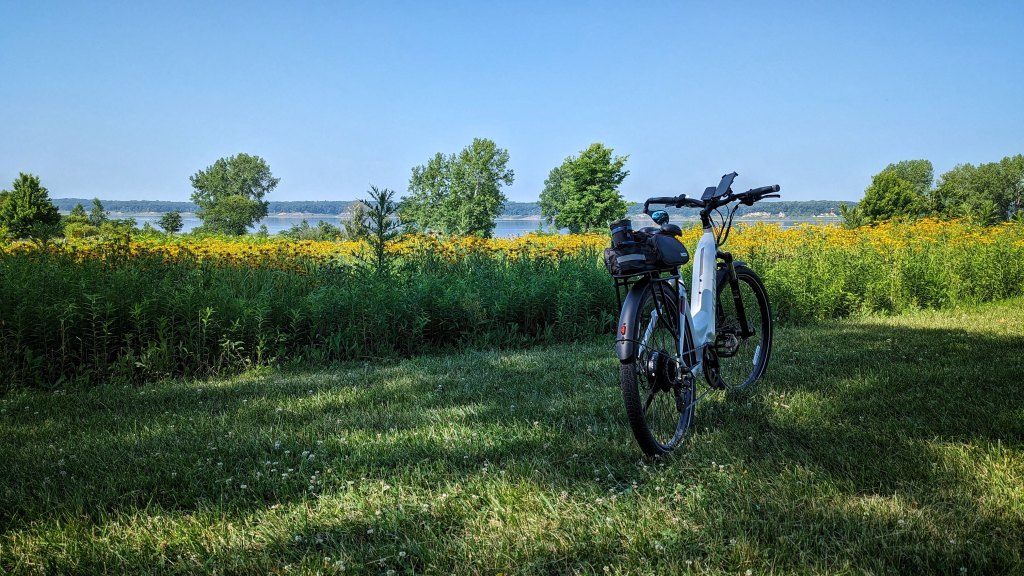
And I can’t exclude former President Comrade Trump when it comes to problems. A couple of days ago I rode down to a nearby reservoir, which is a popular sport for boaters, folks who like to fish, and birders. There’s a large paved parking area where folks park their vehicles and leave their boat trailers. As I was riding along, a couple of guys (white, short hair, in their 20s) driving a Jeep approached me, going the opposite direction. They slowed down, looked at me, and one of the guys yelled, “Fuck Ukrainian Nazis!”

It seemed like an odd thing to shout at a random stranger…until I remembered I was wearing a t-shirt with the Ukrainian flag and ‘Україна’ written on it. I’m assuming they recognized the flag, although I suppose it’s possible they were also familiar with the Cyrillic alphabet. I’m actually kind of impressed they recognized the flag; I don’t expect MAGA-Anon folks to have much awareness of geography or vexillology.

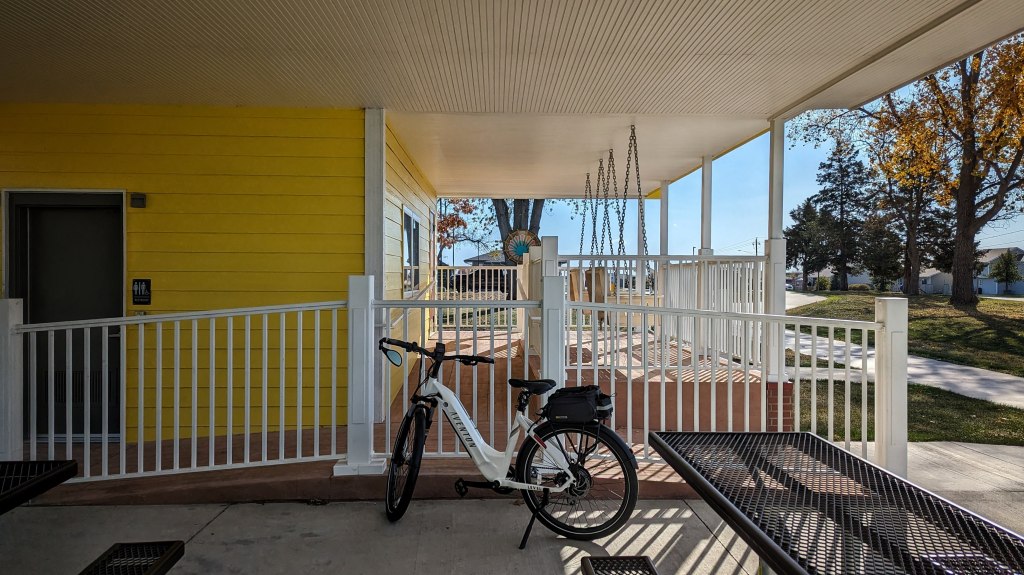
The incident put a very short-term damper on my enjoyment of the day. Maybe five minutes. It was just too nice a day to allow fuckwits to disrupt it. My biggest disappointment that day was arriving at one of my favorite bicycle bars and remembering they didn’t open until 1500 hours. There’s a pair of large open-air pavilions nearby, with restrooms and a public bike repair station, so I considered just hanging out for an hour or so until it opened. But home was only a couple of miles away, and I have a refrigerator stocked with an assortment of beers, so for once I made the logical decision.

Okay, I can’t write a blog post without getting at least a little bit pretentious. So here’s Albert Einstein, in a letter to his son:

Life is like riding a bicycle. To keep your balance you must keep moving

This is me, keeping my balance.

please tell me this doesn’t say what i think it says

Two semi-related things. First, I have a new bike (about which I will almost certainly write, because that’s the sort of thing I do), but I’ve also been uncharacteristically busy, so unable to ride it as much I’d like. I’ve done a few short jaunts around the area, but that’s it.

Second, over the last couple of years, I’ve developed a habit of stopping when I see bike path graffiti. Sometimes the graffito is chalk art, sometimes it’s bits of philosophy, sometimes it’s a sort of editorial opinion. Regardless of what it is, the notion that somebody has deliberately made their way down a bike path and stopped to express themselves pleases me. I keep telling myself I should start photographing all those graffiti; it might make an interesting project.

So last Thursday, when I took a short ride, and saw some bike path graffiti, I did just that. Stopped, read it, photographed it, then went on my way. I didn’t pay a lot of attention to the graffito itself since a) my mind was largely occupied by what I’d been working on before I went for a ride and b) a word in the graffito had been smudged out.

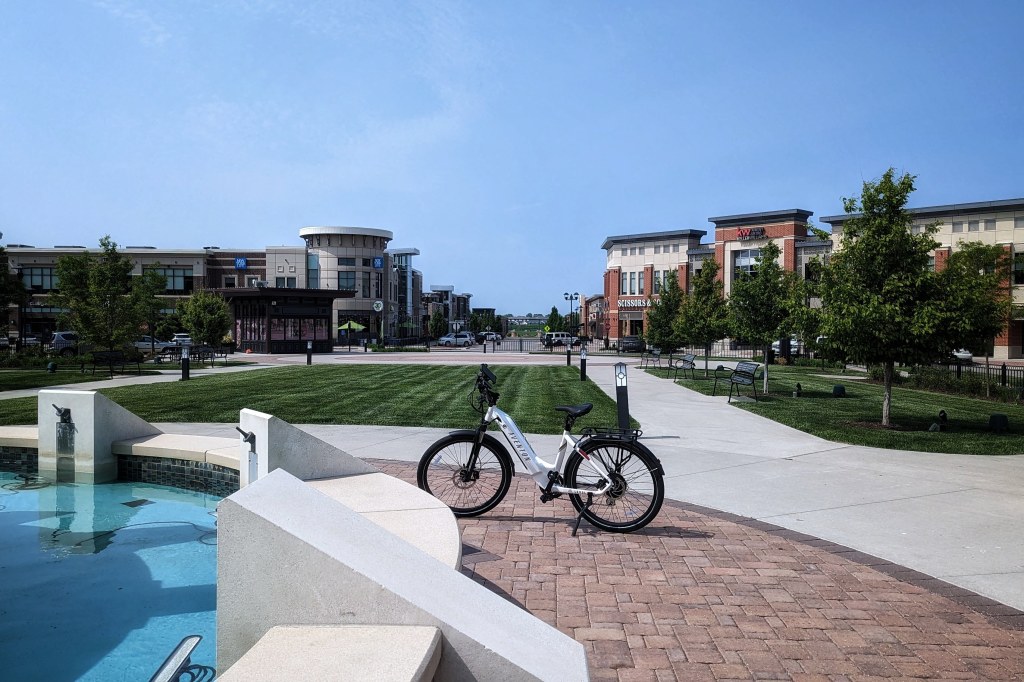
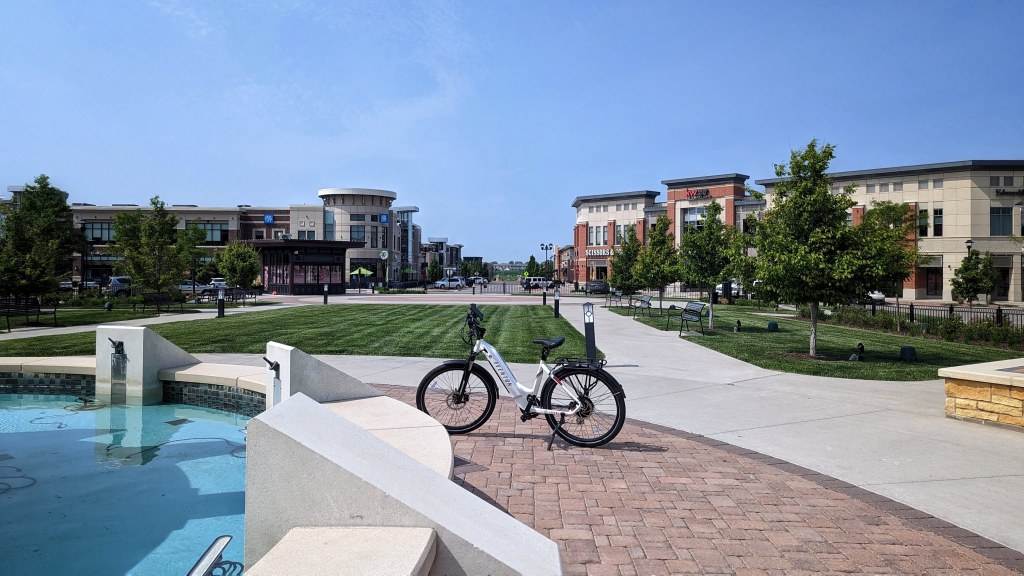
This greenspace is located between a commercial area and some townhomes.

It wasn’t until later, when I actually looked at the photo, that I tried to figure out what the smudged word was…and why it had been smudged out.

The [blank] never happened… but it should have!!!

Google Lens has an image-to-text application, so I tried that first. It suggested The halogen never happened, which didn’t make a lick of sense.

I tried to think of things that should have happened but didn’t. Because a lot of bike path graffiti deals with either matters of the heart (you know, stuff like Chad hearts Becky) or inspirational comments (like ‘Life is Good’), I initially focused on words that would make the phrase sweet or celebratory. The first smudged letter seems to be a ‘b’ or an ‘h’. Boyfriend…no. Backstory…no. Bahamas…maybe? The Bahamas never happened, but it should have. Possible.

Then I just tried to find words that would fit. Hangover…possibly, if the writer was into self-punishment. Harlequin…unlikely. Horseplay…don’t think so. Hologram…probably not. Holo…oh, fuck.
I’m hoping this isn’t as ugly and hateful as I think it might be.

Holocaust? The last smudged letters COULD be and ‘s’ and a ‘t’. And Iowa has increasingly become a Red-MAGA state. Our governor and legislature have been actively encouraging and passing more hateful, authoritarian policies. So this sort of irrational hate is very possible. It doesn’t matter that Jews make up less than 1% of Iowa’s population; antisemitism is never based on reality.

As much as I hate to say it…or even think it…holocaust seems to fit.

In the first photograph, you can see there’s another graffito just a few feet away. One word, maybe one short line. I didn’t even stop to look at it. Again, my mind was largely elsewhere when I stopped. But tomorrow, weather permitting, I’ll get back on the bike and ride this path again to see what it says. Maybe it’ll add some clarity.

I’m really hoping somebody can decipher that smudged word in a more positive way. But even if there IS a better interpretation, I’m disheartened by the fact that my worst-case rendering seems so very possible.

EDITORIAL NOTE: We must burn the patriarchy. Burn it to the ground, gather the ashes, piss on them, douse them in oil and set them on fire again. Burn the patriarchy, then drive a stake directly through the ashes where its heart used to be, and then set fire to the stake. Burn the fucker one more time. And keep burning it, over and over. Burn it for generations. Then nuke it from orbit. Then have tea.

Also? Include antisemitism.

ADDENDUM: I went back yesterday to look at the other graffito. It’s also been smudged, which leads me to assume it was equally ugly. I can’t make out the word, though it seems to start with ‘JE’. Here it is:

riding slowly on a bike, looking around me, enjoying myself

Half of the US on fire–unprecedented wildfires are destroying homes and businesses and live in the west. Half of the US is under water–unprecedented flooding is destroying homes and businesses and lives in the east and south. And half of the US is suffering from an unprecedented heat wave.

So I went for a bike ride.

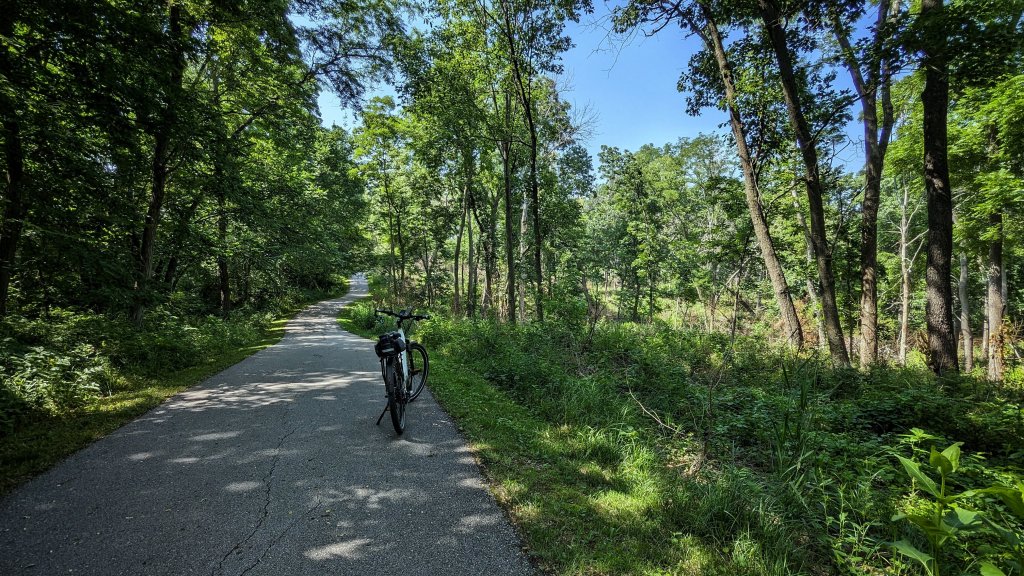
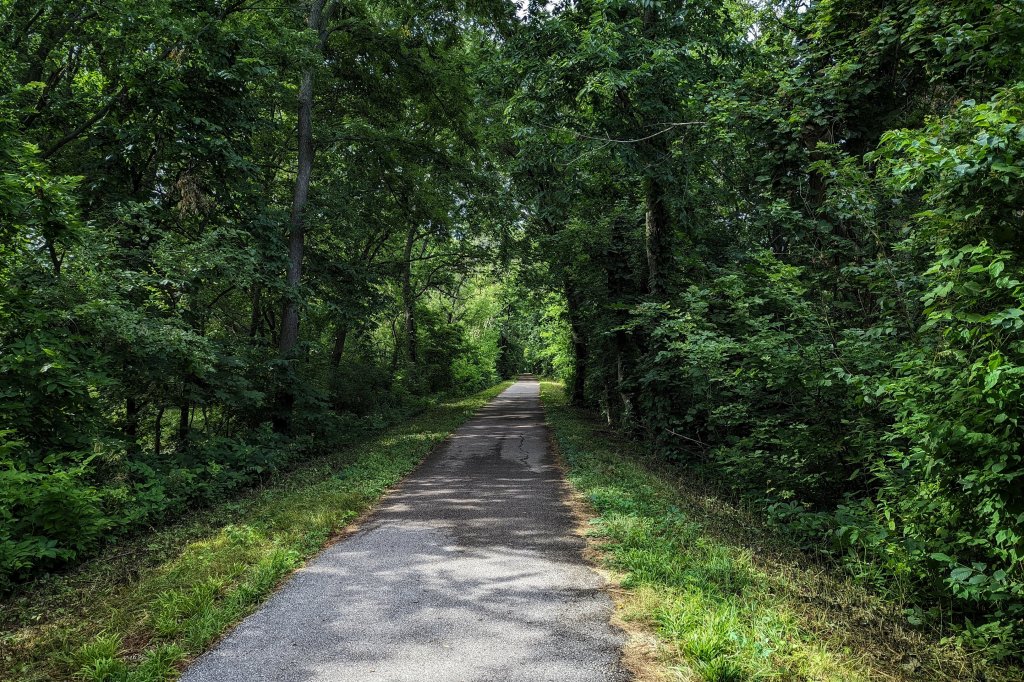
The early part of my ride was through the woods…

For some perverse climatic reason, the local weather has been absolutely gorgeous this week. Temps in the shallow end of the 80s, low humidity, light breeze. It’s like we’re in a pocket of beautiful weather surrounded by nightmare climate change. It’s temporary, of course. I know that. Assuming the weather forecasters are correct (hush, it could happen) next week promises to be miserable.

So yeah, on Thursday I went for bike ride. Didn’t feel at all guilty about the good weather. It wasn’t a long ride. Just under 20 miles. And I took my time, stopping periodically to shoot a photo or take a drink or indulge my curiosity. In other words, it was a nice, leisurely ride. I didn’t have any destination in mind; I just wanted to be on the bike.

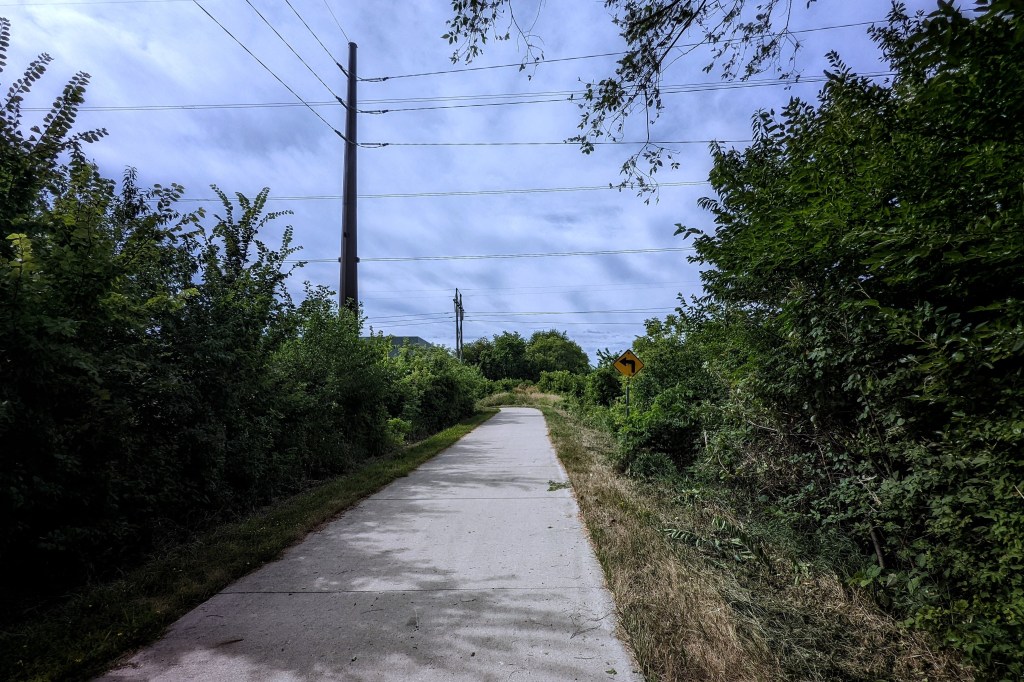
…and then through a semi-industrial area that was home to lots of groundhogs…

That’s my usual approach to cycling. I don’t ride for exercise or to keep fit; I don’t ride to save gas or limit my carbon footprint. I ride because it’s fun, because it makes me happy, because it makes me feel like I’m twelve years old and skipping school. That’s why I like to ride on weekdays, when all the decent, employed people are hard at work.

Riding on weekdays also means I often have the bike paths and trails all to myself. When I do encounter other cyclists, they’re usually folks like me. Relaxed, lackadaisical riders who are maybe retired, maybe unconventionally employed, maybe skipping work. Only occasionally do I encounter stern cyclists wearing spandex and riding serious road bikes, putting in the grim miles in the name of…I don’t know, physical fitness or time trials or something that is amenable to measurement. I’m confident they’re also riding for the pleasure of it, just like me–but it’s a radically different sort of pleasure. I slow down and let them zip by me.

…then into what I call the Valley of Enormous Warehouses, a favorite hunting ground for hawks…

It’s not that I believe my approach to cycling is better than the serious cyclists. Well, maybe I sorta kinda DO believe that, but only because I personally find more value in connecting with the world at large rather than focusing primarily on yourself. I’ve been a serious, spandexed cyclist; I like to think I’ve outgrown it (which I recognize is arrogant as fuck). I had a good road bike and I rode it seriously, as fast as I could, focused on the road ahead of me–sometimes just a few yards ahead of me, sometimes a more expansive view. But I gave little attention to what was on either side of me. Part of that was because of the way road bikes are designed–the rider leans forward in an aerodynamic pose, which limits your vision. It was also partly because road bikes are designed for speed, and the faster you go the more you have to pay attention to the road.

…and along a marsh, where I saw herons and red-winged blackbirds…

Then, many years ago, on a whim, I bought a mountain bike. The riding posture was more upright, which allowed me to…well, look around as I rode. And I had a moment of clarity. There was stuff happening around me as I rode. And that stuff was interesting. Birds and animals. Buildings and people. Scenery. Colors. The whole damned world, right there all around me all the time, and I’d given it no attention at all.

I started riding more slowly. I started looking around. I started smiling and laughing when I rode. Riding became more enjoyable, more fun, more pleasant.

…and I came across this abandoned building for sale; I rode around it a couple of times before stopping to peek in the windows, but some wasps encouraged me to get back on the bike…

I got rid of that road bike. Now I ride a massive fat tire electric bike. It’ll go fast if I want it to, but I’ve little interest in going fast. I generally just cruise casually along, probably around 10-12 miles per hour, looking at stuff. Sometimes I just enjoy the motion of the bike, and I’ll glide along as long as I can without stopping. Sometimes I stop fairly often. To look at something, or to sit on a bench and drink some water, or to feed peanuts to crows (yes, I have a bag of raw peanuts in a pannier for those times when I encounter crows–and yes, I also keep a crow caller in the same bag in case I don’t encounter crows but want to). Sometimes I stop to shoot a photo or buy a cupcake or pet a stranger’s dog.

…then I stopped by a pond and for a few minutes sat on a bench; I had a drink while watching an old guy fishing with (I presume) his grandson…

Frances Willard, the 19th century women’s suffragist, wrote that learning to ride a bicycle helped her find the courage and determination she needed to lead a movement. She said,

“I found high moral uses in the bicycle and can commend it as a teacher without pulpit or creed. She who succeeds in gaining the mastery of the bicycle will gain the mastery of life.”

I agree with her that cycling is a great teacher, though I think the notion of trying to gain mastery of life is a mug’s game. Cycling is fun, but it hasn’t given me mastery of anything. What it has given me is genuine pleasure and moments of joy. There’s a certain purity in the joy and pleasure that comes with cycling. It’s unalloyed pleasure, undiluted, uncontaminated and unblemished because it’s so simple.

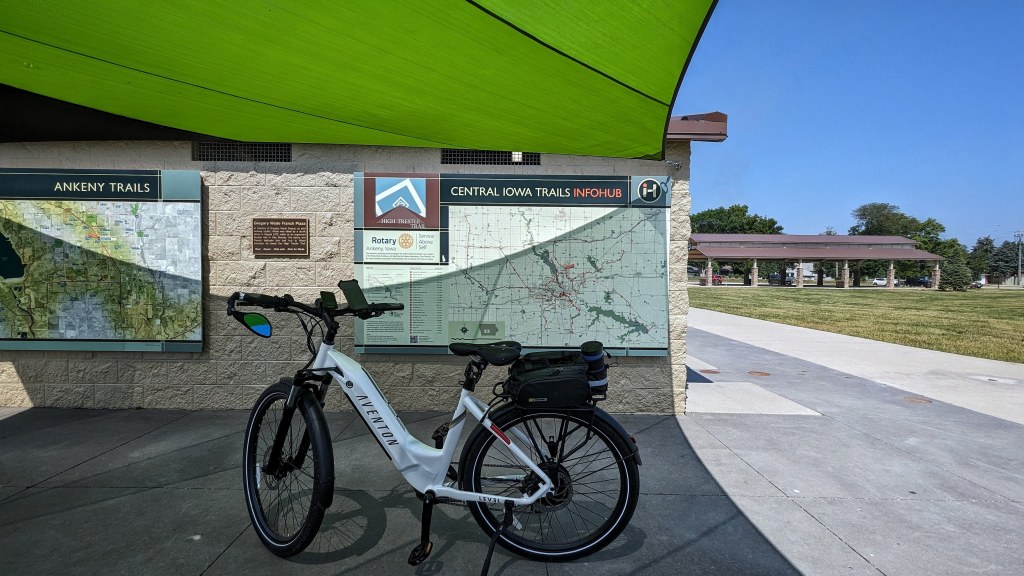
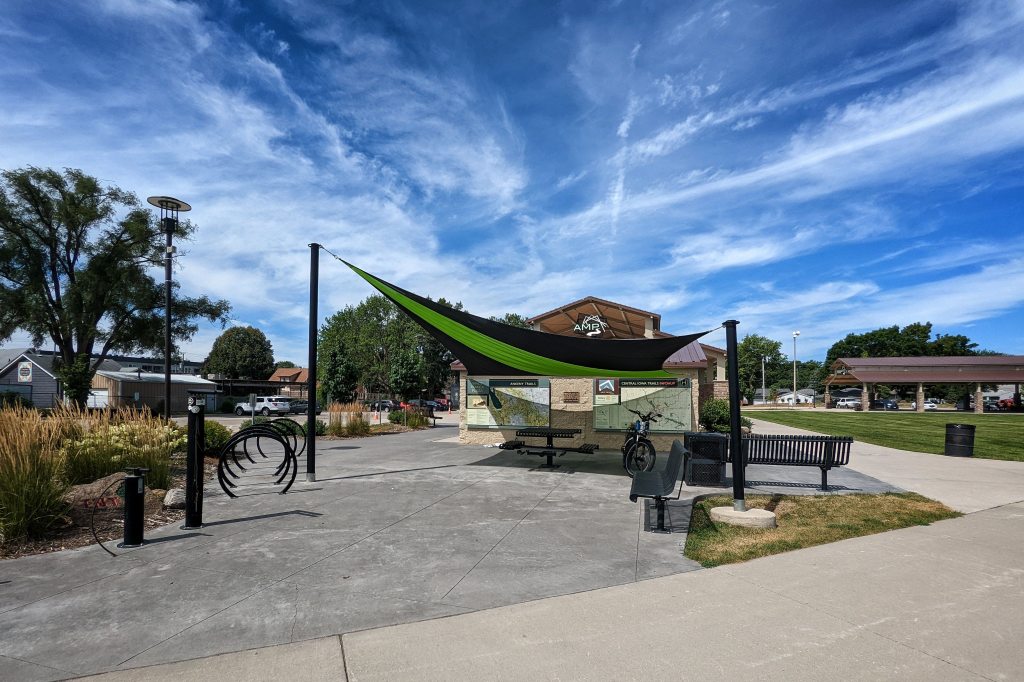
…and near the end of my ride, I stopped at the Wade Franck Plaza, named for a cyclist killed by a negligent driver. It has bathrooms, maps of local bike trails, a bike repair station, and fresh water.

A couple of weeks ago I rode my bike through a gaggle of Canada geese. These large birds gather around the many ponds here; they’ll casually step aside as you ride through them, but they are completely unimpressed by bikes (or cars and trucks, for that matter). As I was riding slowly through them, some of them took flight. For a moment–probably no more than six or seven seconds–the geese and I were moving at the same speed. I was surrounded by half a dozen flying Canada geese. It was glorious.

That will probably never happen again. It only happened because I was riding slowly on a bike, looking around me, enjoying myself.

sunday — this beautiful world

Sunday morning, early October, chilly but sunny, not a cloud in the sky, very little wind. Who wouldn’t want to go for a bike ride? Now, I know what you’re thinking; you’re thinking, “Greg, old sock, you always want to go for a bike ride.” First, stop calling me ‘old sock’. Second, well, yeah.

My brother-in-law, who’ll I’ll call “Jeff” (on account of that’s his name) and I started our ride in a little Iowa town called Mingo. I am NOT making that up. It’s an old coal-mining town, named after the Mingo tribe of the Iroquois nation. The Mingos, by the way, didn’t call themselves Mingos; that’s what the neighboring Algonquin tribes called them. It’s a corruption of the Algonquin term mingwe, which apparently means ‘sneaky’. But they weren’t sneaky enough to escape the notice of ‘progress’. As part of the Indian Removal Act of 1830, any remaining Mingos in Iowa were required to shift themselves to Kansas. Why? As President Andrew Jackson said at the time,

“What good man would prefer a country covered with forests and ranged by a few thousand savages to our extensive Republic, studded with cities, towns, and prosperous farms?”

Andrew Jackson was more fucking savage than the Mingos, and a LOT of us would prefer a country covered with forests. Anyway, Mingo now is a sneaky little town of about 300 white people and a small biker tavern (as opposed to a cyclist pub). We did NOT have a beer at the Greencastle Tavern because 10:30 in the morning is too early to drink. And besides, the tavern wasn’t open yet.

Just outside of Mingo.

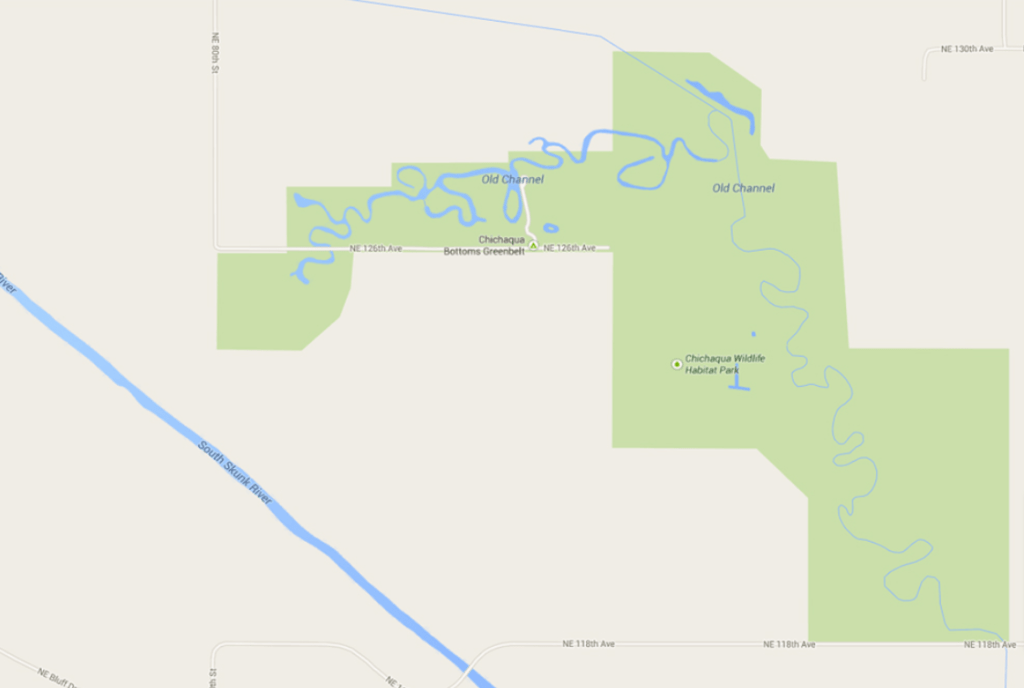
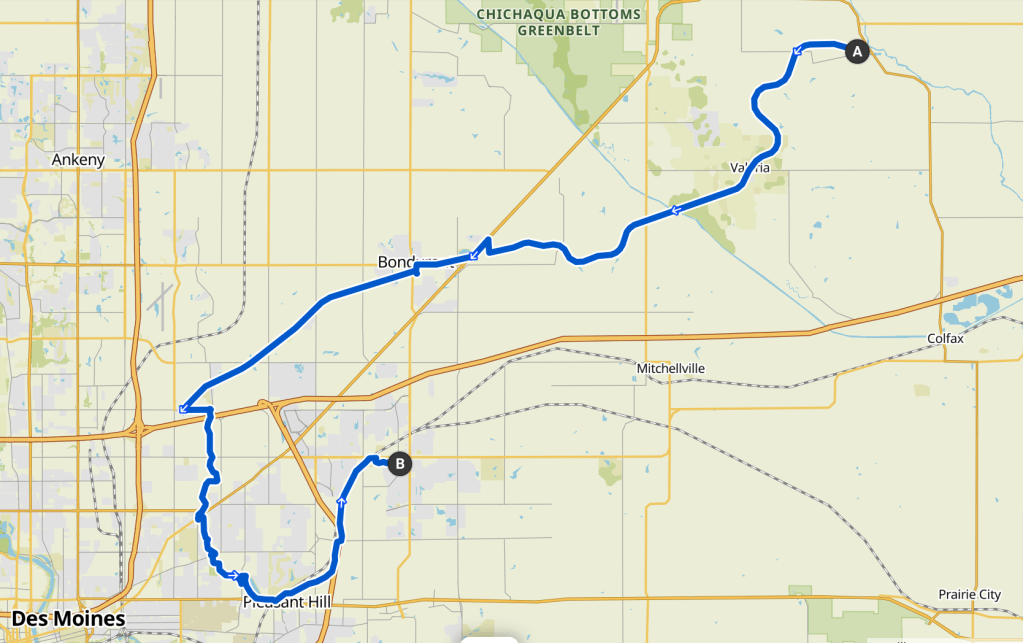
This bike trail is called the Chichaqua Valley Trail. You might assume that’s because it runs through the Chichaqua Valley. Silly rabbit. There is no Chichaqua Valley. There is, however, a 25-mile-long series of oxbows and bottomlands called the Chichaqua Bottoms Greenbelt. The oxbows are the isolated remains of the South Skunk River, which coal companies ‘straightened’ in order to facilitate barges transporting coal from mining towns like Mingo. More ‘progress’.

That straight line is the current channel of the South Skunk River

The Skunk River got its name a couple hundred years before the Mingo arrived in this part of the country. The French voyageurs, exploring and trapping beaver, asked the local Meskwaki tribe what the river was called. They were told the river was Chichaqua. The natives were referring the smell of the wild onions and cabbage that grew along the riverbanks. They’d also used that term to describe skunks. So we can thank the confused French for the Skunk River.

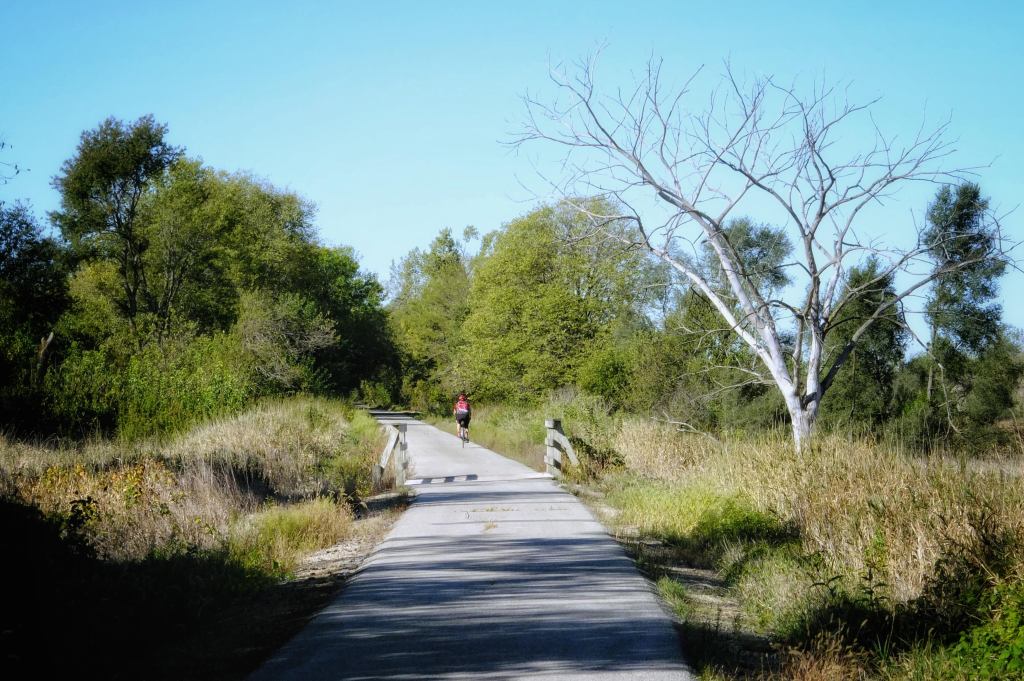
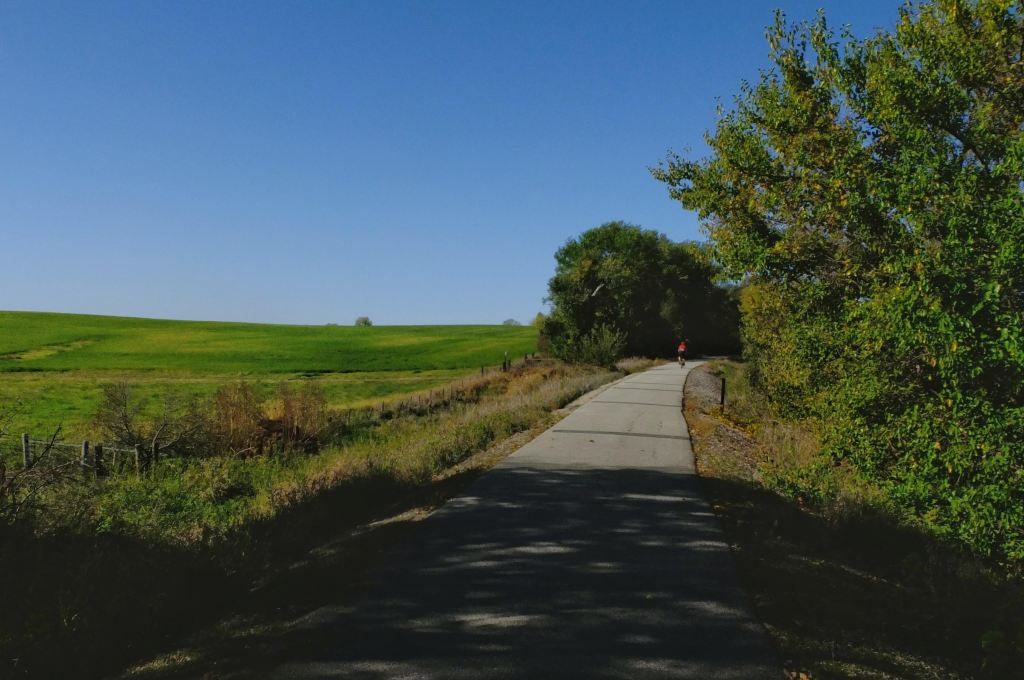
Like so many Iowa bicycle trails, the Chichaqua Trail follows an old railroad line. This was the Wisconsin, Iowa & Nebraska Railroad, originally built in 1885 to haul coal and livestock throughout the Midwest. You can actually gauge your progress along the trail by watching for old railroad mile markers that show the distance to Kansas City. Unlike most rails-to-trails bike paths, which tend to be incredibly straight and incredibly dull, this trail is full of curves and turns. One bicycle trail guide describes it as ‘serpentine,’ which may be a tad too elegant, but isn’t entirely wrong.

One of the many bridges.

It runs mostly through farmland and woods. It’s a quiet trail. Even on a perfect autumn Sunday afternoon, we saw very few other cyclists. For the most part, all you hear is the wind and the sound of your tires on pavement or rattling over the many wooden bridges. There are a LOT of bridges–some small, some extensive. The trail crosses over creeks, drainage ditches, oxbows, and the South Skunk River. I don’t know how many bridges there are; I forgot to keep count after the first nine.

Another bridge.

We tend to think of bike trails on old railroad lines as being flat–and they generally are. When there are hills, early railroad builders tended to rely on long slow inclines. Really long inclines. There’s a section of the trail that winds uphill for just about four miles. And I mean it winds. You can only see a few hundred feet in front of you, so you have no grasp of just how close–or how far away–you are from the top. It’s not steep, but it’s fucking endless. You start to believe…to hope…that you’ll be able to see the top around the next bend in the trail, And each bend in the trail crushes that hope. You won’t see any photos of that hill, because there was no way I was going to stop.

Bridge over the South Skunk River

After about 15 miles, we reached the town of Bondurant, named for the first white person who settled there (Alexander C. Bondurant–I don’t know if he did anything worthy or important other than being white and deciding he’d gone far enough west and decided to just stop traveling). Eventually the Chicago Great Western Railway Company built a depot there–which has been reproduced as a rest area for cyclists. It’s very nice. Bathrooms, picnic tables, repair station, drinking water. All very pleasant, but Jeff and I made straight for Reclaimed Rails–a bike brew pub just off the trail.

One of the best things about cycling in Iowa is the advent of the bike brew pub. Beer and bikes are a natural pairing. The sugars and salts in beer help you absorb fluids more efficiently than water alone; you’d have to drink a lot more water to get the same hydration effects of beer. No, I’m serious. THIS IS SCIENCE, people. Beer also has almost as many antioxidants as red wine, and that helps your leg muscles recover. And hey, it’s cold and it tastes good.

Along the Gay Lea Wilson Trail, a man fishing.

After hydrating and dosing ourselves with antioxidants (mine was a nice malty Märzen), we set off again. After a few miles, we turned off onto the Gay Lea Wilson Trail, named for the advocate who came up with the idea of a series of bike paths and trails through central Iowa. Unlike the rails-to-trails bike paths, which were based on direct routes for transporting goods, the Gay Lea Wilson trail weaves in and out of semi-rural areas and suburbs. It’s designed to transport people, making it easy for folks (and families) to access the trail and travel by bike to places they want to visit. Places like libraries and parks and picnic areas and playgrounds and…well, brew pubs.

Another 15 miles or so took us to our final stop: Brightside Aleworks, a fairly new craft brew pub that has a relaxed vibe closer to a coffee shop than a beer joint. We’d ridden about 33 miles altogether. Aside from the brutal four mile uphill stretch, it was a nice way to spend a day. It was fun. And the beer was cold and welcome (I had a biscuity, slightly sweet Irish red).

That’s the thing about cycling. It’s fun. Sure, it’s good for you. Fresh air, healthy exercise, all that. But mostly it’s fun. That’s why I ride. Bugger exercise; I ride because it makes me happy. Because it’s one of the best ways to see the world you live in. You get to meander along at whatever pace you want (well, fucking hills excepted) and be a part of the landscape, rather than just passing through it in a car.

Dr. K.K. Doty (who doesn’t seem to exist on the internet other than as the author of this quote) wrote: Cyclists see considerably more of this beautiful world than any other class of citizens. A good bicycle, well applied, will cure most ills this flesh is heir to. Most ills. Not all ills. But most. It’s a bicycle, not a miracle machine.

Well, maybe a miracle machine. Small miracles in a big world. It’s enough.

a slightly faster way of walking

I swear, every couple of weeks I come across another article about electric bikes and ‘cheating’. This one was on the Electrek website. Are electric bikes cheating? If you google ‘ebike cheating‘ you’ll get a cascade of results, and every single one debunks the idea that riding an ebike is cheating.

I’ve never quite understood the question. How can riding a bike–any sort of bike–be considered cheating? Cheating at what? Cheating against whom? That question led me to understand my personal approach to cycling is something of an aberration. The fact that the question persists–the fact that the question even exists and that it gets asked so often–is, in my opinion, evidence of a deep problem in the cycling culture of the United States.

I believe the problem evolved from the way cycling has been marketed. In the US, it’s almost always promoted as a ‘fun’ form of exercise. Exercise is basically a form of self-competition. Exercise isn’t supposed to be easy. Push yourself, work hard, work a little harder, sweat a bit more, feel the burn, ignore the pain, keep going, do better than you did the last time, meet or exceed your personal best. Exercise is a constant measuring of yourself now against yourself before. Are you getting better? Are you maintaining? Are you fading?

Row upon row of road bikes.

There’s nothing wrong with exercise, of course. It IS actually good for you. But there’s a lot more to cycling than a good workout, and that’s generally ignored when cycling is being marketed or advertised. In the US cycling is occasionally presented as an alternate form of transportation–as a way to commute to work or a way to run short errands. But it’s never marketed as a source of joy or delight or pleasure.

I’ve been cycling most of my life–never for physical fitness, sometimes as a mode of transportation, but always because it makes me happy, because it brings me joy and delight. I didn’t realize that approach to cycling was an aberration until recently. Part of that realization came about because of the ebike-cheating question. But it was driven home this year after joining a few organized bike rides.

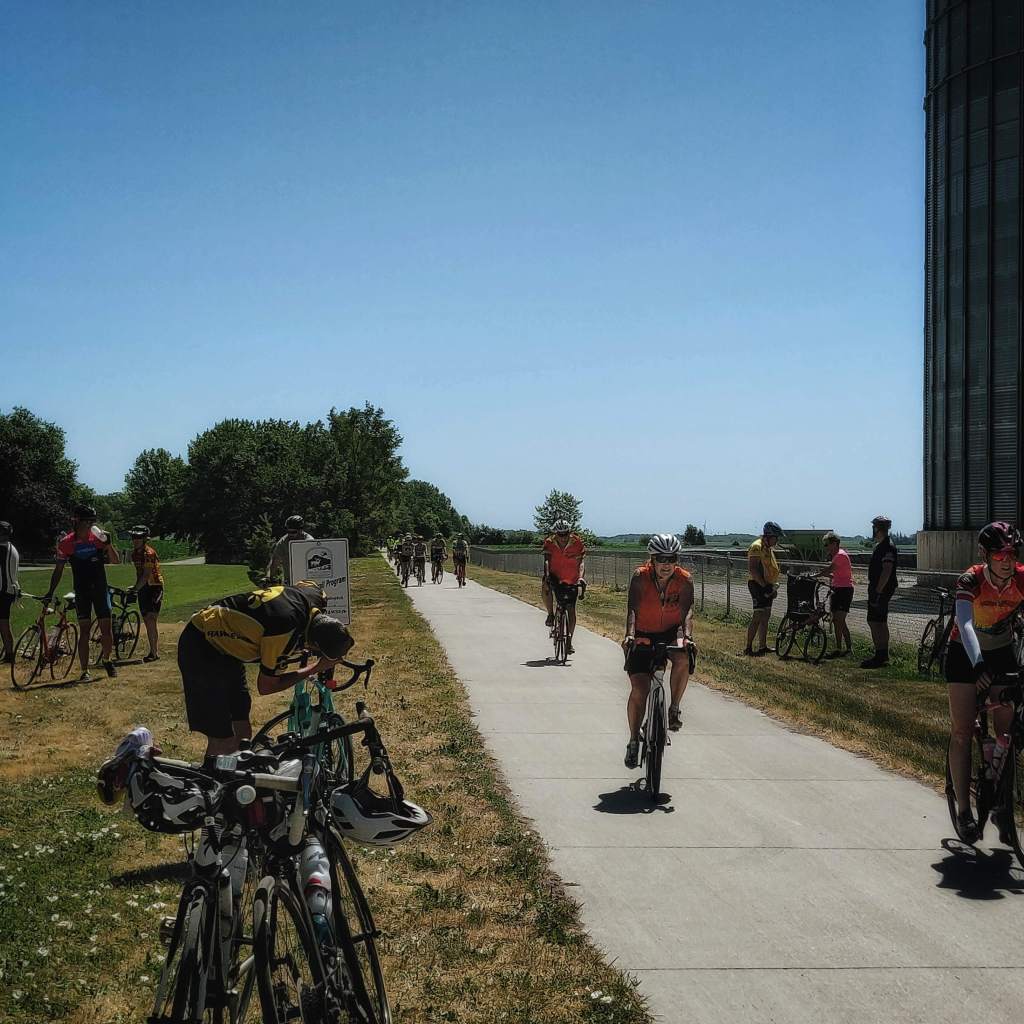
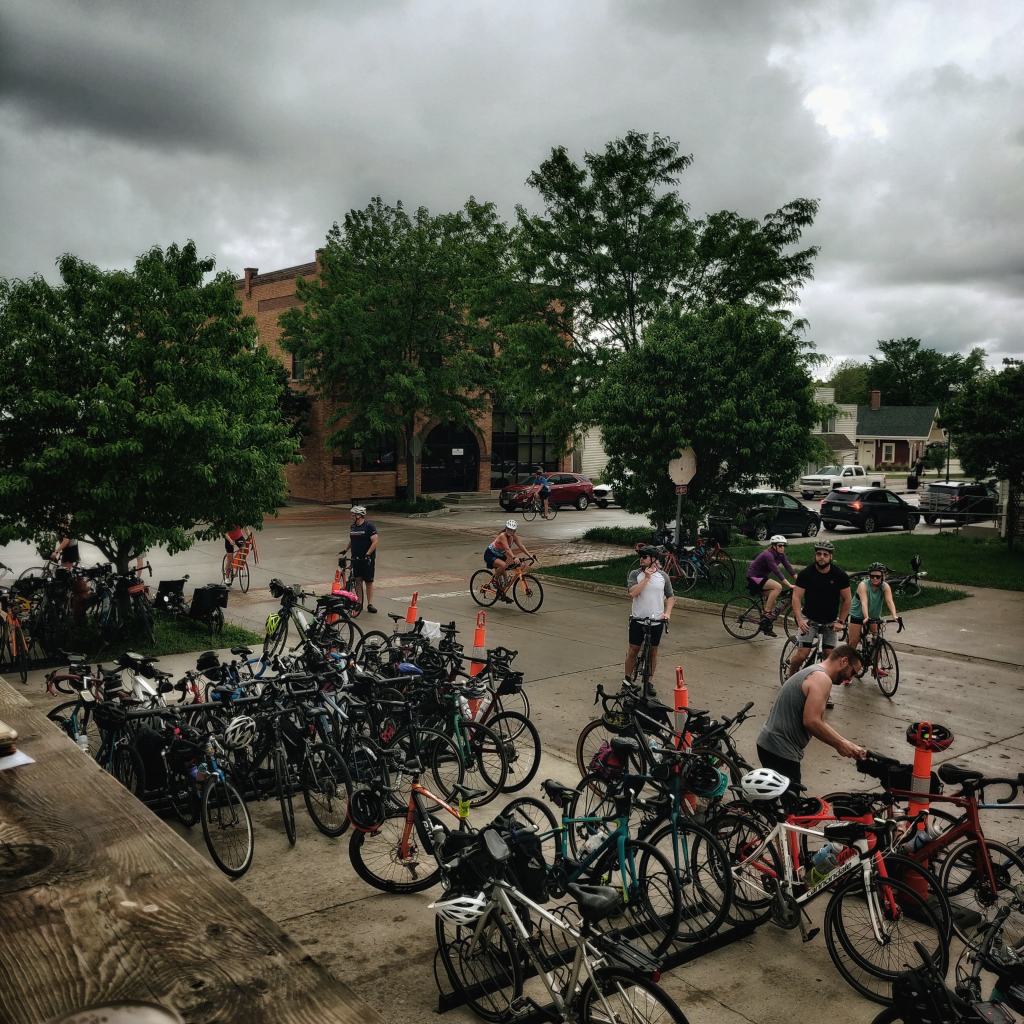
Rows of road bikes outside a pub.

I’m basically a solitary cyclist. I like to ride at my own pace, take my own path, stop when I want, go faster or slower as my mood takes me. There’s just SO MUCH to see when you’re on a bike. You lose that independence when you ride in a group. But this year my charming sister (and her equally charming husband) have invited me along on a few organized bike rides–and because she’s my sister and because she’s charming, I’ve gone along.

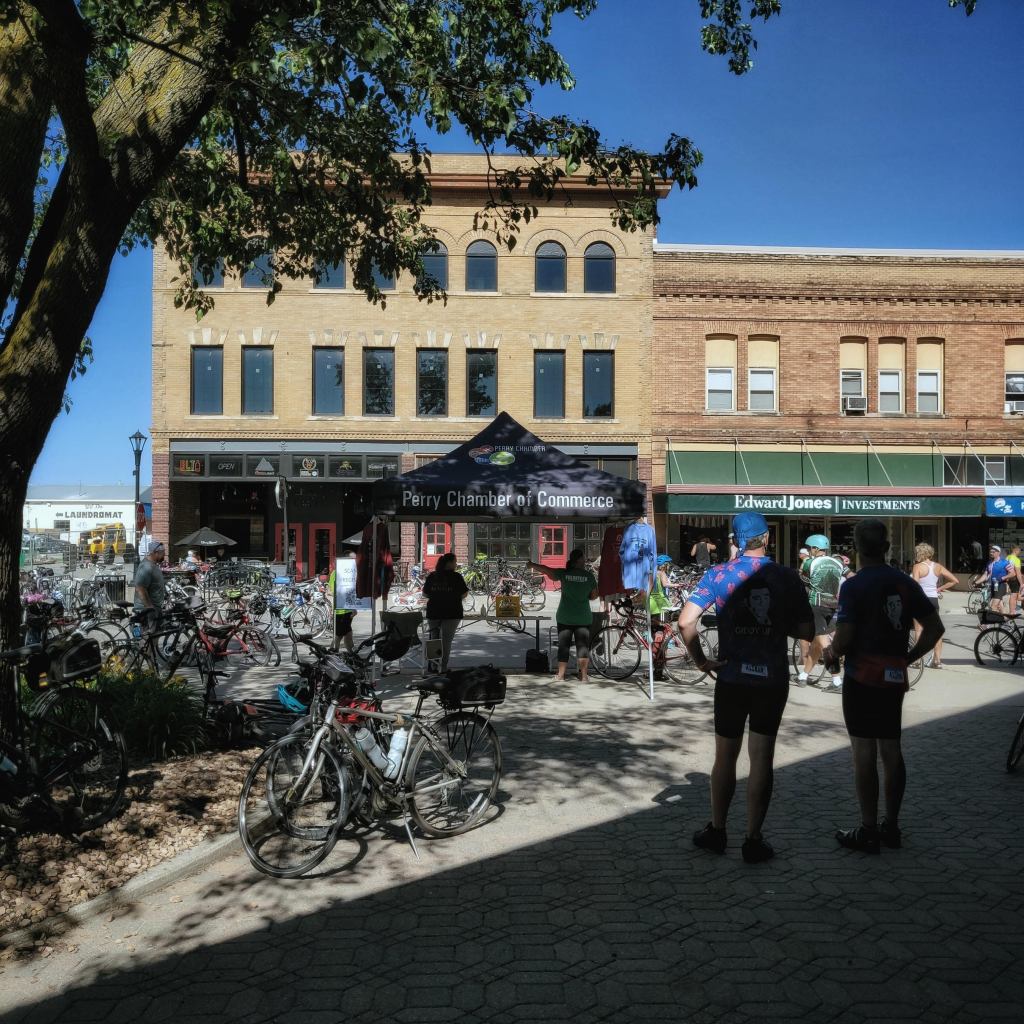
I’ve thoroughly enjoyed the rides, in part because they always start at some bike pub and end at some bike pub, often with a couple of stops at bike pubs along the way. Bikes and beer have a long, happy history together. But because almost all of my professional training has taught me to pay attention to social behavior, I noticed this very obvious fact: aside from me on my ebike, almost everybody rode a road bike. There’d be an occasional mountain bike, a couple of fat tire bikes, maybe a recumbent bike, and one or two other ebikes–but the the vast majority of cyclists were on road bikes.

Why?

Dozens of road bikes.

A road bike is designed to be fast. Essentially, they’re designed for racing, even if racing isn’t the cyclist’s intent. Because of that, road bikes are the least versatile type of bike, the most finicky, the least forgiving, the most expensive, the least comfortable. But they’re fast. They’re built to be ridden almost exclusively on hard surfaces. They have thin, high pressure tires to minimize surface friction on the road, and that makes them faster. They lack any sort of suspension because the flex of suspension reduces the efficiency of the pedaling, and that makes them faster. The riding position is aerodynamic (which makes them faster), but it’s also unnatural and puts a lot of stress on joints and nerves.

Because road bikes are fast, and because their design makes them more vulnerable to road conditions, and because of the unnatural riding position, cyclists on road bikes need to focus their attention on the road in front of them. A lapse in attention can result in a crash. The result is folks on road bikes aren’t devoting much attention to the general environment they’re riding through. These cyclists are mostly focused on the road just a few yards in front of them.

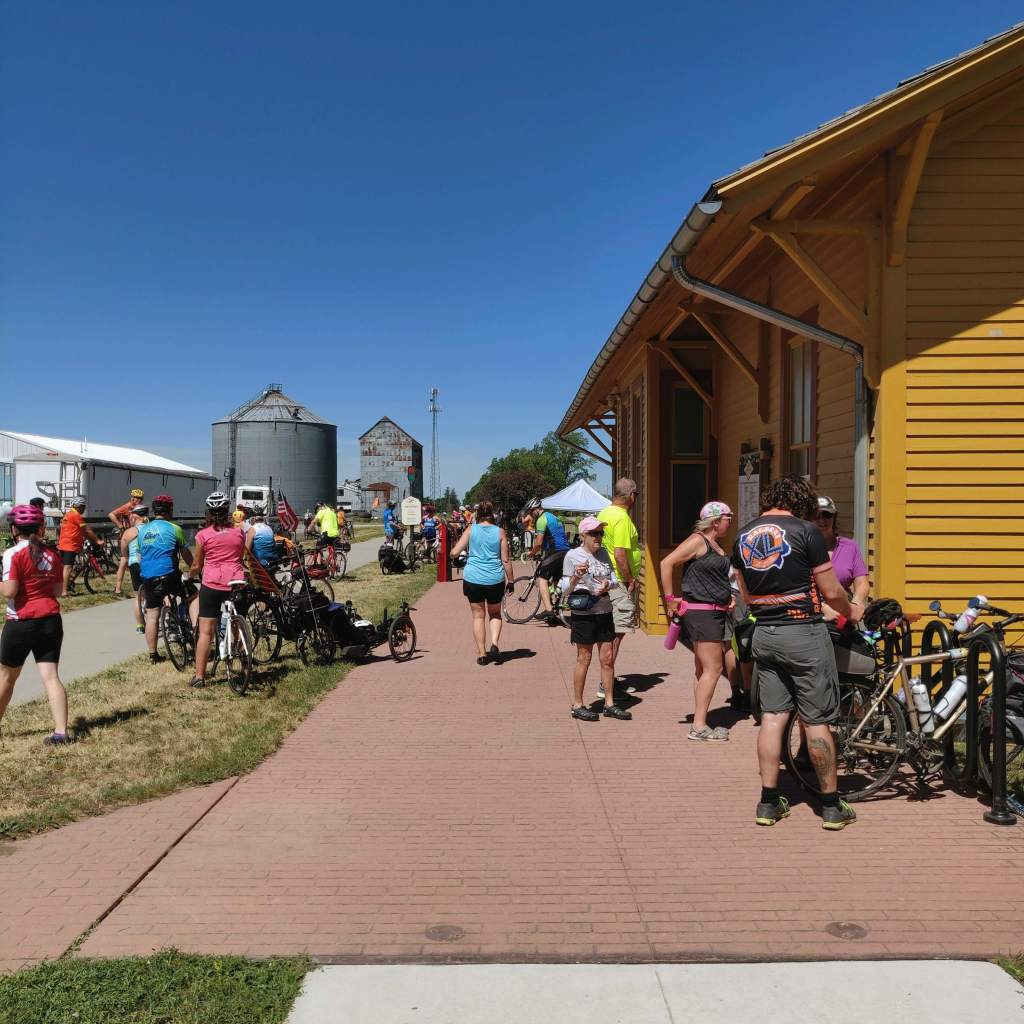
Road bikes outside a former train depot.
Why, I asked myself, were all these people riding road bikes? Because in the US, a road bike is the mark of a ‘serious’ cyclist. Because if you want a good workout–if your primary goal for cycling is exercise–you want a machine designed for competition, even if you’re only competing with yourself.
An electric bike can make cycling easier. This is where the ‘cheating’ notion comes in. Electric bikes can be fast–but with less physical effort. They can be fast with seatpost and tire suspension, which makes them more comfortable to ride. They can be fast with the rider in a more natural and comfortable riding position, with less neck and joint strain. They can be fast while allowing the rider to look around and enjoy the scenery.

And that’s ‘cheating’. Cyclists on electric bikes are cheating because they can go fast without having to suffer as much as regular bike riders. They’re cheating because they haven’t ‘earned’ the speed. They’re cheating ONLY IF you accept the notion that the primary purpose of a bike is sport or exercise or physical fitness. They’re cheating ONLY IF you buy into the way cycling is marketed.

Road bikes.

At the halfway point of a recent organized ride, while having a beer, I discovered that my sister and her husband simply didn’t see most of the cool stuff we rode by. A group of turkeys along the bike path, the dappled horses watching us ride by, a ring-necked pheasant that flew across the bike path about ten feet high directly in front of them, the turtle on a log in a pond, the fat groundhog. They didn’t see any of that, and it made me sort of sad.

Earlier I mentioned googling ‘ebike cheating’ and getting a flood of articles debunking the notion of cheating. Each of those articles base their ‘not cheating’ conclusion on the fact that ebike riders are still getting a good workout. They’ll tell you how ebikes still require physical effort–though the rider has more control over how much effort is expended. They’ll tell you ebike riders tend to ride more often than riders on regular bikes, and they tend to ride further–all of which increases the ebike rider’s fitness.

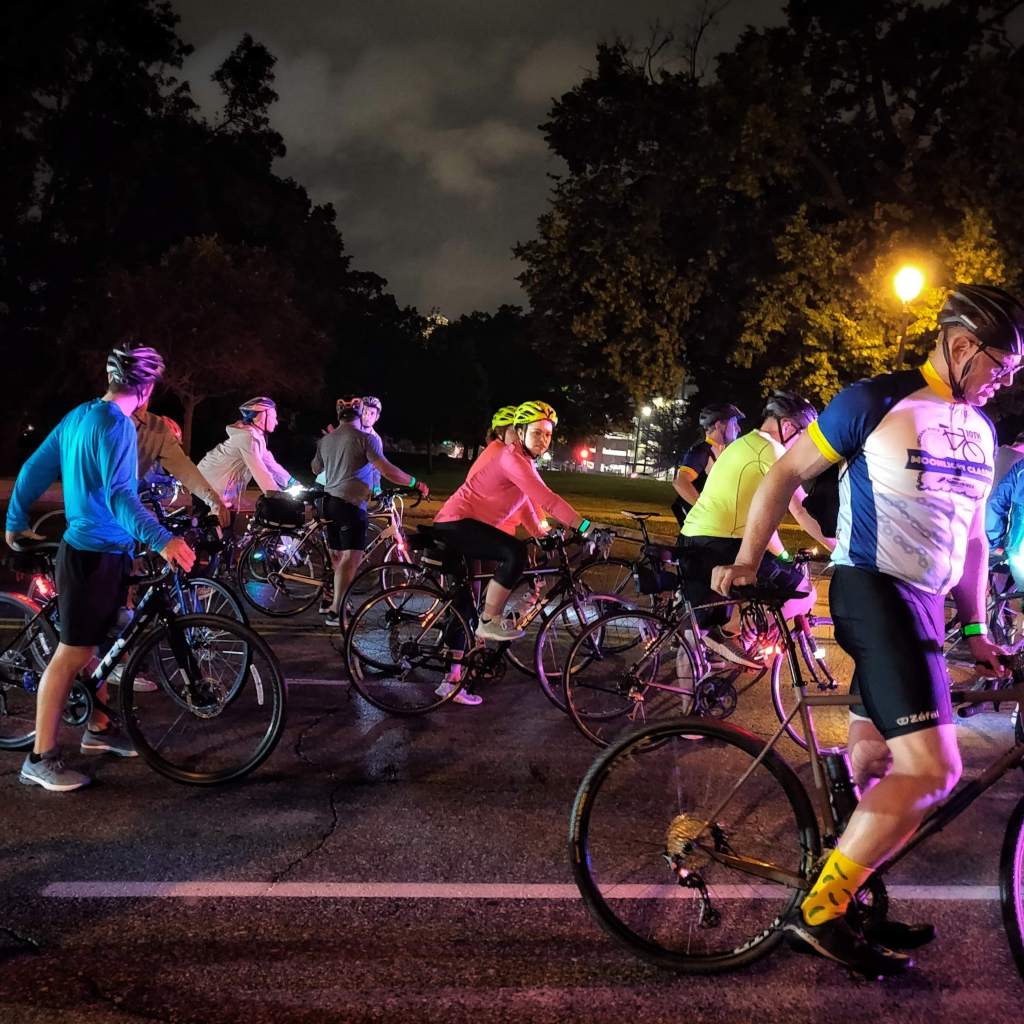
Road bikes on the Moonlight Classic.

Do you see the problem there? All of those articles accept the marketing premise–that the primary reason for cycling is fitness and exercise–as a given. None of them consider that there are other reasons for cycling. None of them consider that riding an ebike makes cycling more pleasurable, more joyous.

The problem is NOT road bikes. Road bikes are incredibly efficient machines. I’ve owned road bikes (though mine were all geared for touring rather than racing) and I’ve ridden them hundreds of miles. The problem (and I admit, this may only be a problem from my personal perspective) is that the marketing emphasis on physical fitness in cycling has turned it into a narrow form of self-competition that detaches riders from a richer experience. There’s nothing wrong with riding for exercise, but neither is there anything wrong with riding because it’s just fucking fun. I have never had as much simple joy and delight in riding a bike as I have this past year. Never.

For a lot of the riders in these organized cycling events, a beer at the end (or the halfway point) is seen as a reward–a sort of liquid recompense for the labor of cycling. I’m of the opinion that a beer is–or should be–just another pleasant facet of an already pleasant experience. It’s as integral to the experience as seeing a turtle on a log. You don’t have to have a beer or see a turtle on a log to enjoy a bike ride, but both enhance the ride in the same way.

I once read an article about the Dutch approach to cycling. It described cycling as a slightly faster way of walking. That fits perfectly with the way I ride. It’s just a pleasant way of getting around, quickly and easily, arriving at your destination (if you have one) without too much fuss, without being weary or sweaty (unless you want to be), and allowing you to enjoy and appreciate the world around you as you go.