molon labe, bitches

Okay, I intended to write something semi-intelligent and mildly educational about an aspect of the gun rights movement that outsiders are mostly unaware of — the incorporation of the Greek phrase Molon labe into the rhetoric of Second Amendment absolutists. There’s really some interesting stuff there, and you’d really have liked it (I’m pretty sure you would)…but then something happened.

I first came across the phrase Molon labe on Gun Appreciation Day back in January. It was a weird day in a lot of respects, and seeing some guy put up a sign with a Greek phrase didn’t seem any weirder than the other things that happened that day. Another guy standing near me in the crowd of gun enthusiasts asked “What the hell does ‘melon labe’ mean?”
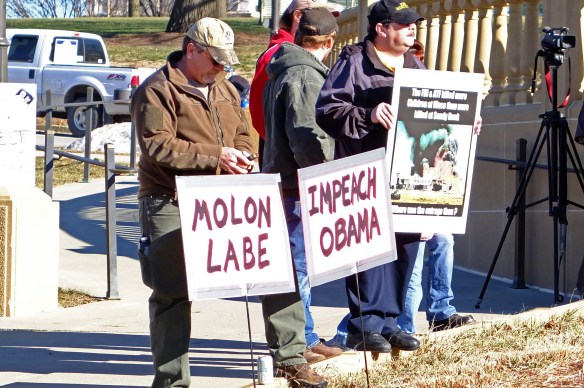
molon labe

It’s a laconic phrase. I don’t mean molon labe is terse or pithy, though it’s both of those things. I mean it’s really and seriously, no-shit laconic. The term laconic comes from the Spartan city of Laconia. You’ve seen the movies; you know the Spartans were extremely militaristic (and totally buff in a…you know…non-gay way). They were militaristic culturally, they were militaristic spiritually, and they were militaristic philosophically. So it shouldn’t be any surprise that they were also militaristic linguistically.

It’s important in military situations to be concise; to speak quickly and precisely, so that orders are clearly and immediately understood. When you’re under attack you don’t want to waste time saying “Okay, listen up…I want you to affix bayonets to your rifles and form a hollow square, two ranks deep, facing outward toward the enemy, with the unit’s colors and officers inside the square.” You just want to shout “Form square!” and be done with it.

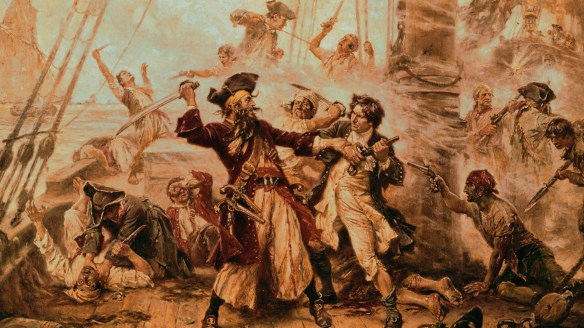
Anyway, that crisp quality of military speech was prized by Spartans. They were literally (and by ‘literally’ I mean literally, not figuratively, so fuck you Merriam-Webster) men of few words. That was apparent at the battle of Thermopylae in 480 BC. The Persian King Xerxes sent an emissary to the Spartan King Leonidas, offering to allow the Spartans to live and be resettled on better land (dramatic pause) IF they would lay down their weapons. Leonidas reportedly replied “Molon Labe,” which basically means “Come and take them.” It’s a great line.

molon labe spartans

That Spartan phrase has now been adopted by Second Amendment absolutists. These folks believe (or claim to believe) President Obama has an ultra top super secret plan to seize everybody’s firearms. They fancy themselves to be modern-day Spartans (only fully dressed — except in rare circumstances, which you’ll see in a bit), courageously standing up to the tyrant Obama and daring him to come and try to take their guns. It’s ridiculous, of course, but in order to pretend to be Spartans, you need to invent a tyrant and defy him.

See, I was going to get all intellectual on you guys. But then I stumbled across this:

Watching this is a lot like being repeatedly struck in the head with a ball peen hammer. It leaves you confused and unsure what the hell just happened. Was that really a fat white guy wearing a cape and a Spartan helmet claiming to be King Leonidas returned to save America, riding down the street between mobile homes because that’s what the Revolutionary War was fought for?

Yes. Yes, it was. And my attempt to write an intelligent, semi-educational post just collapsed — like that guy’s horse is about to do. So in the words of the resurrected Leonidas, let’s put my stifling helmet back on and ride some more. God bless the truckers. Impeach Obama. Molon labe, bitches.
walking like a camel

No, I don’t do it for the exercise. Yes, I understand that both walking and cycling are terrific forms of exercise, but no, that’s not why I do it. Yes, I’m usually going somewhere when I go for a walk or a ride, but no, that ‘somewhere’ isn’t a destination. I’m not actually going to that place. That place is just a prompt, a nudge, a reminder that it’s time to turn around and go back. Yes, the walk or ride serves a purpose; the walk or the ride is the purpose.

the cyclistI do this almost every day, regardless of weather. Sometimes I’ll walk or ride for hours, sometimes just for ten or fifteen minutes. I might stroll for a couple of hours along the river; I might ride five minutes to the nearby Stop & Rob and buy a Coke Zero. The purpose isn’t to see the river or fetch a Coke, though those are both fine things. The purpose is movement, the purpose is to move the body and disengage the mind from whatever I was doing and allow it to re-engage in…well, something else.

jaywalkHere’s a true thing: I don’t really walk or ride. I saunter. I even saunter when I’m on a bicycle. This is how Chambers defines saunter:

to walk, often aimlessly, at a leisurely pace; to wander or stroll idly

That’s me, wandering idly on foot or bicycle, somewhat aimlessly, at a leisurely pace.

promenadeThere’s some uncertainty about the etymology of saunter. It’s been suggested the term derives from sans terre, ‘being without land or a home,’ which would be a good reason for walking aimlessly. Others believe it comes from s’aventurer, ‘to take risks or leave to chance.’ My favorite explanation of the term, though, comes from the Middle Ages, during the period of the Crusades.

When we think of the Crusades, we generally think of armored knights on destriers, traveling to Jerusalem to ‘rescue’ Christendom. But it wasn’t just knights and noblemen who made their way halfway around the world; poor folks were also seized with the irrational desire to travel to the Holy Land. But they had to walk and beg for food as they made their way à la sainte terre. While of lot of those folks were sincere, the willingness of people to help a common sainte-terrer (it was a sacrifice that would gain them favor with God) created a population of poor folks who wandered through much of Europe claiming to be journeying to the Holy Land, but actually were just medieval hobos.

humming to himselfObviously, I’m not that sort of saunterer. I’m more in the Ludwig Von School of walking. Beethoven took a long stroll almost every afternoon, with a pencil and some paper stuffed in a pocket so he could write down any musical thoughts he might have. I keep myself open to ideas when I walk or ride, but I don’t take any writing paraphernalia with me. I tell myself that if an idea is good enough, I’ll remember it. If I don’t remember it when I get home, I tell myself the idea couldn’t have been that good.

That’s probably nonsense, but it gives me some comfort when I get home and can’t recall the ‘great’ idea I had when out sauntering.

a wee bit tipsyOr maybe I’m more in the Thoreau School of walking. Thoreau said this:

[T]he walking of which I speak has nothing in it akin to taking exercise, as it is called…but is itself the enterprise and adventure of the day.
Moreover, you must walk like a camel which is said to be the only beast which ruminates when walking.

I’m very much taken with the notion of riding a bicycle like a camel.

hard day at the officeI think I could argue that the real reason I take walks or go on rides is to get outside of my mind. Things happen when you’re out and about. Real things, and they happen to real people. The things that happen when you’re at your desk only happen in your mind.

Here’s an example of the way things happen. This thing happened to the composer Benjamin Britten, who was a great walker. It’s my favorite Benjamin Britten story (okay, my only Benjamin Britten story, because c’mon, does anybody have more than one Benjamin Britten story?). He was walking along a railroad track one day and came across a couple of young boys standing by the track, waiting. They had a newt in a jam jar. Britten asked the kids what they were doing. They said, “We’re waiting for the two o’clock train to come out of Aldeburgh, so we can show this newt what a steam train looks like.”

I’m willing to bet you five dollars this will become your favorite Benjamin Britten story too.

freebooters in the senate

I keep seeing some version of this headline: Senate Fails to Pass Popular Gun Control Legislation. I keep hearing radio and television news reporters repeating some version of this: “The Senate failed to obtain the sixty votes needed to pass the legislation.”

Those are lies. No, the Senate didn’t fail to pass legislation extending background checks to guns sold at guns shows and over the Internet — they were prevented from voting on the legislation. No, it doesn’t require sixty votes to pass legislation — it only takes fifty-one.

Here’s another lie: the Senate Republicans filibustered the legislation. They didn’t. They only threatened to filibuster it. Under current Senate rules, the mere threat of a filibuster is treated as an actual filibuster.

How the hell did we end up with a Senate in which the minority party has all the power? And just what the hell is a filibuster anyway? The term comes from the Spanish filibustero, which is derived from the Dutch vrijbuiter, which is translated as ‘freebooter.’ A freebooter is a sort of pirate — a mercenary who wages ad-hoc war primarily for the money in it, a seafaring hijacker. Like Edward Teach, better known as Blackbeard.

The original approach to the filibuster

The original approach to the filibuster

In legislative terms, a filibuster is a tactic by which one or more members can hijack the debate over pending legislation, delaying it from reaching a vote. The intent was to give minority members a platform for voicing opposition to the proposed legislation, or to stall the vote while attempts were made to gather support from other legislators. This required the legislator(s) to take the floor of the Senate and hold it by continuously speaking.

Initially it was a rarely used tactic, partly because it required a great deal of effort and organization, and partly because it stopped ALL legislative activity. Nothing else could happen in the Senate so long as the filibuster continued. The filibuster is famously employed in the movie Mr. Smith Goes to Washington.

A more refined form of filibuster

A more refined form of filibuster

In the mid-1970s, the rules were changed to allow other legislative business to take place during a filibuster. The new rules created the ‘virtual’ filibuster we have now. Even so, the tactic was rarely employed. In fact, the filibuster had only been used 413 times before 1990.

In 2005, Democrats (who were the minority party in the Senate) began to use the virtual filibuster more frequently, mainly to block some of President George W. Bush’s more controversial judicial nominees. When President Obama took office in 2009, the practice skyrocketed. Now almost every nomination for every judicial position is subject to the virtual filibuster, as is almost every piece of legislation offered by Democrats. The virtual filibuster has become the norm.

Let me just repeat that. The virtual filibuster has become the norm. Republicans have normalized the practice. That’s why lazy journalists continue to claim the legislation requiring background checks to be extended to gun shows and internet sales was defeated, even though the Senate was blocked from voting on it. That’s why lazy journalists continue to claim sixty votes are required to pass legislation.

It doesn’t have to be this way. The Senate Majority Leader has the power to change that. Harry Reid can modify the rules of the Senate. He can restore the talking filibuster. He can do away with the filibuster altogether (though that would be a bad idea). And Reid keeps threatening to reform the filibuster rules. Ten days ago he said this::

“All within the sound of my voice — including my Democratic senators and the Republican senators who I serve with — should understand that we as a body have the power on any given day to change the rules with a simple majority. And I will do that if necessary.”

The problem with a threat is that it only has meaning if the person making the threat is taken seriously. Nobody takes Senator Reid’s threats seriously.

Majority Leader Harry Reid

Majority Leader Harry Reid

In fact, Republicans openly mock him. After the shameful virtual filibuster on the recent gun control legislation (which was supported by nearly 90% of Americans and more than half of NRA members, and which was approved by a majority of the Senate), Minority Leader Mitch McConnell posted this on his Facebook page:

harry reid punked

So long as Democrats have ineffective leaders like Harry Reid, and so long as filibuster rules remain as they are now, and so long as Republicans in the hire of the National Rifle Association continue to thwart the will of the public, nothing is going to change.

A handful of freebooters have been allowed to rule the legislative high seas. That needs to stop.

louche

Louche. I can’t recall the first time I encountered this word, but I immediately fell in love with it. I’d no idea what the definition of louche was, but I knew exactly what it meant.

Checking a dictionary simply confirmed it.

Louche, adjective:
1) of questionable taste or morality; decadent
2) not reputable or decent; shady, dubious, seedy

What else could it possibly mean? I was attracted to the word partly by the way it comes out of your mouth. Loosh. You have to make a sort of kissy-face to say it.

It’s French, of course. How could it not be? From the Old French term lousche or lois, which apparently meant ‘cross-eyed’ or ‘squint-eyed.’ That came from the Latin lusca, which is the feminine form of luscus which meant ‘one-eyed.’

You can almost see it, can’t you. A man peering squint-eyed through the half-gloom of evening at a woman wearing a red smear of lipstick. A louche scenario.

But louche isn’t just an adjective; it’s also a noun and a verb. As a noun it describes the cloudiness that comes from a suspension of fine particles in a liquid. As a verb it describes the act of suspending those particles. That sounds so very scientific, but it can be an almost erotic act of decadence.

When preparing absinthe to drink, one first pours the liquor into a glass. A slotted spoon is laid across the rim of the glass. A cube of sugar is placed on the spoon. Ice-cold water is then very slowly dripped over the sugar, dissolving it into the absinthe. The absinthe itself is highly alcoholic — forty-five to eighty percent alcohol combined with anise, fennel, and other medicinal herbs. The high alcohol content keeps the herbal oils in suspension. The higher the alcohol content, the more oils the absinthe can hold. The introduction of cold sugar-water causes the herbal oils in the absinthe to become cloudy, creating a sort of milky opalescence and releasing the aromas and scents of the herbs. The cloudiness is called the louche.

Decadent. Of questionable taste or morality. Disreputable. Shady. Louche.

Which explains why, when I was recently walking down 5th Street as evening approached and shadows began to obscure and conceal parts of the world, I passed a bright red doorway glancing at me sideways out of the darkness, the first word that came to my mind was louche.red door

a trick of fog and mist

Fog. The weather forecast said — promised — there would be fog in the morning. So I arranged my schedule (okay, I don’t actually have anything even remotely resembling a schedule — but if I did, I’d have arranged it) so I could be downtown early in the morning. Because fog, right?

Here’s a meteorologically true thing: the only difference between fog and mist is their density as measured by the degree of visibility. They’re both just localized collections of water droplets suspended in the air. They’re essentially stratus clouds — flat, lazy, featureless clouds — hanging on at or just above ground level. Here’s the difference between fog and mist: if you can see for more than a kilometer, you’re in mist; if you can see less than a kilometer, you’re in fog.

waiting for the bus

waiting for the bus

I had both. Fog and mist. Most of the time there was a layer of fog about 10 to 20 meters above the ground, beneath which was mist. Sometimes the cloud would dip down and I was in fog; sometimes it lifted a wee bit and I was in mist.

It was very odd and strange, and even if it made photography confusing as hell, it made for an interesting walk. One moment visibility would be only a few hundred feet, the next you could see for a couple of block; one moment it was chilly and damp, and the next moment if was…well, it stayed chilly and damp, but the degree of chilliness and dampness shifted radically.

chill breeze by the river

chill breeze by the river

I was on the street by around 6:30 in the morning. At that hour, there weren’t a lot of people about. It’s been a long, long time since I’ve held a straight job, and I’d forgotten the simple fact that most folks go to work by themselves. Aside from car-poolers and folks who take public transportation, people don’t generally go to work in groups. Almost everybody I saw that morning was alone. One solitary person, moving purposefully through the fog/mist. It made them all seem isolated.

heading for the diner

heading for the diner

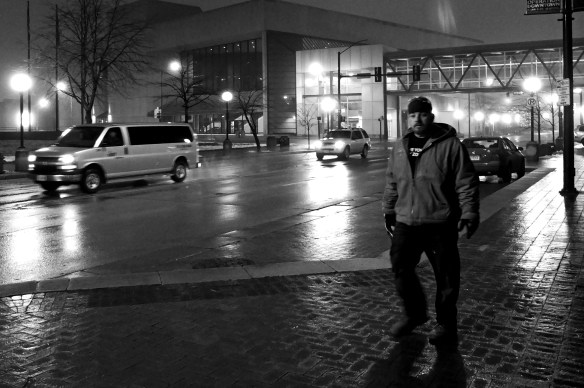
Isolated, but not unfriendly. I photographed several people as they walked toward me, and as they reached me I usually smiled and showed them their photo. Most of them paused long enough to admire themselves, make a joke, ask a question. The guy in the photograph below looked at his picture and said “That’s pretty good. But why did you take my picture?” I guess it was a good question because a very attractive young woman had been walking in front of him, and I didn’t shoot her photo. I said “Because you’re so purty.” He laughed, punched me gently in the arm, said “Fuck you,” and wandered off still laughing.

because you're so purty

because you’re so purty

I know that right now you’re almost certainly wondering about the etymology of fog and mist, because that’s just the sort of person you are. And aren’t you in luck, because I can tell you there’s some uncertainty about the etymology of ‘fog’ but not about ‘mist.’ Most linguists suggest fog is related to the Dutch vocht and German feucht (which, if there is any justice in the world, has to be pronounced fucked). The origins of ‘mist,’ on the other hand, are pretty clear. It comes from the Old English term mist (what a shock), which apparently referred to a ‘dimness of eyesight.’ That Old English term is believed to derive from the Proto-Indo-European meigh which meant ‘to urinate’ (and no, I’m not making this up).

In photographic terms, this means if you’re shooting in fog or mist your autofocus is fucked, which could leave you pissed.

on court street

on court street

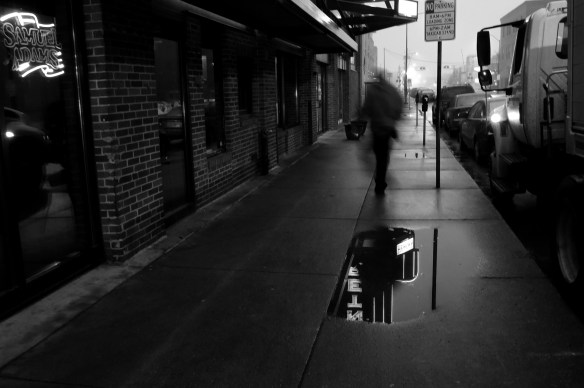
Here’s a photographically true thing: as atmospheric conditions, both fog and mist can be dense enough to bitch-slap most autofocus systems. One of the things I’ve come to rely on with my little Fujifilm X10 is its quick and accurate autofocus, and even though it tried valiantly, the X10 wasn’t always successful.

At first it was a tad frustrating when I chimped a photo and saw it wasn’t in focus. Then I reminded myself that sharpness is a bourgeois concept. It’s also a relative notion. If the photo shows what you want it to show, that’s all that counts. Besides, black-and-white photography is more about form and line and shape and geometry than about clarity. Fog and mist are made for b&w work.

old woman

old woman

At one point I saw this stooped figure approach, moving in a slow rolling sort of gait that was oddly gorilla-like. I shot the photo above and another, and waited for the person to walk into the patch of light at the corner. It turned out to be an old Slavic-looking woman, which left me in sort of a moral quandary. Not in regard to shooting her photo; that seemed immediately inappropriate. The quandary was whether or not I should offer to carry her bag. It didn’t look particularly heavy, but that wasn’t the issue. However, it seemed a rather impertinent offer; I know how my own mother would have reacted to that offer. “What…do I look too old to carry my own bags?”

So I lowered my camera and stood there, waiting and trying to decide what to do. She shuffled on by without even looking up. And I continued on my way.

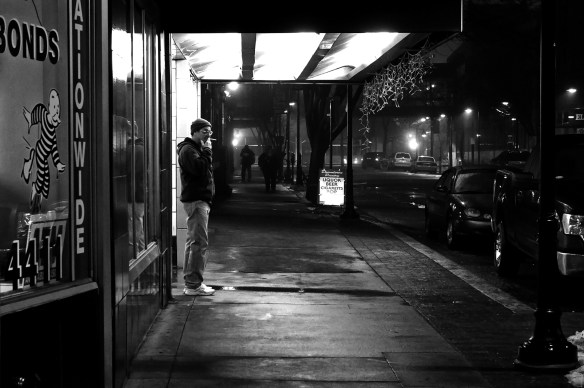
outside the bail bond office

outside the bail bond office

The fog started to lift pretty quickly after that. The X10’s autofocus breathed a sigh of relief and went back to work. There were more people on the street — some still making their way to work, some already working, some making deliveries, some just hanging out, some taking their dogs for their morning ‘walkies.’

The people with dogs were always willing to stop a moment and allow their dogs to be praised and admired. Here’s an odd thing: all of the dog-walkers I met that morning were happy to have their dogs photographed, but every single one of the people were reluctant to be photographed themselves.

in a hurry

in a hurry

Near the end of my walk I saw this woman in the photograph below standing along the promenade overlooking the riverwalk. I shot a couple frames of her standing there. She looked so sad and forlorn I felt I should speak to her. So I said “Excuse me?” and when she turned I told her I’d just taken her photograph and asked if she’d like to see it.

She smiled and said yes. When she saw it she laughed and said, “Oh good, you got the old lights on the bridge. I was just standing here admiring them.”

on the promenade

on the promenade

We chatted for maybe five minutes. She was just out taking a walk in the fog, and was as happy and cheerful as anybody I saw all morning. There was nothing the least bit sad or forlorn about her.

It was just another trick of the fog and mist.

come home to roost

It’s derived from the Old English term hrōst, which referred to the wooden framework of a roof. Old English birds would perch and sleep on old English hrōsts, and by the early 16th century that’s essentially what roost came to mean. As a noun, it generally denotes a place where birds sleep for the night; as a verb, it means to settle in for the night.

crows, roosting

crows, roosting

Roost is also the root of rooster, which refers to a male chicken. The term used to be roost cock or just cock, but during the Puritan movement of the 16th and 17th century, some folks became uncomfortable with the association of cock with the male sexual organ. So Puritans began calling male chickens roosters and on those rare occasions when they needed to refer to the male sexual organ they probably called it the ‘male sexual organ’ (which I suspect is one of the reasons the Puritan movement died out).

The term has worked its way into idiomatic expressions. To rule the roost means to be the controlling member of a family or group. There was a time when that was assumed to be somebody with a male sexual organ, though to assert that definition these days would be to risk the rooster becoming a capon (which, by the way, has the same etymological root as hatchet, which is alarmingly appropriate).

When wicked deeds or words cause discomfort to the originator, we say the chickens have come home to roost. That phrase actually comes from an 1810 poem by Robert Southey (who is best known for writing The Story of the Three Bears, which is now known as the story of Goldilocks). In his epic poem The Curse of Kehama, Southey wrote:

“Curses are like young chicken: they always come home to roost.”

Southey, it has to be said, stole the concept from Geoffrey Chaucer, who basically said the same thing (only with a lot more vowels) in The Parson’s Tale:

And ofte tyme swich cursynge wrongfully retorneth agayn to hym that curseth, as a bryd that retorneth agayn to his owene nest.

Modern bryds, of course, no longer need to retorneth agayn to their owene nests. Nor do they need an Old English hrōst. If they want to roost, all they have to do is find a convenient spot to plant their feathered butts and go to sleep.