in which I look at an old photo (part 4)

Okay, why am I looking at one of my old photographs? I explained all this back in May, but to recap quickly, I happened across an article on some photo website that suggested looking at and analyzing your old photos as if they were made by a different person. Although that idea strikes me as silly, I thought I’d try it.

This is me, still trying it–although, to be honest and transparent, this is also me trying like hell NOT to think about a future under Trump Unbound. So, the photo.

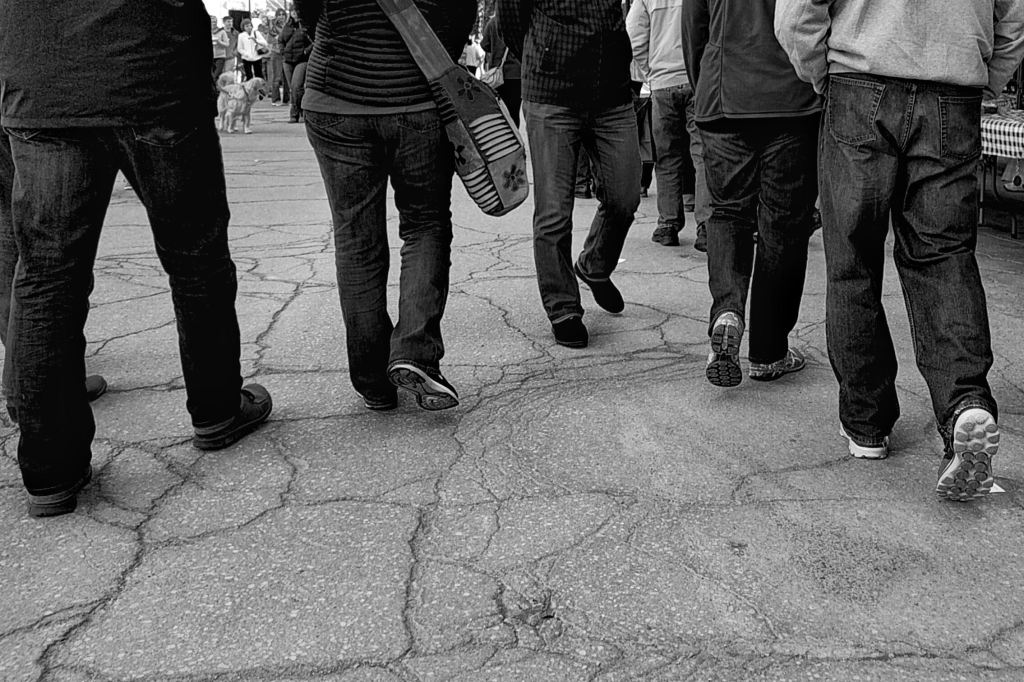
9:22 AM, Saturday, May 14, 2016

Okay, see that dog, barely visible in the upper left hand side of the frame? That dog was my main interest. It was Saturday morning, we were at the local farmers market (which actually has a policy discouraging dogs, but that policy is almost universally ignored, for which I’m grateful). I keep my eye out for dogs at the farmers market because dogs do unpredictable things. Unpredictable things can make good photographs. Unpredictable things in a crowd, even better.

I shot this with my cellphone, using a dedicated monochrome app (well, that’s not entirely true; it was a general photography app that I’d set up as my dedicated b&w app). So I opened the app as I approached the dog. That’s when I noticed the two couples in front of me separate so a man could pass between them. I instinctively snapped a quick frame, then went back to concentrating on the dog.

The dog apparently didn’t do anything unpredictable or interesting, because I have no other photo of that dog. Later, when I downloaded the photos, I was drawn to the photograph above, but I didn’t give it much thought. There was nothing farmers-markety about it, so it didn’t hold my attention. But I kept going back to it. There’s something about the arrangement–ten feet forming a sort of arc; eight feet walking away, two feet walking toward the viewer. Maybe it’s the balance. Or maybe it’s the implied movement, the sense of coming and going, of people fluidly making way for others. I’m sure I posted this photo online in some venue, but I’m not curious enough to track it down.

Why did I choose this photo to re-examine today? I don’t know. Maybe I picked this particular photo to look at on this particular day because it offers a hopeful metaphor. It feels like everything in the world right now is somehow going away, and I’d like to believe that at some point in the future all that ‘going away’ feeling will part and allow something good to get through.

That sounds a lot like bullshit, doesn’t it. It probably is. Like I said at the beginning, the idea of looking your old photos as if they were made by a different person seems silly. Maybe I just need a bit of silliness today.

border collies, civil war, and murder for the fun of it

A million years ago I wanted to write a novel about border collies. I’d just published a detective novel (my first and only) and a couple of nonfiction books on detective stuff, so I was able to wrangle an invitation to spend a few days on a sheep ranch in the Appalachians. It was a wonderful and fascinating experience, and it helped clarify the story I wanted to write. I wrote the first couple of chapters over a weekend.

But the world, as Lula Pace Fortune pointed out, is wild at heart and weird on top. Stuff happened, I moved away from Washington, DC, and the manuscript ended up as a mostly-forgotten file on a thumb drive. I continued to write, but my focus became short detective fiction. Short stories are a more difficult form than novels; they require more discipline to write well, but are more elegant when they work. They also pay considerably less.

I didn’t write a lot of them, but I sold every manuscript I submitted. Well, all but one–and, of course, I like to think the editors made a mistake there. I even won an Edgar for Best Short Story in 2023. But a part of me still wanted to carve out enough time to write another novel-length manuscript. So after Mr. Poe’s head was delivered to my door, I plugged in that ancient thumb drive with the border collie story, downloaded the early partial draft, and started thinking about it.

After reading it, I decided to scrap everything–the plot, the characters, the style. I scrapped everything but the setting and the border collies. I added two sisters–one who’d left rural Appalachia to become a conflict photographer, one who’d stayed home and raised sheep. I added a Civil War diary, whose author died mysteriously after surviving the war. I added a writer for a monthly American history magazine who was interested in the diary. I added a rural community worried about the future of their Civil War memorial, a community suspicious of an outsider poking around in their past. I added an escalating plague of vandalism and racist graffiti. I added a sheriff who tries to cope with the unrest disrupting the community he loves. I added a wealthy, gentleman farmer–a relative newcomer to the community who wants to fit in. And I added townsfolk, some of whom struggle to be decent while being conflicted about their community’s racist past.

Then I killed one of them. Which brings in the State Police, whose presence isn’t entirely welcome and whose agenda differs from that of the sheriff.

It’s taken me about a year to write, edit, and revise the manuscript, but early this afternoon, I put the final period on it. Now I can relax, right? Nope. Now comes the hard part. Now I have to find the energy to start the agony and humiliation of an agent search, which is SO MUCH WORSE than writing.

You know, short fiction may be harder, it may pay poorly, but once you’re done with a short story, you send it off and forget about it. This novel business is work.

the truck is a macguffin

So here’s me, larking about in alleys again. I’ve always had a thing for alleyways. I used to do this frequently, wandering through alleys, looking for stuff that might make an interesting photo. It eventually became a small photo project. I’ve written about how that project came into existence. But like all projects, eventually it came to an end. That was about a decade or so ago.

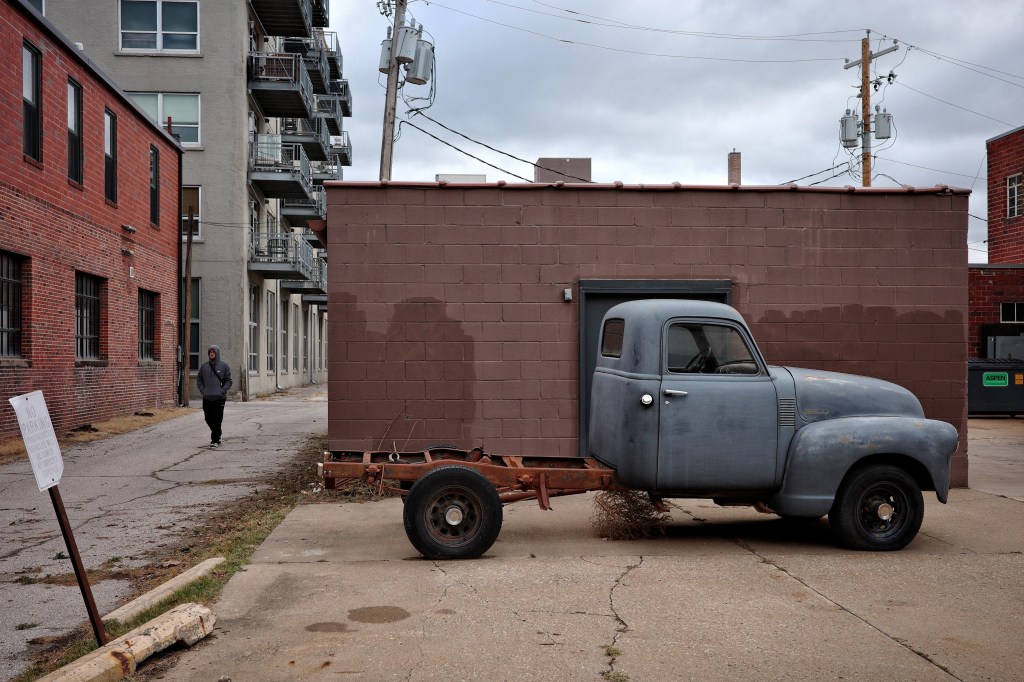
But yesterday I took a little walk. It was cold and cloudy, damp and dismal, and the light seemed fairly listless. I passed by an alley and thought, “What the hell, why not?” There’s almost always something worth photographing in an alley. And there’s always a lot of stuff that’s almost, but not quite, worth photographing. For example, an old, partially dismembered pickup.

When I spotted this unit, I was certain it had potential. It was a sort of blue-grey; I couldn’t tell if the color was a primer coat or the actual color of the truck. It didn’t matter. What mattered was that it was similar to the color of the sky. Again, that seemed like it ought to have potential. The truck also had a tumbleweed caught below its frame, which I thought might contribute something.

But, no. Nothing seemed to work. I looked at the truck from a distance, I looked at it close up, and while I kept seeing potential, I couldn’t see anything worth photographing. It didn’t help that it was parked next to a cinderblock structure that was painted an unfortunate tawny port color. Had the building been a different color, them maybe something might have worked. But it wasn’t. It was just blah.

I gave it a few minutes, trying to find an angle or an approach that appealed to me. I considered shooting it in monochrome, but even then it felt inert, bland, static. So I gave up and started to walk away. Sometimes the photo just isn’t there.

As I started back down the alley, I saw a guy approaching. He was also rather drab, dressed in grey and black. But he was moving—and, lawdy, his hoodie was almost the same color as the truck. I thought maybe…maybe…adding an active figure in the frame might make a photo of the truck work. So I turned around and headed back.

This is where years of shooting photos paid off. I had only a moment to compose the photo. I knew what I wanted. The truck, of course, but I also wanted that crooked sign on the left half of the frame; I wanted those buildings on the right side of the frame to give the image more depth; I wanted the transformers on the telephone poles along the top. Since I was shooting with a fixed focal length lens, I had to position myself in the right spot (rather than zoom in or out). A step forward, a step back, a step to the left or right—every step made a difference. A step back would have brought in the top of a telephone pole, but it would diminish the figure of the guy. He’d be too small in the frame. Easy decision.

I got the composition I wanted just a second or two before the guy arrived. I also knew I wanted to isolate him and his dark clothing against the light grey building backdrop. I knew I’d only get one chance. I was maybe a tenth of a second late. Not enough to matter, but still enough to make me wince. But still, I had my photo of the truck.

This morning, when I started reviewing yesterday’s photos, I realized this wasn’t actually a photo of the truck at all. It’s a photograph of the guy. The truck is, in effect, a MacGuffin. If you’re not familiar with the term, a MacGuffin is a movie device; it refers to an object or event that sets the plot and characters in motion but is essentially insignificant, unimportant, or irrelevant in itself. The truck that drew me in turned out to be largely unimportant.

I thought I was taking a photo of a truck. It turned out I was taking a photo of that guy. The guy—because he’s in the right clothing, in the right spot at the right moment—holds the photograph together. Without that guy, this would be a dull, static, uninteresting photo. With the guy, it becomes a photograph of a single moment in the long course of his life. The truck is just there; the photo is about some guy wandering by himself down an alley for purposes known only to himself.

Now I think of it, that guy could be me.

Okay, I didn’t expect this post to get so weird.

i still talk to strangers

I wrote a piece back in April of 2023 about my habit of talking to strangers. Here’s a somewhat concise summary of the point of that post.

I like talking to strangers. I like meeting new people and learning something about them. Granted, most of my conversations with strangers are casually superficial, so it’s not like I’m learning anything important or meaningful about them or their lives. But the simple fact of meeting and having an idle conversation with random strangers tells me something about humanity in general.

And this is what I’ve learned: most people are pretty much okay.

That’s still true. Most people really are pretty much okay. A few days ago I found myself in Perry, Iowa, a small town of about 8,000 people. As my companion and I walked down the street, we saw a guy get out of a pickup truck, carrying a couple of small jars. One of which looked like homemade pickles.

I kind of leaned forward and grinned at the jar of pickles…and he stopped. He was delivering the pickles and some homemade cherry jelly to a couple of friends in a nearby shop. I asked if he sold his homemade goods, and he said, “No, I just give them to friends.” He asked, in a very kindly but curious say, what we were doing in Perry. I told him we were just walking around, looking at the town and its architecture, shooting photos.

He started talking about the town—how it had changed over the years, how it had fallen on hard times, and he started to get a bit emotional. I said something vague about how it was clear that he loved his town, and that sort of love was a wonderful thing. Then he left to deliver his goods.

We walked on. I stopped to take a few photos. And then the guy came trotting up to us. The friend who was to get the cherry jelly wasn’t in the shop, so he thought we might like it. This stranger, just because we’d chatted with him for a bit, wanted to share his jelly with us.

Randy Kennedy and a jar of cherry jelly.

Randy Kennedy. He’d lived in Perry most of his life, and he walked with us down the street, giving us a history of almost every building and the people/families who lived/worked in them. The old shoe store owned by Greek immigrants, whose son was a hero in the Second World War. The French woman who ran a small diner/sandwich shop, and the various sandwiches she made, and how he and his friends would tap on a window and she’d sell them sandwiches through the window. The florist whose shop always smelled so nice. The building where the local newspaper had been printed and how he and his brother had been paperboys and they’d gather at “that door right there” and collect their papers, and how he was sometimes late in getting his deliveries made because he’d stop and get a slice of pie at another shop. He told us about two taverns with doors on opposite sides of an alley, one for hippies and one for farm folks, and how they’d drink together and argue politics in the 1970s.

As we walked and talked, other locals would drive by or ride by on bikes, and many of them would call out to Randy, and he’d wave back. He walked with us for maybe thirty minutes, telling us stories about how wonderful the town was, and how it was failing now, and how MAGA had created deep rifts in the community. He talked about the way the town felt increasingly divided, and had become less tolerant. He talked about the local pork producing plant that closed six months earlier, putting 800 people out of work. Eight hundred, out of a population of eight thousand.

He didn’t mention the school shooting that happened in January, leaving an 11-year-old boy and the school’s principal dead, and seven others wounded. Some things were apparently still too raw to talk about. But most of the shops—even the ones that were closed and empty—kept ‘Perry Strong’ posters in their windows, maybe claiming more resilience than the town actually has. Maybe hoping resilience would hold the town up long enough for some good news.

This guy loved his small town and was proud of what it had been and mourning what it had become. He was pessimistic about the future, but desperately hoped he was wrong. His love for the town was heartbreaking. He was sad, but said he was okay. That’s when I asked if I could take his photograph, holding the jelly he’d give us.

Like I said in my earlier post, most people are pretty much okay. In a lot of ways, being okay can be seen as a victory. Randy Kennedy may look a wee bit sad in this photo; he has good reason to be. And yet he’s basically okay. The proof of that is that he chased a couple of strangers down the street just to give us some cherry jelly that he’d made himself.

I talk to strangers. I will always talk to strangers. And this morning, I had cherry jelly on my toast.

yellow lines, yellow rope, yellow dumpster lid

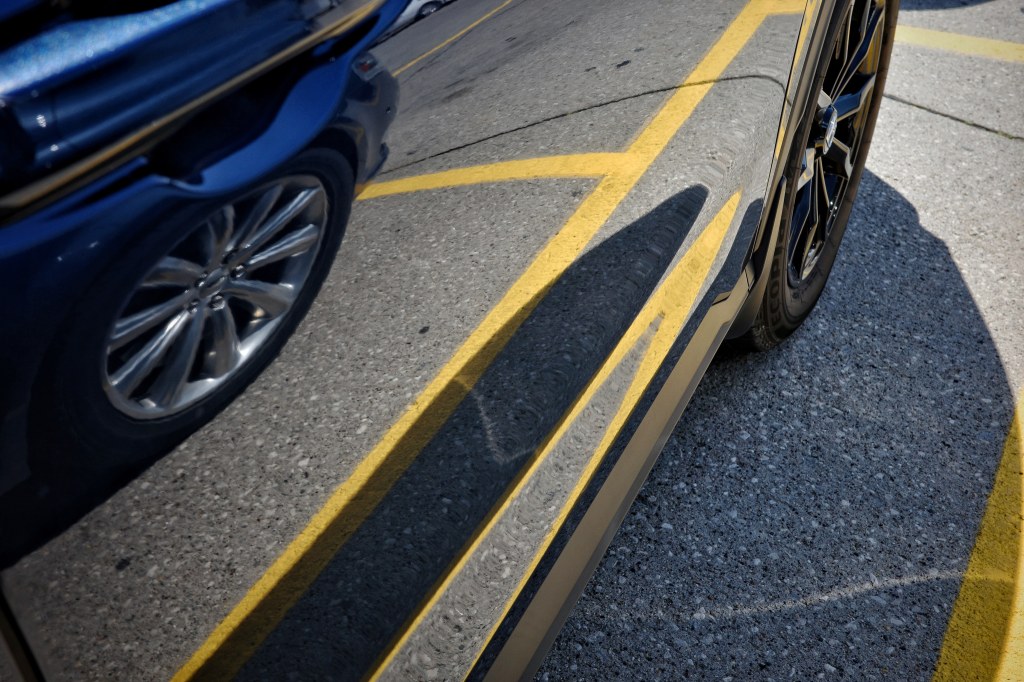
I’m an absolute pain-in-the-ass to run errands with. Why? Because I have a tendency to get distracted by stuff I see. Random stuff. I’m talking abstract lines and shadows and shapes and colors, stuff that usually gets lost in the passing clutter of everyday life. Stuff that, when it’s isolated within a frame, becomes visually interesting (to me, at least). Like, for example, some newly painted yellow parking lines reflected off a car door.

We’d just bought a few groceries and I’d just put the bag in the back seat when I saw the reflection. I stood there for a moment, sort of arranging it in my head. In the past, I’d have just admired it, then got in the car. But now I have an actual camera that fits in my pocket. So now I have this photograph.

It’s just a flash of light, shadow, line, and color that likely won’t appeal to anybody but me. But this is how I go through the world, seeing stuff like this. And since I now own a little Ricoh GR3X, I can photograph the world the way I see it. Sure, I could have taken a similar photo with my cellphone. But it’s not the same. With an actual camera you have more control over the exposure.

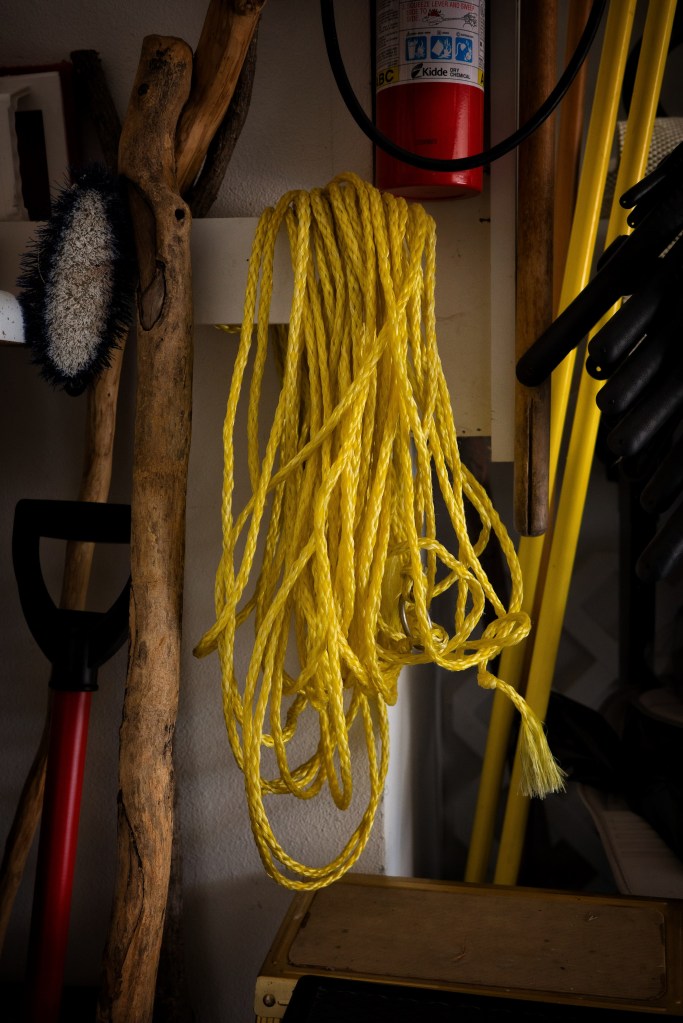
I also use the GR3X to take ‘normal’ photographs, of course. The usual landscapes, urbanscapes, street images, New Topo stuff (which counts as ‘normal’ for me). But almost every day there’s some weird little visual thing that will captivate me enough to stare at for a moment, but not enough to go fetch a camera. Having a camera in my pocket comes in handy at these moments. You know…in case I see a bit of sunlight illuminating a coil of yellow polypropylene rope hanging in the garage.

The yellow rope alone would have been enough. But the red of the fire extinguisher almost exactly matched the red of the walking stick. You can explain that to people, but without the photograph they probably won’t see it. They may not see it even with the photograph. But that’s okay.

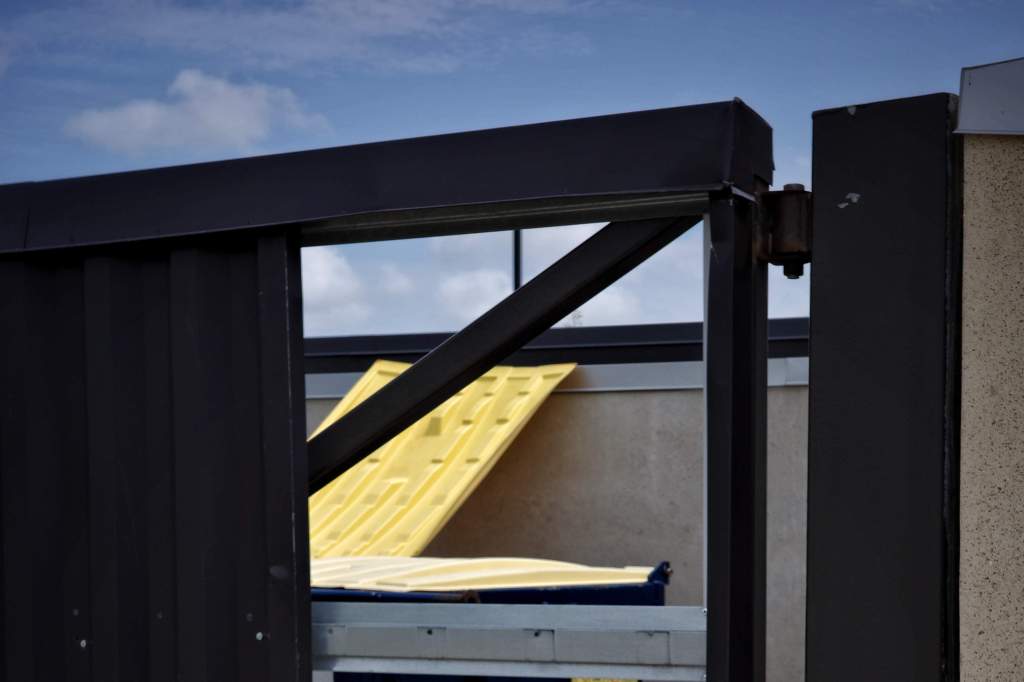
My friends and family are ridiculously patient with me when this sort of thing happens. “What are you doing? Why have you stopped?” “The dumpsters have yellow lids.” “Yellow lids.” “One of them is open and the yellow is brighter. And the clouds.” “I’ll wait in the car.” It’s really a wonder they don’t stab me.

There’s an old photographer’s aphorism: the best camera is the one you have with you. I suppose at some point I’ll get over my infatuation with this camera and I’ll stop carrying it with me all the time. But right now, it’s just part of my leaving-the-house ritual. I grab my keys, my wallet, my phone, and my Ricoh GR3X before I walk out the door.

There are two benefits to this. First, I’m shooting more photographs and shooting them more thoughtfully. Second, carrying this camera everywhere has impressed upon me how very tolerant folks are of my eccentricities. It reminds me that I’m a very lucky guy. It reminds me to appreciate the people around me even more. How many cameras can do that?

EDITORIAL NOTE: Okay, I just now noticed that the predominant color in all three of these photos is yellow. Is that weird? It seems weird. But now I have to change the title to reflect that.

ptsd morning

I’m getting over my very first case of Covid, which has been unpleasant but tolerable. I mention that because…I don’t know, maybe that helps to explain my PTSD episode this morning. Maybe?

It’s been a while since I’ve had one of those. I still have occasional lightning quick PTSD moments, but they’re mild and not disruptive. It’s like a jolt of static electricity–a sharp moment that passes almost instantly. In fact, the spark of this morning’s episode is my most common trigger: a light shining from under a closed door. I wrote about this…okay, this is weird. I just checked, and I wrote about this almost exactly ten years ago. August 21, 2014. I’m NOT going to read anything into that.

Okay, quick recap. DON’T READ THIS & DON’T CLICK ON THE LINK ABOVE IF SUICIDE IS A TRIGGER FOR YOU.

A million years ago when I was a medic in the military I responded to an off-base call involving a patient in ‘respiratory distress’ in the basement of a hotel. The basement was dim, but you could see to walk through the corridors. There was bright light coming from beneath the doorway of the room we were led to. We opened the door to an Asian guy who’d hung himself a couple of days earlier. It was ugly. There’s more detail in the post from a decade ago, if you want that information.

Anyway, light beneath a closed door is such a common trigger for me that when I see it, I’ll usually say, “Dead Asians” and everybody understands 1) why I’ve gone quiet for a moment and 2) why they should probably turn off lights when they leave a room and close the door.

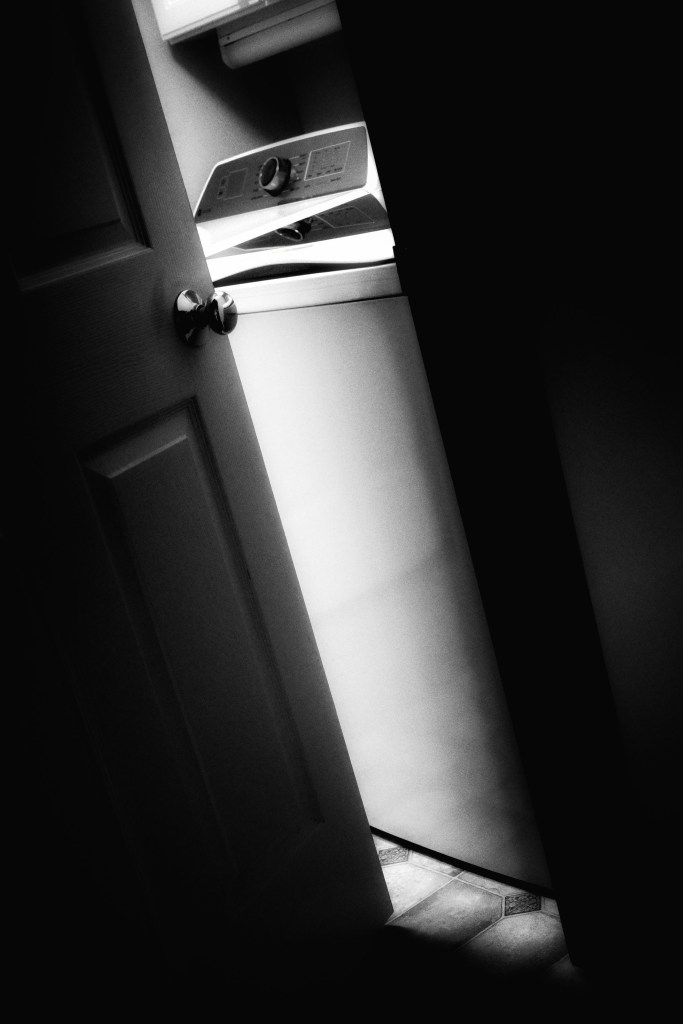
Normally, that’s it. I see the light, there’s a moment of shock, then I’m fine. No big deal. But for some reason, this morning when it happened, I found myself…well, fucked up. It was my own fault; I’d left the light on in the laundry room while I did something and when I started to return to the laundry, it hit me. I didn’t want to open the door. Which was silly, and I did open it, and of course there was nothing in there but the washer and dryer.

But for the next hour or so, I couldn’t shake the…I don’t even know what I couldn’t shake. A feeling, I guess. Not so much the image of the dead guy, which is still pretty clear in my mind, but the feeling of getting ready to open the door and seeing something so awful that it would still be with me decades later. I don’t know about anybody else, but on these rare occasions when the PTSD spanks me, I find myself replaying several of the other awful things I’ve seen and done. It’s like I’m getting all the horrific shit out of the way at one time, so I can get on with my life.

It’s just a laundry room.

I took a photo of the laundry room because that’s what I do. And then I thought maybe I should write about the photograph, which would require writing about why I took the photo, and what the hell, I might just as well write about the whole thing, right?

Does it help to write about it? Nope, not really. Didn’t help to take the photograph either. I didn’t expect it to. But it seems…not important, but worthwhile to write about it, because that puts it back into perspective. I’ve lived the sort of life in which I encountered a big chunk of horrible shit. Horrible shit is supposed to stay with you; you don’t want to be the sort of person who isn’t affected by horrible shit.

But it’s worthwhile to remind yourself that it doesn’t have to live with you all the time. This evening I’ll grill out some chicken and asparagus; I’ll have a nice meal and a good craft beer and spend the evening with people I love. THAT is what lives with me all the time. The horrible shit…it’ll dissipate. And with any luck, I won’t have another episode for months or years. I’m okay with that.

in which I look at an old photo (part 3)

Okay, why am I looking at one of my old photographs? I explained all this back in May, but to recap quickly, I happened across an article on some photo website that suggested looking at and analyzing your old photos as if they were made by a different person. Although that idea strikes me as silly, I thought I’d try it.

And I did. Twice, so far. But I have to admit, I’ve failed. I mean, yeah, I looked at a couple of old photos and yeah, I tried to analyze them. But I didn’t analyze them as if some other jamoke shot them. I did try to look at the photos as objectively as I could (and I like to think I succeeded at that), but I couldn’t separate that analysis from my personal awareness of what was happening in the world around me when I shot the photo or my reasons for shooting it.

But, whatever. Here I am, doing it again. I’m just going to ignore the original idea and continue my pattern of…of whatever it is that I’ve done. I’m even creating a new tag: greg looks at an old photo. I’ll probably do this once every month or two. Probably. Anyway, here:

1:09 PM, Monday, August 15, 2016

I chose this photograph for two reasons. First, because the Iowa State Fair is underway (I’m planning to attend soon). And second, because it doesn’t quite work as a photo. It almost works. Technically, it’s a tad underexposed. I shot it with my wee Fujifilm X10, which is a fine little camera but it doesn’t allow for quick exposure changes (this was shot at f2.2 at 1/100 and an ISO of 400). If I’d had time, I’d have fiddled with the exposure compensation dial. But that’s the thing about shooting photos that are about people living their lives. They’re not there to be photographed; they’re there because they’re there. You just have to take what’s given. So, underexposed a wee bit.

I’m happy with the basic composition, although the exposure detracts from it. Obviously, the young couple are the primary subject of the photo, but as I approached them I noticed some sort of vacuum/blower device on the floor; it was almost the same color as the top the young woman was wearing. This is where the exposure hurts me; the vacuum thingy gets lost; you can barely see it in the lower left corner of the frame. Still, the quietness of the young couple is, I think, nicely balanced by the other activity in the barn. And I quite like the cow portrait in the upper right of the frame.

So yeah, as a photograph it’s technically flawed, but (I think) well composed. What I really wanted was to depict a moment in the lives of these kids. For almost two weeks, folks from farms all over the state basically live in these massive barns, along with their livestock. They arrive before the fair starts and often don’t leave until after it ends. The Cattle Barn, the Sheep Barn, the Swine Barn, the Horse Barn—they all become small, temporary communities. Over the years, I’ve taken dozens of photos of people in these barns—napping, eating, playing (young barn kids seem to enjoy playing practical jokes on fair-goers), making friends, living a weird approximation of their ordinary lives. There’s something rather sweet about it, something simple (and something rather uncomfortable for those of us not accustomed to barnyard smells). Because they’re only here for a brief time, all these human interactions—the friendships, the squabbles, the romances–become compressed, more immediate.

Another thing about this photo that appeals to me: the transience of these relationships is in marked contrast to the stability of the Fair itself. The Iowa State Fair has been held almost every year since 1854 (they skipped 1898 because of the World’s Fair in Omaha, and missed three years from 1942–1945 because the fairgrounds had been turned into a supply depot for World War II, and the Covid pandemic axed the fair in 2020). It’s been held at this same location since 1886; some of the buildings from the early 1900s are still in use. The barn in which these kids are having their moment was built in 1914.

This particular moment took place in 2016, but you can easily imagine a similar moment in the same barn a hundred years ago. Different fashions, different hair styles, different chair, but the cattle haven’t changed much, and the barn is almost exactly the same. Imagine how many of these moments have happened over the years.

speaking of photography…

I have a complicated history with Instagram. I downloaded the app and joined 11 years ago today, on 21 July, 2013. I did it under a pseudonym–Knuckles Dobrovic–because, like every good photographer I knew, I assumed Instagram was trash and I didn’t want to be associated with it. As I wrote at the time,

We sneered at Instagram for being a cheap, easy, lazy way to turn crappy photos into images that look artsy. Not ‘artful’ or ‘artistic’ but artsy. We sneered at it because the learning curve for using Instagram is — well, it’s hardly a curve at all. It’s almost a straight line. You shoot a photo with your cell phone, you flip through a couple dozen preset filters until you find one you like, tap to apply it, and hey bingo, you have yourself an artsy photo of your drunken friends at a tacky Chinese restaurant.

I hadn’t actually looked at Instagram; I was just operating on the assumption it was trash. I had to join it in order to confirm my assumption. And hey, I was right. It was, in fact, trash. It still is trash, mostly. But eleven years ago to my surprise, I also found a healthy dose of really fine photography. All sorts of photography, from street work to portraiture to landscape to editorial work to fashion photography. There was (and still is) solid work to be found on Instagram.

I used the Knuckles Dobrovic account mainly to explore IG. But I also felt an obligation to participate, so I used it as a platform for a hastily cobbled together project. After a few months, I decided to more fully embrace IG; I created a second account under my own name. Originally, the account was devoted to square format monochrome photos. Now, of course, it’s my main IG account for all types of photography.

I continued to use the Knuckles account as a platform for random photo projects (for anybody interested, I’ll include a list and a description of those projects in an addendum at the end of this post). The last Knuckles project ended in April of 2023. I haven’t posted anything under the Knuckles account since then.

Until today. My IG anniversary. I’m starting my 8th Knuckles project. Appropriately, it’s going to be pretty similar to how I began my personal IG account. I’ve always had four simple rules for a Knuckles Dobrovic project.

  1. It’s got to be simple (which means I won’t have to do a lot of planning or a lot of post-processing).
  2. It’s got to be organic to my life (which means it’s something I can photograph during the course of an ordinary day — whatever that is).
  3. It’s got to have at least one intellectual component (which is more accurately described as a pretentious bullshit element).
  4. It’s got to be able to keep my interest over time.

So here we go. Simple: high contrast monochrome, which is made easy with my new Ricoh GR3X camera. Organic to my life: my normal flâneur walk-about style plus whatever I happen to see that catches my interest. Pretentious Bullshit Element: my ongoing fascination with the Japanese Provoke-style photography, which is NOT how I normally see the world. Keeping my interest: Well, yeah. I’ve played around with this style of photography before and I see no reason why I’ll ever stop. At some point, I may feel the need to start a 9th Knuckles project, but until then…well.

ADDENDUM: Previous Knuckles Dobrovic projects.

Things on a Table
 — I put a thing on a table and photographed it.

My Feet on the Earth — I took walks, stopping periodically to photograph my feet. I selected two or three of the images during a walk and created multiple exposure images.

One Hundred Appropriated Google Street Views — This was sort of an homage to Hiroshige’s ‘One Hundred Famous View of Edo’. While playing the online game GeoGuessr (which involves finding a random location based on Google Street View), I made screen captures of interesting vistas. I converted those screen grabs into square black & white images.

Slightly Dislocated — During the enforced isolation of the pandemic, I shot square format photos during my solo walks or masked errands. I diddled with the color a wee bit, digitally sliced the image in thirds, then re-arranged the pieces.

Are Bure Bampot — I’d been playing Geoguessr again, and during a break I read something about Daido Moriyama, the godfather of a photographic style called are bure bokeh, which roughly translates as “rough, coarse/crude, out of focus.” That same afternoon, on Twitter, a Scots acquaintance referred to somebody as ‘a total bampot,’ which I was told means “an idiot, a foolish person, a nutcase”. For reasons I can’t explain, the phrase are bure bampot came to me, and I decided to follow through on it. As before, I made Google Street View screen captures of scenes and locations in Scotland. This time I modified them using the are bure bokeh style.

Geoguesser Bus Stops — A bus is the most democratic form of public transport. They’re most commonly used by the poor and working classes, but the bus stops for everybody. A bus network is fundamentally simple: a series of designated routes with consistent designated arrival/departure times and stable designated boarding locations with predetermined fees. It’s a predictable, reliable, efficient dynamical transportation system in which bus stops act as fixed point attractors. Bus stops are ubiquitous; they’re everywhere because a bus network is socially elastic–the design can be stretched to fit almost any community anywhere in the world. Bus stops are both local and global.