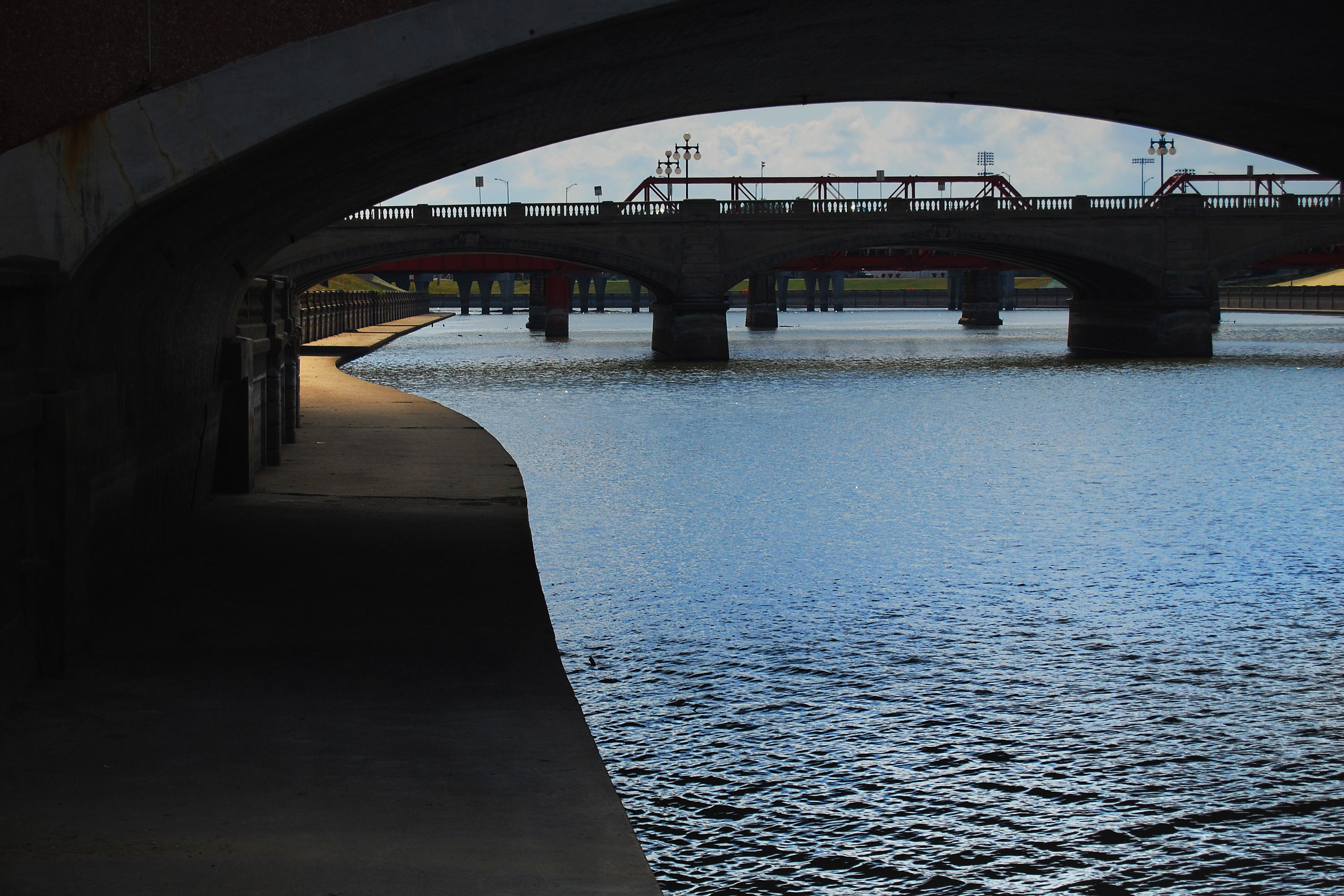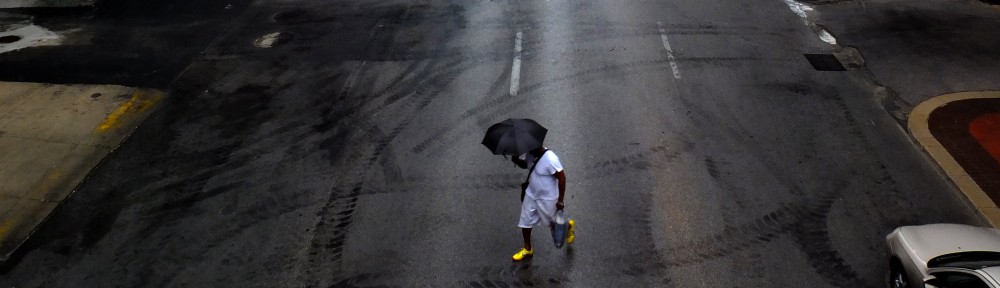
the world is an unlikely place

A drought led me to a railroad bridge, which led me to a brick, which led me to an 18th century French fur trader, which led me to the establishment of a major city, which led me back to the railroad bridge. The world is an unlikely place

We’ve had a bit of a drought in the central plains of the United States. River levels have dropped dramatically. This is troubling and problematic in any number of very obvious ways. It does, however, create an opportunity for curious people to explore areas that are usually under several feet of water.

Once you start exploring anything, you never know what you’ll find.
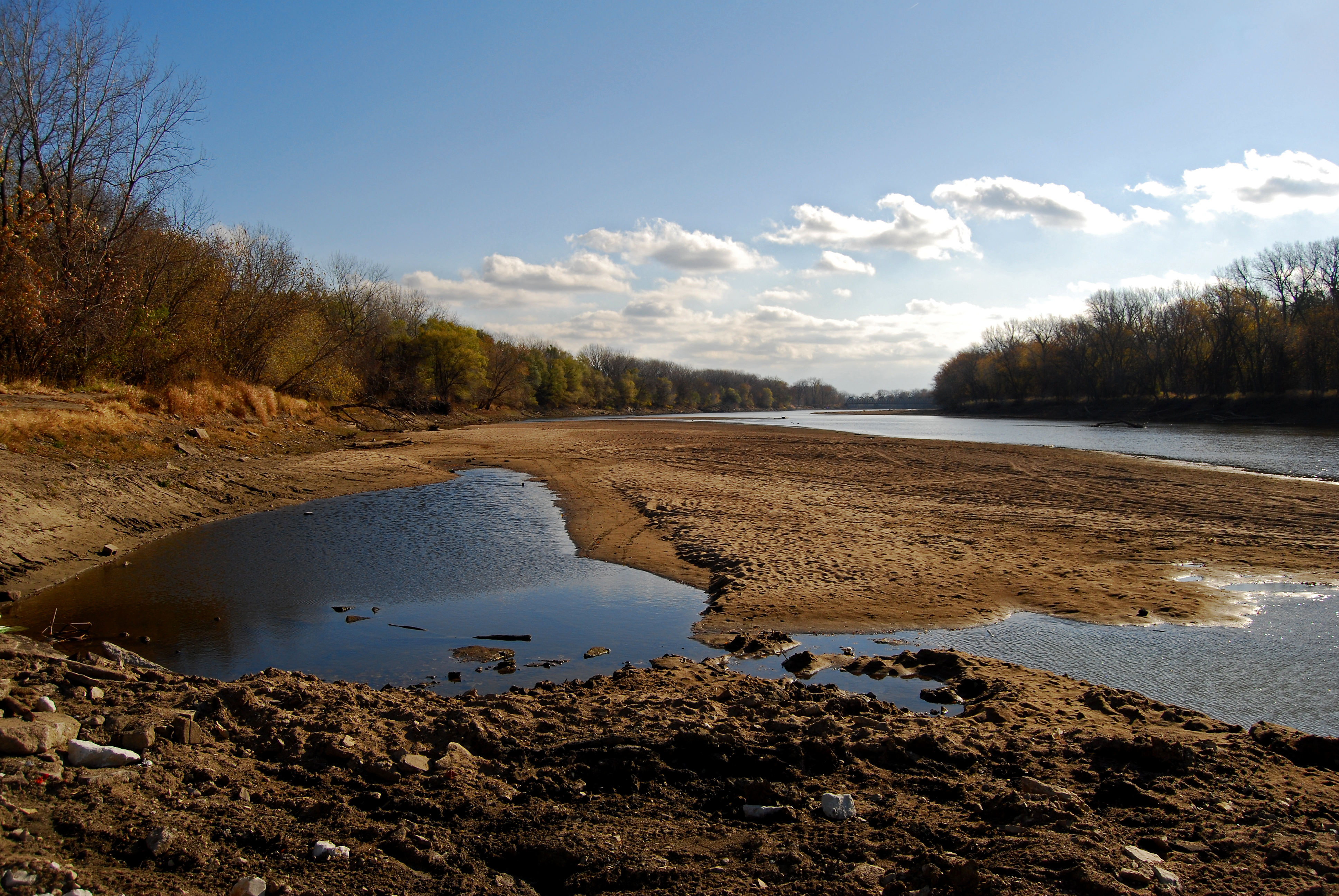
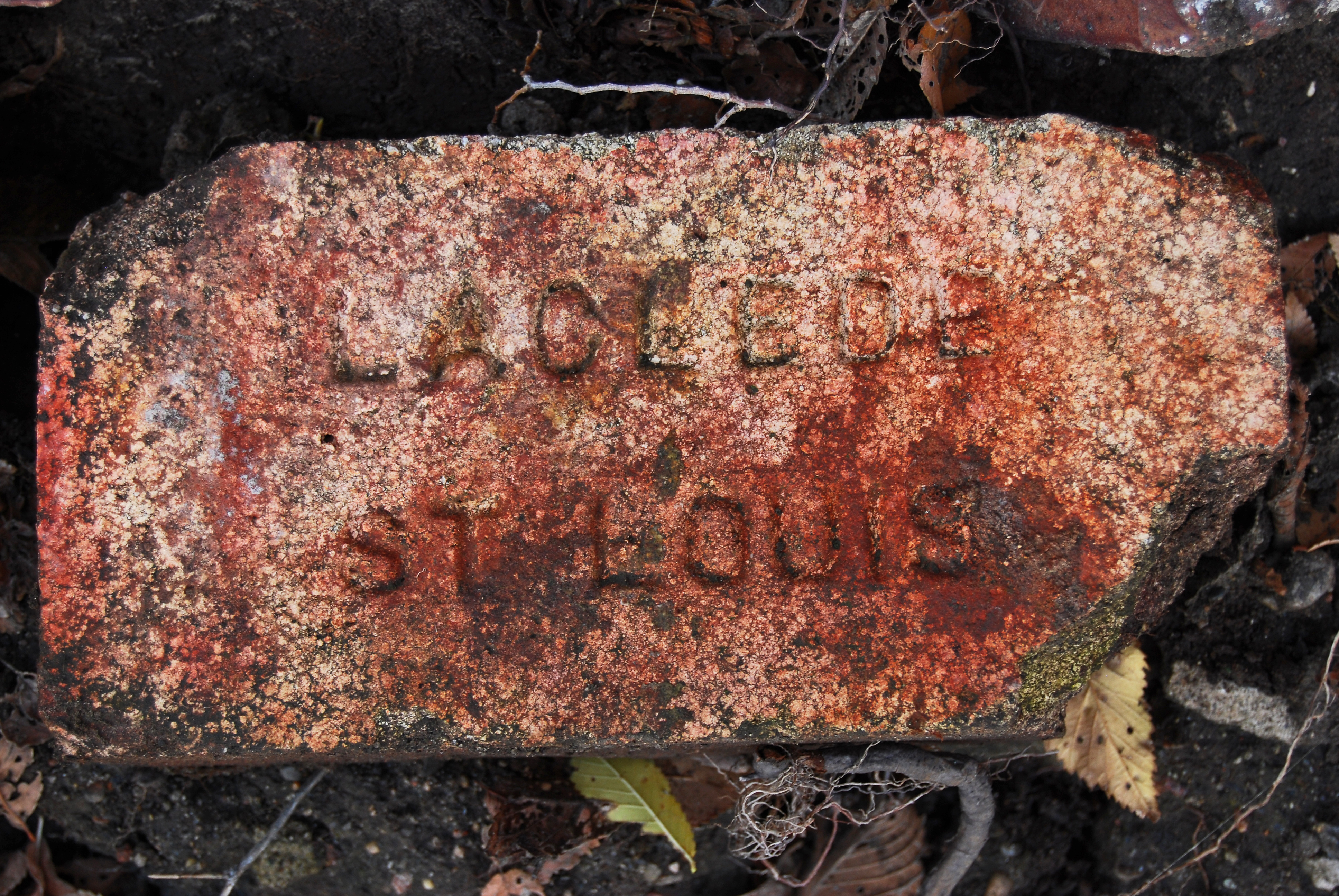
A couple weeks ago my brother Roger Lee and I found ourselves wandering along the river bed near a defunct railroad bridge on the Des Moines River. I explored along the riverbank, where erosion had exposed all manner of odd stuff—included many dozens of old bricks. A lot of those bricks displayed the names of the brick-makers. Among them were several bricks from the Leclede Brick Company of St. Louis, Missouri.

I was curious enough to Google the company. And again, once you start exploring, you never know what you’ll find.

Among the things I found was this: Pierre Laclède was born in 1729 in Bedous, France—a small village in the Pyranees (even today the village’s population is less than a thousand). Laclède must have been an adventurous youth. For reasons we don’t know, he made his way to New Orleans, arriving in 1755. He was 26 years old. Laclède became a fur trader, traveling up the Mississippi River and exploring its tributaries in search of native tribes with whom he could exchange goods for the pelts of beaver, ermine, mink and skunk.
By all accounts, he was a poor businessman, but a very good trader. In 1763, Laclède’s trading company was commissioned to establish a trading post far upriver, near the confluence of the Mississippi and Missouri Rivers. He led a party of thirty men up the Mississippi until he found a gently sloping site with nearby limestone outcroppings. He hoped the limestone would eventually provide the material for stone buildings. Laclède ambitiously laid out a map consisting of three streets and named the trading post after King Louis IX, the only French king ever to be canonized. Saint Louis.

Laclède’s company established a monopoly on furs trapped by the Osage tribe, who inhabited that part of the Missouri River. The fur trade, of course, eventually died. Happily for Laclède’s ancestors (the children he begat with another man’s wife), around the same time the fur trade ended a new brick manufacturing process was being perfected. That process required a certain type of clay (called ‘fireclay’). The best type of fireclay was found near limestone deposits. The presence of limestone, of course, was one of the factors that determined the location of Laclède’s trading post. Laclède’s children owned much of the property where the best fireclay was to be found.
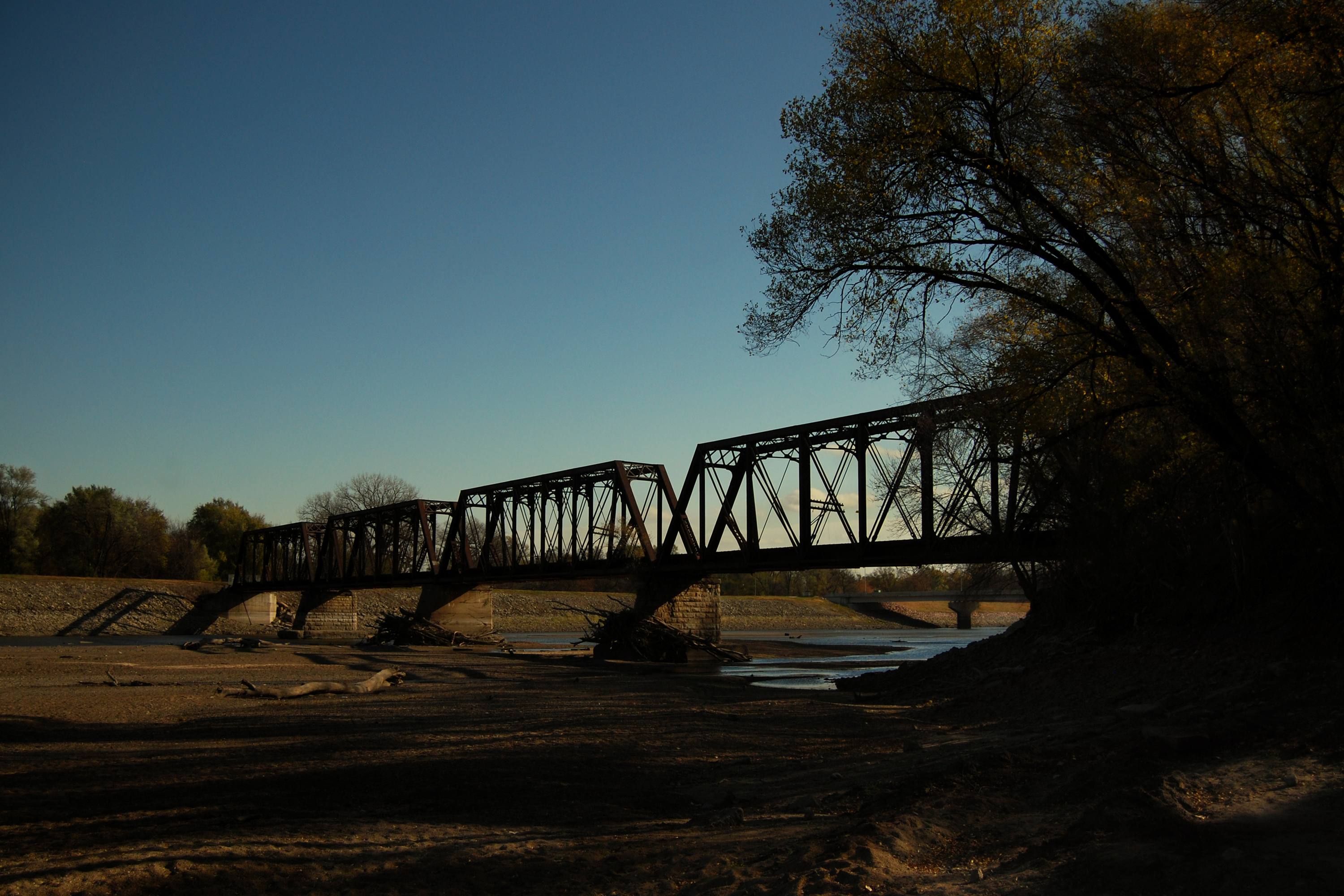
By the end of the 19th century, the Laclède family abandoned the grave over the first ‘e’ in their name and founded the Laclede Fire Brick Company, which covered more than 120 acres on the outskirts of St. Louis, Missouri, and made untold millions of bricks, some of which can be found on the dry riverbed beneath a defunct railroad bridge on the Des Moines River.

The world is an unlikely place, and once you start exploring it you never know what you’re going to find.


poor bastard

The beauty of traditional publishing is that all the writer has to do is write. That’s it. You make shit up and write it down. You finish the manuscript, you take it to the Post Office or Federal Express, you drop it in an envelope, send the damned thing off and that’s it. You can forget about it and move on to the next project. Easy peasy, as they say.

Some other poor bastard (or several poor bastards) will have to do the grunt work of copy editing, and considering issues of typeface, and dealing with formatting, and coming up with cover art.

But e-publishing makes every writer a poor bastard—at least in the sense of all the grunt work that’s necessary to prepare the manuscript for publication. Copy editing? You have to do it. Typeface and formatting? Figure it out. Cover art? Dude, it’s all up to you. You can stare at your computer and say “Dammit, Jim—I’m a doctor, not an engineer.” But you still have to get the warp engines back on line.

I’m okay with the copy editing. I hate it, but I can do it. I don’t know dick about typeface, but I can see that there are certain industry standards and follow those. I can cope with the formatting because the e-publishing software makes it a bit easier. But cover art? Dammit, Jim—I’m a writer, not a graphic designer.

Graphic designers never get the credit they deserve. I’ve known this for a long time—partly because graphic designers keep telling me it’s so, and partly because I’ve seen graphic designers make almost unnoticeable changes that somehow magically turns a dull design into one that seizes and holds the eye and the imagination. So I’ve known graphic designers have their own peculiar genius, but now that I’ve tried to build a book cover, I appreciate it all the more.

I tried to take a lot of things into account. The cover is for a book of non-traditional detective stories, so I wanted the cover to have a light noir-ish vibe—somewhat urban, but not quite hard-boiled. I wanted it to relate to something that appears in the stories—a setting, an object, an atmosphere. I wanted the cover to be clean and simple and somewhat austere.

I guess I’ve made maybe a couple dozen different covers now. They all look too simplistic to me. They look like—well, they look like I made them. They don’t look to me like real book covers. I spent an inordinate amount of time looking at e-book covers on Amazon.com and B&N.com, and I’ve got myself so turned around at this point that they don’t look like real book covers either.

I suspect I’ll settle for one of these four covers. Years ago I learned to be able to let go of a manuscript; now I have to learn to do the same with a book cover.

But this shit ain’t easy.

river of monks

The Sauk and Meskwaki tribes called this Ke-oh-shaw-kwa, the river of hermits. They’d been driven out of their native lands in Michigan and Ontario by French explorers, missionaries and settlers. They settled here, not far from a bend in the river where they’d encountered a man living alone in a hut—a person living outside the safety of a community was an unusual sight in those days.

The French, who eventually followed along, came to call this La Rivière des Moines—the River of Monks.The monks in question were from the Order of Cistercians of the Strict Observance, more commonly known as ‘Trappists’ (the nickname derives from the abbey at Soligny-la-Trappe in Normandy). They’d established an outpost a couple hundred miles downriver—little more than a few huts, a trading post, and a chapel built on what they believed to be a massive native burial mound. The Trappists worked the ground, made beer, tried to convert the natives, and after about 20 years, were forced to abandon their settlement on the mounds by hostile tribes.

You have to appreciate the poetic justice. But even though the French left, the name La Rivière des Moines remained.

That’s the accepted version of events. Like so many accepted versions of history, there’s doubt about its accuracy. Before everybody agreed to call it La Rivière des Moines, it was known by some French explorers as La Rivière des Moingona. The term ‘moingona’ is usually translated as meaning ‘mound,’ thereby making this the ‘River of the Mounds.’ Given that there were monks living on mounds, it’s easy to see how confusion could ensue. River of Monks, River of Mounds—both names make sense.

But there’s more. One of the first people to call the river by its European name was the French Jesuit missionary and explorer Jacques Marquette. He’d encountered natives of the Peoria tribe at the confluence of this river and the Mississippi. Asking about other tribes who inhabited the river basin, the local natives told Marquette this branch of the river was controlled by Mooyiinkweena. Marquette interpreted that as a local variation on ‘moingona.’ According to one linguist, however, mooyiinkweena actually meant ‘shit-face.’ The local tribe members had apparently been insulting their neighbors.

So, what’s the truth? The truth is this river is now known as the Des Moines River. It may be the river of monks, it may be the river of mounds, it may be the river of shit-faces, or it may be the river of shit-faced monks living on mounds. After three centuries, does it matter?

I’m inclined to think not.

following through rock

I  used to dislike giving titles to photographs. Then, for reasons I’ve never bothered to try to understand, I began to enjoy giving titles to photographs. Sometimes the title means something; sometimes it’s just a word or phrase that makes an otter slide into my head and I slap it on the photo.

I did that this morning. I was getting ready to post a faux Polaroid in my traffic signal series and I needed a title. I called it Lodestone. No idea why. I wasn’t entirely certain I knew what a lodestone was—a primitive magnet of some sort used as a compass?

It turns out a lodestone is a naturally occurring magnetized mineral called (are you ready for this?) magnetite. But what’s really interesting is that lode is the original spelling of load, and in Middle English it meant a path or a course. Somewhere around the 16th century, miners began to speak of following a vein of ore through the rock—following the lode. They would then carry the lode (load) out, and eventually folks began to differentiate between lode and load.

Because magnetized stone would, if suspended, always point North, a lodestone was a stone that showed one the way.

I still don’t have any idea what that has to do with the photograph. But I learned something new. So there’s that.

thorn

You learn something new every day. Today I learned about this: þ. This is the letter ‘thorn,’ which I didn’t even know was a letter. And in a way, it’s not–at least not in modern English. It was used in Old English, Old Norse and is apparently still in use in the Icelandic alphabet. It’s pronounced like the digraph ‘th’ (as in either ‘theory’ or ‘then’).

Now, why is this cool? I’ll tell you why. Because over time þ began to be written as Ƿ, which eventually became indistinguishable from the letter ‘Y’.

Okay, it’s still not clear why that’s cool, is it. It becomes more clear when you see the letter thorn in use. As in ‘Ƿe Olde Pickle Shoppe.’ Which is now generally written as ‘Ye Olde Pickle Shoppe.’ And which is always pronounced ‘Yee’ when it should, in fact, be pronounced ‘The’.

All right, then–maybe it’s not all that cool. But hey, I learned something new.