Well, here we are again. This is the eighth time I’ve looked at an old photo. This is apparently a thing I do now. Why? Because in May of 2024 I read an article that suggested photographers could benefit from looking at their old photos as if they were made by a different person. I was skeptical about the idea, but what the hell…I did it. The notion still seems a wee bit precious to me. But here I am, doing it again.
Two things: first, I don’t recall the exact point of looking at your old photos as if they were made by a stranger. I know it had something to do with how our approach to photography changes over time, but surely that’s a given, isn’t it? In any event, when I look at these old photos, I find I’m mostly thinking about why I shot that particular photo, or why I shot it in that particular way, or what that photo means to me now. None of which, I suspect, is what the author of the article intended.
Second thing: when I decided to do this, I was stymied by the fact that I’d have to actually pick an old photo to look at. How do you do that? I chose a random approach. I pick a random month in a random year and see what catches my eye. I was completely unprepared to have emotions about this stuff. But I do.
Anyway, here we go.
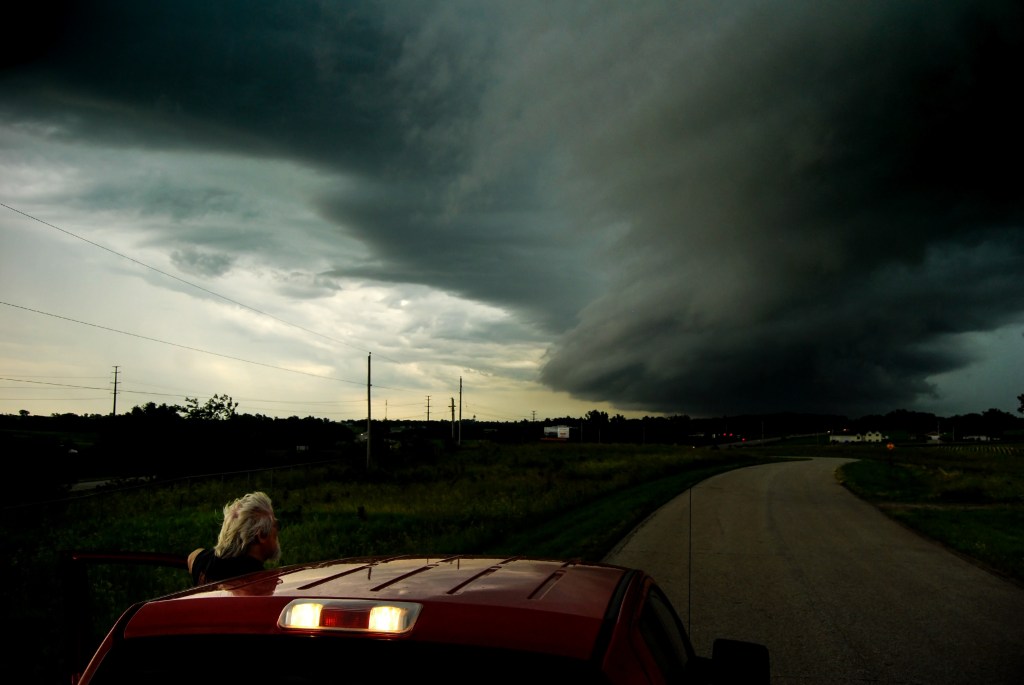
I shot this photo standing up in the back of my brother’s pickup. What you’re seeing here is an anvil cloud. These form when a thunderstorm’s updraft reaches a level of the atmosphere where moisture effectively stops, which causes the storm to spread out horizontally. These sorts of clouds are associated with really severe weather, including hail and tornadoes. As I understand it, when the moist air can’t go any higher, water vapor coalesces and returns to Earth in the form of heavy rain and/or hail. There’s also a lot of wind. A lot of wind.
Light gets really weird during a thunderstorm. The clouds make a huge difference, of course; they shape the angle of sunlight. The air is full of moisture and particulate matter swept up by the wind, so the light gets diffused and often turns into a beautifully ominous bruised color. It’s compelling and lovely and wild and sometimes scary. It’s that savage, unpredictable, astonishing, untamed wildness that makes big storms both lovely and terrifying.
That’s exactly why my brother, Jesse Eugene, and I were there. He’d been a Marine in Vietnam, and a firefighter afterward. There was a stormy wildness in him. A wildness that showed up in most aspects of his life, to be honest. A wildness I’m afraid I encouraged during tornado season. The wildness–and his willingness to give into it–largely ruined his life. There was a part of him that loved the destructive power of fires, and loved facing and beating down that power. I’m sure that’s one of the reasons he loved thunderstorms. I think he probably saw them as a challenge he could face down.
On this particular day, we knew a bad storm was coming and we drove out to meet it. This was just a few miles outside the city. I’d had him stop his pickup at this particular spot because I liked the curve of the road. I got excited when I got out of the vehicle and saw the curve reflected the curve of the anvil cloud. It amused Jesse Eugene when I asked him to turn the truck around so I could include the red roof in a photo. He enjoyed the absurdity of it–of me insisting on posing a pickup truck while a massive thunderstorm was approaching. It soon became too dark and windy to shoot photographs, but we stayed there until the storm hit hard and it began pissing down rain like the End of Days. It was a good storm.
I picked this photo to look at because, even though you can see his face, it’s probably the most honest photograph I’ve taken of my brother. I’m happy with this just as a photograph, even though it’s flawed. I like the way the sunlight behind us illuminated my brother’s white hair. I like the artificial red shininess of the pickup’s roof. I like the way the curve of the road echoes the curve of the clouds. I like the emotion of the image; I like that the emotion is just there and doesn’t depend on the viewer knowing anything at all about the circumstance the people involved. It’s not a great photo, but I think it works.
I’m also happy with it as a memory. I’d much rather remember Jesse Eugene like this, laughing and facing a thunderstorm, rather than the thin, frail, cancer-ravaged person he became at the end. But that’s the thing, I guess. Even the wildest storms eventually lose strength and peter out.

 gregfallis.com