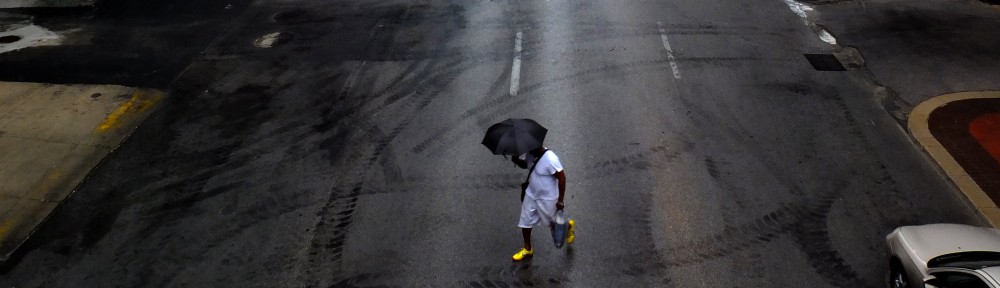
About a month ago I happened to use the phrase ‘Deadpan aesthetic’ in conversation with a photographer friend. He was unfamiliar with the term—with the entire concept, really—and asked what it meant. I don’t recall exactly what I said, but it was essentially this:
It’s what Buster Keaton would shoot if he had a digital camera.
Which didn’t help him at all because, let’s face it, it’s a bullshit answer. I was trying to be clever, but ended up just being a smart-ass. However, I’ve been sporadically thinking about the concept ever since. So I did what people normally do when they’re sporadically thinking about anything. I turned to the internet, which kindly gave me this definition:.
[A] deadpan photograph is devoid of emotion. It simply exists as a subject and photograph, yet it seems to be empty. There is no joy or sorrow.
This is from the New York Film Academy. Far be it from me to claim the NYFA is full of shit, but folks, the NYFA is pretty much full of shit. There IS an approach to photography that’s devoid of emotion, but it ain’t Deadpan. It’s called New Topographics. Very few photographers follow a pure New Topo approach. I can only think of one. Well, okay, two—but they’re a team. Bernd and Hilla Becher. In the 1950s and 60s they photographed German industrial architecture. Which is about as exciting as you’d think it is.
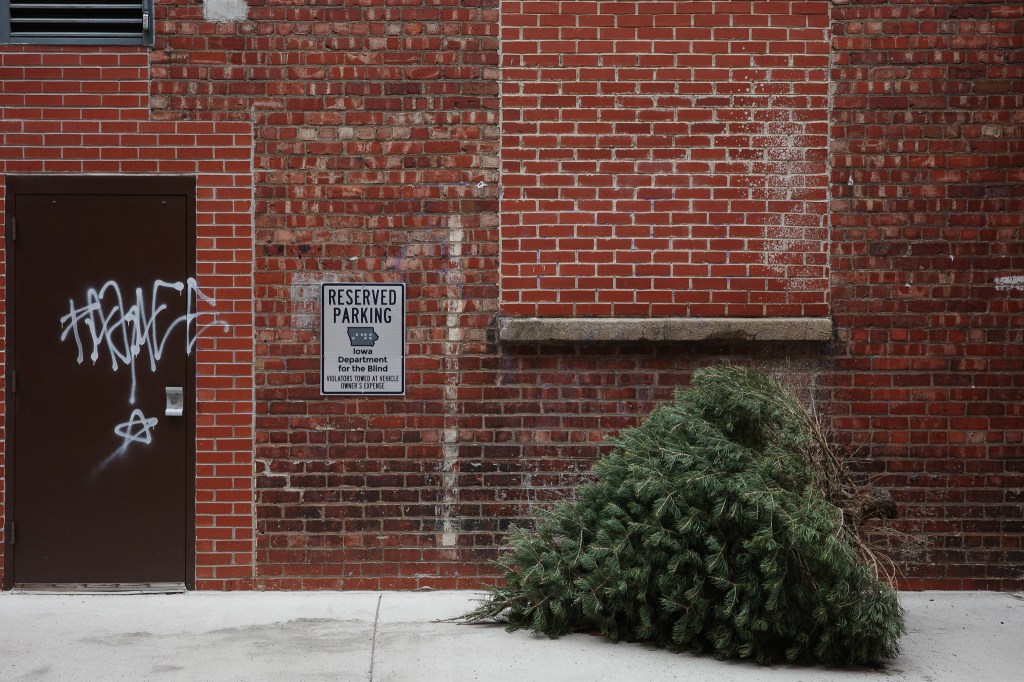
There’s most definitely emotion in Deadpan photography. It’s just understated, soft-pedaled (see note) emotion. It may be dry humor, it may be wistful, maybe a tad melancholy, or nostalgic, or any quiet emotion, but it’s there. There’s something ineffably sad about a bare Christmas tree in an alley behind the Department for the Blind.
Let me give you a better, more accurate definition (with less bullshit than my earlier definition). Here we go:
Deadpan photography examines the living world as it is; simple, without pretense, without any attempt at artfulness, without staging, straightforward, but with an eye for understated absurdity.
Think Deadpan humor with a camera. You know what? My original definition was accidentally pretty accurate. Buster Keaton was the model for Deadpan humor. He put himself in absurd positions, but never cracked a smile. It’s an acknowledgement that the world is absurd, that absurdity is everywhere, but mostly unseen or ignored. There’s something quietly absurd about a nearly religious symbol in an alleyway near a metal container for used cooking oil.
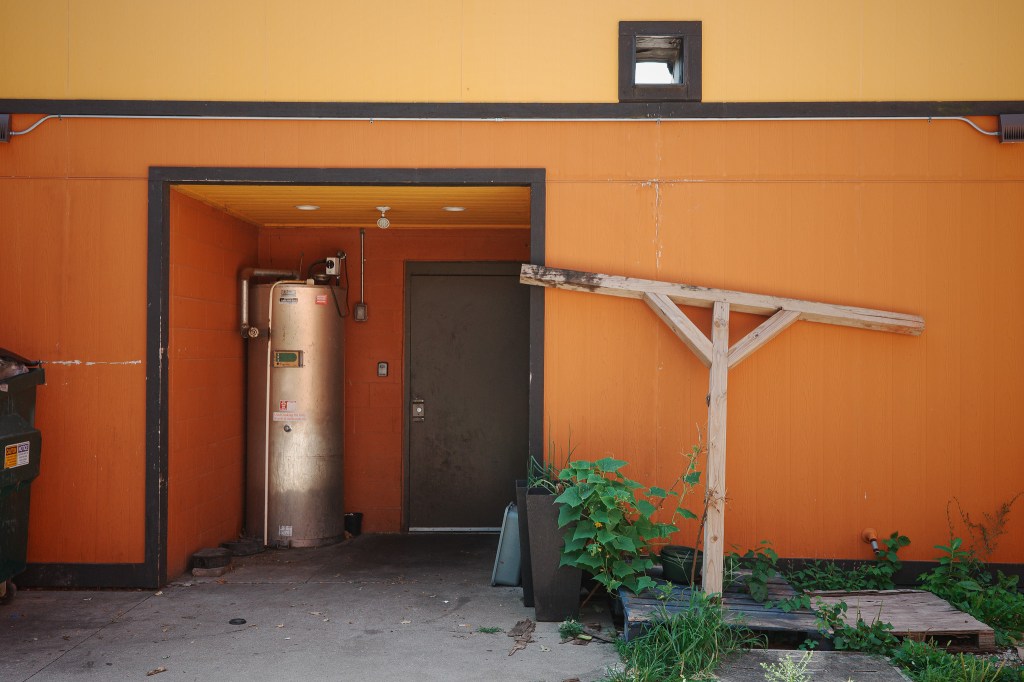
A Deadpan photograph makes you go “what?“. Not “WHAT??!!“. It doesn’t hit you over the head. It’s not farce. It probably won’t make you laugh, although it might make you shake your head a bit. Deadpan photography occupies an odd interstitial space between the very human tendency to seek meaning in life and the failure to find it. It doesn’t necessarily nudge you to ask questions, but it may make you blink and try to make sense of what you’re seeing. There’s a certain ‘What the hell?’ quality to Deadpan.

There are no rules to Deadpan photography, but there are some general similarities. The photos tend to be shot head on, straightforward, avoiding artsy angles. The lighting is generally flat and devoid of dramatic shadows. Colors are often soft, muted. Compositions are mostly somewhat formal and balanced. But those are just generalities. You can ignore all that and, if you happen across a wee church surrounded by dandelions in a decaying, semi-industrial section of a small town on a bright sunny day, you can still shoot a Deadpan photograph. I mean, what the hell is a tiny wooden one-room church with a steeple doing among those warehouses?
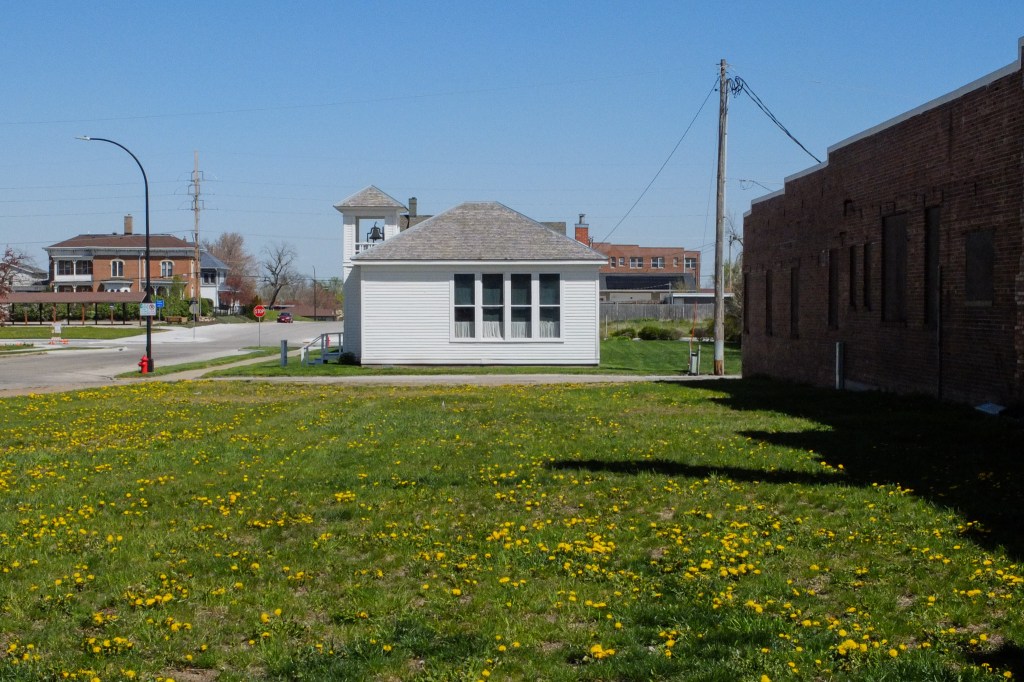
That’s te thing about Deadpan photography; photographically, it’s really simple. It doesn’t matter where you are, or what time you’re there, or whether the sun is right, or what sort of camera (or lens) you have, or whether anything ‘interesting’ is taking place. You just have to BE there and pay attention. The entire world is filled with ‘What the hell?’ scenes just waiting for a Deadpan photographer to wander by. The world you live in is going to give you stuff to photograph. All you have to do is look and see stuff that normal people are ignoring, to recognize there’s something—not wrong exactly, but not quite right—about what you’re seeing.
Then point your camera at it and take the photo.
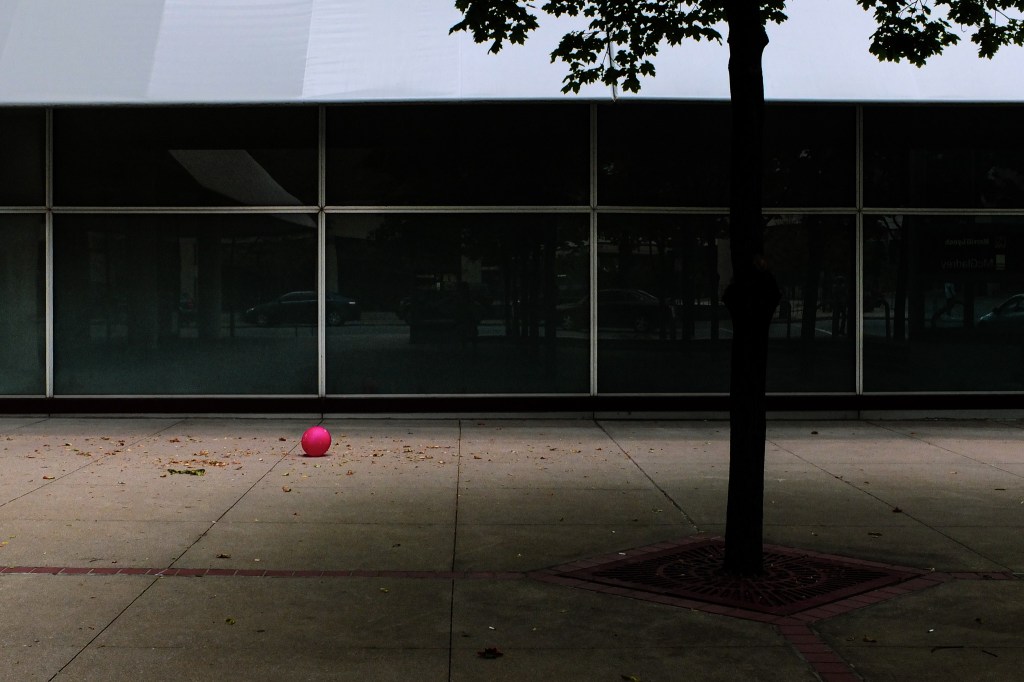
If you shoot photos regularly, you’ve probably shot some Deadpan photos without realizing it. The trick is to do it with intention. Easy peasy, lemon squeezy.
NOTE: Yes, that’s right, soft-pedaled. Not soft-peddled and certainly not soft-petaled. The lefthand pedal on a piano is the soft pedal, which is used to create a quieter, softer, more delicate tone.


Great stuff Greg. You do this very, very well. xoJ
LikeLiked by 1 person
J, I always tend to overthink stuff before I do it. Once I start doing it, I sort of stop thinking about it. Deadpan appeals to me because it’s subtle. I like the fact that people respond to it without knowing why they’re responding that way.
LikeLike
Geez, Greg, my photography is chock-a-block with deadpan photos. I didn’t know there was a name for it.
LikeLiked by 1 person
I’ve seen a lot of your photos, so that doesn’t surprise me.
What’s weird is that there’s always a name for it, whatever you’re shooting. The hard part–and for me, it’s the fun part–is deliberately choosing to shoot in a specific genre before I lift the camera.
LikeLike
This is the second piece I’ve read about Deadpan Photography in as many days. I hadn’t heard the term before. The other piece was a bit dry and I’ll confess I gave up half way through. That’s what I love about your writing. It’s engaging to the end.
LikeLiked by 1 person
Deadpan has been around for quite a while, but it seems like every few years it gets rediscovered. Most folks don’t give any thought at all to photographic genre–nor should they. Why would anybody really care about the difference between Deadpan and Snapshot photography?
The only reason I care about it is intentionality. I enjoy deliberately working in different genres. It makes me think about what I’m doing and why I’m doing it before I do it. If that makes sense.
LikeLike
Makes complete sense to me 😁
LikeLike
I didn’t know that there was a type of photography associated with the word deadpan. I just knew it as an expression of the face. Not giving anything away. Deadpan. Flat. Expressionless.
The thing I was drawn too most about the first photograph wasn’t the tree, but the “reserved parking” for blind people. Yikes.
LikeLiked by 1 person
Sue, you’re right about the term ‘deadpan.’ It originally referred to being expressionless–an absence of affect. Buster Keaton used that to heighten the effect of his comedy. In photography, it allows us to use the absence of visual affectations to heighten some unspoken emotion.
And here’s more Yikes for you. Back in 2013, Iowa’s law that limited the right to carry a gun (which is Yikes enough on its own) based on physical ability constituted illegal discrimination. So the law was rescinded and now it’s actually legal for legally blind folks in Iowa to carry a handgun. Yikes.
LikeLike