I got metaphorically spanked a couple of days ago. Folks have been talking about the Fearless Girl statue ever since it was dropped in Manhattan’s Financial District some five weeks ago. I have occasionally added a comment or two to some of the online discussions about the statue.

Recently most of the Fearless Girl discussions have focused on the complaints by Arturo Di Modica, the sculptor who created Charging Bull. He wants Fearless Girl removed, and that boy is taking a metric ton of shit for saying that. Here’s what I said that got me spanked:
The guy has a point.
This happened in maybe three different discussions over the last week or so. In each case I explained briefly why I believe Di Modica has a point (and I’ll explain it again in a bit), and for the most part folks either accepted my comments or ignored them. Which is pretty common for online discussions. But in one discussion my comment sparked this:
Men who don’t like women taking up space are exactly why we need the Fearless Girl.
Which — and this doesn’t need to be said, but I’m okay with saying the obvious — is a perfectly valid response. It’s also one I agree with. As far as that goes, it’s one NYC Mayor Bill de Blasio agrees with, since he said it first (although, to be fair, probably one of his public relations people first said it first).
But here’s the thing: you can completely agree with the woman who responded to my comment AND you can still acknowledge that Arturo Di Modica has a point. Those aren’t mutually exclusive or contradictory points of view.
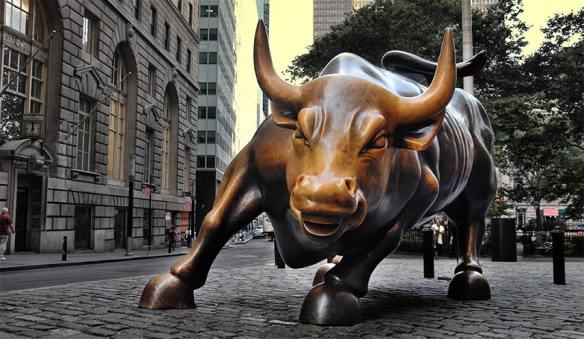
Let me apologize here, because I have to do some history — and for reasons I’ve never understood, some folks actively dislike history. It’s necessary though. So here we go. Back in 1987 there was a global stock market crash. Doesn’t matter why (at least not for this discussion), but stock markets everywhere — everywhere — tanked. Arturo Di Modica, a Sicilian immigrant who became a naturalized citizen of the U.S., responded by creating Charging Bull — a bronze sculpture of a…well, a charging bull. It took him two years to make it. The thing weighs more than 7000 pounds, and cost Di Modica some US$350,000 of his own money. He said he wanted the bull to represent “the strength and power of the American people”. He had it trucked into the Financial District and set it up, completely without permission. It’s maybe the only significant work of guerrilla capitalist art in existence.
People loved it. The assholes who ran the New York Stock Exchange, for some reason, didn’t. They called the police, and pretty soon the statue was removed and impounded. A fuss was raised, the city agreed to temporarily install it, and the public was pleased. It’s been almost thirty years, and Charging Bull is still owned by Di Modica, still on temporary loan to the city, still one of the most recognizable symbols of New York City.
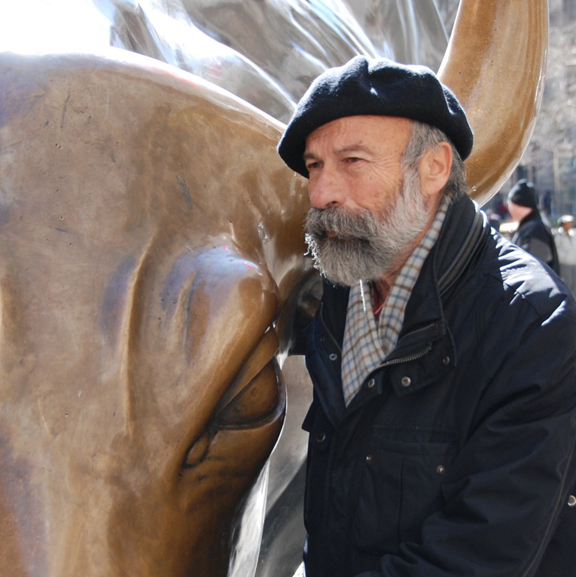
Arturo Di Modica (the one in the beret)
And that brings us to March 7th of this year, the day before International Women’s Day. Fearless Girl appeared, standing in front of Charging Bull. On the surface, it appears to be another work of guerrilla art — but it’s not. Unlike Di Modica’s work, Fearless Girl was commissioned. Commissioned not by an individual, but by an investment fund called State Street Global Advisors, which has assets in excess of US$2.4 trillion. That’s serious money. It was commissioned as part of an advertising campaign developed by McCann, a global advertising corporation. And it was commissioned to be presented on the first anniversary of State Street Global’s “Gender Diversity Index” fund, which has the following NASDAQ ticker symbol: SHE. And finally, along with Fearless Girl is a bronze plaque that reads:
Know the power of women in leadership. SHE makes a difference.
Note it’s not She makes a difference, it’s SHE makes a difference. It’s not referring to the girl; it’s referring to the NASDAQ symbol. It’s not a work of guerrilla art; it’s an extremely clever advertising scheme. This is what makes it clever: Fearless Girl derives its power almost entirely from Di Modica’s statue. The sculptor, Kristen Visbal, sort of acknowledges this. She’s said this about her statue:
“She’s not angry at the bull — she’s confident, she knows what she’s capable of, and she’s wanting the bull to take note.”
It’s all about the bull. If it were placed anywhere else, Fearless Girl would still be a very fine statue — but without facing Charging Bull the Fearless Girl has nothing to be fearless to. Or about. Whatever. Fearless Girl, without Di Modica’s bull, without the context provided by the bull, becomes Really Confident Girl.

Fearless Girl also changes the meaning of Charging Bull. Instead of being a symbol of “the strength and power of the American people” as Di Modica intended, it’s now seen as an aggressive threat to women and girls — a symbol of patriarchal oppression.
In effect, Fearless Girl has appropriated the strength and power of Charging Bull. Of course Di Modica is outraged by that. A global investment firm has used a global advertising firm to create a faux work of guerrilla art to subvert and change the meaning of his actual work of guerrilla art. That would piss off any artist.
See? It’s not as simple as it seems on the surface. It’s especially complicated for somebody (like me, for example) who appreciates the notion of appropriation in art. I’ve engaged in a wee bit of appropriation my ownself. Appropriation art is, almost by definition, subversive — and subversion is (also almost by definition) usually the province of marginalized populations attempting to undermine the social order maintained by tradition and the establishments of power. In the case of Fearless Girl, however, the subversion is being done by global corporatists as part of a marketing campaign. That makes it hard to cheer them on. There’s some serious irony here.
And yet, there she is, the Fearless Girl. I love the little statue of the girl in the Peter Pan pose. And I resent that she’s a marketing tool. I love that she actually IS inspiring to young women and girls. And I resent that she’s a fraud. I love that she exists. And I resent the reasons she was created.
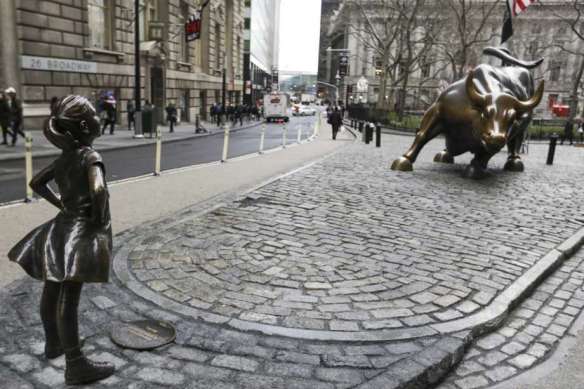
I love the Fearless Girl and I resent her. She’s an example of how commercialization can take something important and meaningful — something about which everybody should agree — and shit all over it by turning it into a commodity. Fearless Girl is beautiful, but she is selling SHE; that’s why she’s there.
Should Fearless Girl be removed as Di Modica wants? I don’t know. It would be sad if she was. Should Di Modica simply take his Charging Bull and go home? I mean, it’s his statue. He can do what he wants with it. I couldn’t blame him if he did that, since the Fearless Girl has basically hijacked the meaning of his work. But that would be a shame. I’m not a fan of capitalism, but that’s a damned fine work of art.
I don’t know what should be done here. But I know this: Arturo Di Modica has a point. And I know a lot of folks aren’t willing to acknowledge that.
 gregfallis.com
Actually, he doesn’t have a point. You bring up interesting points about the provenance and placement of the new sculpture. You have a point. But he doesn’t.
Once art is out in the public realm, artists lose, and should lose, control if the meaning of their work. They can give interviews, write artist’s statements, speak publicly, etc., but they don’t get to control the interaction of other people with that art. They don’t get to protect that art from criticism, or in this case, from artistic reaction. He was one-upped. There was an effective, and transformational commentary on his art. He can answer back, but he doesn’t get to ask for the removal, and thereby the censorship, of that commentary.
And now, the place where your point gives me historical pause. Art of this scale and public positioning has, historically in the western context certainly, almost always been sponsored by powerful forces. Indeed, that’s sort of their point, and analyzing that, as I think your piece does nicely, is a central part of doing art history. Commissioned art isn’t any less art, even if one is queasy about the commissioner.
LikeLiked by 3 people
My response if I were him would be to create another statue to replace his Charging Bull.
A couple of Parents for example walking the other direction but looking kindly back at the girl with a hand held gesture trying to get her to come along.
That plaque could read; “America is a family, and family can overcome any adversity.”
With reference to how the US citizens rallied together in unity after the 11th Sept and moved forward.
LikeLiked by 2 people
Or leave the bull and put the parents of to one side ushering the girl to them worriedly, with a plaque “Sometimes confidence can be dangerous.” Then sue the fund for appropriation.
The message isn’t a good as my previous suggestion but it does allow for expansion.
LikeLiked by 1 person
There a demotivator which has a car driving towards a huge tornado. The caption is: “Perseverance. The courage to ignore the obvious wisdom of turning back.”
LikeLiked by 3 people
This is an insightful read. It’s always important to attempt to look at issues from different perspectives.
LikeLiked by 2 people
If the bull is supposed to represent “the strength and power of the American people”, why should it be in the financial district? Why not in some park or museum or some other public place?
If the argument is that it represents the financial strength and power of the American people – well, nearly 70% of Americans have less than $1,000 in savings. Seriously, it needs to be replaced by a statue of a dead bull!
LikeLiked by 2 people
It’s in the financial district because it was created in response to the Stock Market crash, which is something that would have happened in the financial district.
LikeLiked by 2 people
Honestly what bothers me is that it’s an advertisement. If it was purely an art piece, one that co-opted the existing art piece that would be fine, laudable even, but it’s an ad that’s co-opting art which doesn’t sit right. Don’t we have enough ads already? Ads pretending to be articles. Ads pretending to be news. Ads pretending to be reviews. And now? Now we have Ads pretending to be art. Even worse it’s an ad that’s actually detracting from an existing art piece by co-opting it. It’s effectively negative art, where there used to be one piece of art, there is now a single ad.
Honestly what would be amazing is if someone stole the fearless girl statue and replaced it with a fearless woman statue, one actually created as a gorilla art piece and a statement about gender equality instead of as a pandering piece of advertisement.
LikeLiked by 3 people
Art has been used as advertising for years. Michelangelo received the commission to paint the Sistine Chapel ceiling because Pope Julius II decided to scale back on a huge sculpted memorial… to himself. (OK, maybe that is ego, rather than advertising, but still.) Toulouse Lautrec is famous for his advertising art. More recently, Adidas has commissioned several pieces of street art, as advertising, as have competitors Converse and Nike. Ditto for Frank Frazetta’s work is lauded… yet many of his pieces were associated with the covers of fantasy schlock novels. In 1939, Salvador Dali created window displays for Bonwit Teller, and in 1961, Andy Warhol embarked on the same sort of work.
LikeLike
If I were Di Modica I would simply turn my bull around, point the bull’s rear end at the Fearless Girl, simply ignoring here. That is what a majestic bull does when confronted with non consequentials.
LikeLiked by 2 people
Intelligently beautiful. The ‘scene’ begs for a third statue. The Bear, in a Circus skirt and clown hat.
LikeLiked by 2 people
He should take his statue and turn it to a different angle
LikeLiked by 2 people
First of all, I would not buy the noble idea that the Charging Bull was a guerrilla art – look how eagerly Di Modica sues anyone who uses bull’s image, claiming his share of possible benefits or observing his rights.. that goes into no comparison to, let’s say, Banksy’s. And before that, one just gets his own $360K after widespread financial crash and makes a statue, then goes around telling it was about “strength and power of the American people”, seriously? Knowing what bull image symbolizes in financial markets, must be the Wall Street people, right? Or the ones who prostrate before grown up Golden Calf? The girl part is just a further iteration of the joke.
Putting all aforementioned aside, Di Modica of course has a point – the girl is too close. Flipping girl, so she faces away, would still alter the original artwork, however it might have beneficial effect for everyone involved.
LikeLiked by 2 people
Honestly what bothers me is that it’s an advertisement. If it was purely an art piece, one that co-opted the existing art piece that would be fine, laudable even, but it’s an ad that’s co-opting art which doesn’t sit right. Don’t we have enough ads already? Ads pretending to be articles. Ads pretending to be news. Ads pretending to be reviews. And now? Now we have Ads pretending to be art. Even worse it’s an ad that’s actually detracting from an existing art piece by co-opting it. It’s effectively negative art, where there used to be one piece of art, there is now a single ad.
What would be amazing is if someone stole the fearless girl statue and replaced it with a fearless woman statue, one actually created as a gorilla art piece and a statement about gender equality instead of as a pandering piece of advertisement.
LikeLiked by 2 people
I especially liked how this commentator specifically discusses how one can have complex, nuanced views on a subject without having to take an all-or-none position. This ability and willingness to delve into history and complexity is key in our society, where we are constantly bombarded with propaganda that is posing as news, designed to force people onto a fixed position on a dialectic (such as “you’re either for the war or you are for the terrorists”).
LikeLiked by 2 people
She needs a teddy bear under her arm. That would be poetic.
LikeLiked by 2 people
You know what, just turn the bull 180 degrees… Hey presto, completely different symbolism…
LikeLiked by 2 people
Not a fan of capitalism. Ironic, since capitalism gave us the means and wealth to sit and appreciate the circumstances of such things. The working class didn’t appreciate art until the 20th century, only the socially elite did. Now, most of us enjoy the time and perspective for deep thought and appreciation of the world around us. I.E. We can now dislike the means to which we attained the means to appreciate such things.
LikeLiked by 2 people
I really appreciate the historical context provided here, and the surprising background of Fearless Girl that I also did not know. Although all of that helps me sympathize with Di Modico, deeply, I wonder if he’s still holding too tightly to the context of Charging Bull 30 years ago and not seeing its how its context has shifted today. Certainly that is his prerogative, but just as people and cities and narratives are not static, neither is art. His art exists in a different context now than when it was first created. That doesn’t change its history or what it meant then, but it would be incorrect not to acknowledge that the economic state now is not what it was. Perhaps Wall Street now needs Fearless Girl just the way it needed Charging Bull in 1989. I am definitely disappointed by the marketing ploy for SHE, though.
LikeLiked by 2 people
This might be a goofy solution, but they could turn the bull away. That way the bull is more a manifestation of fearlessness and strength. Both of them would be confident and fearless and strong going ‘forward’ and Arturo Di Modica would get a nice smug closure.
LikeLiked by 1 person
Or, that the girl has scared the bull and now it has done an about-face to run away.
LikeLiked by 1 person
I agree wholeheartedly. Thank you for the explanation. As you explain it, this girl actually becomes a tool of the corporate status quo! Her power is being undermined for their purposes. It is only inspiring to little girls when the do not know the truth. We must be willing to let go of the superficial Pollyanna illusion and stand for the TRUTH. Women: IT’S OUR MOVE. We are being played!
LikeLiked by 2 people
I haven’t scrolled through all of the comments (so it is possible I’m missing some here), but it surprises me that no one is talking about The Fearless Girl as a marketing tool. This is massively disappointing to me because, unlike the bull, or whether or not the works change each others power dynamic, the fact that she was commissioned as a marketing piece speaks to a much heavier betrayal and appropriation in this story. A stupidly wealthy investment fund has decided to use the renewed national conversation/attention around protest, women’s rights, the poor, and subverting systems of power, to advertise a fund, in the very system that everyone views the bull to represent. That is sick; and now all I see is bull when looking at The Fearless Girl.
LikeLiked by 4 people
No, he doesn’t. I mean, seriously, the man who used guerrilla art tactics to make his point is angry that someone else (even if a company was behind if) did the same thing? He needs to open his mind, get over himself, and realize that art not being static is a good thing.
LikeLiked by 2 people
What to do? Announce a competition every five years, a challenge to all the world’s sculptors to come up with a proposal for a sculpture which once again and again changes the whole meaning of the sculpture groupe and let it grow until the square is full!
LikeLiked by 5 people
Replace the bull with a father pointing to his watch, telling her it’s bedtime. That would be about right.
LikeLiked by 2 people
No. Remove the ‘Fearless girl’ and make a ‘Charging Girl’ that rides the bull to battle
LikeLiked by 2 people
The charging bull and the fearless girl should face against the Wall Street building. They both represent the strength of the people, not working against each other.
LikeLiked by 10 people
This is very interesting. It is slightly misleading, though. You are trying to imply that the artist who originally installed the bull represents the little guy, the independent artist. He just happens to be an independent artist who had $350,000 of his own money to spare in the early 80s? I’m a little suspicious of that. Both pieces of art promote capitalism and are created by powerful players in capitalism, one is a corporation another is an independently wealthy individual. Is one more pure? Can one really be separated from the other? Not really.
Also, you imply that the little girl completely transforms the meaning of the bull. She is not completely transforming the meaning. She is making some of its meaning, meaning that as people immersed in a male dominated world we don’t even recognize. A bull is not just a strong animal who represents the strength of the American people. A bull is a symbol of masculinity. Should the strength of the American people be represented by a bull? I don’t blame the artist for being upset at the way his art is being interpreted, but this is what happens when you put art out into the world. People read it and respond. You do not get to control that part.
LikeLiked by 11 people
The difference is that Di Modica wasn’t trying to sell us something. Fearless Girl is an advertisement, pure and simple, it’s no different than the ads being shown on TV, it’s just doing a better job at pretending to be something else. People should be furious at the way this Wallstreet firm is pandering to them, not applauding them. Fearless Girl isn’t a statement about gender equality or a pro-feminism statement, it’s a slick gorilla marketing campaign by a corporate behemoth who’s identified a market segment they want to capture.
LikeLiked by 3 people
Does it really matter though? Both works have been transformed away from it’s origins that few know about. The bull is now an ad for Wall Street and the girl is now a feminist icon.
LikeLiked by 3 people
But he is trying to sell us something. He’s trying to sell us the idea that the people of the United States are represented by the interests of capitalism in general and financial capital in particular. That’s a pretty contentious idea whether you agree with it or not.
Personally I find both works trite and didactic with little to recommend them from an aesthetic point of view. Even Banksy’s over-rated shtick is more thought provoking these two paeans to naked greed.
LikeLiked by 3 people
But how effective of a marketing campaign is it, and has the general response to it been related to that marketing campaign? In all of the stories when it showed up how often was the SHE fund mentioned? When people go to look at it how many of them are walking away thinking of the SHE fund? Is its cultural place defined by the original intent of its funding or by what the everyday person on the street comes away from it with?
LikeLiked by 2 people
Pretty lousy ad though since practically no one knows it’s an ad or what it’s advertising
LikeLiked by 1 person
I would argue that your commentary , musing about if the bull , a male animal, should represent the strength of the People; indeed the Statue of Liberty is a Female piece; a piece associated distinctly representing the US as a female strong presences of Truth, Liberty, Justice…all Strong ideals we associate our country with. I see two pieces of art, representing a male and female presence and no one is taking exception to Lady Liberty, well then, I find the bulls maleness to be a moot point.
LikeLiked by 2 people
I’ve read through the comments, and so far there is one massive point that no one has brought up.
He planted his bull statue illegally, on city-owned (taxpayer-owned) property. The girl was planted legally, with the required permits up front. Now he’s throwing a hissy-cow (credit to Steven Brust for the term) over another statue placed (legally and with a 1-year temporary permit!) nearby.
Let’s suppose I come to your front yard and plant a massive piece of my art right in the path to your front door. I don’t ask for your permission first, but the neighbors seem to like it, so you grudgingly allow it to stay… Then I turn up and start telling you that you can’t have any other yard decorations unless I like them, and that I now have a say in what color you paint your house, because wrong colors might distract from my art.
How do you feel about my art piece now? Now that I’m issuing demands do you regarding your personal property?
If he wants that sort of control, to the extent of demanding other, legally permitted art can’t be near his illegally planted art, he can take his stupid bull and put it on his own property, or in a museum willing to put up with his bullshit.
That’s my take on it all, as a taxpayer.
LikeLiked by 6 people
Yeah – no-one cares, this is about art not legality, and I’m guessing you don’t pay a single cent to the upkeep of the statue so…
LikeLiked by 4 people
We’re not talking about someone’s front yard, so your point doesn’t apply.
LikeLiked by 4 people
That is one take. But considering that the bull has been there for thirty years, it’s a rather tenuous one.
LikeLiked by 2 people
He placed it illegally initially and then it was removed, which was met with disapproval. It’s current placement is perfectly legal because it’s officially on loan to NYC.
LikeLiked by 2 people
He placed it illegally, it was removed, and then after an outcry of the citizens it was re-set LEGALLY.
LikeLiked by 2 people
Art is the point here, not legalities
LikeLiked by 1 person
Reblogged this on Victor T. Cypert's Spectacular, Tentacular Spec-Fic Roundup and commented:
Brilliant.
The symbolism of cowing the bull–the symbol of prosperity–seemed inauthentic to me. There were better choices for communicating the strength of women than this hot mess.
Why not a cowgirl statue, maybe riding alongside the bull and getting it to go where she wants it to go?
It’s pretty clear that it’s an ad campaign. The symbolism was all wrong. That’s marketing for you, folks.
LikeLiked by 4 people
I agree. Fearless or not, that girl’s getting killed by that bull just as soon as motion resumes.
LikeLiked by 2 people
I enjoyed reading this informative article and the comments below. My first reaction to the fearless girl statue was not positive. I still don’t like it and agree that it should be removed because it totally alters the original message of the bull. Fearless girl isn’t helping the cause of feminism at all. In fact, I think it hurts it because it makes females look stupid. On the surface, anyone would be crazy to stand in front of a charging bull (bullfighters aside, though I suspect they are a little crazy).Metaphorically to me, the bull represents a bull market surging forward. Given it’s location on Wall Street, I would think that’s the most common interpretation of the statue. In general, a bull market is good. It represents growth. Why would anyone be opposed to that? Now, the message is either “I’m a girl and I don’t like economic growth” or “stand up to male dominated big money.” I understand that many Americans feel that the stock market is out of reach and that it is the exclusive territory of 1 percenters, but that simply isn’t the case. I’m not wealthy at all, but I recently invested in stock for the first time. The most expensive stock I own is 13 dollars a share. I hope Fearless Girl doesn’t scare off the bull because I’d really like to see my 13 dollar investment pay off someday.
LikeLiked by 1 person
I do not agree at all with Matt – I love the juxtaposition of the two statues. I think it is a stroke of brilliance. Nor do i even see the girl as white – to me she looks universal – any colour. And I think it absolutely sends a feminist message. Women around the world do not benefit from globalisation and corporate power – it is one of the biggest concerns about development, both economic and social. Growth is not always good. As I have said on this thread before – they together are are intriguing, make many different narratives and clearly excite interesting and articulate debate. What more can we ask of art?
LikeLike
I would turn the bull around
LikeLiked by 3 people
Or move the bull. Have the girl face nothing. Put the bull to the side of the girl so it looks like she’s bravely facing forward, ignorant of the danger approaching her. Reappropriate the appropriation.
LikeLiked by 1 person
it should remain as is to continue the dialogue. It’s very thought provoking. I’ve enjoyed reading the different opinions. It’s art, whether it’s guerilla or commissioned, both is doing its job.
LikeLiked by 5 people
One is art; the other is advertising cleverly designed to manipulate the viewer and appear as art.
LikeLiked by 1 person
Di Modica used $350,000 of his own money, in 1987, after the market crashed, and we’re supposed to buy it as a work of guerilla art? Sounds to me like both works are manifestations of the will of the 1%, one just promotes a profoundly 80s sensibility, the other reflects corporate co-opting of social movements for marketing purposes.
LikeLiked by 2 people
It’s hard to find much about De Modica that doesn’t seem to originate from his own PR, but:
He apparently had a career as a sculptor before the bull statue. He bought property in SoHo 1979 to build his studio. This was right at the tail-end of SoHo’s rebirth. At the beginning of the decade SoHo was dead and dark, drained by a years-long exodus of industry and residents to the suburbs. Artists lived and worked in low-rent (or no-rent, as squatters) lofts. De Modica was among them, having settled there in 1973. By the end of the decade SoHo had been remade, with art galleries, restaurants, and other businesses. Shortly thereafter, fueled in part by speculation and excess, but also by fundamentals, real estate prices started a steady rise.
His purchase of the land for the studio was likely financed with a mortgage, and the bull may well have been financed by a loan against a decade’s appreciation of the property.
In short, while De Modica clearly had some resources at his disposal. But like other artists in SoHo at the time, it seems his story could easily be that of an artist who managed enough success to qualify for a mortgage, to get a toe-hold in the middle-class, and the good fortune to see his investment in his own livelyhood appreciate at a rapid rate.
I’m sure he worked hard and took risks, but he also had the good fortune to see outsized rewards for his efforts. Whether or not he sees it that way, he’s still an artist who created a piece of art and plopped it down in public, without permission.
LikeLiked by 1 person
I think we should make a particular point of making sure SHE fails apically. If the Girl had been put there for genuine, uplifting reasons than the story would be different. But she is nothing more than a (very) clever marketing ploy. Two things need to happen. We need to make sure everyone knows the TRUE reason for the Girl, so a false legend is not created. Second, we need to teach people what the REAL meaning of the Bull is, and why it was created. I always saw it as a symbol of the corruptions and greed of Wall Street until I was educated to its real meaning. Many will go on believing the the Girl is a symbol of gender equality, when in fact it was created by a corporation run almost entirely by men, that pay their female employees less than their male counterparts. Look up the profiles of some of the leaders of the corporation and it is blatantly clear some of the are openly misogynistic. Using art to sell things is timeless. Using art to lie to the public about the true intention of the symbol is both underhanded and reeking of disrespect. Not just to the Bull’s artist, but to the women out there that are being duped. I can just see the aforementioned men sitting back, sipping their $600 bottle of whiskey and laughing about the whole thing.
LikeLiked by 2 people
The REAL meaning of art is not the creator’s intention but what the audience takes from it.
Which is not to say that you are wrong to call for wider acknowledgement of the original intentions, just that the meaning of art can change, and cannot be controlled.
LikeLiked by 2 people
Not a fan of capitalism, yet the artist was commissioned. That’s capitalism at its finest. If the commissioner wanted to display it in his/her bathroom, it is his/her prerogative. It’s is whining from your part and not art appreciation (unless the ‘owners’ do only what you want them to do). Hypocrisy much?
LikeLiked by 2 people
If they leave the Fearless Girl statue and take back the plaque after a while so it’s no longer advertising, would it really be so bad that the Charging Bull’s meaning has changed over time as people need to address different issues now than they did then?
LikeLiked by 2 people
There is a very simple and easy solution to all this. Make them face the same way. The Charging Bull and the Fearless Girl standing together. This solution will send a message that is worthy of Modica’s original message and at the same time add an entirely new meaning to the commisioned art that is the Fearless Girl.
LikeLiked by 2 people
This has all the signs of I am losing so I will take my ball & go home Di Modico did something wrong NYC let it stand Now someone else did the same thing as he did and to him it is taking away his limelight.
It doesn’t matter what the Fearless Girl means let her stay It will be another tourist site
LikeLiked by 2 people
Thank you for this. I didn’t know the history behind either statue – just what I’ve heard on TV or read on new sites. Appreciate being made smarter on this issue.
LikeLiked by 3 people
Once released to the public, the intentions of the creators of a piece of art become secondary to the meaning the viewers see in it. The message can be easily altered by time and circumstance, lauded or condemned concurrently or consecutively. The message of the bull for many today (the 99%?) is one of being trampled in the aggressive pursuit of profit by large corporations. It wasn’t always so, but Occupy Wallstreet shone a spotlight on the harm caused by the business and financial industry playing money games with people and the environment.
So regardless of the intentions behind Fearless Girl, the people are claiming her as their own, a symbol of the power of the “little” people the stand up to the corporate giants. Both artists can now rightly complain that the meaning of their artwork has been altered but as that follows the interpretive nature of art, nobody has to give a damn about either their original intentions or their objections.
LikeLiked by 4 people
That simply is not the case. First, while the artist cedes some control, to claim that their intentions are secondary has no foundation, especially when the object is still owned by them, and can be moved, changed or removed by them at will.
Second, while the public at large may have no knowledge of the actual intentions behind “Fearless Girl” the people to whom the marketing message is intended most certainly do.
Which is why the claim that “both artists can now rightly complain that the meaning of their artwork has been altered” misunderstands the reality. “Fearless Girl” is working EXACTLY as intended as it is perceived by the original intended audience. The perception of the public just lends it added notoriety.
LikeLiked by 1 person
Loved your explanation. I read it to my husband and he suggested Di Modica should just turn the bull around, and put some bronze droppings behind it! Sorry…much ado about nothing… someone should just add the history on a sign beside the girl. Maybe that would help…or move the girl!! I’m with Di Modica!
LikeLiked by 2 people
Fearless girl should be placed NEXT to the bull. Imho.
LikeLiked by 3 people
Agree with DiModica, the Feraless girl statue only exists when it’s put next to his art. What I disagree with him on is the meaning behind the Charging Bull. I get the history, what it means to him and what it meant when it got installed. However, I would argue that the meaning itself has shifted over the years and people asosiciate the bull from “the America people” to “rich, crazy, Wall Street”. After all, if we had to ask the country to take a survey before the fearless girl statue was installed, I think more people than not would have a negative association with the bull. All that said, I think his argument that the girl requires his statue is accurate but not the argument that it distorts the bull’s meaning.
LikeLiked by 2 people
What if he turned it 180 degrees?
LikeLiked by 2 people
An interesting commentary, thank you for sharing the “his-story”. Equally interesting that the artist wanted the CHARGING BULL to be a symbol of the strength and the power of the American “people”…although traditionally the bull is a sign of male fertility and oft destructive, strength. Perhaps this commissioned work, albeit a clever marketing strategy, actually illuminates that the strength and power of the American people might just lie, in part, in also recognizing the contributions of women. In particular, that the commissioned piece deliberately chose a young girl is mockingly clever. The discomfort that arises is perhaps, again, only in part, a necessary growth experience when one uncovers an expressed unconscious bias. And yes, there are several more layers of privilege to uncover here…”a Peter Pan” stance, really, now? Does one have to evoke “maleness” (Peter Pan is often a less than flattering description and often implies weakness) even in the description of the child’s integral determination. And yet, what I find hopeful about all of this is that we are awakening to the biases, conscious and unconscious, that have in the past, and are currently keeping us shrouded in veils of separation and dominance. The hopefulness of this is inspiring. We need strength of character, warmth, integrity, a harnessing of power, inclusiveness, compassion and true presence to begin to listen deeply to each other and to see things clearly in order to co-create a future that supports humanity. Thank you for having the courage to express your view and to catalyze this conversation.
LikeLiked by 2 people
There is a hidden capitalist discourse in this discussion, and it’s about private property when faced with the public nature of art. The central value of the bull statue is to be placed at a public space. Unfortunately, as you can’t have your cake and eat it to, the sculptor can’t place the statue at a public space -where it acquires it’s current artistic value- but keep control over what people see in it, nor can he demand that public space will not be intervened and distort his original intention. That is part of the public domain, he doesn’t own it. If he intended people to see in the statue only what he wanted, perhaps he should have kept it away from the public, only to be seen under his careful guidance. But when he decided to place that statue where it is, he lost ownership, he lost control (which is what private property is about, control). He might still legally own the physical structure and -in a very typical childish reaction to reality- he could remove it in an attempt to prevent things from happening when they don’t go like he wanted them to. But that will not change the fact that the symbolism of the statue to the public is not and never was his; it is a public construct that he can’t own. And the same logic applies to Fearless Girl. I also resent that it originated as another appropriation from the publicity industry of relevant societal values. But the industry doesn’t control what people see in Fearless Girl, and I think very few people see in that statue a message for investing on a certain fund, or even the relevance of having women in finance. What most people saw -and see- in that statue, which was installed on the eve of International Women’s Day, is that women are powerful, and they could confront even the most arrogant and conceited of forces; that of the markets. And even the hidden symbolism and irony of that message deriving from a marketing campaign is so interesting, so revealing of our current times, I’m not so sure I resent it.
PS: For the grammar Nazis, I’m not an English native, so I apologize for any typos.
LikeLiked by 3 people
I think some people just like to hear themselves overthink out loud lol
LikeLiked by 2 people
He does have a point, but … A) you lost me at “fraud”, B) so what? It’s inspiring to millions, and whatshisface will get used to it.
LikeLiked by 2 people
someone played that well and made some coin as an artist brilliant(i hope it was a women i should research that). and love how it has taken something that has been miss interpreted as not what the artist intended and made it into something knew, a powerfull symbol that still represents america as he intended but bigger and in context with today. as it struggles within its self. this young girl looking to the future standing confident taking on the bull before her to make change to make her mark on the day! not just here but all over the world, it has taken it from a symbol of a america to a symbol of america and the world as a whole, and prolly one of the best corprat atemps at art and has taken the artists peic and elevated it to a new lvl cntinueing a dicsuion witch is art!
and he has every right to be pissed but its art plz dont take u bull away sir
a dude from canada
LikeLiked by 2 people
He should move the bull and put it at her side. The two, togeather, as a team.
LikeLiked by 2 people
Replied to this on FB… thought I would share here
“The mistake here, to me anyway, is that art is not owned by artists…. sure, an artist may have an intent on making art, a person commissioning an art piece may have their own reasons for art and a buyer can surely purchase and hold physical ownership to art…
However…
Once art is seen, everyone who see’s art is going to bring their own meaning to the conversation. Art is ever evolving as more and more people see it and either as individuals or as a collective, they may see it as holding a specific meaning. Art may have begun with one intention but it continues with many meanings and feelings and belongs to everyone who experiences it.
It seems to me, these pieces of art, once joined, have evolved to mean something quite different… quite unintentional, it seems, as a pair.”
LikeLiked by 2 people
Sadly, this is a common occurrence now. We used to be a nation that could disagree without everything having a nefarious motive. Not so much now. If you express ANY agreement with ANY point that counteracts somebody’s politics, with frightening frequency, they will attack you. America’s continual polarization makes us increasingly unable to see anything but binary choices. If you think this artist has a point (and he does…even though, like you, I love the message from the girl), then you’re a sexist. I gave money to HRC and have obliterated President Trump daily since his election. I said he was right when he used cruises missiles on Syria, and I got DESTROYED by people who are on my political side (“stfu” was a common refrain and I got called a “Trump supporter”), even when I noted that Hillary Clinton said we should bomb SIXTEEN Syrian airfields, not one. Flip the pancake. Show somebody who used to crap on President Obama for playing golf the side-by-sides with Trump, and now you don’t support America. A tragic amount of America processes every social media comment like this: “Before I spend a millisecond to delve into the logic, is the general sentiment expressed by this person completely in line with my view? No? Well, f ’em! He/she is a (racist/sexist/xenophobic/homophobic/ageist/nazi/fascist/communist/libtard)!” I seriously don’t know how we maintain our nation is we all don’t look hard in the mirror. Good article though! The analogy I used was of an artist concerned about police brutality who paints a mural that shows a young black man with a cop on his back on the pavement surrounded by ten other police. Somebody else paints a mural next to it that expands the vista to show more police bagging up an insane amount of guns and drugs, thus making it seem as if the arrest and show of force is completely proportional to him being a kingpin. You mean to tell me you wouldn’t feel bad for the original artist? I would. And if you don’t feel bad in this circumstance, it’s probably because you love the message so much, you don’t care about what he thinks. But that’s doesn’t mean he doesn’t have a point. It just means, like so many in America, you aren’t hearing it.
LikeLiked by 2 people
There are unspoken assumptions here that the bull is some sort of universally-accepted good art, and that it is loved by all New Yorkers. Neither is true. In fact it might be art, but many, myself included, think it is at best kitsch, on a level that makes Jeff Koons look like a genius. And tourists surely love the bull, but New Yorkers I know either don’t care, or tolerate the thing as a kind of joke that has been going on an awfully long time by now. Which is how we are about just about everything. I’d say we love the fact of the bull, but the bull itself is of no particular interest.
For reference, I work a few blocks south of there and I haven’t looked at the statue in years. Once you’ve seen it, you’ve seen it. Seeing it again doesn’t add anything to the experience. That alone makes it fail for me as art, and even as architecture. It’s just a bit of decor.
People discuss it as a symbol of hope, power, and refusal to budge, representing some sort of American spirit that suffuses New York and the nation. The fact is that the number of pictures tourists take standing by the bulls testicles, which are polished to a bright shine by the constant attentions of the public, outnumbers the number of pictures taken at the front of the bull by something like five to one. Or is it ten to one? I forget. The bull is a gauche novelty, and the public loves it for that. It’s not a symbol of power and unity. It’s just goofy.
Yes, the Girl is a commissioned piece, and so what? Nearly every classical sculpture and painting you will ever see in a museum, and scads of modern pieces as well, was commissioned by the Catholic church, by an oppressive noble, by a coporation, or by a vain rich man. Art has always been a conversation between the oppressive urbane interests of rulers and the creative impulses of artists. The girl is not some sort of sneaky scheme created by shadowy interests; it is art paid for by a corporation. Nearly every piece of public art on the New York streets is exactly the same, EXCEPT for Di Modica’s bull. Does anyone really think that SHE has suddenly begun to sell more shares since the sculpture went up? No one really knows who the funders are, or what they do. They’re not selling anything. It’s corporate art, backing a humanist cause in a time of crisis. It’s actually, I would argue, a pretty spectacular example – and a rare one – of how corporate art can be relevant and strong, and a benefit to the public.
And let’s be clear: the Bull is also an economic piece, it’s just not a commission. Di Modica has made his living and his reputation off it. It wasn’t some sort of casual beneficent gift. It was a career move, and I suspect he’s using the girl now to insert himself back into public attention because, well, let’s face it: he has not been relevant in any way since he first dropped the bull, and I can’t find any indication that he has ever made any other even remotely interesting piece of art that isn’t a variant. The bull itself is barely art, and is interesting only because of where it is and how it got there. As a sculpture it’s a well-crafted waste of time. Di Modica was originally going to make five of them for five cities; he only made one other, the Bund Bull, which is in Shanghai (and was commissioned, and unveiled in 2010).
For my part, I really hope he does trundle out in the middle of the night and take it away. Good riddance. And I hope the Fearless Girl stays after, looking out over the bad-tempered empty ground where a folly of ego, arrogance, and entitlement had to cede the field in a fury, simply because she was there.
LikeLiked by 5 people
You’re completely missing the real question that this post asks.
Why is Wall Street so eager to embrace this “humanism” as you put it? The post is telling you that they’re trying to give the statue a new meaning by paying for another statue to be placed across from it. Why do they want to see that new meaning, and what’s their real goal?
Can you get your head far enough out of Manhattan to see what’s really going on here? Notice who won the election last year. Notice what America really looks like in 2017. Cui bono, hombre?
LikeLiked by 2 people
excellent points.
LikeLiked by 1 person
“It was a career move”
Yeah. It’s a piece of art. Made by an artist. It’s sort of what they do: make art. One could just as easily dismiss any sculpture, painting, film, etc. as “Oh, it’s just a career move. It has no merit of its own. The artist is just trying to get his name out there…” …you know, if one was as cynical as you, anyway. That’s a good look for you, by the way. Keep going with it.
LikeLiked by 1 person
Wow, what a rant.
Infantilizing women is never a good strategy. It’s part of why we are “here” in the first place.
The statuette is in a dangerous spot. That reason alone is enough to necessitate its movement away from there. Staring down The New York Stock Exchange would be more fitting.
Of course, SHE doesn’t have the “b***s” to do that because that would mean they’d need to bite the hand that feeds them. Much better to go up against the little guy. And yes, he’s a small, tiny entity compared to a firm that handles Trillions of dollars.
LikeLiked by 3 people
Isn’t that a function of great art? It should change and still have meaning in a different context. The charging bull lives. It, like the world around it, lives. Trying to hold anything still is a fool’s errand.
LikeLiked by 3 people
It’s simple.
It’s not. A stand off.
Turn the bull around.
Literally turn the “shite” around.
Take the power back from the corporations,
Because really what this represents is not women.
It’s corporations bullying the people.
Turn the corporations into a bystander.
All you have to do is remove the conflict.
LikeLiked by 2 people
Heh.. or stand her atop the bull.. 🙂
LikeLike
I’d say Mr. Di Modica should move his statue somewhere else and see how long Fearless Girl lasts on her own!!!
LikeLiked by 2 people