I got metaphorically spanked a couple of days ago. Folks have been talking about the Fearless Girl statue ever since it was dropped in Manhattan’s Financial District some five weeks ago. I have occasionally added a comment or two to some of the online discussions about the statue.

Recently most of the Fearless Girl discussions have focused on the complaints by Arturo Di Modica, the sculptor who created Charging Bull. He wants Fearless Girl removed, and that boy is taking a metric ton of shit for saying that. Here’s what I said that got me spanked:
The guy has a point.
This happened in maybe three different discussions over the last week or so. In each case I explained briefly why I believe Di Modica has a point (and I’ll explain it again in a bit), and for the most part folks either accepted my comments or ignored them. Which is pretty common for online discussions. But in one discussion my comment sparked this:
Men who don’t like women taking up space are exactly why we need the Fearless Girl.
Which — and this doesn’t need to be said, but I’m okay with saying the obvious — is a perfectly valid response. It’s also one I agree with. As far as that goes, it’s one NYC Mayor Bill de Blasio agrees with, since he said it first (although, to be fair, probably one of his public relations people first said it first).
But here’s the thing: you can completely agree with the woman who responded to my comment AND you can still acknowledge that Arturo Di Modica has a point. Those aren’t mutually exclusive or contradictory points of view.
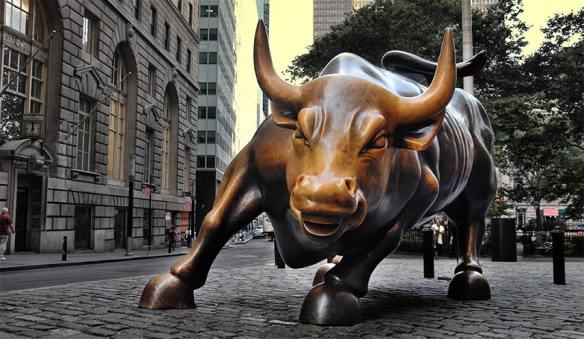
Let me apologize here, because I have to do some history — and for reasons I’ve never understood, some folks actively dislike history. It’s necessary though. So here we go. Back in 1987 there was a global stock market crash. Doesn’t matter why (at least not for this discussion), but stock markets everywhere — everywhere — tanked. Arturo Di Modica, a Sicilian immigrant who became a naturalized citizen of the U.S., responded by creating Charging Bull — a bronze sculpture of a…well, a charging bull. It took him two years to make it. The thing weighs more than 7000 pounds, and cost Di Modica some US$350,000 of his own money. He said he wanted the bull to represent “the strength and power of the American people”. He had it trucked into the Financial District and set it up, completely without permission. It’s maybe the only significant work of guerrilla capitalist art in existence.
People loved it. The assholes who ran the New York Stock Exchange, for some reason, didn’t. They called the police, and pretty soon the statue was removed and impounded. A fuss was raised, the city agreed to temporarily install it, and the public was pleased. It’s been almost thirty years, and Charging Bull is still owned by Di Modica, still on temporary loan to the city, still one of the most recognizable symbols of New York City.
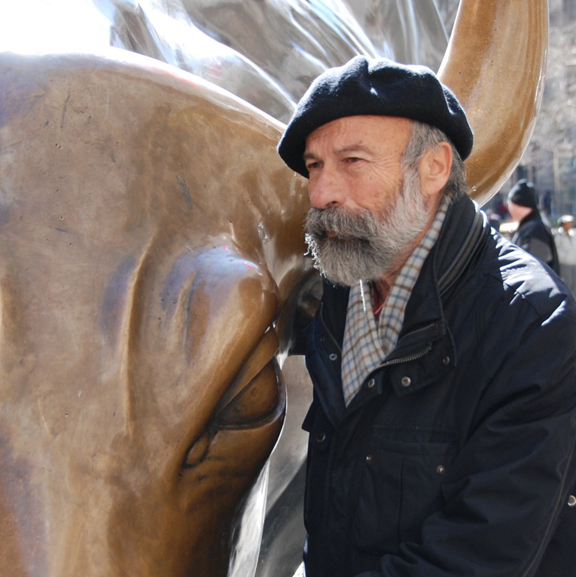
Arturo Di Modica (the one in the beret)
And that brings us to March 7th of this year, the day before International Women’s Day. Fearless Girl appeared, standing in front of Charging Bull. On the surface, it appears to be another work of guerrilla art — but it’s not. Unlike Di Modica’s work, Fearless Girl was commissioned. Commissioned not by an individual, but by an investment fund called State Street Global Advisors, which has assets in excess of US$2.4 trillion. That’s serious money. It was commissioned as part of an advertising campaign developed by McCann, a global advertising corporation. And it was commissioned to be presented on the first anniversary of State Street Global’s “Gender Diversity Index” fund, which has the following NASDAQ ticker symbol: SHE. And finally, along with Fearless Girl is a bronze plaque that reads:
Know the power of women in leadership. SHE makes a difference.
Note it’s not She makes a difference, it’s SHE makes a difference. It’s not referring to the girl; it’s referring to the NASDAQ symbol. It’s not a work of guerrilla art; it’s an extremely clever advertising scheme. This is what makes it clever: Fearless Girl derives its power almost entirely from Di Modica’s statue. The sculptor, Kristen Visbal, sort of acknowledges this. She’s said this about her statue:
“She’s not angry at the bull — she’s confident, she knows what she’s capable of, and she’s wanting the bull to take note.”
It’s all about the bull. If it were placed anywhere else, Fearless Girl would still be a very fine statue — but without facing Charging Bull the Fearless Girl has nothing to be fearless to. Or about. Whatever. Fearless Girl, without Di Modica’s bull, without the context provided by the bull, becomes Really Confident Girl.

Fearless Girl also changes the meaning of Charging Bull. Instead of being a symbol of “the strength and power of the American people” as Di Modica intended, it’s now seen as an aggressive threat to women and girls — a symbol of patriarchal oppression.
In effect, Fearless Girl has appropriated the strength and power of Charging Bull. Of course Di Modica is outraged by that. A global investment firm has used a global advertising firm to create a faux work of guerrilla art to subvert and change the meaning of his actual work of guerrilla art. That would piss off any artist.
See? It’s not as simple as it seems on the surface. It’s especially complicated for somebody (like me, for example) who appreciates the notion of appropriation in art. I’ve engaged in a wee bit of appropriation my ownself. Appropriation art is, almost by definition, subversive — and subversion is (also almost by definition) usually the province of marginalized populations attempting to undermine the social order maintained by tradition and the establishments of power. In the case of Fearless Girl, however, the subversion is being done by global corporatists as part of a marketing campaign. That makes it hard to cheer them on. There’s some serious irony here.
And yet, there she is, the Fearless Girl. I love the little statue of the girl in the Peter Pan pose. And I resent that she’s a marketing tool. I love that she actually IS inspiring to young women and girls. And I resent that she’s a fraud. I love that she exists. And I resent the reasons she was created.
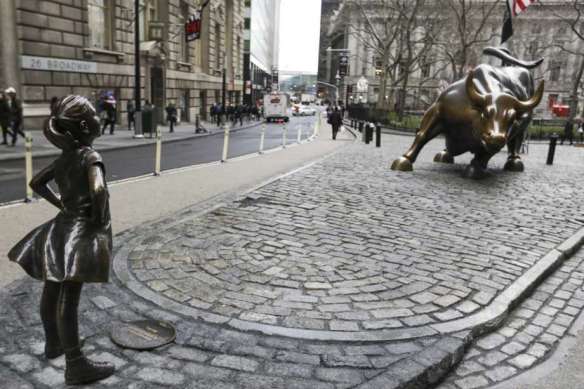
I love the Fearless Girl and I resent her. She’s an example of how commercialization can take something important and meaningful — something about which everybody should agree — and shit all over it by turning it into a commodity. Fearless Girl is beautiful, but she is selling SHE; that’s why she’s there.
Should Fearless Girl be removed as Di Modica wants? I don’t know. It would be sad if she was. Should Di Modica simply take his Charging Bull and go home? I mean, it’s his statue. He can do what he wants with it. I couldn’t blame him if he did that, since the Fearless Girl has basically hijacked the meaning of his work. But that would be a shame. I’m not a fan of capitalism, but that’s a damned fine work of art.
I don’t know what should be done here. But I know this: Arturo Di Modica has a point. And I know a lot of folks aren’t willing to acknowledge that.
 gregfallis.com
Thank you, Mr. Fallis, for providing your views and the history behind this debate.
There are ALWAYS more than one side to a story & humanity is losing its empathetic ear. Or did we ever have one? Is the fact that we’re not listening to each other & trying to at least walk in our fellow man’s shoes the reason we’re at this juncture—a huge debate over Fearless Girl vs. Wall St. Bull!!?? But, it’s all good and I’m pleased to see so many debating this. It’s the part of humanity I love so much. Thank you, again, for giving me a fresh perspective. 👍😊
LikeLiked by 2 people
Or, put them side by side a little closer to the exchange – a team bringing the fight to the enemy.
LikeLiked by 2 people
Good article on the symbolism. My reaction, having been raised on a farm, was to see the scene a few seconds in the future playing out in the real world. A mangled dead foolish girl. From this standpoint the scene represents the many beliefs that people like to have that defy reality. Reality sooner or later wins. This type of thinking can be temporarily empowering but untempered by experience becomes unreal and narcissistic. And as such it represents well America’s Imperialism on the world stage and America’s endless wars, America’s feigned self image as it rages war around the world.
“In the United States, the CDC estimates that about twenty-two people are killed by cows each year, and of those cow attacks, seventy-five percent were known to be deliberate attacks. One third of the killings were committed by cows that had previously displayed aggressive behavior. People know that bulls are dangerous, and it’s true. When animal behaviorists analyzed 21 cases that occurred across a four-state area, they found that bulls were responsible for ten of the deaths. “
LikeLiked by 3 people
You missed the point of the Fearless Girl statue, it was never about female empowerment. it’s about those without power bravely standing up to those WITH power. Gender isn’t’ the issue. It’s power dynamics.
LikeLiked by 4 people
If Fearless Girl stood side by side with the Bull she would still be fearless but the Bull would no longer be a threat to Her. Instead they combine forces to show strength in different but equal forms
It’s not the statue but rather the placement of her that is the problem
LikeLiked by 2 people
I think the only thing that needs to change is the inscription, removing the words, “SHE makes a difference,” would remove the stigma of advertising and leave a fabulous piece of art.
LikeLiked by 2 people
If you want control over how your art is seen and interpreted, there’s an easy solution: retain title to it. Don’t sell it (or, in this case, install it on someone else’s property without a prior agreement).
LikeLiked by 4 people
I’m confused. DiModica *does* retain title to the bull. “Fearless Girl” was installed on public property with a prior agreement. So what are you saying? Who wants to control the meaning of which piece of art?
LikeLiked by 2 people
One possible solution would be to have Mexico pay to have a wall built between the two statues
LikeLiked by 4 people
Put them side by side
LikeLiked by 2 people
While I do see your point, I would say that any art, can be interpreted in many ways. And just because a piece of art was developed by marketers, IF it still speaks to people and people are moved by its presence, doesn’t that move it out of the “fraud” category and into the category of real art after all? Can art inspire ONLY if it was created by certain people and entities, or can art be created by anyone or any group? I think Fearless Girl is great! I DO interpret the bull as an icon of a cold capitalistic money-hungry society. Regardless of the intention of any art, interpretation is in the eye of the beholder. I love seeing a small but mighty girl stand up to and old establishment of greedy capitalist men. But, another’s interpretation may vary. That’s the beauty of art. No one person is totally correct. (This is true for all art: visual, musical, etc.)
LikeLiked by 4 people
Greg thanks for the history.
You’ve got a point! 😃
LikeLiked by 1 person
Reblogged this on Welcome to Curio City and commented:
I dislike the fact that an art form takes strength from another by taking away its true essence. I agree with the author of this article, Arturo Di Modica has a point. Girls should be fearless on their own anyway.
LikeLiked by 2 people
“As far as that goes, it’s one NYC Mayor Bill de Blasio agrees with, since he said it first (although, to be fair, probably one of his public relations people first said it first).”
Interesting you felt a need to clarify that Bill said that first.
LikeLiked by 2 people
You should know!!! You should know that is the intension that counts.
This is a disgrace for the feminism mouvements.
This is a disgrace for the work of Di Modica.
The status quo (the not knowing state), would a symbolic fight won by the worst side of the society.
LikeLiked by 2 people
Without reading all the comments, I have to say that I don’t think yet that DiModica has a point. He’s thrown a temper tantrum that someone dared to place another piece of art, with permission, in the same public space where he placed his bull without permission. *He’s* not making any of the arguments about imagery and power. Commentators/apologists are making those arguments on his behalf. So far as I’ve read, his only legal complaint has been based on copyright — and I don’t see how that can possibly survive more than the time it takes a judge to read it.
Symbolism is a wonderful thing. It can have multiple meanings, all defensible and all valid. “Fearless Girl” has people talking about gender equality. Who cares why it was created or by whom? We’re talking. That’s worth something, and if it offends DiModica — well, as has already been said, he still owns the bull. He can always move it someplace more to his liking.
LikeLiked by 1 person
The artist can interpret his work any way he wants but that bull has always been and will always be about the strength and power of Wall Street/Big Money. The interpretation of art goes to the observer whatever the intention of the artist. No one I know has ever viewed it as a symbol of American might. By arguing for the isolation of the work and what it means to its audience, is to argue for the primacy and importance of greed, money and male power.
LikeLiked by 6 people
“You don’t get to say what your art represents, I do.”
LikeLiked by 3 people
The bull is a symbol of a “bullish market”. Ie. economic growth and investment. It may well be where Wall Street and Big Money derive their strength, but that is because it’s where the American people (and indeed the people of the world) derive their strength, too. The bull is NOT about the “strength and power of Wall Street/Big Money, as if opposing economic growth would somehow improve outcomes for women and girls – or anyone.
The opposite of the bull is the bear. Both the bull and the bear are statues outside many of the world’s stock exchanges. Feminism seems to have focused on the bull simply because they know it has testicles. The bear may or may not be male. They’re missing the economic metaphor entirely. Surely that has to be it, because why would they want to associate with the bear metaphor? The bear is what led to the great depression. It drastically increased the rate of male suicides and homelessness, which doesn’t take place in a vacuum. The irony of a hugely powerful, Big Money, Wall Street company commissioning this girl statue is lost on those praising it.
LikeLiked by 1 person
The statue of the girl is an ad for a financial firm. Is it OK that it’s about greed and power, because it has taken the shape of an adorably confident little girl? Your feminism is being played upon by an ad firm.
LikeLiked by 5 people
For most of history, art was nothing but commercial. Who paid to create it is only one factor in interpreting its meaning. It’s quite possible to consider the ceiling of the Sistine chapel to be a remarkable work of art and to know that the families of Pope Sixtus IV and Pope Julian II are there up there with Adam, Eve, Jesus, Mary, and Joseph, because the popes paid for the work.
LikeLiked by 1 person
Sorry, but context is important, and this author is correct. Since my childhood that bull has had meaning because of where it was placed. It was a symbol of strength in our economy.
Placing the girl out in front had changed the context. And the new context has hijacked the meaning and power of an icon.
When today’s kids become adults, they won’t remember that the bull was there alone for the decades before the girl.
But the worst part is that it’s an advertisement–SHE refers to a commercial entity, not the little girl. Shall we allow Microsoft or Chase Bank to erect bronze statues with their NASDAQ beside the girl? Or in front of Lady Liberty, or wherever the advertising works best?
LikeLiked by 5 people
No the bull “has *NOT* always been and will *NOT* always be about the strength and power of Wall Street/Big Money”. This article gives loads of evidence why that’s just factually, objectively incorrect. The bull, in fact, stood for the opposite of those things.
You didn’t know what the bull truly stood for. You were ignorant. That is not the artist’s responsibility. It is yours.
But just so I can see if I understand your arguments, here are a couple of parallel hypotheticals…
So a neo-Nazi can erect a sculpture near a Martin Luther King statue which makes him look like he’s murdering white children? Because to them the statue always symbolised “an invasion against the white race”?
Or a black supremacist can erect a sculpture near a Benjamin Franklin statue which makes him look like he’s exterminating black people? Because to them the statue has always symbolised “white oppression”?
Or a chauvinist can erect a sculpture near an Emmeline Pankhurst statue which makes it look like she’s performing a sex act? Because to them the statue has always symbolised “an abandonment of traditional values by women”?
How the hell can you not see how unfair (to the artist) and inaccurate (for the symbol) it is to suggest that an audience can pervert a work of art however it likes? Simply because that work of art is publicly visible and accessible.
If you didn’t know the true meaning of the bull, that’s as a result of your own ignorance (as would be the case with all the clearly ridiculous hypotheticals I gave above). Your ignorance is not the fault of the artist and he should not be made to pay for it.
Is this how intellectually lazy our society has become? That when we’re too stupid to learn the factual meanings of things, we blame the truth for not seeking us out… instead of learning to seek the truth out ourselves?
LikeLiked by 3 people
Well, I don’t know what happened in your art history classes, but yeah, an artist can make a piece of art in response to another one. It’s the basic dynamic of “art as a conversation”. We didn’t feel that we were “intellectually lazy” for reaching beyond the artist’s statements of the meaning of a work to form our own opinions, we thought we were participating in a criticism as our predecessors had for centuries.
Sir Walter Raleigh’s “The Nymph’s Reply to the Shepherd” is art in response to Marlowe’s “The Passionate Shepherd to His Love”. We study both today (or we do where English classes still ready Elizabethan poetry). You couldn’t have Raleigh without Marlowe, and without Raleigh, William Carlos Williams wouldn’t have had the context to write “Raleigh was Right” (in 1944).
Art is always a conversation, and what the pieces mean is always open to new interpretation, and what’s lazy is assuming that a work only means what someone says it means or that a work only means one thing to everyone, or that no one else can have say.
Let art be complex, dude, it’s more fun that way.
LikeLiked by 1 person
Street art has always been about changing perceptions. A significant amount of the perception changing has to do with previous street art and responding to it.
Ultimately, interpretation of art is left to the observer regardless of what the artist intends. The artist may intend to communicate one view with his art, but if the observer receives a different message the artist has failed in his communication.
My interpretation of the Charging Bull sculpture is consistent with the Wall Street / Corporate Greed interpretation of many observers, which is not the artist’s intent. I see the Charging Bull in the context of running rampant in a “china shop” fragile stock market.
Regardless of the origins of the Fearless Girl statue, I see it as a populist response to that rampant bull saying “ENOUGH IS MORE THAN ENOUGH, YOU WILL NO LONGER DOMINATE ME!” The fact that it was commissioned by a greed motivated Wall Street firm as an advertising gimmick is ironical in a most profound way.
The Charging Bull sculptor has every right to remove his street art. It no longer states the meme he wanted. The Fearless Girl will still have the same powerful interpretation for me. She (not SHE) still represents me.
NOTE: the use of male gender pronouns uses the standard generalization grammatic linguistic rules for the American Dialect. It is not intended to exclude any other gender.
LikeLiked by 1 person
“Art is always a conversation, and what the pieces mean is always open to new interpretation, and what’s lazy is assuming that a work only means what someone says it means or that a work only means one thing to everyone, or that no one else can have say.”
Sure art can be interpreted in different ways by other then the artist. Guess what? That’s an opinion. If the artist actually comes out and states their interpretation of the art actually is, then guess what? That is what the artist intended that piece to be about and that’s what it’s about. There can be NO argument or debate about it.
The whole interpretation concept is bullshit in art. Minus of course the artists past, present and the future that actually don’t state what their art is about.
LikeLiked by 1 person
And you can interpret any way you want too. But there are actual facts behind the sculptures, and I think this post makes good points. The Fearless Girl statue is LITERALLY an advertisement for an investment fund, and commissioned by a marketing group precisely for that. So it’s not exactly anti-wall street/big money. And if you don’t know anyone who considers a “bull market” a positive thing for the economy then I’d question the diversity of your acquaintances. The bull has symbolized economic growth for a very long time, and usually the bull has had positive connotations while the bear has had the negative ones. Like it or not, the Fearless Girl is facing off AGAINST economic health, not against greed in general, and certainly not against wall street, since she is directly marketing for it.
LikeLiked by 2 people
On one hand you appear to advocate free interpretation of art but you ALSO claim that everyone has the same interpretation (your own), even when the artists himself claims otherwise. Quite the contradiction. It’s as if you staunchly refuse to admit the artist has a point.
LikeLiked by 1 person
Fairly sure it works the other way around in terms of interpretation, by which it’s us the common mass who grants it a whole new meaning, while the original artist has his own perspective when he wanted the work to be displayed there.
Neither are wrong, artwork is meant to be ambiguous and thought provoking, but right now the artist is simply feeling as if he’s attacked by the American people when, ironically, he wanted to show how he sees America as “the strength and power of the American people”.
LikeLiked by 2 people
It’s a good article, but the grammar Nazi in me wishes that people would use the subjective form of “was” correctly… “..if she were….”
LikeLiked by 3 people
John Greene, just between us Nazis, I believe you mean “subjunctive”.
LikeLiked by 6 people
We prefer the term “alt-write.”
LikeLike
You’re allowed to make the art you want. You’re not allowed to dictate how people respond to it. What you might think it means might not be all it means and your loss of the privilege to be the only one speaking in the public square is not oppression.
His work’s meaning isn’t changed by the other work, a layer of it he doesn’t like is being exposed. The bull is a perfect symbol of Wall Street in the 1980s, the Gordon Gecko “greed is good” era. It’s nice to see someone notice that a charging bull can also do a lot of damage, too
Frankly, as an artist, he should be thrilled that almost thirty years after he made this work it still evokes enough of a reaction to get a response from another artist. If he doesn’t like the reaction he gets, he should make more art in response, not whine. He should try to be tougher, like the little girl.
LikeLiked by 3 people
This isn’t about toughness, this is about education. He provides the historical context of the bull, which many did and do not have and then explains what the genesis of the defiant girl statue was. After that he offers up a conclusion informed by the background. I didn’t know any of that, my expectation is that most people that read this didn’t either and respectfully my guess is you didn’t. “You’re not allowed to dictate how people respond to it” is what you write and that is correct. What you CAN do and what this author DOES is provide the necessary historical context to anyone that reads and then let those FACTS evolve the perception and consumption of the art. We as a society need to get back to a mentality that can function in a state of adaptation that accepts new information as tools to continuously sculpt our understanding and thus our actions and support.
LikeLiked by 2 people
Clearly, the correct, American solution to all of this is commissioning a third piece of artwork, erecting a statue named “Tireless Lawyer”.
LikeLiked by 8 people
*grin* Perhaps he should be serving the Bull with a restraining order from the Fearless girl.
LikeLiked by 1 person
Thanks for the laugh!
LikeLike
He’s also wrong though since art is not a monologue, but rather a conversation and especially guerilla art. If you can’t handle the heat stay out of the kitchen.
LikeLiked by 3 people
This actually got me really thinking. If the original Bull was about the American spirit recovering. The Bull represented America going forward and getting better.
But if you think about it, in the last thirty years, we’ve watch income move towards the 1%. The middle class be devastated, and if you look at “economic recovery” since 2008. most of it was seen in the stock market, and not middle and lower class workers. If anything, the Bull has gotten out of control, he’s moved too fast and no longer represents the American people, but rather a small percentage of Americans who’ve benefitted from economy that grew too fast and left many people behind.
If you think about it that way, then the Fearless Girl showing up now is a perfect response to it. For 30 years, the Bull raged forward but now it’s time to stop. Di Monaco (sorry sp) should think about how what his bull symbolizes has changed and if anything, Fearless Girl has brought back his original intention of representing America. (I know I’m kind of having a Bernie Sanders moment here)
Basically what I’m saying is this, the original meaning of the art has changed but I think what the Bull represents has changed. The Bull, who once represented America, now only represents a small percentage of the ultra rich and it’s time for Fearless Girl to show up and stop him.
Di Monaco (sorry sp) perhaps should be grateful that his art continues to evolve and live years after it was originally created. That’s exciting stuff. Maybe he’s just mad he didn’t think about it himself.
(and yes, I know the irony that the 1% is also responsible for the Fearless Girl but I guess I’m talking more from a purely artistic perception)
LikeLiked by 4 people
I think she’d fit equally well in front of the Supreme Court, White House, or any governor’s mansion, so I don’t buy that she needs the bull.
LikeLiked by 7 people
Good background. So now here’s my suggestion.
The charging bull represents the strength of our economy. The girl represents the strength of women, including women in our economy.
Greg Fallis says he is not a fan of capitalism. I like capitalism, but only well-regulated capitalism. And I like strong women in good businesses that contribute to society.
So simply reposition the girl. Have her standing by the bull facing down the same threat. Which, like the 2000 crash, was caused by lack of regulation.
They are partners, not foes.
LikeLiked by 4 people
Or put the girl in front of a bear, not the bull.
LikeLiked by 1 person
“Fearless Girl” should be turned around and placed with and along side of the Bull, showing that she can be a strong and integral part of a bull market. Together they send a message that would please both artist. She should never have been placed opposing the bull market.
LikeLiked by 6 people
Again, the only reason to do this comes solely from the original statue. The girl cannot stand alone and give the message some want.
LikeLike
If he doesn’t like it, he could always turn the bull around.
LikeLiked by 2 people
I understand the history and the facts about both statues. However, since few people know the history, the perceived meaning is what endures. And, to be totally true to the context of the origin of the charging bull statue, at the time of it’s creation the statement about the strength of the American people basically referred to the men. Let’s be honest about that. Which further illuminates the statement the girl statue makes and the necessity of that statement. Plus, few people are aware that the girl is meant as an advertisement of anything so how effective I can it be for that purpose.
LikeLiked by 4 people
Arturo Di Modica should turn the bull into the opposit direction. This would perserve the original context of the of the Bull and, at the same time, disarm the coup of the dishonest girl’s creators without causing any physical damage.
LikeLiked by 4 people
Love it!
LikeLiked by 1 person
But then it looks like the bull is trying to run from her 🙂
LikeLiked by 2 people
Or it could mean Wall Street has turned it’s back to women/Americans.
LikeLike
I really appreciate this post. I love when someone formulates a balanced opinion like the one you have developed.
LikeLiked by 3 people
This article made me think. I like both statues. What if they stood together, staring down the city, ready to face the world?
LikeLiked by 4 people
Darn fine article and interesting conflict.
LikeLiked by 2 people
He should remove Charging Bull and leave a giant pile of brass bullshit in its place to show what happens when commercializations and feminism fuck up good things
LikeLiked by 3 people
If anything is a sign of male power, it’s “Fearless Girl.” If anything is appropriation, it’s “Fearless Girl.” “Fearless Girl” is by men for men. Melt it down and replace it with art for the sake of women, not an ETF.
LikeLiked by 2 people
Fantastic read. Thank you for the history. I agree, it’s critical. I also agree with the argument. But, with the history lost, people don’t know that they don’t know 😕 So, I’m sharing this. Because, it’s worth knowing!
LikeLiked by 2 people
I would place the girl next to the bull, both looking into the same direction. United is what we need in times like today! United we go!
LikeLiked by 2 people
Thought provoking and on the money! The last thing artists and women need or want are clever schemes to exploit their work or their cause. Thank you for voicing your support for Di Modica in on line forums, facing the comment sections fearlessly and explaining the point so finely here. It is important.
LikeLiked by 2 people
Interesting that the author, a man, would be inspired to both love and resent *Fearless Girl.* Isn’t this a common male response when faced with feminine strength? I’m not a femininist by any means, but I can see the irony in that.
LikeLiked by 3 people
Webster defines feminism as: “the theory of the political, economic, and social equality of the sexes” – so I think it’s very possible you’re a feminist.
LikeLiked by 2 people
I agree with you 1000%!!!
LikeLiked by 1 person
I like Fearless Girl, but I think she would be better placed in front of City Hall or the United Nations Building. The Bull is the wrong competitition.
LikeLiked by 2 people
Subtexts exist with EVERYTHING that is put out for public consumption. Sometimes the subtext is intentional. Sometimes, it is not. For example, a Coca-Cola logo may symbolize cool refreshment to some, and a calorie-laden poison to others.
And honestly, until you pointed out the capitalization of the word SHE in the plaque at Fearless Girl’s feet, I had never noticed it. Probably, millions of people have seen the statue and never noticed that plaque, or noticed the irony in the inscription. No matter how much emphasis they tried to put on the SHE, unless you stand in front of the statue and look straight down at the plaque, and read it with a jaundiced eye, you may not… probably will not… notice the connection.
Of course, there was the young jackass broker who was videoed “humping” the statue of Fearless Girl. I’m not sure what his subtexts were, and don’t really want to know.
I respect Di Modico’s artistry. It is a powerful, well-done piece of statuary. I don’t agree, though, that it represents the “strength and power of the American People.” I have seen the statue many times, and to me it has always symbolized the fierce, unthinking, and often unbridled brutality of the Market. And as Darlene Ruiz noted, the observer has to make up his or her mind about the meaning of the work. The intention of the artist has less meaning than the interpretation of those who see the artist’s work, especially in such a public setting in the financial district.
LikeLiked by 3 people
Oops…Sorry!
Di Modica, not Di Modico.
LikeLiked by 1 person
Here’s a thought…It is also likely that although you hadn’t consciously noticed the capitalization of SHE along with lot of others who are surprised to find the work was commissioned as an advertisement, it is still being observed and recorded in your mind. If I was the marketing company trying to build brand awareness, I would continue to take actions that might embed this branding subconsciously as long as I could get away with leveraging the positive associations made by the emotional response to the statue.
Just notice the next time you see the letters SHE what kind of associations are made. It is starting to become familiar and have deeper meaning already, is it not? This is an effect I have noticed in myself and others whether they know the history or not, whether they love Fearless Girl or not.
I believe Di Modica has not yet properly articulated what his true challenge with this appropriation is, it may be quite hard to verbalize plus he has legal counsel, lots of people calling him a misogynist in the public sphere, so he can’t just go for it and fumble around until he finds the words that will make people consider his perspective at least as valuable as their own or anyone else’s. Not less valuable because he created the statue.
For my part, I know that I instantly objected the first time I saw Fearless Girl and I still cannot quite articulate why, it seems completely out of place. The only language I have for it is, that the bull is not our enemy, nature and wild forces are not our enemy, we are of the same system, we do not need to oppose them rather to respect and align with them lest they annihilate us. If the Fearless Girl was a metaphorical symbol that complemented, balanced, checked or protected us from the effects of this “wildness” then that might be different. But innocent, defiant, fearlessness is not it. Essentially the challenge she offers is idealistic AND impotent.
LikeLiked by 1 person
Move the girl so the bull stands beside her, and also she won’t be associated with the inscription! She should be standing to the bull’s left…
LikeLiked by 2 people
The bull by itself has a meaning. Placed in the financial district, it takes on another meaning. Di Monica appropriated that context when the bull went up in the financial district, changing the meaning from the strength of the American people, to the strength of Wall Street. Bull Market metaphor became its very simple meaning.
People will see what they want to see. Funny, the initial opposition was from financiers who saw it as appropriating their space, their message, their property.
So he does have a sound argument, because the girl now changes the metaphor to a story. Much simpler and easier to understand, reflective of contemporary needs, actually. Abstract metaphors are out. Literal simple understandings are in.
LikeLiked by 4 people
The bull is a high quality sculpture with a beautiful patina. The gitl sculpture is low quality brass krap from Taiwan. The patina is aweful, I can see the weld marks. I don’t blame the artist for being angry….
LikeLiked by 3 people
If they stood side by side rather than facing each other, wouldn’t that make everyone happy?
LikeLiked by 2 people
Guerilla capitalist, you mean pirate?
LikeLiked by 2 people
please inform your inner grammar nazi that you didn’t need to put was in quotation marks and the that between wishes and people is incorrect form.
Great thought provoking article. Personally I’d pull the bull and make their (SHE) advertising meaningless.
LikeLiked by 2 people
I understand and appreciate the dichotomy of the fearless girl and it’s position in front of the Charging Bull. To me, Di Modica’s argument is null. His Charging Bull sculpture was set in a public place. I understand artist’s rights (I work for an art museum and deal with moral rights of artists as a marketer) but a public setting is subject to whims and trends of surrounding environment. The cultural attribution of the Bull has changed dramatically since its installation in 1989 and the artist cannot deny that fact. In my opinion, Di Modica gave up his right to control the attribution of his sculpture when he put it in a public place.
LikeLiked by 3 people
I agree with Di Modica, the girl changes his sculpture. As an artist I would be upset too. Since he owns the Bull sculpture and not the city, I think he should move his sculpture. Richard Serra had a sculpture of his removed after the environment around it changed because his piece was site specific. Changing the surroundings changed the work of art in a way it was not intended to be viewed. I can see a future result of Bull/Girl controversy for public art, the artists will start making contracts stating that no other works of art may be place within X number of feet of their work.
Why is a commentary on a lack of females in finance started with a little girl dressed like she is from the early 20th century? Look at those shoes! No one wears shoes like that now. If you want to make a statement about including women in our time, use women of our time. Not a female child. It actually feels patronizing to me, “sure you’re brave and fearless, but you’re still just a little girl.”
LikeLiked by 2 people
I absolutely believe the artist should have been included in the dialogue. It’s a dramatic expression of the dynamics of public, even global, conflicts.
Whoever persuaded the bank to do this was brilliant. Brings up questions like, whose expression matters most in the public space? Whose values, ownership, ethical conflict, art – or is it really a matter of engaging in a dialogue together to co-create it to resolve?
From breakdowns can come breakthroughs.
LikeLiked by 3 people
Not a fan of capitalism. Ironic, since capitalism gave us the means and wealth to sit and appreciate the circumstances of such things. People didn’t appreciate art until the 20th century, only the socially elite did. Now, we’re all elite enough to have perspective. For instance, we can now dislike the means to which we attained the means to appreciate such things.
LikeLiked by 2 people
I can’t believe we have such little sympathy for an artist who created something to celebrate unity and strength, but had his work corrupted (by an ad agency, no less) to suggest the exact opposite.
People being this easily manipulated is why garbage like the Pepsi ad gets made. The corporations believe we’re dumb enough to lap up any old bullshit, as long as it’s bullshit that strokes our egos—and they’re almost always right.
Some of the comments are saying, “It doesn’t matter what he meant, it only matters what we say it means now.”
Do they not see the stunning implications of such a relativist, egocentric stance? A stance with such little regard for *verified* facts and history.
Yet we’re angry when politician’s proffer “alternative facts” (which is a different side of the same coin). We humans (as a group, if not as individuals) are such hypocrites. We only care about getting our way, not getting at the truth.
It’s not like the *ONLY* way of promoting the message of gender equality is by perverting an existing work of art. There are countless other ways of ingeniously and publicly supporting the cause.
But hey, hypocrisy is bad… unless it’s in service of agendas with which we agree, eh?
LikeLiked by 3 people
Irony in spades! I always thought the bull was put there by the New York Stock Exchange about a bull market aka the strength of our business community and the dollar. Like all works of art, we read into it what we will.
LikeLiked by 3 people