I got metaphorically spanked a couple of days ago. Folks have been talking about the Fearless Girl statue ever since it was dropped in Manhattan’s Financial District some five weeks ago. I have occasionally added a comment or two to some of the online discussions about the statue.

Recently most of the Fearless Girl discussions have focused on the complaints by Arturo Di Modica, the sculptor who created Charging Bull. He wants Fearless Girl removed, and that boy is taking a metric ton of shit for saying that. Here’s what I said that got me spanked:
The guy has a point.
This happened in maybe three different discussions over the last week or so. In each case I explained briefly why I believe Di Modica has a point (and I’ll explain it again in a bit), and for the most part folks either accepted my comments or ignored them. Which is pretty common for online discussions. But in one discussion my comment sparked this:
Men who don’t like women taking up space are exactly why we need the Fearless Girl.
Which — and this doesn’t need to be said, but I’m okay with saying the obvious — is a perfectly valid response. It’s also one I agree with. As far as that goes, it’s one NYC Mayor Bill de Blasio agrees with, since he said it first (although, to be fair, probably one of his public relations people first said it first).
But here’s the thing: you can completely agree with the woman who responded to my comment AND you can still acknowledge that Arturo Di Modica has a point. Those aren’t mutually exclusive or contradictory points of view.
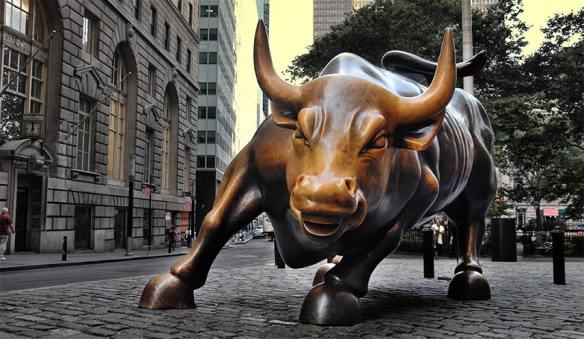
Let me apologize here, because I have to do some history — and for reasons I’ve never understood, some folks actively dislike history. It’s necessary though. So here we go. Back in 1987 there was a global stock market crash. Doesn’t matter why (at least not for this discussion), but stock markets everywhere — everywhere — tanked. Arturo Di Modica, a Sicilian immigrant who became a naturalized citizen of the U.S., responded by creating Charging Bull — a bronze sculpture of a…well, a charging bull. It took him two years to make it. The thing weighs more than 7000 pounds, and cost Di Modica some US$350,000 of his own money. He said he wanted the bull to represent “the strength and power of the American people”. He had it trucked into the Financial District and set it up, completely without permission. It’s maybe the only significant work of guerrilla capitalist art in existence.
People loved it. The assholes who ran the New York Stock Exchange, for some reason, didn’t. They called the police, and pretty soon the statue was removed and impounded. A fuss was raised, the city agreed to temporarily install it, and the public was pleased. It’s been almost thirty years, and Charging Bull is still owned by Di Modica, still on temporary loan to the city, still one of the most recognizable symbols of New York City.

Arturo Di Modica (the one in the beret)
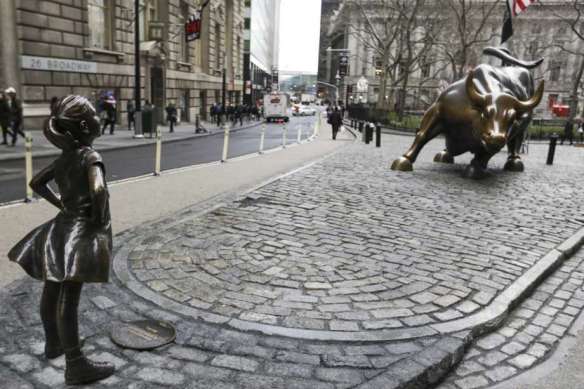
And that brings us to March 7th of this year, the day before International Women’s Day. Fearless Girl appeared, standing in front of Charging Bull. On the surface, it appears to be another work of guerrilla art — but it’s not. Unlike Di Modica’s work, Fearless Girl was commissioned. Commissioned not by an individual, but by an investment fund called State Street Global Advisors, which has assets in excess of US$2.4 trillion. That’s serious money. It was commissioned as part of an advertising campaign developed by McCann, a global advertising corporation. And it was commissioned to be presented on the first anniversary of State Street Global’s “Gender Diversity Index” fund, which has the following NASDAQ ticker symbol: SHE. And finally, along with Fearless Girl is a bronze plaque that reads:
Know the power of women in leadership. SHE makes a difference.
Note it’s not She makes a difference, it’s SHE makes a difference. It’s not referring to the girl; it’s referring to the NASDAQ symbol. It’s not a work of guerrilla art; it’s an extremely clever advertising scheme. This is what makes it clever: Fearless Girl derives its power almost entirely from Di Modica’s statue. The sculptor, Kristen Visbal, sort of acknowledges this. She’s said this about her statue:
“She’s not angry at the bull — she’s confident, she knows what she’s capable of, and she’s wanting the bull to take note.”
It’s all about the bull. If it were placed anywhere else, Fearless Girl would still be a very fine statue — but without facing Charging Bull the Fearless Girl has nothing to be fearless to. Or about. Whatever. Fearless Girl, without Di Modica’s bull, without the context provided by the bull, becomes Really Confident Girl.

Fearless Girl also changes the meaning of Charging Bull. Instead of being a symbol of “the strength and power of the American people” as Di Modica intended, it’s now seen as an aggressive threat to women and girls — a symbol of patriarchal oppression.
In effect, Fearless Girl has appropriated the strength and power of Charging Bull. Of course Di Modica is outraged by that. A global investment firm has used a global advertising firm to create a faux work of guerrilla art to subvert and change the meaning of his actual work of guerrilla art. That would piss off any artist.
See? It’s not as simple as it seems on the surface. It’s especially complicated for somebody (like me, for example) who appreciates the notion of appropriation in art. I’ve engaged in a wee bit of appropriation my ownself. Appropriation art is, almost by definition, subversive — and subversion is (also almost by definition) usually the province of marginalized populations attempting to undermine the social order maintained by tradition and the establishments of power. In the case of Fearless Girl, however, the subversion is being done by global corporatists as part of a marketing campaign. That makes it hard to cheer them on. There’s some serious irony here.
And yet, there she is, the Fearless Girl. I love the little statue of the girl in the Peter Pan pose. And I resent that she’s a marketing tool. I love that she actually IS inspiring to young women and girls. And I resent that she’s a fraud. I love that she exists. And I resent the reasons she was created.
I love the Fearless Girl and I resent her. She’s an example of how commercialization can take something important and meaningful — something about which everybody should agree — and shit all over it by turning it into a commodity. Fearless Girl is beautiful, but she is selling SHE; that’s why she’s there.
Should Fearless Girl be removed as Di Modica wants? I don’t know. It would be sad if she was. Should Di Modica simply take his Charging Bull and go home? I mean, it’s his statue. He can do what he wants with it. I couldn’t blame him if he did that, since the Fearless Girl has basically hijacked the meaning of his work. But that would be a shame. I’m not a fan of capitalism, but that’s a damned fine work of art.
I don’t know what should be done here. But I know this: Arturo Di Modica has a point. And I know a lot of folks aren’t willing to acknowledge that.
 gregfallis.com
You are all idiots. Woodstock was a commercial enterprise. Get over it. Love the message
LikeLiked by 3 people
Let’s just say that I didn’t know SHE, the investment fund, existed until now.
LikeLiked by 2 people
Yes he has a point and yet, we can ignore it. History will define the meaning of the work.
Namely, the feminine imperative idealised in the form of a protected, entitled, little princess that seeks to hold back the masculine drive that is competitive capitalism. The solipsism embodied in this female statute is a brilliant, giant, middle finger to the commissioners of this piece.
To truly represent the current climate she needs to have a reinforced barrier protecting her from the brutal reality of the market place.
LikeLiked by 3 people
Its all about identifying and giving something a specific meaning unique to who we have become and how that is individually defined – are your identifications the same as the identifications of others? Of course not. Can we change the identifications of others to our own? Probably not. Why would we have the need to?
LikeLiked by 2 people
How about they just turn her around a quarter circle, so the bull and her are companions? Just a thought.
LikeLiked by 2 people
Thank you. I love that you took the time to enlighten us all to the “history” of these two beautiful works of art. Maybe this article could be posted on a plaque at the sight so people can see them both for what they truly were meant to be. I agree, I love both pieces for what I feel they can represent. The resilience of the American people and the inspiration for strength of women and girls everywhere.
LikeLiked by 2 people
What if there was a compromise and they both faced the same direction?
LikeLiked by 1 person
Behind her Podesta in a toga, or a spirit cooking scene, maybe A.N.Other for luck, behind them a pair or two of handcuffs, behind that a key made of money.
LikeLiked by 2 people
The little girl, as fantastic as she is, should be placed elsewhere. The original art work of the bull should stand representative of what the artist intended. You would not go to a museum and add some other artwork to represent your own thoughts and feelings. So why do it here?
LikeLiked by 2 people
It should be removed. As for raging bull…I wonder just how many American people can afford to have money in the stock market???
LikeLiked by 2 people
The statue of the girl did not transform the bull into a symbol of patriarchal oppression. That symbolism had already come to exist over time. The statue of the girl merely acknowledges it. Di Modica might not like that the original meaning of his creation changed, but the girl didn’t cause that. Wall Street itself did.
LikeLiked by 4 people
Simply rotate the bull statue 180 degrees.
LikeLiked by 2 people
If I were the parent of the girl, I would spank her for being so dumb as to stand in the way of a raging bull. That is not confidence, that is crazyness.
LikeLiked by 2 people
Very good comment. However, to me in these days it gives the girlstatue an even deeper meaning in a time when rampant nationalism is running pretty wild. It becomes a meta-comment on the ongoing political narrative, the brave single small individual standing up in the face of “the stregth of the American People” as represented by a raging bull. You really do not need to even insert a feminist narrative into it, it becomes a pure symbol of bravery in the face of the juggernaut. The addition of the stue gives the whole piece a really good depth and dynamism, and for me that makes it rather unimportant who paid for it and who owns it, it has alerady become a integrated sculpture of two pieces already, thesum being greater than the two parts. Or to put it short, *it works*.
LikeLiked by 2 people
Well this nicely explains what Charging Bull was originally intended to symbolise, but that is certainly not what it represents to much of the world.
Today, it symbolises the threat posed to all humanity by charging, raging, out of control Capitalism.
Somebody once said, the opposite of poverty is NOT wealth, it’s justice.
That Bull, with all its power and strength, cares nothing for justice, or compassion. It is the epitome of unrestrained, irrational power, and thus it perfectly represents Wall Street as it is today.
As a sixth nine year old man, I say that Fearless Girl represents me too.
Because she symbolises those who are without resources, without power and without voice, yet are still able to find a way to say, “Enough! Stop your destruction, before you kill us all.”
LikeLiked by 2 people
Di Modica should sculpt a large, rearing bear and place it behind the girl facing the bull.
LikeLiked by 3 people
It would be better if the writer would “commission ” a sculpture of a bear for Master Sculpture Di Modica to produce and display. Why does public art have to be free. In this case free means I didn’t pay for it and I don’t care if anyone did.
LikeLiked by 1 person
So instead of facing the girl at the bull… Face her at the NYSE. Makes the point as clearly and isn’t relying on the Bull.
LikeLiked by 4 people
The girl was originally placed in front of the stock exchange looking up at it. That was the meaning originally intended for it. The original intent of the artist who made the bull is interesting. Put where it is, it has come to be a symbol of Wall Street rather than the American people. That is what has co-opted the meaning of his piece. If he still owns it, perhaps his best move would be to move it. I am not sure even that would remove the meaning it has come to have but perhaps with time it could change.
LikeLiked by 3 people
are you too stupid to realise that the bull has an additional meaning in terms of finance which is the reason it is a bull and stands on wall street? this meaning also makes that stupid girl statue a piece of socialist garbage.
LikeLiked by 3 people
Not that I think a reply worded so rudely deserves a response, but how do you figure this?
LikeLiked by 1 person
lol @ not being a socialist in 2017
LikeLiked by 1 person
Adam, are you too stupid to realize* that your enlightening reference to the meaning of the bull was already outlined in this article when explaining the motives for the statue’s creation? You probably shouldn’t be calling things stupid multiple times in one statement if you’re borderline illiterate yourself.
LikeLiked by 1 person
What if they moved Fearless Girl? Instead of having her challenge the bull, stand her on its left hand side, looking in the same direction. Then the message would be that ‘the American spirit’ doesn’t just have to mean bullish strength, which is a relatively exclusive masculine image, but also the fearlessness of women and girls. Everyone working together.
LikeLiked by 8 people
“It’s all about the bull. If it were placed anywhere else, Fearless Girl would still be a very fine statue — but without facing Charging Bull the Fearless Girl has nothing to be fearless to.” — If the bull weren’t placed on Wall Street within striking distance of the Stock Exchange, it would simply be an animal statue. Context is indeed everything, here. For BOTH pieces. Not to mention Wall St types now embrace this bull as it’s talisman and mascot…rather than ‘the strength of the American people’, it now, for the most part, symbolizes the strength/aggressiveness/bravado of the stock market and it’s money. Whatever the artist thinks, the meaning behind the bulls changed with the times…it is not a symbol of patriarchal oppression because of the girl…it has been that symbol for a long time. In fact– placed on it’s own, the Fearless Girl statue, within striking distance of the stock market and on Wall Street is MORE relevant today than the bull. Ad gimmick or not, a young girl facing down the biggest boy’s club of all says more right now than a dodging bovine.
LikeLiked by 6 people
Well said!
LikeLiked by 2 people
If I were Di Modica, I’d find a way to finance a removal of the bull, place it in a poor part of NYC or anywhere else in America where people are struggling thanks to the assholes on Wall Street. Let the capitalist girl statue stand on her own in faux-feminism and all its alleged artistic glory and merit and get this bull crap over with.
LikeLiked by 3 people
You can use a semiotic argument to say that all art is infinitely interpretable, and so placing the girl opposite the bull is just another juxtaposition that allows for more free association of meanings of the bull. Or not. I don’t think you can ignore the deliberate manipulation of images by those who wish to control our gaze and control the meaning that we see. That is what advertising is all about. Cleverly manipulating images to actually close down various options or interpretations and guide us to see what the marketer wants us to see. We are being manipulated by the fearless girl creators in a whole suite of ways…the choice of a girl rather than a woman, the choice of her clothes and stance, the text near the statue: all create a faux feminist message which is strangely non-threatening and sweetly appealing, though basically meaningless and vacuous (the companies who commissioned this piece do not in fact meet gender equality goals in terms of female management etc). Sure, people may view this and see some other meanings, but I think the majority of people are actually buying a very cleverly manipulative message. And Di Modica does have a point.
LikeLiked by 5 people
It’s worse than vacuous, it’s delusional. Suppose that both pieces were to magically come to life. Fearless Girl becomes Trampled To Death Girl approximately two seconds later, assuming that she doesn’t become Horrifically Gored Girl instead. Third Wave feminism relies on denying reality.
LikeLiked by 5 people
Interesting post, thanks. Like many of the other commenters here I always took the bull statue to represent the uncontrolled and violent nature of capitalism, particularly bullish markets.
If I was the artist, my tendency would be to re-orient the bull to try and steal the power from the advertisers. Turn it 90 degrees to the right or left. 180 degrees perhaps has some unfortunate symbolism of the fearless girl (/advertising companies) having defeated the artist and forced a retreat. A 90 degree turn would keep her in place but render her defiance objectless and therefore confusing and strange.
LikeLiked by 3 people
I don’t buy the idea that she is a fraud. SHE seeks to help address gender inequality in corporate America by offering investors an opportunity to create change with capital and seek a return on gender diversity. That is not a bad thing at all. And it is a method of resisting male-dominated control over the economy so she is not a fraud. If Di Modica doesn’t like it – tough. Things change, he needs to move with the times. And if that means moving the bull, that is his right. The little girl will remain a symbol of defiant change with or without the presence of the bull.
LikeLiked by 2 people
No one would look twice at the girl if she weren’t placed in front of the bull. In fact, she’s a parasite of the bull, leeching energy from it with no benefit to the bull. Kind of sums up modern feminism and it’s impact on modern society.
LikeLiked by 3 people
I’ve read one too many sanctimonious “intentional fallacy” type comments in response to this blog post, which keep ignoring that the bull was originally removed by Wall Street. This blogger isn’t concerned with artist intent but with sociohistorical context. Revisit the notebook from that one English course you took in college, because you’re effigy-burning the wrong critical school.
LikeLiked by 2 people
First of all, most of the world’s great art WAS commissioned. And to this moment “…Instead of being a symbol of “the strength and power of the American people” as Di Modica intended, it’s now seen as an aggressive threat to women and girls — a symbol of patriarchal oppression…” I say, have you not see how women are and have been systematically oppressed in the work environment? The time for this statue is right and so is the location since Wall Street has one of the worst records with women. But, I agree the artist has a point.
LikeLiked by 1 person
CORRECT ARGUMENT
—“In effect, Fearless Girl has appropriated the strength and power of Charging Bull. Of course Di Modica is outraged by that. A global investment firm has used a global advertising firm to create a faux work of guerrilla art to subvert and change the meaning of his actual work of guerrilla art. That would piss off any artist.”—
In other words, it was an act of theft. If you can reduce it to an act of theft, it’s theft. Plain and simple. Go make your own propaganda, don’t steal from someone else’s.
The bull is equivalent to a local pagan deity – the symbol of helen in athens.
Go make your own gods.
LikeLiked by 3 people
This is a well-written blog post, but I ultimately don’t buy the premise that “the guy has a point.” Much great art, throughout history, involved patronage from the rich and powerful. The Medici family — most notably Lorenzo de Medici — became some of the most noteworthy patrons in the history of art. They were also brutal, Game of Thrones style political figures with many moral failings.
The problem is that artists need to sustain themselves economically, even when they try to subvert the system. Subversive art that is sponsored by patronage still retains many subversive characteristics, particularly if the message is seen as transgressive. I buy the point that this sponsorship might in some way diminish the work (compared to a situation in which its provenance were truly guerilla), but it doesn’t completely undo the power of the work. And as others have mentioned, I think that the new piece actually strengthens and enriches the original one.
LikeLiked by 2 people
And here’s another point: It’s a self-destructive feminazi message. There’s a young girl, apparently symbolizing women “taking up space” in the business, brazenly standing in the way of progress and success.
Think about it! That’s a bull, not a bear. ROFLMAO
LikeLiked by 2 people
I parallel with the authors feelings in every way but always thought that the Bull represented the bullish stock market, a Talisman to keep America wealthy, and if everyone interprets this art piece the way I did then the Bull lost its purpose long ago and because of that the Fearless Girl should stay. It can serve as a talisman towards gender equality.
LikeLiked by 2 people
This artist’s point was exemplified in a case in Toronto’s Eaton Centre where commissioned art of Canada Geese hung flying through the mall. Years after the installation the mall tied red ribbons around the necks of the geese for the holiday season. The artist objected–and won–on the basis that his “art” can not be altered in this way. It makes sense when you think about it–and so does the fearless girl objection. You can’t appropriate and artist’s expression just because you want to.
LikeLiked by 2 people
Well, if they’d put the girl on the bull’s back like a rodeo rider, you’d have a point.
But they’re not parallel cases at all.
And you ABSOLUTELY can appropriate an artist’s expression just because you want to. Art in response to other art is the life-blood of the creative dialog and the only reason certain pieces of amazing art exist is that they were responses to other pieces.
The artist can control what he or she makes. They cannot control how people react to it, including what art they make in response. That’s actually a vital part of the way art works.
LikeLiked by 1 person
I agree with the author and the sculptor. Why, of you put Leonardo da Vinci’s Mona Lisa face to face with Michaelangelo’s David, it would totally change the meaning of her “enigmatic” smile, wouldn’t it?
LikeLiked by 4 people
What about, instead of challenging the strength of the American people that the bull represents, the girl is moved to be *in front of* or *next to* the bull. This would: show that the strength of the bull is made all the more by have girls lead or be part of the charge; take the advertising out by repositioning the statue; and, potentially showing the empowerment of women as non-combative. A potential solution because yes, he does have a point. (Please excuse any typos.)
LikeLiked by 3 people
Fascinating. I didn’t know the history of the bull. So if another artist were to say, move the fearless girl, so she is standing with the bull, instead of facing the bull, we’d get yet another reinvention. One that wouldn’t take the bull’s nor the girl’s power, but make them each more powerful by association, OR more menacing ( perhaps the bull is her pet, if so whom is she sicking him on?) THAT would be pretty gorilla.
LikeLiked by 2 people
He should turn the bull around.
LikeLiked by 2 people
You’re being disingenuous here:
“and for reasons I’ve never understood, some folks actively dislike history. It’s necessary though. So here we go. Back in 1987 there was a global stock market crash. Doesn’t matter why (at least not for this discussion), but stock markets everywhere — everywhere — tanked. ”
Actually it does matter. Michael Milkens Junk Bond theory brought to life as portrayed by Douglas as Gordon Gecko in Wall Street helped facilitate the crash by playing a game of charades with the rating system. The very greed and BULLISHNESS of wall street led to the international crash. This reinterpreting as American strength is just revisionist history by Di Modica.
The index-funded subversive piece of corporate art is actually a perfect foil to this Ronald Regan era inspired piece of americana.
LikeLiked by 2 people
Except, you’ve not stated what SHE is.” ‘SHE’ is the symbol for State Street’s SPDR Gender Diversity Index. SHE … tracks a benchmark of companies that are gender diverse, and which have higher numbers of women on their board of directors and in executive leadership positions than their peers”
Three sides to every story.
http://www.nasdaq.com/article/the-fearless-girl-statue-isnt-a-symbol-it-is-an-advertisement-cm766282
LikeLiked by 2 people
Yet state streets board only has 3 women out of 11 members. Corporate men co-opting women’s issues for profit. Same bullshit different day. Faux equality. Faux art. Faux good intentions.
LikeLiked by 2 people
3 out of 11 is pitiful, but likely still a higher number than their peers. Sadly.
LikeLike
There’s an argument here about whether art is about the artist’s intent or about the viewer’s response. Considering the artist’s intent is often never known, it seems to me that the viewer’s response will always be more important. I look at the charging bull and think it is about the strength and power of the American dollar, not the people, because the bull is a symbol of money. I look at the girl and see power and defiance of women. Most people won’t know or care about what SHE is. The work is about something bigger than an ad campaign.
That said, Arturo has a right to be upset and an equal right to remove his statue. But he is resisting the idea that art’s meaning changes over time. Wanting the public to only see what you want them to see in a work of art is about control. Which in the end is not so different than advertising. In some ways, the beauty of this is that no one is seeing Arturo’s or SHE’s intent.
LikeLiked by 3 people
He should just turn the bull around.
LikeLiked by 2 people
Thank you for the history lesson and the read it was very enlightening. I have to admit as well he has a point.
LikeLiked by 2 people
Reblogged this on Auntwheezie's Blog.
LikeLiked by 1 person
I have an idea…cast this essay in bronze…and, as a guerrilla piece of art, embed it in the pavement between the two works. It’ll be the first time the denizens of Wall Street have thought about something besides making money…or doing obscene things to Fearless Girl.
LikeLiked by 2 people
Art in public places is infinitely more prone to being contextualized. If you want your pieces to be immune to reinterpretation, rent an empty room and put it there. He’s being a big baby imo.
LikeLiked by 3 people
I say he should move it somewhere else where it can be fully appreciated, then replaced with a statue of a man being patronizing toward the girl. Then, her point can happily be made!
LikeLiked by 2 people
In the spirit of your piece, I agree with some of what you have to say, but I also don’t. You over-emphasizes the fact that it’s a marketing campaign as though it was the main reason why State Street commissioned this work. Yes, they made a Gender Diversity Index that this helped promote, but I feel you lose sight of the fact that State Street, like its peers, makes probably dozens of index funds, a dozen of which minus one that they don’t promote. There are hundreds of these funds now, but there is now one that specifically lets people invest into multiple companies that have greater representation of women in the workforce, or some sort of awareness that is something worth striving for. That is, it’s not just promoting that idea, it’s actually providing an avenue for people to put their money where their mouths are, not excluding State Street.
Another thing worth mentioning: I’m a guy who works in the financial sector on Water Street (which crosses Wall St.), I invest (and particularly into index funds), and I see the girl and the bull all the time since they are right outside my gym. Up until reading this article I had zero idea this was to promote an index (which, given what I said above, I’ll actually now invest in and even be comfortable with if it didn’t perform exceptionally well or even poorly), but I had zero idea it was to promote an actual good product and not just State Street as a company (something that actually makes me appreciate it more). If I didn’t know it was to promote a ticker, what do you suppose the average Joe and Jane know about that? To them (the Janes especially) she’s a powerful symbol. If Arturo did take the bull back (I hope he won’t) State Street might just put her on Wall St. in front of the stock exchange so she’s not just Really Confident Girl sans bull but still remains Fearless Girl that takes on the male-dominated financial sector (or probably any sectors represented at the stock exchange for the matter).
At a time when it can be tricky to invest in some places that are doing well as a result of a Trump presidency (e.g., I know the construction sector is doing well now, but I absolutely hate the idea that investing in that sector partly helps fund the construction of a Berlin Wall 2.0 on the Mexican border), this is a very welcome index that State Street developed in my honest opinion.
As for Arturo’s Charging Bull, I see his point too, and maybe they will ultimately put the girl somewhere outside the stock exchange and still be pretty powerful. But if they don’t, I hope he comes around and sees her endearingly as I and many others do. Just because she’s standing up to the bull at the moment captured between the two, doesn’t mean she will actually stop or just evade him. The only plausible explanations are that she is standing there to tame his wild, perhaps at times destructive, charge or to jump on his back and ride him off into the sunset (like I, and so many others have at one time). As good art goes, it’s meant to provoke a conversation and to have multiple interpretations depending on the audience. While one can chose to have a negative interpretation of it, there are many more positive interpretations available for you to explore as well.
LikeLiked by 2 people
Reblogged this on sideshowtog.
LikeLiked by 2 people
So chip away the capitalized ‘HE’ in SHE, and make it lower case “She.”
Seems like a cheaper and clearer subversion of the investment company and advertising firms’ intentions.
It doesn’t hit the greater point, but I bet it would piss them off.
LikeLiked by 2 people
Move the bull to stand next to the girl. The strength of America stands with her.
LikeLiked by 2 people
The artist relinquishes the rights to their art once they gift it to the viewer/audience. It is then up to us to interpret the response it ilicits in us. So while yes for years Charging Bull represented the artists vision, today’s audience views it differently. It is now a symbol of everything that is wrong with American capitalism. And while it’s horrible Fearless Girl is there BECAUSE of this same capitalism, the audience has chosen to view her the way they want to. In fact if this author hadn’t mentioned it I (& many others) would have no idea about SHE. So that the makes me question who commissioned this article? 😲
LikeLiked by 3 people
Great read. Maybe they should place fearless girl next to charging bull facing the same direction and working together!
LikeLiked by 2 people