I got metaphorically spanked a couple of days ago. Folks have been talking about the Fearless Girl statue ever since it was dropped in Manhattan’s Financial District some five weeks ago. I have occasionally added a comment or two to some of the online discussions about the statue.

Recently most of the Fearless Girl discussions have focused on the complaints by Arturo Di Modica, the sculptor who created Charging Bull. He wants Fearless Girl removed, and that boy is taking a metric ton of shit for saying that. Here’s what I said that got me spanked:
The guy has a point.
This happened in maybe three different discussions over the last week or so. In each case I explained briefly why I believe Di Modica has a point (and I’ll explain it again in a bit), and for the most part folks either accepted my comments or ignored them. Which is pretty common for online discussions. But in one discussion my comment sparked this:
Men who don’t like women taking up space are exactly why we need the Fearless Girl.
Which — and this doesn’t need to be said, but I’m okay with saying the obvious — is a perfectly valid response. It’s also one I agree with. As far as that goes, it’s one NYC Mayor Bill de Blasio agrees with, since he said it first (although, to be fair, probably one of his public relations people first said it first).
But here’s the thing: you can completely agree with the woman who responded to my comment AND you can still acknowledge that Arturo Di Modica has a point. Those aren’t mutually exclusive or contradictory points of view.
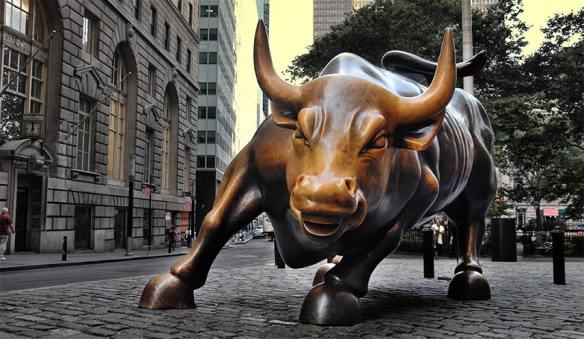
Let me apologize here, because I have to do some history — and for reasons I’ve never understood, some folks actively dislike history. It’s necessary though. So here we go. Back in 1987 there was a global stock market crash. Doesn’t matter why (at least not for this discussion), but stock markets everywhere — everywhere — tanked. Arturo Di Modica, a Sicilian immigrant who became a naturalized citizen of the U.S., responded by creating Charging Bull — a bronze sculpture of a…well, a charging bull. It took him two years to make it. The thing weighs more than 7000 pounds, and cost Di Modica some US$350,000 of his own money. He said he wanted the bull to represent “the strength and power of the American people”. He had it trucked into the Financial District and set it up, completely without permission. It’s maybe the only significant work of guerrilla capitalist art in existence.
People loved it. The assholes who ran the New York Stock Exchange, for some reason, didn’t. They called the police, and pretty soon the statue was removed and impounded. A fuss was raised, the city agreed to temporarily install it, and the public was pleased. It’s been almost thirty years, and Charging Bull is still owned by Di Modica, still on temporary loan to the city, still one of the most recognizable symbols of New York City.
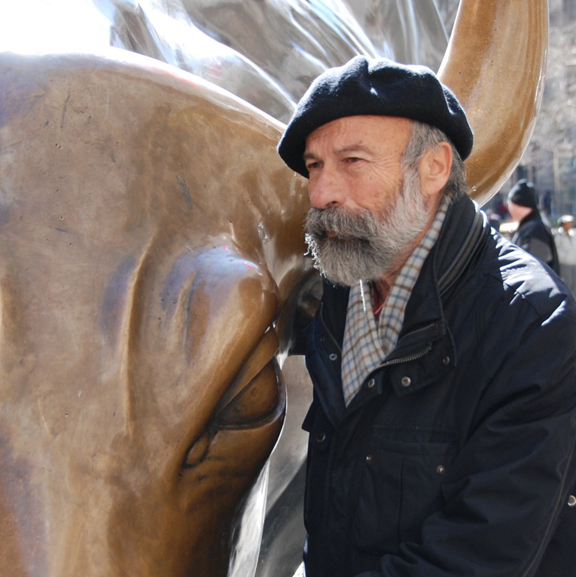
Arturo Di Modica (the one in the beret)
And that brings us to March 7th of this year, the day before International Women’s Day. Fearless Girl appeared, standing in front of Charging Bull. On the surface, it appears to be another work of guerrilla art — but it’s not. Unlike Di Modica’s work, Fearless Girl was commissioned. Commissioned not by an individual, but by an investment fund called State Street Global Advisors, which has assets in excess of US$2.4 trillion. That’s serious money. It was commissioned as part of an advertising campaign developed by McCann, a global advertising corporation. And it was commissioned to be presented on the first anniversary of State Street Global’s “Gender Diversity Index” fund, which has the following NASDAQ ticker symbol: SHE. And finally, along with Fearless Girl is a bronze plaque that reads:
Know the power of women in leadership. SHE makes a difference.
Note it’s not She makes a difference, it’s SHE makes a difference. It’s not referring to the girl; it’s referring to the NASDAQ symbol. It’s not a work of guerrilla art; it’s an extremely clever advertising scheme. This is what makes it clever: Fearless Girl derives its power almost entirely from Di Modica’s statue. The sculptor, Kristen Visbal, sort of acknowledges this. She’s said this about her statue:
“She’s not angry at the bull — she’s confident, she knows what she’s capable of, and she’s wanting the bull to take note.”
It’s all about the bull. If it were placed anywhere else, Fearless Girl would still be a very fine statue — but without facing Charging Bull the Fearless Girl has nothing to be fearless to. Or about. Whatever. Fearless Girl, without Di Modica’s bull, without the context provided by the bull, becomes Really Confident Girl.

Fearless Girl also changes the meaning of Charging Bull. Instead of being a symbol of “the strength and power of the American people” as Di Modica intended, it’s now seen as an aggressive threat to women and girls — a symbol of patriarchal oppression.
In effect, Fearless Girl has appropriated the strength and power of Charging Bull. Of course Di Modica is outraged by that. A global investment firm has used a global advertising firm to create a faux work of guerrilla art to subvert and change the meaning of his actual work of guerrilla art. That would piss off any artist.
See? It’s not as simple as it seems on the surface. It’s especially complicated for somebody (like me, for example) who appreciates the notion of appropriation in art. I’ve engaged in a wee bit of appropriation my ownself. Appropriation art is, almost by definition, subversive — and subversion is (also almost by definition) usually the province of marginalized populations attempting to undermine the social order maintained by tradition and the establishments of power. In the case of Fearless Girl, however, the subversion is being done by global corporatists as part of a marketing campaign. That makes it hard to cheer them on. There’s some serious irony here.
And yet, there she is, the Fearless Girl. I love the little statue of the girl in the Peter Pan pose. And I resent that she’s a marketing tool. I love that she actually IS inspiring to young women and girls. And I resent that she’s a fraud. I love that she exists. And I resent the reasons she was created.
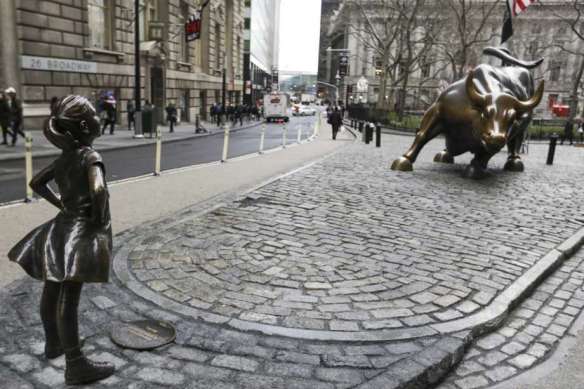
I love the Fearless Girl and I resent her. She’s an example of how commercialization can take something important and meaningful — something about which everybody should agree — and shit all over it by turning it into a commodity. Fearless Girl is beautiful, but she is selling SHE; that’s why she’s there.
Should Fearless Girl be removed as Di Modica wants? I don’t know. It would be sad if she was. Should Di Modica simply take his Charging Bull and go home? I mean, it’s his statue. He can do what he wants with it. I couldn’t blame him if he did that, since the Fearless Girl has basically hijacked the meaning of his work. But that would be a shame. I’m not a fan of capitalism, but that’s a damned fine work of art.
I don’t know what should be done here. But I know this: Arturo Di Modica has a point. And I know a lot of folks aren’t willing to acknowledge that.
 gregfallis.com
This article is blah blah blah blah blah. It was Beyond not interesting and slanted in a way you “believe”. Pathetic. The US is better than this jibberish, that girl rocks and your over annalytical perceived nonsense it ridiculous. Go back to your cave.
LikeLiked by 3 people
The idea is alive. There should be no conflict at all. Move the ‘fearless girl’ beside the ‘charging bull’, facing the same direction. The essence of both ideas is strengthened, becomes dynamic, and positive. There is already too much conflict and aggression in this world, that there is no need for more conflict.
LikeLiked by 3 people
Maybe part of the strength of the charging bull is that he is changing direction, in dismissal? of the more vulnerable “Fearless Girl” (or something Di Modica had already subconsciously implied), with respect, and the bull has been aimed at some other target. A perfect compliment that infers one thing (possibly fear of the girl) but implies the bull has made a choice. It takes nothing away from either work.
LikeLiked by 2 people
I feel for the original artist. The new artist has incorporated the bull into his art, so the bull’s art no longer exists. Especially as the girl doesn’t reflect feminism. It reflects the idiocy of standing in front of a charging bull.
But for those who say art changes and all is fair – hmm. Well, maybe I’ll comisssion a piece of art of a nightmare horror, place it behind the girl, and entitle it “the dangers of overconfidence”. All those praising the girl statue will have to praise mine too, or else be revealed as hypocrites!
LikeLiked by 2 people
Thanks for this interesting discussion and good to hear about the complexities of the history of the two works – a quick, possibly uninformed thought:
1. The bull’s original ‘meaning’:
I also like the idea of it as a ‘guerrilla artwork’, though it does seem a little incongruous to consider a $350,000 3-ton bronze statue as a somehow subversive artistic statement, juts by virtue of the resources it takes to create the work.
I don’t know enough about Arturo Di Modica or the statue to judge his original intent, however, so lets take its meaning at face value for now:
Representing “the strength and power of the American people” could mean a lot of different things to different people socially and politically, ranging from (what I, with my political slant consider) the benign & uplifting to the downright ominous (think about all of the disaster our political movements throughout history that have claimed to champion the ‘strengthen and power’ of their constituents).
Greg’s piece above implies the more benign (again, by my slant) interpretation, in that ‘the people’ loved it and ‘the assholes who ran the NYSE’ didn’t. So by this reading (and you could certainly contest the assumptions here), the piece was evoking benign ideals and proposed by a powerful establishment for which the artwork and the ideals it represented were an inconvenience at best, threat at worst.
…which is Greg’s point and one jobs of subversive art, so so far so good, I think.
2. The bulls appropriated meaning:
If this was the artists original meaning (and whatever NYSE’s original objection) there’s a pretty convincing argument that its meaning had already been appropriated long before the girl came along. I’m not an art expert, and I didn’t know the history of the bull but I definitely knew it existed, and I definitely associated it with the capitalist establishment.
Every depiction of the work in popular culture and media has re-enforced its association with “the strength and power of American capitalism” (and the wall street version of American capitalism at that). That it would mean anything else is frankly surprising to anyone coming to this discussion for the first time (which is the reason the girl works in the first place, obviously).
…so either by conscious appropriation or just the shifting tides of social meaning (themselves inextricably influenced by the same system), the more benign meaning proposed above had already changed – I think there’s a pretty good argument that this would have been the appropriation for Arturo Di Modica to object to.
3. The girl’s pre-appropriated meaning:
…and so comes the statue of the girl, with its corrective to the Bull’s socially understood meaning that we all love and that those of us who are not activists we probably feel should have been championing before a $2.4 trillion investment fund came along and did it for us.
There’s a broader point here about how our involvement in a system that does not necessarily reflect the world we want creates dissonances within us which the system itself can then package-up and sell back to us. The ideas are real – the question is whether we are comfortable with entrenched interests telling us how and when to have them.
Despite how it looks it is not necessarily a pessimistic message – it implies the system needs us just as we may need (some parts of) the it. There also might be an argument that without OWS and other movements the marketing firms would not have considered it timely (or profitable) to move into this space and represent our ideals for us. Either way the lesson it should teach us is the sheer necessity of vigilance, empathy and critical thought of all of us (which is why I like this thread).
As for what to do about the statues now I’m not sure – I like the new message, but it wouldn’t have been great if Arturo Di Modica or others had beaten the establishment to the punch and re-installed the ‘people’ into the work long before now…
LikeLiked by 2 people
(Ed for sloppy typing: ‘but wouldn’t it have been great’, not ‘but it wouldn’t be great’… )
LikeLiked by 1 person
Historically, the stock exchange was a LlVESTOCK market. Cattle were part of that, though too many bulls would probably have created havoc. Steers, pigs milk cows. Goats, sheep, etc would have been more in keeping with the place. Also, I believe Wall Street was the original site of Columbia College, and I think there is a plaque somewhere which asserts Columbia Univ’s continuing claim, modified by an easement for city use. So probably the Columbia trustees should determine how to deal with bronze litter on their sidewalk.
LikeLiked by 2 people
put the bull somewhere else in the same district maybe? so it can get it’s meaning back without the girl
LikeLiked by 2 people
I think Arturo Di Modica can simply turn his statue around, actually.
Impressive arguments you fingered out, by the way.
LikeLiked by 2 people
Great article
LikeLiked by 2 people
It’s really a matter of placement and orientation to one another. By placing her in front it gives a false forced meaning to the bull, a projected opposition. Both objects oppose the same thing… Can’t they stand in unity side by side defying a common foe they both oppose?
The $10m dollar question is did the artist of standing girl know the original intent of the bull? If not… that means there is a forced relationship and history is being ignored… knowing what we do now… I still pose the question, why can’t they stand united?
LikeLiked by 2 people
I think they’re both fine where they are. We can look at Charging Bull and see it as the power of American labor in pursuit of the American dream, and we can simultaneously look at Fearless Girl and see it as resistance to whatever scapegoat we imagine to be bearing down on her. I honestly wouldn’t have looked for articles like this, or any other source that explained Charging Bull’s history, if Fearless Girl hadn’t drawn attention to Charging Bull.
That said, I am concerned that Fearless Girl might represent an intellectually dishonest argument; that it wasn’t created to celebrate the strength of girls and women even though it would be seen that way, nor was it intended to promote the Gender Diversity Index fund as it claims, but rather, was intended to make Charging Bull look threatening to a girl.
Di Modica has every right to have his statue displayed elsewhere, and if he did it, Charging Bull would lose its negative association. It’s likely that once people forget that Fearless Girl used to be staring at Charging Bull, Fearless Girl would lose its positive association too. But I hope he doesn’t do that. Charging Bull really is subject to both positive and negative interpretation, and it would suck for Fearless Girl to be reduced to shilling for an index fund. Moving either piece would diminish both, in my view.
LikeLiked by 2 people
There’s something they can do about it. Just move the girl to the left or right of the bull, facing the same side. Then it will mean “We’re together in this”, and the girl will still look fearless.
LikeLiked by 3 people
not my original idea though.
LikeLike
I wasn’t aware of any of these aspects. A simple solution would just be to turn the Charging Bull in the same direction as the Fearless Girl.
LikeLiked by 1 person
The little girl statue is a testament to runaway female vanity exuded by our culture. Everybody knows that little girls are not leaders — how could they be; they’re just starting out in life — yet everybody participates in, nay, celebrates, the charade. Adults humor the silly overconfidence of children. The association of female leadership with an uppity postured bronze girl, is a clear declaration that we’re indulging women when we put them in leadership positions. Everybody’s patting the girl on her head, precisely for her vanity. Look at her! I wouldn’t be able to devise an installation more insulting to women, if I tried. Yet the irony deepens, as women celebrate this whole debacle as a sign of female empowerment — closing the loop, and demonstrating that, maybe, the insult is deserved after all.
LikeLiked by 3 people
In regards to the fact that ‘Fearless Girl’ was commissioned by a big company and meant as an advertising tool, a huge part of art history is populated by pieces that were precisely that.
Most of the work that people revere today was commissioned by powerful and rich people and often contained propagandistic overtones.
The idea that art has to be ‘pure’ is quite a new and kind of unrealistic one. Where there’s art, there’s usually money.
Also, the recontextualisation of a piece isn’t a new or shocking concept. I think Duchamp and Picasso would agree. I think it’s par the course in art.
LikeLiked by 2 people
Fearless Girl should stand side-by-side with Charging Bull. The positioning will change the whole context for the better.
LikeLiked by 2 people
Well, I’m disappointed to learn that this piece was created by a global investment firm as an ad campaign — but the power of its cultural impact remains undeniably positive and inspiring, and I would encourage Di Monica to reframe and embrace this evolution.
I can understand why Di Modica would be pissed off by corporate appropriation of his piece, which suddenly makes his symbol into the villain of the story…but if he’s able to see beyond his original intent, he might recognize that his piece now represents the “the strength and power of the American people” more profoundly then ever before.
If Di Monica is truly committed to honoring American ideals and celebrating what makes this nation great…he could chose to embrace this shift in metaphor. He could chose to embrace the way it empowers women everywhere in their fight for equality and access in a male-dominated economic system.
“Charging Bull” effectively became a major symbol of American capitalism and power. If Di Monica has the humility and grace to recognize that this symbol is bigger than him now…and see that his piece is now part of a duo that serves to inspire our nation toward greater heights of freedom and equality…he would be doing a great service to the country he admires so much. Given the profound systemic inequity women still face in our country, I hope he can put his ego aside long enough to serve the greater good and permit this new metaphor to stand tall to inspire millions more.
LikeLiked by 2 people
He may removed the bull. As it may also lost its meaning now. And change it to a Mom and dad statue. So the fearless girl will become a disobedience girl.
LikeLiked by 3 people
Reblogged this on The World According to Life and commented:
Interesting discourse on art going on here.
LikeLiked by 2 people
**Yawn**
LikeLiked by 2 people
Oh the dilemma. Thank you for pointing out both sides of a difficult situation. I agree there is no easy answer as to a plan of action. I also see her as standing against a bullish market which can be seen as standing against the best interest of our country. What to do, what to do? In my heart I think she needs to go. She in essence is a bronze billboard. This opens the door to so many undesirable scenarios.
LikeLiked by 3 people
Maybe… the meaning of art is in the mind of the person experiencing it. You create and object and you only own your own meaning, not those of other people. That’s why a hip hop version of Mozart’s requiem is still music. Still beautiful. Still meaningful.
The bull is a man’s conceptualisation of the power and strength of the American people. The girl is a woman’s. That’s my idea. A woman happened to create the girl, and where did she get the money? A man created the bull and where did he get the money? Why is one funding stream valid (though undisclosed in the post) and another not? Plenty of women work in finance, nothing inherently male about the fund described.
I love the thought-provoking post, and my intention is an objective, scientific approach to questioning the logic of the objections expressed, not critiquing those objections.
Enjoy the art. Di Modica paid for his bull somehow. Remember that: He didn’t pay for the space it’s in, or pay for monopoly of anybody’s response to it. He put it in a district where the finance industry pays the taxes that keep the street repaired and clean, and he gets his work seen because of that industry. If he doesn’t like the response they commission, he, like the individuals who experience his bull, can suck it up. I hope it makes him think.
Maybe he knows the source of all his funding was 100% ethical, but his point can be raised to question the funding of all creative projects including his own. There’s potential irony for you.
LikeLiked by 2 people
I have no problem of the fearless girl being co-operate or that the bull is not. I get Di Modica original intent. But that argument aside the question we have to ask if a relatively small bronze statue of a girl with a pony tail staring at his art makes it so easily a negative he has to ask. ‘Is my original message really what I thought’
Because his argument screams of privilege and a co-operate statue of a girl changing his message so easily acknowledges that.
LikeLiked by 2 people
Maybe they could turn her around, so both her and the bull are facing the same way, and fighting the same fight.
LikeLiked by 2 people
I think she should be moved, placed next to the bull .. This way she does not lose her defiance against the world (not the bull thus changing what it represents) and that the bull should of course stay….or the girl should be put somewhere else …she has acheived international recgonition and ca stand on her own. The bull should not be removed … One should not be used to change the message of the other….after reading this i almost feel that the commisioned work is trying to shame out the non commisioned work…and we must now protect both…
LikeLiked by 2 people
He should turn the bull arpund 180 degree to blame SHE….
LikeLiked by 2 people
Just wanted to let you know, I put this on my facebook, and it’s public so if you want to join and comment THERE too, you can.
LikeLiked by 2 people
I wish the fearless girl could make some headway on the State Street Board or Management Committee.
LikeLiked by 3 people
Reblogged this on Ja, du sier noe. and commented:
A good take on a PR stunt.
LikeLiked by 2 people
There should be a third statue, of what and expressing what, I do not know.
The story evolves.
LikeLiked by 2 people
Thank you, Greg, and also to everyone who commented. It was wonderfully refreshing to read about the many layers of meanings, and how contradiction exists, even within one person’s perspective.
I myself have no particular opinion on the meaning of the two statues, but I really enjoyed reading the article and the conversation that followed. I often reflect on the multiple stances in issues. In a world where everyone is so certain that they are right, seeing multiple sides of an issue is often paralysing. This article and discussion has encouraged me to be … well, to be less paralysed!
LikeLiked by 2 people
Reblogged this on Musings of an 'Insufferable Horsey Girl' and commented:
Not horsey, but a very interesting and well-constructed argument.
LikeLiked by 2 people
Leave them both and make them stand side by side. And scratch the SHE into a She. Appropriation of the appropriation.
LikeLiked by 2 people
He does not own it any more. He abandoned it on the street. It is no longer his to have any say over.
LikeLiked by 3 people
Artists can’t choose what their art pieces are are going to be exhibited next to. That’s the someone else’s job. Once an art piece is exhibited, it belongs in a sense to the public to take what meaning they want from it or interpret how they want to. Therefore he can’t protest it changing his context, the same way an actor or actress can’t complain about the way the film turns out. The artist is still only a part of the process that includes commissioner, artist, audience, critic, and so on in a full context. Nobody says you can always fully control the context. The art piece either belongs to the world or he can take it back.
LikeLiked by 3 people
Yeah, I can see why the original artist would be ticked. If I were him I would sneak in again & move the bull. Or just rotate it 180 degrees 🙂
This is no different than if someone had done a painting, & somebody came along & painted an extra person into it. Sure, the original is still there, but it isn’t the same painting
LikeLiked by 2 people
Yeah, let’s bash the artist, and act surprised when – with his work not being what he wants it to be- he sells the Bull to a private collector for millions. The girl can take it’s place, although she’s more likely to be sold out as well, having served SHE’s purpose. Then we can analyze how patriarchal oppression destroyed yet another public good, and plead with the new owner to sell back the Bull. Perhaps even pay for it with public money, thus effectively paying for SHE’s campaign and our stupidity and misguided arrogance Any way you look at it I don’t see the feminist message in there. Taken literally, the girl is just suicidal; taken metaphorically, it puts down women more than it gives them power except if women should be overjoyed and thankful that a corporation decided to try and placate them with a female statue)
LikeLiked by 3 people
Maybe they should turn her around, so that both she (or SHE) and the bull are charging, fearlessly, together…
LikeLiked by 2 people
THE VIEW FROM ACROSS THE POND
The bull stands for only one half of the American people, and the half of that half which is aggressive, macho and threatening. You know, like Trump. It’s an ugly thing, move it, I’d say.
The the Litte Girl doesn’t have to be there as a corporate advert, fine though she is.
Let the company in question buy them both, to be situated in their building, where people can view them if they like…
LikeLiked by 2 people
Di Modica has a point. And, since that statue is legally his, he has the right to remove it.
although, there is another point to be made. Art, like beauty, is in the eye of the beholder. Often what people see in a painting, or sculpture, or any other art form, may not be what the artist intended to convey. That is sometimes unfortunate, sometimes serendipitous.
Little does it matter what the commissioner of the fearless girl mean, what she is shouting at the world is her true meaning. It is, however, unfortunate that the meaning of the bull changes in the process. It is no longer what the artist intended not what the oublic understood thus far.
Personally, I would like to see the sculptures remain in place. Perhaps a plaque with an explanation could help. At the same time, I do understand Di Modica’s point. I do believe he has the right to remove his statue. I wander how the two would look side by side…
LikeLiked by 2 people
As an artist, I think it’s important to leave them both there, BUT add an explanation of them.
In other words, pretty much duplicate this article in some way and post it there.
See, art is personal. Not just to the artist, but the viewer as well.
Charging Bull represents american fearlessness to the artist, but it means many other things to the public. In MY mind iy represents an unstoppable evil in Wall street…but that might just be the hippy i. Me talking.
Honestly, a real artist needs to keep that idea in mind: Art is different for everyone. Everyone has different perceptions. AND art can be fluid.
You don’t force YOUR perceptions down people’s throats. You let them discover it.
Now Fearless Girl is also a powerful piece….for the public. But for the artist, who was commissioned, it probably means less.
But when added to Charging Bull, it makes something amazing.
We can’t ban something (in this case remove) because someone doesn’t like it. While Mark Twain’s books contain a disparaging term for black people, it is important for people to see it and understand why it is there and how perceptions have changed.
In the case of Charging Bull and Fearless Girl, it creates one of the best stories I’ve ever seen about art.
To remove either would be a tragedy. Just add a sign or two that talks about their history and what they mean to different people.
Get the public thinking about perceptions of others. Let the public decide for themselves if Chargeing Bull has morphed into a symbol of patriarchal power, or if Fearless Girl spits in the face of strong women because it is a clever advertisement. But most importantly, let the public see that art DOES HAVE VALUE.
LikeLiked by 2 people
Let me get this straight: a ‘socially relevant and subversive’ piece of art supports the financial machine, that’s ok; but the financial machine supporting a piece of ‘socially relevant and subversive’ art, that’s a problem. Oh fuck off.
Di Modica allows his work to be commodified and interpreted by anyone in politics or finance. Who knew this backstory of the bull? Who cares? Where is Di Modica during the 2008 crash, complaining Wall Street ripped everyone off?
You park your ‘analysis’ in one step back from the frontside of this; but take another step back and that analysis evaporates.
LikeLiked by 2 people
The bull has been gentrified like everything else in the city. Just usurp the culture and meaning of something, turning the original idea banal. Remove the girl, this is graffiti in my opinion. Would you draw a little boy on the Mona Lisa?
LikeLiked by 1 person
I never knew the story of the bull. Maybe Fearless Girl should stand next to the bull. Together we draw strength from each other and face adversity. I do love the Fearless Girl and TBH I think the artist’sintent behind the bull has gotten lost. The bull, to me, represents a bullying sense of greed. But I see it differently now that I know the story.
LikeLiked by 2 people
How about moving the Fearless Girl to stand with Charging Bull?
LikeLiked by 2 people
I get why Arturo di Modica is upset. I get that the message of the raging bull is subverted. I get it.
But what I would say to di Modica is that the Charging Bull, is a symbol. What a symbol represents changes over time, as the world changes. And the world has changed. In 1987, the financial markets collapsed. By the time the bull appeared in Wall Street in december 1989, the Berlin Wall had collapsed or was collapsing, symbolising the disintegration of the communist economies. Capitalism appeared to be the only way to organise economies. So, it might have been intended to represent the strength of the US economy but it also represented the strength of capitalism.
Today, some 30 years later, the world is again different. The rampant capitalism of the last 30 years have resulted in the rise and rise of the richest 1%. The same capitalism has resulted in the fall of real incomes of just about everyone else. and the impact of all this capitalism has resulted in the election of Dump, a cheat, a liar and a sexual molester happy to grab any woman’s pussy if she were pretty enough and a bully to women he deems not attractive enough.
Yep, I’d say world has changed. And this Charging Bull, this optimistic symbolism of capitalism, needs to be aware that it represents darker aspects of capitalism.
As for the girl in this statue? She’s every human being, man, woman, girl, boy or LGBT etc.. She’s not just female. I don’t really care why she was conceived and by whom. I care that she was conceived.
And di Modica should be grateful that his work of art, this symbol of optimistic capitalism is still relevant, even if it represents darker and sadder messages. Let’s hope that he remembers that when life gives you lemons, make lemonade.
LikeLiked by 2 people
There’s also the very important context of the concept of “bear” and “bull” markets on Wall Street. That’s why the statue *is* a bull. In finance and especially regarding stocks, a bull market is characterized by optimism, investor confidence and expectations that strong results should continue. A bear market is the opposite; characterized by falling prices and typically shrouded in pessimism. So, Di Modica is exalting the bull as the ideal and the hope, and as a reaction to the 80’s long streak of “bear” market. I just think that fact is very important when regarding the bull as a separate piece of art. The bull is a symbol of economy, *placed on Wall Street itself*, which alters its meaning significantly when considering Fearless Girl (a piece of art I like in itself). So she’s facing a charging bull, okay, but she’s also facing… a strong economic market? Which she wants to… what? It doesn’t really make sense to me. It’s not “just” a bull and it’s not a bull for just any reason.
LikeLiked by 3 people
Now someone needs to put up a fence around the bull
LikeLiked by 2 people
Put them side by side. That would change the meaning completely.
LikeLiked by 2 people
Perhaps if State Street Global Advisors could be convinced(coerced) to remove the f***ing plaque, we’d all be happy.
LikeLiked by 2 people