I got metaphorically spanked a couple of days ago. Folks have been talking about the Fearless Girl statue ever since it was dropped in Manhattan’s Financial District some five weeks ago. I have occasionally added a comment or two to some of the online discussions about the statue.

Recently most of the Fearless Girl discussions have focused on the complaints by Arturo Di Modica, the sculptor who created Charging Bull. He wants Fearless Girl removed, and that boy is taking a metric ton of shit for saying that. Here’s what I said that got me spanked:
The guy has a point.
This happened in maybe three different discussions over the last week or so. In each case I explained briefly why I believe Di Modica has a point (and I’ll explain it again in a bit), and for the most part folks either accepted my comments or ignored them. Which is pretty common for online discussions. But in one discussion my comment sparked this:
Men who don’t like women taking up space are exactly why we need the Fearless Girl.
Which — and this doesn’t need to be said, but I’m okay with saying the obvious — is a perfectly valid response. It’s also one I agree with. As far as that goes, it’s one NYC Mayor Bill de Blasio agrees with, since he said it first (although, to be fair, probably one of his public relations people first said it first).
But here’s the thing: you can completely agree with the woman who responded to my comment AND you can still acknowledge that Arturo Di Modica has a point. Those aren’t mutually exclusive or contradictory points of view.
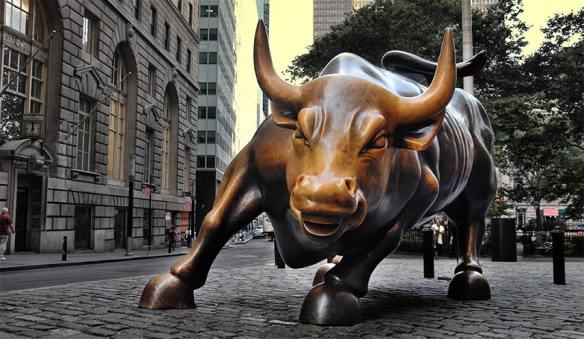
Let me apologize here, because I have to do some history — and for reasons I’ve never understood, some folks actively dislike history. It’s necessary though. So here we go. Back in 1987 there was a global stock market crash. Doesn’t matter why (at least not for this discussion), but stock markets everywhere — everywhere — tanked. Arturo Di Modica, a Sicilian immigrant who became a naturalized citizen of the U.S., responded by creating Charging Bull — a bronze sculpture of a…well, a charging bull. It took him two years to make it. The thing weighs more than 7000 pounds, and cost Di Modica some US$350,000 of his own money. He said he wanted the bull to represent “the strength and power of the American people”. He had it trucked into the Financial District and set it up, completely without permission. It’s maybe the only significant work of guerrilla capitalist art in existence.
People loved it. The assholes who ran the New York Stock Exchange, for some reason, didn’t. They called the police, and pretty soon the statue was removed and impounded. A fuss was raised, the city agreed to temporarily install it, and the public was pleased. It’s been almost thirty years, and Charging Bull is still owned by Di Modica, still on temporary loan to the city, still one of the most recognizable symbols of New York City.
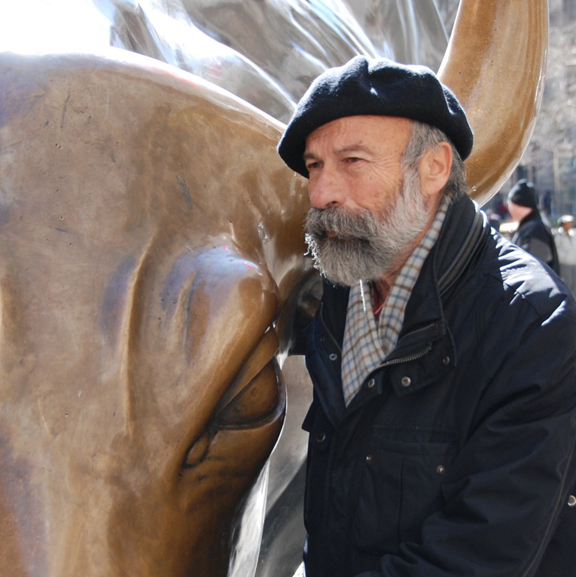
Arturo Di Modica (the one in the beret)
And that brings us to March 7th of this year, the day before International Women’s Day. Fearless Girl appeared, standing in front of Charging Bull. On the surface, it appears to be another work of guerrilla art — but it’s not. Unlike Di Modica’s work, Fearless Girl was commissioned. Commissioned not by an individual, but by an investment fund called State Street Global Advisors, which has assets in excess of US$2.4 trillion. That’s serious money. It was commissioned as part of an advertising campaign developed by McCann, a global advertising corporation. And it was commissioned to be presented on the first anniversary of State Street Global’s “Gender Diversity Index” fund, which has the following NASDAQ ticker symbol: SHE. And finally, along with Fearless Girl is a bronze plaque that reads:
Know the power of women in leadership. SHE makes a difference.
Note it’s not She makes a difference, it’s SHE makes a difference. It’s not referring to the girl; it’s referring to the NASDAQ symbol. It’s not a work of guerrilla art; it’s an extremely clever advertising scheme. This is what makes it clever: Fearless Girl derives its power almost entirely from Di Modica’s statue. The sculptor, Kristen Visbal, sort of acknowledges this. She’s said this about her statue:
“She’s not angry at the bull — she’s confident, she knows what she’s capable of, and she’s wanting the bull to take note.”
It’s all about the bull. If it were placed anywhere else, Fearless Girl would still be a very fine statue — but without facing Charging Bull the Fearless Girl has nothing to be fearless to. Or about. Whatever. Fearless Girl, without Di Modica’s bull, without the context provided by the bull, becomes Really Confident Girl.

Fearless Girl also changes the meaning of Charging Bull. Instead of being a symbol of “the strength and power of the American people” as Di Modica intended, it’s now seen as an aggressive threat to women and girls — a symbol of patriarchal oppression.
In effect, Fearless Girl has appropriated the strength and power of Charging Bull. Of course Di Modica is outraged by that. A global investment firm has used a global advertising firm to create a faux work of guerrilla art to subvert and change the meaning of his actual work of guerrilla art. That would piss off any artist.
See? It’s not as simple as it seems on the surface. It’s especially complicated for somebody (like me, for example) who appreciates the notion of appropriation in art. I’ve engaged in a wee bit of appropriation my ownself. Appropriation art is, almost by definition, subversive — and subversion is (also almost by definition) usually the province of marginalized populations attempting to undermine the social order maintained by tradition and the establishments of power. In the case of Fearless Girl, however, the subversion is being done by global corporatists as part of a marketing campaign. That makes it hard to cheer them on. There’s some serious irony here.
And yet, there she is, the Fearless Girl. I love the little statue of the girl in the Peter Pan pose. And I resent that she’s a marketing tool. I love that she actually IS inspiring to young women and girls. And I resent that she’s a fraud. I love that she exists. And I resent the reasons she was created.
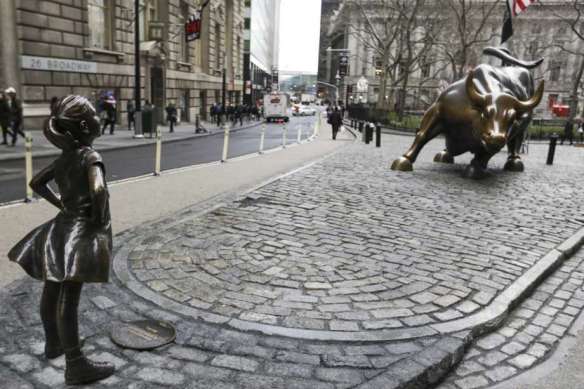
I love the Fearless Girl and I resent her. She’s an example of how commercialization can take something important and meaningful — something about which everybody should agree — and shit all over it by turning it into a commodity. Fearless Girl is beautiful, but she is selling SHE; that’s why she’s there.
Should Fearless Girl be removed as Di Modica wants? I don’t know. It would be sad if she was. Should Di Modica simply take his Charging Bull and go home? I mean, it’s his statue. He can do what he wants with it. I couldn’t blame him if he did that, since the Fearless Girl has basically hijacked the meaning of his work. But that would be a shame. I’m not a fan of capitalism, but that’s a damned fine work of art.
I don’t know what should be done here. But I know this: Arturo Di Modica has a point. And I know a lot of folks aren’t willing to acknowledge that.
 gregfallis.com
And why can’t some subversive artistic vandal simply remove the offending bronze tablet and set her free??
LikeLike
I don’t care how the two statues came to occupy this public space. Their stories intertwine and the effect is artistically sound – they inspire, create commentary and demonstrate craft. Art is.
LikeLiked by 1 person
Gotta love people who appreciate guerilla art by thinking it has to be protected from any interaction with other works of art that have complimentary meaning.
LikeLiked by 3 people
The author explains that it doesn’t have a complementary meaning, let alone a complimentary one.
LikeLike
But, it doesn’t have complimentary meaning. It’s corporate advertising.
LikeLike
Is the respected and very long history of art that was funded by the Catholic Church NOT advertising?
LikeLike
You do not understand what complimentary means. This wouldn’t even be supplementary because it isn’t much of anything on its own and it defaces something that is actually art.
LikeLike
It’s not a complimentary meaning, though. It changes the whole meaning of the bull statue, and makes it negative.
LikeLike
I’m with the bull, the girl should have been placed to make a statement somewhere else, women always seem to have to make a point, and irritate others.
LikeLiked by 2 people
Read the article. The girl is a piece of advertising based on the motivations of the “sculptor.” It’s not about the woman, it’s about the mutual fund. It’s a perfect metaphor: the actual art (the bull) charging at the poor, defenseless advertising (the girl). You’d think it was the other way around, but it’s not.
LikeLiked by 1 person
I’m with the bull, the girl should have been placed to make a statement somewhere else, women always seem to have to make a point, and irritate others.
LikeLike
He could turn the bull around.
LikeLiked by 3 people
Excellent suggestion.
LikeLike
Reblogged this on A Sort of Nut and commented:
This is exactly why I read posts online: a completely different perspective. Now I can bring up these points in a casual conversation. I appreciate that not everything needs to be mutually exclusive when considering the different perspectives of the Fearless Girl.
LikeLike
Turn the bull around! After all, it is all the fearless girls and women who have “stood by their man” who have helped made this country great. Turning the bull makes it also say that the bull turns its back on corporate cynicism. Great article.
LikeLiked by 1 person
Thank you for the history lesson. I am with you. I like the girl, how she is standing, and what she has represented to me (the little girl inside of me who worked in a field dominated by men). I am with you for the artist – I am a professional artist today – who hates to have my work messed with and also would be wildly offended by a corporation trying to take something from a piece I made, from my own spirit and funding to say something about the people I love, to make a buck or 5 million. Thank you again. Confused as ever but better informed.
LikeLiked by 1 person
a statue of the Trump in between them would make each piece of art as strong as they were originally intended to be.
LikeLiked by 1 person
Wow.. that’s genius! The American people charging back at him, and the future female generation standing strong against a Masagenistic ruler.
I say go for it, both artists should agree the meaning of artist is tic statement will not be tampered with!
LikeLiked by 1 person
I think the bull should be moved so that her face is two inches from the bull’s butt. THAT would be fearless, and it would give some context to the windblown look of her dress :)
LikeLike
Hear hear!
LikeLike
Pingback: Artistry in Action 2017- Summary, Homework & Notes- Class #5- 4/17/17 – Artistry in Action Class Blog
You correctly stated the point of it all: But here’s the thing: you can completely agree with the woman who responded to my comment AND you can still acknowledge that Arturo Di Modica has a point.
LikeLiked by 1 person
I think this article misses the point of view of history of art and the it’s conception. Is not considering the fact that all the works of arts before 19th century were funded or commissioned by someone rich or a powerful institution. All the masterpieces from Renaissance were commissioned and funded by the Catholic Church or the Medici’s (who were the most powerful bankers back then). Not for that cause the master pieces that we know today are considered less artistic than others or were removed from the churches or the museums or public spaces where they belong to.
This post also ignores the fact that removing a piece of art from the public eye is an outrageous anti democratic behavior. I also agree with Anne who posted earlier that all art is a reflection of society and we are living in different times now.
LikeLiked by 4 people
This piece reflects corporations co-opting movements created by people, hijacking the movement’s messaging to advertise their own messaging. If I were a female, I would feel used, not empowered.
LikeLike
But it done by invalidating the original work’s meaning, which isnt affected by time.
LikeLike
I don’t agree that it was ignored or missed. Art that is commissioned for the sake of the art is different from art that is commissioned for the sake of profit or advertising. The article did not make point to good or bad just that it was different, and that if those who comment understood or knew of those differences they may or may not change their position. I was taken aback by the comment that not disagreeing was in a way taking a position.
LikeLike
I am an artist. I have 50 years of glass work in my past. I’ll be 70 in June.
I have work in hospitals,libraries and universities.
Once they pay me, that’s it.
I might not like what happens to my work later, but the thing is it’s NOT mine any more.
That’s how it works. That’s how it’s always worked.
This sculptor should quit whining.
The sculpture of the girl brought him more publicity than he’s had in years.
LikeLiked by 2 people
He wasn’t paid…
LikeLike
Did you miss the point that NO ONE bought the bull?
LikeLike
I have to assume that you didnt read the article which is something that I feel is requisite before you comment on it.
LikeLike
You must not get out much. The Charging Bull is one of the most recognized pieces of art in the world.
LikeLike
Not sure of your point since the article says that the sculptor still owns it.
LikeLike
Yeah but he’s not been payed. He still owns the work…. If I was him I’d turn the bull around, move it a metre from the girl and plant a pile of shit there too…
LikeLike
The sculptor has not been paid; he continues to own the bull. But I agree: if you’re placing your art out in a public space, you should have an expectation of commentary in more forms than text. I DO NOT condone the vandalism of a piece of art (with graffiti, e.g.), but I think that the irony of the Art of Commerce (the Bull) being confronted with the Commerce of Art (the Girl) is extremely powerful and rich.
LikeLike
Much like “Fearless Girl also changes the meaning of Charging Bull”, it would seem that the original meaning of “Fearless Girl” is also being changed by those that have embraced it. Art is funny that way. It may have started out as a clever piece of advertising, but has evolved into something that represents something much bigger; especially to those that are feeling more afraid these last few months.
LikeLiked by 2 people
De Modica’s point is, and has always been, tarnished by the existence of the Merrill Lynch logo/mascot, which has been a widely known icon of popular culture since its launch in 1974. When you write of the context of his work, that’s an important bit you left out. When first installed, that sculpture was a great big love poem to Merrill Lynch and its ilk, and it is disingenuous to pretend otherwise, regardless of the artist’s disavowal of the context in which he placed his statue. I agree that the “Fearless Girl” interferes with the meaning of his statue, and I think he has a right to complain — and the rest of us have a right to be skeptical of the whole corporatist B.S. foofaraw. I love the little girl statue, but it should not stay unless the plaque is removed.
LikeLiked by 1 person
The bull was a symbol of the rising stock market and American prosperity long before Merrill Lynch. Both the statue and the Merrill logo are referencing the source material, which first came into use in the early 18th century. The bull and bear are indeed widely known icons of popular culture, but not primarily because of their association with Merrill Lynch, not then and certainly not now that Merrill has retired the logo.
Now as to whether the statue has always stood for patriarchal masculinity (regardless of what the artist claims), that’s another story… It is hard to believe that someone who believed in gender equality could condone just about anything going on Wall Street in the late ’80s. An maybe this is clearer from 2017, but isn’t the imagery sort of obvious? As masculine symbol in one of the most hyper-masculine corporatist cultures on the planet made by a male, southern Italian artist. The thing came out of the womb dripping in amniotic masculinity. So I don’t really buy the artists point. But I digress.
LikeLike
Perhaps some talented artist should create another statue and put it in between them both to change narrative yet again. This time, maybe a statue of a Wall Street tycoon (to look kind of like the Monopoly guy) and put it in between the bull and the girl, with the context being that the tycoon is being chased by the bull and the tycoon is looking back at the bull while pointing to the girl as if to say “get her, not me” or “it’s her fault, not mine!” Put the patriarchal oppression back where it belongs. Just a thought. I’m sure someone out there has an even better one.
LikeLike
If we wish to have both Statues make a point, move the fearless girl so she stands in front of the doors to the stock exchange looking at the doors as she is contemplating to one day take charge of such a giant.
LikeLiked by 1 person
He has a moral point, but does that equal a legal point? He is threatening to sue the city, and unless he has a contract stating that no other artwork will be displayed in its vicinity, what would be his legal point?
After all, isn’t it a well established tradition that art means what the viewer interprets it to mean, not what the artist intended for it to mean?
LikeLiked by 2 people
No; he does not have a legal point, IMHO. Not a lawyer.
LikeLike
Probably covered by the terms of agreement creating “long term loan to the city.” Sorry this answer is so boring.
LikeLike
Pingback: Links, 18 April 2017 | illiquid ideas
Early in the article, there’s a mention that Wall Streeters wanted the bull removed from the Financial District. Does anyone remember that the symbol for Merrill Lynch was a bull (that looked very similar to this one)? Could that be one of the reasons Wall Street was so adamant of having it removed? I’m just playing devil’s advocate here, but I think the question is a valid one.
In any event, I completely agree with this author; I loved the symbolism of Fearless Girl, but now that I know her history, I detest the reasons for her coming to be. Yes, it’s clever advertising, but it would have been nice if she wasn’t presented as art when in fact she’s just a marketing tool.
LikeLike
Pingback: Fearless Girl vs. Charging Bull: Social Activism or Marketing Stunt?
The beauty of art is that once the material is on display or published, the artist’s intentions are essentially obsolete and it is the responsibility of interpretation falls upon the beholder. This male animal represents a male-dominated marketplace that is a key player in the political functioning of the world. To me, the fearless girl is an example of women’s strength. After another qualified woman was turned down for a job she deserved but lost to an incompetent man, I am happy the fearless girl looks an economically structured, patriarchal society in the eye and says, “we will overcome”. I love the fearless girl statue and don’t care why it’s there. What matters is how I interpret it.
LikeLiked by 4 people
THIS.
LikeLike
But I’m sure you’re also mindful that your interpretation is a demographic to marketing company, that you can be led by the nose, or the statue, to stand affronted to anything a corporation deems worthy?
LikeLike
What can be do is placing the girl besides the bull…it’s not one against the other and she would be as fearless as she is know if side by side with it
LikeLike
That was also my thought.
LikeLike
Great point. As you said, ANY artist would dislike if not hate something that puts a label on his/her artwork, altering its meaning. As an artist myself, I would also love the Fearless Girl, but want her removed. Artists’ work define them and often portray a social message such as Di Modica’s. Artists are also very particular with their work and think in deep levels about their work that many wouldn’t come close to. Not to undermine anyone’s opinion, but it seems to me that placing Fearless Girl in front of his artwork is invading. I love HER, but she warps the symbolism of the Charging Bull. No one can deny her influence on the bull whether its good or bad. And whether its good or bad? Why should it matter? SHE adds significance to the piece as a whole but earases Di Modica’s message. The capability and strength of women are outstanding and should be brought attention to, but I feel that many people can be blinded by their passion for feminism. Di Modica is an artist. Hear him out.
LikeLiked by 1 person
The statute is his. Let him take it if he now d/n like where it is.
LikeLike
Di Modica isn’t much of an artist if he thinks Charging Bull stands in opposition to bull markets. His bull stands in sympathy. Only Fearless Girl stands in opposition.
If Di Modica is sincere in his opposition to capitalism and Wall Street, why does he not support this new context, which in part reaffirms what he claims was his original intent?
LikeLike
The Bull is not in opposition to capitalism, as a matter of fact it exists due to capitalism, it is paid for by a man from his own pocket. It is sympathetic to wall street, in that it recognizes the great power capitalism can be in developing a country, in making a place where we all can prosper, ideally, although that is a blanket statement and fails to comment on the great harm capitalism can do.
Ironically, the SHE statue is a marketing ploy, meant to illicit this feeling from you, if only to show how well a corporation, trading on the stock market, can manipulate your feelings.
LikeLike
And his Bull would not have much meaning if it were in a cornfield in Iowa rather than on Wall Street. Did not the Bull alter the meaning of what the architects made with buildings on Wall Street? No art installation is permanent, and certainly no arrangement will be permanent: even if you keep the whole scene the same, people will interpret it differently (e.g., “Wow. A bull, those went extinct years ago!”).
So why not let the girl stand, and enjoy what is a pretty rich message/counter-message where it truly can’t be said who is in the right (true art showcasing the raging bull of patriarchal capitalism facing off against the tough little girl of the clever marketing of feminism). I mean, this is a true scenario where there’s an honest debate about which one is really bull, even! Depending on your point of view, either is the hero or the villain: there’s a yin and yang to it.
It’s an interesting message for now, so might as well let it stand until it’s time to make way for new statues and icons.
LikeLike
That’s the thing about art. The artist doesn’t truly own it. It’s value and meaning are in the eye of the beholder and I’d think he might find some delight in knowing that his art still lives as it is reinterpreted for this generation. Knowing the history is important. But it’s history… and this just adds to the richness of the story I think.
LikeLiked by 4 people
Reblogged this on Freeing My Heart and commented:
” Fearless Girl also changes the meaning of Charging Bull. Instead of being a symbol of “the strength and power of the American people” as Di Modica intended, it’s now seen as an aggressive threat to women and girls — a symbol of patriarchal oppression.
In effect, Fearless Girl has appropriated the strength and power of Charging Bull. Of course Di Modica is outraged by that. A global investment firm has used a global advertising firm to create a faux work of guerrilla art to subvert and change the meaning of his actual work of guerrilla art. That would piss off any artist.
See? It’s not as simple as it seems on the surface. It’s especially complicated for somebody (like me, for example) who appreciates the notion of appropriation in art. I’ve engaged in a wee bit of appropriation my ownself. Appropriation art is, almost by definition, subversive — and subversion is (also almost by definition) usually the province of marginalized populations attempting to undermine the social order maintained by tradition and the establishments of power. In the case of Fearless Girl, however, the subversion is being done by global corporatists as part of a marketing campaign. That makes it hard to cheer them on. There’s some serious irony here.”… I wonder what would happen to the visual meaning of the Fearless girl if the Di Modica took his bull back, you know, removed it? THAT would change the context of SHE, I think.
LikeLike
Pingback: No, The Wall St. Bull Sculptor Doesn't 'Have A Point' – Miller Trades
I think Di Monica should take back his statue and place it in Philadelphia- we would love it here.
LikeLike
Let it charge at Rocky! LOL – out loud.
LikeLike
Just lose the girl’s plaque.
Let the viewer decide who she represents or why she’s there.
If the fund that commissioned her objects, perhaps it can be pointed out to them that they can possibly PURCHASE some space to display their ad somewhere else.
LikeLike
He should pull the statue. I would.
LikeLike
Take his bull and go home? Certainly.
LikeLike
Art provokes discussion, dissent, disagreement. Even the (white male Christian) artist knows this. I am not a huge fan of this sculpture being a GIRL (society has problems with grown females; girls are adorable!!), but what i DO like about this statue is that it DOES actively and meanly change the conversation about the Bull and what it means and represents. Of COURSE he has “a point.” So do sharp pencils and straight pins. Doesn’t mean he should get a say in WHAT else interacts with his public art piece. That is the great part of public art. It just does not belong to the artists at all anymore. Don’t care if it weighs 7000 tons!
LikeLiked by 4 people
Put her on TOP of the bull – she should be RIDING the bull.
LikeLiked by 1 person
Why not place the fearless girl statue in front of the twin towers location where the meaning would be twofold, not only would it be a stand against terrorism but also against the oppression of women.
LikeLiked by 1 person
Sort of wrong: The guy has a point, but it’s weak.
The author says the artist insists that the bull represents “the power of the American people”. I’m sorry… what? The bull at a prominent location on Wall Street represents a “Bull Market”, meaning a stock market preforming well and creating wealth for some of its participants, including thousands of brokers who practice their craft in offices nearby.
Period.
The bald eagle 🦅 is the symbol of the American people, always has been, and likely always will be.
That bull on that site represents greed.
Period.
So the argument that the artist has a point that the “Fearless Girl” portrays the bull as something threatening is correct.
But Fearless Girl didn’t CHANGE the meaning of the bull.
It confirmed it.
And any other point that implies the bull represents the American people in general… is bull.
LikeLiked by 1 person
Yes. That’s the irony. If you look at the artists’ motivations, the statue that appears to honor greed is an altruistic representation of the sculptor’s vision, while the statue that appears to honor strength and women is a commercial representation of the advertiser’s greed.
Brilliant symmetry.
LikeLiked by 1 person
Just because art is paid for does not mean it is a fraud! We should applaud anyone who pays artists to create- so often we are expected to do art for the love of it and never get compensated. Also this whole thing has brought him a lot of attention so he has a huge stage where he can voice his thoughts on it. I think the solution is simply to talk about it and hear all points of view then you know the history as you look at the art, and you can take in all the perspectives. Art is supposed to create conversations- why would that need to be shut down?
LikeLiked by 2 people
Art will always change with evolving cultural interpretations. Everybody is right and wrong at the same time. In this age of digital stimuli shouldn’t we just be happy anyone is talking about sculpture?
LikeLike
If Fearless Girl gets to stay, the commercial meaning she was installed to celebrate will be forgotten. No one will remember that she represented an investment firm. I completely understand Mr. Di Modica’s position, but his bull has stood there, uninvited for 30 years. He could be petty and remove it at any time, but he doesn’t have any say about what is place near, around or about his statue on City of New York property. Perhaps it is just hard for bulls to realizes that other may have an equal amount of strength.
LikeLiked by 1 person
To appease all, a third statue should be constructed between the bull and the girl. Something that represents a terrorist threat. The girl is there to stop it from advancing, and the bull is charging to destroy it. In this way they can work together as the equals they are to destroy evil instead of eacother.
LikeLike
I love fearless girl! As a grandmother of 5 granddaughters (1 grandson) and mother of two daughters, I sure do hope they have some fearlessness. I hope this for grandson as well. Leave the bull alone, let it represent the strength of our country. Move fearless girl to look out onto the ocean. Add fearless boy to stand beside her. Let them represent the future of our country as well as the idea that anyone can have a fearlessness to dream…dream big!
LikeLiked by 1 person
You missed something. The bull was an ill-advised choice of symbol for criticizing Wall Street. In 1901, a cartoon depicted JP Morgan as a bull facing eager investors, and when share prices are rising and encouraging buying, it’s called bull market.
Thus, Di Modica’s work was already hijacked long before Fearless Girl, as it symbolized Wall Street’s dick-swinging awesomeness. In my opinion, Fearless Girl puts a different spin on Di Modica’s vision, but the spirit of his artistic intent is honoured.
LikeLiked by 1 person
Turn the bull 180 degrees and a pile of bronze poop. Then fearless girl will be leaning in to …
LikeLike
I just asked around and no one I talked to knew anything about SHE or the creators of fearless girl. They all had seen the statue and liked it, but the SHE people did a crummy job of branding it, if that’s what they wanted to do. And, anyway, the fund they represent is pretty cool. People need to pay a LOT more attention to how their 401K money is invested.
LikeLiked by 1 person
maybe the girl is North Korean…………..
LikeLike
Either remove the girl or remove the bull. This is a good case of a piece of art completely changing its meaning because another piece of art is there. People will have a hard time looking at one without looking at the other at the same time. And it’s true, both of them together create an intriguing scene, but if both of their intended messages are changed because of this, then one of them has to to.
LikeLike
Why do anything? I see only a charging but somehow not angry bull and a wonderful fearless little girl taking her place in front of him. I see human and animal; male and female; brute strength and strength of character; great size and small size; both have beauty. I love it as a conversation. It seems that the child will win if it comes to a real confrontation but it will not because the bull will veer away. The addition of the girl makes me stop and admire both artists, symbols and the changing meanings. I don’t care that one is owned by the artist and the other is a commercial action. They both can be seen as talking economics – that is indeed a confrontation but without actual violence though it is a possibility. Fantastic!
Sent from my iPhone
>
LikeLiked by 1 person
Art that doesn’t change meaning is art that has died, in the same way that Robert Frost would not “kill” a poem by explaining its meaning. Although the intent for “Girl…” was to market gender-conscious investments, she became a symbol of the general sentiment of the 98% towards the 2% that have gotten fat and rich over the centuries off of the backs of the middle and lower classes. So the bull (which already change meaning for the “bull market”) is private property and the artist is upset that a little girl has changed its meaning? Fine. Move it and complete the metaphor and meaning people have assigned to her.
LikeLike
Go into a toy store. Purchase a plastic cowboy figure. Place it in between Fearless Girl and Raging Bull.
LikeLike
Before this post, I didn’t know the intended meaning of the bull sculpture. I don’t believe I am a minority.
My take on the bull? I have always responded to it as a symbol of the patriarchy. My immediate response to it was “bull market”. Nothing about it made me think “the strength and power of the American people”. It is a bull – a MALE bovine. It is in a position of aggression. It is right there at the Stock Exchange, a system that controls a great deal of the planet, overrun with men, and notorious for male aggression. It is representing the power of men, and more specifically, the power of our exchange system in the world. It is inherently sexist. And intentional or not, it seems to be representing the Stock Exchange.
You stated that it “cost Di Modica some US$350,000 of his own money”. His own money. A man – an artist – who has $350,000 to spend on a piece of “guerrilla” art that is championing male aggression.
Of course Di Modica has a problem with his “power” being challenged by a woman. A woman who is being made to feel like she her work is somehow invalid because of where she received her funding.
Artists have always had to get our funding from those who have the money. Always. And frequently, the artist has not necessarily agreed with the beliefs or morality of the source of that funding. Most of the finest works of art in history were commissioned by political leaders and religious institutions (the great powers of their time) to promote their agenda.
Regardless of who paid for what, the girl is standing up to the aggressive male. And quickly, the viewing public will not think about who paid for it. They will just seeing the brave girl, standing up to insurmountable odds.
LikeLiked by 1 person
You have literally no idea what you’re talking about. You certainly have no business discussing the artist. If you had bothered to do even a minute of research before posting, you’d know exactly why he had $350k to spend. But you didn’t so you don’t. And as such, again, you have no idea what you’re talking about, and as such have no business opining as if you did.
LikeLike
I believe the girl should be placed next to the bull, not as antagonists but as partners in a righteous fight.
LikeLike