I got metaphorically spanked a couple of days ago. Folks have been talking about the Fearless Girl statue ever since it was dropped in Manhattan’s Financial District some five weeks ago. I have occasionally added a comment or two to some of the online discussions about the statue.

Recently most of the Fearless Girl discussions have focused on the complaints by Arturo Di Modica, the sculptor who created Charging Bull. He wants Fearless Girl removed, and that boy is taking a metric ton of shit for saying that. Here’s what I said that got me spanked:
The guy has a point.
This happened in maybe three different discussions over the last week or so. In each case I explained briefly why I believe Di Modica has a point (and I’ll explain it again in a bit), and for the most part folks either accepted my comments or ignored them. Which is pretty common for online discussions. But in one discussion my comment sparked this:
Men who don’t like women taking up space are exactly why we need the Fearless Girl.
Which — and this doesn’t need to be said, but I’m okay with saying the obvious — is a perfectly valid response. It’s also one I agree with. As far as that goes, it’s one NYC Mayor Bill de Blasio agrees with, since he said it first (although, to be fair, probably one of his public relations people first said it first).
But here’s the thing: you can completely agree with the woman who responded to my comment AND you can still acknowledge that Arturo Di Modica has a point. Those aren’t mutually exclusive or contradictory points of view.
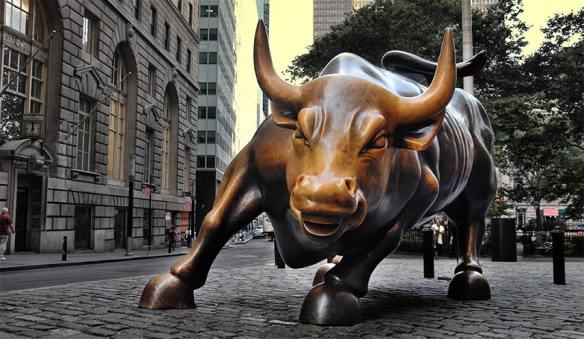
Let me apologize here, because I have to do some history — and for reasons I’ve never understood, some folks actively dislike history. It’s necessary though. So here we go. Back in 1987 there was a global stock market crash. Doesn’t matter why (at least not for this discussion), but stock markets everywhere — everywhere — tanked. Arturo Di Modica, a Sicilian immigrant who became a naturalized citizen of the U.S., responded by creating Charging Bull — a bronze sculpture of a…well, a charging bull. It took him two years to make it. The thing weighs more than 7000 pounds, and cost Di Modica some US$350,000 of his own money. He said he wanted the bull to represent “the strength and power of the American people”. He had it trucked into the Financial District and set it up, completely without permission. It’s maybe the only significant work of guerrilla capitalist art in existence.
People loved it. The assholes who ran the New York Stock Exchange, for some reason, didn’t. They called the police, and pretty soon the statue was removed and impounded. A fuss was raised, the city agreed to temporarily install it, and the public was pleased. It’s been almost thirty years, and Charging Bull is still owned by Di Modica, still on temporary loan to the city, still one of the most recognizable symbols of New York City.
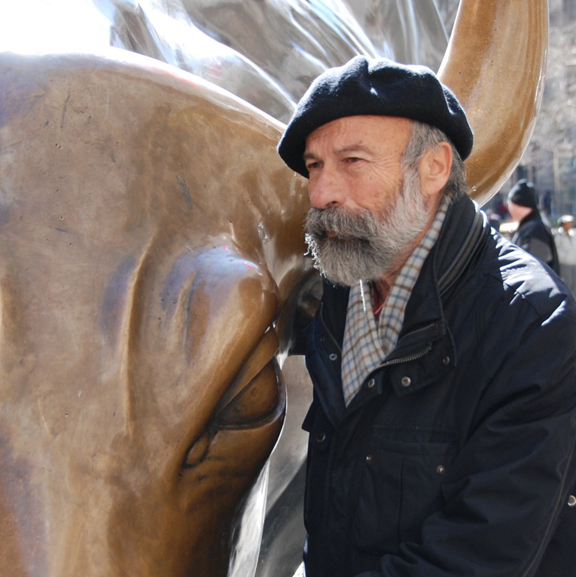
Arturo Di Modica (the one in the beret)
And that brings us to March 7th of this year, the day before International Women’s Day. Fearless Girl appeared, standing in front of Charging Bull. On the surface, it appears to be another work of guerrilla art — but it’s not. Unlike Di Modica’s work, Fearless Girl was commissioned. Commissioned not by an individual, but by an investment fund called State Street Global Advisors, which has assets in excess of US$2.4 trillion. That’s serious money. It was commissioned as part of an advertising campaign developed by McCann, a global advertising corporation. And it was commissioned to be presented on the first anniversary of State Street Global’s “Gender Diversity Index” fund, which has the following NASDAQ ticker symbol: SHE. And finally, along with Fearless Girl is a bronze plaque that reads:
Know the power of women in leadership. SHE makes a difference.
Note it’s not She makes a difference, it’s SHE makes a difference. It’s not referring to the girl; it’s referring to the NASDAQ symbol. It’s not a work of guerrilla art; it’s an extremely clever advertising scheme. This is what makes it clever: Fearless Girl derives its power almost entirely from Di Modica’s statue. The sculptor, Kristen Visbal, sort of acknowledges this. She’s said this about her statue:
“She’s not angry at the bull — she’s confident, she knows what she’s capable of, and she’s wanting the bull to take note.”
It’s all about the bull. If it were placed anywhere else, Fearless Girl would still be a very fine statue — but without facing Charging Bull the Fearless Girl has nothing to be fearless to. Or about. Whatever. Fearless Girl, without Di Modica’s bull, without the context provided by the bull, becomes Really Confident Girl.

Fearless Girl also changes the meaning of Charging Bull. Instead of being a symbol of “the strength and power of the American people” as Di Modica intended, it’s now seen as an aggressive threat to women and girls — a symbol of patriarchal oppression.
In effect, Fearless Girl has appropriated the strength and power of Charging Bull. Of course Di Modica is outraged by that. A global investment firm has used a global advertising firm to create a faux work of guerrilla art to subvert and change the meaning of his actual work of guerrilla art. That would piss off any artist.
See? It’s not as simple as it seems on the surface. It’s especially complicated for somebody (like me, for example) who appreciates the notion of appropriation in art. I’ve engaged in a wee bit of appropriation my ownself. Appropriation art is, almost by definition, subversive — and subversion is (also almost by definition) usually the province of marginalized populations attempting to undermine the social order maintained by tradition and the establishments of power. In the case of Fearless Girl, however, the subversion is being done by global corporatists as part of a marketing campaign. That makes it hard to cheer them on. There’s some serious irony here.
And yet, there she is, the Fearless Girl. I love the little statue of the girl in the Peter Pan pose. And I resent that she’s a marketing tool. I love that she actually IS inspiring to young women and girls. And I resent that she’s a fraud. I love that she exists. And I resent the reasons she was created.
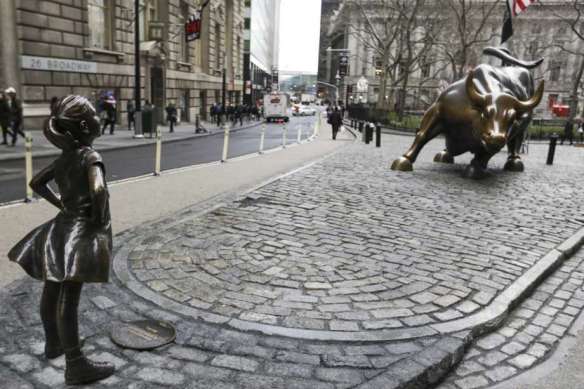
I love the Fearless Girl and I resent her. She’s an example of how commercialization can take something important and meaningful — something about which everybody should agree — and shit all over it by turning it into a commodity. Fearless Girl is beautiful, but she is selling SHE; that’s why she’s there.
Should Fearless Girl be removed as Di Modica wants? I don’t know. It would be sad if she was. Should Di Modica simply take his Charging Bull and go home? I mean, it’s his statue. He can do what he wants with it. I couldn’t blame him if he did that, since the Fearless Girl has basically hijacked the meaning of his work. But that would be a shame. I’m not a fan of capitalism, but that’s a damned fine work of art.
I don’t know what should be done here. But I know this: Arturo Di Modica has a point. And I know a lot of folks aren’t willing to acknowledge that.
 gregfallis.com
Reblogged this on Funhouse and commented:
An amazing article converging art, culture, business, and current events.
LikeLike
As far as I’m concerned, SHE is just clever signature to who paid for it. I’d sign my art too… and this autograph is clever. “SHE” is a credit to who paid for it.
LikeLike
Put them together rather than opposed.
LikeLike
What Mark Henson said. As evidence of that, just look at the Sphere – whose purpose was basically the same as the bull, to celebrate the triumph of capitalism and international trade. It got crushed literally by people disagreeing with that vision. It’s now on display in its newly mangled form back at the WTC. The context changed here also…. https://www.youtube.com/watch?v=JgLkdth62eI
LikeLike
The Fearless Girl statue only sullies the meaning of Charging Bull if you 100% accept this article writer’s description of Di Modica’s intent in creating it. However, the bull statue is even referred to as the Wall Street Bull, and the meaning of the statue has long since been accepted by the public as a symbol of capitalism and the financial district it is placed in. Unless he’d like to install an essay on his vision alongside the bull, Di Modica’s original intent has no bearing on the symbolism the public attributes to it.
LikeLike
No one has a right to tell him how to feel about his art being incorporated into a project he didn’t consent to. He has a right to ask it to be taken down, and if that doesn’t work, he has the right to remove his bull.
LikeLiked by 1 person
What if the had her standing beside the bull. She would still be fearless, not against the bull but standing with the bull facing the same foe.
LikeLike
Much of the nation, as well as the sculptor of “Charging Bull,” missed the point of “Fearless Girl.” State Street Global Advisors make it very clear that their goal in commissioning the site-specific sculpture is to “drive a conversation around the need to improve gender diversity in corporate leadership roles.” Specifically, they urge companies to have at least one woman on their boards. Ironically, “Fearless Girl” is not challenging the original artist’s intent or Wall Street—like any kid, she just wants to play. And how apropos: women fighting for leadership roles in top corporations have been represented symbolically by a small girl.
LikeLiked by 1 person
The problem with the whole thing is if you press the play button, the charging bull would trample the fearless girl to death, like a bug.
LikeLike
Returning from the military in 1968, It didn’t take long to realize that America has been taken over by the draft-dodging unAmerican politically-correct Leftist who had avoided the draft by fleeing to and taking over our universities. Almost immediately, I became aware that political correctness now controled our country. We ‘white-men’ were pushed to the side for socialistic political correctness of promoting black men, soon to be followed by social promotion of women then Mexicans. Our country was permanently damaged by the left’s political correctness..so, now, why am I not the least bit surprised that the unAmerican Leftist would undermine wallstreet’s raging bull with a defiant but totally worthless little girl image stealing the power and strength of the raging bull.
LikeLike
Reblogged this on The Dharma Pages: About The Music.
LikeLike
A strong stock market makes sense , defiance loses money. A little girl standing in front of a raging bull market of prosperity is opposite of what should be wanted On Wall St.
LikeLike
I say stand the statue of the girl and the bull side by side facing a statue of Trump.
LikeLiked by 1 person
He should just take it and go home. It’s had a good 30 years of exactly what it was meant for. Like it was said, Fearless Girl wouldn’t be what she is without the Charging Bull!
Let Fearless Girl stand on her own two feet not having to prove anything. Just be a Fearless Girl!
LikeLiked by 1 person
Well, since it’s his statue and is merely on loan to the city of New York, a simple solution would be to change the direction the bull is facing. The “Fearless Girl” becomes “Confident Girl”. The bull still represents the artist’s vision, but it dulls the impact of the advertising ploy.
LikeLike
Pingback: The Hidden Symbolism of the Wall Street Bull and Girl |
I love that there is no black or white to this piece. I feel that so many things are truly gray areas and too many people keep insisting that we “pick a side.” I, too, love the statue of the Fearless Girl and all she inspires, but I see the artist’s point as well. Bravo,
Interesting, open-minded read!
LikeLike
I think Di Modica should take his bull and find a place in New York that will allow it to exist as he intended. It’s his art on loan to the city. If he is unhappy with how it is being used/treated, then take it and leave. He has every right to do just that and I’m sure there would be dozens of other places in New York in the financial district that would be happy make themselves the new home to the charging bull. Making the ridiculous marketing ploy by a multi trillion dollar investment firm with no other motive than to sell stock null and void. If the statue has any merit on it’s own at that point then it will stand on its own.
LikeLike
I agree wirh yiu well thought throug piece. In fact for whatever reason when I first saw the piece I didnt like position of the girl. I didnt know the back story but I felt it demonstrated the barriers women face and not the strength we have not as aggressors but as meaningful members of the human race. Thanks for helping fill in the gaps.
LikeLike
This is the greatest example of why Intentional Fallacy is so important. Authorial intent is dead, and yet here is an article desperately trying to resuscitate it.
LikeLike
A really thoughtful article and the bit about appropriation is really quotable!
LikeLike
I think both artists were making a statement, each of which were pertinent to their own vision and sensibilities. Considering how many of us lost our businesses and homes in the 1980s because of a rapacious Wall Street and the junk bond market collapse.
Here we are years later with an economy that is sluggish but Wall Street is still the raging bull. Perhaps the little girl symbolizes also the innocence of the average person though from personal experience, all the raging bravado in the world won’t save you when Wall Street takes all but the most wealthy down
LikeLike
Fair enough. I love ambiguity as much, more probably, than the next guy. I think what is missing in this piece is the subversiveness of all art. It doesn’t matter what either artist/corporate entity meant for the art to mean. Once you release it into the wild it means what the people who see it take it to mean. Robert Frost’s poem about two roads diverging, was making fun of college grads going on and on about their path in life, when they almost all went and did boring, safe, mainstream stuff. Both those roads look pretty much the same, remember. But his point was too subtle and people never read it that way, so it came to mean exactly the opposite of what he intended. If a corporation and a raging capitalist both have their meanings subverted….I’m okay with that.
LikeLike
I think the Fearless Girl should be moving . Placed in different places at different times. To show She can face anything ! And She could even stand with anything also. Just a thought.
LikeLike
Totally understand his point of view. Love the Fearless Girl. She does totally obliterate his intended statement. He was there first. Maybe a compromise??
A large bronze plaque explaining the history and intent of each???
LikeLike
Me: I really do not care what his point, from years ago, is. … Times change. The world is no longer flat. … His art was just a comment on the times as he saw it then. A comment on a comment is just as valid, even though the second comment may piss off the first commenter. … Take that trolls.
Party2: How would you feel if Pepsi erected a bronze vending machine full of their soda brands behind the bull?
Me: How would you feel if coke erected a pile of coke cans coming out of the ass of the bull and making a pile of bullshit?
Party2: Should Raytheon hang a painting on the wall opposite Guernica extolling the virtues of war?
Me: That is fine. I would hope then, that another person put the video of the gassed syrians extolling the violence of war.
Party2: At least you are consistent. … I do think this is a very good point, though:
“Appropriation art is, almost by definition, subversive — and subversion is (also almost by definition) usually the province of marginalized populations attempting to undermine the social order maintained by tradition and the establishments of power. In the case of Fearless Girl, however, the subversion is being done by global corporatists as part of a marketing campaign. That makes it hard to cheer them on. There’s some serious irony here.”
Are marketing campaigns art?
Was Warhol selling Brillo pads or Campbell’s soup?
Me: Warhol was making a comment. … The 1984 Apple Superbowl commercial is art. Art can come from anywhere.
Party2: I agree that Warhol was making a comment, I wouldn’t dispute the artistic value of his work. But my question is more to do with the fact that his work wasn’t produced to sell the products depicted in them, where the Apple commercial was produced to sell computers. I do think that there is a difference in intent between a piece of art and a piece of marketing. The latter may use the former, but the intent is not the same. I think the intent of the artist plays a big role in whether we should consider something to be art or not.
Another way to look at it, an artist may choose to accept commissions, including commercial commissions, and in that case they are selling their skill as an artist for someone else’s intention. Many photographers and illustrators, for example, will differentiate in their portfolios between commercial and personal work.
Me: Art is art. Artists get paid for their work, or they die. … Once the creator has created the piece, no matter the artists intent, it is up to the world to decide if the piece will become world renown, or landfill.
Party2: How would you feel if Victoria’s Secret erected a bronze bra 12 feet high and someone else erected right nearby a giant Hello Kitty?
How would you feel if someone erected a statue of Superman, and then someone turned around and erected a statue of Lex Luthor holding a bag of Kryptonite and giving Superman the finger?
Me: I would laugh.
LikeLike
Nasdaq symbols have 4 letters; SHE, only 3
LikeLike
Remove the advertising plaque and the girl becomes art…to be interpreted in whichever way each observer may choose.
LikeLike
Just as much as Fearless Girl takes her meaning from the bull, the bull takes its meaning from the surrounding, super-capitalist, super-moneyed Wall Street buildings that surround it. The bull was a commentary (positive, it seems) on the locale. The girl is a commentary on the bull and also the locale. I don’t see any reason why the bull sculptor should have the last word in this conversation. Insofar as that’s his “point,” I’d say he doesn’t have one.
LikeLiked by 1 person
Maybe they could move her standing next to the bull in solidarity. She doesn’t fear his power and he is not intimated by her confidence.
LikeLike
Remove the fearless girl.
She can be a beautiful piece of art, somewhere else.
LikeLike
The fact that it is commissioned by a corporation does not negate the intent to inspire a sense of empowerment for women. That the concept is sponsored does not dilute the message. It DOES co-opt the bull’s impact – there’s some history of this in public art
LikeLike
I live in Texas, It’a bit irrelevant to me. To me no child with a parent in their right mind would allow their child to face off that type of a bull. In the real world these are examples of fine art, put them in a museum and let’s move on. Much ado about nothing.
LikeLike
Change the meaning again by placing a cowering Bear between the two statues.
LikeLike
Nice article. What if he just turned the bull around?
LikeLike
Lend her to Birmingham in front of the bull statue in the shopping centre. Maybe she can stand up yo thd forces if retail might and gender bias
LikeLike
Just add another sculpture of a NYC cop in front of that Fearless Girl statue to change the story again. lol
LikeLike
Solution: Take the Bull and turn it around. Change the meaning yet again.
LikeLike
Everyone disagreeing is hurtful. Dimarco is not advertising anything and as his property he has the right to sell replicas of his work and has every right to be upset about a company blantantly marketing something and using his work to do it. He has every right to be upset and a s a born and breed New Yorker I can tell you charging bull is very special to all of us and as a woman I can say fearless girl is beautiful but dimarco is right they are using his artwork as a statement and marketing ploy and he has every right to be upset by that. Pull your head out of your ass and stop making things about gender. This is about an artists love for his sculpture. It’s his child! If someone used your child as a political statement and marketing strategy you would be pissed and protect the integrity of your child as well. So stop because this artist is within his rights to be upset and all you saying he’s marketing as well he’s not. His art installment was just that ART, make of it what you will but do not trample on his right to be upset hat something so pure was made to be ominous and used to promote this company’s NASDAQ ticker and no one is talking about that.
LikeLike
It isn’t the history of these sculptures that matters, it’s the optics.
Once a piece of art enters the public space, it’s the public meaning that takes over. Whatever Di Modica meant thirty years ago, that charging bull now means a charging bull market. The power of money to mow down everything in its path. Even the 1% and the 99% can agree on that.
I didn’t know “Fearless Girl” was corporate commissioned. But that hardly matters to the public either. It has taken on the meaning of the small and weak challenging the rich and powerful. Kind of like the lone protester challenging the line of tanks at Tiananmen Square. SHE’s meaning has been hijacked too now.
In a world where women are still seen as breeders and ornaments, the courage of “Fearless GIrl’s” stance, gives me a little hope. See, even big money knows a winner when they see one….
LikeLike
Perhaps the Bull can be turned around? Fearless indeed!
LikeLike
Fearless Girl would still be fearless is she was put on the edge of a bridge or on the ledge of a building.
LikeLike
He should move the statue and if SHE Folloes then Dimodica should sue SHE.
– shame on people using something so pure and use it for their gains. The SHE statue is a tool of deceit, where are the Bull is of Inspiration
LikeLike
I think HE should remove the bull, put it elsewhere thus removing the blatant marketing plug, leaving his original artworks integrity intact, and let the fearless girl status stand on it’s own merits. I also think he should sue to get the sculptor to pay for the move.
LikeLike
No matter the reasoning behind the two works of art, they are still for all intents and purposes pieces of art created for public viewing. There would be no point in them existing if not for the public. Since both are on public property it would seem the “But I was here first” petulant bellow is at the base of the conflict. Only the ego of the artist prevents him from “taking his ball (oops…bull) and going home.”
LikeLiked by 1 person
Isn’t SHE what he was celebrating???
LikeLiked by 1 person
Turn the bull around.
Done.
LikeLike
I respectfully disagree with your premise that the girl changed the meaning of the bull. That masculine pride was always apparent to me in the bull. I am just glad she is there now, so everyone else can become aware of it. The bull is a classic example of an unintentional biases people don’t notice until it’s pointed out to them.
LikeLiked by 1 person
Has anyone looked into what SHE actually is? The statue certainly is selling SHE, but what does SHE do? It might be worthwhile to look into that, because it may actually matter.
http://www.businesswire.com/news/home/20160307005890/en/State-Street-Global-Advisors-Launches-Gender-Diversity
LikeLiked by 1 person
I appreciate your column; I learned a lot from it and I agree that he really does have a point.
I have a simple, less artistic reason for thinking that the placement of “Fearless Girl” is not brilliant: the bull, being on Wall Street, represents a “bull market,” one that is growing and increasing in value. Who can really applaud someone trying to stop a bull market? Certainly, a bull market can become a “Bubble market,” one in which stock prices do not reflect actual value but potential re-sale value when investors loose sight of the actual companies – but a real bull market is a good thing.
LikeLike