I got metaphorically spanked a couple of days ago. Folks have been talking about the Fearless Girl statue ever since it was dropped in Manhattan’s Financial District some five weeks ago. I have occasionally added a comment or two to some of the online discussions about the statue.

Recently most of the Fearless Girl discussions have focused on the complaints by Arturo Di Modica, the sculptor who created Charging Bull. He wants Fearless Girl removed, and that boy is taking a metric ton of shit for saying that. Here’s what I said that got me spanked:
The guy has a point.
This happened in maybe three different discussions over the last week or so. In each case I explained briefly why I believe Di Modica has a point (and I’ll explain it again in a bit), and for the most part folks either accepted my comments or ignored them. Which is pretty common for online discussions. But in one discussion my comment sparked this:
Men who don’t like women taking up space are exactly why we need the Fearless Girl.
Which — and this doesn’t need to be said, but I’m okay with saying the obvious — is a perfectly valid response. It’s also one I agree with. As far as that goes, it’s one NYC Mayor Bill de Blasio agrees with, since he said it first (although, to be fair, probably one of his public relations people first said it first).
But here’s the thing: you can completely agree with the woman who responded to my comment AND you can still acknowledge that Arturo Di Modica has a point. Those aren’t mutually exclusive or contradictory points of view.
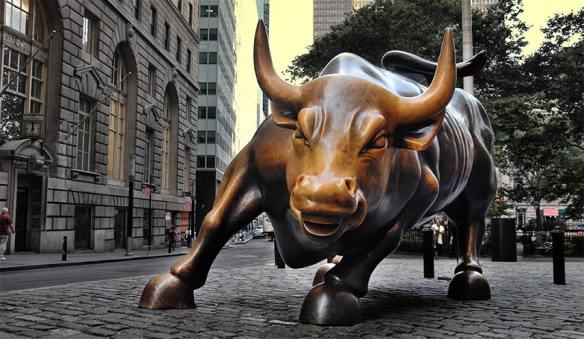
Let me apologize here, because I have to do some history — and for reasons I’ve never understood, some folks actively dislike history. It’s necessary though. So here we go. Back in 1987 there was a global stock market crash. Doesn’t matter why (at least not for this discussion), but stock markets everywhere — everywhere — tanked. Arturo Di Modica, a Sicilian immigrant who became a naturalized citizen of the U.S., responded by creating Charging Bull — a bronze sculpture of a…well, a charging bull. It took him two years to make it. The thing weighs more than 7000 pounds, and cost Di Modica some US$350,000 of his own money. He said he wanted the bull to represent “the strength and power of the American people”. He had it trucked into the Financial District and set it up, completely without permission. It’s maybe the only significant work of guerrilla capitalist art in existence.
People loved it. The assholes who ran the New York Stock Exchange, for some reason, didn’t. They called the police, and pretty soon the statue was removed and impounded. A fuss was raised, the city agreed to temporarily install it, and the public was pleased. It’s been almost thirty years, and Charging Bull is still owned by Di Modica, still on temporary loan to the city, still one of the most recognizable symbols of New York City.
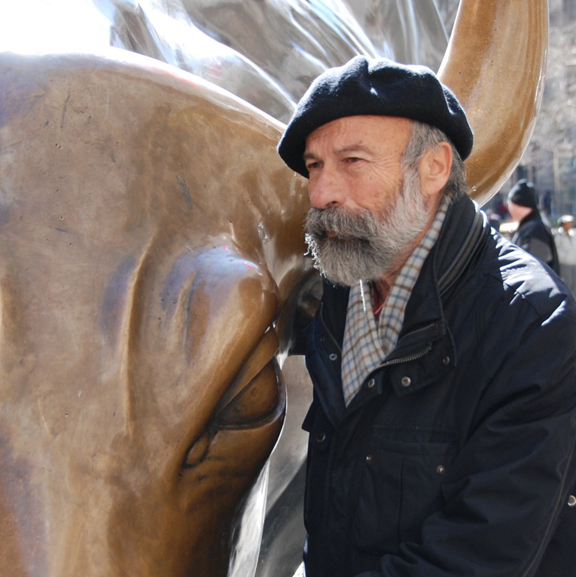
Arturo Di Modica (the one in the beret)
And that brings us to March 7th of this year, the day before International Women’s Day. Fearless Girl appeared, standing in front of Charging Bull. On the surface, it appears to be another work of guerrilla art — but it’s not. Unlike Di Modica’s work, Fearless Girl was commissioned. Commissioned not by an individual, but by an investment fund called State Street Global Advisors, which has assets in excess of US$2.4 trillion. That’s serious money. It was commissioned as part of an advertising campaign developed by McCann, a global advertising corporation. And it was commissioned to be presented on the first anniversary of State Street Global’s “Gender Diversity Index” fund, which has the following NASDAQ ticker symbol: SHE. And finally, along with Fearless Girl is a bronze plaque that reads:
Know the power of women in leadership. SHE makes a difference.
Note it’s not She makes a difference, it’s SHE makes a difference. It’s not referring to the girl; it’s referring to the NASDAQ symbol. It’s not a work of guerrilla art; it’s an extremely clever advertising scheme. This is what makes it clever: Fearless Girl derives its power almost entirely from Di Modica’s statue. The sculptor, Kristen Visbal, sort of acknowledges this. She’s said this about her statue:
“She’s not angry at the bull — she’s confident, she knows what she’s capable of, and she’s wanting the bull to take note.”
It’s all about the bull. If it were placed anywhere else, Fearless Girl would still be a very fine statue — but without facing Charging Bull the Fearless Girl has nothing to be fearless to. Or about. Whatever. Fearless Girl, without Di Modica’s bull, without the context provided by the bull, becomes Really Confident Girl.

Fearless Girl also changes the meaning of Charging Bull. Instead of being a symbol of “the strength and power of the American people” as Di Modica intended, it’s now seen as an aggressive threat to women and girls — a symbol of patriarchal oppression.
In effect, Fearless Girl has appropriated the strength and power of Charging Bull. Of course Di Modica is outraged by that. A global investment firm has used a global advertising firm to create a faux work of guerrilla art to subvert and change the meaning of his actual work of guerrilla art. That would piss off any artist.
See? It’s not as simple as it seems on the surface. It’s especially complicated for somebody (like me, for example) who appreciates the notion of appropriation in art. I’ve engaged in a wee bit of appropriation my ownself. Appropriation art is, almost by definition, subversive — and subversion is (also almost by definition) usually the province of marginalized populations attempting to undermine the social order maintained by tradition and the establishments of power. In the case of Fearless Girl, however, the subversion is being done by global corporatists as part of a marketing campaign. That makes it hard to cheer them on. There’s some serious irony here.
And yet, there she is, the Fearless Girl. I love the little statue of the girl in the Peter Pan pose. And I resent that she’s a marketing tool. I love that she actually IS inspiring to young women and girls. And I resent that she’s a fraud. I love that she exists. And I resent the reasons she was created.
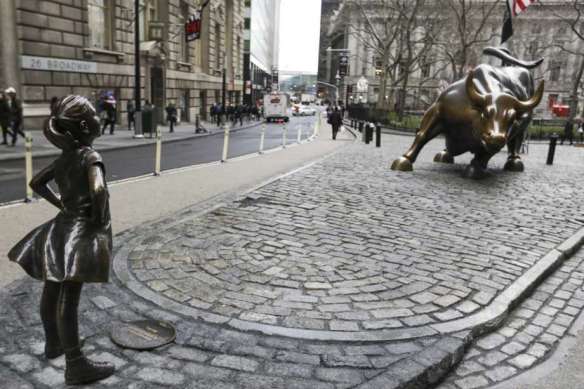
I love the Fearless Girl and I resent her. She’s an example of how commercialization can take something important and meaningful — something about which everybody should agree — and shit all over it by turning it into a commodity. Fearless Girl is beautiful, but she is selling SHE; that’s why she’s there.
Should Fearless Girl be removed as Di Modica wants? I don’t know. It would be sad if she was. Should Di Modica simply take his Charging Bull and go home? I mean, it’s his statue. He can do what he wants with it. I couldn’t blame him if he did that, since the Fearless Girl has basically hijacked the meaning of his work. But that would be a shame. I’m not a fan of capitalism, but that’s a damned fine work of art.
I don’t know what should be done here. But I know this: Arturo Di Modica has a point. And I know a lot of folks aren’t willing to acknowledge that.
 gregfallis.com
I agree with you, but not having had the context of either sculpture beforehand, I too saw the anti-patriarchal message only, and I think for most that is the message that will be conveyed (even if the commissioning ad department had other ideas) and in the long run (assuming both objects stay in place) that is the new, transformed message that will be conveyed to the clean-slate viewer. In a way the symbols of the bull and girl has changed as wall street greed and the role of women in society have both become flashpoints in society. Di Modica and the ad agency, in a way, are having their pieces re-contextualized by society as a while.
LikeLiked by 17 people
Excellent point. I didn’t even think about ‘the clean slate viewer’. I guess that’s because it’s been so long since my slate has been clean.
I’ve been pretty uncomfortable with this situation. I dislike finding myself in a position where I’m sort of defending a sculptor who created a beautiful work that celebrates an economic system I adamantly oppose. And I find myself disparaging a statue whose public interpretation I agree with, because its a product of that same economic system.
It’s a big ol’ goofy world, as John Prine says.
LikeLiked by 8 people
I don’t think it is fair to characterize the raging bull as becoming merely a symbol of rampaging patriarchy. I think it stays the same even with the capitalist message intended by Di Modica.
Consider it from this context, Di Modica is a perfect representation of the constraints capitalism puts on art. If he had not had the money to fund the creation of the piece, it never would have gotten done. The ability to create this act of Guerrilla art was dependent on his own existing status. Moreover, the fact that it was ultimately allowed to remain was likely in large part also influenced by the status conferred on him by having money, a luxury not afforded many artists. Moreover, the piece itself is not in protest, not even celebration as protest. Celebration of capitalism is encouraged in our society, it is a celebration of the status quo. Even the American spirit he praises ignored the very many people who do suffer even fatal consequences as a result of stock market turmoil. It might as well be saying that the American Spirit lives only in those who succeed.
Guerrilla art is the voice of the unheard and underprivileged. It exists in large part as a result OF Capitalism and the various oppressive dynamics it reinforces, including yes, patriarchy. By celebrating capitalism in the medium of its victims, is almost an intentional slap in the face of other guerrilla artists for whom guerrilla art isn’t necessarily a choice but the result of their struggles with an uncaring capitalist system. And then to have it praised as a symbol of the style…
I almost dare say that you could argue it’s a form of cultural appropriation.
Now Fearless Girl, regardless of its origins is a response that forces the viewer to consider what the girl has TO BE afraid of. Yes there is the obvious answer of the aggressive charging bull, a good metaphor for toxic masculinity, but there is also the artistic answer of raging capitalism. Women are more likely than men to live in poverty. They are less likely to afforded the same opportunities in business, academia, politics, etc. Capitalism is used to reinforce systemic patriarchy because less capital means less opportunities for advancement.
Bringing in the capitalist context into Fearless Girl itself, yes, it is advertisement, and yes it was funded by a multimillion dollar company, BUT it is still an interesting message. Here is a girl, standing up to the Toxic Masculinity that is Raging Capitalism and using it’s own weapon to support her defiance. I don’t know enough about the company to be able to read further into it, but if it turns out that the company embodies female empowerment then the symbol is almost even more powerful.
(there is also an argument to be made that advertising can be a form of art as well).
But lets add another layer to all this. One of the unique features of Guerrilla/Street Art, is this idea of Call and Response. Many times, street artists will respond to one another’s pieces, creating art that works individually as well together.
It’s easy to dismiss the idea of Really Confident Girl, but consider that a lot of social pressure made being really confident an act of rebellion for women. We are often told to be quieter, less aggressive. Our anger is dismissed as irrationality. Confidence is seen as vanity. Really Confident Girl is equally Fearless Girl as a girl standing up to a charging bull is.
LikeLiked by 15 people
I agree with about 90% of what you say. I even mostly agree with this: Guerrilla art is the voice of the unheard and underprivileged. I’d argue that guerrilla art is in almost all instances the voice of the unheard and underprivileged. But I hope you’d agree that the foundation of guerrilla art is unpaid and unapproved public art — which is what Di Modica’s bull was. I’m not comfortable with the notion that guerrilla art is restricted to certain populations. I don’t feel I can reject a work of guerrilla art simply because it was produced by somebody driven by an ideology I find offensive.
One of the unique features of Guerrilla/Street Art, is this idea of Call and Response.
Yes. And had Fearless Girl been sparked by that notion — had it been a personal response rather than a work commissioned by a marketing agency — I’d never have written this.
It’s easy to dismiss the idea of Really Confident Girl
I hope you don’t think I was doing that. I was just pointing out that to be fearless one has to be facing something to be feared — in this case, the bull. If you remove the thing to be feared, the title Fearless Girl loses a lot of its power. At least in my opinion.
LikeLiked by 6 people
It’s a bit like drawing a mustache on the Mona Lisa. It could be funny or a profound statement, but at the end of the day, you’ve twisted someone’s voice. That’s a disturbing thought.
LikeLiked by 4 people
And that (the re-contextualization of art) is the POINT of art. Starting a conversation. Do YOU dictate the course of a conversation? I would argue that you may attempt to but, good luck with that. It’s the the right of the viewer to decide the meaning of a work. In fact, the artist relinquished any rights of control over the meaning of his or her art by placing it in a public space. I refer you to Terry Barrett’s “Interpreting Art”….https://www.amazon.com/Interpreting-Art-Reflecting-Wondering-Responding/dp/0767416481
LikeLiked by 10 people
that’s true for post modernism, but a lot of post modernism is simply bullshit.
I don’t think this statue is bullshit, I rather like it. But just because something is a redefinition doesn’t make it worthwhile.
LikeLiked by 4 people
And I argue that Fearless Girl doesn’t lose that meaning even without the bull. In this day and age a young girl being so visibly and completely confident is to be Fearless. Being assertive like that isn’t just socially dangerous for women, but is physically dangerous as well. Just look at how many school shootings of girls are motivated by them saying no to a date. They are literally punished fatally for not being attracted to someone, and society often tells them they are wrong for “not giving them a chance”. A chance for what!? How many times do men reject women or consider them only friends because the spark is not there. Why are women expected to ignore their own attraction and feelings in deference to a man’s? And yet, look at a lot of the comments when a girl is threatened, or beaten, or yes, killed, for having told a boy No.
As to your commission argument: I disagree with your premise – commissioned art can still have meaning. They might provide a set of criteria, but ultimately, it is the artist who gives it life. There are so many ways that someone could have take this concept and made it their own, and the artist did so here. To claim that it is not art just because someone paid for it before hand is to dismiss histories of art. The Sistine Chapel was a commissioned work. Is Michelangelo not an artist?
I’ve done commissioned work and it’s often just another source of inspiration. There are bits of me in every work like this. Some personal signature of decision that has meaning at the very least to me. A message to what I am creating that is all my own. I would hate to have any of those pieces denigrated as just commission work.
Also consider the systemic social bias that leads to that conclusion. Someone who works on a commission often does so because they need money. It’s a form of poverty shaming to suggest that putting face to someone else’s vision is in any way less difficult and less a creative endeavor than doing so for your own.
Re: Post modernism.
You can take or leave post modernism as you want but there is a reason that death of the author is such an important aspect of critical analysis: People are the worst judges of their own biases. Everyone thinks they are unbiased and uninfluenced by society at large, but deviation from the mean is painful. It is often an act of sacrifice and passion in the true sense of the word.
Art is not devoid of context, and creating a bronze idol to capitalism cannot divorce itself from capitalism’s toxic masculinity.
LikeLiked by 6 people
**I can’t seem to reply directly to Greg. Not going to lie sometimes these nested withing nested replies confuse the hell out of me.
I forgot to add one thing. It’s not about dismissing a work because you disagree with it’s politics. It’s about recognizing power dynamics and the roles they play in what is recognized as art and allowed to exist and what isn’t.
If Charging Bull had been made (exactly the same) by a poor black woman, do you think it would still be standing?
LikeLiked by 6 people
What would you think if I made a sculpture of a woman twerking her ass against Michelangelo’s David? It’s a publicly displayed sculpture, and I want to start a conversation about sexuality and idealism in art. Using his sculpture to do that will get me a lot more exposure. I mean, Michelangelo’s dead, who cares what he originally intended. I need -my- vision to be the prevailing meaning of his piece, not his.
LikeLiked by 4 people
If it has to be moved, place it and its plaque outside the gate of the White House to keep a steady eye on our residing president. (Not on the lawn itself, no, it would render it inaccessible.) The vast numbers of people gathering at the gate to take selfies with her would magically feed Trump’s ego and maybe boost his morale.
LikeLiked by 3 people
This is very well articulated. Most people will not take the time to investigate origins before coming to conclusions. Most are going to trust that the system which placed this, now joint, installation there are honorable, noble in intention. This is my first time actually seeing the girl, and although I was instantly enamored, I felt that there was something inherently wrong with the deflection away from another artist’s hard work. Now knowing the back story, it really leaves a bad taste.
LikeLiked by 2 people
“that is the new, transformed message that will be conveyed to the clean-slate viewer. In a way the symbols of the bull and girl has changed as wall street greed and the role of women in society have both become flashpoints in society. Di Modica and the ad agency, in a way, are having their pieces re-contextualized by society as a while.”
No, sorry I don’t believe that and it’s total rubbish for Di Modica.
If people think the bull is about patriarchy then they have missed the point. They are ignorant. You are saying that if enough people are ignorant the artist has to go along with their new, collective and ignorant interpretation.
Stupidity or ignorance should never get to “recontextualise” what anything means. That’s insane.
The clean slate viewer needs to engage with the art. If someone refuses information about a subject, makes wrong assertions, and then spreads that misinformation, that’s not good. It should not change the message.
LikeLiked by 3 people
Olly perhaps it was Di Modica who was ignorant- of the pervasive sexism embedded in Wall Street and in the wider culture. It was there when he made the sculpture. He may have chosen to ignore that context, but it existed, and now it is more recognized, and now it informs our interaction with his work.
To call that rubbish, or misinformation, or wrong assertion, is to attempt to silence the discussion about the realities of sexism.
LikeLike
I like pieces like this one that stimulate and stir up our thinking and inspire a great exchange of differing opinions on complicated subjects. So thank you for that. I am interested in the comment the article’s author makes: “I’m not a fan of capitalism.” Yet the blog’s tagline is, “It’s this or get a real job.” It seems to me that capitalism is allowing you to write (and avoid ‘getting a real job.’) So good for you. I support that behavior. That’s the dream, isn’t it? To use our natural abilities and gifts to earn a respectable living and not have to slave away at jobs we hate. So I would say congratulations on your blog and writing career. And maybe we can celebrate the upside of Capitalism which allows people the freedom to do that.
LikeLike
I’m more inclined to say I’m managing to avoid a real job in spite of capitalism. Capitalism requires me to sell my labor in one way or another. Sensible folks sell their labor by taking a real job with a regular paycheck and (it’s to be hoped) benefits like health care and a paid vacation. In exchange for that, a LOT of folks are willing to do a job they don’t care about — or actively dislike. Capitalism doesn’t give me the freedom to write; it would be more accurate to say it punishes me for that choice. There are a LOT of people who’d like to write; they don’t because they have to make enough money to support a family or pay off school debts or pay for day care or have health issues that would bankrupt them otherwise. Capitalism makes writing for a living a stupid, risky choice.
But it’s what we have in the U.S., and there are so many other things I love about this country that I’ve no abiding desire to live anywhere else.
LikeLike
The commodification of feminism has been happening for years. There’s nothing in this country, no concept, no ideal, that we don’t shit all over in the pursuit of money. I never even knew about the bull, so the only context I’ve seen it in is with the girl. It has, however, started an interesting conversation about art and that can’t be a bad thing at a time when culture seems to be in free fall.
LikeLiked by 10 people
My first reaction was, I think, like most folks. I completely applauded the new statue. It seemed like such a terrific act of resistance. But the more I learned about it, the more disappointed I became. Now I find myself asking questions. Since this was a commissioned piece, how much of the design was the sculptor’s idea? What seemed like an act of resistance now seems like an attempt to co-opt the passion of resistance for commercial gain.
On the other hand, art means what the people think it means. It may be that the people will ignore the interests of commerce and celebrate the Fearless Girl for being a fearless girl. I hope so.
LikeLiked by 5 people
“What seemed like an act of resistance now seems like an attempt to co-opt the passion of resistance for commercial gain.”
An interesting point, espcially considering the (perfectly valid) issues people have with the recent Pepsi ad campaign which did that in a much more heavy-handed (and far more superficial) way. If the plaque were a little bigger, and more obviously an advertisement, I wonder how different the reaction would have been?
LikeLiked by 4 people
“What seemed like an act of resistance now seems like an attempt to co-opt the passion of resistance for commercial gain.”
Activism is the new sex in advertising.
LikeLiked by 3 people
I sort of liked the statement that fearless girl seemed to make, but on reflection,it seems symptomatic of a larger movement that seems a little more focused on raising women’s opinions of their abilities, while not making any real changes in their lives.
Just convincing a girl that she is strong enough to stand in front of the bull is not the same as giving her the abilities to actually do so. In the military, we are doing our very best to bring women into all jobs and specialties. But sometimes we run into harsh realities. A large percentage of female candidates are just not physically able to throw a fragmentation grenade beyond it’s potential blast radius. And no amount of confidence seems to change that reality. It is frustrating for everyone involved.
That is one small example of the challenges that we are facing daily. And the problem is not that girls lack enough self confidence. So more confidence is not necessarily part of the solution.
LikeLiked by 4 people
As a veteran, I could easily get into a big discussion about abilities and the aspects of modern warfare that don’t rely on a throwing arm, but that would be veering off course of what this post is addressing.
LikeLiked by 1 person
I agree with everything you’ve written about this. I like the idea of the fearless girl, but I don’t agree with the appropriation of the bull to convey the meaning of the fearless girl. It makes the bull (and what it symbolizes) look like the villain. Instead, why don’t they both face the world together, side by side? Men working with and alongside women, as it were? I think that would be a good compromise. But I must say something about the fearless girl that you did not mention. Maybe because I am a woman, I feel this. I don’t know. Anyway, I am actually offended by the fearless girl because the fact it is a girl and not a woman plays into the hands of patriarchy. Why is it so hard for a woman, an actual adult woman, to be represented? Are men offended by the portrait of an actual Fearless Woman? It seems like the fearless girl is a “less offensive” statement. Nobody can dislike a little girl. If they wanted to make a true statement about women, it should have been a Fearless Woman.
LikeLiked by 8 people
“… the fact it is a girl and not a woman plays into the hands of patriarchy. ”
Yes, I did actually think about that. As I mentioned in another comment, I wonder if the ad agency specified the sculpture should be of a girl rather than a woman. I started to write about that, but that leads to a larger discussion — and the blog post was already longer than I wanted it to be.
An argument could be made that it’s important for the character to be a young girl because girlhood is when the work of being fearless needs to begin. On the other hand, that puts the burden on girls to be fearless rather than on boys not to create fear. Both are important.
The thing is, the statue was created for advertising purposes more than as a statement about the role of women in business. I don’t think men are necessarily offended by a fearless woman. I think the patriarchy is terrified of them, though. Terror sucks as an advertising tool.
I think the discussion about these statues is good. I just want it to be about more than cute, perky little girls standing up to mean, charging bulls.
LikeLiked by 2 people
Funny you bring up the patriarchy, since I just had this discussion (er, fight) about intersectionality – feminism and ageism. I agree that “girl” plays in to the patriarchy on many levels. But in my debate, while simultaneously taking on the “not everything is the patriarchy” argument and “younger women dismiss older women” ageism issue, I learned this about me (as an “old ideologue”). Women only lose our voice when we choose not to use it and “I’m too old for this s*&^” is an option, but it’s not mandatory. My power is not threatened by Bull or Girl, regardless of what the Patriarchy would have me believe, unless I choose it to be. If Bull and Girl think otherwise, that’s on them. I am not the Jackass whisperer (though raising your voice to one is a choice, too).
LikeLiked by 5 people
I think that both you and Greg have a point here. Girlhood is the start of esteem building and before girlhood is over we begin to see steep drops in confidence. And yes, boys should be taught to not be perpetrators of fear. However, I do feel that using the cute girl is also related to women being called girls more often then men being called boys; and why women are expected to conform to beauty standards that require the hairlessness of a pre-pubescent girl. I don’t think a patriarchal system wants to see the statue of an arm on hips woman daily, though we have plenty erected for men. I feel there are surely conscious and unconscious forces at play. It’s unfortunate that both works of art are great together and apart. I would take really confident girl alone if they decided to move her.
LikeLiked by 1 person
Di Modica should just do a 180 with the Bull so it would look like the bull is farting on her. (her stance is perfect for this.)
LikeLiked by 6 people
was just going to say that. though without the farting. maybe a 90 degree, 😉
LikeLiked by 3 people
No, do the 180 or take it away. But then what would all these sjw’s have to write about? I take that back. They don’t need complex issues to express their verbal diarrhea, as evidenced by this topic.
Here’s a new one- Put the little girl outside an abortion clinic.
LikeLiked by 1 person
For what it’s worth, that is now exactly Arturo Di Modica’s plan. Not necessarily the farting part, but he intends to turn his statue around.
LikeLiked by 1 person
Thanks for this post, Greg. I learned something – and really interesting discussion points have been made .
LikeLiked by 4 people
I doubt this is the discussion that McCann and State Street Global Advisors wanted folks to have — which is good. I’m sure they’d have preferred to keep the discussion about the cute but fearless little girl standing up to the big bad bull, But that’s not a very honest discussion — and not all that interesting either.
LikeLiked by 3 people
That bull was always patriarchal. It’s always been a symbol of Wall Street, in a vacuum, divorced from common people or those not in the “in” club of equities, wealth, and materialism. Or the Old Boys Club. The Fearless Girl existed there, even prior to her being placed there. How many women CEOs are there of Fortune 500 companies? 4%? 5%? My mother infiltrated the boys club as an attorney long before women attorneys existed. And the only reason she became successful was she was precisely that fearless girl from her childhood onward. Every single day of her life, she punched up, grabbing that bull by the horns from a defensive posture. Those two statues coexist whether they coexist materially or not.
LikeLiked by 12 people
Strong women like your mother helped carve out a place for others. It’s still not easy for women, of course, but good on your mother for breaking the ground.
LikeLiked by 3 people
Exactly. The bull, if it ever was about “the american people” had already long been re-contextualized by its proximity to *wall street*. If, as you say with the girl, it had been put anyplace else, its meaning would be changed significantly. The girl does not make it a symbol of patriarchal oppression, it simply points out how much it already is.
LikeLiked by 4 people
Except it’s not hahahaha this is what I love about liberals these days they just have to tell you about oppression, even if an artist specifically says something you know better because patriarchy patriarchy blah blah blah I really think most of you are missing the point behind who made the girl and why
LikeLiked by 1 person
That’s what I love bout conservatives these days. They just serve as mindless mouthpieces and puppets, regurgitating nonsense and brainlessly repeating whatever line they are told to say.No need for thought involved, let alone facts or logic.
Oh, and their complete inability to construct grammatical correct, coherent sentences in English, or use punctuation to delineate their rambling, stream of unconsciousness from incomprehensible word salad.
LikeLike
The bull has always been ironic. It was created and placed in the wake of a financial crisis by a good who is clearly not part of the financial services industry. That people cannot understand this simple fact is probably why there is any controversy over his potential lawsuit to begin with.
LikeLike
Emblems, symbols and art are how they are perceived, not strictly intent. You can read any book by, say, Umberto Eco or Michel Foucault to wrap your head around this. Or, you can take a walk through Central Park and think about it. Almost everyone who descends on Wall Street each and every day *does* associate the bull (not the cow or tigress) with a bullish market and the dopamine spikes on and off Wall Street — within equities and/or the accumulation of wealth and power. It is a club, it is exclusive and it is exclusionary. You can certainly have your own opinion. But the girl is far more ironic (I would argue iconic) than that bull ever will be.
Sure, she can be removed. It will not alter the truth. It will not change the fact that Janet Yellen was the first and only ever woman chair of the Federal Reserve. There has never been a woman US President in 240 years. And that is not by some cosmic happenstance. It is certainly not happenstance when even 53 percent of white women vote for an unqualified male over a qualified female. Women cannot be so ambitious, as to fib, dissemble or triangulate. A man can be a pathological liar, clinically insane, a sexual predator, unlawful, unconstitutional, etc. Still he will retain core support. Shrug, we just love all that “bull.”
LikeLike
This will go around & around as long as these statues exist. I’m sure in the end it’ll be one of those “history being written by the winner” cases, where whoever gets their way will tell their version of what actually happened. Meanwhile, people will continue going about their business oblivious to these subtleties of story.
LikeLiked by 2 people
Di Modica should sue for 1/2 of the fee paid to the advetising firm at a minimum. it was his creation that made the girl possible and relevane. his art was used without his permission to create the girl.
LikeLiked by 2 people
I don’t think money is the issue for Di Modica. I think he’s trying to protect his work from being interpreted in a way he didn’t intend. And the fact is, no artist can control that.
LikeLiked by 1 person
Strangely, since the bull represents the strength of the American people, the girl ends up being an obstruction, not brave. Regardless of how this is resolved, and I do also see both sides, I think the plaque by the girl needs to be removed, and just let the art remain. There should be no ad there.
LikeLiked by 3 people
I still don’t think he has a point. Even if the girl is an advertising stunt – he cannot dictate what other artists do (god forbid they should be PAID!). If someone wants to respond to his piece of guerilla art (which even – maybe especially – after a Stock Market crash is still, to me, a symbol of oppression)- they can! This artist was clearly able to take her mission beyond its advertising function into another realm. I doubt if the advertising function will even be remembered.
LikeLiked by 3 people
I have to disagree, at least in part. I agree the advertising angle will be forgotten by viewers. But I think any artist whose work is appropriated has a right to be upset by it. I think appropriation has a place in art, and I don’t have much sympathy for the bull as a symbol of capitalism, so I’m okay with the way Fearless Girl works. But I also think Di Modica has a legit gripe about the way his work has been used and it’s meaning changed.
LikeLike
I am not sure that appropriation is the correct term here. Art can be a conversation just like writing, or speaking. Are we not allowed to comment or criticize another artist’s work? In public? Is that appropriation? Critical conversations can be held with visual mediums as well as with words. For me the only real use of the word ‘appropriation” with regard to art is cultural appropriation – when an artists uses the visual vocabulary of another culture whose experience he does not share. This girl is not appropriation – its dialog.
LikeLiked by 1 person
Appropriation is generally considered to be the unauthorized borrowing of an existing work, incorporating it into a new work. I don’t think it’s an issue of whether we can ‘comment or criticize another artist’s work’. Of course we can. My concern had been that the public discussion has ignored some facts that are worth consideration.
LikeLiked by 1 person
Since Greg fails to understand what appropriation truly is, here you go. Education is power, so trust a valid source…not this random man who has a blog online. MoMa is a valid source. Greg, not so much.
As you can see, 1) FG isn’t appropriation, and 2) appropriation is a form of artwork made famous by the likes of Warhol, Picasso, Duchamp, Rauschenberg, Braque, and Lichtenstein, among others.
https://www.moma.org/learn/moma_learning/themes/pop-art/appropriation
Here’s the thing, guys: Greg posts inflammatory blog posts in the hopes that one of them becomes viral and he becomes famous and he collects the ad revenue. He might even be hoping for paid writing gigs, although this is probably a stretch since his writing style is choppy, at best. I forwarded this blog to the head of the art department at my university and he wasn’t surprised at Greg’s opinion on this topic. Greg is looking for clicks, but would be doing himself a favor if he instead educated himself through college art courses and then discussed his opinions and thoughts with a group of people with all sorts of varying opinions. And not online where he can hide behind lies and a facade of knowledge.
LikeLiked by 2 people
Re: “Are we not allowed to comment or criticize another artist’s work? In public?” although I agree that art should be in conversation with other art, and critique other art when it is necessary, this specific example of “talking-back” differs from other examples. You could hang a painting in the Louvre that copied and defaced the image of the Mona Lisa and it wouldn’t be harming the original in any way. If you created a statue and positioned it in the Louvre so that it was physically blocking someone’s view of the Mona Lisa, that would be a fascinating artistic statement but it would a very different proposition. There is only one “Bull,” and now that “Fearless Girl” is there it is impossible to read the “Bull” without “Fearless Girl” being there. The “Bull” isn’t the same statue it used to be, in a very meaningful way. It is now Bull + Girl. And yeah, in a real sense the Bull’s artist ceded any control the second he put it up. He did set up a physical object, without anyone’s permission, on a busy street where anyone could do anything they liked. But it’s important to not forget the physicality of the particular case we’re talking about in the process of trying to extrapolate to what this means about art in general.
LikeLiked by 2 people
MoMa is a valid source. Greg, not so much.
I said appropriation is “the unauthorized borrowing of an existing work, incorporating it into a new work.” MoMa says it’s “the intentional borrowing, copying, and alteration of preexisting images and objects.” Perhaps you see a difference; I don’t.
Greg posts inflammatory blog posts in the hopes that one of them becomes viral and he becomes famous and he collects the ad revenue.
Well, no. I get no ad revenue, I don’t think there’s anything in this post that’s inflammatory (not nearly as inflammatory as your accusations). I’ve no ambition to be internet famous, and I already make a living writing.
I write this blog for my own amusement. When I write here, I post a link on facebook for my friends; it’s not even a public post. That’s the extent of what you claim is my desire to go viral.
I’m not sure why you’re so angry about this or so angry at me.
LikeLiked by 2 people
“But I also think Di Modica has a legit gripe about the way his work has been used and it’s meaning changed.”
But did the girl change the meaning of his work or was it the financial institutions that Di Modica authorized to appropriate it?
Maybe it’s time for Di Modica to remove the bull since it no longer represents the strength of the American people.
LikeLike
Greg posts inflammatory blog posts
Honestly, I have spent the last hour reading this post and the many, many comments and replies to it, and so far the only thing I have seen that comes even close to “inflammatory” is your post. Everywhere I see people having polite, civil, intelligent conversations about a well-raised point on recontextualization of art without the consent of the artist, appropriation of socially popular mores for profit and advertising, and how much right, if any, the artist has to be upset about that or demand change. Greg has not insulted people who believe differently, he has not insisted his view is the only correct one, he has simply created an intelligent, open discussion about a complex topic.
And then there’s you, insulting and slinging accusations, because somebody on the internet said something you don’t want to have to actually think about.
LikeLike
Re: ‘Greg is looking for clicks, but would be doing himself a favor if he instead educated himself through college art courses and then discussed his opinions and thoughts with a group of people with all sorts of varying opinions.’
Interesting thought, considering Universities these days try silencing everyone with Opinions which vary too much, because they would disturb the ‘safe spaces’ of others or the ‘publicly accepted norm’ too much.
I think him doing wjat you suggest would silence him very fast, so i disagree with you
LikeLike
“(which even – maybe especially – after a Stock Market crash is still, to me, a symbol of oppression)”
Did you even pay attention to why di Modica made the bull? You are saying “I know it’s not a symbol of oppression but to me it’s still a symbol of oppression!”
It’s a symbol of the opposite. It was a piece of guerilla art AGAINST (pls note the caps) the oppression you are talking about. You cannot turn it into an oppressive symbol just bc you don’t understand what it is, what it means or just because it’s a big bull vs a little girl.
This is exactly the point – these days all somebody needs to do to derail a protest is to shout “patriarchy!” and suddenly the protest symbol becomes the oppressor. If Jesus came back to earth riding a fucking unicorn shooting rainbows out of his arse, someone would shout “patriarchy!” or “racist!” and he’d be crucified again.
The bull is a protestor! The bull is against all these things that you’re getting wound up about.
However now the bull is the enemy because… you can’t read? Or were just too lazy to find out about it? Or you saw the bull and someone shouted “patriarchy” in your head because bulls are male and little girls aren’t? PAY ATTENTION
LikeLiked by 1 person
Great writing and reporting Greg.
Your right the girl needs to be removed. Maybe the SHE investment fund could find another use for the statue. Arturo’s work defines American financial power. It needs to be left alone, not degraded like this.
LikeLiked by 3 people
Oh, I don’t think the Fearless Girl needs to be removed. I’m not sure what the appropriate action should be. I just think people ought to be aware that the situation is more complicated than it appears on the surface.
LikeLiked by 1 person
Don’t think I agree with your limited definition of appropriation..I agree that the term usually refers to the using of another culture’s visual language without an understanding of their language vis a vis that culture..using another artist’s work is more like stealing or copying..not appropriating…
LikeLiked by 2 people
It pisses me off that she’s a marketing ploy but I don’t want to lose her. I think they should stand beside each other. Then, instead of two opposing sides, they’re a team. The Charging Bull, a symbol of American strength and The Fearless Girl, a symbol of feminine empowerment, side by side. The message stops being a war against “the man” and instead becomes a symbol of unity. America stands with women. America empowers women and women empower America. They’re both symbols of strength, why do they need to oppose each other?
LikeLiked by 1 person
ok, but in 2011, his Bull was caged in by security barricades and cops to keep Occupy away and he didn’t complain then, so I call bull on the context argument.
LikeLiked by 4 people
False equivalence.
LikeLiked by 3 people
While I agree with everything you wrote here, there’s one more thing to consider. Ar (or anything), once placed within the public space, stops being the sole possession of the artist and becomes something else. It becomes part of the space it occupies. It can then be used, built upon, parodied, photographed, touched, misunderstood, re-thought, juxtaposed, or incorporated into new ways of thinking, either by intent or coincidence.
This is not Di Modica’s bull anymore. It stopped being his when he had it placed (illegally, I remind you) on a public street in NYC. It hasn’t been “his” for 30 years.
I get what he’s saying but it’s 30 years too late to complain. Once the bull appeared in public, its meaning belongs to each person who sees it.
(Personally, the idea that this statue is (or ever was) “a symbol of “the strength and power of the American people” goes right past me. Seriously? A large and dangerous animal? I would like to think the American people are better than that.
Whether Fearless Girl was commissioned as a marketing tool or not, set without a permit or not, also doesn;t matter. As soon as her feet hit the ground, she became something else. Like the bull, she belongs to the people who see her.
Art is not art, that alters when it alteration finds.
LikeLiked by 5 people
Philosophically I completely agree. The bull and the girl form a dialectic that creates something new. If we step outside the world of art as a commodity, then we have a dialog. But this is NYC and the Financial District — and while I wish it weren’t so, everything is a commodity there. Socially and culturally both those statues sort of belong to the public, but legally Di Modica owns the bull.
I like the new meaning the girl brings to the bull, even if I dislike the corporate origins of the statue. I also think the bull is beautiful… as a bull. As a symbol of American capitalism, it’s appalling. I really think this a situation with no good resolution.
LikeLike
If he is that unhappy perhaps he should just take his bull and go home.
That being said, I, too, dislike the fact that the Fearless Girl is really just an advertising stunt.
LikeLiked by 2 people
At least it began as a public relations campaign. At this point I don’t think most folks are aware of it.
LikeLike
The Bull was placed in front of the NYSE to change how people thought about that building, ‘appropriating’ it if you want to use that term. Fearless Girl did the same thing to the Bull. So the artist who made the Bull doesn’t object to ‘appropriation’ in principle – he just doesn’t like some other artist doing it to him.
As for how Fearless Girl was paid for – lots of great art was paid for lots of ways, for lots of reasons. What’s important about art is the response in viewers. And Fearless Girl is provoking a powerful public discussion, making it highly effective art.
LikeLiked by 4 people
Excellent point
LikeLike
“a symbol of “the strength and power of the American people” goes right past me. Seriously? A large and dangerous animal? I would like to think the American people are better than that.”
Yeah, seriously. Bulls (if you ever lived on a farm) aren’t just dangerous animals. They are functional, proud, strong, majestic beasts. Like the expression “strong like bull”. Bulls are symbols of potency and strength.
Your actual symbol is an eagle – a solitary, flesh-eating predator that hunts down things that are smaller and weaker. America is an imperialist predator masquerading under the pretence of freedom and ideal. That’s why the little girl is perfect – everybody stands up for her because she’s a girl, without realising she’s the devil.
LikeLiked by 1 person
I had no idea! Another example of the importance of asking questions. My question now before making a judgement is, is SHE making a difference in any way?
LikeLiked by 2 people
I have no idea if SHE is helping or just masking a symptom. I’m not sure it matters. By commissioning the statue the fund calls its motives into question. Hell, I’m not even sure THAT matters. But it all contributes to the discussion, so that’s good.
LikeLike
Simple solution: turn the bull around.
LikeLiked by 1 person
Simple. Turn the girl around.so the both face the same direction.
LikeLiked by 1 person
Maybe Di Modica should just turn the bull around.
It might give the impression the little girl had scared the big bad bull away, but it would also remove the symbilisim of the threat toward women (which the bull was never intended to symbolize).
If Di Modica turns the bull to face another direction and they move The Fearless Girl then maybe Di Modica has a legal case against the advertising company for intentional defacement of his art.
LikeLiked by 3 people
Agreed. Imagine how all great works of art could be co-opted in this manner. McCann Corporation got their PR (great ad campaign, btw) and now they should remove it. Put it on display at a gallery that needs the draw. Thanks for the backstory.
LikeLiked by 2 people
Fascinating points. I love the idea of a plucky girl tweaking the (patriarchal) system, and my first instinct when seeing the sculpture was to respond, “You go girl!”. But yes, this raises a number of issues. A problem with greenlighting any and all forms of appropriation is that it could boomerang back in less pleasant ways. For example, next week another artist with an axe to grind could create a new installation around Fearless Girl to make it look like she’s standing amidst broken bodies of minority kids and turn this plucky girl into a statement about bullying and white privilege. And yet, as many people have pointed out art gets recycled in many ways, by many hands. All in all an interesting situation that doesn’t provide easy answers.
LikeLiked by 2 people
Wonderful commentary and I appreciate the additional history behind this situation and seeing all sides of it. That being said, I think the public has appropriated both pieces into something bigger than either one alone would be and certainly beyond what the State Street Global Advisors had in mind. I understand and empathize with Di Modica’s reaction to all of this, particularly in light of what was originally a generous tribute to the spirit of America in the midst of a crisis. However, I also think that time itself has appropriated this new permutation. I hope they stay exactly as they are now, with a nod to Di Modica’s generosity if he chooses to leave the charging bull there.
LikeLiked by 4 people
I think I’m not bothered by the advertising bit. For one thing, the bare existence of the fund in question is evidence of the problems the piece of art is commenting on. For another, the idea that only individuals with deep pockets should be able to stick art out in the streets is pretty appallingly classist. Art is not and should not be just for the wealthy. Yes, that company has lots of money, but that’s because many people with not so much money have worked together for their mutual benefit. Why is one capitalist piece of art OK when the other is not? Finally, the idea that the strength and power of the American people is being wielded against women is awful. It is not, however, false.
LikeLiked by 2 people
Why is one capitalist piece of art OK when the other is not?
One piece was created by an individual who devoted his time and own money in an effort to make a personal statement. The other was created by an artist who was commissioned by an investment fund through an advertising agency to produce a work that promoted the investment fund.
There’s nothing wrong with either work of art. They were just created for different reasons. In addition, the success of the latter work relies on the success of the earlier work. Without that earlier work, it’s unlikely the Fearless Girl would exist.
LikeLiked by 1 person
I wouldn’t remove “Fearless Girl.” I’d turn her around, facing away from the bull, so that she is no longer in an adversarial pose in opposition to prosperity and economic confidence but, instead, is stepping up to lead. Which is more apropos of the point that the Fearless Girl statue’s funders claim they were trying to make – that more women need to be in leadership positions on Wall Street and the economy in general.
LikeLiked by 3 people
I love the depth of your discussion. I want to share my perspective. I like both statues together. I see the charging bull as the stock market on a good day. I see the fearless girl as unafraid of the stock market. Historically, women in the US were supposed to leave finances to their husbands. Even today, I meet women who have no knowledge of their family finances and can barely balance a budget. I see this combination as girls and women taking control of their financial success. I find all these different perspectives enhances the beauty of the art, like facets on a diamond. Since most people don’t read the fine print, and ignore history, a a marketing ploy it can’t really be very successful. More art in cities is good, and artists getting paid is good. So I have net happiness when I see this, as a financially successful and fearless woman.
LikeLiked by 4 people
I like both statues together.
I’m glad you shared your perspective. I like both statues together as well. As a result of all this discussion, my own thoughts and feelings about this situation fluctuates. At this point, if the Fearless Girl was removed as Di Modica wants, the fact is his statue will be thought of as the Charging Bull That Used to Face the Fearless Girl.
LikeLiked by 2 people
As an immigrant, Di Modica might find that adding several multicultural children riding the bull might re-appropriate his sculpture to a more modern significance.
LikeLike
To add another wrinkle: the thing they’re marketing appears to be a useful tool in fighting against sexism and for gender equality. It’s an index (an investment fund, in effect) of large companies that are leading the way in gender diversity at the upper management and board membership level.
LikeLiked by 2 people
I get it. You don’t like Capitalism.
Communism is so much better, you think? Then why did and do people risk their lives fleeing from Commuist countries to Capitalist ones, and not vice versa? We didn’t see people fleeing from West to East Germany or from Florida to Cuba, and don’t see people fleeing from South to North Korea,
LikeLiked by 2 people
*Rolls eyes* Do you really not understand that there are more than two polar opposites as financial options?
LikeLiked by 3 people
Re: We didn’t see people fleeing from West to East Germany
The Berlin Wall fell in 1989, East Germany is as Communist as West Germany is. Namely not. There is still a difference, yes, but after 28 Years not as large as in 1989. At least this is what is told to me living here in West Germany
LikeLike
Nevermind, missread your comment, ignore mine. Thought your point was about why nobody flees wo east Germany today, not before the Wall fell. Considering this Context, your point is valid. Sorry about that.
LikeLike
I have a few comments. First, thanks for the history lesson. I did not know the bull was un commissioned and my interpretation of it has been tempered by my opinion of traders, capitalism and image of the bull market bull dozing anything that stands in its way. So the idea that something small and fearless standing up to evil corporatism interests me. I agree with the idea that the context has now changed for the bull and I’m sorry for the artist. But as soon as he dropped his bull off it became open to any and everyone’s interpretation.
For my part, it’s the child who should be removed. For two reasons, the first being that as a piece of art in public does it only have meaning in that one location? I would like to think it would have meaning anywhere.
Most importantly, if those who commissioned have something important they are trying to advertise about gender diversity (and I’m not sure what that means exactly to them because I think it means something completely different to me) then a young girl offends me. I would like to see corporations be more concerned with gender equality and pay equity within their corporate cultures. Characteristics found endearing in a young girl tend to be off-putting in a grown woman. Ultimately, when the bull charges (yes I will always see it as a male force) the female child (who represents women and not gender diversity) will be violently destroyed and that is a story that plays out daily in homes and at work for too many women.
LikeLiked by 4 people
It doesn’t seem appropriate to ‘like’ your response, but what I very much like is your thoughtful analysis (while I dislike the socio-cultural situation that makes such an analysis necessary — if that makes sense.)
LikeLiked by 1 person
Puts the bro who dry humped ‘Fearless Girl in a modified light. He goes from being an immature sexist douchebag to being an immature sexist douchebag accidentally protesting the system that employs him
LikeLiked by 2 people
The two statues should be side by side, lending strength to each other. She is not afraid, and he is not a threat. Instead it is a powerful relationship where she is confident beside him and he is proud to be there.
LikeLiked by 2 people
The true brilliance of the advertising here is this: the people most offended by the fact that it was designed as advertising are those who are going to tell everyone it’s advertising.
For those wanting to subvert the advertising aspect, simply stop telling other people its advertising.
LikeLiked by 2 people
Simple solution. Turn both statues around.
LikeLiked by 2 people
Absolutely agree with the original artist. Remove fearless girl. If the company wants to do right by the original work, remove the SHE plaque, and place her next to the bull facing the same direction, showing a notion of cooperative effort and gives a different message.
LikeLiked by 2 people
I actually LIKE the fact that Fearless Girl is facing down the bull. I think that, for the most part, it’s a powerful and necessary statement. The message on the surface is one of resistance, and I support that. I believe the depredations of Wall Street need to be resisted. My problem isn’t the surface message; my problem is that the motive for creating the statue was to promote Wall Street, but from a somewhat different angle.
I also thought it was worthwhile for folks to understand Di Modica’s perspective.
LikeLiked by 1 person
I think Di Modica should remove his Bull which will undermine SHE. He owns the Bull so should take full advantage of being able to relocate it. And I think you are wrong when you say “without facing Charging Bull the Fearless Girl has nothing to be fearless to. Or about.” ……. the moment girls learn to walk they are molded and influenced by societal expectation, much of it warped and damaging to their sense of self. Show me a girl who has stood in the face of ridicule, bullying, sexism or abuse and not been shamed for doing so. As for Art being hijacked for corporate gain ….. the world if full of it. The next move is up to Di Modica ….. if he’s smart he will take his power back and take his Bull.
LikeLiked by 2 people
In fact, he does NOT own the bull any more. He gifted it to the city of New York when he placed it on public property without being asked or obtaining permission. I’m pretty sure that would hold up in court as there is case law to back it up.
LikeLiked by 1 person
The City of New York has acknowledged that Di Modica owns the statue, and that it’s still there on a long-standing ‘temporary’ permit.
LikeLiked by 1 person
Rubbish.
You dont get to control how people respond to and comment on your art – not even when it’s in close physical proximity.This is very clear cut free speech. He has no point, he has a big ego and a sense of entitlement.
If you could sue people for creating art dependent on your art, every critic, satirist, parody artist, and cover song singer would be sued.
The answer to speech we dont like is more speech, not censorship and lawsuits.
LikeLiked by 1 person
Free speech only applies to people being prosecuted, persecuted, etc. by the government. It does not apply to other people’s responses, and it doesn’t give you a right to install something permanently on land that doesn’t belong to you. Di Modica has a right to free speech, too. He has every right to respond to the Fearless Girl statue however he likes, without regard to whether you and I agree with him.
LikeLiked by 2 people
For the sake of this discussion, could another firm commission a statue of a boy standing in front of the girl? That way, every work of art can be like a game of hand-over-hand.
LikeLiked by 2 people
So. Many. words… That bull is a tribute to strength of this nation? Then the girl is an absolutely necessary argument to putting our faith in brute force and domination.
LikeLiked by 3 people
What the hell is capitalist guerilla art? When Eric Garner sold his mixtape in front of the bodega they called that a crime, but this guy dumps a 3 ton statue in the middle of the street and it’s guerilla art? It’s privilege art. That’s why no one cares about the original context and meaning of it.
Here’s an idea. Put a Pepsi in fearless girl’s hand, and have the police choke both artists to death. Then this capitalist shit show will come full circle.
LikeLiked by 2 people
What the hell is capitalist guerilla art?
I know, it sounds like an oxymoron. A lot of people are disagreeing with my characterization of the bull as capitalist guerrilla art. I think it meets all the criteria of guerrilla art even though it was produced by somebody with privilege and financial security. If guerrilla art is privately created, unapproved art located in public without permission, then we can’t reject some works because they were created by capitalists, or right wing Christianists, or some other group just because we might find their beliefs offensive.
As far as I know, the bull is the only example of capitalist guerrilla art. Mainly because capitalists usually have more ‘legit’ avenues for getting their work out in public.
LikeLike
Agreed on all points; however, I am reminded of a Carl Sagan comment that says (Completely paraphrased…maybe even incorrect, as I don’t excel at this) the universe is still beautiful after exposing/describing the science behind it. While Fearless Girl subverts Charging Bull, and while one is guerilla art and the other is corporate marketing, all but a few will ever see the duelling statues in this context. The average Joe and Josephine, especially as time passes and the details of this article become trivia questions, will see the clear inference – business, a man’s game, and ruthless, is challenged by innocence and gender. If I were the artist – the villification of the bull would be my greatest concern.
LikeLiked by 2 people
Something else for people to waste time on. Who cares? Excellent bronze of a charging bull, poorly made bronze of a child, it’s all theatre and not real life. Talk about distract the masses.
LikeLiked by 2 people
Then why comment? Other people care–which should be apparent to you, even in your smugness. Just move along.
LikeLiked by 2 people
Because there is a point to be made.
LikeLiked by 1 person
What if the girl were moved to a spot just ahead of the bull? I mean, it makes sense in that fearlessness should be backed by the power of the people. Saying “we have your back, girl, do what you can” is an empowering, if idealistic statement.
LikeLiked by 2 people
I think that particularly given the fact that Di Modica placed his statue in a public place without any permission takes away his moral authority to say what else should be placed in the vicinity. Both artworks can be appreciated separately or together. If he’s able to dictate what happens to Fearless Girl, then that’s just one more victory for the patriarchy, in my opinion. I appreciate your analysis of the conundrum!
LikeLiked by 4 people
The meaning of art doesn’t truly belong to the artist, it belongs to the people.
LikeLiked by 3 people
The simple fact is, the artist neither owns nor dictates the meaning of his or her art once they have put it on display. The meaning and interpretation has become a part of a conversation and no-one CONTROLS a conversation (you can try to direct it but, in my experience that is akin to herding cats in a tuna cannery). The conversation belongs to the people viewing the art.
As for ownership of the bull, I would argue that, by installing the sculpture under cover of night and without permission the bull became the property of the city of New York. And that’s an argument that could be made in court…..he “gifted” it to the city. Legally, a gift once given, cannot be taken back unless the recipient offers it back……
LikeLiked by 3 people
I agree with you! And I disagree with you!
I mean that! And I don’t mean that.
No seriously. I don’t think Di Modica needs to take this so seriously. So his bull has been there since I was about the age Fearless Girl appears to be. Well, I get that he’s Italian and inclined to get fired up, but sit tight, Di Modica, and keep on putting the real story of your piece out. Trying to censor others just doesn’t really help, though.
LikeLiked by 2 people
The bull market is a threat to all Americans, now, whatever it’s sculptor intended, the reason the market crashed in 87 is vitally important to this discussion because it is essentially the same reason it did so in 08. Which is to say rampant greed unchecked by effective regulatory agencies, and a complete lack of a corporate conscience. The bull market, like a real charging bull IS a dangerous, thoughtless thing that often tramples smaller things in its path. The girl, reminds me of an ancient Cretean ritual from which both the legend of the Minotaur and the modern bullfight come:The art of “Bull dancing”. Fearless lithe and well trained athletes squared off in an arena against charging bulls. They would vault over the bulls, do acrobatic tricks on their backs etc (if they slipped and we’re killed by the bulls it was thought the gods demanded a human sacrifice that year, if the bull was goaded to exhaustion, it was sacrificed instead) Fearless Girl is a reminder that the charging bull market is not tamed and guided with strength or power, but agility and intelligence and that knows no gender
LikeLiked by 5 people
I think it’s an excellent reply to the original artwork. Who cares if it’s a commercial enterprise, it doesn’t wear that on it’s sleeve. I fail to see the bull as a symbol of patriarchy, that is just a shallow contemporary interpretation. It’s a little girl standing up to a bull…it’s amusing, it’s cute. That’s it.
LikeLiked by 3 people
Whereas the artist may feel like his meaning is adulterated by the new statue, I would contend that it this happened long ago with the bull, in a way, becoming more synonymous with the arrogance and overpowering strength of Wall Street more so than the strength of the American People as a whole. Basically the exact opposite as seems was intended, having been placed at a time when big business really did represent the strength of the nation. Fast forward to today, I would see the girl as representative of the people and a strength that in itself is very much needed – a symbol that could/should reinvigorate the very message that was originally intended.
What I find interesting is the focus on patriarchy – the fact that it’s a girl, and looking at it from the perspective of the bull as an aggressor toward a female. It’s a child. It’s innocence. It’s the meek standing up with confidence in front of an imminent threat. If it was a little boy, I am certain there would be those who would see and focus on the confidence and say, “of course it’s a boy, why couldn’t it depict a confident little girl?” Rather, being a girl, “we” see it from the bull’s point of view and the threat it represents. The fact that it’s a girl, if it were consequential to the display at all, could be applauded if we were to so choose – despite the disappointment of it being a marketing gimmick.
LikeLiked by 2 people
I’m sure someone has suggested this – but maybe Arturo could turn his bull 90 degrees? Then the girl is cheering the bull on, and the bull is not threatening the girl at all. (I’d say turn it 180 degrees, so they’re both going the same direction, but then it looks like she chased it away.)
LikeLiked by 2 people
My first reaction is for the Artist of the bull is for him to turn the bull around showing the other end to the SHE company…
LikeLiked by 2 people
Di Modica argues that Fearless Girl changes the context of Charging Bull, but I would argue that Fearless Girl exists because the context of Charging Bull has already changed. A minor plot point of Mr. Robot season 2 (filmed in late 2015/early 2016) was a group cutting off the testicles of the Charging Bull statue and dropping them from the ceiling in congress. Occupy Wall Street appropriated the image of the bull as a symbol of greed as well. Charging Bull is an edition of five: another bull resides at a gated community in Florida which is home to billionaires, many involved in investment management, so the statue has been bought by the same Wall Street types.
Fearless Girl may be a commissioned piece, but if people don’t know that it is an ad, is that still important? It exists as a different symbol in the public sphere, just as the bull exists as a different symbol in the public sphere. Placing any art in the context of a public space is transformative of the original intent and meaning, and often itself appropriative of the context of the space. Not that any piece can be separated from its origins and funding, but it should be considered as part of the work’s entire chronology. Much of the western canon of art exists because they were commissioned by patrons to promote status, wealth, and theology, but those works have accrued a different content through history. It’s possible for Fearless Girl to emerge as a positive figure with dubious origins and Charging Bull to represent malevolent forces despite positive intent.
But hey, if Di Modica wants the statue back, maybe he could sell it to another country club for the rich.
LikeLiked by 2 people
Fearless Girl may be a commissioned piece, but if people don’t know that it is an ad, is that still important?
That’s a more difficult question than it appears on the surface. The fact is MOST folks won’t know it’s part of a marketing campaign, because most people aren’t in a financial position to invest big chunks of money. On the other hand, you can be sure the folks who DO make investments of that sort are well aware of SHE, and it may influence their investment decisions.
And on the third hand, SHE is intended to support women who occupy leading positions on corporate boards, which can be interpreted as a good thing. And on the fourth hand, State Street Corporation itself only has three women on its board.
So, does it matter? Absolutely not. And yes, it absolutely does. Depending on your income
LikeLike
When an artist puts their work into the public realm, they are putting it there so that people (the audience) can react to it. I have learned that not everyone sees my artwork the way I see it, or intended it. In fact, often they see the opposite of my intention. This reaction creates a conversation. And that is what was created when the bull first was illicitly installed.
The installation of the Fearless Girl creates a new conversation – one that society and individuals need. Art is not, or should not be, a static form of communication. It is only when it is alive in the public mind and creating discussion and controversy that it truly is public art.
The creator released his bull on the world. Now he needs to let the world react – even if it is not what he wants. The piece has not been vandalized or diminished in power. In fact, it highlights the strengths of his intentions and the conflicts in society that need to be addressed.
Both works of art are powerful alone – together they are dynamic, controversial, and alive. They need to be left together to challenge each other and the viewer.
LikeLiked by 3 people