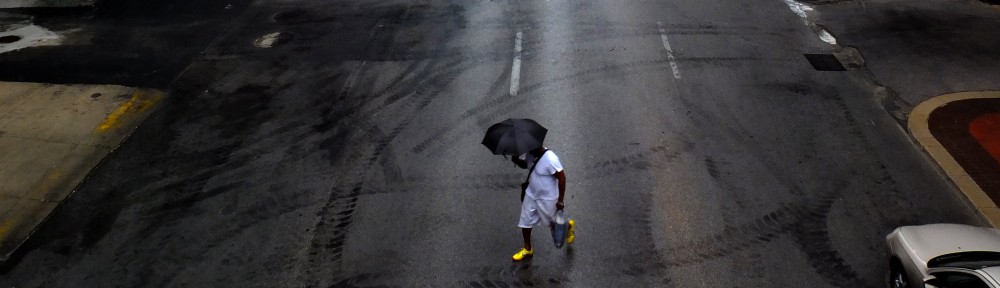
Late last night I was noodling about on YouTube, looking for something about Japanese photographer Miyako Ishiuchi (who, by the way, is vastly underappreciated) and I came across a video by–I guess he’d be considered an ‘influencer’? I’m not going to mention names; he’s a good photographer, makes a LOT of videos about photography and photo gear, he’s got a large following. This particular video was focused on his feelings about being burnt out. He said:
“Lately I’ve been feeling like my photography hasn’t been saying what I want to say. I’ve been questioning if it’s even the right medium for me to communicate my thoughts and feelings.”
Okay, valid. And hey, he’s right. Still photography isn’t a very effective medium for expressing thoughts and feelings. Writing is a good medium for communicating thoughts and feelings. Cinematography–moving images–another good medium for communicating thoughts and feelings. A cohesive series of purposely related still images can be an effective medium for communicating thoughts and feelings.
But a single photograph? Nope.
A single photograph is useless for expressing thoughts and it’s unreliable as a tool for expressing something as complex as feelings. A single photo can certainly invoke a mood, and that mood might suggest something of what the photographer was feeling. But it might not. A happy photographer can shoot a grim, moody photo; a photographer in deep despair can still shoot a cheerful photograph. A single photo, regardless of how powerful it is, is just a moment isolated in time and limited by an artificial frame.
As to thoughts, you often hear people say stuff like, “This photo tells a story.” No. No, it doesn’t. A single photo doesn’t tell a story. It can’t tell a story. A story has a beginning, a middle, and an ending; you need at least three photographs to tell a story.
BUT a single photograph can hint at a story. It can imply a story. The viewer, looking at a single photo, can create a story based on that moment. But it’s the viewer’s story; it comes from the viewer. It’s only inspired by the photo. A single photo can be the beginning, the middle, or the ending of a story. But an entire story? Nope.
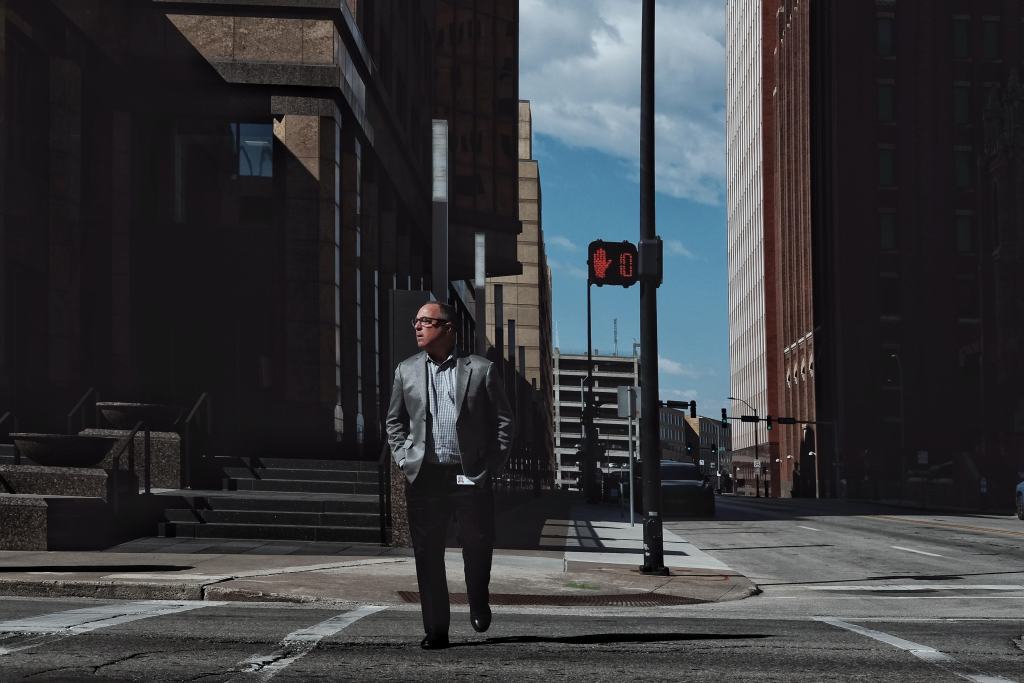
That said, still photography can be a powerful story-telling tool IF you string together a series of related photographs. Photo-stories can even be more powerful than video, because you can take your time looking at a still photo. You can examine every corner of the frame. You have time to blink and think and ponder what you’re seeing in each image, instead of simply responding to the images streaming in front of you.
The photographer in the video also said this:
“I feel like a good photograph is something that expresses what the creator wanted to say.”
I dunno, maybe? If you want to say something like “Ducks are cool” or “Tall buildings are impressive” or “Look at this guy cleaning up street trash on a cold, wet, foggy morning,” then yeah, a good photo can express what you want to say. But if you want to express anything more complex than a simple declarative sentence, then your hope that a photograph will express what you want to say is…well, misplaced.
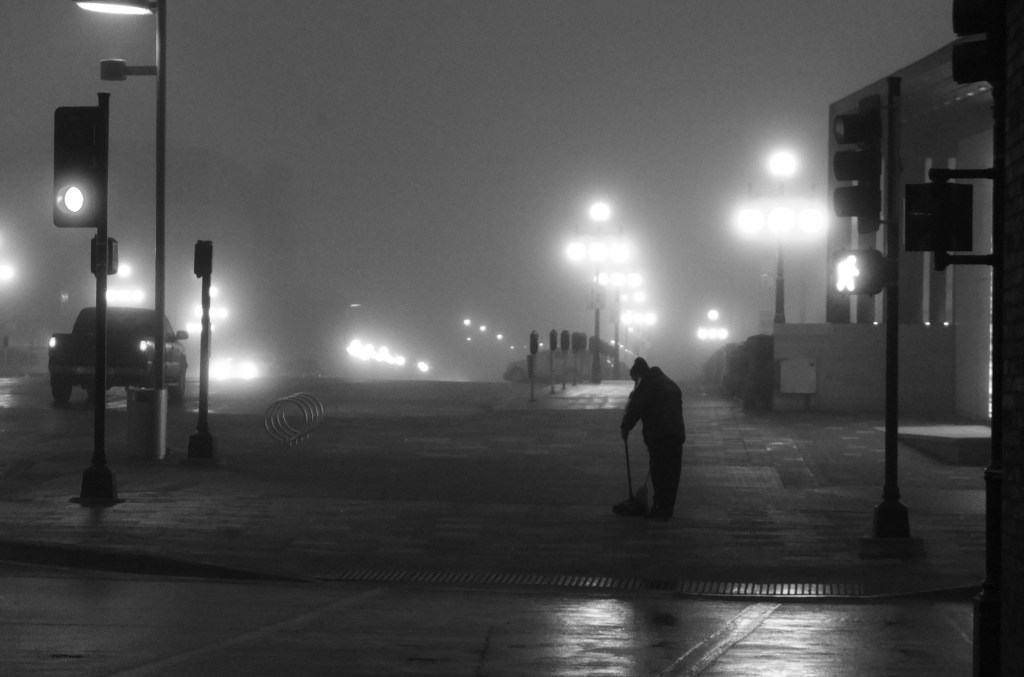
Another thing—at no point in his video did the guy ever articulate WHAT he wanted to say. Or why he wanted to say it. Or how his photography was falling short. In fact, he said,
“I sometimes feel like I don’t have anything to say…and that I’m just making photos.”
Dude, that’s fine. Ain’t nothing wrong with just making photos. But when you deliberately take a photograph, regardless of the subject, you ARE saying something. You’re saying, “This is what I see. This is how I see it. What’s happening in front of my camera is interesting to me. It makes me feel a certain way. Maybe it’ll have a similar effect on you.” The impulse to press the shutter release is, by itself, a valid reason to take a photo.
I found this guy’s video annoying. Annoying and ironic. The irony is that the guy who was complaining that still photography failed to communicate his thoughts and feelings was actually communicating his thoughts and feelings using a medium designed to communicate thoughts and feelings.
My point is this: any expressive medium–still photography, cinema, writing, dance, painting, acting, sculpture–is limited. Don’t ask more from any expressive medium than it can give you. And don’t whine about the limitations.
 gregfallis.com