Right, quick recap: Back in the Spring of last year I was slowly emerging from a photographic funk. I hadn’t picked up an actual camera in…I don’t know, months, Several months. This had happened to me once before (see the endnote if you’re interested). Anyway, for whatever reason, I was coming out of that funk and starting to think about photography again.
That included reading about photography again. I came across an article on some photo website that suggested looking at and analyzing your old photos as if they were made by a different person. That seemed ridiculous to me. I’m not terribly interested in my old photos; I mean, I’ve already seen them, right? Why would I want to look at them again, especially when there are lots of photos by other people that I haven’t seen?
But I thought I’d give it a try now and then. This is my fifth time in nine months. I’m still not comfortable in doing this. But several years ago I wrote about Alfred Stieglitz and his notion of practicing in public. The idea, as I interpreted it at the time, is that if you’re serious about photography, you’ve got to be willing show your whole ass in public. So that’s sort of what I’m doing. So, here we go:
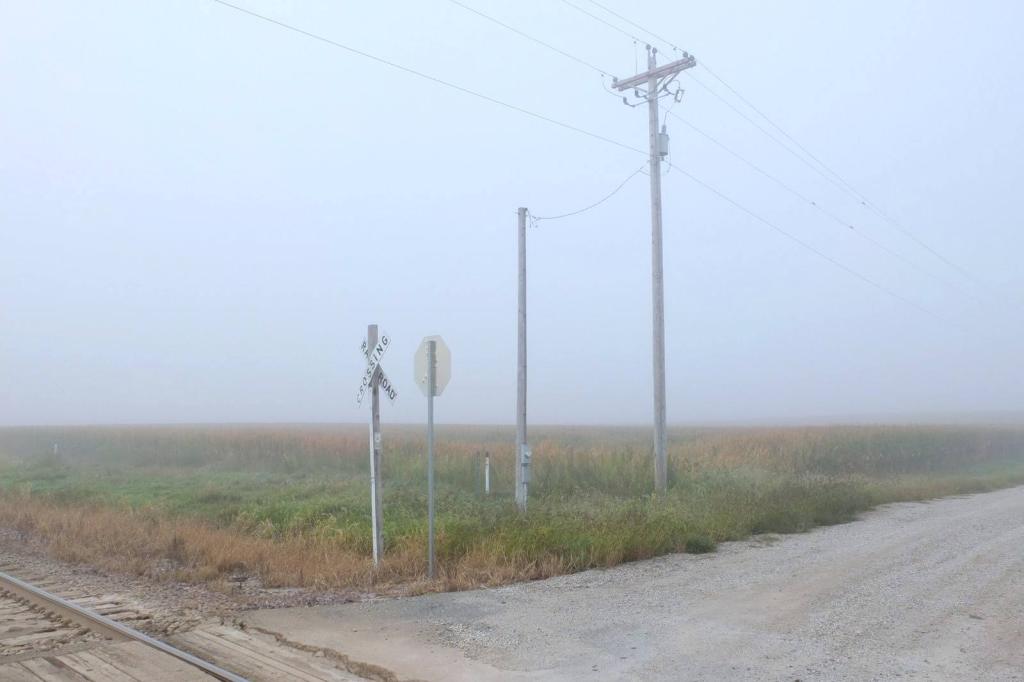
The metadata informs me I shot this photo on September 18, 2014 at 9:03 in the morning with my old Fujifilm X10 (ƒ/4.5, 1/450, ISO 200). It’s one of six photographs I shot that misty morning. I tend to be parsimonious when I shoot–a habit from the days when I couldn’t afford to piss away film.
I don’t remember anything about that day, but it’s clear to me why I stopped long enough to take this particular photo. It’s all about those angular lines. The railroad tracks, the dirt road, the rising line of poles, the telephone wires, and that terrifyingly flat horizon line (although I’m living in Iowa, I’m not a country boy, and I’m always a tad freaked out when I find myself in the flattest and most open parts of the Midwest countryside. There’s so much sky and so little to break up the horizon. It always reminds me that I’m on the surface of a planet, which makes me feel incredibly small and unimportant; that’s both humbling and sort of a nice reminder that everything is temporary when seen on a planetary scale).
I’m sort of surprised I didn’t shoot this photo in monochrome. If line and form are the predominant features inside the frame, I tend to opt for black-and-white (okay, yet another tangent, sorry. It’s silly, I know, but I deliberately choose to shoot in either color or in monochrome. I almost never turn a color photo into monochrome, though that process certainly gives the photographer a LOT more control over the final image). I have to assume that at the time I took the photo, I thought the mist-muted colors added something to composition. Maybe it does. I’m not curious enough to process the image in b&w to find out. I mean, this is the photo I chose to shoot, and there it is.
I like this photograph. I think I’d like it no matter who shot it. I like the simplicity of it. I like the balance. I like the emptiness.
So, is there any real value in this whole ‘looking at an old photo’ bullshit? I kind of hate to admit it, but I think there is. I may not be learning anything new, but the practice does reinforce the reality that I see and react to the world differently than regular people. That’s true of all photographers; it has to be. It validates the willingness to stop your car at some random spot, and get out in the chill mist, simply because you’re smitten by a series of visual lines that other folks wouldn’t notice.
So I’ll probably do this old photo business again in the not-too-distant future.
ENDNOTE: My first long-term photographic funk came at the end of my career as a criminal defense investigator. I used my cameras a LOT as a PI, but in a very technical forensic way. The photos I took for my work were all potential evidence to be used in court. The work was very object oriented. The photos were sometimes technically challenging (I once had to photograph the undercarriage of a wrecked car, which involved some tricky lighting and wide angle lenses while lying on a roller beneath the vehicle, which was claustrophobic as fuck). The problem was that there was no joy in that sort of forensic photography. Blood spatter patterns might be visually interesting, but it’s hard to appreciate when you’re shooting them. When I ended that career, I stuffed my cameras into my Sam Spade Conjurer’s Kit and stuck it in a closet, where it sat for about 3-4 years. I had no desire to hold a camera in my hand in all that time.
 gregfallis.com
Something I want you to know….I love the fact that you are both a photographer and a writer….I appreciate both. Reading this, I realize that I do enjoy looking back on old things I have photographed, with various equipment and various thoughts in my head. It makes me view the photographs much more objectively than when I took them. Sometimes I think it is really poor photography, and sometimes I just smile:)
>
LikeLiked by 1 person
Thank you. That’s very sweet of you to say.
I don’t know if I’m learning anything at all by looking at my old photos. At least not in terms of ‘improving’ my skills. But it IS reinforcing the fact that, when given the time, i’m ridiculously fussy about composition. What’s in the frame, what isn’t, and how tiny shifts in the camera’s position make a big difference. Well, a big difference to me.
LikeLike