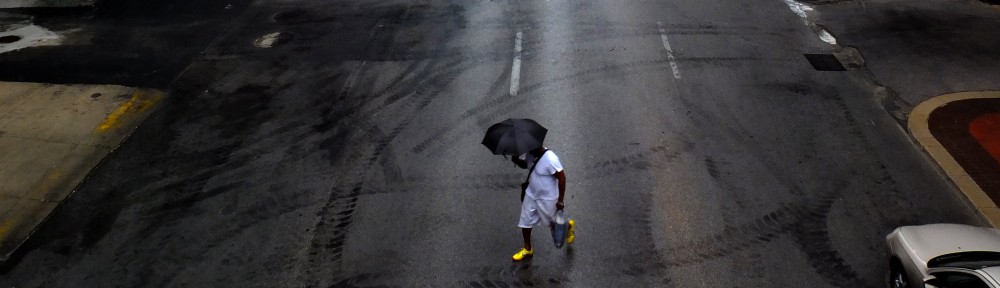
We’re living through the early stages of a climate change nightmare right now. Persistent heat domes with dangerously high temperatures, torrential rainstorms, exceptionally powerful hurricanes forming earlier than usual, drought-based wildfires whipped into firestorms by freakishly high winds, stronger than usual tornadoes that stay on the ground longer, thousand-year floods every couple of years leading to dams collapsing.
Because of the exceptional rainstorms, the Des Moines River is currently 20-22 feet higher than normal–not quite at actual flood levels (which, I believe, is 24 feet). A visit to the dam which creates Saylorville Lake yesterday was compelling. The 6000 acre lake has risen almost two feet in the last 24 hours; the spillway was releasing over 16,000 cubic feet of water every second — that’s 190% of its normal release. It was loud and furious and utterly fascinating to see.
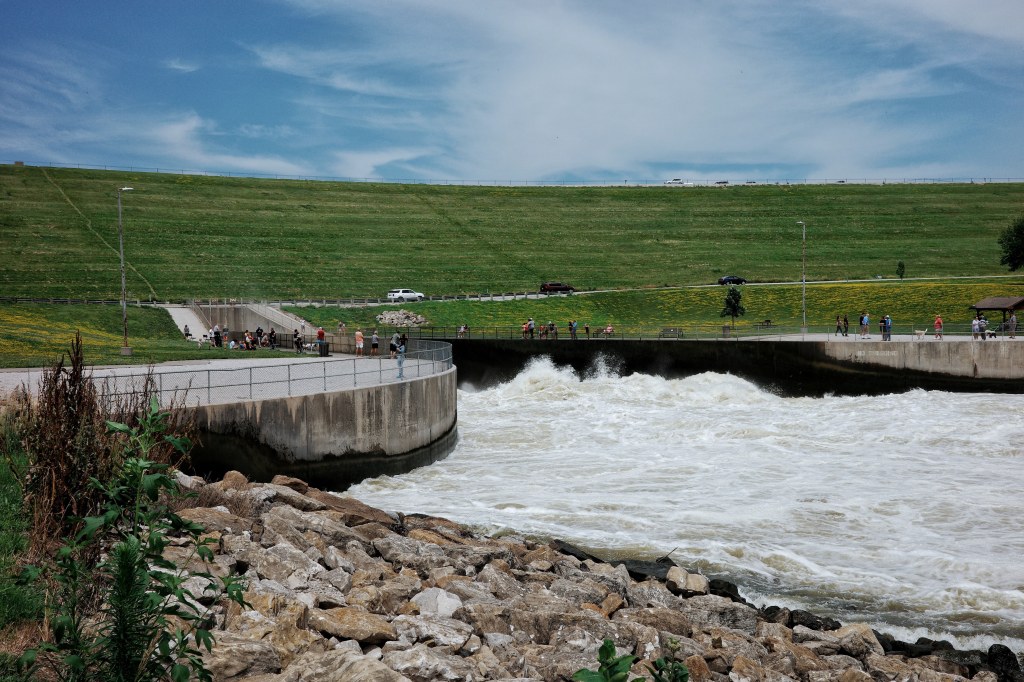
People showed up to see it. Young people, old people, families with kids and dogs, couples, people on their own — a constant low-volume parade of people just to take a look at the chaos of the spillway. Just a few dozen at a time. Most of them would slowly approach the fence guarding the spillway, gawk a bit, gradually move closer to the release point at the bottom of the dam. The turbulent water was mostly unpredictable, and would splash people unexpectedly. Most laughed and ran away from the fence. A few got irrationally angry, as though the water had played some sort of trick on them.
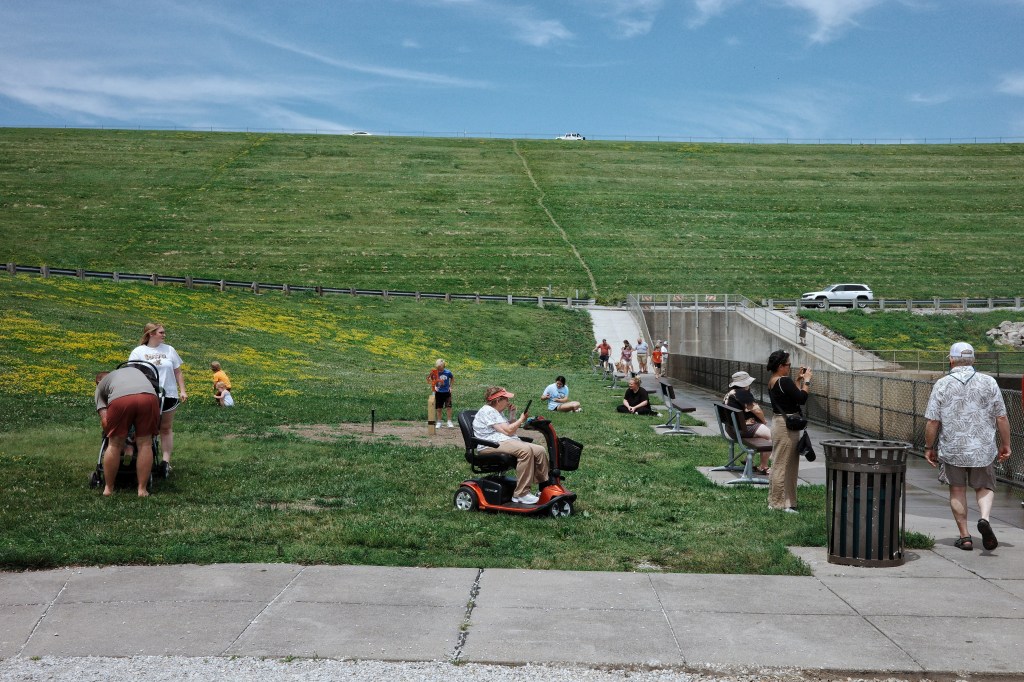
That large solid hill behind the spillway? That’s actually the dam holding back the Saylorville Lake. On other side, the water level is probably 30-35 feet higher. There’s a second, emergency spillway (not pictured in any of these photos) in the dam. The water level in the lake is expected to peak in a couple of days, and (it’s hoped) will remain a couple of feet below the emergency spillway.
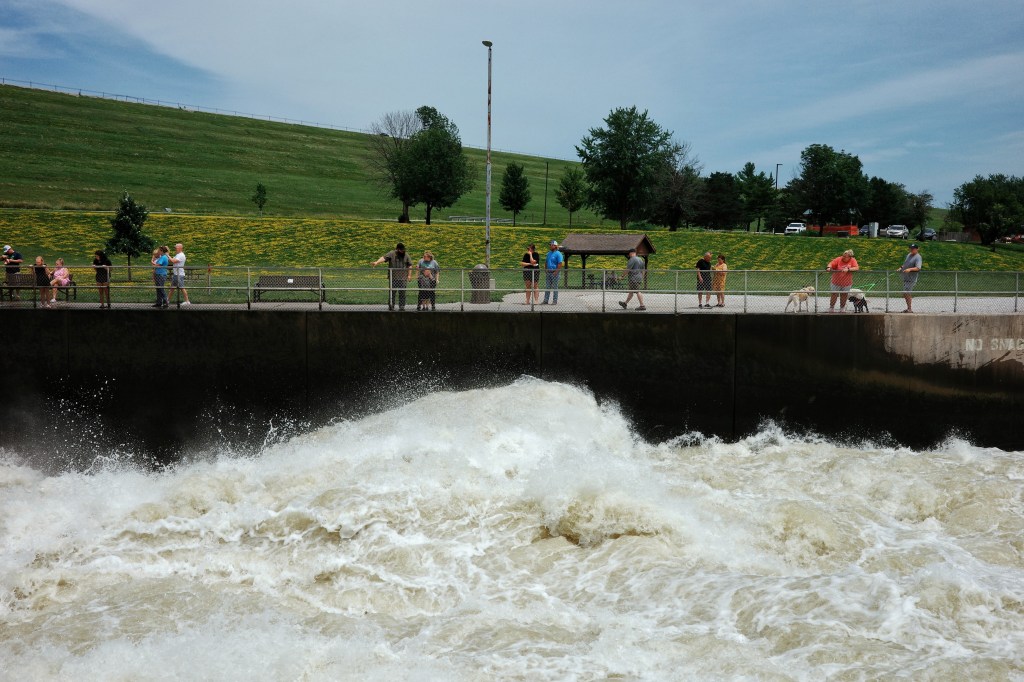
“If you fell in there, you’d die.” I can’t tell you how many people I heard say that. They’d stand at the fence, look at the raging water cascading out of the spillway, shake their heads, and say it in an awestruck voice. They often repeated themselves. “Wouldn’t have a prayer, if you fell in there. Nothing you could do. Nothing anybody could do. Find your body somewhere downstream.”
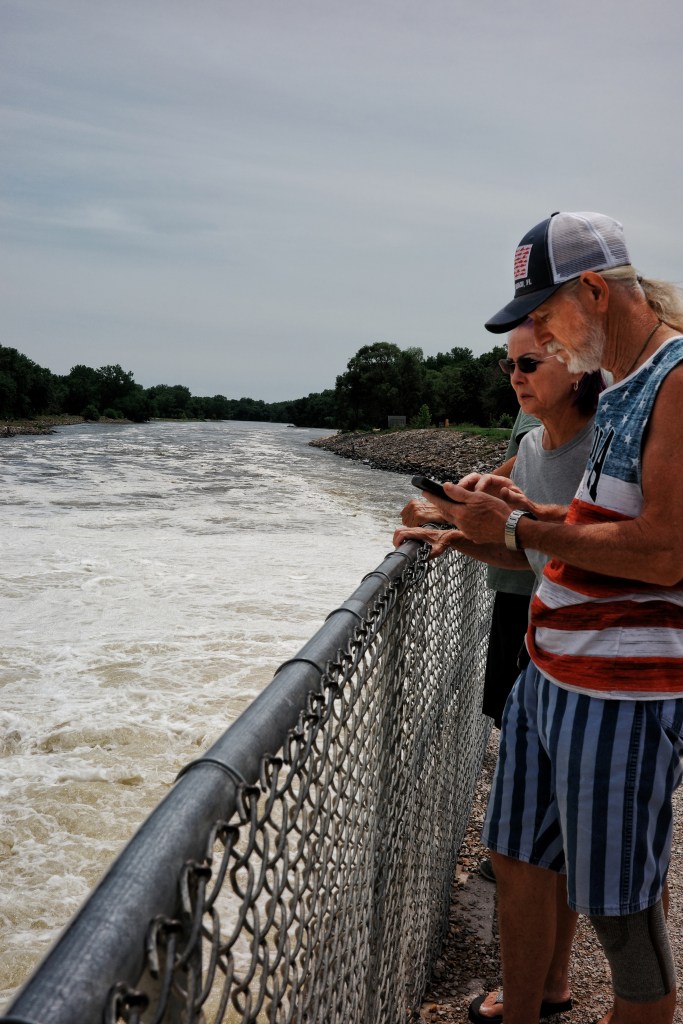
Normally, the only people you’d see at the spillway were fishing. It’s a popular fishing spot; apparently it’s one of the few places you can catch eight to ten different fish species along a single short stretch of the river. Under normal conditions, that also makes it a popular spot for birds — pelicans, cormorants, gulls and terns, eagles. I didn’t see any birds even approach the spillway yesterday. Birds have too much sense for that.
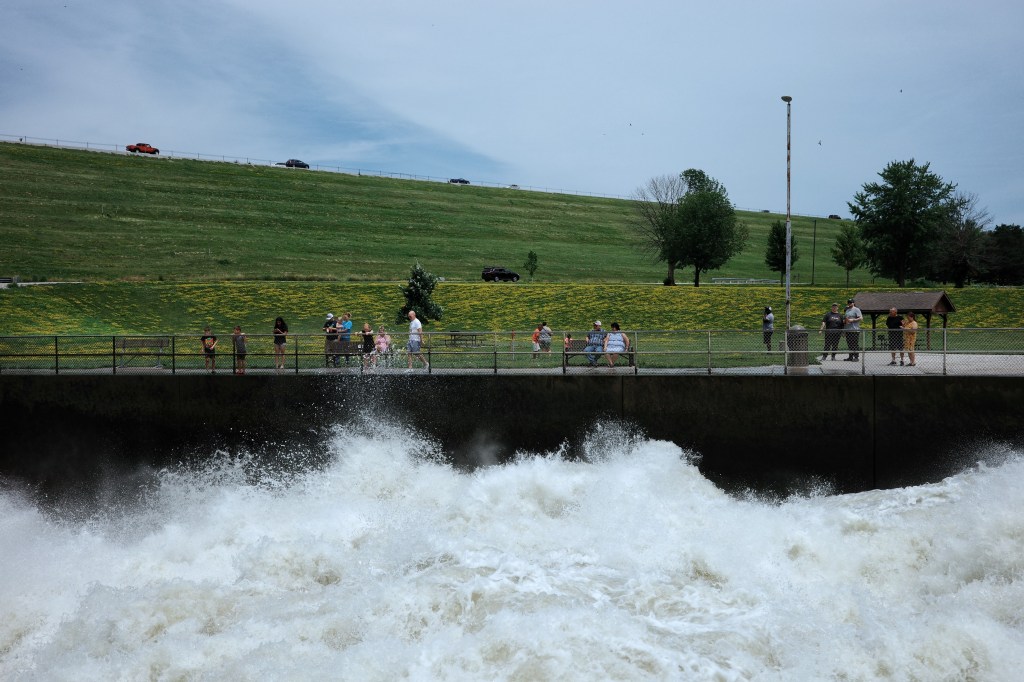
There was something almost pagan about the experience. Not pagan in a religious sense (since ‘paganism’ is just a term early Christians applied to any pre-Christian belief system), but in the sense of common people making a sort of pilgrimage to witness, awestruck, the beauty and savagery of nature, to experience their own smallness in the world. I doubt many of the people at the spillway thought of it in those terms, but it was there. The awareness of a natural power beyond our control and our understanding.
We were only there for a half hour or so. It seemed like longer, but time gets weird in the presence of the old gods.
Editorial Note: I was informed about this fishing video that shows the spillway under ordinary conditions. You don’t have to watch the entire thing; the opening seconds will give you a sense of what it’s normally like at the spillway.
 gregfallis.com
I wrote about the reasons for this kind of weather behaviour on my old blog Tetherd Cow Ahead more than a decade ago. I can’t stop to think about it too much, because, frankly, I find it terrifying. As part of that piece I said:”What you should expect is periods when the weather seems just as it always has, interspersed with occasional outbursts of extreme behaviour. For a while this will seem normal, and you will be as happy as a frog in a warm pond”Nearly all of that article remains extremely relevant, though I would change a few things. These unusual weather events are the precursor for much, much worse.Is It Just Me, or Is It Warm in Here?
The old gods are more fearsome and capricious than any of us have the capacity to imagine.
LikeLiked by 1 person
A lot of folks are unaware that what we now call chaos theory was largely sparked by a meteorologist named Edward Lorenz. He’s the guy who, back in the early 1960s, really established the concept of sensitive dependence on initial conditions. Weather turned out to be a LOT more nonlinear than anybody expected.
And yeah, we’re seeing that played out in real time. And most folks still refuse to see it — and that’s only partly because the science behind it is counter-intuitive. It’s easier to claim it’s all a hoax than to try to grasp the underlying science.
LikeLike