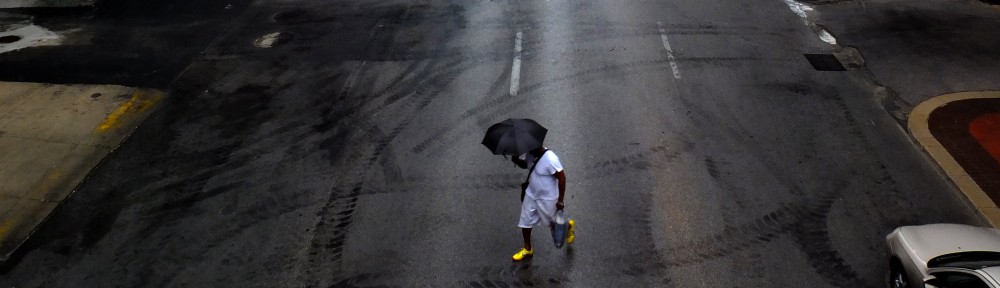
This might seem a silly question, but…
This question wasn’t asked of me; it was asked generally on Bluesky. But anybody who has ever written anything and been paid for it will eventually get a question that starts the same way. The questions tend to be pretty generic (…but how much dialog do you need?) or vague (…but how do you know when a scene is over?). But this was the most common and fundamental ‘silly’ question:
…but how do you *start* writing? How do you bridge the gap between staring at an empty page, with only a story idea & vague sense of urgency in your head, and convincing yourself to actually Start Writing?
There’s something fundamentally innocent about this situation. I’m just a writer, standing in front of an empty page, asking it how to begin. It’s both silly and serious, because the answer is both self-evident and incomprehensibly complex. How do you start writing a story? You put words in a row. It’s that simple. How do you start writing? Using godlike powers, you create an entire world where none exists and imbue it with rules and natural laws, then populate it with beings who behave as though they have free will but are, in fact, completely and entirely under your control. It seriously IS that complex.
Any story (and by ‘story’ I mean a work of fiction of any length–novel, novella, short fiction) is a cosmological event. When we write a story, we create a world and the world we create shapes how the story will be played out. All fictional worlds, to some degree, resemble the one we live in. The operative term there is resemble. As writers we routinely take liberties with the world we live in, making our fictional worlds different in ways we find useful. We may, for example, create a world in which dog trainers routinely discover dead bodies and solve crimes. Or librarians secretly engage in magical combat with ghosts. Or lesbian necromancers explore haunted gothic palaces in space. Regardless of the liberties we take with reality, the world we create nonetheless still resembles the world we live in.
This is true, but it doesn’t begin to help answer the actual question. How do you confront the empty page?
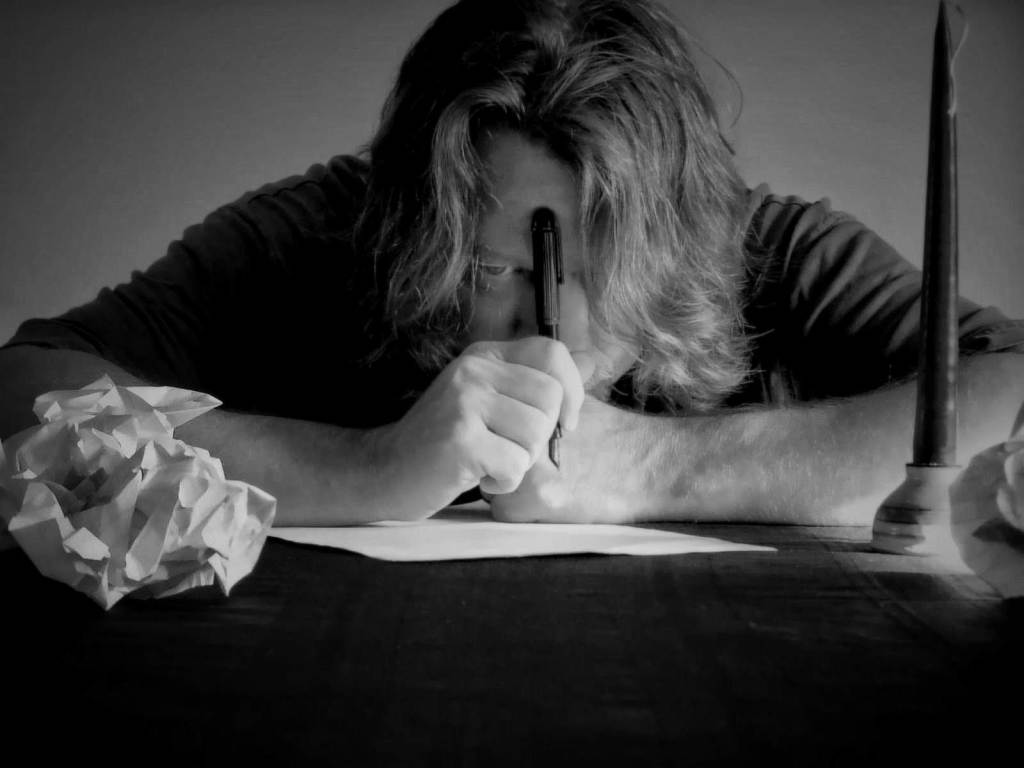
It’s like when you have a new car (or any other shiny new purchase). You’re very careful where you park, because you don’t want other cars to ding it, or birds to shit on it, or tree sap to fall on it. You dread that first ding, but once it happens you relax a bit. You don’t fret about it as much.
So that’s how you start writing. Ding the car. If you find a clean white page to be intimidating, get it dirty. Put words in a row. Any words.
Another thing. There are LOTS of books on how to write. I haven’t read any of them, but I’m told many have rules on what NOT to do when starting a story. Rules’ like Don’t start with dialog or Don’t start with descriptions of weather or other bullshit. If you’re at a loss with how to start, maybe start by deliberately breaking one of those ‘rules.’
Start with dialog between lesbian necromancers describing the gloomy weather at the gothic space castle if you want. You can always change it later. I mean, it’s ALL just stuff you’re making up, so do whatever the fuck you want. Ain’t nobody looking over your shoulder. Later, if you want/intend/hope to sell what you’ve written, then you may want to take an audience into consideration. But when you’re starting a story, you are completely free. There are no rules, no moral code, no ethical constraints, no social standards you have to comply with.
Once you realize you’re free to write anything you want in any way you want, starting to write becomes pretty easy. Here’s what I know to be true: writing the beginning is fun. It’s all enthusiasm and you’re unburdened by the weight of the story. Writing the ending is harder, but it’s always satisfying. The dangerous part of writing–the part that strangles most writing projects–is the grim fucking middle. That’s where you have to do the grunt work of creativity. That’s where you have to do the heavy lifting of the imagination. The middle requires discipline. I don’t know about you, but I resent discipline. But it’s part of the gig, so there it is.
The beginning though? That’s all bluebirds and sunshine and chocolate eclairs.
 gregfallis.com
Great post.
extra kudos for the GT9 reference 👍😎
LikeLiked by 1 person
Gideon the Ninth is such a wonderful, entertaining, moving, deliciously weird novel. I recently (well, within the last year) reread it, and it’s even better on the second reading.
LikeLiked by 1 person
wow WordPress is a fucking asshole today. let’s hope the fourth time’s the charm
LikeLike
I’ve started Harrow the Ninth twice and put it down twice. There are books I simply don’t enjoy, and I’ll discard them without a second thought. But there are also books that I want to read, but need to be in the right frame of mind…so I’ll return to them and try again. Harrow is one of them.
I’ve heard of ‘This Is How You Lose The Time War’ but haven’t read it. I’ll track it down.
And yeah, I don’t know what’s going on with WordPress lately. I’ve had other folks tell me it’s being fussy.
LikeLike
Okay, coming from an art background, the way to start is to fill an empty page full of scribbling until form begins to emerge.
As for writing, I thought it was easy. You start with:
“It was a dark and stormy night…”
The rest just follows.
LikeLiked by 1 person
You know, that Bulwer-Lytton line would work if it had been broken into two sentences and lightly edited.
It was a dark and stormy night. The rain fell in torrents, checked at intervals by violent gusts of wind sweeping up the streets, rattling along the housetops, and agitating the scanty flame of the lamps that struggled against the darkness.
This is why writers also need to be editors. Or at least hire a good editor.
LikeLike
Oh. I thought Snoopy wrote that.
LikeLiked by 1 person
It was a dark and stormy knight …
LikeLiked by 2 people
A dark and stormy nightmare…
LikeLiked by 2 people
I have to hear it in my head before anything gets written on a page.
LikeLiked by 1 person
It’s different for everybody. In the end, what matters is that it DOES get written on the page.
LikeLike