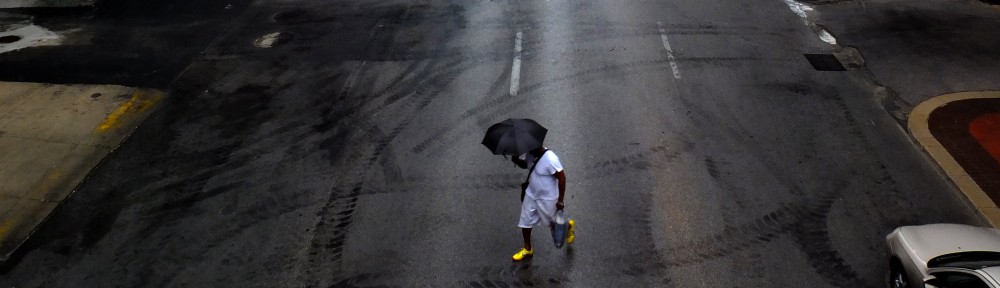
F/8 and be there. That’s the classic photographer’s maxim. It’s usually attributed to Arthur Fellig (better known as Weegee), though it’s highly unlikely he actually said it. Weegee was famous for what was called ‘spot’ or ‘moment’ photography in the 1930s and 40s. He made it his business for being at the right spot for newsworthy moments and being prepared to photograph them. A camera aperture of F/8 is generally considered an all-purpose aperture; it allows in enough light for a decent exposure while providing a relatively broad depth of field. So how do you get a good ‘spot’ photo? F/8 and be there.
In fact, Weegee routinely shot most of his famous photos with his massive 4×5 Speed Graphic camera set at F/16 or F/22. Not that the actual aperture he used matters. What matters is the concept is solid. Be in the right spot with usable camera settings, and you’ll probably get a good shot.
Me, I had my 12-year-old Fujifilm X10 set to F/5.6 in case I came across some random right spot. I was just idly wandering around the city when I heard the distinctive sound of a basketball being dribbled. I followed the sound. There’s a small urban recreation area in Des Moines with a single pickleball court, a ping pong table, a few tables set up for chess and backgammon, and a basketball half-court. This is what I saw when I came around a corner.
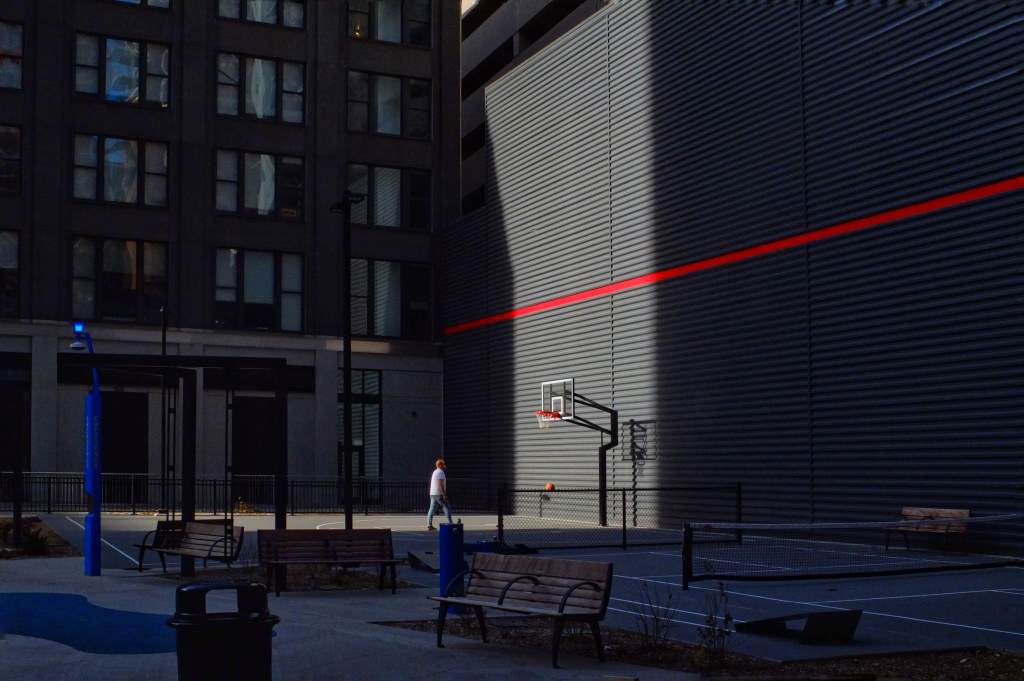
There was a guy, all by himself, dribbling a basketball, juking around imaginary defenders, shooting baskets. He was in the shade and almost invisible, but the setting itself was so stark and had such a startling red stripe that I turned on my camera and kept approaching, hoping he’d move into the sunlight. And he did.
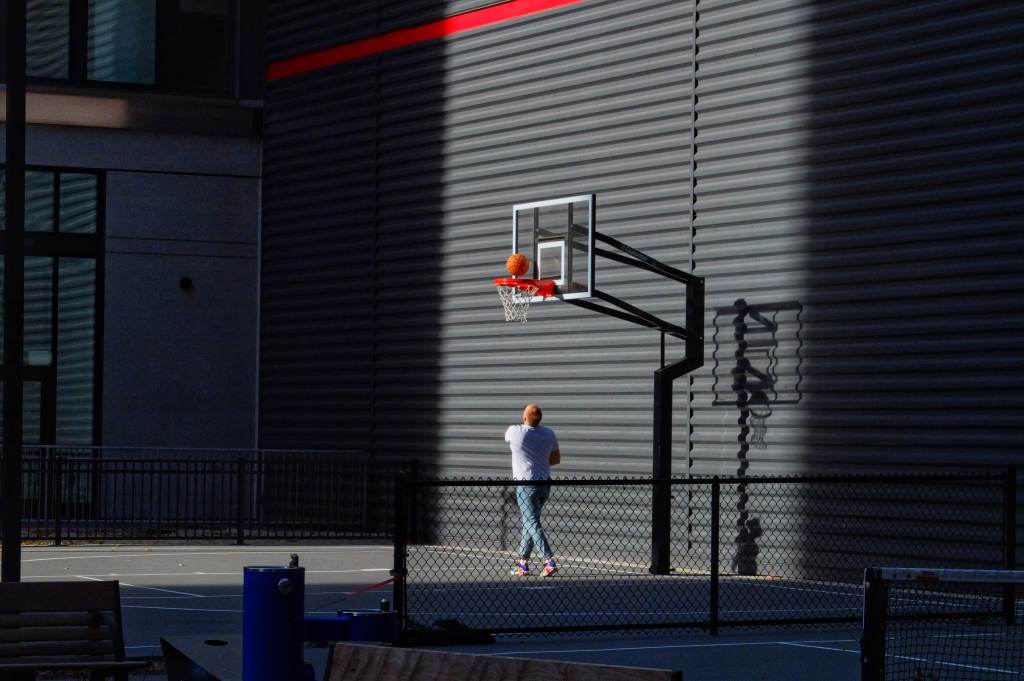
I kept edging closer. I refused to look down to double-check the camera settings for fear he’d move into the sunlight and I’d miss the shot. He kept dribbling and juking and shooting, and every time he moved into the sunlight, I snapped a photo.
I only got five shots before he stepped into the shadow to check his watch. Then he put on a jacket, collected his basketball, and walked off. My first shot was as 12:44, the last at 12:45. Two minutes at most. Probably closer to seventy or eighty seconds, most of which was spent walking forward, camera ready, trying to maneuver the guy into the sunshine by wishing really really hard.
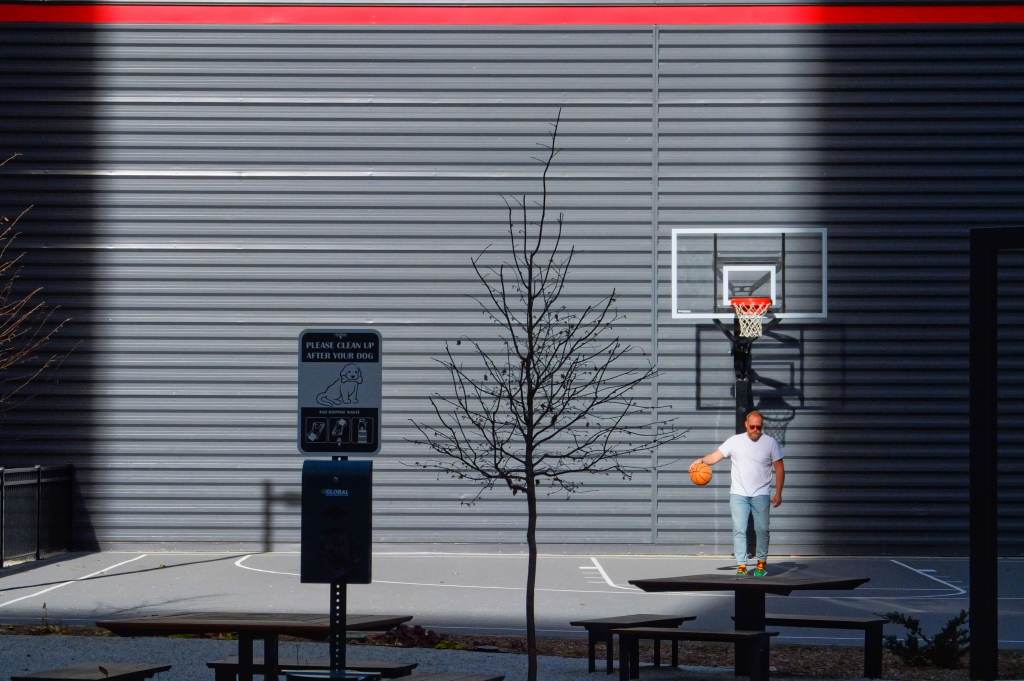
Once it was clear the moment was gone, I started desperately chimping* my camera’s playback, hoping I’d managed to get at least one shot that was worthwhile. In one of the shots, the guy was too obscured by the shadow. The other four? They all turned out.
Are they great photographs? No. But when you’re shooting a photo, you generally have an idealized version of the resulting image in your mind. These four photographs are pretty much what I was hoping they’d be. Pretty much. I have some niggling complaints about the final photo, but overall I was ridiculously pleased.
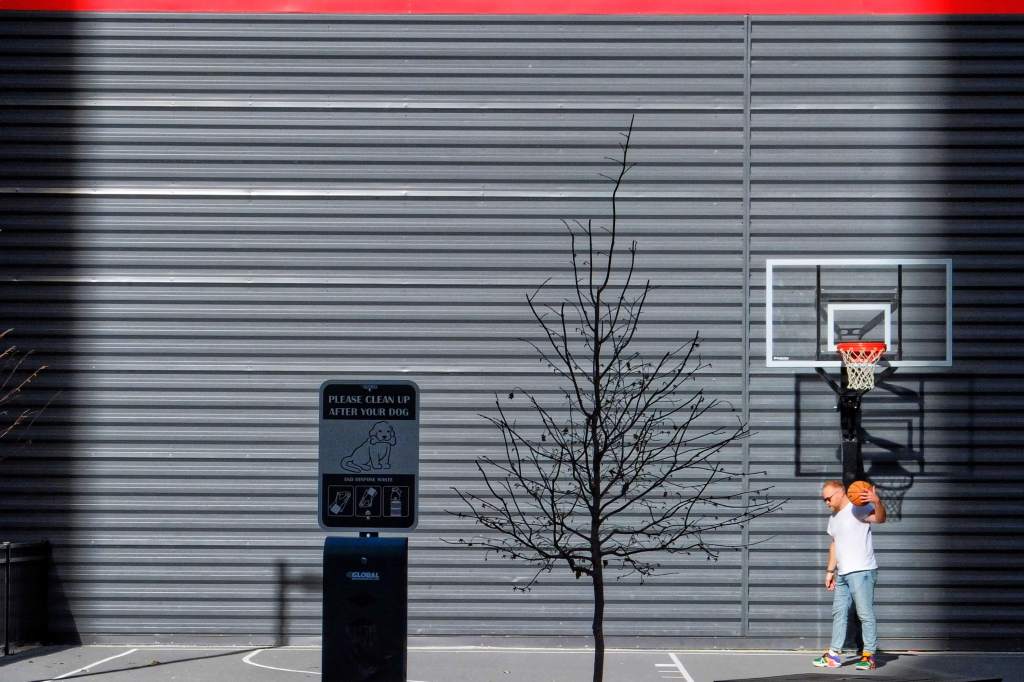
Photographing some random guy shooting baskets on his lunch hour is a small thing. But it’s the sort of thing that keeps photographers walking around with a camera. There’s a definite dopamine jolt when you get the shot right. It doesn’t even matter what the shot is about; you just want to recreate that feeling again. That’s exactly why I was idly wandering around the city and exactly why my camera set to my default daytime aperture of F/5.6.
I’m no Weegee, but I want to be ready when I’m there, wherever there happens to be.
EDITORIAL NOTE: Chimping, for non-photographers, is the act of looking down at the screen of your digital camera while reviewing the shots you’ve just made, and making chimp-like “Ooh ooh” noises as you do it.
 gregfallis.com
Such a great eye for structure you have
LikeLiked by 1 person
I’ve heard the phrase as the more rhymey “f/8 and don’t be late”
LikeLiked by 1 person
I love it when you talk photography…..and skulduggery…
LikeLike