
I don’t know if this is a thing or not, but during the holiday season (which, for those not in the US, is the period between our Thanksgiving and the New Year) I tend to re-read favorite novels. It’s probably got something to do with comfort and quiet and nesting. I don’t know, but there it is and I’m not going to think about it too much.
This year I’ve decided to re-read Ellen Kushner’s The Privilege of the Sword. It’s probably been a decade since I read it, but it’s a novel that resonated with me. I’d read her earlier novel, Swordspoint, a few months before. The Privilege of the Sword (okay, I’m just going to refer to as PotS from now on) isn’t exactly a sequel to the earlier novel, but it’s definitely sequelish. It includes many of the same characters and takes place in the same “fantasy” world.
You’ll note I’ve put “fantasy” in quotation marks. Both novels are often listed as fantasy novels, which is a genre I tend to associate with some sort of magic (and, too often, elves and dragons). I’m fundamentally skeptical about the use of magic (and elves and dragons) in a story, but I accept that they’re inextricably bound up in the fantasy genre. I accept them in the same way that I accept the frequency of murder victims in cozy mysteries. I tend to wince a little when it happens, then get on with the story.
As I started reading Swordspoint, the first novel, I kept waiting for somebody to do something magical. It was sort of like having a new car; you know it’s going to get dinged at some point, so you’re sort of tense every time you leave it in a parking lot. But once somebody opens their car door and dings your fender, you relax a bit. The damage is done. My point is I couldn’t quite relax and enjoy Swordspoint for the first few chapters, because I was waiting for somebody to wave a wand or cast a spell or something. Eventually I realized it wasn’t going to happen. It was a tremendous relief.
There’s no magic in either of these novels (at least not as an element of the story; the magic is in the quality of the writing). These novels are fantasies in the same way one of my childhood favorite books, The Prisoner of Zenda, was a fantasy. They’re set in an imaginary but internally consistent story world, one in which politics and political intrigue play as much a role as the swordplay. The ‘fantasy’ element is the way the story world–its culture, its social norms, its customs and traditions, its concept of status–is maintained and made real.
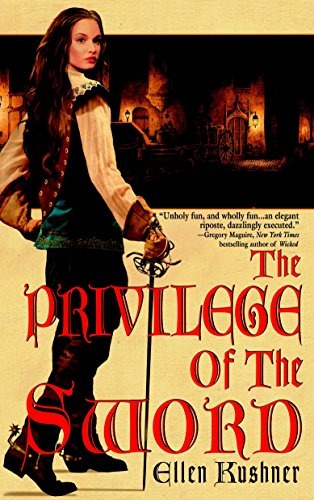
So why have I decided to read PotS instead of Swordspoint? Because I recall PotS as a more human story. I recall it being funnier, sadder, more simple but more surprising, more elegant, more intelligent, and more (for me, at any rate) emotional. My recollection may be faulty, but I’m relying on it anyway. There’s an excellent chance I’ll reread Swordspoint as well.
The basic plot of PotS (as I recall) is as follows: a young, rather flighty young woman is called to attend her uncle — the mad and deliciously depraved Duke of Tremontaine — who has decided, for obscure reasons and against all tradition, to train her as a swordsman. In both novels, disputes are sometimes/often decided by setting hired swordsmen against each other. The young woman (I think she’s in her teens?) is initially more interested in attending balls and attracting a potential husband, but tolerates her uncle’s peculiarities for her family’s sake. Eventually, she learns to appreciate swordplay both as a skill and for the freedom it provides her. Her new talent and attitude also allows her to help others who aren’t able to help themselves. There are, as I recall, at least a couple of subplots which are woven seamlessly into the narrative.
Some of that may be incorrect, but that’s how I remember it. What I remember most is that delicious feeling of being completely engaged with the story world and the characters who inhabit it.
I’ll start re-reading PotS this evening or tomorrow, depending on when I finish the novel I’m now reading (the most recent Murderbot novel) and how busy I am. I’ll take my time reading it — maybe read 2-3 chapters a day. I may report back here every few chapters.
I confess, I’m a tad hesitant to start re-reading it for fear it won’t quite hold up to my memory and my expectations. It’s always a risk to return to your favorites, isn’t it.
 gregfallis.com
There is indeed a risk, rereading old favorites, in that they may relinquish the title of old favorite. That has happened to me more and more lately, but I realize now that it has less to do with not correctly remembering what I have read in the past and more with the fact that I am no longer the person who read those books years ago.
I was a huge fan of Clive Cussler’s Dirk Pitt books. He was a roguish swashbuckler who found a way out of any danger, but he was human in that the repeated entanglements wore him down. I was also drawn to the books because they often featured strong women, something that I wasn’t finding in other books I was reading in my teenage and early adult years.
A few years ago, I decided to revisit the series and managed to struggle through three books. What disturbed me most was that these strong women were still in constant need of Dirk’s rescue. They were strong to the point when they weren’t and the rescue could take place, then once again be strong. I found this to be worse than typical patriarchal, chauvinistic writing because the message sent was “women are strong, but still need to be rescued.” I will never read another Dirk Pitt adventure, despite still loving the memories they provide.
LikeLiked by 1 person
Oh, I know that feeling. A couple of years ago a friend mentioned he’d wanted to study fencing ever since he’d read Robert Heinlein’s ‘Glory Road’ as a kid. I’d also read that as a kid and I had, in fact, joined my base’s fencing club while I was in the military. I remembered the novel as a sort of rollicking adventure story, so I bought it and read it again.
MASSIVELY sexist. It did sort of rollick along, but damn. It was embarrassing.
LikeLike
I experienced the first two (three?) Murderbot novels as audiobooks. They’re fantastic. I’ll probably grab a few more this week. I’ve been working through a lot of SciFi and space opera this year. I can recommend some if you like.
This one sounds like fun (and a break from the SciFi); I’ll look it up.
Happy Reading,
C
LikeLiked by 1 person
I absolutely adore Murderbot. There is a character who (if I recall correctly) is somewhat similar in attitude to Sec Unit, though a LOT less technological. She appears in at least two novels by James Alan Gardner. It’s been a couple of decades since I read them, but the one I remember is called Expendable.
Damn it, now I have to track that novel down and re-read it to see if I remember the character accurately. The novels were light reading, if I recall correctly, but entertaining.
LikeLike
Speaking of Murderbot…
https://deadline.com/2023/12/alexander-skarsgard-star-murderbot-apple-chris-amp-paul-weitz-1235668011/
LikeLike
Oh, I am so watching that!
LikeLike
It might be a risk, but it’s also a joy. Every few years I re-read Dickens “A Christmas Carol” and this year it’s due round again.
I first read it as a young teenager. I was looking for something in one of the sideboard cupboards at home and found a red, cloth bound copy of the book there. No idea why it was there or where it came from as it wasn’t new. I just remember being sat cross-legged on the floor in front of the open cupboard in lamplight and starting reading and not being able to stop until I had to sort out and lay the table for dinner. It was the perfect read for the run up to Christmas and I loved it.
As an adult I had a Penguin edition. But probably around 16 years ago now, I found an incomplete set of dull red, cloth bound Dickens novels, including A Christmas Carol, in a local antiques barn. I bought them immediately and they sit up on top of the book shelves in our reading area. They were each inscribed with a Christmas message to a young woman and from relatives or friends, I don’t have one to hand to check. Early 1900’s dated I think. They have all the original illustrations inside. It’s like stepping back into time. I love that rereading. I look forward to it. I’m a bit behind, it’s been a while, but I couldn’t face it the Christmas dad died and after that we had 2 lock-down Christmases and I didn’t fancy it then either. So now is the time.
Enjoy your re-read. It sounds like fun.
Happy holiday season.
LikeLiked by 1 person
A Christmas Carol is actually a very good story. I haven’t read it in years, but it’s very well written. And is still one of my favorite Christmas movies — especially the 1951 version with Alistair Sim as Scrooge.
LikeLike
It is very well written. It brings the seedy side of London Victorian life to the fore. The Alistair Sim film version is on TV this Christmas. I’ve just been through mum’s TV Times highlighting all the films I think she’d enjoy and that was one of them.
For some strange reason as I wrote the above, thinking of the stinking stews of London – the Rookeries as they called the very worst of the crime ridden slums where Fagin and his gang would have hung out, the thought crossed my mind that our house was already old when the book was first published.
History is a funny thing. You can get used to it. I think us Brits are really good at being used to history to the point of not noticing because we are tripping over it everywhere.
LikeLiked by 1 person