
As I’ve explained elsewhere, about a year ago I came across an article on some photo website that suggested looking at and analyzing your old photos as if they were made by a different person. The idea seemed a wee bit silly to me, but I was just coming out of a photographic slump…so what the hell, I thought I’d try it.
That slump is long dead now, though I suspect it had more to do with buying a camera that fits my approach to photography than with this practice of looking at old photos. That said, I’ve found some unexpected value in looking at my old photographs. I’m not learning anything new about photography (as I recall, the article was about evaluating or improving your compositional skills or something), but I’ve been surprised to find a weird sense of formality in my photos.
I don’t think of myself as being a formal photographer. I tend to shoot sparingly (I learned photography in the film era, which meant every shot cost money and I was rather poor), but quickly. I’ve been doing this photo stuff long enough that I don’t really think much when it comes to composition. I just put myself or my subject in a position that feels right, then take the photo. While I don’t believe there are any rules that MUST BE OBEYED, I do think there are some very strong photographic suggestions that ought to be considered. For example, if you’re making an informal portrait, you should be reluctant to have your subject strike a pose and you should avoid putting your subject in the center of the frame.
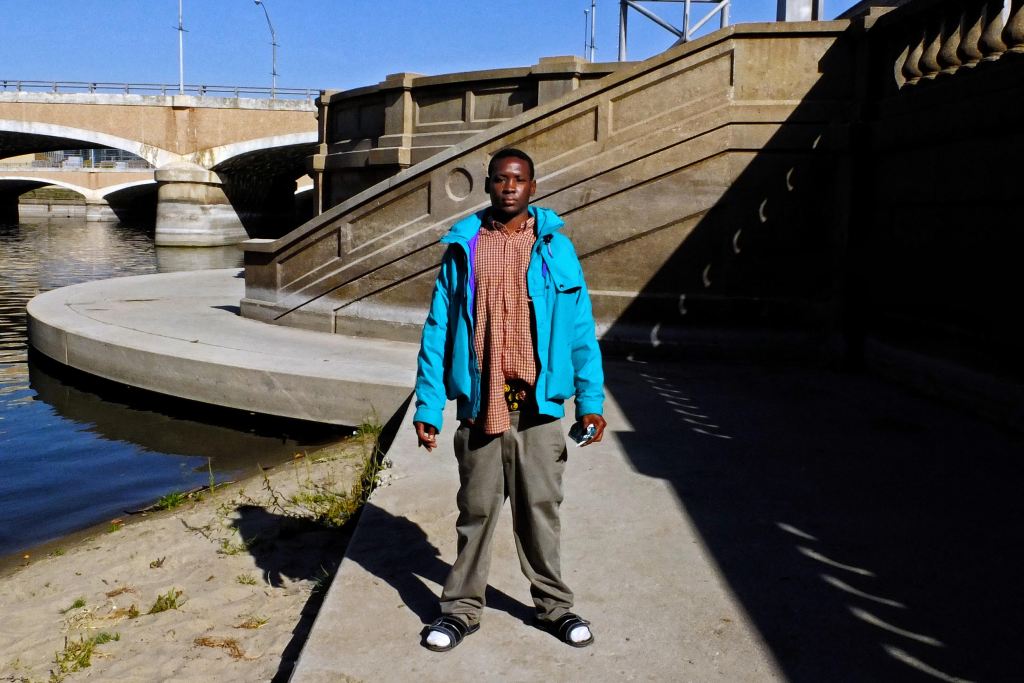
Like this. This is Sakim. I’ll tell you about Sakim in a moment. First, the photo. It’s everything you don’t want in an informal portrait–stiff pose, center of the frame. But (to me, at any rate) it works as a photograph. Why? Partly because of the composition; all the lines direct your eye to him and the angle of his arms matches the angle of the light on the sidewalk. It also works partly because this genuinely represents this particular person at this particular moment.
I was noodling along the riverwalk when I saw Sakim approaching. He was wearing a black baseball cap with smiley faces on it, drinking juice from a soft packet, and walking in a sort of marching gait that I associate with psychiatric patients. I’ve worked with a lot of psychiatric patients, mostly in a prison setting. I’m comfortable encountering them in unscripted public settings. I’ve found folks with emotional issues are often eager to visit with people IF those people are relaxed around them. Of course, the opposite is also true; some folks just want to be left alone. You can’t always tell until you start visiting with them.
I don’t recall how we struck up a conversation, but based on past experience I suspect I initiated it. I do recall he had a soft, gentle, deeply accented voice. We spoke about the weather (it was warm for October, but Sakim said it was chillier than where he was from) and his juice (he didn’t mind that his juice was warm). He wasn’t entirely comfortable having a conversation, but I had the feeling he didn’t really want the conversation to end. My sense was that he didn’t quite know how to have a casual conversation and was always concerned that he wasn’t doing it right.
After a few moments I asked if I could take his photo and he agreed. He took his cap off and stuck it down the front of his pants (which was disappointing–I really wanted him to leave it on, but I didn’t want him to feel like he’d made a mistake by taking it off). Then he struck this awkward pose. He had the sun to his back, which left his face in shadow, so I asked if we could trade places. He struck the same pose again. I told him he could relax. He said he was relaxed. Without lifting the camera to my eye, I recall asking him to take a couple steps this way and that way until it felt like he was in the right position, then I raised the camera and took a single shot. I showed him the photo and thanked him; he said “Okay” or something, then he turned around and went marching off.
Sakim never smiled the entire time we talked. Never showed any emotional affect at all. The entire encounter couldn’t have taken more than 3-5 minutes. I left feeling like I’d sort of failed him somehow.
When I got home and looked at the day’s photos, I almost deleted this one. I was only looking at Sakim and thinking about his awkward attempt to engage with a stranger. It’s NOT a good photo of him. He looks a little sad and distant. But even though it violated my sense of informal portraiture, and even though it’s not a good photo of Sakim, I felt it still worked as a photograph. Despite that, I’m not sure I ever posted it on social media.
If nothing else, this practice of looking at old photographs has reminded me of my 3-5 minutes with Sakim. It’s been almost 13 years. I hope he’s okay.
 gregfallis.com